EP0523005A2 - Disazoverbindungen mit Cycloalkylester- oder Cycloalkylamidresten - Google Patents
Disazoverbindungen mit Cycloalkylester- oder Cycloalkylamidresten Download PDFInfo
- Publication number
- EP0523005A2 EP0523005A2 EP92810505A EP92810505A EP0523005A2 EP 0523005 A2 EP0523005 A2 EP 0523005A2 EP 92810505 A EP92810505 A EP 92810505A EP 92810505 A EP92810505 A EP 92810505A EP 0523005 A2 EP0523005 A2 EP 0523005A2
- Authority
- EP
- European Patent Office
- Prior art keywords
- formula
- compounds
- radical
- formulas
- och3
- Prior art date
- Legal status (The legal status is an assumption and is not a legal conclusion. Google has not performed a legal analysis and makes no representation as to the accuracy of the status listed.)
- Granted
Links
- 0 Cc(cc1)c(*)cc1-c1cc(*)c(C)cc1 Chemical compound Cc(cc1)c(*)cc1-c1cc(*)c(C)cc1 0.000 description 3
Classifications
-
- C—CHEMISTRY; METALLURGY
- C09—DYES; PAINTS; POLISHES; NATURAL RESINS; ADHESIVES; COMPOSITIONS NOT OTHERWISE PROVIDED FOR; APPLICATIONS OF MATERIALS NOT OTHERWISE PROVIDED FOR
- C09B—ORGANIC DYES OR CLOSELY-RELATED COMPOUNDS FOR PRODUCING DYES, e.g. PIGMENTS; MORDANTS; LAKES
- C09B43/00—Preparation of azo dyes from other azo compounds
- C09B43/32—Preparation of azo dyes from other azo compounds by reacting carboxylic or sulfonic groups, or derivatives thereof, with amines; by reacting keto-groups with amines
-
- C—CHEMISTRY; METALLURGY
- C08—ORGANIC MACROMOLECULAR COMPOUNDS; THEIR PREPARATION OR CHEMICAL WORKING-UP; COMPOSITIONS BASED THEREON
- C08K—Use of inorganic or non-macromolecular organic substances as compounding ingredients
- C08K5/00—Use of organic ingredients
- C08K5/16—Nitrogen-containing compounds
- C08K5/22—Compounds containing nitrogen bound to another nitrogen atom
- C08K5/23—Azo-compounds
- C08K5/235—Diazo and polyazo compounds
-
- C—CHEMISTRY; METALLURGY
- C09—DYES; PAINTS; POLISHES; NATURAL RESINS; ADHESIVES; COMPOSITIONS NOT OTHERWISE PROVIDED FOR; APPLICATIONS OF MATERIALS NOT OTHERWISE PROVIDED FOR
- C09B—ORGANIC DYES OR CLOSELY-RELATED COMPOUNDS FOR PRODUCING DYES, e.g. PIGMENTS; MORDANTS; LAKES
- C09B33/00—Disazo and polyazo dyes of the types A->K<-B, A->B->K<-C, or the like, prepared by diazotising and coupling
- C09B33/02—Disazo dyes
- C09B33/147—Disazo dyes in which the coupling component is a bis -(-o-hydroxy-carboxylic- acid amide)
-
- C—CHEMISTRY; METALLURGY
- C09—DYES; PAINTS; POLISHES; NATURAL RESINS; ADHESIVES; COMPOSITIONS NOT OTHERWISE PROVIDED FOR; APPLICATIONS OF MATERIALS NOT OTHERWISE PROVIDED FOR
- C09B—ORGANIC DYES OR CLOSELY-RELATED COMPOUNDS FOR PRODUCING DYES, e.g. PIGMENTS; MORDANTS; LAKES
- C09B33/00—Disazo and polyazo dyes of the types A->K<-B, A->B->K<-C, or the like, prepared by diazotising and coupling
- C09B33/02—Disazo dyes
- C09B33/153—Disazo dyes in which the coupling component is a bis-(aceto-acetyl amide) or a bis-(benzoyl-acetylamide)
Definitions
- the present invention relates to new disazo compounds containing cycloalkyl ester or cycloalkylamide residues and their use for coloring high molecular weight organic material, in particular polyolefins.
- Azo pigments with ester residues have long been known. Red disazo pigments are e.g. in U.S. Patent Nos. 3137688 and 4689403, while yellow disazo compounds e.g. in U.S. Patent Nos. 4003886 and 4065448. A main feature of the compounds listed there is that they have at least four alkyl ester residues, the alkyl residue up to max. Contains 4 carbon atoms. Disazo compounds containing long chain alkyl ester or alkyl amide residues are described in US Pat. No. 4,946,948. Monoazo pigments with a cycloalkyl ester residue are also known, e.g. according to EP-A 41605. Disazo pigments with alkylamide groups are e.g. in U.S. Patent No. 3,562,249.
- disazo pigments with at least two cycloalkyl ester or cycloalkylamide residues are surprisingly very well suited for dyeing high molecular weight organic materials, in particular polyolefins, with improved dispersibility, less blooming tendency and excellent pigment properties.
- the new disazo pigments with 2 or more cycloalkyl radicals are surprisingly considerably more light, weather and acid resistant than the monoazo pigments with only one cycloalkyl radical.
- R represents a radical of the formulas -OR3 or -NHR3
- A represents a radical of the formulas II or III
- B a remainder of the formulas mean, in which n is the number 1 or 2, R1 -H or -Cl, R2 -H, halogen, -NO2, -CN, C1-C4-alkyl, C1-C4-alkoxy, -CF3, C2-C5-alkoxycarbonyl, or unsubstituted or on the phenyl nucleus by one or two chlorine atoms or one or two methyl, -CONH-phenyl, -NHCO- phenyl or phenyloxy substituted by methoxy or ethoxy groups, R3 C5-C12-cycloalkyl which is unsubstituted or substituted 1 to 3 times by C1-C4-alkyl or C5-C6-cycloalkyl, R4 and
- Halogen in the groups listed above means fluorine, bromine and especially chlorine.
- C1-C4-alkyl means methyl, ethyl, n-propyl, isopropyl, n-butyl, isobutyl and tert-butyl.
- R4 and R5 means e.g. Methoxy, ethoxy, n-propoxy, isopropoxy, n-butoxy and tert-butoxy.
- C2-C5 alkoxycarbonyl as R2 is e.g. Methoxycarbonyl, ethoxycarbonyl, n-propoxycarbonyl, isopropoxycarbonyl, n-butoxycarbonyl and tert-butoxycarbonyl.
- R3 as unsubstituted or substituted by C1-C4-alkyl or C5C6-cycloalky C z.B.-C12-cycloalkyl means e.g. Cyclopentyl, cyclohexyl, 1-, 2- or 3-methylcyclopentyl, cycloheptyl, 1-, 2-, 3-, cis-4- or trans-4-methylcyclohexyl, 1-ethylcyclopentyl, 3,3-dimethylcyclopentyl, cyclooctyl, 1- , 2-, 3- or 4-ethylcyclohexyl, 2,4-dimethylcyclohexyl, 2,6-dimethylcyclohexyl, 1-n-propylcyclopentyl, 1-n-propyl-, 1-isopropyl- or 4-isopropylcyclohexyl, 2,4,6 -Trimethylcyclohexyl, ⁇ -, cis-2- or trans
- radicals B in formulas II and III are derived from m-phenylene and in particular from p-phenylenediamines of the following formulas R4 and R5 have the meaning given above.
- diamines examples include: 1,4-diaminobenzene, 1,4-diamino-2-chlorobenzene, 1,4-diamino-2-bromobenzene, 1,4-diamino-2,5-dichlorobenzene, 1,4-diamino-2-methylbenzene, 1, 4-diamino-2,5-dimethylbenzene, 1,4-diamino-2-methoxybenzene, 1,4-diamino-2,5-dimethoxybenzene, 1,4-diamino-2,5-di-ethoxybenzene, 2-chloro 5-methyl-1,4-phenylenediamine, 2-chloro-5-methoxy-1,4-phenylenediamine, 2-methyl-5-methoxy-1,4-phenylenediamine, 1,3-diaminobenzene, 1,3-diamino 2-methylbenzene, 1,3-diaminobenz
- diamines that differ from the rest of the formula derive are: 3,3'-dichlorobenzidine, 3,3'-dibromobenzidine, 3,3'-dimethylbenzidine and 3,3'-dimethoxybenzidine.
- A represents a radical of the formulas V or VI is where R is a radical of the formulas -OR3 or -NHR3, and R2 -H, -Cl, -CH3, -OCH3, -OC2H5, -COOCH3, -COOC2H5 or -OC6H5, R3 C5-C6-cycloalkyl, and R4 and R5 independently of one another mean -H, -Cl, -CH3, -OCH3 or -OC2H5.
- R very preferably represents a radical of the formula -NHR3.
- A preferably represents a radical of formula V, but in particular a radical of formula V, wherein R4 and R5 independently of one another denote -H, -Cl, -CH3 or -OCH3.
- R2 is preferably -Cl, -CH3 or -OCH3 and R3 cyclohexyl.
- the compounds of the formula I are preferably symmetrical compounds in which the two diazo components are the same.
- Asymmetric compounds in which the two diazo components are different also fall under the definition of formula I above.
- a preferred manufacturing process is the condensation process according to scheme a) above.
- the condensation is expediently carried out in the presence of an organic inert solvent at normal or elevated pressure, with or without a catalyst.
- Suitable solvents are e.g. Toluene, chlorobenzene, dichlorobenzenes, such as o-dichlorobenzene, also trichlorobenzenes, nitrobenzene or mixtures of aromatic and / or aliphatic solvents, such as ®Shellsole.
- the compounds of the formula I can also be prepared via a transesterification or amidation reaction by using a compound of the formula wherein T is C1-C3-alkyl, and the other symbols n, A, R1 and R2 have the meaning given above, transesterified with an alcohol or an amine of the formula R3-OH or R3NH2 by known processes to give compounds of the formula I or umamidated.
- T means methyl, ethyl, propyl or isopropyl. The following may be mentioned as examples of the alcohols and amines mentioned above:
- Cyclopentylamine Cyclohexylamine 4-methylcyclohexylamine 4-tert-butylcyclohexylamine Cycloheptylamine Cyclooctylamine Cyclododecylamine
- reaction is conveniently carried out directly in an excess of the corresponding alcohol or amine or in the presence of an organic solvent, such as e.g. Toluene, xylenes, dichlorobenzenes, nitrobenzene, chloronaphthalene, anisole, ®Dowtherm, or ketones, such as cyclohexanone, at elevated temperature, e.g. in the boiling range of the solvent used, under normal pressure or under pressure, with or without catalysts. If catalysts are used, e.g.
- Sulfuric acid, p-toluenesulfonic acid, methylsulfonic acid, LiH, LiNH2, NaOCH3, KO-tert-butoxide, tetraalkyl titanates, dibutyltin oxide or rare earths are suitable.
- the isolation of the compounds of formula I obtained is carried out as usual, e.g. by filtration.
- the filter cake is washed with one of the solvents already mentioned above and then expediently with water. They are generally obtained in good yield and purity and can be used in finely divided form without further purification, e.g. can be used for coloring high molecular weight organic material.
- the compounds according to the invention can be further conditioned.
- Conditioning means the production of a fine particle shape and size that is optimal for the application, for example by dry grinding with or without salt, by solvent or aqueous grinding or by salt kneading or by subsequent thermal solvent treatment.
- Thermal solvent treatments can e.g. in organic solvents, preferably with those boiling above 100 ° C.
- benzenes substituted by halogen atoms, alkyl or nitro groups such as toluene, chlorobenzene, o-dichlorobenzene, xylenes or nitrobenzene, alcohols, such as isopropanol or isobutanol, and also ketones, such as cyclohexanone, ethers, such as ethylene glycol monomethyl or monoethyl ether , Amides, like Dimethylformamide or N-methyl-pyrrolidone, as well as dimethyl sulfoxide, sulfolane or water alone, optionally under pressure.
- the aftertreatment can also be carried out in water in the presence of organic solvents and / or with the addition of surface-active substances or aliphatic amines, or in liquid ammonia.
- texture-improving agents to the compounds of the formula I according to the invention before or after the conditioning process.
- fatty acids with at least 18 carbon atoms for example stearic or behenic acid or their amides or metal salts, in particular Mg salts, and plasticizers, waxes, resin acids such as abietic acid, rosin soap, alkylphenols or aliphatic alcohols such as stearyl alcohol or vicinals Diols, such as 1,2-dodecanediol, also modified rosin maleinate resins or fumaric acid rosin resins.
- the texture-improving agents are preferably added in amounts of 0.1-30% by weight, in particular 2-15% by weight, based on the end product.
- High molecular weight organic material can be of natural or artificial origin.
- natural resins or drying oils rubber or casein or modified natural substances, such as chlorinated rubber, oil-modified alkyd resins, viscose, cellulose ethers or esters, such as cellulose acetate, cellulose propionate, cellulose acetobutyrate or nitrocellulose, but especially fully synthetic and organic thermoplastic polymers (thermosets) as they are obtained by polymerization, polycondensation or polyaddition.
- polystyrene resins From the class of polymerization resins, the following may be mentioned primarily: polyolefins, such as polyethylene, polypropylene or polyisobutylene, further substituted polyolefins, such as polymers made from vinyl chloride, vinyl acetate, styrene, acrylonitrile, acrylic acid and / or methacrylic acid esters or butadiene, and copolymers of the monomers mentioned, especially ABS, EVA or acrylic styrene acrylonitrile (ASA).
- polyolefins such as polyethylene, polypropylene or polyisobutylene
- further substituted polyolefins such as polymers made from vinyl chloride, vinyl acetate, styrene, acrylonitrile, acrylic acid and / or methacrylic acid esters or butadiene
- copolymers of the monomers mentioned especially ABS, EVA or acrylic styrene acrylonitrile (ASA).
- the condensation products of formaldehyde with phenols, the so-called phenoplasts, and the condensation products of formaldehyde with urea, thiourea and melamine, the so-called aminoplastics are the polyesters used as coating resins, both saturated and, for example, alkyd resins. as well as unsaturated, such as maleate resins, furthermore the linear polyesters, polycarbonates, polyurethanes and polyamides or silicones.
- the high-molecular compounds mentioned can be present individually or in mixtures, as a plastic mass or melts, which can optionally be spun into fibers.
- film formers or binders for lacquers or printing inks e.g. Linseed oil varnish, nitrocellulose, alkyd resins, melamine resins and urea-formaldehyde resins or acrylic resins.
- the pigmentation of the high molecular weight, organic substances with the compounds of formula I according to the definition takes place, for example, by admixing such a compound in the form of masterbatches, if appropriate, with these subseeds using rolling mills, mixing or grinding apparatus.
- the pigmented material is then brought into the desired final shape by processes known per se, such as calendering, pressing, extrusion, brushing, spinning, casting or by injection molding.
- plasticizers into the high-molecular compounds before the molding in order to produce non-rigid moldings or to reduce their brittleness.
- serve esters of phosphoric acid, phthalic acid or sebacic acid e.g. Serve esters of phosphoric acid, phthalic acid or sebacic acid.
- the plasticizers can be incorporated into the polymers before or after the pigment is incorporated. It is also possible to add fillers or other coloring constituents, such as white, colored or black pigments, to the high molecular weight organic substances in addition to the compounds according to the invention in order to achieve different colors.
- the high molecular weight organic materials and the compounds of the formula I are finely dispersed or dissolved in a common organic solvent or solvent mixture. You can do this by dispersing or dissolving the individual components for yourself or several together, and only then bringing all the components together.
- the high molecular weight organic material preferably contains 0.01-20% by weight of a compound of the formula I according to the invention, for example in plastics, fibers, lacquers and prints.
- the compounds according to the invention are notable for good dispersibility, resistance to overpainting, migration, heat, light and weather, good color strengths and a good gloss of the resulting colorations.
- the compounds of the formula I are preferably used for coloring polyolefins.
- polyolefins examples include high and low density polyethylene (HD-PE, LD-PE and LLD-PE), polypropylene and polyisobutylene, and copolymers of polyolefins with e.g. Polyethers, polyether ketones or polyurethanes mentioned.
- the dyeing is carried out by customary methods, for example by mixing a compound of the formula I with the polyolefin granules or powder and extruding the mixture into fibers, films or granules. The latter can then be injection molded into objects.
- the colorations obtained have high purity and high saturation and are distinguished by excellent dispersibility, good general resistance, in particular to heat and light, and by their low tendency to bloom.
- a particular advantage of polyethylene objects colored with the compounds of the formula I according to the invention is that, in particular in the case of HD-PE, they do not show an increased tendency to warp and deformation. They also show high acid resistance.
- plastic fibers colored with the compounds of the formula I according to the invention have excellent textile properties, e.g. Light and wet resistance to detergents and solvents.
- the product of this example dyes polyvinyl chloride with high migration resistance in bright green-yellow tones with excellent light and weather resistance.
- Example 1 describes further compounds which can be prepared by the process of Example 1 by coupling the diazo compound from 3-amino-4-chloro-benzoic acid to the bisacetoacetic acid arylide of the diamine listed in column I, the disazo dye dicarboxylic acid thus obtained in their corresponding dicarboxylic acid dichloride is converted and then this is condensed with the cycloamine or cycloalcohol of column II.
- Column III specifies the color of the PVC film colored with these pigments.
- This product colors polyethylene, polyamide and polyvinyl chloride in strong colors. The heat resistance of these colors is excellent.
- the pigment has the following structure.
- the azo dye carboxylic acid (starting material for the preparation of the azo dye carboxylic acid chloride) can be synthesized as follows: 3.5 g of 3-amino-4-methyl-benzoic acid cyclohexyl ester and 2.8 g of 2-hydroxy-3-naphthoic acid are dissolved in the mixture of 25 ml of toluene, 5 ml of acetic acid and 40 ml of 96% ethyl alcohol at 24 ° C . The clear brown solution is mixed with 2 ml of tert-butyl nitrite. The temperature rises to 32 ° C and a red precipitate falls out. The red suspension is stirred for 4 hours without heating.
- a mixture of 1.0 g of the disazo condensation pigment obtained according to Example 1, 1.0 g of the antioxidant ®IRGANOX 1010 (CIBA-GEIGY AG) and 1000 g of polyethylene HD granules (®VESTOLEN A60-16, HUELS) is in a 3 1 for 15 minutes Glass bottle premixed on a roller bench. The mixture is then extruded twice through a single-screw extruder. The granules thus obtained are then on a Injection molding machine (®Allround Aarburg 200) sprayed into sheets at 250 ° C with a dwell time of 5 minutes. The plates obtained in this way have uniformly strong green-yellow colorations of high purity and excellent lightfastness.
Landscapes
- Chemical & Material Sciences (AREA)
- Organic Chemistry (AREA)
- Health & Medical Sciences (AREA)
- Chemical Kinetics & Catalysis (AREA)
- Medicinal Chemistry (AREA)
- Polymers & Plastics (AREA)
- Compositions Of Macromolecular Compounds (AREA)
- Coloring (AREA)
Abstract
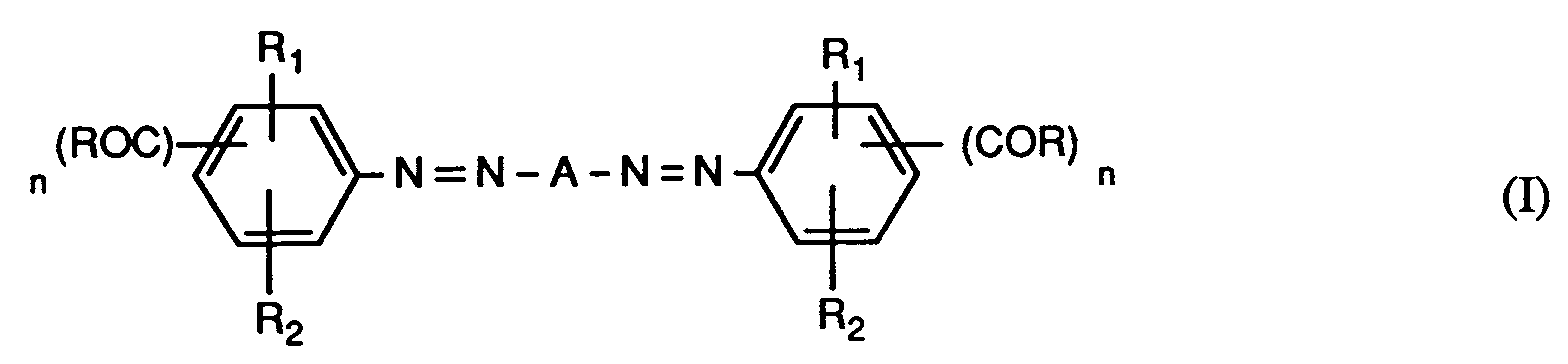
worin R für einen Rest der Formeln -OR₃ oder -NHR₃ steht, A einen Rest der Formeln II oder III
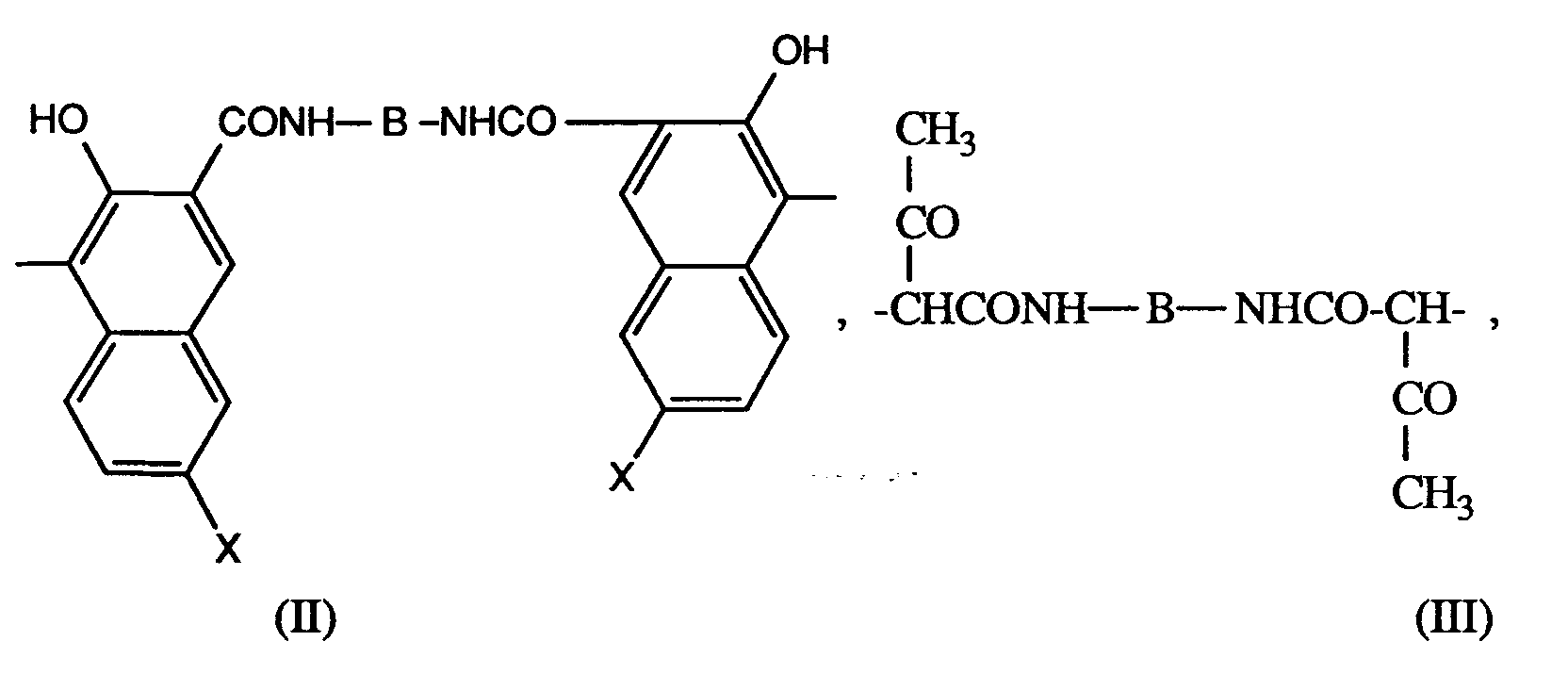
und B einen Rest der Formeln
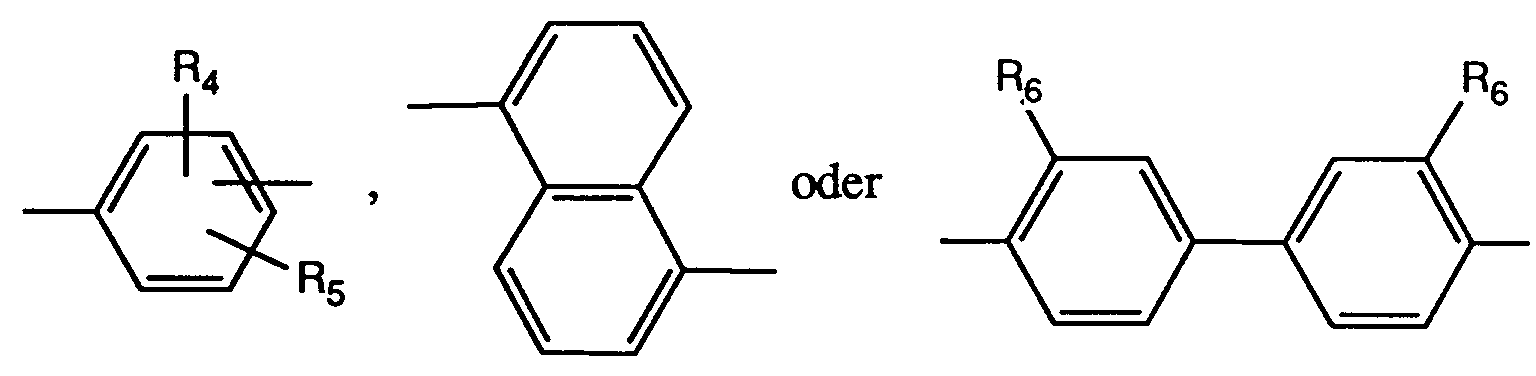
bedeuten,
wobei
n die Zahl 1 oder 2 ist,
R₁ -H oder -Cl, R₂ -H, Halogen, -NO₂, -CN, C₁-C₄-Alkyl, C₁-C₄-Alkoxy, -CF₃, C₂-C₅-Alkoxycarbonyl, oder unsubstituiertes oder am Phenylkern durch ein oder zwei Chloratome oder eine oder zwei Methyl-, Methoxy- oder Ethoxygruppen substituiertes -CONH-Phenyl, -NHCO-Phenyl oder Phenyloxy,
R₃ C₅-C₁₂-Cycloalkyl, das unsubstituiert oder 1 bis 3 Mal durch C₁-C₄-Alkyl oder C₅-C₆-Cycloalkyl substituiert ist,
R₄ und R₅ unabhängig voneinander -H, Halogen, -NO₂, -CN, -CF₃, C₁-C₄-Alkyl oder C₁-C₄-Alkoxy,
R₆ -H, -Cl, -Br, -CH₃ oder -OCH₃, und X -H, -Br, -OCH₃ -CN oder -NO₂ bedeuten, eignen sich als Pigmente insbesondere zum Färben von Polyolefinen.
Description
- Die vorliegende Erfindung betrifft neue Disazoverbindungen enthaltend Cycloalkylester- oder Cycloalkylamidreste und ihre Verwendung zum Einfärben von hochmolekularem organischem Material, insbesondere von Polyolefinen.
- Azopigmente mit Esterresten sind schon lange bekannt. Rote Disazopigmente sind z.B. in den US-Patenten Nr. 3137688 und Nr. 4689403 beschrieben, während gelbe Disazoverbindungen z.B. in den US-Patenten Nr. 4003886 und Nr. 4065448 offenbart werden. Ein Hauptmerkmal der dort aufgeführten Verbindungen besteht darin, dass sie mindestens vier Alkylesterreste aufweisen, wobei der Alkylrest bis max. 4 C-Atome enthält. Disazoverbindungen enthaltend langkettige Alkylester- oder Alkylamidreste sind in US-Patent 4946948 beschrieben. Auch Monoazopigmente mit einem Cycloalkylesterrest sind bekannt, wie z.B. gemäss EP-A 41605. Disazopigmente mit Alkylamidgruppen sind z.B. im US-Patent Nr. 3562249 beschrieben.
- Derartige Produkte besitzen zwar im allgemeinen gute Pigmenteigenschaften, sie genügen jedoch je nach Applikation nicht immer den heutigen Anforderungen der Technik.
- Es ist nun gefunden worden, dass sich Disazopigmente mit mindestens zwei Cycloalkylester- oder Cycloalkylamidresten überraschenderweise sehr gut zum Färben von hochmolekularen organischen Materialien, insbesondere von Polyolefinen, eignen, wobei sie eine verbesserte Dispergierbarkeit, eine geringere Ausblühtendenz und ausgezeichnete Pigmenteigenschaften aufweisen. Die neuen Disazopigmente mit 2 oder mehr Cycloalkylresten sind überraschenderweise erheblich Licht-, Wetter- und Säurebeständiger als die Monoazopigmente mit nur einem Cycloalkylrest.
- Die vorliegende Erfindung betrifft demnach Verbindungen der Formel I

worin R für einen Rest der Formeln -OR₃ oder -NHR₃ steht, A einen Rest der Formeln II oder III
und B einen Rest der Formeln
bedeuten,
wobei
n die Zahl 1 oder 2 ist,
R₁ -H oder -Cl,
R₂ -H, Halogen, -NO₂, -CN, C₁-C₄-Alkyl, C₁-C₄-Alkoxy, -CF₃, C₂-C₅-Alkoxycarbonyl, oder unsubstituiertes oder am Phenylkern durch ein oder zwei Chloratome oder eine oder zwei Methyl-, Methoxy- oder Ethoxygruppen substituiertes -CONH-Phenyl, -NHCO- Phenyl oder Phenyloxy,
R₃ C₅-C₁₂-Cycloalkyl, das unsubstituiert oder 1 bis 3 Mal durch C₁-C₄-Alkyl oder C₅-C₆-Cycloalkyl substituiert ist,
R₄ und R₅ unabhängig voneinander -H, Halogen, -NO₂, -CN, -CF₃, C₁-C₄-Alkyl oder C₁-C₄-Alkoxy,
R₆ -H, -Cl, -Br, -CH₃ oder -OCH₃, und
X -H, -Br, -OCH₃, -CN oder -NO₂ bedeuten. - Halogen in den oben aufgeführten Gruppen bedeutet Fluor, Brom und insbesondere Chlor.
- C₁-C₄-Alkyl bedeutet Methyl, Ethyl, n-Propyl, Isopropyl, n-Butyl, Isobutyl und tert-Butyl.
- C₁-C₄-Alkoxy als R₂, R₄ und R₅ bedeutet z.B. Methoxy, Ethoxy, n-Propoxy, Isopropoxy, n-Butoxy und tert.-Butoxy.
- C₂-C₅-Alkoxycarbonyl als R₂ ist z.B. Methoxycarbonyl, Ethoxycarbonyl, n-Propoxycarbonyl, Isopropoxycarbonyl, n-Butoxycarbonyl und tert-Butoxycarbonyl.
- R₃ als unsubstituiertes oder durch C₁-C₄-Alkyl- oder C₅C₆-Cycloalky substituiertes C₅-C₁₂-Cycloalkyl bedeutet z.B. Cyclopentyl, Cyclohexyl, 1-, 2- oder 3-Methylcyclopentyl, Cycloheptyl, 1-, 2-, 3-, cis-4- oder trans-4-Methylcyclohexyl, 1-Ethylcyclopentyl, 3,3-Dimethylcyclopentyl, Cyclooctyl, 1-, 2-, 3- oder 4-Ethylcyclohexyl, 2,4-Dimethylcyclohexyl, 2,6-Dimethylcyclohexyl, 1-n-Propylcyclopentyl, 1-n-Propyl-, 1-Isopropyl- oder 4-Isopropylcyclohexyl, 2,4,6-Trimethylcyclohexyl, α-, cis-2- oder trans-2-Decalyl, trans-4-Cyclohexylcyclohexyl, 4-tert.-Butylcyclohexyl oder Cyclododecyl. Bevorzugt ist Cyclohexyl.
- Die Reste B in den Formeln II und III leiten sich von m-Phenylen- und insbesondere von p-Phenylendiaminen der folgenden Formeln

R₄ und R₅ die oben angegebene Beteutung haben. - Beispiele für derartige Diamine sind:
1,4-Diaminobenzol, 1,4-Diamino-2-chlorbenzol, 1,4-Diamino-2-brombenzol, 1,4-Diamino-2,5-dichlorbenzol, 1,4-Diamino-2-methylbenzol, 1,4-Diamino-2,5-dimethylbenzol, 1,4-Diamino-2-methoxybenzol, 1,4-Diamino-2,5-dimethoxybenzol, 1,4-Diamino-2,5-di-ethoxybenzol, 2-Chlor-5-methyl- 1,4-phenylendiamin, 2-Chlor-5-methoxy- 1,4-phenylendiamin, 2-Methyl-5-methoxy- 1,4-phenylendiamin, 1,3-Diaminobenzol, 1,3-Diamino-2-methylbenzol, 1,3-Diamino-4-chlorbenzol und 1,3-Diamino-4-methylbenzol. - Beispiele von Diaminen, die sich vom Rest der Formel

ableiten, sind:
3,3′-Dichlorbenzidin, 3,3′-Dibrombenzidin, 3,3′-Dimethylbenzidin und 3,3′-Dimethoxybenzidin. - Bevorzugt sind Verbindungen der Formel I, wobei die Formel I folgende Struktur

aufweist, und
die Gruppen R, R₁, R₂ und A die oben angegebene Bedeutung haben. - Ebenfalls bevorzugt sind Verbindungen der Formel I, wobei die Formeln II und III die folgenden Strukturen

aufweisen und die Gruppen R₄, R₅ und X die oben angegebene Bedeutung haben. - Besonders bevorzugt sind Verbindungen der Formel IV

worin A für einen Rest der Formeln V oder VI
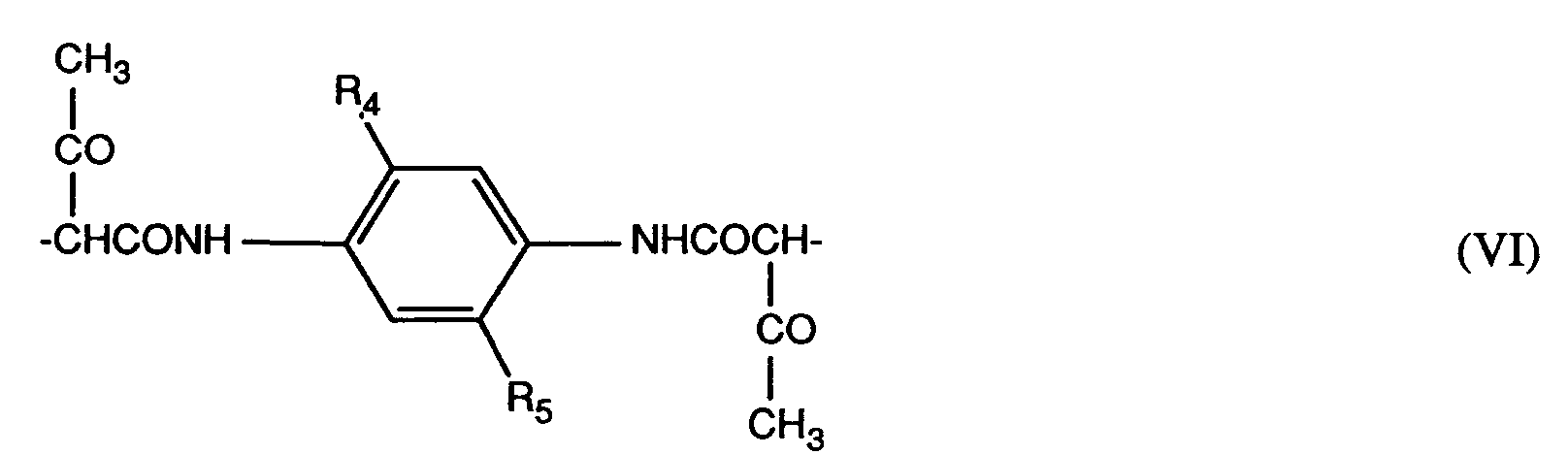
steht, worin R für einen Rest der Formeln -OR₃ oder -NHR₃ steht, und R₂ -H, -Cl, -CH₃, -OCH₃, -OC₂H₅, -COOCH₃, -COOC₂H₅ oder -OC₆H₅, R₃ C₅-C₆-Cycloalkyl, und R₄ und R₅ unabhängig voneinander -H, -Cl, -CH₃, -OCH₃ oder -OC₂H₅ bedeuten. R steht ganz bevorzugt für einen Rest der Formel -NHR₃. - In der Formel IV steht A bevorzugt für einen Rest der Formel V, insbesondere aber für einen Rest der Formel V, worin R₄ und R₅ unabhängig voneinander -H, -Cl, -CH₃ oder -OCH₃ beteuten. R₂ ist bevorzugt -Cl, -CH₃ oder -OCH₃ und R₃ Cyclohexyl.
- Die Verbindungen der Formel I stellen bevorzugt symmetrische Verbindungen dar, worin die beiden Diazokomponenten gleich sind. Asymmetrische Verbindungen, worin die beiden Diazokomponenten verschieden sind, fallen auch unter die Definition der obigen Formel I.
- Die Verbindungen der Formel I können nach an und für sich bekannten Verfaren hergestellt werden, z.B.:
- a) durch Kondensation von 2 Mol eines Carbonsäurehalogenides, insbesondere eines Chlorides der Formel

H₂N-B-NH₂, insbesondere

- b) durch Diazotierung eines Amins der Formel


- Die obigen Kupplungskomponenten und Carbonsäurehalogenide sind bekannte Zwischenprodukte.
- Ein bevorzugtes Herstellungsverfahren ist das Kondensationsverfahren gemäss obigem Schema a). Die Kondensation wird zweckmässig in Gegenwart eines organischen inerten Lösungsmittels bei Normal- oder Ueberdruck, mit oder ohne Katalysator, durchgeführt. Geeignete Lösungsmittel sind z.B. Toluol, Chlorbenzol, Dichlorbenzole, wie o-Dichlorbenzol, ferner Trichlorbenzole, Nitrobenzol oder Gemische aromatischer und/oder aliphatischer Lösungsmittel, wie ®Shellsole.
- Die Verbindungen der Formel I können aber auch über eine Umesterungs- bzw. Amidierungsreaktion hergestellt werden, indem man eine Verbindung der Formel

worin T C₁-C₃-Alkyl bedeutet, und die übrigen Symbole n, A, R₁ und R₂ die oben angegebene Bedeutung haben, mit einem Alkohol oder einem Amin der Formel R₃-OH oder R₃NH₂ nach bekannten Verfahren zu Verbindungen der Formel I umestert bzw. umamidiert. T beteutet Methyl, Ethyl, Propyl oder Isopropyl. Als Beispiele für die obenerwähnten Alkohole und Amine seien folgende erwähnt: - Cyclopentanol
Cyclohexanol
1-Methylcyclopentanol
2-Methylcyclopentanol
3-Methylcyclopentanol
Cycloheptanol
1-Methylcyclohexanol
2-Methylcyclohexanol
3-Methylcyclohexanol
cis-4-Methylcyclohexanol
trans-4-Methylcyclohexanol
1-Ethylcyclopentanol
3,3-Dimethylcyclopentanol
Cyclooctanol
1-Ethylcyclohexanol
2-Ethylcyclohexanol
3-Ethylcyclohexanol
4-Ethylcyclohexanol
2,4-Dimethylcyclohexanol
2,6-Dimethylcyclohexanol
1-n-Propylcyclopentanol
1-n-Propyl-1-cyclohexanol
1-Isopropylcyclohexanol
4-Isopropylcyclohexanol
2,4,6-Trimethylcyclohexanol
α-Decalol
cis-2-Decalol
trans-2-Decalol
trans-4-Cyclohexylcyclohexanol - Cyclopentylamin
Cyclohexylamin
4-Methylcyclohexylamin
4-tert.-Butylcyclohexylamin
Cycloheptylamin
Cyclooctylamin
Cyclododecylamin - Die Umsetzung erfolgt zweckmässig direkt in einem Ueberschuss des entsprechenden Alkohols oder Amins oder in Gegenwart eines organischen Lösungsmittels, wie z.B. Toluol, Xylole, Dichlorbenzole, Nitrobenzol, Chlornaphthalin, Anisol, ®Dowtherm, oder Ketone, wie Cyclohexanon, bei erhöhter Temperatur, z.B. im Siedebereich des verwendeten Lösungmittels, unter Normaldruck oder unter Druck, mit oder ohne Katalysatoren. Werden Katalysatoren eingesetzt, so sind z.B. Schwefelsäure, p-Toluolsulfonsäure, Methylsulfonsäure, LiH, LiNH₂, NaOCH₃, KO-tert-Butylat, Tetraalkyltitanate, Dibutylzinnoxid oder seltene Erden geeignet.
- Die Isolierung der erhaltenen Verbindungen der Formel I erfolgt wie üblich z.B. durch Filtration. Das Nutschgut wird mit einem der bereits oben angegebenen Lösungsmittel und dann zweckmässig noch mit Wasser gewaschen. Sie werden im allgemeinen in guter Ausbeute und Reinheit erhalten und können ohne weitere Reinigung in feinverteilter Form z.B. zum Färben von hochmolekularem organischem Material verwendet werden.
- Sofern ihre Reinheit und/oder Partikel-Form und -Grösse zur Anwendung als Pigmente noch nicht genügend bzw. optimal sind, können die erfindungsgemässen Verbindungen weiter konditioniert werden. Unter Konditionierung versteht man die Herstellung einer feinen, für die Applikation optimalen Partikel-Form und -Grösse, beispielsweise durch Trockenmahlung mit oder ohne Salz, durch Lösungsmittel- oder wässrige Mahlung oder durch Salzknetung oder durch eine nachträgliche thermische Lösungsmittelbehandlung.
- Thermische Lösungsmittelbehandlungen können z.B. in organischen Lösungsmitteln, vorzugsweise mit solchen, die über 100°C sieden, durchgeführt werden.
- Als besonders geeignet hierfür erweisen sich durch Halogenatome, Alkyl- oder Nitrogruppen substituierte Benzole, wie Toluol, Chlorbenzol, o-Dichlorbenzol, Xylole oder Nitrobenzol, Alkohole, wie Isopropanol oder Isobutanol, ferner Ketone, wie Cyclohexanon, Ether, wie Ethylenglykolmonomethyl- oder -monoethylether, Amide, wie Dimethylformamid oder N-Methyl-pyrrolidon, sowie Dimethylsulfoxyd, Sulfolan oder Wasser allein, gegebenenfalls unter Druck. Man kann die Nachbehandlung auch in Wasser in Gegenwart von organischen Lösungsmitteln und/oder mit Zusatz von oberflächenaktiven Substanzen oder aliphatischen Aminen, oder in flüssigem Ammoniak, durchführen.
- Je nach Konditionierverfahren und/oder Applikationszweck kann es von Vorteil sein, den erfindungsgemässen Verbindungen der Formel I gewisse Mengen an texturverbessernden Mitteln vor oder nach dem Konditionierprozess zuzufügen. Als solche kommen insbesondere Fettsäuren mit mindestens 18 C-Atomen, beispielsweise Stearin- oder Behensäure oder deren Amide oder Metallsalze, insbesondere Mg-Salze, sowie Weichmacher, Wachse, Harzsäuren, wie Abietinsäure, Kolophoniumseife, Alkylphenole oder aliphatische Alkohole, wie Stearylalkohol, oder vicinale Diole, wie Dodecandiol-1,2, ferner modifizierte Kolophoniummaleinatharze oder Fumarsäurekolophoniumharze, in Betracht. Die texturverbessernden Mittel werden vorzugsweise in Mengen von 0,1-30 Gew.%, insbesondere 2-15 Gew.%, bezogen auf das Endprodukt, zugesetzt.
- Hochmolekulares organisches Material kann natürlicher oder künstlicher Herkunft sein. Es kann sich z.B. um Naturharze oder trocknende Oele, Kautschuk oder Casein oder um abgewandelte Naturstoffe, wie Chlorkautschuk, ölmodifizierte Alkydharze, Viscose, um Celluloseether oder -ester, wie Celluloseacetat, Cellulosepropionat, Celluloseacetobutyrat oder Nitrocellulose handeln, insbesondere aber um vollsynthetische organische Polymere (Duroplaste und Thermoplaste), wie sie durch Polymerisation, Polykondensation oder Polyaddition erhalten werden. Aus der Klasse der Polymerisationsharze seien in erster Linie genannt: Polyolefine, wie Polyethylen, Polypropylen oder Polyisobutylen, ferner substituierte Polyolefine, wie Polymerisate aus Vinylchlorid, Vinylacetat, Styrol, Acrylnitril, Acrylsäure- und/oder Methacrylsäureestern oder Butadien, sowie Kopolymerisate der erwähnten Monomeren, insbesondere ABS, EVA oder Acryl-styrol-acrylonitril (ASA).
- Aus der Reihe der Polyadditionsharze und Polykondensationsharze seien die Kondensationsprodukte von Formaldehyd mit Phenolen, die sogenannten Phenoplaste, und die Kondensationsprodukte von Formaldehyd mit Harnstoff, Thioharnstoff und Melamin, die sogenannten Aminoplaste, die als Lackharze verwendeten Polyester, und zwar sowohl gesättigte, wie z.B. Alkydharze, als auch ungesättigte, wie beispielsweise Maleinatharze, ferner die linearen Polyester, Polycarbonate, Polyurethane und Polyamide oder Silikone genannt.
- Die erwähnten hochmolekularen Verbindungen können einzeln oder in Gemischen, als plastische Masse oder Schmelzen, die gegebenenfalls zu Fasern versponnen werden können, vorliegen.
- Sie können auch im polymerisierten Zustand in gelöster Form als Filmbildner oder Bindemittel für Lacke oder Druckfarben vorliegen, wie z.B. Leinölfirnis, Nitrocellulose, Alkydharze, Melaminharze und Harnstoff-Formaldehydharze oder Acrylharze.
- Die Pigmentierung der hochmolekularen, organischen Substanzen mit den definitionsgemässen Verbindungen der Formel I erfolgt beispielsweise derart, dass man eine solche Verbindung gegebenenfalls in Form von Masterbatches, diesen Subsaaten unter Verwendung von Walzwerken, Misch- oder Mahlapparaten zumischt. Das pigmentierte Material wird hierauf nach an sich bekannten Verfahren wie Kalandrieren, Pressen, Strangpressen, Streichen, Verspinnen, Giessen oder durch Spritzguss in die gewünschte endgültige Form gebracht. Oft ist es erwünscht, zur Herstellung von nicht starren Formlingen oder zur Verringerung ihrer Sprödigkeit den hochmolekularen Verbindungen vor der Verformung sogenannte Weichmacher einzuverleiben. Als solche können z.B. Ester der Phosphorsäure, Phthalsäure oder Sebacinsäure dienen. Die Weichmacher können vor oder nach der Einverleibung des Pigmentes in die Polymeren eingearbeitet werden. Es ist ferner möglich, zwecks Erzielung verschiedener Farbtöne den hochmolekularen organischen Stoffen neben den erfindungsgemässen Verbindungen noch Füllstoffe bzw. andere farbgebende Bestandteile, wie Weiss-, Bunt- oder Schwarzpigmente, in beliebigen Mengen zuzufügen.
- Zum Pigmentieren von Lacken und Druckfarben werden die hochmolekularen organischen Materialien und die Verbindungen der Formel I gegebenenfalls zusammen mit Zusatzstoffen, wie Füllmitteln, anderen Pigmenten, Siccativen oder Weichmachern, in einem gemeinsamen organischen Lösungsmittel oder Lösungsmittelgemisch fein dispergiert bzw. gelöst. Man kann dabei so verfahren, dass man die einzelnen Komponenten für sich oder auch mehrere gemeinsam dispergiert bzw. löst, und erst hierauf alle Komponenten zusammenbringt.
- Das hochmolekulare organische Material enthält vorzugsweise 0,01-20 Gew.% einer erfindungsgemässen Verbindung der Formel I, beispielsweise in Kunststoffen, Fasern, Lacken und Drucken. Die erfindungsgemässen Verbindungen zeichnen sich durch gute Dispergiebarkeit, Ueberlackier-, Migrations-, Hitze-, Licht- und Wetterbeständigkeit, gute Farbsträke sowie durch einen guten Glanz der damit erhaltenen Ausfärbungen, aus.
- Die Verbindungen der Formel I werden aber bevorzugt zum Einfärben von Polyolefinen eingesetzt.
- Als Beispiele für Polyolefine seien Polyethylen hoher und niederer Dichte (HD-PE, LD-PE und LLD-PE), Polypropylen und Polyisobutylen, sowie Copolymere von Polyolefinen mit z.B. Polyethern, Polyetherketonen oder Polyurethanen erwähnt.
- Die Einfärbung erfolgt nach üblichen Verfahren, beispielsweise durch Mischen einer Verbindung der Formel I mit dem Polyolefingranulat oder -pulver und Extrudieren der Mischung zu Fasern, Folien oder Granulaten. Letztere können dann im Spritzgussverfahren zu Gegenständen verformt werden.
- Die erhaltenen Ausfärbungen weisen hohe Reinheit und hohe Sättigung auf und zeichnen sich durch eine ausgezeichnete Dispergierbarkeit, durch gute allgemeine Beständigkeit, insbesondere gegen Hitze und Licht, sowie durch ihre geringe Ausblühtendenz, aus. Ein besonderer Vorteil von mit den erfindungsgemässen Verbindungen der Formel I gefärbten Polyethylengegenständen besteht darin, dass sie insbesondere im Falle von HD-PE, keine erhöhte Neigung zu Verzugs- und Deformationserscheinungen zeigen. Sie zeigen zudem eine hohe Säurebeständigkeit.
- Die mit den erfindungsgemässen Verbindungen der Formel I in der Masse eingefärbten Kunststoff-Fasern, wie z.B. PP-Fasern, besitzen ausgezeichnete textile Eigenschaften, wie z.B. Licht- und Nassbeständigkeiten gegenüber Wasch- und Lösungsmitteln.
- Die nachfolgenden Beispiele dienen zur Erläuterung der Erfindung.
- 3,65 g des Disazodicarbonsäuredichlorides der Formel

und 3,1 g Cyclohexylamin werden in 150 ml o-Dichlorbenzol auf 132°C erhitzt und während 2 Stunden bei dieser Temperatur kräftig gerührt. Die gelbe Suspension wird auf 80°C abgekühlt. Man nutscht das Produkt bei dieser Temperatur ab, wäscht es mit o-Dichlorbenzol und heissem Methanol und trocknet es im Vakuum bei 60°C. Man erhält 4,1 g (96,2 % der Theorie) eines gelben Pulvers der Formel

- Das Produkt dieses Beispiels färbt Polyvinylchlorid mit hoher Migrationsbeständigkeit in farbstarken grüngelben Tönen von ausgezeichneter Licht- und Wetterbeständigkeit.
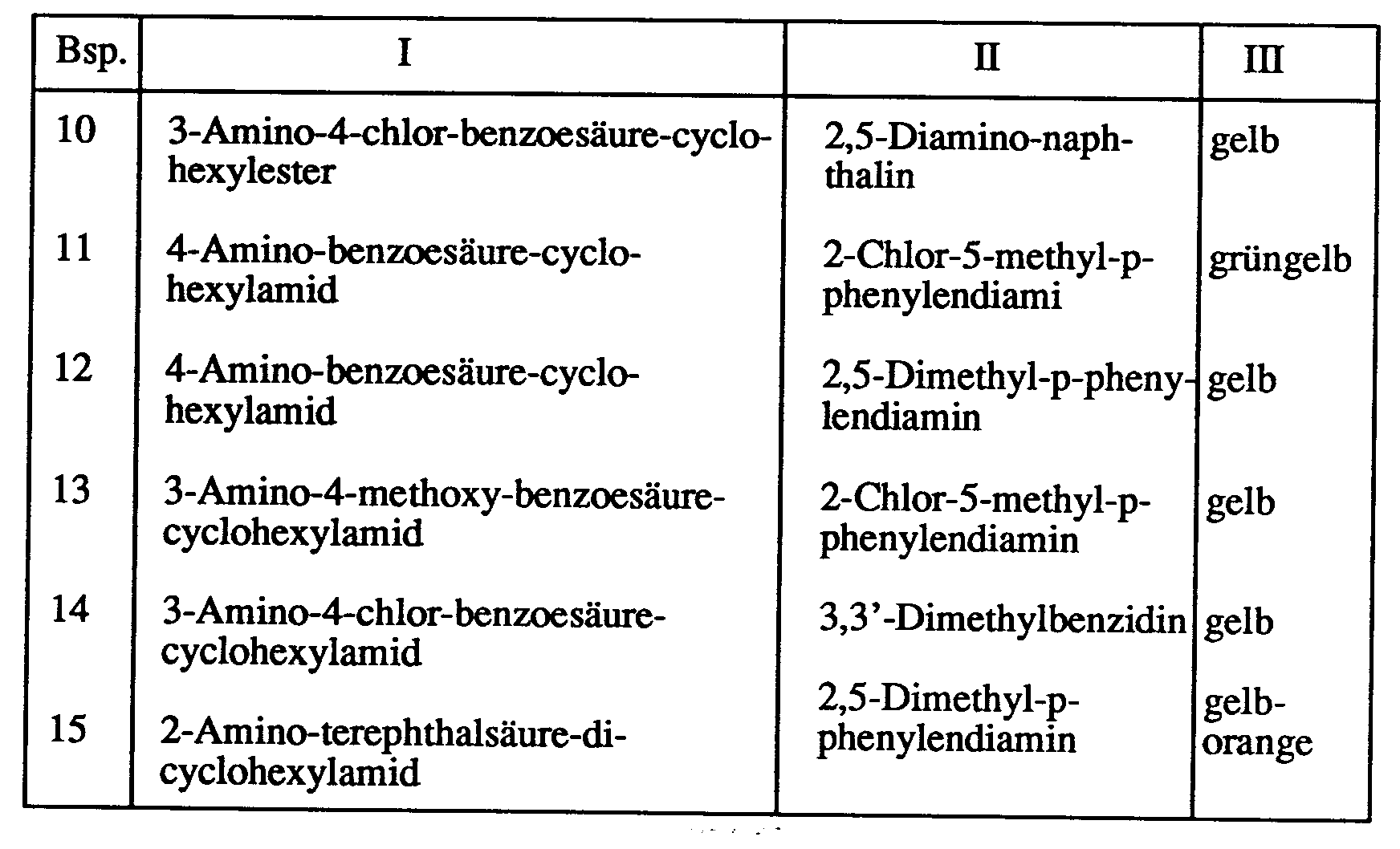
- In nachstehender Tabelle sind weitere Verbindungen beschrieben, die nach dem Verfahren des Beispiels 1 hergestellt werden können, indem man die Diazoverbindung aus 3-Amino-4-chlor-benzoesäure auf das Bisacetessigsäurearylid des in der Kolonne I aufgeführten Diamins kuppelt, die so erhaltene Disazofarbstoffdicarbonsäure in ihr entsprechendes Dicarbonsäuredichlorid überführt und dann dieses mit dem Cycloamin oder Cycloalkohol der Kolonne II kondensiert. Kolonne III gibt den Farbton der mit diesen Pigmenten gefärbten PVC-Folie an.

- 2,6 g 3-Amino-4-methyl-benzoesäure-cyclohexylamid und 1,5 g 2,56Dimethyl- 1,4-diaceto-acetylaminobenzol werden in 200 ml Essigsäure auf 60°C erhitzt. Die entstandene klare gelbe Lösung wird auf 57°C abgekühlt und bei dieser Temperatur durch schnelles Zutropfen mit 2,86 ml einer 4N-Natriumnitritlösung versetzt. Es fällt ein dicker oranger Niederschlag aus. Die orange Suspension wird 3 Stunden bei 65°C gerührt und abfiltriert. Das Nutschgut wird mit 200 ml 96%-igem Ethylakohol gewaschen und im Vakuum bei 60°C getrocknet. Man erhält 2,6 g (91 % der Theorie) eines ockergelben Pulvers der Formel


- Dieses Produkt färbt Polyethylen, Polyamid und Polyvinylchlorid in farbstarken Tönen Die Hitzebeständigkeiten dieser Ausfärbungen sind ausgezeichnet.
- In nachstehender Tabelle sind weitere Verbindungen beschrieben, die durch Kupplung im Molverhältnis 2:1 der diazotierten Verbindung einer Base gemäss Kolonne I mit einem Bisacetessigsäurearylid eines Diamines der kolonne II erhalten werden. Kolonne III gibt den Farbton der mit diesen Pigmenten gefärbten PVC-Folie an.
- 5,3 g des Azofarbstoffes aus diazotiertem 3-Amino-4-methylbenzoesäurecyclohexylester und 2-Hydroxy-3-naphthoesäure werden in 50 ml wasserfreiem Toluol suspendiert. Man gibt zum Gemisch 1 ml Thionylchlorid und 2 Tropfen Dimethylformamid und erwärmt eine Stunde unter Rühren auf 88°C. Die dunkelrote Lösung wird auf 40°C abkühlen gelassen. Es fällt ein roter Niederschlag aus. Er wird abgenutscht, mit 200 ml Petrolether gewaschen und im Vakuum bei 60°C getrocknet. Man erhält 4,3 g (95,6 % der Theorie) des Azofarbstoffcarbonsäurechlorides der Formel

mit Schmelzpunkt 188°-190°C.
3,45 g des so hergestellten Farbsäurechlorides werden mit 80 ml wasserfreiem o-Dichlorbenzol verrührt und auf 80°C erhitzt. Die kläre rote Lösung wird bei dieser Temperatur mit einer 80°C-warmen Lösung von 0,5 g 2,5-Dimethyl- 1,4-phenylendiamin in 50 ml o-Dichlorbenzol versetzt. Es fällt dabei ein dunkelroter Niederschlag aus. Man erwärmt die entstandene dunkelrote Suspension unter Rühren auf 116°C und rührt während 16 Stunden bei dieser Temperatur weiter. Das Produkt wird bei 60°C abgenutscht und mit Chlorbenzol sowie heissem Methanol gewaschen. Nach dem Trocknen des Produktes im Vakuum bei 60°C werden 3,5 g (95 % der Theorie) eines weichkörnigen rotbraunen Pulvers erhalten, das z.B. Polyvinylchlorid in roten Tönen von ausgezeichneter Migration-, Hitze- und Lichtbeständigkeit färbt. Das Pigment besitzt folgende Struktur.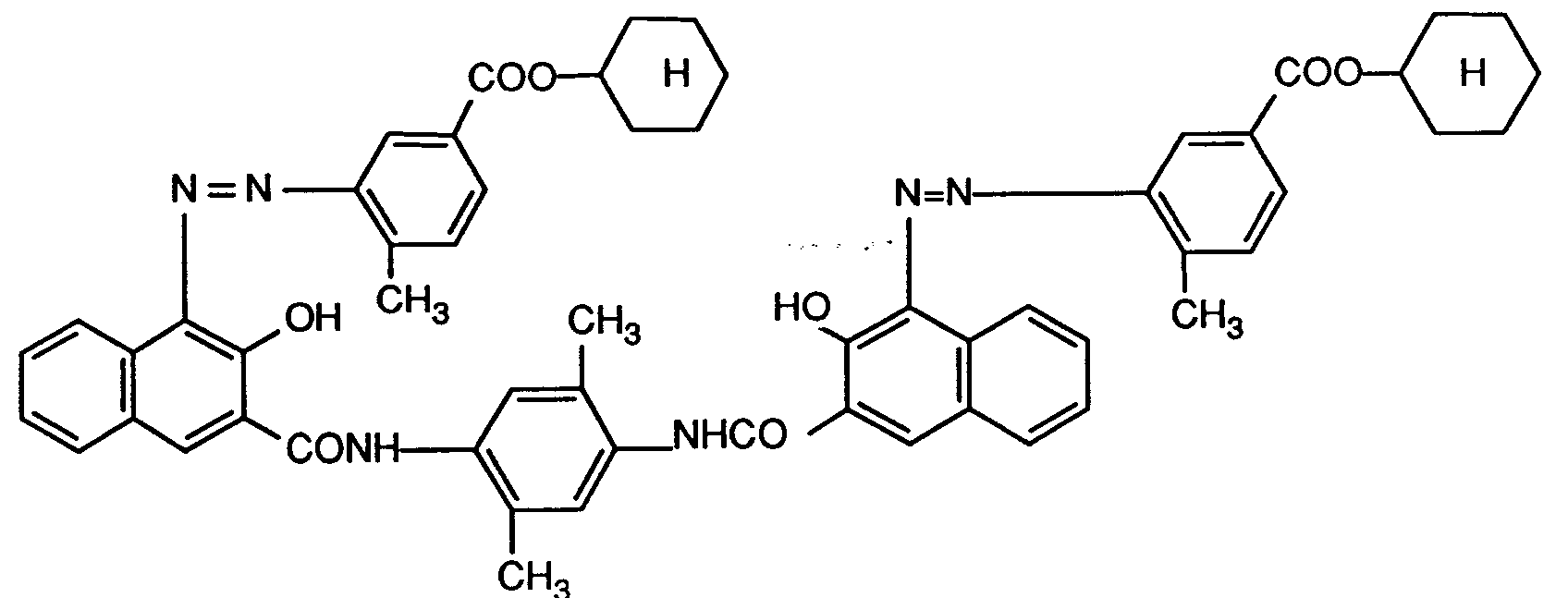

- Die Azofarbstoffcarbonsäure (Ausgangsmaterial zur Darstellung des Azofarbstoffcarbonsäurechlorides) kann wie folgt synthetisiert werden:
3,5 g 3-Amino-4-methyl-benzoesäurecyclohexylester und 2,8 g 2-Hydroxy-3-naphthoesäure werden in der Mischung aus 25 ml Toluol, 5 ml Essigsäure und 40 ml 96%-igem Ethylalkohol bei 24°C gelöst. Die klare braune Lösung wird mit 2 ml tert.-Butylnitrit versetzt. Die Temperatur steigt auf 32°C an und es fällt ein roter Niederschlag aus. Die rote Suspensions wird 4 Stunden ohne Heizung gerührt. Man nutscht das Produkt bei Raumtemperatur ab, wäscht mit 200 ml 96%-igem Ethylalkohol und trocknet im Vakuum bei 60°C. Man erhält 5,9 g (90 % der Theorie) eines braunroten Pulvers vom Schmelzpunkt 248-250°C. Die Struktur entspricht der Formel

- Die folgende Tabelle beschreibt weitere Pigmente, die nach dem Verfahren des obigen Beispiels hergestellt werden können, indem man die Diazoverbindung der in der Kolonne I aufgeführten Amine auf 2-Hydroxy-3-naphthoesäure kuppelt, die erhaltene Azofarbstoffcarbonsäure dann in das entsprechende Säurechlorid überführt und dieses mit den in der Kolonne II angegebenen Diaminen im Molverhältnis 2:1kondensiert. Kolonne III charakterisiert die Nuance der mit den erhaltenen Pigmenten gemäss Beispiel 32 eingefärbten Polyvinylchloridfolie.

- Eine Mischung von 1,0 g des nach Beispiel 1 erhaltenen Disazokondensationpigmentes, 1,0 g Antioxidans ®IRGANOX 1010 (CIBA-GEIGY AG) und 1000g Polyethylen HD Granulat (®VESTOLEN A60-16, HUELS) wird während 15 Minuten in einer 3 1-Glasflasche auf einer Rollbank vorgemischt. Danach wird die Mischung zweimal durch einen Einwellenextruder extrudiert. Das so erhaltene Granulat wird dann auf einer Spritzgussmaschine (®Allround Aarburg 200) bei 250°C mit einer Verweilzeit von 5 Minuten zu Platten verspritzt. Die so erhaltenen Platten weisen gleichmässig farbstarke grüngelbe Färbungen hoher Reinheit und ausgezeichneter Lichtbeständigkeit auf.
- 40 mg des gemäss Beispiel 1 erhaltenen Disazokondensationspigmentes werden mit 7,3 ml Dioctylphthalat und 13,3 g eines stabilisierten Polyvinylchlorids vom Typ ®LONZA E-722 in einem Becherglas mit einem Glasstab gut vermischt. Das erhaltene Gemisch wird dann auf einem Walzenstuhl während 5 Minuten bei 160°C zu einer dünnen Folie verarbeitet. Die so erzeugte PVC-Folie weist eine sehr farbstarke, grüngelbe Färbung hoher Reinheit und sehr guter Lichtbeständigkeit auf. Die Dispergierbarkeit des Pigmentes ist ausgezeichnet.
- 1000 g Polypropylengranulat (®DAPLEN PT-55, Chemie LINZ) und 1,0 g des nach Beispiel 1 erhaltenen Disazokondensationspigmentes werden in einer 3 l-Flasche während 15 Minuten auf dem Rollbock gemischt. Danach wird die Mischung zweimal durch einen Einwellenextruder extrudiert und anschliessend granuliert. Das so erhaltene Granulat wird bei 280-285°C nach dem Schmelzspinnverfahren versponnen. Die so gefärbten Fasern weisen eine sehr gute Lichtbeständigkeit und ausgezeichnete textile Echtheiten, wie Reib- und Nassechtheiten gegenüber Wasch- und Lösungsmitteln, auf. Die Hitzebeständigkeit des Pigmentes während des Spinnprozesses bei 285°C ist ausgezeichnet.
- 100 g Polyamid ®GRILON A 25 (EMS-Chemie AG, Zürich) und 0,2 g des nach Beispiel 1 erhaltenen Disazokondensationspigmentes werden auf einem Laborturbulamischer (W.A. Bachofen, Basel) während 20 Minuten gut vermischt. Danach wird die Mischung auf einem Einwellenextruder bei 240°C extrudiert. Das so erhaltene Band weist eine grüngelbe Färbung auf und zeigt gute Lichtbeständigkeiten.
- Verfährt man analog wie in Beispiel 31 beschrieben, verwendet aber neben dem Buntpigment 10 g Titandioxid ®KRONOS RN-57-P (KRONOS Titan GmbH), so erhält man grüngelbe Pressplatten mit ebensoguten Hitzebeständigkeiten. Die zwischen 200 und 280°C gespritzten Pressplatten weisen nach dem Erkalten keine Farbabweichungen auf.
Claims (9)
- Verbindungen der Formel I


wobei n die Zahl 1 oder 2 ist,
R₁ -H oder -Cl,
R₂ -H, Halogen, -NO₂, -CN, C₁-C₄-Akyl, C₁-C₄-Akoxy, -CF₃, C₂-C₅-Akoxycarbonyl, oder unsubstituiertes oder am Phenykern durch ein oder zwei Chloratome oder eine oder zwei Methyl-, Methoxy- oder Ethoxygruppen substituiertes -CONH-Phenyl,
-NHCO-Phenyl oder Phenyloxy,
R₃ C₅-C₁₂-Cycloalkyl, das unsubstituiert oder 1 bis 3 Mal durch C₁-C₄-Akyl oder C₅-C₆-Cycloakyl substituiert ist,
R₄ und R₅ unabhängig voneinander -H, Halogen, -NO₂, -CN, -CF₃, C₁-C₄-Akyl oder C₁-C₄-Akoxy,
R₆ -H, -Cl, -Br, -CH₃ oder -OCH₃, und
X -H, -Br, -OCH₃, -CN oder -NO₂ bedeuten. - Verbindungen der Formel I gemäss Anspruch 1, wobei die Formel I folgende Struktur

die Gruppen R, R₁, R₂ und A die im Anspruch 1 angegebene Bedeutung haben. - Verbindungen der Formel I gemäss Anspruch 1, wobei die Formeln II und III die folgenden Strukturen


- Verbindungen der Formel IV gemäss Anspruch 1
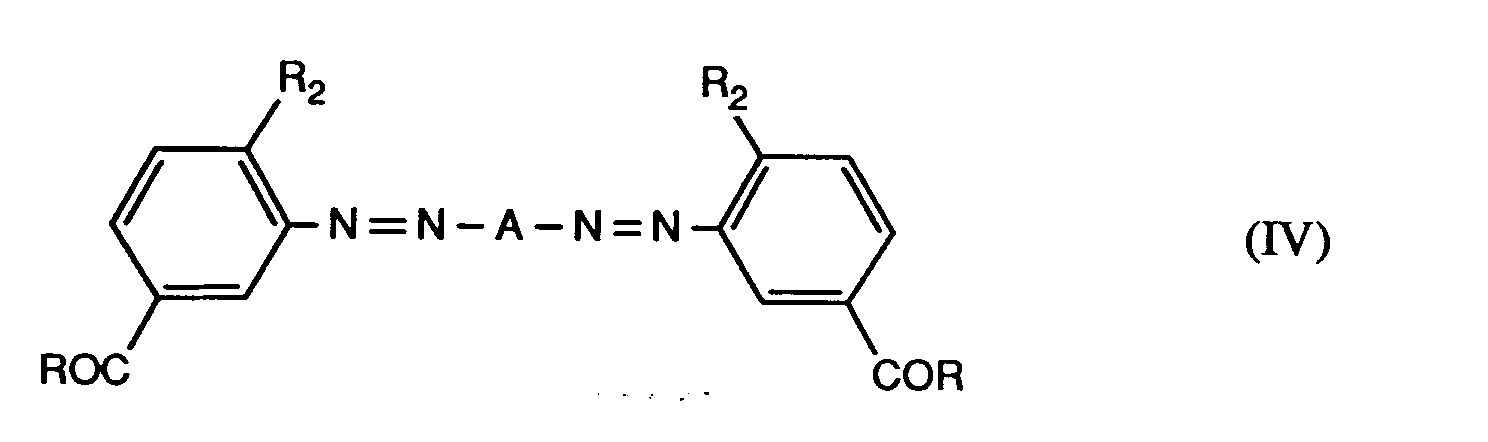


R₄ und R₅ unabhängig voneinander -H, -Cl, -CH₃, -OCH₃ oder -OC₂H₅ bedeuten. - Verbindungen der Formel IV gemäss Anspruch 4, wobei R für einen Rest der Formel -NHR₃ steht, und die übrigen Reste die im Anspruch 4 angegebene Bedeutung haben.
- Verbindungen der Formel IV gemäss Anspruch 4, wobei A für einen Rest der Formel V steht, und die übrigen Gruppen die im Anspruch 4 angegebene Bedeutung haben.
- Verbindungen der Formel IV gemäss Anspruch 4, wobei A für einen Rest der Formel V steht, R₂ -Cl, -CH₃ oder -OCH₃, R₃ Cyclohexyl, und R₄ und R₅ unabhängig voneinander -H, -Cl, -CH₃ oder -OCH₃ bedeuten.
- Gefärbtes hochmolekulares organisches Material enthaltend als Färbemittel eine Verbindung der Formel I gemäss Anspruch 1.
- Gefärbtes organisches Material gemäss Anspruch 8, dadurch gekennzeichnet, dass es sich um ein Polyolefin handelt.
Applications Claiming Priority (2)
| Application Number | Priority Date | Filing Date | Title |
|---|---|---|---|
| CH2064/91 | 1991-07-11 | ||
| CH206491 | 1991-07-11 |
Publications (3)
| Publication Number | Publication Date |
|---|---|
| EP0523005A2 true EP0523005A2 (de) | 1993-01-13 |
| EP0523005A3 EP0523005A3 (en) | 1993-08-18 |
| EP0523005B1 EP0523005B1 (de) | 1995-03-08 |
Family
ID=4225061
Family Applications (1)
| Application Number | Title | Priority Date | Filing Date |
|---|---|---|---|
| EP92810505A Expired - Lifetime EP0523005B1 (de) | 1991-07-11 | 1992-07-02 | Disazoverbindungen mit Cycloalkylester- oder Cycloalkylamidresten |
Country Status (4)
| Country | Link |
|---|---|
| US (1) | US5298609A (de) |
| EP (1) | EP0523005B1 (de) |
| JP (1) | JPH05230386A (de) |
| DE (1) | DE59201585D1 (de) |
Families Citing this family (4)
| Publication number | Priority date | Publication date | Assignee | Title |
|---|---|---|---|---|
| EP0882705B1 (de) * | 1996-10-14 | 2003-05-28 | Kabushiki Kaisha Ueno Seiyaku Oyo Kenkyujo | Bis(aminocarbonylnaphthanol)-derivat |
| JP2000254490A (ja) * | 1999-03-15 | 2000-09-19 | Toyo Ink Mfg Co Ltd | 比較的低分子の化合物を選択的に捕捉する特性を有する高分子材料、被覆剤、分離方法、分離材、機能性化合物等の検知方法および検知材料 |
| CN105777576B (zh) * | 2016-03-08 | 2018-02-13 | 鞍山七彩化学股份有限公司 | 十八胺基双偶氮缩合化合物及其制备方法 |
| JP7140070B2 (ja) * | 2019-07-24 | 2022-09-21 | 日東紡績株式会社 | 混用染色布帛及びその製造方法 |
Family Cites Families (14)
| Publication number | Priority date | Publication date | Assignee | Title |
|---|---|---|---|---|
| US3137686A (en) * | 1962-04-10 | 1964-06-16 | Hoechst Ag | Water-insoluble benzimidazolone monoazo-dyestuffs |
| CH477521A (de) * | 1966-08-15 | 1969-08-31 | Ciba Geigy | Verfahren zur Herstellung neuer Disazofarbstoffpigmente |
| CH489577A (de) * | 1967-07-11 | 1970-04-30 | Geigy Ag J R | Verfahren zur Herstellung von Disazopigmenten |
| CH519561A (de) * | 1969-07-08 | 1972-02-29 | Ciba Geigy Ag | Verfahren zur Herstellung neuer Disazopigmente |
| US4065448A (en) * | 1970-02-03 | 1977-12-27 | Ciba-Geigy Ag | Tertiary alkyl substituted disazo pigments |
| US4003886A (en) * | 1970-09-11 | 1977-01-18 | Ciba-Geigy Ag | Tetracarboxylic acid ester substituted disazo pigments |
| BE793071A (fr) * | 1971-12-22 | 1973-06-20 | Sandoz Sa | Nouveaux composes disazoiques utilisables comme pigments et leur preparation |
| US4070353A (en) * | 1973-04-18 | 1978-01-24 | Ciba-Geigy Corporation | Dicarboxylic acid ester diazo pigments |
| CH579130A5 (de) * | 1973-05-16 | 1976-08-31 | Ciba Geigy Ag | |
| CH602887A5 (de) * | 1973-06-26 | 1978-08-15 | Ciba Geigy Ag | |
| EP0040173B1 (de) * | 1980-05-07 | 1983-07-27 | Ciba-Geigy Ag | Disazopigment, Verfahren zu dessen Herstellung und Verwendung |
| DE3018713A1 (de) * | 1980-05-16 | 1981-12-03 | Basf Ag, 6700 Ludwigshafen | Verfahren zum faerben und/oder bedrucken von cellulosehaltigem textilmaterial und neue farbstoffe |
| EP0095442A1 (de) * | 1982-05-18 | 1983-11-30 | Ciba-Geigy Ag | Disazopigmente, Verfahren zu deren Herstellung und Verwendung |
| DE58908065D1 (de) * | 1988-09-07 | 1994-08-25 | Ciba Geigy Ag | Disazoverbindungen mit langkettigen Alkylester- oder Alkylamidresten. |
-
1992
- 1992-07-02 EP EP92810505A patent/EP0523005B1/de not_active Expired - Lifetime
- 1992-07-02 DE DE59201585T patent/DE59201585D1/de not_active Expired - Fee Related
- 1992-07-10 JP JP4182750A patent/JPH05230386A/ja active Pending
-
1993
- 1993-07-14 US US08/092,023 patent/US5298609A/en not_active Expired - Fee Related
Also Published As
| Publication number | Publication date |
|---|---|
| US5298609A (en) | 1994-03-29 |
| DE59201585D1 (de) | 1995-04-13 |
| EP0523005A3 (en) | 1993-08-18 |
| EP0523005B1 (de) | 1995-03-08 |
| JPH05230386A (ja) | 1993-09-07 |
Similar Documents
| Publication | Publication Date | Title |
|---|---|---|
| EP0133156B1 (de) | Neue 1,4-Diketopyrrolo-(3,4-c)-pyrrole | |
| EP0748851B1 (de) | Pigmentzusammensetzungen aus Diketopyrrolopyrrolen | |
| EP0277914A2 (de) | Feste Lösungen von Pyrrolo-[3,4-c]-pyrrolen mit Chinacridonen | |
| EP0241413B1 (de) | Neue Aminsalze von Azoverbindungen | |
| EP0673979B1 (de) | Cyaniminogruppen enthaltende Fluoreszenzfarbstoffe | |
| EP0168343B1 (de) | Neue Metallkomplexe, Verfahren zu ihrer Herstellung ihre Verwendung zum Färben von hochmolekularem organischem Material | |
| DE2243999A1 (de) | Neue disazopigmente, verfahren zu deren herstellung und verwendung | |
| EP0358604B1 (de) | Disazoverbindungen mit langkettigen Alkylester- oder Alkylamidresten | |
| DE69708905T2 (de) | Verfahren zum färben von hochmolekularem organischem material und polycyclische pigmente | |
| DE2823930A1 (de) | Neue monoazopigmente und verfahren zu deren herstellung | |
| EP0523005B1 (de) | Disazoverbindungen mit Cycloalkylester- oder Cycloalkylamidresten | |
| EP0169167B1 (de) | Verfahren zum Färben von hochmolekularem organischem Material und neue Metallkomplexe | |
| DE2032601A1 (de) | Neue Disazopigmente und Verfahren zu deren Herstellung | |
| EP0442846A2 (de) | Disazoverbindungen mit langkettigen Alkylester- oder Alkylamidresten | |
| EP0359708B1 (de) | Monoazoverbindungen mit langkettigen Alkylresten | |
| EP0138761B1 (de) | Verfahren zum Pigmentieren von hochmolekularem organischem Material | |
| EP0162806B1 (de) | Monoazoverbindungen enthaltend mindestens eine Carbonamidgruppe | |
| EP0673940B1 (de) | Cyaniminogruppen enthaltende Pyrrolo(3,4-c)pyrrole | |
| EP0051560A1 (de) | Heterocyclen enthaltende Monoazopigmente, Verfahren zu deren Herstellung und deren Verwendung | |
| DE2145422B2 (de) | Neue Disazopigmente | |
| DE2739041A1 (de) | Verfahren zum pigmentieren von hochmolekularem organischem material | |
| EP0265383A2 (de) | Verwendung von Pyridochinolon-Derivaten als Pigmente | |
| DE2525587A1 (de) | Iminoisoindolinonpigmente und verfahren zu deren herstellung | |
| DE2430197A1 (de) | Neue disazopigmente und verfahren zu deren herstellung | |
| DE2429286A1 (de) | Neue disazopigmente und verfahren zu deren herstellung und verwendung |
Legal Events
| Date | Code | Title | Description |
|---|---|---|---|
| PUAI | Public reference made under article 153(3) epc to a published international application that has entered the european phase |
Free format text: ORIGINAL CODE: 0009012 |
|
| AK | Designated contracting states |
Kind code of ref document: A2 Designated state(s): CH DE FR GB LI |
|
| PUAL | Search report despatched |
Free format text: ORIGINAL CODE: 0009013 |
|
| AK | Designated contracting states |
Kind code of ref document: A3 Designated state(s): CH DE FR GB LI |
|
| 17P | Request for examination filed |
Effective date: 19940113 |
|
| 17Q | First examination report despatched |
Effective date: 19940413 |
|
| GRAA | (expected) grant |
Free format text: ORIGINAL CODE: 0009210 |
|
| AK | Designated contracting states |
Kind code of ref document: B1 Designated state(s): CH DE FR GB LI |
|
| REF | Corresponds to: |
Ref document number: 59201585 Country of ref document: DE Date of ref document: 19950413 |
|
| GBT | Gb: translation of ep patent filed (gb section 77(6)(a)/1977) |
Effective date: 19950426 |
|
| ET | Fr: translation filed | ||
| PLBE | No opposition filed within time limit |
Free format text: ORIGINAL CODE: 0009261 |
|
| 26N | No opposition filed | ||
| REG | Reference to a national code |
Ref country code: CH Ref legal event code: PUE Owner name: CIBA-GEIGY AG TRANSFER- CIBA SC HOLDING AG |
|
| REG | Reference to a national code |
Ref country code: CH Ref legal event code: PFA Free format text: CIBA SC HOLDING AG TRANSFER- CIBA SPECIALTY CHEMICALS HOLDING INC. |
|
| REG | Reference to a national code |
Ref country code: GB Ref legal event code: 732E |
|
| REG | Reference to a national code |
Ref country code: FR Ref legal event code: TP |
|
| PGFP | Annual fee paid to national office [announced via postgrant information from national office to epo] |
Ref country code: FR Payment date: 19990531 Year of fee payment: 8 Ref country code: CH Payment date: 19990531 Year of fee payment: 8 |
|
| PGFP | Annual fee paid to national office [announced via postgrant information from national office to epo] |
Ref country code: DE Payment date: 19990609 Year of fee payment: 8 |
|
| PGFP | Annual fee paid to national office [announced via postgrant information from national office to epo] |
Ref country code: GB Payment date: 19990618 Year of fee payment: 8 |
|
| PG25 | Lapsed in a contracting state [announced via postgrant information from national office to epo] |
Ref country code: GB Free format text: LAPSE BECAUSE OF NON-PAYMENT OF DUE FEES Effective date: 20000702 |
|
| PG25 | Lapsed in a contracting state [announced via postgrant information from national office to epo] |
Ref country code: LI Free format text: LAPSE BECAUSE OF NON-PAYMENT OF DUE FEES Effective date: 20000731 Ref country code: CH Free format text: LAPSE BECAUSE OF NON-PAYMENT OF DUE FEES Effective date: 20000731 |
|
| GBPC | Gb: european patent ceased through non-payment of renewal fee |
Effective date: 20000702 |
|
| REG | Reference to a national code |
Ref country code: CH Ref legal event code: PL |
|
| PG25 | Lapsed in a contracting state [announced via postgrant information from national office to epo] |
Ref country code: FR Free format text: LAPSE BECAUSE OF NON-PAYMENT OF DUE FEES Effective date: 20010330 |
|
| REG | Reference to a national code |
Ref country code: FR Ref legal event code: ST |
|
| PG25 | Lapsed in a contracting state [announced via postgrant information from national office to epo] |
Ref country code: DE Free format text: LAPSE BECAUSE OF NON-PAYMENT OF DUE FEES Effective date: 20010501 |