EP0523082B1 - Systeme interactif, anti-copie, anti-fraude, anti-fax, a etats multiples et a communation - Google Patents
Systeme interactif, anti-copie, anti-fraude, anti-fax, a etats multiples et a communation Download PDFInfo
- Publication number
- EP0523082B1 EP0523082B1 EP91906440A EP91906440A EP0523082B1 EP 0523082 B1 EP0523082 B1 EP 0523082B1 EP 91906440 A EP91906440 A EP 91906440A EP 91906440 A EP91906440 A EP 91906440A EP 0523082 B1 EP0523082 B1 EP 0523082B1
- Authority
- EP
- European Patent Office
- Prior art keywords
- dye
- light
- main surface
- substrate
- optical element
- Prior art date
- Legal status (The legal status is an assumption and is not a legal conclusion. Google has not performed a legal analysis and makes no representation as to the accuracy of the status listed.)
- Expired - Lifetime
Links
- 230000002452 interceptive effect Effects 0.000 title description 2
- 239000000758 substrate Substances 0.000 claims abstract description 35
- 238000000034 method Methods 0.000 claims abstract description 28
- 230000004044 response Effects 0.000 claims abstract description 27
- 230000008859 change Effects 0.000 claims abstract description 13
- 238000000576 coating method Methods 0.000 claims description 42
- 239000011248 coating agent Substances 0.000 claims description 40
- 230000003287 optical effect Effects 0.000 claims description 35
- 239000010409 thin film Substances 0.000 claims description 10
- 239000002775 capsule Substances 0.000 claims description 7
- 239000002904 solvent Substances 0.000 claims description 6
- 239000007788 liquid Substances 0.000 claims description 3
- 230000003247 decreasing effect Effects 0.000 abstract 1
- 239000000975 dye Substances 0.000 description 39
- 230000003595 spectral effect Effects 0.000 description 26
- 239000010410 layer Substances 0.000 description 19
- 230000005855 radiation Effects 0.000 description 16
- 238000002310 reflectometry Methods 0.000 description 10
- 230000004913 activation Effects 0.000 description 8
- 230000000694 effects Effects 0.000 description 8
- 239000010408 film Substances 0.000 description 8
- 239000000463 material Substances 0.000 description 8
- 230000009466 transformation Effects 0.000 description 7
- YXFVVABEGXRONW-UHFFFAOYSA-N Toluene Chemical compound CC1=CC=CC=C1 YXFVVABEGXRONW-UHFFFAOYSA-N 0.000 description 6
- 238000009826 distribution Methods 0.000 description 6
- 239000000126 substance Substances 0.000 description 6
- 238000010521 absorption reaction Methods 0.000 description 5
- NIXOWILDQLNWCW-UHFFFAOYSA-N acrylic acid group Chemical group C(C=C)(=O)O NIXOWILDQLNWCW-UHFFFAOYSA-N 0.000 description 5
- 238000005516 engineering process Methods 0.000 description 5
- 230000006870 function Effects 0.000 description 5
- 230000003213 activating effect Effects 0.000 description 4
- 238000007639 printing Methods 0.000 description 4
- 230000001133 acceleration Effects 0.000 description 3
- 239000002131 composite material Substances 0.000 description 3
- 230000004907 flux Effects 0.000 description 3
- 230000003993 interaction Effects 0.000 description 3
- 238000001465 metallisation Methods 0.000 description 3
- 239000003094 microcapsule Substances 0.000 description 3
- 239000000203 mixture Substances 0.000 description 3
- -1 that is to say Substances 0.000 description 3
- 239000002390 adhesive tape Substances 0.000 description 2
- 230000008901 benefit Effects 0.000 description 2
- 239000003086 colorant Substances 0.000 description 2
- DOIRQSBPFJWKBE-UHFFFAOYSA-N dibutyl phthalate Chemical compound CCCCOC(=O)C1=CC=CC=C1C(=O)OCCCC DOIRQSBPFJWKBE-UHFFFAOYSA-N 0.000 description 2
- 238000001704 evaporation Methods 0.000 description 2
- 230000008020 evaporation Effects 0.000 description 2
- 238000005286 illumination Methods 0.000 description 2
- 238000004519 manufacturing process Methods 0.000 description 2
- 230000008569 process Effects 0.000 description 2
- 230000001902 propagating effect Effects 0.000 description 2
- 230000002123 temporal effect Effects 0.000 description 2
- 238000001429 visible spectrum Methods 0.000 description 2
- JZUHIOJYCPIVLQ-UHFFFAOYSA-N 2-methylpentane-1,5-diamine Chemical compound NCC(C)CCCN JZUHIOJYCPIVLQ-UHFFFAOYSA-N 0.000 description 1
- NCGICGYLBXGBGN-UHFFFAOYSA-N 3-morpholin-4-yl-1-oxa-3-azonia-2-azanidacyclopent-3-en-5-imine;hydrochloride Chemical compound Cl.[N-]1OC(=N)C=[N+]1N1CCOCC1 NCGICGYLBXGBGN-UHFFFAOYSA-N 0.000 description 1
- FOMVRNXWLOJQBV-UHFFFAOYSA-N CC1=CC=CC(C)=C1C.ClC1=CC=CC(Cl)=C1Cl Chemical compound CC1=CC=CC(C)=C1C.ClC1=CC=CC(Cl)=C1Cl FOMVRNXWLOJQBV-UHFFFAOYSA-N 0.000 description 1
- 239000004215 Carbon black (E152) Substances 0.000 description 1
- LFQSCWFLJHTTHZ-UHFFFAOYSA-N Ethanol Chemical compound CCO LFQSCWFLJHTTHZ-UHFFFAOYSA-N 0.000 description 1
- 229920001131 Pulp (paper) Polymers 0.000 description 1
- 239000002253 acid Substances 0.000 description 1
- 239000000853 adhesive Substances 0.000 description 1
- 230000001070 adhesive effect Effects 0.000 description 1
- XAGFODPZIPBFFR-UHFFFAOYSA-N aluminium Chemical compound [Al] XAGFODPZIPBFFR-UHFFFAOYSA-N 0.000 description 1
- 229910052782 aluminium Inorganic materials 0.000 description 1
- 238000000149 argon plasma sintering Methods 0.000 description 1
- 230000009286 beneficial effect Effects 0.000 description 1
- 230000015556 catabolic process Effects 0.000 description 1
- 229920002301 cellulose acetate Polymers 0.000 description 1
- 238000006243 chemical reaction Methods 0.000 description 1
- 150000001875 compounds Chemical class 0.000 description 1
- 239000012141 concentrate Substances 0.000 description 1
- HASGOCLZFTZSTN-UHFFFAOYSA-N cyclohexane;hexane Chemical compound CCCCCC.C1CCCCC1 HASGOCLZFTZSTN-UHFFFAOYSA-N 0.000 description 1
- 238000006731 degradation reaction Methods 0.000 description 1
- 230000001419 dependent effect Effects 0.000 description 1
- 238000000151 deposition Methods 0.000 description 1
- 238000009795 derivation Methods 0.000 description 1
- 230000006866 deterioration Effects 0.000 description 1
- 238000011161 development Methods 0.000 description 1
- 235000012489 doughnuts Nutrition 0.000 description 1
- 238000005538 encapsulation Methods 0.000 description 1
- 150000002148 esters Chemical class 0.000 description 1
- 229930195733 hydrocarbon Natural products 0.000 description 1
- 150000002430 hydrocarbons Chemical class 0.000 description 1
- 230000006872 improvement Effects 0.000 description 1
- 239000012535 impurity Substances 0.000 description 1
- 125000001449 isopropyl group Chemical group [H]C([H])([H])C([H])(*)C([H])([H])[H] 0.000 description 1
- 239000003550 marker Substances 0.000 description 1
- 238000013178 mathematical model Methods 0.000 description 1
- 230000007246 mechanism Effects 0.000 description 1
- 239000002480 mineral oil Substances 0.000 description 1
- 235000010446 mineral oil Nutrition 0.000 description 1
- 239000002245 particle Substances 0.000 description 1
- 230000000704 physical effect Effects 0.000 description 1
- 239000000049 pigment Substances 0.000 description 1
- 239000013047 polymeric layer Substances 0.000 description 1
- 239000000843 powder Substances 0.000 description 1
- 230000002265 prevention Effects 0.000 description 1
- 238000011084 recovery Methods 0.000 description 1
- 238000009877 rendering Methods 0.000 description 1
- 239000011347 resin Substances 0.000 description 1
- 229920005989 resin Polymers 0.000 description 1
- 238000004904 shortening Methods 0.000 description 1
- 238000004544 sputter deposition Methods 0.000 description 1
- 238000010561 standard procedure Methods 0.000 description 1
- 238000012360 testing method Methods 0.000 description 1
- FHYUCVWDMABHHH-UHFFFAOYSA-N toluene;1,2-xylene Chemical group CC1=CC=CC=C1.CC1=CC=CC=C1C FHYUCVWDMABHHH-UHFFFAOYSA-N 0.000 description 1
- 238000012546 transfer Methods 0.000 description 1
- 230000007704 transition Effects 0.000 description 1
- 238000007738 vacuum evaporation Methods 0.000 description 1
- 230000000007 visual effect Effects 0.000 description 1
Images



Classifications
-
- G—PHYSICS
- G03—PHOTOGRAPHY; CINEMATOGRAPHY; ANALOGOUS TECHNIQUES USING WAVES OTHER THAN OPTICAL WAVES; ELECTROGRAPHY; HOLOGRAPHY
- G03G—ELECTROGRAPHY; ELECTROPHOTOGRAPHY; MAGNETOGRAPHY
- G03G21/00—Arrangements not provided for by groups G03G13/00 - G03G19/00, e.g. cleaning, elimination of residual charge
- G03G21/04—Preventing copies being made of an original
- G03G21/043—Preventing copies being made of an original by using an original which is not reproducible or only reproducible with a different appearence, e.g. originals with a photochromic layer or a colour background
-
- G—PHYSICS
- G03—PHOTOGRAPHY; CINEMATOGRAPHY; ANALOGOUS TECHNIQUES USING WAVES OTHER THAN OPTICAL WAVES; ELECTROGRAPHY; HOLOGRAPHY
- G03C—PHOTOSENSITIVE MATERIALS FOR PHOTOGRAPHIC PURPOSES; PHOTOGRAPHIC PROCESSES, e.g. CINE, X-RAY, COLOUR, STEREO-PHOTOGRAPHIC PROCESSES; AUXILIARY PROCESSES IN PHOTOGRAPHY
- G03C5/00—Photographic processes or agents therefor; Regeneration of such processing agents
- G03C5/08—Photoprinting; Processes and means for preventing photoprinting
-
- Y—GENERAL TAGGING OF NEW TECHNOLOGICAL DEVELOPMENTS; GENERAL TAGGING OF CROSS-SECTIONAL TECHNOLOGIES SPANNING OVER SEVERAL SECTIONS OF THE IPC; TECHNICAL SUBJECTS COVERED BY FORMER USPC CROSS-REFERENCE ART COLLECTIONS [XRACs] AND DIGESTS
- Y10—TECHNICAL SUBJECTS COVERED BY FORMER USPC
- Y10S—TECHNICAL SUBJECTS COVERED BY FORMER USPC CROSS-REFERENCE ART COLLECTIONS [XRACs] AND DIGESTS
- Y10S283/00—Printed matter
- Y10S283/902—Anti-photocopy
Definitions
- the invention relates to a method of preventing reproduction of an information-bearing substrate by photocopying, telefaxing and the like, as well as to a substrate therefore.
- the invention particularly relates to anti-photocopying and anti-tele-facsimile paper, that is to say, paper which when carrying information in conventional black or similar dark color cannot be readily photocopied or transmitted by telefacsimile in a visually readable manner.
- U.S. Patent 4,522,429 teaches the use of anti-photocopying paper having a color with a reflection spectral response of less than about 10% for light with a wavelength below about 600 millimicrons and yet which is sufficiently visually contrasting with information, when such information is typed thereon or otherwise applied thereto, to enable such information to be read by the human eye when the paper is viewed under white light.
- U.S. Patent 4,632,429 teaches the use of anti-photocopying paper with a front face having a color with a reflection spectral response which is effectively zero for light with a wavelength below about 625 millimicrons and less than about 1% up to about 1,000 millimicrons so as to render the paper substantially incapable of being photocopied in an information readable manner, after substantially non-translucent information has been typed or otherwise applied to the front face, the paper being capable of transmitting visible light from a rear face to the front face to cause sufficient contrast between the substantially non-translucent information and the transmitted light to enable the information to be read by a human eye viewing the front face of the paper when visible light is transmitted to the paper from the rear face to the front face thereof.
- a method of preventing reproduction of an information-bearing substrate comprising the steps of providing a substrate with a main surface and applying a photochromic dye to the main surface which changes color in response to exposure to light with a response time which is a function of the amount of light absorbed by the dye in a given time period and wherein the color change prevents reproduction of information at the main surface of the substrate when the main surface is illuminated by a given amount of light by a photocopier, telefax or the like, is characterized in that an optical element is applied to the main surface and/or photochromic dye to decrease the response time and thereby accelerate the change in color of the dye by increasing the proportion of light which is absorbed by the dye from the given amount of light.
- a suitable substrate for such a method is defined in claim 6, and preferable embodiments are defined in the dependent claims.
- the invention essentially consists in the making of a multistate optical characteristic, that translates into a multistate optical density at different optical wavelengths, to be used in the manufacture of anti-photocopying systems.
- Such systems can be implemented in the form of an ink to be used for example to produce marks with a marker pen on a paper or other substance or in the form of a uniform coating on a portion or the entire surface of a paper or document such that the pen mark or the paper coating will exhibit a variable optical characteristic when exposed to intense illumination.
- the invention consists in structuring the optical multistate characteristic device in one of a number of specified ways, such that when applied in conjunction with a paper or any document substrate it will render the combination, resistant to photocopying, telefaxing, or other equivalent means of reproduction.
- the anti-photocopying system can be designed for an open loop operation in which case it is to be controlled by the user, or for a closed loop, machine operated configuration, where the photocopying light source itself produces the change in the optical characteristic.
- a basic physical property used in this system is the physical characteristic of certain substances whereby the optical absorption or reflection spectral characteristic of these materials changes dramatically when they are exposed to sufficiently intense (typically optical) radiation at preferred wavelengths. The visual effects of such changes is a change of visible color.
- certain substances such as photochromics, will be essentially transparent in their natural state, and will convert into a deep blue color when exposed to long ultraviolet or short wavelength blue radiation.
- This invention consists particularly in the structuring of specific ink or dye coating systems which allow the system to exhibit the desirable specific variable optical characteristics with specific reduced response times when exposed to the switching activation radiation.
- the coating system is furthermore physically applied to the substrate with such a specified spatial distribution, that the combination of the spectral, temporal and spatial optical characteristics of the resulting system will make the latter resistant to the photocopying, telefaxing or other types of photoreproduction attempts.
- the invention thus relates to the selection of the optically active coating system in terms of it's variable optical spectral characteristics, the specified temporal behavior, i.e., the response time to the applied activating light source, and its application with a specific spatial distribution to the paper or any other substrat.
- one of the fundamental elements of this invention is the new degree of freedom it introduces to the photocopy prevention problem by completely separating the uncopiability feature from the readability feature of the original document.
- the latter two features are intimately and inversely coupled together such that a highly uncopiable system also tends to be less and less readable, i.e., less reader friendly.
- Fig. 1 is a graph of reflectance characteristics according to the invention.
- Fig. 2 is a graph of reflectance characteristics of photochromic dyes according to the invention.
- Fig. 3 is a graph of reflectance characteristics of the method and apparatus of the invention.
- Fig. 4 is a sectional view of one embodiment of the invention.
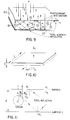
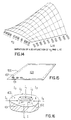
- Fig. 5 shows another embodiment of the invention.
- Fig. 6 is a side view of an embodiment using the element of Fig. 5.
- Figs. 7A and 7B shows another embodiment of the invention.
- FIGs. 8A and 8B shows a still further embodiment of the invention.
- Fig. 9 shows an alternative to the embodiment of Fig. 8.
- Fig. 10 shows a thin film light intensifier according to the invention.
- Fig. 11 shows a single scatterer case for the TFLI of Fig. 10.
- Fig. 12 shows the distribution of scattering centers in Fig. 10.
- Fig. 13 is a top view of the sphere scatterer.
- Fig. 14 shows the graphical representation of the light intensification factor K dependence on n2 and L/d.
- Fig. 15 is a top view of another embodiment of the invention.
- Fig. 16 is a detail of the embodiment of Fig.15.
- the coating can be applied using one of the standard paper coating, inking or printing techniques as well as by dye impregnating the paper pulp.
- the composition of the coating may consist of a standard acrylic material or resin in an aqueous, alcohol or hydrocarbon solution such as the Rohm & Haas B66 acroloid solution in toluene to which a combination of dyes is added to produce what we shall label as the "base optical characteristic.”
- the base spectral characteristic may consist of any of the following: a colorless i.e., transparent state, a plain white color with a very high reflectivity across the full range of the visible spectrum, or a light color that can be in the blue range with a reflectivity peak at or above 30%, at or above 400 to 500 nanometer wavelength range, or a light color that can be in the yellow range with a reflectivity at or above 30% at and above 560 nanometer wavelength, with a cut-off at and around 560 nanometers, a light color in the range of pink or red with a reflectivity at or above 30% at and above 600 nanometers with a cut-off at and around 600 nanometers, or finally the deep burgundy color more specifically described in the Nocopi technology , and whose spectral characteristic is shown in Figure 1.
- variable optical characteristic dye typical examples of which is the chromadye 15 or chromadye 2 photochromic dye of Chroma Chemicals Inc. of Dayton, Ohio, in concentrations of the order of 0.5% by weight.
- the dye can be simply added to the coating compound but an essential feature of this invention is to preferably add the nonlinear dye in a microencapsulated form using technology, which is now well established, in order to allow the use of an optimum solvent structure for the photo-chromic dye that is independent and unaffected by the other components of the coating material. This allows us to tailor the dynamic behavior of the composite coating system both in terms of it's spectral behavior and the response time to an activation source of radiation.
- the photochromic dyes that are specified to be used in this invention when exposed to the activation light are required to result specifically in a strong absorption band with a broad minimum at around the peak or maximum reflectivity wavelengths of the above mentioned base colors.
- the absorption minimum is generally expected to extend up to the 600 nanometer range which is shown in Figure 2.
- the activated photochromic dyes will modify the previously listed base spectral characteristics in the way of what can be loosely described as the switching on or the addition of a deep blue or more generally a complimentary color which when combined with the base characteristics listed above will make the latter appear respectively as blue, purple, deep brown or black.
- the full antiphotocopy effect is achieved when the new reflectance shows a very broad minimum extending from below 400 nanometers to around 600 nanometers and limited to a maximum value in the range of 10% or even better 5% as shown in Figure 3.
- the photo-reproduction resistant device is produced using a multi layer structure, where the first or bottom layer 1 on paper substrate 3 exhibits the characteristics prescribed by the Nocopi technology and is covered with a top layer 2 which consists of a coating prepared to exhibit one of the "base spectral characteristics" described above.
- This method of implementation of the invention is, however, overly restrictive and secure. It is, therefore, possible or desirable that the spectral characteristics of the first layer be relaxed to allow a substantially higher reflectivity and, therefore, also substantially higher readability of the unactivated device.
- the basic spectral characteristics of the top layer is "transformed" by the activation light source the overall characteristics will fall well within the Nocopi prescription and, therefore, the document will be uncopiable.
- the invention can, in the limit, be implemented with the bottom layer having an overall reflectivity across the visible spectrum that is above 15% up to a practically white spectral signature of close to 100% reflectivity.
- the most efficient anti-photocopying device will be obtained when the information printed on the double layer is in a color corresponding to the "transformed" spectral characteristics of the photochromic layer such as blue, purple, deep brown or black in the examples cited above but not limited to these colors alone. It is clear that upon activation of the variable spectral characteristic coating, the contrast between the printed information and the background coating will be eliminated and full reproduction will be impossible.
- the multistate nonlinear optical system is activated at several ultraviolet and visible wavelengths a1, a2, a3 etc. such that a single filter for one of these wavelengths would not be able to neutralize the activation of the device.
- the activating light can be in the ultraviolet or the visible spectral range, more importantly, the speed of the response can be increased to the milliseconds range and down to several seconds, the intensity of the activation radiation can vary from a very small value to several joules per cm2.
- the photochromic material is chosen with the broadest freedom of choice insofar as the wavelength, the speed of response and the intensity requirements are concerned.
- this configuration it is the user who controls the transformation of the spectral characteristics of the photochromic coating which constitutes the second layer 2 of the two layer scheme introduced previously.
- the user will switch the variable spectral characteristic coating to the anti-photocopying state by illuminating it outside the photocopier, with an intense light source that provides any desired light intensity levels at the required ultraviolet or visible wavelengths, for the desired length of time (typically tens of seconds), in order for the spectral characteristic to transform to a "dark" state of sufficient optical density where the minimum reflectivity is of the order of 5-10% as described above.
- this double layered substrate carrying a printed information as mentioned previously is used in a photocopying or fax machine, the attempt to obtain a readable copy will fail.
- This mode of operation is useful when the controlling user, is physically present to make the document unaccessible when the top coating starts to recover its original basic spectral characteristic.
- the recovery time in this application is preferably as slow as possible, typically of the order of tens of minutes or even several hours.
- the prescription of the invention is to use in the optically active layer, dyes, typically of the spiropyran photochromic family, that respond to long ultraviolet and even better visible wavelength radiation, the chromadye 2 of Chroma Chemicals Inc. is a good example of such a dye.
- a vital requirement for the success of this invention in the closed loop mode of operation is, however, the necessity for the optically active dye system to be able to exhibit very short response times, namely of the order of a fraction of a second to a maximum of one second, with switching light energy thresholds of the order of a fraction of a joule/cm2.
- a central part of this invention consists of the devices which will carry, contain or surround for example the photochromic dye systems in order to impart to the latter the fast time response and the low switching light intensity thresholds specified above.
- This invention relates, thus, to the development of light intensity enhancement devices which are such that, for a given externally applied activating light intensity, such as the light intensity of the photocopying machine, the actual intensity of the light that impinges on the photochromic dye elements is multiplied several fold, thus accelerating by as much, the color change mechanism.
- light intensity enhancement devices which are such that, for a given externally applied activating light intensity, such as the light intensity of the photocopying machine, the actual intensity of the light that impinges on the photochromic dye elements is multiplied several fold, thus accelerating by as much, the color change mechanism.
- Different acceleration techniques of the photochromic color switching times are listed below.
- a specific embodiment of this invention may use one of the latter or any number of them in combination in order to increase the speed of response to the level required in a given application.
- Encapsulated Containment of the Photochromic Dyes Macrocapsules, Oversized Microcapsules.
- the photochromic dyes are contained in spherical macrocapsules 10 using a technology similar to that of carbonless paper, as shown in Figure 5.
- the microencapsulation provides, to begin with, the enclosure where the photochromic dye can be maintained in an environment independent of the vehicles that will be used in the printing or coating processes of the dye.
- the photochromic dyes will prefer controlled environments such as Toluene, Cellulose acetates or others, to exhibit intrinsically faster response times and well defined spectral characteristics. While encapsulation for this latter purpose alone will require typical microcapsule dimensions of the order of 5 microns, in the present invention the preferred dimensions is distinctly larger and in the 10 to 25 and even 50 micron range. We shall call these structures macrocapsules in comparison with the usual microcapsule dimension.
- the macrocapsules 10 are now utilized as light accumulating elements as shown in Figure 5.
- a fraction of the external surface of the macrocapsule sphere is covered with a reflecting coating 11. This can be achieved for example by standard evaporation techniques in vacuum.
- a spherical mirror effect will concentrate the light Ic towards the center to an intensity which compared to the incident light intensity Ii will be very large and a function of the diameter of the sphere.
- Figure 6 gives an example of a practical embodiment of this technique, where a transparent substrate 30 is first coated from side 31 with the photochromic dye filled macrocapsules 10 having a light metallic reflective coating 11 applied thereafter by evaporation or an equivalent technique such as coating impregnating sputtering, depositing, etc. on these capsules from the same side 31, such that the macrocapsules now become spherical mirrors for light that impinges onto them from side 32 of the substrate which is also the printing, observation and photocopying side of this substrate. It is clear that when the already intense photocopier light is incident from side 32, the focused and further intensified light intensity Ic will instantly switch the multistate optical characteristic to the dark state and will render the information printed on side 32 uncopiable.
- the photochromic dye filled macrocapsules 10 having a light metallic reflective coating 11 applied thereafter by evaporation or an equivalent technique such as coating impregnating sputtering, depositing, etc. on these capsules from the same side 31, such that the macrocapsules now become
- the corresponding focussed light intensities in the macrocapsules will be incapable of producing an appreciable color change in the photochromic coating of the substrate.
- switch-off time of the photochromic dye is important in a practical embodiment. If the switch-off time is slow, then the darkened dye will slowly become lighter after exposure to an intense light. However, if the substrate is exposed to ambient light, it will become increasingly darker over time and will not go back to its original state, which is undesirable.
- the environment of the dye In order to obtain the faster switch-off time, the environment of the dye must be controlled. Specifically, the dye is held in the macrocapsule in a liquid solvent which apparently enhances its response time into the off state.
- a Fabry Perot structure in optical terminology generally consists of two face to face partially reflective surfaces separated by a distance L.
- Figure 7A shows the configuration which is utilized to contain the optically active coating described in section I, labelled as component 42; the components 41 and 43 consist of partially reflective coatings which are thus separated by the thickness L of the component 42.
- the basic feature of this structure consists in the dramatic build up of radiation intensities inside the region 42 to a level Ie, when it is exposed to an incident radiation of intensity Ii. This is due to the multiple reflections between reflectors 41 and 42 which trap the radiation inside the component 42.
- a paper or clear acrylic 5 substrate 40 is first coated by light metalization with the reflective coating 43, in a second step the photochromic active coating 42 of thickness L is applied, where typically values of L can be in the 25 to 50 microns range and finally the second reflective coating 41 is 0 applied through a last step of light metalization.
- the Fabry Perot light enhancement and switching acceleration scheme is used in conjunction with a paper substrate when making antiphotocopying papers, it is also most conveniently used in conjunction with the clear acrylic substrate of a self adhesive tape, in which case the tape is utilized as an anti-photocopying device that can be applied on selected parts of a document.
- the sheet or film acts like a thin film light intensifier (TFLI).
- TFLI thin film light intensifier
- the planar sheet of Figure 8B constitutes the coating of an anti-photocopying paper sheet, or the coating of a clear acrylic self-adhesive tape. Since t is normally very small, typically of the order of a few microns, K can be made very large.
- the photochromically active dye systems which are for example, microencapsulated as described in section I-1, are implanted within the coating thickness t. They are therefore, subjected to the enhanced light intensity I T and therefore, their conversion or switching to the dark state is correspondingly accelerated.
- the diversion of the light propagation direction from the normal to the sheet surface to the direction parallel to the sheet surface, inside the thickness of the latter can be done in a number of different ways as well as by the combination of a few of the latter.
- the techniques proposed to achieve the diversion of the propagation direction rely on the substantially positive differential of the dielectric coefficient between the light propagating sheet material and free space, together with the inclusion of active or passive light scattering centers throughout the thickness t.
- Figure 9 shows three types 61, 62, 63 of light scatterers, utilized separately or in combination, in a particular embodiment of the invention.
- the scatterers 61 are passive point scattering centres that are obtained by implanting inside the body of the planar sheet, reflective impurities such as aluminum or other metallic powder seeds.
- the scatterers 62 are active point scattering centers that are implemented by introducing in the planar sheet material composition, fluorescent pigments which absorb the incident light in a broad band of wavelengths and re-emit radiation in a narrower band width but omnidirectionally at a longer wavelength.
- the scatterer 63 is a microcorrugated reflection surface applied to the bottom face of the planar sheet 60, typically by metalization through vacuum evaporation.
- Figure 9 shows the final form of the propagation cross section transformation structure that constitutes the coating of the paper substrate, when the latter is utilized as an antiphotocopying device, or the coating of a self adhesive transparent acrylic tape which can be used to selectively render portions of a sheet of paper, uncopiable.
- the TFLI is composed of a thin film and the scattering centers (scatterers) that are embedded in the film. If the refractive index of the scattering centers is high enough, the absorption by the scattering centers is small, therefore hopefully most of the incident optical energy can be converted from vertical direction to horizontal direction so that we can obtain high intensity light output (Figure 10).
- the critical conditions are n1 ⁇ n2 ⁇ n3 where n1, n2, n3 are refractive indices of the surrounding material, the film and the scattering centers respectively.
- the scatterer can also be a metallic reflector.
- the light energy impinging on the region A1A2 will be totally reflected by surfaces 1 and 2 assuming that the sphere's refractive index is so high that no absorption happens on the sphere's surface.
- the sphere is a metallic reflector.
- Van De Hulst pointed out that a mutual distance of 3 times the radius of the particle is a sufficient condition for independence simplification; i.e. to ignore the interaction between the scatterers.
- variable spectral characteristic coating obtained utilizing one or more of the considerations described in section I and II, and which constitutes the second layer of the structure described in Figure 4 of section I as a two layer system to be laid on the original paper or other document substrate in a spatially non-uniform manner.
- This second layer is prescribed to be laid down, by one of the standard methods of printing or coating, non-uniformly corresponding to a 100% density modulation, with a single or multiple one dimensional or two dimensional spatial Fourier frequency similar to the prescription of WO 91/00 390.
- This is a preferred feature of the invention.
- the spatial modulation of the density will render this technique highly successful in the anti-photocopying art, because it allows a very wide dynamic range in the variable spectral characteristic of the top optically active layer.
- the photochromic dye can be applied to a paper substrate in accordance with the scrambling pattern disclosed in WO 91/00 390, filed June 29, 1990.
- the dye is printed on substrate 100 in the form of doughnut shapes 101 which correspond to the circles in the aforementioned scrambling pattern.
- the TFLI is coated thereover, filling in the center 102 of each doughnut shape and filling in there-around at 103.
- light I1 falling in area 101 will be directed to the dye
- light I3 falling in area 103 will be directed to the dye
- light I2 will add to the light I1 and I3.
- a basic feature of this invention is the ability to switch off the scrambling effect of the spatial density modulation when the document is not subject to photocopying, and therefore, the readability of the document is not degraded when the photochormic system is in its switched off state.
- the bottom layer of the two layer structure introduced in section I is made to have a light or even white color, the antiphotocopying paper can actually appear to be almost a white paper.
- the present disclosure describes an invention for a novel anti-photocopying and anti-telefaxing technique which provides the possibility of manufacturing an interactive uncopiable paper or document, the uncopiability of which is switched on and off in the process of attempting to photocopy such a document. Furthermore, the invention decouples the uncopiability feature of the document from its readability, and the latter can thus be strongly enhanced.
- One advantage of the invention is that a document in accordance with the invention can easily be distinguished from a counterfeit document not in accordance with the invention because the counterfeiting techniques are normally incapable of transferring the optical activity effect. Hence, the counterfeit document will not respond to a photochromic test as does the genuine original.
- the invention thus has an antifraud application.
Landscapes
- Physics & Mathematics (AREA)
- General Physics & Mathematics (AREA)
- Non-Silver Salt Photosensitive Materials And Non-Silver Salt Photography (AREA)
- Automatic Analysis And Handling Materials Therefor (AREA)
- Facsimiles In General (AREA)
- Electrochromic Elements, Electrophoresis, Or Variable Reflection Or Absorption Elements (AREA)
- Push-Button Switches (AREA)
- Medicines Containing Material From Animals Or Micro-Organisms (AREA)
- Measurement Of Unknown Time Intervals (AREA)
Claims (10)
- Procédé pour empêcher toute reproduction d'un substrat portant une information par photocopie, par télécopie et analogue, qui consiste à prévoir un substrat ayant une surface principale et à appliquer un colorant photochrome à la surface principale, qui change de couleur lorsqu'il est exposé à de la lumière avec une durée de réaction qui est fonction de la quantité de lumière, absorbée par le colorant en un laps de temps donné, le changement de couleur empêchant la reproduction d'une information sur la surface principale du substrat quand la surface principale est éclairée par une quantité donnée de lumière dans un photocopieur, un appareil de télécopie ou analogue, caractérisé en ce qu'il consiste à appliquer un élément optique (1, 11, 41, 43, 61, 62, 63, 101) à la surface principale et/ou au colorant photochrome pour diminuer la durée de réaction et accélérer ainsi le changement de couleur du colorant en augmentant la proportion de lumière qui est absorbée par le colorant à partir de la quantité donnée de lumière.
- Procédé suivant la revendication 1, dans lequel le substrat est transparent, qui consiste à appliquer le colorant photochrome en encapsulant le colorant dans des capsules (10) transparentes sphériques et en revêtant la surface principale à l'aide des capsules et à appliquer un élément optique en recouvrant moins de toute la surface des capsules sphériques, sur une partie éloignée de la surface principale, d'un revêtement (11) réfléchissant.
- Procédé suivant la revendication 2, qui consiste à effectuer l'encapsulation en encapsulant le colorant en même temps qu'un solvant liquide.
- Procédé suivant la revendication 1, qui consiste à appliquer l'élément optique en mettant le colorant dans une structure Fabry-Perot comprenant au moins une surface (43) partiellement réfléchissante adjacente à la surface principale et une autre surface (41) partiellement réfléchissante, le colorant (42) étant interposé entre elles.
- Procédé suivant la revendication 1, qui consiste à appliquer un élément optique en appliquant un intensificateur (61, 62, 63, 101) de lumière sous forme de mince pellicule à la surface principale pour diriger de la lumière qui y est incidente sur le colorant dans une direction particulière à la surface principale et avec une intensité plus grande.
- Substrat pour empêcher la reproduction d'une information sur lui par photocopie, télécopie et analogue, comprenant une surface principale et un colorant photochrome appliqué à la surface principale qui change de couleur en réaction à une exposition à de la lumière avec une durée de réaction qui est fonction de la quantité de lumière absorbée par le colorant en une durée donnée, le changement de couleur empêchant la reproduction de l'information sur la surface principale du substrat quand la surface principale est éclairée par une quantité donnée de lumière par un photocopieur, un appareil à télécopier ou analogue, caractérisé en ce qu'un élément optique (1, 11, 41, 43, 61, 62, 63, 101) est appliqué à la surface principale et/ou au colorant photochrome pour diminuer la durée de réaction et accélérer ainsi le changement de couleur du colorant en augmentant la proportion de lumière qui est absorbée par le colorant à partir de la quantité donnée de lumière.
- Substrat suivant la revendication 6, qui est transparent et dans lequel le colorant photochrome comprend du colorant encapsulé dans des capsules transparentes sphériques et appliqué sur la surface principale et l'élément optique comprend un revêtement (11) réfléchissant, sur moins que toute la surface des capsules sphériques, sur une partie éloignée de la surface principale.
- Substrat suivant la revendication 7, dans lequel le colorant est encapsulé avec un solvant liquide.
- Substrat suivant la revendication 6, dans lequel l'élément type comprend une structure Fabry-Perot comprenant une surface (43) au moins partiellement réfléchissante adjacente à la surface principale et une autre surface (41) partiellement réfléchissante, le colorant (42) étant interposé entre elles.
- Substrat suivant la revendication 6, dans lequel l'élément optique comprend un intensificateur (60, 61, 62, 101) de lumière sous forme de mince pellicule appliqué à la surface principale pour diriger de la lumière qui y est incidente sur le colorant dans une direction parallèle à la surface principale et avec une plus grande intensité.
Applications Claiming Priority (3)
| Application Number | Priority Date | Filing Date | Title |
|---|---|---|---|
| GB909007387A GB9007387D0 (en) | 1990-04-02 | 1990-04-02 | A switchon-switchoff,multistate,interactive,antiphotocopying,antifraud and antifaxing system |
| GB9007387 | 1990-04-02 | ||
| PCT/CA1991/000101 WO1991015805A1 (fr) | 1990-04-02 | 1991-03-28 | Systeme interactif, anti-copie, anti-fraude, anti-fax, a etats multiples et a communation |
Publications (2)
| Publication Number | Publication Date |
|---|---|
| EP0523082A1 EP0523082A1 (fr) | 1993-01-20 |
| EP0523082B1 true EP0523082B1 (fr) | 1995-03-15 |
Family
ID=10673726
Family Applications (1)
| Application Number | Title | Priority Date | Filing Date |
|---|---|---|---|
| EP91906440A Expired - Lifetime EP0523082B1 (fr) | 1990-04-02 | 1991-03-28 | Systeme interactif, anti-copie, anti-fraude, anti-fax, a etats multiples et a communation |
Country Status (9)
| Country | Link |
|---|---|
| US (1) | US5338067A (fr) |
| EP (1) | EP0523082B1 (fr) |
| JP (1) | JPH0820689B2 (fr) |
| AT (1) | ATE120018T1 (fr) |
| AU (1) | AU7544491A (fr) |
| CA (1) | CA2079672C (fr) |
| DE (1) | DE69108231T2 (fr) |
| GB (1) | GB9007387D0 (fr) |
| WO (1) | WO1991015805A1 (fr) |
Families Citing this family (19)
| Publication number | Priority date | Publication date | Assignee | Title |
|---|---|---|---|---|
| DE4135591C2 (de) * | 1991-10-29 | 1994-09-15 | Hans Dr Theidel | Verfahren zum Herstellen von Kopien, die nur im UV-A-Licht lesbar sind |
| US5826915A (en) * | 1995-02-17 | 1998-10-27 | Wallace Computer Services, Inc. | Method of using thermochromic material on security documents and product |
| US5752152A (en) * | 1996-02-08 | 1998-05-12 | Eastman Kodak Company | Copy restrictive system |
| US6232124B1 (en) | 1996-05-06 | 2001-05-15 | Verification Technologies, Inc. | Automated fingerprint methods and chemistry for product authentication and monitoring |
| US5830609A (en) * | 1996-05-10 | 1998-11-03 | Graphic Arts Technical Foundation | Security printed document to prevent unauthorized copying |
| US6171734B1 (en) | 1996-05-10 | 2001-01-09 | Graphic Arts Technical Foundation | Security printed document to prevent unauthorized copying |
| US6240396B1 (en) | 1996-09-04 | 2001-05-29 | Priceline.Com Incorporated | Conditional purchase offer management system for event tickets |
| US6107932A (en) * | 1997-08-22 | 2000-08-22 | Walker Digital, Llc | System and method for controlling access to a venue using alterable tickets |
| US6490030B1 (en) | 1999-01-18 | 2002-12-03 | Verification Technologies, Inc. | Portable product authentication device |
| US7079230B1 (en) | 1999-07-16 | 2006-07-18 | Sun Chemical B.V. | Portable authentication device and method of authenticating products or product packaging |
| US6512580B1 (en) | 1999-10-27 | 2003-01-28 | Verification Technologies, Inc. | Method and apparatus for portable product authentication |
| US6638593B2 (en) | 2000-06-30 | 2003-10-28 | Verification Technologies, Inc. | Copy-protected optical media and method of manufacture thereof |
| US20050063256A1 (en) * | 2000-06-30 | 2005-03-24 | Selinfreund Richard H. | Data storage in optical discs |
| WO2002002301A1 (fr) | 2000-06-30 | 2002-01-10 | Verification Technologies Inc. | Support optique protege et procede de fabrication |
| US7486790B1 (en) | 2000-06-30 | 2009-02-03 | Verification Technologies, Inc. | Method and apparatus for controlling access to storage media |
| US7124944B2 (en) | 2000-06-30 | 2006-10-24 | Verification Technologies, Inc. | Product packaging including digital data |
| US7660415B2 (en) | 2000-08-03 | 2010-02-09 | Selinfreund Richard H | Method and apparatus for controlling access to storage media |
| KR100802891B1 (ko) * | 2005-09-06 | 2008-02-13 | 주식회사 엘지화학 | 광변색 필름 또는 판 제조방법 |
| AU2012322328B2 (en) * | 2011-10-14 | 2016-07-21 | 3Dtl, Inc. | Security element or document with a security feature including at least one dynamic-effect feature |
Family Cites Families (7)
| Publication number | Priority date | Publication date | Assignee | Title |
|---|---|---|---|---|
| US4137194A (en) * | 1961-05-09 | 1979-01-30 | Polaroid Corporation | Capsular products |
| US3427160A (en) * | 1961-05-09 | 1969-02-11 | Polaroid Corp | Capsular products |
| US3276869A (en) * | 1961-05-09 | 1966-10-04 | Polaroid Corp | Capsular product coated with silver halide and containing a color-providing substance |
| US3468662A (en) * | 1961-05-09 | 1969-09-23 | Polaroid Corp | Capsular products having a silver halide layer |
| FR2618812B1 (fr) * | 1987-07-30 | 1990-04-27 | Vicat Sa | Support d'impression-ecriture anticopie et procede associe |
| JPH01310381A (ja) * | 1988-06-09 | 1989-12-14 | Minolta Camera Co Ltd | 原本の作成方法 |
| US5060981A (en) * | 1989-09-19 | 1991-10-29 | Minnesota Mining And Manufacturing Company | Transparent overlay for protecting a document from tampering |
-
1990
- 1990-04-02 GB GB909007387A patent/GB9007387D0/en active Pending
-
1991
- 1991-03-28 DE DE69108231T patent/DE69108231T2/de not_active Expired - Fee Related
- 1991-03-28 AU AU75444/91A patent/AU7544491A/en not_active Abandoned
- 1991-03-28 AT AT91906440T patent/ATE120018T1/de not_active IP Right Cessation
- 1991-03-28 CA CA002079672A patent/CA2079672C/fr not_active Expired - Fee Related
- 1991-03-28 WO PCT/CA1991/000101 patent/WO1991015805A1/fr not_active Ceased
- 1991-03-28 JP JP3506259A patent/JPH0820689B2/ja not_active Expired - Lifetime
- 1991-03-28 EP EP91906440A patent/EP0523082B1/fr not_active Expired - Lifetime
- 1991-03-28 US US07/941,031 patent/US5338067A/en not_active Expired - Fee Related
Also Published As
| Publication number | Publication date |
|---|---|
| ATE120018T1 (de) | 1995-04-15 |
| CA2079672A1 (fr) | 1991-10-03 |
| CA2079672C (fr) | 1997-12-16 |
| JPH05508236A (ja) | 1993-11-18 |
| WO1991015805A1 (fr) | 1991-10-17 |
| EP0523082A1 (fr) | 1993-01-20 |
| JPH0820689B2 (ja) | 1996-03-04 |
| GB9007387D0 (en) | 1990-05-30 |
| DE69108231T2 (de) | 1995-08-24 |
| DE69108231D1 (de) | 1995-04-20 |
| AU7544491A (en) | 1991-10-30 |
| US5338067A (en) | 1994-08-16 |
Similar Documents
| Publication | Publication Date | Title |
|---|---|---|
| EP0523082B1 (fr) | Systeme interactif, anti-copie, anti-fraude, anti-fax, a etats multiples et a communation | |
| US3713861A (en) | Inhibitor device | |
| US3388027A (en) | Graphic materials incorporating microsphere distributions for the presentation of visual information | |
| US5856048A (en) | Information-recorded media and methods for reading the information | |
| US4766050A (en) | Imaging system with integral cover sheet | |
| US4303307A (en) | Copy security system | |
| JP2960434B2 (ja) | 磁気特性およびカラーシフティング特性を持つ薄フイルム構造体 | |
| CA1060917A (fr) | Carte d'identite multicouche, non reproductible | |
| JP2831095B2 (ja) | 光学式可変装置 | |
| KR100343861B1 (ko) | 자기함유화상화어셈블리및이의내부에화상을형성하는방법 | |
| US4472479A (en) | Light barrier fluorescent ribbon | |
| US20100208313A1 (en) | Security and sensing elements with volume holograms | |
| WO2012141211A1 (fr) | Microparticules, ensembles de particules, encre anti-contrefaçon, toner anti-contrefaçon, feuille anti-contrefaçon et support anti-contrefaçon | |
| CN103260896A (zh) | 标签剂粒子组以及具有其的防伪用油墨、防伪用调色剂、防伪用片材和防伪介质 | |
| KR20030012887A (ko) | 위변조방지용 소재 | |
| WO2012077490A1 (fr) | Particules, encre anti-falsification, toner anti-falsification, feuille anti-falsification, support anti-falsification et procédé de fabrication de particules | |
| JPS6223294B2 (fr) | ||
| JP4193377B2 (ja) | 潜像形成可能な転写箔及び潜像を有する転写媒体 | |
| JPH08508946A (ja) | カラー複写機による複製の防護法 | |
| JP3536413B2 (ja) | 不可視情報記録シール | |
| GB2219248A (en) | Optical security device | |
| GB2232927A (en) | Holographic device | |
| JPH0876674A (ja) | ホログラム転写箔とホログラムラベル | |
| US4971941A (en) | Imaging sheet for achieving color balance | |
| JP3341856B2 (ja) | 液晶表示装置 |
Legal Events
| Date | Code | Title | Description |
|---|---|---|---|
| PUAI | Public reference made under article 153(3) epc to a published international application that has entered the european phase |
Free format text: ORIGINAL CODE: 0009012 |
|
| 17P | Request for examination filed |
Effective date: 19920929 |
|
| AK | Designated contracting states |
Kind code of ref document: A1 Designated state(s): AT BE CH DE DK ES FR GB GR IT LI LU NL SE |
|
| 17Q | First examination report despatched |
Effective date: 19930423 |
|
| GRAA | (expected) grant |
Free format text: ORIGINAL CODE: 0009210 |
|
| RAP1 | Party data changed (applicant data changed or rights of an application transferred) |
Owner name: NOCOPI TECHNOLOGIES, INC.(A CORPORATION OF THE STA |
|
| AK | Designated contracting states |
Kind code of ref document: B1 Designated state(s): AT BE CH DE DK ES FR GB GR IT LI LU NL SE |
|
| PG25 | Lapsed in a contracting state [announced via postgrant information from national office to epo] |
Ref country code: IT Free format text: LAPSE BECAUSE OF FAILURE TO SUBMIT A TRANSLATION OF THE DESCRIPTION OR TO PAY THE FEE WITHIN THE PRESCRIBED TIME-LIMIT;WARNING: LAPSES OF ITALIAN PATENTS WITH EFFECTIVE DATE BEFORE 2007 MAY HAVE OCCURRED AT ANY TIME BEFORE 2007. THE CORRECT EFFECTIVE DATE MAY BE DIFFERENT FROM THE ONE RECORDED. Effective date: 19950315 Ref country code: ES Free format text: THE PATENT HAS BEEN ANNULLED BY A DECISION OF A NATIONAL AUTHORITY Effective date: 19950315 Ref country code: DK Effective date: 19950315 Ref country code: BE Effective date: 19950315 Ref country code: CH Effective date: 19950315 Ref country code: AT Effective date: 19950315 Ref country code: GR Free format text: LAPSE BECAUSE OF FAILURE TO SUBMIT A TRANSLATION OF THE DESCRIPTION OR TO PAY THE FEE WITHIN THE PRESCRIBED TIME-LIMIT Effective date: 19950315 Ref country code: NL Free format text: LAPSE BECAUSE OF NON-PAYMENT OF DUE FEES Effective date: 19950315 Ref country code: LI Effective date: 19950315 |
|
| REF | Corresponds to: |
Ref document number: 120018 Country of ref document: AT Date of ref document: 19950415 Kind code of ref document: T |
|
| PG25 | Lapsed in a contracting state [announced via postgrant information from national office to epo] |
Ref country code: LU Free format text: LAPSE BECAUSE OF NON-PAYMENT OF DUE FEES Effective date: 19950331 |
|
| REF | Corresponds to: |
Ref document number: 69108231 Country of ref document: DE Date of ref document: 19950420 |
|
| ET | Fr: translation filed | ||
| PG25 | Lapsed in a contracting state [announced via postgrant information from national office to epo] |
Ref country code: SE Effective date: 19950615 |
|
| REG | Reference to a national code |
Ref country code: CH Ref legal event code: PL |
|
| NLV1 | Nl: lapsed or annulled due to failure to fulfill the requirements of art. 29p and 29m of the patents act | ||
| PLBE | No opposition filed within time limit |
Free format text: ORIGINAL CODE: 0009261 |
|
| STAA | Information on the status of an ep patent application or granted ep patent |
Free format text: STATUS: NO OPPOSITION FILED WITHIN TIME LIMIT |
|
| 26N | No opposition filed | ||
| PGFP | Annual fee paid to national office [announced via postgrant information from national office to epo] |
Ref country code: FR Payment date: 20010302 Year of fee payment: 11 |
|
| PGFP | Annual fee paid to national office [announced via postgrant information from national office to epo] |
Ref country code: GB Payment date: 20010306 Year of fee payment: 11 |
|
| PGFP | Annual fee paid to national office [announced via postgrant information from national office to epo] |
Ref country code: DE Payment date: 20010307 Year of fee payment: 11 |
|
| REG | Reference to a national code |
Ref country code: GB Ref legal event code: IF02 |
|
| PG25 | Lapsed in a contracting state [announced via postgrant information from national office to epo] |
Ref country code: GB Free format text: LAPSE BECAUSE OF NON-PAYMENT OF DUE FEES Effective date: 20020328 |
|
| PG25 | Lapsed in a contracting state [announced via postgrant information from national office to epo] |
Ref country code: DE Free format text: LAPSE BECAUSE OF NON-PAYMENT OF DUE FEES Effective date: 20021001 |
|
| GBPC | Gb: european patent ceased through non-payment of renewal fee |
Effective date: 20020328 |
|
| PG25 | Lapsed in a contracting state [announced via postgrant information from national office to epo] |
Ref country code: FR Free format text: LAPSE BECAUSE OF NON-PAYMENT OF DUE FEES Effective date: 20021129 |
|
| REG | Reference to a national code |
Ref country code: FR Ref legal event code: ST |