EP0523672A2 - Copolymere aus ethylenisch ungesättigten Carbonsäureestern mit Polyoxyalkylenethern von niederen, ungesättigten Alkoholen als Fliessverbesserer für paraffinhaltige Öle - Google Patents
Copolymere aus ethylenisch ungesättigten Carbonsäureestern mit Polyoxyalkylenethern von niederen, ungesättigten Alkoholen als Fliessverbesserer für paraffinhaltige Öle Download PDFInfo
- Publication number
- EP0523672A2 EP0523672A2 EP92112100A EP92112100A EP0523672A2 EP 0523672 A2 EP0523672 A2 EP 0523672A2 EP 92112100 A EP92112100 A EP 92112100A EP 92112100 A EP92112100 A EP 92112100A EP 0523672 A2 EP0523672 A2 EP 0523672A2
- Authority
- EP
- European Patent Office
- Prior art keywords
- weight
- alkyl
- formula
- copolymers
- hydrogen
- Prior art date
- Legal status (The legal status is an assumption and is not a legal conclusion. Google has not performed a legal analysis and makes no representation as to the accuracy of the status listed.)
- Granted
Links
Classifications
-
- C—CHEMISTRY; METALLURGY
- C10—PETROLEUM, GAS OR COKE INDUSTRIES; TECHNICAL GASES CONTAINING CARBON MONOXIDE; FUELS; LUBRICANTS; PEAT
- C10L—FUELS NOT OTHERWISE PROVIDED FOR; NATURAL GAS; SYNTHETIC NATURAL GAS OBTAINED BY PROCESSES NOT COVERED BY SUBCLASSES C10G OR C10K; LIQUIFIED PETROLEUM GAS; USE OF ADDITIVES TO FUELS OR FIRES; FIRE-LIGHTERS
- C10L1/00—Liquid carbonaceous fuels
- C10L1/10—Liquid carbonaceous fuels containing additives
- C10L1/14—Organic compounds
- C10L1/18—Organic compounds containing oxygen
- C10L1/192—Macromolecular compounds
-
- C—CHEMISTRY; METALLURGY
- C08—ORGANIC MACROMOLECULAR COMPOUNDS; THEIR PREPARATION OR CHEMICAL WORKING-UP; COMPOSITIONS BASED THEREON
- C08F—MACROMOLECULAR COMPOUNDS OBTAINED BY REACTIONS ONLY INVOLVING CARBON-TO-CARBON UNSATURATED BONDS
- C08F220/00—Copolymers of compounds having one or more unsaturated aliphatic radicals, each having only one carbon-to-carbon double bond, and only one being terminated by only one carboxyl radical or a salt, anhydride ester, amide, imide or nitrile thereof
- C08F220/02—Monocarboxylic acids having less than ten carbon atoms; Derivatives thereof
- C08F220/10—Esters
- C08F220/12—Esters of monohydric alcohols or phenols
- C08F220/16—Esters of monohydric alcohols or phenols of phenols or of alcohols containing two or more carbon atoms
- C08F220/18—Esters of monohydric alcohols or phenols of phenols or of alcohols containing two or more carbon atoms with acrylic or methacrylic acids
- C08F220/1818—C13or longer chain (meth)acrylate, e.g. stearyl (meth)acrylate
-
- C—CHEMISTRY; METALLURGY
- C10—PETROLEUM, GAS OR COKE INDUSTRIES; TECHNICAL GASES CONTAINING CARBON MONOXIDE; FUELS; LUBRICANTS; PEAT
- C10L—FUELS NOT OTHERWISE PROVIDED FOR; NATURAL GAS; SYNTHETIC NATURAL GAS OBTAINED BY PROCESSES NOT COVERED BY SUBCLASSES C10G OR C10K; LIQUIFIED PETROLEUM GAS; USE OF ADDITIVES TO FUELS OR FIRES; FIRE-LIGHTERS
- C10L1/00—Liquid carbonaceous fuels
- C10L1/10—Liquid carbonaceous fuels containing additives
- C10L1/14—Organic compounds
- C10L1/143—Organic compounds mixtures of organic macromolecular compounds with organic non-macromolecular compounds
-
- C—CHEMISTRY; METALLURGY
- C10—PETROLEUM, GAS OR COKE INDUSTRIES; TECHNICAL GASES CONTAINING CARBON MONOXIDE; FUELS; LUBRICANTS; PEAT
- C10L—FUELS NOT OTHERWISE PROVIDED FOR; NATURAL GAS; SYNTHETIC NATURAL GAS OBTAINED BY PROCESSES NOT COVERED BY SUBCLASSES C10G OR C10K; LIQUIFIED PETROLEUM GAS; USE OF ADDITIVES TO FUELS OR FIRES; FIRE-LIGHTERS
- C10L1/00—Liquid carbonaceous fuels
- C10L1/10—Liquid carbonaceous fuels containing additives
- C10L1/14—Organic compounds
- C10L1/146—Macromolecular compounds according to different macromolecular groups, mixtures thereof
-
- C—CHEMISTRY; METALLURGY
- C10—PETROLEUM, GAS OR COKE INDUSTRIES; TECHNICAL GASES CONTAINING CARBON MONOXIDE; FUELS; LUBRICANTS; PEAT
- C10L—FUELS NOT OTHERWISE PROVIDED FOR; NATURAL GAS; SYNTHETIC NATURAL GAS OBTAINED BY PROCESSES NOT COVERED BY SUBCLASSES C10G OR C10K; LIQUIFIED PETROLEUM GAS; USE OF ADDITIVES TO FUELS OR FIRES; FIRE-LIGHTERS
- C10L1/00—Liquid carbonaceous fuels
- C10L1/10—Liquid carbonaceous fuels containing additives
- C10L1/14—Organic compounds
- C10L1/18—Organic compounds containing oxygen
- C10L1/192—Macromolecular compounds
- C10L1/195—Macromolecular compounds obtained by reactions involving only carbon-to-carbon unsaturated bonds
- C10L1/196—Macromolecular compounds obtained by reactions involving only carbon-to-carbon unsaturated bonds derived from monomers containing a carbon-to-carbon unsaturated bond and a carboxyl group or salts, anhydrides or esters thereof homo- or copolymers of compounds having one or more unsaturated aliphatic radicals each having one carbon bond to carbon double bond, and at least one being terminated by a carboxyl radical or of salts, anhydrides or esters thereof
- C10L1/1963—Macromolecular compounds obtained by reactions involving only carbon-to-carbon unsaturated bonds derived from monomers containing a carbon-to-carbon unsaturated bond and a carboxyl group or salts, anhydrides or esters thereof homo- or copolymers of compounds having one or more unsaturated aliphatic radicals each having one carbon bond to carbon double bond, and at least one being terminated by a carboxyl radical or of salts, anhydrides or esters thereof mono-carboxylic
-
- C—CHEMISTRY; METALLURGY
- C10—PETROLEUM, GAS OR COKE INDUSTRIES; TECHNICAL GASES CONTAINING CARBON MONOXIDE; FUELS; LUBRICANTS; PEAT
- C10L—FUELS NOT OTHERWISE PROVIDED FOR; NATURAL GAS; SYNTHETIC NATURAL GAS OBTAINED BY PROCESSES NOT COVERED BY SUBCLASSES C10G OR C10K; LIQUIFIED PETROLEUM GAS; USE OF ADDITIVES TO FUELS OR FIRES; FIRE-LIGHTERS
- C10L1/00—Liquid carbonaceous fuels
- C10L1/10—Liquid carbonaceous fuels containing additives
- C10L1/14—Organic compounds
- C10L1/18—Organic compounds containing oxygen
- C10L1/192—Macromolecular compounds
- C10L1/195—Macromolecular compounds obtained by reactions involving only carbon-to-carbon unsaturated bonds
- C10L1/196—Macromolecular compounds obtained by reactions involving only carbon-to-carbon unsaturated bonds derived from monomers containing a carbon-to-carbon unsaturated bond and a carboxyl group or salts, anhydrides or esters thereof homo- or copolymers of compounds having one or more unsaturated aliphatic radicals each having one carbon bond to carbon double bond, and at least one being terminated by a carboxyl radical or of salts, anhydrides or esters thereof
- C10L1/1966—Macromolecular compounds obtained by reactions involving only carbon-to-carbon unsaturated bonds derived from monomers containing a carbon-to-carbon unsaturated bond and a carboxyl group or salts, anhydrides or esters thereof homo- or copolymers of compounds having one or more unsaturated aliphatic radicals each having one carbon bond to carbon double bond, and at least one being terminated by a carboxyl radical or of salts, anhydrides or esters thereof poly-carboxylic
-
- C—CHEMISTRY; METALLURGY
- C10—PETROLEUM, GAS OR COKE INDUSTRIES; TECHNICAL GASES CONTAINING CARBON MONOXIDE; FUELS; LUBRICANTS; PEAT
- C10L—FUELS NOT OTHERWISE PROVIDED FOR; NATURAL GAS; SYNTHETIC NATURAL GAS OBTAINED BY PROCESSES NOT COVERED BY SUBCLASSES C10G OR C10K; LIQUIFIED PETROLEUM GAS; USE OF ADDITIVES TO FUELS OR FIRES; FIRE-LIGHTERS
- C10L1/00—Liquid carbonaceous fuels
- C10L1/10—Liquid carbonaceous fuels containing additives
- C10L1/14—Organic compounds
- C10L1/18—Organic compounds containing oxygen
- C10L1/192—Macromolecular compounds
- C10L1/198—Macromolecular compounds obtained otherwise than by reactions involving only carbon-to-carbon unsaturated bonds homo- or copolymers of compounds having one or more unsaturated aliphatic radicals, each having only one carbon to carbon double bond, and at least one being terminated by an acyloxy radical of a saturated carboxylic acid, of carbonic acid
- C10L1/1985—Macromolecular compounds obtained otherwise than by reactions involving only carbon-to-carbon unsaturated bonds homo- or copolymers of compounds having one or more unsaturated aliphatic radicals, each having only one carbon to carbon double bond, and at least one being terminated by an acyloxy radical of a saturated carboxylic acid, of carbonic acid polyethers, e.g. di- polygylcols and derivatives; ethers - esters
-
- C—CHEMISTRY; METALLURGY
- C10—PETROLEUM, GAS OR COKE INDUSTRIES; TECHNICAL GASES CONTAINING CARBON MONOXIDE; FUELS; LUBRICANTS; PEAT
- C10M—LUBRICATING COMPOSITIONS; USE OF CHEMICAL SUBSTANCES EITHER ALONE OR AS LUBRICATING INGREDIENTS IN A LUBRICATING COMPOSITION
- C10M145/00—Lubricating compositions characterised by the additive being a macromolecular compound containing oxygen
- C10M145/02—Macromolecular compounds obtained by reactions only involving carbon-to-carbon unsaturated bonds
- C10M145/10—Macromolecular compounds obtained by reactions only involving carbon-to-carbon unsaturated bonds containing monomers having an unsaturated radical bound to a carboxyl radical, e.g. acrylate
- C10M145/12—Macromolecular compounds obtained by reactions only involving carbon-to-carbon unsaturated bonds containing monomers having an unsaturated radical bound to a carboxyl radical, e.g. acrylate monocarboxylic
- C10M145/14—Acrylate; Methacrylate
-
- C—CHEMISTRY; METALLURGY
- C10—PETROLEUM, GAS OR COKE INDUSTRIES; TECHNICAL GASES CONTAINING CARBON MONOXIDE; FUELS; LUBRICANTS; PEAT
- C10M—LUBRICATING COMPOSITIONS; USE OF CHEMICAL SUBSTANCES EITHER ALONE OR AS LUBRICATING INGREDIENTS IN A LUBRICATING COMPOSITION
- C10M145/00—Lubricating compositions characterised by the additive being a macromolecular compound containing oxygen
- C10M145/18—Macromolecular compounds obtained otherwise than by reactions only involving carbon-to-carbon unsaturated bonds
- C10M145/24—Polyethers
- C10M145/26—Polyoxyalkylenes
- C10M145/38—Polyoxyalkylenes esterified
-
- C—CHEMISTRY; METALLURGY
- C10—PETROLEUM, GAS OR COKE INDUSTRIES; TECHNICAL GASES CONTAINING CARBON MONOXIDE; FUELS; LUBRICANTS; PEAT
- C10L—FUELS NOT OTHERWISE PROVIDED FOR; NATURAL GAS; SYNTHETIC NATURAL GAS OBTAINED BY PROCESSES NOT COVERED BY SUBCLASSES C10G OR C10K; LIQUIFIED PETROLEUM GAS; USE OF ADDITIVES TO FUELS OR FIRES; FIRE-LIGHTERS
- C10L1/00—Liquid carbonaceous fuels
- C10L1/10—Liquid carbonaceous fuels containing additives
- C10L1/14—Organic compounds
- C10L1/16—Hydrocarbons
- C10L1/1616—Hydrocarbons fractions, e.g. lubricants, solvents, naphta, bitumen, tars, terpentine
-
- C—CHEMISTRY; METALLURGY
- C10—PETROLEUM, GAS OR COKE INDUSTRIES; TECHNICAL GASES CONTAINING CARBON MONOXIDE; FUELS; LUBRICANTS; PEAT
- C10L—FUELS NOT OTHERWISE PROVIDED FOR; NATURAL GAS; SYNTHETIC NATURAL GAS OBTAINED BY PROCESSES NOT COVERED BY SUBCLASSES C10G OR C10K; LIQUIFIED PETROLEUM GAS; USE OF ADDITIVES TO FUELS OR FIRES; FIRE-LIGHTERS
- C10L1/00—Liquid carbonaceous fuels
- C10L1/10—Liquid carbonaceous fuels containing additives
- C10L1/14—Organic compounds
- C10L1/22—Organic compounds containing nitrogen
- C10L1/234—Macromolecular compounds
- C10L1/236—Macromolecular compounds obtained by reactions involving only carbon-to-carbon unsaturated bonds derivatives thereof
- C10L1/2368—Macromolecular compounds obtained by reactions involving only carbon-to-carbon unsaturated bonds derivatives thereof homo- or copolymers derived from unsaturated compounds containing heterocyclic compounds containing nitrogen in the ring
-
- C—CHEMISTRY; METALLURGY
- C10—PETROLEUM, GAS OR COKE INDUSTRIES; TECHNICAL GASES CONTAINING CARBON MONOXIDE; FUELS; LUBRICANTS; PEAT
- C10M—LUBRICATING COMPOSITIONS; USE OF CHEMICAL SUBSTANCES EITHER ALONE OR AS LUBRICATING INGREDIENTS IN A LUBRICATING COMPOSITION
- C10M2209/00—Organic macromolecular compounds containing oxygen as ingredients in lubricant compositions
- C10M2209/02—Macromolecular compounds obtained by reactions only involving carbon-to-carbon unsaturated bonds
- C10M2209/08—Macromolecular compounds obtained by reactions only involving carbon-to-carbon unsaturated bonds containing monomers having an unsaturated radical bound to a carboxyl radical, e.g. acrylate type
- C10M2209/084—Acrylate; Methacrylate
-
- C—CHEMISTRY; METALLURGY
- C10—PETROLEUM, GAS OR COKE INDUSTRIES; TECHNICAL GASES CONTAINING CARBON MONOXIDE; FUELS; LUBRICANTS; PEAT
- C10M—LUBRICATING COMPOSITIONS; USE OF CHEMICAL SUBSTANCES EITHER ALONE OR AS LUBRICATING INGREDIENTS IN A LUBRICATING COMPOSITION
- C10M2209/00—Organic macromolecular compounds containing oxygen as ingredients in lubricant compositions
- C10M2209/10—Macromolecular compoundss obtained otherwise than by reactions only involving carbon-to-carbon unsaturated bonds
- C10M2209/103—Polyethers, i.e. containing di- or higher polyoxyalkylene groups
-
- C—CHEMISTRY; METALLURGY
- C10—PETROLEUM, GAS OR COKE INDUSTRIES; TECHNICAL GASES CONTAINING CARBON MONOXIDE; FUELS; LUBRICANTS; PEAT
- C10M—LUBRICATING COMPOSITIONS; USE OF CHEMICAL SUBSTANCES EITHER ALONE OR AS LUBRICATING INGREDIENTS IN A LUBRICATING COMPOSITION
- C10M2209/00—Organic macromolecular compounds containing oxygen as ingredients in lubricant compositions
- C10M2209/10—Macromolecular compoundss obtained otherwise than by reactions only involving carbon-to-carbon unsaturated bonds
- C10M2209/103—Polyethers, i.e. containing di- or higher polyoxyalkylene groups
- C10M2209/104—Polyethers, i.e. containing di- or higher polyoxyalkylene groups of alkylene oxides containing two carbon atoms only
-
- C—CHEMISTRY; METALLURGY
- C10—PETROLEUM, GAS OR COKE INDUSTRIES; TECHNICAL GASES CONTAINING CARBON MONOXIDE; FUELS; LUBRICANTS; PEAT
- C10M—LUBRICATING COMPOSITIONS; USE OF CHEMICAL SUBSTANCES EITHER ALONE OR AS LUBRICATING INGREDIENTS IN A LUBRICATING COMPOSITION
- C10M2209/00—Organic macromolecular compounds containing oxygen as ingredients in lubricant compositions
- C10M2209/10—Macromolecular compoundss obtained otherwise than by reactions only involving carbon-to-carbon unsaturated bonds
- C10M2209/103—Polyethers, i.e. containing di- or higher polyoxyalkylene groups
- C10M2209/107—Polyethers, i.e. containing di- or higher polyoxyalkylene groups of two or more specified different alkylene oxides covered by groups C10M2209/104 - C10M2209/106
-
- C—CHEMISTRY; METALLURGY
- C10—PETROLEUM, GAS OR COKE INDUSTRIES; TECHNICAL GASES CONTAINING CARBON MONOXIDE; FUELS; LUBRICANTS; PEAT
- C10M—LUBRICATING COMPOSITIONS; USE OF CHEMICAL SUBSTANCES EITHER ALONE OR AS LUBRICATING INGREDIENTS IN A LUBRICATING COMPOSITION
- C10M2209/00—Organic macromolecular compounds containing oxygen as ingredients in lubricant compositions
- C10M2209/10—Macromolecular compoundss obtained otherwise than by reactions only involving carbon-to-carbon unsaturated bonds
- C10M2209/103—Polyethers, i.e. containing di- or higher polyoxyalkylene groups
- C10M2209/109—Polyethers, i.e. containing di- or higher polyoxyalkylene groups esterified
Definitions
- the invention relates to the use of copolymers of ethylenically unsaturated carboxylic acid esters with polyoxyalkylene ethers of allyl and / or methallyl alcohol as flow improvers for oils containing paraffin.
- the invention also relates to new copolymers of ethylenically unsaturated carboxylic acid esters with polyoxyalkylene ethers of lower, unsaturated alcohols, their preparation, their use as flow improvers for paraffin-containing oils and oils which contain such copolymers.
- Crude oils, residual oils, oil distillates, such as diesel fuel, mineral oils, lubricating oils, hydraulic oils, etc. contain, depending on their origin or the way in which they are processed, more or less large proportions of n-paraffins and asphaltenes, which pose particular problems because they reduce the temperature crystallize out or agglomerate and can thus lead to deterioration in the flow properties of these oils.
- This deterioration in the flow properties of the oils is referred to as "stagnation" of the oil.
- the pour point is the standardized term for the temperature at which an oil such as mineral oil, diesel fuel or hydraulic fluid just stops flowing. However, the pour point is not identical to the so-called pour point.
- the pour point is an unspecific term, not covered by standards, for the temperature at which a solid begins to flow under given measuring conditions.
- the deterioration in the flow properties can block containers, pipelines, valves or pumps, for example during transport, storage and / or processing of these oils, in particular with oils containing paraffin, which are difficult to inhibit.
- Special Difficulties arise in practice when the natural pour point of these oils is above the ambient temperature, in particular at 20 ° C. or above.
- Flow improvers are generally homo- or copolymers based on olefins, (meth) acrylic acid esters, maleic acid derivatives and certain vinyl monomers. From GB-1 368 729 homopolymers of acrylic esters with C18- to C24-alkyl chains in the alcohol residue for use as pour point depressants in crude and residual oils are known. Copolymers of free (meth) acrylic acid and long-chain (meth) acrylic acid esters as flow improvers for crude and residual oils are known from US Pat. No. 5,039,432.
- Esters of polyoxyalkylene ethers have been described in various forms as flow improvers.
- EP-A-0 418 610 discloses copolymers of alkyl (meth) acrylates and esters of alkyl polyoxyalkylene ethers with (meth) acrylic acid as oil additives in diesel and gasoline engines. Copolymers of polyoxyalkylene ethers of (meth) allyl alcohol and C1- to C20- (meth) acrylic acid alkyl esters are described in GB-2 174 096. However, these copolymers are used as demulsifiers for crude oil emulsions.
- a disadvantage of the known flow improvers for crude and residue oils is the insufficient effectiveness and the resulting high use concentrations.
- Another disadvantage is the high intrinsic pour points of the flow improvers, which require heating and / or a very strong dilution for the metering.
- Copolymers are therefore sought which have improved properties as pour point depressants, ie which still have sufficient activity even at low doses and which have a lower intrinsic pour point at the same high concentration in comparison with pour point depressants of the prior art and with a large number of oils, in particular those containing paraffin Oils are effective.
- the invention relates to the use of copolymers of ethylenically unsaturated carboxylic acid esters with polyoxyalkylene ethers of allyl and / or methallyl alcohol as flow improvers for oils containing paraffin.
- copolymers known from GB-2 174 096 improve the fluidity particularly effectively by significantly lowering the pour point of paraffinic oils and that solutions of these copolymers in aromatic solvents simultaneously have a very low intrinsic pour point.
- these copolymers in admixture with known homopolymers of acrylic acid esters or methacrylic acid esters of long-chain C18 to C24 fatty alcohols, such as those e.g. from GB-1 368 729 are particularly effective.
- the present invention also relates to new copolymers of ethylenically unsaturated carboxylic acid esters with polyoxyalkylene ethers of lower, unsaturated alcohols, their preparation, their use as flow improvers for paraffin-containing oils and oils which contain such copolymers.
- the present invention thus relates to new copolymers containing 50 to 99.9% by weight, preferably 70 to 99.9% by weight, of at least one recurring structural element of the formula I.
- R1 and R2 independently of one another represent hydrogen, phenyl or a group of the formula COOR4, R3 represents hydrogen, methyl or a group of the formula CH2COOR4, or R2 and R3 together represent C4 to C7 alkylene and R4 represents hydrogen, C8- to C40-alkyl or C8-C40-alkenyl, with the proviso that recurring structural elements of the formula I contain at least one, at most two carboxylic acid units of the formulas COOR4, CH2COOR4 in one structural element and 0.1 to 50% by weight, preferably 0.1 to 30% by weight, of at least one recurring structural element of the formula II wherein R5 represents hydrogen or methyl, Z represents C1 to C3 alkyl, R6 represents hydrogen, C1- to C30-alkyl, cycloalkyl, ary
- the copolymers according to the invention have structural elements of the formula I in which R4 can be a linear or branched alkyl chain with 8 to 40 carbon atoms, preferably 10 to 24 carbon atoms or a linear or branched alkenyl chain with 8 to 40 carbon atoms.
- the copolymers according to the invention have structural elements of the formula II in which R6 is linear or branched alkyl chains having up to 30 carbon atoms, preferably with up to 24 carbon atoms, cycloalkyl radicals or aryl radicals, R7 linear or branched alkyl chains with up to 20 carbon atoms, preferably methyl and R8 linear or branched alkyl chains with up to 30 carbon atoms, preferably up to 22 carbon atoms, linear or branched alkenyl chains with 2 to 30 Carbon atoms, cycloalkyl radicals or aryl radicals, preferably phenyl.
- the cycloalkyl radicals generally have a ring size of 5 to 7 carbon atoms, can be saturated or unsaturated and / or contain one or more heteroatoms, such as S, O, N.
- Suitable cycloalkyl radicals are, for example, cyclopentyl, cyclohexyl, cycloheptyl, cyclopentenyl, cyclohexenyl, cycloheptenyl, piperidyl or morpholinyl radical.
- aryl radicals are derived from mono- or polynuclear carbocyclic or heterocyclic aromatics and can carry alkyl radicals of 1 to 4 carbon atoms and / or halogen atoms, preferably fluorine or chlorine, as substituents.
- Suitable aryl radicals are, for example, the phenyl, naphthyl, pyridyl or benzyl radical.
- copolymers according to the invention are prepared by copolymerization of 50 to 99.9% by weight, preferably 70 to 99.9% by weight, of the monomers of the formula (III) and 0.1 to 50% by weight, preferably 0, 1 to 30% by weight of the monomers of the formula IV by customary free-radical polymerization processes.
- a suitable production process consists in dissolving the monomers of the formulas III and IV in an organic solvent and polymerizing in the presence of a radical initiator at a temperature in the range from 30 to 150 ° C.
- Aromatic hydrocarbons are suitable as solvents, such as B. toluene, xylene, trimethylbenzene, dimethylnaphthalene or mixtures of these aromatic hydrocarbons.
- Commercially available mixtures of aromatic hydrocarbons such as. B. Solvent Naphtha or Shellsol AB® (manufacturer: Shell) are used.
- Aliphatic hydrocarbons are also suitable as solvents.
- alkoxylated aliphatic alcohols or their esters such as. B. butyl glycol are used as solvents, but preferably as a mixture with aromatic hydrocarbons.
- radical initiators are starters such as azo-bis-isobutyronitrile, esters of peroxycarboxylic acids such as e.g. t-Butyl perpivalate and t-butyl per-2-ethylhexanoate or dibenzoyl peroxide are used.
- the monomers of the formula III are ethylenically unsaturated carboxylic esters which contain at least one, at most two carboxylic acid units of the formulas COOR4, CH2COOR4.
- the monomers of the formula III can be esters of monocarboxylic acids, such as acrylic acid, methacrylic acid or cinnamic acid with C8 to C40 alcohols, preferably acrylic acid with C12-C24 alcohols, particularly preferably acrylic acid with C18-, C20- and / or Trade C22 alcohols.
- Suitable alcohols for ester production are e.g. B. coconut oil alcohol, tallow oil alcohol, lauryl alcohol, myristyl alcohol, cetyl alcohol and stearyl alcohol.
- the monomers of the formula III can also be esters of dicarboxylic acids.
- the half esters of dicarboxylic acids are preferably used, such as. B. the half esters of maleic acid, fumaric acid or itaconic acid with C8 to C40 alcohols.
- ⁇ -olefin oxides such as ethylene oxide, propylene oxide and / or Butylene oxide
- polymerizable lower unsaturated alcohols are e.g. B. allyl alcohol, methallyl alcohol, butenols such as 3-buten-1-ol, 1-buten-3-ol or methylbutenols such as 2-methyl-3-buten-1-ol, 2-methyl-3-buten-2-ol or 3-methyl-3-buten-1-ol. Addition products of ethylene oxide and / or propylene oxide with allyl alcohol are preferred.
- the chlorides and bromides are preferably used as halides. Suitable manufacturing processes are described, for example, in J. March, Advanced Organic Chemistry, 2nd edition, pp. 357f (1977).
- the acid halides and anhydrides with C1 to C30 alkyl, cycloalkyl or aryl are preferably used.
- the esterification is generally carried out at temperatures from 0 to 200 ° C., preferably 10 to 100 ° C.
- the carboxylic acid derivative is generally used in a stoichiometric amount, based on the alcohol group of the polyoxyalkylene ether. However, it is possible to use the acid component in excess, e.g.
- Suitable solvents are, for example, aromatic hydrocarbons, e.g. Alkyl aromatics, such as toluene, xylene, trimethylbenzenes, tetramethylbenzenes, dimethylethylbenzenes, dimethylnaphthalene and aromatics mixtures.
- aromatic hydrocarbons e.g. Alkyl aromatics, such as toluene, xylene, trimethylbenzenes, tetramethylbenzenes, dimethylethylbenzenes, dimethylnaphthalene and aromatics mixtures.
- the copolymers according to the invention can be prepared in two ways.
- the index m indicates the degree of alkoxylation, ie the number of moles of ⁇ -olefin oxide which are added per mole of alcohol of the formula V or VI.
- copolymers according to the invention are soluble in organic solvents such as toluene and xylene, as well as in crude oil, crude oil containing paraffin and crude oil products containing paraffin, residual oils, petroleum distillates such as e.g. Diesel, hydraulic oils, as well as mixtures of aromatic and aliphatic hydrocarbons, e.g. are commercially available under the names Shellsol®AB, Shellsol®R or Shellsol®A (manufacturer: Shell) and Solvesso®100, Solvesso®200 or Actrel® (manufacturer: Esso Chemie).
- organic solvents such as toluene and xylene
- crude oil crude oil containing paraffin and crude oil products containing paraffin, residual oils
- petroleum distillates such as e.g. Diesel, hydraulic oils
- mixtures of aromatic and aliphatic hydrocarbons e.g. are commercially available under the names Shellsol®AB, Shellsol®R or Shellsol®A (manufacturer: Shell)
- the monomers III and IV can be present in any desired distribution in the copolymers according to the invention, the distribution preferably being statistical.
- the molecular weights or molecular weight distributions of the copolymers according to the invention are characterized by a K value of 10 to 100, preferably 10 to 80 (measured according to Ubbelohde).
- the molecular weights M ⁇ n can be in the range from 1,000 to 300,000, preferably 5,000 to 200,000, and can be determined, for example, by the gel permeation chromatography method using polystyrene calibration.
- the copolymers according to the invention and known can be used very generally as flow improvers in oils containing paraffin of any origin.
- the paraffins can be, for example, straight-chain or branched alkanes having 8 to 100, preferably 10 to 70, carbon atoms.
- the copolymers according to the invention and known have a broad activity in a wide variety of paraffinic oils. They are therefore generally applicable, for example in crude oils, other paraffinic oils and paraffinic oil products of various origins.
- Paraffin-containing oils are understood to mean, for example, crude oils, other paraffin-containing oils and paraffin-containing oil products such as are obtained in the processing of crude oils, for example as distillation products such as diesel fuel or hydraulic oil. They are particularly suitable as flow improvers for crude and residue oils.
- paraffin-containing oils are described for which the copolymers according to the invention are also suitable as crystallization inhibitors.
- the known copolymers according to the invention can be separated off from the solvent and the copolymers separated off can be added to the oil. If you want to isolate the copolymers from the reaction mixture, this is e.g. B. by distilling off the solvent or by precipitation, e.g. B. by adding acetone, possible. However, it may be advantageous not to isolate the flow improvers, but to add the solution obtained in the polymerization to the petroleum in order to improve the flow properties.
- the copolymers according to the invention are added to the oil in amounts such that the content of the copolymers is in the range from 10 to 10,000 ppm by weight, preferably in the range from 50 to 5000 ppm by weight.
- the optimal application concentration can be different for different oils.
- the known copolymers according to the invention can be added already in the borehole for the crude oil, but also before or during its transport, storage and / or further processing.
- the copolymers according to the invention and known improve the flow behavior of oils containing paraffin, especially at low temperatures, which is indicated by greater reductions in pour points compared to paraffin inhibitors of the prior art. If precipitates are formed by crystallization of the paraffin, the presence of the copolymers according to the invention and known copolymers does not form deposits which are as compact and / or not as strongly adherent.
- the manageability of oils containing paraffin such as crude oils, residual oils, Oil distillates, such as, for example, diesel fuels, mineral oils, lubricating oils, hydraulic oils, etc., are therefore significantly improved overall at low temperatures when the inventive and known copolymers are added, and blockages during transport, storage and / or processing do not occur so easily. This also applies to oils which are otherwise difficult to inhibit against crystallization of paraffins.
- the effectiveness of the copolymers or terpolymers prepared according to the invention and the known copolymers is described by determining the pour points according to the method according to DIN ISO 3016.
- the crude oil samples which have not been additized or which have been additized with the polymers are tested for the flowability under defined conditions after prior heating and subsequent defined cooling.
- the pour point tests were carried out with an Indian crude oil which has a pour point of 29 ° C. in the untreated state.
- Table 2 shows comparative experiments with known pour point depressants.
- Table 3 shows the intrinsic pour points of the copolymers according to the invention.
- the designation EO stands for ethylene oxide units
- the designation PO stands for popylene oxide units.
- the percentages are to be understood as percentages by weight.
- the inherent viscosity values K are determined according to Ubbelohde at 25 ° C in toluene at a polymer concentration of 5% by weight.
- the polymerizations are carried out in a 1 l five-necked flask equipped with an anchor stirrer, reflux condenser, contact thermometer, gas inlet tube and dropping funnel. The solutions presented for the polymerization are purged with nitrogen.
- Example II.1 95 g of stearyl acrylate and 5 g of allyl polyglycol (with 4 EO) were analogous to Example II.1. polymerized. The polymer has a K value (5%) of 33.
- example Comonomer K value 9 10% allyl alcohol (10 EO) 45 10th 2% allyl alcohol (15 EO) 40 11 5% allyl alcohol (10 PO) 36 12th 5% allyl alcohol (5 EO + 5 PO) 42 13 5% 2-methyl-3-buten-2-ol (9 EO) 37
- Table 2 (Comparative examples) product Amount used (ppm) Eigenstock point (° C) Paradyne 70® 300 25.5 Paradyne 70® 500 23.0 Paradyne 85® 300 30.6 Paradyne 85® 500 30.5 Shellswim 5 T® 300 21.3 Shellswim 5 T® 500 14.0 Shellswim 11 T® 300 20.5 Shellswim 11 T® 500 14.0
- the flow improvers listed in Table 2 are commercially available products from Exxon (Paradyne 70®, Paradyne 80®) and Shell (Shellswim 5 T®, Shellswim 11 T®) Table 3 product Eigenstock point (° C) Copolymer according to Example II.1. (50%) 18th Copolymer according to Example II.3. (40%) 18th Copolymer according to Example II.4. (48%) 22 Copolymer according to Example II.9. (53%) 19th Copolymer according to Example II.10. (57%) 21
Landscapes
- Chemical & Material Sciences (AREA)
- Oil, Petroleum & Natural Gas (AREA)
- Chemical Kinetics & Catalysis (AREA)
- Organic Chemistry (AREA)
- General Chemical & Material Sciences (AREA)
- Engineering & Computer Science (AREA)
- Health & Medical Sciences (AREA)
- Emergency Medicine (AREA)
- Medicinal Chemistry (AREA)
- Polymers & Plastics (AREA)
- Liquid Carbonaceous Fuels (AREA)
- Addition Polymer Or Copolymer, Post-Treatments, Or Chemical Modifications (AREA)
- Lubricants (AREA)
- Fats And Perfumes (AREA)
- Organic Low-Molecular-Weight Compounds And Preparation Thereof (AREA)
- Treatments For Attaching Organic Compounds To Fibrous Goods (AREA)
- Compositions Of Macromolecular Compounds (AREA)
- Macromonomer-Based Addition Polymer (AREA)
- Colloid Chemistry (AREA)
Abstract
Description
- Die Erfindung betrifft die Verwendung von Copolymeren aus ethylenisch ungesättigten Carbonsäureestern mit Polyoxyalkylenethern des Allyl- und/oder Methallylalkohols als Fließverbesserer für paraffinhaltige Öle.
Die Erfindung betrifft auch neue Copolymere aus ethylenisch ungesättigten Carbonsäureestern mit Polyoxyalkylenethern von niederen, ungesättigten Alkoholen, deren Herstellung, deren Verwendung als Fließverbesserer für paraffinhaltige Öle und Öle, die solche Copolymere enthalten. - Rohöle, Rückstandsöle, Öldestillate, wie z.B. Dieselkraftstoff, Mineralöle, Schmieröle, Hydrauliköle usw. enthalten je nach ihrer Herkunft oder der Art ihrer Verarbeitung mehr oder weniger große Anteile an n-Paraffinen und Asphaltenen, die besondere Probleme darstellen, weil sie bei Erniedrigung der Temperatur auskristallisieren bzw. agglomerieren und dadurch zur Verschlechterung der Fließeigenschaften dieser Öle führen können. Diese Verschlechterung der Fließeigenschaften der Öle bezeichnet man als "Stocken" des Öles. Der Stockpunkt ist die normierte Bezeichnung für diejenige Temperatur bei der ein Öl z.B. Mineralöl, Dieselkraftstoff oder Hydraulikflüssigkeit gerade eben zu fließen aufhört. Der Stockpunkt (Pourpoint) ist jedoch nicht identisch mit dem sogenannten Fließpunkt. Der Fließpunkt ist eine unspezifische, nicht durch Normen abgedeckte Bezeichnung für diejenige Temperatur, bei der ein Feststoff unter gegebenen Meßbedingungen zu fließen beginnt. Durch die Verschlechterung der Fließeigenschaften können dann beispielsweise beim Transport, bei der Lagerung und/oder der Verarbeitung dieser Öle Behälter, Rohrleitungen, Ventile oder Pumpen verstopfen, insbesondere bei paraffinhaltigen Ölen, die schwierig zu inhibieren sind. Besondere Schwierigkeiten treten in der Praxis dann auf, wenn der Eigenstockpunkt dieser Öle oberhalb der Umgebungstemperatur, insbesondere bei 20°C oder darüber liegt. In Anbetracht der abnehmenden Welterdölvorräte und zunehmender Erschließung von Lagerstätten, die Rohöle mit hohen Eigenstockpunkten liefern, erlangen die Förderung und der Transport derartiger Problemöle eine immer größer werdende Bedeutung.
- Zur Wiederherstellung oder Aufrechterhaltung der Fließfähigkeit gibt es eine Reihe von Maßnahmen thermischer oder mechanischer Art, z. B. das Abkratzen des Paraffins von der Rohrinnenwand, das Beheizen ganzer Pipelines oder Spülvorgänge mit Lösungsmitteln. Eleganter ist sicherlich die ursächliche Bekämpfung des Phänomens durch Zugabe von Fließverbesserern, die auch als Stockpunktserniedriger (pour point depressants) oder Paraffininhibitoren bezeichnet werden. Dabei ist im allgemeinen eine Erniedrigung des Stockpunkts auf Werte von etwa 10°C und darunter vorteilhaft.
- Die Wirkungsweise dieser Fließverbesserer wird im allgemeinen dadurch erklärt, daß sie die Kristallisation von Paraffinen und Asphaltenen inhibieren. Die Folge ist eine Absenkung des Stockpunktes und die Aufrechterhaltung der Fließfähigkeit des Öls bei niedriger Temperatur. Die Wirksamkeit der Fließverbesserer hängt dabei sowohl von ihrer Konstitution als auch von ihrer Konzentration ab.
- Bei Fließverbesserern handelt es sich im allgemeinen um Homo- oder Copolymere auf Basis von Olefinen, (Meth-)Acrylsäureestern, Maleinsäurederivaten und bestimmten Vinylmonomeren.
So sind aus GB-1 368 729 Homopolymere von Acrylsäureestern mit C₁₈- bis C₂₄-Alkylketten im Alkoholrest für die Anwendung als Stockpunktserniedriger in Roh- und Rückstandsölen bekannt. Aus US-A-5 039 432 sind Copolymere aus freier (Meth-)Acrylsäure und langkettigen (Meth-)Acrylsäureestern als Fließverbesserer für Roh- und Rückstandsöle bekannt. - Ester von Polyoxyalkylenethern sind in verschiedener Form als Fließverbesserer beschrieben.
- Aus GB-84/28880 sind Copolymere aus Estern der Fumarsäure mit Polyoxyalkylenglykolen bekannt. Copolymere aus 1-Alkenen und dem (Meth-) Acrylsäureester eines C₁₀- bis C₂₄- Alkylpolyoxyalkylenethers (EP-B-0 220 611), Copolymere aus (Meth-)Acrylsäureestern mit über ein Heteroatom alkoxylierten cyclischen Kohlenwasserstoffen (DE-A-3 711 344) sowie Mischungen aus Fettsäureestern von Polyoxyalkylenethern und C₁₀- bis C₃₀-Fumarsäureestern von Polyoxyalkylenethern (US-A-4 891 145) sind als Fließverbesserer für Rohöle bzw. paraffinreiche Erdölfraktionen bekannt. Aus EP-A-0 418 610 sind Copolymere aus Alkyl(meth-)acrylaten und Estern von Alkylpolyoxyalkylenethern mit (Meth-)Acrylsäure als Öladditive in Diesel- und Ottomotoren bekannt.
Copolymere aus Polyoxyalkylenethern des (Meth-)Allylalkohols und C₁- bis C₂₀-(Meth-)Acrylsäurealkylestern sind in GB-2 174 096 beschrieben. Diese Copolymeren werden jedoch als Demulgatoren für Rohölemulsionen verwendet. - Nachteilig bei den bekannten Fließverbesserern für Roh- und Rückstandsöle sind die noch nicht ausreichende Wirksamkeit und die daraus resultierenden hohen Einsatzkonzentrationen. Weiterhin nachteilig sind die hohen Eigenstockpunkte der Fließverbesserer, die für die Dosierung eine Erwärmung und/oder eine sehr starke Verdünnung erfordern.
- Es werden deshalb Copolymere gesucht, die verbesserte Eigenschaften als Stockpunktserniedriger aufweisen, d. h. die auch bei geringer Dosierung noch genügende Wirksamkeit besitzen und im Vergleich mit Stockpunktserniedrigern des Standes der Technik bei gleich hoher Konzentration einen niedrigeren Eigenstockpunkt haben und bei einer Vielzahl von Ölen, insbesondere bei paraffinhaltigen Ölen wirksam sind.
- Die Erfindung betrifft die Verwendung von Copolymeren aus ethylenisch ungesättigten Carbonsäureestern mit Polyoxyalkylenethern des Allyl- und/oder Methallylalkohols als Fließverbesserer für paraffinhaltige Öle.
- Aus GB-2 174 096 ist die Verwendung von Copolymeren aus Polyoxyalkylenethern des (Meth-)Allylalkohols und C₁- bis C₂₀-(Meth-) crylsäurealkylestern als Demulgatoren für Wasser enthaltendes Rohöl bekannt.
- Überraschenderweise wurde gefunden, daß die aus GB-2 174 096 bekannten Copolymeren durch deutliche Absenkung des Stockpunkts von paraffinhaltigen Ölen deren Fließfähigkeit besonders wirkungsvoll verbessern und daß Lösungen dieser Copolymeren in aromatischen Lösemitteln gleichzeitig einen sehr niedrigen Eigenstockpunkt aufweisen. Darüberhinaus wurde gefunden, daß diese Copolymeren in Abmischung mit bekannten Homopolymeren aus Acrylsäureestern bzw. Methacrylsäureestern langkettiger C₁₈- bis C₂₄-Fettalkohole, wie sie z.B. aus GB-1 368 729 bekannt sind, besonders wirksam sind.
- Die vorliegende Erfindung betrifft auch neue Copolymere aus ethylenisch ungesättigten Carbonsäureestern mit Polyoxyalkylenethern von niederen, ungesättigten Alkoholen, deren Herstellung, deren Verwendung als Fließverbesserer für paraffinhaltige Öle und Öle, die solche Copolymere enthalten.
- Somit sind ein Gegenstand der vorliegenden Erfindung neue Copolymere enthaltend 50 bis 99,9 Gew.-%, bevorzugt 70 bis 99,9 Gew.-% mindestens eines wiederkehrenden Strukturelementes der Formel I

worin
R¹ und R² unabhänig voneinander für Wasserstoff, Phenyl oder eine Gruppe der Formel COOR⁴ stehen,
R³ für Wasserstoff, Methyl oder eine Gruppe der Formel CH₂COOR⁴ steht, oder R² und R³ zusammen für C₄-bis C₇-Alkylen stehen und
R⁴ für Wasserstoff, C₈- bis C₄₀-Alkyl oder C₈-C₄₀-Alkenyl steht,
mit der Maßgabe, daß wiederkehrende Strukturelemente der Formel I mindestens eine, höchstens zwei Carbonsäureeinheiten der Formeln COOR⁴, CH₂COOR⁴ in einem Strukturelement enthalten
und 0,1 bis 50 Gew.-%, bevorzugt 0,1 bis 30 Gew-% mindestens eines wiederkehrenden Strukturelementes der Formel II
worin
R⁵ für Wasserstoff oder Methyl steht,
Z für C₁- bis C₃-Alkyl steht,
R⁶ für Wasserstoff, C₁- bis C₃₀-Alkyl, Cycloalkyl, Aryl oder -C(O)-R⁸ steht,
R⁷ für Wasserstoff, C₁- bis C₂₀-Alkyl steht,
R⁸ für C₁- bis C₃₀-Alkyl, C₃- bis C₃₀-Alkeny, Cycloalkyl oder Aryl steht und
m eine Zahl von 1 bis 60, vorzugsweise zwischen 1 und 30 bedeutet, mit der Maßgabe, daß falls R⁶ gleich Wasserstoff ist, R¹ und R² nicht gleichzeitig Wasserstoff sind. - Die erfindungsgemäßen Copolymeren besitzen Strukturelemente der Formel I, worin R⁴ eine lineare oder verzweigte Alkylkette mit 8 bis 40 Kohlenstoffatomen, bevorzugt 10 bis 24 Kohlenstoffatomen oder eine lineare oder verzweigte Alkenylkette mit 8 bis 40 Kohlenstoffatomen sein kann.
- Die erfindungsgemäßen Copolymeren besitzen Strukturelemente der Formel II, worin R⁶ lineare oder verzweigte Alkylketten mit bis zu 30 Kohlenstoffatomen, bevorzugt mit bis zu 24 Kohlenstoffatomen, Cycloalkylreste oder Arylreste, R⁷ lineare oder verzweigte Alkylketten mit bis zu 20 Kohlenstoffatomen, bevorzugt Methyl und R⁸ lineare oder verzweigte Alkylketten mit bis zu 30 Kohlenstoffatomen, bevorzugt bis zu 22 Kohlenstoffatomen, lineare oder verzweigte Alkenylketten mit 2 bis 30 Kohlenstoffatomen, Cycloalkylreste oder Arylreste, bevorzugt Phenyl sein können.
Die Cycloalkylreste besitzen im allgemeinen eine Ringgröße von 5 bis 7 Kohlenstoffatomen, können gesättigt oder ungesättigt sein und/oder ein bis mehrere Heteroatome, wie S, O, N enthalten. Geeignete Cycloalkylreste sind z.B. Cyclopentyl-, Cyclohexyl-, Cycloheptyl-, Cyclopentenyl-, Cyclohexenyl-, Cycloheptenyl-, Piperidyl- oder Morpholinylrest.
Die Arylreste leiten sich von ein- oder mehrkernigen carbocyclischen oder heterocyclischen Aromaten ab und können als Substituenten Alkylreste von 1 bis 4 C-Atomen und/oder Halogenatome, bevorzugt Fluor oder Chlor tragen.
Geeignete Arylreste sind z.B. der Phenyl-, Naphthyl-, Pyridyl-, oder Benzylrest. - Die Herstellung der erfindungsgemäßen Copolymeren erfolgt durch Copolymerisation von 50 bis 99,9 Gew.-%, bevorzugt 70 bis 99,9 Gew.-% der Monomeren der Formel (III) und 0,1 bis 50 Gew.-%, bevorzugt 0,1 bis 30 Gew.-% der Monomeren der Formel IV nach üblichen radikalischen Polymerisationsverfahren.

- Ein geeignetes Herstellungsverfahren besteht darin, die Monomeren der Formeln III und IV in einem organischen Lösungsmittel zu lösen und in Gegenwart eines Radikalstarters bei einer Temperatur im Bereich von 30 bis 150°C zu polymerisieren. Als Lösungsmittel eignen sich aromatische Kohlenwasserstoffe, wie z. B. Toluol, Xylol, Trimethylbenzol, Dimethylnaphthalin oder Gemische dieser aromatischen Kohlenwasserstoffe. Auch handelsübliche Gemische aus aromatischen Kohlenwasserstoffen wie z. B. Solvent Naphtha oder Shellsol AB® (Hersteller: Shell) finden Verwendung. Als Lösungsmittel sind ebenfalls aliphatische Kohlenwasserstoffe geeignet. Auch alkoxylierte aliphatische Alkohole oder deren Ester wie z. B. Butylglykol finden als Lösungsmittel Verwendung, bevorzugt aber als Gemisch mit aromatischen Kohlenwasserstoffen.
- Als Radikalstarter werden üblicherweise gebräuchliche Starter wie Azo-bis-isobutyronitril, Ester von Peroxicarbonsäuren wie z.B. t-Butyl-perpivalat und t-Butyl-per-2-ethylhexanoat oder Dibenzoylperoxid verwendet.
- Bei den Monomeren der Formel III handelt es sich um ethylenisch ungesättigte Carbonsäureester, die mindestens eine, höchstens zwei Carbonsäureeinheiten der Formeln COOR⁴, CH₂COOR⁴ enthalten.
Bei den Monomeren der Formel III kann es sich um Ester von Monocarbonsäuren, wie Acrylsäure, Methacrylsäure oder Zimtsäure mit C₈- bis C₄₀-Alkoholen, bevorzugt Acrylsäure mit C₁₂-C₂₄-Alkoholen, besonders bevorzugt von Acrylsäure mit C₁₈-, C₂₀- und/oder C₂₂-Alkoholen handeln. Geeignete Alkohole zur Esterherstellung sind z. B. Kokosfettalkohol, Talgfettalkohol, Laurylalkohol, Myristylalkohol, Cetylalkohol und Stearylalkohol.
Bei den Monomeren der Formel III kann es sich auch um Ester von Dicarbonsäuren handeln. Bevorzugt werden die Halbester der Dicarbonsäuren eingesetzt, wie z. B. die Halbester der Maleinsäure, Fumarsäure oder Itaconsäure mit C₈- bis C₄₀-Alkoholen. - Bei den Monomeren der Formel IV kann es sich um Veretherungsprodukte oder Veresterungsprodukte von Polyoxyalkylenethern mit R⁶ = H handeln.
- Diese Polvoxyalkylenether mit R⁶ = H lassen sich nach bekannten Verfahren durch Anlagerung von α-Olefinoxiden, wie Ethylenoxid, Propylenoxid und/oder Butylenoxid an polymerisierbare niedere, ungesättigte Alkohole der Formel V

herstellen. Solche polymerisierbaren niederen ungesättigten Alkohole sind z. B. Allylalkohol, Methallylalkohol, Butenole wie 3-Buten-1-ol, 1-Buten-3-ol oder Methylbutenole wie 2-Methyl-3-buten-1-ol, 2-Methyl-3-buten-2-ol oder 3-Methyl-3-buten-1-ol. Bevorzugt sind Anlagerungsprodukte von Ethylenoxid und/oder Propylenoxid an Allylalkohol. - Eine nachfolgende Veretherung dieser Polyoxyalkylenether mit R⁶ = H zu Verbindungen der Formel IV mit R⁶ = C₁- bis C₃₀-Alkyl, Cycloalkyl oder Aryl erfolgt nach an sich bekannten Verfahren. Geeignete Verfahren sind z.B. aus J. March, Advanced Organic Chemistry, 2. Auflage, S. 357f (1977) bekannt.
- Die Veretherungsprodukte der Polyoxyalkylenether mit R⁶ = H der Formel IV lassen sich auch herstellen, indem α-Olefinoxide, bevorzugt Ethylenoxid, Propylenoxid und/oder Butylenoxid an Alkohole der Formel VI
R⁶ - OH (VI)
worin R⁶ gleich C₁- bis C₃₀-Alkyl, Cycloalkyl oder Aryl,
nach bekannten Verfahren anlagert und mit polymerisierbaren niederen ungesättigten Halogeniden der Formel VII
umsetzt, wobei X für ein Halogenatom steht und R⁵ und Z die zuvor angegebene Bedeutung besitzen. Als Halogenide werden bevorzugt die Chloride und Bromide eingesetzt. Geeignete Herstellungsverfahren werden z.B. in J. March, Advanced Organic Chemistry, 2. Auflage, S. 357f (1977) genannt. - Die Veresterung der Polyoxyalkylenether mit R⁶ = H erfolgt durch Umsetzung mit gängigen Veresterungsmitteln wie Carbonsäurehalogeniden, Carbonsäureanhydriden oder Carbonsäureestern mit C₁- bis C₄-Alkoholen. Bevorzugt werden die Säurehalogenide und -anhydride mit C₁- bis C₃₀-Alkyl, Cycloalkyl oder Aryl verwendet. Die Veresterung wird im allgemeinen bei Temperaturen von 0 bis 200°C, vorzugsweise 10 bis 100°C durchgeführt. Das Carbonsäurederivat wird im allgemeinen in einer, bezogen auf die Alkoholgruppe des Polyoxyalkylenethers, stöchiometrischen Menge eingesetzt. Es ist jedoch möglich, die Säurekomponente im Überschuß, z.B. in einem Überschuß von 20 bis 100 %, wie auch in Unterschuß zuzugeben. Die Veresterung wird zweckmäßg in einem Lösungsmittel durchgeführt. Geeignete Lösungsmittel sind beispielsweise aromatische Kohlenwasserstoffe, z.B. Alkylaromaten, wie Toluol, Xylol, Trimethylbenzole, Tetramethylbenzole, Dimethylethylbenzole, Dimethylnaphthalin sowie Aromatengemische.
- Für den Fall der zuvor beschriebenen acylierten Polyoxyalkylenether mit R⁶ = C(O)-R⁸ können die erfindungsgemäßen Copolymere auf zwei Wegen hergestellt werden.
Einerseits lassen sich die Polyoxyalkylenether mit R⁶ = H direkt mit den ethylenisch ungesättigten Carbonsäureestern der Formel III copolymerisieren und anschließend durch Zusatz von Carbonsäurederivaten zu den erfindungsgemäßen Copolymeren verestern, andererseits kann man auch zunächst die Polyoxyalkylenether mit R⁶ = H durch Zusatz von Carbonsäurederivaten zu den Monomeren der Formel IV verestern und anschließend mit den ethylenisch ungesättigten Carbonsäureestern der Formel III copolymerisieren. Wegen den unterschiedlichen Reaktivitäten der zur Polymerisation eingesetzten Monomeren resultieren aus beiden Herstellungsverfahren unterschiedliche Molekulargewichtsverteilungen. - Bei den Monomeren der Formel IV gibt der Index m den Alkoxylierungsgrad, d.h. die Anzahl der Mole an α-Olefinoxid an, die pro Mol Alkohol der Formel V oder VI angelagert werden.
- Die erfindungsgemäßen Copolymeren sind in organischen Lösungsmitteln wie Toluol und Xylol löslich, ebenso in Rohöl, paraffinhaltigem Rohöl und paraffinhaltigen Rohölprodukten, Rückstandsölen, Erdöldestillaten , wie z.B. Diesel, Hydraulikölen, sowie Gemischen aromatischer und aliphatischer Kohlenwasserstoffe, wie sie z.B. unter den Bezeichnungen Shellsol®AB, Shellsol®R oder Shellsol®A (Hersteller: Shell) und Solvesso®100, Solvesso®200 oder Actrel® (Hersteller: Esso Chemie) im Handel sind.
- In den erfindungsgemäßen Copolymeren können die Monomere III und IV in beliebiger Verteilung vorliegen, wobei die Verteilung vorzugsweise statistisch ist. Die Molekulargewichte bzw. Molmassenverteilungen der erfindungsgemäßen Copolymeren sind durch einen K-Wert von 10 bis 100, vorzugsweise 10 bis 80 (gemessen nach Ubbelohde) charakterisiert. Die Molekulargewichte

- Die erfindungsgemäßen und bekannten Copolymeren können ganz allgemein bei paraffinhaltigen Ölen beliebigen Ursprungs als Fließverbesserer verwendet werden. Bei den Paraffinen kann es sich z.B. um geradkettige oder verzweigte Alkane mit 8 bis 100, vorzugsweise 10 bis 70 C-Atomen handeln. Die erfindungsgemäßen und bekannten Copolymeren besitzen in den verschiedensten paraffinhaltigen Ölen eine breite Wirksamkeit. Sie sind deshalb allgemein anwendbar, z.B. in Rohölen, anderen paraffinhaltigen Ölen und paraffinhaltigen Ölprodukten unterschiedlichster Herkunft. Als paraffinhaltige Öle werden dabei z.B. Rohöle, andere paraffinhaltige Öle und paraffinhaltige Ölprodukte verstanden, wie sie bei der Verarbeitung von Rohölen anfallen, beispielsweise als Destillationsprodukte wie Dieselkraftstoff oder Hydrauliköl.
Besonders geeignet sind sie als Fließverbesserer für Roh- und Rückstandsöle. In Compositions and Properties of Petroleum, F. Enke Publishers, Stuttgart 1981, S. 1 bis 37 sind paraffinhaltige Öle beschrieben, für die die erfindungsgemäßen Copolymere ebenfalls als Kristallisationsinhibitoren geeignet sind. - Man kann die erfindungsgemäßen und bekannten Copolymeren aus dem Lösungsmittel abtrennen und die abgetrennten Copolymeren dem Öl zusetzen. Will man die Copolymeren aus dem Reaktionsgemisch isolieren, so ist dies z. B. durch Abdestillieren des Lösemittels oder durch Ausfällen, z. B. durch Zugabe von Aceton, möglich. Es kann jedoch vorteilhaft sein, die Fließverbesserer nicht zu isolieren, sondern die bei der Polymerisation erhaltene Lösung dem Erdöl zur Verbesserung der Fließeigenschaften zuzugeben. Im allgemeinen werden die erfindungsgemäßen Copolymeren dem Öl in solchen Mengen zugegeben, daß der Gehalt der Copolymeren im Bereich von 10 bis 10000 Gew.-ppm, bevorzugt im Bereich von 50 bis 5000 Gew.-ppm liegt. Die optimale Anwendungskonzentration kann bei unterschiedlichen Ölen unterschiedlich sein.
Sie kann gegebenenfalls leicht ermittelt werden, beispielsweise indem man durch routinemäßige Stockpunktbestimmungen (z.B. gemäß DIN ISO 3016 vom Oktober 1982 oder ASTM-Norm Nr. 97B, Section 6f) oder durch routinemäßige Viskositätsmessungen feststellt, mit welcher Anwendungskonzentration eine optimale Verbesserung des Fließverhaltens eintritt. Die Zugabe der erfindungsgemäßen und bekannten Copolymeren kann bereits im Bohrloch für das Rohöl erfolgen, aber auch vor oder während seines Transportes, seiner Lagerung und/ oder seiner Weiterverarbeitung. - Die erfindungsgemäßen und bekannten Copolymeren verbessern das Fließverhalten von paraffinhaltigen Ölen vor allem bei tiefen Temperaturen, was durch größere Erniedrigungen der Stockpunkte im Vergleich zu Paraffininhibitoren des Standes der Technik angezeigt wird. Falls es zur Bildung von Niederschlägen durch Kristallisation des Paraffins kommt, werden durch das Vorhandensein der erfindungsgemäßen und bekannten Copolymeren nicht so kompakte und/oder nicht so stark haftende Ablagerungen gebildet. Die Handhabbarkeit von paraffinhaltigen Ölen, wie Rohölen, Rückstandsölen, Öldestillaten, wie z.B. Dieselkraftstoffen, Mineralölen, Schmierölen, Hydraulikölen usw. ist bei tiefen Temperaturen beim Zusatz der erfindungsgemäßen und bekannten Copolymeren also insgesamt deutlich verbessert und Verstopfungen bei Transport, Lagerung und/oder Verarbeitung treten nicht so leicht auf. Das gilt auch für sonst schwierig gegen Kristallisation von Paraffinen zu inhibierende Öle.
- Die Eigenstockpunkte von 50 Gew.-%igen Lösungen der erfindungsgemäßen und bekannten Copolymeren in aromatischen Lösemitteln und deren Gemischen wie z. B. in Toluol, Xylol oder Shellsol AB® liegen unterhalb 20°C und damit deutlich unter denen herkömmlicher Fließverbesserer. Die Zugabe zum Erdöl bzw. zur Erdölfraktion kann folglich ohne vorheriges Erwärmen und/oder aus konzentrierter Lösung erfolgen.
- Die Wirksamkeit der erfindungsgemäß hergestellten Co- bzw. Terpolymerisate und der bekannten Copolymerisate wird durch die Bestimmung der Stockpunkte (Pour points) gemäß der Methode nach DIN ISO 3016 beschrieben. Bei dieser Methode werden die nichtadditivierten bzw. die mit den Polymerisaten additivierten Rohölproben unter definierten Bedingungen nach vorangehender Aufwärmung und anschließender definierter Abkühlung auf die Fließfähigkeit geprüft. Mit den erfindungsgemäßen und bekannten Polymerisaten wurden die Stockpunktuntersuchungen mit einem indischen Rohöl vorgenommen, das in unbehandeltem Zustand einen Stockpunkt von 29°C aufweist.
- Die erhaltenen Resultate sind in Tabelle 1 zusammengefaßt. Die jeweils genannten Einsatzkonzentrationen (ppm) beziehen sich jeweils auf Polymerisate, die 50 % Wirkstoff enthalten. Produkte mit höherem Wirkstoffgehalt werden mit Lösemitteln auf einen 50 %igen Wirkstoffgehalt verdünnt, Produkte mit niedrigerem Wirkstoffgehalt werden in einer entsprechend höheren Einsatzmenge zudosiert.
- Tabelle 2 zeigt Vergleichsversuche mit bekannten Stockpunkterniedrigern.
- Tabelle 3 zeigt die Eigenstockpunkte der erfindungsgemäßen Copolymere.
- Die folgenden Beispiele sollen die Erfindung erläutern, ohne sie einzuschränken.
- Im Folgenden soll die Herstellung einiger Monomeren beschrieben werden, bei denen es sich nicht um gängige Handelsprodukte handelt. Die Bezeichnung EO steht für Ethylenoxid-Einheiten, die Bezeichnung PO steht für Popylenoxid-Einheiten.
- In einen 500 ml 4-Halskolben mit Rührer, Kontaktthermometer, Rückflußkühler und Gaseinleitungsrohr werden 28,2 g Benzoylchlorid und 73,2 g Allylpolyglykol (7 EO) in 100 g Toluol gelöst. Es wird 8 Stunden bei 60 °C gerührt, wobei zur Beschleunigung des HCl-Austrags Stickstoff durch die Lösung geblasen wird. Nach beendeter Reaktion wird das Lösungsmittel im Vakuum entfernt. Man erhält 90 g (96 % d. Th.) eines hellgelben Öls.
IR (Film): 1705 cm⁻¹ (-C(O)-O-).
¹H-NMR (CDCl₃/TMS i. Standard): 7,45 ppm (m,3H); 8,04 ppm (m,2H). - Analog I.1.
IR (Film): 1720 cm⁻¹ (-C(O)-O-)
¹H-NMR (CDCl₃/TMS i. Standard): 0,8 ppm (t,3H); 1,3 ppm (s,30H); 1,6 ppm (m,2H); 2,3 ppm (t,2H). - 30,6 g Acetanhydrid und 110 g Allylpolyglykol (7 EO) werden in 140 g Toluol 5 Stunden bei 75 °C gerührt. Anschließend werden Toluol und Essigsäure durch Destillation im Vakuum entfernt. Man erhält 121 g (Ausbeute quantitativ) eines rotbraunen Öls.
IR (Film): 1725 cm⁻¹ (-C(O)-O-).
¹H-NMR (CDCl₃/TMS i. Standard): 2,06 ppm (s,3H). - Die Prozentangaben sind in allen Fällen als Gewichtsprozente zu verstehen. Die Eigenviskositätswerte K werden nach Ubbelohde bei 25 °C in Toluol bei einer Polymerkonzentration von 5 Gew.-% bestimmt.
Die Polymerisationen werden in einem 1 I-Fünfhalskolben, ausgestattet mit Ankerrührer, Rückflußkühler, Kontaktthermometer, Gaseinleitungsrohr und Tropftrichter durchgeführt. Die zur Polymerisation vorgelegten Lösungen werden mit Stickstoff gespült. - 90 g Stearylacrylat und 10 g Allylpolyglykol (7 EO) werden in 74 g Toluol unter Durchleiten von Stickstoff auf 50 °C erwärmt. Bei dieser Temperatur wird über einen Zeitraum von 30 Minuten eine Katalysatorlösung von 1,0 g Azo-bis-isobutyronitril in 25 g Toluol zugegeben. Man rührt jeweils eine Stunde bei 60, 70, 80 und 90 °C und erhält so ein hellgelbes Copolymer, das mit Toluol auf einem Feststoffgehalt von 50 % eingestellt wird. Dieses Gopolymer besitzt einen K-Wert (5%-ig) von 30. Der Eigenstockpunkt der Polymerlösung liegt bei 18 °C.
- 112,5 g Stearylacrylat und 12,5 g Allylmethylpolyglykol (6 EO) wurden unter Erwärmen in 100 ml Toluol gelöst und wie in Beispiel II.1. beschrieben mit Azo-bis-isobutyronitril polymerisiert. Man erhält ein Copolymer, das mit Toluol auf einen Feststoffgehalt von 50% eingestellt wird und einen K-Wert (5%-ig) von 25 besitzt.
-
- 133 g Stearylacrylat und 7 g Allylpolyglykol (7 EO) wurden unter Erwärmen auf 50 °C und Durchleiten von Stickstoff in einer Mischung aus 15 g Butyldiglykol und 15 g Shellsol AB® gelöst. Durch Zugabe einer Lösung von 0,7 g Azo-bis-isobutyronitril in 15 g Butyldiglykol und 15 g Shellsol AB® über einen Zeitraum von 30 Minuten und anschließendes Nachheizen wurde ein Copolymer mit einem K-Wert (5%-ig) von 30 erhalten. Der Eigenstockpunkt der mit Shellsol AB® verdünnten 40 Gew.-%igen Polymerlösung liegt bei 18 °C.
- 95 g Alkylacrylat (Kettenschnitt aus 42 % C₁₈-, 11 % C₂₀-, 45 % C₂₂- und 2 % C₂₄-Alkohol) und 5 g Allylpolyglykol (7 EO) wurden in 80 g Toluol gelöst und durch Zugabe einer Lösung von 0,75 g tert.-Butyl-peroxypivalat wie unter Beispiel II.1. beschrieben, polymerisiert. Das resultierende Polymer hat einen K-Wert (5%ig) von 30. Der Eigenstockpunkt der resultierenden Polymerlösung liegt bei 22 °C.
- 95 g Stearylacrylat und 5 g des nach Beispiel I.1. hergestellten Allylpolyglykolacetats (7 EO) wurden analog Beispiel II.1. polymerisiert. Die resultierende 50 %ige Polymerlösung hat einen K-Wert (5%ig) von 33.
- 95 g Stearylacrylat und 5 g Allylpolyglykol (mit 4 EO) wurden analog Beispiel II.1. polymerisiert. Das Polymer hat einen K-Wert (5%ig) von 33.
- 48 g Maleinsäureoctadecylester, 41 g Stearylacrylat und 10 g Allylpolyglykol (7 EO) wurden in 100 g Toluol wie in Beispiel II.1. beschrieben polymerisiert. Das resultierende Polymer hat einen K-Wert (5%ig) von 15.
- 100 g der 50 %igen Lösung eines Copolymers aus 90 g Stearylacrylat und 10 g Allylpolyglykol gemäß Beispiel II.1 werden mit 3,0 g Acetylchlorid versetzt und 8 Stunden bei 75°C gerührt. Zur Beschleunigung des HCl-Austrags wird Stickstoff durch die Lösung geblasen. Das resultierende Polymer hat einen K-Wert (5 %ig) von 35.
¹H-NMR (CDCl₃/TMS i. Standard) = 2,05 ppm (s). - Analog Beispiel II.1. wurden folgende Copolymere auf Basis Stearylacrylat hergestellt:
Beispiel Comonomer K-Wert 9 10 % Allylalkohol (10 EO) 45 10 2 % Allylalkohol (15 EO) 40 11 5 % Allylalkohol (10 PO) 36 12 5 % Allylalkohol (5 EO + 5 PO) 42 13 5 % 2-Methyl-3-buten-2-ol (9 EO) 37 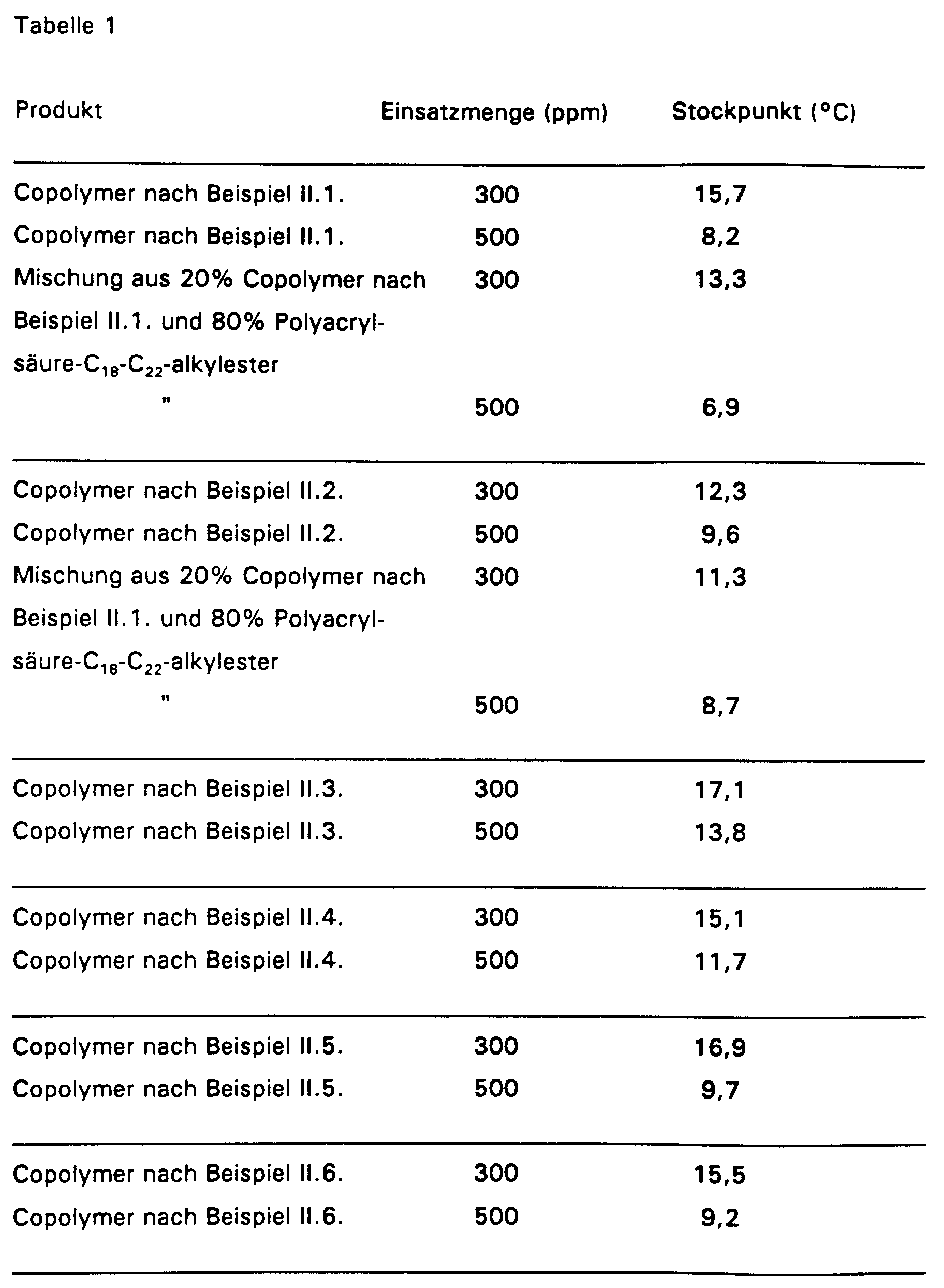

Tabelle 2 (Vergleichsbeispiele) Produkt Einsatzmenge (ppm) Eigenstockpunkt (°C) Paradyne 70® 300 25,5 Paradyne 70® 500 23,0 Paradyne 85® 300 30,6 Paradyne 85® 500 30,5 Shellswim 5 T® 300 21,3 Shellswim 5 T® 500 14,0 Shellswim 11 T® 300 20,5 Shellswim 11 T® 500 14,0 - Die in Tabelle 2 genannten Fließverbesserer sind handelsübliche Produkte der Firmen Exxon (Paradyne 70®, Paradyne 80®) und Shell (Shellswim 5 T®, Shellswim 11 T®)
Tabelle 3 Produkt Eigenstockpunkt (°C) Copolymer nach Beispiel II.1. (50%ig) 18 Copolymer nach Beispiel II.3. (40%ig) 18 Copolymer nach Beispiel II.4. (48%ig) 22 Copolymer nach Beispiel II.9. (53 %ig) 19 Copolymer nach Beispiel II.10. (57 %ig) 21
Claims (13)
- Copolymere enthaltend 50 bis 99,9 Gew.-%, bevorzugt 70 bis 99,9 Gew.-% mindestens eines wiederkehrenden Strukturelementes der Formel I

R¹ und R² unabhänig voneinander für Wasserstoff, Phenyl oder eine Gruppe der Formel COOR⁴ stehen,
R³ für Wasserstoff, Methyl oder eine Gruppe der Formel CH₂COOR⁴ steht, oder
R² und R³ zusammen für C₄-bis C₇-Alkylen stehen und
R⁴ für Wasserstoff, C₈- bis C₄₀-Alkyl oder C₈- bis C₄₀-Alkenyl steht,
mit der Maßgabe, daß wiederkehrende Strukturelemente der Formel I mindestens eine, höchstens zwei Carbonsäureeinheiten der Formeln COOR⁴, CH₂COOR⁴ in einem Strukturelement enthalten
und 0,1 bis 50 Gew.-%, bevorzugt 0,1 bis 30 Gew-% mindestens eines wiederkehrenden Strukturelementes der Formel II
R⁵ für Wasserstoff oder Methyl steht,
Z für C₁- bis C₃-Alkyl steht,
R⁸ für Wasserstoff, C₁- bis C₃₀-Alkyl, Cycloalkyl, Aryl oder -C(O)-R⁸ steht,
R⁷ für Wasserstoff, C₁- bis C₂₀-Alkyl steht,
R⁸ für C₁- bis C₃₀-Alkyl, C₃- bis C₃₀-Alkenyl, Cycloalkyl oder Aryl steht und
m eine Zahl von 1 bis 60, vorzugsweise zwischen 1 und 30 bedeutet, mit der Maßgabe, daß falls R⁶ gleich Wasserstoff ist, R¹ und R² nicht gleichzeitig Wasserstoff sind. - Copolymere nach Anspruch 1, dadurch gekennzeichnet, daß
R¹ und R² unabhängig voneinander für Wasserstoff oder eine Gruppe der Formel COOR⁴ stehen,
R⁴ für C₁₀- bis C₂₄-Alkyl steht,
R⁶ für Wasserstoff oder C₁- bis C₂₄-Alkyl steht,
R⁷ für Wasserstoff oder Methyl steht und
R⁸ für C₁- C₂₂-Alkyl oder Phenyl steht. - Copolymere nach Anspruch 1 oder 2, dadurch gekennzeichnet, daß die Eigenviskosität einer 5-Gew.-%igen Polymerlösung in Toluol, bestimmt nach Ubbelohde, zwischen 10 und 100, vorzugsweise zwischen 10 und 80 liegt.
- Paraffinhaltige Öle enthaltend Copolymere nach Anspruch 1 in einer wirksamen Menge von 10 bis 10000 Gew.-ppm, bevorzugt 50 bis 5000 Gew.-ppm.
- Verfahren zur Herstellung der Copolymeren nach Anspruch 1, dadurch gekennzeichnet, daß man 50 bis 99,9 Gew.-%, bevorzugt 70 bis 99,9 Gew.-% der Monomeren der Formel III
R¹R²C=CR³COOR⁴ (III)
und 0,1 bis 50 Gew.-%, bevorzugt 0,1 bis 30 Gew.-% der Monomeren der Formel IV
- Verfahren nach Anspruch 5, dadurch gekennzeichnet, daß man zwischen 50 bis 99,9 Gew.-%, bevorzugt zwischen 70 bis 99,9 Gew.-% der Monomere der Formel III
und 0,1 bis 50 Gew.-%, bevorzugt 0,1 bis 30 Gew.-% der Monomere der Formel IV in einem organischen Lösungsmittel löst und in Gegenwart eines Radikalstarters bei 30 bis 150°C polymerisiert. - Verwendung von Copolymeren enthaltend 50 bis 99,9 Gew.-%, bevorzugt 70 bis 99,9 Gew.-% mindestens eines wiederkehrenden Strukturelementes der Formel I

R¹ und R² unabhängig voneinander für Wasserstoff, Phenyl oder eine Gruppe der Formel COOR⁴ stehen
R³ für Wasserstoff, Methyl oder eine Gruppe der Formel CH₂COOR⁴ steht,oder
R² und R³ zusammen für C₄-bis C₇-Alkylen stehen und
R⁴ für Wasserstoff, C₈- bis C₄₀-Alkyl oder C₈- bis C₄₀-Alkenyl steht,
mit der Maßgabe, daß wiederkehrende Strukturelemente der Formel I mindestens eine, höchstens zwei Carbonsäureeinheiten der Formeln COOR⁴, CH₂COOR⁴ im wiederkehrenden Strukturelement enthalten
und 0,1 bis 50 Gew.-%, bevorzugt 0,1 bis 30 Gew-% mindestens eines wiederkehrenden Strukturelementes der Formel II
R⁵ für Wasserstoff oder Methyl steht,
Z für C₁- bis C₃-Alkyl steht,
R⁶ für Wasserstoff, C₁- bis C₃₀-Alkyl, Cycloalkyl, Aryl oder -C(O)-R⁸ steht,
R⁷ für Wasserstoff, C₁- bis C₂₀-Alkyl steht,
R⁸ für C₁- bis C₃₀-Alkyl, C₃- bis C₃₀-Alkenyl, Cycloalkyl oder Aryl steht,
m eine Zahl von 1 bis 60, vorzugsweise zwischen 1 und 30 bedeutet zur Verbesserung der Fließfähigkeit von paraffinhaltigen Ölen. - Verwendung gemäß Anspruch 7, dadurch gekennzeichnet, daß
R' und R² unabhängig voneinander für Wasserstoff oder COOR⁴ stehen,
R⁴ für C₁₀- bis C₂₄-Alkyl steht,
R⁶ für Wasserstoff oder Methyl steht,
R⁷ für Wasserstoff oder Methyl steht und
R⁸ für C₁- bis C₂₂-Alkyl oder Phenyl steht. - Verwendung gemäß Anspruch 7, dadurch gekennzeichnet, daß
R¹ und R² für Wasserstoff stehen,
R³ für Wasserstoff oder Methyl steht und
R⁶ für Wasserstoff steht. - Verwendung von Zusammensetzungen enthaltend 10 bis 90 Gew.-% eines Copolymers gemäß Anspruch 7 und 10 bis 90 Gew.-% eines Polyacrylsäure-C₈-C₂₄-alkylesters zur Verbesserung der Fließfähigkeit von paraffinhaltigen Ölen.
- Verwendung von Zusammensetzungen enthaltend 10 bis 90 Gew.-% eines Copolymers gemäß Anspruch 7 und 10 bis 90 Gew.-% eines aromatischen Lösemittels zur Verbesserung der Fließfähigkeit von paraffinhaltigen Ölen.
- Zusammensetzung enthaltend 10 bis 90 Gew.-% eines Copolymers gemäß Anspruch 7 und 10 bis 90 Gew.-% eines Polyacrylsäure-C₈-C₂₄-alkylesters.
- Zusammensetzung enthaltend 10 bis 90 Gew.-% eines Copolymers gemäß Anspruch 7 und 10 bis 90 Gew.-% eines aromatischen Lösungsmittels.
Applications Claiming Priority (2)
| Application Number | Priority Date | Filing Date | Title |
|---|---|---|---|
| DE4123795 | 1991-07-18 | ||
| DE4123795 | 1991-07-18 |
Publications (3)
| Publication Number | Publication Date |
|---|---|
| EP0523672A2 true EP0523672A2 (de) | 1993-01-20 |
| EP0523672A3 EP0523672A3 (en) | 1993-04-28 |
| EP0523672B1 EP0523672B1 (de) | 1996-10-09 |
Family
ID=6436440
Family Applications (1)
| Application Number | Title | Priority Date | Filing Date |
|---|---|---|---|
| EP92112100A Expired - Lifetime EP0523672B1 (de) | 1991-07-18 | 1992-07-15 | Copolymere aus ethylenisch ungesättigten Carbonsäureestern mit Polyoxyalkylenethern von niederen, ungesättigten Alkoholen als Fliessverbesserer für paraffinhaltige Öle |
Country Status (10)
| Country | Link |
|---|---|
| US (1) | US5718821A (de) |
| EP (1) | EP0523672B1 (de) |
| JP (1) | JPH05255452A (de) |
| AT (1) | ATE143983T1 (de) |
| AU (1) | AU649552B2 (de) |
| BR (1) | BR9202722A (de) |
| CA (1) | CA2074111A1 (de) |
| DE (1) | DE59207320D1 (de) |
| EG (1) | EG20168A (de) |
| NO (1) | NO301077B1 (de) |
Cited By (2)
| Publication number | Priority date | Publication date | Assignee | Title |
|---|---|---|---|---|
| WO2000078897A1 (de) * | 1999-06-17 | 2000-12-28 | Clariant Gmbh | Verwendung hydroxylgruppenhaltiger copolymere zur herstellung von brennstoffölen mit verbesserter schmierwirkung |
| EP1134274A3 (de) * | 2000-03-16 | 2002-03-06 | Clariant GmbH | Mischungen aus Carbonsäuren, deren Derivaten und hydroxylgruppenhaltigen polymeren, sowie deren Verwendung zur Verbesserung der Schmierwirkung von Ölen |
Families Citing this family (2)
| Publication number | Priority date | Publication date | Assignee | Title |
|---|---|---|---|---|
| DE10106147A1 (de) * | 2001-02-10 | 2002-08-14 | Clariant Gmbh | Saure Pigmentdispergatoren und Pigmentzubereitungen |
| DE102007039785A1 (de) * | 2007-08-23 | 2009-02-26 | Clariant International Ltd. | Nichtionische wasserlösliche Additive auf Allyl- und Vinyletherbasis |
Family Cites Families (12)
| Publication number | Priority date | Publication date | Assignee | Title |
|---|---|---|---|---|
| CA481657A (en) * | 1952-03-11 | Dominion Rubber Company | Copolymers of dimethallyl ether and a propenoic acid ester | |
| US2579079A (en) * | 1948-11-12 | 1951-12-18 | Us Rubber Co | Interpolymers of mono-2-alkenyl ethers of saturated monohydric alcohols or phenols with esters of saturated monohydric alcohols or phenols and alpha-unsat-urated aliphatic carboxylic acids |
| NL238305A (de) * | 1958-04-21 | |||
| GB1001475A (en) * | 1960-12-30 | 1965-08-18 | Monsanto Co | Compositions containing oil-soluble polymeric materials |
| US3904385A (en) * | 1972-05-08 | 1975-09-09 | Texaco Inc | Polyacrylates and waxy residual fuel compositions thereof |
| JPS57202311A (en) * | 1981-06-05 | 1982-12-11 | Nippon Shokubai Kagaku Kogyo Co Ltd | Novel block copolymer, its preparation and its use |
| GB8428880D0 (en) * | 1984-11-15 | 1984-12-27 | Exxon Research Engineering Co | Polyesters |
| GB8502458D0 (en) * | 1985-01-31 | 1985-03-06 | Exxon Chemical Patents Inc | Lubricating oil composition |
| DE3513550C1 (de) * | 1985-04-16 | 1986-11-06 | Th. Goldschmidt Ag, 4300 Essen | Verwendung von Copolymerisaten von Polyoxyalkylenethern des Allyl- und/oder Methallylalkohols und Acryl- oder Methacrylestern als Dismulgatoren fuer Wasser enthaltendes Erdoel |
| US4972025A (en) * | 1987-03-24 | 1990-11-20 | Nippon Shokubai Kagaku Kogyo, Co., Ltd. | Cement dispersant |
| DE3807395A1 (de) * | 1988-03-07 | 1989-09-21 | Henkel Kgaa | Verwendung ausgewaehlter copolymertypen der acryl- und/oder methacrylsaeureester als fliessverbesserer in paraffinreichen erdoelen und erdoelfraktionen (ii) |
| JP2804273B2 (ja) * | 1988-03-09 | 1998-09-24 | 株式会社メニコン | 高含水性眼用レンズ材料 |
-
1992
- 1992-07-15 AT AT92112100T patent/ATE143983T1/de active
- 1992-07-15 EP EP92112100A patent/EP0523672B1/de not_active Expired - Lifetime
- 1992-07-15 DE DE59207320T patent/DE59207320D1/de not_active Expired - Fee Related
- 1992-07-16 EG EG39692A patent/EG20168A/xx active
- 1992-07-16 JP JP4189599A patent/JPH05255452A/ja not_active Withdrawn
- 1992-07-17 CA CA002074111A patent/CA2074111A1/en not_active Abandoned
- 1992-07-17 BR BR929202722A patent/BR9202722A/pt not_active Application Discontinuation
- 1992-07-17 NO NO922854A patent/NO301077B1/no not_active IP Right Cessation
- 1992-07-17 AU AU20428/92A patent/AU649552B2/en not_active Ceased
-
1997
- 1997-03-20 US US08/821,284 patent/US5718821A/en not_active Expired - Fee Related
Cited By (4)
| Publication number | Priority date | Publication date | Assignee | Title |
|---|---|---|---|---|
| WO2000078897A1 (de) * | 1999-06-17 | 2000-12-28 | Clariant Gmbh | Verwendung hydroxylgruppenhaltiger copolymere zur herstellung von brennstoffölen mit verbesserter schmierwirkung |
| US6391071B1 (en) | 1999-06-17 | 2002-05-21 | Clariant Gmbh | Use of hydroxyl-containing copolymers for the preparation of fuel oils having improved lubricity |
| EP1134274A3 (de) * | 2000-03-16 | 2002-03-06 | Clariant GmbH | Mischungen aus Carbonsäuren, deren Derivaten und hydroxylgruppenhaltigen polymeren, sowie deren Verwendung zur Verbesserung der Schmierwirkung von Ölen |
| US6461393B1 (en) | 2000-03-16 | 2002-10-08 | Clariant Gmbh | Mixtures of carboxylic acids, their derivatives and hydroxyl-containing polymers and their use for improving the lubricating effect of oils |
Also Published As
| Publication number | Publication date |
|---|---|
| NO922854D0 (no) | 1992-07-17 |
| EP0523672B1 (de) | 1996-10-09 |
| EP0523672A3 (en) | 1993-04-28 |
| BR9202722A (pt) | 1993-03-23 |
| US5718821A (en) | 1998-02-17 |
| AU649552B2 (en) | 1994-05-26 |
| EG20168A (en) | 1997-08-31 |
| CA2074111A1 (en) | 1993-01-19 |
| NO922854L (no) | 1993-01-19 |
| ATE143983T1 (de) | 1996-10-15 |
| DE59207320D1 (de) | 1996-11-14 |
| JPH05255452A (ja) | 1993-10-05 |
| AU2042892A (en) | 1993-01-21 |
| NO301077B1 (no) | 1997-09-08 |
Similar Documents
| Publication | Publication Date | Title |
|---|---|---|
| EP0126363B1 (de) | Verwendung von Copolymeren aus Estern und Amiden der Acryl- und/oder Methacrylsäure als Stockpunkterniedriger für Paraffinlösungen | |
| EP0606055B1 (de) | Terpolymere auf Basis von alpha,beta-ungesättigten Dicarbonsäureanhydriden, alpha,beta-ungesättigten Verbindungen und Polyoxyalkylenethern von niederen, ungesättigten Alkoholen | |
| EP0271738B1 (de) | Verfahren zur Herstellung von Ethylen-Mischpolymerisaten und deren Verwendung als Zusatz zu Mineralöl und Mineralölfraktionen | |
| EP0332002B1 (de) | Verwendung ausgewählter Copolymeren der Acryl- und/oder Methacrylsäureester als Fliessverbesserer in paraffinreichen Erdölen und Erdölfraktionen (II) | |
| EP2935346B1 (de) | Polymere zusammensetzungen aus ethylen-vinylester-copolymeren alkyl(meth)acrylaten, verfahren zu deren herstellung und deren verwendung als pour-point-depressants für rohöle, mineralöle oder mineralölprodukte | |
| EP0463518B1 (de) | Terpolymerisate des Ethylens, ihre Herstellung und ihre Verwendung als Additive für Mineralöldestillate | |
| EP1433836B1 (de) | Brennstofföle mit verbesserten Kälteeigenschaften | |
| EP2935345B1 (de) | Polymerformulierungen in lösemitteln mit hohem flammpunkt, verfahren zu deren herstellung und deren verwendung als pour-point-depressants für rohöle, mineralöle oder mineralölprodukte | |
| EP0744457A2 (de) | Schmierstoffadditive | |
| EP1881053B1 (de) | Additive zur Verbesserung der Kälteeigenschaften von Brennstoffölen | |
| DE3443475A1 (de) | Terpolymerisate des ethylens, verfahren zu ihrer herstellung und ihre verwendung | |
| EP0405270B1 (de) | Verfahren zur Verbesserung der Fliessfähigkeit von Mineralölen und Mineralöldestillaten | |
| DE19901803A1 (de) | Copolymere und ihre Verwendung als Additiv zur Verbesserung der Kaltfließeigenschaften von Mitteldestillaten | |
| DE69309928T2 (de) | Ölzusätze und zusammensetzungen | |
| EP1134275B1 (de) | Copolymermischungen und ihre Verwendung als Additiv zur Verbesserung der Kaltfliesseigenschaften von Mitteldestillaten | |
| EP3394122B1 (de) | Polymerzusammensetzungen mit verbesserter handhabbarkeit | |
| EP0332000B1 (de) | Verwendung ausgewählter Copolymertypen der Acryl- und/oder Methacrylsäureester als Fliessverbesserer in paraffinreichen Erdölen und Erdölfraktionen (I) | |
| EP0523672B1 (de) | Copolymere aus ethylenisch ungesättigten Carbonsäureestern mit Polyoxyalkylenethern von niederen, ungesättigten Alkoholen als Fliessverbesserer für paraffinhaltige Öle | |
| DE3513356A1 (de) | Neue ester ungesaettigter polymerisierbarer carbonsaeuren, daraus gewonnene oelloesliche homo- und copolymere, verfahren zu ihrer herstellung und ihre verwendung als stockpunktserniedriger | |
| EP0190553B1 (de) | Verfahren zur Verbesserung der Fliessfähigkeit von Mineralölen und Mineralöldestillaten | |
| DE3237308A1 (de) | Neue copolymerisate verfahren zu ihrer herstellung und ihre verwendung | |
| EP0376138B1 (de) | Neue Copolymere, deren Mischungen mit Poly(meth)acrylsäureestern und deren Verwendung zur Verbesserung der Fliessfähigkeit von Rohölen in der Kälte | |
| DE1165858B (de) | Verfahren zur Herstellung von Mischpolymerisaten aus monomeren Estern von polymerisierbaren AEthylencarbonsaeuren | |
| EP3798261A1 (de) | Polymerzusammensetzungen und ihre verwendung als pour point depressant in paraffinhaltigen kohlenwasserstoffölen | |
| EP0925274B1 (de) | Fliessverbesserer für erdöl-mitteldestillate |
Legal Events
| Date | Code | Title | Description |
|---|---|---|---|
| PUAI | Public reference made under article 153(3) epc to a published international application that has entered the european phase |
Free format text: ORIGINAL CODE: 0009012 |
|
| AK | Designated contracting states |
Kind code of ref document: A2 Designated state(s): AT DE FR GB IT NL |
|
| PUAL | Search report despatched |
Free format text: ORIGINAL CODE: 0009013 |
|
| AK | Designated contracting states |
Kind code of ref document: A3 Designated state(s): AT DE FR GB IT NL |
|
| 17P | Request for examination filed |
Effective date: 19940112 |
|
| 17Q | First examination report despatched |
Effective date: 19950123 |
|
| GRAH | Despatch of communication of intention to grant a patent |
Free format text: ORIGINAL CODE: EPIDOS IGRA |
|
| GRAA | (expected) grant |
Free format text: ORIGINAL CODE: 0009210 |
|
| AK | Designated contracting states |
Kind code of ref document: B1 Designated state(s): AT DE FR GB IT NL |
|
| REF | Corresponds to: |
Ref document number: 143983 Country of ref document: AT Date of ref document: 19961015 Kind code of ref document: T |
|
| REF | Corresponds to: |
Ref document number: 59207320 Country of ref document: DE Date of ref document: 19961114 |
|
| ITF | It: translation for a ep patent filed | ||
| GBT | Gb: translation of ep patent filed (gb section 77(6)(a)/1977) |
Effective date: 19961213 |
|
| ET | Fr: translation filed | ||
| PGFP | Annual fee paid to national office [announced via postgrant information from national office to epo] |
Ref country code: FR Payment date: 19970619 Year of fee payment: 6 |
|
| PGFP | Annual fee paid to national office [announced via postgrant information from national office to epo] |
Ref country code: NL Payment date: 19970630 Year of fee payment: 6 |
|
| PGFP | Annual fee paid to national office [announced via postgrant information from national office to epo] |
Ref country code: AT Payment date: 19970710 Year of fee payment: 6 |
|
| PLBE | No opposition filed within time limit |
Free format text: ORIGINAL CODE: 0009261 |
|
| STAA | Information on the status of an ep patent application or granted ep patent |
Free format text: STATUS: NO OPPOSITION FILED WITHIN TIME LIMIT |
|
| 26N | No opposition filed | ||
| PG25 | Lapsed in a contracting state [announced via postgrant information from national office to epo] |
Ref country code: AT Free format text: LAPSE BECAUSE OF NON-PAYMENT OF DUE FEES Effective date: 19980715 |
|
| PG25 | Lapsed in a contracting state [announced via postgrant information from national office to epo] |
Ref country code: NL Free format text: LAPSE BECAUSE OF NON-PAYMENT OF DUE FEES Effective date: 19990201 |
|
| PG25 | Lapsed in a contracting state [announced via postgrant information from national office to epo] |
Ref country code: FR Free format text: LAPSE BECAUSE OF NON-PAYMENT OF DUE FEES Effective date: 19990331 |
|
| NLV4 | Nl: lapsed or anulled due to non-payment of the annual fee |
Effective date: 19990201 |
|
| REG | Reference to a national code |
Ref country code: FR Ref legal event code: ST |
|
| REG | Reference to a national code |
Ref country code: GB Ref legal event code: 732E |
|
| PGFP | Annual fee paid to national office [announced via postgrant information from national office to epo] |
Ref country code: DE Payment date: 20010620 Year of fee payment: 10 |
|
| PGFP | Annual fee paid to national office [announced via postgrant information from national office to epo] |
Ref country code: GB Payment date: 20010626 Year of fee payment: 10 |
|
| REG | Reference to a national code |
Ref country code: GB Ref legal event code: IF02 |
|
| PG25 | Lapsed in a contracting state [announced via postgrant information from national office to epo] |
Ref country code: GB Free format text: LAPSE BECAUSE OF NON-PAYMENT OF DUE FEES Effective date: 20020715 |
|
| PG25 | Lapsed in a contracting state [announced via postgrant information from national office to epo] |
Ref country code: DE Free format text: LAPSE BECAUSE OF NON-PAYMENT OF DUE FEES Effective date: 20030201 |
|
| GBPC | Gb: european patent ceased through non-payment of renewal fee |
Effective date: 20020715 |
|
| PG25 | Lapsed in a contracting state [announced via postgrant information from national office to epo] |
Ref country code: IT Free format text: LAPSE BECAUSE OF NON-PAYMENT OF DUE FEES;WARNING: LAPSES OF ITALIAN PATENTS WITH EFFECTIVE DATE BEFORE 2007 MAY HAVE OCCURRED AT ANY TIME BEFORE 2007. THE CORRECT EFFECTIVE DATE MAY BE DIFFERENT FROM THE ONE RECORDED. Effective date: 20050715 |