EP0524710A2 - Ustensile de table en métal - Google Patents
Ustensile de table en métal Download PDFInfo
- Publication number
- EP0524710A2 EP0524710A2 EP92250179A EP92250179A EP0524710A2 EP 0524710 A2 EP0524710 A2 EP 0524710A2 EP 92250179 A EP92250179 A EP 92250179A EP 92250179 A EP92250179 A EP 92250179A EP 0524710 A2 EP0524710 A2 EP 0524710A2
- Authority
- EP
- European Patent Office
- Prior art keywords
- cutlery
- part according
- cutlery part
- spoon
- bowl
- Prior art date
- Legal status (The legal status is an assumption and is not a legal conclusion. Google has not performed a legal analysis and makes no representation as to the accuracy of the status listed.)
- Granted
Links
Images


Classifications
-
- B—PERFORMING OPERATIONS; TRANSPORTING
- B22—CASTING; POWDER METALLURGY
- B22F—WORKING METALLIC POWDER; MANUFACTURE OF ARTICLES FROM METALLIC POWDER; MAKING METALLIC POWDER; APPARATUS OR DEVICES SPECIALLY ADAPTED FOR METALLIC POWDER
- B22F5/00—Manufacture of workpieces or articles from metallic powder characterised by the special shape of the product
-
- A—HUMAN NECESSITIES
- A47—FURNITURE; DOMESTIC ARTICLES OR APPLIANCES; COFFEE MILLS; SPICE MILLS; SUCTION CLEANERS IN GENERAL
- A47G—HOUSEHOLD OR TABLE EQUIPMENT
- A47G21/00—Table-ware
Definitions
- the invention relates to one-piece cutlery parts made of metal, in particular tableware, such as knives, forks, spoons.
- the manufacturing processes for the production of cutlery made of nickel silver, which are silvered, and for cutlery made of chrome-nickel steel are roughly the same.
- Fork and spoon cutlery are cut in one piece from sheet steel. These pre-cuts, called brandeln, have to be deburred and rolled. The brandeln for the production of spoon cutlery parts must be rolled down to a smaller material thickness in the area of the bowl to be formed later. Afterwards fork and spoon brandies have to be cut to size according to the model. Washing and glowing operations follow before the cutlery parts get their shape and decor through the embossing process.
- the embossing process creates an inevitable burr on the "high edge" of the cutlery. This burr has to be sanded, only then can the grinding and polishing operations for leveling the surface and for producing the gloss on the surface take place.
- a The washing process then completes the steps for the manufacture of cutlery items made of chrome-nickel steel. With silver-plated cutlery, silvering follows.
- the knife booklet is welded together from two half-shells that were previously formed from a sheet metal strip.
- the blade is fastened in the hollow knife handle part, preferably by welding or cementing. With this type of knife, the handle is made from a surface-finishable chrome-nickel steel.
- the blade is made of hardened, elastic, stainless steel.
- a one-piece knife is produced from a hardenable chrome-nickel steel by rolling and / or forging.
- the forging process cannot achieve the same or similar decors as an embossing process.
- the forging process is also very complex, especially because the surface has to be polished afterwards. Fine decors cannot be achieved here. These introduced during forging would be ground down again during the grinding operation.
- Monoblock knives can therefore only be provided with very simple decors.
- the matching spoons and forks, derived from them, can only be given simple decors.
- the object of the invention is to provide cutlery parts made of stainless steel, which are manufactured by powder metallurgy, allow a simple and economical production method and, in addition to the usual simple designs, require little or no restrictions with regard to their shape and type of design options.
- the invention relates to new cutlery items of the type characterized in the characterizing part of claim 1 and having advantageous and / or expedient refinements specified in subclaims 2 to 17.
- cutlery parts according to the invention are comparatively less technically complex to manufacture, extremely variable in shape and allow - with unchanged good, partly improved usage properties - any new cutlery designs which are advantageous and expedient for increasingly internationalized eating habits. Cutlery parts according to the invention give every possibility for fashionable innovations and progressive designs.
- Known working methods are, for example, hot forging metal powders or metal powder mixtures filled in sheet metal capsules, isostatic compression, explosion compacting of metal powders or metal powder mixtures and Mold casting or extrusion or injection molding of metal powder mixtures pasted or kneaded with temporary binders and subsequent removal of the binder from the "green body” and sintering of the green body.
- the metal powders can be introduced into sheet metal capsules designed in accordance with the cutlery parts to be produced, these can be evacuated, the powder mixture mechanically compacted and then sintered in the closed capsules.
- Special tools are used to compact metal powders, in particular in the form of slender structures such as cutlery items; e.g. can be ensured by spring force, hydraulic and / or pneumatic cylinder, a safe positioning of the die, and it can be controlled the die speed during the upsetting process in relation to the movable punch so that the slim moves the die at a predetermined speed when the upper punch goes down .
- the metal powder mixture in the sheet metal capsules can also be subjected to a forging and sintering process in special forging machines or compacted by rolling and then removed from the mold.
- the sheet metal capsule material can be reused.
- MIM method metal injection molding
- the so-called MIM method is also advantageous for the production of cutlery parts according to the invention with a complicated shape, for example, for example, a special decorative design of the cutlery handles or the formation of particularly “exotic” cutlery shapes.
- the metal powder is plasticized Binder or binder mixture is mixed, e.g.
- the kneading compound or slurry is degassed and brought into a shape corresponding to the cutlery to be manufactured, for example poured into a die or by extrusion or injection molding (so-called PM injection molding) Shaped appropriately trained injection mold, then the binder is removed from the green body, this is sintered and / or compacted and the finished cutlery is obtained.
- the starting materials for cutlery items according to the invention are commercially available.
- Metal powders of different types of metal are available on the market in different particle sizes and grain shapes, in particular in spherical and speckled grain shapes with relatively small particle sizes.
- such metal powders with the small particle sizes up to about 60 ⁇ m are well usable for cutlery items according to the invention.
- Metal powders with particle sizes up to 20 ⁇ m are especially recommended for the manufacture of cutlery items according to the invention by the injection molding process.
- the special composition of the starting metal powder for the production of cutlery parts according to the invention depends on the properties specifically desired for the finished cutlery parts. Unlike with conventional sheet metal material, it is possible with metal powder mixtures as the starting material to achieve alloys that cannot be produced in the normal melting process and thus to achieve material properties of the cutlery parts according to the invention that are adapted to the intended uses.
- the cutlery part properties for cutlery parts according to the invention can be influenced in a comparatively wide range by the composition of the metal powder mixtures used for the production.
- the metal composition is no longer restricted to alloy phases.
- Largely variable chemical compositions can be formed by powder metallurgy, and the shape, size and mixing ratio of differently shaped powder particles can influence the properties in the finished cutlery during its manufacture.
- One-piece cutlery parts according to the invention can have two or more different alloy compositions over their longitudinal extent.
- One-piece knife-cutlery parts according to the invention are particularly advantageous, the blade parts of which have a higher hardness than their shaft part.
- cutlery items according to the invention can also have a partially desired porosity and have a decorative coating, at least partially, for example on the handle portion.
- Cutlery parts according to the invention can have plastic functional and / or decorative elements that cannot be produced by sheet metal technology using industrial manufacturing methods at any point on the cutlery surface. And they can be surface-treated in a manner known per se, for example provided with a detector by painting or enamelling.
- the surfaces of cutlery items according to the invention can advantageously be partially decorated in accordance with the process described in DE-PS 12 98 384 by the applicant. You can silver in a manner known per se. Cutlery parts according to the invention require a small amount of material in their production because, in contrast to sheet metal production, there is practically no waste in the course of processing.
- the powder mixture was filled into a spoon-shaped press mold and pressed on both sides by means of a press pressure of approx. 6500 bar.
- Spoon green body was obtained, which was sintered in a hydrogen atmosphere at a sintering temperature of 1300 ° C. for three hours.
- the density after sintering was 92% of the theoretical density. It was then densified with the original molding pressure and again sintered for two hours at 1300 o C in a hydrogen atmosphere. This gave a sintered metal spoon with a density of 96% of the theoretical density.
- the sintered metal spoon obtained in this way was degreased with acetone to remove surface contamination, dried at 80 ° C., washed with ammonia water and dried in vacuo at 150 ° C. It was then mechanically finished.
- the spoon thus obtained had excellent usage properties, was scratch-resistant and corrosion-resistant.
- a metal powder mixture of the following composition and particle size distribution was used to produce a spoon: 18 parts of ferrochrome Grain size 10 - 30 ⁇ m 6% Cr, 0.2% C, 0.05% Si, balance Fe 9 parts of carbonyl nickel Grain size 0.5 - 10 ⁇ m 73 parts of carbonyl iron Grain size 0.5 - 10 ⁇ m.
- the melting and homogenization process is controlled by the speed of the screw.
- the mixing length ie the screw length of the homogenizing extruder, calculated from the powder metal mass feed opening, was 12 D.
- the homogenized powder-binder melt then went into the cooling extruder, which had a degassing device by means of which the solvent present in the melt was removed.
- the binder was then heated from the demolded spoon body (green body), which consisted of 63% by volume powder metal and 37% by volume binder and was practically non-porous. For this, the green compact was placed in a continuous furnace with a heating rate of 15 o C / min.
- the binder-free spoon body was then sintered in a sintering furnace for 10 hours under a pressure of 0.01 mb at 1260 ° C. and then slowly cooled to room temperature.
- the spoon obtained in this way could be finished with conventional mechanical post-processing and had an excellent appearance and very good usage properties.
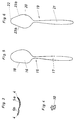
- the contour edge 4 of the bowl 2 forms a curve which has cracks. This curve consists of a total of three individual curves that do not continuously adjoin each other.
- the bowl 2 has depressions 5 on its front side. As can be seen from FIG. 3, the dimensions of one recess 5a are larger than the other recess 5b. In addition, as can be clearly seen in FIG. 3, the thickness distribution of the bowl is discontinuous.
- the bowl near the contour edge 4 is thicker than in the recess part running towards the center of the bowl, and in the recess 5a, the material thickness at the contour edge 4 is weaker than in the center of the bowl.
- the bowl 2, as shown in FIG. 1, also has an engraving 6 on its front, which serves for decorative design, but at the same time also contributes to the identification of the different recesses 5 of the bowl 2.
- the different thickness of the spoon improves the usability of the spoon. Due to the different, delimited recesses 5a and 5b, it is possible to separate dishes on this spoon, so that dishes in the spoon can be stripped separately from the lips, for example liquids and solids.
- a three-leaf opening 7 is provided in the spoon 1.
- This breakthrough is for decorative purposes. However, it can also be used to allow liquid to drain from the spoon 2 in the particular handling position of the spoon.
- This opening 7 is harmoniously followed on the one hand by the engraving 8 and on the other hand by the curved lines of the stem neck 9.
- the stem 3 offers an all-round view. It is designed on all sides with merging structured elements. From the stem neck 9, the stem 3 extends in a tapered profile 10 to the handle part 11.
- the profile 10, as illustrated in FIG. 4 has a shape in its cut surface which is irregularly formed by various curves and undercuts. Both the cross-section and the shape of the profile 10 change over the length of the profile.
- the handle part 11 increases discontinuously in its cross-section up to the handle end 13.
- the profile 12 of the handle part 11 results up to the stem end 13, beveled by a cut running at an angle to the longitudinal axis of the stem.
- oval openings 14 are provided in the grip part 11.
- the spoon 15 shown in FIG. 5 consists in one piece of a bowl 16 and a handle 17 and, according to the material, of sintered metal made of stainless steel. It was manufactured using powder metallurgy.
- the bowl 16 is formed on one side with a straight edge 18. With such a spoon according to the invention, dishes, especially liquids, can advantageously be taken from a plate.
- the material distribution in the cross section of the bowl 16 is discontinuous. The thickness of the bowl is thinner on the straight edge 18 than on the opposite side. With this type of material distribution, the spoon is also suitable for being able to share food more easily.
- FIG. 6 shows a spoon cutlery part 19 made of stainless sintered steel in one piece and made of a bowl 20 and a handle 21 in a conical bowl shape with roundings on the bowl tip 22.
- this cup 20 there are approximately straight side edges 23a and 23b on both sides, which bring about the same use effect as previously described in connection with the design according to FIG. 5.
- FIGS. 7 to 10 Further novel creative bowl shapes which could not be produced industrially with conventional spoon cutlery parts are shown in FIGS. 7 to 10.
- the bowls 24, 26 and 29 shown in FIGS. 7, 8 and 9 have an advantageously thin bowl material, as a result of which very light cutlery items are created.
- the required stability in use is ensured according to the embodiments of FIGS. 7 and 8 by edge reinforcements 25 and 27, so that the cutlery parts according to the invention thus formed are stable in use despite the thin material thickness of the bowl due to the thickened and rounded rim of the bowl.
- the bowl 26 is designed to be pulled up laterally on one side.
- the rim of the cup 28 does not run in one plane, which also has an advantageous effect on the properties of use.
- the light-weight cup 29 made of very thin material shown in FIG. 9 has an unreinforced, but angled cup edge 30 which ensures the required stability in use and is not unpleasant to handle and use.
- FIG. 10 shows a spoon shape of a cutlery part according to the invention made of sintered metal, which is made in one piece from the bowl 31 and the handle 33, the handle 33 already starting at the side edge 32 of the bowl and / or the bowl 34 increasing in thickness and continuously in its part 34 facing the handle turns into a thickened stem neck.
- cutlery parts such as a spoon, fork or knife
- cutlery parts such as a spoon, fork or knife
- Cutlery items according to the invention which are manufactured by powder metallurgy, can be finished by a polishing operation in such a way that they have the same surface quality as a previously customary cutlery item, which was manufactured and polished from sheet metal material.
Landscapes
- Engineering & Computer Science (AREA)
- Manufacturing & Machinery (AREA)
- Mechanical Engineering (AREA)
- Table Equipment (AREA)
- Powder Metallurgy (AREA)
- Valve-Gear Or Valve Arrangements (AREA)
- Baking, Grill, Roasting (AREA)
Applications Claiming Priority (2)
| Application Number | Priority Date | Filing Date | Title |
|---|---|---|---|
| DE4124393 | 1991-07-23 | ||
| DE4124393A DE4124393A1 (de) | 1991-07-23 | 1991-07-23 | Besteckteile aus metall |
Publications (3)
| Publication Number | Publication Date |
|---|---|
| EP0524710A2 true EP0524710A2 (fr) | 1993-01-27 |
| EP0524710A3 EP0524710A3 (fr) | 1994-03-02 |
| EP0524710B1 EP0524710B1 (fr) | 1997-01-29 |
Family
ID=6436831
Family Applications (1)
| Application Number | Title | Priority Date | Filing Date |
|---|---|---|---|
| EP92250179A Expired - Lifetime EP0524710B1 (fr) | 1991-07-23 | 1992-07-09 | Ustensile de table en métal |
Country Status (7)
| Country | Link |
|---|---|
| EP (1) | EP0524710B1 (fr) |
| JP (1) | JPH05230506A (fr) |
| AT (1) | ATE148318T1 (fr) |
| DE (3) | DE9116669U1 (fr) |
| DK (1) | DK0524710T3 (fr) |
| ES (1) | ES2099201T3 (fr) |
| GR (1) | GR3023273T3 (fr) |
Cited By (5)
| Publication number | Priority date | Publication date | Assignee | Title |
|---|---|---|---|---|
| EP0609502A1 (fr) * | 1993-02-03 | 1994-08-10 | Elektro- und Gas-Armaturen-Fabrik GmbH | Procédé pour fabriquer une pièce métallique par frittage |
| WO1995019861A1 (fr) * | 1994-01-19 | 1995-07-27 | Söderfors Powder Aktiebolag | Procede trouvant application dans la fabrication d'un produit metallique composite |
| EP0701875A1 (fr) * | 1994-09-15 | 1996-03-20 | Basf Aktiengesellschaft | Procédé de préparation d'articles métalliques par moulage par injection |
| WO2000069587A3 (fr) * | 1999-05-19 | 2001-04-05 | Allied Signal Inc | Moulage par injection a basse pression d'articles de table plats a partir de matieres premieres metalliques |
| CN100353199C (zh) * | 2002-08-10 | 2007-12-05 | 艾姆特利英国有限公司 | 信号传输线缆 |
Families Citing this family (2)
| Publication number | Priority date | Publication date | Assignee | Title |
|---|---|---|---|---|
| DE102009004675A1 (de) | 2009-01-12 | 2010-07-15 | Carl Mertens Besteckfabrik Gmbh | Besteckteil mit Dekor |
| JP2011030729A (ja) * | 2009-07-31 | 2011-02-17 | Combi Corp | 液体摂取用スプーン |
Family Cites Families (10)
| Publication number | Priority date | Publication date | Assignee | Title |
|---|---|---|---|---|
| CH148057A (fr) * | 1930-02-27 | 1931-07-15 | Kramer Paul | Couvert de table. |
| FR764140A (fr) * | 1933-11-22 | 1934-05-15 | Jakob Bischoff Aktien Ges | Cuiller d'office à tous usages |
| CH216263A (de) * | 1940-08-08 | 1941-08-15 | Niklaus Waldesbuehl Paul | Löffel. |
| FR1426656A (fr) * | 1965-03-12 | 1966-01-28 | Neuzeughammer Ambosswerk Messe | Cuiller à bouche |
| DD110782A1 (fr) * | 1974-04-29 | 1975-01-12 | ||
| US4425711A (en) * | 1979-06-29 | 1984-01-17 | Wood Geraldine E | Double-ended doubly-concaved baby spoon |
| JPS6048472B2 (ja) * | 1981-07-09 | 1985-10-28 | 東レ株式会社 | ジルコニア焼結体 |
| DE3135034C2 (de) * | 1981-09-04 | 1984-02-23 | Degussa Ag, 6000 Frankfurt | Werkstoff für Schmuck- und Gebrauchsgegenstände und Verfahren zu seiner Herstellung |
| JPS5883914A (ja) * | 1981-11-16 | 1983-05-19 | 東レ株式会社 | 食器具 |
| EP0520465B1 (fr) * | 1991-06-27 | 1996-12-27 | Kyocera Corporation | Alliage fritté de couleur dorée |
-
1991
- 1991-07-23 DE DE9116669U patent/DE9116669U1/de not_active Expired - Lifetime
- 1991-07-23 DE DE4124393A patent/DE4124393A1/de active Granted
-
1992
- 1992-06-29 JP JP4171161A patent/JPH05230506A/ja active Pending
- 1992-07-09 ES ES92250179T patent/ES2099201T3/es not_active Expired - Lifetime
- 1992-07-09 DK DK92250179.6T patent/DK0524710T3/da active
- 1992-07-09 DE DE59207977T patent/DE59207977D1/de not_active Expired - Fee Related
- 1992-07-09 EP EP92250179A patent/EP0524710B1/fr not_active Expired - Lifetime
- 1992-07-09 AT AT92250179T patent/ATE148318T1/de not_active IP Right Cessation
-
1997
- 1997-04-24 GR GR970400934T patent/GR3023273T3/el unknown
Cited By (8)
| Publication number | Priority date | Publication date | Assignee | Title |
|---|---|---|---|---|
| EP0609502A1 (fr) * | 1993-02-03 | 1994-08-10 | Elektro- und Gas-Armaturen-Fabrik GmbH | Procédé pour fabriquer une pièce métallique par frittage |
| WO1995019861A1 (fr) * | 1994-01-19 | 1995-07-27 | Söderfors Powder Aktiebolag | Procede trouvant application dans la fabrication d'un produit metallique composite |
| US5815790A (en) * | 1994-01-19 | 1998-09-29 | Soderfors Powder Aktiebolag | Method relating to the manufacturing of a composite metal product |
| RU2127195C1 (ru) * | 1994-01-19 | 1999-03-10 | Седерфорс Паудер Актиеболаг | Способ изготовления композитного металлического изделия |
| EP0701875A1 (fr) * | 1994-09-15 | 1996-03-20 | Basf Aktiengesellschaft | Procédé de préparation d'articles métalliques par moulage par injection |
| US5737683A (en) * | 1994-09-15 | 1998-04-07 | Basf Aktiengesellschaft | Process for producing metallic shaped parts by powder injection molding |
| WO2000069587A3 (fr) * | 1999-05-19 | 2001-04-05 | Allied Signal Inc | Moulage par injection a basse pression d'articles de table plats a partir de matieres premieres metalliques |
| CN100353199C (zh) * | 2002-08-10 | 2007-12-05 | 艾姆特利英国有限公司 | 信号传输线缆 |
Also Published As
| Publication number | Publication date |
|---|---|
| DE59207977D1 (de) | 1997-03-13 |
| GR3023273T3 (en) | 1997-07-30 |
| EP0524710B1 (fr) | 1997-01-29 |
| EP0524710A3 (fr) | 1994-03-02 |
| ATE148318T1 (de) | 1997-02-15 |
| JPH05230506A (ja) | 1993-09-07 |
| DE4124393C2 (fr) | 1993-05-27 |
| DE4124393A1 (de) | 1993-01-28 |
| ES2099201T3 (es) | 1997-05-16 |
| DE9116669U1 (de) | 1993-06-17 |
| DK0524710T3 (da) | 1997-07-21 |
Similar Documents
| Publication | Publication Date | Title |
|---|---|---|
| DE3740547C2 (de) | Verfahren zum Herstellen von Extruderschnecken und damit hergestellte Extruderschnecken | |
| DE19800689C1 (de) | Formkörper aus einem verschleißfesten Werkstoff | |
| DE69521292T2 (de) | Verfahren zur herstellung einer schichtwerkstoffen aus metall | |
| DE4211319C2 (de) | Verfahren zur Herstellung von Sintereisen-Formteilen mit porenfreier Zone | |
| DE2912861C2 (de) | Verfahren zur Herstellung eines Sinterhartmetallkörpers | |
| DE2219856B2 (de) | Verfahren zum Herstellen von in einem Arbeitsgang geschmiedeten Sinterschmiedewerkstücken | |
| EP0426101B1 (fr) | Elément de cylindre d'une extrudeuse pour un dispositif à deux vis et procédé de fabrication | |
| DE69230194T2 (de) | Aussenteil einer Uhr | |
| DE69203962T2 (de) | Verfahren zur herstellung eines harten sinterkörpers. | |
| DE2828308A1 (de) | Verfahren zur herstellung von titancarbid-wolframcarbid-hartstoffen | |
| DE4318512C2 (de) | Verfahren und Vorrichtung zum Extrudieren von pulverförmigem Material | |
| EP0524710B1 (fr) | Ustensile de table en métal | |
| EP0217807B1 (fr) | Procede de frittage | |
| DE102004002714B3 (de) | Verfahren zum Leichtmetall-Legierungs-Sintern | |
| DE3043321A1 (de) | Sinterprodukt aus metall-legierung und dessen herstellung | |
| DE1301017B (de) | Verfahren zum Verhindern des Werfens bei der pulvermetallurgischen Herstellung von schlanken Formkoerpern | |
| EP1281459A2 (fr) | Procédé et dispositif de thixomoulage par injection pour la fabrication de pièces métalliques | |
| DE19745283C2 (de) | Verfahren zur Herstellung von Bauteilen aus Pulvern | |
| DE2363881B2 (de) | Dekorative Aluminium-Erzeugnisse und Verfahren zu ihrer Herstellung | |
| DE3643016C1 (de) | Verfahren zur Herstellung von Bloecken oder Profilen | |
| DE2645864A1 (de) | Verfahren zur herstellung von aluminiumoxidfaser-verstaerkten aluminiumverbundwerkstoffen | |
| AT242964B (de) | Pulvermetallurgische Mischung und Verfahren zur Herstellung von Formkörpern | |
| DE1144573B (de) | Verfahren zum gleichzeitigen Strangpressen und Plattieren von gesinterten Presslingen aus aluminiumoxydhaltigen Aluminiumpulver oder dessen Legierungen | |
| DE2255505A1 (de) | Sinterhartmetalle | |
| DE3904494C1 (fr) |
Legal Events
| Date | Code | Title | Description |
|---|---|---|---|
| PUAI | Public reference made under article 153(3) epc to a published international application that has entered the european phase |
Free format text: ORIGINAL CODE: 0009012 |
|
| AK | Designated contracting states |
Kind code of ref document: A2 Designated state(s): AT BE CH DE DK ES FR GB GR IT LI LU MC NL PT SE |
|
| 17P | Request for examination filed |
Effective date: 19930623 |
|
| PUAL | Search report despatched |
Free format text: ORIGINAL CODE: 0009013 |
|
| AK | Designated contracting states |
Kind code of ref document: A3 Designated state(s): AT BE CH DE DK ES FR GB GR IT LI LU MC NL PT SE |
|
| 17Q | First examination report despatched |
Effective date: 19951116 |
|
| GRAG | Despatch of communication of intention to grant |
Free format text: ORIGINAL CODE: EPIDOS AGRA |
|
| GRAH | Despatch of communication of intention to grant a patent |
Free format text: ORIGINAL CODE: EPIDOS IGRA |
|
| GRAH | Despatch of communication of intention to grant a patent |
Free format text: ORIGINAL CODE: EPIDOS IGRA |
|
| GRAA | (expected) grant |
Free format text: ORIGINAL CODE: 0009210 |
|
| AK | Designated contracting states |
Kind code of ref document: B1 Designated state(s): AT BE CH DE DK ES FR GB GR IT LI LU MC NL PT SE |
|
| REF | Corresponds to: |
Ref document number: 148318 Country of ref document: AT Date of ref document: 19970215 Kind code of ref document: T |
|
| REG | Reference to a national code |
Ref country code: CH Ref legal event code: EP |
|
| GBT | Gb: translation of ep patent filed (gb section 77(6)(a)/1977) |
Effective date: 19970131 |
|
| REF | Corresponds to: |
Ref document number: 59207977 Country of ref document: DE Date of ref document: 19970313 |
|
| ET | Fr: translation filed | ||
| ITF | It: translation for a ep patent filed | ||
| REG | Reference to a national code |
Ref country code: ES Ref legal event code: FG2A Ref document number: 2099201 Country of ref document: ES Kind code of ref document: T3 |
|
| REG | Reference to a national code |
Ref country code: PT Ref legal event code: SC4A Free format text: AVAILABILITY OF NATIONAL TRANSLATION Effective date: 19970325 Ref country code: GR Ref legal event code: FG4A Free format text: 3023273 |
|
| REG | Reference to a national code |
Ref country code: DK Ref legal event code: T3 |
|
| PLBE | No opposition filed within time limit |
Free format text: ORIGINAL CODE: 0009261 |
|
| 26N | No opposition filed | ||
| PGFP | Annual fee paid to national office [announced via postgrant information from national office to epo] |
Ref country code: PT Payment date: 19990622 Year of fee payment: 8 |
|
| PGFP | Annual fee paid to national office [announced via postgrant information from national office to epo] |
Ref country code: MC Payment date: 19990626 Year of fee payment: 8 |
|
| PGFP | Annual fee paid to national office [announced via postgrant information from national office to epo] |
Ref country code: CH Payment date: 19990628 Year of fee payment: 8 |
|
| PGFP | Annual fee paid to national office [announced via postgrant information from national office to epo] |
Ref country code: LU Payment date: 19990629 Year of fee payment: 8 Ref country code: GR Payment date: 19990629 Year of fee payment: 8 |
|
| PGFP | Annual fee paid to national office [announced via postgrant information from national office to epo] |
Ref country code: ES Payment date: 19990708 Year of fee payment: 8 Ref country code: AT Payment date: 19990708 Year of fee payment: 8 |
|
| PGFP | Annual fee paid to national office [announced via postgrant information from national office to epo] |
Ref country code: DK Payment date: 19990729 Year of fee payment: 8 |
|
| PGFP | Annual fee paid to national office [announced via postgrant information from national office to epo] |
Ref country code: NL Payment date: 19990730 Year of fee payment: 8 |
|
| PG25 | Lapsed in a contracting state [announced via postgrant information from national office to epo] |
Ref country code: LU Free format text: LAPSE BECAUSE OF NON-PAYMENT OF DUE FEES Effective date: 20000709 Ref country code: DK Free format text: LAPSE BECAUSE OF NON-PAYMENT OF DUE FEES Effective date: 20000709 Ref country code: AT Free format text: LAPSE BECAUSE OF NON-PAYMENT OF DUE FEES Effective date: 20000709 |
|
| PG25 | Lapsed in a contracting state [announced via postgrant information from national office to epo] |
Ref country code: ES Free format text: LAPSE BECAUSE OF NON-PAYMENT OF DUE FEES Effective date: 20000710 |
|
| PG25 | Lapsed in a contracting state [announced via postgrant information from national office to epo] |
Ref country code: MC Free format text: THE PATENT HAS BEEN ANNULLED BY A DECISION OF A NATIONAL AUTHORITY Effective date: 20000731 Ref country code: LI Free format text: LAPSE BECAUSE OF NON-PAYMENT OF DUE FEES Effective date: 20000731 Ref country code: GR Free format text: LAPSE BECAUSE OF NON-PAYMENT OF DUE FEES Effective date: 20000731 Ref country code: CH Free format text: LAPSE BECAUSE OF NON-PAYMENT OF DUE FEES Effective date: 20000731 |
|
| PGFP | Annual fee paid to national office [announced via postgrant information from national office to epo] |
Ref country code: DE Payment date: 20000906 Year of fee payment: 9 |
|
| PGFP | Annual fee paid to national office [announced via postgrant information from national office to epo] |
Ref country code: GB Payment date: 20000915 Year of fee payment: 9 |
|
| PGFP | Annual fee paid to national office [announced via postgrant information from national office to epo] |
Ref country code: SE Payment date: 20000918 Year of fee payment: 9 |
|
| PGFP | Annual fee paid to national office [announced via postgrant information from national office to epo] |
Ref country code: FR Payment date: 20000919 Year of fee payment: 9 |
|
| PGFP | Annual fee paid to national office [announced via postgrant information from national office to epo] |
Ref country code: BE Payment date: 20001020 Year of fee payment: 9 |
|
| PG25 | Lapsed in a contracting state [announced via postgrant information from national office to epo] |
Ref country code: PT Free format text: LAPSE BECAUSE OF NON-PAYMENT OF DUE FEES Effective date: 20010131 |
|
| PG25 | Lapsed in a contracting state [announced via postgrant information from national office to epo] |
Ref country code: NL Free format text: LAPSE BECAUSE OF NON-PAYMENT OF DUE FEES Effective date: 20010201 |
|
| REG | Reference to a national code |
Ref country code: CH Ref legal event code: PL |
|
| REG | Reference to a national code |
Ref country code: DK Ref legal event code: EBP |
|
| NLV4 | Nl: lapsed or anulled due to non-payment of the annual fee |
Effective date: 20010201 |
|
| REG | Reference to a national code |
Ref country code: PT Ref legal event code: MM4A Free format text: LAPSE DUE TO NON-PAYMENT OF FEES Effective date: 20010131 |
|
| PG25 | Lapsed in a contracting state [announced via postgrant information from national office to epo] |
Ref country code: GB Free format text: LAPSE BECAUSE OF NON-PAYMENT OF DUE FEES Effective date: 20010709 |
|
| PG25 | Lapsed in a contracting state [announced via postgrant information from national office to epo] |
Ref country code: SE Free format text: LAPSE BECAUSE OF NON-PAYMENT OF DUE FEES Effective date: 20010710 |
|
| PG25 | Lapsed in a contracting state [announced via postgrant information from national office to epo] |
Ref country code: BE Free format text: LAPSE BECAUSE OF NON-PAYMENT OF DUE FEES Effective date: 20010731 |
|
| BERE | Be: lapsed |
Owner name: WURTTEMBERGISCHE METALLWARENFABRIK A.G. WMF Effective date: 20010731 |
|
| GBPC | Gb: european patent ceased through non-payment of renewal fee |
Effective date: 20010709 |
|
| EUG | Se: european patent has lapsed |
Ref document number: 92250179.6 |
|
| PG25 | Lapsed in a contracting state [announced via postgrant information from national office to epo] |
Ref country code: FR Free format text: LAPSE BECAUSE OF NON-PAYMENT OF DUE FEES Effective date: 20020329 |
|
| PG25 | Lapsed in a contracting state [announced via postgrant information from national office to epo] |
Ref country code: DE Free format text: LAPSE BECAUSE OF NON-PAYMENT OF DUE FEES Effective date: 20020501 |
|
| REG | Reference to a national code |
Ref country code: FR Ref legal event code: ST |
|
| REG | Reference to a national code |
Ref country code: ES Ref legal event code: FD2A Effective date: 20010810 |
|
| PG25 | Lapsed in a contracting state [announced via postgrant information from national office to epo] |
Ref country code: IT Free format text: LAPSE BECAUSE OF NON-PAYMENT OF DUE FEES Effective date: 20050709 |