EP0525610A2 - Procédé de amélioration de la stabilité d'enzymes et enzymes stabilisées - Google Patents
Procédé de amélioration de la stabilité d'enzymes et enzymes stabilisées Download PDFInfo
- Publication number
- EP0525610A2 EP0525610A2 EP92112509A EP92112509A EP0525610A2 EP 0525610 A2 EP0525610 A2 EP 0525610A2 EP 92112509 A EP92112509 A EP 92112509A EP 92112509 A EP92112509 A EP 92112509A EP 0525610 A2 EP0525610 A2 EP 0525610A2
- Authority
- EP
- European Patent Office
- Prior art keywords
- amino acid
- protease
- ionic
- acid residue
- dna
- Prior art date
- Legal status (The legal status is an assumption and is not a legal conclusion. Google has not performed a legal analysis and makes no representation as to the accuracy of the status listed.)
- Ceased
Links
Images








Classifications
-
- C—CHEMISTRY; METALLURGY
- C11—ANIMAL OR VEGETABLE OILS, FATS, FATTY SUBSTANCES OR WAXES; FATTY ACIDS THEREFROM; DETERGENTS; CANDLES
- C11D—DETERGENT COMPOSITIONS; USE OF SINGLE SUBSTANCES AS DETERGENTS; SOAP OR SOAP-MAKING; RESIN SOAPS; RECOVERY OF GLYCEROL
- C11D3/00—Other compounding ingredients of detergent compositions covered in group C11D1/00
- C11D3/16—Organic compounds
- C11D3/38—Products with no well-defined composition, e.g. natural products
- C11D3/386—Preparations containing enzymes, e.g. protease or amylase
- C11D3/38663—Stabilised liquid enzyme compositions
-
- C—CHEMISTRY; METALLURGY
- C11—ANIMAL OR VEGETABLE OILS, FATS, FATTY SUBSTANCES OR WAXES; FATTY ACIDS THEREFROM; DETERGENTS; CANDLES
- C11D—DETERGENT COMPOSITIONS; USE OF SINGLE SUBSTANCES AS DETERGENTS; SOAP OR SOAP-MAKING; RESIN SOAPS; RECOVERY OF GLYCEROL
- C11D3/00—Other compounding ingredients of detergent compositions covered in group C11D1/00
- C11D3/16—Organic compounds
- C11D3/38—Products with no well-defined composition, e.g. natural products
- C11D3/386—Preparations containing enzymes, e.g. protease or amylase
-
- C—CHEMISTRY; METALLURGY
- C12—BIOCHEMISTRY; BEER; SPIRITS; WINE; VINEGAR; MICROBIOLOGY; ENZYMOLOGY; MUTATION OR GENETIC ENGINEERING
- C12N—MICROORGANISMS OR ENZYMES; COMPOSITIONS THEREOF; PROPAGATING, PRESERVING, OR MAINTAINING MICROORGANISMS; MUTATION OR GENETIC ENGINEERING; CULTURE MEDIA
- C12N9/00—Enzymes; Proenzymes; Compositions thereof; Processes for preparing, activating, inhibiting, separating or purifying enzymes
-
- C—CHEMISTRY; METALLURGY
- C12—BIOCHEMISTRY; BEER; SPIRITS; WINE; VINEGAR; MICROBIOLOGY; ENZYMOLOGY; MUTATION OR GENETIC ENGINEERING
- C12N—MICROORGANISMS OR ENZYMES; COMPOSITIONS THEREOF; PROPAGATING, PRESERVING, OR MAINTAINING MICROORGANISMS; MUTATION OR GENETIC ENGINEERING; CULTURE MEDIA
- C12N9/00—Enzymes; Proenzymes; Compositions thereof; Processes for preparing, activating, inhibiting, separating or purifying enzymes
- C12N9/14—Hydrolases (3)
- C12N9/16—Hydrolases (3) acting on ester bonds (3.1)
- C12N9/18—Carboxylic ester hydrolases (3.1.1)
- C12N9/20—Triglyceride splitting, e.g. by means of lipase
-
- C—CHEMISTRY; METALLURGY
- C12—BIOCHEMISTRY; BEER; SPIRITS; WINE; VINEGAR; MICROBIOLOGY; ENZYMOLOGY; MUTATION OR GENETIC ENGINEERING
- C12N—MICROORGANISMS OR ENZYMES; COMPOSITIONS THEREOF; PROPAGATING, PRESERVING, OR MAINTAINING MICROORGANISMS; MUTATION OR GENETIC ENGINEERING; CULTURE MEDIA
- C12N9/00—Enzymes; Proenzymes; Compositions thereof; Processes for preparing, activating, inhibiting, separating or purifying enzymes
- C12N9/14—Hydrolases (3)
- C12N9/48—Hydrolases (3) acting on peptide bonds (3.4)
- C12N9/50—Proteinases, e.g. Endopeptidases (3.4.21-3.4.25)
- C12N9/52—Proteinases, e.g. Endopeptidases (3.4.21-3.4.25) derived from bacteria or Archaea
- C12N9/54—Proteinases, e.g. Endopeptidases (3.4.21-3.4.25) derived from bacteria or Archaea bacteria being Bacillus
Definitions
- the present invention relates to a method for improving the stability of enzymes against ionic surfactants by directed mutagenesis of DNA sequences coding for these enzymes and subsequent expression of these enzymes with improved ionic surfactant stability.
- Enzymes such as proteases, lipases, amylases, cellulases etc. are valuable industrial products with advantageous applications in the detergent industry, because they are used e.g. B. break down enzymatically cleavable impurities and thus enable easier removal of these impurities.
- these enzymes must not only have enzymatic activity under washing conditions (pH value, temperature), but also, in addition, with other detergent components, in particular e.g. in combination with surfactants, be compatible, i.e. have sufficient stability and effectiveness in the presence of these substances.
- the ionic-type surfactants frequently used in detergent and cleaning agent compositions can have a negative influence on the stability of the detergent enzymes used, so that the activity of the enzymes drops rapidly in the presence of the ionic surfactant and the activity is hardly used sufficiently, even with short washing cycles of about 30 minutes can.
- the insufficient utilization of the enzymatic activity during the washing or cleaning process which is due to the insufficient stability of the enzymes with respect to ionic surfactants, therefore also results in significantly reduced washing or cleaning performance.
- enzymes in which the original amino acid according to (a), (b) and / or (c) is exchanged in or at such a hydrophobic surface area of the enzyme which is a depression on the enzyme surface, in particular as a trough, a depression or a hole penetrating into the interior of the enzyme.
- apolar surfactant residue to access the hydrophobic core of the enzyme, provided that the apolar surfactant residue does not find its way into the interior of the enzyme through stable structural elements of the enzyme, such as a helix or a rigid fold, etc. is blocked. If the apolar surfactant residue, particularly in the case of hydrophobic troughs, depressions or holes, can easily penetrate into the interior of the enzyme via the hydrophobic surface area of the enzyme, the unfolding and deactivation of the enzyme is likely.
- the stability of the enzyme against destabilizing action of anionic surfactants is improved by an amino acid exchange according to (a) or (b) or by a cationic amino acid being replaced by an amino acid with an uncharged hydrophilic or with an anionic amino acid residue.
- the stabilized enzymes according to the invention can in themselves comprise any enzyme which can be used in the detergent and cleaning agent industry, for example enzymes such as proteases, lipases, amylases, pullulanases, glucanases, pectinases, nucleases, oxidoreductases etc.
- proteases such as proteases, lipases, amylases, pullulanases, glucanases, pectinases, nucleases, oxidoreductases etc.
- Proteases, lipases, amylases or are particularly useful as stabilized enzymes
- Cellulases, proteases stabilized against destabilizing effects of ionic surfactants being preferred in one embodiment of the invention.
- subtilisins are particularly advantageous as proteases.
- subtilisins are alkaline serine proteases, i.e. Proteases with optimum pH in the alkaline pH range and with an essential serine residue in the active center.
- the subtilisins of the present invention can be obtained by cultivating Gram-positive bacteria or fungi.
- Well-known subtilisins of the prior art are obtained from Bacillus strains, for example subtilisins such as Subtilisin BPN 'or Subtilisin Carlsberg.
- This also includes alkaline proteases, which can be obtained by cultivating Bacillus subtilis, Bacillus amyloliquefaciens, Bacillus licheniformis or Bacillus lentus.
- Very particularly preferred subtilisins are the highly alkaline serine proteases, which are obtained in particular by cultivating Bacillus species such as e.g. Bacillus alcalophilus can be obtained.
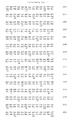
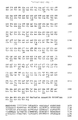
- these highly alkaline proteases have an amino acid sequence with at least 80%, preferably at least 90%, but in particular at least 95% homology to the amino acid sequence shown in FIG. 1, with at least one of the original amino acids in the amino acid sequence of the highly alkaline protease indicated above under (a), (b) and / or (c) is replaced by another amino acid.
- Homology to the amino acid sequence shown in FIG. 1 is understood here to mean the structural relationship of the relevant amino acid sequences to the amino acid sequence shown in FIG. 1.
- the structurally corresponding sections of the amino acid sequence of FIG. 1 and the amino acid sequence to be compared are brought into congruence with one another in such a way that there is maximum structural agreement between the amino acid sequences, taking into account differences caused by deletion or insertion of individual amino acids and by corresponding ones Movements of sequence sections can be compensated.
- the number of amino acids ("homologous positions") which now coincide in the sequences, based on the total number of amino acids contained in the sequence of FIG. 1, indicates the homology in%. Deviations in the sequences can be caused by variation, insertion or deletion of amino acids.
- the amino acid positions designated with reference to FIG. 1 relate to the homologous positions of the protease used in each case.
- Deletions or insertions in the amino acid sequences of the proteases homologous to FIG. 1 can lead to a relative shift in the amino acid positions, so that in homologous sections of mutually homologous amino acid sequences the numerical designations of the corresponding amino acid positions need not be identical.
- Expediently stabilized highly alkaline proteases of the invention are, in particular, those which, by exchanging amino acids in at least one of positions 4, 14, 27, 39, 43, 47, 49, 77, 80, 89, 111, 117, 118, 127, 143, 161, 164, 165, 208, 232, 233, 235, 237, 249 or 256, preferably 27, 43, 118, 143, 164, 237 or 249, of FIG. 1 or in one of the positions homologous thereto are stabilized.
- positions 27, 43, 118, 143, 164, 237 and 249 of FIG. 1 and the positions homologous to them are particularly advantageous.
- Examples of particularly preferably stabilized highly alkaline proteases are those which are replaced by at least one of the amino acid exchanges K27Q, 143R, 143K, 143Q, 143E, H118W, H118Y, R143N, R143S, R143T, R164Q, N237P, T249R, T249K, T249Q, and T249E 1 or a homologous amino acid exchange are stabilized.
- the nomenclature customary in the prior art is used here to designate the mutations.
- the amino acids are identified by the one-letter code, the original amino acid preceding the position and the amino acid introduced for stabilization Position information is reproduced.
- a hydrophilic amino acid instead of a hydrophobic amino acid is introduced into an apolar region of the enzyme surface in the enzymes.
- the new, hydrophilic amino acid which takes the place of the original, hydrophobic amino acid can have both a charged and an uncharged polar amino acid residue.
- the long-chain amino acids glutamine, glutamic acid, arginine and lysine are particularly preferred.
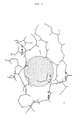
- hydrophobic region in which an amino acid exchange according to (a) leads to a stabilized highly alkaline protease from Bacillus alcalophilus is the hydrophobic region of the amino acid position Ile 43 shown in FIG. 9.
- This hydrophobic region is characterized by the polar amino acids Gln 57, Asn 42 and the ionic amino acid Arg 44 surrounded.
- the replacement of Ile 43 with, for example, arginine, lysine, glutamine or glutamic acid leads to highly alkaline proteases stabilized according to the invention with one of the mutations 143R, 143K, 143Q and 143E.
- variant (b) of the invention instead of a polar uncharged amino acid adjacent to the apolar region of the enzyme surface, an amino acid which is more sterically demanding than this original amino acid is introduced in the enzymes.
- the polar, uncharged amino acids to be exchanged for the purposes of this variant of the invention are, for example, the amino acids tyrosine, and in particular threonine, asparagine and histidine.
- any amino acid that is sterically sufficiently demanding compared to the original amino acid, possibly even hydrophobic amino acid is suitable per se.
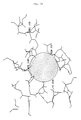
- variant (b) of the invention with a hydrophobic region, in which the exchange of an adjacent polar uncharged amino acid with a more sterically demanding amino acid leads to a stabilized, highly alkaline protease is shown in FIG. 10.
- This hydrophobic region is designed as a hole penetrating deeply into the hydrophobic enzyme interior, which is surrounded by a polar region formed by the amino acids His 118, Lys 229, Asn 237 and Arg 143.
- the polar uncharged amino acids His 118 and Asn 237 are directly adjacent to the hydrophobic region. Replacing the amino acid His 118 or the amino acid Asn 237 with one of the more sterically demanding amino acids tryptophan, tyrosine or proline leads to highly alkaline proteases stabilized according to the invention with e.g. one of the mutations H118W, H118Y or N237P.
- the apolar region of the enzyme surface is preferably shielded by an amino acid which is more sterically demanding than the original amino acid and has a long-chain hydrophilic amino acid residue.
- An example of such a hydrophobic region, in which the replacement of an adjacent polar uncharged amino acid by a longer-chain hydrophilic amino acid leads to a stabilized, highly alkaline protease is shown in FIG. 11.
- This hydrophobic region is formed by the amino acids Leu 261 and Val 262 and is surrounded by a polar region from the amino acids Glu 265, Asn 263, Gln 12, Arg 10, Asn 178.
- the polar, uncharged amino acid which adjoins the hydrophobic region at Leu261-Va1262 is Thr 249.
- the replacement of the amino acid Thr 249 by, for example, one of the longer-chain hydrophilic amino acids arginine, lysine, glutamine or glutamic acid leads to highly alkaline proteases stabilized according to the invention with e.g. one of the mutations T249R, T249K, T249Q, and T249E.
- an uncharged hydrophilic or an amino acid charged in the same direction as the surfactant is introduced.
- the ionic acids to be exchanged, as well as the amino acids charged in the same direction as the surfactant, are the hydrophilic amino acids with charged amino acid residues already mentioned above, ie aspartic acid, glutamic acid, lysine and arginine.
- one of the anionic amino acids such as aspartic acid and glutamic acid is replaced by a cationic amino acid such as lysine or arginine.
- a cationic amino acid such as lysine and arginine exchanged for an anionic amino acid.
- the ionic amino acid to be exchanged is replaced by an uncharged hydrophilic amino acid.
- the introduction of an uncharged hydrophilic amino acid for the original, ionic amino acid leads to enzymes that are stabilized against the action of both cationic and anionic surfactants.
- FIG. 12 An example of a hydrophobic region of the enzyme surface in which an amino acid exchange according to variant (c) of the invention leads to a stabilized highly alkaline protease from Bacillus alcalophilus is shown in FIG. 12.
- This hydrophobic region is designed as a hole penetrating deep into the hydrophobic interior of the enzyme and is surrounded by the amino acids Glu 110, Asn 114 and Arg 143.
- the replacement of the ionic amino acid Arg 143 which can form a preferred point of attachment for an anionic surfactant, for example with, in particular, asparagine, serine or threonine leads to highly alkaline proteases stabilized according to the invention with, for example, one of the mutations R143N, R143S or R143T.
- the above-described, highly alkaline proteases stabilized according to the invention are, for example, those which can be obtained by cultivating microorganisms such as e.g. Bacillus alcalophilus are available.
- these highly alkaline Bacillus proteases can be obtained by cultivating Bacillus species which have the identification features of Bacillus alcalophilus DSM 5466.
- the proteases stabilized according to the invention thus have a relationship, defined by the homology given above, to the protease obtainable from Bacillus alcalophilus DSM 5466, the amino acid sequence of which is given in FIG. 1 as a reference point for the proteases stabilized according to the invention.
- These highly alkaline proteases have molecular weights of 26,000 to 28,000 g / mol, measured by SDS-polyacrylamide gel electrophoresis compared to reference proteins with a known molecular weight. They are further characterized by a pH optimum in the range from 10 to 12.5, the pH range being understood as the pH range in which the proteases have maximum proteolytic activity and the proteases have good pH stability.
- a suitable bacterium which produces a highly alkaline protease with an amino acid sequence with at least 80%, preferably at least 90%, but in particular at least 95% homology to the amino acid sequence of FIG. 1, is used for the protease coding DNA sequence (ie the structural gene of the protease) isolated.
- the structural genes which code for amino acid sequences of these highly alkaline proteases can be obtained by general methods known per se. For this, e.g.
- a bacterium from a bacterium ("donor bacterium"), in particular from a Bacillus species which produces the highly alkaline protease, isolates the chromosomal DNA according to methods known per se and is partially hydrolyzed with suitable restriction endonucleases in a manner known per se.
- the restriction fragments of the donor DNA obtained in this way can e.g. separated by size by gel electrophoresis and the fragments of the desired size are then connected (ligated) in vitro with a suitable, double-stranded vector DNA (recombination).
- Frequently used vectors are the so-called plasmids, i.e.
- extrachromosomal, ring-shaped, double-stranded bacterial DNA which can be introduced into microorganisms by suitable methods (transformation) and can be multiplied there (autonomously replicable).
- the plasmids may have so-called markers, i.e. DNA fragments that code for certain observable properties (e.g. antibiotic resistance) and that can be used to select the transformed microorganisms (transformants).
- bacteria preferably a Bacillus species
- the transformants can be selected according to the known marker property (e.g. neomycin resistance).
- the marker property e.g. neomycin resistance
- those that increasingly secrete protease can be searched for on protein-containing plates and then isolated.
- the plasmid DNA introduced into these transformants is finally isolated from a clone with protease activity and a check is made again by transforming a bacterium whether the protease activity is plasmid-bound, i.e. whether the protease activity is linked to the marker property.
- the plasmid isolated in this way contains the desired structural gene for the highly alkaline starting protease to be stabilized and further DNA sequences from the donor bacterium which are not required here.
- the plasmid isolated in this way contains the desired structural gene for the highly alkaline starting protease to be stabilized and further DNA sequences from the donor bacterium which are not required here.
- the plasmid which comprises the structural gene and the additional DNA sequence
- the restriction sites located in the region of the donor DNA sequence are thus determined. Knowing the restriction map of the plasmid makes it possible to cut out a DNA fragment from the donor DNA sequence by cutting with selected restriction endonucleases which essentially only contains the structural gene for the highly alkaline protease, the associated pre and pro units, and also for the gene expression required promoter unit comprises.
- a new, replicable vector By reinstalling this reduced-size donor DNA sequence in a suitable vector, a new, replicable vector can be obtained, the ability of which to express the highly alkaline starting protease can be checked by using a bacterium, in particular a Bacillus species Vector transformed, the transformants obtained cultured and checked for protease activity.
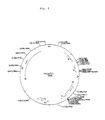
- the restriction map of FIG. 2 shows an example of such a reduced vector with the designation pCLEAN4.
- the Replicated vector described above in a suitable microorganism and isolated the protease gene. This is then subcloned into a phagemid and the phagemids obtained are then transformed into a suitable microorganism, for example E. coli, and single-stranded DNA containing the protease gene is produced by culturing the transformants. The single-stranded DNA formed is isolated and sent for sequencing.
- the sequencing is carried out according to methods known per se, for example by applying the single-stranded DNA with the protease gene according to Maxam and Gilbert to a base-specific partial chemical cleavage (1980, in Methods in Enzymology, Grossmann L., Moldave K., eds., Academic Press Inc., New York and London, Vol. 65, 499), or, for example, by using the single-stranded DNA with the protease gene as a template for the partial synthesis of sections of the complementary DNA strand by the dideoxy chain terminator method according to Sanger et al. (1977, Proc. Natl. Acad. Sci. USA 74: 5463).
- a triplet word codon stands for a defined amino acid.
- a short piece of the amino acid sequence is determined at the N-terminal end of the mature protease by methods known per se for determining amino acid sequences in peptides .
- the known N-terminal amino acid sequence can now be assigned to the corresponding section of the above nucleotide sequence on the basis of the genetic code and the starting point of the DNA sequence coding for the mature protease can thus be determined.
- the further amino acid sequence of the protease then inevitably results from the DNA sequence by assigning the subsequent amino acids using the genetic code.
- the DNA sequence coding for the highly alkaline protease is mutated by changing the corresponding codons in such a way that the mutated DNA sequence codes for a highly alkaline protease stabilized against the action of ionic surfactants, the amino acid sequence of which in one of the positions 4, 14, 27, 39, 43, 47, 49, 77, 80, 89, 111, 117, 118, 127, 143, 161, 164, 165, 208, 232, 233, 235, 237, 249, 256 of FIG. 1 or in one of the homologous positions, the amino acid in question is replaced by an amino acid according to one of the process variants (a), (b) and / or (c).
- the mutations are introduced into the DNA coding for the highly alkaline protease by methods known per se for directed mutagenesis.
- Suitable vectors phagemids
- phagemids e.g. From pCLMUTN1 of FIG. 4 or pCLMUTC1 of FIG. 5, optionally with the aid of a helper phage, annular single-stranded DNA is generated which contains the entire structural gene, or preferably only that part (for example only the N-terminal part or the C -terminal part) of the structural gene of the original protease in which the mutation is to be carried out.
- a synthetic, hybridizable oligonucleotide is hybridized with this circular single-stranded DNA, which contains a base triplet (codon) in the desired mutation site, which according to the invention instead of for the original amino acid to be exchanged for a new amino acid, according to (a), (b) or ( c) encoded.
- the oligonucleotide is modified by one or a few further nucleotide building blocks in such a way that the coding of the original amino acid sequence is retained as part of the degeneracy of the genetic code, but any restriction site that may be present in the original protease nucleotide sequence removed in the synthetic oligonucleotide or a further restriction site is introduced into the synthetic oligonucleotide.
- the removed or introduced restriction site is later used with the aid of suitable restriction endonucleases to identify the mutant DNA sequence compared to the starting type DNA sequence.
- the partially double-stranded DNA sequence obtained by hybridization is supplemented by adding the required nucleotides and under the action of DNA polymerase and DNA ligase to form the complete double strand.
- the ring-shaped, double-stranded DNA sequence produced is subsequently transformed as a vector into a suitable microorganism and, after sufficient replication, the mutated DNA sequences are identified via the removed or additionally introduced restriction site in the part of the oligonucleotide sequence and then isolated.
- uracylated single-stranded DNA is generated as a template in the directed mutagenesis and used for hybridization with the synthetic oligonucleotides.
- the uracil-containing DNA single strand which served as a template for generating mutated DNA strands (vectors)
- the uracil-N-glycosylase treatment can be carried out, for example, with the aid of a suitable microorganism with uracil-N-glycosylase activity which has been transformed with mutated vector DNA.
- the replication can be carried out, for example, in an E. coli strain which only multiplies the mutated, non-uracylated DNA strand of the double-strand vector generated in the mutation process. In this way the selection of the mutated DNA vectors made even easier.
- the synthetic oligonucleotides required for the directed mutagenesis are produced by methods known per se. For example, the production of the oligonucleotides according to Beaucage S.L. and Caruthers M.H. (1981, Tetrahedron Letters 22: 1859-1862) with ⁇ -cyanoethyl phosphoramidite in a Cyclone synthesizer (Biosearch).
- the oligonucleotides obtained can e.g. by elution from polyacrylamide gels and, if appropriate, subsequent desalination with the aid of Sephadex columns and be used for further use.
- the synthetic oligonucleotides can serve directly as primers for the DNA polymerase in the mutagenesis method described above.
- the synthetic oligonucleotide sequences include e.g. 20 to 30 nucleotide building blocks that code for about 7 to 10 amino acids. It is of course also possible to use longer nucleotide sequences for the above hybridization, but this does not lead to any further advantages as long as the short-chain synthetic oligonucleotides have sufficient hybridization ability.
- the circular, double-stranded DNA sequences with the introduced mutations obtained by the above-described method of directed mutagenesis represent mutated vectors, from which, by treatment with suitable restriction endonucleases, the entire mutated protease structural gene or the mutated section of the protease, as the case may be.
- Structural gene can be cut out and inserted (subcloned) into a suitable expression vector.
- Suitable microorganisms e.g. Bacillus species, which are subsequently cultivated for expression and recovery of the mutant highly alkaline proteases under suitable conditions.
- the entire structural gene is not used for the directed mutagenesis, but only a part of the same in which the mutation is to be generated.
- the vector used to replicate the structural genes e.g. the N-terminal or C-terminal half of the structural gene was cut out with suitable restriction endonucleases and subcloned into a suitable phagemid.
- Vectors are thus obtained which contain either the N-terminal or the C-terminal half of the structural gene of the protease and which are in a suitable microorganism, e.g. E. coli, first replicated sufficiently and then fed to the directed mutagenesis described above.
- the mutagenesis of sections of the structural gene has the advantage that shorter single-stranded DNA sequences can be used and that after the hybridization step with synthetic oligonucleotides in the partial double-stranded DNA, significantly fewer nucleotides have to be added than when using the entire DNA sequence. This reduces the synthetic effort and also the risk of undesired random mutations.
- the mutated DNA sequences can be cut out of the cloning vector used to generate the mutations by means of suitable restriction endonucleases and inserted into vectors with suitable restriction sites.
- the vectors obtained are, for example, precursors to the actual expression vectors required for the expression of the highly alkaline protease.
- These vectors are constructed in such a way that, in addition to the suitable restriction sites (eg from a synthetic linker), they also already contain the regulatory sequences, signal sequences, promoter sequences required for protease expression in a host organism and the DNA sequences coding for the pre and pro units of the protease .
- the actual expression vector for an optimized highly alkaline protease is obtained by subcloning a mutated DNA sequence into such a vector.
- the mutant DNA sequence is incorporated into this precursor of the expression vector in such a way that an expression vector with a suitable reading frame is produced.
- mutated sections of the DNA sequence coding for the protease e.g. a C-terminal or an N-terminal section into which vectors containing the remaining non-mutated section are already incorporated; or the entire mutated DNA sequence coding for the protease is incorporated into vectors which do not yet contain any parts of this protease DNA sequence.
- Examples of such precursor vectors of an expression vector which already contain a part of the non-mutated DNA sequence are the vectors with the names pAL1 N and pAL1 C which are described in more detail below and in the examples.
- the expression vector precursors for the preferred variant of the invention are obtained, for example, as follows. First, a polycloning site is introduced into a Bacillus plasmid. The plasmid obtained in this way is restricted and recombined with an E. coli plasmid fragment which contains markers and sequence parts which are important for replication. Subsequently, restriction sites that would disrupt later process steps are removed, for example by directed mutagenesis. A new vector is constructed from the plasmid obtained in this way, which replicates the DNA sequences from the Bacillus plasmid and the E.
- coli plasmid DNA sequences for the promoter, DNA sequences for the pre-prosequence of the Protease code (obtained from, for example, the plasmid pCLEAN4 of FIG. 2), and contains a synthetic linker.
- the restriction map of FIG. 7 shows an example of such a plasmid with the designation pAL1P.
- the synthetic linker is selected such that, after cutting with suitable restriction endonucleases, it can be recombined either with the entire original structural gene or with the entire mutated structural gene or with mutated or non-mutated sections of the structural gene.
- the vector constructed above which contains the Bacillus, E. coli, promoter and pre- and pro-sequences of the Protease and the synthetic linker contains, by cutting the synthetic linker, for example, first introduced the non-mutated C-terminal half of the structural gene of the protease.
- the vectors of the type pAL1C mentioned above are obtained in this way.
- the missing, mutated N-terminal half of the protease structural gene is inserted again by cutting the synthetic linker.
- a vector of the type pAL 1 NC of FIG. 8 is obtained. The same applies to the reverse case.
- the non-mutated N-terminal half is then first introduced into a vector of the pAL1P type and the mutated C-terminal half is subsequently introduced into the vector of the pAL1N type obtained in this way, a vector of the pAL1 NC type of FIG. 8 likewise being obtained .
- Suitable bacteria preferably Bacillus species, in particular Bacillus subtilis, licheniformis and alcalophilus, are transformed with the expression vectors described above.
- the transformants are then cultivated in a manner known per se and the highly alkaline protease formed, stabilized according to the invention, is isolated from the culture medium.
- the expression vectors can be transformed both in bacteria which are still capable of forming their own protease and in protease-deficient bacteria (which no longer form their own protease).
- the highly alkaline protease stabilized according to the invention can, if desired, be subsequently purified, e.g.
- HPLC high-resolution liquid chromatography
- Positions of hydrophobic amino acids which are located in a hydrophobic region of the enzyme surface are, for example, Val 4, Pro 14, Pro 39, Ile 43, Ala 47, Phe 49, Ile 77, Leu 80, Trp 111, Met 117, Pro 127, Pro 233, Trp 235, Leu 256.
- Positions of polar uncharged amino acids which adjoin a hydrophobic region of the enzyme surface are, for example, the tyrosine positions 89, 161, 165, 208; asparagine positions 232 and 237; the histidine position 118 and the threonine position 249.
- positions of ionic amino acids which are adjacent to a hydrophobic region are in particular the arginine positions 143 and 164 and the lysine position 27.
- Maniatis et al. T. Maniatis, E.F. Fritsch, J. Sambrook, Molecular Cloning, A Laboratory Manual, Cold Spring Harbor Laboratory, 1982).
- Output vectors used here are commercially available and available on an unlimited basis; or they can be prepared from available vectors by methods known per se.
- phagemids called pBS e.g. pBS (+), pBS (-) etc.
- pBS e.g. pBS (+), pBS (-) etc.
- helper phage M13K07 from Bio-Rad Laboratories, Richmond, California
- M13tg131 vector from Amersham, Buckinghamshire, England
- the plasmid pUC18 from Pharmacia LKB, Uppsala, Sweden.
- restriction endonucleases used are state of the art and are commercially available.
- the reaction, cofactor and other conditions required in each case when using these known restriction endonucleases are also known.
- Cutting vectors with restriction endonucleases may be followed by hydrolysis of the terminal 5'-phosphate residue with an alkaline phosphatase (dephosphorylation). This can prevent the ends of the restricted vector resulting from cutting from recombining with themselves and thus preventing the desired insertion of a foreign DNA fragment into the restriction site. If dephosphorylation of the 5 'end was carried out in the examples, this was done in a manner known per se. Further information on the implementation of dephosphorylation and the reagents required for this can be found in Maniatis et al. (Pp. 133 - 134).
- Partial hydrolysis means incomplete digestion of DNA by a restriction endonuclease.
- the reaction conditions are chosen so that a cut is made at some, but not all, of the recognition sites for the restriction endonuclease used in a DNA substrate.
- the DNA fragments obtained were separated in a manner known per se by gel electrophoresis (for example on agarose gel), subsequently identified by means of the molecular weight (determined by comparison with reference DNA fragments of known molecular weight) and the desired DNA Fragments separated from the corresponding gel zones.
- Treatment with the Klenow fragment of DNA polymerase I from E. coli means a process for filling the inner 3 'ends of double-stranded DNA with nucleotides which are complementary to the nucleotides of the respective protruding 5' ends of the DNA double strand.
- the Klenow fragment and reagents required for the Klenow treatment are known in the prior art and are commercially available. Details on the Klenow treatment are e.g. from Maniatis et al. (Pp. 107 to 108) can be removed.
- Ligation means a process for forming phosphodiester bonds between DNA fragments (see e.g. Maniatis et al., P. 146). Ligations can be carried out under conditions known per se, e.g. in a buffer with about 10 units of T4 DNA ligase per 0.5 ⁇ g of an approximately equal molar amount of the DNA fragments to be ligated.
- Transformation is understood to be the introduction of DNA into a microorganism so that the DNA can be replicated or expressed in it.
- E. coli for example, the calcium chloride method according to Mandel et al. (1970, J. Mol. Biol. 53: 159) or according to Maniatis et al. (P. 250 to 251).
- Mandel et al. (1970, J. Mol. Biol. 53: 159) or according to Maniatis et al. (P. 250 to 251).
- Anagnostopoulos et al. (1961, J. Bact. 81: 741- 746).
- a linker is a short-chain, double-stranded DNA fragment which has some recognition sites for restriction endonucleases and is suitable for connecting DNA fragments.
- Linkers are e.g. used when recombining DNA fragments to form a vector and can serve to introduce certain recognition sites for restriction endonucleases into this vector.
- a polycloning site is a short to medium double-stranded DNA fragment which has a large number of recognition sites for restriction endonucleases in close proximity.
- a polycloning site used in the examples derived from the vector M13tg131, has e.g. has a size of approximately 0.07 KB (kilo base pairs) and has recognition sites for 14 different restriction endonucleases.
- Bacillus alcalophilus strain used in Example 1 and named Bacillus alcalophilus HA1 was deposited with the German Collection of Microorganisms (DSM) with the DSM number 5466 on July 28, 1989.
- DSM German Collection of Microorganisms
- Other microorganisms used are commercially available, e.g. Bacillus subtilis BD 244 (Bacillus Genetic Stock Center 1 A 46) or Bacillus subtilis BD 366 (Bacillus Genetic Stock Center 1 E 6).
- the natural isolate Bacillus alcalophilus HA1 (deposited with the German Collection of Microorganisms under the number DSM 5466) was used according to the method of Saito et al. (1963, Biochim.Biophys. Acta. 72: 619-629) chromosomal DNA isolated and partially hydrolyzed with the restriction endonuclease Sau3A. The restriction fragments were separated by electrophoresis on an agarose gel and the fragments with a size of 3 to 8 kilobases (KB) were isolated.
- the isolated and size-selected DNA fragments from Bacillus alcalophilus HA1 were recombined in vitro with vector DNA of the plasmid pUB 110 (obtained as described in Example 7).
- the plasmid pUB110 was first restricted with the restriction endonuclease BamHl and then dephosphorylated with alkaline phosphatase from calf intestine. Subsequently, 2 ⁇ g of the restricted and dephosphorylated vector DNA were incubated with 8 ⁇ g of Bacillus alcalophilus DNA fragments in a total volume of 100 ⁇ l with T4-DNA ligase for 24 h at 16 * C.
- Protoplasts of the Bacillus subtilis BD224 strain were transformed with the in vitro recombined DNA by the method described by S. Chang and N. Cohen (1979, Mol. Gen. Genet. 168: 111-115). The transformants were selected on plates with neomycin and then transferred to skim milk agar. Among 13800 transformants examined, one was found that formed a significantly larger courtyard by proteolysis of the skim milk agar. The plasmid DNA according to Maniatis et al. isolated. The cloned fragment from the B. alcalophilus DNA contained in this plasmid was 4.1 KB in size and contained the complete information for the highly alkaline protease from Bacillus alcalophilus HA1.
- the 4.1 KB DNA fragment was initially reduced in size.
- the recognition sites for restriction endonucleases located on the DNA fragment were determined by cutting the plasmid with various restriction endonucleases and separating the fragments of the restricted DNA by electrophoresis on an agarose gel.
- a 2.3 KB large DNA fragment was obtained by cutting with the restriction endonucleases Aval and Hindlll, which had the complete information for the highly alkaline protease and which was used for the further process.
- the above plasmid with the 4.1 KB fragment was restricted with the restriction endonucleases Aval and HindIII.
- the 2.3 KB DNA fragment was isolated and ligated with the vector pUB131 (obtained as described in Example 7), which had also previously been cut with Aval and HindIII.
- the plasmid obtained which was given the name pCLEAN4, was introduced into the strain B. subtilis BD224.
- the transformants were able to excrete the highly alkaline protease, which shows that the Aval / Hindlll fragment contains the complete structural gene for the highly alkaline protease from B. alcalophilus HA1.
- the restriction map of the plasmid pCLEAN4 is shown in FIG. 2.
- the directed mutations were in partial DNA sequences of the protease structural gene with that of Kunkel, T.A. (1985, Proc.Natl.Acad.Sci.USA 82: 488-492) described "primer extension" technique performed.
- the starting vectors pCLMUTN1 and pCLMUTC1 do not contain the entire DNA sequence of the protease structural gene from B.
- alcalophilus HA1 but only the N-terminal half (pCLMUTN1) or the C-terminal half (pCLMUTC1) of the same.
- pCLMUTN1 N-terminal half
- pCLMUTC1 C-terminal half
- these vectors, as descendants of a phagemid, are capable of forming single-strand vector DNA, which could be removed and isolated from the host organism used for replication under the conditions given here.
- Each of these vectors was designed according to Maniatis et al. (Pp. 250 to 251) with the help of the CaC! 2 method introduced in E. coli CJ236 as host organism.
- the bacterium E. coli CJ236 when replicating vectors instead of thymine, incorporates the nucleotide uracil into the DNA sequence of the vector, the uracil-containing analogs of the vector pCLMUTN1 or received pCLMUTC1. These uracil-containing vectors are indistinguishable from the usual thymine-containing vectors in in vitro reactions.
- the uracil content in the vector DNA does not interfere with in vitro DNA synthesis since uracil is neither mutagenic in vitro nor in vivo and encodes uracil in the same way as thymine.
- Uracylated vectors can be used advantageously for the subsequent in vitro reactions of directed mutagenesis. After the reactions have ended, the uracil-containing DNA single strand, which served as a template for generating mutated DNA strands (vectors), can be removed by treatment with uracil-N-glycosylase without the need for phenotypic selection of mutants.
- the glycosylase treatment can be carried out both with the isolated enzyme and with an E. coli strain transformed by vector DNA and having uracil-N-glycosylase activity.
- the uracylated single-stranded DNA of the vectors pCLMUTN1 and pCLMUTC1 required for the directed mutagenesis as a template was produced by culturing E. coli CJ236 bacteria transformed with one of the two vectors, which were additionally infected with the helper phage M13K07.
- the helper phage itself is hardly capable of reproduction and shows no interfering interaction with the vector DNA of the vectors pCLMUTN1 or pCLMUTC1. Its task is the synthesis of envelope proteins for the uracylated single-stranded vector DNA. Enveloped single-strand vector DNA is removed from the host organism E. coli CJ236 and can be isolated from the culture medium. With the help of the helper phage, the qualitative and quantitative yield of (here uracylated) single-stranded vector DNA is significantly increased.
- the isolated, uracylated DNA single-strand vectors pCLMUTN1 or pCLMUTC1 were hybridized with the synthetic oligonucleotides produced according to Example 6, which contained a mutation site and at the same time served as a primer for the subsequent addition to the complete DNA double strand with mutation.
- the synthesis of the second strand of DNA was carried out with the addition of nucleotides with T4-DNA polymerase and the subsequent ligation of the newly formed strand with T4-DNA ligase (Kunkel et al. 1987, Methods in Enzymol. 154, 367-382).
- the double-stranded vector DNA formed was transformed into E. coli MC1061 and the mutant vectors were identified by checking the corresponding unitary restriction endonuclease recognition sites that were inserted or removed with the synthetic oligonucleotides.
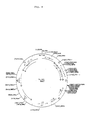
- the plasmid pCLEAN4 produced in Example 1 was cut with Aval. The sticky ends were filled in with the necessary nucleotides using the Klenow fragment of E. coli DNA polymerase I (Maniatis et al., P. 114) to form the DNA double strand. After subsequent restriction of this DNA with Xbal, the N-terminal 1618 base pair (BP) fragment of the protease gene was isolated and cloned into the Smal / Xbal site of pBS. The resulting vector was named pCLMUTN1. The restriction map of this vector is shown in FIG. 4.
- the plasmid pCLEAN4 produced in Example 1 was cut with the restriction endonucleases Xbal and Asp718.
- the 658 BP Xbal / Asp718 double-stranded DNA fragment, which comprises the C-terminal half of the protease structural gene, was cloned into the Xbal / Asp718 site of pBS.
- the resulting vector was named pCLMUTC1.
- the restriction map of the vector is shown in FIG. 5.
- the plasmid pUB11 obtained above was restricted with EcoRI and BamHl.
- the smaller fragment (790 BP) was replaced by a polylinker consisting of 67 base pairs, which had previously been isolated as an EcoRI / BglII fragment from the vector M13tg131.
- the vector obtained in this way called pUB131, is thus a descendant of pUB110, in which the approximately 0.8 KB EcoRI / BamHI fragment was deleted and a polycloning site was installed for this.
- the plasmid pUC18 was cut with Aatll and Pvull.
- the 1990 base pair fragment with the ⁇ -lactamase gene and the E. coli "origin of replication" was isolated.
- the sticky ends were filled into the DNA double strand with the addition of the required nucleotides using the Klenow fragment of E. coli DNA polymerase I (Maniatis et al., P. 114).
- the fragment was then inserted into the SnaBl site of the vector pUB131 obtained according to Example 7, whereby the vector with the name pUBC131 was obtained.
- the 2187 BP EcoRI / BglII fragment of the vector pUBC131 obtained above was subcloned into the EcoRI / BamHI site of pBS (+) to give the vector called pBSREPU.
- the Ncol or styl recognition site which is present in the DNA sequence for the repU polypeptide in the vector pBSREPU was then (I. Maciag et al. 1988, Mol. Gen. Genet. 212: 232-240) by directed mutagenesis eliminated by replacing the nucleotide sequence CCA TGG with the nucleotide sequence CCG TGG (both nucleotide sequences code for the amino acid sequence tryptophan-proline).
- the procedure was analogous to the procedure of Example 3.
- uracylated single-stranded DNA of the vector pBSREPU was produced as a template for the directed mutation to eliminate the Ncol or Styl recognition site.
- This template was then analogous to the "primer extension" technique described in Example 3 using the following synthetic oligonucleotide (produced and purified analogously to the method for producing the synthetic oligonucleotides of Example 6) added to the DNA double-stranded vector and isolated by transformation and cultivation of E. coli MC1061 the now Ncol- or Styl-recognition site-free vectors.
- the 1726 BP EcoRI / Apal fragment of the isolated vector was introduced into the EcoRI / Apal site of pUBC131.
- the new vector, the restriction map of which is shown in FIG. 6, was given the name pUBC132.
- the construction of the vector pAL1 P was carried out in E. coli MC1061 and the vector was isolated from ampicillin-resistant E. coli transformants.
- the restriction map of the vector obtained is shown in FIG. 7.
- the construction of the plasmids pAL1 N and pAL1 C was carried out in E. coli MC1061, the vectors being isolated from ampicillin-resistant E. coli transformants.
- the plasmid pAL1 N was constructed by first cutting the vector pCLEAN4 obtained in Example 1 with the restriction endonucleases Ncol and Xbal and then cloning the Ncol / Xbal fragment obtained into the Ncol / Xbal site of the vector pAL1 P (prepared according to Example 9) has been.
- the vector produced contained the N-terminal part of the DNA sequence coding for the mature enzyme and the regulatory elements for the transcription and translation of the highly alkaline protease, as well as the signal sequence and the processing sequence.
- the plasmid pAL1C was constructed by first clipping the vector pCLEAN4 obtained in Example 1 with the restriction endonucleases Xbal and Asp718 and cloning the Xbal / Asp718 fragment obtained in the Xbal / Asp718 site of the vector pAL1 P (prepared according to Example 9) .
- the vector produced contained the C-terminal part of the DNA sequence coding for the mature protease and the regulatory elements for the transcription and translation of the highly alkaline protease, as well as the signal sequence and the processing sequence.
- the transformants were capable of producing the mutant stabilized (transformants with vectors from section A., B. of this example) or the non-mutated (transformants with vector from section C. of this example) highly alkaline protease.
- the restriction map of the vectors of type pAL1 NC produced is shown in FIG. 8.
- the mutated vector pCLMUTN1 obtained by directed mutagenesis according to Example 3 was cut with the restriction endonucleases Ncol and Xbal.
- the isolated Ncol / Xbal fragment (mutated N-terminal part of the protease structural gene with the mutations K27Q, 143R, 143K, 143Q, 143E, H118W, H118Y) was cloned into the Ncol / Xbal site of the plasmid pAL1C obtained according to Example 10.
- the vectors obtained were complete expression vectors with a suitable reading frame for expressing the mutant-stabilized proteases.
- the mutated vector pCLMUTC1 obtained according to Example 3 by directional mutagenesis was cut with the restriction endonucleases Xbal and Asp718.
- the isolated Xbal / Asp718 fragment (mutated C-terminal part of the protease structural gene with the R143N, R143S, R143T, R164Q, N237P, T249R, T249K, T249Q, T249E) was inserted into the Xbal / Asp718 site of the plasmid pAL1 obtained according to Example 10 N cloned.
- the vectors obtained were complete expression vectors with a suitable reading frame for expressing the mutant-stabilized proteases.
- the expression vector with the non-mutated starting structural gene of the protease was obtained by either cloning the non-mutated Ncol / Xbal fragment from the plasmid pCLEAN4 obtained according to Example 1 into the Ncol / Xbal site of pAL1C (Example 10); or by cloning the Xbal / Asp718 fragment from the plasmid pCLEAN4 obtained according to Example 1 into the Xbal / Asp718 site of pAL1 N (Example 10).
- the vectors thus obtained were complete expression vectors with a suitable reading frame for the expression of the starting protease.
- the starting protease and, on the other hand, the stabilized proteases of the amino acid sequence of FIG. 1 with the mutations K27Q, 143K, 143Q, 143E, H118, H118Y, R143N, R143S, R143T, R164Q, N237P, T249R, T249K, T249Q and T249E were obtained.
- washing performance of the highly alkaline proteases stabilized by mutation The washing performance of proteases stabilized according to the invention was determined in washing tests with different detergents and for differently soiled fabrics.
- the washing performance of the proteases was determined by washing tests on the test fabric EY-PC (egg yolk / ink soiling on polyester-cotton blend fabric - in-house production) in laboratory washing machines (type: Polycolor). For this purpose, the test fabric was washed with an aqueous wash liquor, to which the protease to be examined was added in a concentration of 0.71 mg / l.
- a detergent formulation customary for a powdery heavy-duty detergent with customary detergent ingredients (18.4% zeolite, 7.3% Na 2 CO 3 , 4.8% linear alkylbenzenesulfonate, 3.3% nonionics, 3.3% soap, 0.
- the dosage of the detergent formulation in the wash liquor was 6 g / l.
- the enzyme-containing wash liquor acted on the test fabric in a rotating sample vessel, which was controlled via a water bath in accordance with the temperature program. After the washing process, the test fabric was rinsed twice with tap water and then ironed.
- the washing performance was determined by measuring the reflection of the washed test fabric using a reflectance photometer. For comparison, the reflection of the test fabric washed under the same conditions only with the detergent formulation without protease addition was also determined.
- Example 13a An enzyme-free detergent formulation, obtainable from detergent manufacturers, was used as the detergent, as is customary for a powdery compact heavy-duty detergent.
- the dosage of the detergent formulation in the wash liquor was 3 g / l.
- washing was carried out in the temperature range from 15 ° C. to 40 ° C. for 45 min (2 ° C./min; 32.5 min holding time at 40 ° C.).
- a polyester / cotton blend (EMPA 117, obtained from the Swiss Federal Laboratory for Materials, St. Gallen, Switzerland) was used as the test fabric soiled with blood, milk and ink.
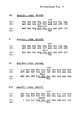
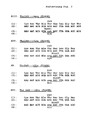
- the proteases given in Table 1 below were examined for their washing performance. The stated increase in the reflection of the washed test fabric relates to test fabric washed under the same conditions without the addition of proteases only with the detergent formulation.
- Example 13b The washing tests were carried out as described in Example 13b. However, a test fabric EY-PC (egg yolk / ink stains on polyester-cotton blend fabric - own production) was used.
- EY-PC egg yolk / ink stains on polyester-cotton blend fabric - own production
- the proteases given in Table 2 below were examined for their washing performance. As already described, the stated increase in the reflection of the test fabric relates to test fabric washed without the protease addition under the same conditions and only with the detergent formulation.
- Example 13a An enzyme-free detergent formulation obtainable from detergent manufacturers, as is customary for a heavy-duty liquid detergent, was used as the detergent.
- the dosage of the detergent formulation in the wash liquor was 4 g / l.
- a test fabric EY-PC egg yolk / ink stains on polyester-cotton blend fabric - own production was used as the test fabric.
- the proteases given in Table 3 below were examined for their washing performance.
- the specified reflection of the test fabric relates to test fabric that has only been washed with the detergent formulation without the addition of proteases under the same conditions.
Landscapes
- Chemical & Material Sciences (AREA)
- Life Sciences & Earth Sciences (AREA)
- Health & Medical Sciences (AREA)
- Organic Chemistry (AREA)
- Engineering & Computer Science (AREA)
- Wood Science & Technology (AREA)
- Genetics & Genomics (AREA)
- Zoology (AREA)
- Bioinformatics & Cheminformatics (AREA)
- Microbiology (AREA)
- Biotechnology (AREA)
- Biomedical Technology (AREA)
- Molecular Biology (AREA)
- Biochemistry (AREA)
- General Engineering & Computer Science (AREA)
- General Health & Medical Sciences (AREA)
- Medicinal Chemistry (AREA)
- Chemical Kinetics & Catalysis (AREA)
- Oil, Petroleum & Natural Gas (AREA)
- Enzymes And Modification Thereof (AREA)
- Detergent Compositions (AREA)
- Micro-Organisms Or Cultivation Processes Thereof (AREA)
Priority Applications (1)
| Application Number | Priority Date | Filing Date | Title |
|---|---|---|---|
| EP99123991A EP0995801A1 (fr) | 1991-07-27 | 1992-07-22 | Procédé d'amélioration de la stabilité d'enzymes et enzymes stabilisées |
Applications Claiming Priority (2)
| Application Number | Priority Date | Filing Date | Title |
|---|---|---|---|
| DE4124997 | 1991-07-27 | ||
| DE4124997 | 1991-07-27 |
Related Child Applications (1)
| Application Number | Title | Priority Date | Filing Date |
|---|---|---|---|
| EP99123991A Division EP0995801A1 (fr) | 1991-07-27 | 1992-07-22 | Procédé d'amélioration de la stabilité d'enzymes et enzymes stabilisées |
Publications (2)
| Publication Number | Publication Date |
|---|---|
| EP0525610A2 true EP0525610A2 (fr) | 1993-02-03 |
| EP0525610A3 EP0525610A3 (en) | 1993-03-24 |
Family
ID=6437189
Family Applications (2)
| Application Number | Title | Priority Date | Filing Date |
|---|---|---|---|
| EP19920112509 Ceased EP0525610A3 (en) | 1991-07-27 | 1992-07-22 | Process for increasing the stability of enzymes and stabilized enzymes |
| EP99123991A Withdrawn EP0995801A1 (fr) | 1991-07-27 | 1992-07-22 | Procédé d'amélioration de la stabilité d'enzymes et enzymes stabilisées |
Family Applications After (1)
| Application Number | Title | Priority Date | Filing Date |
|---|---|---|---|
| EP99123991A Withdrawn EP0995801A1 (fr) | 1991-07-27 | 1992-07-22 | Procédé d'amélioration de la stabilité d'enzymes et enzymes stabilisées |
Country Status (4)
| Country | Link |
|---|---|
| US (1) | US5453372A (fr) |
| EP (2) | EP0525610A3 (fr) |
| DE (1) | DE4224125A1 (fr) |
| FI (1) | FI106315B (fr) |
Cited By (76)
| Publication number | Priority date | Publication date | Assignee | Title |
|---|---|---|---|---|
| EP0610808A3 (fr) * | 1993-02-12 | 1994-11-02 | Solvay Enzymes Gmbh & Co Kg | Protéases très alcalines améliorées. |
| WO1995022615A1 (fr) * | 1994-02-22 | 1995-08-24 | Novo Nordisk A/S | Procede pour preparer un variant d'une enzyme lipolytique |
| WO1996000292A1 (fr) * | 1994-06-23 | 1996-01-04 | Unilever N.V. | Pseudomonas lipases modifiees et leur utilisation |
| WO1996034946A1 (fr) * | 1995-05-05 | 1996-11-07 | Novo Nordisk A/S | Variantes du type protease et compositions |
| WO1996034935A3 (fr) * | 1995-05-05 | 1997-01-16 | Unilever Nv | Variantes de subtilisine |
| WO1998020115A1 (fr) | 1996-11-04 | 1998-05-14 | Novo Nordisk A/S | Variants et compositions de subtilase |
| WO1998020116A1 (fr) | 1996-11-04 | 1998-05-14 | Novo Nordisk A/S | Variants de subtilase et compositions |
| US5753460A (en) * | 1993-10-08 | 1998-05-19 | Novo Nordisk A/S | Amylase variants |
| US5801043A (en) * | 1993-10-08 | 1998-09-01 | Novo Nordisk A/S | Amylase variants |
| US5837517A (en) * | 1995-05-05 | 1998-11-17 | Novo Nordisk A/S | Protease variants and compositions |
| US5892013A (en) * | 1990-09-13 | 1999-04-06 | Novo Nordisk A/S | Lipase variants |
| WO2000071687A1 (fr) | 1999-05-20 | 2000-11-30 | Novozymes A/S | Enzymes subtilases des sous-groupes i-s1 et i-s2 possedant au moins un residu d'acide amine additionnel entre les positions 129 et 130 |
| WO2000071688A1 (fr) | 1999-05-20 | 2000-11-30 | Novozymes A/S | Enzymes subtilases des sous-groupes i-s1 et i-s2 comprenant au moins un reste d'acide amine additionnel entre les positions 126 et 127 |
| WO2000071689A1 (fr) | 1999-05-20 | 2000-11-30 | Novozymes A/S | Enzymes subtilases des sous groupes i-s1 et i-s2 possedant au moins un residu acide amine supplementaire entre les positions 127 et 128 |
| WO2000071690A1 (fr) | 1999-05-20 | 2000-11-30 | Novozymes A/S | Enzymes subtilases des -sous groupes i-s1 et i-s2 possedant au moins un residu acide amine supplementaire entre les positions 128 et 129 |
| WO2000071685A1 (fr) | 1999-05-20 | 2000-11-30 | Novozymes A/S | Enzymes subtilases des sous-groupes i-s1 et i-s2 renfermant au moins un residu d'acide amine supplementaire entre les positions 132 et 133 |
| WO2000071691A1 (fr) | 1999-05-20 | 2000-11-30 | Novozymes A/S | Enzymes de subtilase des sous-groupes i-s1 et i-s2 possedant au moins un residu supplementaire d'acide amine entre les positions 125 et 126 |
| WO1995030744A3 (fr) * | 1994-05-04 | 2001-05-03 | Gistbrocades B V | Lipases a resistance aux tensioactifs amelioree |
| US6558938B1 (en) | 1997-08-29 | 2003-05-06 | Novozymes, A/S | Protease variants and compositions |
| US6605458B1 (en) | 1997-11-21 | 2003-08-12 | Novozymes A/S | Protease variants and compositions |
| WO2003080827A2 (fr) | 2002-03-27 | 2003-10-02 | Novozymes A/S | Granules a enrobages filamenteux |
| US6682924B1 (en) | 1995-05-05 | 2004-01-27 | Novozymes A/S | Protease variants and compositions |
| US6727085B2 (en) | 1999-12-15 | 2004-04-27 | Fanoe Tina Sejersgaard | Subtilase variants having an improved wash performance on egg stains |
| US6773907B2 (en) | 1997-11-21 | 2004-08-10 | Peter Kamp Hansen | Subtilase enzymes |
| WO2004067739A2 (fr) | 2003-01-27 | 2004-08-12 | Novozymes A/S | Stabilisation de granules |
| US6777218B1 (en) | 2000-03-14 | 2004-08-17 | Novozymes A/S | Subtilase enzymes having an improved wash performance on egg stains |
| US6780629B2 (en) | 1997-11-21 | 2004-08-24 | Novozymes A/S | Subtilase enzymes |
| WO2004082564A2 (fr) | 2003-03-18 | 2004-09-30 | Novozymes A/S | Granules enzymatiques revetus |
| WO2005040372A1 (fr) | 2003-10-23 | 2005-05-06 | Novozymes A/S | Protease a stabilite amelioree dans les detergents |
| EP1624050A3 (fr) * | 1997-10-23 | 2006-06-21 | Genencor International, Inc. | Variants de protéase a substitutions multiples |
| WO2007036235A1 (fr) | 2005-09-30 | 2007-04-05 | Novozymes A/S | Immobilisation d'enzymes |
| EP1803817A1 (fr) | 1998-12-18 | 2007-07-04 | Novozymes A/S | Enzymes substitulases des sous-groupes I-S1 et I-S2 ayant un résidu d'acide amine additionnel dans une région boucle de site actif |
| US7262042B2 (en) | 2001-12-20 | 2007-08-28 | Henkel Kommanditgesellschaft Auf Aktien (Henkel Kgaa) | Alkaline protease from Bacillus gibsonii (DSM 14393) and washing and cleaning products comprising said alkaline protease |
| WO2007098756A1 (fr) | 2006-03-02 | 2007-09-07 | Novozymes A/S | Procédé d'encapsulation haute capacité |
| WO2007136469A2 (fr) | 2006-04-14 | 2007-11-29 | Genencor International, Inc. | Traitement en une étape de textiles |
| US7320887B2 (en) | 2001-10-31 | 2008-01-22 | Henkel Kommanditgesellschaft Auf Aktien | Alkaline protease variants |
| WO2008017661A1 (fr) | 2006-08-07 | 2008-02-14 | Novozymes A/S | Granules d'enzyme pour alimentation animale |
| WO2008134343A1 (fr) | 2007-04-30 | 2008-11-06 | Danisco Us Inc., Genencor Division | Utilisation d'hydrolysats de protéine pour stabiliser des formulations détersives de métalloprotéase |
| US7449187B2 (en) | 2001-12-20 | 2008-11-11 | Henkel Kommanditgesellschaft Auf Aktien (Henkel Kgaa) | Alkaline protease from Bacillus gibsonii (DSM 14391) and washing and cleaning products comprising said alkaline protease |
| WO2008151999A1 (fr) | 2007-06-11 | 2008-12-18 | Novozymes A/S | Procédé pour biopolissage et nettoyage par un agent de blanchiment combinés |
| US7507569B2 (en) | 2003-05-07 | 2009-03-24 | Novozymes A/S | Variant subtilisin enzymes (subtilases) |
| WO2009118329A1 (fr) | 2008-03-28 | 2009-10-01 | Novozymes A/S | Système à libération déclenchée |
| EP2143339A1 (fr) | 2004-09-27 | 2010-01-13 | Novozymes A/S | Granules d'enzyme |
| EP2199386A1 (fr) | 1993-10-08 | 2010-06-23 | Novozymes A/S | Variants d'amylase |
| EP2202290A1 (fr) | 2008-12-23 | 2010-06-30 | Unilever PLC | Composition de lavage fluide et son conditionnement |
| EP2261359A1 (fr) | 1998-06-10 | 2010-12-15 | Novozymes A/S | Mannanases |
| EP2383330A1 (fr) | 2006-03-31 | 2011-11-02 | Novozymes A/S | Composition enzymatique liquide stabilisée |
| DE212009000119U1 (de) | 2008-09-12 | 2011-12-30 | Unilever N.V. | Spender und Vorbehandlungsmittel für viskose Flüssigkeiten |
| WO2012022777A1 (fr) | 2010-08-19 | 2012-02-23 | Novozymes A/S | Procédé de criblage d'une sporulation induite |
| EP2431048A2 (fr) | 2002-10-08 | 2012-03-21 | Genencor International, Inc. | Peptides de liaison phénolique |
| EP2455465A2 (fr) | 1995-02-03 | 2012-05-23 | Novozymes A/S | Alleles D'Amylase-Alpha |
| WO2012140438A1 (fr) | 2011-04-15 | 2012-10-18 | Revolymer Limited | Nouveau composite |
| WO2012140442A1 (fr) | 2011-04-15 | 2012-10-18 | Revolymer Limited | Particules dotées d'un revêtement de copolymère vinylique à fonctionnalité hydroxyde sensible à la force ionique |
| WO2012140413A1 (fr) | 2011-04-15 | 2012-10-18 | Reckitt & Colman (Overseas) Limited | Agent d'entretien de textile revêtu |
| WO2013024143A1 (fr) | 2011-08-18 | 2013-02-21 | Unilever Plc | Système enzymatique |
| WO2013167613A1 (fr) | 2012-05-10 | 2013-11-14 | Unilever Plc | Système d'enzymes d'entretien |
| WO2014067933A1 (fr) | 2012-10-31 | 2014-05-08 | C-Lecta Gmbh | Préparation de support bioactif pour une sécurité améliorée dans les produits de soin et les aliments |
| US9029310B2 (en) | 2008-07-07 | 2015-05-12 | Basf Se | Enzyme composition comprising enzyme containing polymer particles |
| EP3072399A1 (fr) | 2006-08-07 | 2016-09-28 | Novozymes A/S | Granules d'enzyme pour alimentation animale |
| WO2017050675A1 (fr) | 2015-09-24 | 2017-03-30 | Unilever Plc | Dispositif et procédé de lavage de substrat |
| WO2018224379A1 (fr) | 2017-06-09 | 2018-12-13 | Unilever Plc | Système de distribution de lessive liquide |
| WO2020099490A1 (fr) | 2018-11-14 | 2020-05-22 | Novozymes A/S | Composition de soin buccal comprenant des enzymes |
| WO2020115179A1 (fr) | 2018-12-05 | 2020-06-11 | Novozymes A/S | Utilisation d'un granule enzymatique |
| WO2021110337A1 (fr) | 2019-12-05 | 2021-06-10 | Unilever Ip Holdings B.V. | Emballage biodégradable contenant des capsules hydrosolubles |
| WO2022043273A2 (fr) | 2020-08-24 | 2022-03-03 | Novozymes A/S | Composition de soin bucco-dentaire comprenant une fructanase |
| DE202022102651U1 (de) | 2022-05-13 | 2022-05-30 | Unilever Global Ip Limited | Wasserlösliche Kapseln enthaltende Packung |
| DE202022102610U1 (de) | 2021-05-14 | 2022-07-18 | Unilever Global Ip Limited | Wasserlösliche Kapseln enthaltende Packung |
| DE202022102611U1 (de) | 2021-05-14 | 2022-08-09 | Unilever Global Ip Limited | Wasserlösliche Kapseln enthaltende Packung |
| WO2022238495A1 (fr) | 2021-05-14 | 2022-11-17 | Unilever Ip Holdings B.V. | Emballage contenant des capsules hydrosolubles |
| WO2022238179A1 (fr) | 2021-05-14 | 2022-11-17 | Unilever Ip Holdings B.V. | Emballage contenant des capsules hydrosolubles |
| WO2022238442A1 (fr) | 2021-05-14 | 2022-11-17 | Unilever Ip Holdings B.V. | Emballage contenant des capsules solubles dans l'eau |
| WO2022238053A1 (fr) | 2021-05-14 | 2022-11-17 | Unilever Ip Holdings B.V. | Emballage contenant des capsules hydrosolubles |
| WO2022248466A1 (fr) | 2021-05-25 | 2022-12-01 | Unilever Ip Holdings B.V. | Emballage contenant des capsules hydrosolubles |
| WO2023078594A1 (fr) | 2021-11-05 | 2023-05-11 | Unilever Ip Holdings B.V. | Emballage contenant des capsules solubles dans l'eau |
| WO2023104646A1 (fr) | 2021-12-07 | 2023-06-15 | Unilever Ip Holdings B.V. | Emballage contenant des capsules hydrosolubles |
| US12157869B2 (en) | 2019-07-10 | 2024-12-03 | Jeffrey Dean Lindsay | Methods and compositions for reducing persistent odor in clothing and mitigating biofilms on various materials |
Families Citing this family (37)
| Publication number | Priority date | Publication date | Assignee | Title |
|---|---|---|---|---|
| US6436690B1 (en) * | 1993-09-15 | 2002-08-20 | The Procter & Gamble Company | BPN′ variants having decreased adsorption and increased hydrolysis wherein one or more loop regions are substituted |
| US6440717B1 (en) * | 1993-09-15 | 2002-08-27 | The Procter & Gamble Company | BPN′ variants having decreased adsorption and increased hydrolysis |
| DE4411223A1 (de) * | 1994-03-31 | 1995-10-05 | Solvay Enzymes Gmbh & Co Kg | Verwendung alkalischer Proteasen in gewerblichen Textilwaschverfahren |
| US6599730B1 (en) * | 1994-05-02 | 2003-07-29 | Procter & Gamble Company | Subtilisin 309 variants having decreased adsorption and increased hydrolysis |
| US6455295B1 (en) * | 1995-03-08 | 2002-09-24 | The Procter & Gamble Company | Subtilisin Carlsberg variants having decreased adsorption and increased hydrolysis |
| IL117350A0 (en) * | 1995-03-09 | 1996-07-23 | Procter & Gamble | Proteinase k variants having decreased adsorption and increased hydrolysis |
| US6475765B1 (en) * | 1995-03-09 | 2002-11-05 | Procter & Gamble Company | Subtilisin DY variants having decreased adsorption and increased hydrolysis |
| US6197070B1 (en) | 1996-05-15 | 2001-03-06 | The Procter & Gamble Company | Detergent compositions comprising alpha combination of α-amylases for malodor stripping |
| US5976859A (en) * | 1996-11-15 | 1999-11-02 | Wisconsin Alumni Research Foundation | Detergent-stable alkaline protease from bacillus pumilus |
| BR9811248B1 (pt) * | 1997-08-29 | 2011-10-04 | variante de enzima subtilase derivada de uma subtilase originária selecionada a partir do sub-grupo i-s1 ou do sub-grupo i-s2, dita variante tendo melhorado desempenho de lavagem em detergentes em comparação com a subtilase originária, sequência de dna isolada, vetor de expressão, célula hospedeira microbiana, processo para produzir uma variante, composição, uso de uma variante de subtilase. | |
| ES2368718T3 (es) | 1997-10-23 | 2011-11-21 | Danisco Us Inc. | Variantes de subtilisina con múltiples sustituciones. |
| CN100491525C (zh) | 2000-07-28 | 2009-05-27 | 汉高两合股份公司 | 从芽孢杆菌a7-7(dsm 12368)中提取的新型淀粉分解酶以及含有该新型淀粉分解酶的洗涤剂和清洗剂 |
| US6541234B1 (en) * | 2000-09-11 | 2003-04-01 | University Of Maryland Biotechnology Institute | Calcium free subtilisin mutants |
| US6541235B1 (en) * | 2000-09-29 | 2003-04-01 | University Of Maryland Biotechnology Institute | Calcium free subtilisin mutants |
| DE10121463A1 (de) * | 2001-05-02 | 2003-02-27 | Henkel Kgaa | Neue Alkalische Protease-Varianten und Wasch- und Reinigungsmittel enthaltend diese neuen Alkalischen Protease-Varianten |
| DE10163884A1 (de) | 2001-12-22 | 2003-07-10 | Henkel Kgaa | Neue Alkalische Protease aus Bacillus sp. (DSM 14392) und Wasch- und Reinigungsmittel enthaltend diese neue Alkalische Protease |
| DE10163883A1 (de) * | 2001-12-22 | 2003-07-10 | Henkel Kgaa | Neue Alkalische Protease aus Bacillus sp. (DSM 14390) und Wasch- und Reinigungsmittel enthaltend diese neue Alkalische Protease |
| JP2005535284A (ja) * | 2001-12-31 | 2005-11-24 | ジェネンコー・インターナショナル・インク | 免疫反応の変化を生じるプロテアーゼ、ならびにその製造および利用方法 |
| ES2336092T3 (es) * | 2002-01-16 | 2010-04-08 | Genencor International, Inc. | Variantes de proteasas con multiples sustituciones. |
| DE10360805A1 (de) * | 2003-12-23 | 2005-07-28 | Henkel Kgaa | Neue Alkalische Protease und Wasch- und Reinigungsmittel, enthaltend diese neue Alkalische Protease |
| DE102004019751A1 (de) * | 2004-04-23 | 2005-11-17 | Henkel Kgaa | Neue Alkalische Proteasen und Wasch- und Reinigungsmittel, enthaltend diese neuen Alkalischen Proteasen |
| US20090060933A1 (en) * | 2004-06-14 | 2009-03-05 | Estell David A | Proteases producing an altered immunogenic response and methods of making and using the same |
| US20070010416A1 (en) * | 2004-10-22 | 2007-01-11 | Novozymes A/S | Protease with improved stability in detergents |
| US20090215663A1 (en) | 2006-04-20 | 2009-08-27 | Novozymes A/S | Savinase variants having an improved wash performance on egg stains |
| DE102006022224A1 (de) * | 2006-05-11 | 2007-11-15 | Henkel Kgaa | Subtilisin aus Bacillus pumilus und Wasch- und Reinigungsmittel enthaltend dieses neue Subtilisin |
| DE102007003143A1 (de) * | 2007-01-16 | 2008-07-17 | Henkel Kgaa | Neue Alkalische Protease aus Bacillus gibsonii und Wasch- und Reinigungsmittel enthaltend diese neue Alkalische Protease |
| CA2690055A1 (fr) * | 2007-06-06 | 2008-12-18 | Danisco Us Inc. | Procedes d'amelioration de la performance des proteines |
| DE102007032111B4 (de) | 2007-07-09 | 2017-07-20 | Henkel Ag & Co. Kgaa | Neue Proteasen und Wasch- und Reinigungsmittel enthaltend diese Proteasen |
| DE102007036756A1 (de) | 2007-08-03 | 2009-02-05 | Henkel Ag & Co. Kgaa | Neue Proteasen und Wasch- und Reinigungsmittel, enthaltend diese neuen Proteasen |
| DE102007051092A1 (de) | 2007-10-24 | 2009-04-30 | Henkel Ag & Co. Kgaa | Subtilisin aus Becillus pumilus und Wasch- und Reinigungsmittel enthaltend dieses neue Subtilisin |
| WO2018188667A1 (fr) * | 2017-04-14 | 2018-10-18 | Novozymes A/S | Procédés de solubilisation de déchets solides municipaux avec des compositions enzymatiques comprenant une protéase et leurs compositions enzymatiques |
| DE102017125560A1 (de) | 2017-11-01 | 2019-05-02 | Henkel Ag & Co. Kgaa | Reinigungszusammensetzungen, die dispersine iii enthalten |
| US20220162528A1 (en) * | 2019-04-02 | 2022-05-26 | Novozymes A/S | Liquid Dishwashing Detergent Compositions |
| US20220089342A1 (en) * | 2021-05-14 | 2022-03-24 | Conopco, Inc., D/B/A Unilever | Package containing water-soluble capsules |
| EP4525615A2 (fr) | 2022-05-14 | 2025-03-26 | Novozymes A/S | Compositions et procédés de prévention, de traitement, de suppression et/ou d'élimination d'infestations et d'infections phytopathogènes |
| KR102888405B1 (ko) * | 2023-03-27 | 2025-11-21 | 씨제이제일제당 주식회사 | 프로테아제 활성을 갖는 변이형 폴리펩티드 |
| CN119752863B (zh) * | 2024-12-17 | 2025-09-19 | 湖北大学 | 低温下比酶活提高的碱性蛋白酶突变体及应用 |
Family Cites Families (11)
| Publication number | Priority date | Publication date | Assignee | Title |
|---|---|---|---|---|
| US3770587A (en) * | 1971-02-09 | 1973-11-06 | Pfizer | Chemically modified proteolytic enzymes |
| US4760025A (en) * | 1984-05-29 | 1988-07-26 | Genencor, Inc. | Modified enzymes and methods for making same |
| US5185258A (en) * | 1984-05-29 | 1993-02-09 | Genencor International, Inc. | Subtilisin mutants |
| US4990452A (en) * | 1986-02-12 | 1991-02-05 | Genex Corporation | Combining mutations for stabilization of subtilisin |
| IE65767B1 (en) * | 1986-04-30 | 1995-11-15 | Genencor Int | Non-human carbonyl hydrolase mutants DNA sequences and vectors encoding same and hosts transformed with said vectors |
| US4914031A (en) * | 1987-04-10 | 1990-04-03 | Amgen, Inc. | Subtilisin analogs |
| DK6488D0 (da) * | 1988-01-07 | 1988-01-07 | Novo Industri As | Enzymer |
| CN1056187C (zh) * | 1988-02-11 | 2000-09-06 | 金克克国际有限公司 | 新的蛋白水解酶及其在洗涤剂中的应用 |
| BR9006827A (pt) * | 1989-06-26 | 1991-08-06 | Unilever Nv | Composicoes detergentes enzimaticas |
| BR9006832A (pt) * | 1989-06-26 | 1991-08-06 | Unilever Nv | Composicao detergente enzimatica |
| DE4023458A1 (de) * | 1989-08-31 | 1991-03-07 | Kali Chemie Ag | Neue hochalkalische proteasen |
-
1992
- 1992-07-22 EP EP19920112509 patent/EP0525610A3/de not_active Ceased
- 1992-07-22 EP EP99123991A patent/EP0995801A1/fr not_active Withdrawn
- 1992-07-22 DE DE4224125A patent/DE4224125A1/de not_active Withdrawn
- 1992-07-24 FI FI923372A patent/FI106315B/fi active
- 1992-07-27 US US07/918,318 patent/US5453372A/en not_active Expired - Lifetime
Cited By (99)
| Publication number | Priority date | Publication date | Assignee | Title |
|---|---|---|---|---|
| US5892013A (en) * | 1990-09-13 | 1999-04-06 | Novo Nordisk A/S | Lipase variants |
| EP0610808A3 (fr) * | 1993-02-12 | 1994-11-02 | Solvay Enzymes Gmbh & Co Kg | Protéases très alcalines améliorées. |
| EP2199386A1 (fr) | 1993-10-08 | 2010-06-23 | Novozymes A/S | Variants d'amylase |
| US5753460A (en) * | 1993-10-08 | 1998-05-19 | Novo Nordisk A/S | Amylase variants |
| US5801043A (en) * | 1993-10-08 | 1998-09-01 | Novo Nordisk A/S | Amylase variants |
| WO1995022615A1 (fr) * | 1994-02-22 | 1995-08-24 | Novo Nordisk A/S | Procede pour preparer un variant d'une enzyme lipolytique |
| CN1077598C (zh) * | 1994-02-22 | 2002-01-09 | 诺沃奇梅兹有限公司 | 制备脂解酶变异体的方法 |
| US5976855A (en) * | 1994-02-22 | 1999-11-02 | Novo Nordisk A/S | Method of preparing a variant of a lipolytic enzyme |
| WO1995030744A3 (fr) * | 1994-05-04 | 2001-05-03 | Gistbrocades B V | Lipases a resistance aux tensioactifs amelioree |
| WO1996000292A1 (fr) * | 1994-06-23 | 1996-01-04 | Unilever N.V. | Pseudomonas lipases modifiees et leur utilisation |
| US5830837A (en) * | 1994-11-22 | 1998-11-03 | Novo Nordisk A/S | Amylase variants |
| EP2465930A2 (fr) | 1995-02-03 | 2012-06-20 | Novozymes A/S | Allleles d'amylase-alpha |
| EP2455465A2 (fr) | 1995-02-03 | 2012-05-23 | Novozymes A/S | Alleles D'Amylase-Alpha |
| EP2455468A2 (fr) | 1995-02-03 | 2012-05-23 | Novozymes A/S | Alleles d'amylase-alpha |
| US6682924B1 (en) | 1995-05-05 | 2004-01-27 | Novozymes A/S | Protease variants and compositions |
| CN100387712C (zh) * | 1995-05-05 | 2008-05-14 | 诺沃奇梅兹有限公司 | 蛋白酶变体和组合物 |
| US5837517A (en) * | 1995-05-05 | 1998-11-17 | Novo Nordisk A/S | Protease variants and compositions |
| US6190900B1 (en) | 1995-05-05 | 2001-02-20 | Novo Nordisk A/S | Subtilase variants |
| WO1996034935A3 (fr) * | 1995-05-05 | 1997-01-16 | Unilever Nv | Variantes de subtilisine |
| WO1996034946A1 (fr) * | 1995-05-05 | 1996-11-07 | Novo Nordisk A/S | Variantes du type protease et compositions |
| EP2278001A1 (fr) | 1996-11-04 | 2011-01-26 | Novozymes A/S | Variants et compositions de protéase |
| WO1998020116A1 (fr) | 1996-11-04 | 1998-05-14 | Novo Nordisk A/S | Variants de subtilase et compositions |
| WO1998020115A1 (fr) | 1996-11-04 | 1998-05-14 | Novo Nordisk A/S | Variants et compositions de subtilase |
| US6558938B1 (en) | 1997-08-29 | 2003-05-06 | Novozymes, A/S | Protease variants and compositions |
| EP1624050A3 (fr) * | 1997-10-23 | 2006-06-21 | Genencor International, Inc. | Variants de protéase a substitutions multiples |
| US6605458B1 (en) | 1997-11-21 | 2003-08-12 | Novozymes A/S | Protease variants and compositions |
| US6780629B2 (en) | 1997-11-21 | 2004-08-24 | Novozymes A/S | Subtilase enzymes |
| US6773907B2 (en) | 1997-11-21 | 2004-08-10 | Peter Kamp Hansen | Subtilase enzymes |
| US7026153B2 (en) | 1997-11-21 | 2006-04-11 | Novozymes A/S | Protease variants and compositions |
| EP2284272A1 (fr) | 1998-06-10 | 2011-02-16 | Novozymes A/S | Mannanases |
| EP2261359A1 (fr) | 1998-06-10 | 2010-12-15 | Novozymes A/S | Mannanases |
| EP2287318A1 (fr) | 1998-06-10 | 2011-02-23 | Novozymes A/S | Mannanases |
| EP1803817A1 (fr) | 1998-12-18 | 2007-07-04 | Novozymes A/S | Enzymes substitulases des sous-groupes I-S1 et I-S2 ayant un résidu d'acide amine additionnel dans une région boucle de site actif |
| WO2000071687A1 (fr) | 1999-05-20 | 2000-11-30 | Novozymes A/S | Enzymes subtilases des sous-groupes i-s1 et i-s2 possedant au moins un residu d'acide amine additionnel entre les positions 129 et 130 |
| WO2000071688A1 (fr) | 1999-05-20 | 2000-11-30 | Novozymes A/S | Enzymes subtilases des sous-groupes i-s1 et i-s2 comprenant au moins un reste d'acide amine additionnel entre les positions 126 et 127 |
| WO2000071689A1 (fr) | 1999-05-20 | 2000-11-30 | Novozymes A/S | Enzymes subtilases des sous groupes i-s1 et i-s2 possedant au moins un residu acide amine supplementaire entre les positions 127 et 128 |
| WO2000071691A1 (fr) | 1999-05-20 | 2000-11-30 | Novozymes A/S | Enzymes de subtilase des sous-groupes i-s1 et i-s2 possedant au moins un residu supplementaire d'acide amine entre les positions 125 et 126 |
| WO2000071685A1 (fr) | 1999-05-20 | 2000-11-30 | Novozymes A/S | Enzymes subtilases des sous-groupes i-s1 et i-s2 renfermant au moins un residu d'acide amine supplementaire entre les positions 132 et 133 |
| WO2000071690A1 (fr) | 1999-05-20 | 2000-11-30 | Novozymes A/S | Enzymes subtilases des -sous groupes i-s1 et i-s2 possedant au moins un residu acide amine supplementaire entre les positions 128 et 129 |
| US6727085B2 (en) | 1999-12-15 | 2004-04-27 | Fanoe Tina Sejersgaard | Subtilase variants having an improved wash performance on egg stains |
| US6777218B1 (en) | 2000-03-14 | 2004-08-17 | Novozymes A/S | Subtilase enzymes having an improved wash performance on egg stains |
| US7320887B2 (en) | 2001-10-31 | 2008-01-22 | Henkel Kommanditgesellschaft Auf Aktien | Alkaline protease variants |
| US7449187B2 (en) | 2001-12-20 | 2008-11-11 | Henkel Kommanditgesellschaft Auf Aktien (Henkel Kgaa) | Alkaline protease from Bacillus gibsonii (DSM 14391) and washing and cleaning products comprising said alkaline protease |
| US7262042B2 (en) | 2001-12-20 | 2007-08-28 | Henkel Kommanditgesellschaft Auf Aktien (Henkel Kgaa) | Alkaline protease from Bacillus gibsonii (DSM 14393) and washing and cleaning products comprising said alkaline protease |
| WO2003080827A2 (fr) | 2002-03-27 | 2003-10-02 | Novozymes A/S | Granules a enrobages filamenteux |
| EP2431048A2 (fr) | 2002-10-08 | 2012-03-21 | Genencor International, Inc. | Peptides de liaison phénolique |
| US8293702B2 (en) | 2002-10-08 | 2012-10-23 | Danisco Us Inc. | Phenolic binding peptides |
| WO2004067739A2 (fr) | 2003-01-27 | 2004-08-12 | Novozymes A/S | Stabilisation de granules |
| WO2004082564A2 (fr) | 2003-03-18 | 2004-09-30 | Novozymes A/S | Granules enzymatiques revetus |
| US7507569B2 (en) | 2003-05-07 | 2009-03-24 | Novozymes A/S | Variant subtilisin enzymes (subtilases) |
| WO2005040372A1 (fr) | 2003-10-23 | 2005-05-06 | Novozymes A/S | Protease a stabilite amelioree dans les detergents |
| EP2143338A1 (fr) | 2004-09-27 | 2010-01-13 | Novozymes A/S | Granules d'enzyme |
| DE202005021810U1 (de) | 2004-09-27 | 2010-04-22 | Novozymes A/S | Körnchen mit einem Kern und einer Beschichtung |
| DE202005021811U1 (de) | 2004-09-27 | 2010-04-15 | Novozymes A/S | Körnchen mit einem Kern und einer Beschichtung |
| EP2143339A1 (fr) | 2004-09-27 | 2010-01-13 | Novozymes A/S | Granules d'enzyme |
| EP2258209A1 (fr) | 2004-09-27 | 2010-12-08 | Novozymes A/S | Granules d'enzyme |
| EP2160950A1 (fr) | 2004-09-27 | 2010-03-10 | Novozymes A/S | Granules d'enzyme |
| WO2007036235A1 (fr) | 2005-09-30 | 2007-04-05 | Novozymes A/S | Immobilisation d'enzymes |
| WO2007098756A1 (fr) | 2006-03-02 | 2007-09-07 | Novozymes A/S | Procédé d'encapsulation haute capacité |
| EP2383330A1 (fr) | 2006-03-31 | 2011-11-02 | Novozymes A/S | Composition enzymatique liquide stabilisée |
| WO2007136469A2 (fr) | 2006-04-14 | 2007-11-29 | Genencor International, Inc. | Traitement en une étape de textiles |
| EP3072399A1 (fr) | 2006-08-07 | 2016-09-28 | Novozymes A/S | Granules d'enzyme pour alimentation animale |
| WO2008017661A1 (fr) | 2006-08-07 | 2008-02-14 | Novozymes A/S | Granules d'enzyme pour alimentation animale |
| WO2008134343A1 (fr) | 2007-04-30 | 2008-11-06 | Danisco Us Inc., Genencor Division | Utilisation d'hydrolysats de protéine pour stabiliser des formulations détersives de métalloprotéase |
| WO2008151999A1 (fr) | 2007-06-11 | 2008-12-18 | Novozymes A/S | Procédé pour biopolissage et nettoyage par un agent de blanchiment combinés |
| WO2009118329A1 (fr) | 2008-03-28 | 2009-10-01 | Novozymes A/S | Système à libération déclenchée |
| US9029310B2 (en) | 2008-07-07 | 2015-05-12 | Basf Se | Enzyme composition comprising enzyme containing polymer particles |
| DE212009000119U1 (de) | 2008-09-12 | 2011-12-30 | Unilever N.V. | Spender und Vorbehandlungsmittel für viskose Flüssigkeiten |
| EP2202290A1 (fr) | 2008-12-23 | 2010-06-30 | Unilever PLC | Composition de lavage fluide et son conditionnement |
| WO2012022777A1 (fr) | 2010-08-19 | 2012-02-23 | Novozymes A/S | Procédé de criblage d'une sporulation induite |
| WO2012140442A1 (fr) | 2011-04-15 | 2012-10-18 | Revolymer Limited | Particules dotées d'un revêtement de copolymère vinylique à fonctionnalité hydroxyde sensible à la force ionique |
| WO2012140413A1 (fr) | 2011-04-15 | 2012-10-18 | Reckitt & Colman (Overseas) Limited | Agent d'entretien de textile revêtu |
| WO2012140438A1 (fr) | 2011-04-15 | 2012-10-18 | Revolymer Limited | Nouveau composite |
| WO2013024143A1 (fr) | 2011-08-18 | 2013-02-21 | Unilever Plc | Système enzymatique |
| WO2013167613A1 (fr) | 2012-05-10 | 2013-11-14 | Unilever Plc | Système d'enzymes d'entretien |
| WO2014067933A1 (fr) | 2012-10-31 | 2014-05-08 | C-Lecta Gmbh | Préparation de support bioactif pour une sécurité améliorée dans les produits de soin et les aliments |
| WO2017050675A1 (fr) | 2015-09-24 | 2017-03-30 | Unilever Plc | Dispositif et procédé de lavage de substrat |
| CN108026683A (zh) * | 2015-09-24 | 2018-05-11 | 荷兰联合利华有限公司 | 基材洗涤装置和方法 |
| WO2018224379A1 (fr) | 2017-06-09 | 2018-12-13 | Unilever Plc | Système de distribution de lessive liquide |
| WO2020099490A1 (fr) | 2018-11-14 | 2020-05-22 | Novozymes A/S | Composition de soin buccal comprenant des enzymes |
| WO2020099491A1 (fr) | 2018-11-14 | 2020-05-22 | Novozymes A/S | Composition de soin buccal comprenant un polypeptide ayant une activité dnase |
| WO2020115179A1 (fr) | 2018-12-05 | 2020-06-11 | Novozymes A/S | Utilisation d'un granule enzymatique |
| US12157869B2 (en) | 2019-07-10 | 2024-12-03 | Jeffrey Dean Lindsay | Methods and compositions for reducing persistent odor in clothing and mitigating biofilms on various materials |
| WO2021110337A1 (fr) | 2019-12-05 | 2021-06-10 | Unilever Ip Holdings B.V. | Emballage biodégradable contenant des capsules hydrosolubles |
| WO2022043273A2 (fr) | 2020-08-24 | 2022-03-03 | Novozymes A/S | Composition de soin bucco-dentaire comprenant une fructanase |
| WO2022238449A1 (fr) | 2021-05-14 | 2022-11-17 | Unilever Ip Holdings B.V. | Emballage contenant des capsules hydrosolubles |
| EP4624355A2 (fr) | 2021-05-14 | 2025-10-01 | Unilever IP Holdings B.V. | Emballage contenant des capsules hydrosolubles |
| WO2022238495A1 (fr) | 2021-05-14 | 2022-11-17 | Unilever Ip Holdings B.V. | Emballage contenant des capsules hydrosolubles |
| WO2022238179A1 (fr) | 2021-05-14 | 2022-11-17 | Unilever Ip Holdings B.V. | Emballage contenant des capsules hydrosolubles |
| WO2022238442A1 (fr) | 2021-05-14 | 2022-11-17 | Unilever Ip Holdings B.V. | Emballage contenant des capsules solubles dans l'eau |
| WO2022238053A1 (fr) | 2021-05-14 | 2022-11-17 | Unilever Ip Holdings B.V. | Emballage contenant des capsules hydrosolubles |
| US12559292B2 (en) | 2021-05-14 | 2026-02-24 | Conopco, Inc. | Package containing water-soluble capsules |
| DE202022102610U1 (de) | 2021-05-14 | 2022-07-18 | Unilever Global Ip Limited | Wasserlösliche Kapseln enthaltende Packung |
| DE202022102611U1 (de) | 2021-05-14 | 2022-08-09 | Unilever Global Ip Limited | Wasserlösliche Kapseln enthaltende Packung |
| WO2022238440A1 (fr) | 2021-05-14 | 2022-11-17 | Unilever Ip Holdings B.V. | Emballage contenant des capsules hydrosolubles |
| WO2022248466A1 (fr) | 2021-05-25 | 2022-12-01 | Unilever Ip Holdings B.V. | Emballage contenant des capsules hydrosolubles |
| WO2023078594A1 (fr) | 2021-11-05 | 2023-05-11 | Unilever Ip Holdings B.V. | Emballage contenant des capsules solubles dans l'eau |
| WO2023104646A1 (fr) | 2021-12-07 | 2023-06-15 | Unilever Ip Holdings B.V. | Emballage contenant des capsules hydrosolubles |
| DE202022102651U1 (de) | 2022-05-13 | 2022-05-30 | Unilever Global Ip Limited | Wasserlösliche Kapseln enthaltende Packung |
Also Published As
| Publication number | Publication date |
|---|---|
| DE4224125A1 (de) | 1993-01-28 |
| EP0995801A1 (fr) | 2000-04-26 |
| FI923372L (fi) | 1993-01-28 |
| EP0525610A3 (en) | 1993-03-24 |
| FI106315B (fi) | 2001-01-15 |
| US5453372A (en) | 1995-09-26 |
| FI923372A0 (fi) | 1992-07-24 |
Similar Documents
| Publication | Publication Date | Title |
|---|---|---|
| EP0525610A2 (fr) | Procédé de amélioration de la stabilité d'enzymes et enzymes stabilisées | |
| EP0415296B2 (fr) | Protéases particulièrement alcalines | |
| DE68926163T2 (de) | Mutierte subtilisingene | |
| EP0528828B2 (fr) | Lipases bacillaires alcalines, sequences d'adn de codage pour celles-ci et bacilles produisant ces lipases | |
| EP0686692B1 (fr) | Utilisation des proteases alcalines dans les procedes industriels de lavage de textiles | |
| DE69434187T2 (de) | Subtilisin varianten | |
| DE3486139T2 (de) | Bacillus, der weder Subtilisin noch neutrale Protease ausscheiden kann. | |
| EP1456368B1 (fr) | Nouvelle protease alcaline obtenue a partir de bacillus sp. (dsm 14392) et agents de lavage et de nettoyage contenant cette protease alcaline | |
| DE69034159T2 (de) | Enzymatische Waschmittelzusammensetzungen | |
| DE69032852T2 (de) | Subtilisinmutanten | |
| DE68929484T2 (de) | Proteolytische Enzyme und ihre Verwendung in Waschmitteln | |
| DE69839076T2 (de) | Proteasevarianten und zusammensetzungen | |
| DE69034243T2 (de) | Enzyme und Waschmittelzusammensetzungen | |
| DE69226182T2 (de) | Stabilisierte enzyme und waschmittelzusammensetzungen | |
| DE69028040T2 (de) | Mehrfach mutierte Subtilisine | |
| DE69212390T2 (de) | Stabilisierte Enzyme enthaltende Waschmittelzusammensetzungen | |
| DE69434873T2 (de) | Subtilisin bpn'-varianten mit verminderter adsorption und erhöhter hydrolyse | |
| US5352603A (en) | Highly alkaline proteases | |
| DE69132057T2 (de) | Enzyme und waschmittelzusammensetzungen auf enzymbasis | |
| EP0572992B1 (fr) | Protéases alcalines de Bacillus pumillus | |
| EP0610808A2 (fr) | Protéases très alcalines améliorées | |
| EP0503346A2 (fr) | Procédé d'amélioration de la stabilité de protéases très alkalines | |
| WO2010060822A1 (fr) | Nouvelles protéases et produits contenant ces protéases | |
| DE69933695T2 (de) | Subtilase enzyme der i-s1 und i-s2 untergruppen, mit einem zusätzlichen aminosäurerest in einer aktiven schleifenregion | |
| DE69334177T2 (de) | Hochalkalische serinproteasen |
Legal Events
| Date | Code | Title | Description |
|---|---|---|---|
| PUAI | Public reference made under article 153(3) epc to a published international application that has entered the european phase |
Free format text: ORIGINAL CODE: 0009012 |
|
| AK | Designated contracting states |
Kind code of ref document: A2 Designated state(s): AT BE CH DE DK FR GB IT LI NL SE |
|
| PUAL | Search report despatched |
Free format text: ORIGINAL CODE: 0009013 |
|
| AK | Designated contracting states |
Kind code of ref document: A3 Designated state(s): AT BE CH DE DK FR GB IT LI NL SE |
|
| 17P | Request for examination filed |
Effective date: 19930922 |
|
| 17Q | First examination report despatched |
Effective date: 19960813 |
|
| RAP1 | Party data changed (applicant data changed or rights of an application transferred) |
Owner name: GENENCOR INTERNATIONAL GMBH Owner name: GESELLSCHAFT FUER BIOTECHNOLOGISCHE FORSCHUNG MBH |
|
| STAA | Information on the status of an ep patent application or granted ep patent |
Free format text: STATUS: THE APPLICATION HAS BEEN REFUSED |
|
| 18R | Application refused |
Effective date: 20000514 |