EP0525665B1 - Optischer Gegenstand mit hoher Polarisations-Suszeptibilität zweiter Ordnung und niedriger Übertragungsdämpfung - Google Patents
Optischer Gegenstand mit hoher Polarisations-Suszeptibilität zweiter Ordnung und niedriger Übertragungsdämpfung Download PDFInfo
- Publication number
- EP0525665B1 EP0525665B1 EP19920112680 EP92112680A EP0525665B1 EP 0525665 B1 EP0525665 B1 EP 0525665B1 EP 19920112680 EP19920112680 EP 19920112680 EP 92112680 A EP92112680 A EP 92112680A EP 0525665 B1 EP0525665 B1 EP 0525665B1
- Authority
- EP
- European Patent Office
- Prior art keywords
- moiety
- amphiphiles
- repeating units
- amphiphile
- layer unit
- Prior art date
- Legal status (The legal status is an assumption and is not a legal conclusion. Google has not performed a legal analysis and makes no representation as to the accuracy of the status listed.)
- Expired - Lifetime
Links
- 230000003287 optical effect Effects 0.000 title claims description 73
- 230000010287 polarization Effects 0.000 title claims description 52
- 230000005540 biological transmission Effects 0.000 title claims description 16
- 230000001747 exhibiting effect Effects 0.000 title claims description 12
- 239000010410 layer Substances 0.000 claims description 155
- OGQYPPBGSLZBEG-UHFFFAOYSA-N dimethyl(dioctadecyl)azanium Chemical compound CCCCCCCCCCCCCCCCCC[N+](C)(C)CCCCCCCCCCCCCCCCCC OGQYPPBGSLZBEG-UHFFFAOYSA-N 0.000 claims description 65
- 239000012044 organic layer Substances 0.000 claims description 63
- 125000004432 carbon atom Chemical group C* 0.000 claims description 39
- 125000005647 linker group Chemical group 0.000 claims description 32
- 229930195733 hydrocarbon Chemical group 0.000 claims description 31
- 150000002430 hydrocarbons Chemical group 0.000 claims description 29
- 239000004215 Carbon black (E152) Chemical group 0.000 claims description 21
- 229910052739 hydrogen Inorganic materials 0.000 claims description 21
- 239000001257 hydrogen Substances 0.000 claims description 21
- 125000004435 hydrogen atom Chemical group [H]* 0.000 claims description 15
- 238000001074 Langmuir--Blodgett assembly Methods 0.000 claims description 10
- 125000000753 cycloalkyl group Chemical group 0.000 claims description 7
- 125000002496 methyl group Chemical group [H]C([H])([H])* 0.000 claims description 7
- 125000001495 ethyl group Chemical group [H]C([H])([H])C([H])([H])* 0.000 claims description 6
- 125000004093 cyano group Chemical group *C#N 0.000 claims description 4
- 125000001301 ethoxy group Chemical group [H]C([H])([H])C([H])([H])O* 0.000 claims description 4
- DMLAVOWQYNRWNQ-UHFFFAOYSA-N azobenzene Chemical compound C1=CC=CC=C1N=NC1=CC=CC=C1 DMLAVOWQYNRWNQ-UHFFFAOYSA-N 0.000 claims description 2
- 229940088644 n,n-dimethylacrylamide Drugs 0.000 claims description 2
- 239000010408 film Substances 0.000 description 57
- 230000005670 electromagnetic radiation Effects 0.000 description 46
- 229920000642 polymer Polymers 0.000 description 38
- 238000000429 assembly Methods 0.000 description 29
- 230000000712 assembly Effects 0.000 description 29
- 238000006243 chemical reaction Methods 0.000 description 24
- 238000010276 construction Methods 0.000 description 18
- 229910052751 metal Inorganic materials 0.000 description 17
- 239000002184 metal Substances 0.000 description 17
- 239000000758 substrate Substances 0.000 description 17
- 238000000151 deposition Methods 0.000 description 15
- 239000000370 acceptor Substances 0.000 description 13
- 125000000217 alkyl group Chemical group 0.000 description 13
- 238000003384 imaging method Methods 0.000 description 13
- 230000008021 deposition Effects 0.000 description 12
- 230000008901 benefit Effects 0.000 description 11
- 230000005684 electric field Effects 0.000 description 11
- 125000006850 spacer group Chemical group 0.000 description 11
- -1 atom hydrocarbon Chemical class 0.000 description 10
- 230000004888 barrier function Effects 0.000 description 9
- 125000001183 hydrocarbyl group Chemical group 0.000 description 9
- 125000000843 phenylene group Chemical group C1(=C(C=CC=C1)*)* 0.000 description 9
- HEDRZPFGACZZDS-UHFFFAOYSA-N Chloroform Chemical compound ClC(Cl)Cl HEDRZPFGACZZDS-UHFFFAOYSA-N 0.000 description 8
- 230000006870 function Effects 0.000 description 8
- 238000013459 approach Methods 0.000 description 7
- 125000003118 aryl group Chemical group 0.000 description 7
- 230000008878 coupling Effects 0.000 description 7
- 238000010168 coupling process Methods 0.000 description 7
- 238000005859 coupling reaction Methods 0.000 description 7
- 239000000463 material Substances 0.000 description 7
- 230000007480 spreading Effects 0.000 description 7
- 238000003892 spreading Methods 0.000 description 7
- UFHFLCQGNIYNRP-UHFFFAOYSA-N Hydrogen Chemical compound [H][H] UFHFLCQGNIYNRP-UHFFFAOYSA-N 0.000 description 6
- 229910052799 carbon Inorganic materials 0.000 description 6
- 238000005259 measurement Methods 0.000 description 6
- 230000000644 propagated effect Effects 0.000 description 6
- XLYOFNOQVPJJNP-UHFFFAOYSA-N water Substances O XLYOFNOQVPJJNP-UHFFFAOYSA-N 0.000 description 6
- VIWUBXKCYJGNCL-SRVKXCTJSA-N Leu-Asn-His Chemical compound CC(C)C[C@H](N)C(=O)N[C@@H](CC(N)=O)C(=O)N[C@H](C(O)=O)CC1=CN=CN1 VIWUBXKCYJGNCL-SRVKXCTJSA-N 0.000 description 5
- 125000001434 methanylylidene group Chemical group [H]C#[*] 0.000 description 5
- 238000000034 method Methods 0.000 description 5
- 238000012546 transfer Methods 0.000 description 5
- 150000001412 amines Chemical group 0.000 description 4
- 230000015572 biosynthetic process Effects 0.000 description 4
- 150000001721 carbon Chemical group 0.000 description 4
- 238000006073 displacement reaction Methods 0.000 description 4
- 239000011521 glass Substances 0.000 description 4
- 230000002209 hydrophobic effect Effects 0.000 description 4
- 125000001997 phenyl group Chemical group [H]C1=C([H])C([H])=C(*)C([H])=C1[H] 0.000 description 4
- 238000006116 polymerization reaction Methods 0.000 description 4
- RWRDLPDLKQPQOW-UHFFFAOYSA-N Pyrrolidine Chemical group C1CCNC1 RWRDLPDLKQPQOW-UHFFFAOYSA-N 0.000 description 3
- 230000005281 excited state Effects 0.000 description 3
- 230000005283 ground state Effects 0.000 description 3
- 150000002500 ions Chemical class 0.000 description 3
- 229920002120 photoresistant polymer Polymers 0.000 description 3
- 239000013047 polymeric layer Substances 0.000 description 3
- 125000000472 sulfonyl group Chemical group *S(*)(=O)=O 0.000 description 3
- PYJJCSYBSYXGQQ-UHFFFAOYSA-N trichloro(octadecyl)silane Chemical compound CCCCCCCCCCCCCCCCCC[Si](Cl)(Cl)Cl PYJJCSYBSYXGQQ-UHFFFAOYSA-N 0.000 description 3
- RZVAJINKPMORJF-UHFFFAOYSA-N Acetaminophen Chemical compound CC(=O)NC1=CC=C(O)C=C1 RZVAJINKPMORJF-UHFFFAOYSA-N 0.000 description 2
- OKTJSMMVPCPJKN-UHFFFAOYSA-N Carbon Chemical compound [C] OKTJSMMVPCPJKN-UHFFFAOYSA-N 0.000 description 2
- YNAVUWVOSKDBBP-UHFFFAOYSA-N Morpholine Chemical group C1COCCN1 YNAVUWVOSKDBBP-UHFFFAOYSA-N 0.000 description 2
- KAESVJOAVNADME-UHFFFAOYSA-N Pyrrole Chemical group C=1C=CNC=1 KAESVJOAVNADME-UHFFFAOYSA-N 0.000 description 2
- XUIMIQQOPSSXEZ-UHFFFAOYSA-N Silicon Chemical compound [Si] XUIMIQQOPSSXEZ-UHFFFAOYSA-N 0.000 description 2
- PJANXHGTPQOBST-VAWYXSNFSA-N Stilbene Natural products C=1C=CC=CC=1/C=C/C1=CC=CC=C1 PJANXHGTPQOBST-VAWYXSNFSA-N 0.000 description 2
- 125000003342 alkenyl group Chemical group 0.000 description 2
- 125000004429 atom Chemical group 0.000 description 2
- 238000012512 characterization method Methods 0.000 description 2
- 239000011248 coating agent Substances 0.000 description 2
- 238000000576 coating method Methods 0.000 description 2
- 239000013078 crystal Substances 0.000 description 2
- 230000001419 dependent effect Effects 0.000 description 2
- 238000010586 diagram Methods 0.000 description 2
- ZUOUZKKEUPVFJK-UHFFFAOYSA-N diphenyl Chemical compound C1=CC=CC=C1C1=CC=CC=C1 ZUOUZKKEUPVFJK-UHFFFAOYSA-N 0.000 description 2
- 230000000694 effects Effects 0.000 description 2
- 125000001153 fluoro group Chemical group F* 0.000 description 2
- 125000005843 halogen group Chemical group 0.000 description 2
- CPBQJMYROZQQJC-UHFFFAOYSA-N helium neon Chemical compound [He].[Ne] CPBQJMYROZQQJC-UHFFFAOYSA-N 0.000 description 2
- AMGQUBHHOARCQH-UHFFFAOYSA-N indium;oxotin Chemical compound [In].[Sn]=O AMGQUBHHOARCQH-UHFFFAOYSA-N 0.000 description 2
- 239000002052 molecular layer Substances 0.000 description 2
- 125000001624 naphthyl group Chemical group 0.000 description 2
- 229910052700 potassium Inorganic materials 0.000 description 2
- 238000002360 preparation method Methods 0.000 description 2
- 125000002924 primary amino group Chemical group [H]N([H])* 0.000 description 2
- 239000005297 pyrex Substances 0.000 description 2
- 230000005855 radiation Effects 0.000 description 2
- 229910052710 silicon Inorganic materials 0.000 description 2
- 239000010703 silicon Substances 0.000 description 2
- 238000001228 spectrum Methods 0.000 description 2
- 235000021286 stilbenes Nutrition 0.000 description 2
- 239000000126 substance Substances 0.000 description 2
- 125000001424 substituent group Chemical group 0.000 description 2
- 238000006467 substitution reaction Methods 0.000 description 2
- 125000000446 sulfanediyl group Chemical group *S* 0.000 description 2
- RUMACXVDVNRZJZ-UHFFFAOYSA-N 2-methylpropyl 2-methylprop-2-enoate Chemical compound CC(C)COC(=O)C(C)=C RUMACXVDVNRZJZ-UHFFFAOYSA-N 0.000 description 1
- RSEBUVRVKCANEP-UHFFFAOYSA-N 2-pyrroline Chemical group C1CC=CN1 RSEBUVRVKCANEP-UHFFFAOYSA-N 0.000 description 1
- YGTSVJQQDISEHZ-UHFFFAOYSA-N 22-tricosenoic acid Chemical compound OC(=O)CCCCCCCCCCCCCCCCCCCCC=C YGTSVJQQDISEHZ-UHFFFAOYSA-N 0.000 description 1
- KGBCKWISKAFFMB-UHFFFAOYSA-L 4-[2-(1-docosylpyridin-1-ium-4-yl)ethenyl]-n,n-dimethylaniline;sulfate Chemical compound [O-]S([O-])(=O)=O.C1=C[N+](CCCCCCCCCCCCCCCCCCCCCC)=CC=C1\C=C\C1=CC=C(N(C)C)C=C1.C1=C[N+](CCCCCCCCCCCCCCCCCCCCCC)=CC=C1\C=C\C1=CC=C(N(C)C)C=C1 KGBCKWISKAFFMB-UHFFFAOYSA-L 0.000 description 1
- VCCYSMQHMFVOJT-UHFFFAOYSA-N 4-[2-(4-methylsulfonylphenyl)ethenyl]-n,n-dioctadecylaniline Chemical compound C1=CC(N(CCCCCCCCCCCCCCCCCC)CCCCCCCCCCCCCCCCCC)=CC=C1C=CC1=CC=C(S(C)(=O)=O)C=C1 VCCYSMQHMFVOJT-UHFFFAOYSA-N 0.000 description 1
- KMGDYKOGDOVDCW-UHFFFAOYSA-N CC1CC=C(C)CC1 Chemical compound CC1CC=C(C)CC1 KMGDYKOGDOVDCW-UHFFFAOYSA-N 0.000 description 1
- NCWKRPLRLVAGPS-UHFFFAOYSA-N CCC1OC(NC)OC(C)[NH2]1 Chemical compound CCC1OC(NC)OC(C)[NH2]1 NCWKRPLRLVAGPS-UHFFFAOYSA-N 0.000 description 1
- WWZKQHOCKIZLMA-UHFFFAOYSA-N Caprylic acid Natural products CCCCCCCC(O)=O WWZKQHOCKIZLMA-UHFFFAOYSA-N 0.000 description 1
- PXGOKWXKJXAPGV-UHFFFAOYSA-N Fluorine Chemical compound FF PXGOKWXKJXAPGV-UHFFFAOYSA-N 0.000 description 1
- 229910019142 PO4 Inorganic materials 0.000 description 1
- JUJWROOIHBZHMG-UHFFFAOYSA-N Pyridine Chemical class C1=CC=NC=C1 JUJWROOIHBZHMG-UHFFFAOYSA-N 0.000 description 1
- CDBYLPFSWZWCQE-UHFFFAOYSA-L Sodium Carbonate Chemical compound [Na+].[Na+].[O-]C([O-])=O CDBYLPFSWZWCQE-UHFFFAOYSA-L 0.000 description 1
- 241001061127 Thione Species 0.000 description 1
- 238000010521 absorption reaction Methods 0.000 description 1
- 125000003545 alkoxy group Chemical group 0.000 description 1
- 125000002877 alkyl aryl group Chemical group 0.000 description 1
- 238000004458 analytical method Methods 0.000 description 1
- 125000003710 aryl alkyl group Chemical group 0.000 description 1
- 125000004104 aryloxy group Chemical group 0.000 description 1
- XYOVOXDWRFGKEX-UHFFFAOYSA-N azepine Chemical group N1C=CC=CC=C1 XYOVOXDWRFGKEX-UHFFFAOYSA-N 0.000 description 1
- HONIICLYMWZJFZ-UHFFFAOYSA-N azetidine Chemical group C1CNC1 HONIICLYMWZJFZ-UHFFFAOYSA-N 0.000 description 1
- 230000009286 beneficial effect Effects 0.000 description 1
- 235000010290 biphenyl Nutrition 0.000 description 1
- 239000004305 biphenyl Substances 0.000 description 1
- 238000003486 chemical etching Methods 0.000 description 1
- 230000021615 conjugation Effects 0.000 description 1
- 230000001186 cumulative effect Effects 0.000 description 1
- 125000004122 cyclic group Chemical group 0.000 description 1
- 125000000392 cycloalkenyl group Chemical group 0.000 description 1
- 125000000113 cyclohexyl group Chemical group [H]C1([H])C([H])([H])C([H])([H])C([H])(*)C([H])([H])C1([H])[H] 0.000 description 1
- 125000001511 cyclopentyl group Chemical group [H]C1([H])C([H])([H])C([H])([H])C([H])(*)C1([H])[H] 0.000 description 1
- 230000007547 defect Effects 0.000 description 1
- 239000000539 dimer Substances 0.000 description 1
- 238000000572 ellipsometry Methods 0.000 description 1
- 238000001914 filtration Methods 0.000 description 1
- 239000012530 fluid Substances 0.000 description 1
- 229910052731 fluorine Inorganic materials 0.000 description 1
- 239000011737 fluorine Substances 0.000 description 1
- 150000008282 halocarbons Chemical class 0.000 description 1
- 229910052736 halogen Inorganic materials 0.000 description 1
- 150000005826 halohydrocarbons Chemical class 0.000 description 1
- 229920001519 homopolymer Polymers 0.000 description 1
- 125000002887 hydroxy group Chemical group [H]O* 0.000 description 1
- 230000006872 improvement Effects 0.000 description 1
- 230000010354 integration Effects 0.000 description 1
- 230000003993 interaction Effects 0.000 description 1
- 125000001449 isopropyl group Chemical group [H]C([H])([H])C([H])(*)C([H])([H])[H] 0.000 description 1
- 238000005304 joining Methods 0.000 description 1
- 239000007788 liquid Substances 0.000 description 1
- GQYHUHYESMUTHG-UHFFFAOYSA-N lithium niobate Chemical compound [Li+].[O-][Nb](=O)=O GQYHUHYESMUTHG-UHFFFAOYSA-N 0.000 description 1
- PQIOSYKVBBWRRI-UHFFFAOYSA-N methylphosphonyl difluoride Chemical group CP(F)(F)=O PQIOSYKVBBWRRI-UHFFFAOYSA-N 0.000 description 1
- 125000004170 methylsulfonyl group Chemical group [H]C([H])([H])S(*)(=O)=O 0.000 description 1
- 239000000203 mixture Substances 0.000 description 1
- 230000004048 modification Effects 0.000 description 1
- 238000012986 modification Methods 0.000 description 1
- 238000005442 molecular electronic Methods 0.000 description 1
- 239000000178 monomer Substances 0.000 description 1
- 229910000402 monopotassium phosphate Inorganic materials 0.000 description 1
- 235000019796 monopotassium phosphate Nutrition 0.000 description 1
- 235000021281 monounsaturated fatty acids Nutrition 0.000 description 1
- JLJXOOLAALLTOW-UHFFFAOYSA-M n,n-dimethyl-4-[2-(1-octadecylpyridin-1-ium-4-yl)ethenyl]aniline;chloride Chemical compound [Cl-].C1=C[N+](CCCCCCCCCCCCCCCCCC)=CC=C1\C=C\C1=CC=C(N(C)C)C=C1 JLJXOOLAALLTOW-UHFFFAOYSA-M 0.000 description 1
- FUZZWVXGSFPDMH-UHFFFAOYSA-N n-hexanoic acid Natural products CCCCCC(O)=O FUZZWVXGSFPDMH-UHFFFAOYSA-N 0.000 description 1
- GFQJFBVOZYMKRT-UHFFFAOYSA-N n-methyl-4-[2-(4-nitrophenyl)ethenyl]-n-octadecylaniline Chemical compound C1=CC(N(C)CCCCCCCCCCCCCCCCCC)=CC=C1C=CC1=CC=C([N+]([O-])=O)C=C1 GFQJFBVOZYMKRT-UHFFFAOYSA-N 0.000 description 1
- 230000007935 neutral effect Effects 0.000 description 1
- 239000011368 organic material Substances 0.000 description 1
- 125000004430 oxygen atom Chemical group O* 0.000 description 1
- 230000037361 pathway Effects 0.000 description 1
- 125000003538 pentan-3-yl group Chemical group [H]C([H])([H])C([H])([H])C([H])(*)C([H])([H])C([H])([H])[H] 0.000 description 1
- 235000021317 phosphate Nutrition 0.000 description 1
- 150000003013 phosphoric acid derivatives Chemical class 0.000 description 1
- PJNZPQUBCPKICU-UHFFFAOYSA-N phosphoric acid;potassium Chemical compound [K].OP(O)(O)=O PJNZPQUBCPKICU-UHFFFAOYSA-N 0.000 description 1
- 238000001020 plasma etching Methods 0.000 description 1
- 230000008569 process Effects 0.000 description 1
- 238000012545 processing Methods 0.000 description 1
- 239000000047 product Substances 0.000 description 1
- 125000001436 propyl group Chemical group [H]C([*])([H])C([H])([H])C([H])([H])[H] 0.000 description 1
- QQONPFPTGQHPMA-UHFFFAOYSA-N propylene Natural products CC=C QQONPFPTGQHPMA-UHFFFAOYSA-N 0.000 description 1
- 125000004805 propylene group Chemical group [H]C([H])([H])C([H])([*:1])C([H])([H])[*:2] 0.000 description 1
- ZVJHJDDKYZXRJI-UHFFFAOYSA-N pyrroline Chemical group C1CC=NC1 ZVJHJDDKYZXRJI-UHFFFAOYSA-N 0.000 description 1
- 230000009467 reduction Effects 0.000 description 1
- 238000012552 review Methods 0.000 description 1
- 229910052702 rhenium Inorganic materials 0.000 description 1
- 229910052703 rhodium Inorganic materials 0.000 description 1
- 229920006395 saturated elastomer Polymers 0.000 description 1
- 235000003441 saturated fatty acids Nutrition 0.000 description 1
- 125000002914 sec-butyl group Chemical group [H]C([H])([H])C([H])([H])C([H])(*)C([H])([H])[H] 0.000 description 1
- 239000002356 single layer Substances 0.000 description 1
- 238000000992 sputter etching Methods 0.000 description 1
- 238000010561 standard procedure Methods 0.000 description 1
- PJANXHGTPQOBST-UHFFFAOYSA-N stilbene Chemical compound C=1C=CC=CC=1C=CC1=CC=CC=C1 PJANXHGTPQOBST-UHFFFAOYSA-N 0.000 description 1
- 125000005504 styryl group Chemical group 0.000 description 1
- 239000013589 supplement Substances 0.000 description 1
- SJMYWORNLPSJQO-UHFFFAOYSA-N tert-butyl 2-methylprop-2-enoate Chemical compound CC(=C)C(=O)OC(C)(C)C SJMYWORNLPSJQO-UHFFFAOYSA-N 0.000 description 1
- TUNFSRHWOTWDNC-UHFFFAOYSA-N tetradecanoic acid Chemical class CCCCCCCCCCCCCC(O)=O TUNFSRHWOTWDNC-UHFFFAOYSA-N 0.000 description 1
- 239000010409 thin film Substances 0.000 description 1
- 125000003944 tolyl group Chemical group 0.000 description 1
- 125000005023 xylyl group Chemical group 0.000 description 1
Images


Classifications
-
- B—PERFORMING OPERATIONS; TRANSPORTING
- B82—NANOTECHNOLOGY
- B82Y—SPECIFIC USES OR APPLICATIONS OF NANOSTRUCTURES; MEASUREMENT OR ANALYSIS OF NANOSTRUCTURES; MANUFACTURE OR TREATMENT OF NANOSTRUCTURES
- B82Y20/00—Nanooptics, e.g. quantum optics or photonic crystals
-
- G—PHYSICS
- G02—OPTICS
- G02F—OPTICAL DEVICES OR ARRANGEMENTS FOR THE CONTROL OF LIGHT BY MODIFICATION OF THE OPTICAL PROPERTIES OF THE MEDIA OF THE ELEMENTS INVOLVED THEREIN; NON-LINEAR OPTICS; FREQUENCY-CHANGING OF LIGHT; OPTICAL LOGIC ELEMENTS; OPTICAL ANALOGUE/DIGITAL CONVERTERS
- G02F1/00—Devices or arrangements for the control of the intensity, colour, phase, polarisation or direction of light arriving from an independent light source, e.g. switching, gating or modulating; Non-linear optics
- G02F1/35—Non-linear optics
- G02F1/355—Non-linear optics characterised by the materials used
- G02F1/361—Organic materials
- G02F1/3618—Langmuir Blodgett Films
Definitions
- the invention is directed to optical articles exhibiting high second order polarization susceptibilities.
- P the total induced polarization
- E the local electric field created by electromagnetic radiation
- ⁇ , ⁇ , and ⁇ are the first, second, and third order polarizabilities, each of which is a function of molecular properties.
- ⁇ and ⁇ are also referred to as first and second hyperpolarizabilities, respectively.
- the molecular level terms of Equation 1 are first order or linear polarization ⁇ E, second order or first nonlinear polarization ⁇ E, and third order or second nonlinear polarization ⁇ E3.
- P the total induced polarization
- E the local electric field created by electromagnetic radiation
- ⁇ (1) , ⁇ (2) , and ⁇ (3) are the first, second, and third order polarization susceptibilities of the electromagnetic wave transmission medium.
- ⁇ (2) and ⁇ (3) are also referred to as the first and second nonlinear polarization susceptibilities, respectively, of the transmission medium.
- the macromolecular level terms of Equation 2 are first order or linear polarization ⁇ (1) E, second order or first nonlinear polarization ⁇ (2) E, and third order or second nonlinear polarization ⁇ (3) E3.
- ⁇ (2) E of any significant magnitude, it is essential that the transmission medium exhibit second order (first nonlinear) polarization susceptibilities, ⁇ (2) , greater than 10 ⁇ 9 electrostatic units (esu). To realize such values of ⁇ (2) it is necessary that the first hyperpolarizability ⁇ be greater than 10 ⁇ 30 esu.
- ⁇ For a molecule to exhibit values of ⁇ greater than zero, it is necessary that the molecule be asymmetrical about its center--that is, noncentrosymmetric. Further, the molecule must be capable of oscillating (that is, resonating) between an excited state and a ground state differing in polarity. It has been observed experimentally and explained by theory that large ⁇ values are the result of large differences between ground and excited state dipole moments as well as large oscillator strengths (that is, large charge transfer resonance efficiencies). Materials having usefully large values of ⁇ are commonly referred to as molecular dipoles.
- ⁇ (2) For ⁇ (2) to exhibit a usefully large value it is not only necessary that ⁇ be large, but, in addition, the molecular dipoles must be aligned so as to lack inversion symmetry.
- the largest values of ⁇ (2) are realized when the molecular dipoles are arranged in polar alignment--for example, the alignment obtained when molecular dipoles are placed in an electric field.
- Garito US-A-4,431,263 "Observation of Second Harmonic Generation from a Langmuir-Blodgett Monolayer of a Merocyanine Dye," Electronic s Letters , Vol. 21, No. 5, 2/28/85; Neal, Petty, Roberts, Ahmad, and Feast, "Second Harmonic Generation from LB Superlattices Containing two Active Components," Electronics Letters , Vol. 22, No.
- the organic layer unit has a thickness which is at least 70 percent of the wavelength of the zero order transverse magnetic mode and differs by less than 100 ⁇ from the thickness required for identical propagation constants of the zero and first order transverse magnetic modes.
- the organic layer unit is comprised of a Y-type Langmuir-Blodgett assembly of amphiphiles forming a first Langmuir-Blodgett layer unit containing noncentro-symmetric organic molecular dipoles of a first orientation providing a second order polarization susceptibility to the first layer unit in excess of 10 ⁇ 9 electrostatic units, and a Y-type Langmuir-Blodgett assembly of amphiphiles forming a second Langmuir-Blodgett layer unit adapted to be coated on the first Langmuir-Blodgett layer unit containing noncentro-symmetric organic molecular dipoles of a second orientation providing a second order polarization susceptibility to the
- this invention is directed to an optical article comprised of an organic layer unit exhibiting a second order polarization susceptibility greater than 10 ⁇ 9 esu and means for providing an optical input to and an optical output from the layer unit, wherein said layer is comprised of a Y type Langmuir-Blodgett assembly having superimposed oriented monomolecular layers of first polymeric amphiphiles each containing repeating units comprised of a hydrophilic moiety and a lipophilic moiety and, interposed between each adjacent pair of oriented monomolecular layers of said first polymeric amphiphiles, an oriented monomolecular layer of second polymeric amphiphiles each containing repeating units comprised of a hydrophilic moiety oriented adjacent one of said hydrophilic moieties of one of said first amphiphiles of one of said adjacent monomolecular layers and a lipophilic moiety oriented adjacent one of said lipophilic moieties of one of said first amphiphiles of the other of said adjacent mono
- the invention is characterized in that the organic layer unit exhibits a transmission attenuation of less than 2 dB/cm and repeating units of at least one of the first and second amphiphiles each containing a branched lipophilic moiety of up to 9 carbon atoms.
- Figure 1 is a schematic diagram of an optical article satisfying the requirements of the invention.
- Figure 2 is an elevation, partly in section, of a second optical article satisfying the requirements of the invention.
- Figure 3 is a plan view of the optical article of Figure 2.
- Figure 4 is an elevation, partly in section of a third optical article satisfying the requirements of the invention.
- Figure 5 is a plan view of the optical article of Figure 4.
- Figure 6 is a sectional view of the optical article of Figure 4.
- the invention is generally applicable to all types of optical articles containing an organic layer unit exhibiting a second order polarization susceptibility greater than 10 ⁇ 9 electrostatic units.
- the features that set all of the optical articles of the invention apart from those previously known are that the organic layer unit exhibits a transmission attentuation of less than 2 dB/cm and is constructed of a polymeric Y type Langmuir-Blodgett assembly.
- L-B assemblies have been chosen for construction of the organic layer unit, since they have a variety of advantages.
- L-B assemblies can be constructed with second order polarization susceptibilities of at least 10-9 esu and well in excess of the highest levels that have been achieved by poling techniques of forming high second order polarization susceptibility organic layers.
- L-B assemblies in general offer the advantages of precise control of layer thicknesses and uniformity. Because L-B film assemblies are constructed in mono-molecular layer increments and each mono-molecular layer typically ranges from 10 to 50 ⁇ , it is apparent that this approach is consistent with forming the organic layer unit within ⁇ 100 ⁇ of an aim thickness.
- Y type L-B assemblies are inherently more stable than X or Z type L-B assemblies, for reasons explained below.
- using polymeric materials to construct the Y type L-B assemblies greatly enhances their stability.
- the polymers used to construct L-B films contain repeating units that are amphiphiles--that is, repeating units that contain at least one hydrophilic moiety ( H ), also commonly referred to as a head group, and at least one lipophilic moiety ( L ), also commonly referred to as a tail group, joined through a linking group ( K ).
- the first mono-molecular polymer layer deposited on a support surface can take one of two possible orientations, depending upon whether the support surface is hydrophilic or lipophilic: where H-K-L in each occurrence represents one repeating unit of the polymer.
- the repeating units are shown linked through the hydrophilic moieties H , but the repeating units can alternatively be in many instances be linked through the lipophilic moieties L or the linking moieties K .
- ⁇ (2) > 10 ⁇ 9 esu
- ⁇ a high proportion of the amphiphile repeating units of the polymeric layers used to construct the L-B assemblies.
- M molecular dipole linking group
- ⁇ a linking group to be considered a molecular dipole linking group its second order polarizability, ⁇ , must be greater than 10-30 electrostatic units (esu). The following reflects the inclusion of a molecular dipole:
- Each molecular dipole in turn is comprised of at least one electron donor ( D ), at least one electron acceptor ( A ) and a linking group ( E ), specifically a conjugated ⁇ bonding system, which provides a pathway for charge transfer resonance between A and D :
- D electron donor
- A electron acceptor
- E linking group
- Multilayer L-B assemblies are characterized as X, Y or Z type assemblies, depending on the relative orientations of the amphiphile layers.
- X, Y or Z type assemblies the first amphiphile layer is oriented with the hydrophilic moiety nearest the support as shown at 1b, 2b, 4b, and 4d above.
- the next and all subsequent amphiphile layers are deposited in the same orientation as the first amphiphile layer--that is, the hydrophilic moieties H are nearer the support than the lipophilic moieties L in each successive layer.
- X type assemblies are similar to Z type assemblies, except that the lipophilic moieties L in each amphiphile layer are nearest the support.
- X type assemblies are constructed starting with the initial layer arrangements shown at 1a, 2a, 4a, and 4c above. The next and all subsequent amphiphile layers are deposited in the same amphiphile orientation as the first amphiphile layer--that is, the lipophilic moieties L are nearer the support than the hydrophilic moieties H in each successive layer.
- X and Z type assemblies have the appeal of structural simplicity and were the only type L-B assemblies envisioned by D. Williams, cited above, to have any applicability to the construction of nonlinear optical articles, since all successive amphiphile monomolecular layers can be identical within an L-B layer unit.
- Y type L-B assemblies place the lipophilic moieties and hydrophilic moieties in adjacent positions in the layer sequence. This avoids placing mutually repellant hydrophilic and lipophilic moieties in proximity and thereby provides a more stable L-B assembly.
- noncentrosymmetric Y type L-B assemblies require at least two different types of amphiphile repeating unit containing polymers.
- two different polymers, containing L-M-H and L-N-H amphiphile repeating units, are required, where N represents a molecular dipole having its polarity reversed as compared with the molecular dipole M .
- the molecular dipole M is oriented with its electron donor group adjacent the lipophilic moiety L
- the molecular dipole N is oriented with its electron acceptor group adjacent the lipophilic moiety L , so that L-M-H is by expanded notation L-D-E-A-H while L-N-H is by expanded notation L-A-E-D-H .
- L-M-H is by expanded notation L-D-E-A-H
- L-N-H is by expanded notation L-A-E-D-H .
- An alternate Y type assembly one that permits the use of only a single type of molecular dipole containing polymer, can be achieved by replacing every other amphiphile repeating unit polymer monomolecular layer with an amphiphile polymer monomolecular spacer layer lacking a molecular dipole.
- the spacer amphiphile polymers can be identical to the amphiphile polymers containing molecular dipoles, except that the molecular dipole M or N is replaced by linking group (S) which exhibits a second order polarizability of less than 10-30 esu.
- S linking group
- each of the amphiphile repeating units L-M-H and L-N-H must be capable of depositing on the other.
- amphiphile monolayer repeating units have been shown, which is the minimum number required to show the layer sequence. In practice many more successive layers are usually preferred to complete each of the L-B layer units. For convenience only a few amphiphile repeating units are shown in each polymer layer. In practice a larger number of repeating units is generally preferred.
- a second, overlying L-B layer unit is constructed with the sign of its second order polarization susceptibility, ⁇ (2) , reversed. This is accomplished by reversing the polar orientation of the molecular dipoles M and N in the amphiphile repeating units of the second L-B layer unit as compared to the first L-B layer unit.
- X and Z type L-B assemblies reversing the polarities of the organic molecular dipoles in second L-B layer unit with respect to the first is accomplished by changing the orientation of the molecular dipole with respect to the head and tail groups.
- the first L-B layer unit is constructed of H-A-E-D-L amphiphile repeating unit layers
- the second L-B layer unit can be formed merely by substituting H-D-E-A-L repeating unit polymer layers.
- reversal with two repeated spacer amphiphile polymer layers can be achieved independently of the layer sequence chosen below the lower L-M-H or L-N-H amphiphile repeating unit layer or above the next succeeding L-M-H or L-N-H amphile repeating unit layer.
- amphiphile polymer repeating units used to form the polymers of the L-B layer units can take a variety of different forms, with a variety of different hydrophilic moieties (head groups) H , lipophilic moieties (tail groups) L and linking groups K , including both spacer groups S and molecular dipoles M or N .
- amphiphile repeating units that can be joined through a lipophilic moiety L or a linking group K with varied hydrophilic moieties serving as head groups: where K and K ' represent independently selected linking moieties; L and L ' represent independently selected lipophilic moieties; m is an integer of from 1 to 20, preferably 1 to 10 and optimally from 1 to 6; n is an integer of from 1 to 6, preferably from 1 to 3 and optimally 2; R1, R and R3 are independently hydrogen or any synthetically convenient hydrocarbon or substituted hydrocarbon compatible with the desired hydrophilic character of the head group, these groups, when hydrocarbons, preferably being alkyl of from 1 to 10 carbon atoms, most preferably 1 to 5 carbon atoms.
- the alkyl groups can be substituted with common modifying groups, such as aryl, halo, hydroxy, alkoxy, and aryloxy moieties, where the alkyl moieties preferably contain from 1 to 3 carbon atoms and the aryl moieties contain from 6 to 10 carbon atoms (for example, phenyl or naphthyl moieties);
- R4, R5 and R6 independently represent any of the same hydrocarbon or substituted hydrocarbon groups as R1 and R or any two together represent carbon and optionally oxygen atoms completing a 4 to 7 member ring (for example, an azetidine, pyrrole, pyrroline, pyrrolidine, morpholine or azepine ring); and Z represents a counter ion.
- head groups that are capable also as acting the electron acceptor, indicated by the prefix HA, or electron donor, indicated by the prefix HD, of the organic molecular dipole.
- the following are illustrative of such groups: (HA-22) L-D-E- NO2 (HA-23) L-D-E -CN (HA-26) L-D-E -SO2-CH3 where R7 and R8 are independently hydrogen, hydrocarbon or substituted hydrocarbon selected similarly as R1 and R.
- linking groups K function merely to provide a synthetically convenient linkage between the hydrophilic moieties H and the lipophilic moieties L, as in the amphiphiles H-S-L , they can take a wide variety of forms. While the H and L moieties are relied upon primarily to provide ambiphilic properties, linking groups are seldom entirely neutral moieties.
- the linking group is a divalent hydrocarbon moiety, the demarcation between the linking group and lipophilic moiety is, of course, arbitrary. In other instances the linking group can contain one or more polar moieties, making it hydrophilic to some degree; however, the linking group is normally chosen to be less hydrophilic than the hydrophilic moiety H with which it is employed.
- the linking moiety contains a hydrophilic or lipophilic portion, that portion is preferably attached to the hydrophilic or lipophilic moiety, so that it supplements the hydrophilic or lipophilic moiety in providing the desired ambiphilic properties to the molecule.
- the overall structure of the amphiphile can be represented as H-A-E-D-L or H-D-E-A-L .
- the electron acceptor moiety is itself sufficiently hydrophilic to be employed as a head group.
- the preferred electron acceptor moieties for forming the H-A-E-D-L amphiphile repeating units are those described above identified by the prefix HA.
- An amine structure, HD-27, is shown above capable of acting as both a donor and a head group; however, electron donor moieties are in general not strongly hydrophilic moieties.
- the electron donor moiety D is preferably employed with one of the preferred hydrophilic groups identified above by the prefix H .
- exemplary electron donor moieties contemplated include oxy, -0-, and thio, -S-, moieties directly linked to a carbon atom of E and a carbon atom of H or L .
- the amine structure of HD-27, above can be converted to a L-D - structure by replacing one or both of R1 and R with a more lipophilic group L of the type described above.
- the electron acceptor -SO2- particularly lends itself to forming H-D-E-A-L amphiphile repeating units, since, unlike the other electron acceptors listed above, it lends itself to -A-L structures, such as (S-1) H - D - E -SO2-R9 where R9 is T1 or T.
- T1 can be a multicarbon atom hydrocarbon or substituted hydrocarbon of the type described above for use as L groups, preferably those containing at least 5 carbon atoms and optimally at least 10 carbon atoms.
- T requires a difluoro-substituted carbon atom attached to the sulfonyl, -SO2-, moiety--that is, the ⁇ carbon atom.
- R9 takes the form of T, the structure can be represented as follows: where R10 can be hydrogen, fluorine, or any hydrocarbon or substituted hydrocarbon described above as being useful as a lipophilic moiety, but preferably is a hydrocarbon containing less than 10 and optimally less than 5 carbon atoms.
- the second order polarizability ⁇ of the molecule is enhanced.
- the fluoro substituents markedly increase the hydrophobicity of the sulfonyl substituent. This allows the number of carbon atoms required to form the lipophilic moiety L to be reduced.
- the moiety -SO2CH3 has been noted above to be a hydrophilic electron acceptor moietys--that is, an HA- moiety; but the moiety -SO2CF3 is a lipophilic acceptor moiety--that is, an LA- moiety.
- the trifluormethylsulfonyl moiety is a much more efficient electron acceptor than the methylsulfonyl moiety. Additional fluoro substitutions of ⁇ and ⁇ carbon atoms increase the lipophilic character of the moieties satisfying formula S-2, but make progressively smaller additional contributions to second order polarizability.
- the linking group E between the electron donor D and electron acceptor A can take the form of a conjugated ⁇ bonding linkage of any convenient type.
- K-6, K-7 and K-10 provide the required conjugated ⁇ bonding linkage.
- the conjugated ⁇ bonding linkages of K-4, K-8, K-9 and K-12 are, of course, not useful in forming organic molecular dipoles, since the conjugation is interrupted by one or more nonconjugated linkages. This prevents resonance between an excited state and a ground state required for useful organic molecular dipoles.
- the terminal portions of the linkage are aromatic.
- a linkage E for an organic molecular dipole a number of factors must be taken into account in addition to the conjugated ⁇ bonding linkage. Increasing the length of the linkage tends to increase the dipole moment and to shift electromagnetic radiation absorption to longer wavelengths, both of which are beneficial, but this must be balanced against reducing the resonance efficiency of the organic molecular dipole, which occurs as the conjugated ⁇ bonding linkage is lengthened.
- n is as defined for E-2.
- G and n are as defined for E-2 and X ⁇ is a counter ion.
- X ⁇ is a counter ion.
- Stilbene and diazobenzene linking groups E as well as their pyridinium analogues have been observed to provide an optimum balance of synthetic convenience and optical advantages.
- Preferred L-B spacer amphiphile repeating units H-S-L are saturated and mono-unsaturated fatty acids containing from 16 to 24 carbon atoms, including hexadecanoic, octadecanoic, eicosanoic, docosanoic, 22-tricosenoic and tetradecanoic acids.
- the lipophilic moieties or tail groups L are nonpolar groups. Depending upon the group to which the lipophilic moiety is attached, an alkyl group of from 1 to 3 carbon atoms (for example, a methyl, ethyl or propyl group) can function effectively as a lipophilic moiety.
- Preferred lipophilic moieties are hydrocarbons that contain a least four carbon atoms, including alkyl, cycloalkyl, alkenyl groups, cycloalkenyl, aryl, alkaryl, and aralkyl moieties. To avoid excessive bulk the hydrocarbon lipophilic moieties are preferably limited to 24 or fewer carbon atoms.
- Alkyl and alkenyl groups of from 4 to 20 carbon atoms are preferred.
- Aryl groups such as phenyl, naphthyl and biphenyl, are specifically contemplated.
- Preferred cycloalkyl groups are those that contain from 5 to 7 ring carbon atoms.
- Halogen substitution of the hydrocarbons is recognized to increase their lipophilic properties. Fluoro-substituted hydrocarbons are specifically recognized to be highly lipophilic.
- the repeating units of at least one of the first and second amphiphile polymers contain a branched lipophilic moiety L of up to 9 carbon atoms the optical attenuation within the organic layer unit formed by the Y type L-B assembly is exceedingly low. Specifically, optical attenuation levels are reduced to less than 2 dB/cm. It is preferred that both of the lipophilic moieties be formed of a branched hydrocarbon of 9 or fewer carbon atoms, particularly when each of the polymeric amphiphiles forming the Y type L-B assembly contains an organic molecular dipole moiety.
- the branched lipophilic moiety exhibits the structure: where R is hydrogen or a hydrocarbon and R1 and R represent separate hydrocarbons or together complete a cyclic hydrocarbon.
- the branched lipophilic moiety can be chosen from among 2-propyl, 2-butyl, 2-(2-methylpropyl), 2-(2-methylbutyl), 2-(2-ethylbutyl), 2-(3-methylbutyl), 2-pentyl, 2-(2-methylpentyl), 2-(3-methylpentyl), 3-pentyl, 3-(2,4-dimethylpentyl), 3-(3-ethylpentyl), 2-hexyl, 2-(2-methylhexyl), 2-(3-methylhexyl), 2-(4-methylhexyl), 2-(3-ethylhexyl), 2-(4-ethylhexyl), 2-heptyl, 4-heptyl, 4-(3-ethylheptyl), cycl
- amphiphile repeating units have focused on moieties that are not responsible for linking adjacent repeating units.
- each amphiphile repeating unit must contain one hydrophilic moiety H , linking moiety K or lipophilic moiety L that links adjacent repeating units.
- the linking moiety K contains an organic molecular dipole M or N , further complication of the linking group by providing bonding sites for adjacent repeating units is not preferred.
- the lipophilic moiety L is a branched lipophilic moiety of 9 or fewer carbon atoms, particularly a structure satisfying structure (9) above, the lipophilic moiety is not a convenient site for linking adjacent repeating units.
- R z represents -L or - K-L and Z z represents hydrogen, methyl, ethyl or cyano;
- R y represents - L or - K-L when Z y is hydrogen or alkyl of from 1 to 3 carbon atoms and
- Z y represents - L or - K-L when R y is hydrogen or alkyl of from 1 to 3 carbon atoms;
- Z x represents a divalent hydrocarbon containing from 1 to 12 carbon atoms (for example, an alkanediyl, an alkenediyl, a cycloalkanediyl, phenylene, and so forth);
- Z w represents a hydrocarbon group of from 1 to 12 carbon atoms (for example, alkyl or phenyl); where one of R w and R x represents - K-L with the other being -
- Z u represents a trivalent hydrocarbon group of from 1 to 10 carbon atoms (e.g., a substituted alkanediyl or phenylene); where at least one R p and R q is - K-H and the remaining of R p and R q is - K'-H' or any synthetic convenient lipophilic, - L , or hydrophilic, - H , moiety; where Y w is a divalent hydrocarbon of from 1 to 12 carbon atoms (e.g.
- alkanediyl or phenylene and Z t represents a trivalent hydrocarbon group of from 1 to 10 carbon atoms (e.g., a substituted alkanediyl or phenylene); where Y v is a divalent hydrocarbon of from 1 to 12 carbon atoms (e.g.
- Z s represents a trivalent hydrocarbon group of from 1 to 10 carbon atoms (e.g., a substituted alkanediyl or phenylene); where Z s is as previously defined; where R v represents - K-L when Y v is hydrogen or alkyl of from 1 to 3 carbon atoms and Y v represents - K-L when R v is hydrogen or alkyl of from 1 to 3 carbon atoms and Z r represents a trivalent hydrocarbon group of from 1 to 10 carbon atoms (e.g., a substituted alkanediyl or phenylene); where n is the integer 2, 3 or 4; where R is -(CH2) n - or -(CH2OCH2) m - and n and m are integers of from 1 to 6; where R l , R m and R m' can be independently hydrogen or any synthetically convenient hydrophilic, - H , or lip
- the degree of polymerization can vary widely, ranging from dimers through oligomers and lower molecular weight polymers with maximum molecular weights being limited only by the ability of the polymers to retain their fluid properties under L-B assembly construction conditions. It is generally preferred to employ polymers that have molecular weights of less than 20,000.
- the polymers can be homopolymers or polymers that contain mixtures of repeating units with compatible Langmuir-Blodgett film-forming properties.
- the Y type L-B assemblies described above are ideally suited to form the organic layer unit of a variety of high second order polarization susceptibility optical articles.
- An optical article 100 capable of efficiently converting polarized electromagnetic radiation of a selected wavelength to a second harmonic wavelength is shown in Figure 1.
- Polarized electromagnetic radiation of a selected wavelength supplied to the article is schematically indicated by the arrow ⁇ while electromagnetic radiation of a second harmonic wavelength emanating from the device is schematically indicated by arrow ⁇ /2.
- the optical article is shown comprised of a support made up of portions 101 and 103.
- the sole required function of support portion 101 is to offer structural integrity to the device. Any convenient substrate material can be used as this purpose. In a simple device construction the materials satisfying the requirements of support portion 103 also have the capability of lending structural integrity to the device. In this instance support portions 101 and 103 can be different portions of a single unitary element.
- Support portion 103 is selected to be optically transparent to both ⁇ and ⁇ /2, thereby avoiding optical attenuation during transmission through the device. In addition support portion 103 is selected for its ability to support a Langmuir-Blodgett film on its major surface 105. Support portion 103 can be selected so that major surface 105 is either hydrophilic or oleophilic.
- An organic layer unit 107 Formed on the major surface of the support is an organic layer unit 107.
- a prism 109 is shown as a means for coupling polarized electromagnetic radiation ⁇ into the organic layer unit while prism 111 is shown as a means for coupling polarized electromagnetic radiation ⁇ /2 out of the organic layer unit.
- the organic layer unit is capable of acting as a transmission medium for the electromagnetic radiation ⁇ , concurrently efficiently converting a portion of this electromagnetic radiation to ⁇ /2, and acting as a transmission medium for the electromagnetic radiation ⁇ /2.
- the organic layer unit must be transparent or near transparent to each of ⁇ and ⁇ /2. This, coupled with the optical transparency of support portion 103, avoids internal attenuation within the device.
- the surfaces as well as the interior of the organic layer unit must be smooth and essentially defect free to avoid scattering or otherwise disrupting the electromagnetic radiation as it is being transmitted.
- the thickness of the organic layer unit must be at least 70 percent of ⁇ to contain adequately the electric field of ⁇ as it is being guided through the device. Taking these requirements into account, the articles of the invention with organic layer unit thicknesses in the range of from 1.6 ⁇ m to 600 nm particularly lend themselves to use with lasers having outputs in the 1.9 ⁇ m to 830 nm wavelength range.
- the organic layer unit To be capable of internally producing ⁇ /2, the organic layer unit must exhibit an absolute second order polarization susceptibility, ⁇ (2) , of greater than 10 ⁇ 9 electrostatic units. This in itself is not, however, sufficient to achieve a high conversion efficiency. If, instead of the specific construction described below, the organic layer unit consisted of one uniform layer having the requisite ⁇ (2) , the device would be operative, but highly inefficient. One reason for this can be appreciated by the manner in which ⁇ and ⁇ /2 are propagated within the organic layer unit. The maximum positive amplitude profile of the electric field of ⁇ is shown at 113, where axis 115 represents zero amplitude.
- the corresponding amplitude profile of the electric field of ⁇ /2 is shown at 117a and 117b, where axis 119 represents zero amplitude. While lobe 117a represents a maximum positive amplitude profile, lobe 117b represents a maximum negative amplitude profile. Thus, the net amplitude of the electric field of ⁇ /2 integrated across the total thickness of the organic layer unit is zero.
- the organic layer unit is divided into two separate Langmuir-Blodgett layer units.
- the first Langmuir-Blodgett layer unit 121 is formed on the major surface 105 of the support.
- the second Langmuir-Blodgett layer unit 123 is formed on the first L-B unit 121.
- the second L-B layer unit includes an interface layer unit 125 to facilitate its formation on the first layer unit.
- the function of the interface layer unit is to facilitate adhesion of the first-deposited layer of the second L-B layer unit to the last-deposited layer of the first L-B layer unit. Where adhesion is adequate in the absence of the interface layer unit, it can, of course, be omitted.
- the purpose of constructing the organic layer unit of two separate L-B layer units is to permit the organic molecular dipoles in the first and second L-B layer units to be oppositely oriented. This is schematically illustrated by the oppositely oriented arrows 127 and 129 in the first and second L-B layer units, respectively. Although the arrows are shown in their ideal perpendicular (90°) orientation to the major surface 105 of the support, it is appreciated that orientations of the molecular dipoles at angles down to 50° are not uncommon.
- the description above has for simplicity been based on each of the two L-B layer units contributing exactly half the thickness of the organic layer unit, it is appreciated that increased conversion efficiencies occur from any apportionment of total organic layer unit thickness between the two L-B layer units. Significant improvements in conversion efficiencies can occur with the thickness of either L-B layer unit ranging up to 90 percent of the total organic layer unit thickness. It is preferred that the L-B-layer units individually account for from 40 to 60 percent of the total organic layer unit thickness, optimally 45 to 55 percent of the total organic layer unit thickness.
- the organic layer units of the optical articles are constructed to allow the propagation rates of ⁇ and ⁇ /2 to be at least approximately matched within the organic layer unit. To explain how this is accomplished, it is necessary to describe the polarized source of electromagnetic radiation ⁇ in somewhat greater detail.
- the optical articles include the structure required to supply polarized electromagnetic radiation ⁇ to the organic layer unit in its zero order transverse magnetic mode TM o . This orients the electric field of ⁇ perpendicular to the major surface 105 and achieves a highly efficient interaction with the molecular dipoles of the L-B layer units.
- the electromagnetic radiation ⁇ /2 is produced by conversion of ⁇ from its TM o mode to its TM1 mode.
- TM o to TM1 It is necessary to make a specific selection of the conversion modes, in this instance TM o to TM1, to be able to construct the organic layer unit for high conversion efficiency.
- the rate of transmission of electromagnetic radiation of a given wavelength in a bulk medium is a function of the refractive index of the medium. It is generally recognized that the numerical value of a refractive index for a bulk transmission medium is dependent on the wavelength of the electromagnetic radiation being propagated. Thus, TM o and TM1 can be expected to propagate at different rates in bulk transmission media.
- observed refractive indices are referred to as "effective refractive indices", since they are dependent on the thickness of the film.
- the propagation constants of the organic layer units are the parameter of choice for comparison, where the propagation constant is the product of the effective refractive index and wavenumber of the electromagnetic radiation of interest in free space ( ⁇ /c, where ⁇ is the angular frequency of the electromagnetic radiation and c is its speed).
- An alternative second harmonic generating device construction can be identical to Device A, described above, except that the thicknesses of the organic layer units are chosen so that conversion occurs from the zero order transverse electric mode, TE o , to the first order transverse magnetic mode, TM1.
- Devices to achieve TE o to TM1 conversion are disclosed by Akhemediev and Novak, Opt. Spectros. (USSR) 58 (4), 558 (1985) and Electronic and Photonic Applications of Polymers , M.J. Bowden and S.R. Turner Ed., Chapter 6, Polymers in Nonlinear Optics, by D. Williams, American Chemical Society 1988.
- the advantages which the present invention offers over the disclosures of Akemediev and Novak and D. Williams flow from the Y type L- assemblies described above for forming the organic layer units.
- a modulator 200 is shown consisting of a prism 202, which serves a support for the device.
- a dielectric layer 206 having a lower index of refraction than the prism
- a reflective metal layer 208 On the base 204 of the prism is located a dielectric layer 206 having a lower index of refraction than the prism, a reflective metal layer 208, an electrooptic medium 210 in the form of a Y type L-B assembly polymeric organic layer unit constructed according to the invention as discussed above, and a counter electrode 212 divided into a plurality of laterally spaced segments of which segment 212a is representative.
- the modulator is shown attached to an imaging controller 220.
- An electrical conduction path from the controller to the reflective metal layer is indicated at 222.
- a plurality of electrical conduction paths 224 are shown each connecting the controller to one of the counter electrode segments. Representative conduction path 224a is shown connected to counter electrode segment 212a.
- a photographic element 300 comprised of a support 301 and an image recording portion 303 coated on the support, by reflections from the modulator in areas controlled by representative counter electrode segment 212a.
- the modulator is addressed by a beam of polarized monochromatic electromagnetic radiation indicated by arrow 305 directed at a point of incidence 307 with the dielectric layer 206 in an area of the modulator underlying selected segment 212a.
- the beam forms an angle of incidence ⁇ measured from an axis normal to the dielectric layer.
- the potential biasing supplied by the controller 220 to the reflective metal layer 208 through conduction path 222 and the counter electrode segment 212a through conduction path 224a is as shown intermediate between that required for either maximum or minimum reflection.
- a portion of the incident electromagnetic radiation is propagated within the modulator along the interfaces of the reflective metal layer as a long range surface plasmon or the electrooptic medium as a guided mode. This occurs because the potential gradient applied by the counter electrode segment 212a has resulted in locally adjusting the refractive index of the electrooptic medium 210 to a level that permits coupling of the wavefronts at the opposite interfaces of the reflective metal layer.
- the reflected beam 309 is slightly spread in the direction of propagation within the device, since evanescent fractions of the electromagnetic radiation can emerge from the device at displacements of up to 100 mm from the point of incidence. However, the intensity of the reflected beam falls off sharply with its displacement from the point of incidence. No significant spreading of the incident beam normal to the longitudinal axis of the segment 212a occurs, since the beam lacks lateral propagation momentum. Hence, no significant lateral spreading of electromagnetic radiation between counter electrode segment areas occurs.
- a lens 311 is provided to focus the reflected beam for exposure of the image recording portion of the photographic element. Since beam spreading occurs in only one plane, a hemicylindrical lens is sufficient to focus the reflected beam incident upon the image recording portion 303 of the photographic element 300. As shown a mirror 313 is positioned to intercept and reflect the beam 309 to the image recording portion of the photographic element.
- beam 305 is essentially a point source of electromagnetic radiation
- imagewise exposing the photographic element requires sequentially addressing the various segment areas of the modulator and reflecting the beam 309 to different areas of the photographic element by adjusting the relative positioning of one or more of the beam 305, the modulator 200, the lens 311, the mirror 313 and the photographic element 300.
- the beam 305 is a laterally expanded line that concurrently impinges on all of the segment areas of the modulator, but over only a narrow portion of each segment area.
- the hemicylindrical lens 311 now transfers a line exposure to the mirror 313 and the photographic element 300 in one step.
- the biasing of the segments of the electrode 212 are adjusted to permit selective internal propagation or reflection as required for imaging and the mirror 313 is reoriented.
- the angle at which the beam 305 strikes the dielectric layer 206 determines whether the modulator internally propagates the beam by generating long range surface plasmons or internally guided modes. At the highest angle of incidence ⁇ that produces internal propagation internal long range surface plasmon propagation occurs. At lower values of ⁇ internal guided mode propagation occurs. A choice of angles are available for achieving guided mode operation. Generally best results are achieved at the first (zero order) guided mode angle first encountered following the long range surface plasmon producing angle. Appropriate angles of incidence of the polarized monochromatic electromagnetic radiation can be calculated from known physical relationships. Optimum angles can also be readily determined simply by varying the angles of incidence and observing the optimum angles for modulation.
- the prism 202 is shown as the support for the modulator, it is appreciated that the optical articles of this invention can be formed on any convenient conventional optical coupling element.
- the prism can be replaced with an optical grating.
- a modulator 400 is shown consisting of a prism 402, which serves a support for the device.
- a dielectric layer 406 having a lower index of refraction than the prism.
- the dielectric layer is divided into a plurality of different zones, illustrated in terms of three zones 406a, 406b, and 406c, each having a different thickness.
- a reflective metal layer 408 is divided into a plurality of electrically isolated zones shown as 408a, 408b and 408c.
- an electrooptic medium 410 Overlying the reflective metal layer is an electrooptic medium 410 in the form of a Y type L-B assembly organic polymeric layer satisfying the requirements of the invention as described above.
- a counter electrode Overlying the electrooptic medium is a counter electrode divided into a plurality of electrically isolated zones shown as counter electrode zones 412, 414 and 416.
- each counter electrode zone is in turn divided into a plurality of segments.
- Segments 412a, 414a and 416a are each representative of the segments within the corresponding zone.
- the representative segments 412a, 414a and 416a are electrically attached through electrical conduction paths 422a, 424a and 426a to a schematically shown imaging controller 420.
- Identical electrical conduction paths are provided between the imaging controller and each of the segments in each zone. This is shown in Figure 6, which shows all of the electrical connections between the imaging controller and one of the zones of the modulator.
- the zone 408a of the reflective metal layer is connected to the imaging controller 420 through electrical conduction path 428a.
- Each segment of the counter electrode zone 412 is connected to the imaging controller through a separate electrical conduction path 422.
- the electrical conduction path 422a to the segment 412a is representative.
- Each of the two remaining zones have identical electrical connections to the imaging controller.
- each zone by selectively controlling the potential difference between the metal reflective layer and each of the individual segments of the counter electrode it is possible to bias the modulator so that in selected segment areas the modulator exhibits maximum reflection of polarized monochromatic electromagnetic radiation directed toward it and in other selected segment areas the modulator exhibits minimum reflection of that same radiation.
- just maximum and minimum reflection biasing it is possible to produce half tone images. It is also possible to modulate reflection intensity over the full range from maximum to minimum reflection to produce continuous tone images. By independently addressing two or more of the zones concurrently it is possible to produce multicolor images.
- a photographic element 500 comprised of a support 501 and three superimposed image recording portions 503a, 503b and 503c, each capable of recording electromagnetic radiation of a different wavelength, coated on the support, by reflections from the modulator in areas controlled by representative counter electrode segments 412a, 414a and 416a.
- the modulator is addressed by a beam of polarized monochromatic electromagnetic radiation indicated by arrow 505a directed at a point of incidence 507a with the dielectric layer in zone 406a in an area of the modulator underlying representative counter electrode segment 412a.
- the beam forms an angle of incidence ⁇ measured from an axis normal to the dielectric layer.
- the potential biasing supplied by the controller 420 to the zone 408a of the reflective metal layer through conduction path 428a and the counter electrode segment 412a through conduction path 422a is as shown intermediate between that required for either maximum or minimum reflection.
- a portion of the incident electromagnetic radiation is propagated within the modulator along the interfaces of the reflective metal layer as a long range surface plasmon or in the electrooptic medium as a guided mode. This occurs because the potential gradient applied by the counter electrode segment 412a has resulted in locally adjusting the refractive index of the electrooptic medium 410 to a level that permits coupling of the wavefronts at the opposite interfaces of the reflective metal layer.
- the reflected beam 509a is slightly spread in the direction of propagation within the device, since evanescent fractions of the electromagnetic radiation can emerge from the device at displacements of up to 100 mm from the point of incidence. However, the intensity of the reflected beam falls off sharply with its displacement from the point of incidence. No significant spreading of the incident beam normal to the longitudinal axis of the segment 412a occurs, since the beam lacks lateral propagation momentum. Hence, no significant lateral spreading of electromagnetic radiation between counter electrode segment areas occurs.
- polarized monochromatic beams 505b and 505c are directed to the zones 406b and 406c of the dielectric layer at points of incidence 507b and 507c, respectively, resulting in reflected beams 509b and 509c.
- Each of the three beams 505a, 505b and 505c supplies polarized monochromatic electromagnetic radiation of a different wavelength.
- the dielectric layer To allow the modulator to couple internally or reflect simultaneously and selectively beams of each of three different wavelengths it is necessary that the dielectric layer have three different thicknesses, a different thickness in each zone.
- the thicknesses of the dielectric layer in the three different zones are proportional to the relative wavelengths of the electromagnetic radiation.
- the zones distinguished by a, b and c reference numeral suffixes, referred to hereafter as the a, b and c zones are constructed to allow electromagnetic radiation of the longest wavelength to be modulated by the a zone, intermediate wavelength to be modulated by the b zone, and the shortest wavelength to be modulated by the c zone.
- the zones can be identical, except for the thickness of the dielectric layer. If, for example, beams 505a, 505b and 505c represent wavelengths of 300 nm, 800 nm and 1300 nm, respectively, the ratios of the thicknesses of the dielectric layer in the a, b and c zones are 1300:800:300 or 4.3:2.7:1 Differing wavelengths for the three separate beams can be selected ranging from the near ultraviolet, typically including wavelengths as short as 300 nm, through the visible region of the spectrum, and through the near infrared portion of the electromagnetic spectrum, typically through 1.5 mm. Monochromatic sources of electromagnetic radiation can be provided by filtration, lasers or any other convenient conventional source.
- an integrating lens 515 is provided, which provides a combined beam 517.
- the beams 505a, 505b, and 505c are each laterally expanded lines that concurrently impinge on all of the segment areas within the a, b and c zones, respectively, of the modulator, but over only a narrow portion of each segment area.
- the integrating lens 515 is a hemicylindrical lens that transfers the integrated beam 517, representing a multicolor line exposure, to the mirror 600 and the photographic element 500 in one step.
- the biasing of the segments of the counter electrode in each zone are adjusted to permit selective internal propagation or reflection as required for imaging and the mirror 600 is reoriented.
- This approach offers the advantage that the input beams, modulator, lens and photographic element all remain in a fixed relative spatial relationship during imaging and the mirror alone requires physical manipulation.
- the counter electrode is segmented in each zone to permit line-by-line exposure of the photographic element.
- segmenting the counter electrode in each zone it is possible to achieve exactly the same operation by providing instead a segmented reflective metal layer in each zone.
- the modulator is intended to address a single point on the multicolor photographic element in a single exposure step.
- the integrating lens 515 in this instance focuses the beam 517 at a single point or spot on the photographic element.
- Mirror manipulation can move the location of the exposure spots on the surface of the photographic element to allow an image to be formed in the photographic element.
- the multicolor photographic element 500 is chosen to be capable of separately recording each of the three monochromatic sources of electromagnetic radiation being received. As shown, three superimposed image recording layer portions 503a, 503b and 503c are provided. The image recording layer portions are each chosen to be responsive to a different one of the three wavelengths of electromagnetic radiation and to produce a dye image. In multicolor photography the customary practice is to employ three image recording layer portions capable of producing yellow, magenta and cyan dye images, directly or during subsequent processing. The wavelength of the electromagnetic radiation chosen for producing a dye image in any one of the recording layer portions can be selected independently of the hue of the dye image sought to be formed.
- the angle at which each of the beams 505a, 505b and 505c strikes the dielectric layer 406 determines whether the modulator internally propagates the beam by generating long range surface plasmons or internally guided modes. At the highest angle of incidence ⁇ that produces internal propagation internal long range surface plasmon propagation occurs. At lower values of ⁇ internal guided mode propagation occurs. A choice of angles are available for achieving guided mode operation. Generally best results are achieved at the first (zero order) guided mode angle first encountered following the long range surface plasmon producing angle. Appropriate angles of incidence of the polarized monochromatic electromagnetic radiation can be calculated from known physical relationships. Optimum angles can also be readily determined simply by varying the angles of incidence and observing the optimum angles for modulation.
- the prism 402 is shown as the support for the modulator, it is appreciated that the optical articles of this invention can be formed on any convenient conventional optical coupling element.
- the prism can be replaced with an optical grating.
- the Y type L-B assembly forming the organic layer unit is coextensive with the support on which it is formed. It is specifically contemplated to construct optical articles comprised of high second order polarization susceptibility organic layer units that are restricted to selected portions of a support.
- an optical article according to the invention can be constructed according to the teachings of US-A-4,936,645, but with the modification that a Y type L-B assembly according to the invention is substituted for the spin-coated high second order polarization susceptibility polymeric layer employed by Yoon and others.
- a specific construction shown by Yoon and others is a Mach-Zehnder interferometer, but the teachings of Yoon and others are generally applicable to the construction of varied high second order polarization susceptibility optical articles in which an optically active polymeric layer is restricted to a selected portion of a substrate.
- An exemplary starting element can take the following form: (11a) Electrode Metal Layer Optical Barrier 2 Y Type L-B Assembly Optical Barrier 1 Support where Support represents any convenient conventional support.
- Y Type L-B Assembly represents any of the various Y type L-B assemblies described above as providing the combination of high second order polarization susceptibility and low optical attentuation.
- Optical Barrier 1 and 2 are essentially transparent layers that are chosen to exhibit a lower refractive index that the Y Typle L-B Assembly to avoid optical losses in the latter.
- the optical barriers can be either electrically conductive or insulative, depending upon the specific type of optically active device to be constructed, in one specifically preferred form
- Optical Barrier 1 is constructed of a transparent conductive layer, such as indium tin oxide, so that it is capable of forming a device electrode.
- a photoresist pattern is created as follows: Chemical etching is next performed to remove the portion of the Electrode Metal Layer that is not protected by the Photoresist, thereby creating the final Electrode configuration, as shown below: The next step of the process is to pattern the Y Type L-B Assembly and Optical Barriers 1 and 2. This can be done by any convenient technique, such as reactive ion etching or ion milling. After this step is completed, the residual photoresist is removed to leave the following completed structure:
- the invention can be better appreciated by reference to the following specific Examples.
- the Examples demonstrate the high second order polarization susceptibilities and low optical attenuations realized by constructing Y type L-B assemblies using polymeric amphiphiles in which the lipophilic moieties L of the repeating units of at least one of the amphiphile polymers exhibits a branched structure of up to 9 carbon atoms--for example, satisfying structure (9) above.
- the Examples further demonstrate the feasibility and advantages of constructions incorporating Y type L-B assemblies and the inferiority of X and Z type L-B assemblies.
- the purpose of this example is to demonstrate the preparation of a Y type Langmuir-Blodgett assembly having the layer sequence shown in diagram (8a) above and having a lipophilic moiety L in one of the polymer amphiphiles satisfying the branched requirement of structure (9) above.
- This example demonstrates light propagation and low optical attenuation in the L-B film.
- a polymeric amphiphile PM-2 (hereinafter in this example referred to as Film A) was dissolved in chloroform, spread on the surface of a pool of pure water and compressed.
- the amphiphile PM-2 contained H-D-E-A-L repeating units, with adjacent repeating units being joined through the hydrophilic moiety H .
- polymeric amphiphile PS-2 (hereinafter in this example referred to as Film B) was dissolved in chloroform, spread on the surface of a pool of pure water and compressed.
- the polymeric amphiphile PS-2 contained H-S-L repeating units, with adjacent repeating units being joined through the hydrophilic moiety H .
- the film was visually transparent (clear) and was tested for ability to guide light. Polarized light from a helium-neon laser at 633 nm was coupled into the film through a prism by mechanical contact of the prism with the surface of the film supported on the glass substrate. The film was able to guide light, with a propagation streak being visible the entire length of the sample (>3 cm). The intensity of the light beam in the film was measured by microdensitometry of a photographic image of the propagation streak.
- Attenuation of the waveguided light beam in the film was determined by this analysis to be approximately 1 dB/cm of the film length, indicating an extremely low level of optical attentuation in the film as compared to previously reported optical attenuations in high second order polarization susceptibility films.
- the purpose of this example is to demonstrate the importance of the branched lipophilic moiety L in achieving the low optical attentuation levels reported in Example 1.
- the film Although at the measured thickness the film theoretically should have been capable of guiding light at 633 nm on the substrate, the film was observed to be only translucent and not transparent--that is, the film was hazy in appearance. Attempts to couple polarized light from a helium-neon laser at 633 nm into the film through a prism associated with the film as in Example 1 were unsuccessful. Attentuation of light in the film was estimated based on these observations to be greater than 10 dB/cm.
- This example has as its purpose to demonstrate realization of the advantages of the invention in thick L-B film constructions with variances in the substrate and the choice of polymeric amphiphiles.
- the purpose of this example is to demonstrate the high second order polarization susceptibility, ⁇ (2) , for a structure corresponding to that of 8(a) above.
- Second order polarization susceptibility was characterized by second harmonic generation (SHG) in a reflection mode using a 1064 nm input polarized electromagnetic input and measuring output intensity at 532 nm.
- the p-polarized component of the output beam was measured for both p and s-polarized input beams.
- the ratio of the p-polarized SHG output for p and s-polarized was found by measurement to be 30. This ratio provide a measure of the polar orientation factor of the organic molecular dipole D-E-A of PM-2 that is proportional to the second order polarization susceptibility, ⁇ (2) .
- ⁇ (2) was calculated using the polar ratio 30 together with the volume density of the organic molecular dipole, N, the molecular first hyperpolarizability, ⁇ , and the refractive indices of the L-B film at the fundamental and second harmonic wavelengths.
- N was determined to be 6.8 x 100 cm-3 from the molecular cross-section of the PM-2 film at its air-water interface (35 ⁇ ) together with the ellipsometrically measured film thickness (42 ⁇ per bilayer).
- a published value for ⁇ of 6.4 X 10⁻⁹ esu measured at 1900 nm was used, and the refractive indices at 1900 nm and 950 nm was estimated from a value of 1.50 measured at 633 nm by elippsometry.
- ⁇ (2) was calculated to be 1.1 X 10 ⁇ 7 esu at 950 nm--that is, greater than two orders of magnitude above the high second order polarization susceptibility threshold.
- This example is to demonstrate the capability of successful successive formation of Langmuir-Blodgett layer units 121 and 123.
- This example further demonstrates the successful deposition of the spacer amphiphile on itself to create the orientation inversion necessary to the formation of a second L-B layer unit 123.
- this example demonstrates the successful formation of an oppositely oriented second Y type Langmuir-Blodgett assembly on the first Y-type Langmuir-Blodgett assembly.
- a polymeric amphiphile PM-2 (hereinafter referred to as Film A) was dissolved in chloroform, spread on the surface of a pool of pure water and compressed.
- the amphiphile PM-2 can be schematically represented as Hy-D-E-A-L, where polymerization was through the Hy moiety.
- polymeric amphiphile PS-1 (hereinafter also referred to as Film B) was dissolved in chloroform, spread on the surface of a pool of pure water and compressed.
- the polymeric amphiphile PS-1 can be schematically represented as Hy-S-L, where polymerization was through the Hy moiety.
- Film thickness characterization was measured by ellipsometry (thickness variability) and second order nonlinear optical activity by Second Harmonic Generation (SHG) in reflection mode using a 1064nm input wavelength and measuring output intensity at 532nm using an optical system similar to that reported frequently in the literature. Sample thickness varied less than 5% across this film and was (291 ⁇ ) which is within 10% of expected thickness based on the ellipsometric measurement of films of A and B individually. Film characterization by SHG showed a low signal. The electronically amplified detector signal was +0.6 volts relative to the uncoated substrate. The low SHG measurement confirmed that the B/A bilayers and the A/B bilayers together formed a centrosymmetric unit. This in turn confirmed that the orientation inversion of the molecular dipoles required for a second L-B layer unit had been successfully achieved.
- SHG Second Harmonic Generation
Landscapes
- Physics & Mathematics (AREA)
- Nonlinear Science (AREA)
- Nanotechnology (AREA)
- Optics & Photonics (AREA)
- Chemical & Material Sciences (AREA)
- Engineering & Computer Science (AREA)
- Crystallography & Structural Chemistry (AREA)
- Biophysics (AREA)
- Life Sciences & Earth Sciences (AREA)
- General Physics & Mathematics (AREA)
- Laminated Bodies (AREA)
- Addition Polymer Or Copolymer, Post-Treatments, Or Chemical Modifications (AREA)
- Manufacture Of Macromolecular Shaped Articles (AREA)
Claims (7)
- Optischer Gegenstand miteiner organischen Schichteneinheit, die eine Polarisationssuszeptibilität zweiter Ordnung von größer als 10⁻⁹ Esu aufweist undMitteln für die Bereitstellung eines optischen Einganges in die und eines optischen Ausganges aus der Schichteneinheit, in dem die Schichteneinheit einen Langmuir-Blodgett-Zusammenbau vom Y-Typ umfaßt, mitÜbereinander angeordneten ausgerichteten monomolekularen Schichten von ersten polymeren Amphiphilen, die jeweils wiederkehrende Einheiten aufweisen mit einem hydrophilen Rest und einem lypophilen Rest undzwischen jedem einander benachbarten Paar von ausgerichteten monomolekularen Schichten angeordnet aufweisen eine orientierte monomolekulare Schicht von zweiten polymeren Amphiphilen, jeweils enthaltend wiederkehrende Einheiten mit einem hydrophilen Rest, der ausgerichtet ist benachbart zu einem der hydrophilen Reste von einem der ersten Amphiphilen von einer der benachbarten monomolekularen Schichten, und mit einem lipophilen Rest, der ausgerichtet ist, benachbart zu einem der lipophilen Reste von einem der ersten Amphiphilen der anderen der benachbarten monomolekularen Schichten undwiederkehrenden Einheiten von mindestens einem der ersten und zweiten Amphiphilen, die jeweils einen organischen molekularen Dipol enthalten, dadurch gekennzeichnet, daß wiederkehrende Einheiten von mindestens einem der ersten und zweiten Amphiphilen jeweils einen verzweigten lipophilen Rest mit bis zu 9 Kohlenstoffatomen enthalten, so daß die organische Schichteneinheit eine Übertraqungsdämpfung von weniger als 2 dB/cm aufweist.
- Optischer Gegenstand nach Anspruch 1, weiter dadurch gekennzeichnet, daß der verzweigte lipophile Rest die Struktur hat
 R ein Wasserstoffatom oder ein Kohlenwasserstoffrest ist, undR¹ und R getrennte Kohlenwasserstoffreste darstellen oder gemeinsam einen cyclischen Kohlenwasserstoffrest vervollständigen.
 - Optischer Gegenstand nach Anspruch 1, weiter dadurch gekennzeichnet, daß die wiederkehrenden Einheiten von mindestens einem der ersten und zweiten Amphiphilen die Struktur haben:
 H einen hydrophilen Rest;K gleich S oder M;S einen verbindenden Rest, ausgewählt, um eine Polarisationssuszeptibilität zweiter Ordnung von weniger als 10⁻³⁰ elektrostatischen Einheiten zu erzeugen;M eine aus einem organischen molekularen Dipol bestehende Verbindungsgruppe des Aufbaues
-A-E-D-;
A einen Elektronenacceptor;D einen Elektronendonor;E ein konjugiertes π-Bindungssystem, das A und D miteinander verbindet; undL ein verzweigter lipophiler Rest mit 3 bis 9 Kohlenstoffatomen, der die Struktur hat R¹ und R separate Kohlenwasserstoffreste darstellen oder gemeinsam einen cyclischen Kohlenwasserstoffrest vervollständigen.
 - Optischer Gegenstand nach Anspruch 1, weiter dadurch gekennzeichnet, daß die wiederkehrenden Einheiten von mindestens einem der ersten und zweiten Amphiphilen die Struktur haben:
 worin Zz für Wasserstoff, Methyl, Ethyl oder Cyano steht;Rz - L oder -K-L darstellt;K für S oder M steht;S ein verbindender Rest ist, der derart ausgewählt ist, daß eine Polarisationssuszeptibilität zweiter Ordnung von weniger als 10⁻³⁰ elektrostatischen Einheiten hervorgerufen wird;M eine verbindende Gruppe aus einem organischen molekularen Dipol der Zusammensetzung
- A - E - D -;
A steht für einen Elektronenacceptor;D steht für einen Elektronendonor;E steht für ein konjugiertes π-Bindungssystem, das A mit D verbindet;L steht für einen lipophilen Rest; und der lipophile Rest von mindestens einem der ersten und zweiten Amphiphilen ist ein verzweigter lipophiler Rest mit 3 bis 9 Kohlenstoffatomen und weist die Struktur auf: R ein Wasserstoffatom oder einen Kohlenwasserstoffrest undR¹ und R stellen separate Kohlenwasserstoffreste dar oder vervollständigen gemeinsam einen cyclischen Kohlenwasserstoffrest.
 - Optischer Gegenstand nach Anspruch 1, weiter dadurch gekennzeichnet, daßdie wiederkehrenden Einheiten des ersten Amphiphilen die Struktur haben:

 worin Zz für Wasserstoff, Methyl, Ethyl oder Cyano steht;M eine verbindende Gruppe aus einem organischen molekularen Dipol ist, aufgebaut aus
- A - E - D -;
A für einen Elektronenacceptor steht;D ein Elektronendonor ist;E ein konjugiertes π-Bindungssystem ist, das A und D miteinander verbindet, undL einen lipophilen Rest darstellt;worin L in mindestens einem der ersten und zweiten Amphiphilen ein verzweigter lipophiler Rest mit 3 bis 9 Kohlenstoffatomen ist, der die Struktur aufweist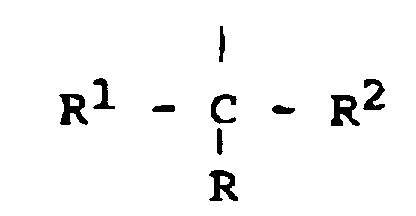 R für Wasserstoff oder einen Kohlenwasserstoffrest steht undR¹ und R separate Kohlenwasserstoffreste darstellen oder gemeinsam einen cyclischen Kohlenwasserstoffrest vervollständigen.
 - Optischer Gegenstand nach Anspruch 5, weiter dadurch gekennzeichnet, daß der verzweigte lipophile Rest ein tertiärer oder Isoalkylrest ist.
- Optischer Gegenstand nach Anspruch 5, weiter dadurch gekennzeichnet, daß das zweite Amphiphil ausgewählt ist aus der Gruppe bestehend ausPoly{4'-N-methyl-N-[2-(2-acryloyloxethoxy)ethoxy]ethylamino-4-octadecylsulfonylazobenzol};Poly{4'-N-methyl-N-[2-(2-acryloyloxethoxy)ethoxy]ethylamino-4-octadecylsulfonylazobenzol-co-2-hydroxyethylacrylat};Poly{4'-dioctadecylamino-4-(6-acryloyloxy)hexylsulfonylazobenzol-co-2-hydroxyethylacrylat}; undPoly{4'-N-methyl-N-(8-acryloyloxy)octylamino-4-octadecylsulfonylazobenzol-co-N,N-dimethylacrylamid}
Applications Claiming Priority (2)
| Application Number | Priority Date | Filing Date | Title |
|---|---|---|---|
| US73555191A | 1991-07-25 | 1991-07-25 | |
| US735551 | 1991-07-25 |
Publications (3)
| Publication Number | Publication Date |
|---|---|
| EP0525665A2 EP0525665A2 (de) | 1993-02-03 |
| EP0525665A3 EP0525665A3 (en) | 1993-04-07 |
| EP0525665B1 true EP0525665B1 (de) | 1996-03-06 |
Family
ID=24956249
Family Applications (1)
| Application Number | Title | Priority Date | Filing Date |
|---|---|---|---|
| EP19920112680 Expired - Lifetime EP0525665B1 (de) | 1991-07-25 | 1992-07-24 | Optischer Gegenstand mit hoher Polarisations-Suszeptibilität zweiter Ordnung und niedriger Übertragungsdämpfung |
Country Status (4)
| Country | Link |
|---|---|
| EP (1) | EP0525665B1 (de) |
| JP (1) | JPH05224259A (de) |
| CA (1) | CA2071167A1 (de) |
| DE (1) | DE69208768T2 (de) |
Families Citing this family (2)
| Publication number | Priority date | Publication date | Assignee | Title |
|---|---|---|---|---|
| EP0596325A1 (de) * | 1992-10-27 | 1994-05-11 | Hoechst Aktiengesellschaft | Optisches Bauelement auf Basis von Langmuir-Blodgett-Schichten |
| CN115657396B (zh) * | 2022-11-15 | 2023-03-10 | 中国科学院长春光学精密机械与物理研究所 | 基于二阶非线性信号强度调制的衬底结构 |
Family Cites Families (3)
| Publication number | Priority date | Publication date | Assignee | Title |
|---|---|---|---|---|
| US4792208A (en) * | 1987-09-28 | 1988-12-20 | Eastman Kodak Company | Optical article exhibiting a high level of second order polarization susceptibility |
| DE3918016A1 (de) * | 1989-06-02 | 1990-12-06 | Basf Ag | (meth)arcrylat-copolymerisate sowie ihre verwendung in der nichtlinearen optik und zur herstellung von langmuir-blodgett-schichten |
| DE3929053A1 (de) * | 1989-09-01 | 1991-03-07 | Basf Ag | Endstaendig ethylenisch ungesaettigte verbindungen sowie ihre verwendung in der nichtlinearen optik |
-
1992
- 1992-06-12 CA CA 2071167 patent/CA2071167A1/en not_active Abandoned
- 1992-07-24 DE DE1992608768 patent/DE69208768T2/de not_active Expired - Fee Related
- 1992-07-24 EP EP19920112680 patent/EP0525665B1/de not_active Expired - Lifetime
- 1992-07-27 JP JP19948992A patent/JPH05224259A/ja active Pending
Also Published As
| Publication number | Publication date |
|---|---|
| DE69208768T2 (de) | 1996-11-14 |
| JPH05224259A (ja) | 1993-09-03 |
| EP0525665A3 (en) | 1993-04-07 |
| DE69208768D1 (de) | 1996-04-11 |
| EP0525665A2 (de) | 1993-02-03 |
| CA2071167A1 (en) | 1993-01-26 |
Similar Documents
| Publication | Publication Date | Title |
|---|---|---|
| US5291567A (en) | Electro-optic waveguide deflector using a nonlinear optic film or liquid-crystal overlay cell for use in an optical pickup head | |
| CA2039207C (en) | Optical article for reflection modulation | |
| US5150446A (en) | Conversion efficiency second harmonic generator | |
| US5075796A (en) | Optical article for multicolor imaging | |
| US4818616A (en) | Optically non-linear materials and thin films incorporating these materials | |
| US7957617B2 (en) | Methods, materials and devices for light manipulation with oriented molecular assemblies in micronscale photonic circuit elements with High-Q or slow light | |
| US5155791A (en) | Hybrid optical waveguides for phase-matched nonlinear wavelength conversion | |
| JP3193453B2 (ja) | 光学的スイッチ | |
| JPH06175172A (ja) | 非線形光学材料、その製造方法並びにそれを用いた非線形光学デバイス及び方向性結合型光スイッチ | |
| EP0422723B1 (de) | Optischer Gegenstand für die Reflexionsmodulation | |
| CA2036036C (en) | Optical article exhibiting a high level of second order polarization susceptibility | |
| US5276743A (en) | Langmuir-Blodgett films in a waveguide optical pick-up head using Mach-Zehnder interferometers | |
| Flörsheimer et al. | Phase‐matched optical second‐harmonic generation in Langmuir–Blodgett film waveguides by mode conversion | |
| Penner et al. | Langmuir-Blodgett films for second-order nonlinear optics | |
| EP0525665B1 (de) | Optischer Gegenstand mit hoher Polarisations-Suszeptibilität zweiter Ordnung und niedriger Übertragungsdämpfung | |
| US5217792A (en) | Stable polar optically nonlinear multilayer films and devices using the same | |
| US5327512A (en) | Langmuir-Blodgett film in an integrated electro-optical scanner | |
| US5247602A (en) | Blue transparent second harmonic generator | |
| US5272002A (en) | Transparent optical article exhibiting high second order polarization susceptibility and low transmission attenuation | |
| Swalen | Linear and non-linear optical and spectroscopic properties of Langmuir-Blodgett films | |
| US4965020A (en) | Non-linear optical device | |
| Clays et al. | Blue light guiding in a polymeric nonlinear optical Langmuir-Blodgett waveguide | |
| Cresswell et al. | An electro-optic Fabry-Pérot through-plane-modulator based on a Langmuir-Blodgett film | |
| JPH10282531A (ja) | 光学偏向器 | |
| US20260085236A1 (en) | Chromophores with New Bridges that Increase Refractive Index |
Legal Events
| Date | Code | Title | Description |
|---|---|---|---|
| PUAI | Public reference made under article 153(3) epc to a published international application that has entered the european phase |
Free format text: ORIGINAL CODE: 0009012 |
|
| AK | Designated contracting states |
Kind code of ref document: A2 Designated state(s): DE FR GB NL |
|
| PUAL | Search report despatched |
Free format text: ORIGINAL CODE: 0009013 |
|
| AK | Designated contracting states |
Kind code of ref document: A3 Designated state(s): DE FR GB NL |
|
| 17P | Request for examination filed |
Effective date: 19930503 |
|
| 17Q | First examination report despatched |
Effective date: 19950425 |
|
| GRAH | Despatch of communication of intention to grant a patent |
Free format text: ORIGINAL CODE: EPIDOS IGRA |
|
| GRAA | (expected) grant |
Free format text: ORIGINAL CODE: 0009210 |
|
| AK | Designated contracting states |
Kind code of ref document: B1 Designated state(s): DE FR GB NL |
|
| REF | Corresponds to: |
Ref document number: 69208768 Country of ref document: DE Date of ref document: 19960411 |
|
| ET | Fr: translation filed | ||
| PLBE | No opposition filed within time limit |
Free format text: ORIGINAL CODE: 0009261 |
|
| STAA | Information on the status of an ep patent application or granted ep patent |
Free format text: STATUS: NO OPPOSITION FILED WITHIN TIME LIMIT |
|
| 26N | No opposition filed | ||
| PGFP | Annual fee paid to national office [announced via postgrant information from national office to epo] |
Ref country code: GB Payment date: 19990614 Year of fee payment: 8 |
|
| PGFP | Annual fee paid to national office [announced via postgrant information from national office to epo] |
Ref country code: NL Payment date: 19990630 Year of fee payment: 8 |
|
| PGFP | Annual fee paid to national office [announced via postgrant information from national office to epo] |
Ref country code: FR Payment date: 19990707 Year of fee payment: 8 |
|
| PGFP | Annual fee paid to national office [announced via postgrant information from national office to epo] |
Ref country code: DE Payment date: 19990730 Year of fee payment: 8 |
|
| PG25 | Lapsed in a contracting state [announced via postgrant information from national office to epo] |
Ref country code: GB Free format text: LAPSE BECAUSE OF NON-PAYMENT OF DUE FEES Effective date: 20000724 |
|
| PG25 | Lapsed in a contracting state [announced via postgrant information from national office to epo] |
Ref country code: NL Free format text: LAPSE BECAUSE OF NON-PAYMENT OF DUE FEES Effective date: 20010201 |
|
| GBPC | Gb: european patent ceased through non-payment of renewal fee |
Effective date: 20000724 |
|
| PG25 | Lapsed in a contracting state [announced via postgrant information from national office to epo] |
Ref country code: FR Free format text: LAPSE BECAUSE OF NON-PAYMENT OF DUE FEES Effective date: 20010330 |
|
| NLV4 | Nl: lapsed or anulled due to non-payment of the annual fee |
Effective date: 20010201 |
|
| REG | Reference to a national code |
Ref country code: FR Ref legal event code: ST |
|
| PG25 | Lapsed in a contracting state [announced via postgrant information from national office to epo] |
Ref country code: DE Free format text: LAPSE BECAUSE OF NON-PAYMENT OF DUE FEES Effective date: 20010501 |