EP0526257B1 - Procédé pour déterminer la position d'un objet - Google Patents
Procédé pour déterminer la position d'un objet Download PDFInfo
- Publication number
- EP0526257B1 EP0526257B1 EP92307083A EP92307083A EP0526257B1 EP 0526257 B1 EP0526257 B1 EP 0526257B1 EP 92307083 A EP92307083 A EP 92307083A EP 92307083 A EP92307083 A EP 92307083A EP 0526257 B1 EP0526257 B1 EP 0526257B1
- Authority
- EP
- European Patent Office
- Prior art keywords
- hyperbolic
- lines
- patterns
- lanes
- lane
- Prior art date
- Legal status (The legal status is an assumption and is not a legal conclusion. Google has not performed a legal analysis and makes no representation as to the accuracy of the status listed.)
- Expired - Lifetime
Links
- 238000000034 method Methods 0.000 title claims abstract description 57
- 238000005259 measurement Methods 0.000 description 3
- 101100190615 Mus musculus Plcd1 gene Proteins 0.000 description 2
- 101100408448 Mus musculus Plcd4 gene Proteins 0.000 description 2
- 238000013480 data collection Methods 0.000 description 2
- 230000001360 synchronised effect Effects 0.000 description 2
- 238000011161 development Methods 0.000 description 1
- 230000018109 developmental process Effects 0.000 description 1
- 238000010586 diagram Methods 0.000 description 1
- 238000009434 installation Methods 0.000 description 1
- 239000005433 ionosphere Substances 0.000 description 1
- 238000012545 processing Methods 0.000 description 1
- 230000000644 propagated effect Effects 0.000 description 1
Images
Classifications
-
- G—PHYSICS
- G01—MEASURING; TESTING
- G01S—RADIO DIRECTION-FINDING; RADIO NAVIGATION; DETERMINING DISTANCE OR VELOCITY BY USE OF RADIO WAVES; LOCATING OR PRESENCE-DETECTING BY USE OF THE REFLECTION OR RERADIATION OF RADIO WAVES; ANALOGOUS ARRANGEMENTS USING OTHER WAVES
- G01S5/00—Position-fixing by co-ordinating two or more direction or position line determinations; Position-fixing by co-ordinating two or more distance determinations
- G01S5/02—Position-fixing by co-ordinating two or more direction or position line determinations; Position-fixing by co-ordinating two or more distance determinations using radio waves
- G01S5/10—Position of receiver fixed by co-ordinating a plurality of position lines defined by path-difference measurements, e.g. omega or decca systems
Definitions
- the present invention relates to a method and an apparatus for determining the position of an object by producing a plurality of hyperbolic electromagnetic wave patterns.
- a procedure for determining a position of an object by producing a plurality of hyperbolic electromagnetic waves is disclosed in U.S. Patent No. 4,492,963.
- a position is identified by the intersection of two hyperbolic lines of position and each of said lines of position is defined by a lane and a fractional position within the lane.
- the hyperbolic method provides accurate positioning of objects within lanes, which is achieved by comparing the relative phases of signals received from cooperating transmitters.
- an acknowledged problem with this type of location is that of maintaining an accurate record of the actual lane.
- drastic measures may be required if signals are lost such that a lane count becomes unreliable.
- a vehicle location system may be employed to guide the driver of a vehicle to an intended destination or so that an operator can establish the location of one or more vehicles in a fleet of such vehicles. Regardless of the intended application of a vehicle location system, namely vehicle guidance or fleet control, the most important requirement of the system is the establishment of the position of the vehicle within acceptable limits of accuracy.
- the present invention seeks to provide a vehicle location system which provides an indication of the position of a vehicle with a relatively high degree of accuracy and reliability.
- the position of the object may be computed using a least mean squares technique.
- the size of the enclosed areas may be determined by directly considering their area. However, in an alternative embodiment, said sizes are determined by considering the sum of the lengths of the perpendiculars from the computed position of the lines of position. Alternatively, some of the lengths of lines from the computed position to the apexes of areas enclosed by the lines of position are determined.
- the method may include a step of producing lines of position in Cartesian co-ordinates.
- the invention provides apparatus as defined in claim 9.
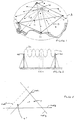
- FIG. 1 there is illustrated a vehicle location system according to the present invention.
- a plurality of time synchronised fixed transmitters 10 are provided which transmit low frequency signals, for example, between 130 kHz and 150 kHz, on a time shared basis.
- the base stations receive data from vehicles within the area A and send this data, by telephone lines 13 to a data collection centre 14.
- the data received from the base stations is processed to provide an indication of the location of each vehicle in the area A.
- FIG. 1 there are four transmitters 10 and nineteen base stations 11.
- each vehicle there is a locator unit to be described in greater detail hereinafter.
- the locator unit measures the phase difference between the signals it receives from each transmitter within range and uses this information to generate hyperbolic lines of position. By receiving signals from at least three transmitters the position of the vehicle can be established.
- FIG 2 shows two transmitters 10a, 10b which radiate continuous wave sinusoidal signals Sa, Sb, respectively.
- the waveforms of the signals shown in Figure 2 are for an instant in time and are, therefore frozen.
- the frequency of the signal Sa produced by the transmitter 10a is kept accurately constant, whilst the transmitter 10b incorporates a receiver (not shown) which is tuned to the signal Sa to enable the transmitter 10b to transmit the signal Sb phase locked to the signal Sa.
- a locator unit situated halfway between the two transmitters at point P1 will receive the two signals Sa, Sb from the transmitters in phase since the distance travelled by each signal will be identical.
- point P2 is a position where the two signals Sa, Sb are separated by exactly 180°, that is to say the signals are completely out of phase.
- Point P3 is a position where the the two signals Sa, Sb are again in phase. In moving from P1 to P3 the locator unit is said to have crossed one "lane", the width of which is equal to half the wavelength of the frequency of the signals from the transmitters 10a, 10b.
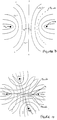
- Figure 3 shows hyperbolic lines of zero phase difference between the transmitters 10a, 10b.
- the area L separating adjacent hyperbolic lines is a lane.
- lane reading lane
- the locator unit at point P3 will produce the same lane reading at any point along the hyperbolic line Y-Y.
- a family of hyperbolic lines, such as shown in Figure 3, is referred to as a "hyperbolic pattern" and can be generated between any two transmitters. As a locator moves through the hyperbolic pattern it measures the difference in phase between the signals Sa, Sb received from the transmitters.
- the locator unit must be on one of the hyperbolic lines. As the locator unit moves through a single lane L the phase difference changes from 0° to 360°. Thus measurement of the phase difference determines a hyperbolic position line PLab of the locator unit in a lane, but no indication of the position of the lane itself relative to the transmitters 10a, 10b.
- a second hyperbolic pattern is produced giving a hyperbolic position line PLcd.
- the position X of the locator unit can be determined from the intersection of hyperbolic position lines PLab, PLcd determined from the two hyperbolic patterns.
- phase comparison is inherently ambiguous since the phase measurement only determines the position of the locator unit within a single lane. Thus the locator unit must also identify the lane in which the locator unit is positioned.
- two methods of lane identification are employed.
- the locator unit is initialised at a known position and then counts lanes as it moves through them from the known position. This maintains a check on the lane in which the locator unit is currently situated.
- two coarse hyperbolic patterns are superimposed on the fine hyperbolic patterns shown in Figure 4. The coarse hyperbolic patterns are generated at a different frequency from the fine hyperbolic patterns and have lanes which are wider than those shown in Figure 4.
- the frequency of the coarse hyperbolic pattern may, for example, be a tenth the frequency of the fine hyperbolic pattern. That is to say the width of each lane generated by the coarse hyperbolic pattern will contain ten lanes of the fine hyperbolic pattern.
- the locator unit measures the phase of the coarse hyperbolic pattern and by scaling up by a factor calculated from the relative frequencies used to generate the coarse and fine hyperbolic patterns (10 in this example) produces the second lane identification. Because of small errors in the phase measurement of the coarse hyperbolic pattern, when scaled up, there may be a discrepancy between the lane identifications produced by the two methods. Discrepancies may also be caused by perturbations in the propagated waves due to noise, reflections from the ionosphere, variations in signal propagation speed with terrain, etc.
- the aim of this invention is to determine which of the lane identification produced by the two lane identifications methods is the more likely to be the correct one. As will be appreciated an incorrect lane identification may lead to a serious error in determining the position of the locator unit.
- Figure 5 illustrates a method according to the present invention seeking to determine which of the lane identifications determined from the two lane identification methods is the more likely to be correct.
- the locator unit converts the hyperbolic position lines into cartesian co-ordinates, for example those of the National Grid, and from this three lines of position LOP1, LOP2, LOP3 are generated using the lane identification determined by the first lane identification method. These three lines of position should theoretically intersect at a single point, that being the position of the locator unit. However, in practice, the three lines of position enclose a triangle T. Thus an estimate of the position X of the locator unit within this triangle is calculated using, for example, the conventional least mean squares technique. In addition the locator unit calculates the size of the triangle T enclosed by the three lines of position.
- the second lane identification method gives a different lane identification for one of the lines of position LOP1, LOP2, LOP3 for that given by the first lane identification method a new line of position is calculated using the lane identification determined by the second lane identification method.
- Figure 5 shows the case where from the second lane identification method a line of position LOP1′, parallel to the line of position LOP1 is calculated.
- the locator unit determines the size of the triangle T' enclosed by the lines of position LOP1′, LOP2, LOP3.
- the size of the triangle T determined by the lines of position LOP1, LOP2, LOP3 is smaller than that of the triangle T' determined by the lines of position LOP1′, LOP2, LOP3.
- the locator unit determines that the lane identification determined by the second lane identification method is likely to be incorrect and, in consequence the line of position LOP1 is more likely to be correct than the line of position LOP1′.
- the locator unit uses the triangle T' determined by the lines of position LOP1′, LOP2, LOP3 to determine the position of the locator unit using, for example, the least mean squares technique.
- the lane identification for two or more of the lines of position does not coincide, the size of the triangle T enclosed by the lines of position determined from the first lane identification method and the lines of position determined from the second lane identification method are compared. The position of the locator unit is then determined from the lines of position that enclose the triangle of the smaller area.
Landscapes
- Physics & Mathematics (AREA)
- Engineering & Computer Science (AREA)
- General Physics & Mathematics (AREA)
- Radar, Positioning & Navigation (AREA)
- Remote Sensing (AREA)
- Position Fixing By Use Of Radio Waves (AREA)
- Radar Systems Or Details Thereof (AREA)
- Navigation (AREA)
- Vehicle Body Suspensions (AREA)
- Devices For Executing Special Programs (AREA)
- Image Analysis (AREA)
- Measurement Of Velocity Or Position Using Acoustic Or Ultrasonic Waves (AREA)
- Length Measuring Devices With Unspecified Measuring Means (AREA)
- Golf Clubs (AREA)
Claims (9)
- Procédé pour déterminer la position d'un objet en produisant une pluralité de diagrammes hyperboliques d'ondes électromagnétiques, dans lequel une position est identifiée par l'intersection de deux lignes hyperboliques de position et chacune desdites lignes de position est définie par une voie et une position fractionnaire sur cette voie, caractérisé par les opérations suivantes :- identifier une surface fermée définie par une troisième hyperbole de position qui coupe au moins une des deux dites hyperboles de position ;- calculer la surface fermée identifiée, obtenue en identifiant les voies selon une première procédure, qui consiste à compter les voies depuis une position particulière connue ;- calculer la surface fermée identifiée obtenue en identifiant des voies selon une seconde procédure indépendante consistant à superposer deux autres diagrammes hyperboliques sur ladite pluralité de diagrammes hyperboliques, lesquels autres diagrammes hyperboliques ont des voies plus larges que ladite pluralité de diagrammes hyperboliques, et en utilisant la phase des autres diagrammes hyperboliques dans la zone de la surface fermée identifiée pour identifier des voies de ladite pluralité de diagrammes hyperboliques ;- sélectionner des lignes de position dans les voies qui résultent d'une zone fermée plus petite ; et- utiliser les lignes sélectionnées comme bases pour déterminer la position de l'objet.
- Procédé selon la revendication 1, dans lequel la position de l'objet est calculée par la méthode des moindres carrés.
- Procédé selon la revendication 1 ou 2, dans lequel les régions délimitées par les lignes de position déterminées par les deux dites procédures sont comparées.
- Procédé selon la revendication 1 ou 2, dans lequel la somme des longueurs des perpendiculaires partant de la position calculée des lignes de position déterminées par les deux dits procédés est comparée.
- Procédé selon la revendication 1 ou 2, dans lequel la somme des longueurs des lignes allant de la position calculée jusqu'aux sommets des surfaces entourées par les lignes de position déterminées par les deux dits procédés est comparée.
- Procédé selon l'une quelconque des revendications précédentes, comprenant l'étape du tracé des lignes de position en coordonnées cartésiennes.
- Procédé selon l'une quelconque des revendications 1 à 6, dans lequel lesdits objets sont des véhicules et ledit procédé est appliqué pour identifier la position desdits véhicules.
- Procédé selon la revendication 7, dans lequel lesdits véhicules sont des véhicules routiers.
- Appareil pour déterminer la position d'un objet, tel qu'un véhicule routier comprenant :- des moyens (10) pour former une pluralité de diagrammes hyperboliques d'ondes électromagnétiques ; et- des moyens pour identifier l'intersection de deux hyperboles de position, dans lesquels chacune desdites lignes de position est définie par une voie et une position fractionnaire sur cette voie ;caractérisé par des moyens pour identifier une surface fermée définie par une troisième hyperbole de position qui coupe au moins une des deux dites hyperboles de position et qui est définie par une voie et une position fractionnaire sur cette voie ;- des moyens pour calculer la surface fermée identifiée obtenue en identifiant des voies selon une première procédure qui consiste à compter des voies à partir d'une position particulière connue ;- des moyens pour former deux autres diagrammes hyperboliques ayant des voies plus larges que ladite pluralité de diagrammes hyperboliques ;- des moyens pour calculer la surface fermée identifiée en identifiant des voies selon une seconde procédure indépendante, qui consiste à superposer les deux autres diagrammes hyperboliques et ladite pluralité de diagrammes hyperboliques et à utiliser la phase des autres diagrammes hyperboliques dans la région de la surface fermée identifiée pour identifier des voies dans ladite pluralité de diagrammes hyperboliques ; et- des moyens pour sélectionner des lignes de position dans des voies qui résultent d'une surface fermée plus petite, et en utilisant les lignes sélectionnées comme base pour déterminer la position de l'objet.
Applications Claiming Priority (2)
| Application Number | Priority Date | Filing Date | Title |
|---|---|---|---|
| GB919116771A GB9116771D0 (en) | 1991-08-02 | 1991-08-02 | A method of determining the position of an object |
| GB9116771 | 1991-08-02 |
Publications (2)
| Publication Number | Publication Date |
|---|---|
| EP0526257A1 EP0526257A1 (fr) | 1993-02-03 |
| EP0526257B1 true EP0526257B1 (fr) | 1996-01-10 |
Family
ID=10699457
Family Applications (1)
| Application Number | Title | Priority Date | Filing Date |
|---|---|---|---|
| EP92307083A Expired - Lifetime EP0526257B1 (fr) | 1991-08-02 | 1992-08-03 | Procédé pour déterminer la position d'un objet |
Country Status (10)
| Country | Link |
|---|---|
| US (1) | US5402348A (fr) |
| EP (1) | EP0526257B1 (fr) |
| JP (1) | JPH05203717A (fr) |
| AT (1) | ATE132978T1 (fr) |
| AU (1) | AU655044B2 (fr) |
| CA (1) | CA2074206A1 (fr) |
| DE (2) | DE69207504T2 (fr) |
| ES (1) | ES2081572T3 (fr) |
| GB (1) | GB9116771D0 (fr) |
| GR (1) | GR3019051T3 (fr) |
Families Citing this family (7)
| Publication number | Priority date | Publication date | Assignee | Title |
|---|---|---|---|---|
| US5900825A (en) * | 1996-08-01 | 1999-05-04 | Manitto Technologies, Inc. | System and method for communicating location and direction specific information to a vehicle |
| US6734824B2 (en) | 2002-08-06 | 2004-05-11 | Lockheed Martin Corporation | System and method for locating emitters |
| US7626544B2 (en) * | 2006-10-17 | 2009-12-01 | Ut-Battelle, Llc | Robust low-frequency spread-spectrum navigation system |
| US8068984B2 (en) * | 2006-10-17 | 2011-11-29 | Ut-Battelle, Llc | Triply redundant integrated navigation and asset visibility system |
| GB2448715A (en) * | 2007-04-24 | 2008-10-29 | Eads Defence And Security Systems Ltd | Wireless asset tracking system |
| US20090284361A1 (en) * | 2008-05-19 | 2009-11-19 | John Boddie | Driver scoring system with lane changing detection and warning system |
| US8384487B2 (en) | 2011-04-08 | 2013-02-26 | Ut-Battelle, Llc | Orthogonally referenced integrated ensemble for navigation and timing |
Family Cites Families (12)
| Publication number | Priority date | Publication date | Assignee | Title |
|---|---|---|---|---|
| US3623100A (en) * | 1969-05-01 | 1971-11-23 | Northrop Corp | Lane counter for digital navigational computer system |
| US3848254A (en) * | 1971-07-28 | 1974-11-12 | Siemens Ag | Method for locating vehicles |
| US4054880A (en) * | 1976-01-19 | 1977-10-18 | E-Systems, Inc. | Position fixing system utilizing plural commercial broadcast transmissions and having frequency correction |
| US4232317A (en) * | 1978-11-01 | 1980-11-04 | Freeny Jr Charles C | Quantized hyperbolic and inverse hyperbolic object location system |
| US4398198A (en) * | 1980-10-28 | 1983-08-09 | Del Norte Technology, Inc. | Pulse-hyperbolic location system using three passive beacon measurements |
| US4492963A (en) * | 1983-10-05 | 1985-01-08 | Eg&G, Inc. | Method and apparatus for determining lane count error in a radio navigational system |
| US4442432A (en) * | 1983-12-05 | 1984-04-10 | Quigley William L | Electronic navigation method and system |
| US4713768A (en) * | 1984-02-20 | 1987-12-15 | Hitachi, Ltd. | Method of localizing a moving body |
| US4916455A (en) * | 1987-02-20 | 1990-04-10 | Scientific Development Inc. | Locating system and method |
| US4987420A (en) * | 1989-01-11 | 1991-01-22 | Mitsubishi Denki Kabushiki Kaisha | Method of determining a position using satellites |
| US5163004A (en) * | 1991-01-11 | 1992-11-10 | Cartesian Devices | Position tracking system |
| US5173710A (en) * | 1991-08-15 | 1992-12-22 | Terrapin Corporation | Navigation and positioning system and method using uncoordinated beacon signals |
-
1991
- 1991-08-02 GB GB919116771A patent/GB9116771D0/en active Pending
-
1992
- 1992-07-20 CA CA002074206A patent/CA2074206A1/fr not_active Abandoned
- 1992-07-22 AU AU20464/92A patent/AU655044B2/en not_active Ceased
- 1992-07-29 JP JP4202128A patent/JPH05203717A/ja active Pending
- 1992-07-30 US US07/921,656 patent/US5402348A/en not_active Expired - Fee Related
- 1992-08-03 ES ES92307083T patent/ES2081572T3/es not_active Expired - Lifetime
- 1992-08-03 AT AT92307083T patent/ATE132978T1/de not_active IP Right Cessation
- 1992-08-03 DE DE69207504T patent/DE69207504T2/de not_active Expired - Fee Related
- 1992-08-03 EP EP92307083A patent/EP0526257B1/fr not_active Expired - Lifetime
- 1992-08-03 DE DE92307083T patent/DE526257T1/de active Pending
-
1996
- 1996-02-21 GR GR960400455T patent/GR3019051T3/el unknown
Also Published As
| Publication number | Publication date |
|---|---|
| US5402348A (en) | 1995-03-28 |
| DE69207504T2 (de) | 1996-07-04 |
| AU2046492A (en) | 1993-02-04 |
| ATE132978T1 (de) | 1996-01-15 |
| AU655044B2 (en) | 1994-12-01 |
| ES2081572T3 (es) | 1996-03-16 |
| GB9116771D0 (en) | 1991-09-18 |
| GR3019051T3 (en) | 1996-05-31 |
| DE526257T1 (de) | 1994-04-21 |
| CA2074206A1 (fr) | 1993-02-03 |
| DE69207504D1 (de) | 1996-02-22 |
| EP0526257A1 (fr) | 1993-02-03 |
| JPH05203717A (ja) | 1993-08-10 |
Similar Documents
| Publication | Publication Date | Title |
|---|---|---|
| EP1020736B1 (fr) | Appareil Radar | |
| US11002849B2 (en) | Driving lane detection device and driving lane detection method | |
| US6356229B1 (en) | Method for processing radar signals | |
| US7474256B2 (en) | Position detecting system, and transmitting and receiving apparatuses for the position detecting system | |
| KR100662063B1 (ko) | 스캔식 레이더의 정지물 검지(檢知) 방법 | |
| US5806019A (en) | Object detecting process in vehicle | |
| US4863123A (en) | Process and system for localizing a mobile unit which travels on a system of railroads | |
| US6204804B1 (en) | Method for determining object movement data | |
| WO2007143238A2 (fr) | Méthode et système permettant de corréler des données de position radar avec des données d'identification de cible et de déterminer la position de cibles en utilisant des données de temps de propagation en boucle | |
| JP2004526166A (ja) | 高度推定システムおよび方法 | |
| CN100359560C (zh) | 利用无线电信号的多普勒频移进行车辆定位的方法与装置 | |
| EP1181572A1 (fr) | Ameliorations dans ou relatives a la localisation d'objet | |
| CN109358322A (zh) | 前向目标检测雷达和方法 | |
| CN115079121B (zh) | 用于车载雷达的多径目标识别方法、装置及存储介质 | |
| WO2021187455A1 (fr) | Système radar | |
| JPS6019470B2 (ja) | 船舶位置検出装置 | |
| Stein et al. | Rail detection using lidar sensors | |
| EP0742447B1 (fr) | Méthode de détermination d'une position | |
| CN110799851B (zh) | 周边监视雷达装置 | |
| US5402348A (en) | Method and apparatus for determining the position of an object within lanes determined utilizing two independent techniques | |
| GB2370706A (en) | Determining the position of a vehicle | |
| CN104103095A (zh) | 定位方法、装置及系统 | |
| US6906661B2 (en) | Object-detecting system for vehicle | |
| JP3653862B2 (ja) | 車両用カーブ径推定装置および目標先行車検出装置 | |
| EP1210615A1 (fr) | Systeme de determination de la position d'un transpondeur |
Legal Events
| Date | Code | Title | Description |
|---|---|---|---|
| PUAI | Public reference made under article 153(3) epc to a published international application that has entered the european phase |
Free format text: ORIGINAL CODE: 0009012 |
|
| AK | Designated contracting states |
Kind code of ref document: A1 Designated state(s): AT BE CH DE DK ES FR GB GR IE IT LI LU MC NL PT SE |
|
| 17P | Request for examination filed |
Effective date: 19930609 |
|
| TCNL | Nl: translation of patent claims filed | ||
| 17Q | First examination report despatched |
Effective date: 19931004 |
|
| DET | De: translation of patent claims | ||
| GRAA | (expected) grant |
Free format text: ORIGINAL CODE: 0009210 |
|
| AK | Designated contracting states |
Kind code of ref document: B1 Designated state(s): AT BE CH DE DK ES FR GB GR IE IT LI LU MC NL PT SE |
|
| PG25 | Lapsed in a contracting state [announced via postgrant information from national office to epo] |
Ref country code: LI Effective date: 19960110 Ref country code: DK Effective date: 19960110 Ref country code: CH Effective date: 19960110 Ref country code: AT Effective date: 19960110 |
|
| REF | Corresponds to: |
Ref document number: 132978 Country of ref document: AT Date of ref document: 19960115 Kind code of ref document: T |
|
| REG | Reference to a national code |
Ref country code: IE Ref legal event code: FG4D Free format text: 66840 |
|
| REF | Corresponds to: |
Ref document number: 69207504 Country of ref document: DE Date of ref document: 19960222 |
|
| ET | Fr: translation filed | ||
| REG | Reference to a national code |
Ref country code: ES Ref legal event code: FG2A Ref document number: 2081572 Country of ref document: ES Kind code of ref document: T3 |
|
| ITF | It: translation for a ep patent filed | ||
| PG25 | Lapsed in a contracting state [announced via postgrant information from national office to epo] |
Ref country code: PT Effective date: 19960410 |
|
| REG | Reference to a national code |
Ref country code: GR Ref legal event code: FG4A Free format text: 3019051 |
|
| REG | Reference to a national code |
Ref country code: CH Ref legal event code: PL |
|
| PG25 | Lapsed in a contracting state [announced via postgrant information from national office to epo] |
Ref country code: IE Free format text: LAPSE BECAUSE OF NON-PAYMENT OF DUE FEES Effective date: 19960803 |
|
| PG25 | Lapsed in a contracting state [announced via postgrant information from national office to epo] |
Ref country code: LU Free format text: LAPSE BECAUSE OF NON-PAYMENT OF DUE FEES Effective date: 19960831 |
|
| PLBE | No opposition filed within time limit |
Free format text: ORIGINAL CODE: 0009261 |
|
| STAA | Information on the status of an ep patent application or granted ep patent |
Free format text: STATUS: NO OPPOSITION FILED WITHIN TIME LIMIT |
|
| 26N | No opposition filed | ||
| PG25 | Lapsed in a contracting state [announced via postgrant information from national office to epo] |
Ref country code: MC Effective date: 19970228 |
|
| REG | Reference to a national code |
Ref country code: GB Ref legal event code: IF02 |
|
| PGFP | Annual fee paid to national office [announced via postgrant information from national office to epo] |
Ref country code: SE Payment date: 20030807 Year of fee payment: 12 Ref country code: NL Payment date: 20030807 Year of fee payment: 12 Ref country code: GB Payment date: 20030807 Year of fee payment: 12 |
|
| PGFP | Annual fee paid to national office [announced via postgrant information from national office to epo] |
Ref country code: GR Payment date: 20030811 Year of fee payment: 12 |
|
| PGFP | Annual fee paid to national office [announced via postgrant information from national office to epo] |
Ref country code: ES Payment date: 20030813 Year of fee payment: 12 |
|
| PGFP | Annual fee paid to national office [announced via postgrant information from national office to epo] |
Ref country code: BE Payment date: 20030820 Year of fee payment: 12 |
|
| PGFP | Annual fee paid to national office [announced via postgrant information from national office to epo] |
Ref country code: FR Payment date: 20030829 Year of fee payment: 12 |
|
| PGFP | Annual fee paid to national office [announced via postgrant information from national office to epo] |
Ref country code: DE Payment date: 20031020 Year of fee payment: 12 |
|
| PG25 | Lapsed in a contracting state [announced via postgrant information from national office to epo] |
Ref country code: GB Free format text: LAPSE BECAUSE OF NON-PAYMENT OF DUE FEES Effective date: 20040803 |
|
| PG25 | Lapsed in a contracting state [announced via postgrant information from national office to epo] |
Ref country code: SE Free format text: LAPSE BECAUSE OF NON-PAYMENT OF DUE FEES Effective date: 20040804 Ref country code: ES Free format text: LAPSE BECAUSE OF NON-PAYMENT OF DUE FEES Effective date: 20040804 |
|
| PG25 | Lapsed in a contracting state [announced via postgrant information from national office to epo] |
Ref country code: BE Free format text: LAPSE BECAUSE OF NON-PAYMENT OF DUE FEES Effective date: 20040831 |
|
| BERE | Be: lapsed |
Owner name: *SECURICOR DATATRAK LTD Effective date: 20040831 |
|
| PG25 | Lapsed in a contracting state [announced via postgrant information from national office to epo] |
Ref country code: NL Free format text: LAPSE BECAUSE OF NON-PAYMENT OF DUE FEES Effective date: 20050301 Ref country code: DE Free format text: LAPSE BECAUSE OF NON-PAYMENT OF DUE FEES Effective date: 20050301 |
|
| PG25 | Lapsed in a contracting state [announced via postgrant information from national office to epo] |
Ref country code: GR Free format text: LAPSE BECAUSE OF NON-PAYMENT OF DUE FEES Effective date: 20050303 |
|
| GBPC | Gb: european patent ceased through non-payment of renewal fee |
Effective date: 20040803 |
|
| EUG | Se: european patent has lapsed | ||
| PG25 | Lapsed in a contracting state [announced via postgrant information from national office to epo] |
Ref country code: FR Free format text: LAPSE BECAUSE OF NON-PAYMENT OF DUE FEES Effective date: 20050429 |
|
| NLV4 | Nl: lapsed or anulled due to non-payment of the annual fee |
Effective date: 20050301 |
|
| REG | Reference to a national code |
Ref country code: FR Ref legal event code: ST |
|
| PG25 | Lapsed in a contracting state [announced via postgrant information from national office to epo] |
Ref country code: IT Free format text: LAPSE BECAUSE OF NON-PAYMENT OF DUE FEES Effective date: 20050803 |
|
| REG | Reference to a national code |
Ref country code: ES Ref legal event code: FD2A Effective date: 20040804 |
|
| BERE | Be: lapsed |
Owner name: *SECURICOR DATATRAK LTD Effective date: 20040831 |