EP0526652A1 - Procede pour detecter le virus de l'herpes avec specificite selon le type - Google Patents
Procede pour detecter le virus de l'herpes avec specificite selon le type Download PDFInfo
- Publication number
- EP0526652A1 EP0526652A1 EP92905101A EP92905101A EP0526652A1 EP 0526652 A1 EP0526652 A1 EP 0526652A1 EP 92905101 A EP92905101 A EP 92905101A EP 92905101 A EP92905101 A EP 92905101A EP 0526652 A1 EP0526652 A1 EP 0526652A1
- Authority
- EP
- European Patent Office
- Prior art keywords
- dna
- formula
- base sequence
- bases
- oligonucleotide
- Prior art date
- Legal status (The legal status is an assumption and is not a legal conclusion. Google has not performed a legal analysis and makes no representation as to the accuracy of the status listed.)
- Granted
Links
Images
Classifications
-
- C—CHEMISTRY; METALLURGY
- C12—BIOCHEMISTRY; BEER; SPIRITS; WINE; VINEGAR; MICROBIOLOGY; ENZYMOLOGY; MUTATION OR GENETIC ENGINEERING
- C12Q—MEASURING OR TESTING PROCESSES INVOLVING ENZYMES, NUCLEIC ACIDS OR MICROORGANISMS; COMPOSITIONS OR TEST PAPERS THEREFOR; PROCESSES OF PREPARING SUCH COMPOSITIONS; CONDITION-RESPONSIVE CONTROL IN MICROBIOLOGICAL OR ENZYMOLOGICAL PROCESSES
- C12Q1/00—Measuring or testing processes involving enzymes, nucleic acids or microorganisms; Compositions therefor; Processes of preparing such compositions
- C12Q1/70—Measuring or testing processes involving enzymes, nucleic acids or microorganisms; Compositions therefor; Processes of preparing such compositions involving virus or bacteriophage
- C12Q1/701—Specific hybridization probes
- C12Q1/705—Specific hybridization probes for herpetoviridae, e.g. herpes simplex, varicella zoster
Definitions
- the present invention relates to a method of the type-specific detection of the human herpes simplex virus Type I (hereinafter optionally referred to as HSV I) and the human herpes simplex virus Type II (hereinafter optionally referred to as HSV II).
- HSV I human herpes simplex virus Type I
- HSV II human herpes simplex virus Type II
- HSV Human herpes simplex virus
- Type I Type I
- Type II Type II
- the rate of recurrence and the sensitivity to drugs differ depending on the type. Therefore, the determination of the type of HSV is important.
- the most reliable method of diagnosis of the HSV infectious disease is to isolate the virus for determination, but this method requires culture cells and requires several days for the determination, so is difficult to appropriately reflect the results in treatment.
- the object of the present invention is to provide various primers which can be used for the amplification of DNA fragments specific to HSV I or HSV II, and probes specific to HSV I DNA or HSV II DNA.
- the present invention relates to a method of the type-specific detection of herpes simplex virus, characterized by comprising the step of DNA amplification in a liquid mixture containing either of a combination of a first DNA primer containing an oligonucleotide having at least 15 bases in a base sequence of the formula (1 a)
- the liquid sample used in the method of the present invention is not particularly limited so far as the sample is suspected of containing HSV.
- the HSV detection method of the present invention mainly comprises (1) a DNA amplification step and (2) a DNA detection step.
- the DNA amplification step (1) it is possible to use the PCR (polymerase chain reaction) method.
- the PCR method it is possible to amplify the desired DNA region automatically from a small amount of DNA to about one million-fold (Science, 239, 487 to 491, 1988).
- two types of DNA primers are used: a primer for the + (plus) strand (hereinafter referred to as the first primer) and the primer for the - (minus) strand (hereinafter referred to as the second primer) sandwiching the DNA region to be amplified.
- the above combinations (a) and (b) may be used alone or simultaneously.
- the combination (a) of the primers it is possible to perform detection specific to HSV I
- the combination (b) of the primers it is possible to perform detection specific to HSV II.
- the base sequences of the formulae (1 a) and (2a) lie at the 0.75 map unit on the HSV I DNA gene map.
- the base sequence of the formula (1 a) includes the 20 bases of the complementary strand from the 31 st base to the 12nd base upstream of the 5' end of the BamHIB fragment, while the base sequence of the formula (2a) includes the 20 bases of the complementary strand from the 212nd base to 193rd base downstream from the 5' end of the BamHIB fragment.
- the base sequences of the formulae (1 b) and (2b) lie at the a' sequence of the HSV II DNA (J. Gen. Virol., 55, 315 to 331, 1981).
- the base sequence of the above-mentioned formula (1 b) includes the 20 bases of the complementary strand from the ninth base to the 28th base downstream of the 5' end of the a' sequence, while the base sequence of the above-mentioned formula (2b) includes the 20 bases of the complementary strain from the 221 st base to the 202nd base downstream from the 5' end of the a' sequence.
- the combination of the primers (1 a) and (2a) amplifies the 243 bp portion corresponding to a part of the BamHl fragment gene
- the combination of the primers (1 b) and (2b) amplifies the 213 bp portion corresponding to a part of the a' sequence gene, in the specific manner, in large amounts and a short time, respectively. Accordingly, the presence of HSV I DNA and HSV II DNA in the sample can be detected in the extremely specific manner.
- the first and second primers may respectively be 15 mer to 30 mer, but in general 20 mer to 25 mer. If the primers become less than 15 mer, the specificity is reduced upon annealing and nonspecific bonds are increased. Further, if the primers become over 30 mer, secondary structures are liable to occur between the primer molecules or in the molecules.
- the bases included in the first primer and second primer used in the present invention may be modified by any known manner (for example, biotinated or labeled by a fluorescent substance).
- the first and second primers according to the present invention can be prepared by a known DNA synthesis method (for example, the phosphoamidite method) using an ordinary automatic DNA synthesizing apparatus (for example, Applied Biosystems)
- the amplification cycle is repeated using a DNA polymerase, particularly a heat resistant DNA polymerase, in addition to the first and second primers.
- a DNA polymerase particularly a heat resistant DNA polymerase
- the heat resistant DNA polymerase there may be used a DNA polymerase which can maintain its activity at a temperature up to 95 ° C, for example, a commercially available Taq polymerase.
- a liquid mixture of a particular combination of the above-mentioned first and second primers, the DNA polymerase, and the liquid sample is used.
- the amounts of the first primer, the second primer, and the DNA polymerase can be varied depending on the species of the liquid sample, but may be easily determined in a range that the DNA amplification step may be carried out by the PCR method.
- the liquid mixture in some cases may contain a buffer solution (for example, a tris hydrochloride buffer solution), a stabilizing agent (for example, gelatine), or a salt (for example, sodium chloride).
- the liquid mixture is used in the amplification cycle of the PCR method.
- the amplification cycle comprises steps of:
- the DNA is amplified two-fold. Therefore, after n cycles of amplifications, the DNA is amplified 2" fold.
- the above-mentioned amplification cycle is repeated 10 to 60 times, preferably 20 to 40 times.
- the method of utilizing gel electrophoresis and ethidium bromide dyeing there may be used the method of utilizing gel electrophoresis and ethidium bromide dyeing; the Southern blotting hybridization method; or the method of determining the base sequence by the dideoxy method; the radioactive labeling method, or the like.
- the gel electrophoresis method it is possible to use, for example, submarine type electrophoresis using agarose gel as a carrier or slab gel electrophoresis using acrylamide.
- a radioactive probe or a nonradioactive probes for example, a probe labeled with an enzyme, biotin, digoxigenin, chemoluminescent substance or fluorescent substance.
- the method of determining the base sequence by the dideoxy method there may be used an automatic DNA sequencer (Applied Biosystems) using a fluorescent label.
- Applied Biosystems automatic DNA sequencer
- the present invention also provides two types of DNA probes, specific to the HSV I DNA and HSV II DNA. Accordingly, the present invention also relates to a method of the type-specific detection of herpes simplex virus, characterized by bringing an oligonucleotide probe having at least 10 bases in a base sequence of the formula (3): or the formula (4) and carrying a label thereon into contact with a sample; and detecting a signal from the label.
- the base sequence of the formula (3) includes the 40 bases from the 50th base to 89th base downstream from the 5' end of the BamHIB fragment.
- the DNA probe containing an oligonucleotide having at least 10 bases in the base sequence of the formula (3) (hereinafter referred to optionally as the probe A) is specific to the BamHIB fragment of the HSV I DNA.
- the length of the probe varies with the kind of the pre-treatment applied to the sample. When the sample is treated by the DNA amplification step of the PCR method, the probe can be from 10 bp up to the size of the DNA fragment (except the primer part) amplified by the PCR method.
- the length of the probe A may be of a size from 10 bp to 287 bp.
- the DNA probe A (40 mer) consisting of the oligonucleotide having 40 bases in the base sequence of the formula (3) is preferable, because such a DNA probe may be used for a sample after the treatment of the DNA amplification step of the PCR method or of the in-situ hybridization method.
- the probe A may be prepared by the method of using a succinoimide (for example, disuccinymidyl- suberate), the maleimide method, the active halogen method, a photoreaction using an azide, or the carbodiimide method.
- the base sequence of the formula (4) includes the 40 bases from the 148th base to the 187th base downstream from the 5' end of the a' sequence.
- a DNA probe containing an oligonucleotide having at least 10 bases in the base sequence of the formula (4) (hereinafter optionally referred to as the probe B) is specific to the a' sequence of the HSV II DNA.
- the length of the probe B varies with the kind of the pre-treatment of the sample.
- the probe can be from 10 bp up to the size of the DNA fragment (except the primer part) amplified by the PCR method.
- the length of the probe B may be of a size from 10 bp to 185 bp.
- the DNA probe B (40 mer) consisting of the oligonucleotide having the base sequence of the SEQ ID NO: 6 in the Sequence Listing is preferable, because such a DNA probe may be used for a sample after the treatment of the DNA amplification step of the PCR method or of the in-situ hybridization method.
- the probe B may be prepared the same methods as those for preparing the probe A as mentioned above.
- any known substances may be used for labeling the probes A and B.
- a nonradioactive substance enzyme, fluorescent dye, luminescent substance, biotin, etc.
- synthesizing the labeled DNA there mainly are following two methods:
- the combination of the primers (1 a) and (2a) is used in the method of the present invention
- the 243 bp base part corresponding to a part of the BamHIB fragment gene is amplified and synthesized in a specific manner, in a lot of amounts, and in a short time, only if the HSV I DNA is present in the sample.
- the combination of the primers (1 b) and (2b) is used, the 213 bp base part corresponding to a part of the a' sequence gene is amplified and synthesized in a specific manner, in a large amount, and in a short time, only if the HSV II DNA is present in the sample.
- the DNA is amplified and synthesized even when the HSV I DNA or the HSV II DNA is present in a sample in a slight amount, and so the sensitivity is high.
- a labeled DNA probe specific to the HSV I DNA or HSV II DNA (amplified in some cases) is used in the present invention, and therefore, it is possible to detect the HSV I DNA or the HSV II DNA extremely accurately. Further, if a combination of the amplification step using the first and second primers and the detection step using the above-mentioned probes is used, the time required for the detection is about 4 to 5 hours in the case of ethidium bromide dyeing and is about 48 to 50 hours even in the case of the Southern blotting hybridization method, and so the results can be obtained rapidly.
- a primer (1a) having 20 bases in the sequence of the formula (1a) was synthesized by attaching an adenine CPG column to a Model 381A automatic DNA synthesizer (Applied Biosystems), a primer (2a) having 20 bases in the sequence of the formula (2a) was synthesized by attaching a thymine CPG column to the same, and a primer (1;8) having 20 bases in the sequence of the formula (1 b) and a primer (2;8) having 20 bases in the sequence of the formula (2b) were synthesized by attaching a guanine CPG column to the same.
- a disposable syringe (2.5 ml) containing 2.5 ml of ammonia water (about 30%) was connected to the CPG column wherein the synthesis step was completed.
- the ammonia water was injected into the column, and the synthesized DNA fragments were eluted out.
- the vial containing the recovered DNA ammonia solution was plugged air-tightly and heated at 65 °C for 6 hours, then was cooled to room temperature, and then the solution was concentrated.
- the concentrate was lyophilized, dissolved in 10 mM triethyl ammonium acetate (hereinafter abbreviated as TEA-A) (pH 7.4), and then the precipitate was removed.
- TEA-A triethyl ammonium acetate
- a separation column (YMC-Pack ODS-AM313: YMC) was attached to a Type L-6200 high performance liquid chromatography apparatus (Hitachi) (hereinafter referred to as an HPLC), then purification was carried out using a concentration gradient by acetonitrile and 95 mM-TEA-A containing 5 % acetonitrile, and the main peaks were collected.
- HPLC high performance liquid chromatography apparatus
- 80 % acetic acid (adjusted by acetonitrile) was added to suspend the residue, then the suspension was allowed to stand at room temperature for 30 minutes, and dried under reduced pressure.
- the dried product was dissolved in 10 mM-TEA-A, extracted with diethylether, and dried under reduced pressure.
- the dried DNA sample was dissolved in TEA-A and the precipitate was removed. A second purification was carried out by a HPLC and the main peaks were collected. The resultant purified DNA primers were dried under reduced pressure to store, and used for the Examples 2 and 3.
- a probe a having 40 bases in the sequence of the formula (3) and a probe b having 40 bases in the sequence of the formula (4) were synthesized.
- a cytosine CPG column was used, and for the synthesis of the probe b, a guanine CPG column was used.
- the probes a and b prepared in Example 1 were oligo-labeled by 32p (using oligo-labeling kit of Pharmacia). To 4 ⁇ l of an aqueous solution containing 100 ng of the probe DNA, 58 ⁇ l of water was added. The whole was heated for 10 minutes at 100°C, then was immediately cooled with ice. To the ice-cooled probe solution, 20 ⁇ l of deoxynucleotide-triphosphate mixture, 4 ⁇ l of bovine serum albumin, 4 ⁇ l of Klenow enzyme, and 1 ⁇ l of a- 32 P-dCTP (300 Ci) were added, then the whole was allowed to stand at room temperature for 2 hours.
- the resultant precipitate was dissolved in 30 ⁇ l of a 10 mM tris hydrochloride buffer solution containing 1 mM-EDTA, then 16 ⁇ l of 7.5M ammonium acetate and 92 ⁇ l of ethyl alcohol were added, and the whole was allowed to stand at -70 °C for 15 minutes, then was centrifuged. To the resultant precipitate, 200 ⁇ l of 75 % ethyl alcohol was added, then the whole was further centrifuged, and the resultant precipitate was air-dried at room temperature for 2 hours.
- the resultant labeled probe was dissolved in 200 ⁇ l of a 10 mM tris hydrochloride buffer solution containing 1 mM-EDTA. The resultant labeled probe solution was used in an amount of about 10 ⁇ l for a single dot blotting.
- a probe end-labeled with 32p was prepared by the following method: To 1 ⁇ l of a solution containing 500 ng of the probe DNA prepared in Example 1, 2.5 ⁇ l of a 10 x kinase buffer solution, 1.5 ⁇ l (15 units) of T4 polynucleotide kinase, and 20 ⁇ l (200 Ci) of ⁇ - 32 P-dATP were added, then the mixture was held at 37°C for 45 minutes.
- WT51-3-4 strain isolated from a herpetic keratitis patient: Acta Vicol. 23: 226-230 (1979)] as the standard strain of HSV I
- UW268 as the standard strain of HSV II
- five strains for each of Type I and Type II of clinically isolated strains isolated from herpes-like sites of patients infected with HSV
- HSV wild strains which had been determined as to the types.
- Each virus was made to infect CV-1 cells derived from the kidney of African green monkeys at a concentration of 1 pfu/cell.
- the cells infected with viruses were cultivated in a gaseous phase of 5 % carbon dioxide and 95 % air.
- the cells showing effects of cell modification were used to extract the virus DNA's by the sucrose method (Virology, 93, 260-264, 1979).
- the PCR method was carried out to amplify the DNA by repeating 30 times the cycle consisting of (i) 92 ° C for 1 minute, (ii) 60 ° C for 1 minute, and (iii) 72 ° C for 2 minutes, and finally treating at 72°C for 5 minutes.
- the PCR method was carried out to amplify the DNA by repeating 30 times the cycle consisting of (i) 93 ° C for 1 minute, (ii) 65 °C for 1 minute, and (iii) 73 °C for 1 minute, and finally treating at 73 °C for 5 minutes.
- Electrophoresis gel was prepared by dissolving 4 % agarose gel in 1 liter of a buffer solution (pH 8.0) containing 5.4 g of tris hydrochloride, 2.75 g of boric acid and 2 ml of 0.5M EDTA (hereinafter referred to as 0.5 X TBE) and pouring into a gel plate of Mupid (Advance). Then, 2 ⁇ l of a 15 % aqueous solution of Ficoll Type 400 (Pharmacia) was mixed with 10 ⁇ l of the solution after the PCR reaction, and the mixture was inserted into sample wells. After 1 x TBE was inserted into an electrode tank, electrophoresis was carried out at room temperature and 100 V for 2 hours.
- the agarose gel was stained with ethidium bromide and the results of the electrophoresis were observed under illumination from a UV illuminator.
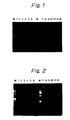
- the results of the case wherein the HSV I primer was used are shown in Fig. 1 and the results of the case wherein the HSV II primer was used are shown in Fig. 2.
- the reference numerals have the following meanings:
- DNA markers ⁇ x 174-Haelll digest
- those appearing at 72 bp, 118 bp, 194 bp, 234 bp, 271 bp, 281 bp, 310 bp, 603 bp, 872 bp, 1078 bp, and 1357 bp from the bottom were used. It is manifest from Figs. 1 and 2 that the PCR method wherein the primers according to the present invention are used make it possible to amplify the particular DNA parts specific to the desired HSV's.
- HSV I standard strain WT51-3-4
- the lanes 2 and 4 are HSV II standard strain (UW268).
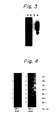
- the end-labeled probe a was used for the lanes 1 and 2 of Fig. 3, while the end-labeled probe b was used for the lanes 3 and 4. It is manifest from Fig. 3 that only the bands amplified by the HSV II primers as a template were hybridized with the probe b for determining HSV II, while the bands amplified by the HSV I primers as a template were not hybridized with the probe b for determining HSV II.
- a bulla (5 ⁇ l) taken from patients suspected of having herpes infection was suspended in 2 ml of a physiological saline solution for dilution.
- a physiological saline solution for dilution.
- To 200 ⁇ l of the diluted sample the same amount of 0.5N NaOH was added and the mixture was allowed to stand at room temperature for 10 minutes.
- the resultant treated sample (50 ⁇ l) containing the modified DNA was placed on a blotting apparatus having Gene Screen Plus NEF976 (Du Pont) and allowed to stand at room temperature for 30 minutes, then the liquid was removed by suction.
- the Gene Screen Plus NEF976 with the blotted DNA was placed in a plastic bag, then 5 ml of a hybridization solution containing a composition of 0.2 % polyvinylpyrrolidone (molecular weight of 40,000), 0.2 % Ficoll (molecular weight of 40,000), 0.2 % bovine serum albumin, 0.05M tris hydrochloride buffer solution (pH 7.5), 1M sodium chloride, 0.1 % sodium phosphate, 1 % sodium lauryl sulfate, 10 % dextran sodium sulfate (molecular weight of 500,000), and modified salmon sperm DNA (100 ⁇ g/ml) was added thereto and the bag was sealed air-tightly.
- a hybridization solution containing a composition of 0.2 % polyvinylpyrrolidone (molecular weight of 40,000), 0.2 % Ficoll (molecular weight of 40,000), 0.2 % bovine serum albumin, 0.05M tris hydrochlor
- the whole was allowed to stand at 65 ° C for 6 hours, then the 32 P-labeled and HSV-determining probes prepared in Example 2 (oligo labeling) were added, then the whole was allowed to further stand at 65 ° C for 6 hours.
- the treated Gene Screen Plus NEF976 was washed twice at room temperature with agitation for 5 minutes in a 2 x SSC (pH 7.0) containing a large amount of 0.3M sodium chloride and 0.034M trisodium citrate, then was washed twice at 65°C for 15 minutes in a 2 x SSC and 1 % SDS, further was washed twice at room temperature with agitation for 5 minutes in 0.1 x SSC.
- the washed film was air-dried at room temperature for 1 hour.
- the Gene Screen Plus NEF976 which was subjected to the hybridization treatment with the HSV type- determining probes was placed in an exposing cassette and fixed therein. Then the film (Kodak-X-OMAT-AR XAR5) was exposed at -70 ° C and developed. The results are shown in Fig. 4.
- 1 to 5 are patient samples
- 6 is an HSV I standard strain
- 7 is an HSV II standard strain.
- the remarks at the right side of the figure are the results of determination.
- the probe a hybridizes with the HSV I virus and the probe b hybridizes with the HSV II virus.
- Table 1 shows that, according to the clinical examination method as to the 18 bulla solutions, three samples were found to be HSV I, three samples were found to be HSV II, and 12 samples were not able to determine (it was not able to conclusively diagnosis them as being Type I or Type II).
- the fluorescent antibody method seven samples were found to be HSV I, one sample HSV II, eight samples were not able to examine (diseased cells were not able to take up), and two samples were not able to determine.
- 12 samples were found to be HSV I and six HSV II. No samples could not be examined or could not be determined as to the types.
- Example 8 (1) DNA was extracted from the throat swab of patients suspected of suffering from herpes infection.
- the extracted DNA was used for the type determination of HSV by the dot blot method as described in Example 7 and the PCR method as described in Example 8 (1).
- the dot blot method showed that 10 samples were HSV I, 10 samples could not be determined as to the type, and 16 samples were negative.
- the PCR method according to the present invention exhibited a high ability to the type determination, wherein 32 samples found to be HSV I and the remaining four negative. The results are shown in Table 2.
- the process of the present invention provides primers which can be used for the amplification of DNA fragments specific to HSV I DNA or HSV II DNA, and also provides, as probes specific to HSV I DNA or HSV II DNA, oligonucleotides having base sequences of a size to an extent that can be chemically synthesized and further which are not reduced in type-specificity. Therefore, it is possible to determinate infection of HSV I or HSV II rapidly in a type-specific manner at a high precision, and also possible to make use of the results thereof in diagnosis and treatment.
Landscapes
- Chemical & Material Sciences (AREA)
- Life Sciences & Earth Sciences (AREA)
- Health & Medical Sciences (AREA)
- Organic Chemistry (AREA)
- Zoology (AREA)
- Engineering & Computer Science (AREA)
- Immunology (AREA)
- Wood Science & Technology (AREA)
- Proteomics, Peptides & Aminoacids (AREA)
- Virology (AREA)
- Biotechnology (AREA)
- Microbiology (AREA)
- Molecular Biology (AREA)
- Physics & Mathematics (AREA)
- Biophysics (AREA)
- Analytical Chemistry (AREA)
- Biochemistry (AREA)
- Bioinformatics & Cheminformatics (AREA)
- General Engineering & Computer Science (AREA)
- General Health & Medical Sciences (AREA)
- Genetics & Genomics (AREA)
- Measuring Or Testing Involving Enzymes Or Micro-Organisms (AREA)
Abstract
Applications Claiming Priority (4)
| Application Number | Priority Date | Filing Date | Title |
|---|---|---|---|
| JP5333691 | 1991-02-25 | ||
| JP53336/91 | 1991-02-25 | ||
| JP05333691A JP3167138B2 (ja) | 1991-02-25 | 1991-02-25 | 単純ヘルペスウイルスの型特異的検出方法 |
| PCT/JP1992/000196 WO1992014846A1 (fr) | 1991-02-25 | 1992-02-24 | Procede pour detecter le virus de l'herpes avec specificite selon le type |
Publications (3)
| Publication Number | Publication Date |
|---|---|
| EP0526652A1 true EP0526652A1 (fr) | 1993-02-10 |
| EP0526652A4 EP0526652A4 (en) | 1993-05-26 |
| EP0526652B1 EP0526652B1 (fr) | 2001-06-27 |
Family
ID=12939907
Family Applications (1)
| Application Number | Title | Priority Date | Filing Date |
|---|---|---|---|
| EP92905101A Expired - Lifetime EP0526652B1 (fr) | 1991-02-25 | 1992-02-24 | Procede pour detecter le virus de l'herpes avec specificite selon le type |
Country Status (7)
| Country | Link |
|---|---|
| US (1) | US5354653A (fr) |
| EP (1) | EP0526652B1 (fr) |
| JP (1) | JP3167138B2 (fr) |
| CA (1) | CA2081354C (fr) |
| DE (1) | DE69231896T2 (fr) |
| ES (1) | ES2158846T3 (fr) |
| WO (1) | WO1992014846A1 (fr) |
Cited By (4)
| Publication number | Priority date | Publication date | Assignee | Title |
|---|---|---|---|---|
| US5455678A (en) * | 1993-08-25 | 1995-10-03 | Kopin Corporation | Method for mounting light valves for projection display system |
| US5624174A (en) * | 1993-08-25 | 1997-04-29 | Kopin Corporation | Display panel mount for projection display system |
| US5653522A (en) * | 1993-08-25 | 1997-08-05 | Kopin Corporation | Display panel mount for projection dislay system |
| EP0714399A4 (fr) * | 1993-08-20 | 1999-01-27 | Smithkline Beecham Corp | Gene hsv-2 ul26, proteines capsides, dosages immunologiques et inhibiteurs de protease |
Families Citing this family (9)
| Publication number | Priority date | Publication date | Assignee | Title |
|---|---|---|---|---|
| ES2093554B1 (es) * | 1995-02-17 | 1997-07-01 | Inst De Salud Carlos Iii | Procedimientos de amplificacion de genoma y mezclas de oligonucleotidos iniciadores para la deteccion y la identificacion de agentes infecciosos relacionados. |
| US5925733A (en) * | 1995-07-14 | 1999-07-20 | University Of Washington | DNA polymerase of gamma herpes viruses associated with Kaposi's sarcoma and retroperitoneal fibromatosis |
| RU2165977C1 (ru) * | 1999-12-07 | 2001-04-27 | Государственный научный центр вирусологии и биотехнологии "Вектор" | Синтетические олигонуклеотиды-праймеры, используемые для выявления днк вируса простого герпеса 1 типа (впг-1) человека |
| AU2002243751A1 (en) * | 2001-01-31 | 2002-08-12 | Mayo Foundation For Medical Education And Research | Detection of herpes simplex virus |
| RU2196179C2 (ru) * | 2001-03-07 | 2003-01-10 | Государственный научный центр вирусологии и биотехнологии "Вектор" | Синтетические олигонуклеотиды-праймеры, используемые для выявления днк вируса простого герпеса 2 типа (впг-2) человека |
| US20060252032A1 (en) * | 2005-01-28 | 2006-11-09 | Third Wave Technologies, Inc. | Detection of human herpesviruses |
| RU2348695C2 (ru) | 2006-05-23 | 2009-03-10 | Закрытое акционерное общество "Молекулярно-медицинские технологии" | Дифференцирующий и специфический олигонуклеотиды для идентификации последовательностей днк инфекционных агентов в биологических материалах, способ видовой идентификации инфекционных агентов, биочип и набор для осуществления этого способа |
| MD3299G2 (ro) * | 2006-09-28 | 2007-11-30 | Институт Генетики, Физиологии И Защиты Растений Академии Наук Молдовы | Primer oligonucleotidic pentru depistarea ADN-ului virusului herpes de tip 1 |
| US20090226889A1 (en) * | 2008-01-14 | 2009-09-10 | Chen Fan | Methods and compositions for detecting cns viruses |
Family Cites Families (4)
| Publication number | Priority date | Publication date | Assignee | Title |
|---|---|---|---|---|
| ZA862334B (en) * | 1985-03-28 | 1987-11-25 | Cetus Corp | Process for amplifying,detecting and/or cloning nucleic acid sequences |
| EP0326395A2 (fr) * | 1988-01-29 | 1989-08-02 | City Of Hope | Méthode de détection et d'identification de certaines séquences virales |
| FR2649122B1 (fr) * | 1989-07-03 | 1991-10-18 | Pasteur Institut | Perfectionnements apportes aux techniques d'amplification par reaction de polymerisation en chaine (pcr) |
| WO1991002091A1 (fr) * | 1989-08-10 | 1991-02-21 | Northwestern University | Procede d'identification d'herpes virus et oligonucleotides utilises dans le procede |
-
1991
- 1991-02-25 JP JP05333691A patent/JP3167138B2/ja not_active Expired - Lifetime
-
1992
- 1992-02-24 EP EP92905101A patent/EP0526652B1/fr not_active Expired - Lifetime
- 1992-02-24 ES ES92905101T patent/ES2158846T3/es not_active Expired - Lifetime
- 1992-02-24 DE DE69231896T patent/DE69231896T2/de not_active Expired - Lifetime
- 1992-02-24 WO PCT/JP1992/000196 patent/WO1992014846A1/fr not_active Ceased
- 1992-02-24 US US07/949,488 patent/US5354653A/en not_active Expired - Lifetime
- 1992-02-24 CA CA002081354A patent/CA2081354C/fr not_active Expired - Lifetime
Cited By (4)
| Publication number | Priority date | Publication date | Assignee | Title |
|---|---|---|---|---|
| EP0714399A4 (fr) * | 1993-08-20 | 1999-01-27 | Smithkline Beecham Corp | Gene hsv-2 ul26, proteines capsides, dosages immunologiques et inhibiteurs de protease |
| US5455678A (en) * | 1993-08-25 | 1995-10-03 | Kopin Corporation | Method for mounting light valves for projection display system |
| US5624174A (en) * | 1993-08-25 | 1997-04-29 | Kopin Corporation | Display panel mount for projection display system |
| US5653522A (en) * | 1993-08-25 | 1997-08-05 | Kopin Corporation | Display panel mount for projection dislay system |
Also Published As
| Publication number | Publication date |
|---|---|
| CA2081354A1 (fr) | 1992-08-26 |
| JP3167138B2 (ja) | 2001-05-21 |
| CA2081354C (fr) | 2003-08-26 |
| US5354653A (en) | 1994-10-11 |
| JPH0556800A (ja) | 1993-03-09 |
| EP0526652B1 (fr) | 2001-06-27 |
| ES2158846T3 (es) | 2001-09-16 |
| DE69231896D1 (de) | 2001-08-02 |
| WO1992014846A1 (fr) | 1992-09-03 |
| EP0526652A4 (en) | 1993-05-26 |
| DE69231896T2 (de) | 2001-10-25 |
Similar Documents
| Publication | Publication Date | Title |
|---|---|---|
| US4886741A (en) | Use of volume exclusion agents for the enhancement of in situ hybridization | |
| JP3608823B2 (ja) | 真菌の検出および真菌の菌種同定用オリゴヌクレオチド | |
| US6514699B1 (en) | Multiplex polynucleotide capture methods and compositions | |
| US5843650A (en) | Nucleic acid detection and amplification by chemical linkage of oligonucleotides | |
| EP0192168B1 (fr) | Essai de double-hybridation en phase solution pour déterminer les séquences de polynucléotides | |
| EP0526652B1 (fr) | Procede pour detecter le virus de l'herpes avec specificite selon le type | |
| JPH05271272A (ja) | 受身固定により核酸フラグメントを固体支持体上に不動化する方法、そのようにして得られた固体支持体およびその使用 | |
| EP0338067A1 (fr) | Diagnostic pour la detection de papillomavirus humains avec sondes de nucleotides | |
| Forghani et al. | Rapid detection of herpes simplex virus DNA in human brain tissue by in situ hybridization | |
| EP0237833B1 (fr) | Test d'hybridation en phase liquide pour détecter des séquences polynucléotidiques | |
| US20010039012A1 (en) | Methods for diagnostic screening | |
| WO2021194145A1 (fr) | Composition pour l'extraction d'adn acellulaire comprenant un complexe alginate-polydopamine-silice | |
| US6329152B1 (en) | Process for detecting low abundance RNA in intact cells | |
| JP3360737B2 (ja) | エプスタイン−バールウイルスの検出方法 | |
| JP3414766B2 (ja) | 単純ヘルペスウイルス2型の特異的検出方法 | |
| WO2000011215A2 (fr) | Procede de depistage diagnostique | |
| JP3489102B2 (ja) | 標的核酸の検出方法およびそのためのキット | |
| JP3001919B2 (ja) | 蛍光標識dnaの調製方法及びキット | |
| WO1995011316A1 (fr) | METHODE DIAGNOSTIQUE DE L'ACIDE NUCLEIQUE RECOURANT AUX RIBOSONDES, A LA DIGESTION DE LA RNAse ET A LA CHROMATOGRAPHIE PAR EXCLUSION DE POIDS MOLECULAIRE | |
| JPH0427399A (ja) | エプシュタイン・バール・ウイルスの同時型別検出法およびdna配列 | |
| EP0249628A1 (fr) | Procede, kit et produit pour le diagnostic de maladie | |
| JP2000032992A (ja) | ヒトサイトメガロウイルスの検出方法 | |
| JP3439492B2 (ja) | ヒトヘルペスウイルス6型(hhv−6)dnaの検出及びサブタイプ識別方法 | |
| CN116904617A (zh) | 一种斑疹伤寒核酸检测引物探针组合物及一体化微流控芯片试剂盒 | |
| KR20090118777A (ko) | 인유두종바이러스의 유전자형 검출을 위한 ρνα 프로브,키트 및 방법 |
Legal Events
| Date | Code | Title | Description |
|---|---|---|---|
| PUAI | Public reference made under article 153(3) epc to a published international application that has entered the european phase |
Free format text: ORIGINAL CODE: 0009012 |
|
| 17P | Request for examination filed |
Effective date: 19921202 |
|
| AK | Designated contracting states |
Kind code of ref document: A1 Designated state(s): BE DE ES FR GB IT NL |
|
| A4 | Supplementary search report drawn up and despatched |
Effective date: 19930406 |
|
| AK | Designated contracting states |
Kind code of ref document: A4 Designated state(s): BE DE ES FR GB IT NL |
|
| 17Q | First examination report despatched |
Effective date: 19950727 |
|
| GRAG | Despatch of communication of intention to grant |
Free format text: ORIGINAL CODE: EPIDOS AGRA |
|
| GRAG | Despatch of communication of intention to grant |
Free format text: ORIGINAL CODE: EPIDOS AGRA |
|
| GRAG | Despatch of communication of intention to grant |
Free format text: ORIGINAL CODE: EPIDOS AGRA |
|
| GRAH | Despatch of communication of intention to grant a patent |
Free format text: ORIGINAL CODE: EPIDOS IGRA |
|
| GRAH | Despatch of communication of intention to grant a patent |
Free format text: ORIGINAL CODE: EPIDOS IGRA |
|
| GRAA | (expected) grant |
Free format text: ORIGINAL CODE: 0009210 |
|
| AK | Designated contracting states |
Kind code of ref document: B1 Designated state(s): BE DE ES FR GB IT NL |
|
| PG25 | Lapsed in a contracting state [announced via postgrant information from national office to epo] |
Ref country code: FR Free format text: LAPSE BECAUSE OF FAILURE TO SUBMIT A TRANSLATION OF THE DESCRIPTION OR TO PAY THE FEE WITHIN THE PRESCRIBED TIME-LIMIT Effective date: 20010627 Ref country code: BE Free format text: LAPSE BECAUSE OF FAILURE TO SUBMIT A TRANSLATION OF THE DESCRIPTION OR TO PAY THE FEE WITHIN THE PRESCRIBED TIME-LIMIT Effective date: 20010627 |
|
| REF | Corresponds to: |
Ref document number: 69231896 Country of ref document: DE Date of ref document: 20010802 |
|
| REG | Reference to a national code |
Ref country code: ES Ref legal event code: FG2A Ref document number: 2158846 Country of ref document: ES Kind code of ref document: T3 |
|
| ITF | It: translation for a ep patent filed | ||
| EN | Fr: translation not filed | ||
| REG | Reference to a national code |
Ref country code: GB Ref legal event code: IF02 |
|
| PLBE | No opposition filed within time limit |
Free format text: ORIGINAL CODE: 0009261 |
|
| STAA | Information on the status of an ep patent application or granted ep patent |
Free format text: STATUS: NO OPPOSITION FILED WITHIN TIME LIMIT |
|
| 26N | No opposition filed | ||
| NLS | Nl: assignments of ep-patents |
Owner name: IATRON LABORATORIES, INC. |
|
| NLT1 | Nl: modifications of names registered in virtue of documents presented to the patent office pursuant to art. 16 a, paragraph 1 |
Owner name: MITSUBISHI KAGAKU IATRON, INC. |
|
| PG25 | Lapsed in a contracting state [announced via postgrant information from national office to epo] |
Ref country code: IT Free format text: LAPSE BECAUSE OF NON-PAYMENT OF DUE FEES;WARNING: LAPSES OF ITALIAN PATENTS WITH EFFECTIVE DATE BEFORE 2007 MAY HAVE OCCURRED AT ANY TIME BEFORE 2007. THE CORRECT EFFECTIVE DATE MAY BE DIFFERENT FROM THE ONE RECORDED. Effective date: 20050224 |
|
| PGRI | Patent reinstated in contracting state [announced from national office to epo] |
Ref country code: IT Effective date: 20080301 |
|
| REG | Reference to a national code |
Ref country code: GB Ref legal event code: 732E Free format text: REGISTERED BETWEEN 20100610 AND 20100616 |
|
| REG | Reference to a national code |
Ref country code: NL Ref legal event code: SD Effective date: 20100716 |
|
| PGFP | Annual fee paid to national office [announced via postgrant information from national office to epo] |
Ref country code: DE Payment date: 20110218 Year of fee payment: 20 Ref country code: IT Payment date: 20110221 Year of fee payment: 20 Ref country code: NL Payment date: 20110216 Year of fee payment: 20 |
|
| PGFP | Annual fee paid to national office [announced via postgrant information from national office to epo] |
Ref country code: ES Payment date: 20110222 Year of fee payment: 20 Ref country code: GB Payment date: 20110217 Year of fee payment: 20 |
|
| REG | Reference to a national code |
Ref country code: DE Ref legal event code: R071 Ref document number: 69231896 Country of ref document: DE |
|
| REG | Reference to a national code |
Ref country code: DE Ref legal event code: R071 Ref document number: 69231896 Country of ref document: DE |
|
| REG | Reference to a national code |
Ref country code: NL Ref legal event code: V4 Effective date: 20120224 |
|
| REG | Reference to a national code |
Ref country code: GB Ref legal event code: PE20 Expiry date: 20120223 |
|
| PG25 | Lapsed in a contracting state [announced via postgrant information from national office to epo] |
Ref country code: DE Free format text: LAPSE BECAUSE OF EXPIRATION OF PROTECTION Effective date: 20120225 |
|
| REG | Reference to a national code |
Ref country code: ES Ref legal event code: FD2A Effective date: 20120510 |
|
| PG25 | Lapsed in a contracting state [announced via postgrant information from national office to epo] |
Ref country code: GB Free format text: LAPSE BECAUSE OF EXPIRATION OF PROTECTION Effective date: 20120223 |
|
| PG25 | Lapsed in a contracting state [announced via postgrant information from national office to epo] |
Ref country code: ES Free format text: LAPSE BECAUSE OF EXPIRATION OF PROTECTION Effective date: 20120225 |