EP0528089B1 - Etappes intégrées d'isomerisation et d'adsorption pour valoriser des hydrocarbures C5 et C6 - Google Patents
Etappes intégrées d'isomerisation et d'adsorption pour valoriser des hydrocarbures C5 et C6 Download PDFInfo
- Publication number
- EP0528089B1 EP0528089B1 EP91307656A EP91307656A EP0528089B1 EP 0528089 B1 EP0528089 B1 EP 0528089B1 EP 91307656 A EP91307656 A EP 91307656A EP 91307656 A EP91307656 A EP 91307656A EP 0528089 B1 EP0528089 B1 EP 0528089B1
- Authority
- EP
- European Patent Office
- Prior art keywords
- stream
- zone
- isomerization
- desorbent
- hydrocarbons
- Prior art date
- Legal status (The legal status is an assumption and is not a legal conclusion. Google has not performed a legal analysis and makes no representation as to the accuracy of the status listed.)
- Expired - Lifetime
Links
Images
Classifications
-
- C—CHEMISTRY; METALLURGY
- C10—PETROLEUM, GAS OR COKE INDUSTRIES; TECHNICAL GASES CONTAINING CARBON MONOXIDE; FUELS; LUBRICANTS; PEAT
- C10L—FUELS NOT OTHERWISE PROVIDED FOR; NATURAL GAS; SYNTHETIC NATURAL GAS OBTAINED BY PROCESSES NOT COVERED BY SUBCLASSES C10G OR C10K; LIQUIFIED PETROLEUM GAS; USE OF ADDITIVES TO FUELS OR FIRES; FIRE-LIGHTERS
- C10L1/00—Liquid carbonaceous fuels
- C10L1/04—Liquid carbonaceous fuels essentially based on blends of hydrocarbons
- C10L1/06—Liquid carbonaceous fuels essentially based on blends of hydrocarbons for spark ignition
-
- C—CHEMISTRY; METALLURGY
- C10—PETROLEUM, GAS OR COKE INDUSTRIES; TECHNICAL GASES CONTAINING CARBON MONOXIDE; FUELS; LUBRICANTS; PEAT
- C10G—CRACKING HYDROCARBON OILS; PRODUCTION OF LIQUID HYDROCARBON MIXTURES, e.g. BY DESTRUCTIVE HYDROGENATION, OLIGOMERISATION, POLYMERISATION; RECOVERY OF HYDROCARBON OILS FROM OIL-SHALE, OIL-SAND, OR GASES; REFINING MIXTURES MAINLY CONSISTING OF HYDROCARBONS; REFORMING OF NAPHTHA; MINERAL WAXES
- C10G61/00—Treatment of naphtha by at least one reforming process and at least one process of refining in the absence of hydrogen
- C10G61/02—Treatment of naphtha by at least one reforming process and at least one process of refining in the absence of hydrogen plural serial stages only
- C10G61/06—Treatment of naphtha by at least one reforming process and at least one process of refining in the absence of hydrogen plural serial stages only the refining step being a sorption process
-
- C—CHEMISTRY; METALLURGY
- C10—PETROLEUM, GAS OR COKE INDUSTRIES; TECHNICAL GASES CONTAINING CARBON MONOXIDE; FUELS; LUBRICANTS; PEAT
- C10G—CRACKING HYDROCARBON OILS; PRODUCTION OF LIQUID HYDROCARBON MIXTURES, e.g. BY DESTRUCTIVE HYDROGENATION, OLIGOMERISATION, POLYMERISATION; RECOVERY OF HYDROCARBON OILS FROM OIL-SHALE, OIL-SAND, OR GASES; REFINING MIXTURES MAINLY CONSISTING OF HYDROCARBONS; REFORMING OF NAPHTHA; MINERAL WAXES
- C10G2400/00—Products obtained by processes covered by groups C10G9/00 - C10G69/14
- C10G2400/02—Gasoline
Definitions
- This invention relates generally to the isomerization of C5 and C6 hydrocarbons. This invention relates more specifically to the isomerization of light paraffins using a solid catalyst, and the separation of more highly branched paraffins from less highly branched paraffins by adsorptive separation.
- High octane gasoline is required for modern gasoline engines. Formerly it was common to accomplish octane number improvement by the use of various lead-containing additives. As lead is phased out of gasoline for environmental reasons, it has become increasingly necessary to rearrange the structure of the hydrocarbons used in gasoline blending in order to obtain high octane levels. Catalytic reforming and catalytic isomerization are two widely used processes for this upgrading.
- a gasoline blending pool normally includes C4 and heavier hydrocarbons having boiling points of less than 205 o C (395 o F) at atmospheric pressure (101.3 kPa).
- This range of hydrocarbon includes C4-C6 paraffins and especially the C5 and C6 normal paraffins which have relatively low octane numbers.
- the C4-C6 hydrocarbons have the greatest susceptibility to octane improvement by lead addition and were formerly upgraded in this manner.
- Octane improvement can also be obtained by using isomerization to rearrange the structure of the paraffinic hydrocarbons into branched-chain paraffins or reforming to convert the C6 and heavier hydrocarbons to aromatic compounds.
- the effluent from an isomerization reaction zone will contain a mixture of more highly branched and less highly branched paraffins.
- normal paraffins and sometimes less highly branched isoparaffins, are typically recycled to the isomerization zone along with the feed stream in order to increase the ratio of less highly branched paraffins to more highly branched paraffins entering the isomerization zone.
- a variety of methods are known to treat the effluent from the isomerization zone for the recovery of normal paraffins and monomethyl branched isoparaffins for recycling these less highly branched paraffins to the isomerization zone.
- U.S. Patent 2,966,528 issued to Haensel discloses a combination process for the isomerization of C6 hydrocarbons and the adsorptive separation of normal hydrocarbons from branched chain hydrocarbons. The process adsorbs normal hydrocarbons from the effluent of the isomerization zone and recovers the unadsorbed hydrocarbons as product, desorbs straight chain hydrocarbons using a normal paraffin desorbent, and returns the desorbent and adsorbed straight chain hydrocarbons to the isomerization zone.
- U.S. Patent 3,755,144 shows a combination process for the isomerization of a pentane/hexane feed and the separation of normal paraffins from the isomerization zone effluent.
- the isomerization zone effluent is separated by a molecular sieve separation zone that includes facilities for the recovery of desorbent from the normal paraffin containing stream that is recycled to the isomerization zone.
- An extract stream that contains isoparaffins is sent to a deisohexanizer column that separates isopentane and dimethyl butane as a product stream and provides a recycle stream of isohexane that is returned to the isomerization zone.
- the adsorbent contains selective pores that will more strongly adsorb the selectively adsorbed components in the feed mixture.
- the selective pore volume is limited and the quantity of such pores must accommodate the desired volume of components to be adsorbed from the feed mixture.
- the desorbent material is also a selectively adsorbed component. Therefore, an extract column is typically used to recover desorbent, otherwise any desorbent that passes through the reactors of the isomerization zone and enters the adsorption section increases the amount of adsorbed component in the feed mixture and requires additional adsorbent.
- adsorption systems also typically use a desorbent material that has a different composition than the primary components in the feed stream to the adsorption section.
- the desorbent material is typically recovered from the raffinate material that it has desorbed for reuse in the adsorption section. It has been the usual practice to use a raffinate column to separate the desorbent material from the raffinate stream.
- Another object of this invention is to reduce the necessary equipment for the liquid phase adsorptive separation of normal and isoparaffins.
- Another object of this invention is to provide a more cost effective arrangement for an integrated process for isomerization of normal paraffins and the recycle of unreacted normal paraffins using liquid phase adsorptive separations.
- the combination of an isomerization zone for the isomerization of C5-C6 paraffins and an adsorptive separation section for the recycle of low octane paraffins to the isomerization section can be operated with a single fractionation column for the separation of raffinate, extract, product, desorbent and heavier hydrocarbon components.
- the invention is an arrangement for a combination of an isomerization section for the isomerization of C5 and C6 paraffins and an adsorptive separation section for the separation of the isomerization zone effluent.
- This arrangement is structured such that the C5 and C6 portion of effluent from the isomerization zone enters an adsorption section that separates the effluent into a raffinate stream and an extract stream by contact of the effluent with an adsorbent to adsorb the n-paraffins and produce an iso-paraffin-rich raffinate stream.
- the n-paraffins are then desorbed from the adsorbent using a desorbent material.
- the raffinate from the adsorption section and a normal hexane stream recovered from a feed splitter column enter a deisohexanizer that supplies an overhead isomerate product stream, a bottoms stream of heavy hydrocarbons and a sidecut stream of desorbent material comprising normal hexane. Any excess desorbent and the extract from the adsorption section are recycled and combined with the feed entering the isomerization zone.
- the direct recycle of extract from the adsorption section to the isomerization zone, the transfer of the raffinate to the deisohexanizer column and the recovery of desorbent from the deisohexanizer eliminates the need for separate raffinate and extract columns as are typically used in the prior art.
- this arrangement will increase the octane-rating of the isomerate product recovered overhead from the deisohexanizer.
- the octane increase is the result of the recovery of monomethylpentanes with the desorbent material as it is removed in the sidecut stream from the deisohexanizer column.
- the monomethylpentanes are thereby recycled through the isomerization zone and converted to higher octane more highly branched isomers.
- this invention has the advantage of simplifying the facilities for an isomerization adsorption section combination while also increasing the octane number of the product that is obtained therefrom.
- this invention is a process for the isomerization of a feedstream comprising C5-C6 hydrocarbons.
- This process separates the feedstream typically comprising a C5+ naphtha stream into a first stream comprising normal C6 and higher boiling hydrocarbons and a second stream comprising the lower boiling components of the feedstream.
- a combination of the second stream and an extract stream provides a combined feed which passes into an isomerization zone containing an isomerization catalyst at isomerization conditions to isomerize the hydrocarbons in the second stream and recover an isomerization zone effluent from the isomerization zone that comprises C5 and C6 isoparaffins.
- At least a portion of the effluent passes from the isomerization zone to an adsorption section where it contacts an adsorbent that selectively adsorbs normal paraffins from the effluent and produces a raffinate stream having a decreased concentration of at least one normal paraffin component relative to the effluent stream and an adsorbent material having normal paraffins adsorbed thereon.
- At least a portion of the raffinate stream and the first stream pass into a fractionation column. Hydrocarbons having boiling points greater than normal hexane are withdrawn from the bottom of the fractionation zone. An isomerate product is withdrawn from the top of the fractionation zone.
- a sidecut stream comprising normal hexane is withdrawn from the fractionation zone and at least a portion used as the desorbent stream.
- the desorbent stream passes to the adsorption zone where it contacts an adsorbent material having normal paraffins adsorbed thereon to desorb at least one normal paraffin component and produce the extract stream which is then recycled to the isomerization zone.
- this invention is a process for the isomerization of a C5+ naphtha feedstream comprising C5-C6 hydrocarbons.
- the process separates the feedstream in a splitter column into a first stream comprising normal hexane and higher boiling hydrocarbons and a second stream comprising a lower boiling component from the feedstream.
- the combination of the second stream with an extract stream produce a combined feed that passes into an isomerization zone containing an isomerization catalyst at isomerization conditions to isomerize the hydrocarbons in the combined feed.
- An isomerization zone effluent comprising C5 and C6 isoparaffins is recovered from the isomerization zone.
- C4 and lower boiling hydrocarbons are separated from the effluent stream which is then passed to a simulated moving bed adsorption section as an adsorber feed.
- Normal pentane is separated from the adsorber feed by maintaining a net fluid flow through at least three operationally distinct and serially interconnected zones of adsorbent in the adsorption section.
- One zone is an adsorption zone defined by the adsorbent located between a feed input stream at an upstream boundary of the adsorption zone and a raffinate output stream at a downstream boundary of the adsorption zone.
- Another zone is a purification zone defined by the adsorbent located between an extract output stream at an upstream boundary of the purification zone and the feed input stream at a downstream boundary of the purification zone.
- the third zone is a desorption zone located immediately upstream from the purification zone that is defined by the adsorbent located between a desorbent input stream at an upstream boundary of the zone and the extract output stream at a downstream boundary of the zone.
- the adsorber feed is passed into the adsorption zone at adsorption conditions to effect the selective adsorption of the normal paraffins such as normal pentane by the adsorbent in the adsorption zone and withdrawing a raffinate output stream from the adsorption zone.
- At least a portion of the desorbent stream is passed into the desorption zone at desorption conditions to effect the displacement of the adsorbed normal paraffins such as normal pentane from the adsorbent in the desorption zone.
- An extract output stream comprising normal paraffins and desorbent is withdrawn from the desorption zone.
- a raffinate output stream comprising isoparaffins and desorbent is withdrawn from the adsorption zone.
- At least a portion of the raffinate output stream is passed into an upper half of a fractionation column and at least a portion of the first stream is passed into a lower half of the fractionation column.
- a heavy hydrocarbon stream having a boiling point greater than normal hexane is withdrawn from the bottom of the fractionation column and an isomerate product stream is withdrawn from the top of the fractionation column.
- the isomerate product stream is essentially free of normal hexane and higher boiling hydrocarbons.
- a desorbent stream is withdrawn as a sidecut from the fractionation column at a tray location intermediate the column locations where the first stream and raffinate stream enter the column.
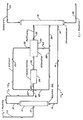
- the Figure is a schematic diagram of a flow arrangement for a combination isomerization and adsorption process arranged in accordance with this invention.
- This invention uses the combination of an isomerization zone and an adsorptive separation section.
- the invention is not restricted to any particular type of isomerization zone or adsorption section.
- the isomerization zone can consist of any type of isomerization zone that takes a stream of C5-C6 straight chain hydrocarbons or a mixture of straight chain and branched chain hydrocarbons and converts straight chain hydrocarbons in the feed mixture to branched chain hydrocarbons and branched hydrocarbons to more highly branched hydrocarbons thereby producing an effluent having branched chain and straight chain hydrocarbons.
- the adsorption sections is preferably liquid phase and can utilize any type of well known adsorption process such as a swing bed, simulated moving bed, or other schemes for contacting the adsorbent with the feed mixture and desorbing the feed mixture from the adsorbent with the desorbent material.
- Suitable feedstocks for this process will include C5 and C6 hydrocarbons. At minimum the feed will include normal hexane and normal pentane. The typical feed for this process will be a naphtha feed with an initial boiling point in the range of normal butane.
- the feedstocks that can be used in this invention include hydrocarbon fractions rich in C4-C6 normal paraffins. The term "rich" is defined as a stream having more than 50% of the mentioned component.
- Preferred feedstocks are substantially pure normal paraffin streams having from 4-6 carbon atoms or a mixture of such substantially pure normal paraffins. It is also preferred that the feed contain at least 10% and preferably at least 20% normal pentanes.
- feed Another requirement of the feed is that it contain enough normal hexane to supply the desorbent requirements of this invention.
- Useful feedstocks include light natural gasoline, light straight-run naphtha, gas oil condensates, light raffinates, light reformate, light hydrocarbons, and straight-run distillates having distillation end points of about 77 o C (170 o F) and containing substantial quantities of C4-C6 paraffins.
- the feed may also contain low concentrations of unsaturated hydrocarbons and hydrocarbons having more than 6 carbon atoms. The concentration of these materials should be limited to 10 wt.% for unsaturated compounds and 20 wt.% for heavier hydrocarbons in order to restrict hydrogen consumption in cracking reactions.
- the feed and any normal paraffin recycle are combined and typically enter the isomerization zone with a hydrogen recycle stream.
- FIG. 1 shows an arrangement wherein a C5+ naphtha is charged by line 10 to a naphtha splitter column 12.
- the naphtha splitter separates isohexane and lower boiling hydrocarbons from normal hexane and higher boiling hydrocarbons.
- Normal hexane and higher boiling hydrocarbons are taken by line 14 to a fractionation zone in the form of a deisohexanizer column 16.
- a line 18 carries the isohexane and lower boiling hydrocarbons overhead from naphtha splitter 12.
- the splitter column is used since a substantial quantity of the normal hexane that is charged to the process must be available for withdrawal as desorbent from the fractionation zone.
- the splitter column 12 present to prevent all of the normal hexane from being charged first to the isomerization zone which may convert too high a quantity of the normal hexane to lower boiling isomers and leave an inadequate amount of normal hexane available in the fractionation column for withdrawal as desorbent.
- the charging of large amounts of unconverted normal hexane through the adsorption section may unnecessarily increase the flowrate through the adsorption section.
- the process may be operated without a splitter.
- the isohexane and lower boiling hydrocarbon stream carried by line 18 is mixed with an extract stream from the adsorption section carried by a line 20.
- the extract stream can be taken directly from the adsorption section and combined with the isomerization feed without intermediate separation.
- the extract stream will contain normal hexane and lower boiling hydrocarbons made up primarily of normal paraffins and monomethyl-branched paraffins.
- the other hydrocarbons in the extract stream will usually be normal pentane and monomethylpentanes. Therefore, all of the hydrocarbon components in the extract stream are susceptible to octane improvement by further processing through the isomerization zone.
- excess desorbent is carried by line 22 and combined with the extract and feed from lines 20 and 18, respectively, to form a combined feed carried by line 24 to isomerization zone 26.
- Hydrogen is admixed with the feed to the isomerization zone in an amount that will provide a hydrogen to hydrocarbon molar ratio of from 0.01 to 10 in the effluent from the isomerization zone.
- the hydrogen to hydrocarbon ratio is in the range of 0.05 to 5.
- the isomerization zone will have a net consumption of hydrogen often referred to as the stoichiometric hydrogen requirement which is associated with a number of side reactions that occur. These side reactions include saturation of olefins and aromatics, cracking and disproportionation.
- the hydrogen to hydrocarbon ratio in isomerization zones that use a chlorided platinum alumina catalyst can be reduced significantly.
- Reduced hydrogen to hydrocarbon ratios have been used based on the finding that the amount of hydrogen needed for suppressing coke formation need not exceed dissolved hydrogen levels.
- the amount of hydrogen in solution at the normal conditions of the isomerization zone effluent are preferably in a ratio of from 0.02 to 0.01.
- the amount of excess hydrogen over the stoichiometric requirement that is required for good stability and conversion is in a ratio of 0.01 to less than 0.05.
- Hydrogen may be added to the feed mixture in any manner that provides the necessary control for the addition of the hydrogen.
- the hydrogen and hydrocarbon feed mixture is contacted in the reaction zone with an isomerization catalyst.
- the catalyst composites that can be used in the isomerization zone include traditional isomerization catalysts.
- Such catalysts include high chloride catalyst on an alumina base containing platinum, and crystalline aluminosilicates or crystalline zeolites. Suitable catalyst compositions of this type will exhibit selective and substantial isomerization activity under the operating conditions of the process.
- the preferred isomerization catalyst for this invention is a chlorided platinum alumina catalyst.
- the aluminum is preferably an anhydrous gamma-alumina with a high degree of purity.
- the catalyst may also contain other platinum group metals. These metals demonstrate differences in activity and selectivity such that platinum has now been found to be the most suitable for this process.
- the catalyst will contain from about 0.1 to 0.25 wt.% of the platinum.
- Other platinum group metals may be present in a concentration of from 0.1 to 0.25 wt.%.
- the platinum component may exist within the final catalytic composite as an oxide or halide or as an elemental metal. The presence of the platinum component in its reduced state has been found most suitable for this process.
- the chloride component termed in the art "a combined chloride” is present in an amount from about 2 to about 10 wt.% based upon the dry support material. The use of chloride in amounts greater than 5 wt.% have been found to be the most beneficial for this process.
- the inorganic oxide preferably comprises alumina and more preferably gamma-alumina, eta-alumina, and mixtures thereof.
- the method that has shown the best results in this invention prepares the catalyst by impregnating the carrier material through contact with an aqueous solution of a water-soluble decomposable compound of the platinum group metal. Additional amounts of halogen must be incorporated into the catalyst by the addition or formation of aluminum chloride to or on the platinum-aluminum catalyst base.
- An alternate method of increasing the halogen concentration in the final catalyst composite is to use an aluminum hydrosol to form the aluminum carrier material such that the carrier material also contains at least a portion of the chloride.
- Halogen may also be added to the carrier material by contacting the calcined carrier material with an aqueous solution of the halogen acid such as hydrogen chloride.
- the crystalline aluminosilicate or crystalline zeolite catalysts comprise crystalline zeolitic molecular sieves having an apparent pore diameter large enough to adsorb neopentane.
- the zeolite will contain an equivalent percent alkali metal cations and will have those AlO4-tetrahedra not associated with alkali metal cations; either not associated with any metal cations or associated with divalent or other polyvalent metal cations.
- the molecular sieve is a mordenite molecular sieve which is essentially in the acid form or is converted to the acid form.
- Particularly preferred catalysts of this type for isomerization are disclosed in detail in U.S. Patents 3,442,794 and 3,836,597.
- a preferred composition of zeolitic catalyst for use in the present invention comprises a Group VIII noble metal, a hydrogen form crystalline aluminosilicate, and a refractory inorganic oxide with the catalyst composition having a surface area of at least 580 m2/g. Significant improvements in isomerization performance are realized when the surface area of the catalytic composite is at or above 580 m2/g.
- a Group VIII metal is incorporated into the catalytic composite to supply a hydrogenation/ dehydrogenation function and the preferred Group VIII noble metal is platinum.
- the Group VIII noble metal is present in an amount from about 0.01 to 5% by weight of the composite.
- the zeolitic catalytic composite may also contain a catalytically effective amount of a promoter metal such as tin, lead, germanium, cobalt, nickel, iron, tungsten, chromium, molybdenum, bismuth, indium, gallium, cadmium, zinc, uranium, copper, silver, gold, tantalum, or one or more of rare earth metals and mixtures thereof.
- a promoter metal such as tin, lead, germanium, cobalt, nickel, iron, tungsten, chromium, molybdenum, bismuth, indium, gallium, cadmium, zinc, uranium, copper, silver, gold, tantalum, or one or more of rare earth metals and mixtures thereof.
- Mordenite in either naturally occurring or synthetic form are preferred, particularly with a silica to alumina ratio of at least 16:1.
- the hydrogen form aluminosilicate may be present in an amount within the range of 50 to about 99.5 wt.%, preferably within the range of 75 to about 95 wt.%, and a refractory inorganic oxide may be present in an amount within the range of from 25 to about 50 wt.%.
- Operating conditions within the isomerization zone are selected to maximize the production of isoalkane product from the feed components. Temperatures within the reaction zone will usually range from about 38-315 o C (100-600 o F). Lower reaction temperatures are generally preferred since they usually favor equilibrium mixtures of isoalkanes versus normal alkanes. Lower temperatures are particularly useful in processing feeds composed of C5 and C6 alkanes where the lower temperatures favor equilibrium mixtures having the highest concentration of the most branched isoalkanes. When the feed mixture is primarily C5 and C6 alkanes temperatures in the range of from 60 to 160 o C are preferred. Higher reaction temperatures increase catalyst activity and promote the isomerization of C4 hydrocarbons. The reaction zone may be maintained over a wide range of pressures.
- Pressure conditions in the isomerization of C4-C6 paraffins range from 700 to 7000 Kpag. Preferred pressures for this process are in the range of from 2000 to 3000 Kpag.
- the feed rate to the reaction zone can also vary over a wide range. These conditions include liquid hourly space velocities ranging from 0.5 to 12 hr. ⁇ 1, however, space velocities between 1 and 6 hr. ⁇ 1 are preferred.
- the isomerization zone will usually operate at a LHSV of about 1.5.
- Operation of the reaction zone with the preferred chlorided platinum-alumina catalyst also requires the presence of a small amount of an organic chloride promoter.
- the organic chloride promoter serves to maintain a high level of active chloride on the catalyst as low levels are continuously stripped off the catalyst by the hydrocarbon feed.
- the concentration of promoter in the reaction zone is maintained at from 30 to 300 ppm.
- the preferred promoter compound is carbon tetrachloride.
- Other suitable promoter compounds include oxygen-free decomposable organic chlorides such as propyldichloride, butylchloride, and chloroform to name only a few of such compounds.
- the need to keep the reactants dry is reinforced by the presence of the organic chloride compound which converts to hydrogen chloride. As long as the process streams are kept dry, there will be no adverse effect from the presence of hydrogen chloride.
- the isomerization zone usually includes a two-reactor system with a first stage reactor and a second stage reactor in the reaction zone.
- the catalyst used in the process is distributed equally between the two reactors. It is not necessary that the reaction be carried out in two reactors but the use of two reactors confer several benefits on the process.
- the use of two reactors and specialized valving allows partial replacement of the catalyst system without taking the isomerization unit off stream. For the short periods of time during which replacement of catalyst may be necessary, the entire flow of reactants may be processed through only one reaction vessel while catalyst is replaced in the other.
- the use of two reaction zones also aids in maintaining lower catalyst temperatures. This is accomplished by having any exothermic reaction such as hydrogenation of unsaturates performed in a first reaction vessel with the rest of the reaction carried out in a final reaction vessel at more favorable temperature conditions.
- the effluent from the reactors enters a stabilizer that removes light gases and butane born the effluent (not shown).
- the amount of butane taken off from the stabilizer will vary depending upon the amount of butane entering the process.
- the stabilizer normally runs at a pressure of from 800 to 1700 Kpaa.
- a separator When the isomerization zone is operated with a high hydrogen to hydrocarbon ratio, a separator is usually placed ahead of the stabilizer. A hydrogen-rich recycle gas stream is recovered from the separator and recycled for combination with the feed entering the isomerization zone. When the isomerization zone operates with very low hydrogen to hydrocarbon ratios the separator is not needed and the effluent from the isomerization zone may enter the stabilizer directly.
- the bottoms stream from the stabilizer provides an isomerization zone effluent stream comprising C5 and higher boiling hydrocarbons that include normal paraffins for recycle and isoparaffin products.
- the chlorides which may be present in the reaction zone will usually pose no problem for the sorbent in the adsorption zone. In normal operation, any chlorides that are present in the effluent from the isomerization zone will be removed in the overhead from the stabilizer. However, where the isomerization zone or separators downstream from the isomerization are subject to upsets, it may be desirable to provide a guard bed of some type to treat the stabilizer bottoms and prevent any carryover of chloride compounds into the adsorption section.
- the isomerization effluent is taken by line 28 and enters the adsorption section 30 where it is contacted with an adsorbent in an adsorption zone.
- the adsorption section of this invention is operated to primarily remove the normal paraffin fraction from the effluent of the isomerization zone. This process is especially suited for adsorption systems that use multiple ports for supplying the process streams to the adsorbent and divide the adsorbent into a plurality of zones for adsorbing normal paraffins, recovering isoparaffins, purifying the adsorbent, and desorbing the normal paraffins.
- a well-known process of this type is the simulated countercurrent moving bed system for simulating moving bed countercurrent flow systems.
- a liquid flow down the molecular sieve chamber may be provided by a pump.
- the chamber circulation pump moves liquid through different zones which require different flow rates.
- a programmed flow controller may be provided to set and regulate these flow rates.
- the active liquid access points effectively divide the molecular sieve chamber into separate zones, each of which has a different function. In this embodiment of the process, it is generally necessary that three separate operational zones be present in order for the process to take place although in some instances an optional fourth zone may be used.
- zone 1 The retention or extract zone, zone 1, is defined as the molecular sieve located between the feed inlet stream and the raffinate outlet stream. In this zone, the feedstock contacts the molecular sieve, an extract component is retained, and a raffinate stream is withdrawn. Since the general flow through zone 1 is from the feed stream which passes into the zone to the raffinate stream which passes out of the zone, the flow in this zone is considered to be a downstream direction when proceeding from the feed inlet to the raffinate outlet streams.
- zone 2 Immediately upstream with respect to fluid flow in zone 1 is the purification zone, zone 2.
- the purification zone is defined as the molecular sieve between the extract outlet stream and the feed inlet stream.
- the basic operations taking place in zone 2 are the displacement from the non-selective void volume of the molecular sieve of any raffinate material carried into zone 2 by the shifting of molecular sieve into this zone and the displacement of any raffinate material retained within the selective pore volume of the molecular sieve.
- Purification is achieved by passing a portion of extract stream material leaving zone 3 into zone 2 at zone 2's upstream boundary to effect the displacement of raffinate material.
- the flow of material in zone 2 is in a downstream direction from the extract outlet stream to the feed inlet stream.
- zone 3 Immediately upstream of zone 2 with respect to the fluid flowing in zone 2 is the displacement or desorption zone, zone 3.
- the desorption zone is defined as the molecular sieve between the desorption inlet and the extract outlet stream.
- the function of the desorption zone is to allow a desorbent which passes into this zone to displace the extract component which was retained in the molecular sieve during a previous contact with feed in zone 1 in a prior cycle of operation.
- the flow of fluid in zone 3 is essentially in the same direction as that of zones 1 and 2.
- zone 4 an optional buffer zone, zone 4, may be utilized.
- This zone defined as the molecular sieve between the raffinate outlet stream and the desorbent inlet stream, if used, is located immediately upstream with respect to the fluid flow to zone 3.
- Zone 4 would be utilized to conserve the amount of desorbent utilized in the desorption step since a portion of the raffinate stream which is removed from zone 1 can be passed into zone 4 to displace desorbent present in that zone out of the zone into the desorption zone.
- Zone 4 will contain enough desorbent so that raffinate material present in the raffinate stream passing out of zone 1 and into zone 4 can be prevented from passing into zone 3 thereby contaminating extract stream removed from zone 3.
- the raffinate stream passed from zone 1 to zone 4 must be carefully monitored in order that the flow directly from zone 1 to zone 3 can be stopped when there is an appreciable quantity of raffinate material present in the raffinate stream passing from zone 1 into zone 3 so that the extract outlet stream is not contaminated.
- a cyclic advancement of the input and output streams through the fixed bed of molecular sieve can be accomplished by utilizing a manifold system in which the valves in the manifold are operated in a sequential manner to effect the shifting of the input and output streams thereby allowing a flow of fluid with respect to solid molecular sieve in a countercurrent manner.
- Another mode of operation which can effect the countercurrent flow of solid molecular sieve with respect to fluid involves the use of a rotating disc valve in which the input and output streams are connected to the valve and the lines through which feed input, extract output, displacement fluid input and raffinate output streams pass are advanced in the same direction through the molecular sieve bed. Both the manifold arrangement and disc valve are known in the art.
- one operational zone will contain a much larger quantity of molecular sieve than some other operational zone.
- the buffer zone can contain a minor amount of molecular sieve as compared to the molecular sieve required for the retention and purification zones. It can also be seen that in instances in which desorbent is used which can easily displace extract material from the molecular sieve that a relatively small amount of molecular sieve will be needed in a desorption zone as compared to the molecular sieve needed in the retention zone or purification zone. Since it is not required that the molecular sieve be located in a single column, the use of multiple chambers or a series of columns is within the scope of the invention.
- the apparatus which can be utilized to effect the process of this invention can also contain a series of individual beds connected by connecting conduits upon which are placed input or output taps to which the various input or output streams can be attached and alternately and periodically shifted to effect continuous operation.
- the connecting conduits can be connected to transfer taps which during the normal operations do not function as a conduit through which material passes into or out of the process.
- liquid-phase operation is preferred for this process because of the lower temperature requirements and because of the higher yields of extract product that can be obtained with liquid-phase operation over those obtained with vapor-phase operation.
- Extract conditions will, therefore, include a pressure sufficient to maintain liquid phase.
- Desorption conditions will include the same range of temperatures and pressures as used for extract conditions.
- a portion of the raffinate output stream will be passed directly to a fractionation zone.
- the fractionation zone will typically be a single fractionation column, the general design and operation of which is well known to the separation art.
- a line 32 passes the raffinate directly to deisohexanizer 16.
- the fractionation zone serves a variety of purposes. It provides an overhead product stream that contains a high concentration of isopentane and dimethylbutanes. Typically, the research octane number of the product stream will be between 91 and 94.
- the isomerate product stream also contains low concentrations of normal pentane, normal hexane and monomethylpentanes.
- octane hydrocarbons are reduced by the operation of the adsorption section which preferentially adsorbs normal pentane and directly recycles the normal pentanes to the isomerization zone in the extract stream and the withdrawal of normal hexane and monomethylpentanes in large amounts from the fractionation zone for use as a desorbent material in the adsorption section which also eventually is recycled to isomerization zone.
- the desorbent is removed preferably as a sidecut from a single fractionation column.
- line 36 is shown as a sidecut stream from the deisohexanizer column 16. Desorbent can be withdrawn from any point below the input point of line 32.
- the raffinate stream can be withdrawn from below the input point for line 14.
- the Figure shows the preferred withdrawal point for sidecut stream 36 which is between the input point for the raffinate stream carried by line 32 and the input point for the normal hexane and higher boiling hydrocarbon stream carried by line 14.
- normal hexane drops down the column from the inlet of line 32 and rises up the column from the inlet of line 14.
- the location of normal hexane input points above and below the withdrawal point for sidecut 36 provides a stream that is rich in normal hexane as well as closely boiling monomethylpentanes that are carried over into the sidecut stream.
- the withdrawal of the desorbent as a liquid sidecut from the deisohexanizer has the advantage of disengaging desorbent from the raffinate stream at very low utility cost.
- Heavier hydrocarbons are withdrawn from the fractionation column as a heavy hydrocarbon stream.
- this heavy hydrocarbon stream is withdrawn by a line 38.
- the heavy hydrocarbon feed will comprise a C7+ naphtha. This bottoms stream will ordinarily be used as the feed in a reforming zone.
- Line 36 provides a desorbent for the adsorption section that is passed from line 36 to the adsorption section by a line 40.
- the amount of the desorbent available through line 36 may exceed that needed for the adsorption section. This excess desorbent is diverted from line 36 to the previously described line 22 and enters the isomerization zone directly as part of the isomerization zone feed.
- Excess desorbent in line 36 is present in the deisohexanizer as part of the normal hexane that has been charged to the fractionation zone. Although it may be possible to eliminate the excess desorbent from the fractionation zone by changing the operation of a splitter column when one is provided, it is usually desirable to have the excess desorbent in the fractionation zone in order to improve the carryover of monomethylpentanes into the isomerization zone.
- the extract stream does not enter any separation section for the recovery of the displacement fluid. At least a portion of the extract stream is recycled directly to the isomerization zone to provide the recycle stream as previously described.
- the direct recycle of the extract stream eliminates the need for a separation column and the equipment associated therewith. The elimination of the separation column for the extract stream significantly reduces the cost of the adsorption section.
- Prior art processes provided a column for the separation of desorbent from the extract stream in the belief that the process could not be economically operated without such a separation.
- the amount of potentially adsorbed component in the feed that enters the adsorption zone will control the amount of selective pore volume that must be available in the adsorbent and the amount of the displacement fluid or desorbent that is needed to recover the adsorbed material from the adsorbent.
- the amount of normal paraffins in the feed mixture sets the amount of selective pore volume that must be available to process a given quantity of the feed mixture.
- This example consists of engineering calculations that are based on experience from the operation of similar components in commercial processing units. This example is arranged in accordance with the isomerization zone and adsorption section shown in the Figure and will be described using the reference numbers appearing therein.
- a C5+ naphtha feed having the composition given in Table 1 for stream No. 10 is fed into a naphtha splitter at a temperature of 66 o C and a pressure of 700 Kpaa.
- Table 1 shows the flowrate of the various feed components into the naphtha splitter.
- the naphtha splitter is arranged with 40 trays and operates with a molar reflux to feed ratio of 0.6.
- a bottoms stream is taken from splitter 12 by line 14 at a temperature of 120 o C and a pressure of 280 Kpaa and transferred to deisohexanizer column 16.
- An overhead stream is taken by line 18 at a pressure of 250 Kpaa and a temperature of 60 o C.
- the overhead and bottoms stream have a flowing composition as given in Table 1 under lines 18 and 14, respectively.
- the feed components carried by line 18 are combined with an extract stream, an excess desorbent stream carried by lines 20 and 22, respectively.
- the flowing compositions of lines 20 and 22 are given in the Table along with the flowing composition of a combined feed that enters a isomerization zone via line 24 at a temperature of 83 o C and a pressure of 250 Kpaa.
- the combined feed is contacted with an isomerization catalyst that comprises a chlorided platinum-alumina catalyst at a liquid hourly space velocity of 1.5.
- the combined feed enters the isomerization zone, it is combined with hydrogen in an amount to produce a hydrogen/hydrocarbon ratio of 0.05 at the outlet of the isomerization section.
- the isomerization section includes a two-reactor system that operates at a pressure of 3100 Kpaa.
- a stabilized effluent having the composition given for line 28 is recovered from the isomerization zone 26 and transferred as the feed to an adsorption section 30.
- the adsorption section is arranged with an eight bed adsorption column filled with a zeolite adsorbent of the Ca-A type.
- the adsorption section operates at a cycle time of less than 60 minutes for a complete sequence of all the zones through the beds of adsorbent.
- An operating temperature of 93 o C (200 o F) and an operating pressure of 2760 Kpag are maintained within the adsorption section.
- the extract stream taken by line 20 is withdraw from the adsorption section along with a raffinate stream having the composition given in the Table under line 32. The raffinate stream is transferred without intermediate separation into the deisohexanizer column 16.
- Deisohexanizer column 16 is arranged with 100 trays and operates with a molar reflux to net deisohexanizer overhead ratio of 4.0.
- the raffinate stream enters the deisohexanizer at tray level 20.
- the desorbent stream having a composition given under line 36 in the Table is withdrawn from the deisohexanizer as a sidecut at tray level 65. All of the desorbent taken by line 36 enters the adsorption section except for the amount of excess desorbent which is carried by line 22 as previously described.
- the previously described bottoms stream taken by line 14 enters the deisohexanizer column at tray level 85.
- a bottoms stream having the composition given for line 38 is withdrawn from the deisohexanizer column and used as the feed to a reforming process.
- the contents of line 38 are taken from the column at a temperature of 93 o C and a pressure of 480 Kpaa.
- the remaining column output is taken overhead by line 34.
- Line 34 recovers an isomerate product stream having the composition given in Table 1.
- the contents of line 34 are recovered at a temperature of 38 o C and a pressure of 350 Kpaa.
- the isomerate product has the properties given in Table 2.
- TABLE 2 RONC 91.0 MONC 89.6 RVP 12.6 S.G. 0.6463
- This example shows that the isomerate product has a high octane number, 3 to 5 octane numbers higher than that usually achievable with conventional recycle isomerization schemes. Therefore, the flow arrangement of this invention will improve the operation of an isomerization zone and adsorption section combination by increasing the octane of the isomerate obtained therefrom and simplifying the overall operation of the combination process.
Landscapes
- Chemical & Material Sciences (AREA)
- Oil, Petroleum & Natural Gas (AREA)
- Engineering & Computer Science (AREA)
- Chemical Kinetics & Catalysis (AREA)
- General Chemical & Material Sciences (AREA)
- Organic Chemistry (AREA)
- Production Of Liquid Hydrocarbon Mixture For Refining Petroleum (AREA)
- Organic Low-Molecular-Weight Compounds And Preparation Thereof (AREA)
Claims (6)
- Procédé intégré pour l'isomérisation d'un courant d'alimentation [10] comprenant des hydrocarbures en C₅-C₆, ledit procédé comprenant les étapes suivantes :(a) séparer ledit courant d'alimentation [10] comprenant des hydrocarbures en C₅-C₆ en un premier courant [14] comprenant de l'hexane normal et des hydrocarbures de point d'ébullition supérieur et un second courant [18] comprenant les constituants dudit courant d'alimentation qui bouillent au-dessous du point d'ébullition de l'hexane normal ;(b) combiner ledit second courant [18] avec un courant d'extrait [20] pour produire un courant d'alimentation combiné [24] et envoyer ce courant d'alimentation combiné [24] dans une zone d'isomérisation [26] contenant un catalyseur d'isomérisation dans des conditions d'isomérisation pour isomériser les hydrocarbures contenus dans ledit second courant [24] et récupérer un effluent [28] de zone d'isomérisation comprenant des isoparaffines en C₅ et C₆ ;(c) envoyer au moins une partie de l'effluent [28] à une section d'adsorption [30], mettre en contact la partie de l'effluent avec un adsorbant, adsorber sélectivement les paraffines normales à partir de ladite partie d'effluent et produire un courant de raffinat [32] ayant une concentration réduite en au moins un constituant paraffinique normal par rapport audit courant d'effluent et un adsorbant sur lequel sont adsorbées des paraffines normales ;(d) envoyer au moins une partie dudit courant de raffinat [32] et dudit premier courant [14] dans une zone de fractionnement [16], retirer les hydrocarbures ayant des points d'ébullition supérieurs à celui de l'hexane normal par le fond de ladite zone de fractionnement sous forme d un courant de résidu [38], récupérer un produit isomérisé à partir d'un distillat de tête [34] de ladite zone de fractionnement [16] et prélever de ladite zone de fractionnement [16] un courant de coupe latérale [36] comprenant de l'hexane normal ;(e) envoyer au moins une partie du courant de coupe latérale [36] en tant que courant de désorbant [40] à ladite zone d'adsorption [30] et mettre en contact ladite matière adsorbante sur laquelle sont adsorbées des paraffines normales avec ledit courant de désorbant [40] pour désorber au moins un constituant paraffinique normal et produire ledit courant d'extrait [20] ; et(f) envoyer ledit courant d'extrait [20] à l'étape [b].
- Procédé intégré de la revendication 1, dans lequel ledit courant combiné [24] est formé en combinant ledit courant d'extrait [20] et ledit second courant [18] avec une autre partie dudit courant de coupe latérale [36].
- Procédé intégré de la revendication 1 ou 2, dans lequel ladite zone d'adsorption opère en phase liquide.
- Procédé intégré de la revendication 1, 2 ou 3, dans lequel ledit catalyseur d'isomérisation comprend de l'alumine comportant 0,01 à 0,25 % en poids de platine et 2 à 10 % en poids d'un composant chlorure.
- Procédé intégré de la revendication 1, 2, 3 ou 4, dans lequel ladite section d'adsorption [30] comprend au moins un lit d'adsorbant, la quantité totale d'adsorbant est divisée en au moins trois zones d'adsorbant fonctionnellement distinctes, ledit effluent [28] et ledit désorbant [40] sont envoyés à des zones différentes et la position des zones par rapport à ladite quantité totale dudit adsorbant est modifiée au moins par intermittence en changeant les points de sortie et d'entrée dudit effluent [28] et dudit désorbant [40].
- Procédé intégré de la revendication 1, dans lequel ladite zone de fractionnement [16] comprend une colonne unique, ledit premier courant [14] entre dans ladite colonne [16] en un premier point d'entrée de niveau inférieur, ledit courant de raffinat [32] entre dans ladite colonne en un second point d'entrée situé au-dessus dudit premier point d'entrée et ledit courant de coupe latérale [36] est prélevé de ladite colonne à un niveau situé entre lesdits premier et second points d'entrée.
Priority Applications (1)
| Application Number | Priority Date | Filing Date | Title |
|---|---|---|---|
| DE69104610T DE69104610D1 (de) | 1991-08-20 | 1991-08-20 | Integrierte Isomerisations- und Adsorptionsstiefen zur Verbesserung von C5- und C6-Kohlenwasserstoffen. |
Applications Claiming Priority (2)
| Application Number | Priority Date | Filing Date | Title |
|---|---|---|---|
| US07/560,655 US5043525A (en) | 1990-07-30 | 1990-07-30 | Paraffin isomerization and liquid phase adsorptive product separation |
| CA002049535A CA2049535A1 (fr) | 1990-07-30 | 1991-08-20 | Etapes integrees d'isomerisation et d'adsorption pour la mise en couleur des hydrocarbures c5 et c6 |
Publications (2)
| Publication Number | Publication Date |
|---|---|
| EP0528089A1 EP0528089A1 (fr) | 1993-02-24 |
| EP0528089B1 true EP0528089B1 (fr) | 1994-10-12 |
Family
ID=25674739
Family Applications (1)
| Application Number | Title | Priority Date | Filing Date |
|---|---|---|---|
| EP91307656A Expired - Lifetime EP0528089B1 (fr) | 1990-07-30 | 1991-08-20 | Etappes intégrées d'isomerisation et d'adsorption pour valoriser des hydrocarbures C5 et C6 |
Country Status (3)
| Country | Link |
|---|---|
| US (1) | US5043525A (fr) |
| EP (1) | EP0528089B1 (fr) |
| CA (1) | CA2049535A1 (fr) |
Families Citing this family (17)
| Publication number | Priority date | Publication date | Assignee | Title |
|---|---|---|---|---|
| US5043525A (en) * | 1990-07-30 | 1991-08-27 | Uop | Paraffin isomerization and liquid phase adsorptive product separation |
| FR2679245B1 (fr) * | 1991-07-18 | 1993-11-05 | Institut Francais Petrole | Procede d'isomerisation de paraffines normales en c5/c6 avec recyclage de paraffines normales. |
| FR2688213B1 (fr) * | 1992-03-06 | 1995-05-24 | Inst Francais Du Petrole | Procede d'isomerisation de paraffines normales en c5/c6 avec recyclage de paraffines normales et methyl-pentanes. |
| US5599439A (en) * | 1993-03-13 | 1997-02-04 | Mobil Oil Corporation | Gasoline and reformate upgrading process |
| US6069289A (en) * | 1998-08-31 | 2000-05-30 | Uop Llc | Process for separating and recovering multimethyl-branched alkanes |
| US6552242B1 (en) | 2001-09-07 | 2003-04-22 | Uop Llc | Fractionation in light paraffin isomerization process |
| US6759563B1 (en) | 2001-10-09 | 2004-07-06 | Uop Llc | Liquid phase adsorptive separation with hexane desorbent and paraffin isomerization |
| US6573417B1 (en) * | 2001-11-05 | 2003-06-03 | Uop Llc | Fractionation of paraffin isomerization process effluent |
| US7514590B1 (en) | 2005-03-11 | 2009-04-07 | Uop Llc | Isomerization process with adsorptive separation |
| US8692046B2 (en) | 2011-01-13 | 2014-04-08 | Uop Llc | Process for isomerizing a feed stream including one or more C4-C6 hydrocarbons |
| US8716544B2 (en) | 2011-01-13 | 2014-05-06 | Uop Llc | Process for isomerizing a feed stream including one or more C4-C6 hydrocarbons |
| US8808534B2 (en) | 2011-07-27 | 2014-08-19 | Saudi Arabian Oil Company | Process development by parallel operation of paraffin isomerization unit with reformer |
| US20140158521A1 (en) * | 2012-12-12 | 2014-06-12 | Uop Llc | Methods and apparatuses for separating desorbent from multiple streams |
| US20140171704A1 (en) * | 2012-12-13 | 2014-06-19 | Uop Llc | Methods and apparatuses for producing ethylene and propylene from naphtha feedstock |
| US9126875B2 (en) | 2013-06-27 | 2015-09-08 | Uop Llc | Sorption process with added drying section |
| US20150045602A1 (en) * | 2013-08-07 | 2015-02-12 | Uop Llc | Process for promoting disproportionation reactions and ring opening reactions within an isomerization zone |
| US20150045597A1 (en) * | 2013-08-07 | 2015-02-12 | Uop Llc | Integrated process for gasoline or aromatics production |
Family Cites Families (12)
| Publication number | Priority date | Publication date | Assignee | Title |
|---|---|---|---|---|
| US2985589A (en) | 1957-05-22 | 1961-05-23 | Universal Oil Prod Co | Continuous sorption process employing fixed bed of sorbent and moving inlets and outlets |
| US2966528A (en) * | 1957-11-08 | 1960-12-27 | Universal Oil Prod Co | Combination process of isomerization and a sorption process followed by selective frationation |
| US3040777A (en) | 1959-04-10 | 1962-06-26 | Universal Oil Prod Co | Rotary valve |
| NL151912B (nl) | 1966-03-25 | 1977-01-17 | Shell Int Research | Werkwijze waarbij een kristallijn silica-alumina wordt omgezet in de "h-vorm", werkwijze voor het bereiden van een katalysator door aanbrengen van metalen of metaalverbindingen op het aldus verkregen silica-alumina en werkwijze voor het omzetten van koolwaterstoffen in aanwezigheid van waterstof en van de aldus verkregen katalysator. |
| US3422848A (en) | 1966-06-09 | 1969-01-21 | Universal Oil Prod Co | Multiport rotary disc valve with liner protection means |
| US3755144A (en) * | 1971-10-13 | 1973-08-28 | Universal Oil Prod Co | Hydrocarbon isomerization and separation process |
| NL171887C (nl) | 1972-04-25 | 1983-06-01 | Shell Int Research | Werkwijze voor het isomeriseren van alifatische verzadigde koolwaterstoffen in aanwezigheid van waterstof. |
| US4210771A (en) * | 1978-11-02 | 1980-07-01 | Union Carbide Corporation | Total isomerization process |
| US4717784A (en) * | 1986-12-10 | 1988-01-05 | Shell Oil Company | Total isomerization process with mono-methyl-branched plus normal paraffin recycle stream |
| US4804802A (en) * | 1988-01-25 | 1989-02-14 | Shell Oil Company | Isomerization process with recycle of mono-methyl-branched paraffins and normal paraffins |
| US4956521A (en) * | 1988-10-06 | 1990-09-11 | Uop | Adsorption and isomerization of normal and mono-methyl paraffins |
| US5043525A (en) * | 1990-07-30 | 1991-08-27 | Uop | Paraffin isomerization and liquid phase adsorptive product separation |
-
1990
- 1990-07-30 US US07/560,655 patent/US5043525A/en not_active Expired - Fee Related
-
1991
- 1991-08-20 EP EP91307656A patent/EP0528089B1/fr not_active Expired - Lifetime
- 1991-08-20 CA CA002049535A patent/CA2049535A1/fr not_active Abandoned
Also Published As
| Publication number | Publication date |
|---|---|
| EP0528089A1 (fr) | 1993-02-24 |
| CA2049535A1 (fr) | 1993-02-21 |
| US5043525A (en) | 1991-08-27 |
Similar Documents
| Publication | Publication Date | Title |
|---|---|---|
| US5146037A (en) | Isomerization with distillation and psa recycle streams | |
| US7223898B2 (en) | Isomerization process | |
| US6927314B1 (en) | Fractionation and treatment of full boiling range gasoline | |
| US6472578B1 (en) | Isomerization with adsorptive separation and dividing wall fractional distillation | |
| US6407303B1 (en) | Isomerization process with adsorptive separation and integrated fractional distillation | |
| US5026951A (en) | Process for paraffin isomerization with liquid phase adsorptive product separation | |
| EP0528089B1 (fr) | Etappes intégrées d'isomerisation et d'adsorption pour valoriser des hydrocarbures C5 et C6 | |
| EP0504510B1 (fr) | Procédé combiné d'hydrogénation et d'isomérisation en charges contenant du benzène et des paraffines | |
| US6759563B1 (en) | Liquid phase adsorptive separation with hexane desorbent and paraffin isomerization | |
| JP2544922B2 (ja) | 水素化リホ−ミングと水素化異性化との組合わせ方法 | |
| US5245102A (en) | Isomerization with distillation and psa recycle streams | |
| US7022889B2 (en) | Isomerization process using novel catalyst | |
| US7514590B1 (en) | Isomerization process with adsorptive separation | |
| US4128593A (en) | Production and recovery of para-cymene | |
| US5453552A (en) | Isomerization and adsorption process with benzene saturation | |
| US5026950A (en) | Hydrotreatment-isomerization without hydrogen recycle | |
| US5082987A (en) | Treatment of hydrocarbons | |
| US5004853A (en) | Continuous process for the production of 2,6-dimethylnaphthalene | |
| US5264187A (en) | Treatment of hydrocarbons | |
| US4333820A (en) | Recovery of normally gaseous hydrocarbons from net excess hydrogen in a catalytic reforming process | |
| US5663466A (en) | Mixed phase benzene saturation with controlled hydrogen addition | |
| US5326925A (en) | Isomerization process for 2,3-dimethylbutane production | |
| US5763713A (en) | Process for the isomerization of benzene containing feed streams | |
| US5516963A (en) | Hydrocarbon conversion with additive loss prevention | |
| JPH05320666A (ja) | C5およびc6炭化水素改質のための統合的異性化および吸着方法 |
Legal Events
| Date | Code | Title | Description |
|---|---|---|---|
| PUAI | Public reference made under article 153(3) epc to a published international application that has entered the european phase |
Free format text: ORIGINAL CODE: 0009012 |
|
| AK | Designated contracting states |
Kind code of ref document: A1 Designated state(s): BE DE ES FR GB IT NL |
|
| 17P | Request for examination filed |
Effective date: 19930726 |
|
| 17Q | First examination report despatched |
Effective date: 19931217 |
|
| GRAA | (expected) grant |
Free format text: ORIGINAL CODE: 0009210 |
|
| AK | Designated contracting states |
Kind code of ref document: B1 Designated state(s): BE DE ES FR GB IT NL |
|
| PG25 | Lapsed in a contracting state [announced via postgrant information from national office to epo] |
Ref country code: IT Free format text: LAPSE BECAUSE OF FAILURE TO SUBMIT A TRANSLATION OF THE DESCRIPTION OR TO PAY THE FEE WITHIN THE PRE;WARNING: LAPSES OF ITALIAN PATENTS WITH EFFECTIVE DATE BEFORE 2007 MAY HAVE OCCURRED AT ANY TIME BEFORE 2007. THE CORRECT EFFECTIVE DATE MAY BE DIFFERENT FROM THE ONE RECORDED.SCRIBED TIME-LIMIT Effective date: 19941012 Ref country code: ES Free format text: THE PATENT HAS BEEN ANNULLED BY A DECISION OF A NATIONAL AUTHORITY Effective date: 19941012 Ref country code: BE Effective date: 19941012 |
|
| REF | Corresponds to: |
Ref document number: 69104610 Country of ref document: DE Date of ref document: 19941117 |
|
| ET | Fr: translation filed | ||
| PG25 | Lapsed in a contracting state [announced via postgrant information from national office to epo] |
Ref country code: DE Effective date: 19950113 |
|
| PLBE | No opposition filed within time limit |
Free format text: ORIGINAL CODE: 0009261 |
|
| STAA | Information on the status of an ep patent application or granted ep patent |
Free format text: STATUS: NO OPPOSITION FILED WITHIN TIME LIMIT |
|
| 26N | No opposition filed | ||
| REG | Reference to a national code |
Ref country code: GB Ref legal event code: IF02 |
|
| PGFP | Annual fee paid to national office [announced via postgrant information from national office to epo] |
Ref country code: NL Payment date: 20080715 Year of fee payment: 18 |
|
| PGFP | Annual fee paid to national office [announced via postgrant information from national office to epo] |
Ref country code: FR Payment date: 20080807 Year of fee payment: 18 |
|
| PGFP | Annual fee paid to national office [announced via postgrant information from national office to epo] |
Ref country code: GB Payment date: 20080708 Year of fee payment: 18 |
|
| REG | Reference to a national code |
Ref country code: NL Ref legal event code: V1 Effective date: 20100301 |
|
| GBPC | Gb: european patent ceased through non-payment of renewal fee |
Effective date: 20090820 |
|
| REG | Reference to a national code |
Ref country code: FR Ref legal event code: ST Effective date: 20100430 |
|
| PG25 | Lapsed in a contracting state [announced via postgrant information from national office to epo] |
Ref country code: NL Free format text: LAPSE BECAUSE OF NON-PAYMENT OF DUE FEES Effective date: 20100301 Ref country code: FR Free format text: LAPSE BECAUSE OF NON-PAYMENT OF DUE FEES Effective date: 20090831 |
|
| PG25 | Lapsed in a contracting state [announced via postgrant information from national office to epo] |
Ref country code: GB Free format text: LAPSE BECAUSE OF NON-PAYMENT OF DUE FEES Effective date: 20090820 |