EP0528366B1 - Verfahren und Schaltungsanordnung zur Bewegungsdetektion in einem Fernsehbild - Google Patents
Verfahren und Schaltungsanordnung zur Bewegungsdetektion in einem Fernsehbild Download PDFInfo
- Publication number
- EP0528366B1 EP0528366B1 EP92113848A EP92113848A EP0528366B1 EP 0528366 B1 EP0528366 B1 EP 0528366B1 EP 92113848 A EP92113848 A EP 92113848A EP 92113848 A EP92113848 A EP 92113848A EP 0528366 B1 EP0528366 B1 EP 0528366B1
- Authority
- EP
- European Patent Office
- Prior art keywords
- block
- pix
- code word
- picture
- video signal
- Prior art date
- Legal status (The legal status is an assumption and is not a legal conclusion. Google has not performed a legal analysis and makes no representation as to the accuracy of the status listed.)
- Expired - Lifetime
Links
Images

Classifications
-
- H—ELECTRICITY
- H04—ELECTRIC COMMUNICATION TECHNIQUE
- H04N—PICTORIAL COMMUNICATION, e.g. TELEVISION
- H04N7/00—Television systems
- H04N7/01—Conversion of standards, e.g. involving analogue television standards or digital television standards processed at pixel level
- H04N7/0117—Conversion of standards, e.g. involving analogue television standards or digital television standards processed at pixel level involving conversion of the spatial resolution of the incoming video signal
- H04N7/012—Conversion between an interlaced and a progressive signal
-
- H—ELECTRICITY
- H04—ELECTRIC COMMUNICATION TECHNIQUE
- H04N—PICTORIAL COMMUNICATION, e.g. TELEVISION
- H04N5/00—Details of television systems
- H04N5/14—Picture signal circuitry for video frequency region
- H04N5/144—Movement detection
-
- H—ELECTRICITY
- H04—ELECTRIC COMMUNICATION TECHNIQUE
- H04N—PICTORIAL COMMUNICATION, e.g. TELEVISION
- H04N7/00—Television systems
- H04N7/01—Conversion of standards, e.g. involving analogue television standards or digital television standards processed at pixel level
- H04N7/0127—Conversion of standards, e.g. involving analogue television standards or digital television standards processed at pixel level by changing the field or frame frequency of the incoming video signal, e.g. frame rate converter
- H04N7/0132—Conversion of standards, e.g. involving analogue television standards or digital television standards processed at pixel level by changing the field or frame frequency of the incoming video signal, e.g. frame rate converter the field or frame frequency of the incoming video signal being multiplied by a positive integer, e.g. for flicker reduction
Definitions
- the invention relates to a method and a circuit arrangement for movement detection in a television picture, wherein the video signal is in digital form and the picture is divided into blocks comprising more than one picture element, and wherein a code word is generated for each block, the code word being compared with the code word of the corresponding block of a previous picture in order to make the movement decision.
- a television picture comprises two half pictures or fields which are scanned in an interlaced mode. Thus the lines of different half pictures will not coincide. If the picture contains straight horizontal boundaries having a strong contrast, then 25 Hz flicker will occur there.
- the interlaced fields of the picture are scanned at a frequency of 50 Hz. When the picture is dark, the 50 Hz frame rate does not appear as disturbing, whereas the eye will clearly perceive flicker in brighter parts of the picture, and the flicker problem is emphasized, if the picture area is large and the viewing angle is wide. It is possible to reduce the flicker in the picture or to remove it completely by storing a field in a field memory and displaying it, either as such or slightly modified, twice during the same period. Then the field rate increases to 100 Hz and the flicker is not anymore disturbing.
- So called movement adaptive methods can be used both to increase the line rate, line rate upconversion (LRU), and to increase the field rate, field rate upconversion (FRU).
- the movement adaptive methods switch between two algorithms, optimized for a static and a moving picture, depending on whether the picture contains movement or not. Movement detection is thus required in the movement adaptive methods.
- the US-A-3 582 546 discloses a method and circuit arrangement according to the preambles of claims 1 and 6, in particular a redundancy reduction system for video signals wherein the amplitude samples of each picture element are digitized and wherein a code word is generated for blocks of the picture, each block comprising more than one picture element.
- the code word is generated by subtracting the absolute magnitude of the difference of the amplitudes of the first and second sample of a block from the amplitude of the third sample of the block, whereupon the absolute magnitude of the result of this subtraction is subtracted from the magnitude of the forth sample of the block and so on.
- JP-A-127 380 (patent abstracts of Japan, Vol. 13, No. 216E760, 3564, 19-05-89), an inter-frame coding system is known wherein 8-bit picture element data is inputted to binarizing circuits wherein bit values of a Laplacian filter are multiplied with each picture element. The result of multiplication is compared with a threshold value and a binary '1' is produced when the result is larger than the threshold value, whereas a binary '0' is produced when the result is smaller than the threshold value. All results are stored in a respective frame memory.
- the object of the present invention is to provide a method and apparatus for movement detection which is reliable, has a very good noise tolerance and reduces the manufacturing cost of the circuits for performing the method.
- a method for movement detection in a television picture wherein the video signal is in digital form and the picture is divided into blocks having the size of more than one picture element, each picture element being represented by a digital video signal sample comprising a plurality of bits and wherein a code word is generated for each block, the code word being compared with the code word of the corresponding block of a previous picture in order to make the movement decision.
- This method is characterized by the fact that a predetermined number of the most significant bits of each digital video signal sample of the picture elements of a block is used for generating the code words.
- the predetermined number equals 1, i.e. only the most significant bit of each digital video sample is used for generating the code words.
- a circuit arrangement for performing the above method, said arrangement comprising: a memory block in which the picture is divided into blocks having the size of more than one picture element and containing at least one line memory and at least two delays; means for generating a code word for each block; a comparison block in which the code word generated for the block is compared with the code word of the corresponding block of the previous picture and containing a RAM memory into which the previous picture is stored; and circuits to perform the comparison.
- Said arrangement is characterized by the fact that it comprises:
- the method for movement detection of the present invention is not sensitive to noise and can be realized using less field memory than with prior known methods.
- the digital video signal sample is cut, i.e. only one or more of the most significant bits are used, and the code word is generated using the cut video signal samples.
- video signal samples of several bits are cut in a thresholding block, whereupon with the aid of line memories and delays, blocks having the size of several picture elements are generated from the picture, the movement detection being performed on these blocks.
- a code word is generated for each block with the aid of a shift-and-add circuit, the code word containing for each picture element a number of bits corresponding to the length of the cut video signal sample.
- the corresponding code words of two pictures are compared in the comparison block.
- the code words of the previous picture are obtained from a RAM memory. If the code words differ, there was a movement, and if they are equal, then there was no movement.
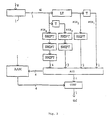
- Fig. 1 shows a block diagram of a circuit for performing the method.
- the video signal is in a digital form and it is processed with the methods of digital signal processing.
- the video signal sample may contain any number of bits in the method according to the invention and it can also be cut into a signal which contains more than one bit after the cutting.
- Cutting the 8-bit sample into a 1-bit signal corresponds to the thresholding of a picture with 256 shades into a picture with 2 shades.
- the cutting can be made because the most significant bit of the sample provides sufficient information for the detection of a movement.
- Blocks of e.g. 2*2 picture elements in the horizontal and vertical directions are formed of the picture after the cutting, the detection being performed on these blocks.
- the blocks are generated in the memory block 2 containing a line memory LT and two delays T with the length of one sample.
- the resolution of the movement detector is also 2*2 picture elements.
- a code word is generated in the coding block 3 for each block of 2*2 picture elements.
- the code word for each picture element contains a number of bits corresponding to the length of the cut sample, i.e. in this example the code word contains one bit for each picture element, whereby the code word representing one block contains a total of four bits.
- Two corresponding code words of two pictures are compared in the comparison block 4. If the code words differ, there was a movement, and if they are equal, then there was no movement.
- Fig. 2 shows as an example a 2*2 block BL comprising four picture elements PIX.
- the figure also shows the factors PIX 1 , PIX 2 , PIX 3 and PIX 4 for the generation of the code word according to the expression 2 0 PIX 1 + 2 1 PIX 2 + 2 2 PIX 3 + 2 3 PIX 4 .
- the factors PIX 1 , PIX 2 , PIX 3 , PIX 4 obtain as values the value of the cut video signal sample, i.e. 1 or 0, so that a code word contains one bit for each picture element PIX.
- the method provides a movement decision for each Block BL, which means that the movement decisions for the four adjacent picture elements PIX always are equal.
- the resolution of the movement detector is thus reduced to one quarter of the conventional. This was not found to affect the quality of the picture.
- the code word can be formed according to the more general expression below: where k is the length of the cut video signal sample, n is an integer, N is the number of picture elements PIX contained in the block BL, and PIX n represents the picture elements PIX of the block BL and obtains as a value the value of the cut video signal samples.
- Fig. 3 shows a more detailed construction of a circuit realizing the method.
- the 8-bit video signal sample is supplied to the thresholding block 1, where it is cut to a 1-bit signal.
- the memory block 2 the picture is divided into blocks BL of 2*2 elements PIX 1 , PIX 2 , PIX 3 and PIX 4 , the memory block containing a line memory LT and two delays T.
- a code word is generated for the blocks BL in the coding block 3, formed by shift-and add circuits SHIFT and ADD.
- the 4-bit code word formed of the picture is compared with the code word of the corresponding block BL of the previous picture in order to make the movement decision.
- the code words of the previous picture are obtained from the RAM memory RAM, which is written and read at the half sampling frequency.
- the movement decision provided by the method was found reliable.
- the method has a very good noise tolerance, as there is a high threshold before the detection.
- the change of shades caused by the noise has no effect at this order.
- the circuit realizing the method is very simple, which reduces the manufactoring costs of the circuit. Instead of the conventional two field memories only a half field memory (720 * 288 * 4 bit) is needed when the video signal sample is cut into a 1-bit signal. Multiplications are not required at all.
- the invention can be applied in IDTV (Improved Definition Television) and in HDTV IDTV (High Definition Television) receivers, where it can be used to increase both the line rate and the field rate.
Landscapes
- Engineering & Computer Science (AREA)
- Multimedia (AREA)
- Signal Processing (AREA)
- Computer Graphics (AREA)
- Compression Or Coding Systems Of Tv Signals (AREA)
Claims (8)
- Verfahren zur Bewegungsdetektion in einem Fernsehbild, wobei das Video-Signal in digitaler Form vorliegt und das Bild in Blöcke (BL) aufgeteilt wird, die die Größe von mehr als einem Bildelement (PIX) aufweisen, wobei jedes Bildelement durch eine digitale Video-Signal-Abtastprobe dargestellt wird, die eine Vielzahl von Bits aufweist, und wobei für jeden Block ein Code-Wort erzeugt wird, das mit dem Code-Wort des entsprechenden Blockes (BL) eines vorhergehenden Bildes verglichen wird, um die Bewegungsentscheidung zu treffen,
dadurch gekennzeichnet, daß eine vorherbestimmte Anzahl der höchstwertigen Bits von jeder Video-Signal-Abtastprobe der Bildelemente eines Blockes zur Erzeugung der Code-Worte verwendet wird. - Verfahren nach Anspruch 1,
dadurch gekennzeichnet, daß jede Video-Signal-Abtastprobe 8 Bits aufweist. - Verfahren nach Anspruch 1 oder 2,
dadurch gekennzeichnet, daß nur das höchstwertigste Bit von jeder Video-Signal-Abtastprobe zur Erzeugung der Code-Worte verwendet wird. - Verfahren nach einem der vorhergehenden Ansprüche,
dadurch gekennzeichnet, daß jeder Block (BL) 2 * 2 Bild-Elemente umfaßt. - Verfahren nach einem der vorhergehenden Ansprüche,
dadurch gekennzeichnet, daß jedes Code-Wort gemäß dem folgenden Ausdruck gebildet wird: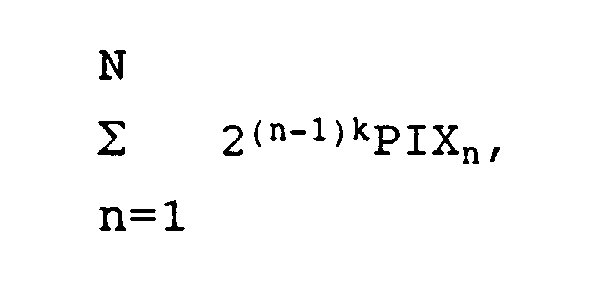
- Schaltungsanordnung zur Durchführung des Verfahrens nach einem der Ansprüche 1 bis 5, wobei die Anordnung umfaßt: einen Speicherblock (2) in dem das Bild in Blöcke (BL) aufgeteilt wird, die die Größe von mehr als einem Bildelement (PIX) aufweisen, und der zumindest einen Zeilenspeicher (LT) und zumindest zwei Verzögerungseinheiten (T) enthält; Einrichtungen zur Erzeugung eines Code-Wortes für jeden Block; einen Vergleicherblock (4), in dem das für den Block (BL) erzeugte Code-Wort mit dem Code-Wort des entsprechenden Blocks (BL) des vorhergehenden Bildes verglichen wird und der einen RAM-Speicher (RAM) enthält, in dem das vorhergehende Bild gespeichert ist; und Schaltungen (COMP) zur Durchführung des Vergleichs, wobei die Schaltungsanordnung dadurch gekennzeichnet ist, daß sie die folgenden Teile aufweist:- einen Schwellenwertblock (1), dem die digitale Video-Signal-Abtastprobe zugeführt wird und von dem eine vorherbestimmte Anzahl der höchstwertigen Bits von jeder Video-Signal-Abtastprobe der Bildelemente eines Blockes dem Speicherblock (2) zugeführt wird, und- einen Codierblock (3), dem das Signal von dem Speicherblock (2) zugeführt wird und bei dem unter Verwendung der vorherbestimmten Anzahl der höchstwertigen Bits der digitalen Video-Signal-Abtastproben eines jeweiligen Blockes ein Code-Wort für die Blöcke (BL) erzeugt und der Schiebe-und-Addier-Schaltungen (SHIFT, ADD) aufweist und von dem das Code-Wort dem Vergleicherblock (4) zugeführt wird.
- Schaltungsanordnung nach Anspruch 6,
dadurch gekennzeichnet, daß die Addier-Schaltung des Codierblocks (3) vier Eingänge aufweist, und daß- der erste Eingang das Bit des PIX1-Faktors des Code-Worts über den Zeilenspeicher (LT) und eine Verzögerungseinheit (T) von dem Schwellenwertblock (1) empfängt,- der zweite Eingang das Bit des PIX2-Faktors des Code-Worts über den Zeilenspeicher (LT) und eine Schiebe-Schaltung (SHIFT) von dem Schwellenwertblock (1) empfängt,- der dritte Eingang das Bit des PIX3-Faktors des Code-Worts über eine Verzögerungseinheit (T) und zwei Schiebe-Schaltungen (SHIFT) von dem Schwellenwertblock (1) empfängt, und- der vierte Eingang das Bit des PIX4-Faktors des Code-Worts über drei Schiebeschaltungen (SHIFT) von dem Schwellenwertblock (1) empfängt, wobei die PIX1-, PIX2-, PIX3-, PIX4-Faktoren die Bildelemente (PIX) des Blockes (BL) darstellen und als einen Wert den Wert der vorherbestimmten Anzahl von Bits der Video-Signal-Abtastprobe aufweisen. - Schaltungsanordnung nach Anspruch 6,
dadurch gekennzeichnet, daß der RAM-Speicher (RAM) des Vergleichsblocks (4) einen Halb-Bildfeldspeicher (720 * 288 * 4 Bit) aufweist.
Applications Claiming Priority (2)
| Application Number | Priority Date | Filing Date | Title |
|---|---|---|---|
| FI913883 | 1991-08-16 | ||
| FI913883A FI90177C (fi) | 1991-08-16 | 1991-08-16 | Foerfarande och kretsanordning foer att ange roerelse fraon en televisionsbild |
Publications (3)
| Publication Number | Publication Date |
|---|---|
| EP0528366A2 EP0528366A2 (de) | 1993-02-24 |
| EP0528366A3 EP0528366A3 (en) | 1993-06-23 |
| EP0528366B1 true EP0528366B1 (de) | 1997-10-29 |
Family
ID=8532989
Family Applications (1)
| Application Number | Title | Priority Date | Filing Date |
|---|---|---|---|
| EP92113848A Expired - Lifetime EP0528366B1 (de) | 1991-08-16 | 1992-08-13 | Verfahren und Schaltungsanordnung zur Bewegungsdetektion in einem Fernsehbild |
Country Status (3)
| Country | Link |
|---|---|
| EP (1) | EP0528366B1 (de) |
| DE (1) | DE69222908T2 (de) |
| FI (1) | FI90177C (de) |
Families Citing this family (6)
| Publication number | Priority date | Publication date | Assignee | Title |
|---|---|---|---|---|
| US5598514A (en) * | 1993-08-09 | 1997-01-28 | C-Cube Microsystems | Structure and method for a multistandard video encoder/decoder |
| KR0166729B1 (ko) * | 1993-11-24 | 1999-03-20 | 김광호 | 공간정보를 이용한 움직임 검출회로 및 그 방법 |
| DE4344924A1 (de) * | 1993-12-30 | 1995-08-10 | Thomson Brandt Gmbh | Verfahren und Vorrichtung zur Bewegungsschätzung |
| US5910909A (en) * | 1995-08-28 | 1999-06-08 | C-Cube Microsystems, Inc. | Non-linear digital filters for interlaced video signals and method thereof |
| KR100261253B1 (ko) * | 1997-04-02 | 2000-07-01 | 윤종용 | 비트율 조절이 가능한 오디오 부호화/복호화 방법및 장치 |
| GB2428924B (en) * | 2005-07-22 | 2007-10-31 | Snell & Wilcox Ltd | Method of and apparatus for image analysis |
Citations (1)
| Publication number | Priority date | Publication date | Assignee | Title |
|---|---|---|---|---|
| US3582546A (en) * | 1969-06-13 | 1971-06-01 | Bell Telephone Labor Inc | Redundancy reduction system for use with a signal having frame intervals |
-
1991
- 1991-08-16 FI FI913883A patent/FI90177C/fi active
-
1992
- 1992-08-13 EP EP92113848A patent/EP0528366B1/de not_active Expired - Lifetime
- 1992-08-13 DE DE69222908T patent/DE69222908T2/de not_active Expired - Fee Related
Patent Citations (1)
| Publication number | Priority date | Publication date | Assignee | Title |
|---|---|---|---|---|
| US3582546A (en) * | 1969-06-13 | 1971-06-01 | Bell Telephone Labor Inc | Redundancy reduction system for use with a signal having frame intervals |
Also Published As
| Publication number | Publication date |
|---|---|
| FI90177B (fi) | 1993-09-15 |
| EP0528366A3 (en) | 1993-06-23 |
| DE69222908T2 (de) | 1998-02-26 |
| EP0528366A2 (de) | 1993-02-24 |
| FI90177C (fi) | 1993-12-27 |
| FI913883A0 (fi) | 1991-08-16 |
| DE69222908D1 (de) | 1997-12-04 |
| FI913883L (fi) | 1993-02-17 |
Similar Documents
| Publication | Publication Date | Title |
|---|---|---|
| KR970009469B1 (ko) | 더블스무딩(Double Smoothing) 기능을 갖는 비월/순차주사변환장치 및 그 방법 | |
| US4682230A (en) | Adaptive median filter system | |
| EP0343728B1 (de) | Verfahren und Anordnung zur Bewegungsdetektion in einem nach einer Film-Fernseh-Umwendung erhaltenen Fernsehbild mit Zeilensprungverfahren | |
| US6404461B1 (en) | Method for detecting static areas in a sequence of video pictures | |
| US6975777B1 (en) | Apparatus and method of block noise detection and reduction | |
| EP0551036B1 (de) | Vorrichtung zur Interpolation der Abtastzeilen eines Fernsehsignals in einem Fernsehempfänger | |
| EP1101354B1 (de) | Umsetzung von mit zeilensprung abgetasteten bildsignalen in progressiv abgetastete bildsignale | |
| US4833537A (en) | Noise reduction circuit for video signal having suitable nonlinear processing character | |
| JP3522801B2 (ja) | 動き補償を用いた動映像信号処理器のためのメモリ装置 | |
| EP0105085B1 (de) | Verfahren und Apparat zum Filtern von Grauskalabilddaten | |
| JPH1013718A (ja) | ノイズ除去回路 | |
| JP3172169B2 (ja) | 動き情報を動き情報信号に変換する装置 | |
| EP0528366A2 (de) | Verfahren und Schaltungsanordnung zur Bewegungsdetektion in einem Fernsehbild | |
| US6963377B2 (en) | Encoding method and device including thresholding pixel-to-pixel differences | |
| JP3286120B2 (ja) | ノイズ除去回路 | |
| EP0680224A1 (de) | Filterarchitektur mit Fuzzy-Logik für Videoanwendungen und entsprechende Filterungsmethode | |
| US5880791A (en) | Method and apparatus for filtering data in which the required storage capacity is reduced | |
| JP2672468B2 (ja) | 空間情報を用いた動き検出回路及びその方法 | |
| EP0951182A1 (de) | Verfahren zur Detektion von statischen Bereichen in einer Bildfolge | |
| EP0220946B1 (de) | Digitaler Schwellenwertdetektor mit Hysterese | |
| EP1592259B1 (de) | Verarbeitung von Hilfsdaten von Videosequenzen | |
| EP0772351A1 (de) | Bewegungsdetektor für Videosignale mit Zeilensprung | |
| JP3389984B2 (ja) | 順次走査変換装置及び方法 | |
| JPS634781A (ja) | デジタルテレビジヨン受像機における動き信号検出回路 | |
| KR0183681B1 (ko) | 에러보상방법 및 이에 적합한 에러보상장치 |
Legal Events
| Date | Code | Title | Description |
|---|---|---|---|
| PUAI | Public reference made under article 153(3) epc to a published international application that has entered the european phase |
Free format text: ORIGINAL CODE: 0009012 |
|
| AK | Designated contracting states |
Kind code of ref document: A2 Designated state(s): DE ES FR GB IT NL SE |
|
| PUAL | Search report despatched |
Free format text: ORIGINAL CODE: 0009013 |
|
| AK | Designated contracting states |
Kind code of ref document: A3 Designated state(s): DE ES FR GB IT NL SE |
|
| 17P | Request for examination filed |
Effective date: 19931130 |
|
| 17Q | First examination report despatched |
Effective date: 19950801 |
|
| GRAG | Despatch of communication of intention to grant |
Free format text: ORIGINAL CODE: EPIDOS AGRA |
|
| GRAH | Despatch of communication of intention to grant a patent |
Free format text: ORIGINAL CODE: EPIDOS IGRA |
|
| GRAH | Despatch of communication of intention to grant a patent |
Free format text: ORIGINAL CODE: EPIDOS IGRA |
|
| GRAH | Despatch of communication of intention to grant a patent |
Free format text: ORIGINAL CODE: EPIDOS IGRA |
|
| GRAA | (expected) grant |
Free format text: ORIGINAL CODE: 0009210 |
|
| AK | Designated contracting states |
Kind code of ref document: B1 Designated state(s): DE ES FR GB IT NL SE |
|
| PG25 | Lapsed in a contracting state [announced via postgrant information from national office to epo] |
Ref country code: NL Free format text: LAPSE BECAUSE OF FAILURE TO SUBMIT A TRANSLATION OF THE DESCRIPTION OR TO PAY THE FEE WITHIN THE PRESCRIBED TIME-LIMIT Effective date: 19971029 Ref country code: ES Free format text: THE PATENT HAS BEEN ANNULLED BY A DECISION OF A NATIONAL AUTHORITY Effective date: 19971029 |
|
| REF | Corresponds to: |
Ref document number: 69222908 Country of ref document: DE Date of ref document: 19971204 |
|
| ET | Fr: translation filed | ||
| ITF | It: translation for a ep patent filed | ||
| PG25 | Lapsed in a contracting state [announced via postgrant information from national office to epo] |
Ref country code: SE Effective date: 19980129 |
|
| NLV1 | Nl: lapsed or annulled due to failure to fulfill the requirements of art. 29p and 29m of the patents act | ||
| PLBE | No opposition filed within time limit |
Free format text: ORIGINAL CODE: 0009261 |
|
| 26N | No opposition filed | ||
| REG | Reference to a national code |
Ref country code: GB Ref legal event code: IF02 |
|
| PGFP | Annual fee paid to national office [announced via postgrant information from national office to epo] |
Ref country code: GB Payment date: 20020807 Year of fee payment: 11 |
|
| PGFP | Annual fee paid to national office [announced via postgrant information from national office to epo] |
Ref country code: FR Payment date: 20020808 Year of fee payment: 11 |
|
| PGFP | Annual fee paid to national office [announced via postgrant information from national office to epo] |
Ref country code: DE Payment date: 20020821 Year of fee payment: 11 |
|
| PG25 | Lapsed in a contracting state [announced via postgrant information from national office to epo] |
Ref country code: GB Free format text: LAPSE BECAUSE OF NON-PAYMENT OF DUE FEES Effective date: 20030813 |
|
| PG25 | Lapsed in a contracting state [announced via postgrant information from national office to epo] |
Ref country code: DE Free format text: LAPSE BECAUSE OF NON-PAYMENT OF DUE FEES Effective date: 20040302 |
|
| GBPC | Gb: european patent ceased through non-payment of renewal fee |
Effective date: 20030813 |
|
| PG25 | Lapsed in a contracting state [announced via postgrant information from national office to epo] |
Ref country code: FR Free format text: LAPSE BECAUSE OF NON-PAYMENT OF DUE FEES Effective date: 20040430 |
|
| REG | Reference to a national code |
Ref country code: FR Ref legal event code: ST |
|
| PG25 | Lapsed in a contracting state [announced via postgrant information from national office to epo] |
Ref country code: IT Free format text: LAPSE BECAUSE OF NON-PAYMENT OF DUE FEES Effective date: 20050813 |