EP0529436B1 - Matériau photographique couleur à l'halogénure d'argent sensible à la lumière - Google Patents
Matériau photographique couleur à l'halogénure d'argent sensible à la lumière Download PDFInfo
- Publication number
- EP0529436B1 EP0529436B1 EP92113881A EP92113881A EP0529436B1 EP 0529436 B1 EP0529436 B1 EP 0529436B1 EP 92113881 A EP92113881 A EP 92113881A EP 92113881 A EP92113881 A EP 92113881A EP 0529436 B1 EP0529436 B1 EP 0529436B1
- Authority
- EP
- European Patent Office
- Prior art keywords
- group
- formula
- compound
- developing agent
- silver halide
- Prior art date
- Legal status (The legal status is an assumption and is not a legal conclusion. Google has not performed a legal analysis and makes no representation as to the accuracy of the status listed.)
- Expired - Lifetime
Links
Classifications
-
- G—PHYSICS
- G03—PHOTOGRAPHY; CINEMATOGRAPHY; ANALOGOUS TECHNIQUES USING WAVES OTHER THAN OPTICAL WAVES; ELECTROGRAPHY; HOLOGRAPHY
- G03C—PHOTOSENSITIVE MATERIALS FOR PHOTOGRAPHIC PURPOSES; PHOTOGRAPHIC PROCESSES, e.g. CINE, X-RAY, COLOUR, STEREO-PHOTOGRAPHIC PROCESSES; AUXILIARY PROCESSES IN PHOTOGRAPHY
- G03C7/00—Multicolour photographic processes or agents therefor; Regeneration of such processing agents; Photosensitive materials for multicolour processes
- G03C7/30—Colour processes using colour-coupling substances; Materials therefor; Preparing or processing such materials
- G03C7/305—Substances liberating photographically active agents, e.g. development-inhibiting releasing couplers
-
- Y—GENERAL TAGGING OF NEW TECHNOLOGICAL DEVELOPMENTS; GENERAL TAGGING OF CROSS-SECTIONAL TECHNOLOGIES SPANNING OVER SEVERAL SECTIONS OF THE IPC; TECHNICAL SUBJECTS COVERED BY FORMER USPC CROSS-REFERENCE ART COLLECTIONS [XRACs] AND DIGESTS
- Y10—TECHNICAL SUBJECTS COVERED BY FORMER USPC
- Y10S—TECHNICAL SUBJECTS COVERED BY FORMER USPC CROSS-REFERENCE ART COLLECTIONS [XRACs] AND DIGESTS
- Y10S430/00—Radiation imagery chemistry: process, composition, or product thereof
- Y10S430/156—Precursor compound
- Y10S430/158—Development inhibitor releaser, DIR
Definitions
- the present invention relates to a silver halide color photographic light-sensitive material.
- this invention relates to a silver halide color photographic light-sensitive material which contains novel timing DIR couplers and pyrazoloazole-based couplers, has high sensitivity, is excellent in color reproducibility, sharpness, graininess, and desilvering properties, and varies little in photographic properties during storage, and also to a method of processing this light-sensitive material.
- Silver halide color photographic light-sensitive materials especially color light-sensitive materials for photographing purposes are required to have high sensitivity and good graininess, color reproducibility, and sharpness, and to vary little in photographic properties during storage.
- a coupler which releases a development-inhibiting compound via two timing groups is known as a means for improving color reproducibility and sharpness.
- this coupler are described in, e.g., JP-A-51-146828 ("JP-A" means Unexamined Published Japanese Patent Application), JP-A-60-218645, JP-A-61-156127, JP-A-63-37346, JP-A-1-280755, JP-A-1-219747, JP-A-2-230139, EP 348139, EP 354,532, and EP 403,019.
- JP-A-51-146828 means Unexamined Published Japanese Patent Application
- JP-A-60-218645 JP-A-61-156127, JP-A-63-37346, JP-A-1-280755, JP-A-1-219747, JP-A-2-230139, EP 348139, EP 354,532, and EP 403,019.
- the use of these timing DIR couplers can enhance an interlayer
- JP-B-47-27411 (“JP-B” means Examined Published Japanese Patent Application), for example, has proposed a pyrazoloazole-based magenta coupler which does not cause much secondary absorption, is excellent in color hue of the coupler, and is therefore desirable in improving color reproducibility. However, no satisfactory color reproducibility has been obtained yet.
- timing DIR couplers and bleaching accelerator-releasing compounds are proposed in, e.g., JP-A-63-216048, JP-A-2-39146, JP-A-2-44338, and JP-A-2-44339. These combinations are also still unsatisfactory though they can improve color reproducibility, desilvering properties, graininess, and sharpness to some extent.
- EP-A-0 514 896 which is a document in accordance with Art. 54(3) EPC describes in its Example 1 the combination of the two specific pyrazoloazole-based couplers with the six compounds described in claim 1 in a silver halide color photographic light-sensitive material.
- A specifically represents a coupler moiety or an oxidation-reduction group.
- Examples of the coupler moiety represented by A are a yellow coupler moiety (e.g., an open-chain ketomethylene-type coupler moiety such as acylacetanilide or malondianilide), a magenta coupler moiety (e.g., a 5-pyrazolone-type, pyrazolotriazole-type, or imidazopyrazole-type coupler moiety), a cyan coupler moiety (e.g., a phenol-type coupler moiety, a naphthol-type coupler moiety, an imidazole-type coupler moiety described in EP 249,453, or a pyrazolopyrimidine-type coupler moiety described in EP 304,001), and a colorless compound forming coupler moiety (e.g., an indanone-type or acetophenone-type coupler moiety).
- a yellow coupler moiety e.g., an open-chain ketomethylene-type coupler moiety such as acylace
- heterocyclic-type coupler moiety described in U.S. Patent 4,315,070, 4,183,752, 4,174,969, 3,961,959, or 4,171,223, or JP-A-52-82423 may be used.
- this oxidation-reduction group is a group which can be oxidized by an oxidized form of a developing agent.
- the group are hydroquinones, catechols, pyrogallols, 1,4-naphthohydroquinones, 1,2-naphthohydroquinones, sulfonamidophenols, hydrazides, and sulfonamidonaphthols. Specific examples of these groups are described in, e.g., JP-A-61-230135, JP-A-62-251746, JP-A-61-278852, U.S. Patents 3,364,022, 3,379,529, 3,639,417, and 4,684,604, and J. Org. Chem., 29,588 (1964).
- a preferable example of A is a coupler moiety represented by Formula (Cp-1), (Cp-2), (Cp-3), (Cp-4), (Cp-5), (Cp-6), (Cp-7), (Cp-8), (Cp-9), (Cp-10), or (Cp-11) to be presented below. These couplers are preferable because of their high coupling rates.
- a symbol * deriving from the coupling position represents the position to which L 1 et seq in Formula (I) or L 4 et seq in Formula (II) is coupled.
- R 51 , R 52 , R 53 , R 54 , R 55 , R 56 , R 57 , R 58 , R 59 , R 60 , R 61 , R 62 , R 63 , R 64 , or R 65 contains a nondiffusing group, the group is so selected as to have 8 to 40, and preferably 10 to 30 carbon atoms in total. Otherwise, the total number of carbon atoms is preferably 15 or less.
- R41 represents an aliphatic group, an aromatic group, or a heterocyclic group
- R 42 represents an aromatic group or a heterocyclic group
- each of R 43 , R 44 , and R 45 represents a hydrogen atom, an aliphatic group, an aromatic group, or a heterocyclic group.
- R 51 has the same meaning as R 41 .
- Each of R 52 and R 53 has the same meaning as R 42 .
- k represents 0 or 1.
- R 54 represents a group having the same meaning as R 41 , an R 41 CON(R 43 )- group, an R 41 R 43 N- group, an R 41 SO 2 N(R 43 )- group, an R 41 S- group, an R 43 O- group, an R 45 N(R 43 )CON(R 44 )- group, or a ⁇ C- group.
- R 55 represents a group having the same meaning as R 41 .
- R 56 and R 57 represents a group having the same meaning as R 43 , an R 41 S- group, an R 43 O- group, an R 41 CON(R 43 )-group,-or an R 41 SO 2 N(R 43 )- group.
- R 58 represents a group having the same meaning as R 41 .
- R 59 represents a group having the same meaning as R 41 , an R 41 CON(R 43 )-group, an R 41 OCON(R 43 )- group, an R 41 SO 2 N(R 43 )- group, an R 43 R 44 NCON(R 45 )- group, an R 41 O- group, an R 41 S-group, a halogen atom, or an R 41 R 43 N- group.
- d represents 0, 1, 2, or 3.
- R 59 's represent the same substituent or different substituents.
- these R 59 's may be divalent groups and combine together to form a cyclic structure. Examples of the cyclic structure are a pyridine ring and a pyrrole ring.
- R 60 represents a group having the same meaning as R 41 .
- R 61 represents a group having the same meaning as R 41 .
- R 62 represents a group having the same meaning as R 41 , an R 41 OCONH-group, an R 41 SO 2 NH- group, an R 43 R 44 NCON(R 45 )-group, an R 43 R 44 NSO 2 N(R 45 )- group, an R 43 O- group, an R 41 S-group, a halogen atom, or an R 41 R 43 N- group.
- R 63 represents a group having the same meaning as R 41 , an R 43 CON(R 45 )-group, an R 43 R 44 NCO- group, an R 41 SO 2 N(R 44 )-group, an R 43 R 44 NSO 2 - group, an R 41 SO 2 -group, an R 43 OCO-group, an R 43 O-SO 2 - group, a halogen atom, a nitro group, a cyan group, or an R 43 CO- group.
- e represents an integer from 0 to 4. If a plurality of R 62 's or R 63 's are present, they represent the same group or different groups.
- R 64 and R 65 represents an R 43 R 44 NCO- group, an R 41 CO-group, an R 43 R 44 NSO 2 - group, an R 41 OCO- group, an R 41 SO 2 - group, a nitro group, or a cyano group.
- Z 2 represents a sulfur atom or an oxygen atom.
- f represents 0 or 1.
- A comprises preferably a nondiffusing group or nondiffusing groups.
- the aliphatic group is a saturated or unsaturated, chained or cyclic, straight-chain or branched, and substituted or nonsubstituted aliphatic hydrocarbon group having 1 to 32, and preferably 1 to 22 carbon atoms.
- Representative examples of the group are methyl, ethyl, propyl, isopropyl, butyl, (t)-butyl, (i)-butyl, (t)-amyl, hexyl, cyclohexyl, 2-ethylhexyl, octyl, 1,1,3,3-tetramethylbutyl, decyl, dodecyl, hexadecyl, and octadecyl.
- the aromatic group is that having 6 to 20 carbon atoms, preferably a substituted or nonsubstituted phenyl group or a substituted or nonsubstituted naphthyl group.
- the heterocyclic group is preferably a 3- to 8-membered substituted or nonsubstituted heterocyclic group having 1 to 20, and preferably 1 to 7 carbon atoms and containing an atom selected from a nitrogen atom, an oxygen atom, and a sulfur atom as a hetero atom.
- Representative examples of the heterocyclic group are 2-pyridyl, 2-furyl, 2-imidazolyl, 1-indolyl, 2,4-dioxo-1,3-imidazolidin-5-yl, 2-benzoxazolyl, 1,2,4-triazol-3-yl, and 4-pyrazolyl.
- substituents are a halogen atom, an R 47 O- group, an R 46 S-group, an R 47 CON(R 48 )- group, an R 47 N(R 48 )CO-group, an R 46 OCON(R 47 )- group, an R 46 SO 2 N(R 47 )- group, an R 47 R 48 NSO 2 - group, an R 46 SO 2 - group, an R 47 OCO-group, an R 47 R 48 NCON(R 49 )- group, a group having the same meaning as R 46 , an R 46 COO- group, an R 47 OSO 2 -group, a cyano group, or a nitro group.
- R 46 represents an aliphatic group, an aromatic group, or a heterocyclic group
- each of R 47 , R 48 , and R 49 represents an aliphatic group, an aromatic group, a heterocyclic group, or a hydrogen atom.
- these aliphatic, aromatic, and heterocyclic groups have the same meanings as defined above.
- R 51 is preferably an aliphatic group or an aromatic group.
- Each of R 52 and R 53 is preferably an aromatic group.
- R 53 is preferably an aromatic group or a heterocyclic group.
- R 54 is preferably an R 41 CONH-group or an R 41 R 43 N- group.
- R 55 is preferably an aromatic group, and more preferably a substituted phenyl group.
- each of R 56 and R 57 is preferably an aliphatic group, an aromatic group, an R 41 O- group, or an R 41 S- group.
- R 58 is preferably an aliphatic group or an aromatic group.
- R 59 is preferably a chlorine atom, an aliphatic group, or an R 41 CONH- group.
- d is preferably 1 or 2.
- R 60 is preferably an aromatic group.
- R 59 is preferably an R41CONH- group.
- R 61 is preferably an aliphatic group or an aromatic group.
- e is preferably 0 or 1.
- R 62 is preferably an R 41 OCONH- group, an R 41 CONH- group, or an R 41 SO 2 NH-group, and the substitution position of these groups is preferably the 5-position of a naphthol ring.
- R 63 is preferably an R 41 CONH- group, an R 41 SO 2 NH- group, an R 41 R 43 NSO 2 - group, an R 41 SO 2 -group, an R 41 R 43 NCO- group, a nitro group, or a cyano group, and e is preferably 1 or 2.
- R 63 is preferably an (R 43 ) 2 NCO- group, an R 43 OCO-group, or an R 43 CO- group, and e is preferably 1 or 2.
- R 54 is preferably an aliphatic group, an aromatic group, or an R 41 CONH- group, and f is preferably 1.
- A preferably has a nondiffusing group.
- Formula (T-1) *-(W-CR 11 (R 12 ))t-** where W represents an oxygen atom, a sulfur atom, or an -NR 13 - group, each of R 11 and R 12 represents a hydrogen atom or a substituent, R 13 represents a substituent, and t represents 1 or 2.
- R 11 and R 12 represent substituents
- representative examples of each of R 11 , R 12 , and R 13 are an R 15 group, an R 15 CO-group, an R 15 SO 2 - group, an R 15 (R 16 )NCO- group, and an R 15 (R 16 )NSO 2 - group, wherein R 15 represents an aliphatic group, an aromatic group, or a heterocyclic group and R 16 represents a hydrogen atom, an aliphatic group, an aromatic group, or a heterocyclic group.
- R 11 , R 12 , and R 13 may represent divalent groups and combine together to form a cyclic structure. Specific examples of a group represented by Formula (T-1) are the following groups.
- T-2 An example of this group is a timing group described in U.S. Patent 4,248,292.
- the group is represented by the following Formula (T-2).
- Formula (T-2) *-Nu-Link-E-** where Nu represents a nucleophilic group, and an example of a nucleophilic seed is an oxygen atom or a sulfur atom.
- E represents an electrophilic group which can cleave a bond with the symbol ** upon nucleophilic attack from Nu.
- Link represents a coupling group which three-dimensionally connects Nu with E so that they cause an intramolecular nucleophilic reaction.
- Specific examples of a group represented by Formula (T-2) are as follows.
- Each of Z 1 and Z 2 independently represents a carbon atom or a nitrogen atom, and each of x and y represents 0 or 1. If Z 1 is a carbon atom, x is 1. If Z 1 is a nitrogen atom, x is 0. The relationship between Z 2 and y is the same as that between Z 1 and x .
- a -CH 2 - group adjacent to the symbol ** may be substituted by an alkyl group having 1 to 6 carbon atoms or a phenyl group.
- a group represented by L 2 in Formula (I) represents a timing group with a valancy of 3 or more but does not use electron transfer via a conjugated system.
- a Z 3 group represents a substituted or nonsubstituted methylene group.
- Two Z 3 groups may be the same or different or may combine together to form a ring.
- substituents examples include an alkyl group (e.g., methyl, ethyl, isopropyl, t-butyl, hexyl, methoxyethyl, methoxymethyl, chloroethyl, cyanoethyl, nitroethyl, hydroxypropyl, carboxyethyl, dimethylaminoethyl, benzyl, and phenethyl), an aryl group (e.g., phenyl, naphthyl, 4-hydroxyphenyl, 4-cyanophenyl, 4-nitrophenyl, 2-methoxyphenyl, 2,6-dimethylphenyl, 4-carboxyphenyl, and 4-sulfophenyl), a heterocyclic group (e.g., 2-pyridyl, 4-pyridyl, 2-furyl, 2-thienyl, and 2-pyrrolyl), a heterocyclic group (e.g., 2-pyridyl
- alkyl group a nitro group, an alkoxy group, an alkylthio group, an amino group, an acylamino group, a sulfonamide group, an alkoxycarbonyl group, and a carbamoyl group.
- m is preferably 1.
- n is preferably 0 or 1, particularly preferably 0.
- a photographically useful group represented by PUG is specifically a development inhibitor, a dye, a fogging agent, a developing agent, a coupler, a bleaching accelerator, or a fixing accelerator.
- the photographically useful group are a photographically useful group described in U.S. Patent 4,248,962 (a group represented by formula PUG in the patent specification), a dye described in JP-A-62-49353 (a portion of a split-off group released from a coupler in the specification), a development inhibitor described in U.S. Patent 4,477,563, and bleaching accelerators described in JP-A-61-201247 and JP-A-2-558 (a portion of a split-off group released from a coupler in each of those specifications).
- a most preferable example of the photographically useful group is a development inhibitor.
- Preferable examples of the development inhibitor are groups represented by the following Formulas (INH-1) to (INH-13).
- R 21 represents a hydrogen atom or a substituted or nonsubstituted hydrocarbon group (e.g., methyl, ethyl, propyl, or phenyl).
- a symbol * represents a position to be bonded to a group represented by L 2 or L 3 of a compound represented by Formula (I).
- a symbol ** represents a position to be bonded to a substituent.
- substituents are a substituted or nonsubstituted aliphatic group, an alkoxycarbonyl group, an aryloxycarbonyl group, an aryl group, and a heterocyclic group.
- aliphatic group examples include methyl, ethyl, propyl, butyl, hexyl, decyl, isobutyl, t-butyl, 2-ethylhexyl, 2-methylthioethyl, benzyl, 4-methoxybenzyl, phenethyl, 1-methoxycarbonylethyl, propyloxycarbonylmethyl, 2-(propyloxycarbonyl)ethyl, butyloxycarbonylmethyl, pentyloxycarbonylmethyl, 2-cyanoethyloxycarbonylmethyl, 2,2-dichloroethyloxycarbonylmethyl, 3-nitropropyloxycarbonylmethyl, 4-nitrobenzyloxycarbonylmethyl, and 2,5-dioxo-3,6-dioxadecyl.
- aryloxycarbonyl group is a phenoxycarbonyl group.
- heterocyclic group examples include 4-pyridyl, 3-pyridyl, 2-pyridyl, 2-furyl, and 2-tetrahydropyranyl.
- INH INH
- INH INH-1
- INH-2 INH-2
- IH-3 INH-3
- INH-4 INH-9
- IH-12 INH-1
- the most preferable examples are (INH-1), (INH-2), and (INH-3).
- a substituent to be bonded to INH is preferably an aliphatic group or a substituted or nonsubstituted phenyl group.
- a compound represented by Formula (I) is most preferably a compound represented by Formula (Ia) below.
- Formula (Ia) A-L 1 -N-(Z 3 -PUG) 2 wherein symbols have the same meanings as in Formulas (I) and (T-L1).
- PUG is preferably a development inhibitor.
- a timing group does not use intramolecular nucleophilic substitution.
- the function of the photographically useful group means a function exhibited by, e.g., a development inhibitor, a dye, a fogging agent, a developing agent, a coupler, a bleaching accelerator, or a fixing agent.
- a compound represented by Formula (II) will be described below.
- A has the same meanings as in Formula (I).
- INH represents a group having a development inhibiting power.
- R 105 represents a nonsubstituted phenyl group, a nonsubstituted primary alkyl group, or a primary alkyl group substituted by a group except for an aryl group.
- Each of R 111 , R 112 , and R 113 represents a hydrogen atom or an organic moiety. Any two of R 111 , R 112 , and R 113 may be divalent groups and combine together to form a ring.
- R 105 may be substituted by two or more types of substituents.
- substituents of R 105 are fluorine, chlorine, an alkoxy group, a carbamoyl group, an alkoxycarbonyl group, a cyano group, a nitro group, and -CO 2 CH 2 CO 2 R 106 . Of these groups, most preferable substituents are an alkoxycarbonyl group and a -CO 2 CH 2 CO 2 R 106 group.
- R 105 is preferably a phenyl group, a primary nonsubstituted alkyl group having 2 to 6 carbon atoms, or a primary alkyl group substituted by the groups enumerated above as the preferable substituents of R 105 . Most preferably, R 105 is a primary nonsubstituted alkyl group having 3 to 5 carbon atoms or a primary alkyl group substituted by an alkoxycarbonyl group.
- a group represented by INH represents a group having a development inhibiting power. Specific examples of the group are (INH-1) to (INH-13) enumerated above in the explanation of PUG in Formula (I). Other comments on the INH, including preferable scope thereof, is same as that described in connection with formula (I).
- each of R 112 and R 113 represents a monovalent organic group
- the organic group is preferably an alkyl group (e.g., methyl or ethyl) or an aryl group (e.g., phenyl).
- At least one of R 112 and R 113 is preferably a hydrogen atom. Most preferably, both of R 112 and R 113 are hydrogen atoms.
- These groups may further have substituents.
- substituents are the groups enumerated above as the substituents of R 111 , a halogen atom (e.g., fluorine, chlorine, and bromine), a carboxyl group, and a sulfo group.
- R 111 preferably has 15 or less atoms except for a hydrogen atom.
- R 111 is more preferably a substituted or nonsubstituted alkyl group or aryl group, and most preferably a substituted or nonsubstituted alkyl group.
- the ring to be formed is preferably a 4- to 8-membered ring, and more preferably a 4- to 6-membered ring.
- R 114 and R 115 represents a hydrogen atom or has the same meaning as R 111 when R 111 represents a monovalent organic group.
- R 114 and R 115 may be the same or different.
- a group which does not function as a divalent group represents a hydrogen atom or a monovalent organic group.
- Specific examples of the organic group are the same as those enumerated above for R 111 , R 112 , and R 113 in the case wherein they do not form a ring.
- R 112 or R 113 is preferably a hydrogen atom, and the remaining one of R 112 and R 113 , and R 111 form a ring. More preferably, the left end of the divalent group enumerated above bonds to a nitrogen atom of Formula (I), and its right end bonds to a carbon atom.
- R 111 , R 112 , and R 113 preferably do not form a ring but respectively represent a hydrogen atom or a monovalent organic group.
- each of the formular weights of the residues which are obtained by removing two groups represented by A and PUG from the formula (I) or (II) respectively is preferably 64 to 240, more preferably 70 to 200, and most preferably 90 to 180.
- the compounds of the present invention can be synthesized by methods described in, e.g., U.S. Patents 4,847,383, 4,770,990, 4,684,604, and 4,886,736, JP-A-60-218645, JP-A-61-230135, and Japanese Patent Application Nos. 2-37070, 2-170832, and 2-251192, or methods similar to these methods.
- the compound was synthesized by the following synthesis route.
- Compounds represented by Formula (I) and/or Formula (II) are preferably added to light-sensitive emulsion layers, and most preferably red-sensitive emulsion layers of a light-sensitive material. If an emulsion layer sensitive to one color is constituted by two or more layers having different sensitivities (e.g., high- and low-sensitivity layers or high-, medium-, and low-sensitivity layers), the compounds are preferably added to layers except for the lowest sensitivity layer.
- the total addition amount of the compound of the invention to a light-sensitive material is 1.0 ⁇ 10 -7 to 1.0 ⁇ 10 -3 mol/m 2 , preferably 5.0 ⁇ 10 -7 to 1.0 ⁇ 10 -4 mol/m 2 , and more preferably 1.0 ⁇ 10 -6 to 5.0 ⁇ 10 -5 mol/m 2 .
- the pyrazolotriazole-based coupler can be represented by Formula (M) below.
- R 1 represents a hydrogen atom or a substituent.
- Z represents a nonmetallic atom group required to form a 5-membered azole ring containing two to three nitrogen atoms. This azole ring may have a substituent (including a condensed ring).
- X represents a hydrogen atom or a group which can split off upon a coupling reaction with an oxidized form of a developing agent.
- skeletons represented by Formula (M) preferable skeletons are 1H-imidazo[1,2-b]pyrazole, 1H-pyrazolo[1,5- b ][1,2,4]triazole, 1H-pyrazolo[5,1- c ][1,2,4]triazole, and 1H-pyrazolo[1,5- d ]tetrazole. These four skeletons are represented by the following Formulas (M-I), (M-II), (M-III), and (M-IV), respectively.
- R 4 represents a hydrogen atom, a halogen atom, an alkyl group, an aryl group, a heterocyclic group, a cyano group, a hydroxyl group, a nitro group, a carboxyl group, an amino group, an alkoxy group, an aryloxy group, an acylamino group, an alkylamino group, an anilino group, a ureido group, a sulfamoylamino group, an alkylthio group, an arylthio group, an alkoxycarbonylamino group, a sulfonamide group, a carbamoyl group, a sulfamoyl group, a sulfonyl group, an alkoxycarbonyl group, a heterocyclic oxy group, an azo group, an acyloxy group, a carbamoyloxy group, a silyloxy group, an aryloxycarbonylamino group
- R 5 represents groups similar to the substituents enumerated above for R 4 and is preferably a hydrogen atom, an alkyl group, an aryl group, a heterocyclic group, an alkoxycarbonyl group, a carbamoyl group, sulfamoyl group, a sulfinyl group, an acyl group, or a cyano group.
- X represents a hydrogen atom or a group which can split off upon a reaction with an oxidized form of an aromatic primary amine color developing agent.
- the split-off group are a halogen atom, an alkoxy group, an aryloxy group, an acyloxy group, an alkylsulfonyloxy or arylsulfonyloxy group, an acylamino group, an alkylsulfonamide or arylsulfonamide group, an alkoxycarbonyloxy group, an aryloxycarbonyloxy group, an alkylthio, arylthio, or heterocyclic thio group, a carbamoylamino group, a 5- or 6-membered nitrogen-containing heterocyclic group, an imide group, and an arylazo group.
- These groups may be further substituted by groups permitted as the substituents for R 4 .
- X sometimes takes a form of a bis-type coupler obtained by condensing 4-equivalent coupler with aldehydes or ketones, as a split-off group which is bonded via a carbon atom.
- X can contain a photographically useful group such as a development inhibitor or a development accelerator.
- a halogen atom an alkoxy group, an aryloxy group, an alkylthio or arylthio group, and a 5- or 6-membered nitrogen-containing heterocyclic group which bonds to a coupling active position by a nitrogen atom.
- a compound represented by Formula (M-I) can be synthesized by a method described in, e.g., U.S. Patent 4,500,630.
- a compound represented by Formula (M-II) can be synthesized by methods described in, e.g., U.S. Patents 4,540,654 and 4,705,863, JP-A-61-65245, JP-A-62-209457, and JP-A-62-249155.
- a compound represented by Formula (M-III) can be synthesized by methods described in, e.g., JP-B-47-27411 and U.S. Patent 3,725,067.
- a compound represented by Formula (M-IV) can be synthesized by a method described in, e.g., JP-A-60-33552.
- a coupler represented by Formula (M) can be added to any layer of a light-sensitive material, it is preferably added to light-sensitive emulsion layers. Most preferably, the coupler is added to green-sensitive emulsion layers or light-sensitive emulsion layers having central sensitivities of 500 to 560 nm, which are described in JP-A-61-34541.
- the total addition amount of the coupler of the invention to a light-sensitive material is 0.001 to 1.0 g/m 2 , preferably 0.01 to 0.80 g/m 2 , and more preferably 0.10 to 0.50 g/m 2 .
- a compound which reacts with an oxidized form of an aromatic primary amine-based developing agent to release a bleaching accelerator.
- the bleaching accelerator-releasing compound can be preferably represented by Formula (B) below.
- Formula (B) A-(L 1 ) i -Z 4 wherein A represents a group which reacts with an oxidized form of a developing agent to cleave (L 1 ) i -Z 4 , L 1 represents a group which cleaves Z after the bond with A is cleaved, i represents 0 or 1, and Z 4 represents a bleaching accelerator.
- A preferably represents a coupler moiety.
- a group represented by Z 4 is specifically a well-known bleaching accelerator group.
- Examples are various mercapto compounds described in U.S. Patent 3,893,858, British Patent 1,138,842, JP-A-53-141623, a compound having a disulfide bond described in JP-A-53-95630, a thiazolidine derivative described in JP-B-53-9854, an isothiourea derivative described in JP-A-53-94927, thiourea derivatives described in JP-B-45-8506 and JP-B-49-26586, a thioamide compound described in JP-A-49-42349, dithiocarbamates described in JP-A-55-26506, and arylenediamine compound described in U.S. Patent 4,552,834.
- Each of these compounds is preferably bonded to A-(L1)i- in Formula (B) at a substitutable hetero atom contained in the molecule.
- a group represented by Z 4 is preferably a group represented by Formula (V), (VI), or (VII) below.
- R 31 represents a divalent aliphatic group having 1 to 8, and preferably 1 to 5 carbon atoms
- R 32 represents a group having the same meaning as R 31 , a divalent aromatic group having 6 to 10 carbon atoms, or a 3- to 8-membered, and preferably 5- or 6-membered divalent heterocyclic group
- q Y 1 's are bonded at substitutable positions of R 31 - ⁇ (X 1 ) r -R 32 ⁇ p and X 2 - ⁇ (X 1 ) r -R 32 ⁇ p
- s Y 1 's are bonded at substitutable positions of X 3 - ⁇ (X 1 ) r -R 32 ⁇ p
- s and q are the plural numbers
- s Y1's and q Y1's represent the same group or different groups.
- p is the plural number
- p (X 1 ) r -R 32 's represent the same group or different groups.
- Each of R 33 , R 34 , and R 35 represents a hydrogen atom or an aliphatic group having 1 to 8, and preferably 1 to 5 carbon atoms.
- the group may be chained or cyclic, straight-chain or branched, saturated or unsaturated, and substituted or nonsubstituted.
- the group is preferably nonsubstituted, it can have substituents such as a halogen atom, an alkoxy group (e.g., methoxy and ethoxy), and an alkylthio group (e.g., methylthio and ethylthio).
- Each of a heterocyclic group represented by X 3 and a heterocyclic group represented by R 32 is a saturated or unsaturated and substituted or nonsubstituted heterocyclic group having an oxygen atom, a sulfur atom, or a nitrogen atom as a hetero atom.
- the heterocyclic group are pyridine, imidazole, piperidine, oxirane, sulforane, imidazolidine, thiazepine, or pyrazole.
- substituent are those enumerated above as the substituents of the aliphatic group.
- a group represented by Formula (V) are as follows. -SCH 2 CH 2 CO 2 H, -SCH 2 CO 2 H, -SCH 2 CH 2 OH, -SCH 2 CONHCH 2 CO 2 H, -SCH 2 CH 2 OCH 2 CO 2 H, -SCH 2 COOCH 2 CH 2 OH, -SCH 2 CH 2 OCH 2 CH 2 OCH 2 CH 2 OH, -SCH 2 CH 2 SCH 2 CO 2 H, -SCH 2 CH 2 CH 2 CO 2 H,
- the bleaching accelerator releasing compounds for use in the present invention can be easily synthesized in accordance with the descriptions in the patent specifications cited above.
- the addition amount of a compound represented by Formula (B) changes in accordance with the structure of the compound, it is preferably 1 ⁇ 10 -5 to 1 mol, and most preferably 1 ⁇ 10 -4 to 0.5 mol per mol of silver present in the same or adjacent layer.
- color photographic light-sensitive material of the present invention obtained as described above makes it possible to obtain a color photographic light-sensitive material superior in graininess, sharpness, color reproducibility, and desilvering properties.
- addition of a compound having the following structure represented by Formula (D) to the color photographic light-sensitive material can further improve the sharpness and the color reproducibility.
- Formula (D) A 1 -(L 11 ) v -B-(L 12 ) w -DI
- a 1 represents a group which reacts with an oxidized form of a developing agent to cleave (L 11 ) v -B-(L 12 ) w -DI
- L 11 represents a coupling group which cleaves its bond with B after its bond with A 1 is cleaved
- B represents a group which reacts with an oxidized form of a developing agent to cleave (L 12 ) w -DI
- L 12 represents a group which cleaves DI after its bond with B is cleaved
- DI represents a developing inhibitor
- each of v and w represents an integer of 0 to 2.
- two L 11 's and two L 12 's may be different or the same.
- a compound represented by Formula (D) cleaves DI through the following reaction process during development.
- a 1 , L 11 , v , B, L 12 , w , and DI have the same meanings as described above for Formula (D)
- QDI represents an oxidized form of a developing agent.
- a heterocyclic mercapto group, a 1-indazolyl group, or a triazolyl group is preferably used.
- the development inhibitor are a tetrazolylthio group, a thiadiazolylthio group, an oxadiazolylthio group, a triazolylthio group, a benzoxazolylthio zoxazolylthio group, a benzothiazolylthio group, a group, a 1-(or 2-)benzotriazolyl group, a 1,2,4-triazol-1-(or 4-)yl group, and a 1-indazolyl group.
- substituents are an aliphatic group, an aromatic group, a heterocyclic group, and the substituents enumerated above as substituents which an aromatic group can have.
- a compound represented by Formula (D) which constitutes the present invention can be synthesized by methods described in U.S. Patents 4,618,571 and 4,770,982, JP-A-63-284159, JP-A-60-203943, and JP-A-63-23152.
- a compound represented by Formula (D) of the present invention is preferably added to light-sensitive silver halide emulsion layers or their adjacent layers in a light-sensitive material.
- the addition amount of the compound is 1 ⁇ 10 -6 to 1 ⁇ 10 -3 mol/m 2 , preferably 3 ⁇ 10 -6 to 5 ⁇ 10 -4 mol/m 2 , and more preferably 1 ⁇ 10 -5 to 2 ⁇ 10 -4 mol/m 2 .
- such unit light-sensitive layers are generally arranged in an order of red-, green-, and blue-sensitive layers from a support. However, according to the intended use, this arrangement order may be reversed, or light-sensitive layers sensitive to the same color may sandwich another light-sensitive layer sensitive to a different color.
- Non-light-sensitive layers such as various types of interlayers may be formed between the silver halide light-sensitive layers mentioned above and as the uppermost layer and the lowermost layer.
- a two-layered structure of high- and low-sensitivity emulsion layers can be preferably used as described in West German Patent 1,121,470 or British Patent 923,045.
- layers are preferably arranged such that the sensitivity is sequentially decreased toward a support, and a non-light-sensitive layer may be formed between the respective silver halide emulsion layers.
- layers may be arranged such that a low-sensitivity emulsion layer is formed remotely from a support and a high-sensitivity layer is formed close to the support.
- layers may be arranged from the farthest side from a support in an order of low-sensitivity blue-sensitive layer (BL)/high-sensitivity blue-sensitive layer (BH)/high-sensitivity green-sensitive layer (GH)/low-sensitivity green-sensitive layer (GL)/high-sensitivity red-sensitive layer (RH)/low-sensitivity red-sensitive layer (RL), an order of BH/BL/GL/GH/RH/RL, or an order of BH/BL/GH/GL/RL/RH.
- BL low-sensitivity blue-sensitive layer
- BH high-sensitivity blue-sensitive layer
- GH high-sensitivity green-sensitive layer
- GL high-sensitivity red-sensitive layer
- RH high-sensitivity red-sensitive layer
- RL low-sensitivity red-sensitive layer
- layers may be arranged from the farthest side from a support in an order of blue-sensitive layer/GH/RH/GL/RL.
- layers may be arranged from the farthest side from a support in an order of blue-sensitive layer/GL/RL/GH/RH.
- three layers may be arranged such that a silver halide emulsion layer having the highest sensitivity is arranged as an upper layer, a silver halide emulsion layer having sensitivity lower than that of the upper layer is arranged as an interlayer, and a silver halide emulsion layer having sensitivity lower than that of the interlayer is arranged as a lower layer, i.e., three layers having different sensitivities may be arranged such that the sensitivity is sequentially decreased toward the support.
- an order of high-sensitivity emulsion layer/low-sensitivity emulsion layer/medium-sensitivity emulsion layer or low-sensitivity emulsion layer/medium-sensitivity emulsion layer/high-sensitivity emulsion layer may be adopted. Furthermore, the arrangement can be changed as described above even when four or more layers are formed.
- a donor layer (CL) with an interlayer effect which is described in U.S. Patent 4,663,271, 4,705,774, or 4,707,436, JP-A-62-160448, or JP-A-63-89850 and different from the main light-sensitive layers BL, GL, and RL in spectral sensitivity distribution, is preferably formed adjacent to or close to the main light-sensitive layers.
- a silver halide may consist of fine grains having a grain size of about 0.2 ⁇ m or less or large grains with its diameter of a projected surface area reaching to 10 ⁇ m, and an emulsion may be either a polydisperse or monodisperse emulsion.
- tabular grains having an aspect ratio of about 3 or more can be used in the present invention.
- the tabular grains can be easily prepared by methods described in, e.g., Gutoff, "Photographic Science and Engineering", Vol. 14, PP. 248 to 257 (1970); U.S. Patents 4,434,226, 4,414,310, 4,433,048, and 4,439,520, and British Patent 2,112,157.
- a silver halide emulsion layer is normally subjected to physical ripening, chemical ripening, and spectral sensitization steps before it is used. Additives for use in these steps are described in Research Disclosure Nos. 17,643, 18,716, and 307,105, and they are summarized in the following Table-A.
- the fine grain silver halide can be prepared following the same procedures as for a common light-sensitive silver halide.
- the surface of each silver halide grain need not be optically sensitized nor spectrally sensitized.
- a well-known stabilizer such as a triazole-based compound, an azaindene-based compound, a benzothiazolium-based compound, a mercapto-based compound, or a zinc compound.
- Colloidal silver can be preferably added to this fine grain silver halide grain-containing layer.
- a colored coupler for correcting additional, undesirable absorption of a colored dye are those described in Research Disclosure No. 17643, VII-G and No. 307105, VII-G, U.S. Patent 4,163,670, JP-B-57-39413, U.S. Patents 4,004,929 and 4,138,258, and British Patent 1,146,368.
- a coupler for correcting unnecessary absorption of a colored dye by a fluorescent dye released upon coupling described in U.S. Patent 4,774,181 or a coupler having a dye precursor group which can react with a developing agent to form a dye as a split-off group described in U.S. Patent 4,777,120 may be preferably used.
- Examples of a high-boiling organic solvent to be used in the oil-in-water dispersion method are described in, e.g., U.S. Patent 2,322,027.
- Examples of a high-boiling organic solvent to be used in the oil-in-water dispersion method and having a boiling point of 175°C or more at atmospheric pressure are phthalic esters (e.g., dibutylphthalate, dicyclohexylphthalate, di-2-ethylhexylphthalate, decylphthalate, bis(2,4-di-t-amylphenyl)phthalate, bis(2,4-di-t-amylphenyl)isophthalate, and bis(1,1-di-ethylpropyl)phthalate), phosphates or phosphonates (e.g., triphenylphosphate, tricresylphosphate, 2-ethylhexyldiphenylphosphate, tricyclohe
- the sum total of film thicknesses of all hydrophilic colloidal layers on the side having emulsion layers is 28 ⁇ m or less, preferably 23 ⁇ m or less, more preferably 18 ⁇ m or less, and most preferably 16 ⁇ m or less.
- a film swell speed T 1/2 is preferably 30 sec. or less, and more preferably, 20 sec. or less.
- the film thickness means a film thickness measured under moisture conditioning at a temperature of 25°C and a relative humidity of 55% (two days).
- the film swell speed T 1/2 can be measured in accordance with a known method in this field of art. For example, the film swell speed T 1/2 can be measured by using a swell meter described in Photogr.
- the color photographic light-sensitive material according to the present invention can be developed by conventional methods described in RD. No. 17643, pp. 28 and 29, RD. No. 18716, page 615, the left to right columns, and RD No. 307105, pp. 880 and 881.
- the color developer contains a Ph buffering agent such as a carbonate, a borate, or a phosphate of an alkali metal, and a development restrainer or an antifoggant such as a chloride, a bromide, an iodide, a benzimidazole, a benzothiazole, or a mercapto compound.
- a Ph buffering agent such as a carbonate, a borate, or a phosphate of an alkali metal
- an antifoggant such as a chloride, a bromide, an iodide, a benzimidazole, a benzothiazole, or a mercapto compound.
- the quantity of replenisher can be decreased to be 500 ml or less by decreasing a bromide ion concentration in the replenisher.
- a contact area of a processing tank with air is preferably decreased to prevent evaporation and oxidation of the replenisher upon contact with air.
- the above aperture efficiency is preferably 0.1 or less, and more preferably, 0.001 to 0.05.
- a shielding member such as a floating cover may be provided on the liquid surface of the photographic processing solution in the processing tank.
- a method of using a movable cover described in JP-A-1-82033 or a slit developing method descried in JP-A-63-216050 may be used.
- the aperture efficiency is preferably reduced not only in color and black-and-white development steps but also in all subsequent steps, e.g., bleaching, bleach-fixing, fixing, washing, and stabilizing steps.
- a quantity of replenisher can be reduced by using a means of suppressing storage of bromide ions in the developing solution.
- Typical examples of the bleaching agent are an organic complex salt of iron(III), e.g., a complex salt of iron(III) and an aminopolycarboxylic acid such as ethylenediaminetetraacetic acid, diethylenetriaminepentaacetic acid, cyclohexanediaminetetraacetic acid, methyliminodiacetic acid, and 1,3-diaminopropanetetraacetic acid, and glycoletherdiaminetetraacetic acid; or a complex salt of iron(III) and citric acid, tartaric acid, or malic acid.
- an organic complex salt of iron(III) e.g., a complex salt of iron(III) and an aminopolycarboxylic acid such as ethylenediaminetetraacetic acid, diethylenetriaminepentaacetic acid, cyclohexanediaminetetraacetic acid, methyliminodiacetic acid, and 1,3-diaminopropanetetraacetic acid, and glyco
- a compound having a mercapto group or a disulfide group is preferable since the compound has a large accelerating effect.
- the total time of a desilvering step is preferably as short as possible as long as no desilvering defect occurs.
- a preferable time is one to three minutes, and more preferably, one to two minutes.
- a processing temperature is 25°C to 50°C, and preferably, 35°C to 45°C. Within the preferable temperature range, a desilvering speed is increased, and generation of a stain after the processing can be effectively prevented.
- An automatic developing machine for processing the light-sensitive material of the present invention preferably has a light-sensitive material conveyor means described in JP-A-60-191257, JP-A-191258, or JP-A-60-191259.
- this conveyor means can significantly reduce carry-over of a processing solution from a pre-bath to a post-bath, thereby effectively preventing degradation in performance of the processing solution. This effect significantly shortens especially a processing time in each processing step and reduces a processing solution replenishing amount.
- the amount of water used for washing can be greatly decreased. Since washing water stays in the tanks for a long period of time, however, bacteria multiply and floating substances may be undesirably attached to the light-sensitive material.
- a method of decreasing calcium and magnesium ions can be effectively utilized, as described in JP-A-62-288838.
- the pH of the water for washing the photographic light-sensitive material of the present invention is 4 to 9, and preferably, 5 to 8.
- the water temperature and the washing time can vary in accordance with the properties and the intended use of the light-sensitive material. Normally, the washing time is 20 seconds to 10 minutes at a temperature of 15°C to 45°C, and preferably, 30 seconds to 5 minutes at 25°C to 40°C.
- the light-sensitive material of the present invention can be processed directly by a stabilizing agent in place of washing. All known methods described in JP-A-57-8543, JP-A-58-14834, and JP-A-60-220345 can be used in such stabilizing processing.
- Stabilizing is sometimes performed subsequently to washing.
- An example is a stabilizing bath containing a dye stabilizing agent and a surface-active agent to be used as a final bath of the photographic color light-sensitive material.
- the dye stabilizing agent are an aldehyde such as formalin and glutaraldehyde, an N-methylol compound, hexamethylenetetramine, and an aldehyde sulfite adduct.
- Various chelating agents or antifungal agents can be added in the stabilizing bath.
- An overflow solution produced upon washing and/or replenishment of the stabilizing solution can be reused in another step such as a desilvering step.
- Each processing solution in the present invention is used at a temperature of 10°C to 50°C. Although a normal processing temperature is 33°C to 38°C, processing may be accelerated at a higher temperature to shorten a processing time, or image quality or stability of a processing solution may be improved at a lower temperature.
- the silver halide light-sensitive material of the present invention can be applied to thermal development light-sensitive materials described in, e.g., U.S. Patent 4,500,626, JP-A-60-133449, JP-A-59-218443, JP-A-61-238056, and EP 210,660A2.
- a sample 102 was manufactured by replacing the magenta coupler EX-6 in the seventh and eighth layers of the sample 101 with an equal molar quantity of M-1 of the present invention and EX-16 in the seventh, eighth, and ninth layers with a 0.8-times molar quantity of EX-8.
- Samples 106 to 113 were manufactured by replacing the magenta coupler EX-6 in the seventh and eighth layers and the compound (EX-16) in the seventh, eighth, and ninth layers of the sample 101 with equal molar quantities of the couplers of the present invention as listed in Table 2 to be presented later.
Landscapes
- Physics & Mathematics (AREA)
- General Physics & Mathematics (AREA)
- Silver Salt Photography Or Processing Solution Therefor (AREA)
Claims (11)
- Matériau photosensible photographique couleur à l'halogénure d'argent présentant au moins une couche d'émulsion d'halogénure d'argent photosensible sur un support, et contenant un copulant à base de pyrazoloazole, dans lequel ledit matériau photosensible photographique couleur à l'halogénure d'argent contient un composé représenté par la formule (I) et/ou la formule (II) ci-dessous:dans laquelle A a la même signification que dans la formule (I), INH représente un groupe présentant un pouvoir d'inhibition du développement, et R105 représente un groupe phényle non substitué, un groupe alkyle primaire non substitué ou un groupe alkyle primaire substitué par un groupe autre qu'un groupe aryle, et chacun parmi R111, R112 et R113 représente un atome d'hydrogène ou une fraction organique, deux quelconque parmi R111, R112 et R113 pouvant être des groupes bivalents et se combiner pour former un cycle, dans lequel les composés suivants:


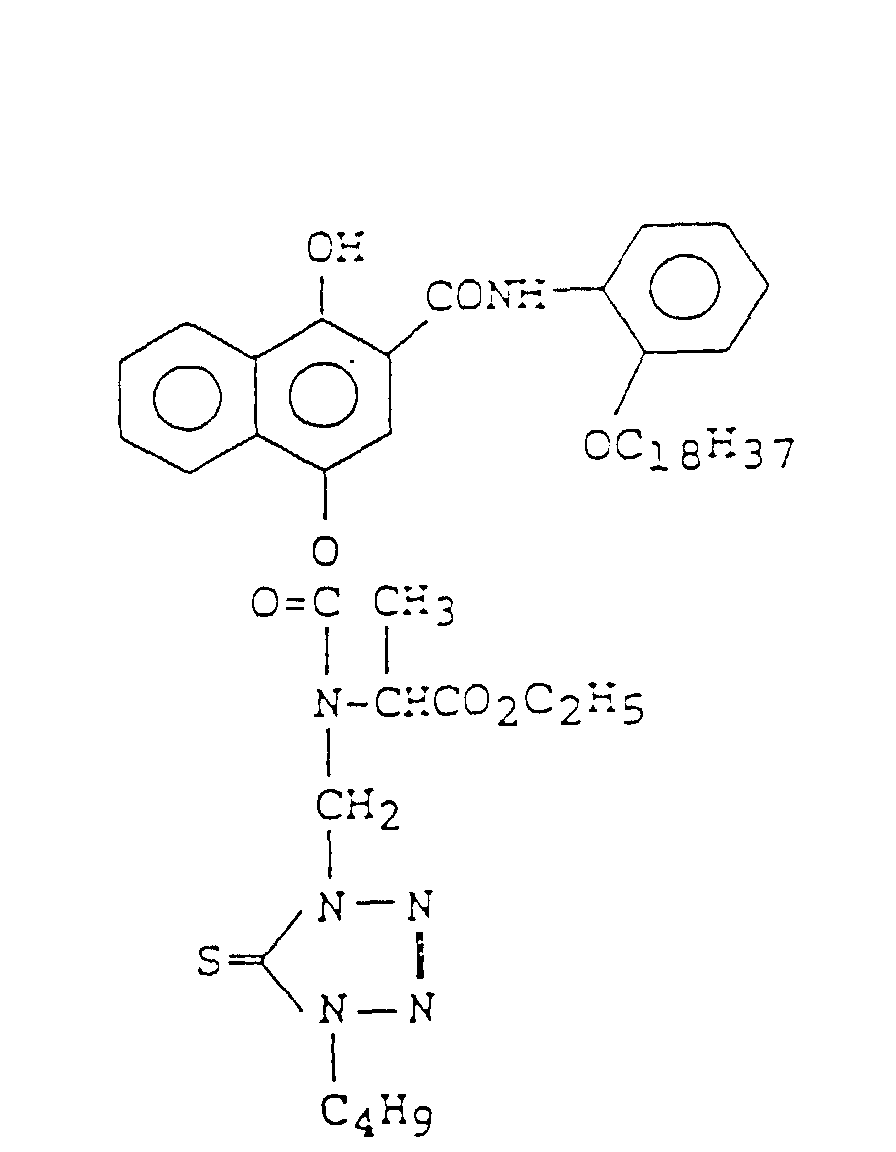
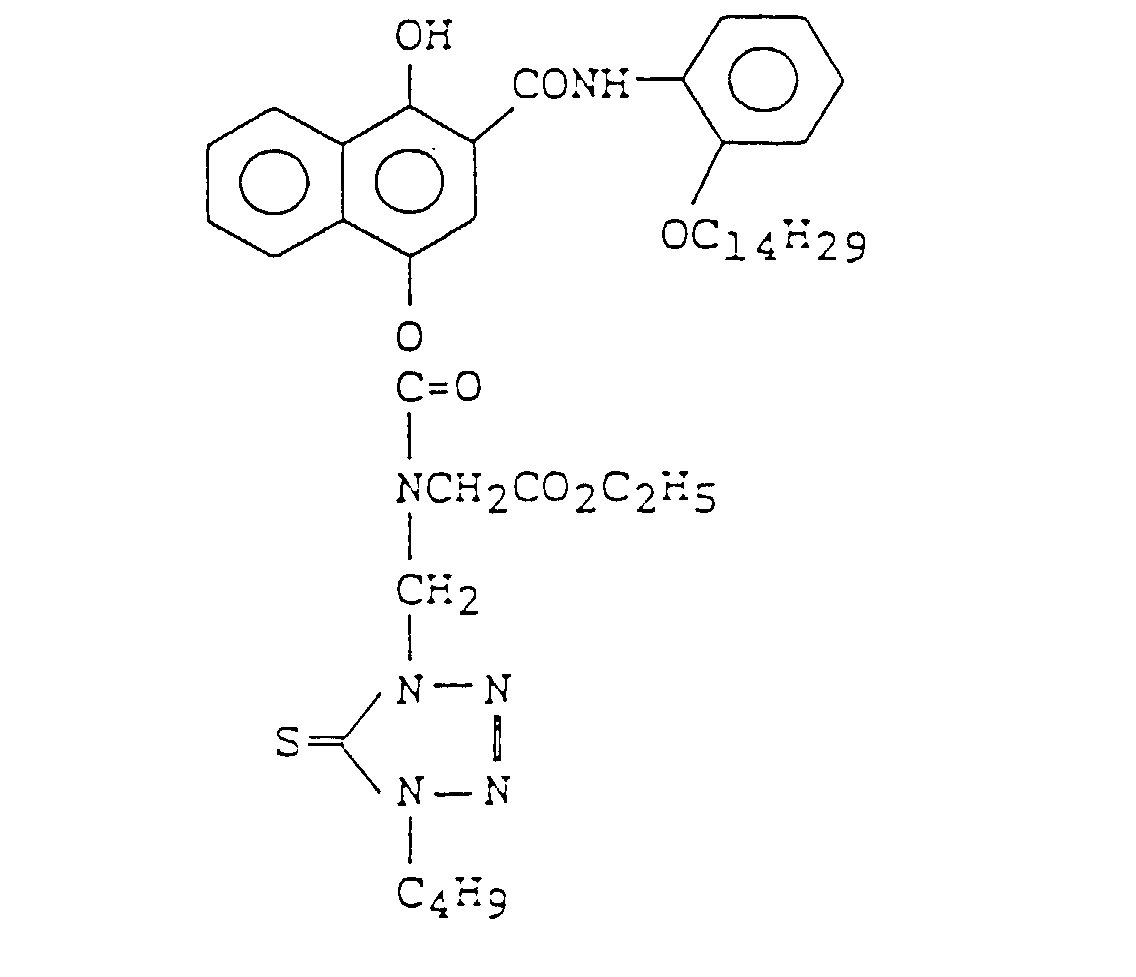

 en combinaison avec l'un quelconque des copulants à base de pyrazoloazole qui suivent sont exclus :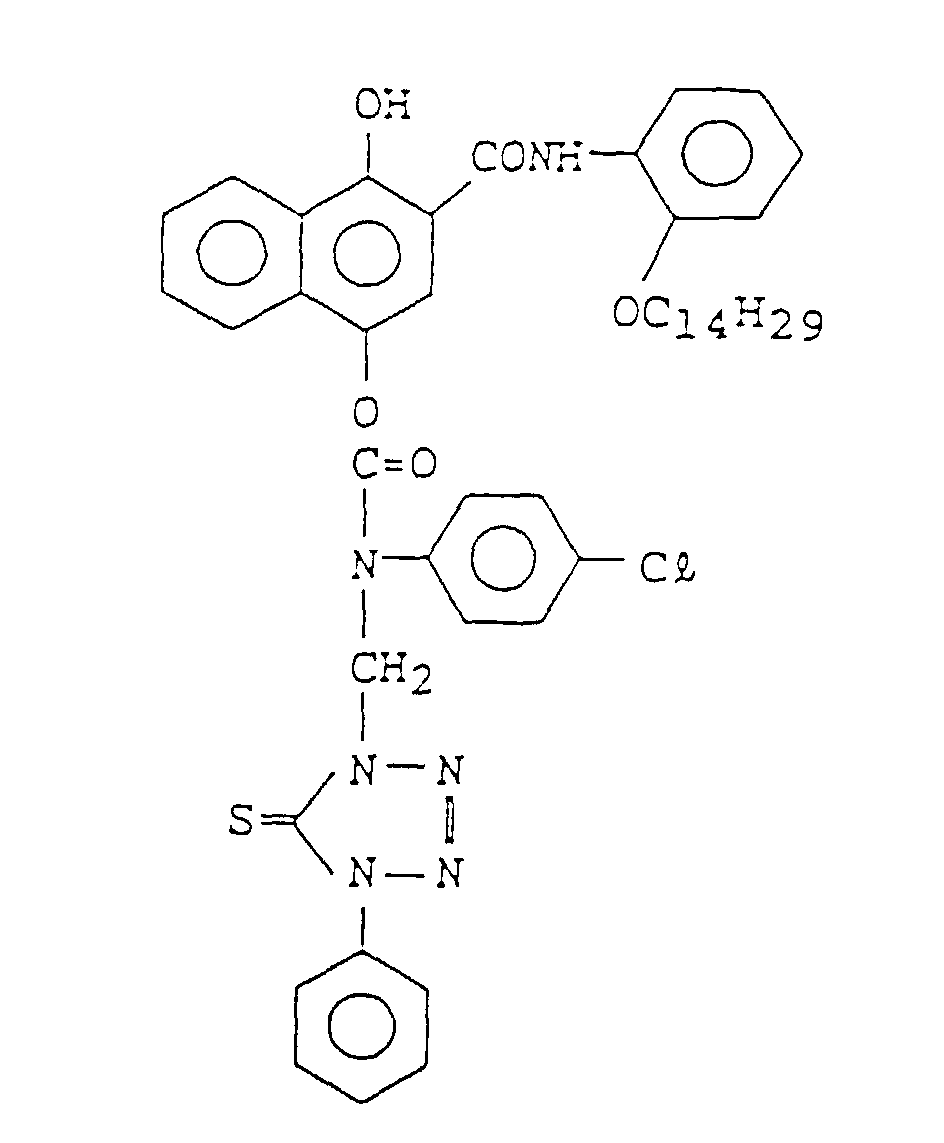
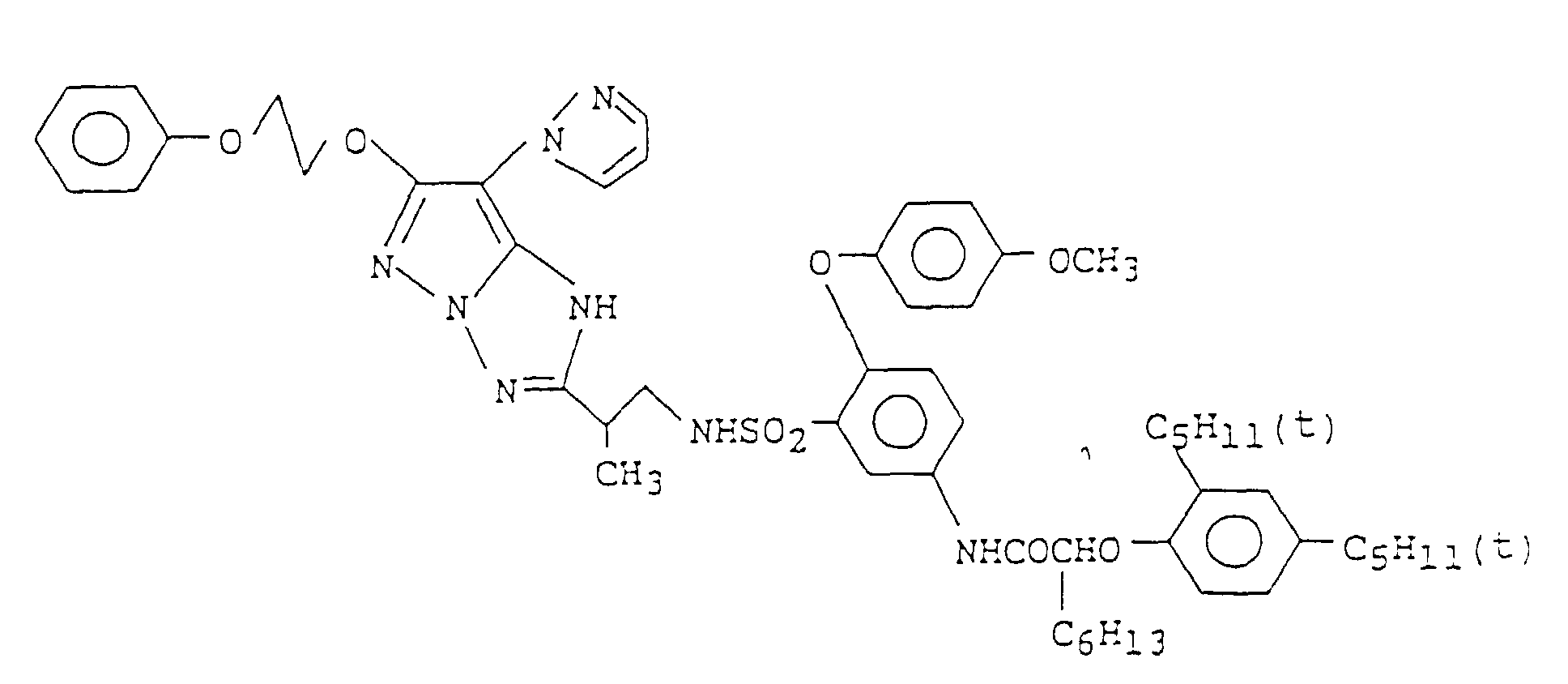

- Matériau selon la revendication 1, caractérisé en ce que chacun des poids de formule des résidus qui sont obtenus en éliminant deux groupes représentés par A et PUG de la formule (I) ou (II), respectivement, vaut 64 à 240.
- Matériau selon la revendication 1, contenant un composé qui réagit avec une forme oxydée d'un agent de développement à base d'amine aromatique primaire pour libérer un accélérateur de blanchiment.
- Matériau selon la revendication 2, contenant un composé qui réagit avec une forme oxydée d'un agent de développement à base d'amine aromatique primaire pour libérer un agent de blanchiment.
- Matériau selon la revendication 1, contenant un composé qui se clive après réaction avec une forme oxydée d'un agent de développement à base d'amine aromatique primaire et réagit avec une autre molécule de la forme oxydée de l'agent de développement pour cliver un inhibiteur de développement.
- Matériau selon la revendication 2, contenant un composé qui se clive après réaction avec une forme oxydée d'un agent de développement à base d'amine aromatique primaire et réagit avec une autre molécule de la forme oxydée de l'agent de développement pour cliver un inhibiteur de développement.
- Matériau selon la revendication 3, contenant un composé qui se clive après réaction avec une forme oxydée d'un agent de développement à base d'amine aromatique primaire et réagit avec une autre molécule de la forme oxydée de l'agent de développement pour cliver un inhibiteur de développement.
- Matériau selon la revendication 4, contenant un composé qui se clive après réaction avec une forme oxydée d'un agent de développement à base d'amine aromatique primaire et réagit avec une autre molécule de la forme oxydée de l'agent de développement pour cliver un inhibiteur de développement.
- Matériau selon la revendication 1, caractérisé en ce qu'un composé représenté par la formule (I) est un composé représenté par la formule (Ia) :
- Matériau selon la revendication 1, caractérisé en ce que chacun des poids de formule des résidus qui sont obtenus en éliminant deux groupes représentés par A et PUG de la formule (I) ou (II) respectivement, vaut 70 à 200.
- Matériau selon la revendication 1, caractérisé en ce que chacun des poids de formule des résidus qui sont obtenus en éliminant deux groupes représentés par A et PUG de la formule (I) ou (II) respectivement, vaut 90 à 180.
Applications Claiming Priority (4)
| Application Number | Priority Date | Filing Date | Title |
|---|---|---|---|
| JP230784/91 | 1991-08-19 | ||
| JP23078491 | 1991-08-19 | ||
| JP4020790A JPH05107706A (ja) | 1991-08-19 | 1992-01-10 | ハロゲン化銀カラー写真感光材料及びその処理方法 |
| JP20790/92 | 1992-01-10 |
Publications (2)
| Publication Number | Publication Date |
|---|---|
| EP0529436A1 EP0529436A1 (fr) | 1993-03-03 |
| EP0529436B1 true EP0529436B1 (fr) | 1998-06-03 |
Family
ID=26357777
Family Applications (1)
| Application Number | Title | Priority Date | Filing Date |
|---|---|---|---|
| EP92113881A Expired - Lifetime EP0529436B1 (fr) | 1991-08-19 | 1992-08-14 | Matériau photographique couleur à l'halogénure d'argent sensible à la lumière |
Country Status (4)
| Country | Link |
|---|---|
| US (1) | US5403703A (fr) |
| EP (1) | EP0529436B1 (fr) |
| JP (1) | JPH05107706A (fr) |
| DE (1) | DE69225751T2 (fr) |
Families Citing this family (5)
| Publication number | Priority date | Publication date | Assignee | Title |
|---|---|---|---|---|
| JPH04152339A (ja) * | 1990-10-17 | 1992-05-26 | Fuji Photo Film Co Ltd | ハロゲン化銀カラー写真感光材料 |
| JPH06347968A (ja) * | 1993-04-14 | 1994-12-22 | Fuji Photo Film Co Ltd | ハロゲン化銀感光材料 |
| US5514530A (en) * | 1993-07-28 | 1996-05-07 | Eastman Kodak Company | Photographic elements comprising 2-phenylcarbamoyl-1-naphthol image-modifying couplers yielding dyes resistant to crystallization and reduction |
| US5686234A (en) * | 1995-06-30 | 1997-11-11 | Eastman Kodak Company | Photographic element containing a coupler capable of releasing a photographically useful group |
| US5670301A (en) * | 1995-06-30 | 1997-09-23 | Eastman Kodak Company | Photographic element containing a coupler capable of releasing a photographically useful group |
Citations (2)
| Publication number | Priority date | Publication date | Assignee | Title |
|---|---|---|---|---|
| EP0499279A1 (fr) * | 1991-02-15 | 1992-08-19 | Fuji Photo Film Co., Ltd. | Matériau photographique couleur à l'halogénure d'argent sensible à la lumière |
| EP0514896A1 (fr) * | 1991-05-22 | 1992-11-25 | Fuji Photo Film Co., Ltd. | Matériau photographique couleur à halogénure d'argent sensible à la lumière |
Family Cites Families (15)
| Publication number | Priority date | Publication date | Assignee | Title |
|---|---|---|---|---|
| JPS60218645A (ja) * | 1984-04-13 | 1985-11-01 | Fuji Photo Film Co Ltd | ハロゲン化銀写真感光材料 |
| JPS60249148A (ja) * | 1984-05-25 | 1985-12-09 | Fuji Photo Film Co Ltd | ハロゲン化銀カラ−写真感光材料 |
| JPS60262158A (ja) * | 1984-06-08 | 1985-12-25 | Fuji Photo Film Co Ltd | ハロゲン化銀カラ−写真感光材料 |
| JPS6374058A (ja) * | 1986-09-18 | 1988-04-04 | Konica Corp | カプラのpKaを規制したハロゲン化銀カラ−写真感光材料 |
| JPS63216048A (ja) * | 1987-03-05 | 1988-09-08 | Fuji Photo Film Co Ltd | ハロゲン化銀カラ−写真感光材料 |
| JPH0255A (ja) * | 1987-10-02 | 1990-01-05 | Fuji Photo Film Co Ltd | ハロゲン化銀カラー写真感光材料 |
| US4861701A (en) * | 1987-10-05 | 1989-08-29 | Eastman Kodak Company | Photographic element and process comprising a compound which comprises two timing groups in sequence |
| JPH01223454A (ja) * | 1988-03-03 | 1989-09-06 | Fuji Photo Film Co Ltd | ハロゲン化銀カラー写真感光材料 |
| JPH01251032A (ja) * | 1988-03-31 | 1989-10-06 | Fuji Photo Film Co Ltd | ハロゲン化銀写真感光材料 |
| JPH0244338A (ja) * | 1988-08-05 | 1990-02-14 | Fuji Photo Film Co Ltd | ハロゲン化銀カラー写真感光材料 |
| JP2670887B2 (ja) * | 1989-07-28 | 1997-10-29 | 富士写真フイルム株式会社 | ハロゲン化銀カラー写真感光材料の処理方法 |
| JPH03255441A (ja) * | 1990-01-17 | 1991-11-14 | Fuji Photo Film Co Ltd | ハロゲン化銀カラー写真感光材料 |
| JPH04211246A (ja) * | 1990-02-16 | 1992-08-03 | Fuji Photo Film Co Ltd | ハロゲン化銀カラー写真感光材料 |
| US5135839A (en) * | 1990-11-13 | 1992-08-04 | Eastman Kodak Company | Silver halide material with dir and bleach accelerator releasing couplers |
| US5326688A (en) * | 1993-05-27 | 1994-07-05 | Eastman Kodak Company | Coating compositions for antistatic layers for photographic elements |
-
1992
- 1992-01-10 JP JP4020790A patent/JPH05107706A/ja active Pending
- 1992-08-13 US US07/929,030 patent/US5403703A/en not_active Expired - Lifetime
- 1992-08-14 DE DE69225751T patent/DE69225751T2/de not_active Expired - Lifetime
- 1992-08-14 EP EP92113881A patent/EP0529436B1/fr not_active Expired - Lifetime
Patent Citations (2)
| Publication number | Priority date | Publication date | Assignee | Title |
|---|---|---|---|---|
| EP0499279A1 (fr) * | 1991-02-15 | 1992-08-19 | Fuji Photo Film Co., Ltd. | Matériau photographique couleur à l'halogénure d'argent sensible à la lumière |
| EP0514896A1 (fr) * | 1991-05-22 | 1992-11-25 | Fuji Photo Film Co., Ltd. | Matériau photographique couleur à halogénure d'argent sensible à la lumière |
Also Published As
| Publication number | Publication date |
|---|---|
| JPH05107706A (ja) | 1993-04-30 |
| DE69225751D1 (de) | 1998-07-09 |
| US5403703A (en) | 1995-04-04 |
| EP0529436A1 (fr) | 1993-03-03 |
| DE69225751T2 (de) | 1998-10-22 |
Similar Documents
| Publication | Publication Date | Title |
|---|---|---|
| US5213958A (en) | Silver halide color photographic material containing a photographic yellow dye forming coupler | |
| US5212052A (en) | Silver halide color photographic material | |
| US5306609A (en) | Silver halide color photographic material | |
| US5238803A (en) | Silver halide color photographic photosensitive material containing a yellow coupler | |
| EP0456257A1 (fr) | Matériau photographique couleur à l'halogénure d'argent | |
| US5272049A (en) | Silver halide color photographic light-sensitive material and image forming method | |
| EP0529436B1 (fr) | Matériau photographique couleur à l'halogénure d'argent sensible à la lumière | |
| US5326680A (en) | Silver halide color photographic light-sensitive material | |
| US5837438A (en) | Silver halide color photographic photosensitive material | |
| US5283166A (en) | Yellow dye-forming coupler and silver halide color photographic light-sensitive material containing the same | |
| US5360709A (en) | Silver halide photographic material containing a DIR compound | |
| US5356767A (en) | Silver halide photographic light-sensitive material containing an acylacetamide type yellow dye forming coupler having an acyl group and a compound capable of releasing a development inhibitor | |
| US5529894A (en) | Silver halide photographic material containing a coupler capable of releasing a plurality of photographically useful groups or precursors thereof | |
| US5437965A (en) | Silver halide color photographic material | |
| EP0517214B1 (fr) | Matériau photographique couleur à l'halogénure d'argent sensible à la lumière et procédé pour son traitement | |
| EP0554778B1 (fr) | Matériau photographique couleur à l'halogénure d'argent | |
| US5336591A (en) | Silver halide color photographic material | |
| US5597683A (en) | Silver halide color photographic material | |
| US5260182A (en) | Silver halide color photographic photosensitive materials | |
| EP0438148A2 (fr) | Produit photographique couleur à l'halogénure d'argent | |
| EP0500043B1 (fr) | Matériau photographique à l'halogénure d'argent sensible à la lumière | |
| US5302503A (en) | Silver halide photographic light-sensitive material | |
| EP0421453A1 (fr) | Matériau photographique couleur à l'halogénure d'argent | |
| JPH05281682A (ja) | ハロゲン化銀カラー写真感光材料 |
Legal Events
| Date | Code | Title | Description |
|---|---|---|---|
| PUAI | Public reference made under article 153(3) epc to a published international application that has entered the european phase |
Free format text: ORIGINAL CODE: 0009012 |
|
| AK | Designated contracting states |
Kind code of ref document: A1 Designated state(s): BE DE FR GB NL |
|
| 17P | Request for examination filed |
Effective date: 19930804 |
|
| 17Q | First examination report despatched |
Effective date: 19960821 |
|
| GRAG | Despatch of communication of intention to grant |
Free format text: ORIGINAL CODE: EPIDOS AGRA |
|
| GRAG | Despatch of communication of intention to grant |
Free format text: ORIGINAL CODE: EPIDOS AGRA |
|
| GRAH | Despatch of communication of intention to grant a patent |
Free format text: ORIGINAL CODE: EPIDOS IGRA |
|
| GRAH | Despatch of communication of intention to grant a patent |
Free format text: ORIGINAL CODE: EPIDOS IGRA |
|
| GRAA | (expected) grant |
Free format text: ORIGINAL CODE: 0009210 |
|
| AK | Designated contracting states |
Kind code of ref document: B1 Designated state(s): BE DE FR GB NL |
|
| PG25 | Lapsed in a contracting state [announced via postgrant information from national office to epo] |
Ref country code: BE Free format text: LAPSE BECAUSE OF FAILURE TO SUBMIT A TRANSLATION OF THE DESCRIPTION OR TO PAY THE FEE WITHIN THE PRESCRIBED TIME-LIMIT Effective date: 19980603 Ref country code: FR Free format text: LAPSE BECAUSE OF FAILURE TO SUBMIT A TRANSLATION OF THE DESCRIPTION OR TO PAY THE FEE WITHIN THE PRESCRIBED TIME-LIMIT Effective date: 19980603 Ref country code: NL Free format text: LAPSE BECAUSE OF FAILURE TO SUBMIT A TRANSLATION OF THE DESCRIPTION OR TO PAY THE FEE WITHIN THE PRESCRIBED TIME-LIMIT Effective date: 19980603 |
|
| REF | Corresponds to: |
Ref document number: 69225751 Country of ref document: DE Date of ref document: 19980709 |
|
| EN | Fr: translation not filed | ||
| NLV1 | Nl: lapsed or annulled due to failure to fulfill the requirements of art. 29p and 29m of the patents act | ||
| PLBE | No opposition filed within time limit |
Free format text: ORIGINAL CODE: 0009261 |
|
| 26N | No opposition filed | ||
| REG | Reference to a national code |
Ref country code: GB Ref legal event code: IF02 |
|
| REG | Reference to a national code |
Ref country code: GB Ref legal event code: 732E |
|
| PGFP | Annual fee paid to national office [announced via postgrant information from national office to epo] |
Ref country code: DE Payment date: 20100721 Year of fee payment: 19 |
|
| PGFP | Annual fee paid to national office [announced via postgrant information from national office to epo] |
Ref country code: GB Payment date: 20100811 Year of fee payment: 19 |
|
| GBPC | Gb: european patent ceased through non-payment of renewal fee |
Effective date: 20110814 |
|
| REG | Reference to a national code |
Ref country code: DE Ref legal event code: R119 Ref document number: 69225751 Country of ref document: DE Effective date: 20120301 |
|
| PG25 | Lapsed in a contracting state [announced via postgrant information from national office to epo] |
Ref country code: GB Free format text: LAPSE BECAUSE OF NON-PAYMENT OF DUE FEES Effective date: 20110814 |
|
| PG25 | Lapsed in a contracting state [announced via postgrant information from national office to epo] |
Ref country code: DE Free format text: LAPSE BECAUSE OF NON-PAYMENT OF DUE FEES Effective date: 20120301 |