EP0529604A1 - Procédé pour analyser une protéine ou un peptide - Google Patents
Procédé pour analyser une protéine ou un peptide Download PDFInfo
- Publication number
- EP0529604A1 EP0529604A1 EP92114531A EP92114531A EP0529604A1 EP 0529604 A1 EP0529604 A1 EP 0529604A1 EP 92114531 A EP92114531 A EP 92114531A EP 92114531 A EP92114531 A EP 92114531A EP 0529604 A1 EP0529604 A1 EP 0529604A1
- Authority
- EP
- European Patent Office
- Prior art keywords
- peptide
- protein
- reaction mixture
- sample
- amino acid
- Prior art date
- Legal status (The legal status is an assumption and is not a legal conclusion. Google has not performed a legal analysis and makes no representation as to the accuracy of the status listed.)
- Granted
Links
Images









Classifications
-
- G—PHYSICS
- G01—MEASURING; TESTING
- G01N—INVESTIGATING OR ANALYSING MATERIALS BY DETERMINING THEIR CHEMICAL OR PHYSICAL PROPERTIES
- G01N33/00—Investigating or analysing materials by specific methods not covered by groups G01N1/00 - G01N31/00
- G01N33/48—Biological material, e.g. blood, urine; Haemocytometers
- G01N33/50—Chemical analysis of biological material, e.g. blood, urine; Testing involving biospecific ligand binding methods; Immunological testing
- G01N33/68—Chemical analysis of biological material, e.g. blood, urine; Testing involving biospecific ligand binding methods; Immunological testing involving proteins, peptides or amino acids
- G01N33/6803—General methods of protein analysis not limited to specific proteins or families of proteins
- G01N33/6818—Sequencing of polypeptides
- G01N33/6821—Sequencing of polypeptides involving C-terminal degradation
-
- C—CHEMISTRY; METALLURGY
- C07—ORGANIC CHEMISTRY
- C07K—PEPTIDES
- C07K1/00—General methods for the preparation of peptides, i.e. processes for the organic chemical preparation of peptides or proteins of any length
- C07K1/12—General methods for the preparation of peptides, i.e. processes for the organic chemical preparation of peptides or proteins of any length by hydrolysis, i.e. solvolysis in general
- C07K1/128—General methods for the preparation of peptides, i.e. processes for the organic chemical preparation of peptides or proteins of any length by hydrolysis, i.e. solvolysis in general sequencing
-
- Y—GENERAL TAGGING OF NEW TECHNOLOGICAL DEVELOPMENTS; GENERAL TAGGING OF CROSS-SECTIONAL TECHNOLOGIES SPANNING OVER SEVERAL SECTIONS OF THE IPC; TECHNICAL SUBJECTS COVERED BY FORMER USPC CROSS-REFERENCE ART COLLECTIONS [XRACs] AND DIGESTS
- Y10—TECHNICAL SUBJECTS COVERED BY FORMER USPC
- Y10T—TECHNICAL SUBJECTS COVERED BY FORMER US CLASSIFICATION
- Y10T436/00—Chemistry: analytical and immunological testing
- Y10T436/24—Nuclear magnetic resonance, electron spin resonance or other spin effects or mass spectrometry
Definitions
- the present invention relates to a method of analysing a primary structure of a protein or a peptide.
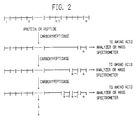
- the conventional method utilising carboxypeptidase has a number of disadvantages in that the substrate specificity and the activity of the carboxypeptidase vary according to the C-terminal amino acid or an adjacent amino acid; in that the reagent contains other contaminant enzymes which hinder a precise analysis, and in that an external amino acid is introduced by self-dissociation of the enzyme, thereby reducing the sensitivity of the amino acid analysis.
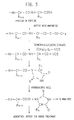
- the other conventional method utilising TMS-ITC has the disadvantage that the processing is complicated since three kinds of reagents are applied sequentially and that the repetitive yield rate is rather small, and this method is therefore not in common use.
- an object of the invention is to provide a simplified method of determining the amino acid sequence of a protein or peptide from a C-terminal without using an enzyme or other complicated organic compounds.
- a method of determining an amino acid sequence of a protein or a peptide wherein the protein or peptide is sequentially degraded from a C-terminal thereof to give a reaction mixture, and the reaction mixture is analysed to determine the amino acid sequence of the protein or the peptide from the C-terminal, characterised in that the protein or the peptide is treated with a vapour containing an organic acid represented by a general formula CF3 - (CF2) n - COOH, where n denotes zero or an integer, and optionally with a reducing agent, so as to produce the reaction mixture.
- the amino acid sequence can be determined from the C-terminal of the protein or peptide by a simplified treatment without utilising an enzyme or other complicated compounds, while avoiding the above-noted disadvantages.
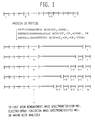
- Figure 1 is a process step chart showing a method according to the first aspect of the invention.
- Figure 2 is a process step chart showing a conventional analysis method utilising carboxypeptidase.
- Figure 3 is a process step chart showing another conventional analysis method utilising trimethylsilylisothiocyanate.
- Figure 4(A) shows an experimental system according to a first aspect of the invention, in which a reducing agent is added into an aqueous solution of an organic acid.
- Figure 4(B) shows another experimental system according to a first aspect of the invention, in which a reducing agent is charged into a small test tube while the sample of protein or peptide, to be analysed is held in a separate small test tube.
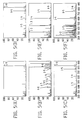
- Figures 5(A)-5(F) show various analysis results of reaction mixtures of a peptide analysed by FAB-MS, where a hexapeptide, sample No. 1, is treated with various vapours containing TFA (Figure 5(B)), PFPA (Figure 5(C)) and HFBA ( Figure 5(D)) for 4 hours, and where the hexapeptide is treated with PFPA ( Figure 5(E)) and HFBA ( Figure 5(F)) for 24 hours, and additionally, the hexapeptide is not treated with organic acid (Figure 5(A)).
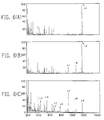
- Figures 6(A)-6(C) show various analysis results of reaction mixtures of another peptide analysed by FAB-MS, where a nonapeptide, Sample No. 2, is treated with vapours containing HFBA for 4 hours ( Figure 6(B)) and for 24 hours ( Figure 6(C)), and the nonapeptide is not treated with the organic acid ( Figure 6(A)).
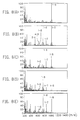
- Figures 7(A)-7(E) show various analysis results of the hexapeptide, sample No. 1, treated with PFPA at 90 o C for 4 hours while varying the concentration of PFPA in the range of 50% to 98%, where the concentration of PFPA is set to 50% ( Figure 7(B)), 70% ( Figure 7(C)), 90% ( Figure 7(D)) and 98% ( Figure 7(E)), and the hexapeptide is not treated with organic acid (Figure 7(A)).
- Figures 8(A)-8(E) show various analysis results of octapeptide, sample No. 3, treated with HFBA at 90 o C for 4 hours while varying the concentration of HFBA in the range of 50% to 98%, where the concentration of HFBA is set to 50% in Figure 8(B), 70% in Figure 8(C), 90% in Figure 8(D) and 98% in Figure 8(E), and the octapeptide is not treated with the organic acid in Figure 8(A).
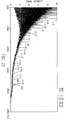
- Figure 9 shows a mass spectrogram indicating an analysis result in which ESI-MS is utilised to analyse a reaction mixture obtained by treating a tricosapeptide, sample No. 4, with PFPA for 2 hours.
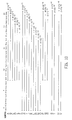
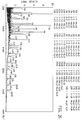
- Figure 10 is a diagram illustrating data of the Figure 9 analysis results.
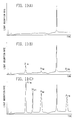
- Figures 11(A)-11(C) show analysis results in which an amino acid analyser is utilised to analyse reaction mixtures of the hexapeptide, sample No. 1, treated with a vapour containing PFPA for 4 hours ( Figure 11(B)) and 24 hours ( Figure 11(C)), and is not treated with the organic acid in the case of Figure 11(A).
- Figure 12 is a process step chart showing a method according to the second aspect of the invention.
- Figure 13 is a diagram showing an experimental system according to a second aspect of the invention.
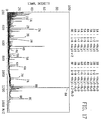
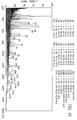
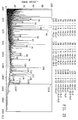
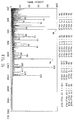
- Figure 14 is a diagram showing an analysis result of a sample peptide, sample No. 5, which is not treated with an acid anhydride.
- Figure 15 is a diagram showing an analysis result of a reaction mixture of sample No. 5, treated with the anhydride of PFPA.
- Figure 16 is a diagram showing an analysis result of a reaction mixture of sample No. 5, treated with the anhydride of HFBA.
- Figure 17 is a diagram showing an analysis result of a reaction mixture of sample No. 5, treated with the anhydride of TFA.
- Figure 18 is a diagram showing an analysis result of a sample peptide, sample No. 6, which is not treated with the anhydride of an acid.
- Figure 19 is a diagram showing an analysis result of a reaction mixture of sample No. 6, which is treated with an acid anhydride for two hours at -18 o C.
- Figure 20 is a diagram showing an analysis result of a reaction mixture of sample No. 6 which is treated with an acid anhydride for two hours at 0 o C.
- Figure 21 is a diagram showing an analysis result of a reaction mixture of sample No. 6 which is treated with an acid anhydride for two hours at - 18 o C and is then dried, and which is thereafter treated with water under a weak alkaline condition containing pyridine.
- Figure 22 is a diagram showing an analysis result of a peptide, sample No. 4, which is not treated with an acid anhydride.
- Figure 23 is a diagram showing an analysis result of a reaction mixture of sample No. 4 which is treated with an acid anhydride for ten minutes at -18 o C.
- Figure 24 is a diagram showing an analysis result of a reaction mixture of sample No. 4 which is treated with an acid anhydride for 30 minutes at -18 o C.
- Figure 25 is a diagram showing an analysis result of a reaction mixture of sample No. 4 which is treated with an acid anhydride for one hour at -18 o C.
- Figure 26 is a diagram showing an analysis result of a reaction mixture of sample No. 4 which is treated with an acid anhydride for 5 hours at -18 o C.
- FIG. 1 is a process step chart showing the first inventive analysis method.
- a protein or peptide is treated with trifluoroacetic acid (TFA), pentafluoropropionic acid (PFPA) or heptafluorobutyric acid (HFBA) to cause a successive degradation reaction from the C-terminal.
- TFA trifluoroacetic acid
- PFPA pentafluoropropionic acid
- HFBA heptafluorobutyric acid
- the resulting reaction mixture is analysed by a fast atom bombardment mass spectrometer (FAB-MS) or an electro-spray ionisation mass spectrometer (ESI-MS) to obtain a mass spectrum, or the reaction mixture is processed by an amino acid analyser.
- FAB-MS fast atom bombardment mass spectrometer
- ESI-MS electro-spray ionisation mass spectrometer
- the analysis procedure of the invention is as follows.
- a sample solution 1 containing a protein or a peptide is charged into a small test tube 2 and is then dried.
- This small test tube 2 is placed in an outer test tube 4 which contains an aqueous solution 3 of TFA, PFPA or HFBA.
- a reducing agent 5 is added in the aqueous solution ( Figure 4(A)).
- the reducing agent 5 may be placed in another separate small test tube, which is then placed together with the small test tube 2 containing the protein or peptide 1 in the outer test tube 4 containing the aqueous solution of the organic acid ( Figure 4(B)).
- the outer test tube is flame-sealed under a reduced gas pressure state.
- The, the double structure of the test tubes is heated. Thereafter, the sealed outer tube is opened and the inner tube is taken out and dried.
- the dried sample is dissolved into an aqueous solution of acetic acid, and a mixture of glycerol and thioglycerol is added. Thereafter, the sample is analysed by FAB-MS.
- the sample may be analysed by ESI-MS, after being dissolved into a methanol solution containing acetic acid, and then the sample is introduced into an ESI-MS device.
- an amino acid analyser may be utilised for the analysis, and in that case the sample is dissolved into a citric acid buffer solution of pH 2.2 and is then introduced into the analyser.
- the analyser used may be a model A-5500 produced by Iricakiki Co., Ltd., which performs amino acid analysis by the ninhydrin method with ion exchange chromatography.
- subsidiary peptides 4-6, 3-5 and 3-6 produced by non-specific cleavage reactions within the peptide chain, can also be detected.
- the peptides detained by this method are not limited to those obtained by a sequential cleavage reaction from the C-terminal.
- the peptides detected are mainly the whole peptide 1-6 and fragmental peptides 1-5, 1-4 and 1-3 which are produced by sequential cleavages of the peptide chain from the C-terminal. It is understood that the amino acid sequence can be determined from the C-terminal based on the detection results.
- Figures 5(E) and 5(F) show the results obtained when the sample is treated for 24 hours by PFPA and HFBA respectively.
- cleaved peptides produced by sequential degradation of the peptide chain from the C-terminal in a manner similar to the case where the sample is treated for 4 hours.
- fragmental peptide 1-2 which is not observed when the sample is treated for 4 hours.
- Figure 6(A) shows an analysis result of the sample peptide which is not treated with the organic acid.
- Figure 6(B) shows the result of an analysis when the sample is treated with 90% of HFBA for 4 hours at 90 o C.
- the peptides 1-9,1-8 and 1-7 are detected so that the sequence of the last two amino acid units from the C-terminal is determined or identified.
- Figure 6(C) peptides 1-9, 1-8, 1-7, 1-6, 1-5, 1-4 and 1-3 are detected, so that the sequence of the last six amino acid units is identified.
- FIG. 7(A) - 7(E) show the detection results obtained by FAB-MS analysis of a reaction mixture which is obtained by applying PFPA having variable concentration in the range of 50% to 90% to the sample for 4 hours at 90 o C.
- the sample is hexapeptide, sample No. 1, Leu-Trp-Met-Arg-Phe-Ala.
- Figure 7(A) shows an analysis result when the sample peptide is not treated with the organic acid.
- Figure 7(B) shows another analysis result where the sample is treated with 50% of PFPA.
- 7(C), 7(D) and 7(E) show different results when the concentration of acid is set to 70%, 90% and 98%, respectively.
- concentration of PFPA is set to 50%
- subsidiary peptide fragments 4-6, 3-5 and 3-6 produced by non-specific dissociation reactions within the peptide chain, which take place at the same time as the sequential cleavage from the C-terminal. It is understood that specific sequential cleavage from the C-terminal occurs most efficiently when the concentration of the organic acid is set to 90%.
- Figures 8(A) - 8(E) shows analysis results obtained when a sample is treated with HFBA for 4 hours at 90 o C while varying the concentration in the range of 50% to 98%.
- the sample is octapeptide, sample No. 3, His-Pro-Phe-His-Leu-Val-Tyr.
- Figure 8(A) shows an analysis result where the sample is not treated with the organic acid.
- Figure 8(B) shows another result where the sample is treated with HFBA having a concentration of 50%.
- Figures 8(C), 8(D) and 8(E) show different results where the concentration is set to 70%, 90% and 98% respectively.
- the concentration of HFBA is set to 50%, by-product peptides 4-8 and 3-6 are detected. These peptides are produced by non-specific dissociation reactions within the peptide chain, taking place at the same time as the sequential cleavage from the C-terminal, in a manner similar to the method in which the organic acid is PFPA.
- FIGS 9 and 10 show the analysis result, in which ESI-MS is used to analyse the reaction mixture obtained by applying PFPA in a concentration of 90% for 2 hours at 90 o C to tricosapeptide, sample No. 4, Gly-Ile-Gly-Lys-Phe-Leu-His-Ser-Ala-Gly-Lys-Phe-Gly-Lys-Ala-Phe-Val-Gly-Glu-Ile-Met-Lys-Ser.
- Figure 9 is a mass spectrogram
- Figure 10 is a diagram illustrating the data of the spectrogram.
- Each reference character in the spectrogram of Figure 9 corresponds to each reference character in Figure 10.
- a reference numeral (8-23)2+ in Figure10 denotes an ionised peptide 8-23 having double positive charges.
- ions having various charge units are detected.
- ions having triple charges are selectively detected to determine a sequence of the last eight amino acid units from the C-terminal through the ions (1-23)3+ to (1-15)3+.
- an amino acid analyser is utilised to analyse a reaction mixture.
- Figures 11(B) and 11(C) show analysis results when the amino acid analyser is utilised to analyse reaction mixtures which are obtained by applying a vapour containing PFPA for 4 hours and 24 hours, respectively, to hexapeptide, sample No. 1, Leu-Trp-Met-Arg-Phe-Ala, in a manner similar to the method of Example 2.
- the remaining reaction conditions are similar to those in Example 2, such that the heating temperature is set to 90 o C, and the concentration of the organic acid is set to 90%.
- Figure 11(A) shows an analysis result where the sample is not treated with organic acid.
- Examples 1-6 are summarised as follows.
- the dried peptide is treated with a vapour which is produced by vapourising an aqueous solution containing 50 to 98% of the organic acid represented by the general formula CF3 - (CF2) n - COOH (n is zero or an integer) and optionally with a reducing agent.
- the resulting reaction mixture is processed by FAB-MS or ESI-MS to obtain a mass spectrum indicative of the whole peptide of the sample and fragmented peptides produced by sequential degradation reactions of amino acids from the C-terminal of the sample peptide.
- the spectrum is analysed to determine the amino acid sequence of the sample peptide from the C-terminal.
- the reaction mixture is processed by an amino acid analyser to obtain peak data, which is analysed to determine the amino acid sequence of the sample peptide from the C-terminal.
- FIG. 12 is a process step chart showing the second inventive analysis method.
- a protein or peptide is treated with an anhydride of trifluoroacetic acid (TFA), pentafluoropropionic acid (PFPA) or heptafluorobutyric acid (HFBA) to cause successive degradation reactions from the C-terminal.
- TFA trifluoroacetic acid
- PFPA pentafluoropropionic acid
- HFBA heptafluorobutyric acid
- the analysis procedure according to this aspect of the invention is as follows. Namely, a sample solution 11 containing a protein or a peptide is charged into a small test tube 12, and is then dried. This small test tube is placed in an outer large test tube 14 which contains an acetonitrile solution 13 of an anhydride of TFA, PFPA or HFBA. In this example, the concentration of the anhydride is set at 10%. In this arrangement, the sample solution 11 is not contacted with the anhydride solution 13 of the organic acid. Then, the outer test tube 14 is sealed under vacuum at a temperature of -30 o C. This tube is stored at -18 o C, as shown in Figure13. Thereafter, the sealed tube is opened and the contents are dried in vacuo.
- the dried sample is treated with a vapour of water containing pyridine under a weak alkaline condition. Thereafter, the treated sample is dissolved in dimethyl formamide and is mixed with glycerol, for analysis by FAB-MS. In this process, the aqueous processing treatment is optional.
- this example is designed such that an experiment is undertaken while selecting, as a sample peptide, an octapeptide, sample No. 5, Lys-Lys-Lys-his-Pro-Asp-Tyr-Ile.
- a fragmental peptide Lys-Lys-Lys-His is denoted by peptide 1-4.
- Figures 15, 16 and 17 show analysis results obtained by using FAB-MS to analyse reaction mixtures produced by applying anhydrides of TFA, PFPA and HFBA, respectively.
- the concentration of the applied organic acid anydrides is set at 10%, and the respective anhydrides are applied for 2 hours at -18 o C.
- Figure 14 shows an analysis result of, sample No. 5, which is not treated with an anhydride of the organic acid, for the purpose of comparison.
- Figure 15 shows that the sequence analysis can be achieved from the C-terminal when the anhydride of TFA is applied.
- Degraded peptides 1-8, 1-7, 1-6, 1-5, 1-4, 1-3 and 1-2 are detected, enabling the sequence of the last six amino acid units from the C-terminal to be determined.
- the respective peptide is coupled with TFA and therefore is acylated.
- an acylated peptide 1-8 is denoted by 1-8+Acyl. Further peaks are observed which correspond to products of degraded peptides from which one molecule of water is lost as indicated by "-H2O".
- peptides 1-8, 1-7, 1-6, 1-5, 1-4, 1-3 and 1-2 coupled to PFPA and the amino acid unit of the terminal (hereinafter, referred to as "1 + Acyl") can be detected, thereby determining the complete amino acid sequence from the C-terminal.
- peptide 1-8 coupled with two molecules of PFPA (referred to as "1-8+diAcyl”), can be observed together with various degraded peptides which have lost one molecule of water.
- Figure 17 results show that the sequence analysis can be affected from the C-terminal by applying the anhydride of HFBA.
- Peptides 1-8, 1-7, 1-6, 1-5, 1-4, 1-3, 1-2 and the amino acid unit of the terminal can be detected.
- the peptides are coupled with HFBA.
- the complete amino acid sequence from the C-terminal can thus be determined.
- Peptide 1-8, coupled with two molecules of HFBA can also be observed. Further, there are detected products of cleaved peptides which have lost one molecule of water.
- Subsidiary peptides produced by cleavage of a peptide bond within the peptide chain, are not found in the reaction mixture when this method is used. Therefore, determination of the amino acid sequence may be made by analysis of the peak data.
- a protein or a peptide is treated with an anhydride of the specific organic acids represented by the general formula CF3 - (CF2) n - COOH (n is zero or an integer).
- the reaction products are processed by a mass spectrometer to obtain a mass spectrum. By measuring a mass of the respective products, the amino acid sequence can be determined from the carboxy-terminal of the protein or peptide.
- peptides 1-12, 1-11, 1-10, 1-9, 1-8, 1-7, 1-6, 1-5, 1-4, 1-3 and 1-2 coupled with PFPA are detected under the respective reaction conditions. It is understood that the sequence of the last ten amino acid units can be determined from the C-terminal under these conditions. At the same time, peptide 1-12, coupled with two molecules of PFPA, is detected.
- the peptide 1-11, coupled with two molecules of PFPA is detected when the anhydride of PFPA is applied for two hours at 0 o C. Moreover in this case, there are detected more peaks which cannot be identified. It is understood from these results that a number of signals associated with by-products can be reduced while a relative signal intensity related to the objective reaction products can be increased, when the sample is treated at a lower temperature.
- Figures 23 to 26 show analysis results in order to examine the effect of the reaction time interval during which the anhydride of the organic acid is applied, in the determination of the amino acid sequence.
- This example utilises a sample peptide, sample No. 4, composed of 23 amino acids, which is treated with the anhydride of PFPA at -18 o C for 10 minutes (Figure 23), 30 minutes (Figure 24), one hour (Figure 25) and 5 hours (Figure 26).
- Figure 22 shows the analysis result when sample No. 4 is not treated with the anhydride of the organic acid, for the purpose of comparison.
- Figure 21 shows the analysis result obtained when water containing pyridine is applied under a weak alkaline condition to a reaction mixture which is obtained by applying the anhydride of PFPA to a dodecapeptide for two hours at - 18 o C and then by drying the reaction product.
- the detection intensity is lowered for sequential peptides 1-12, 1-11, 1-10, 1-9, 1-8, 1-7, 1-6, 1-5, 1-4, 1-3 and 1-2, those of which are coupled with PFPA and those of which have lost one molecule of water.
- this treatment can facilitate analysis of the amino acid sequence.
- Examples 7-11 are summarised as follows:
- the dried peptide is treated with an anhydride of the organic acid represented by the general formula CF3 - (CF2) n - COOH (n is zero or an integer).
- the resulting reaction mixture is processed by FAB-MS to obtain a mass spectrum indicative of the whole peptide of the sample and a series of fragmented peptides produced by a sequential degradation reaction of the amino acids from the C-terminal of the sample peptide.
- the spectrum is analysed to determine the amino acid sequence of the sample peptide from the C-terminal.
- the anhydride of the organic acid is applied efficiently for less than 5 hours.
- the reaction temperature is set at below 0 o C so as to suppress progression of subsidiary reactions.
- the reaction product is preferably treated with water so as to suppress dehydration peaks to thereby facilitate the analysis. Further, in this method, peak data analysis is facilitated for determination of amino acid sequence since no by-product peptides are detected which would be produced by cleavage of a peptide bond within the peptide chain.
- anhydride of the specific organic acid represented by the general formula CF3- (CF2) n - COOH n is zero or an integer
- the amino acid sequence can be determined from the C-terminal of the protein or peptide by simplified processing without using an enzyme or other complicated compounds.
Landscapes
- Life Sciences & Earth Sciences (AREA)
- Chemical & Material Sciences (AREA)
- Health & Medical Sciences (AREA)
- Molecular Biology (AREA)
- Engineering & Computer Science (AREA)
- Medicinal Chemistry (AREA)
- General Health & Medical Sciences (AREA)
- Urology & Nephrology (AREA)
- Hematology (AREA)
- Biophysics (AREA)
- Proteomics, Peptides & Aminoacids (AREA)
- Organic Chemistry (AREA)
- Physics & Mathematics (AREA)
- Biochemistry (AREA)
- Analytical Chemistry (AREA)
- Immunology (AREA)
- Biomedical Technology (AREA)
- Bioinformatics & Cheminformatics (AREA)
- Cell Biology (AREA)
- Biotechnology (AREA)
- Bioinformatics & Computational Biology (AREA)
- Microbiology (AREA)
- Genetics & Genomics (AREA)
- Food Science & Technology (AREA)
- General Physics & Mathematics (AREA)
- Pathology (AREA)
- Other Investigation Or Analysis Of Materials By Electrical Means (AREA)
- Investigating Or Analysing Biological Materials (AREA)
- Peptides Or Proteins (AREA)
Applications Claiming Priority (4)
| Application Number | Priority Date | Filing Date | Title |
|---|---|---|---|
| JP3217437A JP2686505B2 (ja) | 1991-08-28 | 1991-08-28 | タンパク質あるいはペプチドのカルボキシ末端からのアミノ酸配列を決定する方法 |
| JP217437/91 | 1991-08-28 | ||
| JP300818/91 | 1991-11-15 | ||
| JP3300818A JP2686506B2 (ja) | 1991-11-15 | 1991-11-15 | タンパク質あるいはペプチドのカルボキシ末端からのアミノ酸配列を決定する方法 |
Publications (2)
| Publication Number | Publication Date |
|---|---|
| EP0529604A1 true EP0529604A1 (fr) | 1993-03-03 |
| EP0529604B1 EP0529604B1 (fr) | 1996-10-16 |
Family
ID=26522024
Family Applications (1)
| Application Number | Title | Priority Date | Filing Date |
|---|---|---|---|
| EP92114531A Expired - Lifetime EP0529604B1 (fr) | 1991-08-28 | 1992-08-26 | Procédé pour analyser une protéine ou un peptide |
Country Status (3)
| Country | Link |
|---|---|
| US (1) | US5521097A (fr) |
| EP (1) | EP0529604B1 (fr) |
| DE (1) | DE69214571T2 (fr) |
Cited By (6)
| Publication number | Priority date | Publication date | Assignee | Title |
|---|---|---|---|---|
| WO1996007916A1 (fr) * | 1994-09-08 | 1996-03-14 | The Perkin-Elmer Corporation | Activation par anhydride acetique destinee au sequençage c-terminal d'une proteine |
| US5792664A (en) * | 1992-05-29 | 1998-08-11 | The Rockefeller University | Methods for producing and analyzing biopolymer ladders |
| EP0842429A4 (fr) * | 1994-05-10 | 2000-05-03 | Univ California | Procede de caracterisation de la structure fine de sites de liaison de proteines |
| US6271037B1 (en) | 1992-05-29 | 2001-08-07 | The Rockefeller University | Method and product for the sequence determination of peptides using a mass spectrometer |
| US6291189B1 (en) | 1994-05-10 | 2001-09-18 | Carta Proteomics, Inc. | Methods for the high-resolution identification of solvent-accessible amide hydrogens in polypeptides or proteins and for characterization of the fine structure of protein binding sites |
| US6599707B1 (en) | 1998-09-11 | 2003-07-29 | Exsar Corporation | Methods for identifying hot-spot residues of binding proteins and small compounds that bind to the same |
Families Citing this family (11)
| Publication number | Priority date | Publication date | Assignee | Title |
|---|---|---|---|---|
| AUPN896396A0 (en) * | 1996-03-27 | 1996-04-26 | Garvan Institute Of Medical Research | Method for preparing amino acid thiohydantoins |
| JP3124507B2 (ja) * | 1996-05-24 | 2001-01-15 | セイコーインスツルメンツ株式会社 | タンパク質あるいはペプチドのカルボキシ末端からのアミノ酸配列を決定する方法 |
| GB9710582D0 (en) | 1997-05-22 | 1997-07-16 | Oxford Glycosciences Uk Ltd | A method for de novo peptide sequence determination |
| US5824556A (en) * | 1997-06-11 | 1998-10-20 | Tarr; George E. | Peptide mass ladders generated using carbon disulfide |
| US6963807B2 (en) | 2000-09-08 | 2005-11-08 | Oxford Glycosciences (Uk) Ltd. | Automated identification of peptides |
| JP2002267674A (ja) * | 2001-03-14 | 2002-09-18 | Nec Corp | 蛋白質あるいはペプチドの分析方法 |
| US6800449B1 (en) | 2001-07-13 | 2004-10-05 | Syngenta Participations Ag | High throughput functional proteomics |
| JP4102581B2 (ja) * | 2002-03-25 | 2008-06-18 | 日本電気株式会社 | ペプチドのc末端アミノ酸配列解析方法 |
| JP4257492B2 (ja) * | 2002-11-29 | 2009-04-22 | 日本電気株式会社 | ペプチドのc末端アミノ酸配列解析方法 |
| WO2009069727A1 (fr) * | 2007-11-28 | 2009-06-04 | Fujifilm Corporation | Procédé de modification chimique d'un biopolymère ou d'un polypeptide |
| US20150099860A1 (en) * | 2013-10-08 | 2015-04-09 | Proteins Easy Corp | Methods for separating and purifying endogenous, exogenous and recombinant proteins/peptides from plants and animals using aqueous-free, anhydrous strategies |
Citations (2)
| Publication number | Priority date | Publication date | Assignee | Title |
|---|---|---|---|---|
| EP0257735A2 (fr) * | 1986-06-06 | 1988-03-02 | Genentech, Inc. | Dispositif et méthode de détermination de la séquence des acides aminés |
| WO1989008835A1 (fr) * | 1988-03-10 | 1989-09-21 | Bio-Affinity Systems, Inc. | Mise en sequence de peptide de thioacylation par acylation de thiazolines |
Family Cites Families (4)
| Publication number | Priority date | Publication date | Assignee | Title |
|---|---|---|---|---|
| GB2168478A (en) * | 1984-11-26 | 1986-06-18 | Scan Limited M | Analysis of protein etc using mass spectrometry |
| US4820648A (en) * | 1985-08-21 | 1989-04-11 | Spectros Limited | Methods for use in the mass analysis of chemical samples |
| JPH0669399B2 (ja) * | 1988-03-15 | 1994-09-07 | 三菱化成株式会社 | カルボキシル末端ペプチドの分取方法 |
| US5185266A (en) * | 1991-10-15 | 1993-02-09 | Applied Biosystems, Inc. | Cleavage method for acyl thiohydantoins and use of the method in c-terminal peptide sequencing |
-
1992
- 1992-08-18 US US07/931,931 patent/US5521097A/en not_active Expired - Lifetime
- 1992-08-26 DE DE69214571T patent/DE69214571T2/de not_active Expired - Lifetime
- 1992-08-26 EP EP92114531A patent/EP0529604B1/fr not_active Expired - Lifetime
Patent Citations (2)
| Publication number | Priority date | Publication date | Assignee | Title |
|---|---|---|---|---|
| EP0257735A2 (fr) * | 1986-06-06 | 1988-03-02 | Genentech, Inc. | Dispositif et méthode de détermination de la séquence des acides aminés |
| WO1989008835A1 (fr) * | 1988-03-10 | 1989-09-21 | Bio-Affinity Systems, Inc. | Mise en sequence de peptide de thioacylation par acylation de thiazolines |
Non-Patent Citations (3)
| Title |
|---|
| ANALYTICAL BIOCHEMISTRY vol. 166, no. 2, 1 November 1987, pages 298 - 307 DAVID H. HAWKE ET AL. 'MICROSEQUENCE ANALYSIS OF PEPTIDES AND PROTEINS: TRIMETHYLSILYLISOTHIOCYANATE AS REAGENT FOR COOH-TERMINAL SEQUENCE ANALYSIS.' * |
| CHEMICAL ABSTRACTS, vol. 70, no. 1, 6 January 1969, Columbus, Ohio, US; abstract no. 803j, N. M. ORLOVSKA ET AL. 'USE OF TRIFLUOROACETIC ACID AND ITS ANHYDRIDE FOR STUDYING THE N-TERMINAL SEQUENCE OF AMINO ACIDS IN PROTEINS' page 68 ; * |
| CHEMISTRY LETTERS vol. 2, 1992, JAPAN pages 235 - 238 A.TSUGITA ET AL. 'REACTION OF PENTAFLUOROPROPIONIC ANHYDRIDE VAPOR ON POLYPEPTIDE AS REVEALED BY MASS SPECTROMETRY. A CARBOXYPEPTIDASE MIMETIC DEGRADATION.' * |
Cited By (10)
| Publication number | Priority date | Publication date | Assignee | Title |
|---|---|---|---|---|
| US5792664A (en) * | 1992-05-29 | 1998-08-11 | The Rockefeller University | Methods for producing and analyzing biopolymer ladders |
| US6271037B1 (en) | 1992-05-29 | 2001-08-07 | The Rockefeller University | Method and product for the sequence determination of peptides using a mass spectrometer |
| US6750061B2 (en) | 1992-05-29 | 2004-06-15 | The Rockefeller University | Method and product for the sequence determination of peptides using a mass spectrometer |
| US7341874B2 (en) | 1992-05-29 | 2008-03-11 | The Rockefeller University | Method for detecting post-translation modifications of peptides |
| EP0842429A4 (fr) * | 1994-05-10 | 2000-05-03 | Univ California | Procede de caracterisation de la structure fine de sites de liaison de proteines |
| US6291189B1 (en) | 1994-05-10 | 2001-09-18 | Carta Proteomics, Inc. | Methods for the high-resolution identification of solvent-accessible amide hydrogens in polypeptides or proteins and for characterization of the fine structure of protein binding sites |
| US6331400B1 (en) | 1994-05-10 | 2001-12-18 | Carta Proteomics, Inc. | Method for characterization of the fine structure of protein binding sites |
| US6797482B2 (en) | 1994-05-10 | 2004-09-28 | Exsar Corporation | Methods for the high-resolution identification of solvent-accessible amide hydrogens in protein binding sites |
| WO1996007916A1 (fr) * | 1994-09-08 | 1996-03-14 | The Perkin-Elmer Corporation | Activation par anhydride acetique destinee au sequençage c-terminal d'une proteine |
| US6599707B1 (en) | 1998-09-11 | 2003-07-29 | Exsar Corporation | Methods for identifying hot-spot residues of binding proteins and small compounds that bind to the same |
Also Published As
| Publication number | Publication date |
|---|---|
| DE69214571T2 (de) | 1997-02-27 |
| US5521097A (en) | 1996-05-28 |
| DE69214571D1 (de) | 1996-11-21 |
| EP0529604B1 (fr) | 1996-10-16 |
Similar Documents
| Publication | Publication Date | Title |
|---|---|---|
| EP0529604B1 (fr) | Procédé pour analyser une protéine ou un peptide | |
| Keough et al. | Peer Reviewed: Sulfonic Acid Derivatives for Peptide Sequencing by MALDI MS. | |
| US8927292B2 (en) | Methods of evaluating peptide mixtures | |
| Borchers et al. | Preliminary comparison of precursor scans and liquid chromatography–tandem mass spectrometry on a hybrid quadrupole time-of-flight mass spectrometer | |
| US20100044560A1 (en) | Method and Apparatus for Pyrolysis-Induced Cleavage in Peptides and Proteins | |
| Hendricker et al. | Amino acid and oligopeptide analysis using Curie-point pyrolysis mass spectrometry with in-situ thermal hydrolysis and methylation: mechanistic considerations | |
| Gray et al. | Application of mass spectrometry to protein chemistry II. Chemical ionization studies on acetylated permethylated peptides | |
| Caprioli et al. | Peptide sequence analysis using exopeptidases with molecular analysis of the truncated polypeptides by mass spectrometry | |
| JP2686506B2 (ja) | タンパク質あるいはペプチドのカルボキシ末端からのアミノ酸配列を決定する方法 | |
| Craig | The characterization of conotoxins § | |
| DASS et al. | Characterization of β‐endorphin in human pituitary by fast atom bombardment mass spectrometry of trypsin‐generated fragments | |
| Kulik et al. | A novel fragmentation process in the fast‐atom bombardment/tandem mass spectra of peptides cationized with Na+, determining the identity of the C‐terminal amino acid | |
| Mudgett et al. | Peptide sequencing: the utility of chemical ionization mass spectrometry | |
| Hong et al. | Simultaneous analysis of C‐terminal amino acid residues of peptide mixtures by combination of field desorption mass spectrometry and carboxypeptidase digestion | |
| JP2686505B2 (ja) | タンパク質あるいはペプチドのカルボキシ末端からのアミノ酸配列を決定する方法 | |
| De Angelis et al. | Peptide sequencing by using a combination of partial acid hydrolysis and fast-atom-bombardment mass spectrometry | |
| JP3175859B2 (ja) | タンパク質あるいはペプチドのカルボキシ末端からのアミノ酸配列を決定する方法 | |
| GB2300260A (en) | Determination of ligand binding affinity | |
| US5962642A (en) | Method for sequencing of protein or peptide | |
| Mathews et al. | Characterization of impurities in a synthetic renin substrate peptide by fast‐atom bombardment mass spectrometry and hybrid tandem mass spectrometry | |
| Merritt | Mass Spectrometry:| | |
| EP0609450B1 (fr) | Procede concernant la detection a haute sensibilite d'un derive d'acide amine | |
| Krutzsch | Protein/peptide sequence analysis by mass spectrometry | |
| Wang et al. | Protein ladder sequencing: towards automation | |
| Zaretskii et al. | Energy and metastable characteristics in peptides. 1‐Metastable/daughter ion ratios as an aid in peptide sequencing |
Legal Events
| Date | Code | Title | Description |
|---|---|---|---|
| PUAI | Public reference made under article 153(3) epc to a published international application that has entered the european phase |
Free format text: ORIGINAL CODE: 0009012 |
|
| AK | Designated contracting states |
Kind code of ref document: A1 Designated state(s): CH DE FR GB LI |
|
| 17P | Request for examination filed |
Effective date: 19930809 |
|
| GRAG | Despatch of communication of intention to grant |
Free format text: ORIGINAL CODE: EPIDOS AGRA |
|
| 17Q | First examination report despatched |
Effective date: 19951218 |
|
| GRAH | Despatch of communication of intention to grant a patent |
Free format text: ORIGINAL CODE: EPIDOS IGRA |
|
| GRAH | Despatch of communication of intention to grant a patent |
Free format text: ORIGINAL CODE: EPIDOS IGRA |
|
| GRAA | (expected) grant |
Free format text: ORIGINAL CODE: 0009210 |
|
| AK | Designated contracting states |
Kind code of ref document: B1 Designated state(s): CH DE FR GB LI |
|
| REG | Reference to a national code |
Ref country code: CH Ref legal event code: NV Representative=s name: PATENTANWAELTE SCHAAD, BALASS, MENZL & PARTNER AG |
|
| REF | Corresponds to: |
Ref document number: 69214571 Country of ref document: DE Date of ref document: 19961121 |
|
| ET | Fr: translation filed | ||
| PLBE | No opposition filed within time limit |
Free format text: ORIGINAL CODE: 0009261 |
|
| 26N | No opposition filed | ||
| REG | Reference to a national code |
Ref country code: GB Ref legal event code: IF02 |
|
| PGFP | Annual fee paid to national office [announced via postgrant information from national office to epo] |
Ref country code: FR Payment date: 20090814 Year of fee payment: 18 |
|
| PGFP | Annual fee paid to national office [announced via postgrant information from national office to epo] |
Ref country code: CH Payment date: 20090814 Year of fee payment: 18 Ref country code: GB Payment date: 20090826 Year of fee payment: 18 Ref country code: DE Payment date: 20090821 Year of fee payment: 18 |
|
| REG | Reference to a national code |
Ref country code: CH Ref legal event code: PL |
|
| GBPC | Gb: european patent ceased through non-payment of renewal fee |
Effective date: 20100826 |
|
| PG25 | Lapsed in a contracting state [announced via postgrant information from national office to epo] |
Ref country code: LI Free format text: LAPSE BECAUSE OF NON-PAYMENT OF DUE FEES Effective date: 20100831 Ref country code: CH Free format text: LAPSE BECAUSE OF NON-PAYMENT OF DUE FEES Effective date: 20100831 |
|
| REG | Reference to a national code |
Ref country code: FR Ref legal event code: ST Effective date: 20110502 |
|
| REG | Reference to a national code |
Ref country code: DE Ref legal event code: R119 Ref document number: 69214571 Country of ref document: DE Effective date: 20110301 |
|
| PG25 | Lapsed in a contracting state [announced via postgrant information from national office to epo] |
Ref country code: DE Free format text: LAPSE BECAUSE OF NON-PAYMENT OF DUE FEES Effective date: 20110301 Ref country code: FR Free format text: LAPSE BECAUSE OF NON-PAYMENT OF DUE FEES Effective date: 20100831 |
|
| PG25 | Lapsed in a contracting state [announced via postgrant information from national office to epo] |
Ref country code: GB Free format text: LAPSE BECAUSE OF NON-PAYMENT OF DUE FEES Effective date: 20100826 |