EP0530741B1 - Kohlefasern, Kohleverbund, verstärkt mit Kohle und Verfahren zur Herstellung - Google Patents
Kohlefasern, Kohleverbund, verstärkt mit Kohle und Verfahren zur Herstellung Download PDFInfo
- Publication number
- EP0530741B1 EP0530741B1 EP92114898A EP92114898A EP0530741B1 EP 0530741 B1 EP0530741 B1 EP 0530741B1 EP 92114898 A EP92114898 A EP 92114898A EP 92114898 A EP92114898 A EP 92114898A EP 0530741 B1 EP0530741 B1 EP 0530741B1
- Authority
- EP
- European Patent Office
- Prior art keywords
- web
- fibers
- carbon
- needlepunching
- layers
- Prior art date
- Legal status (The legal status is an assumption and is not a legal conclusion. Google has not performed a legal analysis and makes no representation as to the accuracy of the status listed.)
- Expired - Lifetime
Links
Images


Classifications
-
- F—MECHANICAL ENGINEERING; LIGHTING; HEATING; WEAPONS; BLASTING
- F16—ENGINEERING ELEMENTS AND UNITS; GENERAL MEASURES FOR PRODUCING AND MAINTAINING EFFECTIVE FUNCTIONING OF MACHINES OR INSTALLATIONS; THERMAL INSULATION IN GENERAL
- F16D—COUPLINGS FOR TRANSMITTING ROTATION; CLUTCHES; BRAKES
- F16D69/00—Friction linings; Attachment thereof; Selection of coacting friction substances or surfaces
- F16D69/02—Composition of linings ; Methods of manufacturing
- F16D69/023—Composite materials containing carbon and carbon fibres or fibres made of carbonizable material
-
- C—CHEMISTRY; METALLURGY
- C04—CEMENTS; CONCRETE; ARTIFICIAL STONE; CERAMICS; REFRACTORIES
- C04B—LIME, MAGNESIA; SLAG; CEMENTS; COMPOSITIONS THEREOF, e.g. MORTARS, CONCRETE OR LIKE BUILDING MATERIALS; ARTIFICIAL STONE; CERAMICS; REFRACTORIES; TREATMENT OF NATURAL STONE
- C04B35/00—Shaped ceramic products characterised by their composition; Ceramics compositions; Processing powders of inorganic compounds preparatory to the manufacturing of ceramic products
- C04B35/71—Ceramic products containing macroscopic reinforcing agents
- C04B35/78—Ceramic products containing macroscopic reinforcing agents containing non-metallic materials
- C04B35/80—Fibres, filaments, whiskers, platelets, or the like
- C04B35/83—Carbon fibres in a carbon matrix
-
- D—TEXTILES; PAPER
- D04—BRAIDING; LACE-MAKING; KNITTING; TRIMMINGS; NON-WOVEN FABRICS
- D04H—MAKING TEXTILE FABRICS, e.g. FROM FIBRES OR FILAMENTARY MATERIAL; FABRICS MADE BY SUCH PROCESSES OR APPARATUS, e.g. FELTS, NON-WOVEN FABRICS; COTTON-WOOL; WADDING ; NON-WOVEN FABRICS FROM STAPLE FIBRES, FILAMENTS OR YARNS, BONDED WITH AT LEAST ONE WEB-LIKE MATERIAL DURING THEIR CONSOLIDATION
- D04H1/00—Non-woven fabrics formed wholly or mainly of staple fibres or like relatively short fibres
- D04H1/40—Non-woven fabrics formed wholly or mainly of staple fibres or like relatively short fibres from fleeces or layers composed of fibres without existing or potential cohesive properties
- D04H1/42—Non-woven fabrics formed wholly or mainly of staple fibres or like relatively short fibres from fleeces or layers composed of fibres without existing or potential cohesive properties characterised by the use of certain kinds of fibres insofar as this use has no preponderant influence on the consolidation of the fleece
- D04H1/4209—Inorganic fibres
-
- D—TEXTILES; PAPER
- D04—BRAIDING; LACE-MAKING; KNITTING; TRIMMINGS; NON-WOVEN FABRICS
- D04H—MAKING TEXTILE FABRICS, e.g. FROM FIBRES OR FILAMENTARY MATERIAL; FABRICS MADE BY SUCH PROCESSES OR APPARATUS, e.g. FELTS, NON-WOVEN FABRICS; COTTON-WOOL; WADDING ; NON-WOVEN FABRICS FROM STAPLE FIBRES, FILAMENTS OR YARNS, BONDED WITH AT LEAST ONE WEB-LIKE MATERIAL DURING THEIR CONSOLIDATION
- D04H1/00—Non-woven fabrics formed wholly or mainly of staple fibres or like relatively short fibres
- D04H1/40—Non-woven fabrics formed wholly or mainly of staple fibres or like relatively short fibres from fleeces or layers composed of fibres without existing or potential cohesive properties
- D04H1/42—Non-woven fabrics formed wholly or mainly of staple fibres or like relatively short fibres from fleeces or layers composed of fibres without existing or potential cohesive properties characterised by the use of certain kinds of fibres insofar as this use has no preponderant influence on the consolidation of the fleece
- D04H1/4209—Inorganic fibres
- D04H1/4242—Carbon fibres
-
- D—TEXTILES; PAPER
- D04—BRAIDING; LACE-MAKING; KNITTING; TRIMMINGS; NON-WOVEN FABRICS
- D04H—MAKING TEXTILE FABRICS, e.g. FROM FIBRES OR FILAMENTARY MATERIAL; FABRICS MADE BY SUCH PROCESSES OR APPARATUS, e.g. FELTS, NON-WOVEN FABRICS; COTTON-WOOL; WADDING ; NON-WOVEN FABRICS FROM STAPLE FIBRES, FILAMENTS OR YARNS, BONDED WITH AT LEAST ONE WEB-LIKE MATERIAL DURING THEIR CONSOLIDATION
- D04H1/00—Non-woven fabrics formed wholly or mainly of staple fibres or like relatively short fibres
- D04H1/40—Non-woven fabrics formed wholly or mainly of staple fibres or like relatively short fibres from fleeces or layers composed of fibres without existing or potential cohesive properties
- D04H1/42—Non-woven fabrics formed wholly or mainly of staple fibres or like relatively short fibres from fleeces or layers composed of fibres without existing or potential cohesive properties characterised by the use of certain kinds of fibres insofar as this use has no preponderant influence on the consolidation of the fleece
- D04H1/4274—Rags; Fabric scraps
-
- D—TEXTILES; PAPER
- D04—BRAIDING; LACE-MAKING; KNITTING; TRIMMINGS; NON-WOVEN FABRICS
- D04H—MAKING TEXTILE FABRICS, e.g. FROM FIBRES OR FILAMENTARY MATERIAL; FABRICS MADE BY SUCH PROCESSES OR APPARATUS, e.g. FELTS, NON-WOVEN FABRICS; COTTON-WOOL; WADDING ; NON-WOVEN FABRICS FROM STAPLE FIBRES, FILAMENTS OR YARNS, BONDED WITH AT LEAST ONE WEB-LIKE MATERIAL DURING THEIR CONSOLIDATION
- D04H1/00—Non-woven fabrics formed wholly or mainly of staple fibres or like relatively short fibres
- D04H1/40—Non-woven fabrics formed wholly or mainly of staple fibres or like relatively short fibres from fleeces or layers composed of fibres without existing or potential cohesive properties
- D04H1/42—Non-woven fabrics formed wholly or mainly of staple fibres or like relatively short fibres from fleeces or layers composed of fibres without existing or potential cohesive properties characterised by the use of certain kinds of fibres insofar as this use has no preponderant influence on the consolidation of the fleece
- D04H1/4282—Addition polymers
- D04H1/43—Acrylonitrile series
-
- D—TEXTILES; PAPER
- D04—BRAIDING; LACE-MAKING; KNITTING; TRIMMINGS; NON-WOVEN FABRICS
- D04H—MAKING TEXTILE FABRICS, e.g. FROM FIBRES OR FILAMENTARY MATERIAL; FABRICS MADE BY SUCH PROCESSES OR APPARATUS, e.g. FELTS, NON-WOVEN FABRICS; COTTON-WOOL; WADDING ; NON-WOVEN FABRICS FROM STAPLE FIBRES, FILAMENTS OR YARNS, BONDED WITH AT LEAST ONE WEB-LIKE MATERIAL DURING THEIR CONSOLIDATION
- D04H1/00—Non-woven fabrics formed wholly or mainly of staple fibres or like relatively short fibres
- D04H1/40—Non-woven fabrics formed wholly or mainly of staple fibres or like relatively short fibres from fleeces or layers composed of fibres without existing or potential cohesive properties
- D04H1/42—Non-woven fabrics formed wholly or mainly of staple fibres or like relatively short fibres from fleeces or layers composed of fibres without existing or potential cohesive properties characterised by the use of certain kinds of fibres insofar as this use has no preponderant influence on the consolidation of the fleece
- D04H1/4374—Non-woven fabrics formed wholly or mainly of staple fibres or like relatively short fibres from fleeces or layers composed of fibres without existing or potential cohesive properties characterised by the use of certain kinds of fibres insofar as this use has no preponderant influence on the consolidation of the fleece using different kinds of webs, e.g. by layering webs
-
- D—TEXTILES; PAPER
- D04—BRAIDING; LACE-MAKING; KNITTING; TRIMMINGS; NON-WOVEN FABRICS
- D04H—MAKING TEXTILE FABRICS, e.g. FROM FIBRES OR FILAMENTARY MATERIAL; FABRICS MADE BY SUCH PROCESSES OR APPARATUS, e.g. FELTS, NON-WOVEN FABRICS; COTTON-WOOL; WADDING ; NON-WOVEN FABRICS FROM STAPLE FIBRES, FILAMENTS OR YARNS, BONDED WITH AT LEAST ONE WEB-LIKE MATERIAL DURING THEIR CONSOLIDATION
- D04H1/00—Non-woven fabrics formed wholly or mainly of staple fibres or like relatively short fibres
- D04H1/40—Non-woven fabrics formed wholly or mainly of staple fibres or like relatively short fibres from fleeces or layers composed of fibres without existing or potential cohesive properties
- D04H1/44—Non-woven fabrics formed wholly or mainly of staple fibres or like relatively short fibres from fleeces or layers composed of fibres without existing or potential cohesive properties the fleeces or layers being consolidated by mechanical means, e.g. by rolling
- D04H1/46—Non-woven fabrics formed wholly or mainly of staple fibres or like relatively short fibres from fleeces or layers composed of fibres without existing or potential cohesive properties the fleeces or layers being consolidated by mechanical means, e.g. by rolling by needling or like operations to cause entanglement of fibres
-
- D—TEXTILES; PAPER
- D04—BRAIDING; LACE-MAKING; KNITTING; TRIMMINGS; NON-WOVEN FABRICS
- D04H—MAKING TEXTILE FABRICS, e.g. FROM FIBRES OR FILAMENTARY MATERIAL; FABRICS MADE BY SUCH PROCESSES OR APPARATUS, e.g. FELTS, NON-WOVEN FABRICS; COTTON-WOOL; WADDING ; NON-WOVEN FABRICS FROM STAPLE FIBRES, FILAMENTS OR YARNS, BONDED WITH AT LEAST ONE WEB-LIKE MATERIAL DURING THEIR CONSOLIDATION
- D04H18/00—Needling machines
- D04H18/02—Needling machines with needles
-
- C—CHEMISTRY; METALLURGY
- C04—CEMENTS; CONCRETE; ARTIFICIAL STONE; CERAMICS; REFRACTORIES
- C04B—LIME, MAGNESIA; SLAG; CEMENTS; COMPOSITIONS THEREOF, e.g. MORTARS, CONCRETE OR LIKE BUILDING MATERIALS; ARTIFICIAL STONE; CERAMICS; REFRACTORIES; TREATMENT OF NATURAL STONE
- C04B2235/00—Aspects relating to ceramic starting mixtures or sintered ceramic products
- C04B2235/02—Composition of constituents of the starting material or of secondary phases of the final product
- C04B2235/50—Constituents or additives of the starting mixture chosen for their shape or used because of their shape or their physical appearance
- C04B2235/52—Constituents or additives characterised by their shapes
- C04B2235/5208—Fibers
- C04B2235/526—Fibers characterised by the length of the fibers
-
- C—CHEMISTRY; METALLURGY
- C04—CEMENTS; CONCRETE; ARTIFICIAL STONE; CERAMICS; REFRACTORIES
- C04B—LIME, MAGNESIA; SLAG; CEMENTS; COMPOSITIONS THEREOF, e.g. MORTARS, CONCRETE OR LIKE BUILDING MATERIALS; ARTIFICIAL STONE; CERAMICS; REFRACTORIES; TREATMENT OF NATURAL STONE
- C04B2235/00—Aspects relating to ceramic starting mixtures or sintered ceramic products
- C04B2235/02—Composition of constituents of the starting material or of secondary phases of the final product
- C04B2235/50—Constituents or additives of the starting mixture chosen for their shape or used because of their shape or their physical appearance
- C04B2235/52—Constituents or additives characterised by their shapes
- C04B2235/5208—Fibers
- C04B2235/5268—Orientation of the fibers
-
- D—TEXTILES; PAPER
- D04—BRAIDING; LACE-MAKING; KNITTING; TRIMMINGS; NON-WOVEN FABRICS
- D04H—MAKING TEXTILE FABRICS, e.g. FROM FIBRES OR FILAMENTARY MATERIAL; FABRICS MADE BY SUCH PROCESSES OR APPARATUS, e.g. FELTS, NON-WOVEN FABRICS; COTTON-WOOL; WADDING ; NON-WOVEN FABRICS FROM STAPLE FIBRES, FILAMENTS OR YARNS, BONDED WITH AT LEAST ONE WEB-LIKE MATERIAL DURING THEIR CONSOLIDATION
- D04H1/00—Non-woven fabrics formed wholly or mainly of staple fibres or like relatively short fibres
- D04H1/40—Non-woven fabrics formed wholly or mainly of staple fibres or like relatively short fibres from fleeces or layers composed of fibres without existing or potential cohesive properties
- D04H1/42—Non-woven fabrics formed wholly or mainly of staple fibres or like relatively short fibres from fleeces or layers composed of fibres without existing or potential cohesive properties characterised by the use of certain kinds of fibres insofar as this use has no preponderant influence on the consolidation of the fleece
- D04H1/4382—Stretched reticular film fibres; Composite fibres; Mixed fibres; Ultrafine fibres; Fibres for artificial leather
- D04H1/43835—Mixed fibres, e.g. at least two chemically different fibres or fibre blends
-
- F—MECHANICAL ENGINEERING; LIGHTING; HEATING; WEAPONS; BLASTING
- F16—ENGINEERING ELEMENTS AND UNITS; GENERAL MEASURES FOR PRODUCING AND MAINTAINING EFFECTIVE FUNCTIONING OF MACHINES OR INSTALLATIONS; THERMAL INSULATION IN GENERAL
- F16D—COUPLINGS FOR TRANSMITTING ROTATION; CLUTCHES; BRAKES
- F16D65/00—Parts or details
- F16D65/02—Braking members; Mounting thereof
- F16D65/12—Discs; Drums for disc brakes
- F16D65/125—Discs; Drums for disc brakes characterised by the material used for the disc body
- F16D65/126—Discs; Drums for disc brakes characterised by the material used for the disc body the material being of low mechanical strength, e.g. carbon, beryllium; Torque transmitting members therefor
-
- Y—GENERAL TAGGING OF NEW TECHNOLOGICAL DEVELOPMENTS; GENERAL TAGGING OF CROSS-SECTIONAL TECHNOLOGIES SPANNING OVER SEVERAL SECTIONS OF THE IPC; TECHNICAL SUBJECTS COVERED BY FORMER USPC CROSS-REFERENCE ART COLLECTIONS [XRACs] AND DIGESTS
- Y10—TECHNICAL SUBJECTS COVERED BY FORMER USPC
- Y10T—TECHNICAL SUBJECTS COVERED BY FORMER US CLASSIFICATION
- Y10T29/00—Metal working
- Y10T29/49—Method of mechanical manufacture
- Y10T29/49789—Obtaining plural product pieces from unitary workpiece
-
- Y—GENERAL TAGGING OF NEW TECHNOLOGICAL DEVELOPMENTS; GENERAL TAGGING OF CROSS-SECTIONAL TECHNOLOGIES SPANNING OVER SEVERAL SECTIONS OF THE IPC; TECHNICAL SUBJECTS COVERED BY FORMER USPC CROSS-REFERENCE ART COLLECTIONS [XRACs] AND DIGESTS
- Y10—TECHNICAL SUBJECTS COVERED BY FORMER USPC
- Y10T—TECHNICAL SUBJECTS COVERED BY FORMER US CLASSIFICATION
- Y10T29/00—Metal working
- Y10T29/49—Method of mechanical manufacture
- Y10T29/49801—Shaping fiber or fibered material
-
- Y—GENERAL TAGGING OF NEW TECHNOLOGICAL DEVELOPMENTS; GENERAL TAGGING OF CROSS-SECTIONAL TECHNOLOGIES SPANNING OVER SEVERAL SECTIONS OF THE IPC; TECHNICAL SUBJECTS COVERED BY FORMER USPC CROSS-REFERENCE ART COLLECTIONS [XRACs] AND DIGESTS
- Y10—TECHNICAL SUBJECTS COVERED BY FORMER USPC
- Y10T—TECHNICAL SUBJECTS COVERED BY FORMER US CLASSIFICATION
- Y10T29/00—Metal working
- Y10T29/49—Method of mechanical manufacture
- Y10T29/49826—Assembling or joining
- Y10T29/49908—Joining by deforming
- Y10T29/49936—Surface interlocking
-
- Y—GENERAL TAGGING OF NEW TECHNOLOGICAL DEVELOPMENTS; GENERAL TAGGING OF CROSS-SECTIONAL TECHNOLOGIES SPANNING OVER SEVERAL SECTIONS OF THE IPC; TECHNICAL SUBJECTS COVERED BY FORMER USPC CROSS-REFERENCE ART COLLECTIONS [XRACs] AND DIGESTS
- Y10—TECHNICAL SUBJECTS COVERED BY FORMER USPC
- Y10T—TECHNICAL SUBJECTS COVERED BY FORMER US CLASSIFICATION
- Y10T428/00—Stock material or miscellaneous articles
- Y10T428/13—Hollow or container type article [e.g., tube, vase, etc.]
- Y10T428/1352—Polymer or resin containing [i.e., natural or synthetic]
- Y10T428/1362—Textile, fabric, cloth, or pile containing [e.g., web, net, woven, knitted, mesh, nonwoven, matted, etc.]
-
- Y—GENERAL TAGGING OF NEW TECHNOLOGICAL DEVELOPMENTS; GENERAL TAGGING OF CROSS-SECTIONAL TECHNOLOGIES SPANNING OVER SEVERAL SECTIONS OF THE IPC; TECHNICAL SUBJECTS COVERED BY FORMER USPC CROSS-REFERENCE ART COLLECTIONS [XRACs] AND DIGESTS
- Y10—TECHNICAL SUBJECTS COVERED BY FORMER USPC
- Y10T—TECHNICAL SUBJECTS COVERED BY FORMER US CLASSIFICATION
- Y10T428/00—Stock material or miscellaneous articles
- Y10T428/30—Self-sustaining carbon mass or layer with impregnant or other layer
-
- Y—GENERAL TAGGING OF NEW TECHNOLOGICAL DEVELOPMENTS; GENERAL TAGGING OF CROSS-SECTIONAL TECHNOLOGIES SPANNING OVER SEVERAL SECTIONS OF THE IPC; TECHNICAL SUBJECTS COVERED BY FORMER USPC CROSS-REFERENCE ART COLLECTIONS [XRACs] AND DIGESTS
- Y10—TECHNICAL SUBJECTS COVERED BY FORMER USPC
- Y10T—TECHNICAL SUBJECTS COVERED BY FORMER US CLASSIFICATION
- Y10T442/00—Fabric [woven, knitted, or nonwoven textile or cloth, etc.]
- Y10T442/30—Woven fabric [i.e., woven strand or strip material]
- Y10T442/3707—Woven fabric including a nonwoven fabric layer other than paper
- Y10T442/3724—Needled
- Y10T442/3732—Including an additional nonwoven fabric
- Y10T442/3748—Including inorganic strand material
-
- Y—GENERAL TAGGING OF NEW TECHNOLOGICAL DEVELOPMENTS; GENERAL TAGGING OF CROSS-SECTIONAL TECHNOLOGIES SPANNING OVER SEVERAL SECTIONS OF THE IPC; TECHNICAL SUBJECTS COVERED BY FORMER USPC CROSS-REFERENCE ART COLLECTIONS [XRACs] AND DIGESTS
- Y10—TECHNICAL SUBJECTS COVERED BY FORMER USPC
- Y10T—TECHNICAL SUBJECTS COVERED BY FORMER US CLASSIFICATION
- Y10T442/00—Fabric [woven, knitted, or nonwoven textile or cloth, etc.]
- Y10T442/40—Knit fabric [i.e., knit strand or strip material]
- Y10T442/494—Including a nonwoven fabric layer other than paper
-
- Y—GENERAL TAGGING OF NEW TECHNOLOGICAL DEVELOPMENTS; GENERAL TAGGING OF CROSS-SECTIONAL TECHNOLOGIES SPANNING OVER SEVERAL SECTIONS OF THE IPC; TECHNICAL SUBJECTS COVERED BY FORMER USPC CROSS-REFERENCE ART COLLECTIONS [XRACs] AND DIGESTS
- Y10—TECHNICAL SUBJECTS COVERED BY FORMER USPC
- Y10T—TECHNICAL SUBJECTS COVERED BY FORMER US CLASSIFICATION
- Y10T442/00—Fabric [woven, knitted, or nonwoven textile or cloth, etc.]
- Y10T442/60—Nonwoven fabric [i.e., nonwoven strand or fiber material]
-
- Y—GENERAL TAGGING OF NEW TECHNOLOGICAL DEVELOPMENTS; GENERAL TAGGING OF CROSS-SECTIONAL TECHNOLOGIES SPANNING OVER SEVERAL SECTIONS OF THE IPC; TECHNICAL SUBJECTS COVERED BY FORMER USPC CROSS-REFERENCE ART COLLECTIONS [XRACs] AND DIGESTS
- Y10—TECHNICAL SUBJECTS COVERED BY FORMER USPC
- Y10T—TECHNICAL SUBJECTS COVERED BY FORMER US CLASSIFICATION
- Y10T442/00—Fabric [woven, knitted, or nonwoven textile or cloth, etc.]
- Y10T442/60—Nonwoven fabric [i.e., nonwoven strand or fiber material]
- Y10T442/603—Including strand or fiber material precoated with other than free metal or alloy
- Y10T442/605—Strand or fiber material is inorganic
-
- Y—GENERAL TAGGING OF NEW TECHNOLOGICAL DEVELOPMENTS; GENERAL TAGGING OF CROSS-SECTIONAL TECHNOLOGIES SPANNING OVER SEVERAL SECTIONS OF THE IPC; TECHNICAL SUBJECTS COVERED BY FORMER USPC CROSS-REFERENCE ART COLLECTIONS [XRACs] AND DIGESTS
- Y10—TECHNICAL SUBJECTS COVERED BY FORMER USPC
- Y10T—TECHNICAL SUBJECTS COVERED BY FORMER US CLASSIFICATION
- Y10T442/00—Fabric [woven, knitted, or nonwoven textile or cloth, etc.]
- Y10T442/60—Nonwoven fabric [i.e., nonwoven strand or fiber material]
- Y10T442/608—Including strand or fiber material which is of specific structural definition
-
- Y—GENERAL TAGGING OF NEW TECHNOLOGICAL DEVELOPMENTS; GENERAL TAGGING OF CROSS-SECTIONAL TECHNOLOGIES SPANNING OVER SEVERAL SECTIONS OF THE IPC; TECHNICAL SUBJECTS COVERED BY FORMER USPC CROSS-REFERENCE ART COLLECTIONS [XRACs] AND DIGESTS
- Y10—TECHNICAL SUBJECTS COVERED BY FORMER USPC
- Y10T—TECHNICAL SUBJECTS COVERED BY FORMER US CLASSIFICATION
- Y10T442/00—Fabric [woven, knitted, or nonwoven textile or cloth, etc.]
- Y10T442/60—Nonwoven fabric [i.e., nonwoven strand or fiber material]
- Y10T442/608—Including strand or fiber material which is of specific structural definition
- Y10T442/614—Strand or fiber material specified as having microdimensions [i.e., microfiber]
-
- Y—GENERAL TAGGING OF NEW TECHNOLOGICAL DEVELOPMENTS; GENERAL TAGGING OF CROSS-SECTIONAL TECHNOLOGIES SPANNING OVER SEVERAL SECTIONS OF THE IPC; TECHNICAL SUBJECTS COVERED BY FORMER USPC CROSS-REFERENCE ART COLLECTIONS [XRACs] AND DIGESTS
- Y10—TECHNICAL SUBJECTS COVERED BY FORMER USPC
- Y10T—TECHNICAL SUBJECTS COVERED BY FORMER US CLASSIFICATION
- Y10T442/00—Fabric [woven, knitted, or nonwoven textile or cloth, etc.]
- Y10T442/60—Nonwoven fabric [i.e., nonwoven strand or fiber material]
- Y10T442/608—Including strand or fiber material which is of specific structural definition
- Y10T442/614—Strand or fiber material specified as having microdimensions [i.e., microfiber]
- Y10T442/621—Including other strand or fiber material in a different layer not specified as having microdimensions
-
- Y—GENERAL TAGGING OF NEW TECHNOLOGICAL DEVELOPMENTS; GENERAL TAGGING OF CROSS-SECTIONAL TECHNOLOGIES SPANNING OVER SEVERAL SECTIONS OF THE IPC; TECHNICAL SUBJECTS COVERED BY FORMER USPC CROSS-REFERENCE ART COLLECTIONS [XRACs] AND DIGESTS
- Y10—TECHNICAL SUBJECTS COVERED BY FORMER USPC
- Y10T—TECHNICAL SUBJECTS COVERED BY FORMER US CLASSIFICATION
- Y10T442/00—Fabric [woven, knitted, or nonwoven textile or cloth, etc.]
- Y10T442/60—Nonwoven fabric [i.e., nonwoven strand or fiber material]
- Y10T442/608—Including strand or fiber material which is of specific structural definition
- Y10T442/614—Strand or fiber material specified as having microdimensions [i.e., microfiber]
- Y10T442/624—Microfiber is carbon or carbonaceous
-
- Y—GENERAL TAGGING OF NEW TECHNOLOGICAL DEVELOPMENTS; GENERAL TAGGING OF CROSS-SECTIONAL TECHNOLOGIES SPANNING OVER SEVERAL SECTIONS OF THE IPC; TECHNICAL SUBJECTS COVERED BY FORMER USPC CROSS-REFERENCE ART COLLECTIONS [XRACs] AND DIGESTS
- Y10—TECHNICAL SUBJECTS COVERED BY FORMER USPC
- Y10T—TECHNICAL SUBJECTS COVERED BY FORMER US CLASSIFICATION
- Y10T442/00—Fabric [woven, knitted, or nonwoven textile or cloth, etc.]
- Y10T442/60—Nonwoven fabric [i.e., nonwoven strand or fiber material]
- Y10T442/643—Including parallel strand or fiber material within the nonwoven fabric
-
- Y—GENERAL TAGGING OF NEW TECHNOLOGICAL DEVELOPMENTS; GENERAL TAGGING OF CROSS-SECTIONAL TECHNOLOGIES SPANNING OVER SEVERAL SECTIONS OF THE IPC; TECHNICAL SUBJECTS COVERED BY FORMER USPC CROSS-REFERENCE ART COLLECTIONS [XRACs] AND DIGESTS
- Y10—TECHNICAL SUBJECTS COVERED BY FORMER USPC
- Y10T—TECHNICAL SUBJECTS COVERED BY FORMER US CLASSIFICATION
- Y10T442/00—Fabric [woven, knitted, or nonwoven textile or cloth, etc.]
- Y10T442/60—Nonwoven fabric [i.e., nonwoven strand or fiber material]
- Y10T442/659—Including an additional nonwoven fabric
-
- Y—GENERAL TAGGING OF NEW TECHNOLOGICAL DEVELOPMENTS; GENERAL TAGGING OF CROSS-SECTIONAL TECHNOLOGIES SPANNING OVER SEVERAL SECTIONS OF THE IPC; TECHNICAL SUBJECTS COVERED BY FORMER USPC CROSS-REFERENCE ART COLLECTIONS [XRACs] AND DIGESTS
- Y10—TECHNICAL SUBJECTS COVERED BY FORMER USPC
- Y10T—TECHNICAL SUBJECTS COVERED BY FORMER US CLASSIFICATION
- Y10T442/00—Fabric [woven, knitted, or nonwoven textile or cloth, etc.]
- Y10T442/60—Nonwoven fabric [i.e., nonwoven strand or fiber material]
- Y10T442/659—Including an additional nonwoven fabric
- Y10T442/666—Mechanically interengaged by needling or impingement of fluid [e.g., gas or liquid stream, etc.]
-
- Y—GENERAL TAGGING OF NEW TECHNOLOGICAL DEVELOPMENTS; GENERAL TAGGING OF CROSS-SECTIONAL TECHNOLOGIES SPANNING OVER SEVERAL SECTIONS OF THE IPC; TECHNICAL SUBJECTS COVERED BY FORMER USPC CROSS-REFERENCE ART COLLECTIONS [XRACs] AND DIGESTS
- Y10—TECHNICAL SUBJECTS COVERED BY FORMER USPC
- Y10T—TECHNICAL SUBJECTS COVERED BY FORMER US CLASSIFICATION
- Y10T442/00—Fabric [woven, knitted, or nonwoven textile or cloth, etc.]
- Y10T442/60—Nonwoven fabric [i.e., nonwoven strand or fiber material]
- Y10T442/659—Including an additional nonwoven fabric
- Y10T442/666—Mechanically interengaged by needling or impingement of fluid [e.g., gas or liquid stream, etc.]
- Y10T442/667—Needled
-
- Y—GENERAL TAGGING OF NEW TECHNOLOGICAL DEVELOPMENTS; GENERAL TAGGING OF CROSS-SECTIONAL TECHNOLOGIES SPANNING OVER SEVERAL SECTIONS OF THE IPC; TECHNICAL SUBJECTS COVERED BY FORMER USPC CROSS-REFERENCE ART COLLECTIONS [XRACs] AND DIGESTS
- Y10—TECHNICAL SUBJECTS COVERED BY FORMER USPC
- Y10T—TECHNICAL SUBJECTS COVERED BY FORMER US CLASSIFICATION
- Y10T442/00—Fabric [woven, knitted, or nonwoven textile or cloth, etc.]
- Y10T442/60—Nonwoven fabric [i.e., nonwoven strand or fiber material]
- Y10T442/682—Needled nonwoven fabric
- Y10T442/684—Containing at least two chemically different strand or fiber materials
- Y10T442/687—Containing inorganic strand or fiber material
Definitions
- This invention relates to fibrous substrates for the production of carbon and/or ceramic (including mixtures of these) fiber reinforced carbon and/or ceramic (including mixtures of these) matrix composites and to methods of manufacture of same.
- This invention particularly relates to the friction discs useful in aircraft braking systems and their manufacture.
- Exemplary of such a composite is a carbon fiber/carbon matrix brake disc made by depositing a carbon matrix on a carbon fiber substrate of the invention, the fibrous material of the substrate being carbonized to reinforce the carbon matrix with carbon fibers.
- Deposition of carbon on the substrate is effected by in situ cracking of a carbon bearing gas (hereinafter referred to as carbon vapor deposition, abbreviated “CVD” or carbon vapor infiltration, abbreviated “CVI”, as these terms are used interchangeably for purposes of the present invention) or by repeatedly impregnating the substrate with a carbon bearing resin and thereafter charring such resin or a combination of such methods to densify the carbon matrix on the carbonized substrate.
- CVD carbon vapor deposition
- CVI carbon vapor infiltration
- the invention is not directed to formation of the carbon matrix or densification of the carbon fiber substrate, but rather to the substrate, its preparation, and subsequent densification in known manner to provide a carbon fiber reinforced composite, especially one suitable for use as a friction disc in a brake or clutch.
- Such friction disc preforms are commonly prepared from virgin polyacrylonitrile (PAN) fiber which, particularly if CVD is to be employed, is preferably in an oxidized condition which facilitates subsequent carbonization.
- Oxidized PAN fiber (which may hereinafter be referred to as "OPF") is available commercially in various forms, including tows, yarns, woven and non-woven fabrics, knit fabrics and felts. Layers of such materials may be mechanically united prior to CVD, for example, by needlepunching.
- Suitable 12k PAN tows may be obtained from Zoltek of Bridgeton, Missouri, and RKT of Muir of Ord, Scotland.
- the term “tow” is used to refer to a continuous strand of continuous filaments.
- the term “yarn” is used to refer to a continuous strand of continuous or staple fibers or blends of these; thus the term “yarn” encompasses tow.
- annuli are cut out of a parallel-sided sheet of PAN fiber material of the requisite thickness or a plurality of annuli of lesser thickness are stacked and joined by needlepunching to form a substrate of the desired thickness.
- this procedure results in considerable wastage of expensive continuous filament PAN sheet 70 because of the relatively large amount of offcut material that is generated when annuli are removed therefrom which cannot be reprocessed to continuous filament form to make a new continuous filament sheet. Additional expensive PAN sheet material is wasted during subsequent CVD densification of such an annulus in known manner.
- the pores of the annulus nearest its surface experience the fastest rate of deposition and thus become of reduced size thereby limiting the rate of deposition, particularly within the central portion of the annulus.
- the partially densified discs are removed from the CVD furnace and subjected to a machining operation in which the outermost portion of the annulus is removed thereby removing the outermost material whose pores have been occluded due to deposition of carbon or other matrix therein.
- the partially densified machined annulus is then returned to a CVD furnace for further CVD densification. This process is repeated until the desired final density is obtained.
- a shaped filamentary structure is prepared in the following manner: needlepunching a unidirectional layer of filaments to provide a degree of dimensional stability; cutting a plurality of segments from the layer of needlepunched material; assembling a plurality of such segments in side-by-side contiguous relationship to produce a filamentary layer of the required structural shape; superposing at least one similar layer on the first layer; and needlepunching the superposed layers to assemble and join the segments.
- the purpose of cutting segments from the dimensionally stable layer and assembling those segments side-by-side to produce a structural shape is to reduce wastage of the material because it is possible to lay out the segmental shapes to enable maximum use of filamentary sheet material. Nevertheless, offcut waste is generated and there remains a need to efficiently recycle such waste.
- offcut PAN sheet material from the cutting of annuli can be recycled by chopping it into staple fibers and thereafter forming a new fabric sheet by needlepunching a layer of carded (recycled) staple fibers to a substantially unidirectional array of continuous filaments extending transversely to the average direction of the carded staple fibers, from which reformed sheet material annuli are again cut out and the off-cut fabric sheet material may again be recycled in like manner.
- Annuli cut out of the sheet may be stacked to form a substrate for an all carbon brake disc. The stacked annuli may be needlepunched to hold them together.
- a fabric sheet having first and second faces (13, 15), the fabric sheet comprising at least one layer of a web (52), of non-woven fibers prepared by recycling fibers obtainable from offcut waste of continuous filamentary sheet material, said fibers being selected from the group consisting of polyacrylonitrile fibers including oxidized polyacrylonitrile fibers, carbon fibers, graphite fibers, ceramic fibers, precursors of carbon fibers and precursor of ceramic fibers, and mixtures of these, characterized in that the web (52) has substantially uniform randomness in direction and a mean fiber length of between 10 and 25 millimeters (0.4 and 1.0 inches) when tested according to ASTM D 1440 (1982) (Array Method) using the double bank sorter, Suter-Webb Suplex Cotton Fiber Sorter.
- a method of making a sheet of fibrous material comprising: a method of making a sheet of fibrous material comprising opening offcut fibrous material obtainable from offcut waste of continuous filamentary sheet material made from polyacrylonitrile fibers including oxidized polyacrylonitrile fibers, carbon fibers, graphite fibers, ceramic fibers, precursors of carbon fibers and precursor of ceramic fibers, and mixtures of these, to form discrete staple fibers having a mean length of between 10 and 25 millimeters (0.4 and 1.0 inches) when tested according to ASTM D 1440, characterized in that said opened fibers are airlayed into a web (80) and the web is pre-needlepunched to a thickness of from 4 to 11 millimeters and a fiber volume of from 7 to 14 percent.
- the resultant airlaid web of the invention may be joined to one or more layers of tow, woven, braided, or knit material or mixtures of these to form a unitary sheet by needlepunching.
- Multiple layers of such airlaid web may be stacked directly upon one another and joined by needlepunching to either face of a core preform that has been formed in known manner, e.g. such as in EP-A-0 232 059, or GB-A-2 012 671 or superposed layers of tow that have been needlepunched into a unitary sheet.
- These outermost layers may be progressively sacrificed by machining away during subsequent multiple furnace cycle CVD densification.
- layers of such airlaid web may be used to form a new core preform by stacking such airlaid web, preferably in a repetitive pattern, most preferably in alternating manner, with additional layers of tow, woven, braided, knit material, and mixtures of these and forming them into a unitary sheet by needlepunching.
- Such preforms may be CVD densified in known manner thereby binding together the needlepunched layers with a matrix selected from carbon, ceramic, precursor of carbon, precursor of ceramic, and mixtures of these.
- the airlaid recycled fiber web of the invention may be prepared at lower cost than carding and thereafter joining the carded layer to a layer of continuous filaments by needlepunching as in GB-A-2 012 671 .
- the properties of the airlaid web are preferred for both sacrificial layers and as part of the core because of their random fiber orientation which exists even prior to needlepunching.
- needlepunching is the only way to create Z-direction fibers.
- Z-direction means inclined out of the plane defined by the web, and for a curved web inclined toward the radial direction of the web rather than the tangential or the circumferential direction of the web.
- the resultant recycled fiber web of the invention may be employed in the manufacture of friction discs, gasketing, high temperature insulation, felting, carbonized paper and possibly other applications.
- Figure 1 is an isometric view of a friction disc preform according to the invention.
- Figure 2 is an enlarged sectional view taken along plane 2-2' of Figure 1, depicting schematically the fiber distribution within the preform.
- Figure 3 is an elevational schematic view of a needle loom.
- Figure 4 is an enlarged schematic depiction of a representative needle used in the needle loom of Figure 3.
- Figure 5 is an isometric view of an alternate embodiment of a friction disc preform according to the invention.
- Figure 6 is an enlarged sectional view taken along plane 6-6' of Figure 5, depicting schematically the fiber distribution within the preform.
- Figure 7 is a plan view of a fibrous sheet after annuli have been stamped or cut out of it.
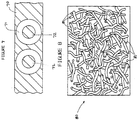
- Figure 8 is an enlarged plan view depicting the random fiber distribution in a web of recycled airlaid material.
- This waste material may be in the form of the remnants including solid discs 72 of a continuous sheet 70 of fibrous material having annular holes 71 therethrough where the hollow annuli have been removed for use in the manufacture of friction discs.
- This sheet material may have been prepared using any of a variety of methods, including those referred to hereinbefore in the Background-of-the-Invention section of this specification, and by cross-lapping continuous filament tows of PAN fiber and thereafter needlepunching them to join the cross-lapped layers and compact them to a suitable density for further processing as friction disc preforms.
- the dense offcut OPF sheet material may have a thickness of up to 5.16 cm (two inches) or more, and a bulk density up to about 0.8 grams per cubic centimeter (g/cc).
- the term "bulk density” as used herein is calculated by dividing the weight of the sample by its volume and is expressed in g/cc.
- the dense OPF waste sheet material was fed into the shredder/opener utilizing the following machine settings: The variable speed control was set to its lowest value, each of the three cylinders was set to the highest available setpoint, number 6. Number 6 is a number which correlates to the spacing between the cylinder pins and the feedplate and therefore the size of the particles of the material to be shredded allowed to pass through. Smaller cylinder pins/feedplate setpoint values will produce shorter fiber and less clumps when all other factors are held constant.
- the fibrous output of the shredder/opener may be referred to as "fluff".
- the term "fluff” as used herein means opened fiber that is fluffy in appearance and ideally contains no hard clumps of unopened fiber.
- the fibers of the fluff may be easily separated from one another manually, even from a sample of fluff that has been manually pulled from a bale of the fluff.
- Opened fibers containing lumps can be recycled according to the invention, but such lumps may cause needles to be broken during needlepunching operations.
- Raw fluff as it comes from the Shredder/Opener is preferably cleaned to remove clumps, short fibers and foreign matter. This may be accomplished in known manner, e.g . by passing it through a model RST 1200 cleaner available from Trützschler of Mönchengladbach, Germany.
- web means a wide film of random oriented and mechancically interlocked fibers such as that formed by air deposition (airlaying) and used to make non-woven fabrics.
- the recycled fiber fluff obtained from the shredder/opener is processed as described below into a web which is added to a developing non-woven fabric sheet which later may be employed to prepare a carbon/carbon brake disc or other preform.
- a web density of at least about 0.1 g/cc is through airlaying followed by pre-needlepunching.
- Suitable web airlaying equipment may be obtained from Rando of Ard, New York; Dr. Ernst Fehrer of Linz, Austria; and DOA of Wels, Austria.
- opened recycled fiber is fed into commercially available airlay equipment such as that available from Fehrer.
- the fibers thereof are separated into small groups of fibers which are dispersed in moving air and collected to form web.
- the web is pre-needlepunched shortly after being formed and prior to further processing according to the invention.
- the pre-needlepunched airlaid web of OPF may have a density ranging from 0.1 to 0.2 g/cc and preferably has a density from 0.1 to 0.15 g/cc. This corresponds to a fiber volume ranging from 7 to 14 percent and preferably from 7 to 10.5 percent.
- "Fiber Volume” is equal to the weight/unit volume of the web or sheet divided by the density of the fibrous material of which the web or sheet is made.
- OPF has a density of 1.37 g/cc.
- the thickness of the pre-needlepunched web preferably ranges from 4 to 11 millimeters (mm), more preferably from 6.9 to 8.1 mm, and most desirably 7.5 mm prior to further needlepunching. Thickness of the web is determined according to ASTM D 1777-64 (Reapproved 1975) (Standard Method for Measuring Textile Materials).
- Pre-needlepunching provides consistency and facilitates handling of such pre-needlepunched web.
- disc preforms of recycled OPF fiber having a fiber volume of from 29 to 58 percent which corresponds to a bulk density of from 0.4 to 0.8 g/cc.
- Suitable needles for use in pre-needlepunching the airlaid web of PAN fiber may be obtained from Foster Needle of Manitowoc, Wisconsin. These are identified as 15 X 18 X 36 X 3.5 SBA F 20 4-22-3B/C felting needles although other needles may be employed. When employing such needles to form airlaid recycled OPF web, it was ascertained that about 94 strokes per square centimeter produced desirable web, although it is believed that 75 to 125 strokes per square centimeter would also produce acceptable web.
- Pre-needlepunching and needlepunching operations referred to herein may be accomplished by passing the layer or superposed layers through a conventional needlepunch loom such as needlepunch loom 30 illustrated schematically in Figure 3, fitted with needles such as representative needlepunch needle 35 illustrated in Figure 4.
- Loom 30 includes rotatable crank 31, connecting rod 32, reciprocable platen 33, needle board 34, needles 35, stripper plate 37, and bed plate 38. Rotation of crank 31 effects reciprocating motion of platen 33, causing needles 35 of needleboard 34 to reciprocally move through stripper plate 37 toward and away from bed plate 38.
- the fibrous layers to be joined are passed between stripper plate 37 and bed plate 38 while reciprocating motion of the needleboard 34 causes needles 35 to penetrate the fibrous layers.
- the barbs 36 of needles 35 effect cross-linking of the layers by displacing filaments out of the layers in a direction generally perpendicular to the faces of the layers.
- Fiber obtained from offcut continuous filament OPF sheet may be recycled into a pre-needlepunched airlaid web that is made of one hundred percent (100%) recycled fiber without blending in any form of virgin fiber. It is unnecessary to utilize a sacrificial substrate as described in U.S. -A- 4,780,363 to Evans et al. or to needlepunch the web to a unidirectional array of continuous filaments as in GB-A-2 012 671 .
- airlaid webs formed of blends of recycled and virgin OPF are believed to be easier to form than when 100% recycled fiber is employed because virgin fiber facilitates mechanical bonding of the fibers to one another due to its greater mean fiber length and the presence of crimp, if any. Longer fibers intersect a greater number of other fibers than do shorter fibers and thus facilitate web formation.
- the fiber opening operation has been conducted with machine settings (Laroche equipment) which resulted in a broad range of fiber lengths with the mean fiber length being approximately 0.75 inch (19 mm) when tested according to ASTM D 1440-77.
- the fiber opening operation when conducted by of Paltex Incorporated of Los Angeles, California using its proprietary machinery and settings resulted in a broad range of fiber lengths with the mean fiber length being approximately 1.0 inch (25 mm).
- No single mean fiber length has been determined to be most desired or critical for the manufacture of airlaid web from such recycled fibers for use in the manufacture of friction disc preforms.
- a mean fiber length of between 40 millimeters and 100 millimeters is necessary for successful conversion of OPF by airlaying into a web.
- FIG 8 schematically shows an airlaid fiber web 80 according to the invention.
- the airlaid fiber web 80 of the invention has a higher percentage of its fibers 81 oriented toward the Z-direction than conventional needlepunched webs of carded fibers (not illustrated) or continuous crosslapped tows (not illustrated).
- the resulting pre-needlepunched airlaid web such as web 80 shown in Figure 8 exhibits general randomness of its fibers within the plane of the web relative to the machine direction and at an angle from the plane of the web, i.e. , inclined or tending toward the Z-direction.
- the Z-factor of such a web may be expressed mathematically as the sum of the Z-component contribution of each of the fibers forming the web.
- the Z-component contribution Z 1 of fiber F 1 is equal to the length L 1 of F 1 times the sine of the angle ⁇ 1 where ⁇ 1 is the angle of inclination of F 1 relative to the plane X-Y of the fibrous web or sheet.
- a layer of carded staple or continuous tow has a Z-factor of nearly zero because all the fibers are aligned in the machine direction, i.e. lie parallel to the X-Y plane defined by the layer. Webs according to the invention have a significant Z-factor.
- Another method for characterizing the randomness and Z-factor of the web is being developed at Texas Tech University and is based upon the porosity or tensile strength of the web.
- a round plate having a diameter of about 7.62 cm (three inches) with a five degree sector removed therefrom was positioned on top of the piece of the web being tested and air permeability through the sample was measured with the open sector of the plate at 0°, 45°, 90°, 135° and 180° relative to the machine direction. Similar permeability values are indicative of a uniform random web.
- a plurality of layers of pre-needlepunched airlaid web may be superposed and further needlepunched in a conventional manner to form and consolidate them into a unitary structure having a greater bulk density than that of the individual layers preceding such further needlepunching.
- a friction disc preform it is desired to have a recycled OPF preform density of from 0.4 to 0.8 g/cc although lower density may be acceptable in certain applications. It is believed that lower density/fiber volume is desired for airlaid web forming all or part of a sacrificial layer than for airlaid web forming a part of the core because such lower density of the sacrificial layer material promotes mass transfer of the gasses into and out of the core during its CVD densification.
- Needlepunched airlaid web of the invention may be utilized as a sacrificial facing material in combination with a core preform.
- the core preform may be formed of knit, braided, woven or other fibrous material including but not limited to virgin continuous filament preform material that has been prepared by other processes such as crosslapping followed by needlepunching or other techniques such as those described hereinbefore in the Background-of-the-Invention section of this specification.
- Such airlaid web sacrificial layers are preferably joined to the core preform material by needlepunching.
- needlepunching of the superposed fibrous layers of disc-shaped preform 10 produces cross-linking of the fibrous layers by filaments such as filaments 59 displaced out of the layers and extending in a direction generally perpendicular to the faces of the layers, i.e. , the Z-direction.
- the airlaid web may be compressed by further needlepunching to a higher density prior to or at the time of joinder to the core preform.
- the exterior surfaces including surface 13 of the airlaid sacrificial layer 12, and surface 15 of airlaid sacrificial layer 14 densify more rapidly than the material of the core 16 resulting in reduced porosity at the surface.
- the partially densified discs are removed from the CVD furnace and subjected to a machining operation in which the outermost portion of the airlaid sacrificial layers 12, 14 is removed thereby removing the outermost material whose pores have been substantially reduced in size or occluded due to deposition of carbon therein.
- the partially densified machined discs are then returned to a CVD furnace for further CVD densification.
- the PAN fiber is understood to be in its oxidized state, i.e. to be OPF, when subjected to all textile processes described herein. While it may be possible to produce suitable preforms out of greige (unoxidized) PAN fiber and thereafter oxidize such preforms in a batch method as opposed to the continuous oxidation method employed in the manufacture of OPF, this is not deemed to be most economical, particularly, because prior to oxidation, the PAN fiber does not have the desired high density nor is it able to withstand the high temperature of the furnace cycles desired to be subsequently employed.
- the airlaid web of recycled fiber comprises one machine direction layer.
- machine direction means the direction in which the material being processed moves through the machine.
- One or more layers of such web may be superposed onto and needlepunched simultaneously into previously formed and arranged fibrous layers.
- annuli are formed and removed in conventional manner, e.g ., by a hydraulic press equipped with suitable punch cutting dies or by water jet cutting to create the preform discs for use in the manufacture of friction discs.
- the resulting preform discs when formed of OPF, are converted into carbon/carbon composite material by either carbon vapor deposition (CVD) or resin char or a combination thereof in known manner.
- the offcut fibrous material may again be recycled through a shredder/opener and reformed into yet another airlaid web with or without blending in of virgin OPF staple fiber or other fibers including carbon fibers, graphite fibers, ceramic fibers, precursors of carbon fibers and precursors of ceramic fibers, and mixtures of these.
- the resulting airlaid web of recycled fiber may be combined by needlepunching with one or more layers of carded staple fibers, or unidirectional continuous filaments, or crosslapped layers of continuous filaments or any combination of these or other methods of manufacturing carbon/carbon fiber preforms for use in friction discs such as aircraft brake discs.
- friction disc 50 comprises a core 56 formed of superposed layers 52 of airlaid web stacked in alternating manner with layers 54 formed from crosslapped layers of OPF tow and upper and lower sacrificial layers 12, 14 respectively formed of a plurality of layers of recycled fiber airlaid web.
- the airlaid web layers 52 of the core 56 and the crosslapped OPF tow layers 54 of the core 56 are joined together and consolidated by needlepunching.
- Core 56 and upper and lower sacrificial layers 12, 14 respectively may be formed separately prior to their joinder by needlepunching.
- Needlepunching of the superposed fibrous layers produces cross-linking of the fibrous layers by filaments such as filaments 59 displaced out of the layers and extending in a direction generally perpendicular to the faces of the layers, i.e. , the Z-direction.
- the shredder/opener can be adjusted to remove a greater quantity of material as "dust" by adjusting it to remove all material including all fibers up to a specified length which may be equal to or greater than 0.16 cm (one sixteenth of an inch).
- 0.16 cm One sixteenth of an inch
- 0.16 cm is the smallest mean fiber length category expressed on the ASTM D 1440-77. Removal of all broken down fibrous material and fibers including fibers of length greater than 0.16 cm (one sixteenth inch) may facilitate airlaid web formation without addition of virgin fiber but it will reduce overall efficiency if measured in terms of the percentage of fibrous feedstock that is converted to reformed sheet.
- Preferred cleaning of the raw fluff results in further loss of feedstock, typically between 10 and 20 weight percent of feedstock, due to removal of short fibers and foreign matter. It is also possible to produce airlaid webs as described herein by use of virgin staple fiber which may be prepared from tow.
- carbonizable as used herein means formed of carbon or having the capability of being converted to carbon.
- PAN fiber, OPF, cotton, rayon and other cellulosic fibers are examples of materials that are carbonizable.
- a friction disc preform was prepared as follows. A layer of 305 g/m 2 (9 ounces/square yard) plain weave cotton fabric was placed on the bed of a needlepunch loom. A sacrificial lower facing was formed by superposing two layers of 800 g/m 2 pre-needlepunched airlaid OPF web on the cotton fabric and joining them by needlepunching them together with a layer of crosslapped tow. Thereafter, a core was formed and joined to the lower sacrificial facing by superposing in alternating manner eleven layers of crosslapped tows of OPF with eleven layers of 400 g/m 2 pre-needlepunched airlaid OPF web on to the developing sheet with needlepunching after the addition of each layer.
- an upper sacrificial facing was formed by superposing two layers of 800 g/m 2 pre-needlepunched airlaid OPF web on the core joining them to one another and the core by needlepunching.
- the preform sheet material being manufactured was subjected to needlepunching using needles at a rate of about 100 to 110 strokes per square centimeter per pass through the needle loom.
- the needles employed throughout this Example 1 were 15 x 18 x 36 x 3.5 C333 G 1002 from Groz-Beckert of Germany.
- Annular friction disc preforms were cut from the resulting fibrous sheet, CVD densified in known manner and thereafter machined and assembled into a multi-disc brake.
- the sacrificial layers were progressively machined away during the required multiple CVD densification furnace runs. Any sacrificial facing material remaining after reaching the desired final density was machined away prior to assembly into the brake. Testing of the brake indicated that discs of this Example 1 can be expected to provide satisfactory performance in certain braking applications.
- a plurality of friction disc preforms were prepared as in Example 1 with the following exceptions.
- a portion of the core of the fibrous sheet material was formed by needlepunching superposed layers of crosslapped OPF tows.
- the first sacrificial facing was formed by superposing three layers of 800 g/m 2 pre-needlepunched airlaid OPF web to the upper face of the core portion and joining them by needlepunching. After joinder of the first sacrificial facing to the core portion, the assembly was flipped over to expose the other face of the core portion of the sheet material which was then completed by adding further superposed layers of crosslapped OPF tows with needlepunching.
- an upper sacrificial facing was formed by superposing three layers of 800 g/m 2 pre-needlepunched airlaid OPF web on the completed core portion and joining them to one another and the core portion by needlepunching.
- Annular friction disc preforms were cut from the resulting fibrous sheet, CVD densified in known manner and thereafter machined and assembled into a multi-disc brake. Testing of the brake indicated that discs of this Example 2 provided performance corresponding to a brake whose discs were formed from a preform made entirely of tow layers, the outermost ones of which were machined away during CVD densification.
- Carbon fiber has a higher density of from 1.74 to 1.78 g/cc compared to OPF which has a density of 1.37 g/cc.
- Recycled sheet material and preforms made of such carbon fiber may have a higher density compared to those formed of OPF at the time of entering the subsequent CVD furnace cycles and thus may be expected to require less initial time in such subsequent furnace cycles, but could be more difficult to densify to a desired final density in the range of 1.79 g/cc to 1.85 g/cc.
Landscapes
- Engineering & Computer Science (AREA)
- Chemical & Material Sciences (AREA)
- Textile Engineering (AREA)
- Ceramic Engineering (AREA)
- Inorganic Chemistry (AREA)
- Composite Materials (AREA)
- Materials Engineering (AREA)
- General Engineering & Computer Science (AREA)
- Mechanical Engineering (AREA)
- Chemical Kinetics & Catalysis (AREA)
- Manufacturing & Machinery (AREA)
- Structural Engineering (AREA)
- Organic Chemistry (AREA)
- Nonwoven Fabrics (AREA)
- Ceramic Products (AREA)
- Braking Arrangements (AREA)
Claims (34)
- Textilbahn, die erste und zweite Außenseiten (13, 15) - wobei die Textilbahn wenigstens eine Schicht eines Gewebes (52) umfaßt - nichtgewebter Fasern aufweist, die durch Wiederverwertung von Fasern hergestellt werden, die aus dem Schnittabfall von Endlosfilament-Bahnmaterial erhältlich sind, wobei die Fasern aus der Gruppe, bestehend aus Polyacrylnitrilfasern, einschließlich oxidierten Polyacrylnitrilfasern, Kohlenstoff-Fasern, Graphitfasern, keramischen Fasern, Vorläufern von Kohlenstoff-Fasern und einem Vorläufer von keramischen Fasern, und Mischungen derselben, ausgewählt sind, dadurch gekennzeichnet, daß das Gewebe (52) im wesentlichen eine gleichförmige Richtungsunregelmäßigkeit und eine mittlere Faserlänge zwischen 10 und 25 mm (0,4 bis 1,0 inch) beim Testen gemäß ASTM D 1440 hat.
- Textilbahn gemäß Anspruch 1, worin das Gewebe (52) im wesentlichen aus oxidierten Polyacrylnitrilfasern gebildet wird.
- Textilbahn gemäß Anspruch 1, worin das Gewebe (52) nach dem Vernadeln ein Faservolumen von 29 bis 58 % hat.
- Textilbahn gemäß Anspruch 2, worin das Gewebe (52) nach dem Vernadeln eine Dichte von 0,4 bis 0,8 g/cm3 hat.
- Textilbahn gemäß Anspruch 1, die weiterhin wenigstens eine zusätzliche Schicht eines anderen faserigen Materials umfaßt, das aus der Gruppe, bestehend aus vorvernadeltem Gewebe, einer unidirektionalen Anordnung von Filamenten, einer multidirektionalen Anordnung von Filamenten, gewebtem, verflochtenem oder gewirktem Textilerzeugnis, ausgewählt ist, wobei die Gewebeschicht (52) und die wenigstens eine zusätzliche Schicht eines anderen faserigen Materials verbunden werden, um durch Vernadeln eine einzige Textilbahn zu bilden.
- Textilbahn gemäß Anspruch 1, die weiterhin eine Schicht von gekreuzt gewickeltem Werggarn umfaßt, wobei die Gewebeschicht (52) und die Werggarnschicht verbunden werden, um durch Vernadeln eine einzige Bahn zu bilden.
- Textilbahn gemäß Anspruch 5, die weiterhin zusätzliche Gewebeschichten (52) umfaßt, die gemäß einem sich wiederholenden Muster mit zusätzlichen Schichten eines anderen faserigen Materials gestapelt und durch Vernadeln verbunden werden.
- Textilbahn gemäß Anspruch 6, die weiterhin zusätzliche Gewebeschichten (52) umfaßt, die in einer alternativen Weise mit zusätzlichen Schichten von gekreuzt gewickeltem Werggarn gestapelt und durch Vernadeln verbunden werden.
- Textilbahn gemäß Anspruch 5, die weiterhin zusätzliche Gewebeschichten (52) umfaßt, die mit jeder Außenseite der Textilbahn durch Vernadeln verbunden sind.
- Textilbahn gemäß Anspruch 6, die weiterhin zusätzliche Gewebeschichten (52) umfaßt, die mit jeder Außenseite der Textilbahn durch Vernadeln verbunden sind.
- Textilbahn gemäß Anspruch 1, die eine Mehrzahl von Gewebeschichten (52) umfaßt, die durch Vernadeln mit jeder Außenseite der Textilbahn verbunden sind, wobei die Mehrzahl der Gewebeschichten (52) eine kombinierte Dicke von 0,3 bis 5 mm (0,01 bis 0,2 inch) und ein Faservolumen von 29 bis 50 % hat.
- Textilbahn gemäß Anspruch 5, die eine Mehrzahl von OPF-Gewebeschichten (52) umfaßt, die durch Vernadeln mit jeder Außenseite der Textilbahn verbunden sind, wobei die Mehrzahl der Gewebeschichten (52) eine kombinierte Dicke von 0,3 bis 5 mm (0,01 bis 0,2 inch) und eine Schüttdichte von 0,45 bis 0,65 g/cm3 hat.
- Textilbahn gemäß Anspruch 10, die eine Schüttdichte von 0,45 bis 0,75 g/cm3 hat.
- Bahn gemäß Anspruch 8, die eine flache, ringförmige Form hat.
- Bahn gemäß Anspruch 14, die weiterhin eine Matrix einschließt, die die vernadelten Schichten miteinnander verbindet, wobei die Matrix aus der Gruppe, bestehend aus Kohlenstoff, Keramik, einer Vorläuferverbindung von Kohlenstoff, einer Vorläuferverbindung einer Keramik und Mischungen derselben, ausgewählt ist.
- Verfahren zur Herstellung einer Bahn faserigen Materials, umfassend das Öffnen von faserigem Schnittabfall-Material, das aus Schnittabfall von Endlosfilament-Bahnmaterial aus polyacrylnitrilfasern, einschließlich oxidierten Polyacrylnitrilfasern, Kohlenstoff-Fasern, Graphitfasern, keramischen Fasern, Vorläufern von Kohlenstoff-Fasern und einem Vorläufer von keramischen Fasern, und Mischungen derselben, erhältlich ist, um diskrete Stapelfasern einer mittleren Länge zwischen 10 und 25 mm (0,4 bis 1,0 inch) - beim Testen gemäß ASTM D 1440 - zu bilden, dadurch gekennzeichnet, daß die geöffneten Fasern in einem Gewebe (80) aerodynamisch abgelegt werden, und das Gewebe zu einer Dicke von 4 bis 11 mm und einem Faservolumen von 7 bis 14 % vorvernadelt wird.
- Verfahren gemäß Anspruch 16, worin die Faser im wesentlichen aus oxidierten Polyacrylnitrilfasern besteht, und das vorvernadelte Gewebe eine Dichte von 0,1 bis 0,2 g/cm3 hat.
- Verfahren gemäß Anspruch 17, das weiterhin das Vernadeln des vorvernadelten Gewebes zu einer Dicke von 0,3 bis 5 mm (0,01 bis 0,2 inch) und einer Dichte von 0,4 bis 0,8 g/cm3 umfaßt.
- Verfahren gemäß Anspruch 16, das weiterhin :
c) das Verbinden des vorvernadelten Gewebes mit wenigstens einem anderen vorvernadelten Gewebe, einer unidirektionalen Anordnung von Endlosfilamenten und einer multidirektionalen Anordnung von Endlosfilamenten durch Vernadeln
umfaßt. - Verfahren gemäß Anspruch 16, das weiterhin:
c) das Übereinanderlegen einer Mehrzahl der vorvernadelten Gewebe und das Vernadeln der übereinandergelegten Gewebe umfaßt, um ein Vernetzen der übereinandergelegten Gewebe durch Filamente herzustellen, die aus den Geweben herausgedrängt werden und sich im allgemeinen in einer Richtung senkrecht zu den Außenseiten der Gewebe erstrecken, um ein nichtgewebtes Substrat zu bilden, das ein Faservolumen von etwa 29 bis etwa 58 % hat. - Verfahren gemäß Anspruch 20, das weiterhin das Anordnen der ersten Gewebeschicht der Mehrzahl der vorvernadelten Gewebeschichten auf einer Schicht von Baumwolltuch vor dem weiteren Vernadeln umfaßt.
- Verfahren gemäß Anspruch 20, worin die Gewebe im wesentlichen aus oxidierten Polyacrylnitrilfasern gebildet werden und zu einer Dichte von 0,4 bis 0,8 g/cm3 vernadelt werden.
- Verfahren gemäß Anspruch 19, das weiterhin:
d) das Stapeln einer Mehrzahl der vorvernadelten Gewebe und jeder der Anordnungen von Endlosfilamenten auf einer alternierenden Weise und Vernadeln der Gewebe und Anordnungen umfaßt, um ein nichtgewebtes Substrat zu bilden, das ein Faservolumen von 45 bis 52 % hat. - Verfahren gemäß Anspruch 16, worin das Schnittabfall-Material keine keramischen Fasern umfaßt.
- Verfahren gemäß Anspruch 16, worin eine Mehrzahl der aerodynamisch abgelegten Gewebe direkt übereinander gestapelt werden, und die Mehrzahl der gestapelten Gewebe auf einen faserigen Kern übereinandergelegt werden, und die übereinader gelegten Gewebe vernadelt werden, um eine gegenseitige Vernetzung der Gewebe und des Kerns durch Filamente herzustellen, die aus den Gewebeschichten herausgedrängt werden und sich allgemein in einer senkrechten Richtung zu den Außenseiten der Gewebe erstrekken.
- Verfahren gemäß Anspruch 25, worin die Mehrzahl der gestapelten Gewebe nach dem Vernadeln mit dem Kern (16) ein Faservolumen zwischen 30 und 40 % haben.
- Verfahren gemäß Anspruch 26, das weiterhin die Bildung des Kerns (16) aus einer Mehrzahl übereinandergelegter, multidirektionaler Anordnungen von Endlosfilamenten aus Polyacrylnitril- oder oxidierten Polyacrylnitrilfasern umfaßt, wobei die Anordnungen des Kern (16) miteinander durch Filamente vernetzt werden, die aus den Anordnungen herausgedrängt werden und sich allgemein in einer senkrechten Richtung zu den Außenseiten der Anordnungen erstrecken.
- Verfahren gemäß Anspruch 26, worin der Kern (16) aus einer Mehrzahl übereinandergelegter Bahnen (52) gebildet wird, die aus gewebtem, verflochtenem oder gewirktem Textilerzeugnissen ausgewählt sind, die aus Polyacrylnitrilfaser und oxidierter Polyacrylnitrilfaser ausgewählt sind, wobei die Bahnen (52) des Kerns (16) durch Filamente miteinander vernetzt werden, die aus den Bahnen herausgedrängt werden und sich allgemein in einer senkrechten Richtung zu den Außenseiten der Bahnen erstrecken.
- Verfahren gemäß Anspruch 26, worin der Kern und die aerodynamisch abgelegten Gewebe in Form einer Scheibe vorliegen.
- Verfahren gemäß Anspruch 19, das weiterhin das Verbinden der vernadelten Schichten durch eine Matrix umfaßt, die aus der Gruppe, bestehend aus Kohlenstoff, Keramik, einer Vorläuferverbindung von Kohlenstoff, einer Vorläuferverbindung einer Keramik und Mischungen derselben, ausgewählt ist.
- Verfahren gemäß Anspruch 23, das weiterhin das Verbinden der vernadelten Schichten durch eine Matrix umfaßt, die aus der Gruppe, bestehend aus Kohlenstoff, Keramik, einer Vorläuferverbindung von Kohlenstoff, einer Vorläuferverbindung einer Keramik und Mischungen derselben, ausgewählt ist.
- Verfahren gemäß Anspruch 25, das weiterhin das Verbinden der vernadelten Schichten durch eine Matrix umfaßt, die aus der Gruppe, bestehend aus Kohlenstoff, Keramik, einer Vorläuferverbindung von Kohlenstoff, einer Vorläuferverbindung einer Keramik und Mischungen derselben, ausgewählt ist.
- Verfahren gemäß Anspruch 32, das weiterhin das teilweise Verdichten der Bahn in einem Kohlenstoffdampfabscheidungs-Ofen, das Entfernen der teilweise verdichteten Bahn aus dem Kohlenstoffdampfabscheidungs-Ofen, das Abspanen des äußersten Anteils (12, 14) der teilweise verdichteten Bahn und das Wiedereinführen der abgespanten Bahn in den Kohlenstoffdampfabscheidungs-Ofen für eine weitere Kohlenstoffdampfabscheidung umfaßt.
- Verfahren gemäß Anspruch 27, das weiterhin das Verbinden der vernadelten Gewebe und der Anordnungen durch eine Matrix umfaßt, die aus der Gruppe, bestehend aus Kohlenstoff, Keramik, einer Vorläuferverbindung von Kohlenstoff, einer Vorläuferverbindung einer Keramik und Mischungen derselben, ausgewählt ist.
Applications Claiming Priority (2)
| Application Number | Priority Date | Filing Date | Title |
|---|---|---|---|
| US75477491A | 1991-09-04 | 1991-09-04 | |
| US754774 | 1991-09-04 |
Publications (2)
| Publication Number | Publication Date |
|---|---|
| EP0530741A1 EP0530741A1 (de) | 1993-03-10 |
| EP0530741B1 true EP0530741B1 (de) | 1996-11-27 |
Family
ID=25036281
Family Applications (1)
| Application Number | Title | Priority Date | Filing Date |
|---|---|---|---|
| EP92114898A Expired - Lifetime EP0530741B1 (de) | 1991-09-04 | 1992-09-01 | Kohlefasern, Kohleverbund, verstärkt mit Kohle und Verfahren zur Herstellung |
Country Status (5)
| Country | Link |
|---|---|
| US (2) | US5869411A (de) |
| EP (1) | EP0530741B1 (de) |
| JP (1) | JPH05230748A (de) |
| CA (1) | CA2077130C (de) |
| DE (1) | DE69215457T2 (de) |
Cited By (1)
| Publication number | Priority date | Publication date | Assignee | Title |
|---|---|---|---|---|
| US8603374B2 (en) | 2004-10-08 | 2013-12-10 | Sgl Carbon Se | Processes for producing a polymer-bonded fiber agglomerate and a fiber-reinforced composite material |
Families Citing this family (83)
| Publication number | Priority date | Publication date | Assignee | Title |
|---|---|---|---|---|
| US5388320A (en) * | 1987-01-27 | 1995-02-14 | Aerospace Preforms Limited | Production of shaped filamentary structures |
| US5882781A (en) * | 1986-01-28 | 1999-03-16 | Aerospace Preforms Limited | Shaped fibrous fabric structure comprising multiple layers of fibrous material |
| US5705264A (en) * | 1987-01-27 | 1998-01-06 | Aerpspace Preforms Limited | Production of shaped filamentary structures |
| FR2717820B1 (fr) * | 1994-03-25 | 1996-05-15 | Valeo | Matériau de frottement destiné à équiper un dispositif mettant en Óoeuvre un frottement en milieu liquide, ainsi que le procédé de réalisation d'un tel matériau de frottement et du dispositif qui en est équipé . |
| US6405417B1 (en) | 1994-07-25 | 2002-06-18 | Goodrich Corporation | Process for forming fibrous structures with predetermined Z-fiber distributions |
| US5858890A (en) * | 1994-07-25 | 1999-01-12 | The B. F. Goodrich Company | Laminar fibrous structure having Z-fibers that penetrate a constant number of layers |
| US5515585A (en) * | 1994-07-25 | 1996-05-14 | The Bf Goodrich Company | Process for forming needled fibrous structures using determined transport depth |
| US6029327A (en) * | 1994-07-25 | 2000-02-29 | The B.F. Goodrich Company | Process for forming fibrous structures with predetermined Z-fiber distributions |
| US5654059A (en) * | 1994-08-05 | 1997-08-05 | Amoco Corporation | Fiber-reinforced carbon and graphite articles and method for the production thereof |
| US5803210A (en) * | 1994-12-28 | 1998-09-08 | Nippon Oil Co., Ltd. | Disk brakes |
| US5546880A (en) * | 1994-12-29 | 1996-08-20 | The Bf Goodrich Company | Annular filamentary structures and methods of making |
| FR2735456B1 (fr) * | 1995-06-19 | 1997-09-12 | Europ Propulsion | Procedes et appareil pour la fabrication de pieces annulaires en materiau composite et de preformes pour ces pieces |
| FR2735830B1 (fr) * | 1995-06-21 | 1997-07-18 | Valeo | Materiau de frottement destine a equiper un dispositif mettant en oeuvre un frottement a sec, ainsi que le procede de realisation d'un tel materiau de frottement et du dispositif qui en est equipe |
| BR9602818A (pt) | 1995-06-21 | 1999-10-13 | Valeo | Material de atrito destinado a equipar um dispositivo que utiliza um atrito a seco, processo de fabricação de um tal material e disco de fricção de embreagem giratório |
| EP0767265B1 (de) * | 1995-10-04 | 2000-12-20 | The B.F. Goodrich Company | Faserige Laminarstruktur mit Z-Fasern, die eine konstante Mehrzahl von Schichten durchdringen |
| US5908792A (en) | 1995-10-04 | 1999-06-01 | The B. F. Goodrich Company | Brake disk having a functional gradient Z-fiber distribution |
| EP0801162A1 (de) * | 1996-03-22 | 1997-10-15 | Fabricas Lucia Antonio Betere S.A. (Flabesa) | Verfahren für personbezogene Steifigkeit, Widerstand und Beständigkeit von Stütze oder Sitze, so hergestellte Stütze und Sitze und Gerät dafür |
| GB9612882D0 (en) * | 1996-06-20 | 1996-08-21 | Dunlop Ltd | Densification of a porous structure |
| FR2754031B1 (fr) * | 1996-09-30 | 1998-12-18 | Carbone Ind | Elaboration de preformes fibreuses pour la fabrication de disques de frein en materiau composite |
| JP4163270B2 (ja) * | 1997-03-26 | 2008-10-08 | 本田技研工業株式会社 | 湿式摩擦クラッチ用c/cコンポジット製クラッチディスクおよびその製造方法 |
| US5871844A (en) | 1997-04-02 | 1999-02-16 | Fiberite, Inc. | Carbon--carbon parts having filamentized composite fiber substrates and methods of producing the same |
| US6105223A (en) * | 1997-04-30 | 2000-08-22 | The B. F. Goodrich Company | Simplified process for making thick fibrous structures |
| KR20000046412A (ko) * | 1998-12-31 | 2000-07-25 | 추호석 | 탄소/탄소 복합재료 브레이크 디스크 제조방법 |
| US7168528B1 (en) | 1999-05-11 | 2007-01-30 | Goodrich Corporation | Three run disk brake stack and method of assembly |
| DE19954585C2 (de) * | 1999-11-12 | 2001-10-11 | Knorr Bremse Systeme | Verfahren zum Herstellen eines Reibringes, insbesondere für eine Bremsscheibe und Bremsscheibe |
| US6340075B1 (en) | 1999-11-24 | 2002-01-22 | The B. F. Goodrich Company | Three run disk brake stack and method of assembly |
| ATE333054T1 (de) * | 2000-02-09 | 2006-08-15 | Freni Brembo Spa | Bremsscheibe für eine scheibenbremse |
| US6521152B1 (en) * | 2000-03-16 | 2003-02-18 | Honeywell International Inc. | Method for forming fiber reinforced composite parts |
| WO2002008150A2 (en) | 2000-07-26 | 2002-01-31 | Ballard Power Systems Inc. | Carbon-matrix composites compositions and methods related thereto |
| US7378362B2 (en) * | 2000-09-29 | 2008-05-27 | Goodrich Corporation | Boron carbide based ceramic matrix composites |
| JP2004510674A (ja) | 2000-09-29 | 2004-04-08 | グッドリッチ・コーポレイション | 炭化ホウ素をベースとしたセラミックマトリックス複合材料 |
| US6699427B2 (en) | 2002-07-26 | 2004-03-02 | Ucar Carbon Company Inc. | Manufacture of carbon/carbon composites by hot pressing |
| US7207424B2 (en) * | 2002-12-03 | 2007-04-24 | Ucar Carbon Company Inc. | Manufacture of carbon/carbon composites by hot pressing |
| US6878331B2 (en) * | 2002-12-03 | 2005-04-12 | Ucar Carbon Company Inc. | Manufacture of carbon composites by hot pressing |
| US20040155382A1 (en) * | 2002-12-03 | 2004-08-12 | Dai Huang | Manufacture of carbon/carbon composites by hot pressing |
| FR2851244B1 (fr) * | 2003-02-17 | 2005-06-17 | Snecma Propulsion Solide | Procede de siliciuration de materiaux composites thermostructuraux et pieces telles qu'obtenues par le procede |
| US8673188B2 (en) * | 2006-02-14 | 2014-03-18 | Goodrich Corporation | Carbon-carbon parts and methods for making same |
| CN100366581C (zh) * | 2006-07-20 | 2008-02-06 | 西安超码科技有限公司 | 单晶硅拉制炉及多晶硅冶炼炉用炭/炭加热器的制备方法 |
| DE102006057939A1 (de) * | 2006-12-08 | 2008-06-12 | Audi Ag | Friktionsbelastbare Scheiben aus faservertärkter Keramik |
| FR2924426B1 (fr) * | 2007-11-30 | 2011-06-03 | Messier Bugatti | Procede de fabrication de pieces en materiau composite a renfort en fibres de carbone. |
| US8074330B2 (en) * | 2008-08-13 | 2011-12-13 | Goodrich Corporation | Method and system for enabling z fiber transfer in needled preform |
| DE102009023529A1 (de) | 2009-05-30 | 2010-12-02 | Bayerische Motoren Werke Aktiengesellschaft | Recyclingverfahren |
| KR101128652B1 (ko) | 2009-09-02 | 2012-03-26 | 주식회사 데크 | 하이브리드 프리폼 및 이를 제조하는 방법 |
| CN101734940B (zh) * | 2009-11-20 | 2012-07-25 | 中南大学 | 基于压差法快速cvi涂层的炭纸性能改善方法和装置 |
| FR2953826B1 (fr) * | 2009-12-16 | 2019-10-11 | Safran Landing Systems | Procede de fabrication d'une piece de friction a base de materiau composite c/c |
| FR2954358B1 (fr) * | 2009-12-23 | 2012-01-13 | Messier Bugatti | Table d'aiguilletage circulaire d'une structure textile formee a partir d'une preforme fibreuse annulaire |
| GB2477531B (en) | 2010-02-05 | 2015-02-18 | Univ Leeds | Carbon fibre yarn and method for the production thereof |
| DE102010008370A1 (de) * | 2010-02-17 | 2011-08-18 | Thüringisches Institut für Textil- und Kunststoff-Forschung e.V., 07407 | Verfahren zur Herstellung eines plattenförmigen Halbzeugs aus Faserverbundwerkstoff |
| DE102010042349B4 (de) * | 2010-10-12 | 2014-04-03 | Benteler Sgl Gmbh & Co. Kg | Textiles Halbzeug, insbesondere Prepreg, auf Basis von aus Recyclingfasern zusammengesetztem Carbonfaservlies, Verfahren zur Herstellung und Verwendung des textilen Halbzeugs sowie Carbonfaserverstärkter Verbundwerkstoff |
| JP2011201750A (ja) * | 2010-03-26 | 2011-10-13 | Toyo Tanso Kk | C/cコンポジット材及びその製造方法 |
| JP5427682B2 (ja) * | 2010-04-16 | 2014-02-26 | 株式会社日立製作所 | 非常止め装置及びそれを用いたエレベーター |
| US20110275266A1 (en) * | 2010-05-05 | 2011-11-10 | Goodrich Corporation | System and method for textile positioning |
| US10443124B1 (en) * | 2010-09-09 | 2019-10-15 | Goodrich Corporation | Process and apparatus for making composite structures |
| JP5728577B2 (ja) * | 2010-11-03 | 2015-06-03 | エスゲーエル・オートモーティブ・カーボン・ファイバーズ・ゲーエムベーハー・ウント・コ・カーゲー | 湾曲した束を有するパイル層 |
| FR2968001B1 (fr) * | 2010-11-26 | 2015-11-20 | Messier Bugatti | Procede de realisation d'une preforme fibreuse tridimensionnelle pour la fabrication d'une piece annulaire en materiau composite carbone-carbone |
| WO2012085211A2 (en) * | 2010-12-22 | 2012-06-28 | Rockwool International A/S | Use of man-made vitreous fibre material |
| WO2012086682A1 (ja) * | 2010-12-24 | 2012-06-28 | 東レ株式会社 | 炭素繊維集合体の製造方法および炭素繊維強化プラスチックの製造方法 |
| CN102166840B (zh) * | 2011-01-27 | 2014-01-15 | 江苏天鸟高新技术股份有限公司 | Z向有连续炭纤维预制体 |
| ITRM20120118A1 (it) * | 2012-03-26 | 2013-09-27 | Agenzia Naz Per Le Nuove Tecn Ologie L Ener | Metodo per la realizzazione di feltri da fibre di carbonio di riciclo. |
| US9394637B2 (en) | 2012-12-13 | 2016-07-19 | Jacob Holm & Sons Ag | Method for production of a hydroentangled airlaid web and products obtained therefrom |
| US10271592B2 (en) * | 2013-03-13 | 2019-04-30 | Nike, Inc. | Monolithic protective article with flexible region |
| KR101440386B1 (ko) * | 2013-04-12 | 2014-09-17 | 주식회사씨앤에프 | 내마모성 및 고강도를 가진 디스크 용 프리폼을 만드는 방법 |
| CN103233323B (zh) | 2013-05-07 | 2015-09-02 | 江苏天鸟高新技术股份有限公司 | 环状纤维预制件及其制备方法 |
| US9873231B2 (en) * | 2014-03-31 | 2018-01-23 | Goodrich Corporation | Methods to fabricate needled preforms with randomly oriented short length carbon fibers |
| US9719199B2 (en) | 2014-05-23 | 2017-08-01 | Goodrich Corporation | System and method for transport of fibers to/from a circular needle-punching loom |
| DE102014013867A1 (de) * | 2014-09-24 | 2016-03-24 | Carl Freudenberg Kg | Verwendung eines Carbonfaservliesstoffs als Isoliermaterial |
| DE102014225604B4 (de) | 2014-12-11 | 2018-02-15 | Sgl Carbon Se | Recyclingverfahren von Carbonfasern und carbonfaserverstärkten Kunststoffen |
| EP3261813B1 (de) * | 2015-02-23 | 2020-04-22 | Volkswagen Aktiengesellschaft | Verfahren zur herstellung faserverstärkter bauteile oder halbzeuge |
| DE102015103585A1 (de) * | 2015-03-11 | 2016-09-15 | Trw Automotive Electronics & Components Gmbh | Verfahren zur Herstellung eines Kunststoffbauteils für den Innenraum eines Kraftfahrzeugs sowie Kunststoffbauteil |
| US10543666B2 (en) | 2015-06-29 | 2020-01-28 | The Boeing Company | Composite sandwich panel and associated methods of manufacture |
| US10457016B2 (en) * | 2016-02-23 | 2019-10-29 | Honeywell International Inc. | Differential needling of a carbon fiber preform |
| US9856592B2 (en) | 2016-03-15 | 2018-01-02 | Goodrich Corporation | Methods and systems for forming a fibrous preform |
| CN105734826A (zh) * | 2016-04-28 | 2016-07-06 | 常州市新创复合材料有限公司 | 一种通过碳纤维废料制造碳纤维毡片的生产工艺 |
| US20180100256A1 (en) * | 2016-10-12 | 2018-04-12 | Zoltek Companies, Inc. | High performance flame barriers |
| CN110670246B (zh) * | 2019-10-29 | 2022-02-01 | 哈尔滨工业大学(威海) | 一种制备陶瓷纤维预制体专用刺针及其使用方法 |
| FR3115047B1 (fr) * | 2020-10-13 | 2023-07-28 | Safran Landing Systems | Structure fibreuse aiguilletée pour la réalisation de préforme fibreuse annulaire de disque de frein |
| CN112324826B (zh) * | 2020-11-02 | 2024-12-10 | 摩擦一号制动科技(仙桃)有限公司 | 舒适型耐高温刹车片 |
| CN112324825B (zh) * | 2020-11-02 | 2024-12-10 | 摩擦一号制动科技(仙桃)有限公司 | 高摩擦性能环保型刹车片 |
| CN113502606A (zh) * | 2021-06-30 | 2021-10-15 | 浙江星辉新材料科技有限公司 | 一种碳刹车盘预制体及其制备方法 |
| CN114276158A (zh) * | 2021-12-29 | 2022-04-05 | 湖南金博碳素股份有限公司 | 一种短切碳纤维复合材料的制备方法 |
| US12297573B2 (en) * | 2023-05-12 | 2025-05-13 | Rohr, Inc. | Systems and methods for through thickness reinforcement using roll-to-roll veil cloth |
| CN119058175A (zh) * | 2023-05-31 | 2024-12-03 | 比亚迪股份有限公司 | 陶瓷刹车盘及其加工方法 |
| CN117183395A (zh) * | 2023-09-15 | 2023-12-08 | 中航复合材料有限责任公司 | 一种再生碳纤维增强环氧树脂预浸料的制备方法 |
Family Cites Families (33)
| Publication number | Priority date | Publication date | Assignee | Title |
|---|---|---|---|---|
| US1610173A (en) * | 1922-06-16 | 1926-12-07 | Slade Edward | Friction disk and the method of making same |
| US2587945A (en) * | 1947-07-01 | 1952-03-04 | Connecticut Asbestos Products | Friction disk and method of making same |
| US2602766A (en) * | 1948-04-10 | 1952-07-08 | Richard J Francis | Reinforced plastic rods and methods of making same |
| US3007497A (en) * | 1956-01-23 | 1961-11-07 | Samuel M Shobert | Reinforced plastic rods and method of fabricating the same |
| DE1006681B (de) * | 1956-02-24 | 1957-04-18 | Jurid Werke Ag | Verstaerkungseinlage fuer ringscheibenfoermige Reibbelaege |
| CA674101A (en) * | 1961-11-13 | 1963-11-12 | T. Dunlap Donald | Tow opening |
| US3457962A (en) * | 1965-11-16 | 1969-07-29 | Samuel M Shobert | Golf club shaft and method of forming the same |
| US3657061A (en) * | 1966-12-13 | 1972-04-18 | Carborundum Co | Reinforced carbon and graphite bodies |
| US3730824A (en) * | 1967-07-03 | 1973-05-01 | Celanese Corp | Continuous filament webs |
| GB1447030A (en) * | 1972-07-21 | 1976-08-25 | Hyfil Ltd | Carbonisable fibrous sheet |
| US4018482A (en) * | 1975-06-19 | 1977-04-19 | The B. F. Goodrich Company | Rim construction for wheels having brake torque drives |
| AU517708B2 (en) * | 1978-01-12 | 1981-08-20 | Dunlop Limited | Carbon composite brake disc manufacture |
| DE2911762A1 (de) * | 1979-03-26 | 1980-10-09 | Dilo Kg Maschf Oskar | Verfahren und vorrichtung zur herstellung von schulterpolstern aus textilem fasermaterial |
| JPS5616575A (en) * | 1979-07-18 | 1981-02-17 | Toho Rayon Co Ltd | Friction material and its preparation |
| FR2506672A1 (fr) * | 1981-06-02 | 1982-12-03 | Lorraine Carbone | Procede de fabrication de disques de frottement |
| DE3137844C2 (de) * | 1981-09-23 | 1984-04-05 | Messerschmitt-Bölkow-Blohm GmbH, 8000 München | Verfahren zum Herstellen von Kurzfasern |
| FR2546473B1 (fr) * | 1983-05-24 | 1987-12-11 | Verre Tisse Sa | Materiau tubulaire a base d'une resine renforcee par une matiere textile et cadre de bicyclette ou vehicule similaire realise a partir d'un tel materiau |
| US4494436A (en) * | 1983-09-02 | 1985-01-22 | Elfin Corporation | Apparatus for manufacturing resin impregnated fiber braided products |
| FR2557550B1 (fr) * | 1983-12-28 | 1986-05-30 | Europ Propulsion | Procede et appareillage pour la fabrication de structures tridimensionnelles de revolution |
| US4790052A (en) * | 1983-12-28 | 1988-12-13 | Societe Europeenne De Propulsion | Process for manufacturing homogeneously needled three-dimensional structures of fibrous material |
| US4613017A (en) * | 1984-07-02 | 1986-09-23 | The B. F. Goodrich Company | Disk brake and method of assembly |
| US4878563A (en) * | 1984-07-13 | 1989-11-07 | The B.F. Goodrich Company | Brake apparatus |
| GB8602003D0 (en) * | 1986-01-28 | 1986-03-05 | Lawton P G | Carbonisable fibre assembly |
| US4775566A (en) * | 1986-08-15 | 1988-10-04 | Essex Group, Inc. | High temperature flexible unitary sleeving insulation |
| GB8700805D0 (en) * | 1987-01-15 | 1987-02-18 | Dunlop Ltd | Carbon fibre materials |
| FR2626294B1 (fr) * | 1988-01-26 | 1990-07-13 | Carbone Ind | Procede de fabrication d'une structure fibreuse tridimensionnelle en vue de la realisation ulterieure d'une piece en un materiau composite et machine pour sa mise en oeuvre |
| US4946722A (en) * | 1988-09-30 | 1990-08-07 | The Bentley-Harris Manufacturing Company | Protective fabric sleeves |
| US5145732A (en) * | 1989-03-01 | 1992-09-08 | Osaka Gas Company Limited | High bulk density carbon fiber felt and thermal insulator |
| GB8905006D0 (en) * | 1989-03-04 | 1989-04-19 | Scapa Group Plc | Manufacture of homogeneously needled three-dimensional structures of fibrous material |
| US4876128A (en) * | 1989-03-31 | 1989-10-24 | E. I. Du Pont De Nemours And Company | Stitchbonded nonwoven fabric |
| US5052446A (en) * | 1989-06-12 | 1991-10-01 | Sulzer Brothers Limited | Thermoplastic heddle with braided fiber tube reinforcement |
| EP0484391B1 (de) * | 1989-07-25 | 1995-09-20 | Dunlop Limited | Herstellung von kohlefaser-halbfabrikaten |
| GB9101397D0 (en) | 1991-01-22 | 1991-03-06 | Fujisawa Pharmaceutical Co | New cephem compounds and processes for preparation thereof |
-
1992
- 1992-08-28 CA CA002077130A patent/CA2077130C/en not_active Expired - Fee Related
- 1992-09-01 EP EP92114898A patent/EP0530741B1/de not_active Expired - Lifetime
- 1992-09-01 JP JP4233497A patent/JPH05230748A/ja active Pending
- 1992-09-01 DE DE69215457T patent/DE69215457T2/de not_active Expired - Fee Related
-
1994
- 1994-04-06 US US08/223,942 patent/US5869411A/en not_active Expired - Lifetime
-
1995
- 1995-06-07 US US08/482,331 patent/US5609707A/en not_active Expired - Lifetime
Cited By (1)
| Publication number | Priority date | Publication date | Assignee | Title |
|---|---|---|---|---|
| US8603374B2 (en) | 2004-10-08 | 2013-12-10 | Sgl Carbon Se | Processes for producing a polymer-bonded fiber agglomerate and a fiber-reinforced composite material |
Also Published As
| Publication number | Publication date |
|---|---|
| JPH05230748A (ja) | 1993-09-07 |
| DE69215457T2 (de) | 1997-04-03 |
| US5609707A (en) | 1997-03-11 |
| EP0530741A1 (de) | 1993-03-10 |
| CA2077130A1 (en) | 1993-03-05 |
| US5869411A (en) | 1999-02-09 |
| CA2077130C (en) | 2003-04-29 |
| DE69215457D1 (de) | 1997-01-09 |
Similar Documents
| Publication | Publication Date | Title |
|---|---|---|
| US5609707A (en) | Carbon fiber reinforced carbon/carbon composite and method of its manufacture | |
| JP2894828B2 (ja) | 炭素繊維予備成形物およびその製造方法 | |
| EP0695730B1 (de) | Faserarmierte Kohlenstoff- und Graphitgegenstände und Verfahren zur Herstellung davon | |
| EP0721835B2 (de) | Geformte Filamentstrukturen und Verfahren zu deren Herstellung | |
| EP0528336B1 (de) | Geflochtene, geformte Faserstrukturen und Verfahren zur Herstellung | |
| US6105223A (en) | Simplified process for making thick fibrous structures | |
| EP1181260B1 (de) | Sehnenvorform für faserarmierte gegenstände und verfahren zu ihrer herstellung | |
| US6248417B1 (en) | Needled near netshape carbon preforms having polar woven substrates and methods of producing same | |
| US5952075A (en) | Needled near netshape carbon preforms having polar woven substrates and methods of producing same | |
| CN111886130A (zh) | 制作纤维预制件的方法以及由此获得的纤维预制件 | |
| US5392500A (en) | Process for the manufacture of a fibrous preform formed of refractory fibers for producing a composite material article | |
| JPH05269902A (ja) | 複合材料製品の製造用の繊維プレフォームの製造方法 | |
| JPH08312699A (ja) | ニアネットシェイプの繊維構造体およびその製造方法 | |
| EP4183568A1 (de) | Verfahren zur herstellung einer faserigen vorform aus kohlenstoff und/oder fasern eines kohlenstoffvorläufers mit vorbestimmter höhe und direkt geformte vorform | |
| EP4183569A1 (de) | Verfahren zur herstellung einer faserigen vorform aus kohlenstoff und/oder fasern eines kohlenstoffvorläufers mit vorbestimmter höhe und direkt geformte vorform | |
| JP3383990B2 (ja) | 炭素繊維強化炭素複合材及びそれを用いた摺動材 |
Legal Events
| Date | Code | Title | Description |
|---|---|---|---|
| PUAI | Public reference made under article 153(3) epc to a published international application that has entered the european phase |
Free format text: ORIGINAL CODE: 0009012 |
|
| AK | Designated contracting states |
Kind code of ref document: A1 Designated state(s): DE FR GB |
|
| 17P | Request for examination filed |
Effective date: 19930629 |
|
| 17Q | First examination report despatched |
Effective date: 19941118 |
|
| GRAG | Despatch of communication of intention to grant |
Free format text: ORIGINAL CODE: EPIDOS AGRA |
|
| GRAH | Despatch of communication of intention to grant a patent |
Free format text: ORIGINAL CODE: EPIDOS IGRA |
|
| GRAH | Despatch of communication of intention to grant a patent |
Free format text: ORIGINAL CODE: EPIDOS IGRA |
|
| GRAA | (expected) grant |
Free format text: ORIGINAL CODE: 0009210 |
|
| AK | Designated contracting states |
Kind code of ref document: B1 Designated state(s): DE FR GB |
|
| ET | Fr: translation filed | ||
| REF | Corresponds to: |
Ref document number: 69215457 Country of ref document: DE Date of ref document: 19970109 |
|
| PLBE | No opposition filed within time limit |
Free format text: ORIGINAL CODE: 0009261 |
|
| 26N | No opposition filed | ||
| REG | Reference to a national code |
Ref country code: GB Ref legal event code: IF02 |
|
| PGFP | Annual fee paid to national office [announced via postgrant information from national office to epo] |
Ref country code: DE Payment date: 20031031 Year of fee payment: 12 |
|
| PG25 | Lapsed in a contracting state [announced via postgrant information from national office to epo] |
Ref country code: DE Free format text: LAPSE BECAUSE OF NON-PAYMENT OF DUE FEES Effective date: 20050401 |
|
| PGFP | Annual fee paid to national office [announced via postgrant information from national office to epo] |
Ref country code: FR Payment date: 20060918 Year of fee payment: 15 |
|
| PGFP | Annual fee paid to national office [announced via postgrant information from national office to epo] |
Ref country code: GB Payment date: 20060925 Year of fee payment: 15 |
|
| GBPC | Gb: european patent ceased through non-payment of renewal fee |
Effective date: 20070901 |
|
| REG | Reference to a national code |
Ref country code: FR Ref legal event code: ST Effective date: 20080531 |
|
| PG25 | Lapsed in a contracting state [announced via postgrant information from national office to epo] |
Ref country code: FR Free format text: LAPSE BECAUSE OF NON-PAYMENT OF DUE FEES Effective date: 20071001 |
|
| PG25 | Lapsed in a contracting state [announced via postgrant information from national office to epo] |
Ref country code: GB Free format text: LAPSE BECAUSE OF NON-PAYMENT OF DUE FEES Effective date: 20070901 |