EP0531108A2 - Traitement de conditions de programme - Google Patents
Traitement de conditions de programme Download PDFInfo
- Publication number
- EP0531108A2 EP0531108A2 EP92307956A EP92307956A EP0531108A2 EP 0531108 A2 EP0531108 A2 EP 0531108A2 EP 92307956 A EP92307956 A EP 92307956A EP 92307956 A EP92307956 A EP 92307956A EP 0531108 A2 EP0531108 A2 EP 0531108A2
- Authority
- EP
- European Patent Office
- Prior art keywords
- condition
- handler
- handlers
- stack frame
- cch
- Prior art date
- Legal status (The legal status is an assumption and is not a legal conclusion. Google has not performed a legal analysis and makes no representation as to the accuracy of the status listed.)
- Withdrawn
Links
Images





Classifications
-
- G—PHYSICS
- G06—COMPUTING OR CALCULATING; COUNTING
- G06F—ELECTRIC DIGITAL DATA PROCESSING
- G06F9/00—Arrangements for program control, e.g. control units
- G06F9/06—Arrangements for program control, e.g. control units using stored programs, i.e. using an internal store of processing equipment to receive or retain programs
- G06F9/46—Multiprogramming arrangements
- G06F9/48—Program initiating; Program switching, e.g. by interrupt
- G06F9/4806—Task transfer initiation or dispatching
- G06F9/4812—Task transfer initiation or dispatching by interrupt, e.g. masked
-
- G—PHYSICS
- G06—COMPUTING OR CALCULATING; COUNTING
- G06F—ELECTRIC DIGITAL DATA PROCESSING
- G06F11/00—Error detection; Error correction; Monitoring
- G06F11/07—Responding to the occurrence of a fault, e.g. fault tolerance
- G06F11/0703—Error or fault processing not based on redundancy, i.e. by taking additional measures to deal with the error or fault not making use of redundancy in operation, in hardware, or in data representation
- G06F11/0793—Remedial or corrective actions
-
- G—PHYSICS
- G06—COMPUTING OR CALCULATING; COUNTING
- G06F—ELECTRIC DIGITAL DATA PROCESSING
- G06F9/00—Arrangements for program control, e.g. control units
- G06F9/06—Arrangements for program control, e.g. control units using stored programs, i.e. using an internal store of processing equipment to receive or retain programs
- G06F9/46—Multiprogramming arrangements
- G06F9/54—Interprogram communication
- G06F9/542—Event management; Broadcasting; Multicasting; Notifications
Definitions
- the present invention relates to methods and systems in the field of computerized data processing and specifically to the handling of conditions which arise during the execution of computer programs.
- Computer systems generally have hardware and software mechanisms which are used in combination to detect and appropriately respond to conditions which arise during the execution of programs.
- condition and exception are often used interchangeably. These conditions or exceptions may be errors such as using an invalid machine address or attempting to divide by zero. Conditions also include events which may not be actual errors, but which require special attention. Examples of this type of condition might include an attempt to reference an uninitialized variable.
- Hardware detected conditions generally cause the CPU to stop executing the program which caused the condition through a hardware interrupt mechanism. The low level software or firmware interrupt handlers in the system will initially be given control. Control may then be passed up through the various layers of programs currently executing such as an operating system, a run-time environment program, and an application program through software branching and calling techniques. Software detected conditions generally result in the calling of routines which have been designated as condition handlers. When a program causes a condition handler to be executed, the program is said to signal a condition.
- a condition is defined as any synchronous event that may need to be brought to the attention of an executing program or of language routines supporting that program. Conditions may originate from any of the following:
- condition handlers may always be the same while others may change dynamically according to what type of operating system routine or application program is running at the time. It is common for high level language (HLL) compilers, such as FORTRAN, PL/I, etc., to provide what is called a run-time environment (RTE) for application programs written in their HLL.
- HLL high level language
- RTE run-time environment
- the RTE may provide routines which interface with the operating system to capture control when certain conditions occur and may allow the application program to setup user routines to which control will be transferred for certain conditions.
- functions provided by an operating system and by an RTE is largely arbitrary. An operating system could provide all of the same functions as an RTE and thereby obviate the need for a separate RTE.
- Threads originate in enclaves.
- the zeroth stack frame is the frame at which the default actions for a language are applied.
- condition handling mechanism in a system is to diagnose errors, and then selectively report and/or tolerate them, possibly after restoring some data values. These actions are taken to solve specific problems within the system and to permit the system to meet its objectives.
- condition processing in High-Level Languages was implemented as appropriate for the objectives of each individual programming language. Not surprisingly, these individual implementations are different from each other, and in fact are often mutually destructive when used together in the same application.
- condition handling is performed based on the source language of the program being executed.
- a program generated using a COBOL compiler will use one set of condition handling routines while programs written in PL/I use a different set.
- condition handling model that manages this mixed environment as well as the single-language environment.
- a basic requirement is to meet the standard for each individual language. Any application implemented entirely within one language must operate as specified in that language's external standard. Without this, a condition handling model is not viable at all.
- Programmer-specified condition handlers should be able to get control for all "recoverable” conditions (other than those conditions which are indicated via some sort of return code mechanism instead) regardless of what source language is being used to write the program. It should be possible for a programmer to design a "subroutine" so that it is insulated from the condition handling characteristics of its caller. This subroutine may consist of many subroutines and/or functions used together as a unit. It should be possible for a programmer to use a well-designed subroutine without the need to be concerned about its internal condition handling mechanisms or the applications that may be contained therein.
- condition handling is used to accomplish backout and state restoration
- the ability of a condition handler to force execution to resume at an arbitrary location in an arbitrary subroutine can be extremely dangerous. This is because one condition handler may perform backout operations (including, for example, releasing locks) on the assumption that the procedure that incurred the condition will not continue executing. If a later condition handler then decides to resume at the point of the condition, results are unpredictable at best.
- backout operations including, for example, releasing locks
- All HLL condition handlers should be prepared to diagnose the condition if they are the condition handler for the stack frame in which the condition occurred. The further one gets from this stack frame, the less information is available to do that diagnosis. If the resume cursor is moved past this stack frame, all information is lost. Therefore, all diagnosis must be done before any condition handling or condition toleration is begun.
- the invention is a computer system and method for condition handling capable of handling programs written in a plurality of computer programming languages.
- a set of routines is compiled to implement the common condition handling (CCH) function. Compilers are modified to interact with the CCH and to create code to interact with the CCH.
- the CCH routines have entry points which are declared as external or entry variables which enables application programs to link to them.
- the application programs can then interact with the condition handling process by calling or branching to the entry points in the CCH when the program is executing.
- the CCH initializes the computer system's standard condition processing means to turn over control of the computer system to the CCH when selected conditions occur.
- the languages in which the program is written should preferably be modified to each have a language condition handling routine specific to that computer programming language.
- the LSH When a condition is detected, the LSH last registered, i.e., the one on the top of the queue, is executed with a request that the condition be checked for enablement. The LSH does not process the condition at this point. If the LSH returns information indicating that the condition is not enabled then the CCH will cause the execution of the program to resume where the condition occurred. If the condition is enabled, then the last User Handler registered will be executed. The User Handler and any other Handlers may respond to the CCH with one of three types of requests: Resume, Percolate, and Promote. The Resume Request indicates that the condition was handled and no further processing needs to occur. If the User Handler Percolates or Promotes the condition, the CCH will execute the next User Handler on the queue.
- the last entered LSH will be executed. It can also respond with one of three requests. If all of the Handlers associated with a stack frame have been executed and none has handled the condition, then the Handlers for the next oldest stack frame will be executed. A logical stack frame zero is maintained which may have a LSH associated with it. The CCH has its own condition handler associated with stack frame zero. When a routine completes its stack frame is released and the associated handlers are removed from the queue.
- the Promote Request requests that the condition be redefined as another condition.
- the Percolate Request requests that the condition be reprocessed by a second condition handling routine.
- the Resume Request requests that execution be resumed in the code at the point indicated by the Resume Cursor because the condition has been handled.
- the CCH then processes the Promote, Percolate or Resume request by performing the requested action.
- a Resume Cursor is maintained which may be moved (changed) at the request of the Handlers.
- a separate means is provided for registering Exit Handlers, so that the Condition Manager does not concern itself with normal exit handling. This separation allows it to satisfy existing language requirements while simultaneously allowing the implementation of a more powerful and robust mechanism. In particular, it is the separation of exit handling that provides the basis for "rollback,” and the restoration of data integrity.
- Figure 1 shows the functional relationship of the CCH between the operating system and the application programs.
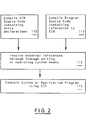
- Figure 2 shows the method of linking the application program and CCH.
- Figure 3 illustrates the use of stack frames in CCH.
- Figure 4 illustrates the relationship between the Handlers, Cursors and a stack frame in CCH.
- Figure 6 shows first example's stack and cursors after signaling condition.
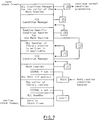
- Figure 8 shows stack view of library routine condition handling using caller's stack frame.
- Figure 9 is a block diagram of a Condition Token.
- the complete run-time environment will be called the Common Execution Environment(CEE).
- CEE The CEE runs in the problem state as a program separate from the operating system, but as noted it can easily be included as part of the operating system without essential modification being required.
- a Condition Model will be defined.
- the Condition Manager implements the Condition Model.
- CEEHDLR Callable routines in the CEE will be assigned label names such as CEEHDLR.
- Compilers and other programs can be written to link to and use the services provided by CEE regardless of their source languages.
- Figure 2 shows that CCH itself 110 and the application programs 111 are written with entry or external label declarations using standard prgramming tecnniques. These external references are resolved by the use of built-in operating system means or a standard linkage editor 112.
- CCH would typically be compiled into linkable object code by the system software producer and sold to an application or compiler writer as object code only.
- a user will execute step 111 and 112 and step 110 will have been performed previously by the CCH producer.
- Operating systems have various ways of loading and executing code similar to the CCH. For example, IBM's MVS operating system uses a link pack area (LPA) and dynamically copies the code from CCH into the user's address space only upon demand. Any mechanism provided by the particular operating system being used for linking will work.
- LPA link pack area
- the CCH handles conditions in the CEE run-time environment for high-level language compilers, debuggers, and assembler language user routines that adhere to the protocol required to interface with the Condition Manager.
- Applications, language library routines, and debuggers establish exits which the Condition Manager may invoke when a condition occurs. These exits are called subordinate condition handlers.
- Condition Manager performs all of the steps listed. Some steps may be omitted or repeated depending on the condition.
- Condition Manager User externals provided by the Condition Manager do not replace the prior condition handling user externals supplied in each language product. This, allows unmodified applications to run as before.
- the CCH is intended to provide a common condition handling base for products. Using the condition handling primatives provided by CCH, each HLL can enforce its own condition handling semantic actions.
- Transition to CCH-enabled versions of a language should be invisible to the single-language user, but the single-language user may want to make modifications to take advantage of the more powerful condition handling available under CCH. Applications written in multiple languages, however, may behave differently under CCH.
- the "Two-Cursor Model” The invention's execution environment condition handling model is most readily described in terms of the two-cursor model . This model envisions the invoked procedures of an application as residing in a last-in first-out (LIFO) stack, with two pointers (or “cursors”) pointing at various levels of the stack.
- LIFO last-in first-out
- the two-cursor model assumes that some condition handling information is logically associated with each stack frame. With the two-cursor model, two pointers into the stack are used (at least conceptually) to keep track of the state of condition handling: :
- condition handler is the deferral of condition handling for an unchanged condition.
- the condition handler can set the handle cursor to continue condition handling in one of two places:
- condition handling information associated with a stack frame logically includes handlers for several distinct phases of the overall handling process.
- the handling functions include:
- Unwinding is the action of calling all registered termination exit routines for a specified stack frame and then 'marking' the stack frame as non-active.
- termination exit handling breaks out termination exit handling as a separate and distinct activity. In combination with the resume cursor, it is this separation of termination exit handling from the remainder of condition handling which is part of the invention.
- the stack 201 is a commonly used way of storing data in the memory of the computer in a time sequence.
- the bottom of the stack as shown contains the oldest data and the newest data is on the top.
- the stack is composed of frames 202-205.
- Each frame contains a block of data including register values, instruction pointer and flags.
- Figure 4 shows by way of example that that associated with Program A's stack frame are two condition handlers: a User Condition Handler 210 and an HLL Condition Handler 211.
- the normal condition handling sequence traverses the stack from later stack frames toward earlier stack frames. If a condition has not been handled by the time that the stack has been traversed to stack frame zero, then the Condition Manager calls the High-Level Language condition handler for the zeroth stack frame. There is a specific indication that the handling is for stack frame zero. If the condition is still not handled after stack frame zero processing, then the Condition Manager default actions apply. The default action depends on the severity of the condition and whatever additional information is available. If any condition handler wishes to terminate the enclave instead of the thread, it must call CEETREN.
- a HLL condition handler When a new stack frame is allocated upon entry of a routine, a HLL condition handler is logically associated with the stack frame. The user may also optionally establish one or more additional condition handlers for that stack frame. When the routine returns to its caller, and the stack frame is deallocated, the HLL condition handler and the user-established condition handlers (if any exist) are dis-established.
- the zero'th stack frame is the stack frame that precedes the stack frame for the first routine.
- the condition handling semantics associated with the zero'th stack frame are the default actions defined by the model.
- Proc3's stack frame is known as the owning stack frame. That is, Proc3's stack frame owns the condition.
- a stack frame is allocated for the Condition Manager.
- the condition handler for the stack frame that had the condition is called for the enablement step. If the response is, the condition is valid, the Condition Manager visits each stack frame, commencing with the owning stack frame and moving stack frame by stack frame towards the zero'th stack frame, until either the condition is handled (in some form) or the current invocation stack is exhausted.
- the HLL condition handler associated with the stack frame is invoked so that the HLL error semantics may be enforced.
- a pointer the handle cursor, identifies the stack frame which has a condition handler currently in control or is about to gain control.
- the semantics of the model defined is that of a one pass stack frame based condition handler. This implies that each stack frame created by the application will be visited once and only once for a given condition. Each stack frame is given one opportunity to react to a condition. It may handle the condition, percolate the condition, or promote the condition.
- An exception to the one pass model is any stack frame owned by PL/I.
- the Condition Manager will re-drive all stack frames containing PL/I code if the condition reaches the PL/I condition handler at stack frame zero.
- the condition caused the Condition Manager's stack frame to be placed on the stack.
- the resume1 cursor "points" at the point at which the condition occurred.
- the handle1 cursor "points" at the last installed user condition handler. In this case it is user4. The following is the sequence of steps in processing the condition:
- Run-time Library routines which compute trigonometric functions are one example of Run-time Library routines.
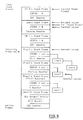
- Condition-handling for the run-time libraries must reflect the semantics of the language environment of the caller. Programming languages vary widely in condition handling semantic action in regard to library routines. A condition could be discovered internally by the library routine (e.g., parameter checking leads to domain error) or the Condition Manager could be the first to become aware of a condition (hardware zero divide exception). The steps are as follows:
- a valid action is to fix-up and resume.
- two conditions that can be returned to the routine-specific condition handler of the library routine are provided. They are: fix-up with new input value and resume with new output value.
- fix-up with new input value and resume with new output value.
- the identifying feedback token is returned to the library routine-specific condition handler. This handler, working in cooperation with the library routine and its caller, can then provide the logical actions necessary to properly do the indicated fix-up activity.
- Condition handling follows the same general process as when the library routine runs on its own stack-frame, but with differences as described in Figure 8.
- Order of processing at stack frame zero The normal condition handling sequence traverses the stack from later frames toward earlier frames. If a condition has not been handled by the time that the stack has been traversed to stack frame zero, the Condition Manager will take control of the expected actions. For compatibility with current language default condition handling, a virtual queue of language specific condition handlers is maintained for stack frame zero.
- stack frame zero There is logically one stack frame zero for each thread. It is the first application routine on the thread. Due to the fact that the thread may have non-CCH stack frames on it's stack without a way for CCH to go around them, CCH will assume a "Virtual" stack frame zero whenever one of these non-CCH stack frames are encountered. At this point stack frame zero processing will commence with the last CCH stack frame processed. There will be up to three High-Level Language condition handlers in this virtual queue. The first handler called is the non-multi pass High-Level Language condition handlers who may wish to have default processing at stack frame zero. The following occurs:
- the Second is the oldest PL/I or multi-pass High-Level Language on the stack. The following actions occur:
- the last handler in this queue is the Condition Manager which will implement the defined defaults for all unhandled conditions.
- Termination due to an unhandled condition The Condition Manager default action of terminating a thread if a condition of severity 2, 3, or 4 is unhandled, is accomplished by calling the CEEEXTD service. If the enclave is terminated as a result of the termination of a thread due to an unhandled condition, a value of 0 will be used as the user return code portion of the return code (i.e., any user return code is ignored).
- Handle Cursor Movement The handle cursor is not explicitly manipulated by either High-Level Language or user condition handlers. Its movement is actually controlled by the Condition Manager, but Condition Manager uses the result code that is returned by the condition handler to determine the action. This movement is toward the zeroth stack frame, except when the condition is promoted. In this instance, the handle cursor can point to the stack frame where the resume cursor points or to the current or first handler for the stack frame for which condition handling is currently occurring. Handling of promoted conditions may also continue at an earlier frame, of course, as for percolated conditions.
- Resume Cursor Movement The resume cursor is manipulated by the callable services CEEMRCR and CEEMRCE. When the resume cursor is moved to a particular stack frame, it has the effect of involuntarily terminating all frames from the previous resumption point up to but not including the new resumption point. As noted above, this may have the effect of truncating any condition handling that was active for any of these terminated frames.
- High-Level Language Regulations, Requirements, and Information In order to work in concert with each other, the HLL condition handlers must adhere to a set of regulations. Also, some extensions to the current High-Level Language error handling schemes are required so that the condition handling model is complete. By doing so, a consistent, cooperative view of the condition handling model is produced. This section lists these regulations and requirements on the HLL's, as well as some additional information provided to aid the HLL writer.
- the HLL condition handling models basically fall into two categories: the stack frame based model (e.g., PL/I), and the Global Error Table (G.E.T.) model (e.g., IBM FORTRAN). To ensure a consistent view of condition handling in a multi-language thread which may involve both models, cooperation is required among the HLL condition handlers.
- the stack frame based model e.g., PL/I
- G.E.T. Global Error Table
- IBM FORTRAN IBM FORTRAN
- the regulations for the HLL condition handling are:
- condition handling processing may be signaled by a program when there is no hardware or operating system detected problem.
- CCH provides the callable CEESGL service to create signals. Regardless of whether the source of the condition is the hardware, the operating system., or a software signal, the condition is first communicated to the Condition Manager. The Condition Manager may then pass control to the subordinate condition handlers, which continue condition handling processing.
- Subordinate may be invoked by the Condition Manager to handle conditions.
- Subordinate condition handlers are divided into three categories, including low-level error handlers, enablement routines, and condition handlers. These routines are called during different phases of CCH condition handling and are described below.
- Low-level Error Handlers If invoked, these routines handle the condition.
- the Condition Manager may resume execution at the next sequential instruction (after the point of interruption) in the program that caused the condition, or they may resume execution at a specified location. These routines are called by the low-level error handler.
- Enablement Routines determine if an condition (a hardware detected error, an operating system detected error, or a software signalled error) should be processed as a condition. In addition, these routines may provide low-level processing of an condition. Enablement routines are called during the enablement phase.
- the condition handlers examine the cause of the condition and perform any action required on the condition.
- the condition Manager invokes the condition handlers during the condition phase.
- the subordinate condition handlers respond to a condition with Resume, Percolate or Promote.
- the subordinate condition handlers must return to the Condition Manager which actually performs the requested action.
- the Resume cursor can be modified by first using the CEEMRCR callable service. Percolation of a condition occurs when a subordinate condition handler declines to handle the condition and gives the calling invocation an opportunity to handle it. This process may be repeated through multiple invocations within a thread before the condition is finally handled by some subordinate condition handler.
- a condition is promoted when a subordinate condition handler converts the condition into a new condition with a different meaning.
- a subordinate condition handler may promote a condition for a variety of reasons, including the subordinate condition handler's knowledge of the cause of the original condition or the subordinate condition handler's lack of knowledge of the cause.
- An example of the latter case is PL/I's promotion of an unhandled condition at stack frame zero to ERROR and resetting the handle cursor to the resume cursor.
- a condition may also be promoted to simulate conditions that would normally come from a different source.
- the Condition Manager continues processing by invoking subordinate condition handlers to handle the promoted condition. The order of invocation is described below. In addition, the Condition Manager retains information about the original condition.
- Condition Manager phases When a condition occurs, the Condition Manager enters separate phases to handle the condition.
- a phase is a sequence of subordinate condition handler invocations. Specific types of routines are invoked during each phase. Some types of routines may not be invoked during a particular phase.
- the Condition Manager phases have the following characteristics.
- condition handling When conditions occur or conditions are signalled during condition handling, the handling of the current condition is suspended and further action is taken based on the "state" of the condition handling that is being maintained in the CEECIB. If a nested condition is allowed, the Condition Manager begins handling the latest condition. When condition handling ends for the latest condition, execution begins at the instruction pointed to by the resume cursor. The resume cursor can be moved from its initial setting.
- Table 1 is a sample COBOL test program (EXCOND) which registers, tests and unregisters a user condition handler.
- Table 2 is a sample user condition handler (SIMHDLR) written in COBOL. For the variable Current-condition the first 8 bytes are declared as of the condition tokens for IBM's System/370 program interrupt codes OCl thru OCF.
- Table 3 is a sample COBOL routine (DIVZERO) to cause a condition. The program EXCOND installs SIMHDLR and tests it by calling DIVZERO.
- the CEECIB for which the condition handler is being called This value is passed by reference.
- Part of the CEECIB is the condition_token and the machine environment for the procedure in which the condition occured.
- This field contains the instructions indicating the actions that the language-specific handler wants the condition manager to take as a result of processing the condition. This field in passed by reference. The following are valid responses:
- the new condition token representing the promoted condition This field is used only for result values of 30, 31, 32, and 33 denoting promote.
- the DSA that is the target for the resume is the target for the resume.
- CEEUDHD is used to unregister a condition handler registered by CEEDHDL. void CEEUDHD (routine, [fc]);
- AMIs Application Writer's Interfaces
- CEEHDLR The callable service, CEEHDLR, has one function - to register a user condition handler for the current stack frame.
- a queue will be provided for each stack frame to accommodate these routines.
- the queue may be empty.
- the condition manager accesses the queue elements in LIFO order.
- Any registered user condition handlers (created through CEEHDLR and not unregistered by CEEHDLU) are unregistered automatically by CCH upon removal of the associated stack frame from the stack. There is no requirement for the user to remember to remove registered user condition handlers.
- void CEEHDLR routine, token, [fc]
- This routine must be an external routine. That is, it must not be a nested routine.
- CEEHDLU The callable service, CEEHDLU, as one function - to unregister a user condition handler for the current stack frame.
- Any registered user condition handler (created through CEEHDLR and not unregistered by CEEHDLU) is unregistered automatically by CCH upon removal of the associated stack frame from the stack. There is no requirement for the user to remember to remove registered user condition handlers.
- void CEEHDLU routine, [fc]
- CEEMRCE The callable service CEEMRCE moves the resume cursor relative to a current position of the handle cursor.
- the actions supported are:
- CEESGL This callable service raises, or signals, a condition, provides qualifying data for this instance of the condition, and optionally creates Instance Specific Information for this condition
- Each enabled signalled condition (of severity 2 or above) increments the error count by one. If the error count becomes equal or exceeds the error count limit (determined by the ERRCOUNT run-time option) the condition manager will terminate the enclave without signalling Termination_Imminent. Promoted conditions do not increment the error count.
- This field contains the instructions indicating the actions that the user condition handler wants the condition manager to take as a result of processing the condition. This field in passed by reference. The following are valid responses
- the new condition token representing the promoted condition This field is used only for results values of 30, 31, and 32, denoting promote , and of 60 denoting fix-up and resume.
- CEE3CNC - Control nested conditions The function of the CEE3CNC service is to allow or prohibit a condition handler to permit nested conditions within a user specified condition handler which was registered via CEEHDLR. When a condition handler is first entered, nested conditions are not tolerated. When a nested condition does occur when it is not permitted, then the application is terminated with an ABEND 4087, reason code 2. However, within a user handler, if another user handler is registered (via a call to CEEHDLR), nested conditions are allowed within the user handler so long as another user handler remains registered or is explicitly disallowed via CEE3CNC.
- the feedback code indicating sucess or failure of the operation.
- the following message identifiers and associated severities may be returned by the service in the feedback code fc.
- a set of AWI services is provided that will indicate to CCH "execution out of CCH” and a "return to CCH".
- the services are CEE3XIT and CEE3RTN. void CEE3XIT; void CEE3RTN;
- CEERTX The function provided by the CEERTX service is to register a user-defined routine to be executed when the stack-frame for which it is registered is abnormally terminated/collapsed. void CEERTX(routine, token, [fc])
- the CEERTX service could not find the proper prolong constants at the start of the routine.
- CEEUTX The function provided by the CEEUTX service, is to un-register a user defined routine that was previously registered to be executed when the stack-frame for which it is registered is abnormally terminated.
- the CEEUTX service operates on the user stack-frame termination exits that are registered for the stack-frame from which the CEEUTX service is called. void CEEUTX(routine, [fc])
- the invention provides for a condition to be communicated via a 12-byte (96-bit) condition token data type.
- the return information (feedback code) from a callable service is an instance of this data type.
- the advantages of the condition token data type include:
- CEECTOK Condition Token data type
- Condition Token 12 bytes (96 bits) long and contains the following information (represented in C syntax):
- the Case field determines the type of identifier. Two identifiers are defined:
- the combination of Facility_ID and Msgno uniquely identifies a condition.
- the Facility_ID is associated with the repository (for example, a file) of the run-time messages and when associated with a message number uniquely identifies a message within the repository.
- the conventions for naming the message repository are platform-specific.
- the Facility_ID need not be unique within the system and can be determined by the application writer.
- Each platform has its own method for locating the message repository. For example, on OS/2, an environment variable; on VM/CMS, a file definition (FILEDEF); on MVS, a ddname can be used.
- the Msgno / Facility_ID identifies a condition for an enabled product. This identification is required to be persistent beyond the scope of a single session. This allows the meaning of the condition and its associated message to be determined after the session that produced the condition has ended.
- the value 1 identifies a case 1 condition
- the value 2 identifies a case 2 condition.
- the value 0 is reserved for platform specific use and the value 3 has been reserved for future use.
- this field contains the same value as the Severity field in the Condition_ID.
- a 3-bit field containing flags that describe or control various aspects of condition handling as follows:
- I_S_Info field contains a value of binary zero.
- a Feedback Code is an instance of a Condition Token (structure CEECTOK).
- a Feedback Code is returned from a service call if the caller has passed a reference to an area to hold it.
- ISI Instance Specific Information
- ISI Instance Specific Information
- condition- and/or language- and/or application-specific The existence and/or use of, either of both of these information items is condition- and/or language- and/or application-specific. That is, a given message may or may not have a requirement for insert data.
- condition qualifying data Q_Data
- condition token is designed to be used across multiple platforms which may have widely varying pointer lenghts
- the 4 bytes used for ISI handle have not been defined as a pointer although it is possible that on some platforms it could in fact be a pointer.
- the handle could be a 32 bit pointer. In general, it is defined as being information which identifies the location of the ISI data.
- Various standard programming techniques for making indirect references may be used.
- the format and structure of the ISI is platform specific but, the ISI must contain the following data items: where:
- This "data object” is a 32-bit item used to access the qualifying data.
- a 4-byte integer containing the insert sequence number (e.g., insert 1, insert 2). It corresponds to that specified with an insert identifier in the message source file.
- One of the uses of this invention is in the production of run-time messages that are associated with the condition represented by an instance of a CEECTOK.
- Message processing is closely related to the condition handling model that is chosen by a given application. Facilities are provided for the application programmer to have a choice of two condition handling models, determined by how the Services are called. The following is an overview of how message processing will occur with the use of each of these two condition handling models and the use of the condition token (CEECTOK) representing a condition:
- the callable service CEESGL raises, or signals, a condition to the Condition Manager, provides qualifying data for this instance of the condition, and optionally creates Instance Specific Information for this condition.
- Each enabled signaled condition (of severity 2 or above) increments the error count by one. If the error count becomes equal or exceeds the error count limit (determined by the ERRCOUNT run-time option) the condition manager will terminate the enclave without signaling Termination_Imminent. Promoted conditions do not increment the error count.
- Severity 0 and 1 conditions are considered 'safe' conditions, which are conditions that should be ignored if they are not handled and no feedback token was passed when the condition was raised.
- CEESGL externally callable subroutine interface is defined using C syntax as follows: void CEESGL (cond_rep, [q_data_token], [fc]);
- the value 1 identifies a case 1 condition
- a value of 2 identifies a case 2 condition.
- the values 0 and 3 are reserved.
- a 2-byte binary integer that indicates the condition's severity For case 1 conditions, the value of this field is the same as in the Condition_ID. For case 1 and 2 conditions, this field may always be used to test the condition's severity.
- the caller will load the insert data into the storage area in the order of insertion for the first message followed by the data required for the second message.
- Message Services will treat these as a pair of messages and use the same Message Insert Block (CEEMIB) for both messages.
- CEEMIB Message Insert Block
- the 8-byte representation of the constructed condition or feedback information is the 8-byte representation of the constructed condition or feedback information.
- CEEDCOD Cond_Token,C_1,C_2,Case,Severity,Control,Facility_ID,[fc]
- An 8-byte condition token (CEECTOK) representing the current condition or feedback information.
- a 2-byte binary integer field that defines the format of the Condition_ID portion of the token.
- a value of 1 identifies a case 1 condition.
- a value of 2 identifies a case 2 condition.
- the values 0 and 3 are reserved.
- a 16-bit field containing flags describing aspects of the state of the condition.
- a 3-character field containing three alphanumeric characters identifying the product generating the condition or feedback information.
- CEE provides a CWI that is IBM System/370 specific that will construct a condition token given a facility id and a message number.
- the name of the service is CEEGETFB.
- CEEGETFB Construct a Condition Token given a facility id and a message number: CEEGETFB constructs a case 1 condition token given a facility id and a message number. The severity will be retrieved from the appropriate message file containing the message number. void CEEGETFB (facility_id, message_no, cond_token, [fc]);
- a case 1 style 8-byte condition token (CEECTOK) that is constructed from the facility_id, message_no, and the severity which is obtained from the appropriate file containing the message definition.
- a 4-byte binary integer representing the message number for the resulting condition token A 4-byte binary integer representing the message number for the resulting condition token.
- the 3 character facility id that will be placed into the resulting condition token. It will be used to determine the file containing the message definition and message text.
Landscapes
- Engineering & Computer Science (AREA)
- Theoretical Computer Science (AREA)
- Software Systems (AREA)
- Physics & Mathematics (AREA)
- General Engineering & Computer Science (AREA)
- General Physics & Mathematics (AREA)
- Quality & Reliability (AREA)
- Multimedia (AREA)
- Devices For Executing Special Programs (AREA)
Applications Claiming Priority (2)
| Application Number | Priority Date | Filing Date | Title |
|---|---|---|---|
| US75570691A | 1991-09-06 | 1991-09-06 | |
| US755706 | 1991-09-06 |
Publications (2)
| Publication Number | Publication Date |
|---|---|
| EP0531108A2 true EP0531108A2 (fr) | 1993-03-10 |
| EP0531108A3 EP0531108A3 (en) | 1993-09-22 |
Family
ID=25040299
Family Applications (1)
| Application Number | Title | Priority Date | Filing Date |
|---|---|---|---|
| EP19920307956 Withdrawn EP0531108A3 (en) | 1991-09-06 | 1992-09-02 | Program condition handling |
Country Status (3)
| Country | Link |
|---|---|
| US (1) | US5630137A (fr) |
| EP (1) | EP0531108A3 (fr) |
| JP (1) | JPH0831041B2 (fr) |
Cited By (4)
| Publication number | Priority date | Publication date | Assignee | Title |
|---|---|---|---|---|
| EP0547840A3 (en) * | 1991-12-19 | 1993-12-15 | Ibm | Event handling in a high level programming language environment |
| WO1994022081A1 (fr) * | 1993-03-25 | 1994-09-29 | Taligent, Inc. | Systeme d'interruption a niveaux multiples |
| US5428772A (en) * | 1991-10-01 | 1995-06-27 | Prime Computer, Inc. | Data processing system providing user interaction in multiple natural languages |
| WO1995017719A1 (fr) * | 1993-12-21 | 1995-06-29 | Taligent, Inc. | Systeme d'interruption oriente objets |
Families Citing this family (11)
| Publication number | Priority date | Publication date | Assignee | Title |
|---|---|---|---|---|
| US5845121A (en) * | 1995-10-06 | 1998-12-01 | International Business Machines Corporation | Expression evaluation in a multi-language debugger |
| US5758161A (en) * | 1996-05-24 | 1998-05-26 | International Business Machines Corporation | Testing method for checking the completion of asynchronous distributed collective operations |
| US6564376B1 (en) * | 1999-09-30 | 2003-05-13 | International Business Machines Corporation | Method, system and program products for operationally backing out components of a cluster through emulation |
| US8312429B2 (en) * | 2000-11-10 | 2012-11-13 | Oracle International Corporation | Cell based data processing |
| WO2002039647A2 (fr) * | 2000-11-10 | 2002-05-16 | Bea Systems, Incorporated | Procede d'execution multilangage |
| US8156471B2 (en) * | 2001-11-09 | 2012-04-10 | Oracle International Corporation | Multi-language execution method |
| US7275238B2 (en) * | 2002-03-28 | 2007-09-25 | International Business Machines Corporation | Program event activated and configured debugger method, system, article of manufacture, computer program product, and data structure |
| US7357332B2 (en) * | 2005-04-29 | 2008-04-15 | International Business Machines Corporation | Providing diagnostic information on the processing of variables in source code |
| EP1902359A1 (fr) * | 2005-07-08 | 2008-03-26 | Corizon Limited | Procede et dispositif de modification de l'interface-utilisateur |
| WO2014074629A1 (fr) * | 2012-11-06 | 2014-05-15 | Intuit Inc. | Localisation adaptative basée sur pile et internationalisation d'applications |
| US11442739B2 (en) * | 2019-09-16 | 2022-09-13 | International Business Machines Carporation | Exception handling |
Family Cites Families (22)
| Publication number | Priority date | Publication date | Assignee | Title |
|---|---|---|---|---|
| BE758813A (fr) * | 1969-11-28 | 1971-04-16 | Burroughs Corp | Structures de programme pour la mise en oeuvre de systemes de traitement d'information, communes a des langages de programme de niveau plus eleve |
| US3794980A (en) * | 1971-04-21 | 1974-02-26 | Cogar Corp | Apparatus and method for controlling sequential execution of instructions and nesting of subroutines in a data processor |
| JPS51113435A (en) * | 1975-03-28 | 1976-10-06 | Hitachi Ltd | Offering processor |
| US4041462A (en) * | 1976-04-30 | 1977-08-09 | International Business Machines Corporation | Data processing system featuring subroutine linkage operations using hardware controlled stacks |
| JPS5311547A (en) * | 1976-07-20 | 1978-02-02 | Oki Electric Ind Co Ltd | Program call order system |
| JPS54107643A (en) * | 1978-02-13 | 1979-08-23 | Toshiba Corp | Operation control method and unit executing structured program |
| US4488227A (en) * | 1982-12-03 | 1984-12-11 | Honeywell Information Systems Inc. | Program counter stacking method and apparatus for nested subroutines and interrupts |
| US4862351A (en) * | 1983-09-01 | 1989-08-29 | Unisys Corporation | Method of executing called activities via depictor-linked low level language microcode, hardware logic, and high level language commands; and apparatus for same |
| US4564903A (en) * | 1983-10-05 | 1986-01-14 | International Business Machines Corporation | Partitioned multiprocessor programming system |
| JPS6151243A (ja) * | 1984-08-20 | 1986-03-13 | Toshiba Corp | レジスタ式演算処理装置 |
| US4980820A (en) * | 1985-02-28 | 1990-12-25 | International Business Machines Corporation | Interrupt driven prioritized queue |
| US5027273A (en) * | 1985-04-10 | 1991-06-25 | Microsoft Corporation | Method and operating system for executing programs in a multi-mode microprocessor |
| US4835685A (en) * | 1985-05-06 | 1989-05-30 | Computer X, Inc. | Virtual single machine with message-like hardware interrupts and processor exceptions |
| US4768149A (en) * | 1985-08-29 | 1988-08-30 | International Business Machines Corporation | System for managing a plurality of shared interrupt handlers in a linked-list data structure |
| US4811208A (en) * | 1986-05-16 | 1989-03-07 | Intel Corporation | Stack frame cache on a microprocessor chip |
| JPS63278145A (ja) * | 1987-05-11 | 1988-11-15 | Nec Corp | パラメ−タ対応検査方式 |
| DE3855029T2 (de) * | 1987-06-12 | 1996-09-05 | Bmc Software Inc | Supervisorverfahren für ein Rechnerbetriebssystem |
| US5220669A (en) * | 1988-02-10 | 1993-06-15 | International Business Machines Corporation | Linkage mechanism for program isolation |
| JPH0247728A (ja) * | 1988-08-08 | 1990-02-16 | Nec Corp | フォルト処理管理方式 |
| US5097533A (en) * | 1988-11-29 | 1992-03-17 | International Business Machines Corporation | System and method for interfacing computer application programs written in different languages to a software system |
| US5103498A (en) * | 1990-08-02 | 1992-04-07 | Tandy Corporation | Intelligent help system |
| US5305455A (en) * | 1990-12-21 | 1994-04-19 | International Business Machines Corp. | Per thread exception management for multitasking multithreaded operating system |
-
1992
- 1992-08-21 JP JP4222652A patent/JPH0831041B2/ja not_active Expired - Lifetime
- 1992-09-02 EP EP19920307956 patent/EP0531108A3/en not_active Withdrawn
-
1995
- 1995-02-13 US US08/387,494 patent/US5630137A/en not_active Expired - Fee Related
Cited By (6)
| Publication number | Priority date | Publication date | Assignee | Title |
|---|---|---|---|---|
| US5428772A (en) * | 1991-10-01 | 1995-06-27 | Prime Computer, Inc. | Data processing system providing user interaction in multiple natural languages |
| EP0547840A3 (en) * | 1991-12-19 | 1993-12-15 | Ibm | Event handling in a high level programming language environment |
| WO1994022081A1 (fr) * | 1993-03-25 | 1994-09-29 | Taligent, Inc. | Systeme d'interruption a niveaux multiples |
| US5630141A (en) * | 1993-03-25 | 1997-05-13 | Taligent, Inc. | Hierarchical apparatus and method for processing device interrupts in a computer system |
| WO1995017719A1 (fr) * | 1993-12-21 | 1995-06-29 | Taligent, Inc. | Systeme d'interruption oriente objets |
| US5680624A (en) * | 1993-12-21 | 1997-10-21 | Object Licensing Corporation | Object oriented interrupt system |
Also Published As
| Publication number | Publication date |
|---|---|
| JPH0831041B2 (ja) | 1996-03-27 |
| US5630137A (en) | 1997-05-13 |
| JPH05250182A (ja) | 1993-09-28 |
| EP0531108A3 (en) | 1993-09-22 |
Similar Documents
| Publication | Publication Date | Title |
|---|---|---|
| US5455949A (en) | Method for representing and signaling run-time program conditions | |
| US5774729A (en) | Event handling in a high level programming language environment | |
| US5583988A (en) | Method and apparatus for providing runtime checking features in a compiled programming development environment | |
| US6745385B1 (en) | Fixing incompatible applications by providing stubs for APIs | |
| US5715463A (en) | Installation utility for device drivers and utility programs | |
| US6351843B1 (en) | Dynamically inserting a function into an application executable at runtime | |
| Robbins et al. | UNIX systems programming: communication, concurrency, and threads | |
| US5628016A (en) | Systems and methods and implementing exception handling using exception registration records stored in stack memory | |
| US6615342B1 (en) | Method and apparatus for object-oriented interrupt system | |
| US6345382B1 (en) | Run-time customization in object-oriented design | |
| US5630137A (en) | Condition handling in a multi-language computer program | |
| US6131187A (en) | Method and system for translating exception handling semantics of a bytecode class file | |
| EP0945792A2 (fr) | Techniques pour realiser un cadre pour des applications extensibles | |
| US20020029374A1 (en) | Generalised program hooks | |
| EP0531107A2 (fr) | Gérant d'exécution de programmes | |
| CA2386658A1 (fr) | Systeme d'elements de logiciel reutilisables pour mettre en oeuvre une execution simultanee et un acces au materiel, et procedes d'utilisation | |
| JPH02272627A (ja) | デイジタル・コンピユータ・システムとその手続呼び出し方法 | |
| US6834391B2 (en) | Method and apparatus for automated native code isolation | |
| US20030221035A1 (en) | CPU life-extension apparatus and method | |
| WO2005045672A1 (fr) | Implementation d'un traitement distribue et asynchrone en cobol | |
| US7607125B2 (en) | Programming language support for integrating undo and exception handling | |
| EP0784264B1 (fr) | Procédé implémenté par ordinateur pour la détermination de code minimal pour une application exécutable dans un système de traitement de données | |
| US20040098639A1 (en) | Debugging kernel-loadable modules and suspending and replacing functions in non-microkernel operating systems | |
| US7089242B1 (en) | Method, system, program, and data structure for controlling access to sensitive functions | |
| US6012149A (en) | Computer system with polymorphic fault processing |
Legal Events
| Date | Code | Title | Description |
|---|---|---|---|
| PUAI | Public reference made under article 153(3) epc to a published international application that has entered the european phase |
Free format text: ORIGINAL CODE: 0009012 |
|
| AK | Designated contracting states |
Kind code of ref document: A2 Designated state(s): DE FR GB |
|
| PUAL | Search report despatched |
Free format text: ORIGINAL CODE: 0009013 |
|
| 17P | Request for examination filed |
Effective date: 19930716 |
|
| AK | Designated contracting states |
Kind code of ref document: A3 Designated state(s): DE FR GB |
|
| 17Q | First examination report despatched |
Effective date: 19951117 |
|
| GRAG | Despatch of communication of intention to grant |
Free format text: ORIGINAL CODE: EPIDOS AGRA |
|
| GRAH | Despatch of communication of intention to grant a patent |
Free format text: ORIGINAL CODE: EPIDOS IGRA |
|
| STAA | Information on the status of an ep patent application or granted ep patent |
Free format text: STATUS: THE APPLICATION IS DEEMED TO BE WITHDRAWN |
|
| 18D | Application deemed to be withdrawn |
Effective date: 19970301 |