EP0531405B1 - Rundfunkempfängersystem - Google Patents
Rundfunkempfängersystem Download PDFInfo
- Publication number
- EP0531405B1 EP0531405B1 EP91910472A EP91910472A EP0531405B1 EP 0531405 B1 EP0531405 B1 EP 0531405B1 EP 91910472 A EP91910472 A EP 91910472A EP 91910472 A EP91910472 A EP 91910472A EP 0531405 B1 EP0531405 B1 EP 0531405B1
- Authority
- EP
- European Patent Office
- Prior art keywords
- labels
- programme
- entered
- programme labels
- received
- Prior art date
- Legal status (The legal status is an assumption and is not a legal conclusion. Google has not performed a legal analysis and makes no representation as to the accuracy of the status listed.)
- Expired - Lifetime
Links
- 230000005540 biological transmission Effects 0.000 claims description 7
- 238000006243 chemical reaction Methods 0.000 claims description 6
- 238000000034 method Methods 0.000 claims description 6
- 238000013507 mapping Methods 0.000 abstract description 10
- 230000006870 function Effects 0.000 description 15
- 230000002441 reversible effect Effects 0.000 description 2
- 230000003111 delayed effect Effects 0.000 description 1
- 230000001419 dependent effect Effects 0.000 description 1
- 230000003278 mimic effect Effects 0.000 description 1
Images
Classifications
-
- H—ELECTRICITY
- H04—ELECTRIC COMMUNICATION TECHNIQUE
- H04N—PICTORIAL COMMUNICATION, e.g. TELEVISION
- H04N7/00—Television systems
- H04N7/08—Systems for the simultaneous or sequential transmission of more than one television signal, e.g. additional information signals, the signals occupying wholly or partially the same frequency band, e.g. by time division
- H04N7/087—Systems for the simultaneous or sequential transmission of more than one television signal, e.g. additional information signals, the signals occupying wholly or partially the same frequency band, e.g. by time division with signal insertion during the vertical blanking interval only
- H04N7/088—Systems for the simultaneous or sequential transmission of more than one television signal, e.g. additional information signals, the signals occupying wholly or partially the same frequency band, e.g. by time division with signal insertion during the vertical blanking interval only the inserted signal being digital
- H04N7/0887—Systems for the simultaneous or sequential transmission of more than one television signal, e.g. additional information signals, the signals occupying wholly or partially the same frequency band, e.g. by time division with signal insertion during the vertical blanking interval only the inserted signal being digital for the transmission of programme or channel identifying signals
-
- H—ELECTRICITY
- H04—ELECTRIC COMMUNICATION TECHNIQUE
- H04N—PICTORIAL COMMUNICATION, e.g. TELEVISION
- H04N5/00—Details of television systems
- H04N5/76—Television signal recording
- H04N5/78—Television signal recording using magnetic recording
- H04N5/782—Television signal recording using magnetic recording on tape
Definitions
- the viewer may enter, by means of a keypad, the labels of the programmes he or she wishes to be automatically recorded.
- the video recorder is set to "record" mode. Using such a system the desired programmes will still be correctly recorded even if their transmission is delayed or re-scheduled.
- the broadcaster has 65,536 possible 16-bit binary numbers available. Of these, the broadcaster would be well advised to choose a subset whose bit patterns, over a period of several days, differ from each other in at least two positions. This reduces the risk of a single bit error imitating a wanted label and so causing the false triggering of a video recorder.
- the use of low value numbers would be of great advantage to the viewer. Low value numbers also take up little room when printed in a television (TV) programme listing and are less susceptible to publishing error.
- Video recorders are known from EP-A-0 133 985 and EP-A-0 122 626 which are provided with a bar code reader which can be used by the viewer to enter programme schedule data into a memory. This data is compared with transmitted signals to determine which programmes are to be recorded and to control a recorder accordingly. This overcomes the problem of long codes because the viewer does not have to enter them, but at the expense of a bar code reader associated with each receiver.
- Our GB-A-2 192 743 describes a unit which recovers video recorder type commands from an off-air TV signal, and generates infra-red signals representing RECORD and STOP which mimic the signals generated by a normal remote control unit. This does not assist in the problem of entering 16-bit programme labels by the viewer.
- a code converter is described in GB-A-2 191 643 which receives a generalised PLAY command from a remote controller and converts it to a specific PLAY command required to activate the currently selected one of a number of video sources, all controllable by the same remote control unit. It is of course known to add increased error protection to digital data transmissions by adding protection bits, allowing erroneous data to be detected and possibly corrected at a receiver, see e.g. GB-A-2 038 145. It has also been proposed to add bits to a digital data stream in order to label it and facilitate its subsequent identification, see e.g. GB-A-2 196 517.
- the problem is solved in accordance with this invention by defining a function that maps input decimal numbers at the low end of the range, such as 0 to 999, to output numbers chosen from the full range of 0 to 65,535 and having markedly different bit patterns.
- a function that maps input decimal numbers at the low end of the range, such as 0 to 999, to output numbers chosen from the full range of 0 to 65,535 and having markedly different bit patterns.
- the function preferably should also accept input numbers in the remainder of the range up to 65,535. This allows a broadcaster to publish four- or five-digit (decimal) programme labels if (in this example) the one thousand labels with three or fewer digits are insufficient to cover a particularly programme-intensive period. In this case, the corresponding output numbers must still be unique but they can no longer be guaranteed to differ from each other in at least two (binary) bit positions. In a practical system, the function would obviously need to be specified and provided in all decoders as well as being used by the broadcaster compiling the 16-bit (binary) labels for transmission.
- a one-to-one mapping function is used, i.e. each possible input value maps onto a unique output value, and vice versa.
- Such a function may be implemented as a look-up table.
- the input number specifies the location within the table at which the output number can be found.
- suitable mapping functions based on modulo-2 arithmetic may be found.
- the method described provides the broadcaster with well spaced, error tolerant, 16-bit numbers and the viewer with short, easily-typed programme labels.
- the method does not restrict the broadcaster to a subset of the 65,536 possible programme labels. Indeed all 65,536 values may be used, when appropriate, at the expense of a little extra keying on behalf of the viewer.
- the system can be applied to any programme delivery service, (i.e. VPS, or format 1 or 2), including radio programmes to be recorded on an audio recorder. It makes the manual selection of programmes quicker, simpler, and less likely to error, and reduces the apparent complexity of keyboard entry. It is particularly applicable to subscription television.
- VPS programme delivery service
- format 1 or 2 radio programmes to be recorded on an audio recorder. It makes the manual selection of programmes quicker, simpler, and less likely to error, and reduces the apparent complexity of keyboard entry. It is particularly applicable to subscription television.
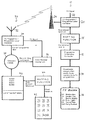
- the accompanying drawing shows a programme delivery control (PDC) system embodying the invention comprising a transmitting station 10 and a receiving station 30.
- the transmitting station includes a programme scheduling computer 12 which is controlled by the broadcaster 14 who assigns to each television programme an identification number called a programme label. These are short easily-typed numbers, and are printed in the TV Guide as illustrated diagrammatically at 16.
- the computer outputs the current short label for each programme and a mapping function processor 18 converts this to a full 16-bit binary code. This is combined in a combiner 20 with a television signal received at an input 22 and applied to the transmitter 24. Typically the programme label is continuously carried as a part of the broadcaster's teletext service data.
- the signal is received by an antenna 32 and processed in conventional fashion by circuits not shown.
- a separator circuit 34 separates the 16-bit programme label from the TV signal and applies the TV signal to a video recorder 36.
- the extracted programme labels are applied to a label comparison circuit 38, where they are compared with a list of wanted labels held in a store 40. So long as the current programme label matches one of the stored labels, the video recorder records the received TV signal. When the current programme label no longer matches any wanted labels, the video recorder stops recording.
- the wanted labels are entered into the store 40 by the user keying the short labels on a keypad 42.
- the keypad has ten keys 0 to 9 and an ENTER key, thus permitting codes of varying length to be entered.
- mapping function processor 44 which mirrors the operation of the processor 18 at the transmitter and converts the short labels to the full 16 bit labels.
- the broadcaster assigns to each TV programme a short, easily typed number. It is this number which is published adjacent to the programme entry in a TV guide.
- the mapping function is used to transform the short number into a more error tolerant value suitable for transmission along with the TV programme.
- the mapping function is also used within the receiver to transform short, easily-typed numbers entered by the viewer into their error tolerant equivalents. These may then be compared with the currently received programme label to determine whether or not to record the current TV programme.
- the received programme labels could be applied to an inverse mapping function to convert them to the short label form and the short labels then compared.
- comparison would mean re-conversion to binary, and the arrangement illustrated is preferred.
- Table 2 demonstrates how modulo-2 based arithmetic may be used to transform low value consecutive 16-bit binary numbers into output values whose bit patterns differ markedly from neighbouring values.
- the algorithm assumes a 16-bit input number with individual bit positions labelled 0 (Least Significant Bit) to 15 (Most Significant Bit). Table 2 If this bit is set... then invert these bits... STEP 1) 0 15,14,13,12,11,10,9,8,7,6,5,4,3,2,1 STEP 2) 1 15,13,11,9,7,5,3 STEP 3) 2 7,6,5,4 STEP 4) 3 11,10,9,8 STEP 5) 4 15,14,13,12 STEP 6) 5 8,7,6 STEP 7) 6 11,10,9 STEP 8) 7 14,13,12
Landscapes
- Engineering & Computer Science (AREA)
- Multimedia (AREA)
- Signal Processing (AREA)
- Input Circuits Of Receivers And Coupling Of Receivers And Audio Equipment (AREA)
- Television Systems (AREA)
- Circuits Of Receivers In General (AREA)
- Two-Way Televisions, Distribution Of Moving Picture Or The Like (AREA)
Claims (11)
- Rundfunkempfängersystem, aufweisend eine Einrichtung (32) zum Empfang eines Rundfunksignals und zur Bereitstellung einer für ein Rundfunkprogramm repräsentativen Programmausgabe, eine Einrichtung (34) zur Identifikation von Programmkennsätzen im empfangenen Rundfunksignal, eine Einrichtung (42) zur Eingabe ausgewählter Programmkennsätze für eine selektive Steuerfunktion, eine Einrichtung (40) zur Speicherung der eingegebenen Programmkennsätze und eine Einrichtung (38) zum Vergleichen der gespeicherten und empfangenen Programmkennsätze, dadurch gekennzeichnet, daß die ausgewählten eingegebenen Programmkennsätze weniger Bits als die entsprechenden Programmkennsätze im empfangenen Signal aufweisen können, und gekennzeichnet durch eine Kennsatzumsetzungseinrichtung (44), die zwischen die Eingabeeinrichtung und die Vergleichseinrichtung geschaltet ist, um zumindest einige der über die Eingabeeinrichtung eingegebenen Kennsätze einer Codeumsetzung zu unterziehen.
- System nach Anspruch 1, in welchem die Umsetzungseinrichtung eine Nachschlagetabelle umfaßt.
- System nach Anspruch 1 oder 2, in welchem die eingegebenen ausgewählten Programmkennsätze Dezimalziffern umfassen.
- System nach Anspruch 1, 2 oder 3, in welchem die Steuerfunktion den Betrieb eines Rekorders zur Aufzeichnung des empfangenen Programms umfaßt.
- System nach einem der Ansprüche 1 bis 4, in welchem die Umsetzungseinrichtung zwischen die Eingabeeinrichtung und die Speichereinrichtung geschaltet ist.
- System nach einem der Ansprüche 1 bis 5, in welchem die Kennsatzumsetzungseinrichtung zumindest einige der einem Eingang der Vergleichseinrichtung zugeführten Kennsätze derart einer Codeumsetzung auf einer Eins-zu-Eins-Basis unterzieht, daß die ausgewählten eingegebenen Programmkennsätze weniger Bits als die entsprechenden Programmkennsätze im empfangenen Signal aufweisen können, wobei solche entsprechenden Programmkennsätze sich bei zumindest zwei Binär-Bitstellen voneinander unterscheiden.
- System nach Anspruch 6, in welchem die ausgewählten eingegebenen Programmkennsätze ferner sämtliche möglichen Kennsätze umfassen können, die durch die Zahl der Bits in den empfangenen Programmkennsätzen identifiziert werden können.
- Verfahren zum Empfang eines mit Programmkennsätzen versehenen Rundfunksignals, aufweisend die Schritte des Eingebens ausgewählter Programmkennsätze für eine selektive Steuerfunktion, des Speicherns der eingegebenen Programmkennsätze, des Identifizierens von Programmkennsätzen im empfangenen Rundfunksignal und des Vergleichens der gespeicherten und empfangenen Programmkennsätze, dadurch gekennzeichnet, daß zumindest einige der eingegebenen ausgewählten Programmkennsätze zur Speicherung derart einer Codeumsetzung unterzogen werden, daß die ausgewählten eingegebenen Programmkennsätze weniger Bits als die entsprechenden Programmkennsätze im empfangenen Rundfunksignal aufweisen können.
- Verfahren nach Anspruch 8, in welchem die Steuerfunktion die Steuerung eines Videorekorders zur Aufzeichnung des ausgewählten Programms umfaßt.
- Verfahren nach Anspruch 8 oder 9, in welchem die eingegebenen ausgewählten Programmkennsätze Dezimalziffern umfassen.
- Rundfunksendesystem, aufweisend eine Einrichtung zur Erzeugung eines Fernsehsignals zum Rundsenden, eine Einrichtung (12, 14), die Programmkennsätze Programmen im Fernsehsignal zuordnet, und eine Einrichtung (20) zur Kombination von Programmkennsätzen mit dem zu sendenden Fernsehsignal, gekennzeichnet durch eine Kennsatzumsetzungseinrichtung (18), die zwischen die Zuordnungseinrichtung und die Kombinationseinrichtung geschaltet ist, um durch die Zuordnungseinrichtung zugeordnete Kurzcode-Programmkennsätze einer Codeumsetzung auf einer Eins-zu-Eins-Basis in Sendeprogrammkennsätze zu unterziehen, die mehr Bits als die Kurzcode-Programmkennsätze aufweisen.
Applications Claiming Priority (3)
| Application Number | Priority Date | Filing Date | Title |
|---|---|---|---|
| GB909012005A GB9012005D0 (en) | 1990-05-30 | 1990-05-30 | Broadcast receiver system |
| GB9012005 | 1990-05-30 | ||
| PCT/GB1991/000863 WO1991019391A1 (en) | 1990-05-30 | 1991-05-30 | Broadcast receiver system |
Publications (2)
| Publication Number | Publication Date |
|---|---|
| EP0531405A1 EP0531405A1 (de) | 1993-03-17 |
| EP0531405B1 true EP0531405B1 (de) | 1996-09-25 |
Family
ID=10676743
Family Applications (1)
| Application Number | Title | Priority Date | Filing Date |
|---|---|---|---|
| EP91910472A Expired - Lifetime EP0531405B1 (de) | 1990-05-30 | 1991-05-30 | Rundfunkempfängersystem |
Country Status (7)
| Country | Link |
|---|---|
| US (1) | US5812206A (de) |
| EP (1) | EP0531405B1 (de) |
| JP (1) | JPH05506559A (de) |
| AT (1) | ATE143556T1 (de) |
| DE (1) | DE69122386T2 (de) |
| GB (2) | GB9012005D0 (de) |
| WO (1) | WO1991019391A1 (de) |
Families Citing this family (10)
| Publication number | Priority date | Publication date | Assignee | Title |
|---|---|---|---|---|
| JP3026686B2 (ja) * | 1992-09-22 | 2000-03-27 | 三洋電機株式会社 | ビデオテープレコーダ |
| US5559548A (en) * | 1994-05-20 | 1996-09-24 | Davis; Bruce | System and method for generating an information display schedule for an electronic program guide |
| GB2292492A (en) * | 1994-08-17 | 1996-02-21 | Thomson Consumer Electronics | Automatic mapping for SHOWVIEW/Video Plus+/G-code |
| US6122011A (en) * | 1995-12-27 | 2000-09-19 | Index Systems, Inc. | Apparatus and method for creating or editing a channel map |
| DE69925088T2 (de) * | 1998-05-22 | 2006-03-02 | Koninklijke Philips Electronics N.V. | Fernsehsignalverarbeitungsvorrichtung zur automatischen auswahl und anzeige des anfangs von den den benutzer interessierenden fernsehprogrammen |
| WO1999062257A2 (en) * | 1998-05-22 | 1999-12-02 | Koninklijke Philips Electronics N.V. | Television signal processing device having a data block address memory for autonomously determining television program information |
| WO1999062256A2 (en) * | 1998-05-22 | 1999-12-02 | Koninklijke Philips Electronics N.V. | Recording arrangement having keyword detection means |
| IL147585A0 (en) * | 2002-01-11 | 2002-08-14 | System and method for providing a computer response associated with a printed material | |
| US20050147398A1 (en) * | 2004-01-06 | 2005-07-07 | Anderson Daryl E. | Digital video recorder disc labeling |
| JP5619621B2 (ja) | 2008-01-04 | 2014-11-05 | ユナイテッドビデオ プロパティーズ, インコーポレイテッド | 双方向メディアガイダンスアプリケーションの画面に表示するメディア資産を選択するためのシステムおよび方法 |
Family Cites Families (11)
| Publication number | Priority date | Publication date | Assignee | Title |
|---|---|---|---|---|
| US4377862A (en) * | 1978-12-06 | 1983-03-22 | The Boeing Company | Method of error control in asynchronous communications |
| JPS56169183A (en) * | 1980-05-16 | 1981-12-25 | Nippon Steel Corp | Blast furnace taphole sealing material |
| JPS56169483A (en) * | 1980-06-02 | 1981-12-26 | Nippon Hoso Kyokai <Nhk> | Character code transmission system |
| GB8609524D0 (en) * | 1986-04-18 | 1986-05-21 | British Broadcasting Corp | Video receivers & recorders |
| JPH07105895B2 (ja) * | 1986-06-02 | 1995-11-13 | ソニー株式会社 | 電子機器 |
| GB8623610D0 (en) * | 1986-10-01 | 1986-11-05 | Gen Electric | Signalling labelling |
| JPS6489784A (en) * | 1987-09-30 | 1989-04-04 | Toshiba Corp | Video program identifying signal deciding device |
| GB8808964D0 (en) * | 1988-04-15 | 1988-05-18 | Rca Licensing Corp | Applications for information transmitted in vertical retrace interval of television signal |
| US4977455B1 (en) * | 1988-07-15 | 1993-04-13 | System and process for vcr scheduling | |
| GB2223899B (en) * | 1988-09-15 | 1992-09-16 | British Broadcasting Corp | Labelling of broadcast signals |
| CA2005070C (en) * | 1988-12-23 | 1999-04-27 | Henry C. Yuen | Apparatus and method for using encoded video recorder/player timer preprogramming information |
-
1990
- 1990-05-30 GB GB909012005A patent/GB9012005D0/en active Pending
-
1991
- 1991-05-30 WO PCT/GB1991/000863 patent/WO1991019391A1/en not_active Ceased
- 1991-05-30 JP JP91510085A patent/JPH05506559A/ja active Pending
- 1991-05-30 EP EP91910472A patent/EP0531405B1/de not_active Expired - Lifetime
- 1991-05-30 US US07/828,808 patent/US5812206A/en not_active Expired - Lifetime
- 1991-05-30 DE DE69122386T patent/DE69122386T2/de not_active Expired - Lifetime
- 1991-05-30 AT AT91910472T patent/ATE143556T1/de not_active IP Right Cessation
-
1992
- 1992-10-08 GB GB9221199A patent/GB2260232B/en not_active Expired - Lifetime
Also Published As
| Publication number | Publication date |
|---|---|
| GB2260232B (en) | 1994-05-25 |
| GB9221199D0 (en) | 1993-01-06 |
| ATE143556T1 (de) | 1996-10-15 |
| GB2260232A (en) | 1993-04-07 |
| JPH05506559A (ja) | 1993-09-22 |
| DE69122386T2 (de) | 1997-04-30 |
| DE69122386D1 (de) | 1996-10-31 |
| US5812206A (en) | 1998-09-22 |
| EP0531405A1 (de) | 1993-03-17 |
| GB9012005D0 (en) | 1990-07-18 |
| WO1991019391A1 (en) | 1991-12-12 |
Similar Documents
| Publication | Publication Date | Title |
|---|---|---|
| EP0300562B1 (de) | Fernseh-Übertragungssystem | |
| EP0420123B1 (de) | Vorrichtung zum Reservieren von Programmen für einen Videobandrecorder geeignet zum Empfang einer Teletextrundfunkübertragung | |
| US5321846A (en) | Signal transmission system with quicker response and with parallel and serial outputs | |
| US6021185A (en) | Method and apparatus for processing and displaying videotext or telephone data | |
| US4746919A (en) | Remote control system with key function display provisions | |
| US4787085A (en) | Digital signal transmitting system | |
| EP0500680B1 (de) | Schnittstelle zwischen kabelfernsehdekoder und fernsehzubehör | |
| US5291343A (en) | Audio/video system for television receiver, video cassette recorder, and so forth | |
| US4876719A (en) | Synchronizing system for digital apparatus | |
| EP0393555B1 (de) | Verarbeitung von Information, übertragen in den vertikalen Austastlücken eines Fernsehsignals | |
| JPS62216485A (ja) | ビデオレコ−ダのプログラミング方法 | |
| EP0531405B1 (de) | Rundfunkempfängersystem | |
| CN1158200A (zh) | 一种使用压缩码选择ir码的vps兼容装置与方法 | |
| JPS6373779A (ja) | サテライトtv放送録画装置 | |
| GB2256549A (en) | Simplified programming of a videocassette recorder having multiple and single channel sources. | |
| JPH01500239A (ja) | テレビジョン放送番組設定のための方法及び装置 | |
| EP0489387A2 (de) | Verbesserter Empfänger für Teletext Übertragungen | |
| EP0145677B1 (de) | Teletext-Empfänger | |
| US4677488A (en) | Video system with television receiver and teletext processor capable of switching external RGB signals | |
| GB2207314A (en) | Video cassette recorder programming via teletext transmissions | |
| EP0368313B1 (de) | Videobandrecorder zum Empfangen einer Teletext Rundfunkübertragung | |
| WO1996013934A1 (en) | Method and apparatus for vcr recording using key word selection of advance broadcast data | |
| HU212955B (en) | Channel selection method and device for tuning a multi-standard tv receiver | |
| EP0464328B1 (de) | Verfahren zur Untersuchung von Mehrtonrundfunk und Vorrichtung in einem NICAM-Rundfunkempfänger | |
| EP0494624B1 (de) | Verfahren und Empfänger für Teletextübertragungen |
Legal Events
| Date | Code | Title | Description |
|---|---|---|---|
| PUAI | Public reference made under article 153(3) epc to a published international application that has entered the european phase |
Free format text: ORIGINAL CODE: 0009012 |
|
| 17P | Request for examination filed |
Effective date: 19921001 |
|
| AK | Designated contracting states |
Kind code of ref document: A1 Designated state(s): AT BE CH DE DK ES FR GR IT LI LU NL SE |
|
| 17Q | First examination report despatched |
Effective date: 19950117 |
|
| GRAG | Despatch of communication of intention to grant |
Free format text: ORIGINAL CODE: EPIDOS AGRA |
|
| GRAH | Despatch of communication of intention to grant a patent |
Free format text: ORIGINAL CODE: EPIDOS IGRA |
|
| GRAA | (expected) grant |
Free format text: ORIGINAL CODE: 0009210 |
|
| GRAH | Despatch of communication of intention to grant a patent |
Free format text: ORIGINAL CODE: EPIDOS IGRA |
|
| AK | Designated contracting states |
Kind code of ref document: B1 Designated state(s): AT BE CH DE DK ES FR GR IT LI LU NL SE |
|
| PG25 | Lapsed in a contracting state [announced via postgrant information from national office to epo] |
Ref country code: DK Effective date: 19960925 Ref country code: CH Effective date: 19960925 Ref country code: ES Free format text: THE PATENT HAS BEEN ANNULLED BY A DECISION OF A NATIONAL AUTHORITY Effective date: 19960925 Ref country code: GR Free format text: LAPSE BECAUSE OF FAILURE TO SUBMIT A TRANSLATION OF THE DESCRIPTION OR TO PAY THE FEE WITHIN THE PRESCRIBED TIME-LIMIT Effective date: 19960925 Ref country code: LI Effective date: 19960925 Ref country code: NL Free format text: LAPSE BECAUSE OF FAILURE TO SUBMIT A TRANSLATION OF THE DESCRIPTION OR TO PAY THE FEE WITHIN THE PRESCRIBED TIME-LIMIT Effective date: 19960925 Ref country code: AT Effective date: 19960925 |
|
| REF | Corresponds to: |
Ref document number: 143556 Country of ref document: AT Date of ref document: 19961015 Kind code of ref document: T |
|
| ITF | It: translation for a ep patent filed | ||
| REF | Corresponds to: |
Ref document number: 69122386 Country of ref document: DE Date of ref document: 19961031 |
|
| ITF | It: translation for a ep patent filed | ||
| ET | Fr: translation filed | ||
| PG25 | Lapsed in a contracting state [announced via postgrant information from national office to epo] |
Ref country code: SE Effective date: 19961225 |
|
| NLV1 | Nl: lapsed or annulled due to failure to fulfill the requirements of art. 29p and 29m of the patents act | ||
| REG | Reference to a national code |
Ref country code: CH Ref legal event code: PL |
|
| PG25 | Lapsed in a contracting state [announced via postgrant information from national office to epo] |
Ref country code: LU Free format text: LAPSE BECAUSE OF NON-PAYMENT OF DUE FEES Effective date: 19970531 |
|
| PLBE | No opposition filed within time limit |
Free format text: ORIGINAL CODE: 0009261 |
|
| STAA | Information on the status of an ep patent application or granted ep patent |
Free format text: STATUS: NO OPPOSITION FILED WITHIN TIME LIMIT |
|
| 26N | No opposition filed | ||
| PGFP | Annual fee paid to national office [announced via postgrant information from national office to epo] |
Ref country code: FR Payment date: 20100611 Year of fee payment: 20 |
|
| PGFP | Annual fee paid to national office [announced via postgrant information from national office to epo] |
Ref country code: DE Payment date: 20100611 Year of fee payment: 20 Ref country code: IT Payment date: 20100529 Year of fee payment: 20 |
|
| PGFP | Annual fee paid to national office [announced via postgrant information from national office to epo] |
Ref country code: BE Payment date: 20100709 Year of fee payment: 20 |
|
| BE20 | Be: patent expired |
Owner name: BRITISH *BROADCASTING CORP. Effective date: 20110530 |
|
| REG | Reference to a national code |
Ref country code: DE Ref legal event code: R071 Ref document number: 69122386 Country of ref document: DE |
|
| PG25 | Lapsed in a contracting state [announced via postgrant information from national office to epo] |
Ref country code: DE Free format text: LAPSE BECAUSE OF EXPIRATION OF PROTECTION Effective date: 20110531 |