EP0531419B1 - Bistriazene als chemotherapeutische mittel - Google Patents
Bistriazene als chemotherapeutische mittel Download PDFInfo
- Publication number
- EP0531419B1 EP0531419B1 EP91910672A EP91910672A EP0531419B1 EP 0531419 B1 EP0531419 B1 EP 0531419B1 EP 91910672 A EP91910672 A EP 91910672A EP 91910672 A EP91910672 A EP 91910672A EP 0531419 B1 EP0531419 B1 EP 0531419B1
- Authority
- EP
- European Patent Office
- Prior art keywords
- substituted
- aralkylene
- aralkyl
- polycyclic
- linker
- Prior art date
- Legal status (The legal status is an assumption and is not a legal conclusion. Google has not performed a legal analysis and makes no representation as to the accuracy of the status listed.)
- Expired - Lifetime
Links
- 239000002246 antineoplastic agent Substances 0.000 title description 9
- 229940127089 cytotoxic agent Drugs 0.000 title description 7
- 150000001875 compounds Chemical class 0.000 claims abstract description 69
- 206010028980 Neoplasm Diseases 0.000 claims abstract description 21
- 239000008194 pharmaceutical composition Substances 0.000 claims abstract description 13
- 230000001093 anti-cancer Effects 0.000 claims abstract description 11
- 238000000034 method Methods 0.000 claims abstract description 11
- 201000011510 cancer Diseases 0.000 claims abstract description 8
- 125000005647 linker group Chemical group 0.000 claims description 34
- 125000000623 heterocyclic group Chemical group 0.000 claims description 32
- 125000003710 aryl alkyl group Chemical group 0.000 claims description 25
- 125000004435 hydrogen atom Chemical group [H]* 0.000 claims description 23
- 239000000203 mixture Substances 0.000 claims description 22
- 239000000243 solution Substances 0.000 claims description 22
- 125000002496 methyl group Chemical group [H]C([H])([H])* 0.000 claims description 19
- 239000003814 drug Substances 0.000 claims description 17
- 125000002947 alkylene group Chemical group 0.000 claims description 16
- 125000003118 aryl group Chemical group 0.000 claims description 16
- 125000003367 polycyclic group Chemical group 0.000 claims description 16
- 125000003837 (C1-C20) alkyl group Chemical group 0.000 claims description 14
- 239000001257 hydrogen Substances 0.000 claims description 12
- 229910052739 hydrogen Inorganic materials 0.000 claims description 12
- 125000000217 alkyl group Chemical group 0.000 claims description 10
- 125000004432 carbon atom Chemical group C* 0.000 claims description 9
- 239000003937 drug carrier Substances 0.000 claims description 9
- AYNNSCRYTDRFCP-UHFFFAOYSA-N triazene Chemical group NN=N AYNNSCRYTDRFCP-UHFFFAOYSA-N 0.000 claims description 9
- 238000000338 in vitro Methods 0.000 claims description 8
- YVIZYRNQLQDYBL-MGCOHNPYSA-N CN=NN(C)[C@H]1CC[C@H](N(C)N=NC)CC1 Chemical compound CN=NN(C)[C@H]1CC[C@H](N(C)N=NC)CC1 YVIZYRNQLQDYBL-MGCOHNPYSA-N 0.000 claims description 7
- 238000004132 cross linking Methods 0.000 claims description 7
- DLGOEMSEDOSKAD-UHFFFAOYSA-N Carmustine Chemical compound ClCCNC(=O)N(N=O)CCCl DLGOEMSEDOSKAD-UHFFFAOYSA-N 0.000 claims description 6
- HGCYERYOLOFXGZ-UHFFFAOYSA-N 1-n,1-n'-bis(methyldiazenyl)ethane-1,1-diamine Chemical compound CNN=NC(C)N=NNC HGCYERYOLOFXGZ-UHFFFAOYSA-N 0.000 claims description 5
- LEONFKCJQQPBIL-UHFFFAOYSA-N 3,6-dimethyl-1-n,2-n-bis(methyldiazenyl)benzene-1,2-diamine Chemical group CNN=NC1=C(C)C=CC(C)=C1N=NNC LEONFKCJQQPBIL-UHFFFAOYSA-N 0.000 claims description 5
- CMSMOCZEIVJLDB-UHFFFAOYSA-N Cyclophosphamide Chemical compound ClCCN(CCCl)P1(=O)NCCCO1 CMSMOCZEIVJLDB-UHFFFAOYSA-N 0.000 claims description 5
- RVBLHCLNQCRMMU-UHFFFAOYSA-N CNN=NC(=C(C)N=NNC)C Chemical compound CNN=NC(=C(C)N=NNC)C RVBLHCLNQCRMMU-UHFFFAOYSA-N 0.000 claims description 4
- 239000006071 cream Substances 0.000 claims description 4
- 229960004397 cyclophosphamide Drugs 0.000 claims description 4
- 239000000839 emulsion Substances 0.000 claims description 4
- 238000004519 manufacturing process Methods 0.000 claims description 4
- 150000003839 salts Chemical class 0.000 claims description 4
- UFHFLCQGNIYNRP-UHFFFAOYSA-N Hydrogen Chemical compound [H][H] UFHFLCQGNIYNRP-UHFFFAOYSA-N 0.000 claims description 3
- 229930192392 Mitomycin Natural products 0.000 claims description 3
- NWIBSHFKIJFRCO-WUDYKRTCSA-N Mytomycin Chemical compound C1N2C(C(C(C)=C(N)C3=O)=O)=C3[C@@H](COC(N)=O)[C@@]2(OC)[C@@H]2[C@H]1N2 NWIBSHFKIJFRCO-WUDYKRTCSA-N 0.000 claims description 3
- 239000000470 constituent Substances 0.000 claims description 3
- -1 ethylene, butylene, trans-2-butenylene, o-xylene Chemical group 0.000 claims description 3
- 229960001101 ifosfamide Drugs 0.000 claims description 3
- HOMGKSMUEGBAAB-UHFFFAOYSA-N ifosfamide Chemical compound ClCCNP1(=O)OCCCN1CCCl HOMGKSMUEGBAAB-UHFFFAOYSA-N 0.000 claims description 3
- 229960004857 mitomycin Drugs 0.000 claims description 3
- 238000007911 parenteral administration Methods 0.000 claims description 3
- 241000124008 Mammalia Species 0.000 claims description 2
- 239000000443 aerosol Substances 0.000 claims description 2
- 239000002270 dispersing agent Substances 0.000 claims description 2
- 239000006196 drop Substances 0.000 claims description 2
- 238000009472 formulation Methods 0.000 claims description 2
- 239000002502 liposome Substances 0.000 claims description 2
- 239000002674 ointment Substances 0.000 claims description 2
- 239000000825 pharmaceutical preparation Substances 0.000 claims description 2
- 239000007921 spray Substances 0.000 claims description 2
- 239000003381 stabilizer Substances 0.000 claims description 2
- 230000000087 stabilizing effect Effects 0.000 claims description 2
- 239000000725 suspension Substances 0.000 claims description 2
- URLKBWYHVLBVBO-UHFFFAOYSA-N Para-Xylene Chemical group CC1=CC=C(C)C=C1 URLKBWYHVLBVBO-UHFFFAOYSA-N 0.000 claims 4
- 238000011200 topical administration Methods 0.000 claims 2
- 238000007918 intramuscular administration Methods 0.000 claims 1
- 238000007912 intraperitoneal administration Methods 0.000 claims 1
- 230000015572 biosynthetic process Effects 0.000 abstract description 12
- 239000003431 cross linking reagent Substances 0.000 abstract description 11
- 238000003786 synthesis reaction Methods 0.000 abstract description 7
- 229920002521 macromolecule Polymers 0.000 abstract description 2
- RTZKZFJDLAIYFH-UHFFFAOYSA-N Diethyl ether Chemical compound CCOCC RTZKZFJDLAIYFH-UHFFFAOYSA-N 0.000 description 37
- ZMXDDKWLCZADIW-UHFFFAOYSA-N N,N-Dimethylformamide Chemical compound CN(C)C=O ZMXDDKWLCZADIW-UHFFFAOYSA-N 0.000 description 30
- XKRFYHLGVUSROY-UHFFFAOYSA-N Argon Chemical compound [Ar] XKRFYHLGVUSROY-UHFFFAOYSA-N 0.000 description 18
- 239000007787 solid Substances 0.000 description 18
- PXIPVTKHYLBLMZ-UHFFFAOYSA-N Sodium azide Chemical compound [Na+].[N-]=[N+]=[N-] PXIPVTKHYLBLMZ-UHFFFAOYSA-N 0.000 description 16
- 150000004654 triazenes Chemical class 0.000 description 13
- 108091034117 Oligonucleotide Proteins 0.000 description 12
- 238000006243 chemical reaction Methods 0.000 description 12
- FDKXTQMXEQVLRF-ZHACJKMWSA-N (E)-dacarbazine Chemical compound CN(C)\N=N\c1[nH]cnc1C(N)=O FDKXTQMXEQVLRF-ZHACJKMWSA-N 0.000 description 11
- 241000282414 Homo sapiens Species 0.000 description 11
- 230000000694 effects Effects 0.000 description 11
- IHLVCKWPAMTVTG-UHFFFAOYSA-N lithium;carbanide Chemical compound [Li+].[CH3-] IHLVCKWPAMTVTG-UHFFFAOYSA-N 0.000 description 11
- 241000349731 Afzelia bipindensis Species 0.000 description 10
- 210000004881 tumor cell Anatomy 0.000 description 10
- 230000029936 alkylation Effects 0.000 description 9
- 238000005804 alkylation reaction Methods 0.000 description 9
- 229910052786 argon Inorganic materials 0.000 description 9
- 210000004027 cell Anatomy 0.000 description 9
- 239000000126 substance Substances 0.000 description 9
- IAZDPXIOMUYVGZ-UHFFFAOYSA-N Dimethylsulphoxide Chemical compound CS(C)=O IAZDPXIOMUYVGZ-UHFFFAOYSA-N 0.000 description 8
- 238000003556 assay Methods 0.000 description 8
- 229940079593 drug Drugs 0.000 description 8
- 239000003208 petroleum Substances 0.000 description 8
- JLCPHMBAVCMARE-UHFFFAOYSA-N [3-[[3-[[3-[[3-[[3-[[3-[[3-[[3-[[3-[[3-[[3-[[5-(2-amino-6-oxo-1H-purin-9-yl)-3-[[3-[[3-[[3-[[3-[[3-[[5-(2-amino-6-oxo-1H-purin-9-yl)-3-[[5-(2-amino-6-oxo-1H-purin-9-yl)-3-hydroxyoxolan-2-yl]methoxy-hydroxyphosphoryl]oxyoxolan-2-yl]methoxy-hydroxyphosphoryl]oxy-5-(5-methyl-2,4-dioxopyrimidin-1-yl)oxolan-2-yl]methoxy-hydroxyphosphoryl]oxy-5-(6-aminopurin-9-yl)oxolan-2-yl]methoxy-hydroxyphosphoryl]oxy-5-(6-aminopurin-9-yl)oxolan-2-yl]methoxy-hydroxyphosphoryl]oxy-5-(6-aminopurin-9-yl)oxolan-2-yl]methoxy-hydroxyphosphoryl]oxy-5-(6-aminopurin-9-yl)oxolan-2-yl]methoxy-hydroxyphosphoryl]oxyoxolan-2-yl]methoxy-hydroxyphosphoryl]oxy-5-(5-methyl-2,4-dioxopyrimidin-1-yl)oxolan-2-yl]methoxy-hydroxyphosphoryl]oxy-5-(4-amino-2-oxopyrimidin-1-yl)oxolan-2-yl]methoxy-hydroxyphosphoryl]oxy-5-(5-methyl-2,4-dioxopyrimidin-1-yl)oxolan-2-yl]methoxy-hydroxyphosphoryl]oxy-5-(5-methyl-2,4-dioxopyrimidin-1-yl)oxolan-2-yl]methoxy-hydroxyphosphoryl]oxy-5-(6-aminopurin-9-yl)oxolan-2-yl]methoxy-hydroxyphosphoryl]oxy-5-(6-aminopurin-9-yl)oxolan-2-yl]methoxy-hydroxyphosphoryl]oxy-5-(4-amino-2-oxopyrimidin-1-yl)oxolan-2-yl]methoxy-hydroxyphosphoryl]oxy-5-(4-amino-2-oxopyrimidin-1-yl)oxolan-2-yl]methoxy-hydroxyphosphoryl]oxy-5-(4-amino-2-oxopyrimidin-1-yl)oxolan-2-yl]methoxy-hydroxyphosphoryl]oxy-5-(6-aminopurin-9-yl)oxolan-2-yl]methoxy-hydroxyphosphoryl]oxy-5-(4-amino-2-oxopyrimidin-1-yl)oxolan-2-yl]methyl [5-(6-aminopurin-9-yl)-2-(hydroxymethyl)oxolan-3-yl] hydrogen phosphate Polymers Cc1cn(C2CC(OP(O)(=O)OCC3OC(CC3OP(O)(=O)OCC3OC(CC3O)n3cnc4c3nc(N)[nH]c4=O)n3cnc4c3nc(N)[nH]c4=O)C(COP(O)(=O)OC3CC(OC3COP(O)(=O)OC3CC(OC3COP(O)(=O)OC3CC(OC3COP(O)(=O)OC3CC(OC3COP(O)(=O)OC3CC(OC3COP(O)(=O)OC3CC(OC3COP(O)(=O)OC3CC(OC3COP(O)(=O)OC3CC(OC3COP(O)(=O)OC3CC(OC3COP(O)(=O)OC3CC(OC3COP(O)(=O)OC3CC(OC3COP(O)(=O)OC3CC(OC3COP(O)(=O)OC3CC(OC3COP(O)(=O)OC3CC(OC3COP(O)(=O)OC3CC(OC3COP(O)(=O)OC3CC(OC3COP(O)(=O)OC3CC(OC3CO)n3cnc4c(N)ncnc34)n3ccc(N)nc3=O)n3cnc4c(N)ncnc34)n3ccc(N)nc3=O)n3ccc(N)nc3=O)n3ccc(N)nc3=O)n3cnc4c(N)ncnc34)n3cnc4c(N)ncnc34)n3cc(C)c(=O)[nH]c3=O)n3cc(C)c(=O)[nH]c3=O)n3ccc(N)nc3=O)n3cc(C)c(=O)[nH]c3=O)n3cnc4c3nc(N)[nH]c4=O)n3cnc4c(N)ncnc34)n3cnc4c(N)ncnc34)n3cnc4c(N)ncnc34)n3cnc4c(N)ncnc34)O2)c(=O)[nH]c1=O JLCPHMBAVCMARE-UHFFFAOYSA-N 0.000 description 7
- 229940100198 alkylating agent Drugs 0.000 description 7
- 239000002168 alkylating agent Substances 0.000 description 7
- 238000001819 mass spectrum Methods 0.000 description 7
- 238000011282 treatment Methods 0.000 description 7
- 238000002425 crystallisation Methods 0.000 description 6
- 230000008025 crystallization Effects 0.000 description 6
- 230000001472 cytotoxic effect Effects 0.000 description 6
- 239000013612 plasmid Substances 0.000 description 6
- 238000003756 stirring Methods 0.000 description 6
- 239000010410 layer Substances 0.000 description 5
- 239000003921 oil Substances 0.000 description 5
- 235000019198 oils Nutrition 0.000 description 5
- 229920000768 polyamine Polymers 0.000 description 5
- HMJSHFWKIHBEQF-ONEGZZNKSA-N (e)-n,n'-bis(methyldiazenyl)but-2-ene-1,4-diamine Chemical compound CN=NNC\C=C\CNN=NC HMJSHFWKIHBEQF-ONEGZZNKSA-N 0.000 description 4
- GQYIWUVLTXOXAJ-UHFFFAOYSA-N Lomustine Chemical compound ClCCN(N=O)C(=O)NC1CCCCC1 GQYIWUVLTXOXAJ-UHFFFAOYSA-N 0.000 description 4
- 230000000973 chemotherapeutic effect Effects 0.000 description 4
- 231100000096 clonogenic assay Toxicity 0.000 description 4
- 238000009643 clonogenic assay Methods 0.000 description 4
- 206010017758 gastric cancer Diseases 0.000 description 4
- 239000000499 gel Substances 0.000 description 4
- 230000007062 hydrolysis Effects 0.000 description 4
- 238000006460 hydrolysis reaction Methods 0.000 description 4
- 150000002500 ions Chemical class 0.000 description 4
- 239000011159 matrix material Substances 0.000 description 4
- 229920000642 polymer Polymers 0.000 description 4
- ATHGHQPFGPMSJY-UHFFFAOYSA-N spermidine Chemical compound NCCCCNCCCN ATHGHQPFGPMSJY-UHFFFAOYSA-N 0.000 description 4
- PFNFFQXMRSDOHW-UHFFFAOYSA-N spermine Chemical compound NCCCNCCCCNCCCN PFNFFQXMRSDOHW-UHFFFAOYSA-N 0.000 description 4
- 230000004083 survival effect Effects 0.000 description 4
- NVURNPBFTDEANK-ONEGZZNKSA-N 3-methoxy-2-[(e)-2-(3-methoxythiophen-2-yl)ethenyl]thiophene Chemical compound C1=CSC(\C=C\C2=C(C=CS2)OC)=C1OC NVURNPBFTDEANK-ONEGZZNKSA-N 0.000 description 3
- 229920001817 Agar Polymers 0.000 description 3
- UHOVQNZJYSORNB-UHFFFAOYSA-N Benzene Chemical compound C1=CC=CC=C1 UHOVQNZJYSORNB-UHFFFAOYSA-N 0.000 description 3
- 108091003079 Bovine Serum Albumin Proteins 0.000 description 3
- 206010006187 Breast cancer Diseases 0.000 description 3
- 208000026310 Breast neoplasm Diseases 0.000 description 3
- 108020004414 DNA Proteins 0.000 description 3
- 102000053602 DNA Human genes 0.000 description 3
- PEDCQBHIVMGVHV-UHFFFAOYSA-N Glycerine Chemical compound OCC(O)CO PEDCQBHIVMGVHV-UHFFFAOYSA-N 0.000 description 3
- 208000008839 Kidney Neoplasms Diseases 0.000 description 3
- DNIAPMSPPWPWGF-UHFFFAOYSA-N Propylene glycol Chemical compound CC(O)CO DNIAPMSPPWPWGF-UHFFFAOYSA-N 0.000 description 3
- 206010038389 Renal cancer Diseases 0.000 description 3
- 206010039491 Sarcoma Diseases 0.000 description 3
- 239000008272 agar Substances 0.000 description 3
- 239000003795 chemical substances by application Substances 0.000 description 3
- 239000002254 cytotoxic agent Substances 0.000 description 3
- 231100000599 cytotoxic agent Toxicity 0.000 description 3
- 239000012894 fetal calf serum Substances 0.000 description 3
- 230000003993 interaction Effects 0.000 description 3
- 201000010982 kidney cancer Diseases 0.000 description 3
- 201000009546 lung large cell carcinoma Diseases 0.000 description 3
- 229960004961 mechlorethamine Drugs 0.000 description 3
- HAWPXGHAZFHHAD-UHFFFAOYSA-N mechlorethamine Chemical class ClCCN(C)CCCl HAWPXGHAZFHHAD-UHFFFAOYSA-N 0.000 description 3
- 150000007523 nucleic acids Chemical group 0.000 description 3
- 230000003389 potentiating effect Effects 0.000 description 3
- 230000001988 toxicity Effects 0.000 description 3
- 231100000419 toxicity Toxicity 0.000 description 3
- NLXLAEXVIDQMFP-UHFFFAOYSA-N Ammonia chloride Chemical class [NH4+].[Cl-] NLXLAEXVIDQMFP-UHFFFAOYSA-N 0.000 description 2
- CURLTUGMZLYLDI-UHFFFAOYSA-N Carbon dioxide Chemical compound O=C=O CURLTUGMZLYLDI-UHFFFAOYSA-N 0.000 description 2
- 206010009944 Colon cancer Diseases 0.000 description 2
- 102100021906 Cyclin-O Human genes 0.000 description 2
- 230000000970 DNA cross-linking effect Effects 0.000 description 2
- 101000897441 Homo sapiens Cyclin-O Proteins 0.000 description 2
- 206010058467 Lung neoplasm malignant Diseases 0.000 description 2
- 206010027406 Mesothelioma Diseases 0.000 description 2
- 241001465754 Metazoa Species 0.000 description 2
- 239000007832 Na2SO4 Substances 0.000 description 2
- 239000000020 Nitrocellulose Substances 0.000 description 2
- 239000004677 Nylon Substances 0.000 description 2
- 206010033128 Ovarian cancer Diseases 0.000 description 2
- 206010061535 Ovarian neoplasm Diseases 0.000 description 2
- KDLHZDBZIXYQEI-UHFFFAOYSA-N Palladium Chemical compound [Pd] KDLHZDBZIXYQEI-UHFFFAOYSA-N 0.000 description 2
- ATUOYWHBWRKTHZ-UHFFFAOYSA-N Propane Chemical compound CCC ATUOYWHBWRKTHZ-UHFFFAOYSA-N 0.000 description 2
- PMZURENOXWZQFD-UHFFFAOYSA-L Sodium Sulfate Chemical compound [Na+].[Na+].[O-]S([O-])(=O)=O PMZURENOXWZQFD-UHFFFAOYSA-L 0.000 description 2
- FAPWRFPIFSIZLT-UHFFFAOYSA-M Sodium chloride Chemical compound [Na+].[Cl-] FAPWRFPIFSIZLT-UHFFFAOYSA-M 0.000 description 2
- 208000005718 Stomach Neoplasms Diseases 0.000 description 2
- 239000002253 acid Substances 0.000 description 2
- 239000004480 active ingredient Substances 0.000 description 2
- 150000008051 alkyl sulfates Chemical class 0.000 description 2
- 230000000259 anti-tumor effect Effects 0.000 description 2
- 230000022131 cell cycle Effects 0.000 description 2
- 238000010382 chemical cross-linking Methods 0.000 description 2
- 239000003153 chemical reaction reagent Substances 0.000 description 2
- 208000029742 colonic neoplasm Diseases 0.000 description 2
- 238000001816 cooling Methods 0.000 description 2
- 125000004122 cyclic group Chemical group 0.000 description 2
- 231100000433 cytotoxic Toxicity 0.000 description 2
- OGGXGZAMXPVRFZ-UHFFFAOYSA-N dimethylarsinic acid Chemical compound C[As](C)(O)=O OGGXGZAMXPVRFZ-UHFFFAOYSA-N 0.000 description 2
- 208000010749 gastric carcinoma Diseases 0.000 description 2
- 230000002496 gastric effect Effects 0.000 description 2
- 238000002347 injection Methods 0.000 description 2
- 239000007924 injection Substances 0.000 description 2
- 231100000518 lethal Toxicity 0.000 description 2
- 230000001665 lethal effect Effects 0.000 description 2
- 239000003446 ligand Substances 0.000 description 2
- 201000005202 lung cancer Diseases 0.000 description 2
- 208000020816 lung neoplasm Diseases 0.000 description 2
- 201000001441 melanoma Diseases 0.000 description 2
- 239000012528 membrane Substances 0.000 description 2
- 229910052751 metal Inorganic materials 0.000 description 2
- 239000002184 metal Substances 0.000 description 2
- 230000004048 modification Effects 0.000 description 2
- 238000012986 modification Methods 0.000 description 2
- JUKPGTVBKUNVRM-UHFFFAOYSA-N n,n'-bis(methyldiazenyl)ethane-1,2-diamine Chemical compound CN=NNCCNN=NC JUKPGTVBKUNVRM-UHFFFAOYSA-N 0.000 description 2
- 229920001220 nitrocellulos Polymers 0.000 description 2
- 108020004707 nucleic acids Proteins 0.000 description 2
- 102000039446 nucleic acids Human genes 0.000 description 2
- 229920001778 nylon Polymers 0.000 description 2
- BASFCYQUMIYNBI-UHFFFAOYSA-N platinum Chemical compound [Pt] BASFCYQUMIYNBI-UHFFFAOYSA-N 0.000 description 2
- 238000002360 preparation method Methods 0.000 description 2
- 230000009257 reactivity Effects 0.000 description 2
- 230000004044 response Effects 0.000 description 2
- 108091008146 restriction endonucleases Proteins 0.000 description 2
- 229910052938 sodium sulfate Inorganic materials 0.000 description 2
- 241000894007 species Species 0.000 description 2
- 229940063673 spermidine Drugs 0.000 description 2
- 229940063675 spermine Drugs 0.000 description 2
- 201000011549 stomach cancer Diseases 0.000 description 2
- 201000000498 stomach carcinoma Diseases 0.000 description 2
- 125000001424 substituent group Chemical group 0.000 description 2
- 239000003981 vehicle Substances 0.000 description 2
- XLYOFNOQVPJJNP-UHFFFAOYSA-N water Substances O XLYOFNOQVPJJNP-UHFFFAOYSA-N 0.000 description 2
- 238000010626 work up procedure Methods 0.000 description 2
- FMGGHNGKHRCJLL-UHFFFAOYSA-N 1,2-bis(chloromethyl)benzene Chemical compound ClCC1=CC=CC=C1CCl FMGGHNGKHRCJLL-UHFFFAOYSA-N 0.000 description 1
- FEJUFSSWIQWAOC-UHFFFAOYSA-N 1,2-diazidoethane Chemical compound [N-]=[N+]=NCCN=[N+]=[N-] FEJUFSSWIQWAOC-UHFFFAOYSA-N 0.000 description 1
- PAAZPARNPHGIKF-UHFFFAOYSA-N 1,2-dibromoethane Chemical compound BrCCBr PAAZPARNPHGIKF-UHFFFAOYSA-N 0.000 description 1
- VEFLKXRACNJHOV-UHFFFAOYSA-N 1,3-dibromopropane Chemical compound BrCCCBr VEFLKXRACNJHOV-UHFFFAOYSA-N 0.000 description 1
- ZZHIDJWUJRKHGX-UHFFFAOYSA-N 1,4-bis(chloromethyl)benzene Chemical compound ClCC1=CC=C(CCl)C=C1 ZZHIDJWUJRKHGX-UHFFFAOYSA-N 0.000 description 1
- ULTHEAFYOOPTTB-UHFFFAOYSA-N 1,4-dibromobutane Chemical compound BrCCCCBr ULTHEAFYOOPTTB-UHFFFAOYSA-N 0.000 description 1
- SGRHVVLXEBNBDV-UHFFFAOYSA-N 1,6-dibromohexane Chemical compound BrCCCCCCBr SGRHVVLXEBNBDV-UHFFFAOYSA-N 0.000 description 1
- PKDBCJSWQUOKDO-UHFFFAOYSA-M 2,3,5-triphenyltetrazolium chloride Chemical compound [Cl-].C1=CC=CC=C1C(N=[N+]1C=2C=CC=CC=2)=NN1C1=CC=CC=C1 PKDBCJSWQUOKDO-UHFFFAOYSA-M 0.000 description 1
- IDPUKCWIGUEADI-UHFFFAOYSA-N 5-[bis(2-chloroethyl)amino]uracil Chemical compound ClCCN(CCCl)C1=CNC(=O)NC1=O IDPUKCWIGUEADI-UHFFFAOYSA-N 0.000 description 1
- CRQJERFKOCCFPE-UHFFFAOYSA-N 5-methyl-1,3-bis(piperidin-1-ylmethyl)-1,3,5-triazinane-2-thione Chemical compound S=C1N(CN2CCCCC2)CN(C)CN1CN1CCCCC1 CRQJERFKOCCFPE-UHFFFAOYSA-N 0.000 description 1
- 206010004146 Basal cell carcinoma Diseases 0.000 description 1
- COVZYZSDYWQREU-UHFFFAOYSA-N Busulfan Chemical compound CS(=O)(=O)OCCCCOS(C)(=O)=O COVZYZSDYWQREU-UHFFFAOYSA-N 0.000 description 1
- WFXIPJLBLPICEO-MGCOHNPYSA-N CNN=NC[C@H]1CC[C@H](CN=NNC)CC1 Chemical compound CNN=NC[C@H]1CC[C@H](CN=NNC)CC1 WFXIPJLBLPICEO-MGCOHNPYSA-N 0.000 description 1
- RYGMFSIKBFXOCR-UHFFFAOYSA-N Copper Chemical compound [Cu] RYGMFSIKBFXOCR-UHFFFAOYSA-N 0.000 description 1
- XDTMQSROBMDMFD-UHFFFAOYSA-N Cyclohexane Chemical compound C1CCCCC1 XDTMQSROBMDMFD-UHFFFAOYSA-N 0.000 description 1
- 230000008836 DNA modification Effects 0.000 description 1
- 239000003298 DNA probe Substances 0.000 description 1
- 231100001074 DNA strand break Toxicity 0.000 description 1
- 206010013710 Drug interaction Diseases 0.000 description 1
- KCXVZYZYPLLWCC-UHFFFAOYSA-N EDTA Chemical compound OC(=O)CN(CC(O)=O)CCN(CC(O)=O)CC(O)=O KCXVZYZYPLLWCC-UHFFFAOYSA-N 0.000 description 1
- 108090000790 Enzymes Proteins 0.000 description 1
- 102000004190 Enzymes Human genes 0.000 description 1
- DGAQECJNVWCQMB-PUAWFVPOSA-M Ilexoside XXIX Chemical compound C[C@@H]1CC[C@@]2(CC[C@@]3(C(=CC[C@H]4[C@]3(CC[C@@H]5[C@@]4(CC[C@@H](C5(C)C)OS(=O)(=O)[O-])C)C)[C@@H]2[C@]1(C)O)C)C(=O)O[C@H]6[C@@H]([C@H]([C@@H]([C@H](O6)CO)O)O)O.[Na+] DGAQECJNVWCQMB-PUAWFVPOSA-M 0.000 description 1
- 238000000023 Kugelrohr distillation Methods 0.000 description 1
- ZDXPYRJPNDTMRX-VKHMYHEASA-N L-glutamine Chemical compound OC(=O)[C@@H](N)CCC(N)=O ZDXPYRJPNDTMRX-VKHMYHEASA-N 0.000 description 1
- 229930182816 L-glutamine Natural products 0.000 description 1
- 206010023774 Large cell lung cancer Diseases 0.000 description 1
- FYYHWMGAXLPEAU-UHFFFAOYSA-N Magnesium Chemical compound [Mg] FYYHWMGAXLPEAU-UHFFFAOYSA-N 0.000 description 1
- 206010027480 Metastatic malignant melanoma Diseases 0.000 description 1
- 208000015914 Non-Hodgkin lymphomas Diseases 0.000 description 1
- 206010035603 Pleural mesothelioma Diseases 0.000 description 1
- BUGBHKTXTAQXES-UHFFFAOYSA-N Selenium Chemical compound [Se] BUGBHKTXTAQXES-UHFFFAOYSA-N 0.000 description 1
- XUIMIQQOPSSXEZ-UHFFFAOYSA-N Silicon Chemical compound [Si] XUIMIQQOPSSXEZ-UHFFFAOYSA-N 0.000 description 1
- 239000008049 TAE buffer Substances 0.000 description 1
- FOCVUCIESVLUNU-UHFFFAOYSA-N Thiotepa Chemical compound C1CN1P(N1CC1)(=S)N1CC1 FOCVUCIESVLUNU-UHFFFAOYSA-N 0.000 description 1
- RTAQQCXQSZGOHL-UHFFFAOYSA-N Titanium Chemical compound [Ti] RTAQQCXQSZGOHL-UHFFFAOYSA-N 0.000 description 1
- 239000007984 Tris EDTA buffer Substances 0.000 description 1
- 239000007983 Tris buffer Substances 0.000 description 1
- QCWXUUIWCKQGHC-UHFFFAOYSA-N Zirconium Chemical compound [Zr] QCWXUUIWCKQGHC-UHFFFAOYSA-N 0.000 description 1
- HGEVZDLYZYVYHD-UHFFFAOYSA-N acetic acid;2-amino-2-(hydroxymethyl)propane-1,3-diol;2-[2-[bis(carboxymethyl)amino]ethyl-(carboxymethyl)amino]acetic acid Chemical compound CC(O)=O.OCC(N)(CO)CO.OC(=O)CN(CC(O)=O)CCN(CC(O)=O)CC(O)=O HGEVZDLYZYVYHD-UHFFFAOYSA-N 0.000 description 1
- 230000004913 activation Effects 0.000 description 1
- 238000001042 affinity chromatography Methods 0.000 description 1
- 238000000246 agarose gel electrophoresis Methods 0.000 description 1
- 230000002152 alkylating effect Effects 0.000 description 1
- 230000000118 anti-neoplastic effect Effects 0.000 description 1
- 239000004599 antimicrobial Substances 0.000 description 1
- 229940034982 antineoplastic agent Drugs 0.000 description 1
- 229940045719 antineoplastic alkylating agent nitrosoureas Drugs 0.000 description 1
- 229940041181 antineoplastic drug Drugs 0.000 description 1
- 229910052785 arsenic Inorganic materials 0.000 description 1
- RQNWIZPPADIBDY-UHFFFAOYSA-N arsenic atom Chemical compound [As] RQNWIZPPADIBDY-UHFFFAOYSA-N 0.000 description 1
- 239000012298 atmosphere Substances 0.000 description 1
- 238000000376 autoradiography Methods 0.000 description 1
- 210000000270 basal cell Anatomy 0.000 description 1
- 230000008901 benefit Effects 0.000 description 1
- 230000004071 biological effect Effects 0.000 description 1
- 229920001222 biopolymer Polymers 0.000 description 1
- UDSAIICHUKSCKT-UHFFFAOYSA-N bromophenol blue Chemical compound C1=C(Br)C(O)=C(Br)C=C1C1(C=2C=C(Br)C(O)=C(Br)C=2)C2=CC=CC=C2S(=O)(=O)O1 UDSAIICHUKSCKT-UHFFFAOYSA-N 0.000 description 1
- 239000007853 buffer solution Substances 0.000 description 1
- 229960002092 busulfan Drugs 0.000 description 1
- 239000001273 butane Substances 0.000 description 1
- 239000006227 byproduct Substances 0.000 description 1
- 229950004243 cacodylic acid Drugs 0.000 description 1
- 230000000711 cancerogenic effect Effects 0.000 description 1
- 239000001569 carbon dioxide Substances 0.000 description 1
- 229910002092 carbon dioxide Inorganic materials 0.000 description 1
- 231100000315 carcinogenic Toxicity 0.000 description 1
- 229960005243 carmustine Drugs 0.000 description 1
- 230000003915 cell function Effects 0.000 description 1
- 230000010261 cell growth Effects 0.000 description 1
- 230000004663 cell proliferation Effects 0.000 description 1
- 238000007385 chemical modification Methods 0.000 description 1
- 229940044683 chemotherapy drug Drugs 0.000 description 1
- 229960004630 chlorambucil Drugs 0.000 description 1
- JCKYGMPEJWAADB-UHFFFAOYSA-N chlorambucil Chemical compound OC(=O)CCCC1=CC=C(N(CCCl)CCCl)C=C1 JCKYGMPEJWAADB-UHFFFAOYSA-N 0.000 description 1
- 238000004587 chromatography analysis Methods 0.000 description 1
- DQLATGHUWYMOKM-UHFFFAOYSA-L cisplatin Chemical compound N[Pt](N)(Cl)Cl DQLATGHUWYMOKM-UHFFFAOYSA-L 0.000 description 1
- 229960004316 cisplatin Drugs 0.000 description 1
- 230000003021 clonogenic effect Effects 0.000 description 1
- 230000005757 colony formation Effects 0.000 description 1
- 230000000052 comparative effect Effects 0.000 description 1
- 229910052802 copper Inorganic materials 0.000 description 1
- 239000010949 copper Substances 0.000 description 1
- 239000002285 corn oil Substances 0.000 description 1
- 235000005687 corn oil Nutrition 0.000 description 1
- 239000013078 crystal Substances 0.000 description 1
- 238000005564 crystal structure determination Methods 0.000 description 1
- MKNXBRLZBFVUPV-UHFFFAOYSA-L cyclopenta-1,3-diene;dichlorotitanium Chemical compound Cl[Ti]Cl.C=1C=C[CH-]C=1.C=1C=C[CH-]C=1 MKNXBRLZBFVUPV-UHFFFAOYSA-L 0.000 description 1
- 238000002784 cytotoxicity assay Methods 0.000 description 1
- 231100000263 cytotoxicity test Toxicity 0.000 description 1
- 229960003901 dacarbazine Drugs 0.000 description 1
- 230000006378 damage Effects 0.000 description 1
- 238000000354 decomposition reaction Methods 0.000 description 1
- 239000012954 diazonium Substances 0.000 description 1
- 201000010099 disease Diseases 0.000 description 1
- 208000037265 diseases, disorders, signs and symptoms Diseases 0.000 description 1
- 239000002552 dosage form Substances 0.000 description 1
- 231100000673 dose–response relationship Toxicity 0.000 description 1
- 230000005782 double-strand break Effects 0.000 description 1
- 230000006862 enzymatic digestion Effects 0.000 description 1
- 238000001976 enzyme digestion Methods 0.000 description 1
- ZMMJGEGLRURXTF-UHFFFAOYSA-N ethidium bromide Chemical compound [Br-].C12=CC(N)=CC=C2C2=CC=C(N)C=C2[N+](CC)=C1C1=CC=CC=C1 ZMMJGEGLRURXTF-UHFFFAOYSA-N 0.000 description 1
- 229960005542 ethidium bromide Drugs 0.000 description 1
- 125000000816 ethylene group Chemical group [H]C([H])([*:1])C([H])([H])[*:2] 0.000 description 1
- 239000007789 gas Substances 0.000 description 1
- 230000003301 hydrolyzing effect Effects 0.000 description 1
- 230000003100 immobilizing effect Effects 0.000 description 1
- 238000001727 in vivo Methods 0.000 description 1
- 230000005764 inhibitory process Effects 0.000 description 1
- 238000001990 intravenous administration Methods 0.000 description 1
- 230000003902 lesion Effects 0.000 description 1
- 239000011344 liquid material Substances 0.000 description 1
- 239000012160 loading buffer Substances 0.000 description 1
- 229960002247 lomustine Drugs 0.000 description 1
- 210000004072 lung Anatomy 0.000 description 1
- 229910052749 magnesium Inorganic materials 0.000 description 1
- 239000011777 magnesium Substances 0.000 description 1
- 230000003211 malignant effect Effects 0.000 description 1
- 239000000463 material Substances 0.000 description 1
- 229960002868 mechlorethamine hydrochloride Drugs 0.000 description 1
- QZIQJVCYUQZDIR-UHFFFAOYSA-N mechlorethamine hydrochloride Chemical compound Cl.ClCCN(C)CCCl QZIQJVCYUQZDIR-UHFFFAOYSA-N 0.000 description 1
- 229960001924 melphalan Drugs 0.000 description 1
- SGDBTWWWUNNDEQ-LBPRGKRZSA-N melphalan Chemical compound OC(=O)[C@@H](N)CC1=CC=C(N(CCCl)CCCl)C=C1 SGDBTWWWUNNDEQ-LBPRGKRZSA-N 0.000 description 1
- 230000002503 metabolic effect Effects 0.000 description 1
- 150000002739 metals Chemical class 0.000 description 1
- 208000021039 metastatic melanoma Diseases 0.000 description 1
- VUQUOGPMUUJORT-UHFFFAOYSA-N methyl 4-methylbenzenesulfonate Chemical compound COS(=O)(=O)C1=CC=C(C)C=C1 VUQUOGPMUUJORT-UHFFFAOYSA-N 0.000 description 1
- 230000003278 mimic effect Effects 0.000 description 1
- 231100000219 mutagenic Toxicity 0.000 description 1
- 230000003505 mutagenic effect Effects 0.000 description 1
- NVZXSDMUGHPMQQ-UHFFFAOYSA-N n,n'-bis(methyldiazenyl)hexane-1,6-diamine Chemical compound CN=NNCCCCCCNN=NC NVZXSDMUGHPMQQ-UHFFFAOYSA-N 0.000 description 1
- WCALVBJZIPMPAS-UHFFFAOYSA-N n-(methyldiazenyl)-1-[4-[(2-methyliminohydrazinyl)methyl]phenyl]methanamine Chemical compound CN=NNCC1=CC=C(CNN=NC)C=C1 WCALVBJZIPMPAS-UHFFFAOYSA-N 0.000 description 1
- IJDNQMDRQITEOD-UHFFFAOYSA-N n-butane Chemical compound CCCC IJDNQMDRQITEOD-UHFFFAOYSA-N 0.000 description 1
- KZEFZLRNGNWORL-UHFFFAOYSA-N n-diazenyl-n-methylmethanamine Chemical compound CN(C)N=N KZEFZLRNGNWORL-UHFFFAOYSA-N 0.000 description 1
- OFBQJSOFQDEBGM-UHFFFAOYSA-N n-pentane Natural products CCCCC OFBQJSOFQDEBGM-UHFFFAOYSA-N 0.000 description 1
- 230000001613 neoplastic effect Effects 0.000 description 1
- 231100000252 nontoxic Toxicity 0.000 description 1
- 230000003000 nontoxic effect Effects 0.000 description 1
- 239000010502 orange oil Substances 0.000 description 1
- 239000012044 organic layer Substances 0.000 description 1
- 229910052763 palladium Inorganic materials 0.000 description 1
- 125000002467 phosphate group Chemical group [H]OP(=O)(O[H])O[*] 0.000 description 1
- 125000001095 phosphatidyl group Chemical group 0.000 description 1
- 230000000704 physical effect Effects 0.000 description 1
- 229910052697 platinum Inorganic materials 0.000 description 1
- 238000002264 polyacrylamide gel electrophoresis Methods 0.000 description 1
- 239000002244 precipitate Substances 0.000 description 1
- 239000003755 preservative agent Substances 0.000 description 1
- 239000001294 propane Substances 0.000 description 1
- 108090000623 proteins and genes Proteins 0.000 description 1
- 238000011084 recovery Methods 0.000 description 1
- 230000010076 replication Effects 0.000 description 1
- 239000000523 sample Substances 0.000 description 1
- QYHFIVBSNOWOCQ-UHFFFAOYSA-N selenic acid Chemical class O[Se](O)(=O)=O QYHFIVBSNOWOCQ-UHFFFAOYSA-N 0.000 description 1
- 229910052711 selenium Inorganic materials 0.000 description 1
- 239000011669 selenium Substances 0.000 description 1
- 229910052710 silicon Inorganic materials 0.000 description 1
- 239000010703 silicon Substances 0.000 description 1
- 230000003007 single stranded DNA break Effects 0.000 description 1
- 230000005783 single-strand break Effects 0.000 description 1
- 150000003384 small molecules Chemical class 0.000 description 1
- 239000011734 sodium Substances 0.000 description 1
- 229910052708 sodium Inorganic materials 0.000 description 1
- 239000011780 sodium chloride Substances 0.000 description 1
- 206010041823 squamous cell carcinoma Diseases 0.000 description 1
- 238000010186 staining Methods 0.000 description 1
- 150000003871 sulfonates Chemical class 0.000 description 1
- 238000001356 surgical procedure Methods 0.000 description 1
- 231100000057 systemic toxicity Toxicity 0.000 description 1
- 231100000378 teratogenic Toxicity 0.000 description 1
- 230000003390 teratogenic effect Effects 0.000 description 1
- 230000002381 testicular Effects 0.000 description 1
- 238000012360 testing method Methods 0.000 description 1
- 230000001225 therapeutic effect Effects 0.000 description 1
- 229960001196 thiotepa Drugs 0.000 description 1
- 229910052719 titanium Inorganic materials 0.000 description 1
- 239000010936 titanium Substances 0.000 description 1
- 230000000699 topical effect Effects 0.000 description 1
- 231100000331 toxic Toxicity 0.000 description 1
- 230000002588 toxic effect Effects 0.000 description 1
- 239000003053 toxin Substances 0.000 description 1
- 231100000765 toxin Toxicity 0.000 description 1
- 108700012359 toxins Proteins 0.000 description 1
- FQDIANVAWVHZIR-OWOJBTEDSA-N trans-1,4-Dichlorobutene Chemical compound ClC\C=C\CCl FQDIANVAWVHZIR-OWOJBTEDSA-N 0.000 description 1
- LENZDBCJOHFCAS-UHFFFAOYSA-N tris Chemical compound OCC(N)(CO)CO LENZDBCJOHFCAS-UHFFFAOYSA-N 0.000 description 1
- 229960001055 uracil mustard Drugs 0.000 description 1
- 238000012800 visualization Methods 0.000 description 1
- 229910052726 zirconium Inorganic materials 0.000 description 1
Images


Classifications
-
- C—CHEMISTRY; METALLURGY
- C07—ORGANIC CHEMISTRY
- C07C—ACYCLIC OR CARBOCYCLIC COMPOUNDS
- C07C245/00—Compounds containing chains of at least two nitrogen atoms with at least one nitrogen-to-nitrogen multiple bond
- C07C245/22—Compounds containing chains of at least two nitrogen atoms with at least one nitrogen-to-nitrogen multiple bond containing chains of three or more nitrogen atoms with one or more nitrogen-to-nitrogen double bonds
- C07C245/24—Chains of only three nitrogen atoms, e.g. diazoamines
-
- A—HUMAN NECESSITIES
- A61—MEDICAL OR VETERINARY SCIENCE; HYGIENE
- A61P—SPECIFIC THERAPEUTIC ACTIVITY OF CHEMICAL COMPOUNDS OR MEDICINAL PREPARATIONS
- A61P35/00—Antineoplastic agents
-
- C—CHEMISTRY; METALLURGY
- C07—ORGANIC CHEMISTRY
- C07C—ACYCLIC OR CARBOCYCLIC COMPOUNDS
- C07C2601/00—Systems containing only non-condensed rings
- C07C2601/12—Systems containing only non-condensed rings with a six-membered ring
- C07C2601/14—The ring being saturated
Definitions
- the present invention relates to the use of bistriazene compounds as chemotherapeutic agents useful in the treatment of various cancers. As such, these compounds find wide utility in both human and veterinary medicine.
- the invention also relates to the use of these compounds as cross linking reagents useful in the synthesis of DNA.
- chemotherapeutic agents which act as alkylating agents capable of forming covalent linkages with a variety of substances, including phosphate groups in DNA. Alkylation of bases in DNA often leads to gene miscoding, serious damage to the DNA molecule, and/or major disruption in nucleic acid function, and results in the inhibition of a wide range of other cellular functions. These agents act by forming lethal crosslinks in nucleic acid molecules, and can often shrink tumours in a matter of days after intravenous administration.
- 2-chloroethyl-nitrosoureas such as bis(2-chloroethyl)nitrosourea (BCNU), mitomycin, cyclophosphamide (cytoxan), and ifosphamide.
- BCNU bis(2-chloroethyl)nitrosourea
- cytoxan cyclophosphamide
- ifosphamide ifosphamide
- bistriazene compounds as defined herein as chemotherapeutic and crosslinking agents has yet to be reported.
- the bistriazene compounds used in the present invention are alkylating agents which are structurally similar to polyamines such as spermine and spermidine, which interact with DNA.
- Most currently employed chemotherapeutic alkylating agents interact covalently or non-covalently with the target DNA, after which a crosslinking reaction may occur, the bistriazene compounds possess a chemical structure which allows them to interact with the DNA molecule while maintaining their chemical integrity. This interaction depends on the formation of multiple hydrogen bonds with the DNA, and in this manner they appear to mimic natural polyamines which normally interact with DNA.
- the bistriazenes may occupy the same sites in DNA as the polyamines themselves.
- the bistriazenes decompose on the surface of the DNA, releasing the "Linker" in the form of a bisdiazonium ion.
- This highly reactive substance covalently interacts with DNA, causing multiple double strand breaks and interstrand crosslinks.
- the bisdiazonium ion can be made to vary in its properties by structural modification of the Linker in the bistriazene molecule, the reactivity of the entire molecule can be modulated by appropriate chemical modification.
- bistriazenes may interact with DNA in a polyamine-like fashion, subsequently breaking down to form crosslinking agents which result in the formation of crosslinks lethal to cells.
- bistriazene compounds as defined herein as chemotherapeutic drugs therefore confers great specificity of drug interaction with DNA, and because the reactive diazonium ions are formed on the surface of the DNA, delivers a much higher effective dose of the ultimate cytotoxic agent per molecule of administered compound than for simple monodentate drugs.
- This feature achieves the advantage that the dosage of such bistriazene-based drugs administered will be low in comparison to that of other conventional chemotherapeutic alkylating agents.
- the combination of specificity and low effective dose portends bistriazene-based anti-cancer drugs with much lower systemic toxicities than those currently in use.
- bistriazene compounds herein defined represent a class of bidentate, chemotherapeutic alkylating agents with greater specificity and lower toxicity as compared to present treatments.
- the present invention provides a pharmaceutical composition comprising an anti-cancer effective amount of a bistriazene compound.
- a pharmaceutical composition comprising an anti-cancer effective amount of a bistriazene compound or physiologically acceptable salt thereof of the formula: wherein the bistriazene compound is trans-1,4-Bis (1,3-dimethyltriazeno) cyclohexane; or wherein the Linker is C 1-20 alkylene;C 1-20 substituted alkylene; aralkylene; substituted aralkylene, wherein the triazene moieties are bonded to said Linker via the alkyl groups of said Linker; polycyclic aralkylene; substituted polycyclic aralkylene; heterocyclic aralkylene; or substituted heterocyclic aralkylene, wherein the triazene moieties are separated by 1-30 carbon atoms;
- EG is identically or independently selected from groups consisting of methyl, substituted C 1-20 alkyl; aralkyl; substituted aralkyl; polycyclic aralkyl; aryl groups; and heterocyclic groups of 2-40 non-hydrogen atoms, containing 1-6 rings; and
- R or R' is identical to EG, except when EG is methyl, or to one another, or is independently selected from the group consisting of hydrogen; substituted C 1-20 alkyl; substituted aralkyl; polycyclic aralkyl; aryl; and heterocyclic groups of 2-40 non-hydrogen atoms, containing 1-6 rings and a pharmaceutically acceptable carrier.
- the pharmaceutical compositions may include an anti-cancer effective amount of an alkylating agent such as chlorambucil, bis(2-chloroethyl) nitrosourea, mitomycin, cyclophosphamide or ifosphamide, melphalan, uracil mustard NF, cyclophosphamide, mechlorethamine hydrochloride, carmustine (BCNU), lomustine, dacarbazine (DTIC), thiotepa NF, and busulfan, or combinations of these latter compounds.
- an alkylating agent such as chlorambucil, bis(2-chloroethyl) nitrosourea, mitomycin, cyclophosphamide or ifosphamide, melphalan, uracil mustard NF, cyclophosphamide, mechlorethamine hydrochloride, carmustine (BCNU), lomustine, dacarbazine (DTIC), thi
- bistriazene compounds useful in treating cancer may include bis(methyltriazeno)-p-xylene, bis(methyltriazeno)-2-butene, bis(methyltriazeno)ethane, and other bistriazene derivatives which are anti-cancer agents, such as the following:
- the bistriazene component of the pharmaceutical composition of the invention can be used for the manufacture of a medicament for the treatment of human and animal cancers.
- bistriazene compounds as herein defined for the manufacture of a medicament for the therapeutic treatment of neoplastic disease
- the use of these compounds as laboratory reagents in connection with DNA, that is in in vitro methods is another aspect of the present invention.
- reagents are often employed which interact with the molecule of interest such that the molecule is:
- Bistriazenes can be adapted for use in these and other laboratory manipulations of DNA.
- a method of manipulating DNA in vitro comprises linking said DNA with a bistriazene compound of the formula: wherein the bistriazene compound is trans-1,4-Bis (1,3-dimethyltriazeno) cyclohexane; or wherein the Linker is C 1-20 alkylene; C 1-20 substituted alkylene; aralkylene; substituted aralkylene, wherein the triazene moieties are bonded to said Linker via the alkyl groups of said Linker; polycyclic aralkylene; substituted polycyclic aralkylene; heterocyclic aralkylene; or substituted heterocyclic aralkylene, wherein the triazene moieties are separated by 1-30 carbon atoms;
- EG is identically or independently selected from groups consisting of methyl, substituted C 1-20 alkyl; aralkyl; substituted aralkyl; polycyclic aralkyl; aryl groups; and heterocyclic groups of 2-40 non-hydrogen atoms, containing 1-6 rings; and
- R or R' is identical to EG, except when EG is methyl, or to one another, or is independently selected from the group consisting of hydrogen, substituted C 1-20 alkyl; substituted aralkyl; polycyclic aralkyl; aryl; and heterocyclic groups of 2-40 non-hydrogen atoms, containing 1-6 rings.
- the method of manipulating DNA according to the invention may include the following.
- alkylation at a stable site may block enzymatic digestion such as restriction enzyme digestion of DNA (no. 2 above).
- Multifunctional chemical crosslinking agents are presently widely used in the above application nos. 3, 5 and 6.
- the use of bistriazene compounds in such applications is another aspect of the present invention.
- the bistriazene compounds herein defined may be employed as highly active chemical crosslinking agents useful in immobilizing molecules of DNA on nitrocellulose, nylon, or other similar membranes (application no. 4 above), thereby facilitating the handling and probing of these biopolymers on such membrane supports.
- Yet another aspect of the present invention is to employ bistriazene as herein defined as crosslinking agents in the formation of DNA from its monomeric constituents.
- the bistriazene compounds used in the present invention may be employed as chemical DNA crosslinking agents in a manner similar to that of other well known DNA crosslinking agents, as would be apparent to one of ordinary skill in the art.
- EG is identically or independently selected from groups consisting of methyl, substituted C 1-20 alkyl; aralkyl; substituted aralkyl; polycyclic aralkyl; aryl groups; and heterocyclic groups of 2-40 non-hydrogen atoms, containing 1-6 rings; and
- R or R' is identical to EG, except when EG is methyl, or to one another, or is independently selected from the group consisting of hydrogen; substituted C 1-20 alkyl; substituted aralkyl; polycyclic aralkyl; aryl; and heterocyclic groups of 2-40 non-hydrogen atoms, containing 1-6 rings.
- the basic bistriazene structure contains a number of elements which can be modified to affect the desired use of these compounds. These elements are indicated in the following structure:
- the "Linker" moiety is involved in the structural definition of the molecule and in crosslink formation.
- the Linker may be C 1-20 , preferably C 2-8 , alkylene; C 1-20 preferably C 2-8 , substituted alkylene; aralkylene; substituted aralkylene; wherein the triazene moieties are bonded to said Linker via the alkyl groups of said Linker; polycyclic aralkylene; substituted polycyclic aralkylene; heterocyclic aralkylene; substituted heterocyclic aralkylene; wherein the triazene moieties are separated by 1-30 carbon atoms, preferably 4-12 carbon atoms.
- the EGs may be identically or independently selected from groups consisting of methyl, substituted C 1-20 , preferably C 1-6 , alkyl; aralkyl; substituted aralkyl; polycyclic aralkyl; aryl; and heterocyclic groups of 2-40 non-hydrogen atoms, containing 1-6 rings including nucleic acid bases and oligonucleotides.
- the final substituent on the triazene moiety i.e. R or R', is perhaps the most fungible, and may be added following assembly of the basic triazene moiety by methods described for simple dialkyltriazenes (R.H. Smith, Jr., et al., J. Org. Chem. , 1986 , 51 , 3751; R.H. Smith, Jr., et al., J. Org. Chem. , 1988 , 53 , 1467; D.H. Sieh, et al., J. Am. Chem. Soc. , 1980 , 102 , 3883; R.H. Smith, Jr. and C.J. Michejda, Synthesis , 1983 , 476).
- R or R' may be identical to EG except when EG is methyl, or to one another, or is independently selected from the group consisting of hydrogen; substituted C 1-20 , preferably C 1-6 , alkyl; aralkyl; substituted aralkyl and polycyclic aralkyl, aryl and heterocyclic groups of 2-40 non-hydrogen atoms, containing 1-6 rings.
- R may be an acid derivative where the original acid includes carboxylic, sulphuric, sulphonic, phosphoric, phosphinic, arsenic, and selenic acids.
- R may also include, in the examples cited above, compounds where R equals R', or R is linked to R' such that a cyclic bistriazene compound is formed.
- Cases where R equals R' may be expanded to include multivalent metals including palladium, platinum, titanium, zirconium, silicon, selenium, magnesium, and copper.
- metal species such as cisplatin and titanocene dichloride are clinically active as antineoplastic agents, and the bistriazene moiety may serve as a bidentate ligand for these classes of compounds in order to generate compounds with multiple modes of cytotoxic action.
- R is linked to R', polymeric compounds may result in addition to cyclic bistraizenes.
- the polymers produced would have unusual physical properties due to the hydrolytic instability of triazenes. This can be used to prepare polymers which could be implanted, and which would hydrolytically decompose to produce active cytotoxic agent in a time release manner. Similarly, it may be that the polymer would only provide a slowly dissolving matrix. This matrix may be used for structural applications, or to release an entrapped substance.
- bistriazenes are prepared by the reaction of 1, ⁇ -diazidoalkanes with two equivalents of an alkyllithium.
- the diazidoalkanes are prepared from the corresponding dihaloalkanes and sodium azide in dimethylformamide solution.
- BMTE 1,2-bis(methyltriazeno)ethane
- BMTE 1,2-bis(methyltriazeno)ethane
- BMTE is remarkably similar to polyamines such as spermine, spermidine, and their phosphatidyl derivatives, which are known to bind strongly to DNA.
- bistriazenes The synthesis and X-ray crystal structure of bistriazenes are described in Blumenstein et al., Tetrahedron Letters , Blumenstein et al., Chemical Communications , both of which have been submitted for publication.
- the synthesis of particular bistriazenes is as follows:
- a flask is charged with 3.0 g (6.6 mmole) of trans-1,4-di(methyl 4-toluenesulfonate)cyclohexane, 1.08 g (16.6 mmole) of sodium azide, and 50 ml of dimethylformamide (DMF).
- the mixture is heated at 50°C with stiring under argon for 2 days.
- the mixture is then diluted with 150 ml of water and extracted four times with 40 ml of petroleum ether.
- the combined organic layers are dried over Na 2 SO 4 , filtered, and evaporated to afford a pale yellow oil.
- the residual oil is dissolved in 100 ml of anhydrous ether and cooled to - 20°C under argon.
- bistriazene compounds defined herein are useful in the manufacture of a medicament for the treatment of a wide variety of cancers, as shown from the data below.
- Clonogenic Assay The response of a variety of human tumour cell lines to bistriazenes was determined via the clonogenic assay described in Fiebig et al. (1987) European Journal of Cancer and Clinical Oncology 23: 937-948.
- the assay system consists of a modified, two-layer soft agar culture system.
- the bottom layer consists of 1 ml of modified dulbecco medium supplemented with L-glutamine, containing 10% fetal calf serum and 0.5% agar, in a 35 mm petri-dish.
- the upper layer contains 2-5 x 10 5 viable human tumour cells suspended in a 1 ml volume, consisting of 0.3% agar, 30% fetal calf serum, and the medium.
- the drugs to be tested contained in 1 ml of medium containing 30% fetal calf serum, are included in the upper layer. Control plates are identical, except for the omission of the drugs.
- the plates are incubated at 37°C in a humidified atmosphere containing 7% carbon dioxide for varying periods (7-21 days).
- the time in culture is determined by the rate of colony formation in the control plates.
- the number of colonies in the drug treated cultures is compared to the number of colonies in the control plates, after visualization of the live colonies by staining with tetrazolium chloride.
- the tumors included those derived from colon cancer, three types of lung cancer, mammary cancer, ovarian cancer, two types of kidney cancer, a mesothelioma, a gastric cancer, and a sarcoma. These tumors represent some of the most important cancers for which current treatments are inadequate.
- the assays of the various bistriazenes were compared to the response induced in the same tumors by DTIC, a drug employed in clinical practice.
- Figure 1 shows dose-response curves obtained in the in vitro clonogenic cytotoxicity assay against several human tumor cell lines employing bis(methyltriazeno)-p-xylene. At a dose of 100 ug/ml, this compound was highly toxic to all tumor cell lines. At a dose of 10 ug/ml, it exhibited toxicity against approximately half of the cell lines examined. Some activity was also evident at a dose of 1 ug/ml in about half the cell lines.
- Figure 3 discloses the results obtained with bis(methyltriazeno)ethane in the clonogenic assay. This compound was highly cytotoxic at 100 ug/ml to most of the tumor cell lines. Relatively little or no activity was observed, however, in the mesothelioma, the gastric carcinoma, or the renal cancer RXF 423/17. At 10 ug/ml, only marginal, but significant, activity was seen in the large cell lung cancer and in the mammary cancer.
- DTIC (5-(3,3-dimethyltriazeno)imidazole-4-carboxamide) was tested in these cell lines. The results are shown in Figure 4. DTIC is used clinically against metastatic melanoma, non-Hodgkins lymphoma, and soft-tissue sarcomas. At each point, the dose of DTIC was 3 times larger than that of the bistriazenes. Thus, at 300 ug/ml, DTIC was potently cytotoxic on all cell lines. At 30 ug/ml, it showed activity against the gastric carcinoma GXF251/16 and the ovarian cancer OVXF899/9. At 3 ug/ml, it exhibited marginal activity against the gastric cancer.
- bistriazene 1,4-bis(methyltriazeno)-trans-2-butene is highly potent against several tumors, especially the large cell lung carcinoma.
- bistriazenes as a class of compounds, are cytotoxic agents which exhibit considerable selectivity toward certain tumors. It is also clear from these data that the nature of the Linker is of paramount importance in modulating the activity and selectivity of cytotoxic action of these compounds.
- the clonogenic assay system facilitates rapid testing of the anti-tumor activities of newly sythesized bistriazenes containing systematically varied EG's and Linkers, in order to establish the chemical and biological characteristics which will result in additional useful drugs.
- Bistriazenes react with varying efficiency with different oligonucleotides.
- Unsaturated bistriazenes such as p-xylyl and trans-butenyl produce stable crosslinked species in oligonucleotides.
- the amount of crosslinked species varies with the oligonucleotide sequence.
- the level of crosslinking is comprable to that seen with nitrogen mustard, and exceeds that observed with 1-(2-chloroethyl)-3-cyclohexyl-1-nitrosourea.
- Final concentrations of the compounds in the oligonucleotide solution were 0.1 mM NMUST, 1.0 mM CCNU, or 10 mM bistriazene. Reactions were incubated at 37°C for 42 hours, and analyzed by denaturing polyacrylamide gel electrophoresis (20% gel) followed by autoradiography. the gels were intentionally overexposed to better visualize bands corresponding to interstrand crosslinks. Large amounts of unreacted oligonucleotides were also visualized under these conditions.
- Plasmid DNA Strandbreaking may occur via the hydrolysis of labile alkylation sites. A single strand break allows the relaxtion of supercoiled DNA to afford a nicked open circular form. Double strand breakage producing linear plasmid DNA occurs upon the hydrolysis of two labile alkylation sites close to one another on opposite DNA strands. These alkylation events may be either an interstrand crosslink, or discrete, but closely located, monoalkylations.
- Dialkyltriazenes afford more strand breakage than alkylsulfates and sulfonates. Bistriazenes are approximately 10-200 times more efficacious at producing strand breaks than dialkyltriazenes. Bistriazenes afford significant quantities of linear DNA, whereas simple dialkyltriazenes produce only small amounts of the linear form, and only traces are detectable in the reaction of alkylsulfates with plasmid DNA. Restriction endonuclease treatment of bistriazene-modified DNA suggests that linearization is not highly specific for sequences on the plasmid.
- the supercoiled plasmid strand break assay was carried out in a solution of 0.15 ug of pBR322 DNA in 9.5 ul of TE buffer (10 mM) Tris, 0.1, mM EDTA, pH 7.4) prepared at room temperature. A 0.5 ul aliquot of compound in DMSO was added, the solution vortexed lightly, and the samples incubated at 37° for 48 hours. Loading buffer (2 ul, 40% glycerol, and 1% bromphenol blue in TAE buffer) was added to each sample, and a 3 ul aliquot was analyzed by agarose gel electrophoresis (0.9% gel, 1.5 ug ethidium bromide/ml gel), and visualized by fluorescence.
- the bistriazene compounds defined herein, or physiologically acceptable salts therof, can be formulated into a pharmaceutical composition comprising an effective anti-cancer amount of the compound and a pharmaceutically acceptable carrier.
- An effective anti-cancer amount of the pharmaceutical composition will be administered to the subject, human, animal, or mammal, in a manner which inhibits cancer cell growth or replication.
- the amount of the compound and the specific pharmaceutically acceptable carrier will vary depending upon the host and its condition, the mode of administration, and the type of cancer being treated.
- the pharmaceutical composition comprises a bistriazene anti-cancer compound in effective unit dosage form.
- effective unit dosage or “effective unit dose” is denoted to mean a predetermined anti-cancer amount sufficient to be effective against the cancer in vivo .
- Pharmaceutically acceptable carriers are materials useful for the purpose of administering the medicament, which are preferably non-toxic, and may be liquid materials which are otherwise inert and medically acceptable, and are compatible with the active ingredients.
- the pharmaceutical compositions may contain other active ingredients such as antimicrobial agents and other agents such as preservatives.
- compositions may take the form of a solution, an emulsion, suspension, ointment or cream. They may be administered parenterally, orally or topically, as an aerosol, spray, or drops, said parenteral administration being conducted intraperitoneally, intramuscularly, subcutaneously, intravenously, intraarticularly, intraarterially, or transdermally, depending upon whether the preparation is used to treat internal or external cancers.
- compositions may contain the compound in an amount of from about 0.1 % - about 99% by weight of the total composition, preferably about 1 to about 90% by weight of the total composition.
- the bistriazene compound can be dissolved in a pharmaceutically suitable carrier such as purified corn oil, propylene glycol, triolene, or dimethyl sulfoxide, and the dose may be about 0.1 mg to about 1000 mg per kilogram per day.
- a pharmaceutically suitable carrier such as purified corn oil, propylene glycol, triolene, or dimethyl sulfoxide
- the dose may be about 0.1 mg to about 1000 mg per kilogram per day.
- the compounds may be dissolved in a suitable vehicle, as above, and the dose may be about 1 mg to about 500 mg per kilogram per day.
- the compounds can be dissolved in oil or another compatible vehicle, and the dose can be about 0.1 mg to about 1000 mg per kilogram per day.
- injections can be carried out once or several times per day over a five day course depending upon the route of administration and the condition of the patient. After such courses, a recovery period of various length may be necessary. Additional courses may then be required under specific conditions.
- Total adult doses can range from about 0.1 to about 5000 mg, with dosages in the range of from about 10 to about 1000 mg being preferred.
- oral administration of bistriazenes encapsulated in liposomes or time-release formulations or dispersed in compatible emulsions together with stabilizing and/or dispersing agents may be the method of choice.
- bistriazenes may be formulated in oil or cream.
Landscapes
- Chemical & Material Sciences (AREA)
- Organic Chemistry (AREA)
- Health & Medical Sciences (AREA)
- Chemical Kinetics & Catalysis (AREA)
- General Chemical & Material Sciences (AREA)
- Medicinal Chemistry (AREA)
- Nuclear Medicine, Radiotherapy & Molecular Imaging (AREA)
- Pharmacology & Pharmacy (AREA)
- Life Sciences & Earth Sciences (AREA)
- Animal Behavior & Ethology (AREA)
- General Health & Medical Sciences (AREA)
- Public Health (AREA)
- Veterinary Medicine (AREA)
- Pharmaceuticals Containing Other Organic And Inorganic Compounds (AREA)
- Heterocyclic Carbon Compounds Containing A Hetero Ring Having Nitrogen And Oxygen As The Only Ring Hetero Atoms (AREA)
- Acyclic And Carbocyclic Compounds In Medicinal Compositions (AREA)
- Organic Low-Molecular-Weight Compounds And Preparation Thereof (AREA)
Claims (17)
- Pharmazeutische Zusammensetzung, umfassend eine gegen Krebs wirksame Menge einer Bistriazen-Verbindung oder eines physiologisch akzeptablen Salzes davon der Formel:worin die Bistriazen-Verbindung trans-1,4-Bis(1,3-dimethyltriazen)cyclohexan ist, oder worin der Linker C1-20-Alkylen, substituiertes C1-20-Alkylen, Aralkylen, substituiertes Aralkylen, worin die Triazen-Gruppierungen über die Alkylgruppen des Linkers mit dem Linker verbunden sind, polycyclisches Aralkylen, substituiertes polycyclisches Aralkylen, beterocyclisches Aralkylen oder substituiertes heterocyclisches Aralkylen ist, worin die Triazen-Gruppierungen durch 1-30 Koblenstoffatome getrennt sind,
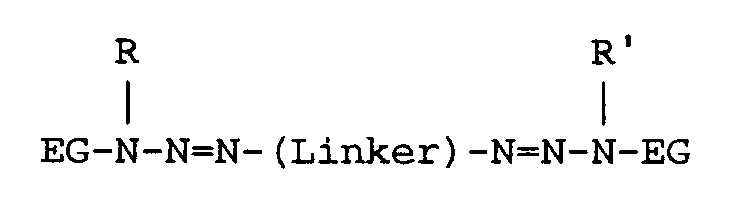 EG identisch oder unabhängig ausgewählt ist aus Gruppen, bestehend aus Methyl, substituiertem C1-20-Alkyl, Aralkyl, substituiertem Aralkyl, polycyclischem Aralkyl, Arylgruppen und heterocyclischen Gruppen mit 2-40 Atomen, die kein Wasserstoff sind, enthaltend 1-6 Ringe undR oder R' EG, ausgenommen, wenn EG Methyl ist,oder einander identisch ist oder unabhängig ausgewählt ist aus der Gruppe bestehend aus Wasserstoff, substituiertem C1-20-Alkyl, substituiertem Aralkyl, polycyclischem Aralkyl, Aryl und heterocyclischen Gruppen von 2-40 Atomen, die kein Wasserstoff sind, enthaltend 1-6 Ringe und einen pharmazeutisch akzeptablen Träger.
 - Zusammensetzung nach Aspruch 1, worin der Linker Ethylen, Butylen, trans-2-Butenylen, o-Xylol oder p-Xylol ist, EG Methyl ist und R und R' jeweils Wasserstoff sind.
- Pharmazeutische Zusammensetzung nach Anspruch 1 oder 2, worin die Bistriazen-Verbindung Bis(methyltriazen)-p-xylol, Bis(methyltriazen)-2-buten oder Bis(methyltriazen)ethan ist.
- Pharmazeutische Zusammensetzung nach Anspruch 1, 2 oder 3, weiter umfassend eine gegen Krebs wirksame Menge von Bis(2-chlorethyl)nitrosoharnstoff, Mitomycin, Cyclophosphamid oder Ifosphamid oder Kombinationen von diesen.
- Verwendung einer Bistriazen-Verbindung oder eines physiologisch akzeptablen Salzes davon der Formelworin die Bistriazen-Verbindung trans-1,4-Bis(1,3-dimethyltriazen)cyclohexan ist, oder worin der Linker C1-20-Alkylen, substituiertes C1-20-Alkylen, Aralkylen, substituiertes Aralkylen, worin die Triazen-Gruppierungen über die Alkylgruppen des Linkers mit dem Linker verbunden sind, polycyclisches Aralkylen, substituiertes polycyclisches Aralkylen, heterocyclisches Aralkylen oder substituiertes heterocyclisches Aralkylen ist, worin die Triazen-Gruppierungen durch 1-30 Kohlenstoffatome getrennt sind,
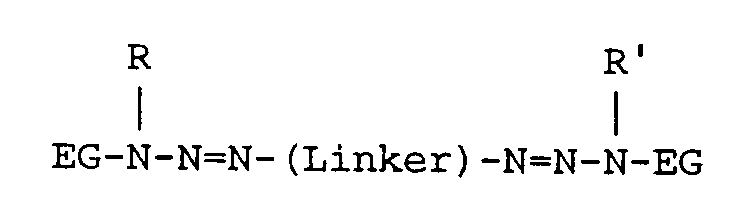 EG identisch oder unabhängig ausgewählt ist aus Gruppen, bestehend aus Methyl, substituiertem C1-20-Alkyl, Aralkyl, substituiertem Aralkyl, polycyclischem Aralkyl, Arylgruppen und heterocyclischen Gruppen mit 2-40 Atomen, die kein Wasserstoff sind, enthaltend 1-6 Ringe undR oder R' EG, ausgenommen, wenn EG Methyl ist,oder einander identisch ist oder unabhängig ausgewählt ist aus der Gruppe bestehend aus Wasserstoff, substituiertem C1-20-Alkyl, substituiertem Aralkyl, polycyclischem Aralkyl, Aryl und heterocyclischen Gruppen von 2-40 Atomen, die kein Wasserstoff sind, enthaltend 1-6 Ringe und einen pharmazeutisch akzeptablen Träger, oder einer pharmazeutischen Zubereitung davon, bei der Herstellung eines Medikamentes zur Behandlung von Krebs in einem Säugetier.
 - Verwendung nach Aspruch 5, worin der Linker Ethylen, Butylen, trans-2-Butenylen, o-Xylol oder p-Xylol ist, EG Methyl ist und R und R' jeweils Wasserstoff sind.
- Verwendung nach Anspruch 5 oder 6, worin die Bistriazen-Verbindung Bis(methyltriazen)-p-xylol, Bis(methyltriazen)-2-buten oder Bis(methyltriazen)ethan ist.
- Verwendung nach Anspruch 5, 6 oder 7, worin dieses Medikament in Form einer Lösung, Emulsion, Suspension, Salbe oder Creme vorliegt.
- Verwendung nach Anspruch 5, 6, 7 oder 8, worin das Medikament in einer Form vorliegt, die geeignet ist für die parenterale, orale oder örtliche Verabreichung, oder es als ein Aerosol, Spray oder Tropfen formuliert ist, worin die parenterale Verabreichung intraperitoneal, intramuskular, subcutan, intravenös, intraarteriell, intraartikulär oder transdermal erfolgt.
- Verwendung nach einem der Ansprüche 5 bis 9, worin die Bistriazen-Verbindung in Öl oder einem anderen pharmazeutisch akzeptablen Träger zur parenteralen Verabreichung in einer Dosis von 0,1 mg bis 1.000 mg pro kg pro Tag aufgelöst ist.
- Verwendung nach einem der Ansprüche 5 bis 10, worin die Bistriazen-Verbindung in Öl oder einem anderen pharmazeutisch akzeptablen Träger für die intraperitoneale Verabreichung in einer Dosis von 1 mg bis 500 mg pro kg pro Tag gelöst ist.
- Verwendung nach einem der Ansprüche 5 bis 9, worin die Bistriazen-Verbindung in Öl oder einem anderen pharmazeutisch akzeptablen Träger zur intramuskulären Verabreichung in einer Dosis von 0,1 mg bis 1.000 mg pro kg pro Tag aufgelöst ist.
- Verwendung nach einem der Ansprüche 5 bis 9, worin die Bistriazen-Verbindung in Liposomen oder Formulierungen zur Abgabe mit der Zeit eingekapselt oder in verträglichen Emulsionen zusammen mit Stabilisierungs- und/oder Dispergierungsmitteln für die orale Verabreichung dispergiert ist.
- Verwendung nach einem der Ansprüche 5 bis 9, worin die Bistriazen-Verbindung in einem Öl oder einer Creme für die örtliche Verabreichung formuliert ist.
- Verwendung nach einem der Ansprüche 8 bis 14, worin das Medikament in einer Form vorliegt, die für die ein- oder mehrmalige Verabreichung pro Tag über fünf Tage geeignet ist.
- Verfahren zum Manipulieren von DNA in vitro, umfassend das Linken der DNA mit einer Bistriazen-Verbindung der Formel:worin die Bistriazen-Verbindung trans-1,4-Bis(1,3-dimethyltriazen)cyclohexan ist, oder worin der Linker C1-200-Alkylen, substituiertes C1-20-Alkylen, Aralkylen, substituiertes Aralkylen, worin die Triazen-Gruppierungen über die Alkylgruppen des Linkers mit dem Linker verbunden sind, polycyclisches Aralkylen, substituiertes polycyclisches Aralkylen, heterocyclisches Aralkylen oder substituiertes heterocyclisches Aralkylen ist, worin die Triazen-Gruppierungen durch 1-30 Kohlenstoffatome getrennt sind,
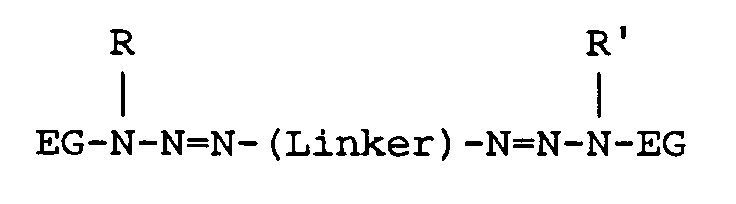 EG identisch oder unabhängig ausgewählt ist aus Gruppen, bestehend aus Methyl, substituiertem C1-20-Alkyl, Aralkyl, substituiertem Aralkyl, polycyclischem Aralkyl, Arylgruppen und heterocyclischen Gruppen mit 2-40 Atomen, die kein Wasserstoff sind, enthaltend 1-6 Ringe undR oder R' EG, ausgenommen, wenn EG Methyl ist,oder einander identisch ist oder unabbängig ausgewählt ist aus der Gruppe bestehend aus Wasserstoff, substituiertem C1-20-Alkyl, substituiertem Aralkyl, polycyclischem Aralkyl, Aryl und heterocyclischen Gruppen von 2-40 Atomen, die kein Wasserstoff sind, enthaltend 1-6 Ringe.
 - Verfahren zum Herstellen von DNA durch Vernetzen ihrer monomeren Bestandteile mit einer Bistriazen-Verbindung der Formel:worin die Bistriazen-Verbindung trans-1,4-Bis(1,3-dimethyltriazen)cyclohexan ist, oder worin der Linker C1-20-Alkylen, substituiertes C1-20-Alkylen, Aralkylen, substituiertes Aralkylen, worin die Triazen-Gruppierungen über die Alkylgruppen des Linkers mit dem Linker verbunden sind, polycyclisches Aralkylen, substituiertes polycyclisches Aralkylen, heterocyclisches Aralkylen oder substituiertes heterocyclisches Aralkylen ist, worin die Triazen-Gruppierungen durch 1-30 Kohlenstoffatome getrennt sind,
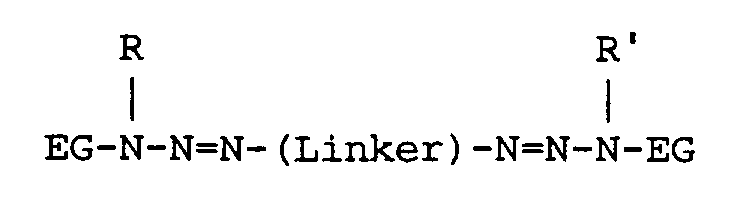 EG identisch oder unabhängig ausgewählt ist aus Gruppen, bestehend aus Methyl, substituiertem C1-20-Alkyl, Aralkyl, substituiertem Aralkyl, polycyclischem Aralkyl, Arylgruppen und heterocyclischen Gruppen mit 2-40 Atomen, die kein Wasserstoff sind, enthaltend 1-6 Ringe undR oder R' EG, ausgenommen, wenn EG Methyl ist,oder einander identisch ist oder unabhängig ausgewählt ist aus der Gruppe bestehend aus Wasserstoff, substituiertem C1-20-Alkyl, substituiertem Aralkyl, polycyclischem Aralkyl, Aryl und heterocyclischen Gruppen von 2-40 Atomen, die kein Wasserstoff sind, enthaltend 1-6 Ringe.
Applications Claiming Priority (3)
| Application Number | Priority Date | Filing Date | Title |
|---|---|---|---|
| US52791590A | 1990-05-24 | 1990-05-24 | |
| US527915 | 1990-05-24 | ||
| PCT/US1991/003445 WO1991017753A1 (en) | 1990-05-24 | 1991-05-22 | Bistriazenes as chemotherapeutic agents |
Publications (3)
| Publication Number | Publication Date |
|---|---|
| EP0531419A1 EP0531419A1 (de) | 1993-03-17 |
| EP0531419A4 EP0531419A4 (en) | 1994-04-06 |
| EP0531419B1 true EP0531419B1 (de) | 1999-07-28 |
Family
ID=24103474
Family Applications (1)
| Application Number | Title | Priority Date | Filing Date |
|---|---|---|---|
| EP91910672A Expired - Lifetime EP0531419B1 (de) | 1990-05-24 | 1991-05-22 | Bistriazene als chemotherapeutische mittel |
Country Status (10)
| Country | Link |
|---|---|
| US (2) | US5672593A (de) |
| EP (1) | EP0531419B1 (de) |
| JP (1) | JPH05506452A (de) |
| AT (1) | ATE182468T1 (de) |
| AU (1) | AU642273B2 (de) |
| CA (1) | CA2083148C (de) |
| DE (1) | DE69131481T2 (de) |
| DK (1) | DK0531419T3 (de) |
| ES (1) | ES2134778T3 (de) |
| WO (1) | WO1991017753A1 (de) |
Families Citing this family (13)
| Publication number | Priority date | Publication date | Assignee | Title |
|---|---|---|---|---|
| US5808038A (en) * | 1990-05-24 | 1998-09-15 | The United States Of America As Represented By The Secretary Of The Department Of Health And Human Services | Bistriazenes as chemotherapeutic agents |
| EP0626943B1 (de) * | 1991-10-31 | 2000-01-26 | THE GOVERNMENT OF THE UNITED STATES OF AMERICA as represented by the SECRETARY OF THE DEPARTMENT OF HEALTH AND HUMAN SERVICES | Bistriazene als chemotherapeutische wirkstoffe |
| CA2128342C (en) * | 1993-07-22 | 1997-06-24 | Jochen Dauth | Organosilicon compounds having triazene groups |
| DE19508076C2 (de) * | 1995-03-08 | 1998-04-30 | Csb Syst Software Entwicklung | Schaltungsanordnung zur Integration eines Sprachsystems in EDV-Systeme und Telefonanlagen, die an das öffentliche Telefonnetz angeschlossen sind |
| ZA973642B (en) * | 1996-04-26 | 1997-11-25 | Merck & Co Inc | DNA vaccine formulations. |
| US6875907B2 (en) | 2000-09-13 | 2005-04-05 | Pioneer Hi-Bred International, Inc. | Antimicrobial peptides and methods of use |
| AU2002331897A1 (en) | 2001-09-27 | 2003-04-07 | Pioneer Hi-Bred International, Inc. | Phytate polynucleotides and methods of use |
| EP1572927A4 (de) | 2002-04-08 | 2007-10-17 | Pioneer Hi Bred Int | Verstärktes austreiben von seide unter stress |
| US7987056B2 (en) | 2004-09-20 | 2011-07-26 | The Regents Of The University Of Colorado, A Body Corporate | Mixed-library parallel gene mapping quantitative micro-array technique for genome-wide identification of trait conferring genes |
| KR20160116056A (ko) | 2008-08-14 | 2016-10-06 | 테바 파마슈티컬즈 오스트레일리아 피티와이 엘티디 | 항-il-12/il-23 항체 |
| EP2557075A1 (de) | 2011-08-09 | 2013-02-13 | Trin Therapeutics GmbH | Neue Triazenverbindungen zur Behandlung von Krebs |
| BR112014009968A2 (pt) | 2011-10-25 | 2017-07-04 | Du Pont | método para redução do teor de acetato, arabinosidase e/ou ferulato em uma planta, método de modulação da concentração de carboidratos da planta em uma planta transgénica, método para alterar o teor de acetila e de reticulação nos tecidos das plantas, método para a produção de biomassa para a produção de biocombustíveis ou silagem, produto, forragem de planta |
| EP3894397A4 (de) * | 2018-12-10 | 2022-09-28 | Ariel Scientific Innovations Ltd. | Therapeutische konjugate |
Family Cites Families (5)
| Publication number | Priority date | Publication date | Assignee | Title |
|---|---|---|---|---|
| US3138521A (en) * | 1960-10-04 | 1964-06-23 | Gen Aniline & Film Corp | Fungicidal method |
| CH482789A (de) * | 1967-03-16 | 1969-12-15 | Ciba Geigy | Verfahren zur Herstellung neuer Disazofarbstoffpigmente |
| DE1793115A1 (de) * | 1968-08-03 | 1972-02-03 | Bayer Ag | Neue Triazenderivate |
| DE3426644A1 (de) * | 1984-07-19 | 1986-02-06 | Deutsches Krebsforschungszentrum Stiftung des öffentlichen Rechts, 6900 Heidelberg | N,n-bis((1-aryl-3-methyltriazen-3-yl) methyl)ether |
| US4923970A (en) * | 1988-03-28 | 1990-05-08 | Bionetics Research, Inc. | Substituted 1-(2-chloroethyl)-3-acyl-3-alkyltriazenes |
-
1991
- 1991-05-22 AT AT91910672T patent/ATE182468T1/de not_active IP Right Cessation
- 1991-05-22 DK DK91910672T patent/DK0531419T3/da active
- 1991-05-22 JP JP91510441A patent/JPH05506452A/ja active Pending
- 1991-05-22 DE DE69131481T patent/DE69131481T2/de not_active Expired - Fee Related
- 1991-05-22 CA CA002083148A patent/CA2083148C/en not_active Expired - Fee Related
- 1991-05-22 EP EP91910672A patent/EP0531419B1/de not_active Expired - Lifetime
- 1991-05-22 AU AU80897/91A patent/AU642273B2/en not_active Ceased
- 1991-05-22 ES ES91910672T patent/ES2134778T3/es not_active Expired - Lifetime
- 1991-05-22 WO PCT/US1991/003445 patent/WO1991017753A1/en not_active Ceased
-
1993
- 1993-06-28 US US08/082,902 patent/US5672593A/en not_active Expired - Fee Related
-
1995
- 1995-05-31 US US08/455,704 patent/US5731301A/en not_active Expired - Fee Related
Also Published As
| Publication number | Publication date |
|---|---|
| US5731301A (en) | 1998-03-24 |
| US5672593A (en) | 1997-09-30 |
| DE69131481T2 (de) | 1999-11-25 |
| ATE182468T1 (de) | 1999-08-15 |
| CA2083148C (en) | 2002-01-01 |
| WO1991017753A1 (en) | 1991-11-28 |
| DK0531419T3 (da) | 1999-11-29 |
| AU8089791A (en) | 1991-12-10 |
| DE69131481D1 (de) | 1999-09-02 |
| EP0531419A1 (de) | 1993-03-17 |
| AU642273B2 (en) | 1993-10-14 |
| JPH05506452A (ja) | 1993-09-22 |
| ES2134778T3 (es) | 1999-10-16 |
| CA2083148A1 (en) | 1991-11-25 |
| EP0531419A4 (en) | 1994-04-06 |
Similar Documents
| Publication | Publication Date | Title |
|---|---|---|
| EP0531419B1 (de) | Bistriazene als chemotherapeutische mittel | |
| US8940770B2 (en) | Nitropyridinyl ethyleneimine compound, the pharmaceutical composition containing it, the preparation method and use thereof | |
| US6872852B2 (en) | Polyamine analogues as cytotoxic agents | |
| CA2950305A1 (en) | Texaphyrin-pt(iv) conjugates and compositions for use in overcoming platinum resistance | |
| Abdelmoniem et al. | Green synthesis of novel hexahydroquinolines and 6-amino-2-oxopyridine-3, 5-dicarbonitriles incorporating sulfaguanidine via [3+ 3] atom combination | |
| Denny et al. | Potential antitumor agents. 40. Orally active 4, 5-disubstituted derivatives of amsacrine | |
| WO1994027954A1 (en) | Nitrobenzyl mustard quaternary salts and their use as hypoxia-selective cytotoxic agents | |
| US6187787B1 (en) | Bis(9-aminoacridine) DNA intercalating agents having antitumor activity | |
| EP0626943B1 (de) | Bistriazene als chemotherapeutische wirkstoffe | |
| US5808038A (en) | Bistriazenes as chemotherapeutic agents | |
| CN108473449B (zh) | 一种作为吲哚胺-2,3-双加氧酶抑制剂的砜脒及其制备方法和用途 | |
| CN107722010A (zh) | 一种含有硝基咪唑基团的低氧激活氯乙基亚硝基脲及其制备方法和应用 | |
| EP0125695B1 (de) | 2-Bromo-1-Tetralon-Derivate | |
| RU2186057C1 (ru) | 4-нитро-3-трифторметил-перфторнонаноиланилид (флустат), способ его получения и фармацевтическая композиция на его основе | |
| US6018058A (en) | 1,4 dihydrodioxins and related compounds as DNA cleaving reagents | |
| EP0087951B1 (de) | Phenanthrolinderivate | |
| US6458983B1 (en) | Method for synthesizing complexes of platinum with iminoethers and their use as antitumoral drugs and nucleotide-base modifiers | |
| JP2002531445A (ja) | 抗腫瘍ジベンゾフルオレン誘導体 | |
| RU2203892C1 (ru) | 2,2,6,6-тетракис(трифторметил)-4-этиламино-5,6-дигидро-1,3,5-оксадиазин ("синтазин"), способ его получения и фармацевтическая композиция на их основе | |
| Llama et al. | Synthesis and antitumor activity of pyrido‐amsacrine analogues and related compounds | |
| US8217022B2 (en) | Analogues of 1,3-bis(4-nitrophenyl)triazenes, their pharmaceutically acceptable salts and N-acyl derivatives for tumour treatment | |
| JPH0359898B2 (de) |
Legal Events
| Date | Code | Title | Description |
|---|---|---|---|
| PUAI | Public reference made under article 153(3) epc to a published international application that has entered the european phase |
Free format text: ORIGINAL CODE: 0009012 |
|
| 17P | Request for examination filed |
Effective date: 19921221 |
|
| AK | Designated contracting states |
Kind code of ref document: A1 Designated state(s): AT BE CH DE DK ES FR GB GR IT LI LU NL SE |
|
| A4 | Supplementary search report drawn up and despatched | ||
| AK | Designated contracting states |
Kind code of ref document: A4 Designated state(s): AT BE CH DE DK ES FR GB GR IT LI LU NL SE |
|
| 17Q | First examination report despatched |
Effective date: 19970114 |
|
| GRAG | Despatch of communication of intention to grant |
Free format text: ORIGINAL CODE: EPIDOS AGRA |
|
| GRAG | Despatch of communication of intention to grant |
Free format text: ORIGINAL CODE: EPIDOS AGRA |
|
| GRAG | Despatch of communication of intention to grant |
Free format text: ORIGINAL CODE: EPIDOS AGRA |
|
| GRAH | Despatch of communication of intention to grant a patent |
Free format text: ORIGINAL CODE: EPIDOS IGRA |
|
| GRAH | Despatch of communication of intention to grant a patent |
Free format text: ORIGINAL CODE: EPIDOS IGRA |
|
| GRAA | (expected) grant |
Free format text: ORIGINAL CODE: 0009210 |
|
| RAP1 | Party data changed (applicant data changed or rights of an application transferred) |
Owner name: THE UNITED STATES OF AMERICA, AS REPRESENTED BY TH |
|
| RIN1 | Information on inventor provided before grant (corrected) |
Inventor name: BLUMENSTEIN, JEFFREY, J. Inventor name: MICHEJDA, CHRISTOPHER, J. |
|
| AK | Designated contracting states |
Kind code of ref document: B1 Designated state(s): AT BE CH DE DK ES FR GB GR IT LI LU NL SE |
|
| PG25 | Lapsed in a contracting state [announced via postgrant information from national office to epo] |
Ref country code: GR Free format text: LAPSE BECAUSE OF NON-PAYMENT OF DUE FEES Effective date: 19990728 |
|
| REF | Corresponds to: |
Ref document number: 182468 Country of ref document: AT Date of ref document: 19990815 Kind code of ref document: T |
|
| REG | Reference to a national code |
Ref country code: CH Ref legal event code: EP |
|
| REG | Reference to a national code |
Ref country code: CH Ref legal event code: NV Representative=s name: R. A. EGLI & CO. PATENTANWAELTE |
|
| REF | Corresponds to: |
Ref document number: 69131481 Country of ref document: DE Date of ref document: 19990902 |
|
| REG | Reference to a national code |
Ref country code: ES Ref legal event code: FG2A Ref document number: 2134778 Country of ref document: ES Kind code of ref document: T3 |
|
| ITF | It: translation for a ep patent filed | ||
| REG | Reference to a national code |
Ref country code: DK Ref legal event code: T3 |
|
| ET | Fr: translation filed | ||
| PLBE | No opposition filed within time limit |
Free format text: ORIGINAL CODE: 0009261 |
|
| STAA | Information on the status of an ep patent application or granted ep patent |
Free format text: STATUS: NO OPPOSITION FILED WITHIN TIME LIMIT |
|
| 26N | No opposition filed | ||
| REG | Reference to a national code |
Ref country code: GB Ref legal event code: IF02 |
|
| PGFP | Annual fee paid to national office [announced via postgrant information from national office to epo] |
Ref country code: NL Payment date: 20050429 Year of fee payment: 15 |
|
| PGFP | Annual fee paid to national office [announced via postgrant information from national office to epo] |
Ref country code: AT Payment date: 20050504 Year of fee payment: 15 |
|
| PGFP | Annual fee paid to national office [announced via postgrant information from national office to epo] |
Ref country code: FR Payment date: 20050517 Year of fee payment: 15 |
|
| PGFP | Annual fee paid to national office [announced via postgrant information from national office to epo] |
Ref country code: GB Payment date: 20050518 Year of fee payment: 15 |
|
| PGFP | Annual fee paid to national office [announced via postgrant information from national office to epo] |
Ref country code: SE Payment date: 20050519 Year of fee payment: 15 |
|
| PGFP | Annual fee paid to national office [announced via postgrant information from national office to epo] |
Ref country code: CH Payment date: 20050520 Year of fee payment: 15 |
|
| PGFP | Annual fee paid to national office [announced via postgrant information from national office to epo] |
Ref country code: DK Payment date: 20050524 Year of fee payment: 15 |
|
| PGFP | Annual fee paid to national office [announced via postgrant information from national office to epo] |
Ref country code: LU Payment date: 20050525 Year of fee payment: 15 |
|
| PGFP | Annual fee paid to national office [announced via postgrant information from national office to epo] |
Ref country code: ES Payment date: 20050609 Year of fee payment: 15 |
|
| PGFP | Annual fee paid to national office [announced via postgrant information from national office to epo] |
Ref country code: BE Payment date: 20050624 Year of fee payment: 15 |
|
| PGFP | Annual fee paid to national office [announced via postgrant information from national office to epo] |
Ref country code: DE Payment date: 20050630 Year of fee payment: 15 |
|
| PG25 | Lapsed in a contracting state [announced via postgrant information from national office to epo] |
Ref country code: GB Free format text: LAPSE BECAUSE OF NON-PAYMENT OF DUE FEES Effective date: 20060522 Ref country code: AT Free format text: LAPSE BECAUSE OF NON-PAYMENT OF DUE FEES Effective date: 20060522 |
|
| PG25 | Lapsed in a contracting state [announced via postgrant information from national office to epo] |
Ref country code: SE Free format text: LAPSE BECAUSE OF NON-PAYMENT OF DUE FEES Effective date: 20060523 Ref country code: ES Free format text: LAPSE BECAUSE OF NON-PAYMENT OF DUE FEES Effective date: 20060523 |
|
| PG25 | Lapsed in a contracting state [announced via postgrant information from national office to epo] |
Ref country code: LI Free format text: LAPSE BECAUSE OF NON-PAYMENT OF DUE FEES Effective date: 20060531 Ref country code: DK Free format text: LAPSE BECAUSE OF NON-PAYMENT OF DUE FEES Effective date: 20060531 Ref country code: CH Free format text: LAPSE BECAUSE OF NON-PAYMENT OF DUE FEES Effective date: 20060531 Ref country code: BE Free format text: LAPSE BECAUSE OF NON-PAYMENT OF DUE FEES Effective date: 20060531 |
|
| PGFP | Annual fee paid to national office [announced via postgrant information from national office to epo] |
Ref country code: IT Payment date: 20060531 Year of fee payment: 16 |
|
| PG25 | Lapsed in a contracting state [announced via postgrant information from national office to epo] |
Ref country code: NL Free format text: LAPSE BECAUSE OF NON-PAYMENT OF DUE FEES Effective date: 20061201 Ref country code: DE Free format text: LAPSE BECAUSE OF NON-PAYMENT OF DUE FEES Effective date: 20061201 |
|
| REG | Reference to a national code |
Ref country code: CH Ref legal event code: PL Ref country code: DK Ref legal event code: EBP |
|
| EUG | Se: european patent has lapsed | ||
| GBPC | Gb: european patent ceased through non-payment of renewal fee |
Effective date: 20060522 |
|
| NLV4 | Nl: lapsed or anulled due to non-payment of the annual fee |
Effective date: 20061201 |
|
| REG | Reference to a national code |
Ref country code: FR Ref legal event code: ST Effective date: 20070131 |
|
| REG | Reference to a national code |
Ref country code: ES Ref legal event code: FD2A Effective date: 20060523 |
|
| BERE | Be: lapsed |
Owner name: THE *UNITED STATES OF AMERICA AS REPRESENTED BY TH Effective date: 20060531 |
|
| PG25 | Lapsed in a contracting state [announced via postgrant information from national office to epo] |
Ref country code: FR Free format text: LAPSE BECAUSE OF NON-PAYMENT OF DUE FEES Effective date: 20060531 |
|
| PG25 | Lapsed in a contracting state [announced via postgrant information from national office to epo] |
Ref country code: LU Free format text: LAPSE BECAUSE OF NON-PAYMENT OF DUE FEES Effective date: 20060522 |
|
| PG25 | Lapsed in a contracting state [announced via postgrant information from national office to epo] |
Ref country code: IT Free format text: LAPSE BECAUSE OF NON-PAYMENT OF DUE FEES Effective date: 20070522 |