EP0532016B1 - Gouverne composite à charge focalisée - Google Patents
Gouverne composite à charge focalisée Download PDFInfo
- Publication number
- EP0532016B1 EP0532016B1 EP92115537A EP92115537A EP0532016B1 EP 0532016 B1 EP0532016 B1 EP 0532016B1 EP 92115537 A EP92115537 A EP 92115537A EP 92115537 A EP92115537 A EP 92115537A EP 0532016 B1 EP0532016 B1 EP 0532016B1
- Authority
- EP
- European Patent Office
- Prior art keywords
- fitting
- front spar
- hinge
- flange
- spoiler
- Prior art date
- Legal status (The legal status is an assumption and is not a legal conclusion. Google has not performed a legal analysis and makes no representation as to the accuracy of the status listed.)
- Expired - Lifetime
Links
Images


Classifications
-
- B—PERFORMING OPERATIONS; TRANSPORTING
- B64—AIRCRAFT; AVIATION; COSMONAUTICS
- B64C—AEROPLANES; HELICOPTERS
- B64C3/00—Wings
- B64C3/20—Integral or sandwich constructions
-
- B—PERFORMING OPERATIONS; TRANSPORTING
- B64—AIRCRAFT; AVIATION; COSMONAUTICS
- B64C—AEROPLANES; HELICOPTERS
- B64C9/00—Adjustable control surfaces or members, e.g. rudders
- B64C9/02—Mounting or supporting thereof
-
- Y—GENERAL TAGGING OF NEW TECHNOLOGICAL DEVELOPMENTS; GENERAL TAGGING OF CROSS-SECTIONAL TECHNOLOGIES SPANNING OVER SEVERAL SECTIONS OF THE IPC; TECHNICAL SUBJECTS COVERED BY FORMER USPC CROSS-REFERENCE ART COLLECTIONS [XRACs] AND DIGESTS
- Y02—TECHNOLOGIES OR APPLICATIONS FOR MITIGATION OR ADAPTATION AGAINST CLIMATE CHANGE
- Y02T—CLIMATE CHANGE MITIGATION TECHNOLOGIES RELATED TO TRANSPORTATION
- Y02T50/00—Aeronautics or air transport
- Y02T50/40—Weight reduction
Definitions
- This invention relates to a method of manufacturing a load bearing structure, according to the preamble of claim 1.
- the invention relates to a load bearing structure according to the preamble of claim 8.
- Advanced composites have already been certified by the FAA for secondary structural (not critical to flight safety) components, and transport aircraft have been designed with advanced composite secondary structures including fairings, control surfaces, and the like.
- a disadvantage of the graphite epoxy control surface is that the cost to weight ratio is relatively high in comparison with metals such as aluminum.
- the reason for the high cost is that structural requirements for graphite epoxy control surfaces currently necessitate a concentration of graphite material plies and, in many configurations, the use of multiple pre-cured parts in order to provide spars and other structural elements necessary to accommodate fitting attachments. Construction of control surfaces having a large number of graphite material plies and precured parts requires multiple curing cycles in the autoclave, greatly increasing manufacturing time and costs.
- FIG 1 is an exploded view of a current graphite epoxy spoiler design for a transport aircraft.
- the spoiler 10 is a special form of control surface which is located on the upper surface of the trailing edge of the wing 11 as shown in Figure 3a, and which deflects upward from flaps 12 under pilot command in order to provide roll control and braking functions.
- the principal load on the spoiler when the spoiler is extended is therefore a shear force resulting from the airstream at the top of the wing which is normal to the spoiler when the spoiler is in its operative position.
- the current design utilizes a honeycomb sandwich core construction, and requires six pieces, not including the three attachment fittings.
- the six pieces include respective pre-cured upper and lower covers 1 and 2, a precured spar 3 for providing shear attachment of mounting fittings 4-6 to the control surface, and pre-cured closure ribs 7 and 8 which enclose the honeycomb core 9.
- the various parts are separately pre-cured and then bonded together to form the spoiler assembly.
- the mounting fittings 4-6 are then attached to spar 3.
- the mounting hardware defines three hinge apertures 11-13 and an aperture 14 for attaching an actuator control rod.
- a center attachment fitting for an aircraft spoiler is provided with a center spoiler hinge point and drive actuator attachment point.
- the core of the spoiler includes a one-piece co-cured honeycomb sandwich construction with an integral front spar supported on the wing by two hinge fittings and a center hinge/actuator drive fitting.
- the spoiler is driven by one mid-span actuator connected to a single hinge/actuator fitting which is designed such that the transverse shear is reacted by a component of the axial force in the lower cover at the hinge/actuator drive fitting.
- the inboard fitting is a link fitting used to uncouple wing and spoiler strong axis bending.
- the outboard fitting has a pivot line normal to the hinge line to eliminate side loads. All side loads are reacted at the center hinge/actuator fitting.
- Focusing of the applied loads is accomplished by causing an extension or tangent of the lower cover fitting attachment flange to converge at a focus point on the upper cover to form an angle of load convergence selected to cause the resulting structure to function as an integral unit or "truss.”
- the above spoiler including a composite load bearing surface of honeycomb sandwich construction, is formed as a one piece co-cured assembly by first predicting the shear forces to which the control surface will be subject, and then forming the lower fitting attachment flange such that an extension thereof converges on the upper surface at the focus point of the predicted shear forces.
- the integral front spar is at an angle of approximately forty-five degrees to allow the lower cover to drape completely over the entire core.
- Figure 1 is an exploded perspective view of a current spoiler design.
- Figure 2 is a perspective view of a one-piece co-cured spoiler design having an integral front spar according to a preferred embodiment of the invention.
- Figure 3(a) is a top view of an aircraft wing showing the location of spoilers of the type illustrated in Figures 1 and 2.
- Figure 3(b) is a top view of the preferred spoiler of Figure 2.
- Figure 4 is a cross-sectional side view of the preferred spoiler taken along line A-A in Figure 3(b).
- Figure 5 is a side view of the preferred spoiler taken along line B-B in Figure 3(b).
- Figure 6 is a side view of the preferred spoiler taken along line C-C in Figure 3(b).
- Figure 7 is a perspective view illustrating the applied loads to the preferred spoiler hinge/actuator drive fitting.
- Figure 8 is a schematic diagram further illustrating the geometry of the applied loads to the preferred hinge/actuator drive fitting.
- Figure 9 is a flowchart illustrating a preferred method of manufacturing a load bearing structure according to a preferred embodiment of the invention.
- Figures 2-6 show a one piece co-cured spoiler structure constructed according to the principles of a preferred embodiment of the invention.
- Figures 1, 2, and 3(b) are shown in inverted position so that the lower cover is depicted as facing up for clarity.
- the preferred spoiler is made up of a honeycomb core 20, a lower surface 21 including a hinge attachment area 22, an upper surface 23, and an integral front spar 24.
- the spoiler is attached to the wing by hinge fittings 25 and 27 and by an actuator/hinge drive fitting 26.
- Each of the attachment fittings includes mounting surfaces or flanges 28 and 29 and an intermediate surface 30.
- the fittings also include hinge attachment apertures 31-33 and actuator attachment aperture 34 similar to respective apertures 11-14 of the conventional spoiler design.
- Flange 29 and surface 21 form an angle determined by a line extending from the flange to the location of the focal point of the predicted shear force on the control surface when the spoiler is extended, as will be described in detail below.
- the preferred material for the spoiler is an advanced composite material such as graphite epoxy while the material for all hinge fittings is preferably aluminum.
- the invention is not intended to be limited to a particular material for either the fittings or the spoiler itself.
- all aluminum parts are preferably isolated from the graphite epoxy using a fiberglass isolation ply.
- Construction of the spoiler employs the previously mentioned, co-cured molding process and the focused load concept to minimize weight, part bonding costs, and assembly costs, including minimizing the costs of hole drilling, fastener insulation, fit up, and shimming.
- Use of a co-cured molding process is possible because the design of the spoiler reduces complexity of the center hinge/actuator drive fitting attachment points.
- the upper and lower cover design utilizes tape and fabric carbon epoxy while the edges of the spoiler are preferably thickened to resist handling damage.
- the integral spar is at forty-five degrees, as shown, to permit the lower cover to drape completely over the entire spar.
- the core may be in the form of a Nomex honeycomb, or a similar advanced composite honeycomb construction.
- the bonded spoiler assemblies are mechanically assembled to the aluminum hinge fittings using flush bolt and nuts through the upper cover and, by way of example, blind Composi-loks for the connections through the lower cover and integral front spar.
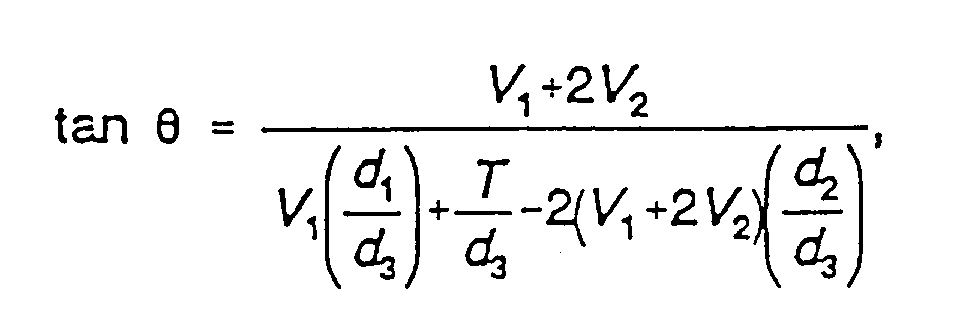
- the spoiler loads may be represented as shear force V1 and 2V2 and opposing coupling forces R1 and R2.
- Force R1 is provided by the actuator and is opposed by the parallel or horizontal hinge coupling force component R 2x of R2.
- the shear force V1 and V2 is opposed by the transverse or vertical component R 2y of hinge coupling force R2.
- the shear force V y actually has two components, the first component V1 being the aerodynamic force on the lower cover as shown in Figure 7.
- the second component V2 of shear force V y is distributed over the spar 24.
- V y V1 + 2V2
- ⁇ F y R 2 y - V 1-2
- V 2 0
- Fy is set to zero because the system is effectively static when in operation, and is preferably determined at the maximum load to which the spoiler will be subject for all flight and ground modes.
- Equations 6 and 7 are solutions of equations 4 and 3, respectively, in terms of R 2x and R 2y .
- ⁇ can thus be defined solely in terms of predictable shear forces acting on the spoiler and the spoiler geometry.
- the determination of the distance to the focal point (d1) would be based on a weighted average loading condition and location of the center of pressure. Moments produced by shear forces not located on the focus would be reacted by vertical forces on the fitting flanges. Under normal conditions these forces would be small and considered as a secondary effect in the design.
- the hinge/actuator drive fitting 27's inner surface flange is designed to match the angle.
- the inboard fitting 25 includes a slotted pivot 43 perpendicular to the hinge line which uncouples the spoiler and wing strong axis bending in the spoiler deployed condition, while the outboard fitting 26 has a pivot line 44 normal to the hinge line to eliminate side loads so that all side loads are reacted at the center hinge/actuator fitting 27, as was assumed in the calculations used to obtain the geometry of fitting 27.
- the focii and magnitude of shear forces V1 and V2 must be determined using conventional internal loads analysis, so that ⁇ can be calculated according to equation 8. Once ⁇ is obtained, the spoiler is formed with integral lower and upper covers and co-cured as a one-piece assembly. Finally, the attachment hardware may be added to complete the spoiler assembly.
- Prediction of the shear forces may be accomplished in a conventional manner, using computer modeling and/or wind tunnel tests of various spoiler configurations.
- the curing process by which the spoiler is formed will be readily apparent to those skilled in the art in view of the above description.
Landscapes
- Engineering & Computer Science (AREA)
- Aviation & Aerospace Engineering (AREA)
- Mechanical Engineering (AREA)
- Laminated Bodies (AREA)
- Moulding By Coating Moulds (AREA)
- Compositions Of Macromolecular Compounds (AREA)
- Epoxy Resins (AREA)
Claims (24)
- Un procédé de fabrication d'une structure supportant des charges et qui est soumise en service à une force de cisaillement, comprenant l'étape consistant à former un noyau ou coeur (20) présentant une surface inférieure (21) et une surface supérieure (23), lesdites surfaces inférieure et supérieure se convergeant à l'arrière de ladite structure, et un longeron frontal (24) relié auxdites surfaces inférieure (21) et supérieure (23) afin de former un revêtement continu pour ledit noyau (20), caractérisé par les étapes consistant:(a) à former au sein de ladite surface inférieure (21), une surface de fixation (22) d'une armature, destinée à fixer une bride (29) constituant une partie d'une armature (25, 26, 27) à fixer sur ladite structure;(b) à déterminer sur ladite surface supérieure (23) un point de focalisation (40) des charges appliquées à ladite armature (25, 26, 27); et(c) à relier ledit longeron frontal (24) et ladite surface de fixation d'armature (22) de telle sorte que, lorsque la bride (29) est fixée sur ladite surface de fixation d'armature, la convergence entre une tangente à ladite bride (29) et ladite surface supérieure (23) se réalise au point de focalisation (40) sur ladite surface supérieure, des charges appliquées à ladite armature.
- Un procédé selon la revendication 1, caractérisé par l'étape consistant à soumettre à un traitement de durcissement simultanément ledit noyau, ladite surface inférieure, ladite surface supérieure et ledit longeron frontal afin d'obtenir une structure monobloc codurcie (10).
- Un procédé selon la revendication 1 ou 2, caractérisé en ce que ledit noyau, ledit longeron frontal et lesdites surfaces inférieure et supérieure sont formées comme une structure monobloc codurcie (10) à noyau en nid d'abeilles pris en sandwich entre lesdites surfaces inférieure et supérieure.
- Un procédé selon l'une quelconque des revendications précédentes, caractérisé en ce que ladite surface de fixation d'armature (22) et ledit longeron frontal (24) sont réalisés sous la forme d'une surface continue unique.
- Un procédé selon l'une des revendications précédentes, caractérisé en ce que ledit longeron frontal (24) est formé avec un angle non nul rapport à un plan principal de ladite surface inférieure (21).
- Un procédé selon l'une quelconque des revendications précédentes, caractérisé en ce que ladite étape consistant à former ladite surface de fixation d'armature (22) comprend l'étape consistant à faire converger ladite tangente à ladite bride (29) avec ladite surface supérieure (23) sous un angle de convergence ϑ choisi pour éliminer le raccordement à cisaillement vertical entre ledit longeron frontal (24) avec ladite bride (29).
- Un procédé selon revendication 6, caractérisé en ce que ledit angle de convergence ϑ entre ladite tangente à ladite bride (29) et ladite surface inférieure (21) est défini par l'équation:

- Une structure supportant des charges qui est soumise à une force de cisaillement, comprenant un noyau ou coeur (20); une surface supérieure (23), une surface inférieure (21) qui convergent à l'arrière de ladite structure avec ladite surface supérieure, et un longeron frontal monobloc (24) reliant la surface inférieure et la surface supérieure (23), caractérisée en ce que la surface inférieure (21) comprend une surface de fixation d'armature (22) pour fixer une bride (22) de l'armature (25, 26, 27) sur ladite structure, et en ce que la convergence entre une tangente à ladite bride (29) et ladite surface supérieure (23) est située en un point de focalisation (40) sur ladite surface supérieure (23) des charges appliquées à ladite armature (25, 26, 27).
- Une structure telle que revendiquée dans la revendication 8, caractérisée en ce que ledit noyau (20), ledit longeron frontal (24), ladite surface inférieure (21) et ladite surface supérieure (23) forment une structure monobloc codurcie (10).
- Une structure selon la revendication 8 ou 9, caractérisée en ce que ledit noyau (20) est un noyau en nid d'abeilles pris en sandwich entre ladite surface inférieure (21) et ladite surface supérieure (23).
- Une structure selon l'une des revendications 8 à 10, caractérisée en ce que ladite surface inférieure (21) et ledit longeron frontal (24) sont des éléments d'une surface continue unique.
- Une structure selon l'une des revendications 8 à 11, caractérisée en ce que ledit longeron frontal (24) constitue une surface orientée sous un angle non nul, par rapport à ladite surface supérieure (23).
- Une structure selon l'une des revendications 8 à 12, caractérisée en ce que ledit angle de convergence ϑ entre ladite tangente à ladite bride (29) et ladite surface supérieure (23) est défini par l'équation suivante:
- Une structure selon l'une des revendications 8 à 13, caractérisée en ce que ladite structure est une gouverne de dégradation de la portance de l'aile d'un avion.
- Une structure selon l'une des revendications 8 à 14, caractérisée en ce que ladite structure est formée d'un matériau composite.
- Une structure selon la revendication 15, caractérisée en ce que ledit matériau composite est un matériau composite graphite-époxy.
- Une structure selon l'une des revendications 8 à 16, caractérisée par des moyens comprenant au moins une armature à charnière (26) pour fixer de façon pivotante la structure à une deuxième structure.
- Une structure selon la revendication 17, caractérisée en ce que ladite armature à charnière (26) est réalisée en aluminium.
- Une structure selon la revendication 17 ou 18, caractérisée en ce que le nombre desdites armatures à charnière (25, 26, 27) est de trois.
- Une structure selon l'une des revendications 17 à 19, caractérisée en ce que l'armature à charnière (25, 26, 27) comprend une première partie (28) agencée pour être montée sur ladite surface supérieure (23), une deuxième partie ou bride (29) orientée pour être parallèle à ladite surface de fixation d'armature (22), et une troisième partie (30) reliant lesdites première et deuxième parties, ladite troisième partie étant orientée pour être parallèle à la surface dudit longeron frontal (24).
- Une structure selon l'une des revendications 17 à 20, caractérisée en ce que chacune desdites armatures à charnière (25, 26, 27) comprend des moyens définissant une ouverture (31, 32, 33) pour le montage de ladite structure sur un moyen de pivotement afin de constituer une charnière, et dans lequel l'une desdites armatures à charnière comprend en outre des moyens définissant une ouverture (34) pour le montage d'un organe d'actionnement destiné à provoquer le pivotement de ladite structure sur ladite charnière.
- Une structure selon l'une quelconque des revendications 8 à 21, caractérisée en ce que ladite première structure est une gouverne de dégradation de la portance et ladite deuxième structure est l'aile (12) d'un avion présentant une partie située vers l'intérieur et une partie située vers l'extérieur.
- Une structure selon l'une des revendications 8 à 22, caractérisée en ce que l'une desdites armatures a charnière située vers l'intérieur (25) est une armature à liaison qui comprend des moyens définissant une liaison à pivotement (43) permettant de découpler la flexion importante entre les axes de l'aile et de la gouverne de dégradation de la portance aérodynamique.
- Une structure selon l'une des revendications 21 à 23, caractérisée en ce que l'une desdites armatures à charnière située vers l'extérieur (25) présente des moyens comprenant un axe de pivotement (44) qui s'étend perpendiculairement à un axe de ladite charnière pour éliminer les charges latérales.
Applications Claiming Priority (2)
| Application Number | Priority Date | Filing Date | Title |
|---|---|---|---|
| US759231 | 1991-09-13 | ||
| US07/759,231 US5224670A (en) | 1991-09-13 | 1991-09-13 | Composite focused load control surface |
Publications (2)
| Publication Number | Publication Date |
|---|---|
| EP0532016A1 EP0532016A1 (fr) | 1993-03-17 |
| EP0532016B1 true EP0532016B1 (fr) | 1995-12-06 |
Family
ID=25054885
Family Applications (1)
| Application Number | Title | Priority Date | Filing Date |
|---|---|---|---|
| EP92115537A Expired - Lifetime EP0532016B1 (fr) | 1991-09-13 | 1992-09-10 | Gouverne composite à charge focalisée |
Country Status (4)
| Country | Link |
|---|---|
| US (1) | US5224670A (fr) |
| EP (1) | EP0532016B1 (fr) |
| JP (1) | JPH05301598A (fr) |
| DE (1) | DE69206541T2 (fr) |
Families Citing this family (25)
| Publication number | Priority date | Publication date | Assignee | Title |
|---|---|---|---|---|
| US5399356A (en) * | 1994-03-24 | 1995-03-21 | The Procter & Gamble Company | Process for making solid dose forms containing bismuth |
| JP2000043796A (ja) | 1998-07-30 | 2000-02-15 | Japan Aircraft Development Corp | 複合材の翼形構造およびその成形方法 |
| AT406858B (de) * | 1998-12-11 | 2000-10-25 | Fischer Adv Components Gmbh | Spoiler für tragflächen |
| AT409482B (de) * | 2001-01-26 | 2002-08-26 | Fischer Adv Components Gmbh | Einrichtung zum verbinden beweglicher teile mit strukturbauteilen von flugzeugen od. dgl. |
| ATE284346T1 (de) * | 2001-01-26 | 2004-12-15 | Fischer Adv Components Gmbh | Einrichtung zum verbinden beweglicher teile mit strukturbauteilen von flugzeugen od. dgl. |
| FI118122B (fi) * | 2004-10-08 | 2007-07-13 | Patria Aerostructures Oy | Ilma-aluksen kääntyvä paneeli ja komposiittirakenteinen tukikappale |
| US7431196B2 (en) * | 2005-03-21 | 2008-10-07 | The Boeing Company | Method and apparatus for forming complex contour structural assemblies |
| US7049548B1 (en) | 2005-03-21 | 2006-05-23 | The Boeing Company | System and method for processing a preform vacuum vessel to produce a structural assembly |
| US7316539B2 (en) * | 2005-04-07 | 2008-01-08 | Siemens Power Generation, Inc. | Vane assembly with metal trailing edge segment |
| US7753313B1 (en) * | 2006-09-19 | 2010-07-13 | The Boeing Company | Composite wing slat for aircraft |
| GB0803689D0 (en) * | 2008-02-29 | 2008-04-09 | Airbus Uk Ltd | Trailing edge aircraft structure with overhaning cover |
| GB0911012D0 (en) * | 2009-06-25 | 2009-08-12 | Airbus Operations Ltd | Cross-bleed dam |
| JP5920979B2 (ja) * | 2012-07-04 | 2016-05-24 | 日本飛行機株式会社 | 航空機用部材 |
| US9688384B1 (en) * | 2012-09-20 | 2017-06-27 | The Boeing Company | Methods and apparatus to control a gap between movable aircraft wing components |
| US10501166B2 (en) | 2012-09-20 | 2019-12-10 | The Boeing Company | Methods and apparatus to control a gap between movable aircraft wing components |
| IL223443A (en) | 2012-12-04 | 2014-06-30 | Elbit Systems Cyclone Ltd | Buildings from composite materials with integral composite connectors and manufacturing methods |
| FR3003233B1 (fr) * | 2013-03-18 | 2016-05-06 | Airbus Operations Sas | Panneau de voilure pour aeronef |
| US9981735B2 (en) | 2014-04-01 | 2018-05-29 | The Boeing Company | Structural arrangement and method of fabricating a composite trailing edge control surface |
| DE102014106743B4 (de) * | 2014-05-13 | 2023-12-21 | Airbus Operations Gmbh | Strömungskörper mit einem darin integrierten Lasteinleitungselement, Verfahren zum Herstellen eines Strömungskörpers und Flugzeug mit einem solchen Strömungskörper |
| AT516211A1 (de) * | 2014-08-11 | 2016-03-15 | Facc Ag | Steuerflächenelement |
| AT517198B1 (de) * | 2015-04-24 | 2021-12-15 | Facc Ag | Steuerflächenelement für ein Flugzeug |
| RU171463U1 (ru) * | 2016-10-20 | 2017-06-01 | Российская Федерация от имени которой выступает Министерство промышленности и торговли Российской Федерации (Минпромторг России) | Механизация крыла летательного аппарата |
| EP3403917A1 (fr) * | 2017-05-18 | 2018-11-21 | BAE SYSTEMS plc | Ensemble de porte pour véhicule |
| WO2018211234A1 (fr) * | 2017-05-18 | 2018-11-22 | Bae Systems Plc | Ensemble porte destiné à un véhicule |
| GB2583134B (en) * | 2019-04-18 | 2021-11-24 | Fokker Aerostructures Bv | Hinge structure |
Family Cites Families (9)
| Publication number | Priority date | Publication date | Assignee | Title |
|---|---|---|---|---|
| GB576418A (en) * | 1942-05-23 | 1946-04-03 | Goodrich Co B F | Improvements in or relating to resin bonded composite ply products |
| US3140066A (en) * | 1962-12-04 | 1964-07-07 | North American Aviation Inc | Multiple pivot mounting means |
| US3768760A (en) * | 1970-10-30 | 1973-10-30 | Hercules Inc | Graphite fiber composite covering employing multi-directional |
| US3775238A (en) * | 1971-06-24 | 1973-11-27 | J Lyman | Structural composite material |
| US3873654A (en) * | 1973-03-05 | 1975-03-25 | Robert G Smith | Process of forming a rigid foam airfoil section |
| US4304376A (en) * | 1977-12-05 | 1981-12-08 | The Boeing Company | Composite honeycomb core structures and single stage hot bonding method of producing such structures |
| US4533098A (en) * | 1983-06-20 | 1985-08-06 | General Electric Company | Thrust reverser attachment |
| DE3530862A1 (de) * | 1985-08-29 | 1987-03-12 | Messerschmitt Boelkow Blohm | Klappenanordnung fuer einen flugzeugtragfluegel |
| US4784355A (en) * | 1986-11-10 | 1988-11-15 | The United States Of America As Represented By The Secretary Of The Air Force | Flap system for short takeoff and landing aircraft |
-
1991
- 1991-09-13 US US07/759,231 patent/US5224670A/en not_active Expired - Fee Related
-
1992
- 1992-09-10 EP EP92115537A patent/EP0532016B1/fr not_active Expired - Lifetime
- 1992-09-10 DE DE69206541T patent/DE69206541T2/de not_active Expired - Fee Related
- 1992-09-14 JP JP4245153A patent/JPH05301598A/ja active Pending
Also Published As
| Publication number | Publication date |
|---|---|
| DE69206541D1 (de) | 1996-01-18 |
| US5224670A (en) | 1993-07-06 |
| DE69206541T2 (de) | 1996-05-15 |
| EP0532016A1 (fr) | 1993-03-17 |
| JPH05301598A (ja) | 1993-11-16 |
Similar Documents
| Publication | Publication Date | Title |
|---|---|---|
| US5224670A (en) | Composite focused load control surface | |
| US7887009B2 (en) | Methods and systems for attaching aircraft wings to fuselages | |
| EP2669186B1 (fr) | Profil aérodynamique composite et procédé de sa fabrication | |
| US6929219B2 (en) | Derivative aircraft and methods for their manufacture | |
| US20060006284A1 (en) | Floor for aircraft | |
| US20250153841A1 (en) | Aircraft wing-to-fuselage interface permitting positional adjustment | |
| US12091155B2 (en) | Structural arrangement for strut-braced wing assembly of an aircraft | |
| US20080173757A1 (en) | Rib support for wing panels | |
| US20240124120A1 (en) | Aircraft wing unit with pressure fence | |
| EP3446963B1 (fr) | Longeron co-durci et caisson de voilure central de poutre | |
| EP3619109B1 (fr) | Unité d'aile d'aéronef à peau de voilure supérieure délimitant un plancher étanche | |
| EP3725674B1 (fr) | Ensembles de fixation de renfort de contrefiche de train d'atterrissage principal d'aéronef et procédés associés | |
| US7316372B2 (en) | Fuselage spar for aircraft and central sparbox provided with such a spar | |
| US7677496B2 (en) | Stringer for an aircraft wing and a method of reinforcing thereof | |
| JP2021183478A (ja) | 直接結合された前部スパーを備えた構造的複合翼形部、および関連する方法 | |
| EP3945017B1 (fr) | Surfaces mobiles renforcées par des nervures | |
| US20260028113A1 (en) | Structural panel with carbon composite plies | |
| Watson | AV-$ B Composite Fuselage Design | |
| Sakata et al. | Design study of structural concepts for an arrow-wing supersonic cruise aircraft | |
| Shuart et al. | Optimum design of swept-forward high-aspect-ration graphite-epoxy wings | |
| CN117401147A (zh) | 用于飞行器的机身区段和飞行器 | |
| Kay | Composites in primary airframe structures | |
| Abbott | Adhesively Bonded Joints in Aircraft Manufacturing | |
| Lesnewski et al. | Aircraft empennage structural detail design |
Legal Events
| Date | Code | Title | Description |
|---|---|---|---|
| PUAI | Public reference made under article 153(3) epc to a published international application that has entered the european phase |
Free format text: ORIGINAL CODE: 0009012 |
|
| AK | Designated contracting states |
Kind code of ref document: A1 Designated state(s): DE GB NL |
|
| 17P | Request for examination filed |
Effective date: 19930419 |
|
| 17Q | First examination report despatched |
Effective date: 19940623 |
|
| GRAA | (expected) grant |
Free format text: ORIGINAL CODE: 0009210 |
|
| AK | Designated contracting states |
Kind code of ref document: B1 Designated state(s): DE GB NL |
|
| REF | Corresponds to: |
Ref document number: 69206541 Country of ref document: DE Date of ref document: 19960118 |
|
| PLBE | No opposition filed within time limit |
Free format text: ORIGINAL CODE: 0009261 |
|
| 26N | No opposition filed | ||
| PGFP | Annual fee paid to national office [announced via postgrant information from national office to epo] |
Ref country code: NL Payment date: 20000824 Year of fee payment: 9 |
|
| PGFP | Annual fee paid to national office [announced via postgrant information from national office to epo] |
Ref country code: GB Payment date: 20000825 Year of fee payment: 9 |
|
| PGFP | Annual fee paid to national office [announced via postgrant information from national office to epo] |
Ref country code: DE Payment date: 20000828 Year of fee payment: 9 |
|
| PG25 | Lapsed in a contracting state [announced via postgrant information from national office to epo] |
Ref country code: GB Free format text: LAPSE BECAUSE OF NON-PAYMENT OF DUE FEES Effective date: 20010910 |
|
| PG25 | Lapsed in a contracting state [announced via postgrant information from national office to epo] |
Ref country code: NL Free format text: LAPSE BECAUSE OF NON-PAYMENT OF DUE FEES Effective date: 20020401 |
|
| GBPC | Gb: european patent ceased through non-payment of renewal fee |
Effective date: 20010910 |
|
| PG25 | Lapsed in a contracting state [announced via postgrant information from national office to epo] |
Ref country code: DE Free format text: LAPSE BECAUSE OF NON-PAYMENT OF DUE FEES Effective date: 20020501 |
|
| NLV4 | Nl: lapsed or anulled due to non-payment of the annual fee |
Effective date: 20020401 |
|
| NLV4 | Nl: lapsed or anulled due to non-payment of the annual fee |
Effective date: 20020401 |