EP0532897A2 - Verfahren zum Wiederanpassen von Schaltungsplatten und wiederangepasste Schaltungsplatten - Google Patents
Verfahren zum Wiederanpassen von Schaltungsplatten und wiederangepasste Schaltungsplatten Download PDFInfo
- Publication number
- EP0532897A2 EP0532897A2 EP92113570A EP92113570A EP0532897A2 EP 0532897 A2 EP0532897 A2 EP 0532897A2 EP 92113570 A EP92113570 A EP 92113570A EP 92113570 A EP92113570 A EP 92113570A EP 0532897 A2 EP0532897 A2 EP 0532897A2
- Authority
- EP
- European Patent Office
- Prior art keywords
- conformal
- dielectric
- polymeric
- circuitization
- layer
- Prior art date
- Legal status (The legal status is an assumption and is not a legal conclusion. Google has not performed a legal analysis and makes no representation as to the accuracy of the status listed.)
- Ceased
Links
Images
Classifications
-
- H—ELECTRICITY
- H10—SEMICONDUCTOR DEVICES; ELECTRIC SOLID-STATE DEVICES NOT OTHERWISE PROVIDED FOR
- H10W—GENERIC PACKAGES, INTERCONNECTIONS, CONNECTORS OR OTHER CONSTRUCTIONAL DETAILS OF DEVICES COVERED BY CLASS H10
- H10W70/00—Package substrates; Interposers; Redistribution layers [RDL]
- H10W70/01—Manufacture or treatment
- H10W70/05—Manufacture or treatment of insulating or insulated package substrates, or of interposers, or of redistribution layers
- H10W70/092—Adapting interconnections, e.g. making engineering charges, repairing
-
- H—ELECTRICITY
- H05—ELECTRIC TECHNIQUES NOT OTHERWISE PROVIDED FOR
- H05K—PRINTED CIRCUITS; CASINGS OR CONSTRUCTIONAL DETAILS OF ELECTRIC APPARATUS; MANUFACTURE OF ASSEMBLAGES OF ELECTRICAL COMPONENTS
- H05K3/00—Apparatus or processes for manufacturing printed circuits
- H05K3/46—Manufacturing multilayer circuits
- H05K3/4644—Manufacturing multilayer circuits by building the multilayer layer by layer, i.e. build-up multilayer circuits
- H05K3/4664—Adding a circuit layer by thick film methods, e.g. printing techniques or by other techniques for making conductive patterns by using pastes, inks or powders
-
- H—ELECTRICITY
- H05—ELECTRIC TECHNIQUES NOT OTHERWISE PROVIDED FOR
- H05K—PRINTED CIRCUITS; CASINGS OR CONSTRUCTIONAL DETAILS OF ELECTRIC APPARATUS; MANUFACTURE OF ASSEMBLAGES OF ELECTRICAL COMPONENTS
- H05K3/00—Apparatus or processes for manufacturing printed circuits
- H05K3/46—Manufacturing multilayer circuits
- H05K3/4685—Manufacturing of cross-over conductors
-
- Y—GENERAL TAGGING OF NEW TECHNOLOGICAL DEVELOPMENTS; GENERAL TAGGING OF CROSS-SECTIONAL TECHNOLOGIES SPANNING OVER SEVERAL SECTIONS OF THE IPC; TECHNICAL SUBJECTS COVERED BY FORMER USPC CROSS-REFERENCE ART COLLECTIONS [XRACs] AND DIGESTS
- Y10—TECHNICAL SUBJECTS COVERED BY FORMER USPC
- Y10T—TECHNICAL SUBJECTS COVERED BY FORMER US CLASSIFICATION
- Y10T29/00—Metal working
- Y10T29/49—Method of mechanical manufacture
- Y10T29/49002—Electrical device making
- Y10T29/49117—Conductor or circuit manufacturing
- Y10T29/49124—On flat or curved insulated base, e.g., printed circuit, etc.
- Y10T29/49155—Manufacturing circuit on or in base
Definitions
- the invention relates to circuit panels, and more particularly to a low cost method of post fabrication circuit changing, repairing, and rerouting.
- the method includes depositing (for example, screening) and curing one or more conformal, polymeric, dielectric coating on the surface of the panel, depositing conductive circuitization atop the cured conformal, polymeric, dielectric coating on the surface of the panel, and depositing a conformal, polymeric, dielectric coating atop the conductive circuitization layer.
- an electronic circuit contains many individual electronic circuit components, e.g., thousands or even millions of individual resistors, capacitors, inductors, diodes, and transistors. These individual circuit components are interconnected to form the circuits, and the individual circuits are further interconnected to form functional units. Power and signal distribution are done through these interconnections.
- the individual functional units require mechanical support and structural protection.
- the electrical circuits require electrical energy to function, and the removal of thermal energy to remain functional.
- Microelectronic packages such as, chips, modules, circuit cards, circuit boards, and combinations thereof, are used to protect, house, cool, and interconnect circuit components and circuits.
- circuit component to circuit component and circuit to circuit interconnection, heat dissipation, and mechanical protection are provided by an integrated circuit chip.
- This chip is referred to as the "zeroth" level of packaging, while the chip enclosed within its module is referred to as the first level of packaging.
- the second level of packaging is the circuit card.
- a circuit card performs at least four functions. First, the circuit card is employed because the total required circuit or bit count to perform a desired function exceeds the bit count of the zeroth and first level packages, i.e., the chip and chip modules. Second, the circuit card provides for signal interconnection with other circuit elements. Third, the second level package, i.e., the circuit card, provides a site for components that are not readily integrated into the first level package, i.e., the chip or module. These components include, e.g., capacitors, precision resistors, inductors, electromechanical switches, optical couplers, and the like. Fourth, attachment to the second level package provides for thermal management of the chip and module, i.e., heat dissipation. The primary purpose of the package remains electrical interconnection.
- reroute the electrical interconnection of the package that is, to reroute wiring leads. This may be the result of engineering changes, for example to accommodate new chip sets. Alternatively, rerouting may be necessary to correct manufacturing defects, for example to provide alternative signal pathways around unintentional open circuits, or to take unintentional short circuits out of the circuit network.
- circuit rerouting is made by abrading or "cutting” surface circuitization on one side of the panel, and running jumpers on the surface of the package between vias and through-holes previously connected by the now abraded or “cut” wiring.
- Other methods of rerouting involve joining insulated jumper wires to appropriate surface features on the package or panel.
- the process begins with an inspection of all incoming boards, followed by "cutting" all of the surface circuitization paths that are to be rerouted, for example because of engineering changes or defects.
- An epoxy dielectric is applied to the surface, except for openings at pads and lands.
- Conductor paths are screened onto the cured dielectric layer.
- 60:40 Pb:Sn solder paste is screened over the conductor paths. The process is completed by reflowing the solder.
- Picard Printed Circuit Card Rework Process
- IBM Technical Disclosure Bulletin Vol. 15 (No. 1) , pp. 246-247, (June 1972).
- Picard describes a rework process which uses two plastic sheets of PTFE, a dielectric, soldered to the microelectronic circuit panel. According to Picard, existing conductive paths are eliminated, for example, by milling, and two sheets of dielectric are used to implement new conductive paths.
- the first sheet which carries no circuitization, only pads and lands, is laid on the microelectronic circuit panel.
- the second sheet which carries circuitization on both surfaces is laid atop the first sheet.
- Both sheets have vias at locations corresponding to vias and lands on the microelectronic circuit panel.
- the needed vias on the circuitized sheet are "opened", and unneeded lands are eliminated, for example, by milling. All unneeded lands are eliminated from the uncircuitized sheet, except for those needed for reworks, changes, etc.
- the two sheets are aligned, and then soldered to the backside of the microelectronic circuit panel.
- Kozik An alternative rerouting process is shown in A.F. Kozik, Reworking of Component Bearing Cards , IBM Technical Disclosure Bulletin , Vol. 20 , No. 4 , pp. 1532-1533 (September 1977).
- Kozik describes reworking a microelectronic circuit panel by removing unneeded components, breaking wired connections, and thereafter adding new components to the component bearing surface of the microelectronic circuit panel. The changes are made on what Kozik characterizes as a new printed circuit.
- This new printed circuit is a sheet of a thin, flexible material, carrying a printed circuit pattern.
- the pattern is on the side of the flexible film facing away from the microelectronic circuit panel.
- the flexible film has a solder tab at each point at which it is to be bonded to a corresponding land on the microelectronic circuit panel, and soldered to the back surface of the panel.
- U.S. Patent 4,438,561 to Richard W. Mueller for METHOD OF REWORKING PRINTED CIRCUIT BOARDS describes a method of connecting electrically unconnected conductors on a microelectronic circuit panel with conductors on a flexible circuit element.
- the patent describes forming a flexible circuit element having a non-conductive substrate with a predetermined circuit pattern thereon.
- the flexible element has at least two through holes.
- This flexible circuit is aligned with respect to the circuit pattern, with the circuitization on the flexible element facing the pcb and being separated therefrom by an interleaved sheet of uncircuitized dielectric (element 24).
- An electrically conductive path is then established between the previously unconnected elements on the microelectronic circuit panel via the circuitization on the attached flexible carrier.
- the insulated wires can be semi-permanently attached to the rework layer.
- Semi-permanent adhesion is said to be achieved by a heat activated thermoplastic adhesive.
- the invention as claimed is intended to provide an inexpensive, low cost method of making engineering changes and repairs to microelectronic circuit panels.
- the method includes depositing sequentially depositing and curing one or more conformal, polymeric, dielectric coating layers on the surface of the panel, depositing conductive circuitization atop the conformal, polymeric, dielectric coating layer or layers on the surface of the panel, and depositing and curing a conformal, polymeric, dielectric top coating atop the conductive circuitization layer.
- a rerouted circuit panel having at least two surface features that are connected by a rerouted current lead.
- the current lead is formed of a dielectric encapsulated conductor electrically joining the two surface features.
- the dielectric encapsulated conductor structure includes a conformal, polymeric dielectric layer adherent to a surface of the circuit board, with a deposited conductor on the conformal, polymeric dielectric layer, and a conformal, polymeric dielectric layer deposited atop the deposited conductor.
- the invention disclosed herein is a deposited polymer thick film method of reworking a circuit panel (as a circuit board or card), and a reworked circuit panel structure including deposited thick film polymeric rerouting wires.
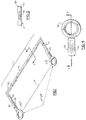
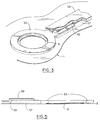
- FIGURES 1 through 5 The polymer thick film jumper wire structure adherent to and forming a new layer or partial layer or layers of the multi-layer circuit panel is shown in FIGURES 1 through 5.
- FIGURE 1 shows a microelectronic circuit panel 11 having original circuitization 21 thereon, shown between surface features, as lands 31a and 31b , or surface mount devices, or wire stubs or pins, or the like. It is desired to reroute circuitization between these two lands 31a and 31b , and remove circuitization 21 . According to the invention, rerouted circuitization 51 is provided on the microelectronic circuit panel 11 between the at least two surface features 31a and 31b .
- the rerouted circuitization 51 shown in FIGURES 1, 2, 3, 4, and 5, includes a pair of terminators, as circular lands 53a and 53b superimposed over the panel lands 31a and 31b .
- the circular lands 53a and 53b include contact portions overlaid by a conductive wire 55 .
- This conductive wire 55 is carried by, and deposited on, a conformal polymeric dielectric layer or layers 57 and overlaid by a conformal polymeric dielectric top layer 59 .
- the dielectrics adherent to the underlying structure, allow a plurality of crossing rerouted circuitization wires 51 to be superimposed one above the other. In this way, a number of reroutings may be accomplished.
- FIGURE 2 is a cross-sectional view of the rerouted circuitization structure 51 through plane 2-2' of FIGURE 1.
- FIGURE 2 shows the underlying microelectronic circuit panel 11 , with the conductive wire 55 .
- This conductive wire 55 is carried by, and deposited on, a conformal first dielectric 57 and overlaid by a conformal second dielectric 59 .
- the conductive lands 53a , 53b are formed of conductive material, such as formed eyelets of Cu.
- the conductive wire 55 is a conductive deposit of a conductive metal, as copper or silver.
- the conductors 55 are typically about 254 ⁇ m to 508 ⁇ m (10 to 20 mils) wide and about 12.7 ⁇ m to 25.4 ⁇ m (0.5 to 1.0 mil) thick. They may be deposits or preforms of Cu or Ag.
- the conductors 55 are formed of "Minico 5000" silver paste, deposited between the bottom polymeric dielectric layer or layers 57 and the top polymeric dielectric layer 59 .
- the conformal bottom polymeric dielectric layer or layers 57 , and the conformal top polymeric dielectric 59 , an overcoat layer dielectric are typically about 12.7 to 25.4 ⁇ m (0.5 to 1.0 mil) thick, surrounding and encapsulating the conductive wire or layer 55 .
- Typical polymers include phenolics, epoxies, polyimides, and the like.
- the preferred polymeric dielectrics are characterized by a low dielectric constant, a relatively high dielectric breakdown voltage, and are substantially nonreactive with the cirtcuitization and the circuitization processes.
- the polymeric dielectric materials are preferably curable at about 200 degrees Centigrade or lower.
- the rerouting current lead 51 is formed of a dielectric 57 , 59 encapsulated conductor 55 electrically joining the two surface features 53a , 53b .
- the dielectric 57 , 59 encapsulated conductor 55 structure 51 includes a conformal, polymeric dielectric layer 57 adherent to a surface of the microelectronic circuit panel 11 , with a deposited conductor 55 on the conformal, polymeric dielectric layer, and a conformal, polymeric dielectric overcoat layer 59 deposited atop the deposited conductor 55 .
- the method includes depositing (for example, screening) a conformal, polymeric, dielectric carrier coating 57 on the surface of the microelectronic circuit panel 11 , depositing the conductive circuitization 55 atop the conformal, polymeric, dielectric carrier coating 57 on the surface of the panel 11 , and depositing a second conformal, polymeric, dielectric coating 59 atop the conductive circuitization layer 55 .
- the bottom dielectric is successively screened on as two or more layers, each individually screened and cured, one atop the other.
- the use of two or more sublayers 57 provides increased resistance to the development of short circuit paths between the deposited conductor 55 and the pre-existing surface circuitization 21 of the package.
- they are preferably about 12.7 to 17.8 ⁇ m (0.5 to 0.7 mils) thick.
- the rerouted circuitization 51 may be pre-formed as a lamination of two thermoset or thermoplastic polymeric layers 57 , 59 with a conductor 55 therebetween.
- the land eyelets 53a , 53b are at the ends of the encapsulated conductor.
- the invention provides an inexpensive, low cost method of and structure for making engineering changes and repairs to microelectronic circuit panels. In this way it is possible to effect engineering changes and wiring rerouting in the field, especially individual, customized engineering changes.
Landscapes
- Engineering & Computer Science (AREA)
- Manufacturing & Machinery (AREA)
- Microelectronics & Electronic Packaging (AREA)
- Production Of Multi-Layered Print Wiring Board (AREA)
- Manufacturing Of Printed Wiring (AREA)
Applications Claiming Priority (2)
| Application Number | Priority Date | Filing Date | Title |
|---|---|---|---|
| US07/762,201 US5214250A (en) | 1991-09-19 | 1991-09-19 | Method of reworking circuit panels, and circuit panels reworked thereby |
| US762201 | 1991-09-19 |
Publications (2)
| Publication Number | Publication Date |
|---|---|
| EP0532897A2 true EP0532897A2 (de) | 1993-03-24 |
| EP0532897A3 EP0532897A3 (en) | 1993-07-21 |
Family
ID=25064386
Family Applications (1)
| Application Number | Title | Priority Date | Filing Date |
|---|---|---|---|
| EP19920113570 Ceased EP0532897A3 (en) | 1991-09-19 | 1992-08-10 | Method of reworking circuit panels, and circuit panels reworked thereby |
Country Status (3)
| Country | Link |
|---|---|
| US (1) | US5214250A (de) |
| EP (1) | EP0532897A3 (de) |
| JP (1) | JPH0779196B2 (de) |
Cited By (2)
| Publication number | Priority date | Publication date | Assignee | Title |
|---|---|---|---|---|
| EP0613330A1 (de) * | 1992-11-09 | 1994-08-31 | Siemens Aktiengesellschaft | Diskretverdrahtungsverfahren für Leiterplatten und/oder elektronische Baugruppen |
| EP1075171A1 (de) * | 1999-07-31 | 2001-02-07 | Mannesmann VDO Aktiengesellschaft | Leiterplatte |
Families Citing this family (19)
| Publication number | Priority date | Publication date | Assignee | Title |
|---|---|---|---|---|
| JP2856240B2 (ja) * | 1992-10-30 | 1999-02-10 | インターナショナル・ビジネス・マシーンズ・コーポレイション | プリント回路基板を再加工する方法 |
| US5834705A (en) * | 1994-03-04 | 1998-11-10 | Silicon Graphics, Inc. | Arrangement for modifying eletrical printed circuit boards |
| US6307162B1 (en) | 1996-12-09 | 2001-10-23 | International Business Machines Corporation | Integrated circuit wiring |
| US6097884A (en) * | 1997-12-08 | 2000-08-01 | Lsi Logic Corporation | Probe points and markers for critical paths and integrated circuits |
| US20030042295A1 (en) * | 2001-08-30 | 2003-03-06 | Wong Marvin G. | Self-adhesive flexible repair circuit |
| US6881609B2 (en) * | 2001-09-07 | 2005-04-19 | Peter C. Salmon | Component connections using bumps and wells |
| US6927471B2 (en) * | 2001-09-07 | 2005-08-09 | Peter C. Salmon | Electronic system modules and method of fabrication |
| US7297572B2 (en) * | 2001-09-07 | 2007-11-20 | Hynix Semiconductor, Inc. | Fabrication method for electronic system modules |
| US7505862B2 (en) * | 2003-03-07 | 2009-03-17 | Salmon Technologies, Llc | Apparatus and method for testing electronic systems |
| US7408258B2 (en) * | 2003-08-20 | 2008-08-05 | Salmon Technologies, Llc | Interconnection circuit and electronic module utilizing same |
| US20050184376A1 (en) * | 2004-02-19 | 2005-08-25 | Salmon Peter C. | System in package |
| US20050255722A1 (en) * | 2004-05-07 | 2005-11-17 | Salmon Peter C | Micro blade assembly |
| US7427809B2 (en) * | 2004-12-16 | 2008-09-23 | Salmon Technologies, Llc | Repairable three-dimensional semiconductor subsystem |
| US20070007983A1 (en) * | 2005-01-06 | 2007-01-11 | Salmon Peter C | Semiconductor wafer tester |
| US20070023923A1 (en) * | 2005-08-01 | 2007-02-01 | Salmon Peter C | Flip chip interface including a mixed array of heat bumps and signal bumps |
| US7586747B2 (en) | 2005-08-01 | 2009-09-08 | Salmon Technologies, Llc. | Scalable subsystem architecture having integrated cooling channels |
| US20070023889A1 (en) * | 2005-08-01 | 2007-02-01 | Salmon Peter C | Copper substrate with feedthroughs and interconnection circuits |
| US20070023904A1 (en) * | 2005-08-01 | 2007-02-01 | Salmon Peter C | Electro-optic interconnection apparatus and method |
| US7351115B1 (en) | 2007-01-17 | 2008-04-01 | International Business Machines Corporation | Method for modifying an electrical connector |
Family Cites Families (10)
| Publication number | Priority date | Publication date | Assignee | Title |
|---|---|---|---|---|
| US4310811A (en) * | 1980-03-17 | 1982-01-12 | Sperry Corporation | Reworkable multi-layer printed circuit board |
| JPS56169576U (de) * | 1980-05-19 | 1981-12-15 | ||
| US4438561A (en) * | 1981-10-01 | 1984-03-27 | Rogers Corporation | Method of reworking printed circuit boards |
| GB2124835B (en) * | 1982-08-03 | 1986-04-30 | Burroughs Corp | Current printed circuit boards |
| DE3432360A1 (de) * | 1984-09-03 | 1986-03-13 | Siemens AG, 1000 Berlin und 8000 München | Verfahren zum aendern einer elektrischen flachbaugruppe |
| US4864723A (en) * | 1986-07-01 | 1989-09-12 | Preleg, Inc. | Electrical circuit modification method |
| US4866507A (en) * | 1986-05-19 | 1989-09-12 | International Business Machines Corporation | Module for packaging semiconductor integrated circuit chips on a base substrate |
| US4775573A (en) * | 1987-04-03 | 1988-10-04 | West-Tronics, Inc. | Multilayer PC board using polymer thick films |
| CA1249064A (en) * | 1987-07-06 | 1989-01-17 | Reginald B.P. Bennett | Process for application of overlay conductors to surface of printed circuit board assemblies |
| JPH0271591A (ja) * | 1988-09-07 | 1990-03-12 | Fujitsu Ltd | 回路基板修復方法 |
-
1991
- 1991-09-19 US US07/762,201 patent/US5214250A/en not_active Expired - Fee Related
-
1992
- 1992-08-10 EP EP19920113570 patent/EP0532897A3/en not_active Ceased
- 1992-08-15 JP JP4238995A patent/JPH0779196B2/ja not_active Expired - Lifetime
Cited By (2)
| Publication number | Priority date | Publication date | Assignee | Title |
|---|---|---|---|---|
| EP0613330A1 (de) * | 1992-11-09 | 1994-08-31 | Siemens Aktiengesellschaft | Diskretverdrahtungsverfahren für Leiterplatten und/oder elektronische Baugruppen |
| EP1075171A1 (de) * | 1999-07-31 | 2001-02-07 | Mannesmann VDO Aktiengesellschaft | Leiterplatte |
Also Published As
| Publication number | Publication date |
|---|---|
| US5214250A (en) | 1993-05-25 |
| JPH06169177A (ja) | 1994-06-14 |
| EP0532897A3 (en) | 1993-07-21 |
| JPH0779196B2 (ja) | 1995-08-23 |
Similar Documents
| Publication | Publication Date | Title |
|---|---|---|
| US5214250A (en) | Method of reworking circuit panels, and circuit panels reworked thereby | |
| US5401913A (en) | Electrical interconnections between adjacent circuit board layers of a multi-layer circuit board | |
| US5527741A (en) | Fabrication and structures of circuit modules with flexible interconnect layers | |
| US5428190A (en) | Rigid-flex board with anisotropic interconnect and method of manufacture | |
| US7923828B2 (en) | Structure and method of making interconnect element, and multilayer wiring board including the interconnect element | |
| US6219253B1 (en) | Molded electronic package, method of preparation using build up technology and method of shielding | |
| US5412539A (en) | Multichip module with a mandrel-produced interconnecting decal | |
| EP0400332B1 (de) | Verfahren zur Herstellung einer mehrschichtigen Zwischenverbindungs-Leiterplattenanordnung unter Anwendung der Dünnfilmtechnik | |
| US4970106A (en) | Thin film multilayer laminate interconnection board | |
| US7006359B2 (en) | Modular electronic assembly and method of making | |
| US20030141600A1 (en) | Apparatus and method of manufacturing printed circuit boards | |
| EP0471938A1 (de) | Thermischer Träger hoher Schaltungsdichte | |
| US6427323B2 (en) | Method for producing conductor interconnect with dendrites | |
| EP1123565B1 (de) | Mehrchipmodule mit eingebetteten kondensatoren | |
| EP0521720A1 (de) | Wärmeabgebende Mehrlagenleiterplatte | |
| GB2204184A (en) | Mounting electronic components on substrates | |
| US6897078B2 (en) | Programmable multi-chip module | |
| KR100301107B1 (ko) | 멀티칩모듈기판및그제조방법 | |
| KR20020054112A (ko) | 수동 소자 내장형 멀티 칩 모듈 기판 제조 방법 | |
| EP0525217A1 (de) | Träger für elektronische Komponenten |
Legal Events
| Date | Code | Title | Description |
|---|---|---|---|
| PUAI | Public reference made under article 153(3) epc to a published international application that has entered the european phase |
Free format text: ORIGINAL CODE: 0009012 |
|
| AK | Designated contracting states |
Kind code of ref document: A2 Designated state(s): DE FR GB |
|
| PUAL | Search report despatched |
Free format text: ORIGINAL CODE: 0009013 |
|
| RHK1 | Main classification (correction) |
Ipc: H05K 3/22 |
|
| AK | Designated contracting states |
Kind code of ref document: A3 Designated state(s): DE FR GB |
|
| 17P | Request for examination filed |
Effective date: 19930716 |
|
| 17Q | First examination report despatched |
Effective date: 19950331 |
|
| 18R | Application refused |
Effective date: 19960324 |