EP0532932B1 - Elektrochemische Messzelle zum Nachweis und zur Bestimmung von Gasen und Dämpfen, insbesondere von Halogen-Wasserstoffen - Google Patents
Elektrochemische Messzelle zum Nachweis und zur Bestimmung von Gasen und Dämpfen, insbesondere von Halogen-Wasserstoffen Download PDFInfo
- Publication number
- EP0532932B1 EP0532932B1 EP92114202A EP92114202A EP0532932B1 EP 0532932 B1 EP0532932 B1 EP 0532932B1 EP 92114202 A EP92114202 A EP 92114202A EP 92114202 A EP92114202 A EP 92114202A EP 0532932 B1 EP0532932 B1 EP 0532932B1
- Authority
- EP
- European Patent Office
- Prior art keywords
- electrode
- electrolyte
- cell according
- additive
- electrochemical
- Prior art date
- Legal status (The legal status is an assumption and is not a legal conclusion. Google has not performed a legal analysis and makes no representation as to the accuracy of the status listed.)
- Expired - Lifetime
Links
Images
Classifications
-
- G—PHYSICS
- G01—MEASURING; TESTING
- G01N—INVESTIGATING OR ANALYSING MATERIALS BY DETERMINING THEIR CHEMICAL OR PHYSICAL PROPERTIES
- G01N27/00—Investigating or analysing materials by the use of electric, electrochemical, or magnetic means
- G01N27/26—Investigating or analysing materials by the use of electric, electrochemical, or magnetic means by investigating electrochemical variables; by using electrolysis or electrophoresis
- G01N27/403—Cells and electrode assemblies
- G01N27/404—Cells with anode, cathode and cell electrolyte on the same side of a permeable membrane which separates them from the sample fluid, e.g. Clark-type oxygen sensors
- G01N27/4045—Cells with anode, cathode and cell electrolyte on the same side of a permeable membrane which separates them from the sample fluid, e.g. Clark-type oxygen sensors for gases other than oxygen
Definitions
- the invention relates to an electrochemical measuring cell for the detection and determination of gaseous and vaporous constituents in a measuring sample, by means of a measuring electrode and a counter electrode, which are located in an electrolyte with an additive which promotes the electrochemical reaction and which are accommodated in a measuring chamber which are used for Environment with a membrane that is permeable to the substance to be detected, impermeable to the electrolyte and the additive.
- the known electrochemical measuring cell has an ion-selective measuring electrode and counter electrode made of silver, which are immersed in an electrolyte made of sulfuric acid and a silver sulfate as an additive. If, for example, hydrochloric acid is detected, the chloride ions dissolved in the electrolyte react with the silver ions and form a silver chloride precipitate Measuring electrode and membrane. This leads to a change or blocking of the diffusion paths in the course of the measurement process, which results in an undesirable falsification of the measurement result. This measuring cell thus enables detection by the addition, but the electrode is blocked.
- the gas sample reaches the semi-permeable membrane exposed to the environment, whereupon the component to be detected diffuses through the membrane and is dissolved in the electrolyte.
- the electrochemical reaction takes place at the electrolyte / measuring electrode surface interface.
- the resulting measuring signal which is tapped between the measuring electrode and counter electrode, is a measure of the concentration of the component to be detected.
- An addition of copper salt is said to catalyze the oxidation of the substance to be detected (hydrocyanic acid, sulfur dioxide). This addition promotes the reaction but does not activate the electrode.
- the present invention is therefore based on the object to improve an electrochemical measuring cell of the type mentioned so that it responds selectively highly sensitive and a stable measurement signal with low cross sensitivity to other components, such as hydrogen, in the test sample containing gas to be released.
- the electrode surface, in particular that of the measuring electrode, should not be impaired in its measuring activity during the entire measuring time.
- the additive contains metal ions M n + of the same metal M o dissolved in the electrolyte from which the measuring electrode is composed in its main component, and that the oxidation level n is greater than or equal to the numerical value 2 and with such a value n is present that a synproportionation reaction takes place between the metal M o of the measuring electrode and the dissolved metal ion M n + .
- such an additive should be selected that the same metal - present as a salt or bound in a complex - is present in the electrolyte in a higher-quality oxidation state (n greater than or equal to 2) such that a synproportionation reaction between the metal of the electrode and the dissolved metal ion takes place.
- the synproportionation reaction usually takes place over several individual steps in which the necessary electron transfer takes place between M o and M n + .
- the synproportionation reaction taking place between the neutral metal ion M o of the measuring electrode and the multiply charged metal ion in solution to a certain extent causes an etching or a permanent exposure of the measuring electrode surface of any deposits or which hinder the reaction on the electrode surface Changes; a metallic clean surface is always available. As a result, their measuring activity is increased, which manifests itself in an improved response behavior.
- the addition in the electrolyte now promotes the reaction and prevents the electrode from blocking.
- the measuring electrode can either consist of pure metal or of a metallic alloy, the main constituent of the alloy being regarded as a partner participating in the proportioning reaction.
- the measuring electrode is preferably made of gold
- the additive is a salt of the general form HAuX 4 or AuX 3 , where X is one of the elements Cl or Br, and its concentration is greater than 10 -5 M, is preferably 10 -3 M.
- Such an electrochemical measuring cell is used, inter alia, in the chemical industry and in the semiconductor industry, in which gaseous constituents such as hydrochloric acid or hydrogen bromide or compounds which develop HCl in moist air, such as, for. B. BCl 3 , BBr 3 , SiH 2 Cl 2 and SiCl 4 as pollutants for those employed in the semiconductor industry in their Working environment must be proven.
- the sensor is characterized by long-term stability and high response speed, because the surface reactions of the measuring electrode always remain activated due to the electrode reactions taking place and their sensitivity does not decrease noticeably even when the measuring cell is exposed to the gas component for a long period of time.
- reaction steps taking place on the measuring electrode during the measurement of hydrogen halide are illustrated using the example of the detection of hydrochloric acid and tetrachloroauric acid as an additive in the following individual reaction steps: (1) Au ⁇ --> Au + + e - (2) Au ⁇ --> Au 3+ + 3e - (3) 2 Au + Au 3+ ⁇ --> 3 Au + (4) Au + + 2 cl - ⁇ --> [AuCl 2nd ] - (5) Au 3+ + 4 cl - ⁇ --> [AuCl 4th ] -
- the tetrachloroauric acid dissolved in the electrolyte is in equilibrium with the Au 3+ ions in accordance with equations (2) and (3), which is disturbed in the presence of, for example, hydrochloric acid by the detection species Cl considered in this case - this equilibrium corresponding to Detection reactions (4) and (5) interfere.
- the chloride ions react both with the Au + ions on the solid gold electrode surface and with the Au 3+ ions in solution.
- the on the Electrode surface removed by the reaction according to equation (4) and (5) Au + / Au 3+ ions are replenished by dissolving the electrode. As a result, the electrode surface is always renewed and thus activated.
- the gold supply is sufficient for the measuring cell to be operated continuously for more than one year.
- tetrachloroauric acid means that the measuring electrode surface is constantly renewed during the detection reaction; the measuring cell responds selectively to halogen-hydrogen, and because of the constantly active measuring electrode surface, the response speed is high and the measuring signal remains stable.
- a suitable electrolyte composition for the measurement of HCl consists in providing an addition of 10 -1 to 10 -5 molar, preferably 10 -3 molar, tetrachloroauric acid in a 4-molar sulfuric acid. This composition enables a continuous measurement for the detection of hydrogen halides in the ppm range.
- an additional reference electrode made of the same material as that of the measuring electrode in the electrochemical measuring cell.
- this third electrode it is possible to determine the reference potential to the working electrode with the aid of a potentiostatic circuit. Because of the identical electrode material, an electrode potential of 0 volts is possible, which is expressed in a short warm-up time and a low basic current. This creates the prerequisites for a quickly deployable and highly sensitive sensor.
- the ion exchange membrane can either be attached in such a way that it is clamped into the housing as a barrier between the measuring electrode and counterelectrode within the electrolyte space, or the surface of the counterelectrode is spanned with the ion exchange membrane.
- a suitable material for the ion exchange membrane is a perfluorosulfonated PTFE (Nafion, trademark of Dupont).
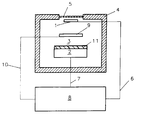
- the single figure shows a measuring cell with a measuring electrode (1), a counter electrode (2) and a reference electrode (9), all made of gold, which are placed in an electrolyte space (3) of the measuring cell housing (4).
- the electrolyte compartment (3) is filled with an aqueous solution of 4-molar sulfuric acid with an addition of 10 -3 molar tetrachloroauric acid.
- the electrolyte space (3) is closed off from the environment containing the measurement sample with halogen-hydrogen by a membrane (5) permeable to halogen-hydrogen.
- the counter electrode (2) is covered with a coating from an ion exchange membrane (11).
- All electrodes (1, 2, 9) have measuring connections (6, 7, 10) which are led through the housing (4) and connected to an evaluation unit (8) for further processing of the measuring signals.
- the evaluation unit (8) also contains a potentiostat, with the aid of which the reference potential between the reference electrode (9) and the measuring electrode (1) is established and maintained.
Landscapes
- Chemical & Material Sciences (AREA)
- Life Sciences & Earth Sciences (AREA)
- Health & Medical Sciences (AREA)
- Physics & Mathematics (AREA)
- Chemical Kinetics & Catalysis (AREA)
- Electrochemistry (AREA)
- Molecular Biology (AREA)
- Analytical Chemistry (AREA)
- Biochemistry (AREA)
- General Health & Medical Sciences (AREA)
- General Physics & Mathematics (AREA)
- Immunology (AREA)
- Pathology (AREA)
- Measuring Oxygen Concentration In Cells (AREA)
- Investigating Or Analyzing Non-Biological Materials By The Use Of Chemical Means (AREA)
Description
- Die Erfindung betrifft eine elektrochemische Meßzelle zum Nachweis und zur Bestimmung von gasförmigen und dampfförmigen Bestandteilen in einer Meßprobe, mittels einer Meßelektrode und einer Gegenelektrode, die sich in einem Elektrolyten mit einem die elektrochemische Reaktion fördernden Zusatz befinden und welche in einer Meßkammer aufgenommen sind, die zur Umgebung hin mit einer für die nachzuweisende Substanz durchlässigen, für den Elektrolyten und den Zusatz undurchlässigen Membran abgeschlossen ist.
- Eine derartige elektrochemische Meßzelle ist in der DE-OS 26 27 271 beschrieben worden.
- Die bekannte elektrochemische Meßzelle besitzt eine ionenselektive Meßelektrode und Gegenelektrode aus Silber, welche in einem Elekrolyten aus Schwefelsäure und einem Silbersulfat als Zusatz eintauchen. Beim Nachweis von beispielsweise Salzsäure reagieren die im Elektrolyten gelösten Chloridionen mit den Silberionen und bilden einen Silberchloridniederschlag zwischen Meßelektrode und Membran. Dies führt im Laufe des Meßvorgangs zu einer Veränderung bzw. Blockierung der Diffusionswege, was eine unerwünschte Verfälschung des Meßergebnisses zur Folge hat. Diese Meßzelle ermöglicht somit durch den Zusatz zwar die Detektion, jedoch wird die Elektrode blockiert.
- Bei einer weiteren bekannten Meßzelle nach der DE-OS 39 23 717 gelangt die Gasprobe an die der Umgebung ausgesetzten semipermeablen Membran, worauf der nachzuweisende Bestandteil durch die Membran diffundiert und in dem Elektrolyten gelöst wird. Die elektrochemische Reaktion findet an der Grenzfläche Elektrolyt/Meßelektroden-Oberfläche statt. Das resultierende Meßsignal, welches zwischen Meßelektrode und Gegenelektrode abgegriffen wird, ist ein Maß für die Konzentration des nachzuweisenden Bestandteils. Ein Zusatz an Kupfersalz soll die Oxidation der nachzuweisenden Substanz (Blausäure, Schwefeldioxid) katalysieren. Dieser Zusatz fördert zwar die Reaktion, aktiviert aber nicht die Elektrode.
- Der vorliegenden Erfindung liegt somit die Aufgabe zugrunde, eine elektrochemische Meßzelle der genannten Art so zu verbessern, daß sie selektiv hochempfindlich anspricht und ein stabiles Meßsignal mit geringer Querempfindlichkeit gegenüber anderen Bestandteilen, wie z.B. Wasserstoff, in der das nachzuweisende Gas enthaltenden Meßprobe abgibt. Die Elektrodenoberfläche, insbesondere die der Meßelektrode, soll während der gesamten Meßzeit in ihrer Meßaktivität nicht beeinträchtigt werden.
- Zur Lösung der Aufgabe ist vorgesehen, daß der Zusatz im Elektrolyten gelöste Metallionen Mn+ des gleichen Metalls Mo enthält, aus dem die Meßelektrode in ihrem Hauptbestandteil zusammengesetzt ist, und daß die Oxidationsstufe n größer oder gleich dem Zahlenwert 2 ist und mit einem solchen Wert n vorliegt, daß eine Synproportionierungsreaktion zwischen dem Metall Mo der Meßelektrode und dem gelösten Metallion Mn+ stattfindet.
- Je nach gewähltem Metall für die Meßelektrode ist ein solcher Zusatz auszuwählen, daß dasselbe Metall - als Salz vorliegend oder in einem Komplex gebunden - in einer solchen höherwertigen Oxidationsstufe (n größer gleich 2) im Elektrolyten gelöst vorliegt, daß eine Synproportionierungsreaktion zwischen dem Metall der Elektrode und dem gelösten Metallion stattfindet. Die Synproportionierungsreaktion läuft üblicherweise über mehrere Einzelschritte ab, in denen der notwendige Elektronentransfer zwischen Mo und Mn+ stattfindet. Besteht z.B. die Meßelektrode aus Kupfer, ist als Zusatz Kupfer(II)chlorid zu wählen (n = 2). Bei Platin als Elektrodenmaterial wäre als Zusatz Hexachloroplatinat mit einer Oxidationsstufe n = 4 einzusetzen.
- Die ablaufende Synproportionierungsreaktion zwischen dem neutralen Metallion Mo der Meßelektrode und dem mehrfach geladenen Metallion in Lösung bewirkt gewissermaßen eine Anätzung bzw. ein immerwährendes Freilegen der Meßelektrodenoberfläche von irgendwelchen, die Reaktion an der Elektrodenoberfläche behindernden Ablagerungen oder Veränderungen; eine metallisch reine Oberfläche steht ständig zur Verfügung. Dadurch ist deren Meßaktivität erhöht, was sich in einem verbesserten Ansprechverhalten äußert. Der Zusatz im Elektrolyten fördert nunmehr die Reaktion, und verhindert dazu ein Blockieren der Elektrode.
- Die Meßelektrode kann dabei entweder aus reinem Metall oder aus einer metallischen Legierung bestehen, wobei der Hauptbestandteil der Legierung als an der Syproportionierungsreaktion teilnehmender Partner anzusehen ist.
- Soll mit der Meßzelle Halogenwasserstoff nachgewiesen werden, besteht die Meßelektrode vorzugsweise aus Gold, und der Zusatz ist ein Salz der allgemeinen Form HAuX4 oder AuX3, wobei X eines der Elemente Cl oder Br ist, und dessen Konzentration größer als 10-5M, vorzugsweise 10-3M ist.
- Die Auswahl von Cl für X ist günstig für den Nachweis von HCl, HBr, HJ, die Auswahl von Br für X begünstigt den Nachweis von HBr, HJ. Für die Bestimmung von HCl hat sich als besonders geeignet die Tetrachlorogoldsäure (HAuCl4) erwiesen. Für diese gilt n = 3.
- Eine derartige elektrochemische Meßzelle findet u.a. ihren Anwendungsbereich in der chemischen Industrie sowie in der Halbleiterindustrie, in welcher gasförmige Bestandteile wie Salzsäure oder Bromwassserstoff bzw. solche Verbindungen, die an feuchter Luft HCl entwickeln, wie z. B. BCl3, BBr3, SiH2Cl2 und SiCl4 als Schadstoffe für die in der Halbleiterindustrie Beschäftigten in deren Arbeitsumgebung nachgewiesen werden müssen. Der Sensor zeichnet sich durch Langzeitstabilität und hohe Ansprechgeschwindigkeit aus, da durch die stattfindenden Elektrodenreaktionen die Oberfläche der Meßelektrode stets aktiviert bleibt und ihre Empfindlichkeit auch bei langanhaltender Belastung der Meßzelle mit dem nachzuweisenden Gasbestandteil nicht merklich nachläßt.
- Die an der Meßelektrode ablaufenden Reaktionsschritte während der Messung von Halogenwasserstoffen wird am Beispiel des Nachweises von Salzsäure und Tetrachlorogoldsäure als Zusatz in folgenden Einzelreaktionsschritten dargestellt:




- Die im Elektrolyten gelöste Tetrachlorogoldsäure ist im Gleichgewicht mit den Au3+-Ionen entsprechend den Gleichungen (2) und (3), welches bei Anwesenheit von beispielsweise Salzsäure gestört wird, indem die in diesem Falle betrachtete Nachweis-Spezies Cl- dieses Gleichgewicht entsprechend der Nachweisreaktionen (4) und (5) stört. Die Chloridionen reagieren sowohl mit den auf der festen Goldelektroden-Oberfläche befindlichen Au+-Ionen als auch mit denen in Lösung befindlichen Au3+-Ionen. Die an der Elektroden-Oberfläche durch die Reaktion nach Gleichung (4) und (5) entfernten Au+/Au3+-Ionen werden durch die Auflösung der Elektrode nachgeliefert. Dadurch wird die Elektroden-Oberfläche stets erneuert und somit aktiviert. Der Goldvorrat reicht für einen mehr als einjährigen Dauerbetrieb der Meßzelle aus.
- Durch den Zusatz an Tetrachlorogoldsäure wird während der Nachweisreaktion somit die Meßelektroden-Oberfläche ständig erneuert; die Meßzelle spricht selektiv auf Halogen-Wasserstoff an, und wegen der gleichbleibend aktiven Meßelektroden-Oberfläche ist die Ansprechgeschwindigkeit hoch und das Meßsignal bleibt stabil.
- Eine geeignete Elektrolyt-Zusammensetzung für die Messung von HCl besteht darin, in einer 4-molaren Schwefelsäure einen Zusatz von 10-1 bis 10-5 molarer, vorzugsweise 10-3 molarer, Tetrachlorogoldsäure vorzusehen. Diese Zusammensetzung ermöglicht eine kontinuierliche Messung zum Nachweis von Halogen-Wasserstoffen im ppm-Bereich.
- Zur weiteren Langzeitstabilisierung des Meßsignales ist es zweckmäßig, in der elektrochemischen Meßzelle eine zusätzliche Referenzelektrode aus demselben Material wie das der Meßelektrode einzubringen. Mit Hilfe dieser dritten Elektrode ist es möglich, das Bezugspotential zur Arbeitselektrode mit Hilfe einer potentiostatischen Schaltung festzulegen. Wegen des identischen Elektrodenmaterials ist ein Elektrodenpotential von 0 Volt möglich, welches sich in einer kurzen Einlaufzeit und einem geringen Grundstrom äußert. Damit sind die Voraussetzungen für einen schnell einsatzbereiten und hochempfindlichen Sensor geschaffen.
- Während der Nachweisreaktion von z.B. Salzsäure findet unter anderem bei der Reduktion des Zusatzes (im Beispiel von Tetrachlorogoldsäure) an der Gegenelektrode eine Anreicherung von Halogen-Wasserstoff (im Beispiel Salzsäure) im Elektrolyten statt. Diese Anreicherung führt zur Verschiebung des Bezugspotentials für die Meßelektrode, was zu einer Drift des Meßsignals führt. Um diese unerwünschten Folgereaktionen zu unterbinden, ist es zweckmäßig, die Gegenelektrode mit einer Kationentauschermembran zu schützen. Dadurch wird die Reduktion des Zusatzes, z.B. der Tetrachlorogoldsäure verhindert, so daß es zur Anreicherung des Zusatzes, und nicht mehr zu einer Anreicherung von Halogen-Wasserstoff in der Lösung kommt.
- Die Anbringung der Ionentauschermembran kann entweder in der Art erfolgen, daß sie innerhalb des Elektrolytraums als eine Barriere zwischen Meßelektrode und Gegenelektrode in das Gehäuse eingespannt ist, oder die Oberfläche der Gegenelektrode ist mit der Ionentauschermembran überspannt.
- Ein geeignetes Material für die Ionentauschermembran ist ein perfluorosulfoniertes PTFE (Nafion, Warenzeichen der Fa. Dupont).
- Ein Ausführungsbeispiel der Erfindung wird anhand einer schematischen Zeichnung dargestellt und im folgenden näher erläutert.
- Die einzige Figur zeigt eine Meßzelle mit einer Meßelektrode (1), einer Gegenelektrode (2) und einer Bezugselektrode (9), alle aus Gold, welche in einem Elektrolytraum (3) des Meßzellengehäuses (4) eingebracht sind. Der Elektrolytraum (3) ist mit einer wäßrigen Lösung von 4-molarer Schwefelsäure mit einem Zusatz von 10-3 molarer Tetrachlorogoldsäure gefüllt. Zur Umgebung hin, die die Meßprobe mit Halogen-Wasserstoff enthält, ist der Elektrolytraum (3) durch eine für Halogen-Wasserstoff permeablen Membran (5) abgeschlossen. Die Gegenelektrode (2) ist mit einem Überzug aus einer Ionentauschermembran (11) überspannt. Alle Elektroden (1, 2, 9) besitzen Meßanschlüsse (6, 7, 10), welche durch das Gehäuse (4) hindurchgeführt und an eine Auswerteeinheit (8) zur weiteren Verarbeitung der Meßsignale angeschlossen sind. Die Auswerteeinheit (8) enthält ebenfalls einen Potentiostaten, mit dessen Hilfe das Bezugspotential zwischen Referenzelektrode (9) und Meßelektrode (1) festgelegt und aufrechterhalten wird.
Claims (9)
- Elektrochemische Meßzelle zum Nachweis und zur Bestimmung von gas- oder dampfförmigen Bestandteilen in einer Meßprobe, mittels einer Meßelektrode und einer Gegenelektrode, die sich in einem Elektrolyten mit einem die elektrochemische Reaktion fördernden Zusatz befinden und welche in einer Meßkammer aufgenommen sind, die zur Umgebung hin mit einer für die nachzuweisende Substanz durchlässigen, für den Elektrolyten und den Zusatz undurchlässigen Membran abgeschlossen ist, dadurch gekennzeichnet, daß der Zusatz im Elektrolyten gelöste Metallionen Mn+ des gleichen Metalls Mo enthält, aus dem die Meßelektrode (1) in ihrem Hauptbestandteil zusammengesetzt ist, und daß die Oxidationsstufe n größer oder gleich dem Zahlenwert 2 ist und mit einem solchen Wert n vorliegt, daß eine Synproportionierungsreaktion zwischen dem Metall Mo der Meßelektrode (1) und dem gelösten Metallion Mn+ stattfindet.
- Elektrochemische Meßzelle nach Anspruch 1, dadurch gekennzeichnet, daß die Meßelektrode (1) zum Nachweis von Halogenwasserstoffen im wesentlichen aus Gold besteht, und daß der Zusatz das Metallion in gelöster Form eines Salzes der allgemeinen Zusammensetzung HAuX4 oder AuX3 enthält, wobei X eines der Elemente Cl oder Br darstellt.
- Elektrochemische Meßzelle nach Anspruch 2, dadurch gekennzeichnet, daß der Zusatz im Elektrolyten in einer Konzentration größer als 10-5M, vorzugsweise 10-3M vorliegt.
- Elektrochemische Meßzelle nach Anspruch 1 bis 3, dadurch gekennzeichnet, daß zum Nachweis von Salzsäure dem Elektrolyten ein Zusatz an Tetrachlorogoldsäure (HAuCl4) beigegeben ist.
- Elektrochemische Meßzelle nach einem der Ansprüche 1 bis 4, dadurch gekennzeichnet, daß eine zusätzliche Referenzelektrode (9) aus demselben Metall wie die Meßelektrode (1) vorgesehen ist.
- Elektrochemische Meßzelle nach einem der Ansprüche 1 bis 5, dadurch gekennzeichnet, daß die Gegenelektrode (2) mit einer Kationentauschermembran (11) geschützt ist.
- Elektrochemische Meßzelle nach Anspruch 6, dadurch gekennzeichnet, daß die Ionentauschermembran (11) aus Nafion (perfluorosulfoniertes PTFE) besteht.
- Elektrochemische Meßzelle nach Anspruch 6 oder 7, dadurch gekennzeichnet, daß die Ionentauschermembran als eine zwischen Meßelektrode (1) und Gegenelektrode (2) im Elektrolytraum (3) eingebrachte Trennmembran (11) im Gehäuse (4) eingespannt ist.
- Elektrochemische Meßzelle nach Anspruch 6 oder 7, dadurch gekennzeichnet, daß die Ionentauschermembran (11) die Oberfläche der Gegenelektrode (2) überdeckt.
Applications Claiming Priority (4)
| Application Number | Priority Date | Filing Date | Title |
|---|---|---|---|
| DE4130690 | 1991-09-14 | ||
| DE4130690 | 1991-09-14 | ||
| DE4133831A DE4133831A1 (de) | 1991-09-14 | 1991-10-12 | Elektrochemische messzelle zum nachweis und zur bestimmung von gasen und daempfen insbesondere von halogen-wasserstoffen |
| DE4133831 | 1991-10-12 |
Publications (3)
| Publication Number | Publication Date |
|---|---|
| EP0532932A2 EP0532932A2 (de) | 1993-03-24 |
| EP0532932A3 EP0532932A3 (en) | 1994-11-02 |
| EP0532932B1 true EP0532932B1 (de) | 1997-07-16 |
Family
ID=25907354
Family Applications (1)
| Application Number | Title | Priority Date | Filing Date |
|---|---|---|---|
| EP92114202A Expired - Lifetime EP0532932B1 (de) | 1991-09-14 | 1992-08-20 | Elektrochemische Messzelle zum Nachweis und zur Bestimmung von Gasen und Dämpfen, insbesondere von Halogen-Wasserstoffen |
Country Status (3)
| Country | Link |
|---|---|
| US (1) | US5316648A (de) |
| EP (1) | EP0532932B1 (de) |
| DE (2) | DE4133831A1 (de) |
Families Citing this family (11)
| Publication number | Priority date | Publication date | Assignee | Title |
|---|---|---|---|---|
| US5481181A (en) * | 1994-08-01 | 1996-01-02 | Hughes Aircraft Company | Real-time toxic metals monitor device and method |
| DE4445948C2 (de) * | 1994-12-22 | 1998-04-02 | Draegerwerk Ag | Verfahren zum Betreiben einer amperometrischen Meßzelle |
| DE4445947C2 (de) * | 1994-12-22 | 1998-03-12 | Draegerwerk Ag | Verfahren zur Erkennung von Fehlerquellen bei amperometrischen Meßzellen |
| US5665604A (en) * | 1995-08-18 | 1997-09-09 | The Regents Of The University Of California, Office Of Technology Transfer | Method and apparatus for detecting halogenated hydrocarbons |
| US5908546A (en) * | 1997-07-02 | 1999-06-01 | Mine Safety Appliances Company | Detection of hydrogen chloride |
| DE19832395C1 (de) * | 1998-07-18 | 1999-11-25 | Draeger Sicherheitstech Gmbh | Elektrochemische Meßzelle zum Nachweis von Hydridgasen |
| JP2004003897A (ja) * | 2002-06-03 | 2004-01-08 | Shinwa Kako Kk | クロマトグラフィー用担体、前処理用担体及びキット |
| US6666963B1 (en) * | 2002-08-14 | 2003-12-23 | Industrial Scientific Corporation | Oxygen sensor |
| EP1853904A1 (de) * | 2005-01-26 | 2007-11-14 | Rosemount Analytical Inc. | Amperometrischer sensor mit von flüssigelektrolyt isolierter gegenelektrode |
| GB2507042B (en) * | 2012-10-16 | 2018-07-11 | Schlumberger Holdings | Electrochemical hydrogen sensor |
| DE102013014995A1 (de) * | 2013-09-09 | 2015-03-26 | Dräger Safety AG & Co. KGaA | Flüssiger Elektrolyt für einen elektrochemischen Gassensor |
Family Cites Families (15)
| Publication number | Priority date | Publication date | Assignee | Title |
|---|---|---|---|---|
| NL256163A (de) * | 1959-09-28 | |||
| US3239444A (en) * | 1962-02-08 | 1966-03-08 | Honeywell Inc | Oxygen sensing polarographic cell |
| US3795589A (en) * | 1970-11-30 | 1974-03-05 | H Dahms | Methods for electrochemical analysis |
| DE2627271C2 (de) * | 1976-06-18 | 1983-09-01 | Bayer Ag, 5090 Leverkusen | Elektrochemische Zelle mit einer polarographischen Einrichtung mit ionenselektiver Elektrode als Arbeits- und Bezugselektrode |
| JPS5554509A (en) * | 1978-10-18 | 1980-04-21 | Nippon Mining Co Ltd | Production of fine gold powder |
| JPS5871344A (ja) * | 1981-10-22 | 1983-04-28 | Asaka Riken Kogyo Kk | 金の精製法 |
| US4552624A (en) * | 1982-08-23 | 1985-11-12 | British Nuclear Fuels Limited | Electrochemical apparatus for monitoring and/or measuring a component of a gas and a method of using said apparatus |
| FR2536388A1 (fr) * | 1982-11-22 | 1984-05-25 | Rhone Poulenc Spec Chim | Procede de preparation de chlorures d'acides a-chlores |
| GB8712582D0 (en) * | 1987-05-28 | 1987-07-01 | Neotronics Ltd | Acidic gas sensors |
| US5133842A (en) * | 1988-11-17 | 1992-07-28 | Physical Sciences, Inc. | Electrochemical cell having electrode comprising gold containing electrocatalyst |
| US4936074A (en) * | 1988-11-17 | 1990-06-26 | D. M. Graham Laboratories, Inc. | Process for preparing solid encapsulated medicament |
| DE3841622A1 (de) * | 1988-12-10 | 1990-06-13 | Draegerwerk Ag | Elektrochemische messzelle zur amperometrischen bestimmung von ammoniak und dessen derivate |
| DE3923717A1 (de) * | 1989-07-18 | 1991-01-24 | Draegerwerk Ag | Elektrochemische messzelle zum nachweis von blausaeure oder schwefeldioxid |
| DE3941554A1 (de) * | 1989-12-16 | 1991-06-20 | Draegerwerk Ag | Elektrochemische messzelle zum nachweis von gaskomponenten in fluiden medien |
| US5084144A (en) * | 1990-07-31 | 1992-01-28 | Physical Sciences Inc. | High utilization supported catalytic metal-containing gas-diffusion electrode, process for making it, and cells utilizing it |
-
1991
- 1991-10-12 DE DE4133831A patent/DE4133831A1/de not_active Withdrawn
-
1992
- 1992-08-20 DE DE59208705T patent/DE59208705D1/de not_active Expired - Fee Related
- 1992-08-20 EP EP92114202A patent/EP0532932B1/de not_active Expired - Lifetime
- 1992-09-11 US US07/943,678 patent/US5316648A/en not_active Expired - Fee Related
Also Published As
| Publication number | Publication date |
|---|---|
| US5316648A (en) | 1994-05-31 |
| DE4133831A1 (de) | 1993-03-18 |
| EP0532932A3 (en) | 1994-11-02 |
| DE59208705D1 (de) | 1997-08-21 |
| EP0532932A2 (de) | 1993-03-24 |
Similar Documents
| Publication | Publication Date | Title |
|---|---|---|
| DE3883289T2 (de) | Sensoren für saure Gase. | |
| DE69201653T2 (de) | Gassensor. | |
| DE10359173B4 (de) | Messvorrichtung mit mehreren auf einem Substrat angeordneten potentiometrischen Elektrodenpaaren | |
| DE1057359B (de) | Vorrichtung zum Nachweis von Sauerstoff | |
| EP0532932B1 (de) | Elektrochemische Messzelle zum Nachweis und zur Bestimmung von Gasen und Dämpfen, insbesondere von Halogen-Wasserstoffen | |
| DE3841622A1 (de) | Elektrochemische messzelle zur amperometrischen bestimmung von ammoniak und dessen derivate | |
| DE69737627T2 (de) | Analysezelle | |
| DE2365477A1 (de) | Elektrochemische vorrichtung zur bestimmung des sauerstoffgehaltes eines fludes | |
| EP0408959B1 (de) | Elektrochemische Messzelle zum Nachweis von Blausäure oder Schwefeldioxid | |
| EP0588984B1 (de) | Verfahren zur verlängerung der einsatzdauer und verminderung der temperaturabhängigkeit ionenselektiver kunststoffmembran-elektroden | |
| CH635200A5 (de) | Verfahren zur einstellung des ph-wertes eines probenstromes in einem potentiometrischen system zur messung niedriger ionenaktivitaeten. | |
| EP0541739B1 (de) | Bezugselektrode mit ionensperre für elektrochemische messeinrichtungen | |
| DE3146066A1 (de) | Potentiometrische elektrode | |
| EP0282441B1 (de) | Verfahren zur Bestimmung des chemischen Sauerstoffbedarfs von Wasser | |
| DE4231256C2 (de) | Elektrochemischer Sauerstoffsensor mit einer Luftsauerstoffelektrode als Bezugselektrode | |
| DE4205157C2 (de) | Elektrochemische Meßzelle zur Bestimmung von Ammoniak, Aminen, Hydrazin und Hydrazinderivaten | |
| DE4425135C2 (de) | Amperometrischer Sensor | |
| EP0780685A1 (de) | Amperometrischer Zweielektrodensensor, insbesondere für Wasserstoffperoxid | |
| DE2808339A1 (de) | Elektrochemische vorrichtung zum aufspueren und/oder ueberwachen einer komponente in einem fluid | |
| EP0693180B1 (de) | Ammoniaksensor | |
| DE2361399B2 (de) | Fluessigkeitschromatographisches verfahren | |
| DE1191984B (de) | Galvanische Zellen eines Sauerstoffmessgeraetes und Verfahren zu ihrer Herstellung | |
| CH642747A5 (de) | Verfahren und reagenz zur verringerung der stoerenden wirkungen von bromid- und iodidionen bei der analyse mit ionenselektiven elektroden. | |
| DE4238337A1 (de) | Elektrochemische Meßzelle zur Bestimmung von Ammoniak oder Hydrazin in einer Meßprobe | |
| DE1798446C2 (de) | Verfahren zur kontinuierlichen elektrochemischen Bestimmung der Konzentration von Chlor, Brom, Jod, deren Wasserstoffsäuren, Cyanwasserstoffsäure und gasförmigen Cyanderivaten in einer Atmosphäre. Ausscheidung aus: 1598225 |
Legal Events
| Date | Code | Title | Description |
|---|---|---|---|
| PUAI | Public reference made under article 153(3) epc to a published international application that has entered the european phase |
Free format text: ORIGINAL CODE: 0009012 |
|
| AK | Designated contracting states |
Kind code of ref document: A2 Designated state(s): DE FR GB NL |
|
| PUAL | Search report despatched |
Free format text: ORIGINAL CODE: 0009013 |
|
| AK | Designated contracting states |
Kind code of ref document: A3 Designated state(s): DE FR GB NL |
|
| 17P | Request for examination filed |
Effective date: 19941123 |
|
| GRAG | Despatch of communication of intention to grant |
Free format text: ORIGINAL CODE: EPIDOS AGRA |
|
| GRAH | Despatch of communication of intention to grant a patent |
Free format text: ORIGINAL CODE: EPIDOS IGRA |
|
| 17Q | First examination report despatched |
Effective date: 19961217 |
|
| GRAH | Despatch of communication of intention to grant a patent |
Free format text: ORIGINAL CODE: EPIDOS IGRA |
|
| GRAA | (expected) grant |
Free format text: ORIGINAL CODE: 0009210 |
|
| AK | Designated contracting states |
Kind code of ref document: B1 Designated state(s): DE FR GB NL |
|
| PGFP | Annual fee paid to national office [announced via postgrant information from national office to epo] |
Ref country code: GB Payment date: 19970722 Year of fee payment: 6 |
|
| PGFP | Annual fee paid to national office [announced via postgrant information from national office to epo] |
Ref country code: FR Payment date: 19970813 Year of fee payment: 6 |
|
| GBT | Gb: translation of ep patent filed (gb section 77(6)(a)/1977) |
Effective date: 19970725 |
|
| REF | Corresponds to: |
Ref document number: 59208705 Country of ref document: DE Date of ref document: 19970821 |
|
| PGFP | Annual fee paid to national office [announced via postgrant information from national office to epo] |
Ref country code: NL Payment date: 19970828 Year of fee payment: 6 |
|
| PGFP | Annual fee paid to national office [announced via postgrant information from national office to epo] |
Ref country code: DE Payment date: 19970929 Year of fee payment: 6 |
|
| ET | Fr: translation filed | ||
| PLBE | No opposition filed within time limit |
Free format text: ORIGINAL CODE: 0009261 |
|
| 26N | No opposition filed | ||
| PG25 | Lapsed in a contracting state [announced via postgrant information from national office to epo] |
Ref country code: GB Free format text: LAPSE BECAUSE OF NON-PAYMENT OF DUE FEES Effective date: 19980820 |
|
| PG25 | Lapsed in a contracting state [announced via postgrant information from national office to epo] |
Ref country code: NL Free format text: LAPSE BECAUSE OF NON-PAYMENT OF DUE FEES Effective date: 19990301 |
|
| GBPC | Gb: european patent ceased through non-payment of renewal fee |
Effective date: 19980820 |
|
| PG25 | Lapsed in a contracting state [announced via postgrant information from national office to epo] |
Ref country code: FR Free format text: LAPSE BECAUSE OF NON-PAYMENT OF DUE FEES Effective date: 19990430 |
|
| NLV4 | Nl: lapsed or anulled due to non-payment of the annual fee |
Effective date: 19990301 |
|
| PG25 | Lapsed in a contracting state [announced via postgrant information from national office to epo] |
Ref country code: DE Free format text: LAPSE BECAUSE OF NON-PAYMENT OF DUE FEES Effective date: 19990601 |
|
| REG | Reference to a national code |
Ref country code: FR Ref legal event code: ST |