EP0532982A1 - Porte coulissante sans seuil de préférence à blindage anti-radiation électromagnétique - Google Patents
Porte coulissante sans seuil de préférence à blindage anti-radiation électromagnétique Download PDFInfo
- Publication number
- EP0532982A1 EP0532982A1 EP92115002A EP92115002A EP0532982A1 EP 0532982 A1 EP0532982 A1 EP 0532982A1 EP 92115002 A EP92115002 A EP 92115002A EP 92115002 A EP92115002 A EP 92115002A EP 0532982 A1 EP0532982 A1 EP 0532982A1
- Authority
- EP
- European Patent Office
- Prior art keywords
- opening
- floor
- floating cover
- angle
- area
- Prior art date
- Legal status (The legal status is an assumption and is not a legal conclusion. Google has not performed a legal analysis and makes no representation as to the accuracy of the status listed.)
- Ceased
Links
Images


Classifications
-
- E—FIXED CONSTRUCTIONS
- E06—DOORS, WINDOWS, SHUTTERS, OR ROLLER BLINDS IN GENERAL; LADDERS
- E06B—FIXED OR MOVABLE CLOSURES FOR OPENINGS IN BUILDINGS, VEHICLES, FENCES OR LIKE ENCLOSURES IN GENERAL, e.g. DOORS, WINDOWS, BLINDS, GATES
- E06B5/00—Doors, windows, or like closures for special purposes; Border constructions therefor
- E06B5/10—Doors, windows, or like closures for special purposes; Border constructions therefor for protection against air-raid or other war-like action; for other protective purposes
- E06B5/18—Doors, windows, or like closures for special purposes; Border constructions therefor for protection against air-raid or other war-like action; for other protective purposes against harmful radiation
-
- E—FIXED CONSTRUCTIONS
- E05—LOCKS; KEYS; WINDOW OR DOOR FITTINGS; SAFES
- E05D—HINGES OR SUSPENSION DEVICES FOR DOORS, WINDOWS OR WINGS
- E05D15/00—Suspension arrangements for wings
- E05D15/06—Suspension arrangements for wings for wings sliding horizontally more or less in their own plane
-
- E—FIXED CONSTRUCTIONS
- E05—LOCKS; KEYS; WINDOW OR DOOR FITTINGS; SAFES
- E05D—HINGES OR SUSPENSION DEVICES FOR DOORS, WINDOWS OR WINGS
- E05D15/00—Suspension arrangements for wings
- E05D15/06—Suspension arrangements for wings for wings sliding horizontally more or less in their own plane
- E05D15/10—Suspension arrangements for wings for wings sliding horizontally more or less in their own plane movable out of one plane into a second parallel plane
- E05D15/1021—Suspension arrangements for wings for wings sliding horizontally more or less in their own plane movable out of one plane into a second parallel plane involving movement in a third direction, e.g. vertically
-
- E—FIXED CONSTRUCTIONS
- E06—DOORS, WINDOWS, SHUTTERS, OR ROLLER BLINDS IN GENERAL; LADDERS
- E06B—FIXED OR MOVABLE CLOSURES FOR OPENINGS IN BUILDINGS, VEHICLES, FENCES OR LIKE ENCLOSURES IN GENERAL, e.g. DOORS, WINDOWS, BLINDS, GATES
- E06B3/00—Window sashes, door leaves, or like elements for closing wall or like openings; Layout of fixed or moving closures, e.g. windows in wall or like openings; Features of rigidly-mounted outer frames relating to the mounting of wing frames
- E06B3/32—Arrangements of wings characterised by the manner of movement; Arrangements of movable wings in openings; Features of wings or frames relating solely to the manner of movement of the wing
- E06B3/34—Arrangements of wings characterised by the manner of movement; Arrangements of movable wings in openings; Features of wings or frames relating solely to the manner of movement of the wing with only one kind of movement
- E06B3/42—Sliding wings; Details of frames with respect to guiding
- E06B3/46—Horizontally-sliding wings
- E06B3/4636—Horizontally-sliding wings for doors
- E06B3/4645—Horizontally-sliding wings for doors with the sliding wing flush closing or moving a considerable distance towards the opening when closing
-
- E—FIXED CONSTRUCTIONS
- E05—LOCKS; KEYS; WINDOW OR DOOR FITTINGS; SAFES
- E05D—HINGES OR SUSPENSION DEVICES FOR DOORS, WINDOWS OR WINGS
- E05D15/00—Suspension arrangements for wings
- E05D15/06—Suspension arrangements for wings for wings sliding horizontally more or less in their own plane
- E05D15/10—Suspension arrangements for wings for wings sliding horizontally more or less in their own plane movable out of one plane into a second parallel plane
- E05D15/1042—Suspension arrangements for wings for wings sliding horizontally more or less in their own plane movable out of one plane into a second parallel plane with transversely moving carriage
- E05D2015/1055—Suspension arrangements for wings for wings sliding horizontally more or less in their own plane movable out of one plane into a second parallel plane with transversely moving carriage with slanted or curved track sections or cams
-
- E—FIXED CONSTRUCTIONS
- E05—LOCKS; KEYS; WINDOW OR DOOR FITTINGS; SAFES
- E05F—DEVICES FOR MOVING WINGS INTO OPEN OR CLOSED POSITION; CHECKS FOR WINGS; WING FITTINGS NOT OTHERWISE PROVIDED FOR, CONCERNED WITH THE FUNCTIONING OF THE WING
- E05F1/00—Closers or openers for wings, not otherwise provided for in this subclass
- E05F1/02—Closers or openers for wings, not otherwise provided for in this subclass gravity-actuated, e.g. by use of counterweights
- E05F1/04—Closers or openers for wings, not otherwise provided for in this subclass gravity-actuated, e.g. by use of counterweights for wings which lift during movement, operated by their own weight
- E05F1/046—Closers or openers for wings, not otherwise provided for in this subclass gravity-actuated, e.g. by use of counterweights for wings which lift during movement, operated by their own weight with rectilinearly-inclined tracks for sliding wings
-
- E—FIXED CONSTRUCTIONS
- E05—LOCKS; KEYS; WINDOW OR DOOR FITTINGS; SAFES
- E05Y—INDEXING SCHEME ASSOCIATED WITH SUBCLASSES E05D AND E05F, RELATING TO CONSTRUCTION ELEMENTS, ELECTRIC CONTROL, POWER SUPPLY, POWER SIGNAL OR TRANSMISSION, USER INTERFACES, MOUNTING OR COUPLING, DETAILS, ACCESSORIES, AUXILIARY OPERATIONS NOT OTHERWISE PROVIDED FOR, APPLICATION THEREOF
- E05Y2900/00—Application of doors, windows, wings or fittings thereof
- E05Y2900/10—Application of doors, windows, wings or fittings thereof for buildings or parts thereof
- E05Y2900/13—Type of wing
- E05Y2900/132—Doors
Definitions
- the invention relates to a device for all-round sealing of a preferably passable opening, in particular a hall gate.
- Thresholds of this type represent an obstacle both for people and for vehicles of all kinds. In particular vehicles which, for example, have only a small ground clearance due to their chassis construction It is difficult to overcome thresholds in the floor area of openings. This is especially true for forklifts with solid rubber tires, driverless industrial trucks and hovercraft vehicles. Thresholds in the floor area of openings can only be run over slowly with great care. For hovercraft in particular, sleepers can also become an insurmountable obstacle.
- gates in halls represent such openings, for example, electromagnetically shielded and sealing gates on transformer test halls.
- the invention is based on the object of specifying a device which enables an opening to be sealed on all sides in spite of the fact that it is surrounded without thresholds.
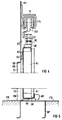
- FIG. 1 shows a thresholdless, preferably drivable opening TO with a completely flat floor FB in the opening area.
- This opening can be sealed on all sides by the device according to the invention.
- e.g. are a hall gate, a door that allows access to an interior space or a possibly free-standing cabin.
- the building-side or cabin-side elements that delimit the opening TO are preferably designed to shield against the radiation or radiation of mostly high-frequency electromagnetic interference fields. In the example of FIG. 1, these elements surrounding and delimiting the opening TO are not shown in detail.
- the reference symbol AS only the outer surfaces of the parts z. B. marked a cabin or a building, which are penetrated by the opening TO. These outer surfaces can e.g. in the case of a building belong to a closed wall area, or are e.g. assigned to individual wall segments in the case of a modular cabin.
- the closure device initially has means for delimiting the opening, which in its area, ie at least inside the opening, and preferably also in the areas in front and behind it, result in a threshold-free floor FB.
- a threshold-free floor FB This can therefore be easily driven over even for vehicles with little or no ground clearance.
- Such a floor represents an ideal base, in particular for vehicles operated via an air cushion.
- FIG represents the left, right and top edges LB, RB, OB of the opening TO.
- the closure device according to the invention also has a flat floating cover AT.
- this is shown on the one hand in a solid line in the state tightly closing the opening on all sides.
- FIG. 1 shows the cover in a dash-dotted line even in the pushed-out state which completely releases the opening.
- the planar floating cover AT is, on the one hand, deposited over the lower edges UK thereof on the thresholdless drive-over floor FB, preferably immediately before the opening.
- the lower edge seals completely with the floor.
- the cover is pushed onto the surfaces AS of the limiting means in this state.
- the side edges SK1, SK2 and the upper edge OK of the floating cover AT thus protrude as evenly as possible over the side edges LB, RB, OB of the outer surfaces AS, which are shown as dashed lines.
- Contact strips KS of the same width as possible are formed between the edges SK1, SK2, OK protruding the opening TO and the floating cover AT and the edges LB, RB, OB serving as boundaries of the opening.
- Sealants can be inserted into these contact strips. If the lower edge UK of the cover is also provided with sealing means, the opening TO in the state of the floating cover shown in FIG. 1, pushed onto the surfaces KS or AS of the limiting means LB, RB, OB and set down on the thresholdless floor FB is sealed on all sides locked.
- the sealants are selected depending on the desired type and the degree of closure of the opening. If, for example, rubber seals are attached to the lower edge UK of the cover and in the area of the contact strips KS to the outer surfaces AS of the limiting means, the suspended cover, which has been pushed on and offset, preferably seals the opening against the passage of Gases, moisture, water and the like. If, on the other hand, the opening is to be shielded against the passage of mostly high-frequency electromagnetic interference fields, the sealing means are preferably designed as so-called contact springs that are electrically conductive.
- the floating cover AT is shown in a dash-dotted line even in the extended state which completely opens the opening TO.
- the floating cover is raised by the vertical lifting area SH compared to the level of the level drive-over floor FB, and, according to the illustration in FIG. 3, is raised by the horizontal lifting area HH from the outer surfaces AS of the limiting means surrounding the opening .
- a displacement area VB is provided for receiving the floating cover AT in the state in which it opens the opening on the left.
- the closure device additionally has displacement means, which are used to push or pull the floating cover onto the surfaces of the limiting means at an angle, and to set or lift the floating cover at an angle onto or from the thresholdless floor in the region of the opening serve with the help of a single, linear displacement movement.
- displacement means which are used to push or pull the floating cover onto the surfaces of the limiting means at an angle, and to set or lift the floating cover at an angle onto or from the thresholdless floor in the region of the opening serve with the help of a single, linear displacement movement.
- the cover AT z. B. inserted by a person via a handle G in the opening TO or pushed into the adjacent displacement area VB.
- a pneumatic or electric linear drive can also be provided to carry out the displacement.
- the floating cover is simultaneously both vertical Direction of movement deposited on the floor or raised from it, as well as pushed in a horizontal direction of movement onto the surfaces KS, AS of the limiting means LB, RB, OB or withdrawn therefrom.
- the displacement means furthermore contain at least one hanging rail FS in which the floating cover AT is mounted via bearing elements.
- the hanging rail FS is inclined by a first angle W1 lying in a vertical plane parallel to the outer surfaces AS with respect to the sleeper-free floor FB, and in accordance with the illustrations in FIGS. 2, 3 by a second one in a horizontal plane Angle W2 lying parallel to the drive-over floor FB is inclined relative to the surfaces KS, AS of the limiting means LB, RB, OB.
- the end E1 of the hanging rail FS which is the most distant from the drive-over floor FB and the surfaces KS, AS, comes to lie above the displacement area VB for the floating cover next to the opening TO.
- the second end E2 of the hanging rail FS which is closest to the drive-over floor FB and the surfaces KS, AS, is in the region of a side edge above the opening TO, in FIG. 1 in the region above the right-hand boundary edge RB.
- the flat floating cover is finally supported with the aid of the bearing elements in the hanging rail FS in such a way that it is rotated by the first and second angles W1, W2 and is approximately perpendicular to the thresholdless floor FB and to the surfaces KS, AS of the limiting means LB, RB, OB takes approximately parallel position.
- the hanging rail FS is above the opening TO and the displacement area with the aid of five supports T1 ... T5 fastened to the outer surfaces AS of the limiting means VB attached.
- the height of the supports decreases continuously from T1 to T5, so that the end E1 or E2 of the hanging rail AS is furthest away from the drive-over floor FB or is closest to it.
- the hanging rail FS is shown in one piece and is preferably opened in a U-shape in the direction of the thresholdless floor FB.
- a guide roller KR1, KR2 is preferably provided as the bearing elements, which are attached to the left and right ends of the upper edge OK of the floating cover AT and engage in the hanging rail FS.
- the bearing elements preferably have additional means for height adjustment, so that in particular the lower edge UK of the floating cover AT can be adjusted into a position parallel to the sleeper-free floor FB.
- the hanging rail FS can also be designed as a telescopic rail. This is then preferably attached exclusively above the opening TO to two supports T1, T3 and T1, T4. The direction in which it is pulled out is directed away from the opening TO onto the displacement region VB.
- Figures 2 and 3 each show a top view of the displacement means and the floating cover.
- 1 shows the right part located above the opening and, in addition to this, FIG. 2 shows the remaining left part located above the displacement area next to the opening.
- W2 the second inclination angle
- the length of the supports for the hanging rail attached to the outer surfaces of the limiting means increases continuously from T1 to T5.
- the left end E2 of the rail is thus the farthest from the surfaces AS, while the right end E2 is the closest.
- the floating cover AT is again shown in two different positions. For example, FIG.
- FIG. 2 shows in a broken line the floating cover AT in the one that closes the opening TO and on the surfaces AS of the limiting means LB, RB postponed condition.
- the strip-shaped contact areas KS between the cover AT and the outer surfaces AS thus result in the area of the left or right boundary LB or RB below the supports T3 or T1.
- FIG. 3 shows in a dash-dotted line the state of the floating cover AT that has been pulled off, that is to say which opens the opening TO. This is now extended into the displacement area VB located next to the opening and is lifted from the outer surfaces AS by the horizontal stroke area HH.
- angles W1, W2 which determine the total inclination of the hanging rail relative to the drive-over floor FB and the outer surfaces AS of the limiting means become dependent on the size of the floating cover and on the height of any sealing means which may be present on the lower edge UK of the cover and on the contact strips KS certainly.
- these angles can be chosen to be relatively small.
- electromagnetically shielding floating covers that a value of approximately 1 degree for the first angle W1 and a value of approximately 0.5 to 3 degrees, preferably also 1 degree, is sufficient for the second angle W2 .
- the invention has the advantage that an opening can be easily sealed on all sides in spite of the floor area having no threshold.
- the floating cover provided for this purpose according to the invention which is particularly advantageously mounted in a hanging rail inclined both with respect to the sillless floor and with respect to the outer surfaces of the opening, can be retracted or extended again with a single, linear sliding movement into the all-round sealing state. It is therefore not necessary for the cover to seal the lower edge UK and the remaining edges SK1, SK2, OK to execute successive, angled movement movements.
- the closure device according to the invention is additionally designed to shield against electromagnetic radiation. It can thus be used to close an opening which allows access e.g. to a transformer test hall, to an EMC test center e.g. for motor vehicles, to a room or cabin containing a computer tomograph for examining the human body according to the principle of nuclear magnetic resonance.
- At least the opening, LB, RB, OB, i.e. at least the outer surfaces AS around the opening and the floating cover AT are themselves shielded from electromagnetic radiation, and consist of electrically conductive materials.
- the limiting means and / or the floating cover are also provided with means for electromagnetic shielding all around, in particular on the edges LB, RB, OB or SK1, SK2, OK in the area of the contact strips KS. These contact the floating cover AT in the state pushed onto the surfaces KS, AS and set down on the thresholdless floor FB all around. So-called contact spring straps are preferably suitable for this.
- electrically conductive contact springs KF that run around the opening TO are shown in section. 4 shows a vertical sectional view through the head region of the floating cover AT.
- a Z-shaped contact spring KF is inserted in the strip-shaped contact area KS, which is located between the upper limit OB of the opening TO and the upper edge OK of the cover AT.
- the contact spring can be attached either on the outer surface AS or on the opposite inner surface of the floating cover.
- An additional support profile BP is advantageous for stabilization and electrical conductive contact without thresholds in the ramp floor FB in the opening.
- a Z-shaped contact spring KF is used for the electromagnetically tight contact between the lower edge UK and the support profile BP when the floating cover AT is set down on the threshold-free floor FB.
- the floor FB itself is electrically conductive or is provided with an electrically conductive covering, the substructure support profile BP according to the example in FIG. 5 is not absolutely necessary.
- the floating cover AT can be placed directly on the floor FB via the contact spring KF in an electromagnetically sealing manner.
- additional floor guide means can be provided which engage the lower edge UK of the floating cover AT and additionally guide them in the running direction rotated by the second angle W2 with respect to the surfaces KS, AS of the limiting means LB, RB, OB.
- Such floor guide means are shown in FIGS. 1, 2, 3 and 5.
- Figures 1, 2 and 3 show an additional running rail LS, which is rotated through the second angle W2 with respect to the surfaces KS, AS in the thresholdless floor FB at least below the displacement area VB.
- At least one guide roller FR engages in this running rail, which is attached at least to the end of the lower edge UK of the floating cover AT facing the running rail LS. In the example of Figures 1-3, this is the left end of the bottom edge.
- the floor guide means are particularly advantageous if the floating cover is not pressed sufficiently tightly against the contact stiffeners KS or between contact means, for example electrically conductive contact springs, when they are pushed onto the surfaces of the limiting means due to a lack of their own weight.
- the floor guide means have at least one additional pressure roller AR. This is in the area below that end of the hanging rail on the thresholdless Floor FB attached, which is closest to the surfaces KS, AS.
- the pressure roller AR is mounted directly next to the opening TO in the area of the right limiting means RB below the right end E2 of the hanging rail FS. This engages the lower edge UK at least when the state closing the opening TO is reached. This also improves the contact pressure of the cover that has been pushed onto the contact strips KS or contact means located in between in the base area.
- the bearing elements can additionally have means for height adjustment HE, with which in particular the lower edge of the floating cover can be adjusted in a position parallel to the thresholdless floor.
- the first guide roller KR1 which is mounted in the hanging rail FS, is connected to the upper edge OK of the floating cover AT via an adjustable screw bolt.
- the edges LB, RB, OB of the limiting means can also be designed in the form of a separate frame which surrounds the opening in a U-shape and without thresholds.
- the limiting means can be designed as long as they have at least in the area of the contact strips KS approximately flat outer surfaces AS for pushing on the flat floating cover AT. So it is possible that the limiting means are provided directly by the edges of surface components. This is particularly the case when the device according to the invention is used to close an opening in all directions in a preferably self-supporting, modular cabin.
- Such cabins usually consist of strip-shaped side part walls, which are preferably screwed modularly to the overall cabin.
- the edges of the side part walls directly represent the limiting means for the opening TO.
Landscapes
- Engineering & Computer Science (AREA)
- Mechanical Engineering (AREA)
- Civil Engineering (AREA)
- Structural Engineering (AREA)
- Health & Medical Sciences (AREA)
- Toxicology (AREA)
- Specific Sealing Or Ventilating Devices For Doors And Windows (AREA)
- Shielding Devices Or Components To Electric Or Magnetic Fields (AREA)
- Cleaning Implements For Floors, Carpets, Furniture, Walls, And The Like (AREA)
Applications Claiming Priority (2)
| Application Number | Priority Date | Filing Date | Title |
|---|---|---|---|
| DE9111718U DE9111718U1 (de) | 1991-09-19 | 1991-09-19 | Schwellenlose, bevorzugt elektromagnetisch abschirmende Schwebeabdeckung |
| DE9111718U | 1991-09-19 |
Publications (1)
| Publication Number | Publication Date |
|---|---|
| EP0532982A1 true EP0532982A1 (fr) | 1993-03-24 |
Family
ID=6871458
Family Applications (1)
| Application Number | Title | Priority Date | Filing Date |
|---|---|---|---|
| EP92115002A Ceased EP0532982A1 (fr) | 1991-09-19 | 1992-09-02 | Porte coulissante sans seuil de préférence à blindage anti-radiation électromagnétique |
Country Status (4)
| Country | Link |
|---|---|
| EP (1) | EP0532982A1 (fr) |
| DE (1) | DE9111718U1 (fr) |
| MX (1) | MX9205319A (fr) |
| NO (1) | NO923611L (fr) |
Cited By (6)
| Publication number | Priority date | Publication date | Assignee | Title |
|---|---|---|---|---|
| AT402982B (de) * | 1995-02-22 | 1997-10-27 | Kronegger Peter Dipl Ing Dr Te | Elektronisches anzeige- und eingabesystem mit induktiver energieversorgung der einzelnen anzeige- und eingabeeinheiten |
| CN102828670A (zh) * | 2011-06-15 | 2012-12-19 | 立兴杨氏实业(深圳)有限公司 | 推拉门型材及其构成的气密性推拉门 |
| CN107605374A (zh) * | 2017-09-30 | 2018-01-19 | 练陈敏 | 一种影像科防护装置 |
| CN107740656A (zh) * | 2017-10-20 | 2018-02-27 | 株洲合力电磁技术有限公司 | 一种双扇滑动屏蔽门安装结构及安装方法 |
| CN107762325A (zh) * | 2017-12-08 | 2018-03-06 | 四川港通医疗设备集团股份有限公司 | 一种门体自动平移变轨装置及方法 |
| US20220281297A1 (en) * | 2021-03-02 | 2022-09-08 | Morgan Olson Corporation | Vehicle With Sliding Door |
Citations (6)
| Publication number | Priority date | Publication date | Assignee | Title |
|---|---|---|---|---|
| DE668057C (de) * | 1934-01-09 | 1938-11-25 | Hosterbach Geb | Schiebetuer mit schiefen Dichtungsebenen |
| US3538642A (en) * | 1968-12-18 | 1970-11-10 | Andersen Corp | Horizontally sliding sash windows |
| DE2426725A1 (de) * | 1974-06-01 | 1975-12-18 | Kloeckner Humboldt Deutz Ag | Schiebetuer fuer eine fahrerkabine |
| GB1491762A (en) * | 1975-03-03 | 1977-11-16 | Insulated Storage & Display Lt | Sliding door assembly |
| DE3224395A1 (de) * | 1982-06-30 | 1984-01-12 | Geze Gmbh, 7250 Leonberg | Teleskopierbarer beschlag fuer schiebetueren |
| FR2583099A1 (fr) * | 1985-06-07 | 1986-12-12 | France Etat Armement | Porte blindee metallique pour enceinte metallique destinee a contenir des objets sensibles aux rayonnements electromagnetiques et/ou aux ondes hertziennes |
Family Cites Families (9)
| Publication number | Priority date | Publication date | Assignee | Title |
|---|---|---|---|---|
| DE1049931B (fr) * | ||||
| US3009984A (en) * | 1958-08-07 | 1961-11-21 | Erik A Lindgren | Door for a shielded enclosure |
| DE1810831U (de) * | 1959-12-21 | 1960-05-05 | Dietrich Vogel | Schiebetuer bzw. -fenster. |
| DE1968026U (de) * | 1967-06-21 | 1967-09-07 | Kaefer & Co Feinblech Holz Und | Vorrichtung an laufschienen fuer schiebetueren. |
| DE1912274A1 (de) * | 1969-03-11 | 1970-09-24 | Hermann Weissenburger | Horizontal-Schiebefenster mit zwei oder mehreren Fluegeln in einer Schliessebene |
| DE6948531U (de) * | 1969-12-16 | 1970-06-25 | Rheinhold & Mahla Gmbh | Tuer, insbesondere fuer kuehl- und gefrierraeume. |
| US4370831A (en) * | 1980-11-28 | 1983-02-01 | The Boeing Company | RF Shielded door seal |
| DE3823779A1 (de) * | 1987-07-17 | 1989-02-02 | Markus Hermetische Deuren | Schiebetueranordnung |
| DE9001218U1 (de) * | 1990-01-31 | 1990-04-05 | BRANDT HANDELSKONTOR GMBH, 3000 Hannover | Vorsetzschiebetür |
-
1991
- 1991-09-19 DE DE9111718U patent/DE9111718U1/de not_active Expired - Lifetime
-
1992
- 1992-09-02 EP EP92115002A patent/EP0532982A1/fr not_active Ceased
- 1992-09-17 NO NO92923611A patent/NO923611L/no unknown
- 1992-09-18 MX MX9205319A patent/MX9205319A/es unknown
Patent Citations (6)
| Publication number | Priority date | Publication date | Assignee | Title |
|---|---|---|---|---|
| DE668057C (de) * | 1934-01-09 | 1938-11-25 | Hosterbach Geb | Schiebetuer mit schiefen Dichtungsebenen |
| US3538642A (en) * | 1968-12-18 | 1970-11-10 | Andersen Corp | Horizontally sliding sash windows |
| DE2426725A1 (de) * | 1974-06-01 | 1975-12-18 | Kloeckner Humboldt Deutz Ag | Schiebetuer fuer eine fahrerkabine |
| GB1491762A (en) * | 1975-03-03 | 1977-11-16 | Insulated Storage & Display Lt | Sliding door assembly |
| DE3224395A1 (de) * | 1982-06-30 | 1984-01-12 | Geze Gmbh, 7250 Leonberg | Teleskopierbarer beschlag fuer schiebetueren |
| FR2583099A1 (fr) * | 1985-06-07 | 1986-12-12 | France Etat Armement | Porte blindee metallique pour enceinte metallique destinee a contenir des objets sensibles aux rayonnements electromagnetiques et/ou aux ondes hertziennes |
Cited By (9)
| Publication number | Priority date | Publication date | Assignee | Title |
|---|---|---|---|---|
| AT402982B (de) * | 1995-02-22 | 1997-10-27 | Kronegger Peter Dipl Ing Dr Te | Elektronisches anzeige- und eingabesystem mit induktiver energieversorgung der einzelnen anzeige- und eingabeeinheiten |
| CN102828670A (zh) * | 2011-06-15 | 2012-12-19 | 立兴杨氏实业(深圳)有限公司 | 推拉门型材及其构成的气密性推拉门 |
| CN102828670B (zh) * | 2011-06-15 | 2015-01-21 | 立兴杨氏实业(深圳)有限公司 | 气密性推拉门 |
| CN107605374A (zh) * | 2017-09-30 | 2018-01-19 | 练陈敏 | 一种影像科防护装置 |
| CN107605374B (zh) * | 2017-09-30 | 2019-06-28 | 张洪涛 | 一种影像科防护装置 |
| CN107740656A (zh) * | 2017-10-20 | 2018-02-27 | 株洲合力电磁技术有限公司 | 一种双扇滑动屏蔽门安装结构及安装方法 |
| CN107762325A (zh) * | 2017-12-08 | 2018-03-06 | 四川港通医疗设备集团股份有限公司 | 一种门体自动平移变轨装置及方法 |
| US20220281297A1 (en) * | 2021-03-02 | 2022-09-08 | Morgan Olson Corporation | Vehicle With Sliding Door |
| US12263726B2 (en) * | 2021-03-02 | 2025-04-01 | Morgan Olson Corporation | Vehicle with sliding door |
Also Published As
| Publication number | Publication date |
|---|---|
| NO923611D0 (no) | 1992-09-17 |
| DE9111718U1 (de) | 1992-10-22 |
| NO923611L (no) | 1993-03-22 |
| MX9205319A (es) | 1993-07-30 |
Similar Documents
| Publication | Publication Date | Title |
|---|---|---|
| EP0682156B1 (fr) | Conteneur | |
| EP0532982A1 (fr) | Porte coulissante sans seuil de préférence à blindage anti-radiation électromagnétique | |
| DE3210468A1 (de) | Tuer- und fensterrahmen | |
| DE2139743C2 (de) | Vorrichtung zum Parken mehrerer Fahrzeuge übereinander | |
| EP0018326A1 (fr) | Capot pour une cellule de réduction d'aluminium | |
| DE2841459A1 (de) | Abdeckung einer schmelzflusselektrolysezelle | |
| DE2310864A1 (de) | Tor fuer industrielle gebaeude | |
| DD284722A5 (de) | Vorhang mit geringem platzbedarf zum absperren von durchgaengen | |
| EP0503743A1 (fr) | Wagon couvert ou conteneur | |
| DE9111721U1 (de) | Schwellenlose Abdeckung, insbesondere elektromagnetisch abgeschirmtes Schiebetor | |
| DE202011004196U1 (de) | Verschlussvorrichtung | |
| DE2917340A1 (de) | Fenster zum austausch von waren | |
| DE60029751T2 (de) | Türanordnung und Verfahren zum Abdecken des Randes einer Türöffnung | |
| EP0253263B1 (fr) | Véhicule à fourgon avec mécanisme de levage | |
| EP0085369A2 (fr) | Procédé pour le refroidissement à sec de coke et chambre de refroidissement | |
| EP2405446B1 (fr) | Structure murale pour bunker anti-radiations | |
| EP1914187A1 (fr) | Ascenseur vertical | |
| DE102017101553A1 (de) | Hebeschwelle | |
| EP0568169A1 (fr) | Carter pour un bain de zinc | |
| DE1640734B2 (de) | Unterputz verteiler mit voll isoliertem Geräteraum und Stahlblechblendrahmen | |
| DE9317794U1 (de) | Schrank | |
| AT400426B (de) | Schiebetüre für einen eisenbahn-personenwaggon | |
| DE68911089T2 (de) | Verfahren zum vertikalen Kabelverlegen. | |
| WO2013186081A1 (fr) | Fenêtre, porte ou similaire équipée d'une barre de fermeture | |
| DE3200497A1 (de) | Schiebetueranlage |
Legal Events
| Date | Code | Title | Description |
|---|---|---|---|
| PUAI | Public reference made under article 153(3) epc to a published international application that has entered the european phase |
Free format text: ORIGINAL CODE: 0009012 |
|
| 17P | Request for examination filed |
Effective date: 19921007 |
|
| AK | Designated contracting states |
Kind code of ref document: A1 Designated state(s): AT BE CH DE ES FR GB GR IT LI NL PT SE |
|
| 17Q | First examination report despatched |
Effective date: 19940628 |
|
| 18R | Application refused |
Effective date: 19941222 |