EP0533024A2 - Granulate aus pulvrigen Primärpartikeln mit verbesserten Verarbeitungseigenschaften - Google Patents
Granulate aus pulvrigen Primärpartikeln mit verbesserten Verarbeitungseigenschaften Download PDFInfo
- Publication number
- EP0533024A2 EP0533024A2 EP92115314A EP92115314A EP0533024A2 EP 0533024 A2 EP0533024 A2 EP 0533024A2 EP 92115314 A EP92115314 A EP 92115314A EP 92115314 A EP92115314 A EP 92115314A EP 0533024 A2 EP0533024 A2 EP 0533024A2
- Authority
- EP
- European Patent Office
- Prior art keywords
- weight
- granules
- polyurethanes
- polyureas
- polymers
- Prior art date
- Legal status (The legal status is an assumption and is not a legal conclusion. Google has not performed a legal analysis and makes no representation as to the accuracy of the status listed.)
- Withdrawn
Links
Classifications
-
- B—PERFORMING OPERATIONS; TRANSPORTING
- B01—PHYSICAL OR CHEMICAL PROCESSES OR APPARATUS IN GENERAL
- B01J—CHEMICAL OR PHYSICAL PROCESSES, e.g. CATALYSIS OR COLLOID CHEMISTRY; THEIR RELEVANT APPARATUS
- B01J2/00—Processes or devices for granulating materials, e.g. fertilisers in general; Rendering particulate materials free flowing in general, e.g. making them hydrophobic
- B01J2/28—Processes or devices for granulating materials, e.g. fertilisers in general; Rendering particulate materials free flowing in general, e.g. making them hydrophobic using special binding agents
Definitions
- the present invention relates to granules of powdery materials which have improved processing properties, in particular with regard to compressibility, expansion behavior, freedom from dust and / or redispersibility.
- these materials can be granulated with the addition of inorganic and / or organic substances. These granules are easier to process.
- additives are polyvinyl alcohol, cellulose derivatives, gelatin, polyacrylamides, polyethers, water glass, leaches of sulfites, phenol formaldehyde resins, melamine resins, vinyl polymers, diene polymers, vinyl copolymers, diene copolymers, surfactants, oil and / or tar (see for example DE-A 2 706 659, DD- A 242 606, DE-A 2 328 841, DE-A 3 505 028, DD-A 159 324 and DD-A 137 835).
- the granules are to be processed into molded articles by pressing or injection molding, e.g.
- pressing or injection molding e.g.
- special demands are placed on the additives, since they not only have to guarantee good processability of the granules, but also must not adversely affect the further process steps of ceramic production.
- Further requirements for such granules are good green strength of the molding, good mold release properties and, in particular, only a slight, preferably no, re-expansion of the compact after the pressure has been released.
- auxiliaries previously used for the production of granules meet the sum of these requirements not or only insufficiently (see R. Bast, Keramische Zeitschrift 42 (3), pp. 155-156 (1990)).
- carboxymethyl cellulose produce granules with good strength, which is important for transport, but at the same time they lead to high back-stretching, which leads to tension in the storage of the compacts and then to cracks when burning.
- Polyacrylate additives are low in terms of low elongation, but lead to granules with only moderate strength. Additions of methyl cellulose and polyvinyl alcohol lead to granules with good strength, but the final density then becomes poor.
- polyurethanes and / or polyureas and polyethers are particularly suitable for the production of granules from powdery substances.
- Granules according to the invention can, for example, 0.01 to 30% by weight of polyurethanes and / or polyureas, 0.01 to 30% by weight of polyether and 0 to 60% by weight of further polymers, but in total not more than 65% by weight of these three components included.
- Preferred granules according to the invention contain 0.02 to 20% by weight of polyurethanes and / or polyureas, 0.02 to 20% by weight of polyether, 0 to 30% by weight of further polymers and a total of not more than 35% by weight of these three components.
- Particularly preferred granules according to the invention contain 0.05 to 10% by weight of polyurethanes and / or polyureas, 0.05 to 10% by weight of polyether, 0 to 20% by weight of further polymers and a total of not more than 25% by weight. of these three components.
- Granules according to the invention can optionally contain customary auxiliaries, for example in amounts of 0 to 35% by weight, based on powdery substances.
- the moisture content of granules according to the invention can be, for example, up to 10% by weight, based on the finished granules.
- the moisture can come from water and / or solvents.
- the polyurethanes and polyureas are expediently introduced in the form of solutions or dispersions. These can contain water and / or organic solvents as solvents or dispersants. Water is preferred. Examples of suitable organic solvents are methyl ethyl ketone, tetrahydrofuran, dimethylformamide and N-methylpyrrolidone.
- Such solutions can have, for example, a polyurethane and / or polyurea content of from 2 to 60% by weight, preferably from 10 to 40% by weight.
- the further polymers which may be present are expediently introduced in the form of polymer dispersions; they can also be used as solutions, e.g. Solutions of cellulose derivatives, polyvinyl alcohol, starch or polyvinyl pyrrolidone.
- Such dispersions can be prepared on the basis of water and / or organic solvents. Water is preferred. Examples of organic solvents which can be used are those mentioned above for polyurethanes and polyureas.
- Such dispersions can have, for example, a polymer content of 5 to 60% by weight, preferably 10 to 50% by weight.
- the mean particle diameter of the dispersed polymers measured by means of laser scattered light correlation spectroscopy can be, for example, in the range from 20 to 1000 nm, preferably from 50 to 500 nm.
- the polyurethanes to be used according to the invention are preferably soluble or dispersible types. It can these are, for example, pure polyurethanes and / or those in which some of the polyurethane groups have been replaced by polyurea groups.
- Preferred polyurethanes are obtainable from at least one diisocyanate and at least one macropolyol, which is a higher molecular weight, hydroxyl group-containing compound with a molecular weight of more than 400. If necessary, at least one short-chain chain extender with a molecular weight of less than 400, in particular a short-chain diol, can additionally be used.
- diisocyanates examples include tolylene diisocyanate, naphthylene diisocyanate, diphenylmethane diisocyanate, hexamethylene diisocyanate (HDI), isophorone diisocyanate (IPDI), cyclohexane-1,4-diisocyanate and perhydrodiphenylmethane diisocyanate.
- HDI hexamethylene diisocyanate
- IPDI isophorone diisocyanate
- cyclohexane-1,4-diisocyanate perhydrodiphenylmethane diisocyanate.
- H12MDI perhydrodiphenylmethane diisocyanate
- Macropolyols include, for. Polyester, polyether, polythioether, polylactone, polycarbonate, polyestercarbonate, polyethercarbonate, polyacetal and polyesteramide polyols in question.
- the macropolyols preferably have an OH functionality of two.
- Polyester polyols which can be used as macropolyols can be, for example, reaction products of polyhydric, preferably dihydric and optionally trihydric alcohols with polyhydric, preferably dihydric, carboxylic acids.
- the polycarboxylic acids can be aliphatic, cycloaliphatic, aromatic and / or heterocyclic in nature and optionally substituted, for example by halogen atoms, and / or unsaturated.
- succinic acid adipic acid, azelaic acid, phthalic acid, trimellitic anhydride, phthalic anhydride, hexahydrophthalic anhydride, tetrachlorophthalic endomethylenetetrahydrophthalic, glutaric anhydride, maleic anhydride, fumaric acid, dimeric and trimeric fatty acids such as oleic acid, optionally mixed with monomeric fatty acids, dimethyl terephthalate, bis-glycol terephthalate.
- Polyhydric alcohols include, for example, ethylene glycol, propylene glycol (1,2) and - (1,3), butylene glycol (1,4) and - (2,3), hexanediol (1,6), octanediol (1, 8), neopentyl glycol, cyclohexanedimethanol (1,4-bis-hydroxymethylcyclohexane), 2-methyl-1,3-propanediol, glycerin, trimethylolpropane, hexanetriol- (1,2,6), butanetriol- (1,2,4), Trimethylolethane, pentaerythritol, quinite, mannitol and sorbitol, methylglycoside, also diethylene glycol, Triethylene glycol, tetraethylene glycol, polyethylene glycols, dipropylene glycol, polypropylene glycols, dibutylene glycol and polybutylene glycols in question.
- Polyethers which can be used as macropolyols can be of a type known per se and e.g. by polymerizing epoxides such as ethylene oxide, propylene oxide, styrene oxide or epichlorohydrin with themselves, e.g. in the presence of Lewis catalysts such as BF3, or by addition of these epoxides, preferably in a mixture or in succession, to starter molecules with reactive hydrogen atoms such as water, diols (e.g. ethylene glycol, propylene glycol (1,3) or - (1,2), 4 , 4'-Dihydroxy-di-phenylpropane) and primary amines (eg aniline, methylamine) can be prepared. Tetrahydrofuran polymers can also be used.
- epoxides such as ethylene oxide, propylene oxide, styrene oxide or epichlorohydrin
- Lewis catalysts such as BF3
- epoxides e.
- polyethers which predominantly have primary OH groups, e.g. up to 90% by weight, based on all OH groups present in the polyether.
- Polybutadienes containing OH groups can also be used as macropolyols.
- polythioether diols The condensation products of thioglycol with themselves and / or with other glycols, dicarboxylic acids, formaldehyde and / or aminocarboxylic acids may be mentioned as polythioether diols. Depending on the co-components, these are, for example, polythio mixed ether diols, polythioether ester diols or polythioether ester amide diols.
- Polylactone diols are understood to mean products which are obtained, for example, if a ring-opening polymerization of a monolactone is used using one of the above as starter molecules for the addition diols described by epoxides. Suitable lactones are, for example, butyrolactone and ⁇ -caprolactone.
- Polycarbonate diols can be substances known per se, e.g. by reacting diols such as propanediol (1,3), butanediol (1,4), hexanediol (1,6), diethylene glycol, triethylene glycol, tetraethylene glycol and / or thiodiglycol with diaryl carbonates, e.g. Diphenyl carbonate, or phosgene can be produced (see DE-A 1 694 080, DE-A 1 915 908, DE-A 2 221 751 and DE-A 2 605 024). If short-chain polyether diols or polyester diols are used for this reaction instead of the diols, polyether carbonate or polyester carbonate diols are formed.
- diols such as propanediol (1,3), butanediol (1,4), hexanediol (1,6)
- diethylene glycol triethylene glycol
- polyacetal diols e.g. the compounds which can be prepared from glycols, such as diethylene glycol, tetraethylene glycol, 4,4'-dioxethoxydiphenyldimethylmethane and hexanediol, and formaldehyde are questionable. Also by polymerizing cyclic acetals, e.g. Trioxane, polyacetaldiols can be produced. Polyesteramide and polyamide diols can e.g. obtained from dihydric saturated carboxylic acids or their anhydrides and dihydric saturated amino alcohols, diamines and / or their mixtures as linear condensates.
- macropolyamines in particular macrodiamines
- macropolyamines can be prepared, for example, from polyether polyols by direct reaction with ammonia (see DE-B 1 215 373).
- Macropolyols can also be reacted with diisocyanates, so Obtain isocyanate prepolymers and hydrolyze them to macropolyamines.
- a urea group then forms from an isocyanate group and an amino group.
- Polyurethanes and / or polyureas to be used according to the invention can be obtained using chain extenders customary in polyurethane chemistry, e.g. short-chain alcohols, amines or amino alcohols, which are generally difunctional with respect to isocyanates.
- chain extenders customary in polyurethane chemistry e.g. short-chain alcohols, amines or amino alcohols, which are generally difunctional with respect to isocyanates.
- Examples of such compounds are ethylene glycol, 1,4-butanediol, 1,6-hexanediol, neopentyl glycol, hydroquinone bis-2-hydroxyethyl ether, 1,4-cyclohexanediol, diethylene glycol, 4,4'-dihydroxydicyclohexylmethane, ethylenediamine, N, N ' -Dimethylethylenediamine, 1,6-diaminohexane, N, N ', N "-trimethyl-diethylenetriamine, piperazine, aminoethylpiperazine, ethanolamine, N-2-hydroxyethylpiperazine, aminoethanesulfonic acid (salts), dimethylpropionic acid, lysine and other diamino and / or dihydroxycarboxylic acids .
- Polyurethanes and / or polyureas to be used according to the invention may have been produced using chain regulators customary in polyurethane chemistry. These may be monofunctional isocyanates, alcohols and / or amines, for example butyl isocyanate, phenyl isocyanate, ethanol, isopropanol, decanol, dibutylamine, hexylamine and / or morpholine.
- Polyurethanes and / or polyureas to be used according to the invention may have been produced with auxiliaries and additives customary in polyurethane chemistry.
- these can be catalysts act like tin-II-octoate, dibutyltin dilaurate, titanium tetrabutylate, iron-II-acetylacetonate, diazabicyclooctane or N, N-tetramethylethylenediamine.
- polyurethanes and / or polyureas to be used according to the invention can also be mixtures of different polyurethanes and / or polyureas, e.g. Mixtures of aliphatic and aromatic polyurethanes.
- Suitable salt-forming acids for group a) are inorganic and organic acids and compounds with reactive halogen atoms and corresponding esters of strong acids. Some examples of such compounds are hydrochloric acid, nitric acid, amidosulfonic acid, acetic acid, lactic acid, haloacetic acids, haloacetic acid alkyl esters, sorbitol-boric acid, methyl halides, dialkyl sulfates, benzyl chloride, chloroacetic esters, haloacetamides, dihaloalkanes and epoxides.
- the compounds of group b) can e.g. are quaternized or ternated with tertiary amines, sulfides or phosphines, in which case quaternary ammonium or phosphonium or ternary sulfonium salts are formed.
- Examples include trialkylamines, pyridine, trialkanolamines, dialkyl sulfides, trialkylphosphines, alkylarylphosphines and triarylphosphines.
- inorganic and organic bases are suitable as salt formers, e.g. Alkali hydroxides, carbonates, bicarbonates, ammonia and amines, and organic phosphorus compounds which are capable of salt formation, such as build-in basic phosphines (for example methyl-bis- ⁇ -hydroxyethylphosphine) and such as derivatives of phosphinic acids, phosphonous acids and phosphonic acids, esters of phosphorous and phosphoric acid and its thione analogues.
- salt formers e.g. Alkali hydroxides, carbonates, bicarbonates, ammonia and amines
- organic phosphorus compounds which are capable of salt formation, such as build-in basic phosphines (for example methyl-bis- ⁇ -hydroxyethylphosphine) and such as derivatives of phosphinic acids, phosphonous acids and phosphonic acids, esters of phosphorous and phosphoric acid and its thione analogues.
- Suitable cationic polyurethanes can be obtained, for example, according to DE-AS 1 270 276 if at least one component with one or more basic tertiary nitrogen atoms is used in the construction of the polyurethane and the basic tertiary nitrogen atoms of the polyurethane are reacted with alkylating agents or acids. It is basically irrelevant at which point of the polyurethane macromolecule the basic nitrogen atoms are located. It is also possible to react polyurethanes with reactive halogen atoms capable of quaternization with tertiary amines.
- Cationic polyurethanes can also be chain-building Produce quaternization, for example by preparing dihalogenurethanes from diols and isocyanates with reactive halogen atoms or diisocyanates and halogen alcohols and reacting these with di-tertiary amines.
- Ditertiary diaminourethanes can also be prepared from diisocyanates and tertiary amino alcohols and reacted with reactive dihalogen compounds.
- the cationic polyurethane composition can also be produced from a cationic salt-like starting component, for example a quaternized basic polyether or a quaternary nitrogen-containing isocyanate.
- Anionic polyurethane dispersions can also be prepared by processes known per se. Suitable anionic polyurethanes are described, for example, in DE-AS 1 237 306, DE-OS 1 570 565, DE-OS 1 720 639 and DE-OS 1 495 847.
- anionic dispersions it is also possible to start from polyurethanes with free hydroxyl and / or amino groups and these with aliphatic or aromatic aldehydes and one React metal sulfite, metal hydrosulfite, metal aminocarboxylate or metal aminosulfate. Another possibility is to react polyurethanes with free hydroxyl and / or amino groups with cyclic compounds which have salt-like groups or groups which are capable of salt formation after the ring opening (see DE-AS 1 237 306).
- Suitable ionic polyurethanes can also be built up according to DE-AS 1 770 068 via formaldehyde polycondensation, for example by reacting higher molecular weight polyisocyanates with an excess of compounds with terminal methylol groups, dispersing the reaction product containing methylol groups in water and crosslinking by heat treatment.
- a large number of processes are known for producing finely divided polyurethanes in aqueous media. It is preferable to use polyurethane prepolymers containing isocyanate or methylol groups, it being possible to use very high-percentage solutions or to work entirely without solvents.
- the primary coarse emulsions formed can be transferred into high molecular weight polyurethane-urea suspensions by reaction of the isocyanate groups with water or di- or polyamines dissolved in the aqueous phase with chain extension and crosslinking.
- Suitable suspensions can also be produced by injecting high molecular weight polyurethanes or their reactive precursors into water or organic non-solvents.
- Nonionic emulsifier-free polyurethane dispersions can be prepared, for example, by the process of DE-OS 2 141 807.
- Self-dispersible, nonionic polyurethane dispersions can also be prepared according to German Offenlegungsschriften 2,314,512, 2,314,513 and 2,320,719 by incorporating lateral polyethylene oxide units bonded to linear polyurethanes via allophanate or biuret groups.
- Dispersions prepared with the aid of emulsifiers can also be used. Products of this type are described, for example, in DE-AS 1 097 673 and in SP Suskind, Journal of Applied Polymer Science, 9 (1965), pages 2451-2458.
- the polyethers to be used as such according to the invention can be addition products of alkylene oxides, preferably of ethylene oxide and / or propylene oxide, to starter molecules with one or more active hydrogen atoms.
- the polyethers to be used as such according to the invention may contain terminal hydroxyl groups. Hydroxyl end groups can also be capped by methods known per se, e.g. by esterification, etherification or reaction with isocyanates.
- Polyethers to be used according to the invention as such can be mono-, di- or polyfunctional and are generally soluble or dispersible in water or organic solvents.
- starter molecules are: mono-, di- and polyfunctional aliphatic alcohols, mono-, di- and polyfunctional aromatic / aliphatic alcohols, optionally alkylated phenols, other aromatic mono-hydroxyl compounds, glycerol, trimethylolpropane, pentaerythritol, sorbitol, amines such as ethylene amine , Polyethyleneimines and aminopolyethers.
- Block polyethers composed of different polyalkylene oxides can have a statistical or a block-like structure. Mixtures of two or more polyethers can also be used.
- Polyether polyols to be used as polyethers for the present invention are frequently known compounds which can be obtained commercially or, if appropriate, prepared in a manner known per se (see, for example, DE-A 27 56 770, DE-A 33 30 197, US Pat 4,481,367, U.S. 2,979,528, U.S. 2,674,619, U.S. 3,472,781, U.S. 4,452,712, U.S.
- the other polymers that may be used according to the invention may e.g. are polybutadiene, poly (butadiene / styrene), polyvinyl acetate, poly (styrene / (meth) acrylate) and / or poly (butadiene / styrene / acrylonitrile).
- all polymers from monomers copolymerizable with one another are suitable, the monomers being, for example, butadiene, styrene, acrylonitrile, alkyl acrylates, methacrylates, (meth) acrylic acid, maleic acid derivatives, olefins and dienes.
- Vinyl acetate-ethylene copolymers, polyacrylates, styrene-acrylate copolymers and rubbers in the form of latices are of particular interest.
- polysiloxanes which may optionally contain reactive groups
- polymers from other reactive systems for example from polyisocyanate prepolymers, unsaturated polyester resins and epoxy resins. It is also possible to use monomers which, after mixing with water, are polymerized, for example acrylic acid.
- olefinic monomers for the preparation of polymers which may be used according to the invention are:
- ⁇ , ⁇ -olefinically unsaturated monocarboxylic acids with 3 to 5 carbon atoms, their esters, nitriles and amides such as acrylic, methacrylic and crotonic acid, acrylic and methacrylic acid amides, acrylic and methacrylonitrile, esters of acrylic and methacrylic acid, especially those with saturated monohydric aliphatic, cycloaliphatic or aromatic alcohols with 1 to 20 carbon atoms, monoesters of ⁇ , ⁇ -monoolefinically unsaturated monocarboxylic acids with 3 to 4 carbon atoms with dihydric saturated aliphatic alcohols with 2 to 4 carbon atoms and aminoalkyl esters and aminoalkylamides of acrylic and Methacrylic acid.
- Monomers with two or more double bonds in the molecule can also be used. Branched or crosslinked polymer particles, so-called microgels, can then be obtained in this way.
- monomers here for e.g. Ethylene glycol diacrylate or methacrylate suitable.
- ⁇ , ⁇ -olefinically unsaturated dicarboxylic acids with 3 to 5 carbon atoms and their derivatives, such as fumaric acid, maleic acid, itaconic acid and mono- and diesters of such dicarboxylic acids with alcohols containing 1 to 18 carbon atoms.
- Aromatic and heterocycle vinyl compounds are aromatic and heterocycle vinyl compounds.
- Allyl compounds for example triallyl cyanurate, triallyl phosphate, allyl alcohol and allylamine.
- Monoolefinically unsaturated aliphatic hydrocarbons with 2 to 6 carbon atoms e.g. Ethylene, propylene, butylene and isobutylene.
- Conjugated diolefins with 4 to 6 carbon atoms eg butadiene, isoprene, 2,3-dimethylbutadiene and chlorobutadiene and Norbornene and hydroxymethylnorbornene.
- the polymerization of the monomers can be carried out in the manner known per se of the emulsion polymerization.
- Dispersions containing polymers which can be used according to the invention, are then obtained, optionally after dilution or concentration.
- Suitable polymerization conditions are, for example, temperatures of 10 to 150 ° C., the presence of 0.05 to 5% by weight of initiators, the presence of 1 to 10% by weight of emulsifiers, pH values of 2 to 10 and, if appropriate, additions of customary ones Molecular weight regulators in amounts of 0.1 to 2 wt .-% (based on the monomer mixture).
- the dispersions obtained in this way can be mixed with dispersions of the same charge.
- Powdery materials with which granules according to the invention can be produced are, for example, fillers such as calcium carbonate, dolomite, talc, kaolin, wollastonite, quartz powder, synthetic silicates, gypsum, ceramic powders such as aluminum oxide, aluminum hydroxide, titanium dioxide, zirconium oxide, silicon nitride, silicon and silicon carbide, porcelain materials for traditional ceramics, feldspar, kaolin, quartz powder, metal powders such as those made of iron, nickel and their alloys, pigments such as titanium dioxide, iron oxides, chromium oxides, quinacridones and other organic pigments, silicon dioxide, carbon, glass powder, enamel powder, graphite, activated carbon, active ingredients such as those with pharmaceutical or crop protection effects and other organic and inorganic powders such as rubber chemicals, organic raw materials for syntheses, catalysts and salts.
- fillers such as calcium carbonate, dolomite, talc, kaolin, wollastonite, quartz powder, synthetic si
- the powders can be used to produce the granules according to the invention dry or in the form of aqueous or non-aqueous dispersions.
- the granules according to the invention may optionally contain auxiliaries, e.g. dispersants customary for the preparation of dispersions, e.g. Polyacrylic acid salts and / or citrates, stabilizers, biocides and / or surface modifiers, as well as plasticizers, pigments, hydrofluoric and silica sols, aluminum clays, alginates, sulfite waste liquors or polyphosphates.
- auxiliaries e.g. dispersants customary for the preparation of dispersions, e.g. Polyacrylic acid salts and / or citrates, stabilizers, biocides and / or surface modifiers, as well as plasticizers, pigments, hydrofluoric and silica sols, aluminum clays, alginates, sulfite waste liquors or polyphosphates.
- the components of the granules according to the invention can vary in proportions depending on the intended use be used. The person skilled in the art can easily determine the optimal proportions of the components, if necessary, by means of a few preliminary tests. If high strength of the granules is of particular importance, it is advantageous to use polymer dispersions, for example in amounts of up to 80% by weight (based on the sum of the polyurethanes, polyureas, polyethers and other polymers present).
- polymer dispersions not at all or in amounts of less than 50% by weight (based on the sum of the polyurethanes, polyureas, polyethers and other polymers present)
- the ratio of polyurethanes and / or polyureas to polyethers can also be varied depending on the application. If, for example, good redispersibility in aqueous media is desired, it is advantageous to increase the proportion of monofunctional polyethers.
- the granules according to the invention can contain, for example, further polymers on the one hand and polyurethanes and / or polyureas and polyethers on the other hand in a weight ratio of 1: 100 to 100: 1, preferably 1:30 to 30: 1, particularly preferably 1:10 to 10: 1.
- the weight ratio of polyurethanes and / or polyureas to polyethers can be, for example, 20: 1 to 1:20, preferably 10: 1 to 1:10, particularly preferably 5: 1 to 1: 5.
- the other polymers can also be dispersions which contain natural and / or synthetic waxes and / or paraffins.
- the amount of compounds according to the invention which may be used can be varied depending on the application of the granules according to the invention. E.g. in the case of granules which contain pigments and porcelain mass granules, it is advantageous to use 0 to 6% by weight of compounds according to the invention (based on the powder to be granulated). In the case of filler granules for the production of masterbatches, this amount can be up to 35% by weight, for example.
- the granules according to the invention can be prepared by processes known per se. Spray drying, plate granulation, granulation in the so-called Eirich mixer and fluidized bed spray granulation are particularly suitable. These methods are preferably suitable for the production of granules from pigments, aqueous filler dispersions and porcelain compositions. When manufacturing material batches, methods from plastics processing are preferred, e.g. Knead or extrude. In this case, it is not necessary to add polyurethanes, polyureas and / or other polymers in the form of dispersions or solutions; these substances can then also be metered in in solid form.
- Spherical particles are preferably formed in the production of granules according to the invention. These can be used to fill molds quickly and evenly, they are sufficiently strong to withstand the stresses during transport and can be easily destroyed during further processing. To avoid density inhomogeneities and segregation processes, granules according to the invention are preferably free of coarse grains.
- Fluid bed spray granulation is also known for compacting powders. Ideally, these processes produce almost round, compact ones Particle. The basic principle of this process has been implemented in numerous variants, as described, for example, in the literature cited above from Chem.-Ing.-Techn. is set out. Ideally, the process steps of germ production, drying, shaping and the selective discharge of the particles that have reached the desired grain size take place simultaneously with one apparatus (see, for example, EP-A 163 836). Scale problems (in the case of larger granulators with a central discharge, the particles have to travel through the layer in further ways so that they no longer participate in the screening process often enough, which increases the risk of coarse grain formation) can be avoided by a modular structure (see EP-A 332 929 ).
- a process for the production of granules from powdery substances was also found, which is characterized in that 0.01 to 30% by weight of polyurethanes and / or polyureas, preferably in dissolved or dispersed form, 0.01 to 30% by weight of polyether, 0 to 60% by weight of further polymers, preferably in dissolved or dispersed form, but in total not more than 65% by weight of these three components, (each based on the granulate) and 0 to 35% by weight auxiliary substances (based on powdery substances) mixes with the powder to be granulated, this mixture is granulated in a manner known per se and, if appropriate, finally the water and / or solvent content of the granules is reduced to less than 5% by weight.
- the three components are preferably used in amounts of 0.05 to 5% by weight, but in total not more than 10% by weight (in each case based on the granules).
- the resulting granulated mixture was dried in a forced-air drying cabinet until a residual moisture of 0.9% was reached.
- the fraction of 100 to 500 ⁇ m was sieved out of the granulate mixture.
- Example 2 The procedure was as in Example 1, but the cellulose derivative Optapix® C 12 G was used instead of the additive preparation.
- the compact obtained had a thickness of 1.110 cm, after 8 days of 1.125 cm and after 15 days of 1.130 cm.
- the granules could not be completely redispersed after being stirred into water (400 rpm, dissolver disc).
- Example 2 The procedure was as in Example 1, but the additive preparation contained as component (1) a polymer of 18% acrylonitrile, 44% butyl acetate, 2% methacrylic acid and 36% methyl methacrylate.
- component (1) a polymer of 18% acrylonitrile, 44% butyl acetate, 2% methacrylic acid and 36% methyl methacrylate.
- the granules obtained were readily redispersible in water.
- the compact obtained had a thickness of 1.020 cm, which did not change over the course of 15 days.
- Example 2 The procedure was as in Example 2, but only components (1) and (5) of the additive preparation were used.
- the compact obtained had a thickness of 1.045 cm, after 8 days of 1.060 cm and after 15 days of 1.065 cm. The granules could not be completely redispersed.
- Example 2 The procedure was as in Example 1, but instead of component (1) of the additive preparation, a 40% latex made of butadiene and styrene was used.
- the compact obtained had a thickness of 1.020 cm, which did not change over the course of 15 days.
- Example 3 The procedure was as in Example 3, but as component (2) of the additive preparation, a 40% polyurethane dispersion of a modified hexamethylene diisocyanate (Desmodur® N, Bayer AG) and a polyether diol of propylene oxide and ethylene oxide was used.
- the compact obtained had a thickness of 1.015 cm, which did not change over the course of 15 days.
- the granulate was readily redispersible in water.
- Example 2 The procedure was as in Example 1, but a 40% aqueous dispersion of a paraffin mixture was used as component (1) of the additive preparation.
- the compact obtained had a thickness of 1,000 cm, which did not change over the course of 15 days.
- Example 2 The procedure was as in Example 1, but instead of components (3) and (4), an adduct of abietic acid and 30 mol of ethylene oxide was used.
- the compact obtained had a thickness of 1.005 cm, which did not change within 15 days.
- Example 2 The procedure was as in Example 2, but 0.4 g of component (1), 0.1 g of component (2), 0.04 g of component (3) and 0.06 g of component (4) were used . The amount of component (5) remained unchanged. The compact obtained had a thickness of 1.005 cm, after 8 days and after 15 days of 1.010 cm.
- Example 2 The procedure was as in Example 2, but instead of components (2) and (3) was replaced by adding a mixture of 5 mol of propylene oxide and 60 mol Polyethers containing basic groups obtained from ethylene oxide on stearylamine are used.
- the compact obtained had a thickness of 0.995 cm, after 8 and after 15 days it was 1,000 cm.
- Example 8 The procedure was as in Example 8, but a block copolymer (MW 30,000) of propylene oxide and ethylene oxide (20: 80%), started on ethylenediamine, was used as the basic polyether.
- the compact obtained had a thickness of 1.010 cm, which did not change over the course of 15 days.
- Example 2 The procedure was as in Example 2, but 38 g of additive preparation were used.
- the compact obtained had a thickness of 1.010 cm, which did not change over the course of 15 days.
- Example 2 The procedure was as in Example 2, but 0.1 g of polymer (component 1) and a total of 0.5 g of components 2, 3 and 4 were used. The completely redispersible granules were pressed into a compact with a thickness of 1.005 cm, the thickness did not change over the course of 15 days.
- Example 2 The procedure was as in Example 2, but instead of the porcelain mass, aluminum oxide (Alcoa® 1000 CT) used.
- the compact obtained had a thickness of 0.800 cm, after 8 days and after 15 days of 0.810 cm.
- the granules obtained were readily redispersible in water.
- Example 2 The procedure was as in Example 2, but the additive preparation contained 0.3 g of polymer, 0.15 g of polyurethane from tolylene diisocyanate, polyethylene oxide and stearyl alcohol and 0.15 g of ethylene oxide polyether.
- the compact obtained had a thickness of 1.045 cm, after 8 and after 15 days of 1.045 cm. The granules were easy to redisperse.
- Example 11 The procedure was as in Example 11, but first an additive-free granulate was produced from the powdered porcelain mass and 15 g of water and then coated with an additive solution. After drying as in Example 1, a compact with a thickness of 1.030 cm was obtained. This thickness was 1.035 cm after 15 days.
- Example 7 The procedure was as in Example 7, but first a 65% slip was prepared from the porcelain mass with 0.3% ammonium polyacrylate (molecular weight: 3000), which was added with the addition of 0.4 g of the polymer used in Example 2 in a fluidized bed spray granulator was granulated. The remaining additives were then coated onto the granules obtained. The granules were then pressed. The compact had a thickness of 1.005 cm, after 8 days and after 15 days of 1.010 cm.
- Example 13 The procedure was as in Example 13, but the granules were dried to constant weight at 105 ° C.
- the powders listed in Table 1 were used. As can be seen from Table 1, all of the granules according to the invention were better redispersed than the granules produced with the cellulose derivative Optapix® C 12 G or the polyvinyl alcohol Moviol® 10-98 for comparison. If component 1 was dispensed with, the redispersibility became even better.
- A means that the respective granules according to Example 11, B analogously to Example 11, but with 0.6 g of components 2, 3 and 4, C with 0.6 g of the cellulose derivative Optapix® C 12 G instead of the additives according to the invention and D with 0.6 g of Moviol® 10-98 polyvinyl alcohol instead of the additives according to the invention.
Landscapes
- Chemical & Material Sciences (AREA)
- Organic Chemistry (AREA)
- Chemical Kinetics & Catalysis (AREA)
- Compositions Of Macromolecular Compounds (AREA)
- Polyurethanes Or Polyureas (AREA)
Abstract
Granulate aus pulverförmigen Primärpartikeln mit vorteilhaften Eigenschaften enthalten Polyurethane und/oder Polyharnstoffe, Polyether und gegebenenfalls weitere Polymere.
Description
- Die vorliegende Erfindung betrifft Granulate aus pulverförmigen Materialien, die verbesserte Verarbeitungseigenschaften, insbesondere bezüglich Verpreßbarkeit, Rückdehnungsverhalten, Staubfreiheit und/oder Redispergierbarkeit aufweisen.
- Bei der Handhabung und Verarbeitung von Füllstoffen, Pigmenten, keramischen Pulvern, Kohle, Metallpulvern und anderen partikelförmigen Materialien entstehen insbesondere dann Probleme, wenn die Partikel ganz oder teilweise Durchmesser von weniger als 10 µm besitzen. Die Stäube aus solchen Partikeln können in Bezug auf Sicherheit, Gesundheit und Umweltschutz besondere Maßnahmen erfordern. Bei der Weiterverarbeitung solcher partikelförmigen Materialien zu gepreßten Artikeln, beispielsweise zu Pellets oder zu Grünkörpern aus keramischen Pulvern treten dann eine ungenügende Verpreßbarkeit der Pulver und schlechte mechanische Eigenschaften bei den Preßlingen auf.
- Zur Verbesserung der Handhabung und der Verarbeitungseigenschaften von feinpulvrigen Materialien kann man diese Materialien unter Zusatz von anorganischen und/oder organischen Stoffen granulieren. Diese Granulate lassen sich besser verarbeiten. Beispiele für solche Zusätze sind Polyvinylalkohol, Cellulosederivate, Gelatine, Polyacrylamide, Polyether, Wasserglas, Sulfitablaugen, Phenolformaldehydharze, Melaminharze, Vinylpolymere, Dienpolymere, Vinylcopolymere, Diencopolymere, Tenside, Öl und/oder Teer (siehe beispielsweise DE-A 2 706 659, DD-A 242 606, DE-A 2 328 841, DE-A 3 505 028, DD-A 159 324 und DD-A 137 835).
- Wenn die Granulate durch Verpressen oder in Spritzgußverfahren zu Formkörpern verarbeitet werden sollen, z.B. beim Trockenpressen von Keramik oder beim Spritzguß von Keramikpulvern, werden besondere Anforderungen an die Zusatzstoffe gestellt, da sie nicht nur eine gute Verarbeitbarkeit der Granulate gewährleisten müssen, sondern auch die weiteren Verfahrensschritte der Keramikherstellung nicht negativ beeinflussen dürfen. Sie müssen sich z.B. rückstandslos und ohne Beschädigung des Formlings ausbrennen lassen und die Herstellung von homogenen, möglichst porenfreien Endprodukten ermöglichen. Weitere Anforderungen an solche Granulate sind gute Grünfestigkeit des Formlings, gute Entformbarkeit und insbesondere eine nur geringe, vorzugsweise keine Rückdehnung des Preßlings nach der Druckentlastung.
- Die bisher eingesetzten Hilfsstoffe für die Herstellung von Granulaten erfüllen die Summe dieser Anforderungen nicht oder nur in ungenügenden Maße (siehe R. Bast, Keramische Zeitschrift 42 (3), S. 155-156 (1990)). So ergeben Zusätze von Carboxymethylcellulose zwar Granulate mit guter Festigkeit, was für den Transport wichtig ist, gleichzeitig führen sie aber zu hohen Rückdehnungen, was zu Spannungen bei der Lagerung der Preßlinge und dann zu Rissen beim Brennen führt. Polyacrylat-Zusätze sind im Hinblick auf geringe Rückdehnung günstig, führen aber zu Granulaten mit nur mäßiger Festigkeit. Zusätze von Methylcellulose und Polyvinylalkohol führen zwar zu Granulaten mit guter Festigkeit, jedoch wird dann die Enddichte schlecht.
- Bei anderen Granulaten ist deren gute Redispergierbarkeit wichtig. So ist es technisch, ökologisch und wirtschaftlich vorteilhaft, wenn sich Granulate, die z.B. Füllstoffe für Polymere oder Pigmente für Lacke oder Anstrichfarben enthalten, mit möglichst geringem Aufwand wieder unter Freisetzung der Primärpartikel redispergieren lassen.
- Überraschend wurde nun gefunden, daß als Zusatzstoffe Polyurethane und/oder Polyharnstoffe und Polyether, gegebenenfalls kombiniert mit weiteren Polymeren, besonders geeignet sind zur Herstellung von Granulaten aus pulverigen Stoffen.
- Die erfindungsgemäßen Granulate erfüllen überraschenderweise die vorstehend beschriebenen Anforderungen.
- Erfindungsgemäße Granulate können beispielsweise 0,01 bis 30 Gew.-% Polyurethane und/oder Polyharnstoffe, 0,01 bis 30 Gew.-% Polyether und 0 bis 60 Gew.-% weitere Polymere, insgesamt jedoch nicht mehr als 65 Gew.-% dieser drei Komponenten enthalten.
- Bevorzugte erfindungsgemäße Granulate enthalten 0,02 bis 20 Gew.-% Polyurethane und/oder Polyharnstoffe, 0,02 bis 20 Gew.-% Polyether, 0 bis 30 Gew.-% weitere Polymere und insgesamt nicht mehr als 35 Gew.-% dieser drei Komponenten.
- Besonders bevorzugte erfindungsgemäße Granulate enthalten 0,05 bis 10 Gew.-% Polyurethane und/oder Polyharnstoffe, 0,05 bis 10 Gew.-% Polyether, 0 bis 20 Gew.-% weitere Polymere und insgesamt nicht mehr als 25 Gew.-% dieser drei Komponenten.
- Erfindungsgemäße Granulate können gegebenenfalls übliche Hilfsstoffe enthalten, beispielsweise in Mengen von 0 bis 35 Gew.-%, bezogen auf pulvrige Stoffe.
- Der Feuchtigkeitsgehalt erfindungsgemäßer Granulate kann beispielsweise bis zu 10 Gew.-%, bezogen auf das fertige Granulat, betragen. Die Feuchtigkeit kann von Wasser und/oder Lösungsmitteln herrühren.
- Die Polyurethane und Polyharnstoffe werden zweckmäßigerweise in Form von Lösungen oder Dispersionen eingebracht. Diese können als Lösungs- oder Dispergiermittel Wasser und/oder organische Lösungsmittel enthalten. Bevorzugt ist Wasser. Als organische Lösungsmittel kommen beispielsweise Methylethylketon, Tetrahydrofuran, Dimethylformamid und N-Methylpyrrolidon in Frage. Solche Lösungen können beispielsweise einen Gehalt an Polyurethanen und/oder Polyharnstoffen von 2 bis 60 Gew.-%, vorzugsweise von 10 bis 40 Gew.-% aufweisen. Bevorzugt sind wässrige Dispersionen mit einem Gehalt an Polyurethanen und/oder Polyharnstoffen von 2 bis 60 Gew.-%, insbesondere 5 bis 40 Gew.-%.
- Die gegebenenfalls vorhandenen weiteren Polymere werden zweckmäßigerweise in Form von Polymerdispersionen eingebracht, sie können auch als Lösungen eingesetzt werden, z.B. Lösungen von Cellulosederivaten, Polyvinylalkohol, Stärke oder Polyvinylpyrrolidon. Solche Dispersionen können auf der Basis von Wasser und/oder organischen Lösungsmitteln hergestellt worden sein Bevorzugt ist Wasser Als organische Lösungsmittel kommen beispielsweise die oben für Polyurethane und Polyharnstoffe genannten in Frage. Solche Dispersionen können beispielsweise einen Gehalt an Polymeren von 5 bis 60 Gew.-%, vorzugsweise 10 bis 50 Gew.-% aufweisen. Die mittels Laser-Streulicht-Korrelationsspektroskopie gemessenen mittleren Teilchendurchmesser der dispergierten Polymere können beispielsweise im Bereich 20 bis 1000 nm, vorzugsweise 50 bis 500 nm liegen.
- Die erfindungsgemäß zu verwendenden Polyurethane sind vorzugsweise lösliche oder dispergierbare Typen. Es kann sich dabei beispielsweise um reine Polyurethane handeln und/oder um solche, bei denen ein Teil der Polyurethangruppen durch Polyharnstoffgruppen ersetzt wurde. Bevorzugte Polyurethane sind erhältlich aus wenigstens einem Diisocyanat und wenigstens einem Makropolyol, worunter eine höhermolekulare, hydroxylgruppenhaltige Verbindung mit einem Molekulargewicht von über 400 verstanden wird. Gegebenenfalls kann zusätzlich wenigstens ein kurzkettiger Kettenverlängerer mit einem Molekulargewicht von unter 400, insbesondere ein kurzkettiges Diol eingesetzt werden.
- Geeignet sind grundsätzlich alle bekannten aromatischen, alicyclischen und/oder aliphatischen Polyisocyanate, die nicht so stark verzweigt oder vernetzt sind, daS sie unlöslich oder nicht dispergierbar werden, Lineare Produkte können aus Diisocyanaten der Formel Q(NCO)₂ erhalten werden, in welcher Q für einen aromatischen Kohlenwasserstoffrest mit 6 bis 15 Kohlenstoffatomen oder für einen aliphatischen, cycloaliphatischen oder gemischt aliphatisch/cycloaliphatischen Kohlenwasserstoffrest mit je 2 bis 14 Kohlenstoffatomen steht. Beispiele solcher Diisocyanate sind Toluylendiisocyanat, Naphthylendiisocyanat, Diphenylmethandiisocyanat, Hexamethylendiisocyanat (HDI), Isophorondiisocyanat (IPDI), Cyclohexan-1,4-diisocyanat und Perhydrodiphenylmethandiisocyanat. Diese Isocyanate können auch als Gemisch eingesetzt werden. Bevorzugt sind IPDI, HDI, TDI und Perhydrodiphenylmethandiisocyanat (H₁₂MDI).
- Als Makropolyole kommen z,B. Polyester-, Polyether-, Polythioether-, Polylacton-, Polycarbonat-, Polyestercarbonat-, Polyethercarbonat-, Polyacetal- und Polyesteramid-polyole in Frage. Bevorzugt weisen die Makropolyole eine OH-Funktionalität von zwei auf.
- Als Makropolyole einsetzbare Polyesterpolyole können beispielsweise Umsetzungsprodukte von mehrwertigen, vorzugsweise zweiwertigen und gegebenenfalls dreiwertigen Alkoholen mit mehrwertigen, vorzugsweise zweiwertigen, Carbonsäuren sein, Anstelle der freien Polycarbonsäuren können auch die entsprechenden Polycarbonsäureanhydride oder entsprechende Polycarbonsäureester von niedrigen Alkoholen oder deren Gemische zur Herstellung der Polyesterpolyole verwendet werden, Die Polycarbonsäuren können aliphatischer, cycloaliphatischer, aromatischer und/oder heterocyclischer Natur sein und gegebenenfalls, z.B. durch Halogenatome, substituiert und/oder ungesättigt sein. Als Beispiele hierfür seien genannt: Bernsteinsäure, Adipinsäure, Korksäure, Azelainsäure, Sebacinsäure, Phthalsäure, Isophthalsäure, Trimellitsäure, Phthalsäureanhydrid, Tetrahydrophthalsäureanhydrid, Hexahydrophthalsäureanhydrid, Tetrachlorphthalsäureanhydrid, Endomethylentetrahydrophthalsäureanhydrid, Glutarsäureanhydrid, Maleinsäure, Maleinsäureanhydrid, Fumarsäure, dimere und trimere Fettsäuren wie Ölsäure, gegebenenfalls in Mischung mit monomeren Fettsäuren, Terephthalsäuredimethylester, Terephthalsäure-bis-glykolester. Als mehrwertige Alkohole kommen z.B. Ethylenglykol, Propylenglykol-(1,2) und -(1,3), Butylenglykol-(1,4) und -(2,3), Hexandiol-(1,6), Octandiol-(1,8), Neopentylglykol, Cyclohexandimethanol (1,4-Bis-hydroxymethylcyclohexan), 2-Methyl-1,3-propandiol, Glycerin, Trimethylolpropan, Hexantriol-(1,2,6), Butantriol-(1,2,4), Trimethylolethan, Pentaerythrit, Chinit, Mannit und Sorbit, Methylglykosid, ferner Diethylenglykol, Triethylenglykol, Tetraethylenglykol, Polyethylenglykole, Dipropylenglykol, Polypropylenglykole, Dibutylenglykol und Polybutylenglykole in Frage.
- Als Makropolyole einsetzbare Polyether können von an sich bekannter Art sein und z.B. durch Polymerisation von Epoxiden wie Ethylenoxid, Propylenoxid, Styroloxid oder Epichlorhydrin mit sich selbst, z.B. in Gegenwart von Lewis-Katalysatoren wie BF₃, oder durch Anlagerung dieser Epoxide, vorzugsweise im Gemisch oder nacheinander, an Startermoleküle mit reaktionsfähigen Wasserstoffatomen wie Wasser, Diole (z.B. Ethylenglykol, Propylenglykol-(1,3) oder -(1,2), 4,4'-Dihydroxy-di-phenylpropan) und primäre Amine (z.B. Anilin, Methylamin) hergestellt werden, Auch Tetrahydrofuran-Polymere können eingesetzt werden.
- Bevorzugt sind Polyether, die überwiegend primäre OH-Gruppen aufweisen, z.B. bis zu 90 Gew.-%, bezogen auf alle im Polyether vorhandenen OH-Gruppen. Auch OH-Gruppen enthaltende Polybutadiene können als Makropolyole eingesetzt werden.
- Als Polythioetherdiole seien insbesondere die Kondensationsprodukte von Thioglykol mit sich selbst und/oder mit anderen Glykolen, Dicarbonsäuren, Formaldehyd und/oder Aminocarbonsäuren angeführt. Je nach den Co-Komponenten handelt es sich dabei z.B. um Polythiomischetherdiole, Polythioetheresterdiole oder Polythioetheresteramiddiole. Unter Polylactondiolen sind Produkte zu verstehen, die man z.B. erhält, wenn man eine ringöffnende Polymerisation eines Monolactons unter Verwendung eines oben als Startermolekule für die Anlagerung von Epoxiden beschriebenen Diole durchführt. Geeignete Lactone sind beispielsweise Butyrolacton und ε-Caprolacton.
- Polycarbonatdiole können an sich bekannte Stoffe sein, die z.B. durch Umsetzung von Diolen wie Propandiol-(1,3), Butandiol-(1,4), Hexandiol-(1,6), Diethylenglykol, Triethylenglykol, Tetraethylenglykol und/oder Thiodiglykol mit Diarylcarbonaten, z.B. Diphenylcarbonat, oder Phosgen hergestellt werden können (siehe DE-A 1 694 080, DE-A 1 915 908, DE-A 2 221 751 und DE-A 2 605 024). Wenn für diese Umsetzung anstelle der Diole kurzkettige Polyetherdiole oder Polyesterdiole verwendet werden, entstehen Polyethercarbonat- oder Polyestercarbonatdiole.
- Als Polyacetaldiole kommen z.B. die aus Glykolen, wie Diethylenglykol, Tetraethylenglykol, 4,4'-Dioxethoxydiphenyldimethylmethan und Hexandiol, und Formaldehyd hergestellbaren Verbindungen in Frage. Auch durch Polymerisation cyclischer Acetale, z.B. Trioxan, lassen sich Polyacetaldiole herstellen. Polyesteramid- und Polyamid-diole kann man z.B. aus zweiwertigen gesättigten Carbonsäuren oder deren Anhydriden und zweiwertigen gesättigten Aminoalkoholen, Diaminen und/oder deren Mischungen als lineare Kondensate erhalten.
- Anstelle von oder zusätzlich zu Makropolyolen können Makropolyamine, insbesondere Makrodiamine, zum Einsatz gelangen. Derartige Makropolyamine können beispielsweise aus Polyetherpolyolen durch direkte Umsetzung mit Ammoniak hergestellt werden (siehe DE-B 1 215 373). Man kann auch Makropolyole mit Diisocyanaten umsetzen, so Isocyanat-Prepolymere erhalten und diese zu Makropolyaminen hydrolysieren. Aus einer Isocyanatgruppe und einer Aminogruppe bildet sich dann eine Harnstoffgruppe.
- Erfindungsgemäß zu verwendende Polyurethane und/oder Polyharnstoffe können unter Verwendung von in der Polyurethan-Chemie üblichen Kettenverlängerern, z.B. kurzkettigen, in der Regel gegenüber Isocyanaten difunktionellen Alkoholen, Aminen oder Aminoalkoholen hergestellt worden sein. Beispiele für derartige Verbindungen sind Ethylenglykol, 1,4-Butandiol, 1,6-Hexandiol, Neopentylglykol, Hydrochinon-bis-2-hydroxyethylether, 1,4-Cyclohexandiol, Diethylenglykol, 4,4'-Dihydroxydicyclohexylmethan, Ethylendiamin, N,N'-Dimethylethylendiamin, 1,6-Diaminohexan, N,N',N"-Trimethyl-diethylentriamin, Piperazin, Aminoethylpiperazin, Ethanolamin, N-2-Hydroxyethylpiperazin, Aminoethansulfonsäure-(salzen), Dimethylpropionsäure, Lysin und andere Diamino- und/oder Dihydroxycarbonsäuren.
- Erfindungsgemäß zu verwendende Polyurethane und/oder Polyharnstoffe können unter Verwendung von in der Polyurethanchemie üblichen Kettenreglern hergestellt worden sein Es kann sich dabei um monofunktionelle Isocyanate, Alkohole und/oder Amine handeln, beispielsweise um Butylisocyanat, Phenylisocyanat, Ethanol, Isopropanol, Decanol, Dibutylamin, Hexylamin und/oder Morpholin.
- Erfindungsgemäß zu verwendende Polyurethane und/oder Polyharnstoffe können mit in der Polyurethanchemie üblichen Hilfs- und Zusatzstoffen hergestellt worden sein. Beispielsweise kann es sich dabei um Katalysatoren wie Zinn-II-octoat, Dibutylzinndilaurat, Titantetrabutylat, Eisen-II-acetylacetonat, Diazabicyclooctan oder N,N-Tetramethylethylendiamin handeln.
- Die erfindungsgemäß zu verwendenden Polyurethane und/oder Polyharnstoffe können auch Gemische von verschiedenen Polyurethanen und/oder Polyharnstoffen sein, z.B. Gemische aus aliphatischen und aromatischen Polyurethanen.
- Für die vorliegende Erfindung sind ebenfalls Polyurethane geeignet, die wäßrige Dispersionen bilden können. Solche Polyurethane kann man z.B. erhalten, wenn bei der Herstellung Komponenten (mit-)verwendet werden, welche ionische oder zur Ionenbildung befähigte Gruppen und daneben noch mindestens eine NCO-Gruppe und/oder mindestens ein mit Isocyanatgruppen reagierendes Wasserstoffatom aufweisen. Als Verbindungen dieser Art kommen, gegebenenfalls auch in Mischung, zum Beispiel die folgenden in Frage (siehe auch US-PS 3 756 992, US-PS 3 479 310 und US-PS 4 108 814):
- a) Verbindungen, die basische, mit wäßrigen Säuren neutralisierbare oder quaternierbare tertiäre Aminogruppen aufweisen,
wie alkoxylierte aliphatische, cycloaliphatische, aromatische und heterocyclische, primäre und sekundäre Amine, z.B. N,N-Dialkylalkanolamine, 1-Dimethylaminopropanol-(2), N,N-Alkyl-β-hydroxyalkyl-aniline, N-alkyldialkanolamine, polyalkoxyliertes Alkyldialkanolamin und Polyester mit tert. Aminogruppen,
wie durch Hydrierung erhaltene Additionsprodukte von Alkylenoxyd und Acrylnitril an primäre Amine, z.B. N-Alkyl-N-(3-aminoalkyl)-alkanolamine,
wie Amine,
wie durch Hydrierung von Anlagerungsprodukten von Acrylnitril an primäre oder disekundäre Amine erhältliche Produkte, z.B. Bis-(3-aminoalkyl)-alkylamine, Bis-(3-aminopropyl)-anilin oder -toluidin, Diaminocarbazol, Tris-(aminopropyl)-amin und N,N'-Bis-carbonamidoalkylpolymethylendiamine,
und wie durch Anlagerung von Acrylamid an Diamine oder Diole erhältliche Verbindungen. - b) Verbindungen, die zu Ouaternierungsreaktionen befähigte Halogenatome oder entsprechende Ester starker Säuren enthalten wie Halogenalkanole, Halogenalkylamine, Alkanolamin-Schwefelsäure-Ether und Polyester mit aliphatisch gebundenem Halogen oder 1,3-Dichlorpropanol-2, sowie halogenhaltige Isocyanate.
- c) Verbindungen, die zur Salzbildung befähigte Carbonsäure- oder Hydroxylgruppen aufweisen,
wie Hydroxy- und Mercapto-carbonsäuren:
Glykolsäure, Thioglykolsäure, Harnsäure, Barbitursäure, Resole und andere Formaldehyd-Phenolkondensationsprodukte,
wie Polycarbonsäuren, z.B. Sulfondiessigsäure, Nitrilotriessigsäure, Ethylendiamintetraessigsäure, Thiodiglykolsäure, Malonsäure, Maleinsäure, Gallussäure, Phthalsäure, Isophthalsäure und Terephthalsäure,
wie Aminocarbonsäuren, z.B. Oxalursäure, Anilinoessigsäure, 2-Hydroxycarbazolcarbonsäure-(3), Glycin, Sarkosin, Methionin und α- und β-Alanin,
wie Hydroxy- und Carboxy-sulfonsäuren, z.B. Hydroxyalkansulfonsäuren, Phenolsulfonsäuren, Sulfoessigsäure, Sulfobenzoesäuren, Benzoesäure, Sulfonsäuren und Naphtholsulfonsäuren und
wie Aminosulfonsäuren, z.B. Amidosulfonsäure, Hydroxylamin-monosulfonsäure, Hydrazinsulfonsäure, Sulfanilsäure, N-Arylaminomethansulfonsäuren und Naphthylaminsulfonsäuren. - Als salzbildende Säuren für die Gruppe a) kommen anorganische und organische Säuren sowie Verbindungen mit reaktiven Halogenatomen und entsprechende Ester starker Säuren in Betracht. Einige Beispiele für derartige Verbindungen sind Salzsäure, Salpetersäure, Amidosulfonsäure, Essigsäure, Milchsäure, Halogenessigsäuren, Halogenessigsäurealkylester, Sorbit-borsäure, Methylhalogenide, Dialkylsulfate, Benzylchlorid, Chloressigester, Halogenacetamide, Dihalogenalkane und Epoxide.
- Die Verbindungen der Gruppe b) können z.B. mit tertiären Aminen, Sulfiden oder Phosphinen quaterniert oder terniert werden, wobei dann quarternäre Ammonium- oder Phosphonium- oder ternäre Sulfoniumsalze entstehen. Beispiele dafür sind Trialkylamine, Pyridin, Trialkanolamine, Dialkylsulfide, Trialkylphosphine, Alkylarylphosphine und Triarylphosphine.
- Für die Verbindungen der Gruppe c) eignen sich anorganische und organische Basen als Salzbildner, z.B. Alkalihydroxide, -carbonate, -hydrogencarbonate, Ammoniak und Amine, sowie organische Phosphorverbindungen, die zur Salzbildung fähig sind, wie einbaufähige basische Phosphine (z.B. Methyl-bis-β-hydroxyethylphosphin) und wie Derivate von Phosphinsäuren, Phosphonigsäuren und Phosphonsäuren, Ester der phosphorigen und der Phosphorsäure sowie deren Thionanaloge.
- Geeignete kationische Polyurethane können z.B. nach der DE-AS 1 270 276 erhalten werden, wenn beim Aufbau des Polyurethans mindestens eine Komponente mit einem oder mehreren basischen tertiären Stickstoffatomen mitverwendet wird und die basischen tertiären Stickstoffatome des Polyurethans mit Alkylierungsmitteln oder Säuren umgesetzt werden. Dabei ist es grundsätzlich gleichgültig, an welcher Stelle des Polyurethanmakromoleküls sich die basischen Stickstoffatome befinden. Man kann auch Polyurethane mit reaktiven, zur Quarternierung befähigten Halogenatomen mit tertiären Aminen umsetzen. Kationische Polyurethane lassen sich auch unter kettenaufbauender Quarternierung herstellen, indem man z.B. aus Diolen und Isocyanaten mit reaktiven Halogenatomen oder Diisocyanaten und Halogenalkoholen Dihalogenurethane herstellt und diese mit ditertiären Aminen umsetzt. Man kann auch aus Diisocyanaten und tertiären Aminoalkoholen ditertiäre Diaminourethane herstellen und diese mit reaktionsfähigen Dihalogenverbindungen umsetzen. Die kationische Polyurethanmasse kann auch aus einer kationischen salzartigen Ausgangskomponente, etwa einem quarternierten basischen Polyether oder einem quartären Stickstoff enthaltenden Isocyanat hergestellt werden. Diese Herstellungsmethoden sind z.B. in den deutschen Auslegeschriften 1 184 946, 1 178 586 und 1 179 363, der US-Patentschrift 3 686 108 und den belgischen Patentschriften 653 223, 658 026 und 636 799 beschrieben. Dort sind auch zum Aufbau von salzartigen Polyurethanen geeignete Ausgangsmaterialien aufgeführt.
- Die Herstellung von anionischen Polyurethandispersionen kann ebenfalls nach an sich bekannten Verfahren erfolgen. Geeignete anionische Polyurethane werden beispielsweise in der DE-AS 1 237 306, der DE-OS 1 570 565, der DE-OS 1 720 639 und der DE-OS 1 495 847 beschrieben.
- Man kann bei der Herstellung von anionischen Dispersionen auch von Polyurethanen mit freien Hydroxyl- und/oder Aminogruppen ausgehen und diese mit aliphatischen oder aromatischen Aldehyden und einem Metallsulfit, Metallhydrosulfit, Metallaminocarboxylat oder Metallaminosulfat umsetzen. Eine weitere Möglichkeit besteht darin, Polyurethane mit freien Hydroxyl- und/oder Aminogruppen mit cyclischen Verbindungen umzusetzen, die salzartige oder nach der Ringöffnung zur Salzbildung befähigte Gruppen aufweisen (siehe DE-AS 1 237 306).
- Geeignete ionische Polyurethane können auch gemäß der DE-AS 1 770 068 über eine Formaldehyd-Polykondensation aufgebaut werden, beispielsweise durch umsetzen höhermolekularer Polyisocyanate mit einem Überschuß an Verbindungen mit endständigen Methylolgruppen, dispergieren des Methylolgruppen aufweisenden Reaktionsprodukts in Wasser und vernetzen durch Wärmebehandlung.
- Es ist auch möglich, für die vorliegende Erfindung Produkte einzusetzen, wie sie in den deutschen Offenlegungsschriften Nr, 1 953 345, 1 953 348 und 1 953 349 beschrieben werden.
- Zur Herstellung feinteiliger Polyurethane in wäßrigen Medien sind eine Vielzahl von Verfahren bekannt. Vorzugsweise kann man dabei Polyurethan-präpolymere mit entständigen Isocyanat- oder Methylol-Gruppen einsetzen, wobei man sehr hochprozentige Lösungen verwenden oder auch ganz lösungsmittelfrei arbeiten kann. Die primär gebildeten groben Emulsionen können durch Reaktion der Isocyanatgruppen mit Wasser oder in der wäßrigen Phase gelösten Di- oder Polyaminen unter Kettenverlängerung und Vernetzung in hochmolekulare Polyurethan-harnstoffsuspensionen übergeben.
- Auch durch Eindüsen von hochmolekularen Polyurethanen oder deren reaktiven Vorläufern in Wasser oder organische Nichtlöser lassen sich geeignete Suspensionen herstellen.
- Eine detaillierte Beschreibung der Herstellung von vernetzten ionischen Polyurethansuspensionen findet sich z.B. in den Deutschen Auslegeschriften Nr. 1 495 745 (US-Patent 3 479 310), 1 282 962 (Kanad. Patent Nr. 837 174) und 1 694 129 (Britisches Patent Nr. 1 158 088) sowie den Deutschen Offenlegungsschriften Nr. 1 595 687 (US-Patent 3 814 095), 1 694 148 (US-Patent 3 622 527), 1 729 201 (Britisches Patent Nr. 1 175 339) und 1 770 068 (US-Patent Nr. 3 756 992).
- Die Herstellung von nichtionischen emulgatorfreien Polyurethandispersionen kann beispielsweise nach dem Verfahren der DE-OS 2 141 807 erfolgen.
- Selbstdispergierbare, nichtionische Polyurethandispersiionen können gemäß den Deutschen Offenlegungsschriften 2 314 512, 2 314 513 und 2 320 719 auch hergestellt werden, indem man in lineare Polyurethane über Allophanat- oder Biuretgruppen gebundene seitenständige Polyethylenoxideinheiten einbaut.
- Es können auch Dispersionen verwendet werden, die mit Hilfe von Emulgatoren hergestellt wurden. Produkte dieser Art sind beispielsweise in der DE-AS 1 097 673 und bei S.P. Suskind, Journal of Applied Polymer Science, 9 (1965), Seiten 2451-2458 beschrieben.
- Weitere Einzelheiten über einsetzbare Polyurethandispersionen und deren Herstellung sind in der DE-OS 4 009 758 entnehmbar.
- Die erfindungsgemäß als solche zu verwendenden Polyether können Additionsprodukte von Alkylenoxiden, bevorzugt von Ethylenoxid und/oder Propylenoxid an Startermoleküle mit einem oder mehreren aktiven Wasserstoffatomen sein. Die erfindungsgemäß als solche zu verwendenden Polyether können endständige Hydroxylgruppen enthalten. Hydroxylendgruppen können aber auch nach an sich bekannten Methoden verkappt werden, z.B. durch Veresterung, Veretherung oder Umsetzung mit Isocyanaten. Erfindungsgemäß als solche zu verwendende Polyether können mono-, di- oder polyfunktionell sein und sind im allgemeinen löslich oder dispergierbar in Wasser oder organischen Lösungsmitteln. Als Beispiele für Startermoleküle seien genannt: mono-, di- und polyfunktionelle aliphatische Alkohole, mono-, di- und polyfunktionelle aromatisch/aliphatische Alkohole, gegebenenfalls alkylierte Phenole, andere aromatische Mono- Hydroxylverbindungen, Glycerin, Trimethylolpropan, Pentaerythrit, Sorbit, Amine wie Ethylenamin, Polyethylenimine und Aminopolyether.
- Aus verschiedenen Polyalkylenoxiden aufgebaute Blockpolyether können einen statistischen oder einen blockartigen Aufbau aufweisen. Es können auch Gemische aus zwei oder mehreren Polyethern eingesetzt werden.
- Für die vorliegende Erfindung als Polyether zu verwendende Polyetherpolyole sind häufig an sich bekannte Verbindungen, die im Handel bezogen oder gegebenenfalls auf an sich bekannte Weise hergestellt werden können (siehe z.B. DE-A 27 56 770, DE-A 33 30 197, US-A 4 481 367, US-A 2 979 528, US-A 2 674 619, US-A 3 472 781, US-A 4 452 712, US-A 2 677 700, EP-A 54 953, EP-A 47 371, EP-A 116 564, EP-A 109 515, DD-PS 237 178, DE-A 22 20 338, Macromolecules 20 Seiten 3089-3091 (1987) und Technical Data on Pluronic® Polyols Kundenzirkular der Fa. BASF-Wyandotte Corp.).
- Bei den erfindungsgemäß gegebenenfalls einzusetzenden weiteren Polymeren kann es sich z.B. um Polybutadien, Poly(Butadien/Styrol), Polyvinylacetat, Poly(Styrol/(Meth)-acrylat) und/oder Poly(Butadien/Styrol/Acrylnitril) handeln. Im Prinzip kommen alle Polymere aus miteinander copolymerisierbaren Monomeren in Frage, wobei es sich bei den Monomeren beispielsweise um Butadien, Styrol, Acrylnitril, Alkylacrylate, Meth-acrylate, (Meth-)Acrylsäure, Maleinsäurederivate, Olefine und Diene handeln kann. Von besonderem Interesse sind Vinylacetat-Ethylen-Copolymere, Polyacrylate, Styrol-acrylat-Copolymere und Kautschuke in Form von Latices.
- Geeignet sind auch Polysiloxane, die gegebenenfalls reaktive Gruppen enthalten können und Polymere aus anderen reaktionsfähigen Systemen, z.B. aus Polyisocyanatprepolymeren, ungesättigten Polyesterharzen und Epoxidharzen. Man kann auch Monomere einsetzen, die nach dem Vermischen mit Wasser zur Polymerisation gebracht werden, z.B. Acrylsäure.
- Als olefinische Monomere zur Herstellung von gegebenenfalls erfindungsgemäß zu verwendenden Polymeren seien beispielhaft genannt:
- α,β-olefinisch ungesättigte Monocarbonsäuren mit 3 bis 5 C-Atomen, deren Ester, Nitrile und Amide wie Acryl-, Methacryl- und Crotonsäure, Acryl- und Methacrylsäureamide, Acryl- und Methacrylnitril, Ester der Acryl- und Methacrylsäure, insbesondere solche mit gesättigten einwertigen aliphatischen, cycloaliphatischen oder aromatischen Alkoholen mit 1 bis 20 Kohlenstoffatomen, Monoester von α,β-monoolefinisch ungesättigten Monocarbonsäuren mit 3 bis 4 C-Atomen mit zweiwertigen gesättigten aliphatischen Alkoholen mit 2 bis 4 C-Atomen und Aminoalkylester und Aminoalkylamide der Acryl- und Methacrylsäure. Auch Monomere mit zwei oder mehr Doppelbindungen im Molekül können eingesetzt werden. Hiermit können dann verzweigte oder vernetzte Polymerpartikel, sogenannte Mikrogele, erhalten werden. Als Monomere hier für sind z.B. Ethylenglykoldiacrylat oder -methacrylat geeignet.
- α,β-olefinisch ungesättigte Dicarbonsäuren mit 3 bis 5 C-Atomen und deren Derivate, wie Fumarsäure, Maleinsäure, Itaconsäure und Mono- und Diester solcher Dicarbonsäuren mit 1 bis 18 C-Atomen enthaltenden Alkoholen.
- Mono- und Diester des Vinylalkohols mit Carbonsäuren oder Vinylether, Vinylketone und Vinylamide.
- Vinylverbindungen von Aromaten und Heterocyclen.
- N-Methylolether des Acrylsäure- und Methacrylsäureamids z.B. gemäß der Formel (I)

in der - R
- für Wasserstoff oder Methyl,
- R₁
- für Wasserstoff, C₁-C₆-Alkyl, C₇-C₁₂-Aralkyl oder C₆-C₁₀-Aryl,
- R₂
- für C₁-C₆-Alkyl oder C₅-C₇-Cycloalkyl stehen
- Mannichbasen des Acrylsäure- und Methacrylsäureamids z.B. gemäß der allgemeinen Formel (II)
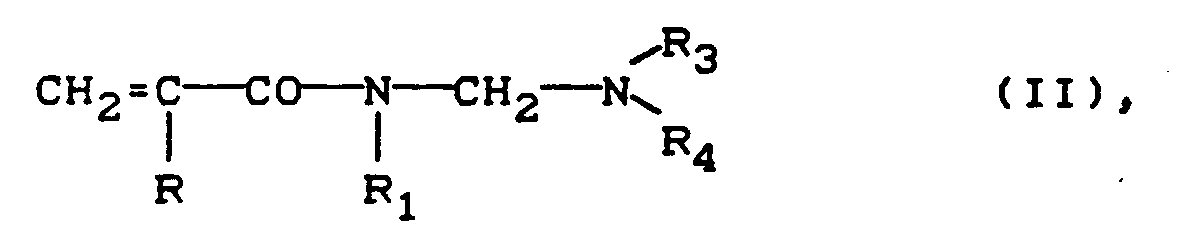
in der - R und R₁
- die gleiche Bedeutung wie bei Formel (I) haben und
- R₃ und R₄
- für C₁-C₆-Alkyl, C₅-C₇-Cycloalkyl oder gemeinsam für einen heterocyclischen Rest, z.B. einen Morpholinrest, stehen.
- Acryl- und Methacrylsäurederivate mit einer endständigen Halogenmethylcarbonylgruppe z.B. der allgemeinen Formel (III)

in der - R
- für Wasserstoff oder Methyl,
- A
- für eine der Gruppen -NH-CH₂-NH-, -NH-CO-NH-,

- X
- für Chlor oder Brom stehen.
- Allylverbindungen, z.B. Triallylcyanurat, Triallylphosphat, Allylalkohol und Allylamin.
- Monoolefinisch ungesättigte aliphatische Kohlenwasserstoffe mit 2 bis 6 C-Atomen, z.B. Ethylen, Propylen, Butylen und Isobutylen.
- Konjugierte Diolefine mit 4 bis 6 C-Atomen, z.B. Butadien, Isopren, 2,3-Dimethylbutadien und Chlorbutadien und
Norbornen und Hydroxymethylnorbornen. - Vorzugsweise werden eingesetzt die Polymere von Acryl- und Methacrylsäureestern mit 1 bis 12 C-Atomen im Alkoholrest, Acrylsäure, Methacrylsäure, von C₂-C₄-Hydroxyalkylestern dieser Säuren, von Styrol, Acrylnitril, Methacrylnitril, Vinylacetat, Vinylpropionat, Ethylen, Propylen und/oder Butadien.
- Die Polymerisation der Monomeren kann auf die an sich bekannte Weise der Emulsionspolymerisation durchgeführt werden. Man erhält dann, gegebenenfalls nach Verdünnung oder Aufkonzentration Polymere enthaltende Dispersionen, die erfindungsgemäß eingesetzt werden können. Geeignete Polymerisationsbedingungen sind z.B. Temperaturen von 10 bis 150°C, die Gegenwart von 0,05 bis 5 Gew.-% Initiatoren, die Gegenwart von 1 bis 10 Gew.-% Emulgatoren, pH-Werte von 2 bis 10 und gegebenenfalls Zusätze von üblichen Molekulargewichtsreglern in Mengen von 0,1 bis 2 Gew.-% (bezogen auf die Monomermischung). Die so erhaltenen Dispersionen können mit gleichgeladenen Dispersionen abgemischt werden.
- Pulverförmige Materialien, mit denen erfindungsgemäße Granulate hergestellt werden können, sind beispielsweise Füllstoffe wie Calciumcarbonat, Dolomit, Talkum, Kaolin, Wollastonit, Quarzmehl, synthetische Silikate, Gips, keramische Pulver wie Aluminiumoxid, Aluminiumhydroxid, Titandioxid, Zirkonoxid, Siliciumnitrid, Silicium und Siliciumcarbid, Porzellanmassen für die traditionelle Keramik, Feldspat, Kaolin, Quarzmehl, Metallpulver wie solche aus Eisen, Nickel und deren Legierungen, Pigmente wie Titandioxid, Eisenoxide, Chromoxide, Chinacridone und andere organische Pigmente, Siliciumdioxid, Kohle, Glaspulver, Emailpulver, Graphit, Aktivkohle, Wirkstoffe wie solche mit pharmazeutischen oder Pflanzenschutz-Wirkungen sowie sonstige organische und anorganische Pulver wie Kautschukchemikalien, organische Rohstoffe für Synthesen, Katalysatoren und Salze.
- Die Pulver können zur Herstellung der erfindungsgemäßen Granulate trocken oder in Form von wäßrigen oder nichtwäßrigen Dispersionen eingesetzt werden.
- Außer den bisher beschriebenen Bestandteilen können die erfindungsgemäßen Granulate gegebenenfalls Hilfsstoffe enthalten, z.B. zur Herstellung von Dispersionen übliche Dispergiermittel, z.B. Polyacrylsäuresalze und/oder Zitrate, Stabilisierungsmittel, Biozide und/oder Oberflächenmodifizierungsmittel, sowie Weichmacher, Pigmente, Fluß- und Kieselsäuresole, Aluminiumtone, Alginate, Sulfitablaugen oder Polyphosphate.
- Die Komponenten der erfindungsgemäßen Granulate können je nach dem Anwendungszweck in variierenden Verhältnissen eingesetzt werden. Die optimalen Mengenverhältnisse der Komponenten kann der Fachmann gegebenenfalls durch wenige Vorversuche leicht ermitteln. Wenn eine hohe Festigkeit der Granulate von besonderer Bedeutung ist, ist es vorteilhaft, Polymerdispersionen z.B. in Mengen bis zu 80 Gew.-% (bezogen auf die Summe der vorhandenen Polyurethane, Polyharnstoffe, Polyether und weiteren Polymere) einzusetzen. Wenn eine gute Verpreßbarkeit und/oder eine gute Redispergierbarkeit der Granulate von besonderer Bedeutung ist, ist es vorteilhaft Polymerdispersionen gar nicht oder in Mengen von weniger als 50 Gew.-% (bezogen auf die Summe der vorhandenen Polyurethane, Polyharnstoffe, Polyether und weiteren Polymere) einzusetzen Auch das Verhältnis von Polyurethanen und/oder Polyharnstoffen zu Polyethern kann je nach Anwendungszweck variiert werden. Wird z.B. eine gute Redispergierbarkeit in wäßrigen Medien angestrebt, so ist es vorteilhaft, den Anteil an monofunktionellen Polyethern zu erhöhen.
- Die erfindungsgemäßen Granulate können beispielsweise weitere Polymere einerseits und Polyurethane und/oder Polyharnstoffe und Polyether andererseits im Gewichtsverhältnis 1:100 bis 100:1, bevorzugt 1:30 bis 30:1, besonders bevorzugt 1:10 bis 10:1 enthalten. Das Gewichtsverhältnis von Polyurethanen und/oder Polyharnstoffen zu Polyethern kann beispielsweise 20:1 bis 1:20, bevorzugt 10:1 bis 1:10, besonders bevorzugt 5:1 bis 1:5 betragen. Bei den weiteren Polymeren kann es sich auch um Dispersionen handeln, die natürliche und/oder synthetische Wachse und/oder Paraffine enthalten.
- Die Menge an gegebenenfalls einzusetzenden erfindungsgemäßen Verbindungen kann je nach Anwendungszweck der erfindungsgemäßen Granulate variiert werden. Z.B. bei Granulaten, die Pigmente enthalten und Porzellanmassen-Granulaten ist es vorteilhaft, 0 bis 6 Gew.-% erfindungsgemäße Verbindungen einzusetzen (bezogen auf das zu granulierende Pulver). Bei Füllstoffgranulaten zur Herstellung von Masterbatches kann diese Menge beispielsweise bis zu 35 Gew.-% betragen.
- Die Herstellung der erfindungsgemäßen Granulate kann nach an sich bekannten Verfahren erfolgen. Besonders geeignet sind dabei Sprühtrocknung, Tellergranulation, Granulation im sogenannten Eirich-Mischer und die Wirbelschichtsprühgranulation. Diese Methoden eignen sich vorzugsweise zur Herstellung von Granulaten aus Pigmenten, wäßrigen Füllstoffdispersionen und Porzellanmassen. Bei der Herstellung von Materbatches sind Methoden aus der Kunststoffverarbeitung bevorzugt, z.B. Kneten oder Extrudieren. In diesem Falle ist es nicht notwendig, Polyurethane, Polyharnstoffe und/oder sonstige Polymere in Form von Dispersionen oder Lösungen zuzusetzen, man kann diese Stoffe dann auch in fester Form zudosieren.
- Bei der Herstellung erfindungsgemäßer Granulate werden vorzugsweise sphärische Partikel gebildet. Mit denen lassen sich z.B. Formen schnell und gleichmäßig füllen, sie sind gegenüber den Beanspruchungen während des Transportes ausreichend fest und bei der Weiterverarbeitung problemlos zu zerstören. Zur Vermeidung von Dichteinhomogenitäten und Entmischungsvorgängen sind erfindungsgemäße Granulate vorzugsweise frei von Grobkorn.
- Die Herstellung freifließender, staubarmer erfindungsgemäßer Granulate kann z.B. auch nach dem in Chem.-Ing.-Techn. 62 (10), S. 822-834 (1989) beschriebenen Verfahren erfolgen.
- Von den Verfahren, die die feinen Teilchen zusammenfügen, führen die Verfahren der Aufbau-Agglomeration zu kugelförmigen Partikeln. Sie formen z.B. die trockenaufbereiteten Porzellanmassen durch Kapillarkräfte in Verbindung mit Abroll- und Mischbewegungen zu Partikeln und kommen dabei mit wenig Wasser aus. Obwohl dabei der Ernergieaufwand gering ist, hat sich dieser auf den ersten Blick kostengünstige Weg bisher noch nicht durchgesetzt.
- Die Herstellung von Granulaten aus Dispersionen von Pulvern hat u.a. hingegen den Vorteil großer Homogenität sowohl der Masse als auch der einzubringenden Additive. Zudem sind Verunreinigungen durch Siebe und Magnete leicht zu eliminieren. Das Verfestigen naßaufbereiteter Pulver erfolgt im allgemeinen durch Sprühtrocknung. Wegen der kurzen Verweilzeiten werden die Sprühtürme mit hohen Ablufttemperaturen betrieben, um zu befriedigenden Durchsätzen zu kommen. Das hat jedoch einen hohen Energieaufwand zur Folge. Nachteilig ist u.a. auch der große Raumbedarf von Sprühtürmen und lange Anlaufzeiten bis zum Erreichen eines stationären Betriebszustandes. Außerdem sind die entstehenden Partikel oft innen hohl, was die Schüttdichte verringert.
- Darüber hinaus ist für die Kompaktierung von Pulvern die Wirbelschicht-Sprühgranulation bekannt. Bei diesen Verfahren entstehen im Idealfall nahezu runde, kompakte Partikel. Das Grundprinzip dieses Verfahrens ist in zahlreichen Varianten realisiert worden, wie sie z.B. in der oben zitierten Literaturstelle aus Chem.-Ing.-Techn. dargelegt ist. Im Idealfall erfolgen die Verfahrensschritte Keimerzeugung, Trocknen, Formgebung und das selektive Austragen der Partikel, die die Wunschkorngröße erreicht haben, simultan mit einem Apparat (siehe z.B. EP-A 163 836). Maßstabsprobleme (bei größeren Granulatoren mit zentralem Austrag müssen die Partikel die Schicht auf weiteren Wegen durchwandern, so daß sie nicht mehr häufig genug am Sichtungsprozeß teilnehmen, was die Gefahr von Grobkornbildung erhöht) lassen sich durch einen modularen Aufbau vermeiden (siehe EP-A 332 929).
- Es wurde auch ein Verfahren zur Herstellung von Granulaten aus pulverförmigen Stoffen gefunden, das dadurch gekennzeichnet ist, daß man
0,01 bis 30 Gew.-% Polyurethane und/oder Polyharnstoffe, vorzugsweise in gelöster oder dispergierter Form,
0,01 bis 30 Gew.-% Polyether,
0 bis 60 Gew.-% weitere Polymere, vorzugsweise in gelöster oder dispergierter Form, insgesamt jedoch nicht mehr als 65 Gew.-% dieser drei Komponenten,
(jeweils bezogen auf das Granulat)
sowie 0 bis 35 Gew.-% Hifsstoffe (bezogen auf pulverige Stoffe)
mit dem zu granulierenden Pulver mischt, dieses Gemisch auf an sich bekannte Weise granuliert und gegebenenfalls abschließend den Gehalt des Granulates an Wasser und/oder Lösungsmitteln auf weniger als 5 Gew.-% reduziert. - Für die Herstellung von Granulaten mit besonders guter Festigkeit kann man beispielsweise
0,02 bis 10 Gew.-% Polyurethane und/oder Polyharnstoffe,
0,02 bis 10 Gew.-% Polyether und
0,02 bis 10 Gew.-% weitere Polymere,
insgesamt jedoch nicht mehr als 25 Gew.-% dieser drei Komponenten (jeweils bezogen auf das Granulat) einsetzen. - Vorzugsweise setzt man dafür die drei Komponenten in Mengen von jeweils 0,05 bis 5 Gew.-%, insgesamt jedoch nicht mehr als 10 Gew.-% (jeweils bezogen auf das Granulat) ein.
- Für die Herstellung von besonders gut redispergierbaren Granulaten kann man beispielsweise
0,02 bis 15 Gew..%, bevorzugt 0,05 bis 7 Gew.-% Polyurethane und/oder Polyharnstoffe und
0,02 bis 15 Gew.-%, bevorzugt 0,05 bis 7 Gew.-% Polyether (jeweils bezogen auf das Granulat) einsetzen. - Die Art der einzusetzenden Komponenten und, sofern diese als Lösungen oder Dispersionen eingesetzt werden, deren Gehalte an Feststoffen, können wie weiter oben beschrieben sein.
- Erfindungsgemäße Granulate eignen sich insbesondere für die
- Herstellung von Geschirr- und/oder anderer traditioneller Keramik,
- Herstellung von Ingenieurkeramik,
- Herstellung von pulvermetallurgischen Erzeugnissen,
- Herstellung von Pigment- und/oder Füllstoffkonzentraten,
- Herstellung von Wirkstofformulierungen, z.B. im Pharma- und/oder Pflanzenschutzgebiet und/oder
- Bereitstellung von Hilfsstoffen, z.B. Kautschuk-Chemikalien, Fließhilfsmitteln oder Trennmitteln für Dispersionen, Compounds oder Kunststoffe.
- Die nachfolgenden Beispiele erläutern die vorliegende Erfindung weiter. Prozentangaben beziehen sich auf das Gewicht, soweit nichts anderes angegeben ist.
- In einem Labormixer wurden zu 100 g pulveriger Porzellanmasse (Restfeuchte 1 %) unter Intervallrühren 19 g wäßriger Additivzubereitung in kleinen Portionen zugegeben. Die Additivzubereitung bestand aus einem Gemisch aus
- (1) 0,2 g eines Polymers aus 55 % n-Butylacrylat, 41 % Styrol und 4 % Methacrylsäure,
- (2) 0,2 g eines Polyurethans aus Isophorondiisocyanat, Polyethylenglykol und Polyethylen-propylenglykolcopolymer,
- (3) 0,08 g eines Diphenylpolyglykolethers,
- (4) 0,012 g eines auf Trimethylolpropan gestarteten Polyetherpolyols aus 10 % Ethylenoxid und 90 % Propylenoxid und
- (5) 18,4 g Wasser.
- Das entstandene granulierte Gemisch wurde im Umlufttrockenschrank bis zum Erreichen einer Restfeuchte von 0,9 % getrocknet. Aus dem Granulatgemisch wurde die Fraktion von 100 bis 500 µm herausgesiebt.
- 50 g dieses Granulats wurden bei 300 bar zu runden Formkörpern mit einem Durchmesser von 6,0 cm verpreßt. Der entstandene Preßling hatte nach Druckentlastung eine Dicke von 1,065 cm, die sich im Verlauf von 15 Tagen nicht änderte. Das Granulat war nach dem Einrühren in Wasser (400 U/min., Dissolverscheibe) vollständig redispergierbar, so daß die ursprüngliche Partikelgrößenverteilung und die mittlere Partikelgröße von d₅₀ = 10 µm wieder erreicht wurde.
- Es wurde gearbeitet wie in Beispiel 1, jedoch wurde statt der Additivzubereitung das Cellulosederivat Optapix® C 12 G eingesetzt. Der erhaltene Preßling hatte eine Dicke von 1,110 cm, nach 8 Tagen von 1,125 cm und nach 15 Tagen von 1,130 cm, Das Granulat ließ sich nach dem Einrühren in Wasser (400 U/min., Dissolverscheibe) nicht vollständig redispergieren.
- Es wurde gearbeitet wie in Beispiel 1, jedoch enthielt die Additivzubereitung als Komponente (1) ein Polymer aus 18 % Acrylnitril, 44 % Butylacetat, 2 % Methacrylsäure und 36 % Methylmethacrylat. Das erhaltene Granulat war in Wasser gut redispergierbar. Der erhaltene Preßling hatte eine Dicke von 1,020 cm, die sich im Verlauf von 15 Tagen nicht änderte.
- Es wurde gearbeitet wie in Beispiel 2, jedoch wurden nur die Komponenten (1) und (5) der Additivzubereitung eingesetzt. Der erhaltene Preßling hatte eine Dicke von 1,045 cm, nach 8 Tagen von 1,060 cm und nach 15 Tagen von 1,065 cm. Das Granulat ließ sich nicht vollständig redispergieren.
- Es wurde gearbeitet wie in Beispiel 1, jedoch wurde anstelle der Komponente (1) der Additivzubereitung ein 40%-iger Latex aus Butadien und Styrol eingesetzt. Der erhaltene Preßling zeigte eine Dicke von 1,020 cm, die sich im Verlauf von 15 Tagen nicht änderte.
- Es wurde gearbeitet wie in Beispiel 3, jedoch wurde als Komponente (2) der Additivzubereitung eine 40%-ige Polyurethandispersion aus einem modifizierten Hexamethylendiisocyanat (Desmodur® N, Bayer AG) und einem Polyetherdiol aus Propylenoxid und Ethylenoxid eingesetzt. Der erhaltene Preßling zeigte eine Dicke von 1,015 cm, die sich im Verlauf von 15 Tagen nicht änderte. Das Granulat war in Wasser gut redispergierbar.
- Es wurde verfahren wie in Beispiel 1, jedoch wurde als Komponente (1) der Additivzubereitung eine 40%-ige wäßrige Dispersion einer Paraffinmischung eingesetzt. Der erhaltene Preßling besaß eine Dicke von 1,000 cm, die sich im Verlauf von 15 Tagen nicht änderte.
- Es wurde verfahren wie in Beispiel 1, jedoch wurde anstelle der Komponenten (3) und (4) ein Addukt aus Abietinsäure und 30 Mol Ethylenoxid eingesetzt. Der erhaltene Preßling hatte eine Dicke von 1,005 cm, die sich innerhalb von 15 Tagen nicht änderte.
- Es wurde verfahren wie in Beispiel 2, jedoch wurden 0,4 g der Komponente (1), 0,1 g der Komponente (2), 0,04 g der Komponente (3) und 0,06 g der Komponente (4) eingesetzt. Die Menge der Komponente (5) blieb unverändert. Der erhaltene Preßling hatte eine Dicke von 1,005 cm, nach 8 Tagen und nach 15 Tagen von 1,010 cm.
- Es wurde verfahren wie in Beispiel 2, jedoch wurde anstelle der Komponenten (2) und (3) ein durch Addition eines Gemisches aus 5 Mol Propylenoxid und 60 Mol Ethylenoxid auf Stearylamin erhaltener, basische Gruppen aufweisender Polyether eingesetzt. Der erhaltene Preßling hatte eine Dicke von 0,995 cm, nach 8 und nach 15 Tagen von 1,000 cm.
- Es wurde gearbeitet wie in Beispiel 8, jedoch wurde als basischer Polyether ein Blockcopolymer (MG 30 000) aus Propylenoxid und Ethylenoxid (20:80%), gestartet auf Ethylendiamin, eingesetzt. Der erhaltene Preßling hatte eine Dicke von 1,010 cm, die sich im Verlauf von 15 Tagen nicht änderte.
- Es wurde gearbeitet wie in Beispiel 2, jedoch wurden 38 g Additivzubereitung eingesetzt. Der erhaltene Preßling hatte eine Dicke von 1,010 cm, die sich im Verlauf von 15 Tagen nicht änderte.
- Es wurde gearbeitet wie in Beispiel 2, jedoch wurde 0,1 g Polymer (Komponente 1) und insgesamt 0,5 g der Komponenten 2, 3 und 4 eingesetzt. Das vollständig redispergierbare Granulat wurde zu einem Preßling mit einer Dicke von 1,005 cm verpreßt, die Dicke änderte sich im Verlauf von 15 Tagen nicht.
- Es wurde gearbeitet wie in Beispiel 2, jedoch wurde anstelle der Porzellanmasse Aluminiumoxid (Alcoa® 1000 CT) eingesetzt. Der erhaltene Preßling hatte eine Dicke von 0,800 cm, nach 8 Tagen und nach 15 Tagen von 0,810 cm. Das erhaltene Granulat war im Wasser gut redispergierbar.
- Es wurde verfahren wie in Beispiel 2, jedoch enthielt die Additivzubereitung 0,3 g Polymer, 0,15 g Polyurethan aus Toluylendiisocyanat, Polyethylenoxid und Stearylalkohol sowie 0,15 g Ethylenoxidpolyether. Der erhaltene Preßling hatte eine Dicke von 1,045 cm, nach 8 und nach 15 Tagen von 1,045 cm. Das Granulat ließ sich gut redispergieren.
- Es wurde gearbeitet wie in Beispiel 11, jedoch wurde zuerst aus der pulverförmigen Porzellanmasse und 15 g Wasser ein additivfreies Granulat hergestellt und anschließend mit einer Additivlösung gecoatet. Nach Trocknung wie in Beispiel 1 wurde ein Preßling mit einer Dicke von 1,030 cm erhalten. Diese Dicke betrug nach 15 Tagen 1,035 cm.
- Es wurde gearbeitet wie in Beispiel 7, jedoch wurde zuerst aus der Porzellanmasse mit 0,3 % Ammoniumpolyacrylat (Molekulargewicht: 3000) ein 65 %iger Schlicker hergestellt, der unter Zugabe von 0,4 g des in Beispiel 2 verwendeten Polymers in einem Wirbelschichtsprühgranulator granuliert wurde. Auf das erhaltene Granulat wurden dann die übrigen Additive aufgecoatet. Anschließend wurde das Granulat verpreßt. Der Preßling hatte eine Dicke von 1,005 cm, nach 8 Tagen und nach 15 Tagen von 1,010 cm.
- Es wurde gearbeitet wie in Beispiel 13, jedoch wurde das Granulat bei 105°C bis zur Gewichtskonstanz getrocknet. Außer Porzellanmasse wurden die in Tabelle 1 aufgeführten Pulver eingesetzt. Wie aus Tabelle 1 ersichtlich, ließen sich alle erfindungsgemäßen Granulate besser redispergieren als die mit dem Cellulosederivat Optapix® C 12 G oder dem Polyvinylalkohol Moviol® 10-98 zum Vergleich hergestellten Granulate. Beim Verzicht auf die Komponente 1 wurde die Redispergierbarkeit noch besser.
- Zur Prüfung der Redispergierbarkeit wurde das jeweilige Granulat 1 Stunde mit einer Dissolverscheibe (400 U/min) in Wasser gerührt und dann bestimmt, welcher Anteil in Gew.-% an Teilchen einer Größe über 65 µm noch vorhanden war, Weitere Details siehe Tabelle 1.
- Dort bedeutet A, daß das jeweilige Granulat entsprechend Beispiel 11, B analog Beispiel 11, jedoch mit 0,6 g der Komponenten 2, 3 und 4, C mit 0,6 g des Cellulosederivats Optapix® C 12 G anstelle der erfindungsgemäßen Zusätze und D mit 0,6 g des Polyvinylalkohols Moviol® 10-98 anstelle der erfindungsgemäßen Zusätze, hergestellt worden ist.

- Diese Beispiele wurden analog den Beispielen 16 bis 24 durchgeführt, qualitativ waren die verwendeten Additive bei E und I identisch mit A, bei F und J identisch mit B, bei G und K identisch mit C und bei H und L identisch mit D. Die Granulate E bis H wurden jedoch unter Einsatz von insgesamt 6% Additiven, die Granulate I bis L unter Einsatz von insgesamt 12% Additiven hergestellt. Weitere Details siehe Tabelle 2.

Claims (10)
- Granulate aus pulvrigen Stoffen, dadurch gekennzeichnet, daß sie als Zusatzstoffe Polyurethane und/oder Polyharnstoffe, Polyether und gegebenenfalls weitere Polymere enthalten.
- Granulate nach Anspruch 1, dadurch gekennzeichnet, daß sie0,01 bis 30 Gew.-% Polyurethane und/oder Polyharnstoffe,0,01 bis 30 Gew.-% Polyether und0 bis 60 Gew.-% weitere Polymere, insgesamt jedoch nicht mehr als 65 Gew.-% dieser Komponenten enthalten,sowie Hilfsstoffe in Mengen von 0 bis 35 Gew.-%, bezogen auf pulvrige Stoffe und maximal 10 Gew.-% Wasser und/oder Lösungsmittel, bezogen auf das fertige Granulat.
- Granulate nach Ansprüchen 1 und 2, dadurch gekennzeichnet, daß Polyurethane und/oder Polyharnstoffe in Form von Lösungen oder Dispersionen mit einem Gehalt von 2 bis 60 Gew.-% und gegebenenfalls weitere Polymere in Form von Polymerdispersionen mit einem Gehalt von 5 bis 60 Gew.-% eingebracht worden sind.
- Granulate nach Ansprüchen 1 bis 3, dadurch gekennzeichnet, daß das eingesetzte Polyurethan aus einem Diisocyanat und wenigstens einem Makropolyol erhalten worden ist.
- Granulate nach Ansprüchen 1 bis 4, dadurch gekennzeichnet, daß das eingesetzte Polyurethan aus Diisocyanaten der Formel Q(NCO)₂, in welcher Q für einen aromatischen Kohlenwasserstoffrest mit 6 bis 15 Kohlenstoffatomen oder für einen aliphatischen, cycloaliphatischen oder gemischt aliphatisch/cycloaliphatischen Kohlenwasserstoffrest mit 2 bis 14 Kohlenstoffatomen steht und
Makropolyolen, bei denen es sich um Polyester-, Polyether-, Polythioether-, Polylacton-, Polycarbonat-, Polyestercarbonat-, Polyethercarbonat-, Polyacetal- und/oder Polyesteramid-Diole handelt,
erhalten wurde. - Granulate nach Ansprüchen 1 bis 5, dadurch gekennzeichnet, daß es sich bei den Polyethern um Additionsprodukte von Ethylenoxid und/oder Propylenoxid an Startermolekülen mit einem oder mehreren aktiven Wasserstoffatomen handelt.
- Granulate nach Ansprüchen 1 bis 6, dadurch gekennzeichnet, daß es sich bei den gegebenenfalls einzusetzenden weiteren Polymeren um Polymere aus α,β-olefinisch ungesättigte Monocarbonsäuren mit 3 bis 5 C-Atomen, deren Ester, Nitrile und Amide, α,β-olefinisch ungesättigte Dicarbonsäuren mit 3 bis 5 C-Atomen und deren Derivate,
Mono- und Diester des Vinylalkohols mit Carbonsäuren oder Vinylether, Vinylketone und Vinylamide, Vinylverbindungen von Aromaten oder Heterocyclen, N-Methylolether des Acrylsäure- und/oder Methacrylsäureamids,
Mannichbasen des Acrylsäure- und/oder Methacrylsäureamids,
Acryl- und/oder Methacrylsäurederivate mit einer endständigen Halogenmethylcarbonylgruppe, Allylverbindungen,
monoolefinisch ungesättigte aliphatische Kohlenwasserstoffe mit 2 bis 6 C-Atomen, konjugierte Diolefine und/oder Norbornene und Hydroxymethylnorbornene
handelt. - Verfahren zur Herstellung von Granulaten aus pulvrigen Stoffen, dadurch gekennzeichnet, daß man0,01 bis 30 Gew.-% Polyurethane und/oder Polyharnstoffe,0,01 bis 30 Gew.-% Polyether,0 bis 60 Gew.-% weitere Polymere,insgesamt jedoch nicht mehr als 65 Gew.-% dieser drei Komponenten (jeweils bezogen auf das Granulat), sowie0 bis 35 Gew.-% Hilfsstoffe (bezogen auf pulvrige Stoffe)mit dem zu granulierenden Pulver mischt, dieses Gemisch auf an sich bekannte Weise granuliert und gegebenenfalls abschließend den Gehalt des Granulats an Wasser und/oder Lösungsmitteln auf weniger als 5 Gew.-% reduziert.
- Verfahren nach Anspruch 8, dadurch gekennzeichnet, daß man für die Herstellung von Granulaten mit besonders guter Festigkeit0,02 bis 10 Gew.-% Polyurethane und/oder Polyharnstoffe,0,02 bis 10 Gew.-% Polyether und0,02 bis 10 Gew.-% weitere Polymere,insgesamt jedoch nicht mehr als 25 Gew.-% dieser drei Komponenten (jeweils bezogen auf das Granulat) und
für die Herstellung besonders gut redispergierbarer Granulate0,02 bis 15 Gew.-% Polyurethane und/oder Polyharnstoffe und0,02 bis 15 Gew.-% Polyether (jeweils bezogen auf das Granulat)einsetzt. - Verwendung von Granulaten des Anspruchs 1 oder hergestellt nach Anspruch 8 für die Herstellung von Geschirr- und/oder anderer traditioneller Keramik, von Ingenieurkeramik, von pulvermetallurgischen Erzeugnissen, von Pigment- und/oder Füllstoffkonzentraten, von Wirkstoff-Formulierungen und/oder die Bereitstellung von Hilfsstoffen.
Applications Claiming Priority (2)
| Application Number | Priority Date | Filing Date | Title |
|---|---|---|---|
| DE4131345 | 1991-09-20 | ||
| DE19914131345 DE4131345A1 (de) | 1991-09-20 | 1991-09-20 | Granulate aus pulvrigen primaerpartikeln mit verbesserten verarbeitungseigenschaften |
Publications (2)
| Publication Number | Publication Date |
|---|---|
| EP0533024A2 true EP0533024A2 (de) | 1993-03-24 |
| EP0533024A3 EP0533024A3 (en) | 1993-06-02 |
Family
ID=6441085
Family Applications (1)
| Application Number | Title | Priority Date | Filing Date |
|---|---|---|---|
| EP19920115314 Withdrawn EP0533024A3 (en) | 1991-09-20 | 1992-09-08 | Granules from primary powdery particles with improved processing properties |
Country Status (2)
| Country | Link |
|---|---|
| EP (1) | EP0533024A3 (de) |
| DE (1) | DE4131345A1 (de) |
Cited By (5)
| Publication number | Priority date | Publication date | Assignee | Title |
|---|---|---|---|---|
| WO2002049991A3 (en) * | 2000-12-19 | 2003-01-23 | Lubrizol Corp | Aminosulfonate product-treated nitrogen-containing salt particles |
| WO2006018667A1 (en) * | 2004-08-19 | 2006-02-23 | Polinvent Fejleszto, Kivitelezo És Értékesito Kft | Process for the production of polyisocyanate/polysi licic acid based resins with widely variable processability and setting periods |
| WO2015193377A1 (de) * | 2014-06-20 | 2015-12-23 | Uhde Fertilizer Technology B.V. | Harnstoffzusammensetzung und verfahren zu ihrer herstellung |
| WO2017103243A1 (de) * | 2015-12-17 | 2017-06-22 | Uhde Fertilizer Technology B. V. | Harnstoffhaltige düngemittel und verfahren zu ihrer herstellung |
| CN112499968A (zh) * | 2020-12-23 | 2021-03-16 | 淄博畅安陶瓷科技有限公司 | 超高温耐磨耐蚀陶瓷釉及其制备方法和应用 |
Families Citing this family (3)
| Publication number | Priority date | Publication date | Assignee | Title |
|---|---|---|---|---|
| DE4309139A1 (de) * | 1993-03-22 | 1994-09-29 | Bayer Ag | Verfahren zur Herstellung von Pulvern und anderen Klein- und Kleinstteilchen |
| DE19502891A1 (de) * | 1995-01-31 | 1996-08-01 | Bosch Gmbh Robert | Preßmasse |
| DE102019118429A1 (de) * | 2019-04-18 | 2020-10-22 | Brillux Gmbh & Co. Kg | Granulat und daraus hergestelltes Anstrichmittel |
Family Cites Families (4)
| Publication number | Priority date | Publication date | Assignee | Title |
|---|---|---|---|---|
| FR88758E (de) * | 1965-02-20 | 1967-06-07 | ||
| US4362559A (en) * | 1981-03-09 | 1982-12-07 | American Cyanamid Company | Method of introducing addition agents into a metallurgical operation |
| US4497661A (en) * | 1981-08-11 | 1985-02-05 | Ohio & Pennsylvania Fuels Co, Ltd. | Formed briquettes, process for forming the same and process for utilizing the same in the manufacture of metals |
| DE3714267A1 (de) * | 1987-04-29 | 1988-11-10 | Degussa | Schlagzaehe polyoxymethylen-formmassen |
-
1991
- 1991-09-20 DE DE19914131345 patent/DE4131345A1/de not_active Withdrawn
-
1992
- 1992-09-08 EP EP19920115314 patent/EP0533024A3/de not_active Withdrawn
Cited By (12)
| Publication number | Priority date | Publication date | Assignee | Title |
|---|---|---|---|---|
| WO2002049991A3 (en) * | 2000-12-19 | 2003-01-23 | Lubrizol Corp | Aminosulfonate product-treated nitrogen-containing salt particles |
| US6949236B2 (en) | 2000-12-19 | 2005-09-27 | The Lubrizol Corporation | Aminosulfonate product-treated nitrogen-containing salt particles |
| AU2002232417B2 (en) * | 2000-12-19 | 2006-09-21 | The Lubrizol Corporation | Aminosulfonate product-treated nitrogen-containing salt particles |
| WO2006018667A1 (en) * | 2004-08-19 | 2006-02-23 | Polinvent Fejleszto, Kivitelezo És Értékesito Kft | Process for the production of polyisocyanate/polysi licic acid based resins with widely variable processability and setting periods |
| WO2015193377A1 (de) * | 2014-06-20 | 2015-12-23 | Uhde Fertilizer Technology B.V. | Harnstoffzusammensetzung und verfahren zu ihrer herstellung |
| CN106458782A (zh) * | 2014-06-20 | 2017-02-22 | 伍德肥料技术公司 | 尿素组合物及其生产方法 |
| US10106469B2 (en) | 2014-06-20 | 2018-10-23 | Uhde Fertilizer Technology B.V. | Urea composition and method for producing same |
| EA032215B1 (ru) * | 2014-06-20 | 2019-04-30 | Уде Фертилайзер Текнолоджи Б.В. | Композиция мочевины и способ её получения |
| WO2017103243A1 (de) * | 2015-12-17 | 2017-06-22 | Uhde Fertilizer Technology B. V. | Harnstoffhaltige düngemittel und verfahren zu ihrer herstellung |
| CN108463447A (zh) * | 2015-12-17 | 2018-08-28 | 蒂森克虏伯肥料技术有限公司 | 含脲肥料及其生产方法 |
| US10752559B2 (en) | 2015-12-17 | 2020-08-25 | Thyssenkrupp Fertilizer Technology Gmbh | Urea-containing fertilizers and process for production thereof |
| CN112499968A (zh) * | 2020-12-23 | 2021-03-16 | 淄博畅安陶瓷科技有限公司 | 超高温耐磨耐蚀陶瓷釉及其制备方法和应用 |
Also Published As
| Publication number | Publication date |
|---|---|
| DE4131345A1 (de) | 1993-03-25 |
| EP0533024A3 (en) | 1993-06-02 |
Similar Documents
| Publication | Publication Date | Title |
|---|---|---|
| EP0009760B1 (de) | Verfahren zur Herstellung von wässrigen Dispersionen oder Lösungen von Polyurethan-Polyharnstoffen sowie ihre Verwendung | |
| EP0901993B1 (de) | Wasserdispergierbare bzw. wasserlösliche Polyurethane als Additive für Beton | |
| EP0000029B1 (de) | Verfahren zur Herstellung von wässrigen Polyurethan-Dispersionen und -Lösungen und deren Verwendung zur Beschichtung von flexiblen Substraten | |
| DE3150174C2 (de) | Urethan-Rheologie-Modifiziermittel, Verfahren zu seiner Herstellung und seine Verwendung | |
| DE2637115C3 (de) | Verfahren zur Herstellung von Polyurethanharnstoffen | |
| EP0850896B9 (de) | Verwendung wasserdispergierbarer Polyisocyanatgemische als Additive für Beton | |
| US4293679A (en) | Composition and method of controlling solid polyurethane particle size with water reactant | |
| EP0004069B1 (de) | Verfahren zur Herstellung von wässrigen Lösungen oder Dispersionen von Polyurethanen sowie ihre Verwendung zur Herstellung von Überzügen, Lacken oder Beschichtungen | |
| EP2723484B1 (de) | Dispergieradditive auf basis von phosphorsäureesterderivaten | |
| DE2732131A1 (de) | Verfahren zur herstellung von seitenstaendige hydroxylgruppen aufweisenden isocyanat-polyadditionsprodukten | |
| DE10022371A1 (de) | Pfropfcopolymere enthaltende Feststoffpräparationen | |
| EP0153456A1 (de) | Chemisch härtende Zweikomponentenmasse auf der Basis von Polyurethan-Präpolymeren, Verfahren zur Herstellung eines Polyurethan und Verwendung der Zweikomponentenmasse | |
| EP0270126A2 (de) | Als Dispergiermittel und als Dispersionsstabilisatoren geeignete Additionsverbindungen, Verfahren zu ihrer Herstellung, ihre Verwendung und damit beschichtete Feststoffe | |
| EP1837355A2 (de) | Additionsverbindungen als Dispergiermittel und Dispersionsstabilisatoren | |
| DE3027198A1 (de) | Feste, in wasser dispergierbare, isocyanatgruppen aufweisende kunststoffvorlaeufer, ein verfahren zur herstellung von waessrigen kunststoffdispersionen unter verwendung dieser kunststoffvorlaeufer, sowie die verwendung der kunststoffvorlaeufer als vernetzungsmittel fuer waessrige kunststoffdispersionen | |
| EP0154768B1 (de) | Verfahren zur Herstellung von Polyurethanen, Polyurethane mit aromatischen Aminoendgruppen und ihre Verwendung | |
| EP0011702B1 (de) | Dispersionen von Destillationsrückständen der TDI-Herstellung in Polyolen und deren Verwendung in einem Verfahren zur Herstellung von Polyurethankunststoffen | |
| EP0312890A2 (de) | Verfahren zur Herstellung von wässrigen Polyurethan-Polyharnstoffdispersionen | |
| EP0084141B1 (de) | Polymerisathaltige, aromatische Polyether-Polyamine, Verfahren zur Herstellung dieser Polyamine und deren Verwendung als Aufbaukomponente zur Herstellung von Polyurethanen | |
| EP0000568A1 (de) | Verfahren zur Herstllung von wässrigen Dispersionen oder Lösungen von Isocyanat-Polyadditionsprodukten; Verwendung dieser Dispersionen bzw. Lösungen zur Herstellung von Überzügen und Beschichtungen | |
| EP1222220A1 (de) | Füllstoff für kunststoff-formulierungen auf polyurethanbasis | |
| EP0533024A2 (de) | Granulate aus pulvrigen Primärpartikeln mit verbesserten Verarbeitungseigenschaften | |
| DE3940273A1 (de) | Heisshaertbare polyether-polyester-polyurethanharnstoffe | |
| EP0629664B1 (de) | Wässrige Polyurethandispersionen | |
| EP0449041B1 (de) | Cellulose-Kunststoff-Blends, Verfahren zur Herstellung und ihre Verwendung |
Legal Events
| Date | Code | Title | Description |
|---|---|---|---|
| PUAI | Public reference made under article 153(3) epc to a published international application that has entered the european phase |
Free format text: ORIGINAL CODE: 0009012 |
|
| AK | Designated contracting states |
Kind code of ref document: A2 Designated state(s): AT BE CH DE DK ES FR GB IT LI |
|
| RTI1 | Title (correction) | ||
| PUAL | Search report despatched |
Free format text: ORIGINAL CODE: 0009013 |
|
| AK | Designated contracting states |
Kind code of ref document: A3 Designated state(s): AT BE CH DE DK ES FR GB IT LI |
|
| 17P | Request for examination filed |
Effective date: 19931110 |
|
| 18W | Application withdrawn |
Withdrawal date: 19940303 |