EP0534809A2 - Verfahren und Vorrichtung zum Nachweis von Wasserdampf in einem Luftvolumen und Dampferzeuger und Dampfofen welche diese benützen - Google Patents
Verfahren und Vorrichtung zum Nachweis von Wasserdampf in einem Luftvolumen und Dampferzeuger und Dampfofen welche diese benützen Download PDFInfo
- Publication number
- EP0534809A2 EP0534809A2 EP92402143A EP92402143A EP0534809A2 EP 0534809 A2 EP0534809 A2 EP 0534809A2 EP 92402143 A EP92402143 A EP 92402143A EP 92402143 A EP92402143 A EP 92402143A EP 0534809 A2 EP0534809 A2 EP 0534809A2
- Authority
- EP
- European Patent Office
- Prior art keywords
- temperature
- air
- sensor
- water vapor
- rise time
- Prior art date
- Legal status (The legal status is an assumption and is not a legal conclusion. Google has not performed a legal analysis and makes no representation as to the accuracy of the status listed.)
- Granted
Links
Images


Classifications
-
- G—PHYSICS
- G01—MEASURING; TESTING
- G01N—INVESTIGATING OR ANALYSING MATERIALS BY DETERMINING THEIR CHEMICAL OR PHYSICAL PROPERTIES
- G01N25/00—Investigating or analyzing materials by the use of thermal means
- G01N25/56—Investigating or analyzing materials by the use of thermal means by investigating moisture content
- G01N25/58—Investigating or analyzing materials by the use of thermal means by investigating moisture content by measuring changes of properties of the material due to heat, cold or expansion
- G01N25/60—Investigating or analyzing materials by the use of thermal means by investigating moisture content by measuring changes of properties of the material due to heat, cold or expansion for determining the wetness of steam
-
- A—HUMAN NECESSITIES
- A47—FURNITURE; DOMESTIC ARTICLES OR APPLIANCES; COFFEE MILLS; SPICE MILLS; SUCTION CLEANERS IN GENERAL
- A47J—KITCHEN EQUIPMENT; COFFEE MILLS; SPICE MILLS; APPARATUS FOR MAKING BEVERAGES
- A47J27/00—Cooking-vessels
- A47J27/14—Cooking-vessels for use in hotels, restaurants, or canteens
- A47J27/16—Cooking-vessels for use in hotels, restaurants, or canteens heated by steam
-
- F—MECHANICAL ENGINEERING; LIGHTING; HEATING; WEAPONS; BLASTING
- F22—STEAM GENERATION
- F22B—METHODS OF STEAM GENERATION; STEAM BOILERS
- F22B1/00—Methods of steam generation characterised by form of heating method
- F22B1/28—Methods of steam generation characterised by form of heating method in boilers heated electrically
- F22B1/284—Methods of steam generation characterised by form of heating method in boilers heated electrically with water in reservoirs
Definitions
- the present invention relates to a method and a device for detecting, in a volume of air at a given temperature, the presence of water vapor at the same temperature.
- the present invention also relates to the application of this method and this device on the one hand to the use of steam generators, preferably operating at atmospheric pressure, to give them an almost instantaneous response and, on the other hand, to control the supply of water vapor, by a steam generator, to cooking ovens with water vapor at atmospheric pressure.
- the present invention also relates to a method and a device intended to determine the percentage of water vapor, at a given temperature, possibly contained in an air mass at the same temperature.
- water vapor is used in many applications, both domestic and artisanal and industrial, where it is essential to carry out a specific detection of water vapor, that is to say to distinguish it from steam. of water at a given temperature of air at the same temperature.
- a means can, for example, be used to ensure good and constant filling with water vapor of an enclosure, which may or may not be thermostatically controlled, or even for example, to detect the start of the actual production of steam from water from a steam generator, after a preheating period, or even, for example, to signal, in a pipe, any sudden burst of water vapor, for example for safety reasons.
- the object of the present invention is therefore to propose a method and a device for the specific detection of water vapor, possibly overheated above the boiling temperature of water at atmospheric pressure, which is particularly simple to implement. .
- the method and the device for detecting water vapor according to the invention are based on tests carried out by the applicant, which have enabled it to observe that the rise in temperature of temperature sensors, in contact with an atmosphere of vapor at a given temperature, was much faster than when these same sensors were put in contact with an atmosphere made up of air at the same temperature.
- the tests have shown that the ratio of the times taken to reach a given set temperature, respectively under an atmosphere of vapor and under an atmosphere of air, could reach a value of ten.
- the Applicant has also established that, although this ratio varies depending on the type of temperature sensor used, the temperature rise time of the latter is however shorter most of the time (at equal air and vapor temperatures) , when in contact with steam, than when it was in contact with air.
- the temperature sensor can be of any type.
- a bimetallic blade which has the advantage of a very low cost, but which has a relatively high inertia.
- the heat losses undergone by the air are greater, in relative value, than those undergone by the steam.
- the temperature of the air drops more than that of the vapor.
- the temperature reached, after an "infinite" time by the sensor, when the air is free of steam is therefore lower than that reached when the air contains steam.
- the vapor detection can then be carried out, not only as mentioned previously, by an examination of the temperature rise curve, but also by an examination, even after some time, of the temperature recorded by the sensor. By comparing this temperature with the values obtained by a prior calibration, it is thus possible determine the presence or absence of vapor in the gas.
- the sensor can be placed in any space subjected to thermal losses, traversed by the flow of gas (water vapor and / or air), the thermal losses thus created making it possible to lower the temperature of the air faster than that water vapor.
- This space can consist for example of a tube, or of any pipe of any shape, or even more simply by the ambient air itself.
- the device according to the invention even if, for example, the temperature of the air is higher than that of the vapor d 'water. It is also possible to implement this device even when, after a first contact, the sensor remains in the presence of air or water vapor. Indeed, in the latter case, it is possible to position the sensor so that the equilibrium temperature of the sensor in the air is lower than that of the sensor in the water vapor, and therefore to choose the crossing of the maximum air temperature as observation point and criteria for detecting water vapor.
- the present invention also relates to the applications of the method and the device according to the invention. It aims in particular to propose, on the one hand, a steam generator having an almost instantaneous response and, on the other hand, an oven for cooking with the steam provided with means for controlling the quantity of steam supplied to the cooking chamber of said oven.
- the device When used on a steam generator, the device according to the invention makes it possible to provide the latter with an almost instantaneous response.
- the temperature sensor used has two temperature rise times, to reach a determined set temperature, when it is placed in the presence of air and water vapor respectively at the same temperature.
- the temperature sensor is disposed near an outlet orifice of the steam generator and controls the means for heating the latter, optionally by means of a control device, for example a total control or nothing or proportional control, depending on the temperature detected. In all or nothing, for example, the control device activates the heating means of the steam generator when the temperature to which the sensor is subjected is lower than a predetermined set value, and cuts them off when the temperature of the sensor reaches the set temperature.
- This implementation makes it possible to have an instant response generator, that is to say one which can emit water vapor immediately at any time, on simple request, and the sensor of which reacts only to that -this. Indeed, the sensor oscillates between a temperature lower than the set temperature when the generator does not produce water vapor, (which triggers the production of water vapor), and a temperature higher than the set temperature when the generator produces water vapor, (which causes the production of it to stop.)
- the generator therefore always works a little, and thus compensates, in fact, for the thermal losses of the walls, so that it maintains the liquid at its boiling point.
- the oven consists of a closed enclosure, communicating on the one hand with the outside by a reduced number of orifices and, on the other hand, with a steam generator, inside or outside at the enclosure.
- a steam generator outside the enclosure
- communication with the steam generator can be done by means of a device for superheating the steam which can bring it ci at a temperature much higher than 100 ° C., for example of the order of 200 to 300 ° C.
- the cooking enclosure is provided with heating means, such as electrical resistances, internal or external to the enclosure, making it possible to heat the latter and to heat the gas contained therein.
- ovens have orifices for communicating the enclosure with the outside, which makes it possible to ensure permanent natural balancing of the pressure between the enclosure and the outside thereof, and the temperature sensor is positioned in the vicinity of one of these orifices.
- This sensor controls the production of water vapor produced by the generator, possibly by means of a control device, for example an all-or-nothing control or a proportional control.
- the control device activates the generator when the temperature reached by the sensor is lower than a predefined set temperature, and cuts it when the temperature of the sensor reaches said set temperature.
- This implementation essentially fulfills three functions: Firstly, at start-up, it controls the evacuation of the air and the filling with steam of the cooking chamber.
- the evacuation of air therefore continues until the gas leaving through the orifice in the vicinity of which the temperature sensor is disposed, is sufficiently rich in vapor. water so that the sensor temperature reaches the set temperature.
- the sensor then triggers off the heating means of the steam generator.
- the cooking chamber then being swept only by a flow of steam, regulation is therefore ensured at the sensor by the steam outlet.
- the steam generator can advantageously be disconnected when the door to the cooking chamber is opened, so that it does not send water vapor into the enclosure which would not be perceived by the sensor, since it would escape through the door.
- the generator is reconnected when the door is closed.
- the sensor is in contact with an air / vapor mixture and reads a low temperature, so that it lets the generator supply water vapor to the cooking chamber.
- the steam supply does not stop until the cooking chamber is full of steam, a flow of excess steam comes out of it and raises the temperature read by the sensor enough to reach the temperature. setpoint.
- an oven according to the invention provides two additional advantages, namely a minimization of the water vapor flow rate, which allows on the one hand to reduce the amount of water consumed, on the other hand, to reduce the escape of water vapor into the atmosphere and finally to maintain, as far as possible, a certain agitation of the gas in the cooking chamber, which allows convection movements of the steam in the latter, which improve the heat exchanges.
- the latter may, in addition, be provided with a superheater making it possible to ensure the rise in the temperature of the water vapor supplied by the steam generator , beyond the boiling point of water at atmospheric pressure.
- a superheater making it possible to ensure the rise in the temperature of the water vapor supplied by the steam generator , beyond the boiling point of water at atmospheric pressure.
- This can be obtained, for example, in a very simple and known manner, by simple passage of water vapor, at the outlet of the steam generator, over a heated resistor arranged in a tube.
- the steam can thus be easily heated to a temperature between 100 ° C and 300 ° C, depending on the power supplied to the heating resistor.
- the oven according to the invention can, of course, be provided with all the usual heating means, compatible with the presence of water vapor in the enclosure, making it possible to carry out the cooking of food and in particular it can be equipped with electrical resistors. It may include control elements, such as a device for controlling the temperature inside the cooking chamber, more commonly called a thermostat, a timer, or a programmer.
- a single temperature control device makes it possible to carry out an overall adjustment of the temperature of the cooking chamber and that of the water vapor entering it, regulation being simultaneous but independent for each heating element.
- the Applicant has also established that, when the sensor is placed in the presence of a mixture of air and water vapor, it can be observed that it indicates a rise in temperature the speed of which is situated intermediate between that existing in the presence of water vapor and that existing in the presence of air, and the rise in temperature is all the more rapid as the proportion of water vapor in the air is high.
- a calibration of the temperature rise times recorded in this way, as a function of the air / water vapor proportion makes it possible to associate a parameter of the temperature rise time with this proportion. Under determined conditions of use, there is thus a means for measuring the air / water vapor proportion, that is to say a means for measuring the hygroscopic degree of air.
- the present invention therefore also aims at a method and a device making it possible to determine, the proportion of water vapor possibly contained in a given air mass,
- FIG. 1 is a graph representing the temperature reached by a thermal sensor as a function of the time during which it is respectively subjected to an atmosphere of water vapor at a given temperature, and to an atmosphere of air at the same temperature.
- FIG. 2 is a graph representing the temperature reached by a thermal sensor as a function of the time during which it is subjected respectively to an atmosphere of water vapor at a given temperature, and to an atmosphere of air at the same temperature, the sensor being placed in an area subject to thermal losses traversed by a gas flow consisting of air and / or water vapor respectively at 230 ° C and 320 ° C.
- FIG. 3 is a view showing, schematically, the mode of implementation used to produce the graph of FIG. 2.
- FIG. 4 is a graph representing the temperature reached by two different thermal sensors, as a function of the time during which they are respectively subjected to a water vapor atmosphere, at a given temperature, and to an air atmosphere at the same temperature.
- Figure 5 is a perspective view, partially cut transversely, of a steam generator according to the invention.
- FIG. 6 is a schematic view of an electrical supply circuit for the steam generator of FIG. 5.
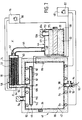
- Figure 7 is a cross-sectional view of a cooking oven according to the invention.
- FIG. 8 is a schematic view of an electrical supply circuit for the baking oven of FIG. 7.
- FIG. 9 is a graph representing the temperature reached by a thermal sensor as a function of the time during which it is respectively subjected to an atmosphere of water vapor, at a given temperature, to an atmosphere of air at the same temperature, and to an atmosphere consisting of a mixture comprising 40% water vapor and 60% air at the same said temperature.
- FIG. 1 represents the temperature reached, as a function of time, by a thermal sensor respectively in contact with an atmosphere of water vapor and an atmosphere of air at the same temperature.
- FIG. 2 represents the temperature reached by a thermal sensor, as a function of the time during which it is respectively in contact with an atmosphere of water vapor and an atmosphere of air, the sensor being placed in an area subjected to thermal losses .
- the applicant has successively put a temperature sensor 5, consisting of a thermocouple, in contact with a water vapor atmosphere at 240 ° C and an air atmosphere at the same temperature, and the temperature variations undergone by the temperature sensor 5 have been shown as a function of time.
- Tc set temperature
- the temperature sensor as shown on the curve A1, takes 15 seconds when it is in contact with the air (the rise time " under air "t a is therefore 15 seconds) and only 10 seconds, as shown on the curve V1, when it is in contact with water vapor (the rise time" under steam "t v is therefore 10 s ), a difference of 5 seconds.
- the sensitivity of the method and of the device can be improved by placing the sensor 5 in a medium traversed by a flow of air and / or steam, subjected to thermal losses.
- the rise time t a in air of the sensor 5 is approximately 75 s while this same rise time t v under steam is no more than 10s.
- This mode of implementation therefore makes it possible to improve particularly efficiently the sensitivity and accuracy of water vapor detection. It can also be seen that the curves obtained at temperatures of 230 ° C and 320 ° C, respectively in air and in water vapor, are very close.
- the applicant has established, under substantially identical conditions, two pairs of curves of the same type, (using two sensors of different types), namely a first pair of curves with an Iron Nickel sensor, respectively in air (curve F a ) and in vapor (F v ) and a second pair of curves with a thermocouple also in air (curve T a ) and under steam (curve T v ), for an air and steam temperature of 135 ° C, close to a set temperature T c of 85 ° C.
- the present invention is used, as shown in FIG. 5, to regulate the flow of steam supplied by a steam generator.
- the steam generator consists of a rectangular enclosure 2, made of a plastic material such as, for example, polypropylene, and has, at its upper part, an orifice 4 closed by a plug allowing the enclosure to be filled with liquid. 2.
- Another orifice 6 is also provided on the upper face of the enclosure 2, and is provided with a flexible pipe 8, for example made of silicone, which allows the water vapor produced by the generator to be evacuated .
- the pipe 8 is interrupted, at a certain distance from the enclosure 2, by a small tee 10, having a lateral opening 12. In the lateral opening 12 of the tee 10, a silicone plug 14 is pressed "by force" so to ensure a perfect seal.
- This plug 14 is pierced, along its longitudinal axis, with a very fine channel, through which is introduced a support wire 16 of a temperature sensor 18.
- This channel compressed when the plug 14 is pressed into the tee 10, does not allow the gases to pass.
- the support wire 16 thus passes through the plug 14, and the temperature sensor 18 is arranged so as to be in the center of the pipe 8, without touching the walls of the latter.
- the temperature sensor 18 used is a thermocouple of the type of which there is shown, in FIG. 2, the curve of variation of the temperature as a function of time in a vapor atmosphere and in an air atmosphere.
- This thermocouple 18 has two respective rise times to reach a set temperature T c of 100 ° C when it is respectively in the presence of steam at 320 ° C and air at the same temperature, namely a first rise time (under vapor) t v equal to approximately 10s and a second rise time (in air) t a equal to approximately 75s.
- the enclosure 2 further comprises an electrical resistance 20, for example of the cartridge type, that is to say constituted by a tubular element of stainless steel inside which is housed an electrical resistance proper, of a power of about 1200 watts, this tubular element being fixed, at its ends, to the two side walls of the enclosure 2, by fixing means not shown in the drawing.
- an electrical resistance 20 for example of the cartridge type, that is to say constituted by a tubular element of stainless steel inside which is housed an electrical resistance proper, of a power of about 1200 watts, this tubular element being fixed, at its ends, to the two side walls of the enclosure 2, by fixing means not shown in the drawing.
- a space 21 is left free between the upper face of the porous body 22, and the upper internal face of the enclosure 2 so as to allow the expansion of the water vapor produced.
- the present device is supplied with electric current by means of an electric control circuit shown in FIG. 6.
- a general switch 28 At the terminals X and Y of the electrical network are successively connected, in series, a general switch 28, a contact 26 associated with the temperature sensor 18, which lets the current flow as long as the threshold temperature is not reached, the resistor 20 and a diode 30 at the terminals C and D of which a switch 32 is mounted in parallel, this switch 32 allowing, when it is open, to allow only half the nominal power of the generator to pass, so as, for example, to slow down the oscillation phases of the sensor 18.
- the steam generator operates as follows: before powering up, the user introduces the liquid to be vaporized into the enclosure 2, through the orifice 4, after having removed the closure cap, until 'that the liquid level is flush with the base of the porous body 22.
- the resistance 20 of the steam generator d water begins to heat the liquid contained by impregnation in the porous body 22.
- the water contained in the porous body 22 surrounding the resistance 20 reaches its boiling point, and begins to produce steam.
- the water vapor produced firstly discharges the air initially present in the enclosure 2 which escapes through the pipe 8.
- the steam generator will have a steam flow rate such that the total evacuation of the air contained in the space 21 of the enclosure 2 is carried out in a time less than the rise time in air t a of the sensor 18, that is to say in the present case less than 75 seconds, in order to prevent the sensor 18 from reaching the set temperature T c before all the air in the enclosure 2 is evacuated, which would stop steam production prematurely.
- a maintenance cycle can then be established, comprising a periodic production of water vapor ensuring a constant filling of water vapor in the enclosure 2.
- the method and the device for detecting water vapor according to the invention can be used with steam generators provided with any heating means and, in particular, with electrodes, between which is placed a compressed porous body containing the liquid to be vaporized and which is supplied with electric current.
- the method and the device for detecting steam are particularly advantageous for ensuring, in a simple, precise and economical manner, the regulation of the flow of water vapor supplying an oven intended for cooking food.
- an oven 40 essentially consists of a cooking enclosure 42, a steam generator 44, arranged outside the enclosure 42, a distribution device 46 steam in the enclosure 42, means 48 for regulating the temperature of the enclosure 42, which can be adjusted using a control 87, a vapor detection device , comprising in particular a temperature sensor 50, and an electrical supply device.
- the cooking chamber 42 of parallelepiped shape, is composed of five flat, metallic faces, constituting the ceiling, the floor, sides and rear, and a frame fitted with a door, not shown in the drawing.
- the cooking chamber 42 has three ports, namely, a steam inlet port 52, an outlet port for the air / steam mixture 54 and a safety port 56 allowing rapid evacuation of the gas in the event of accidental overpressure.
- the steam inlet orifice 52 is, in the present embodiment, connected to the steam generator 44 via a superheater 58
- the latter which is intended to raise the temperature of the water vapor entering the cooking chamber 42 beyond 100 ° C., is essentially composed of a tube 60 of stainless steel, with a longitudinal axis xx ′, which opens, at its opposite ends, onto two tubes of smaller diameter, namely an inlet tube 62 and an outlet tube 64.
- the inlet tube 62 is connected to a flexible pipe 66 connected to an outlet tube 68 of the steam generator 44, so as to allow the admission of water vapor into the superheater 58.
- the outlet tube 64 is connected to the steam intake orifice 52 of the cooking chamber 42.
- a cylindrical mandrel 70 made of refractory ceramic, pierced in the long direction ueur xx ′ of a series of cylindrical channels 72, is disposed inside the tube 60.
- a wire for example of a material sold under the brand "KANTHAL", with a resistivity of about 25 ohms per meter, wound on itself in the manner of a coil spring, is arranged in each seven channels 72 so as to form an electrical resistance 74.
- the ends of this electrical resistance 74 are electrically connected to regulation means 76 ensuring the starting and stopping of the superheater 58, and which are adjustable by means of an order 80.
- a first temperature sensor consisting of a thermocouple 78, is disposed near the steam inlet orifice 52 of the cooking chamber 42. This sensor 78 measures the temperature of the steam leaving the superheater 58 and which is admitted into the enclosure 42. This thermocouple 78 is electrically connected to the regulation means 76, so as to control the operation of the superheater 58, as a function of a chosen temperature displayed by means of a command 80.
- the baking oven according to the invention is provided with two heating resistors in the form of a double U, namely a first resistor 82, suspended under the ceiling of the enclosure 42, the two ends of which include electrical supply connections, leaving the enclosure 42 through orifices provided with sealed passages, not shown in the drawing, this first resistance being able to serve as a grill, when it is brought to a temperature of the order of 500 to 600 ° C., as in traditional air ovens, and a second resistor 84, located under the floor of the cooking chamber 42, against which it is pressed.
- the ends of this heating resistor 84 are electrically connected to the output terminals of the regulation means 48 of the temperature of the enclosure 42.
- a second temperature sensor consisting of a thermocouple 86, is disposed against a lateral face of the cooking enclosure 42 and is electrically connected to the temperature control 48.
- This thermocouple controls the electrical power supplied to the resistor 84 as a function of the difference between the temperature displayed by the control 87 and that measured by the thermocouple 86.
- the cooking enclosure 42 is thermally insulated by the addition of an insulation mat 88, such as silicate alumina.
- thermocouple 50 On the gas outlet orifice 54 a small cylindrical crown 90 is welded, onto which a tee 92 is force-fitted, the lateral connection orifice of this tee 92 being obstructed, in a leaktight manner, by a plug 94 crossed by a wire 95 of the thermocouple 50.
- the latter is disposed substantially in the center of the tee 92, without any contact with the walls of the latter.
- the thermocouple 50 is of the type of which the curve of variation of the temperature as a function of time has been plotted in FIG. 2, respectively under an atmosphere of vapor and under an atmosphere of air.
- This thermocouple 50 has two respective rise times to reach a set temperature T c of 100 ° C when it is respectively placed in the presence of steam at 320 ° C and air at the same temperature, namely a first time of rise (in vapor) t v equal to approximately 10s and a second rise time (in air) t a equal to approximately 75s.
- the gas flow leaving the enclosure 42 thus meets the thermocouple 50 of "full force", which optimizes the response thereof. Because of its mode of fixing inside the tee 92, the sensor 50 is subjected to thermal losses.
- the magnitude of these heat losses can be adjusted so that they are such that when the tee 92 is crossed by air, the sensor 50 cannot reach the set temperature T c , and when this air contains a proportion P c of steam, or critical proportion, the sensor 50 reaches said set temperature.
- T c the set temperature
- the electrical contact 96 associated with the thermocouple 50 is open, which causes the heating resistor 20 of the steam generator to be switched off. 44 as will be described in detail below.
- the Applicant has shown by tests that an opening threshold of the electrical contacts 96 of the thermocouple 50, between 95 ° C and 108 ° C, makes it possible to minimize the amount of water vapor leaving the enclosure 42 during cooking, while ensuring a renewal of the water vapor in the enclosure, and thereby convection, making it possible to obtain cooking times less than those conventionally encountered in traditional ovens.
- the device 46 for distributing the steam arriving in the cooking enclosure 42 is disposed at the outlet of the orifice 52.
- This dispensing device consists of a first metal tube 108 which is fitted, by the 'one of its ends, on the outlet tube 64 of the superheater 58.
- the tube 108 opens at its other end into a second tube 110 which is perpendicular and which is closed at each of its ends.
- This tube 110 has, over its entire length and at its lower part, a series of holes 112. These holes 112, preferably arranged in staggered rows and distributed uniformly over its entire surface, are calibrated so that the water vapor produced is at very slight overpressure in order to easily reach the food placed in the cooking chamber 42.
- the steam generator 44 consists externally of a housing 113, made of plastic material such as polypropylene, and has an interior design similar to that of the generator presented in FIG. 5, that is to say comprising an electrical resistance 20, of cartridge type, with a power of approximately 1250 watts, and of a porous body 22, compressed around this resistance 20, preferably made of quartz wool.
- a bimetallic strip 115 At one end of the resistor 20 is disposed a bimetallic strip 115, the electrical contacts of which are in the closed position, at rest, the said contacts moving to the open position as soon as the temperature exceeds a given threshold of 130 ° C.
- a free space 117 is left between the upper surface of the porous body 22 and the ceiling of the housing 113, so as to allow the expansion of the water vapor produced.
- a circular orifice 104, closed by a unscrewable plug 106, is provided on the upper face of the housing 113 so as to allow the steam generator 44 to be filled with water.
- the electric circuit with which the oven according to the invention is provided and which is partially represented on FIG. 8 essentially comprises two subsets.
- a first sub-assembly which allows the operation of the temperature regulation means 48 and 76 and which, since having no particular characteristic compared to those equipping traditional ovens, will not be described here, and a second sub-assembly, intended for the production and heating of water vapor and for regulating the flow rate of this water vapor.
- This sub-assembly consists of a circuit supplied by the terminals X and Y of the electrical network.
- This circuit comprises, in series, between points C and D, the bimetallic strip 115 for safety and stopping in the event of the absence of water, the thermocouple 86 for warming up the enclosure 42, the contacts 96 of the sensor temperature control 50 for steam flow rate according to the invention, a power diode 116 and the heating resistor 20 of the steam generator 44.
- a power reduction switch 118 is placed in bypass at terminals F and G of the diode 116. When it is desired to reduce the electric power supplied to the resistor 20, the switch 118 is opened, which reduces this power to approximately half of the nominal power, by rectifying every two alternations of the alternating current power supply.
- the resistor 74 of the superheater 58 in series with an adjustment bimetallic strip, is arranged in parallel between the terminals F and D.
- the operation of the oven according to the invention is established as follows. Before the latter is energized, the user fills the porous body 22 of the steam generator 44 with water, the orifice 104, after removing the plug 106, until the water level is flush with the upper surface of the porous body 22. It selects a cooking mode using the temperature control 87 and the control 80 of the temperature of the water vapor entering the enclosure 42, as well as a cooking duration. All these indications can be entered in a programmer, not shown in the drawing, which will also indicate the time of the start of cooking. The food is placed in the cooking enclosure 42 in a conventional manner, after a possible preheating period of the oven.
- the cooking appliance When the user has set a cooking time on the timer, or on the programmer's signal, the cooking appliance is switched on.
- the upper 82 and / or lower 84 heating resistors of the cooking enclosure 42 are supplied with current, according to the selection made, and are controlled by thermostatic regulation, so as to maintain a temperature in the enclosure 42 equal to that indicated on the control device 48.
- the resistor 74 of the superheater 58 is supplied with electric current, the control being carried out by thermostatic regulation, so as to maintain the temperature of the water vapor equal to that indicated on the means 76.
- the bimetallic strip 86 closes, triggering the activation of the resistance 20 of the steam generator 44. This supply of steam makes it possible to fill the '' cooking chamber 42 in steam expelling the air entered during the placement of food therein.
- the temperature sensor 50 does not reach the set temperature T c (here equal to 100 ° C.) and the generator continues to produce steam and to supply it to the cooking chamber 42.
- the gas leaving it is then consisting of water vapor having a rise time t v of 10 seconds and, at the end of this period, brings the temperature sensor 50 to the set temperature T c , which causes the contact 96 to open and cut out of the electrical supply of the heating resistor 20 of the steam generator 44.
- the latter must have a sufficiently large vapor flow so that, between the moment when the air begins to leave the cooking chamber 42 and the moment when all the air is expelled from it, the elapsed time is less than the rise time t a of the temperature sensor 50 in the air (which is, in this case, about 75 seconds), so as to prevent the temperature sensor 50 from reaching the setpoint temperature T c while there is still air in the cooking chamber 42.
- the present invention therefore makes it possible to minimize the consumption of water vapor used, which is advantageous on the one hand in terms of the consumption of water and electricity in the furnace and, on the other hand, in terms of comfort. 'use since the amount of steam released to the cooking place is significantly reduced.
- the present invention makes it possible to ensure, in the cooking chamber, convection movements of water vapor which have the effect of improving the heat exchanges.
- the method and the device according to the invention can also be used for determining the quantity of water vapor contained in a gaseous air / water vapor mixture.
- thermocouple the temperature taken by a temperature sensor, consisting of a thermocouple, has been represented as a function of the time during which it is respectively brought into contact with steam at 135 ° C. (curve V4), with air (curve A4) at 135 ° C and with a mixture consisting of 40% water vapor and 60% air (curve M4) at 135 ° C.
- the time taken by the probe to reach a given set temperature is intermediate between that taken by the probe to reach this same temperature in only steam and only air environments. There is therefore a gradation of this time as a function of the proportion of vapor in the air, and therefore the possibility of measuring this proportion by examining the time taken to reach the set temperature.
Landscapes
- Engineering & Computer Science (AREA)
- Physics & Mathematics (AREA)
- Life Sciences & Earth Sciences (AREA)
- Biochemistry (AREA)
- Sustainable Development (AREA)
- Chemical & Material Sciences (AREA)
- General Health & Medical Sciences (AREA)
- General Physics & Mathematics (AREA)
- Immunology (AREA)
- Pathology (AREA)
- Health & Medical Sciences (AREA)
- Food Science & Technology (AREA)
- Analytical Chemistry (AREA)
- Sustainable Energy (AREA)
- Thermal Sciences (AREA)
- Mechanical Engineering (AREA)
- General Engineering & Computer Science (AREA)
- Investigating Or Analyzing Materials Using Thermal Means (AREA)
- Cookers (AREA)
- Electric Ovens (AREA)
Applications Claiming Priority (2)
| Application Number | Priority Date | Filing Date | Title |
|---|---|---|---|
| FR9109527 | 1991-07-26 | ||
| FR9109527A FR2679657B1 (fr) | 1991-07-26 | 1991-07-26 | Procede et dispositif de detection de vapeur d'eau dans un volume d'air et generateur de vapeur et four de cuisson a la vapeur utilisant ceux-ci. |
Publications (3)
| Publication Number | Publication Date |
|---|---|
| EP0534809A2 true EP0534809A2 (de) | 1993-03-31 |
| EP0534809A3 EP0534809A3 (en) | 1993-04-14 |
| EP0534809B1 EP0534809B1 (de) | 1996-09-25 |
Family
ID=9415609
Family Applications (1)
| Application Number | Title | Priority Date | Filing Date |
|---|---|---|---|
| EP92402143A Expired - Lifetime EP0534809B1 (de) | 1991-07-26 | 1992-07-24 | Verfahren und Vorrichtung zum Nachweis von Wasserdampf in einem Luftvolumen und Dampferzeuger und Dampfofen welche diese benützen |
Country Status (5)
| Country | Link |
|---|---|
| US (1) | US5402709A (de) |
| EP (1) | EP0534809B1 (de) |
| DE (1) | DE69214077T2 (de) |
| ES (1) | ES2095430T3 (de) |
| FR (1) | FR2679657B1 (de) |
Cited By (1)
| Publication number | Priority date | Publication date | Assignee | Title |
|---|---|---|---|---|
| EP2745696A3 (de) * | 2012-12-20 | 2017-01-04 | Miele & Cie. KG | Gargerät und Verfahren zum Betreiben eines Gargerätes |
Families Citing this family (20)
| Publication number | Priority date | Publication date | Assignee | Title |
|---|---|---|---|---|
| US5456164A (en) * | 1995-01-10 | 1995-10-10 | Donghwan Ind. Corp. | Kimchi fermentation or cool storage system using a thermoelectric module |
| DE19741881C2 (de) * | 1997-09-23 | 2002-03-07 | Imp Werke Ohg | Haushaltgerät zum Dampfgaren |
| US20020114507A1 (en) * | 2001-02-21 | 2002-08-22 | Mark Lynch | Saw alignment technique for array device singulation |
| KR20050026604A (ko) * | 2003-09-09 | 2005-03-15 | 삼성전자주식회사 | 과열증기 조리장치 |
| KR20050056052A (ko) * | 2003-12-09 | 2005-06-14 | 삼성전자주식회사 | 증기조리장치 |
| JP3682294B1 (ja) * | 2004-02-27 | 2005-08-10 | シャープ株式会社 | 蒸気調理器 |
| JP3682293B1 (ja) * | 2004-02-27 | 2005-08-10 | シャープ株式会社 | 蒸気調理器 |
| JP3827013B2 (ja) * | 2004-03-19 | 2006-09-27 | シャープ株式会社 | 蒸気調理器 |
| US20060112947A1 (en) * | 2004-11-29 | 2006-06-01 | Atul Saksena | Steam cooker with moving steam delivery member |
| DE102005058592B4 (de) * | 2005-12-07 | 2008-11-06 | Miwe Michael Wenz Gmbh | Dampferzeuger |
| US20070175884A1 (en) * | 2006-01-31 | 2007-08-02 | Atul Saksena | Steam cooker with steam delivery device |
| DE102006014515A1 (de) * | 2006-03-24 | 2007-09-27 | E.G.O. Elektro-Gerätebau GmbH | Verfahren zur Überwachung bzw. Steuerung oder Regelung eines geschlossenen Elektrowärmegerätes |
| EP1855058B1 (de) * | 2006-08-24 | 2017-04-19 | V-Zug AG | Verfahren und Vorrichtung zum Garen von Speisen mit Dampf |
| KR101319874B1 (ko) * | 2006-12-22 | 2013-10-18 | 엘지전자 주식회사 | 건조기의 제어방법 |
| US8859941B2 (en) * | 2010-10-28 | 2014-10-14 | General Electric Company | Surface temperature cooking control |
| US9841261B2 (en) * | 2013-04-29 | 2017-12-12 | Alto-Shaam, Inc. | Combination oven with peak power control |
| US9655468B2 (en) * | 2014-01-10 | 2017-05-23 | 2T2J, Inc. | Apparatus and process for rapidly cooking food |
| KR101741553B1 (ko) * | 2015-08-04 | 2017-06-15 | 엘지전자 주식회사 | 스팀발생장치 및 스팀발생장치의 제어방법 |
| KR102210370B1 (ko) | 2016-06-03 | 2021-02-01 | 삼성전자주식회사 | 오븐 |
| DE102016215650A1 (de) * | 2016-08-19 | 2018-02-22 | BSH Hausgeräte GmbH | Haushaltsgargerät |
Family Cites Families (11)
| Publication number | Priority date | Publication date | Assignee | Title |
|---|---|---|---|---|
| AT251311B (de) * | 1963-05-08 | 1966-12-27 | Vyzk Ustav Energeticky | Verfahren und Vorrichtung zur Bestimmung der Dampffeuchtigkeit |
| US3744474A (en) * | 1971-03-01 | 1973-07-10 | Beatrice Foods Co | Steam cooking apparatus and method |
| JPS5640029A (en) * | 1979-09-07 | 1981-04-16 | Matsushita Electric Ind Co Ltd | Method and apparatus for controlling food heating |
| DE3447296C1 (de) * | 1984-12-24 | 1986-05-07 | Kurt Wolf & Co Kg, 7547 Wildbad | Vorrichtung zum Steuern des Gar- bzw. Kochvorganges in einem Dampfdruckkochgefaess |
| CH670515A5 (de) * | 1985-09-17 | 1989-06-15 | Bbc Brown Boveri & Cie | |
| JPS6258893U (de) * | 1985-09-30 | 1987-04-11 | ||
| GB2207514A (en) * | 1987-06-12 | 1989-02-01 | Flour Milling & Baking Res | Apparatus for measuring atmospheric humidity in ovens |
| FR2629569B1 (fr) * | 1988-03-29 | 1990-08-17 | Armines | Procede et appareil de cuisson ou de rechauffage d'un aliment au moyen de vapeur d'eau |
| US4911357A (en) * | 1988-04-11 | 1990-03-27 | Shibaura Electronics Company, Ltd. | Humidity controller utilizing absolute humidity |
| US5014679A (en) * | 1989-09-18 | 1991-05-14 | Tecogen, Inc. | Gas fired combination convection-steam oven |
| US5038752A (en) * | 1989-10-25 | 1991-08-13 | Bunn-O-Matic Corporation | Boiling water dispenser having improved water temperature control system |
-
1991
- 1991-07-26 FR FR9109527A patent/FR2679657B1/fr not_active Expired - Fee Related
-
1992
- 1992-07-22 US US07/916,687 patent/US5402709A/en not_active Expired - Fee Related
- 1992-07-24 ES ES92402143T patent/ES2095430T3/es not_active Expired - Lifetime
- 1992-07-24 DE DE69214077T patent/DE69214077T2/de not_active Expired - Fee Related
- 1992-07-24 EP EP92402143A patent/EP0534809B1/de not_active Expired - Lifetime
Cited By (1)
| Publication number | Priority date | Publication date | Assignee | Title |
|---|---|---|---|---|
| EP2745696A3 (de) * | 2012-12-20 | 2017-01-04 | Miele & Cie. KG | Gargerät und Verfahren zum Betreiben eines Gargerätes |
Also Published As
| Publication number | Publication date |
|---|---|
| FR2679657A1 (fr) | 1993-01-29 |
| EP0534809B1 (de) | 1996-09-25 |
| EP0534809A3 (en) | 1993-04-14 |
| US5402709A (en) | 1995-04-04 |
| DE69214077D1 (de) | 1996-10-31 |
| DE69214077T2 (de) | 1997-04-17 |
| FR2679657B1 (fr) | 1997-06-20 |
| ES2095430T3 (es) | 1997-02-16 |
Similar Documents
| Publication | Publication Date | Title |
|---|---|---|
| EP0534809B1 (de) | Verfahren und Vorrichtung zum Nachweis von Wasserdampf in einem Luftvolumen und Dampferzeuger und Dampfofen welche diese benützen | |
| EP0843039B1 (de) | Dampferzeuger | |
| EP0772000B1 (de) | Dampferzeuger mit automatischer Speisung und Verfahren zur Messung eines Flüssigkeitsniveaus in einem derartigen Dampferzeuger | |
| EP0348298B1 (de) | Verfahren und Vorrichtung zur thermischen Regulierung eines Heizgerätes und mit dieser Vorrichtung versehenes Heizgerät | |
| RU2675086C2 (ru) | Электронагреваемая система, генерирующая аэрозоль, с торцевым нагревателем | |
| KR102029510B1 (ko) | 향상된 에어로졸 생산을 가진 에어로졸 발생시스템 | |
| EA029524B1 (ru) | Система генерирования аэрозоля, содержащая средство для управления расходом жидкого субстрата | |
| EP0777993B1 (de) | Grillgerät | |
| EP2959793B1 (de) | Dampffrisiergerät mit pumpe mit automatischer einschaltung | |
| EP0453385A1 (de) | Dampferzeuger | |
| EP1681967B1 (de) | Verfahren und dampfgargerät mit einer verbesserten vorrichtung zur wasserzuführung | |
| WO2008023132A2 (fr) | Procede et dispositif pour commander un appareil electrique menager de chauffage de liquide | |
| EP0076759B1 (de) | Vorrichtung zur kontinuierlichen Bestimmung des Heizwertes von Gasen | |
| FR2754348A1 (fr) | Appareil pour la determination du point d'eclair d'un produit | |
| FR2633482A1 (fr) | Recipient culinaire, procede et dispositif de regulation thermique du chauffage de ce recipient | |
| FR2710512A1 (fr) | Ustensile de cuisine à sonde de température. | |
| FR2808579A1 (fr) | Procede de regulation de temperature dans un four vapeur | |
| FR2956300A1 (fr) | Appareil electrique de chauffage d'aliments a la vapeur avec un logement pour un recipient doseur d'eau | |
| FR2758385A1 (fr) | Four bi-energie fonctionnant au gaz ou au fioul et a l'electricite et procede de chauffage de l'enceinte d'un tel four | |
| EP1083389A1 (de) | Verwaltung von Pyrolyse-Zeit | |
| EP2054784A2 (de) | Verfahren und vorrichtung zum steuern eines haushaltgerät zum erwärmen von flüssigkeit | |
| FR2641604A1 (fr) | Appareil de cuisson comportant un bloc de chauffage en matiere minerale | |
| FR2691233A1 (fr) | Générateur de vapeur à réponse instantanée. | |
| WO2001098852A1 (fr) | Procede de regulation de la temperature du reservoir d'un appareil d'epilation a la cire | |
| FR2940981A1 (fr) | Fer a repasser a vapeur comportant un corps chauffant muni d'un insert |
Legal Events
| Date | Code | Title | Description |
|---|---|---|---|
| PUAI | Public reference made under article 153(3) epc to a published international application that has entered the european phase |
Free format text: ORIGINAL CODE: 0009012 |
|
| PUAL | Search report despatched |
Free format text: ORIGINAL CODE: 0009013 |
|
| AK | Designated contracting states |
Kind code of ref document: A2 Designated state(s): DE ES FR GB IT |
|
| AK | Designated contracting states |
Kind code of ref document: A3 Designated state(s): DE ES FR GB IT |
|
| 17P | Request for examination filed |
Effective date: 19930812 |
|
| 17Q | First examination report despatched |
Effective date: 19950920 |
|
| GRAH | Despatch of communication of intention to grant a patent |
Free format text: ORIGINAL CODE: EPIDOS IGRA |
|
| GRAH | Despatch of communication of intention to grant a patent |
Free format text: ORIGINAL CODE: EPIDOS IGRA |
|
| GRAA | (expected) grant |
Free format text: ORIGINAL CODE: 0009210 |
|
| AK | Designated contracting states |
Kind code of ref document: B1 Designated state(s): DE ES FR GB IT |
|
| REF | Corresponds to: |
Ref document number: 69214077 Country of ref document: DE Date of ref document: 19961031 |
|
| ITF | It: translation for a ep patent filed | ||
| GBT | Gb: translation of ep patent filed (gb section 77(6)(a)/1977) |
Effective date: 19961220 |
|
| REG | Reference to a national code |
Ref country code: ES Ref legal event code: FG2A Ref document number: 2095430 Country of ref document: ES Kind code of ref document: T3 |
|
| PG25 | Lapsed in a contracting state [announced via postgrant information from national office to epo] |
Ref country code: GB Free format text: LAPSE BECAUSE OF NON-PAYMENT OF DUE FEES Effective date: 19970724 |
|
| PG25 | Lapsed in a contracting state [announced via postgrant information from national office to epo] |
Ref country code: ES Free format text: LAPSE BECAUSE OF THE APPLICANT RENOUNCES Effective date: 19970726 |
|
| PLBE | No opposition filed within time limit |
Free format text: ORIGINAL CODE: 0009261 |
|
| STAA | Information on the status of an ep patent application or granted ep patent |
Free format text: STATUS: NO OPPOSITION FILED WITHIN TIME LIMIT |
|
| 26N | No opposition filed | ||
| GBPC | Gb: european patent ceased through non-payment of renewal fee |
Effective date: 19970724 |
|
| PG25 | Lapsed in a contracting state [announced via postgrant information from national office to epo] |
Ref country code: FR Free format text: LAPSE BECAUSE OF NON-PAYMENT OF DUE FEES Effective date: 19980331 |
|
| PG25 | Lapsed in a contracting state [announced via postgrant information from national office to epo] |
Ref country code: DE Free format text: LAPSE BECAUSE OF NON-PAYMENT OF DUE FEES Effective date: 19980401 |
|
| REG | Reference to a national code |
Ref country code: FR Ref legal event code: ST |
|
| REG | Reference to a national code |
Ref country code: ES Ref legal event code: FD2A Effective date: 20001009 |
|
| PG25 | Lapsed in a contracting state [announced via postgrant information from national office to epo] |
Ref country code: IT Free format text: LAPSE BECAUSE OF NON-PAYMENT OF DUE FEES;WARNING: LAPSES OF ITALIAN PATENTS WITH EFFECTIVE DATE BEFORE 2007 MAY HAVE OCCURRED AT ANY TIME BEFORE 2007. THE CORRECT EFFECTIVE DATE MAY BE DIFFERENT FROM THE ONE RECORDED. Effective date: 20050724 |