EP0535082B1 - Faser-formende copolyamide und daraus hergestellte fasern - Google Patents
Faser-formende copolyamide und daraus hergestellte fasern Download PDFInfo
- Publication number
- EP0535082B1 EP0535082B1 EP91911671A EP91911671A EP0535082B1 EP 0535082 B1 EP0535082 B1 EP 0535082B1 EP 91911671 A EP91911671 A EP 91911671A EP 91911671 A EP91911671 A EP 91911671A EP 0535082 B1 EP0535082 B1 EP 0535082B1
- Authority
- EP
- European Patent Office
- Prior art keywords
- copolyamide
- nylon
- molecular weight
- fiber
- polymer
- Prior art date
- Legal status (The legal status is an assumption and is not a legal conclusion. Google has not performed a legal analysis and makes no representation as to the accuracy of the status listed.)
- Expired - Lifetime
Links
- 239000000835 fiber Substances 0.000 title claims description 43
- 238000002844 melting Methods 0.000 claims abstract description 12
- 230000008018 melting Effects 0.000 claims abstract description 12
- DJZKNOVUNYPPEE-UHFFFAOYSA-N tetradecane-1,4,11,14-tetracarboxamide Chemical group NC(=O)CCCC(C(N)=O)CCCCCCC(C(N)=O)CCCC(N)=O DJZKNOVUNYPPEE-UHFFFAOYSA-N 0.000 claims abstract description 6
- 229920001577 copolymer Polymers 0.000 claims description 22
- 238000009826 distribution Methods 0.000 claims description 17
- BDAGIHXWWSANSR-UHFFFAOYSA-N methanoic acid Natural products OC=O BDAGIHXWWSANSR-UHFFFAOYSA-N 0.000 claims description 10
- 239000012632 extractable Substances 0.000 claims description 9
- OSWFIVFLDKOXQC-UHFFFAOYSA-N 4-(3-methoxyphenyl)aniline Chemical compound COC1=CC=CC(C=2C=CC(N)=CC=2)=C1 OSWFIVFLDKOXQC-UHFFFAOYSA-N 0.000 claims description 5
- 235000019253 formic acid Nutrition 0.000 claims description 5
- 239000004952 Polyamide Substances 0.000 claims description 4
- GBMDVOWEEQVZKZ-UHFFFAOYSA-N methanol;hydrate Chemical compound O.OC GBMDVOWEEQVZKZ-UHFFFAOYSA-N 0.000 claims description 4
- 229920002647 polyamide Polymers 0.000 claims description 4
- 230000001376 precipitating effect Effects 0.000 claims description 3
- 238000004587 chromatography analysis Methods 0.000 claims description 2
- 229920002302 Nylon 6,6 Polymers 0.000 description 73
- 229920000642 polymer Polymers 0.000 description 43
- 238000000034 method Methods 0.000 description 33
- JZUHIOJYCPIVLQ-UHFFFAOYSA-N 2-methylpentane-1,5-diamine Chemical compound NCC(C)CCCN JZUHIOJYCPIVLQ-UHFFFAOYSA-N 0.000 description 20
- 238000004043 dyeing Methods 0.000 description 20
- 230000008569 process Effects 0.000 description 18
- 238000009987 spinning Methods 0.000 description 18
- XLYOFNOQVPJJNP-UHFFFAOYSA-N water Substances O XLYOFNOQVPJJNP-UHFFFAOYSA-N 0.000 description 16
- 239000000975 dye Substances 0.000 description 15
- 239000000243 solution Substances 0.000 description 15
- WNLRTRBMVRJNCN-UHFFFAOYSA-N adipic acid Chemical compound OC(=O)CCCCC(O)=O WNLRTRBMVRJNCN-UHFFFAOYSA-N 0.000 description 14
- 229920001778 nylon Polymers 0.000 description 14
- IJGRMHOSHXDMSA-UHFFFAOYSA-N Atomic nitrogen Chemical compound N#N IJGRMHOSHXDMSA-UHFFFAOYSA-N 0.000 description 12
- 239000004677 Nylon Substances 0.000 description 12
- NAQMVNRVTILPCV-UHFFFAOYSA-N hexane-1,6-diamine Chemical compound NCCCCCCN NAQMVNRVTILPCV-UHFFFAOYSA-N 0.000 description 12
- 239000000178 monomer Substances 0.000 description 12
- 239000004682 Homopolymer nylon Substances 0.000 description 11
- VLKZOEOYAKHREP-UHFFFAOYSA-N n-Hexane Chemical compound CCCCCC VLKZOEOYAKHREP-UHFFFAOYSA-N 0.000 description 9
- 239000012266 salt solution Substances 0.000 description 9
- GWEVSGVZZGPLCZ-UHFFFAOYSA-N Titan oxide Chemical compound O=[Ti]=O GWEVSGVZZGPLCZ-UHFFFAOYSA-N 0.000 description 8
- 238000005227 gel permeation chromatography Methods 0.000 description 8
- 239000001361 adipic acid Substances 0.000 description 7
- 235000011037 adipic acid Nutrition 0.000 description 7
- 150000001412 amines Chemical class 0.000 description 7
- 229920001519 homopolymer Polymers 0.000 description 7
- 150000003839 salts Chemical class 0.000 description 7
- QGZKDVFQNNGYKY-UHFFFAOYSA-N Ammonia Chemical compound N QGZKDVFQNNGYKY-UHFFFAOYSA-N 0.000 description 6
- 230000003247 decreasing effect Effects 0.000 description 6
- 229910052757 nitrogen Inorganic materials 0.000 description 6
- 239000012071 phase Substances 0.000 description 6
- 238000006116 polymerization reaction Methods 0.000 description 6
- MHCVCKDNQYMGEX-UHFFFAOYSA-N 1,1'-biphenyl;phenoxybenzene Chemical compound C1=CC=CC=C1C1=CC=CC=C1.C=1C=CC=CC=1OC1=CC=CC=C1 MHCVCKDNQYMGEX-UHFFFAOYSA-N 0.000 description 5
- 229920002292 Nylon 6 Polymers 0.000 description 5
- 239000003054 catalyst Substances 0.000 description 5
- 230000007423 decrease Effects 0.000 description 5
- 238000004519 manufacturing process Methods 0.000 description 5
- 238000002074 melt spinning Methods 0.000 description 5
- 239000000203 mixture Substances 0.000 description 5
- -1 poly(hexamethylene adipamide) Polymers 0.000 description 5
- 238000012546 transfer Methods 0.000 description 5
- IAYPIBMASNFSPL-UHFFFAOYSA-N Ethylene oxide Chemical compound C1CO1 IAYPIBMASNFSPL-UHFFFAOYSA-N 0.000 description 4
- 230000008901 benefit Effects 0.000 description 4
- JBKVHLHDHHXQEQ-UHFFFAOYSA-N epsilon-caprolactam Chemical compound O=C1CCCCCN1 JBKVHLHDHHXQEQ-UHFFFAOYSA-N 0.000 description 4
- 239000000463 material Substances 0.000 description 4
- 238000010998 test method Methods 0.000 description 4
- 239000004753 textile Substances 0.000 description 4
- BYEAHWXPCBROCE-UHFFFAOYSA-N 1,1,1,3,3,3-hexafluoropropan-2-ol Chemical compound FC(F)(F)C(O)C(F)(F)F BYEAHWXPCBROCE-UHFFFAOYSA-N 0.000 description 3
- QTBSBXVTEAMEQO-UHFFFAOYSA-N Acetic acid Chemical compound CC(O)=O QTBSBXVTEAMEQO-UHFFFAOYSA-N 0.000 description 3
- WEVYAHXRMPXWCK-UHFFFAOYSA-N Acetonitrile Chemical compound CC#N WEVYAHXRMPXWCK-UHFFFAOYSA-N 0.000 description 3
- 229920000393 Nylon 6/6T Polymers 0.000 description 3
- HEMHJVSKTPXQMS-UHFFFAOYSA-M Sodium hydroxide Chemical compound [OH-].[Na+] HEMHJVSKTPXQMS-UHFFFAOYSA-M 0.000 description 3
- 238000009825 accumulation Methods 0.000 description 3
- 239000000980 acid dye Substances 0.000 description 3
- 150000001278 adipic acid derivatives Chemical class 0.000 description 3
- 229910021529 ammonia Inorganic materials 0.000 description 3
- 230000008859 change Effects 0.000 description 3
- 238000001816 cooling Methods 0.000 description 3
- 238000002425 crystallisation Methods 0.000 description 3
- 230000008025 crystallization Effects 0.000 description 3
- 239000004744 fabric Substances 0.000 description 3
- 238000001879 gelation Methods 0.000 description 3
- 238000010438 heat treatment Methods 0.000 description 3
- 239000007788 liquid Substances 0.000 description 3
- 239000000047 product Substances 0.000 description 3
- 238000010926 purge Methods 0.000 description 3
- 239000007790 solid phase Substances 0.000 description 3
- HRNGDAQBEIFYGL-UHFFFAOYSA-N 3,4-dihydroxy-4-tetradeca-3,6-dienoyloxybutanoic acid Chemical compound CCCCCCCC=CCC=CCC(=O)OC(O)C(O)CC(O)=O HRNGDAQBEIFYGL-UHFFFAOYSA-N 0.000 description 2
- VEXZGXHMUGYJMC-UHFFFAOYSA-N Hydrochloric acid Chemical compound Cl VEXZGXHMUGYJMC-UHFFFAOYSA-N 0.000 description 2
- DGAQECJNVWCQMB-PUAWFVPOSA-M Ilexoside XXIX Chemical compound C[C@@H]1CC[C@@]2(CC[C@@]3(C(=CC[C@H]4[C@]3(CC[C@@H]5[C@@]4(CC[C@@H](C5(C)C)OS(=O)(=O)[O-])C)C)[C@@H]2[C@]1(C)O)C)C(=O)O[C@H]6[C@@H]([C@H]([C@@H]([C@H](O6)CO)O)O)O.[Na+] DGAQECJNVWCQMB-PUAWFVPOSA-M 0.000 description 2
- IMNFDUFMRHMDMM-UHFFFAOYSA-N N-Heptane Chemical compound CCCCCCC IMNFDUFMRHMDMM-UHFFFAOYSA-N 0.000 description 2
- 229920000577 Nylon 6/66 Polymers 0.000 description 2
- NBIIXXVUZAFLBC-UHFFFAOYSA-N Phosphoric acid Chemical compound OP(O)(O)=O NBIIXXVUZAFLBC-UHFFFAOYSA-N 0.000 description 2
- DBMJMQXJHONAFJ-UHFFFAOYSA-M Sodium laurylsulphate Chemical compound [Na+].CCCCCCCCCCCCOS([O-])(=O)=O DBMJMQXJHONAFJ-UHFFFAOYSA-M 0.000 description 2
- QAOWNCQODCNURD-UHFFFAOYSA-L Sulfate Chemical compound [O-]S([O-])(=O)=O QAOWNCQODCNURD-UHFFFAOYSA-L 0.000 description 2
- 239000004957 Zytel Substances 0.000 description 2
- 229920006102 Zytel® Polymers 0.000 description 2
- TZYHIGCKINZLPD-UHFFFAOYSA-N azepan-2-one;hexane-1,6-diamine;hexanedioic acid Chemical compound NCCCCCCN.O=C1CCCCCN1.OC(=O)CCCCC(O)=O TZYHIGCKINZLPD-UHFFFAOYSA-N 0.000 description 2
- 238000006243 chemical reaction Methods 0.000 description 2
- 230000002860 competitive effect Effects 0.000 description 2
- 238000010411 cooking Methods 0.000 description 2
- 239000013078 crystal Substances 0.000 description 2
- 238000001739 density measurement Methods 0.000 description 2
- 239000003599 detergent Substances 0.000 description 2
- 150000004985 diamines Chemical class 0.000 description 2
- 238000001704 evaporation Methods 0.000 description 2
- 230000008020 evaporation Effects 0.000 description 2
- 239000011261 inert gas Substances 0.000 description 2
- 239000013627 low molecular weight specie Substances 0.000 description 2
- FLFJVPPJGJSHMF-UHFFFAOYSA-L manganese hypophosphite Chemical compound [Mn+2].[O-]P=O.[O-]P=O FLFJVPPJGJSHMF-UHFFFAOYSA-L 0.000 description 2
- 238000005259 measurement Methods 0.000 description 2
- 239000000155 melt Substances 0.000 description 2
- 229910052751 metal Inorganic materials 0.000 description 2
- 239000002184 metal Substances 0.000 description 2
- 239000012299 nitrogen atmosphere Substances 0.000 description 2
- MLCHBQKMVKNBOV-UHFFFAOYSA-N phenylphosphinic acid Chemical compound OP(=O)C1=CC=CC=C1 MLCHBQKMVKNBOV-UHFFFAOYSA-N 0.000 description 2
- 238000002360 preparation method Methods 0.000 description 2
- 238000012545 processing Methods 0.000 description 2
- 238000010791 quenching Methods 0.000 description 2
- 229910052708 sodium Inorganic materials 0.000 description 2
- 239000011734 sodium Substances 0.000 description 2
- 239000001488 sodium phosphate Substances 0.000 description 2
- 239000006228 supernatant Substances 0.000 description 2
- VZGDMQKNWNREIO-UHFFFAOYSA-N tetrachloromethane Chemical compound ClC(Cl)(Cl)Cl VZGDMQKNWNREIO-UHFFFAOYSA-N 0.000 description 2
- 239000004408 titanium dioxide Substances 0.000 description 2
- 238000003809 water extraction Methods 0.000 description 2
- 238000004383 yellowing Methods 0.000 description 2
- POAOYUHQDCAZBD-UHFFFAOYSA-N 2-butoxyethanol Chemical compound CCCCOCCO POAOYUHQDCAZBD-UHFFFAOYSA-N 0.000 description 1
- UFFRSDWQMJYQNE-UHFFFAOYSA-N 6-azaniumylhexylazanium;hexanedioate Chemical compound [NH3+]CCCCCC[NH3+].[O-]C(=O)CCCCC([O-])=O UFFRSDWQMJYQNE-UHFFFAOYSA-N 0.000 description 1
- APMIEVNFDISLBO-UHFFFAOYSA-N C(CCCCC(=O)[O-])(=O)[O-].C(CCCCC(=O)[O-])(=O)[O-].[NH3+]CCCCCC[NH3+].C(CCCCC[NH3+])[NH3+] Chemical compound C(CCCCC(=O)[O-])(=O)[O-].C(CCCCC(=O)[O-])(=O)[O-].[NH3+]CCCCCC[NH3+].C(CCCCC[NH3+])[NH3+] APMIEVNFDISLBO-UHFFFAOYSA-N 0.000 description 1
- OKTJSMMVPCPJKN-UHFFFAOYSA-N Carbon Chemical compound [C] OKTJSMMVPCPJKN-UHFFFAOYSA-N 0.000 description 1
- LFQSCWFLJHTTHZ-UHFFFAOYSA-N Ethanol Chemical compound CCO LFQSCWFLJHTTHZ-UHFFFAOYSA-N 0.000 description 1
- OWYWGLHRNBIFJP-UHFFFAOYSA-N Ipazine Chemical compound CCN(CC)C1=NC(Cl)=NC(NC(C)C)=N1 OWYWGLHRNBIFJP-UHFFFAOYSA-N 0.000 description 1
- 238000002441 X-ray diffraction Methods 0.000 description 1
- 239000002253 acid Substances 0.000 description 1
- 150000007513 acids Chemical class 0.000 description 1
- 239000000654 additive Substances 0.000 description 1
- 230000032683 aging Effects 0.000 description 1
- 125000001931 aliphatic group Chemical group 0.000 description 1
- 229910052782 aluminium Inorganic materials 0.000 description 1
- XAGFODPZIPBFFR-UHFFFAOYSA-N aluminium Chemical compound [Al] XAGFODPZIPBFFR-UHFFFAOYSA-N 0.000 description 1
- 229910000147 aluminium phosphate Inorganic materials 0.000 description 1
- BFNBIHQBYMNNAN-UHFFFAOYSA-N ammonium sulfate Chemical compound N.N.OS(O)(=O)=O BFNBIHQBYMNNAN-UHFFFAOYSA-N 0.000 description 1
- 229910052921 ammonium sulfate Inorganic materials 0.000 description 1
- 235000011130 ammonium sulphate Nutrition 0.000 description 1
- 238000004458 analytical method Methods 0.000 description 1
- 239000003963 antioxidant agent Substances 0.000 description 1
- 239000012298 atmosphere Substances 0.000 description 1
- 230000002902 bimodal effect Effects 0.000 description 1
- 239000002775 capsule Substances 0.000 description 1
- 229910052799 carbon Inorganic materials 0.000 description 1
- 125000003178 carboxy group Chemical group [H]OC(*)=O 0.000 description 1
- 238000005266 casting Methods 0.000 description 1
- 239000003518 caustics Substances 0.000 description 1
- 238000004140 cleaning Methods 0.000 description 1
- 230000001143 conditioned effect Effects 0.000 description 1
- 230000003750 conditioning effect Effects 0.000 description 1
- 238000002788 crimping Methods 0.000 description 1
- 229920006037 cross link polymer Polymers 0.000 description 1
- 230000001186 cumulative effect Effects 0.000 description 1
- 125000004122 cyclic group Chemical group 0.000 description 1
- 230000001419 dependent effect Effects 0.000 description 1
- 239000004205 dimethyl polysiloxane Substances 0.000 description 1
- 235000013870 dimethyl polysiloxane Nutrition 0.000 description 1
- 230000000694 effects Effects 0.000 description 1
- 238000007380 fibre production Methods 0.000 description 1
- 238000001914 filtration Methods 0.000 description 1
- 239000006260 foam Substances 0.000 description 1
- 238000005187 foaming Methods 0.000 description 1
- 239000007789 gas Substances 0.000 description 1
- 238000004817 gas chromatography Methods 0.000 description 1
- 239000011521 glass Substances 0.000 description 1
- 238000009998 heat setting Methods 0.000 description 1
- WBNPOFYHFNHGNG-UHFFFAOYSA-N hexanedioic acid;2-methylpentane-1,5-diamine Chemical compound NCC(C)CCCN.OC(=O)CCCCC(O)=O WBNPOFYHFNHGNG-UHFFFAOYSA-N 0.000 description 1
- 239000001257 hydrogen Substances 0.000 description 1
- 229910052739 hydrogen Inorganic materials 0.000 description 1
- 238000005286 illumination Methods 0.000 description 1
- 230000006872 improvement Effects 0.000 description 1
- 239000003317 industrial substance Substances 0.000 description 1
- 230000000670 limiting effect Effects 0.000 description 1
- 238000004811 liquid chromatography Methods 0.000 description 1
- 238000012423 maintenance Methods 0.000 description 1
- 238000002156 mixing Methods 0.000 description 1
- 239000003607 modifier Substances 0.000 description 1
- 229910000403 monosodium phosphate Inorganic materials 0.000 description 1
- 235000019799 monosodium phosphate Nutrition 0.000 description 1
- 238000006386 neutralization reaction Methods 0.000 description 1
- QJGQUHMNIGDVPM-UHFFFAOYSA-N nitrogen group Chemical group [N] QJGQUHMNIGDVPM-UHFFFAOYSA-N 0.000 description 1
- 230000003287 optical effect Effects 0.000 description 1
- 239000000049 pigment Substances 0.000 description 1
- 238000011020 pilot scale process Methods 0.000 description 1
- 229920000435 poly(dimethylsiloxane) Polymers 0.000 description 1
- 238000012643 polycondensation polymerization Methods 0.000 description 1
- 229920000570 polyether Polymers 0.000 description 1
- 230000000379 polymerizing effect Effects 0.000 description 1
- 239000002244 precipitate Substances 0.000 description 1
- 230000002035 prolonged effect Effects 0.000 description 1
- 238000000425 proton nuclear magnetic resonance spectrum Methods 0.000 description 1
- 230000009467 reduction Effects 0.000 description 1
- 230000002829 reductive effect Effects 0.000 description 1
- 230000004044 response Effects 0.000 description 1
- 239000003340 retarding agent Substances 0.000 description 1
- AJPJDKMHJJGVTQ-UHFFFAOYSA-M sodium dihydrogen phosphate Chemical compound [Na+].OP(O)([O-])=O AJPJDKMHJJGVTQ-UHFFFAOYSA-M 0.000 description 1
- UYCAUPASBSROMS-AWQJXPNKSA-M sodium;2,2,2-trifluoroacetate Chemical compound [Na+].[O-][13C](=O)[13C](F)(F)F UYCAUPASBSROMS-AWQJXPNKSA-M 0.000 description 1
- 239000007787 solid Substances 0.000 description 1
- 239000007921 spray Substances 0.000 description 1
- RYFMWSXOAZQYPI-UHFFFAOYSA-K trisodium phosphate Chemical compound [Na+].[Na+].[Na+].[O-]P([O-])([O-])=O RYFMWSXOAZQYPI-UHFFFAOYSA-K 0.000 description 1
- 229910000406 trisodium phosphate Inorganic materials 0.000 description 1
- 235000019801 trisodium phosphate Nutrition 0.000 description 1
- 238000013022 venting Methods 0.000 description 1
- 239000003643 water by type Substances 0.000 description 1
- 239000002759 woven fabric Substances 0.000 description 1
Images



Classifications
-
- C—CHEMISTRY; METALLURGY
- C08—ORGANIC MACROMOLECULAR COMPOUNDS; THEIR PREPARATION OR CHEMICAL WORKING-UP; COMPOSITIONS BASED THEREON
- C08G—MACROMOLECULAR COMPOUNDS OBTAINED OTHERWISE THAN BY REACTIONS ONLY INVOLVING UNSATURATED CARBON-TO-CARBON BONDS
- C08G69/00—Macromolecular compounds obtained by reactions forming a carboxylic amide link in the main chain of the macromolecule
- C08G69/02—Polyamides derived from amino-carboxylic acids or from polyamines and polycarboxylic acids
- C08G69/26—Polyamides derived from amino-carboxylic acids or from polyamines and polycarboxylic acids derived from polyamines and polycarboxylic acids
- C08G69/265—Polyamides derived from amino-carboxylic acids or from polyamines and polycarboxylic acids derived from polyamines and polycarboxylic acids from at least two different diamines or at least two different dicarboxylic acids
Definitions
- the present invention relates to fiber-forming polymers and more particularly to a fiber-forming copolyamide having hexamethylene adipamide units and a minor portion of 2-methyl-pentamethylene adipamide units and fibers produced therefrom.
- Nylon yarns are used in a wide variety of knit and woven fabrics for upholstery, swimwear, lingerie, hosiery and outerwear and in yarns used for carpeting. Most nylon yarns are spun from one of the two commonly used nylon polymers, poly(hexamethylene adipamide), referred to as nylon 66 and poly( ⁇ -caproamide) referred to as nylon 6. While both polymers can be used for most types of textile yarns, the choice of either nylon 66 or nylon 6 is known to impart advantageous or disadvantageous properties to the yarns depending on the end use. However, for most nylon producers, it is not economically feasible to include products made from both types of polymer in their product line to accommodate end use needs.
- nylon 66 has a number of inherent advantages, nylon 66 producers recognize that nylon 66 is not as readily dyeable as nylon 6, especially with large bulky dye molecules such as those of pre-metalized and non-leveling acid dye classes.
- the salt used to make nylon 66 hexamethylene diammonium diadipate, has been copolymerized with 0.2 to 5% of ⁇ -aminocarboxylic acids having 4 or about 6-12 carbon such as ⁇ -caprolactam as disclosed in U.S. Patent Nos. 3,707,522 so that the resulting copolymer is primarily nylon 66 with some other monomer such as ⁇ -caproamide (6 nylon) monomer.
- the copolyamide containing ⁇ -caproamide will be referred to hereinafter as nylon 66/6.
- nylon 66/6 fibers contains unreacted ⁇ -caprolactam monomer and some cyclic oligomer. Without water extraction of the polymer, prolonged spinning of nylon 66/6 with as little as 1.5% ⁇ -caproamide produces monomer and oligomer which sublime onto the face of the spinneret requiring it to be wiped frequently. Consequently, continuity of the spinning is disrupted for "wiping" and the size of the yarn packages may be limited. Also, in feed yarns for texturing containing nylon 66/6, or in high RV, high speed spun yarns containing either homopolymer nylon 66 or nylon 66/6, monomer and oligomers continue to migrate from the interior to the surface of the yarn over time.
- nylon 66/6 fibers do not crystallize as readily as the homopolymer nylon 66, and as a result, are more difficult to stabilize in a fabric during heat setting.
- a fiber-forming copolyamide consisting essentially of between 60 and 99.5 mole % hexamethylene adipamide units and between 0.5 and 40 mole percent 2-methyl-pentamethylene adipamide units, the copolyamide having an RV greater than 25, and a melting point of greater than 220°C.
- the copolyamide of the invention will be referred to as nylon 66/Me5-6.
- the RV of the copolyamide is between 30 and 80, most preferably between 30 and 60.
- the copolyamide has a molecular weight distribution in which less than 10% of the copolyamide comprises copolymer having a molecular weight of less than 10,000.
- copolyamide of the invention in fibers provides deep dyeability with large or bulky dye molecules such as those of the pre-metalized and non-leveling acid dye classes. Dyeability is equivalent to that obtainable to nylon 6 fiber.
- Copolyamides of nylon 66/Me5-6 in accordance with the invention provide good melt spinning performance with low deposits on the spinneret face when the polymer is spun directly without water extraction.
- very low deposits, if any, are deposited by the fiber on processing equipment such as in texturing processes and the amount of deposits does not change with the age of the yarn.
- the molten copolyamide of the invention forms gel much less readily than homopolymer nylon 66 and provides increases in spinning process continuity and decreases in equipment maintenance costs.
- the fibers of the copolyamide of the invention offer a range of boil-off shrinkage levels including a high shrinkage level as is desired for some applications.
- High shrinkage levels equivalent to those obtainable from nylon 6 fibers can be provided by the copolyamides in accordance with the invention.
- High moisture gain yarns can also be provided.
- the copolyamide of the invention provides yarns with low draw tensions and high elongations at low RV levels.
- the copolyamide can provide equivalent draw-texturing performance in draw-texturing feed yarns without the deposits which are associated with fibers of high RV nylon 66.
- novel high shrinkage, draw-textured yarns can be provided using the copolyamide in accordance with the invention.
- FIGURE 1 is a graphical representation of the molecular weight distributions observed by gel permeation chromatography of nylon 66 homopolymer and nylon 66/6 copolyamides containing two levels of ⁇ -caproamide.
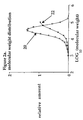
- FIGURES 2a and 2b are graphical representation of the molecular weight distributions observed by gel permeation chromatography of a copolyamide in accordance with the invention compared with a nylon 6/66 copolyamide, respectively, showing the percentage of the copolymer fraction having a molecular weight distribution of less than 10,000.
- FIGURES 3 and 4 are graphical representations of gelation time for copolyamides in accordance with the invention at 292°C and 281°C, respectively.
- the fiber-forming copolyamides of the invention are substantially linear copolyamides which consist essentially of between 60 and 99.5 mole % hexamethylene adipamide units and between 0.5 and 40 mole percent 2-methyl-pentamethylene adipamide (Me5-6) units. In the preferred copolyamides, the Me5-6 units are generally randomly distributed throughout the copolymer.
- the copolyamide has properties similar to homopolymer nylon 66 but with significant process advantages in fiber production and advantages in end use as will become more apparent hereinafter.
- copolyamides of the invention it is advantageous to employ varying mole percentages of Me5-6 in the copolyamide.
- quantities as low as 0.5%, but generally not more than 10% to avoid affecting other properties in the fiber are effective. It is preferred to use at least 1.5% to improve dyeability.
- a higher percentage of Me5-6 in the copolyamide is desirable, e.g., such as between 35 and 40%.
- the copolyamides in accordance with the invention have a formic acid relative viscosity (RV) greater than 25 and are useful for the manufacture of fibers by melt spinning.
- RV formic acid relative viscosity
- an RV of between 30 and 80 is preferred, most preferably between 30 and 60 for textile fiber uses.
- the melting point of copolyamides in accordance with the invention is greater than 220°C.
- the melting points of the copolyamides vary with the percentage of Me5-6 and thus range very close to the melting point of homopolymer nylon 66 polymer, about 265°C, where the percentage of Me5-6 is about 0.5%. With increasing Me5-6, the melting point decreases to 220°C where the Me5-6 percentage is 40%.
- the molecular weight distribution of preferred copolyamides determined by gel permeation chromatography is such that there is substantially less low molecular weight material in the preferred copolyamides of the invention than in homopolymer nylon 66.
- less than 10% by weight of copolyamide is made up of polymer having a molecular weight of less than 10,000. This can be up to 43% less low molecular weight fraction (molecular weight less than 10,000) than homopolymer nylon 66 at an equivalent RV.
- Figure 1 illustrates GPC determined molecular weight distributions of homopolymer nylon 66 and two nylon 66/6 copolymers.
- the molecular weight distribution identified by the numeral 10 in Figure 1 is a standard sample of nylon 66 homopolymer (ZYTEL R 101), 12 is a molecular weight distribution for a sample of nylon 66/6 with 5% ⁇ -caproamide units and 14 is a molecular weight distribution for another nylon 66/6 with 1.5% ⁇ -caproamide units.
- Figure 1 illustrates that nylon 66 homopolymer and nylon 66/6 copolymers exhibit a "tail" of low molecular weight species (e.g. less than 10,000). Figure 1 shows that this bimodal distribution of molecular weight in these samples is readily detectable.
- Figure 2a and 2b illustrate molecular weight distributions for a nylon 66/Me5-6 and a nylon 66 homopolymer, respectively.
- the molecular weight distribution (20) for a 35% Me5-6 containing copolymer shows a fraction of low molecular weight species up to 10,000 of 8%, based on the integral 22 of curve 20.
- the homopolymer in Figure 2b. shows a fraction of species up to 10,000 equal to 14% of the total area, based on the integral 26.
- the copolyamides of the invention also have low levels of "extractable oligomer,” i.e., low levels of polymer having a low molecular weight of less than 500 as shown in the following table.
- "extractable oligomer” i.e., low levels of polymer having a low molecular weight of less than 500 as shown in the following table.
- less than 60% of "extractables” have a molecular weight of less than 500 as observed by that GPC.
- “Extractables” as used in this application refers to the material contained in the supernatant liquid after dissolving the copolymer in formic acid and precipitating with 5:l methanol-water.
- the copolyamides of the invention have also been found to form "gel” at a substantially lower rate than nylon 66 homopolymer.
- Gel refers to the very high molecular weight, cross-linked polymer which forms in the nylon 66 polymer melt and which collects in the transfer line, the spinneret pack filter and other areas in contact with the molten polymer before spinning.
- the gel is essentially insoluble and often can only be removed from equipment using extreme measures such as by burning off of the gel.
- the gelation time the time required to show an inflection in melt viscosity behavior of a polymer sample maintained at a constant temperature, increases significantly, and in a nearly linear fashion with increasing percentages of Me5-6.
- the melting point of the copolyamide is lower and is substantially lower at high Me5-6 mole percentages, the gelation time can be further increased by employing lower polymer melt temperatures without affecting spinning performance.
- the rate of crystallization of the copolymer of the invention is lower than in homopolymer nylon 66 and is dependent on the mole % Me5-6 in the copolyamide.
- the amount of spherulites formed in fibers is also lower.
- the polyamide is useful for high quality ultra-fine denier nylon fiber and can provide fibers with improved optical clarity.
- the copolyamides of the invention can be prepared by condensation polymerization in an aqueous "salt" solution formed by mixing adipic acid with hexamethylene diamine (HMD) and 2-methyl-pentamethylene diamine (MPMD) in the molar proportions necessary to produce the copolymer with the desired mole percent Me5-6 units.
- HMD hexamethylene diamine
- MPMD 2-methyl-pentamethylene diamine
- Procedures useful for the production of homopolymer poly(hexamethylene adipamide) can be applied to the production of the copolymer of the invention. It is generally necessary, however, to modify such procedures to make sure that the MPMD, which is more volatile, stays in solution sufficiently long to react.
- 2-methyl-pentamethylene diamine is commercially available and is sold by E. I. du Pont de Nemours & Co., Wilmington, Delaware, under the trademark DYTEK A R .
- a particularly convenient method for making a copolyamide in accordance with the invention is to provide two aqueous salt solutions of hexamethylene diammonium adipate and 2-methyl-pentamethylene diammonium adipate. Necessary quantities of the two solutions can be readily mixed to produce a salt solution for the desired copolyamide. It has been found that it is advantageous to employ salt solutions in which the pH of the solution is about 1 pH unit above the neutralization pH which assists in keeping the MPMD in solution.
- catalysts are known for use in polymerizing homopolymer nylon 66 such as phenyl phosphinic acid, manganese hypophosphite, etc., and these have been found to be useful in the polymerization of copolymers of the invention.
- the salt solution with catalyst is reacted in a suitable reaction vessel such as an autoclave under an inert atmosphere.
- a suitable reaction vessel such as an autoclave under an inert atmosphere.
- One preferred procedure which has been found to keep the volatile MPMD in solution includes purging the autoclave with nitrogen and increasing the pressure to 2067 kPa (300 psi).
- the salt solution is heated to a temperature between 175°C and 200°C for a sufficient time that the oligomers incorporating the MPMD are formed, typically an hour.
- the temperature is then increased to between 250°C and about 275°C which is somewhat lower than that typically used for nylon 66.
- the pressure is then released over, for example, 1 hour to bleed off steam and approximately the same temperature is maintained while purging with nitrogen for sufficient time to complete the reaction to the extent desired.
- the copolyamide is extruded from the autoclave into water and conveniently chipped and dried to produce flake.
- the RV of the polymer from the clave can be
- copolyamide in accordance with the invention can also be made by any of a variety of continuous polymerization processes.
- the polymer flake is useful in the spinning of fibers which can be spun using a wide variety known melt spinning techniques.
- the copolyamide is particularly useful in high speed spinning techniques to obtain high quality feed yarns for use in draw texturing and for warp-drawing.
- High speed spun draw-texturing feed yarns can be spun in a process such as that disclosed in U.S. Reissue 33,059.
- Me5-6 is capable of hydrogen bonding with the nylon 66 polymer and thus the nylon 66/Me5-6 copolyamide has a modified hydrogen-bonded structure which provides lower draw tension yarns spun at high spinning speeds, e.g., greater than about 4500 mpm.
- the lower draw tensions can be provided at lower RV levels which decreases the amount of deposits which form when high RV nylon 66 polymer is used for draw-texturing feed yarns.
- melt spun fibers from a number of spinning positions are converged into a 660,000-935,000 dtex (600,000-850,000 denier) tow line which is then drawn, crimped, cut at the appropriate cut length and baled in separate operations.
- a high shrinkage (25-30%) Me-5-6/66 (40%/60%) staple can be prepared in this manner.
- the staple can be converted to yarn in 100% form and used to create high-low pile texture effects when woven adjacent to ends of standard nylon in piece-dyed velour upholstery fabrics.
- Blends of the high shrinkage Me5-6 66 fiber with the standard nylon e.g. 50/50 blend
- the RV of the copolyamide flake can be increased by conventional solid phase polymerization (by removing water under controlled temperature and inert gaseous conditions).
- the RV may also be increased as the polymer is melted in an extruder such as before melt spinning of fiber, if desired, by venting off water or by introducing flake from solid phase polymerization which has less than the equilibrium moisture at the given melt temperature.
- water can be added during solid phase polymerization to decrease RV if desired.
- any of a variety of known additives such as delustrants, e.g., titanium dioxide, antioxidants, pigments, and other materials may be added to the copolyamide at a suitable point in the polymer preparation or, for example, as the flake is melted in an extruder in advance of spinning.
- delustrants e.g., titanium dioxide, antioxidants, pigments, and other materials
- the formic acid relative viscosity (RV) of the polyamide is measured as described at col. 2, 1. 42-51, in Jennings, U.S. Patent No. 4,702,875.
- the amount of Me5-6 is determined by heating two grams of the polymer in flake, film, fiber, or other form (surface materials such as finishes being removed) at 100°C overnight in a solution containing 20 mls of concentrated hydrochloric acid and 5 mls of water. The solution is then cooled to room temperature, adipic acid precipitates out and may be removed. (If any TiO2 is present it should be removed by filtering or centrifuging.) One ml of this solution is neutralized with one ml of 33% sodium hydroxide in water. One ml of acetonitrile is added to the neutralized solution and the mixture is shaken. Two phases form. The diamines (MPMD AND HMD) are in the upper phase.
- One microliter of this upper phase is analyzed by Gas Chromatography such as a capillary Gas Chromatograph having a 30 meter DB-5 column (95% dimethylpolysiloxane/5% diphenylpolysiloxane) is used although other columns and supports are suitable for this measurement.
- a suitable temperature program is 100°C for 4 minutes then heating at a rate of 8°C/min up to 250°C.
- the diamines elute from the column in about 5 minutes, the MPMD eluting first.
- the percentage Me5-6 is calculated from the ratio of the integrated areas under the peaks for the MPMD and HMD.
- Amine and carboxyl ends are determined by the methods described on pages 293 and 294 in Volume 17 of the "Encyclopedia of Industrial Chemical Analysis” published by John Wiley & Sons, Inc. in 1973.
- Denier of the yarn is measured according to ASTM Designation D-1907-80. Denier may also be measured by means of automatic cut-and-weigh apparatus such as that described by Goodrich et al in U.S. Patent No. 4,084,434.
- Tensile properties are measured as described by Li in U.S. Patent No. 4,521,484 at col. 2, l. 61 to col. 3, l. 6.
- Boil-Off Shrinkage is measured according to the method in U.S. Patent No. 3,772,872 column 3, line 49 to column 3 line 66.
- Density of the polyamide fiber is measured by use of the standard density gradient column technique using carbon tetrachloride and heptane liquids, at 25°C.
- Melting Behavior is measured by a Differential Scanning Calorimeter (DSC) or a Differential Thermal Analyzer (DTA).
- DSC Differential Scanning Calorimeter
- DTA Differential Thermal Analyzer
- Samples of 3.0 ⁇ 0.2 mg. are placed in aluminum capsules with caps and crimped in a crimping device all provided by the instrument manufacturer. The samples are heated at a rate of 20°C per minute under a nitrogen atmosphere (inlet flow 43 ml/min.) using the glass bell jar cover provided by the instrument manufacturer. After the sample is melted the cooling exotherm is determined by cooling the sample at 10°C per minute under the nitrogen atmosphere. The cooling exotherm is used to determine the crystallization point.
- DSC Differential Scanning Calorimeter
- DTA Differential Thermal Analyzer
- Molecular weight distributions are determined by gel permeation chromatography (GPC).
- GPC gel permeation chromatography
- a Waters 150-C liquid chromatograph operating at 35°C with a mobile phase of 0.01M sodium trifluoroacetate in hexafluoroisopropanol (HFIP) and two Shodex KF-80M/HFIP columns are used.
- Calibration of the molecular weight distribution is done via the "cumulative matching" technique with an assumed most probable distribution of species for a nylon 66 laboratory standard (ZYTEL R 101).
- Weight % of "extractables" having a molecular weight of less than 500 is obtained by dissolving a weighed yarn sample in formic acid and precipitating the high molecular weight fraction from a 5:1 methanol-water solution.
- This solution is evaporated to dryness and weighed.
- the residue is washed in hexane to remove yarn finish, dried and weighed. This dried residue is submitted for gel permeation chromatographic analysis.
- the hexane wash to remove finish can be examined by proton NMR for nylon components, e.g. adipic acid, hexamethylene diamine, 2-methyl pentamethylene diamine, and oligomers to confirm that none of these components are in the hexane wash.
- a MPMD/adipic acid salt solution (approximately 65% concentration) was prepared and balanced with MPMD to a pH of 8.5.
- the nylon 66 salt solution (approximately 50% concentration) was also balanced to a PH of 8.5.
- the two solutions were charged to an autoclave at specific weights to give the mole ratio of 66/Me5-6 units shown in Table I(a).
- Quantities of MPMD, adipic acid, and water to make the MPMD/adipic acid solutions are given.
- the indicated amounts of phenylphosphinic acid to serve as a catalyst were added to the autoclave (about one gram for every kilogram of dry salt).
- the autoclave was purged with nitrogen and sealed.
- the pressure release valve on the clave was set to 2067 kPa (300 psi)and the clave was heated to 200°C. At this point, the pressure read approximately 1378 kPa (200 psi).
- the temperature was held at 200°C for one hour. At the end of the hour, the temperature was raised to 250°C.
- the pressure reached 2067 kPa (300 psi) at approximately 213°C steam was bled off.
- the pressure reduction cycle was started so that the pressure was reduced to atmospheric over one hour. At the same time, the temperature of the autoclave was raised to 275°C.
- copolyamides having the compositions and properties in Table I(b) were prepared.
- the dried polymer was charged to the hopper of a conventional prototype nylon spin-draw process and kept under a nitrogen blanket.
- the spin temperature zone was set at 237 to 283°C and the spinneret temperature was set at 265 to 270°C, depending on the melting point of the polymer.
- the filaments were extruded from a 17 hole round cross-section spinneret, and were drawn 3-3.5x over a hot pin set at a temperature of 85°C.
- Table II illustrate that the tenacity (grams per denier) (g/d) and elongation (percent) and initial modulus (g/d) fall within the range of acceptability for textile applications and that the shrinkage increases with increasing concentration of Me5-6.
- Both the hot-wet shrinkage at the boil (100°C, 212°F) and at 132°C (270°F) (autoclave) correlate with % Me5-6.
- the dry heat shrinkage at 120°C (248°F), (forced air oven) however peaks at the 90/10 nylon 66/Me5-6 level then tends to decrease with increasing Me5-6.
- nylon 66/Me5-6 Another important property of nylon 66/Me5-6 is its ability to absorb more moisture than nylon 66 especially at high RH as shown in Table III.
- the 77 dtex (70 denier)yarns were knit into tubings, dried and exposed at three relative humidity conditions at 21°C (70°F) for 24 hours and the % moisture regain was calculated from the weight of the knit tubing dry and after conditioning.
- the 80/20 copolyamide fiber had an amine end level (55.7 equiv./106g.) similar to that of the nylon control (55.4 equiv./106g).
- the copolyamide and nylon-6,6 items were also dyed in separated baths and tested for dye stability. None of the items had a dry or wet crocking problem as tested by AATCC test method 8-1985 and dyeings (1) and (3) had acceptable dye-lightfastness at 80 hrs. exposure in the fadeometer, and (2) was acceptable at 225 kilojoules in the General Motors Xenon-arc Weather-Ometer test procedure specified for automotive upholstery.
- This example illustrates pilot scale polymerization procedures for selected nylon 66/Me5-6 copolyamides of this invention.
- the salt of 2-methylpentamethylene diamine (MPMD) and adipic acid was prepared using pilot plant size equipment as a batch operation. 144 kg (three-hundred and eighteen pounds) of MPMD and 181.4 kg (400 pounds) of adipic acid were mixed with water to a 60% by weight concentration at 50 degrees centigrade. The pH, measured in the lab at 25 degrees centigrade and at a 9.5% concentration, was 7.8 to 8.9.
- Evaporator body pressure also was controlled using a conventional control algorithm and an evaporator process pressure profile. Evaporator process temperatures were continually monitored and, when the specified temperature was reached, the evaporation process was terminated. For example, for the 95%/5% copolymers, the batch was terminated at a vapor temperature of 147 degrees centigrade which corresponds to a salt concentration of about 75%. Two hundred milliliters of Dow Corning antifoam B was added to each batch in the evaporator for foam control.
- the concentrated salt batch was now transferred to an autoclave.
- Dowtherm was used as the heat transfer medium in the autoclave jacket and autoclave coils.
- Dowtherm pressure was controlled using a conventional control algorithm which followed a pressure profile.
- Autoclave pressure was the other control parameter and also used control algorithms and a pressure profile.
- polymer modifiers were added - titanium dioxide to impart white color to the polymer, acetic acid to control the polymer relative viscosity, and additional Dow Corning antifoam B to control foaming.
- Manganese hypophosphite as a catalyst was added to the salt solutions at the level of about 11 parts per million (ppm).
- the autoclave pressure has ramped down to 101.9 kPa (14.8 psia) in 60 minutes.
- the polymer temperature continued to increase during this time and when the temperature reached 267 degrees, the Dowtherm was cut off.
- the autoclave pressure was controlled at 101.9 kPa (14.8 psia) for 15 minutes during which time the polymer temperature leveled out at 272 degrees.
- inert gas pressure of 723 kPa (105 psia) was applied for the purposes of extruding the polymer from the autoclave.
- the molten polymer is extruded from the autoclave, quenched in water, and chipped.
- the polymer was forced out of the autoclave using the 723 kPa (105 psi) inert gas pressure through a 40 hole metal dye.
- the strands dropped onto a moving belt covered with water from numerous spray nozzles.
- the belt conveyed the now solid polymer into a rotating cutter which chipped the strands into 6.35 x 3.18 mm (1/4 ⁇ by 1/8 ⁇ ) pieces. These pieces were further cooled and dried before being stored in boxes or large metal blenders for use in the spinning machine.
- the 80/20 nylon 66/Me5-6 flake prepared as described above was used to spin 2 dtex (1.8 denier) per filament fibers with a trilobal cross-section having an as spun total bundle denier of 5,400-6,400 (5940-7040 dtex).
- the flake was conditioned and melted so that the relative viscosity (RV) of the copolyamide was 55.7 in the spun yarn.
- RV relative viscosity
- the spun tow items were drawn on an experimental draw machine at 2.6x, 2.75 and 3-3.1x draw ratios. A water base finish was applied at the draw machine to help in processing the yarn.
- the spin speeds, fiber properties and fiber structure of the items made are summarized in Table VII.
- the initial yellow color and the photo-yellowing of the nylon 66/Me5-6 copolyamide was compared to the control nylon 66.
- Samples of MPMD-1, MPMD-2, and C-2 were wound on 6.35 cm (z 1/2 ⁇ ) wide cards and exposed in the General Motors Xenon-Arc Weather-Ometer up to 500 kilojoules.
- the yellowing was determined by reading the reflectance of the exposed and unexposed samples with a Macbeth 1500+ Spectrophotometer at daylight 6500 Kelvin illumination and an observer angle, of 10 degrees.
- Table X show that the initial yellow cast of the nylon 66/Me5-6 copolyamide in terms of the "b" value is similar to the control, but surprisingly, yellowed less than the control upm exposure.
- This example demonstrates the improvement obtained in a wipe cycles using a 95%/5% 66/Me-5 copolyamide compared to a control using a 98.5%/1.5% (weight %) nylon 66/6 copolyamide.
- the machine used has a wind-up capacity of 8.2 kg (18 pound)packages which would require 31 hours before interrupting the position.
- the process with the nylon 66/6 copolymer ran an average of 15 hours before spontaneously breaking.
- the doff and wipe cycle were set at 16 hours, producing 4.2 kg (9.3 pound) packages.
- the upper limit for the wipe cycle was increased to the extent that it could not be defined before the wind-up capacity was reached. After the 30 hours, there was no sign of bent filaments or monomer accumulation as found in the process using nylon 66/6 indicating substantially less "monomer" in the molten polymer being spun.
- draw-texturing feed yarns were prepared from 66/Me5-6 produced as in Example II to provide copolyamide yarns with the % Me5-6 ranging from 5 to 35% by weight.
- the spin temperature was decreased to correspond to the decreased polymer melt temperatures.
- Table XI summarizes the spinning and property data for the yarns spun over a spin speed range of 4500 to 5900 mpm and an RV range of from about 40 to about 70 RV with 0.3% Ti02.
- the starting polymer RV was about 46.5, 39.3, 33.1, and 35.0 for copolymers containing 5%, 10%, 20%, and 35% Me5-6, respectively.
- Nominal 58 dtex (53 denier) 13-filament yarns were spun, interlaced and finish applied at a level of about 0.45% weight %.
- the filaments were extruded through spinneret capillaries of 0.254 mm diameter with a 1.9 L/D-ratio and quenched with 75% RH room temperature air at 18 mpm crossflow and converged by a metered finish tip applicator at 135 cm.
Landscapes
- Chemical & Material Sciences (AREA)
- Health & Medical Sciences (AREA)
- Chemical Kinetics & Catalysis (AREA)
- Medicinal Chemistry (AREA)
- Polymers & Plastics (AREA)
- Organic Chemistry (AREA)
- Artificial Filaments (AREA)
- Polyamides (AREA)
- Hybrid Cells (AREA)
- Surface Treatment Of Glass (AREA)
- Glass Compositions (AREA)
- Photovoltaic Devices (AREA)
Claims (7)
- Copolyamid, bestehend im wesentlichen aus 60 bis 99,5 mol% Hexamethylen-adipinamid-Einheiten und 0,5 bis 40 mol% 2-Methyl-pentamethylen-adipinamid-Einheiten, wobei das Polyamid eine relative Viskosität (RV) >25 und einen Schmelzpunkt >220°C besitzt.
- Copolyamid nach Anspruch 1, wobei RV zwischen 30 und 80 liegt.
- Copolyamid nach Anspruch 1, wobei RV zwischen 30 und 60 liegt.
- Copolyamid nach Anspruch 1, wobei das Copolyamid eine Molekulargewichtsverteilung aufweist, bei der weniger als 10% des Copolyamids ein Copolymer mit einem Molekulargewicht <10 000 sind.
- Copolyamid nach Anspruch 1, wobei weniger als 60% der extrahierbaren Anteile ein Molekulargewicht < 500 besitzen, wobei die extrahierbaren Anteile die Oligomer-Fraktion sind, die in einer Lösung des Copolyamids enthalten ist, die hergestellt worden ist durch Lösen einer abgewogenen Probe in Ameisensäure und Ausfällen der hochmolekularen Fraktion aus einer 5:1 Methanol:Wasser-Lösung und wobei das Molekulargewicht der extrahierbaren Anteile bestimmt wird durch Geldurchdringungs-Chromatographie.
- Copolyamid nach Anspruch 1, wobei das Copolyamid im wesentlichen aus 90 bis 99,5 mol% Hexamethylen-adipinamid-Einheiten und 0,5 bis 10 mol% 2-Methyl-pentamethylen-adipinamid-Einheiten besteht.
- Faser aus dem Copolyamid nach Anspruch 1.
Applications Claiming Priority (3)
| Application Number | Priority Date | Filing Date | Title |
|---|---|---|---|
| US07/541,696 US5194578A (en) | 1990-06-21 | 1990-06-21 | Fiber-forming copolyamide from 2-methyl-pentamethylene diamine |
| US541696 | 1990-06-21 | ||
| PCT/US1991/004240 WO1991019753A2 (en) | 1990-06-21 | 1991-06-21 | Fiber-forming copolyamide and fibers produced therefrom |
Publications (2)
| Publication Number | Publication Date |
|---|---|
| EP0535082A1 EP0535082A1 (de) | 1993-04-07 |
| EP0535082B1 true EP0535082B1 (de) | 1994-07-27 |
Family
ID=24160661
Family Applications (1)
| Application Number | Title | Priority Date | Filing Date |
|---|---|---|---|
| EP91911671A Expired - Lifetime EP0535082B1 (de) | 1990-06-21 | 1991-06-21 | Faser-formende copolyamide und daraus hergestellte fasern |
Country Status (11)
| Country | Link |
|---|---|
| US (1) | US5194578A (de) |
| EP (1) | EP0535082B1 (de) |
| JP (1) | JP2783460B2 (de) |
| KR (1) | KR0156230B1 (de) |
| CN (1) | CN1037364C (de) |
| AU (1) | AU8060991A (de) |
| BR (1) | BR9106571A (de) |
| CA (1) | CA2085004A1 (de) |
| DE (1) | DE69103148T2 (de) |
| ES (1) | ES2057905T3 (de) |
| WO (1) | WO1991019753A2 (de) |
Families Citing this family (18)
| Publication number | Priority date | Publication date | Assignee | Title |
|---|---|---|---|---|
| US5223196A (en) * | 1990-11-20 | 1993-06-29 | E. I. Du Pont De Nemours And Company | Processing of pigmented nylon fibers using modified polymers |
| CA2097620C (en) * | 1990-11-20 | 2002-08-20 | Ketan G. Shridharani | Terpolyamides and multipolyamides containing amide units of 2-methylpentamethylenediamine and products prepared therefrom |
| EP0583243B1 (de) * | 1991-01-10 | 1996-09-11 | Du Pont Canada Inc. | Polyamid Zusammensetzungen enthaltend die 2-methyl-pentamethylendiamin Monomereinheit |
| US5185428A (en) * | 1991-06-21 | 1993-02-09 | E. I. Du Pont De Nemours And Company | Copolyadipamide containing pentamethyleneadipamide units and products prepared therefrom |
| US5110900A (en) * | 1991-06-21 | 1992-05-05 | E. I Du Pont De Nemours And Company | Copolyadipamide containing ethyltetramethyleneadipamide units |
| US5516882A (en) * | 1992-05-19 | 1996-05-14 | E. I. Du Pont De Nemours And Company | Manufacture of terephthalic acid copolyamides |
| GB9304403D0 (en) * | 1993-03-04 | 1993-04-21 | Du Pont Canada | Manufacture of partially aromatic polyamides |
| GB9311754D0 (en) * | 1993-06-08 | 1993-07-28 | Du Pont Canada | High pressure process for the manufacture of terephthalic acid copolyamides |
| US5439626A (en) * | 1994-03-14 | 1995-08-08 | E. I. Du Pont De Nemours And Company | Process for making hollow nylon filaments |
| US5856428A (en) * | 1996-10-01 | 1999-01-05 | E. I. Du Pont De Nemours And Company | Crystalline aromatic polyamide resin composition |
| TW575606B (en) * | 2001-12-26 | 2004-02-11 | Ind Tech Res Inst | Nylon copolymer containing dimeric acid and fiber made thereof |
| JP4595668B2 (ja) * | 2004-05-21 | 2010-12-08 | 三菱化学株式会社 | ポリアミド樹脂 |
| EP3356468A4 (de) * | 2015-09-29 | 2019-06-05 | Ascend Performance Materials Operations LLC | Copolyamidzusammensetzungen mit reduzierten kristallisationsraten |
| CN105887218A (zh) * | 2016-04-16 | 2016-08-24 | 义乌华鼎锦纶股份有限公司 | 一种锦纶高收缩纤维及其制备方法 |
| MX2022004816A (es) | 2019-10-24 | 2022-05-16 | Invista Textiles Uk Ltd | Composiciones de poliamida y articulos fabricados a partir de estas. |
| CN111171312B (zh) * | 2020-01-21 | 2022-08-02 | 军事科学院系统工程研究院军需工程技术研究所 | 一种共聚聚酰胺56/66聚合物及其制备方法与应用 |
| WO2022130293A2 (en) | 2020-12-16 | 2022-06-23 | Inv Nylon Chemicals Americas, Llc | Thermoplastic resin for compression molding |
| IL309925A (en) | 2021-07-30 | 2024-03-01 | Invista Textiles Uk Ltd | Flame retardant polyamide compositions |
Family Cites Families (20)
| Publication number | Priority date | Publication date | Assignee | Title |
|---|---|---|---|---|
| US2245129A (en) * | 1935-01-02 | 1941-06-10 | Du Pont | Process for preparing linear polyamides |
| US2193529A (en) * | 1936-06-05 | 1940-03-12 | Du Pont | Polyamides |
| US2752328A (en) * | 1952-02-16 | 1956-06-26 | Du Pont | Polyamides of terephthalic acid and diamines having methyl substituted hydrocarbon chain |
| US2965616A (en) * | 1957-01-24 | 1960-12-20 | Eastman Kodak Co | Linear polyamides from aliphatic dicarboxy compounds and aliphatic diamines upgraded with trans-1, 4-cyclohexanedicarboxylic acid |
| US3418199A (en) * | 1964-10-01 | 1968-12-24 | Du Pont | Crimpable bicomponent nylon filament |
| US3557544A (en) * | 1967-03-09 | 1971-01-26 | Fiber Industries Inc | Compositions and yarn made therefrom |
| FR95815E (fr) * | 1968-01-12 | 1971-07-09 | Inst Francais Du Petrole | Procédé de préparation du diamino 1,5-diméthyl-2,2-pentane et des polyamides qui en dérivent. |
| US3583949A (en) * | 1968-06-27 | 1971-06-08 | Fiber Industries Inc | Polyamide composition |
| US3629053A (en) * | 1968-10-23 | 1971-12-21 | Kanegafuchi Spinning Co Ltd | Novel polyamide and fiber thereof |
| DE2058414A1 (de) * | 1970-11-27 | 1972-05-31 | Bayer Ag | Hochmolekulare lineare Copolyamide mit Oxamidgruppen |
| JPS4921315A (de) * | 1972-06-20 | 1974-02-25 | ||
| US3872055A (en) * | 1972-08-19 | 1975-03-18 | Toyo Boseki | Polyamide composition having decreased gel-forming property in molten state |
| DE2344420C3 (de) * | 1973-09-04 | 1979-11-15 | Chemische Werke Huels Ag, 4370 Marl | Verwendung eines Copolyamide als Schmelzkleber |
| JPS57130A (en) * | 1980-05-30 | 1982-01-05 | Unitika Ltd | Melt-moldable copolyamide having aromatic amide unit |
| DE3248776A1 (de) * | 1982-12-31 | 1984-07-12 | Chemische Werke Hüls AG, 4370 Marl | Verwendung von copolyamiden zum heisssiegeln von textilien |
| US4476280A (en) * | 1983-02-16 | 1984-10-09 | Standard Oil Company | Polyamide compositions from mixtures of trimethylhexamethylene diamine, hexamethylene diamine and diacids |
| US4559196A (en) * | 1984-04-12 | 1985-12-17 | E. I. Du Pont De Nemours And Company | Process for improving the dyeability of nylon carpet fiber |
| GB8720490D0 (en) * | 1987-08-29 | 1987-10-07 | Bp Chem Int Ltd | Preparation of homopolyamides |
| FR2632958B1 (fr) * | 1988-06-15 | 1990-10-05 | Rhone Poulenc Chimie | Polyamides amorphes transparents ayant une temperature de transition vitreuse elevee |
| FR2632959B1 (fr) * | 1988-06-15 | 1990-10-05 | Rhone Poulenc Chimie | Polyamides semi-aromatiques cristallises ayant une temperature de fusion inferieure a 290 oc |
-
1990
- 1990-06-21 US US07/541,696 patent/US5194578A/en not_active Expired - Lifetime
-
1991
- 1991-06-21 DE DE69103148T patent/DE69103148T2/de not_active Expired - Fee Related
- 1991-06-21 CN CN91105028A patent/CN1037364C/zh not_active Expired - Fee Related
- 1991-06-21 EP EP91911671A patent/EP0535082B1/de not_active Expired - Lifetime
- 1991-06-21 CA CA002085004A patent/CA2085004A1/en not_active Abandoned
- 1991-06-21 ES ES91911671T patent/ES2057905T3/es not_active Expired - Lifetime
- 1991-06-21 AU AU80609/91A patent/AU8060991A/en not_active Abandoned
- 1991-06-21 JP JP3511522A patent/JP2783460B2/ja not_active Expired - Fee Related
- 1991-06-21 WO PCT/US1991/004240 patent/WO1991019753A2/en not_active Ceased
- 1991-06-21 BR BR919106571A patent/BR9106571A/pt not_active IP Right Cessation
-
1992
- 1992-12-19 KR KR1019920703276A patent/KR0156230B1/ko not_active Expired - Fee Related
Also Published As
| Publication number | Publication date |
|---|---|
| WO1991019753A2 (en) | 1991-12-26 |
| CN1058244A (zh) | 1992-01-29 |
| KR0156230B1 (en) | 1998-12-01 |
| US5194578A (en) | 1993-03-16 |
| JPH05507954A (ja) | 1993-11-11 |
| EP0535082A1 (de) | 1993-04-07 |
| DE69103148D1 (de) | 1994-09-01 |
| CA2085004A1 (en) | 1991-12-22 |
| CN1037364C (zh) | 1998-02-11 |
| ES2057905T3 (es) | 1994-10-16 |
| BR9106571A (pt) | 1993-06-01 |
| DE69103148T2 (de) | 1995-01-26 |
| JP2783460B2 (ja) | 1998-08-06 |
| AU8060991A (en) | 1992-01-07 |
| WO1991019753A3 (en) | 1992-02-06 |
Similar Documents
| Publication | Publication Date | Title |
|---|---|---|
| EP0535082B1 (de) | Faser-formende copolyamide und daraus hergestellte fasern | |
| AU664163B2 (en) | Terpolyamides and multipolyamides containing amide units of 2-methylpentamethylenediamine and products prepared therefrom | |
| US3393210A (en) | Polycarbonamides of bis (para-aminocyclohexyl)methane and dodecanedioic acid | |
| US20150266998A1 (en) | Polyamide compositions and processes | |
| US20010030377A1 (en) | Processes for making poly (trimethylene terephthalate) yarns | |
| US20170283557A1 (en) | Process of making hydrophilic polyamide without excessive foaming | |
| CN118497921A (zh) | 通过高度端基封端获得的耐污染性聚酰胺聚合物 | |
| US3696074A (en) | Copolyamide from (a) dodecamethylene diamine,(b) hexamethylene diamine,(c) terephthalic acid and (d) adipic acid | |
| US4113794A (en) | Copolymer of blocks of random poly(dioxa-amide) and polyamide | |
| US4130602A (en) | Block copolymer of poly(dioxa-amide) and polyamide | |
| US3515703A (en) | Polyamide filament | |
| US4136133A (en) | Block copolymer of poly (oxa-amide) and polyamide | |
| US3583949A (en) | Polyamide composition | |
| US10858481B2 (en) | Process for suppressing foam formation in the manufacture of hydrophilic polyamides | |
| CA1063294A (en) | Polyamides derived from hexamethylene diamine, terephthalic acid, isophthalic acid and a c5 to c10 aliphatic dibasic acid | |
| US4168602A (en) | Block copolymer of poly (dioxaarylamide) and polyamide and fibers and fibrous material produced therefrom | |
| US6274697B1 (en) | Process and product for making polyamides | |
| US5238982A (en) | Method for producing polyamide fibers with reduced flammability | |
| KR100911744B1 (ko) | 호모폴리아미드-4,6 섬유의 제조 방법 | |
| US6277948B1 (en) | Process and product for making polyamides | |
| EP1023359B2 (de) | Verfahren zur Herstellung substituierter Polyamide | |
| GB1595464A (en) | Copolymer of poly (4,7-dioxadecamethylene adipamide)-plycaprolactam containing terephthalic acid residues | |
| HK1028055B (en) | Process for preparing substituted polyamides |
Legal Events
| Date | Code | Title | Description |
|---|---|---|---|
| PUAI | Public reference made under article 153(3) epc to a published international application that has entered the european phase |
Free format text: ORIGINAL CODE: 0009012 |
|
| 17P | Request for examination filed |
Effective date: 19921217 |
|
| AK | Designated contracting states |
Kind code of ref document: A1 Designated state(s): DE ES FR GB IT NL |
|
| 17Q | First examination report despatched |
Effective date: 19931102 |
|
| GRAA | (expected) grant |
Free format text: ORIGINAL CODE: 0009210 |
|
| AK | Designated contracting states |
Kind code of ref document: B1 Designated state(s): DE ES FR GB IT NL |
|
| ET | Fr: translation filed | ||
| REF | Corresponds to: |
Ref document number: 69103148 Country of ref document: DE Date of ref document: 19940901 |
|
| ITF | It: translation for a ep patent filed | ||
| REG | Reference to a national code |
Ref country code: ES Ref legal event code: FG2A Ref document number: 2057905 Country of ref document: ES Kind code of ref document: T3 |
|
| PLBE | No opposition filed within time limit |
Free format text: ORIGINAL CODE: 0009261 |
|
| STAA | Information on the status of an ep patent application or granted ep patent |
Free format text: STATUS: NO OPPOSITION FILED WITHIN TIME LIMIT |
|
| 26N | No opposition filed | ||
| REG | Reference to a national code |
Ref country code: GB Ref legal event code: IF02 |
|
| REG | Reference to a national code |
Ref country code: GB Ref legal event code: 732E |
|
| REG | Reference to a national code |
Ref country code: GB Ref legal event code: 732E |
|
| REG | Reference to a national code |
Ref country code: GB Ref legal event code: 732E Free format text: REGISTERED BETWEEN 20090507 AND 20090513 |
|
| PGFP | Annual fee paid to national office [announced via postgrant information from national office to epo] |
Ref country code: NL Payment date: 20090603 Year of fee payment: 19 |
|
| PGFP | Annual fee paid to national office [announced via postgrant information from national office to epo] |
Ref country code: IT Payment date: 20090622 Year of fee payment: 19 |
|
| PGFP | Annual fee paid to national office [announced via postgrant information from national office to epo] |
Ref country code: ES Payment date: 20090709 Year of fee payment: 19 |
|
| PGFP | Annual fee paid to national office [announced via postgrant information from national office to epo] |
Ref country code: DE Payment date: 20090619 Year of fee payment: 19 Ref country code: GB Payment date: 20090617 Year of fee payment: 19 |
|
| REG | Reference to a national code |
Ref country code: NL Ref legal event code: V1 Effective date: 20110101 |
|
| GBPC | Gb: european patent ceased through non-payment of renewal fee |
Effective date: 20100621 |
|
| REG | Reference to a national code |
Ref country code: FR Ref legal event code: ST Effective date: 20110228 |
|
| PG25 | Lapsed in a contracting state [announced via postgrant information from national office to epo] |
Ref country code: IT Free format text: LAPSE BECAUSE OF NON-PAYMENT OF DUE FEES Effective date: 20100621 |
|
| PG25 | Lapsed in a contracting state [announced via postgrant information from national office to epo] |
Ref country code: DE Free format text: LAPSE BECAUSE OF NON-PAYMENT OF DUE FEES Effective date: 20110101 |
|
| PG25 | Lapsed in a contracting state [announced via postgrant information from national office to epo] |
Ref country code: NL Free format text: LAPSE BECAUSE OF NON-PAYMENT OF DUE FEES Effective date: 20110101 Ref country code: FR Free format text: LAPSE BECAUSE OF NON-PAYMENT OF DUE FEES Effective date: 20100630 |
|
| PG25 | Lapsed in a contracting state [announced via postgrant information from national office to epo] |
Ref country code: GB Free format text: LAPSE BECAUSE OF NON-PAYMENT OF DUE FEES Effective date: 20100621 |
|
| REG | Reference to a national code |
Ref country code: ES Ref legal event code: FD2A Effective date: 20111118 |
|
| PG25 | Lapsed in a contracting state [announced via postgrant information from national office to epo] |
Ref country code: ES Free format text: LAPSE BECAUSE OF NON-PAYMENT OF DUE FEES Effective date: 20100622 |
|
| PGFP | Annual fee paid to national office [announced via postgrant information from national office to epo] |
Ref country code: FR Payment date: 20090611 Year of fee payment: 19 |