EP0536551A1 - Lancette pour le tissage en double - Google Patents
Lancette pour le tissage en double Download PDFInfo
- Publication number
- EP0536551A1 EP0536551A1 EP92115439A EP92115439A EP0536551A1 EP 0536551 A1 EP0536551 A1 EP 0536551A1 EP 92115439 A EP92115439 A EP 92115439A EP 92115439 A EP92115439 A EP 92115439A EP 0536551 A1 EP0536551 A1 EP 0536551A1
- Authority
- EP
- European Patent Office
- Prior art keywords
- lancet
- height
- lancets
- projection
- weaving
- Prior art date
- Legal status (The legal status is an assumption and is not a legal conclusion. Google has not performed a legal analysis and makes no representation as to the accuracy of the status listed.)
- Withdrawn
Links
Images



Classifications
-
- D—TEXTILES; PAPER
- D03—WEAVING
- D03D—WOVEN FABRICS; METHODS OF WEAVING; LOOMS
- D03D39/00—Pile-fabric looms
- D03D39/16—Double-plush looms, i.e. for weaving two pile fabrics face-to-face
Definitions
- the present invention relates to a new lancet used in double weaving. These lancets extend between the upper and lower tissues in order to keep them at a certain distance from one another, thus determining the height of the pole of these tissues.
- a frequently occurring embodiment of this lancet consists of an elongated piece of flat steel of a certain height - equal to twice the desired pole height on each tissue - and of a small thickness.
- These lancets which extend in the warp direction, are arranged side by side and with their sides vertically such that they are located between the woven upper and lower piece, being supported by a horizontal profile which extends in the weft direction and rigidly on the Loom is moored. All lancets are arranged parallel to each other. In order to keep the pole height constant, the lancets used up to now have the same height over their entire length.
- the ends are rounded at the edge of the woven piece or even end at one point in such a way that the height of their two side surfaces is gradually and symmetrically reduced. This constant height of the side surfaces of the lancets is not without disadvantages.
- the last inserted and beaten weft of the fabric edge is pulled back by the crossing pile warp threads. For weaving a spaced fabric in weaving processes for double pieces, this is still the case, especially in the zones in which the weft threads are not bound by the base warp threads and are pulled onto the lancets by the pile warp threads or the warp threads connecting the fabrics. These weft threads are pushed back on the lancets, which creates an uneven compartment with the result that the grippers damage the connecting warp threads and thereby numerous warp thread breaks occur.
- FR-A-463 605 discloses lancets, the height of which initially increases in the direction of the end lying between the tissue upper and lower parts and then remains unchanged. The pole height of the tissue can thus be determined by the height of the lancets in this area. Also with these lancets there are no means to prevent the last inserted weft thread from being pulled back.
- FR-A-819 231 discloses two-part lancets, the rear part of the lancet provided with a height profile in each case having an end fixed to a height-movable lancet holder. Depending on the insertion of the upper or lower weft thread, this lancet holder is moved downwards or upwards. This enables e.g. the use of a single gripper arm. The resulting inclination of the lancet in the area of the fabric edge further facilitates the retraction of the weft thread.
- the aim of the invention is to eliminate these disadvantages.
- the lancet according to the invention is characterized in that it is provided with at least one step-like projection, which prevents the last inserted and struck weft thread from retracting under the influence of the crossing pile warp threads.
- FIG. 1a is a schematic section through a double weaving machine in the warp thread direction, which is equipped with lancets, FIG. 1b showing the fabric edge enlarged.
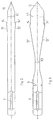
- Figure 2 is a longitudinal section through a first embodiment of a lancet according to the invention.
- FIG. 3 is a longitudinal section through another embodiment of a lancet according to the invention, which is particularly suitable for double weaving with a high pole.
- Figures 4a to 4d contain schematic longitudinal sections of fabric edges, the different phases of the weaving process being shown.
- FIG. 5 is a schematic longitudinal section with two positions of the reed in double weaving with high poles with the aid of a lancet according to the invention, as shown in FIG. 3.
- each lancet (5) ends in the form of a point by gradually and symmetrically reducing the height h of the two side surfaces.
- Figure 1 the weaving machine is shown at the time when the drawer (8) takes its greatest distance with respect to the fabric edge (9 and 9 ') ( Figures 1b and 4a), at which the relevant gripper (10 and 10') Bring in weft threads (3 and 3 '). Once the grippers (10 and 10 ') are withdrawn, the reed (11) guides the two weft threads (3 and 3') against the lancets (5) (Fig. 4b).
- the lancets (5) according to the invention do not end only at a point (12) which is caused by a gradual and symmetrical reduction in the height h1 of the side surfaces of the lancets (5 ) is formed on the side of the fabric edge (9 or 9 '), but are also provided with surfaces (13 and 13'), which extend from the point of contact of the weft threads (3 and 3 ') with the upper and lower surfaces of the lancets (5), whereupon these weft threads (3 and 3 ') are pressed further upwards by the reed (11) by pulling the drawer (8) towards the fabric edges (9 and 9') ( Figure 4b) strikes further until they fall back over the projections (14 and 14 ') (FIGS.
- FIG. 3 Another embodiment of the lancet (5) according to the invention is shown in FIG. 3 and its use is shown in FIG. 5.
- the height h2 of the side faces to the height of the tissue edge (9 and 9 ') is greater than the height h1 of the previous embodiment of the lancet (5 ) according to the invention, which is shown in Figures 1, 2 and 4.
- the lancet (5) with a height profile. While in the previous lancet (5) (FIGS. 1, 2, 4) the height h1 is the same all the way to the sloping surfaces (13 and 13 ') for the projections (14 and 14'), and then at the location of the tissue edges (9 and 9 ') to fall back to the same height in order to form the point (12), the lancet (5) according to the invention shown in FIGS. 3 and 5 has a more profiled height which extends from the base to the elongated gap (6).
- the lancets are set by the lancet holder at a height h which corresponds to the height h1 in the previous case, but which gradually decreases to a height h3 at the locations between which the grippers (3 and 3 ' ) move back and forth transversely to the warp direction that the lancets (5) follow in order to then widen with the inclined surfaces (13 and 13 ') up to the step-like projections (14 and 14') and at the fabric edges ( 9 and 9 ') fall back to a height h2, which is determined by the desired pole height of the fabric is determined.
- the distance between the two grippers (10 and 10 ') of the top and bottom fabrics is much smaller than even in the previous case, although a larger pole of the fabric made is aimed for, which even then higher weaving speed allowed.
- FIG. 5 shows how the grippers (10 and 10 ') come to a standstill with respect to the lancets (5) in position A of the drawer, while in position B the drawer, in which the reed (11) comes to a stop against the respective fabric edges (9 and 9 '), the grippers are withdrawn and the weft threads (3 and 3') are processed in the relevant upper and lower fabrics without being able to withdraw due to the barbs (14 and 14 ') with which the lancets are provided as in the previous case when the drawer (8) will retract.
- a weaving machine does not need to be specially equipped for a high pile, but should work with a usual lifter length, with a usual hook spacing, etc.; the pile height or the spacing tissue area of a conventional double-piece machine can be substantially expanded with the aid of lancets according to the invention by a normal raising of the shed-forming aids.
- the invention as described above can be summarized as follows:
- the invention relates to a lancet (5) for double weaving, which consists of an elongated piece of flat steel and can be provided with a punctiform end (12) which is directed towards the fabric edges.
- the lancet (5) is characterized in that it is provided with step-like projections in height to retain the last weft threads inserted.
Landscapes
- Engineering & Computer Science (AREA)
- Textile Engineering (AREA)
- Looms (AREA)
Applications Claiming Priority (2)
| Application Number | Priority Date | Filing Date | Title |
|---|---|---|---|
| BE9100835 | 1991-09-09 | ||
| BE9100835A BE1005394A5 (nl) | 1991-09-09 | 1991-09-09 | Lancet voor dubbelweven. |
Publications (1)
| Publication Number | Publication Date |
|---|---|
| EP0536551A1 true EP0536551A1 (fr) | 1993-04-14 |
Family
ID=3885693
Family Applications (1)
| Application Number | Title | Priority Date | Filing Date |
|---|---|---|---|
| EP92115439A Withdrawn EP0536551A1 (fr) | 1991-09-09 | 1992-09-09 | Lancette pour le tissage en double |
Country Status (3)
| Country | Link |
|---|---|
| EP (1) | EP0536551A1 (fr) |
| JP (1) | JPH05195370A (fr) |
| BE (1) | BE1005394A5 (fr) |
Cited By (5)
| Publication number | Priority date | Publication date | Assignee | Title |
|---|---|---|---|---|
| DE19831323C2 (de) * | 1997-07-14 | 2000-09-07 | Wiele Michel Van De Nv | Lanzettenvorrichtung mit Überwachungsvorrichtung für eine Webmaschine |
| EP1405940A1 (fr) * | 2002-10-04 | 2004-04-07 | NV Michel van de Wiele | Méthode de fabrication d'éléments en une pièce utilisés dans un métier à tisser |
| BE1015720A3 (nl) * | 2003-10-17 | 2005-07-05 | Wiele Michel Van De Nv | Lancetinrichting voor een dubbelstukweefmachine en dubbelstukweefmachine voorzien van dergelijke lancetinrichting. |
| FR2866032A1 (fr) * | 2004-02-09 | 2005-08-12 | Ltaief Bouaziz | Dispositif pour machine textile et de tissage de guidage de lances et projectiles d'insertion et utilisation |
| US7451786B2 (en) | 2006-11-17 | 2008-11-18 | N.V. Michel Van De Wiele | Weaving machine for weaving pile fabrics, and set of at least two spacers provided to be mounted next to one another in a weaving machine for weaving pile fabrics |
Citations (3)
| Publication number | Priority date | Publication date | Assignee | Title |
|---|---|---|---|---|
| FR19357E (fr) * | 1912-12-20 | 1915-01-20 | Henri Malatre | Perfectionnement à la fabrication du velours double pièce |
| FR792461A (fr) * | 1934-10-01 | 1935-12-31 | Leroux Freres Soc | Perfectionnements aux métiers destinés à la fabrication du velours double pièce |
| FR819231A (fr) * | 1936-10-13 | 1937-10-13 | Thermoid Company | Métier à tisser |
-
1991
- 1991-09-09 BE BE9100835A patent/BE1005394A5/nl not_active IP Right Cessation
-
1992
- 1992-09-08 JP JP4239797A patent/JPH05195370A/ja active Pending
- 1992-09-09 EP EP92115439A patent/EP0536551A1/fr not_active Withdrawn
Patent Citations (3)
| Publication number | Priority date | Publication date | Assignee | Title |
|---|---|---|---|---|
| FR19357E (fr) * | 1912-12-20 | 1915-01-20 | Henri Malatre | Perfectionnement à la fabrication du velours double pièce |
| FR792461A (fr) * | 1934-10-01 | 1935-12-31 | Leroux Freres Soc | Perfectionnements aux métiers destinés à la fabrication du velours double pièce |
| FR819231A (fr) * | 1936-10-13 | 1937-10-13 | Thermoid Company | Métier à tisser |
Cited By (7)
| Publication number | Priority date | Publication date | Assignee | Title |
|---|---|---|---|---|
| DE19831323C2 (de) * | 1997-07-14 | 2000-09-07 | Wiele Michel Van De Nv | Lanzettenvorrichtung mit Überwachungsvorrichtung für eine Webmaschine |
| EP1405940A1 (fr) * | 2002-10-04 | 2004-04-07 | NV Michel van de Wiele | Méthode de fabrication d'éléments en une pièce utilisés dans un métier à tisser |
| BE1015720A3 (nl) * | 2003-10-17 | 2005-07-05 | Wiele Michel Van De Nv | Lancetinrichting voor een dubbelstukweefmachine en dubbelstukweefmachine voorzien van dergelijke lancetinrichting. |
| EP1524345A3 (fr) * | 2003-10-17 | 2006-02-08 | NV Michel van de Wiele | Dispositif de lancette pour métier à tisser double pièce et métier à tisser double pièce comprenant ce dispositif de lancette |
| US7134401B2 (en) | 2003-10-17 | 2006-11-14 | N.V. Michel Van De Wiele | Lancet device for a face-to-face weaving machine and face-to-face weaving machine provided with such a lancet device |
| FR2866032A1 (fr) * | 2004-02-09 | 2005-08-12 | Ltaief Bouaziz | Dispositif pour machine textile et de tissage de guidage de lances et projectiles d'insertion et utilisation |
| US7451786B2 (en) | 2006-11-17 | 2008-11-18 | N.V. Michel Van De Wiele | Weaving machine for weaving pile fabrics, and set of at least two spacers provided to be mounted next to one another in a weaving machine for weaving pile fabrics |
Also Published As
| Publication number | Publication date |
|---|---|
| JPH05195370A (ja) | 1993-08-03 |
| BE1005394A5 (nl) | 1993-07-13 |
Similar Documents
| Publication | Publication Date | Title |
|---|---|---|
| EP3347512B1 (fr) | Metier a tisser destine a la fabrication de produits tisses dotes d'un fil a poser ou a tricoter incorpore | |
| DE2637618B2 (de) | Bandgewebe | |
| EP2128317A1 (fr) | Procédé et dispositif destinés à l'introduction d'un fil de trame pour une machine à tisser à pince | |
| DE2540272C3 (de) | Verfahren und Vorrichtung rum Herstellen eines gekuppelten Reißverschlusses | |
| DE1535414B1 (de) | Verfahren zum Bilden von verduennten Einlegekanten beim Herstellen von Geweben auf Webmaschinen mit Entnahme des Schussfadens von ortsfesten Vorratsspulen und Vorrichtung zur Durchfuehrung des Verfahrens | |
| EP0446424B1 (fr) | Métier à tisser à griffes pour tissus lourds | |
| DE2161013C2 (de) | Nadelwebmaschine, insbesondere Nadelbandwebmaschine | |
| EP1101850A1 (fr) | Dispositif de formation d'une armure de gaze | |
| EP0456599A1 (fr) | Métier à tisser multiphasé à foule linéaire | |
| DE8713074U1 (de) | Separator zum Vereinzeln von in einer Aufreihung gehaltenen Fäden | |
| DE141339C (fr) | ||
| WO1993006282A1 (fr) | Dispositif de pincement d'une couche de fils et son utilisation | |
| EP0888470B1 (fr) | Templet pour metier a tisser | |
| EP0388880A1 (fr) | Séparateur pour machines à coudre | |
| EP1799896B1 (fr) | Element de guidage destine a un element de transport a prehenseur d'une machine a filer | |
| DE69707778T2 (de) | Mitnehmergreifer für Webmaschinen | |
| DE1535414C (de) | Verfahren zum Bilden von verdünnten Einlegekanten beim Herstellen von Geweben auf Webmaschinen mit Entnahme des Schußfa dens von ortsfesten Vorratsspulen und Vor richtung zur Durchfuhrung des Verfahrens | |
| DE2611353C2 (de) | Vorrichtung und Verfahren zum Bilden eines Fadenkreuzes oder Geleses an einer Textilmaschine | |
| DE636980C (de) | Vorrichtung zur Herstellung von aus gewellten Ketten- und Schussdraehten bestehenden Drahtgittern | |
| DE2814483C2 (de) | Verfahren zum Vorbereiten einer Kette und Einlegen derselben in einen Handwebstuhl sowie Handwebstuhl zur Durchführung des Verfahrens | |
| EP3438335A1 (fr) | Ros et métier à tisser circulaire | |
| DE855529C (de) | Webschaft | |
| DE1710317C3 (de) | Verfahren und Vorrichtung zum Herstellen einer Dreherbindung | |
| DE2460737C3 (de) | Vorrichtung in einer Nadelwebmaschine zur Herstellung von Bandgeweben mit Schußschlaufen | |
| DE1291295B (de) | Vorrichtung zum Verhindern von Kettenstreifigkeit bei auf Wellenwebmaschinen hergestellten Geweben |
Legal Events
| Date | Code | Title | Description |
|---|---|---|---|
| PUAI | Public reference made under article 153(3) epc to a published international application that has entered the european phase |
Free format text: ORIGINAL CODE: 0009012 |
|
| AK | Designated contracting states |
Kind code of ref document: A1 Designated state(s): CH DE ES FR GB IT LI |
|
| 17P | Request for examination filed |
Effective date: 19930429 |
|
| RAP1 | Party data changed (applicant data changed or rights of an application transferred) |
Owner name: N.V. MICHEL VAN DE WIELE |
|
| 18D | Application deemed to be withdrawn |
Effective date: 19950401 |