EP0536645A2 - Préparation de solution nécessaire de Bicarbonate pour la dialyse au bicarbonate au niveau d'un appareil de dialyse - Google Patents
Préparation de solution nécessaire de Bicarbonate pour la dialyse au bicarbonate au niveau d'un appareil de dialyse Download PDFInfo
- Publication number
- EP0536645A2 EP0536645A2 EP92116841A EP92116841A EP0536645A2 EP 0536645 A2 EP0536645 A2 EP 0536645A2 EP 92116841 A EP92116841 A EP 92116841A EP 92116841 A EP92116841 A EP 92116841A EP 0536645 A2 EP0536645 A2 EP 0536645A2
- Authority
- EP
- European Patent Office
- Prior art keywords
- container
- dialysis
- bicarbonate
- liquid
- dialysis machine
- Prior art date
- Legal status (The legal status is an assumption and is not a legal conclusion. Google has not performed a legal analysis and makes no representation as to the accuracy of the status listed.)
- Withdrawn
Links
Images


Classifications
-
- A—HUMAN NECESSITIES
- A61—MEDICAL OR VETERINARY SCIENCE; HYGIENE
- A61M—DEVICES FOR INTRODUCING MEDIA INTO, OR ONTO, THE BODY; DEVICES FOR TRANSDUCING BODY MEDIA OR FOR TAKING MEDIA FROM THE BODY; DEVICES FOR PRODUCING OR ENDING SLEEP OR STUPOR
- A61M1/00—Suction or pumping devices for medical purposes; Devices for carrying-off, for treatment of, or for carrying-over, body-liquids; Drainage systems
- A61M1/14—Dialysis systems; Artificial kidneys; Blood oxygenators ; Reciprocating systems for treatment of body fluids, e.g. single needle systems for hemofiltration or pheresis
- A61M1/16—Dialysis systems; Artificial kidneys; Blood oxygenators ; Reciprocating systems for treatment of body fluids, e.g. single needle systems for hemofiltration or pheresis with membranes
- A61M1/1654—Dialysates therefor
- A61M1/1656—Apparatus for preparing dialysates
-
- A—HUMAN NECESSITIES
- A61—MEDICAL OR VETERINARY SCIENCE; HYGIENE
- A61M—DEVICES FOR INTRODUCING MEDIA INTO, OR ONTO, THE BODY; DEVICES FOR TRANSDUCING BODY MEDIA OR FOR TAKING MEDIA FROM THE BODY; DEVICES FOR PRODUCING OR ENDING SLEEP OR STUPOR
- A61M1/00—Suction or pumping devices for medical purposes; Devices for carrying-off, for treatment of, or for carrying-over, body-liquids; Drainage systems
- A61M1/14—Dialysis systems; Artificial kidneys; Blood oxygenators ; Reciprocating systems for treatment of body fluids, e.g. single needle systems for hemofiltration or pheresis
- A61M1/16—Dialysis systems; Artificial kidneys; Blood oxygenators ; Reciprocating systems for treatment of body fluids, e.g. single needle systems for hemofiltration or pheresis with membranes
- A61M1/1654—Dialysates therefor
- A61M1/1656—Apparatus for preparing dialysates
- A61M1/1666—Apparatus for preparing dialysates by dissolving solids
-
- A—HUMAN NECESSITIES
- A61—MEDICAL OR VETERINARY SCIENCE; HYGIENE
- A61M—DEVICES FOR INTRODUCING MEDIA INTO, OR ONTO, THE BODY; DEVICES FOR TRANSDUCING BODY MEDIA OR FOR TAKING MEDIA FROM THE BODY; DEVICES FOR PRODUCING OR ENDING SLEEP OR STUPOR
- A61M1/00—Suction or pumping devices for medical purposes; Devices for carrying-off, for treatment of, or for carrying-over, body-liquids; Drainage systems
- A61M1/14—Dialysis systems; Artificial kidneys; Blood oxygenators ; Reciprocating systems for treatment of body fluids, e.g. single needle systems for hemofiltration or pheresis
- A61M1/16—Dialysis systems; Artificial kidneys; Blood oxygenators ; Reciprocating systems for treatment of body fluids, e.g. single needle systems for hemofiltration or pheresis with membranes
- A61M1/1654—Dialysates therefor
- A61M1/1656—Apparatus for preparing dialysates
- A61M1/1668—Details of containers
Definitions
- the invention relates to a method of the type corresponding to the preamble of claim 1, a container suitable therefor and a device for carrying out the method with the container.
- dialysis fluid In hemodialysis, relatively large amounts of dialysis fluid are required. Depending on the duration of the treatment, 150 to 180 liters per dialysis can be expected. Since it requires considerable transport effort to produce such amounts of liquid in a pharmaceutical company remote from the dialysis site in the final dilution and to transport it to the dialysis site, the early stage was to provide dialysis fluid in the form of highly concentrated solutions.
- a further stage of development is the delivery of quantities of dry concentrate in plastic cartridges, calculated for each dialysis, which, for example, hold 650 g of the salt in question.
- Purified water flows through the cartridges and their contents dissolve.
- the purified water is available on the appropriate dialysis machines and is obtained by reverse osmosis from clean tap water in high quality, so that it is largely free of all ingredients.
- the cartridge concept is particularly important in bicarbonate hemodialysis. Two partial concentrates are required, one of which contains ions Na+, K+, Ca2+ and Mg2+ and the other contains sodium hydrogen carbonate. Because of the low solubility of calcium carbonate, the calcium carbonate would fail if the two components were brought together early.
- the object of the invention is to make the provision of the bicarbonate solution for bicarbonate hemodialysis simple and economical.
- the invention also extends to a container which is adapted to the described method in the manner set out in claim 2.
- the container is arranged in the operating position so that the filter base is horizontal so that the dry concentrate can lie thereon, and that the inlet is arranged above and the outlet below the filter base.
- the water flows vertically through the dry concentrate, thereby dissolving the amount of saturation.
- the volume of the container is not particularly large. It is determined by the amount of bicarbonate to be taken up and an amount of water which allows the saturated bicarbonate solution to be formed rapidly and uniformly and to be removed from the container without problems. Containers of about 0.5 to 2 liters are possible.
- the filter base can be formed according to claim 3 by a ceramic filter, the pore size according to claim 4 can be 100 to 160 microns.
- the container can be provided with a removable glass connection spout, which is tightened with a union nut and sealed with an elastic seal.
- the union nut is screwed onto the glass container and connects the connection nozzle to the actual glass container.
- the liquid outlet can be formed by a glass connecting nozzle which is integral with the glass container.
- connection spouts are at the liquid inlet and liquid outlet are expensive to manufacture if they are made of glass, whether in one piece or separately, since only small series can be considered.
- a one-piece connection spout made of plastic for the liquid inlet and / or to choose for the liquid outlet which is not exposed to the disadvantage of being easily damaged during cleaning and which may even be a commercially available purchase part intended for other purposes.
- this connection nozzle can be screwed on.
- the connecting sleeves made of plastic for the liquid inlet and for the liquid outlet can be sealed with a sealing ring against the glass body (claim 7) and have a peripheral edge as a reinforcement, for attack during handling and for protecting the threaded connector of the container (claim 8).
- a device for carrying out the method described at the beginning can be used in the be designed in accordance with claim 9.
- the container and the device for maintaining a certain liquid level are both arranged outside the dialysis machine and together form a system which ensures the proper formation of the saturated solution because liquid is always above the solid bicarbonate and in this way there is a certain minimum contact time.
- the container is assigned a ballast arranged approximately at the same height with a float valve, which interacts with the container in the manner of communicating tubes, so that there is always the same liquid level in both and the closed position of the Float valve in the ballast tank determines the liquid level in the actual tank.
- the container can be designed to perform a single dialysis. However, it can also be dimensioned larger, so that several dialyses can be carried out in succession in a single dialysis machine with one filling of the container or the container is connected to several dialysis machines, so that several dialyses can be carried out simultaneously.
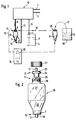
- Fig. 1 denotes the dialysis machine, which is on the patient's bed during dialysis and is connected to the patient via lines 1 and 2.
- the blood flows through lines 1 and 2 introduced and returned to the patient, which is subjected to dialysis treatment in the dialysis machine, ie the removal of urinary constituents from the blood.
- This takes place in the so-called dialyzer (not shown), for example a capillary dialyzer, in which a membrane is present, on one side of which the blood is present and on the other side of which the dialysis fluid is present and through which the substances to be removed diffuse out of the blood into the dialysis fluid.
- dialyzer for example a capillary dialyzer, in which a membrane is present, on one side of which the blood is present and on the other side of which the dialysis fluid is present and through which the substances to be removed diffuse out of the blood into the dialysis fluid.
- the dialysis liquid is prepared from two components, namely a partial concentrate containing the bicarbonate and a further partial concentrate containing ions such as Na+, K+, Ca2+ and Mg2+.
- the latter is supplied in the form of a liquid concentrate 3 in canisters 4 of, for example, ten liters of content and is removed directly from the canister 4 by the dialysis machine 10 via a line 5.
- the partial concentrate containing the bicarbonate is produced from a dry or solid bicarbonate composition 6, which is in a container 20 made of glass of about 1 liter content on a horizontal filter base 7 with fine pores of 100 to 160 ⁇ m pore size in an amount calculated for dialysis located.
- the container 20 Above the filter base 7, the container 20 has a connection 51, in the case shown an inlet, below the filter base 7, a connection 52 with a connection piece 8, below the filter base 7 a connection 52.
- the connection 51 comprises a connection piece 8 with a hose connector 11, via which ultrapure water purified by reverse osmosis is supplied via a line 9 formed by a hose from the dialysis machine 10. If from “above” and “below” is mentioned, the position of the container 20 in operation is always meant.
- the ultrapure water fed in via line 9 passes through the bicarbonate 6 and dissolves so much of the bicarbonate 6 that a saturated solution is obtained which contains about 8.4% sodium bicarbonate at room temperature and passes via line 12 into the dialysis machine 10, where the mixing with the other liquid concentrate supplied via line 5 and the dilution to the required physiological concentration take place.
- the container 20 is reusable. After completion of dialysis, as indicated by arrow 13, it is transferred to a cleaning and sterilizing device 14 and then from a larger, e.g. In a 25 kg sack 15, an existing supply 16 of the dry concentrate containing sodium bicarbonate is filled with an amount of bicarbonate 6 calculated for the next dialysis, which is indicated by the arrow 17. After refilling, the container 20 is again connected to the dialysis machine 10 in the direction of the arrow 18 and used again in the sense already described.
- the embodiment of the container 20 shown in FIG. 2 has an essentially cylindrical storage space 21 for the dry concentrate, which tapers downward in a conical part 22 to approximately half its diameter.
- the filter bottom 7 which is designed as a ceramic frit and is tightly inserted into the container 20 at the edge, is attached.
- the filter base 7 covers the entire cross section of the storage space 21, so that the water or the solution passes through the pores of the filter base 7 must take and there are no side roads.
- an outlet base 19 made of glass with a hose connector 11 for connecting the line 12 formed by a hose.
- the glass connector 8 is provided at the upper end of the cylindrical part 21 and comprises a disc-shaped circumferential projection 23 which rests on the end face 25 of a threaded connector 26 of the cylindrical part 21 via an elastic seal 24 and can be tightly tightened thereon by means of a union nut made of plastic 27 is.
- the threaded connector 26 has a relatively large cross section, so that a large filler cross section can be released for the dry concentrate 16.
- the measured amount of bicarbonate 6 rests on the filter base 7 and the ultrapure water introduced at the connection 51 flows through it from top to bottom.
- the saturated bicarbonate solution 57 which forms exits at the connection 52.
- 50 denotes another container for providing the bicarbonate solution required for bicarbonate hemodialysis on the dialysis machine.
- connection 52 exemplary embodiment according to FIG. 2
- both the connection 51 and the connection 52 are provided with a connecting sleeve 60 made of a suitable plastic.
- Various polymers can be used as plastics; in the exemplary embodiment, polyethylene was chosen.
- the correspondingly stable container body made of glass with a wall thickness of approximately 3 mm is provided with threaded connections 26 at both connections 51, 52 and is designed such that the connecting sleeves 60 commercially available threaded spouts with an axial hose nozzle 11 for pushing on a connecting hose, not shown, can be.
- the liquid inlet and liquid outlet are the same and the connecting sleeves 60 are interchangeable.
- the connecting sleeves 6O for liquid inlet and liquid outlet are sealed with a sealing ring 44 - in the exemplary embodiment made of silicone - which is pressed between an inner shoulder 39 of the connecting piece 6O and the end face of the respective threaded connector 26.
- the connecting nozzle 60 has a radially outwardly projecting circumferential collar 43 for the purpose of attacking when turning, reinforcing and protecting the threaded connector 26.
- the connection sleeves 6O are heat-resistant up to the temperature required for the sterilization.
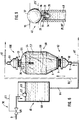
- the device designated as a whole in FIG. 6 with 100 comprises one of the above-described containers 50 made of glass and a ballast container 45 with a float valve 30.
- the container 50 and the storage container 45 are arranged together at approximately the same height outside the dialysis machine, not shown here.
- the container 50 has a liquid inlet at the bottom of the connection 52 in the exemplary embodiment and a liquid outlet at the top of the connection 51, on the connecting piece 11 of which a connecting hose (not shown) can be pushed.
- the middle part of the container 5O merges into an identical threaded connector 26, which forms the liquid outlet and onto which a plastic connecting sleeve 60 is screwed, which has a dip tube engaging through the interior of the threaded connector 26 into the interior of the container 50 53 with a filter insert 54 covering its inlet opening.
- solid bicarbonate 6 in the form of granules lies on the filter base 7 up to an upper limit 56.
- Purified water 58 is fed in via line 9 by reverse osmosis and reaches the ballast tank 45.
- the float valve 3O comprises a shut-off valve 69 which is actuated via a float 61 mechanically connected to it via a linkage 61. At a certain liquid level 63, the shut-off valve 69 is closed, so that the liquid level 63 cannot rise any higher and the volume in contact with the bicarbonate 6 is limited to a defined value.
- the supply of the pure water via line 9 takes place under the action of a pump or under the action of gravity from a higher-level storage container.
- the pure water 58 in the ballast tank 45 passes through the line 64 from its lower region into the liquid inlet at the connection 52, passes through the filter base 7 and the amount of bicarbonate 6 overlying it and then rises to a liquid level 55, which corresponds to the Liquid level 63 corresponds, as is the case with communicating tubes. If the saturated bicarbonate solution 57 standing above the solid bicarbonate is removed via the dip tube 53 and the line 46, the liquid level 55 and thus the liquid level 63 decrease, and pure water is supplied by opening the shut-off valve 69 until this is due to the position of the float 62 certain original liquid level 63 is reached again. In this way, saturated bicarbonate solution 57 is always available on line 46, without having to take care that container 10 does not run empty or saturated bicarbonate solution 57 is forced out by itself through line 46.
- the liquid inlet is provided at the bottom and the liquid outlet at the top.
- both can also be interchanged, as is to be represented by the line 64 'and the line 46' indicated by dash-dotted lines.
- the amount of solid bicarbonate 6 calculated for one (or more) dialysis (s) is initially filled through the connection 51. At the end of the dialysis, the solid bicarbonate has just been used up so that no losses occur.
- the container 50 can be used again after cleaning and sterilization.
- the entire device 100 is arranged as a separate unit outside of the dialysis machine and can be used with any type of dialysis machine without any problems with interventions in the dialysis machines which would cause problems with the medical device regulation.
- FIG. 7 and 8 show devices 2OO to 3OO, in which the float valve controlling the liquid level 55 is integrated in the container 50. No external ballast containers or the like are required here.
- the container 50 is of the same design as in FIG. 6. As far as functionally the same parts occur, the reference numbers are the same.
- the liquid inlet is again at the bottom and the liquid outlet is at the top.
- the lower connecting nozzle 6O is modified compared to the connecting nozzle 6O in FIG. 6 in that it carries a riser pipe 28 which leads through the lower threaded connector 26 and extends to the desired liquid level 55.
- the riser pipe 28 carries a float valve 40, which is shown in detail in FIG. 9. Thanks to the float valve 40, the pure water brought in through the line 9 cannot rise higher than it corresponds to the liquid level 55.
- the connecting nozzle 6O screwed onto the upper threaded connector 26 is also modified compared to the connecting nozzle 6O in FIG. 6, in that the immersion tube 53 'with the filter inlet 54 dips deeper into the container 50 by a certain distance from the extraction point to the liquid supply at the float valve 40 to accomplish.
- the liquid inlet and liquid outlet are interchanged in their position.
- the feed line 9 for pure water thus reaches the inside of the container 5O from above via the connection nozzle 6O.
- the connection nozzle 6O carries a U-shaped tube 28 'which carries the float valve 40 at the end of the upwardly bent U-leg, which defines the liquid level 55.
- the saturated bicarbonate solution formed is drawn off at the liquid outlet located below via the connecting nozzle 60 and the line 46.
- a special filter corresponding to the filter inlet 54 can be omitted here because this task is performed by the filter base 7.
- FIG. 9 A possible embodiment of the float valve 40 is indicated schematically in FIG. 9.
- the upward end of the tubes 28 and 28 ' is provided with a horizontal end face 29 transverse to its axis.
- a sealing ring 31 is inserted, for example clamped or glued, into the end, which has a central opening 33 and a sealing surface 34 at the lower edge of the opening.
- the sealing surface 34 interacts with a sealing ball 35 which has a larger diameter than the through opening 33.
- the float 37 also sinks, as a result of which the sealing ball 35 lifts off the sealing surface 34 and releases the annular space remaining between the connecting pin 36 and the inner circumference of the passage opening 33 as a passage cross section for the pure water 58.
- the float can sink until it sits on the end surface 29. Because of its light weight, the inflow of pure water is not hindered.
- the sealing ball 35 rests on the sealing surface 34, the sealing effect is no longer dependent on the load-bearing capacity of the float 37, but the arrangement is self-sealing, i.e. even if the pressure of the pure water 58 is increased, the tightness remains.
- the sunken state of the float 37 and the sealing ball 35 is indicated by dashed lines in FIG. 9.
Landscapes
- Health & Medical Sciences (AREA)
- Heart & Thoracic Surgery (AREA)
- Urology & Nephrology (AREA)
- Anesthesiology (AREA)
- Vascular Medicine (AREA)
- Engineering & Computer Science (AREA)
- Emergency Medicine (AREA)
- Biomedical Technology (AREA)
- Hematology (AREA)
- Life Sciences & Earth Sciences (AREA)
- Animal Behavior & Ethology (AREA)
- General Health & Medical Sciences (AREA)
- Public Health (AREA)
- Veterinary Medicine (AREA)
- External Artificial Organs (AREA)
Applications Claiming Priority (6)
| Application Number | Priority Date | Filing Date | Title |
|---|---|---|---|
| DE4133652A DE4133652A1 (de) | 1991-10-11 | 1991-10-11 | Verfahren zur bereitstellung der bei der bikarbonat-haemodialyse benoetigten bikarbonatloesung am dialysegeraet und entsprechender behaelter |
| DE4133652 | 1991-10-11 | ||
| DE9202829U DE9202829U1 (de) | 1992-03-04 | 1992-03-04 | Behälter zur Bereitstellung der bei der Bikarbonat-Hämodialyse benötigten Bikarbonatlösungen am Dialysegerät |
| DE9202829U | 1992-03-04 | ||
| DE9208498U DE9208498U1 (de) | 1992-06-25 | 1992-06-25 | Vorrichtung zur Bereitstellung der bei der Bikarbonathämodialyse benötigten Bikarbonatlösung am Dialysegerät |
| DE9208498U | 1992-06-25 |
Publications (2)
| Publication Number | Publication Date |
|---|---|
| EP0536645A2 true EP0536645A2 (fr) | 1993-04-14 |
| EP0536645A3 EP0536645A3 (en) | 1993-11-03 |
Family
ID=27203007
Family Applications (1)
| Application Number | Title | Priority Date | Filing Date |
|---|---|---|---|
| EP19920116841 Withdrawn EP0536645A3 (en) | 1991-10-11 | 1992-10-01 | Preparation on a dialysis apparatus of the necessary bicarbonate solution for bicarbonate dialysis |
Country Status (1)
| Country | Link |
|---|---|
| EP (1) | EP0536645A3 (fr) |
Cited By (6)
| Publication number | Priority date | Publication date | Assignee | Title |
|---|---|---|---|---|
| WO1997029796A1 (fr) * | 1996-02-19 | 1997-08-21 | The St. Helier Nhs Trust | Reservoir destine a la preparation de dialysats |
| WO1999030756A1 (fr) * | 1997-12-16 | 1999-06-24 | Gambro Ab | Procede et dispositif de surveillance de pompe doseuse de dialyseur |
| GB2362843A (en) * | 2000-06-03 | 2001-12-05 | Kuo Hsin Ho & Fed Medical Co L | Mixing concentrates and water in haemodialysis |
| KR20010112727A (ko) * | 2000-06-12 | 2001-12-21 | 신호 쿼 | 혈액투석을 위한 농축물과 물의 혼합장치 |
| CN112843361A (zh) * | 2020-12-30 | 2021-05-28 | 江苏关怀医疗科技有限公司 | 一种精准血液透析系统 |
| CN112843362A (zh) * | 2020-12-31 | 2021-05-28 | 江苏关怀医疗科技有限公司 | 一种用于透析液系统的透析液配液供液装置 |
Family Cites Families (7)
| Publication number | Priority date | Publication date | Assignee | Title |
|---|---|---|---|---|
| DE8109529U1 (de) * | 1981-03-31 | 1982-12-30 | Endert, Günter van, Dr.med., 4000 Düsseldorf | Vorrichtung zur Herstellung von Dialysierflüssigkeit zur Verwendung in Hämodialysegeräten |
| US4734198A (en) * | 1984-02-06 | 1988-03-29 | Minntech Corporation | Dialysis solution mixing system |
| DE3443911C2 (de) * | 1984-12-01 | 1994-06-01 | Andreas Alexander Dr Med Mund | Einrichtung zum Herstellen von flüssigem Konzentrat aus pulverförmigem Konzentratsalz für die Zubereitung von Dialysierflüssigkeit |
| FR2604922B1 (fr) * | 1986-10-01 | 1990-05-04 | Materiels Annexes Dialyse | Dispositif de preparation en continu de solutions de dialyse a partir d'un produit solide se presentant sous forme de granules ou de poudre |
| US4784495A (en) * | 1987-02-06 | 1988-11-15 | Gambro Ab | System for preparing a fluid intended for a medical procedure by mixing at least one concentrate in powder form with water |
| FR2661614B1 (fr) * | 1990-05-04 | 1993-05-28 | Biosedra Lab | Procede et dispositif pour preparer une solution de dialyse. |
| DE9111524U1 (de) * | 1991-09-15 | 1991-12-05 | Zaunbauer, Peter, Dr., 3000 Hannover | Kartusche eines medizinischen Gerätes, insbesondere eines Dialysegerätes |
-
1992
- 1992-10-01 EP EP19920116841 patent/EP0536645A3/de not_active Withdrawn
Cited By (10)
| Publication number | Priority date | Publication date | Assignee | Title |
|---|---|---|---|---|
| WO1997029796A1 (fr) * | 1996-02-19 | 1997-08-21 | The St. Helier Nhs Trust | Reservoir destine a la preparation de dialysats |
| WO1999030756A1 (fr) * | 1997-12-16 | 1999-06-24 | Gambro Ab | Procede et dispositif de surveillance de pompe doseuse de dialyseur |
| AU742819B2 (en) * | 1997-12-16 | 2002-01-10 | Gambro A.B. | System and method for monitoring a dosage pump in a dialysis machine |
| JP2002508224A (ja) * | 1997-12-16 | 2002-03-19 | ガンブロ アクチボラグ | 透析機械用投薬ポンプの監視システムおよび方法 |
| US6440311B1 (en) | 1997-12-16 | 2002-08-27 | Gambro Ab | System and method for monitoring a dosage pump in a dialysis machine |
| GB2362843A (en) * | 2000-06-03 | 2001-12-05 | Kuo Hsin Ho & Fed Medical Co L | Mixing concentrates and water in haemodialysis |
| KR20010112727A (ko) * | 2000-06-12 | 2001-12-21 | 신호 쿼 | 혈액투석을 위한 농축물과 물의 혼합장치 |
| CN112843361A (zh) * | 2020-12-30 | 2021-05-28 | 江苏关怀医疗科技有限公司 | 一种精准血液透析系统 |
| CN112843361B (zh) * | 2020-12-30 | 2024-11-15 | 江苏关怀医疗科技有限公司 | 一种精准血液透析系统 |
| CN112843362A (zh) * | 2020-12-31 | 2021-05-28 | 江苏关怀医疗科技有限公司 | 一种用于透析液系统的透析液配液供液装置 |
Also Published As
| Publication number | Publication date |
|---|---|
| EP0536645A3 (en) | 1993-11-03 |
Similar Documents
| Publication | Publication Date | Title |
|---|---|---|
| DE3780440T2 (de) | Ein system zur herstellung einer fluessigkeit, vorgesehen fuer eine medizinische anwendung, durch mischen von zumindest einem konzentrat in form von pulver mit wasser, und eine kartusche fuer die anwendung in diesem system. | |
| EP0543283B1 (fr) | Dispositif de désinfection d'appareil de dialyse | |
| EP2726121B1 (fr) | Contenant, utilisation, appareil de dialyse ou unité de préparation et procédé pour la préparation d'un concentré | |
| DE69114356T2 (de) | System zur Steuerung einer medizinischen Behandlung, beispielsweise einer Dialyse. | |
| DE69109012T2 (de) | Vorrichtung zum Auflösen eines Korrekturmediums einer dialytischen Lösung. | |
| DE69004739T2 (de) | Einrichtung zur Vorbereitung medizinischer Lösungen. | |
| EP0697220A1 (fr) | Unité d'emballage flexible pour concentré en poudre destiné à la préparation d'un concentré de dialysat ainsi qu'un dispositif pour celle-ci | |
| EP2257499B1 (fr) | Récipient, ainsi que dispositif et procédé pour produire une solution désinfectante | |
| EP0019622B2 (fr) | Procede et dispositif pour maintenir steriles des instruments chirurgicaux ou dentaires | |
| EP0491981A1 (fr) | Dispositif automatique de préparation de concentrés en mélangeant un liquide avec un solide soluble | |
| EP2289839B1 (fr) | Dispositif et procédé de préparation d'un liquide stérile pour une installation de remplissage | |
| DE3307830A1 (de) | Verfahren und vorrichtung zur exkorporalen reinigung von blut | |
| DE2814401C2 (fr) | ||
| DE3316741A1 (de) | Vorrichtung zur bereitstellung, ggf. mischung mit wasser und zufuehrung von reinigungs- und desinfektionsfluessigkeit zu zahnaerztlichen sauganlagen | |
| DE3447989A1 (de) | Haemodialysevorrichtung mit desinfektionseinrichtung | |
| DE9302790U1 (de) | Hilfsgerät zur Verwendung bei einem Bikarbonat-Hämodialyseverfahren | |
| EP0284641B1 (fr) | Dispositif pour recevoir et séparer des polluants de matériaux de plombage contenant des composés métalliques et étant contenus dans la fange de forage ou similaire, notamment dans les cabinets dentaires | |
| EP4117748B1 (fr) | Dispositif et système de nettoyage pour un système de traitement sanguin | |
| DE9208498U1 (de) | Vorrichtung zur Bereitstellung der bei der Bikarbonathämodialyse benötigten Bikarbonatlösung am Dialysegerät | |
| DE4113032A1 (de) | Verfahren zur herstellung einer konzentrierten loesung, die der versorgung eines geraetes zur generierung eines dialysebades dient und vorrichtung zur durchfuehrung des vefahrens | |
| DE19924513C1 (de) | Vorrichtung zur Herstellung von Dialysesalzlösungen | |
| DE4133652A1 (de) | Verfahren zur bereitstellung der bei der bikarbonat-haemodialyse benoetigten bikarbonatloesung am dialysegeraet und entsprechender behaelter | |
| EP3903938A1 (fr) | Module de traitement de l'eau | |
| EP2557069B1 (fr) | Dispositif pour une installation de préparation d'eau potable contenant une tête de filtre | |
| DE102016013875A1 (de) | Dialysemaschine und Reinigungsverfahren für die Dialysemaschine |
Legal Events
| Date | Code | Title | Description |
|---|---|---|---|
| PUAI | Public reference made under article 153(3) epc to a published international application that has entered the european phase |
Free format text: ORIGINAL CODE: 0009012 |
|
| AK | Designated contracting states |
Kind code of ref document: A2 Designated state(s): AT BE CH DE DK ES FR GB IT LI LU NL SE |
|
| PUAL | Search report despatched |
Free format text: ORIGINAL CODE: 0009013 |
|
| AK | Designated contracting states |
Kind code of ref document: A3 Designated state(s): AT BE CH DE DK ES FR GB IT LI LU NL SE |
|
| 17P | Request for examination filed |
Effective date: 19940422 |
|
| 17Q | First examination report despatched |
Effective date: 19951113 |
|
| GRAG | Despatch of communication of intention to grant |
Free format text: ORIGINAL CODE: EPIDOS AGRA |
|
| GRAG | Despatch of communication of intention to grant |
Free format text: ORIGINAL CODE: EPIDOS AGRA |
|
| GRAH | Despatch of communication of intention to grant a patent |
Free format text: ORIGINAL CODE: EPIDOS IGRA |
|
| GRAH | Despatch of communication of intention to grant a patent |
Free format text: ORIGINAL CODE: EPIDOS IGRA |
|
| 18D | Application deemed to be withdrawn |
Effective date: 19971018 |