EP0537877A2 - Lentille de contact souple à haute perméabilité à l'oxygène - Google Patents
Lentille de contact souple à haute perméabilité à l'oxygène Download PDFInfo
- Publication number
- EP0537877A2 EP0537877A2 EP92305381A EP92305381A EP0537877A2 EP 0537877 A2 EP0537877 A2 EP 0537877A2 EP 92305381 A EP92305381 A EP 92305381A EP 92305381 A EP92305381 A EP 92305381A EP 0537877 A2 EP0537877 A2 EP 0537877A2
- Authority
- EP
- European Patent Office
- Prior art keywords
- group
- lens
- prepolymer
- isocyanate
- reacting
- Prior art date
- Legal status (The legal status is an assumption and is not a legal conclusion. Google has not performed a legal analysis and makes no representation as to the accuracy of the status listed.)
- Granted
Links
- SXDWEYRBSHTTLU-UHFFFAOYSA-N CC(CN=C=O)(CC(C1)N=C=O)CC1(C)C#N Chemical compound CC(CN=C=O)(CC(C1)N=C=O)CC1(C)C#N SXDWEYRBSHTTLU-UHFFFAOYSA-N 0.000 description 1
- XAHUNQAOCGDSBW-UHFFFAOYSA-N CC(Nc1ccc(C)c(NC(C)=O)c1)=O Chemical compound CC(Nc1ccc(C)c(NC(C)=O)c1)=O XAHUNQAOCGDSBW-UHFFFAOYSA-N 0.000 description 1
- XBCMSWYSCLLEJG-UHFFFAOYSA-N Cc(ccc(NC(O)=O)c1)c1N=C=O Chemical compound Cc(ccc(NC(O)=O)c1)c1N=C=O XBCMSWYSCLLEJG-UHFFFAOYSA-N 0.000 description 1
Images

Classifications
-
- C—CHEMISTRY; METALLURGY
- C08—ORGANIC MACROMOLECULAR COMPOUNDS; THEIR PREPARATION OR CHEMICAL WORKING-UP; COMPOSITIONS BASED THEREON
- C08G—MACROMOLECULAR COMPOUNDS OBTAINED OTHERWISE THAN BY REACTIONS ONLY INVOLVING UNSATURATED CARBON-TO-CARBON BONDS
- C08G18/00—Polymeric products of isocyanates or isothiocyanates
- C08G18/06—Polymeric products of isocyanates or isothiocyanates with compounds having active hydrogen
- C08G18/70—Polymeric products of isocyanates or isothiocyanates with compounds having active hydrogen characterised by the isocyanates or isothiocyanates used
- C08G18/81—Unsaturated isocyanates or isothiocyanates
- C08G18/8141—Unsaturated isocyanates or isothiocyanates masked
- C08G18/815—Polyisocyanates or polyisothiocyanates masked with unsaturated compounds having active hydrogen
- C08G18/8158—Polyisocyanates or polyisothiocyanates masked with unsaturated compounds having active hydrogen with unsaturated compounds having only one group containing active hydrogen
-
- A—HUMAN NECESSITIES
- A61—MEDICAL OR VETERINARY SCIENCE; HYGIENE
- A61L—METHODS OR APPARATUS FOR STERILISING MATERIALS OR OBJECTS IN GENERAL; DISINFECTION, STERILISATION OR DEODORISATION OF AIR; CHEMICAL ASPECTS OF BANDAGES, DRESSINGS, ABSORBENT PADS OR SURGICAL ARTICLES; MATERIALS FOR BANDAGES, DRESSINGS, ABSORBENT PADS OR SURGICAL ARTICLES
- A61L27/00—Materials for grafts or prostheses or for coating grafts or prostheses
-
- C—CHEMISTRY; METALLURGY
- C08—ORGANIC MACROMOLECULAR COMPOUNDS; THEIR PREPARATION OR CHEMICAL WORKING-UP; COMPOSITIONS BASED THEREON
- C08G—MACROMOLECULAR COMPOUNDS OBTAINED OTHERWISE THAN BY REACTIONS ONLY INVOLVING UNSATURATED CARBON-TO-CARBON BONDS
- C08G18/00—Polymeric products of isocyanates or isothiocyanates
- C08G18/06—Polymeric products of isocyanates or isothiocyanates with compounds having active hydrogen
- C08G18/28—Polymeric products of isocyanates or isothiocyanates with compounds having active hydrogen characterised by the compounds used containing active hydrogen
- C08G18/40—High-molecular-weight compounds
- C08G18/48—Polyethers
- C08G18/487—Polyethers containing cyclic groups
- C08G18/4883—Polyethers containing cyclic groups containing cyclic groups having at least one oxygen atom in the ring
-
- G—PHYSICS
- G02—OPTICS
- G02B—OPTICAL ELEMENTS, SYSTEMS OR APPARATUS
- G02B1/00—Optical elements characterised by the material of which they are made; Optical coatings for optical elements
- G02B1/04—Optical elements characterised by the material of which they are made; Optical coatings for optical elements made of organic materials, e.g. plastics
- G02B1/041—Lenses
- G02B1/043—Contact lenses
Definitions
- any ophthalmic lens must meet a variety of criteria in order to be acceptable for wear. Foremost for a contact lens, any material placed over the cornea of the eye must in some way provide for the passage of oxygen to the eye and waste products away from the eye. With hydrated soft contact lenses this is accomplished by having a material that, inherent with its high water content (sometimes over 50%), passes oxygen to the eye via the water contained in the lens.
- Hydrated soft contact lenses can act as a wick, drawing water way from the tear fluid in the eye and hastening its evaporation. This results in the "dry eye” effect, wherein an excess of moisture is drawn away from the eye by the hydrophilic lens.
- the hard contact lens does not exhibit this wicking effect because water does not absorb and pass through the lens, but rather is underneath the lens.
- Hard lenses can have a deleterious effect on the eye because of its non-pliable nature and the movement of the lens over the cornea whenever the wearer blinks can cause mechanical agitation.
- hard contact lenses do not absorb proteins and lipids to the extent that a high water content hydrogel does.
- the semi-rigid and hard lenses do adsorb some surface proteins and lipids, but these low water content materials absorb no proteins or lipids into the bulk material. Proteins and possibly lipids are taken into the material of the soft lenses along with the tear fluid where they may be deposited. In general, this necessitates cleaning of the hydrated lens to remove protein and lipid deposits.
- hard contact lenses typically exhibit a higher strength and higher refractive index because they contain more plastic and less water allowing them to be made thinner.
- Soft hydrated contact lenses have enjoyed wide acceptance because of high degree of comfort and an extended period of wear.
- Most soft hydrophilic contact lens polymers produced over the last decade have strived to increase the water content of the material because of the water's contribution to wearer comfort and the passage of oxygen and carbon dioxide through the lens.
- This increase in water content leads to the aforementioned problem with wicking of moisture away from the eye and also reduces the refractive index of the lens (i.e., the ability of the lens to bend light), and decreases the stiffness of the lens resulting in poorer handling properties.
- a lens material is either not permeable enough to oxygen and carbon dioxide, or does not provide the "tear pumping" action required to move the tear layer between the cornea and the lens to transport oxygen and carbon dioxide, negative physiological responses occur, which include: acidosis, decreased metabolic rates, thinning of the cornea, microcysts, and stromal edema.
- hydrogel lens may not supply the cornea with enough oxygen and corneal edema during wear may not be as low as desired.
- EP patents 330614, 330615, and 330618 uses polyether and carbamate linkages to produce contact lens polymers of both low and high water content but also use small molecular weight monomers to increase the water content of the base polymer. These patents fail to teach the use of more biocompatible materials such as sugars which contain carbon atoms bonded to two oxygen atoms (geminal) as part of their structures. The materials of the references also require large amounts of hydrophilic modifiers to induce wettability and silicon materials require surface treatment of some type.
- U. S. Patent 3,225,012 discloses a polymer that is prepared by polymerizing 1,2: 5,6-di-O-isopropylidene-3-O-methacryloyl-D-glucose and then removing the isopropylidene groups from the glucose by acid hydrolysis.
- U.S. Patent 3,356,652 describes a polymer that is derived from 2-(D-glucose)oxyethyl methacrylate. Both 3,225,012 and 3,356,652 use the glucose component of the polymer as a terminated pendant group off of a repeating carbon backbone, and not as the primary repeating group from which the polymer chain is formed.
- a material and construction of a contact lens would have sufficient refractivity and a modulus of elasticity such that the lens could be processed thin enough to present a high degree of wearer comfort.
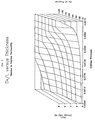
- the object of the invention to provide a contact lens material and construction wherein the permeability, Dk, of the material in combination with its thickness, L, would provide a gas transmissibility through the lens, equal to Dk/L, exceeding that attainable with current hydrogel soft contact lenses.
- the above objects of the invention are attained while maintaining the comfort level of current soft contact lenses by maintaining pliability and wettability of the lenses thus minimizing mechanical agitation of the cornea.
- the present invention achieves the above objects by recognizing that the performance and comfort characteristics achieved by current hydrated soft contact lenses need not necessarily be accomplished by the use of highly hydrated materials with a high water content.
- wearing comfort and a high refractive index can be obtained in a low water lens that also possesses the characteristics of good gas permeability, particularly for O2.
- a low water contact lens material having high 02 permeability is one in which dehydration of the lens is of little concern.
- a lower water content and reduced polymer matrix size does not allow protein or other tear components to penetrate and deposit in the lens.
- a lens with a reduced polymer matrix size has a greater index of refraction and has a greater modulus of elasticity.
- the lens can be made thin enough so that the combination of the material permeability, Dk, and thickness, L, of the lens would achieve the desired criterion for Dk/L.
- such material which would be as soft and pliable as current hydrated contact lens materials and have good surface wettability, would maintain the comfort of soft contact lenses, in contrast to the corneal agitation caused by low water contact lenses of the hard type.
- the present materials have the advantage of having free hydroxyl groups capable of inducing surface wettability without adding carbonyl monomers which lower oxygen permeability.
- such a lens is made by polymerizing and crosslinking a prepolymer which contains a cyclic polyol with polyalkylether segments containing curable segments.
- the cyclic polyols consist of alkoxylated glucose or sucrose which are then reacted with an isocyanate to produce an ultraviolet curable prepolymer.
- the prepolymer is then placed in a mold and polymerized by exposure to ultraviolet light.
- the lens can then be placed into a solution such that the free hydroxyl groups of the material react with a highly hydrophilic reagent to form covalent bonds thus making the surface of the material more wettable.
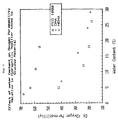
- Fig. 1 is a graph showing the relationship (theoretical and measured) between oxygen permeability and water content for a hydrogel.
- Fig. 2 is a graph showing the relationship among lens thickness, Dk of a material and material transmissibility (dk/L).
- Fig. 3 is a graph showing the relationship between water content and oxygen permeability for three materials with hydrophilic modifier added to increase water content.
- a contact lens is made of a polymer with the properties described above by first producing the prepolymer as follows.
- An ultraviolet light curable isocyanate such as isocyanoethylmethacrylate (IEM), available from Polysciences, is reacted with a polyalkylether such as polypropylene glycol, polyethylene glycol, polypropylene glycol having amine terminals, or polyethylene glycol with amine terminals.
- IEM isocyanoethylmethacrylate
- polyalkylether materials are available from: Aldrich Chemical Co, Inc., 101 West Saint Paul Avenue, Milwaukee, Wisconsin 53233; Dow Chemical USA, 611 Cascade West Parkway S.E., Midland, Michigan 49506; Fluka Chemika-BioChemika, 980 South Second Street, Ronkonoma, New York 11779; and Polysciences Inc.,400 Valley Road, Warrington, Pennsylvania 18976 in varying molecular weights from 200 to 1,000,000.
- Amine terminated polyethylene and polypropylene copolymers are commercially available under the tradename Jeffamines from Texaco Chemical Co., 4800 Forunace Place, Bellaire, Texas 74401.
- HEMA hydroxyethyl-methacrylate
- TDI toluene diisocyanate
- HEMA isophorone diisocyanate
- the amount of di-uv functional compound is kept to a minimum because the TDI and isophoronediisocyanate contain two isocyanate functional groups with two different reactivities, favoring the reaction of one group.
- urethane catalysts include triethyl amines e.g., trimethylamine, triethylamine, N,N-dimethylbenzylamine or an organo metallic urethane catalyst, such as stannous octoate, dibutyltin dilaurate or sodium acetate.
- the IEM is slowly added to the glycol over a three to four hour period. In this way the formation of the di-caped species is held to a minimum.
- the polypropylene or polyethylene glycol is in slight molar excess to the IEM to further minimize the formation of di-capped species.
- TDI isophoronediisocyanate
- isophoronediisocyanate is then reacted again with either TDI or isophoronediisocyanate to give a uv curable isocyanate.
- TDI is reacted in equal molar concentration with the PPG or PEG polymer in the presence of methylene chloride and stannous octoate over a five to eight hour period.
- TDI represents a benzo-di-isocyanate, several of which are acceptable.
- Diisocyanates that may be used include p-tetramethyl-xylene-diisocyanate, trimethyl-hexane-1, 6-diisocyanate, hexane-1,6-diisocyanate, phenylene-1,4-diisocyanate, toluene-2,6-diisocyanate, cyclohexane-1,4-diisocyanate, and most preferably toluene-2,4-diisocyanate and isophorone diisocyanate.
- the reaction product using TDI is the high molecular weight, uv curable isocyanate:
- the uv curable isocyanate produced in the immediately preceding reaction is then reacted with sucrose or glucose alkoxylated with ethylene or propylene oxide.
- the alkoxylation is to a degree that the polyol becomes soluble in an organic solvent suitable for isocyanate reactions with hydroxyl or amino functionalities.
- Aprotic solvents which are appropriate for the synthesis of the above uv-curable prepolymers include methylene chloride, chloroform, tert-butyl acetate, isopropyl acetate, N,N-dimethylformamide, phosphoric acid tri-dimethylamide, acetonitrile, acetamide, N,N-dimethylformamide, and dimethyl sulfoxide.
- Alkoxylated glucose and sucrose can be purchased from a number of sources typically with the total molecular weight of the polyethylene or polypropylene equal to 10 or 20 per molecule of glucose or sucrose.
- Cyclic polyol materials included in the above are commercially available from Amerchol Corporation, 136 Talmadge Road, Edison, New Jersey 08819, and are sold under the tradename Glucam E-10, E-20, P-10, and P-20 with the "E” denoting an ethylene oxide adduct and the number representing the number of moles of ethylene oxide added.
- the "P” denotes a propylene oxide adduct with ten and twenty moles of propylene oxide added respectively.
- Custom amounts of alkoxylation may be used, however, within the range from about a total of 5 to 50 polymer units per molecule of glucose or sucrose.
- R1 is one of the group consisting of N-aliphatic and branched aliphatic chains having between 1 and 7 carbon atoms
- R2 either of the group consisting of CH3 and H
- R4 either of the group consisting of O and NH
- a ⁇ 75 for R 2 CH 3
- a ⁇ 225 for R 2 H 5 ⁇ w + x + y + z ⁇ 50 5 ⁇ m + p + g + r + s + t + u + v + ⁇ 50
- Most cyclic polyols are soluble and reactive with isocyanates only in organic solvents which are extremely difficult to remove.
- the prepolymer is then formed by reacting the alkoxylated glucose or sucrose with the above uv curable isocyanate in methylene chloride.
- the alkoxylated glucose has 4 sites and sucrose has 8 sites available for reaction with the high molecular weight, uv curable isocyanate. At least one site must be reacted in using either the alkoxylated glucose or sucrose, but the remaining sites may either be reacted with the high molecular wight, uv-curable isocyanate or left as hydroxyl groups, depending on the desire for a high modulus (more reacted sites) or greater surface wettability (fewer reacted sites).
- the number of reacted sites, on average, is determined by the relative stoichiometry of the alkoxylated cyclic polyol and the uv curable isocyanate.
- the ratio of uv curable isocyanate to alkoxylated cyclic polyol is about 3 to 1 for glucose and 5 to 1 for sucrose to yield the desired characteristics of wettability and modulus.
- the prepolymers are polymerized with actinic radiation in the presence of a free radical initiator and a diluent non-reactive with the prepolymer.
- Acceptable inert diluents are alkanols, N,N-dimethylformamide acetamide, acetonitrile, N,N-dimethylacetamide, heptane, dimethyl sulfoxide, acetone, tert-butyl acetate, ethyl acetate, isopropyl acetate, and N-methyl-2-pyrrolidone with a low molecular weight polyproplene glycol preferred.
- Acceptable initiators are: an azo compound, e.g., 2,2-azo-bisisobutyronitrile, 2,2'-azo-bis-(2,4-dimethylvaleronitrile), 1,1'-azo-bis-(cyclohexane carbonitrile), 2,2'-azo-bis-(2,4-dimethyl-4-methoxyvaleronitrile) and phenyl-azo-isobutyronitrile; a photoinitiaor, e.g.
- the prepolymers are transferred to a mold and polymerized into a ophthalmic lens or may be spun-cast into contact lenses, with molding preferred as described in U.S. Patent 4,889,664 or 4,495,313.
- the crosslinked polymer can be equilibrated in an aqueous saline solution after polymerization at which time the crosslinked polymer swells relative to the amount of water uptake associated with the particular polymer. At this stage the polymers are dimensionally stable and can be sterilized.
- the higher modulus of the material of the present invention permits a thinner lens to be made that retains the handling characteristics of thicker current contact lenses.
- the polymer matrix of the material showed no detectable protein deposition compared to a typical high water content lens absorbing 688 micrograms of protein in artificial tears in 24 hours.
- composition and properties of polymers made using PPG and PEG of various molecular weights are given in the Table.
- Examples 13 through 16 of the Table show the composition of polymers produced with PPG/PEG mixtures which have an increased water content compared to the polymers containing only PPG.
- low water content lenses are preferred for the above reasons to reduce dehydration when placed on the eye, these higher water content lenses can be made with favorable characteristics.
- hydrophilic reagents a material can be constructed that has an increased water content of hydration and still maintains excellent physical properties (see Table). These materials have optical properties that allow the lens to be made at a reduced thickness, approximately 50 microns, and a water content of 60%, but still maintain good stiffness.
- low water content material according to the invention have superior strength and dehydration resistance resulting from the low water content and achieve Dk/L requirements because of gas permeability and thickness.
- the water content of the lens of the present invention can be increased without decreasing the oxygen permeability, Dk, of the material by adding poiyethylene glycol (PEG) during formation of the intermediate polymer.
- PEG poiyethylene glycol
Landscapes
- Chemical & Material Sciences (AREA)
- Health & Medical Sciences (AREA)
- Medicinal Chemistry (AREA)
- Chemical Kinetics & Catalysis (AREA)
- Physics & Mathematics (AREA)
- Organic Chemistry (AREA)
- Polymers & Plastics (AREA)
- Optics & Photonics (AREA)
- General Physics & Mathematics (AREA)
- Life Sciences & Earth Sciences (AREA)
- Public Health (AREA)
- Veterinary Medicine (AREA)
- General Health & Medical Sciences (AREA)
- Animal Behavior & Ethology (AREA)
- Epidemiology (AREA)
- Transplantation (AREA)
- Oral & Maxillofacial Surgery (AREA)
- Dermatology (AREA)
- Eyeglasses (AREA)
- Polyurethanes Or Polyureas (AREA)
- Materials For Medical Uses (AREA)
- Separation Using Semi-Permeable Membranes (AREA)
- Saccharide Compounds (AREA)
- Macromonomer-Based Addition Polymer (AREA)
- Addition Polymer Or Copolymer, Post-Treatments, Or Chemical Modifications (AREA)
- Prostheses (AREA)
- Macromolecular Compounds Obtained By Forming Nitrogen-Containing Linkages In General (AREA)
- Pharmaceuticals Containing Other Organic And Inorganic Compounds (AREA)
Applications Claiming Priority (2)
| Application Number | Priority Date | Filing Date | Title |
|---|---|---|---|
| US07/777,767 US5196458A (en) | 1991-10-15 | 1991-10-15 | Soft, high oxygen permeability ophthalmic lens |
| US777767 | 1991-10-15 |
Publications (3)
| Publication Number | Publication Date |
|---|---|
| EP0537877A2 true EP0537877A2 (fr) | 1993-04-21 |
| EP0537877A3 EP0537877A3 (en) | 1993-08-25 |
| EP0537877B1 EP0537877B1 (fr) | 1998-09-16 |
Family
ID=25111204
Family Applications (1)
| Application Number | Title | Priority Date | Filing Date |
|---|---|---|---|
| EP92305381A Expired - Lifetime EP0537877B1 (fr) | 1991-10-15 | 1992-06-11 | Lentille de contact souple à haute perméabilité à l'oxygène |
Country Status (24)
| Country | Link |
|---|---|
| US (2) | US5196458A (fr) |
| EP (1) | EP0537877B1 (fr) |
| JP (1) | JP3145793B2 (fr) |
| KR (1) | KR930007465A (fr) |
| CN (1) | CN1103933C (fr) |
| AT (1) | ATE171282T1 (fr) |
| AU (1) | AU656589B2 (fr) |
| BR (1) | BR9202523A (fr) |
| CA (1) | CA2071039C (fr) |
| DE (1) | DE69227002T2 (fr) |
| FI (1) | FI922711A7 (fr) |
| GR (1) | GR1002227B (fr) |
| GT (1) | GT199200037A (fr) |
| HU (1) | HU217359B (fr) |
| IE (1) | IE921894A1 (fr) |
| IL (1) | IL102234A (fr) |
| MX (1) | MX9203131A (fr) |
| NO (1) | NO922290L (fr) |
| NZ (1) | NZ243131A (fr) |
| RU (1) | RU2099761C1 (fr) |
| SG (1) | SG81850A1 (fr) |
| TW (1) | TW218922B (fr) |
| UY (1) | UY23438A1 (fr) |
| ZA (1) | ZA924329B (fr) |
Cited By (7)
| Publication number | Priority date | Publication date | Assignee | Title |
|---|---|---|---|---|
| EP0620455A3 (fr) * | 1993-04-12 | 1995-08-02 | Johnson & Johnson Vision Prod | Lentilles ophtalmiques à base de polymères réticulés par un composé succharidique. |
| WO1998003319A1 (fr) * | 1996-07-24 | 1998-01-29 | Novartis Ag | Procede de production d'articles moules |
| WO1998033834A1 (fr) * | 1997-02-04 | 1998-08-06 | Novartis Ag | Article ophtalmique moule |
| AU727156B2 (en) * | 1997-02-04 | 2000-12-07 | Novartis Ag | Moulded ophthalmic article |
| US6190603B1 (en) | 1997-07-19 | 2001-02-20 | Novartis Ag | Process for producing mouldings |
| US6221303B1 (en) * | 1997-02-21 | 2001-04-24 | Novartis Ag | Ophthalmic mouldings |
| EP1873180A1 (fr) * | 2002-08-14 | 2008-01-02 | Novartis AG | Dispositif ophtalmique fabriqué à partir d'un prépolymère durcissable par radiation |
Families Citing this family (30)
| Publication number | Priority date | Publication date | Assignee | Title |
|---|---|---|---|---|
| US5196458A (en) * | 1991-10-15 | 1993-03-23 | Johnson & Johnson Vision Products, Inc. | Soft, high oxygen permeability ophthalmic lens |
| TW307775B (en) * | 1994-02-15 | 1997-06-11 | Novartis Erfind Verwalt Gmbh | Unsaturated carbohydrate derivatives, polymers thereof and their use |
| US5648402A (en) * | 1995-06-01 | 1997-07-15 | Nunez; Ivan M. | Contact lenses from highly permeable siloxane polyol material |
| ATE223933T1 (de) * | 1995-12-22 | 2002-09-15 | Novartis Erfind Verwalt Gmbh | Polyurethane aus polysiloxan-polyol-makromeren |
| US6482531B1 (en) | 1996-04-16 | 2002-11-19 | Board Of Regents, The University Of Texas System | Non-fouling, wettable coated devices |
| US6329024B1 (en) | 1996-04-16 | 2001-12-11 | Board Of Regents, The University Of Texas System | Method for depositing a coating comprising pulsed plasma polymerization of a macrocycle |
| AU9326598A (en) * | 1997-11-24 | 1999-06-10 | Johnson & Johnson Vision Products, Inc. | Polymeric ophthalmic lens with crosslinker containing saccharide residue |
| US6822016B2 (en) | 2001-09-10 | 2004-11-23 | Johnson & Johnson Vision Care, Inc. | Biomedical devices containing internal wetting agents |
| US20070043140A1 (en) * | 1998-03-02 | 2007-02-22 | Lorenz Kathrine O | Method for the mitigation of symptoms of contact lens related dry eye |
| US7052131B2 (en) | 2001-09-10 | 2006-05-30 | J&J Vision Care, Inc. | Biomedical devices containing internal wetting agents |
| US7461937B2 (en) * | 2001-09-10 | 2008-12-09 | Johnson & Johnson Vision Care, Inc. | Soft contact lenses displaying superior on-eye comfort |
| US6592816B1 (en) | 1999-03-01 | 2003-07-15 | Johnson & Johnson Vision Care, Inc. | Sterilization system |
| US7879288B2 (en) * | 1999-03-01 | 2011-02-01 | Johnson & Johnson Vision Care, Inc. | Method and apparatus of sterilization using monochromatic UV radiation source |
| US20070138692A1 (en) * | 2002-09-06 | 2007-06-21 | Ford James D | Process for forming clear, wettable silicone hydrogel articles |
| US7368127B2 (en) * | 2002-12-19 | 2008-05-06 | Johnson & Johnson Vision Care, Inc. | Biomedical devices with peptide containing coatings |
| US20040120982A1 (en) * | 2002-12-19 | 2004-06-24 | Zanini Diana | Biomedical devices with coatings attached via latent reactive components |
| US7977430B2 (en) * | 2003-11-25 | 2011-07-12 | Novartis Ag | Crosslinkable polyurea prepolymers |
| MY144221A (en) * | 2004-03-03 | 2011-08-15 | Polynovo Biomaterials Pty Ltd | Biocompatible polymer compositions for dual or multistaged curing. |
| US20080102122A1 (en) * | 2006-10-31 | 2008-05-01 | Shivkumar Mahadevan | Antimicrobial polymeric articles, processes to prepare them and methods of their use |
| KR101482808B1 (ko) * | 2007-03-22 | 2015-01-14 | 노파르티스 아게 | 현수 폴리실록산-함유 중합체 사슬이 있는 예비중합체 |
| US20090244479A1 (en) * | 2008-03-31 | 2009-10-01 | Diana Zanini | Tinted silicone ophthalmic devices, processes and polymers used in the preparation of same |
| AU2009327484B2 (en) * | 2008-12-18 | 2012-08-09 | Novartis Ag | Method for making silicone hydrogel contact lenses |
| CN104321405B (zh) * | 2012-05-23 | 2018-04-06 | 巴斯夫欧洲公司 | 水润湿油湿表面的方法 |
| US9423528B2 (en) | 2012-06-25 | 2016-08-23 | Johnson & Johnson Vision Care, Inc. | Method of making silicone containing contact lens with reduced amount of diluents |
| US9395468B2 (en) | 2012-08-27 | 2016-07-19 | Ocular Dynamics, Llc | Contact lens with a hydrophilic layer |
| AU2014348502B2 (en) | 2013-11-15 | 2019-08-15 | Tangible Science, Inc. | Contact lens with a hydrophilic layer |
| KR101533075B1 (ko) * | 2014-03-31 | 2015-07-02 | (주)비젼사이언스 | 생체친화형 소프트 콘택트렌즈 및 이의 제조방법 |
| CN107206119B (zh) | 2014-12-09 | 2021-01-29 | 实体科学公司 | 具有生物相容性层的医疗设备涂层 |
| KR101949147B1 (ko) * | 2017-11-10 | 2019-05-20 | 주식회사 인터로조 | 오팔광택 콘택트렌즈 및 이의 제조방법 |
| CN115895164B (zh) * | 2022-09-30 | 2026-02-06 | 南京大学 | 一种快速溶胀、酶催化降解水凝胶及其制备方法和应用 |
Family Cites Families (13)
| Publication number | Priority date | Publication date | Assignee | Title |
|---|---|---|---|---|
| US3225012A (en) * | 1962-09-20 | 1965-12-21 | William A P Black | Carbohydrate derived polyamides |
| US3356652A (en) * | 1964-03-17 | 1967-12-05 | Nat Starch Chem Corp | Novel monomeric sugar derivatives |
| US4465827A (en) * | 1978-12-29 | 1984-08-14 | Kureha Kagaku Kogyo Kabushiki Kaisha | Process for preparing high polymeric substance having saccharide side chains |
| SU862567A1 (ru) * | 1979-08-08 | 1983-01-23 | Ордена Трудового Красного Знамени Институт Химии Древесины Ан Латвсср | Производные 1,6-ангидро- @ -D-глюкопиранозы дл трехмерной полимеризации |
| CA1187645A (fr) * | 1981-01-12 | 1985-05-21 | Kyoichi Tanaka | Lentille corneenne, et sa preparation |
| US4780488A (en) * | 1986-08-29 | 1988-10-25 | Ciba-Geigy Corporation | Wettable, flexible, oxygen permeable, substantially non-swellable contact lens containing polyoxyalkylene backbone units, and use thereof |
| US4820810A (en) * | 1986-10-30 | 1989-04-11 | Arco Chemical Technology, Inc. | Urea catalyst for preparation of sucrose polyols useful for rigid polyurethane foams |
| ATE114058T1 (de) * | 1988-02-26 | 1994-11-15 | Ciba Geigy Ag | Benetzungsfähige, harte, gasdurchlässige, nichtquellende kontaktlinse. |
| DE68928089T2 (de) * | 1988-02-26 | 1997-12-18 | Ciba Geigy Ag | Benetzbares, biegsames, sauerstoffdurchlässiges, quellbares Polymer mit Polyoxyalkyleneinheiten in der Hauptkette und Kontaktlinse |
| ATE120014T1 (de) * | 1988-02-26 | 1995-04-15 | Ciba Geigy Ag | Benetzbare, flexible und sauerstoff durchlassende kontaktlinsen auf der basis von polyoxyalkyleneinheiten und ihre verwendung. |
| ATE118797T1 (de) * | 1989-01-11 | 1995-03-15 | Ciba Geigy Ag | Perfluorpolyalkylether- und polyalkylether- segmente enthaltende vinylmakromere, daraus hergestellte polymere, interpolymere sowie ophthalmische vorrichtungen. |
| US5115056A (en) * | 1989-06-20 | 1992-05-19 | Ciba-Geigy Corporation | Fluorine and/or silicone containing poly(alkylene-oxide)-block copolymers and contact lenses thereof |
| US5196458A (en) * | 1991-10-15 | 1993-03-23 | Johnson & Johnson Vision Products, Inc. | Soft, high oxygen permeability ophthalmic lens |
-
1991
- 1991-10-15 US US07/777,767 patent/US5196458A/en not_active Expired - Lifetime
-
1992
- 1992-06-11 HU HU9201952A patent/HU217359B/hu not_active IP Right Cessation
- 1992-06-11 NO NO92922290A patent/NO922290L/no unknown
- 1992-06-11 EP EP92305381A patent/EP0537877B1/fr not_active Expired - Lifetime
- 1992-06-11 FI FI922711A patent/FI922711A7/fi unknown
- 1992-06-11 DE DE69227002T patent/DE69227002T2/de not_active Expired - Lifetime
- 1992-06-11 CA CA002071039A patent/CA2071039C/fr not_active Expired - Lifetime
- 1992-06-11 AT AT92305381T patent/ATE171282T1/de active
- 1992-06-11 SG SG9600907A patent/SG81850A1/en unknown
- 1992-06-12 ZA ZA924329A patent/ZA924329B/xx unknown
- 1992-06-12 GR GR920100269A patent/GR1002227B/el unknown
- 1992-06-12 NZ NZ243131A patent/NZ243131A/en unknown
- 1992-06-15 AU AU18245/92A patent/AU656589B2/en not_active Expired
- 1992-06-17 IL IL10223492A patent/IL102234A/en not_active IP Right Cessation
- 1992-06-18 JP JP18282892A patent/JP3145793B2/ja not_active Expired - Lifetime
- 1992-06-23 MX MX9203131A patent/MX9203131A/es not_active IP Right Cessation
- 1992-06-26 GT GT199200037A patent/GT199200037A/es unknown
- 1992-06-26 UY UY23438A patent/UY23438A1/es unknown
- 1992-06-29 CN CN92109184A patent/CN1103933C/zh not_active Expired - Lifetime
- 1992-06-29 KR KR1019920011438A patent/KR930007465A/ko not_active Abandoned
- 1992-07-01 IE IE189492A patent/IE921894A1/en not_active IP Right Cessation
- 1992-07-04 TW TW081105297A patent/TW218922B/zh active
- 1992-07-08 BR BR929202523A patent/BR9202523A/pt not_active Application Discontinuation
- 1992-07-30 RU SU925052537A patent/RU2099761C1/ru active
- 1992-11-23 US US07/979,969 patent/US5304584A/en not_active Expired - Lifetime
Cited By (10)
| Publication number | Priority date | Publication date | Assignee | Title |
|---|---|---|---|---|
| EP0620455A3 (fr) * | 1993-04-12 | 1995-08-02 | Johnson & Johnson Vision Prod | Lentilles ophtalmiques à base de polymères réticulés par un composé succharidique. |
| GR1002568B (el) * | 1993-04-12 | 1997-02-03 | Johnson & Johnson Vision Products Inc. | Πολυμερης οφθαλμικος φακος με διασυνδετη που περιεχει σακχαριδικο υπολειμμα. |
| WO1998003319A1 (fr) * | 1996-07-24 | 1998-01-29 | Novartis Ag | Procede de production d'articles moules |
| WO1998033834A1 (fr) * | 1997-02-04 | 1998-08-06 | Novartis Ag | Article ophtalmique moule |
| EP0867456A1 (fr) * | 1997-02-04 | 1998-09-30 | Novartis AG | Objet ophtalmique moulé |
| AU727156B2 (en) * | 1997-02-04 | 2000-12-07 | Novartis Ag | Moulded ophthalmic article |
| US6165408A (en) * | 1997-02-04 | 2000-12-26 | Novartis Ag | Moulded ophthalmic article |
| US6221303B1 (en) * | 1997-02-21 | 2001-04-24 | Novartis Ag | Ophthalmic mouldings |
| US6190603B1 (en) | 1997-07-19 | 2001-02-20 | Novartis Ag | Process for producing mouldings |
| EP1873180A1 (fr) * | 2002-08-14 | 2008-01-02 | Novartis AG | Dispositif ophtalmique fabriqué à partir d'un prépolymère durcissable par radiation |
Also Published As
Similar Documents
| Publication | Publication Date | Title |
|---|---|---|
| EP0537877B1 (fr) | Lentille de contact souple à haute perméabilité à l'oxygène | |
| CA1258935A (fr) | Polymeres forts a teneur de silicone, hautement permeables a l'oxygene | |
| EP0675910B1 (fr) | Nouveaux macromonomeres | |
| KR0179995B1 (ko) | 생체의학적 장치에 유용한 예비 중합체 | |
| JP2744276B2 (ja) | ポリシロキサン−ポリオキシアルキレンブロックコポリマー骨格単位を有する、湿潤性、可撓性で酸素透過性のコンタクトレンズ | |
| EP0395583B1 (fr) | Lentille de contact souple, mouillable et perméable à l'oxygène contenant dans la chaîne principale des unités d'un copolymère séquencé polysiloxane-poly-(oxyalkylène) | |
| US4929692A (en) | Crosslinked copolymers and ophthalmic devices made from vinylic macromers containing perfluoropolyalkyl ether and polyalkyl ether segments and minor amounts of vinylic comonomers | |
| JPH0826152B2 (ja) | 不飽和ポリシロキサン | |
| CA2222608A1 (fr) | Macromonomeres de siloxane polymerisables | |
| US7781554B2 (en) | Polysiloxanes and polysiloxane prepolymers with vinyl or epoxy functionality | |
| EP0379462B1 (fr) | Macromères vinyliques contenant des segments de perfluoropolyalkyléther et de polyalkyléther, polymères, copolymères et dispositifs ophtalmiques préparés à partir de ceux-ci | |
| EP0745871B1 (fr) | Lentilles de contact fabriquées à partir d'un polyol polysiloxane à haute perméabilité | |
| HK1000286B (en) | Vinylic macromers containing perfluoropolyalkylether and polyalkylether segments, polymers, copolymers and ophthalmic devices made therefrom | |
| CN1040221C (zh) | 聚氨酯形成过程中硬链段大小的控制 | |
| US4933408A (en) | Vinylic macromers containing perfluoropolyalkyl ether and polyalkyl ether segments, polymers and opthalmic devices made therefrom | |
| EP0330617A1 (fr) | Lentille de contact perméable à l'oxygène, flexible, mouillable, contenant un copolymère séquencé avec tronc à unités polysiloxane polyoxyalkylène | |
| CN102348681A (zh) | 用于形成水凝胶的单体和大分子单体 | |
| US5075106A (en) | Vinylic macromers containing perfluoropolyalkylether and polyalkylether segments, polymers and ophthalmic devices made therefrom | |
| HK1001590B (en) | Novel macromonomers |
Legal Events
| Date | Code | Title | Description |
|---|---|---|---|
| PUAI | Public reference made under article 153(3) epc to a published international application that has entered the european phase |
Free format text: ORIGINAL CODE: 0009012 |
|
| AK | Designated contracting states |
Kind code of ref document: A2 Designated state(s): AT BE CH DE DK ES FR GB IT LI LU NL PT SE |
|
| PUAL | Search report despatched |
Free format text: ORIGINAL CODE: 0009013 |
|
| AK | Designated contracting states |
Kind code of ref document: A3 Designated state(s): AT BE CH DE DK ES FR GB IT LI LU NL PT SE |
|
| 17P | Request for examination filed |
Effective date: 19940203 |
|
| 17Q | First examination report despatched |
Effective date: 19960109 |
|
| GRAG | Despatch of communication of intention to grant |
Free format text: ORIGINAL CODE: EPIDOS AGRA |
|
| GRAG | Despatch of communication of intention to grant |
Free format text: ORIGINAL CODE: EPIDOS AGRA |
|
| GRAG | Despatch of communication of intention to grant |
Free format text: ORIGINAL CODE: EPIDOS AGRA |
|
| GRAH | Despatch of communication of intention to grant a patent |
Free format text: ORIGINAL CODE: EPIDOS IGRA |
|
| GRAH | Despatch of communication of intention to grant a patent |
Free format text: ORIGINAL CODE: EPIDOS IGRA |
|
| GRAA | (expected) grant |
Free format text: ORIGINAL CODE: 0009210 |
|
| AK | Designated contracting states |
Kind code of ref document: B1 Designated state(s): AT BE CH DE DK ES FR GB IT LI LU NL PT SE |
|
| PG25 | Lapsed in a contracting state [announced via postgrant information from national office to epo] |
Ref country code: NL Free format text: LAPSE BECAUSE OF FAILURE TO SUBMIT A TRANSLATION OF THE DESCRIPTION OR TO PAY THE FEE WITHIN THE PRESCRIBED TIME-LIMIT Effective date: 19980916 Ref country code: ES Free format text: THE PATENT HAS BEEN ANNULLED BY A DECISION OF A NATIONAL AUTHORITY Effective date: 19980916 Ref country code: BE Free format text: LAPSE BECAUSE OF FAILURE TO SUBMIT A TRANSLATION OF THE DESCRIPTION OR TO PAY THE FEE WITHIN THE PRESCRIBED TIME-LIMIT Effective date: 19980916 Ref country code: AT Free format text: LAPSE BECAUSE OF FAILURE TO SUBMIT A TRANSLATION OF THE DESCRIPTION OR TO PAY THE FEE WITHIN THE PRESCRIBED TIME-LIMIT Effective date: 19980916 |
|
| REF | Corresponds to: |
Ref document number: 171282 Country of ref document: AT Date of ref document: 19981015 Kind code of ref document: T |
|
| REG | Reference to a national code |
Ref country code: CH Ref legal event code: EP |
|
| REG | Reference to a national code |
Ref country code: CH Ref legal event code: NV Representative=s name: E. BLUM & CO. PATENTANWAELTE |
|
| REF | Corresponds to: |
Ref document number: 69227002 Country of ref document: DE Date of ref document: 19981022 |
|
| PG25 | Lapsed in a contracting state [announced via postgrant information from national office to epo] |
Ref country code: SE Free format text: LAPSE BECAUSE OF FAILURE TO SUBMIT A TRANSLATION OF THE DESCRIPTION OR TO PAY THE FEE WITHIN THE PRESCRIBED TIME-LIMIT Effective date: 19981216 Ref country code: DK Free format text: LAPSE BECAUSE OF FAILURE TO SUBMIT A TRANSLATION OF THE DESCRIPTION OR TO PAY THE FEE WITHIN THE PRESCRIBED TIME-LIMIT Effective date: 19981216 |
|
| ET | Fr: translation filed | ||
| PG25 | Lapsed in a contracting state [announced via postgrant information from national office to epo] |
Ref country code: PT Free format text: LAPSE BECAUSE OF FAILURE TO SUBMIT A TRANSLATION OF THE DESCRIPTION OR TO PAY THE FEE WITHIN THE PRESCRIBED TIME-LIMIT Effective date: 19981218 |
|
| NLV1 | Nl: lapsed or annulled due to failure to fulfill the requirements of art. 29p and 29m of the patents act | ||
| PG25 | Lapsed in a contracting state [announced via postgrant information from national office to epo] |
Ref country code: LU Free format text: LAPSE BECAUSE OF NON-PAYMENT OF DUE FEES Effective date: 19990611 |
|
| PLBE | No opposition filed within time limit |
Free format text: ORIGINAL CODE: 0009261 |
|
| STAA | Information on the status of an ep patent application or granted ep patent |
Free format text: STATUS: NO OPPOSITION FILED WITHIN TIME LIMIT |
|
| 26N | No opposition filed | ||
| REG | Reference to a national code |
Ref country code: GB Ref legal event code: IF02 |
|
| PGFP | Annual fee paid to national office [announced via postgrant information from national office to epo] |
Ref country code: CH Payment date: 20040616 Year of fee payment: 13 |
|
| PG25 | Lapsed in a contracting state [announced via postgrant information from national office to epo] |
Ref country code: LI Free format text: LAPSE BECAUSE OF NON-PAYMENT OF DUE FEES Effective date: 20050630 Ref country code: CH Free format text: LAPSE BECAUSE OF NON-PAYMENT OF DUE FEES Effective date: 20050630 |
|
| REG | Reference to a national code |
Ref country code: CH Ref legal event code: PL |
|
| PGFP | Annual fee paid to national office [announced via postgrant information from national office to epo] |
Ref country code: FR Payment date: 20110621 Year of fee payment: 20 |
|
| PGFP | Annual fee paid to national office [announced via postgrant information from national office to epo] |
Ref country code: GB Payment date: 20110608 Year of fee payment: 20 |
|
| PGFP | Annual fee paid to national office [announced via postgrant information from national office to epo] |
Ref country code: IT Payment date: 20110620 Year of fee payment: 20 Ref country code: DE Payment date: 20110608 Year of fee payment: 20 |
|
| REG | Reference to a national code |
Ref country code: DE Ref legal event code: R071 Ref document number: 69227002 Country of ref document: DE |
|
| REG | Reference to a national code |
Ref country code: DE Ref legal event code: R071 Ref document number: 69227002 Country of ref document: DE |
|
| REG | Reference to a national code |
Ref country code: GB Ref legal event code: PE20 Expiry date: 20120610 |
|
| PG25 | Lapsed in a contracting state [announced via postgrant information from national office to epo] |
Ref country code: DE Free format text: LAPSE BECAUSE OF EXPIRATION OF PROTECTION Effective date: 20120612 |
|
| PG25 | Lapsed in a contracting state [announced via postgrant information from national office to epo] |
Ref country code: GB Free format text: LAPSE BECAUSE OF EXPIRATION OF PROTECTION Effective date: 20120610 |