EP0537943A1 - Membranes composites et procédé pour leur fabrication - Google Patents
Membranes composites et procédé pour leur fabrication Download PDFInfo
- Publication number
- EP0537943A1 EP0537943A1 EP92309147A EP92309147A EP0537943A1 EP 0537943 A1 EP0537943 A1 EP 0537943A1 EP 92309147 A EP92309147 A EP 92309147A EP 92309147 A EP92309147 A EP 92309147A EP 0537943 A1 EP0537943 A1 EP 0537943A1
- Authority
- EP
- European Patent Office
- Prior art keywords
- support
- sol
- ceramic
- metal
- gel
- Prior art date
- Legal status (The legal status is an assumption and is not a legal conclusion. Google has not performed a legal analysis and makes no representation as to the accuracy of the status listed.)
- Granted
Links
Images


Classifications
-
- B—PERFORMING OPERATIONS; TRANSPORTING
- B01—PHYSICAL OR CHEMICAL PROCESSES OR APPARATUS IN GENERAL
- B01D—SEPARATION
- B01D67/00—Processes specially adapted for manufacturing semi-permeable membranes for separation processes or apparatus
- B01D67/0039—Inorganic membrane manufacture
- B01D67/0048—Inorganic membrane manufacture by sol-gel transition
-
- B—PERFORMING OPERATIONS; TRANSPORTING
- B01—PHYSICAL OR CHEMICAL PROCESSES OR APPARATUS IN GENERAL
- B01D—SEPARATION
- B01D67/00—Processes specially adapted for manufacturing semi-permeable membranes for separation processes or apparatus
- B01D67/0081—After-treatment of organic or inorganic membranes
- B01D67/0083—Thermal after-treatment
-
- C—CHEMISTRY; METALLURGY
- C23—COATING METALLIC MATERIAL; COATING MATERIAL WITH METALLIC MATERIAL; CHEMICAL SURFACE TREATMENT; DIFFUSION TREATMENT OF METALLIC MATERIAL; COATING BY VACUUM EVAPORATION, BY SPUTTERING, BY ION IMPLANTATION OR BY CHEMICAL VAPOUR DEPOSITION, IN GENERAL; INHIBITING CORROSION OF METALLIC MATERIAL OR INCRUSTATION IN GENERAL
- C23C—COATING METALLIC MATERIAL; COATING MATERIAL WITH METALLIC MATERIAL; SURFACE TREATMENT OF METALLIC MATERIAL BY DIFFUSION INTO THE SURFACE, BY CHEMICAL CONVERSION OR SUBSTITUTION; COATING BY VACUUM EVAPORATION, BY SPUTTERING, BY ION IMPLANTATION OR BY CHEMICAL VAPOUR DEPOSITION, IN GENERAL
- C23C26/00—Coating not provided for in groups C23C2/00 - C23C24/00
-
- B—PERFORMING OPERATIONS; TRANSPORTING
- B01—PHYSICAL OR CHEMICAL PROCESSES OR APPARATUS IN GENERAL
- B01D—SEPARATION
- B01D2323/00—Details relating to membrane preparation
- B01D2323/08—Specific temperatures applied
- B01D2323/081—Heating
-
- B—PERFORMING OPERATIONS; TRANSPORTING
- B01—PHYSICAL OR CHEMICAL PROCESSES OR APPARATUS IN GENERAL
- B01D—SEPARATION
- B01D2325/00—Details relating to properties of membranes
- B01D2325/04—Characteristic thickness
Definitions
- the present invention relates to membranes useful in micro-filtration and ultrafiltration processes. More particularly, the present invention is concerned with a novel composite membrane.
- Membranes containing physical pores have been used in a variety of separations such as filtration, microfiltration, ultrafiltration, and reverse osmosis.
- the size of the pore structure in the membrane is an important factor in determining the type of separation in which the membrane can be used.
- Membranes with pore sizes greater than about 10 ⁇ m are generally used for filtration, while microfiltration utilizes membranes with pore sizes in the range of 10 ⁇ m to 0.1 ⁇ m and ultrafiltration utilizes membranes with pore sizes less than about 0.1 ⁇ m.
- the layer containing the small (less than about .25 ⁇ m) pores is advantageous to make the layer containing the small (less than about .25 ⁇ m) pores as thin as possible.
- One way of achieving this is to construct an asymmetric membrane structure in which a small pore layer is composited with layers having larger pores.
- the small pore layer is the active micro or ultrafiltration membrane, while the larger pore layer or layers provide mechanical strength without significantly reducing the flux through the membrane.
- Asymmetric membrane structures are routinely made from polymeric materials. By controlling the casting and drying conditions, it is possible to obtain a thin, small pore layer on one side of a sheet which has large pores.
- Polymeric asymmetric membranes have been extensively used in ultrafiltration applications; however, polymeric membranes can only be used in low temperature ( ⁇ 150°C) applications because of their thermal unstability and they cannot be cleaned with strong acids, bases and oxidizing agents once they have been fouled because of their chemical reactivity.
- asymmetric membrane structures made entirely from ceramic materials. These asymmetric inorganic membrane structures have several attractive features including: (1) high temperature stability, (2) an ultrafine pore structure in the asymmetric layer which can be fabricated in sizes ranging from about 5 ⁇ to 2500 ⁇ , and (3) relatively high permeabilities due to the thinness of the asymmetric layer.
- modules made using these membranes have not been extensively utilized in industrial processes because of the relatively high cost per unit active area and because of issues associated with the possibility of catastrophic failure of the ceramic elements.
- the present invention seeks to provide structurally sound micro and ultrafiltration membranes. Another object of the present invention is to provide a new thermally and chemically stable membrane structure.
- the present invention provides a novel, porous, composite membrane comprising a metallic support having large pores and a microporous ceramic membrane deposited on the support and integral therewith.
- the support is steel having pores, i.e., pore diameters, in the range of from about .25 ⁇ m to about 50 ⁇ m and the ceramic membrane is alumina having pores ranging from about 5 ⁇ to about 2500 ⁇ .
- a method for forming a metal-ceramic composite membrane structure comprising: providing a metal support having large pores therein, the support having a first surface and a second surface; forming a ceramic gel on the first surface of the support; and thereafter calcining the ceramic gel at a temperature and for a time sufficient to form a microporous ceramic layer which is integral with the support, whereby a component metal-ceramic membrane is formed.
- the composite metal-ceramic membrane of the present invention has a large pore metal layer and a small pore ceramic layer.
- the metal layer which acts as a high permeability mechanical support for the ceramic layer, preferably has pores with sizes greater than about .25 ⁇ m and less than about 50 ⁇ m. In a preferred embodiment, pores of the metal layer are in the range between .25 ⁇ m and 5 ⁇ m.
- the metals suitable as porous supports are stainless steel and other iron alloys, titanium, nickel, silver and copper. Particularly preferred is porous stainless steel which is commercially available in a variety of pore sizes ranging from .2 to 10 ⁇ m.
- a small pore ceramic layer is formed directly on the metal layer and has pores preferably in the range between about 5 ⁇ and about 2500 ⁇ .
- the ceramic materials suitable for use in the composite membrane are alumina, zirconia, titania, silica, ceria and mixtures thereof. Alumina is preferred.
- the thickness of the ceramic layer should be preferably less than about 50 ⁇ m. To avoid problems with pinholes, the thickness of the ceramic layer should be preferably significantly greater than about .01 ⁇ m. In a preferred embodiment, the thickness of the ceramic layer is less than 10 ⁇ m and greater than .1 ⁇ m.
- the large pore metal layer provides mechanical support for the fine pore ceramic layer.
- the metal layer should be thicker than the ceramic layer, but not so thick so as to hinder transport through the composite membrane. This requirement can be met with porous metal layers thicker than about 5 ⁇ m and thinner than about 5 cm. In a preferred embodiment, the metal is thicker than 25 ⁇ m and thinner than 1 mm.
- the metal-ceramic membrane of the present invention is prepared by forming the ceramic membrane directly on one surface of the metal support. This is conveniently achieved by depositing a ceramic sol on one surface of the support, converting the sol to a gel, and then calcining the gel at a temperature and for a time sufficient to form the microporous ceramic layer.
- the ceramic layer will be alumina and the metal layer will be stainless steel; however, it will be appreciated that the techniques are applicable to other ceramics and metal support layers.
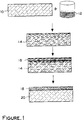
- the first technique uses pH induced surface gelation of a boehmite sol to form an alumina membrane on a porous stainless steel metal support.
- a viscous liquid base 12 is added to a porous stainless steel support 10.
- the viscous base 12 floods the pore structure of support 10 resulting in structure 14.
- the base 12 forms a film over at least some of the internal pore structure as well as the exterior surface of the membrane.
- the base should have a viscosity sufficient to produce that effect.
- the base must be capable of inducing gelation of the sol.
- bases examples include hydroxides such as ammonium hydroxide, organoammonium hydroxides like tetraalkyl, aryl and aralkyl ammonium hydroxides.
- a boehmite sol is then coated as a thin film 16 over the exterior surface of the base flooded structure 14.
- a surfactant may be added to the sol in amounts sufficient to prevent or inhibit cracking of the sol on drying and calcining. Typically, from about 0.01 to about 0.1 wt.% of surfactant is useful.
- the porous alumina layer 18 is formed by successively drying and calcining the interfacially gelled sol. The calcining is performed with a carefully controlled time/temperature cycle which determines the ultimate pore structure in the alumina layer 18.
- the sol coated substrate is heated from ambient temperature to an end temperature in the range of from about 300°C to about 1000°C at a heating rate of from about 5°C to about 100°C per hour and, preferably, from about 10°C to about 20°C per hour.
- the heated calcined composite is heat soaked at the selected end temperature for about 6 to about 48 hours.
- the porous ceramic layer 18 is well adhered to the surface of the porous metal 20.
- the composite structure consisting of a porous ceramic layer 18 and the porous metal 20 form the composite metal/ceramic membrane structure.
- a boehmite sol 26 is coated on the surface of metal support 24.
- coating of the metal support 24 by the sol 26 without significant invasion of the bulk of the metal pores can be achieved.
- a sol having a viscosity of from about 2 to about 10 centistokes can be readily coated on the surface of a metal support having a pore size less than about 2 ⁇ m.
- the viscosity of the sol has to be increased to prevent it from invading the bulk of the metal pore structure.
- a thickener such as a polymer can be added to the sol in an amount sufficient to increase the viscosity of the sol to greater than 10 centistokes, and in a preferred embodiment, the amount of polymer added to the sol is sufficient to increase the viscosity of the resulting sol to more than 50 centistokes.
- Typical polymers include starch and water soluble polymers such as methylcellulose and polyvinylalcohol. To prevent cracks from forming during the curing of the deposited sol layer, it is often advantageous to add a nonionic surfactant to the polymer + sol mixture.
- Typical surfactants useful include nonionic surfactants such as alkylphenyl polyether alcohols and cationic surfactants such as sodium lauryl sulfate.
- the sol is air dried, thereby forming a ceramic gel.
- the gel is then calcined using a carefully controlled time-temperate cycle, as previously described in connection with the first technique.
- a porous ceramic layer 28 is well adhered to the porous metal 30 and the overall structure forms the composite membrane.
- porous ceramic/metal membranes Several uses exist for composite porous ceramic/metal membranes.
- the pore size of the membranes makes them suited to micro-filtration and ultrafiltration applications. Because they are chemically inert to many reagents, they can be chemically cleaned if they foul. For example, they are inert to strong peroxide and bleach solutions which cannot be used to clean fouled polymeric membranes. Their thermal stability makes them suited for a variety of high temperature filtration applications which cannot be addressed with polymer membranes.
- a composite alumina/steel membrane was formed by pH induced surface gelation.
- the porous steel used was formed into a 2 mm thick sheet with a porosity of about 40% and an average pore size near 6 ⁇ m.
- the steel was first flooded with benzyltrimethyl ammonium hydroxide.
- Benzyltrimethyl ammonium hydroxide is an oily base and was coated into the porous stainless steel to guarantee that the ceramic layer (created in later steps) forms only on the surface.
- the benzyltrimethyl ammonium hydroxide was coated so that it forms a thin film covering the pore structure.
- the benzyltrimethyl ammonium hydroxide is coated by flowing a 25% solution of the base in methanol through the porous steel sheet. When the alcohol evaporates, a thin film of benzyltrimethyl ammonium is left coating the pore structure.
- a boehmite sol was rapidly flooded over the base coated porous steel sheet. After about 20 seconds, excess sol was drained off, leaving a gel coating on one surface of the porous metal sheet.
- Boehmite is an alumina sol which is readily gelled by contact with base and the base in the metal pore structure caused the sol to gel near the surface of the porous metal sheet.
- Concentration of the boehmite sol flooded onto the porous metal surface was 10%. In general, the concentration of the boehmite sol should be in the 25 mole % or less regime. Higher concentrations produce thick coatings which tend to crack.
- Triton 100 was added to the sol before it was applied to the porous sheet. Ten drops of the surfactant were added to about 100 ml of the sol. Triton 100 is the trade name for one of a series of nonionic alkylphenyl polyether alcohols sold by Rhom and Haas Company, Philadelphia, Pennsylvania.
- the gel coating on the porous steel was air dried before it was fired to produce the final ceramic layer. Slowly drying the gel coating in a high humidity atmosphere tends to produce crack free films after the final thermal curing cycle.
- the air dried sol-gel layer can be cured into a hard porous ceramic coating by air firing using a carefully controlled time-temperature cycle. To obtain a ceramic layer, air dried sols were heated in an oven with the temperature increasing at the rate of 10°C/hr. to a maximum temperature of about 400°C. The resulting pore distribution in the ceramic layer was characterized using gas adsorption measurements. Results obtained from one of these measurements are summarized in Figure 3. It is seen that most of the pores have dimensions below 50 ⁇ , which was consistent with the curing cycle used to prepare the ceramic layer.
- the pore size produced in the thermal curing cycle depends on the maximum firing temperature and the rate at which the temperature is increased. By varying the rate at which the temperature is ramped and the final firing temperature, it is possible to produce narrow pore distributions with sizes from about 30-1,000 ⁇ .
- a composite alumina/steel membrane was formed by dip coating a solution containing boehmite and water soluble polymer.
- the porous steel sheet was identical to that used in Example 1.
- the water soluble polymer was used to increase the viscosity of the boehmite sol.
- the polymer used was a commercially available material, methylcellulose.
- a solution containing about 10% boehmite, about 1% methylcellulose and .05% of the nonionic surfactant Triton 100 (described in Example 1) was used.
- the nonionic surfactant was added to the polymer and sol solution to improve the quality of the final ceramic film. Improvement of the coating quality comes mainly from the tendency of nonionic surfactant to reduce cracking in the final coating.
Landscapes
- Chemical & Material Sciences (AREA)
- Chemical Kinetics & Catalysis (AREA)
- Engineering & Computer Science (AREA)
- Inorganic Chemistry (AREA)
- Manufacturing & Machinery (AREA)
- Materials Engineering (AREA)
- Dispersion Chemistry (AREA)
- Mechanical Engineering (AREA)
- Metallurgy (AREA)
- Organic Chemistry (AREA)
- Physics & Mathematics (AREA)
- Thermal Sciences (AREA)
- Separation Using Semi-Permeable Membranes (AREA)
Applications Claiming Priority (2)
| Application Number | Priority Date | Filing Date | Title |
|---|---|---|---|
| US775656 | 1991-10-10 | ||
| US07/775,656 US5186833A (en) | 1991-10-10 | 1991-10-10 | Composite metal-ceramic membranes and their fabrication |
Publications (2)
| Publication Number | Publication Date |
|---|---|
| EP0537943A1 true EP0537943A1 (fr) | 1993-04-21 |
| EP0537943B1 EP0537943B1 (fr) | 1999-12-29 |
Family
ID=25105073
Family Applications (1)
| Application Number | Title | Priority Date | Filing Date |
|---|---|---|---|
| EP92309147A Expired - Lifetime EP0537943B1 (fr) | 1991-10-10 | 1992-10-08 | Membranes composites et procédé pour leur fabrication |
Country Status (5)
| Country | Link |
|---|---|
| US (1) | US5186833A (fr) |
| EP (1) | EP0537943B1 (fr) |
| JP (1) | JPH05192546A (fr) |
| CA (1) | CA2078743A1 (fr) |
| DE (1) | DE69230488T2 (fr) |
Cited By (4)
| Publication number | Priority date | Publication date | Assignee | Title |
|---|---|---|---|---|
| FR2699832A1 (fr) * | 1992-12-24 | 1994-07-01 | Atomic Energy Authority Uk | Procédé de production de filtres à membranes céramiques. |
| WO1999021640A1 (fr) * | 1997-10-28 | 1999-05-06 | Amoco Corporation | Materiaux composites pour reacteurs a membrane |
| NL1010267C2 (nl) * | 1998-10-07 | 2000-04-10 | Univ Utrecht | Gemodificeerde poreuze metaal oppervlakken. |
| US8025963B2 (en) | 2005-01-04 | 2011-09-27 | Nanotecture Ltd | Nanoporous filter |
Families Citing this family (22)
| Publication number | Priority date | Publication date | Assignee | Title |
|---|---|---|---|---|
| GB9505038D0 (en) * | 1994-10-01 | 1995-05-03 | Imas Uk Ltd | A filter, apparatus including the filter and a method of use of the apparatus |
| CN1060094C (zh) * | 1995-11-14 | 2001-01-03 | 中国科学院大连化学物理研究所 | 一种制备金属-陶瓷复合膜的化学镀方法 |
| US5789024A (en) * | 1996-05-15 | 1998-08-04 | New Jersey Institute Of Technology | Subnanoscale composite, N2-permselective membrane for the separation of volatile organic compounds |
| US6152986A (en) * | 1999-07-07 | 2000-11-28 | Ppg Industries Ohio, Inc. | Method of enriching chlorine gas |
| US6854602B2 (en) | 2002-06-04 | 2005-02-15 | Conocophillips Company | Hydrogen-selective silica-based membrane |
| CA2396206A1 (fr) * | 2002-07-30 | 2004-01-30 | Nouredine Fakhri | Methode de traitement d'huiles usees |
| RU2312703C1 (ru) * | 2006-06-21 | 2007-12-20 | Ассоциация делового сотрудничества в области передовых коплексных технологий "АСПЕКТ" | Способ получения неорганического градиентно-пористого материала с плакирующим слоем |
| RU2312702C1 (ru) * | 2006-06-21 | 2007-12-20 | Ассоциация делового сотрудничества в области передовых комплексных технологий "АСПЕКТ" | Способ получения композиционного градиентно-пористого материала |
| DE102006042876B4 (de) * | 2006-09-13 | 2008-11-27 | Schott Ag | Asymmetrische Membran, umfassend eine anorganische Funktionsbeschichtung, zur Verwendung als Umkehrosmosemembran, Verfahren zu deren Herstellung und deren Verwendung |
| DE102006048906A1 (de) | 2006-10-17 | 2008-04-30 | Robert Bosch Gmbh | Verfahren zur Stabilisierung und Funktionalisierung von porösen metallischen Schichten |
| US7717272B2 (en) * | 2006-10-18 | 2010-05-18 | Ngk Insulators, Ltd. | Ceramic porous membrane and ceramic filter |
| US20080093291A1 (en) * | 2006-10-18 | 2008-04-24 | Ngk Insulators, Ltd. | Ceramic porous membrane and ceramic filter |
| RU2381824C2 (ru) * | 2007-12-11 | 2010-02-20 | Вадим Леонидович Тарасов | Способ получения неорганического мембранного материала с плакирующим слоем |
| JP2009255035A (ja) * | 2008-03-26 | 2009-11-05 | Ngk Insulators Ltd | セラミックフィルタ |
| NL1036142C (en) * | 2008-10-31 | 2010-05-04 | Pervatech B V | Process for preparing an inorganic porous membrane. |
| RU2443464C1 (ru) * | 2010-07-07 | 2012-02-27 | Учреждение Российской Академии Наук Ордена Трудового Красного Знамени Институт Нефтехимического Синтеза Им. А.В. Топчиева Ран (Инхс Ран) | Способ окислительного дегидрирования метанола |
| CN103100309B (zh) * | 2013-01-28 | 2015-06-17 | 西北农林科技大学 | 用于水溶液中重金属离子Cr(VI)去除的多孔不锈钢基铁氧化物膜的制备方法 |
| RU2616474C1 (ru) * | 2015-12-14 | 2017-04-17 | Федеральное государственное бюджетное образовательное учреждение высшего образования "Российский химико-технологический университет имени Д.И. Менделеева" | Фильтрующий материал и способ его изготовления |
| US11298663B2 (en) | 2018-08-28 | 2022-04-12 | Molecule Works Inc. | Thin metal/ceramic hybrid membrane sheet and filter |
| EP3946675B1 (fr) | 2019-03-25 | 2025-08-06 | Microhaops, Inc. | Structure de substrat pour système de purification d'eau |
| RU2712671C1 (ru) * | 2019-07-23 | 2020-01-30 | Общество с ограниченной ответственностью "КЕРАМИКФИЛЬТР" (ООО "КЕРАМИКФИЛЬТР") | Способ получения неорганического мембранного материала |
| US12383870B2 (en) | 2020-11-25 | 2025-08-12 | Mott Corporation | Engineered coating for filters and methods of manufacture thereof |
Citations (3)
| Publication number | Priority date | Publication date | Assignee | Title |
|---|---|---|---|---|
| FR2550953A1 (fr) * | 1977-04-12 | 1985-03-01 | Commissariat Energie Atomique | Procede de fabrication de membranes minerales permeables |
| EP0344961A1 (fr) * | 1988-05-24 | 1989-12-06 | Ceramesh Limited | Membranes composites |
| EP0381812A1 (fr) * | 1989-02-10 | 1990-08-16 | E.I. Du Pont De Nemours And Company | Couche frittée pour les surfaces des filtres métalliques poreux |
Family Cites Families (1)
| Publication number | Priority date | Publication date | Assignee | Title |
|---|---|---|---|---|
| US5066398A (en) * | 1991-01-22 | 1991-11-19 | Societe Des Ceramiques Techniques | Membrane for a filtration, gas or liquid separation or pervaporation apparatus and a manufacturing method for such membrane |
-
1991
- 1991-10-10 US US07/775,656 patent/US5186833A/en not_active Expired - Lifetime
-
1992
- 1992-09-21 CA CA002078743A patent/CA2078743A1/fr not_active Abandoned
- 1992-10-08 DE DE69230488T patent/DE69230488T2/de not_active Expired - Fee Related
- 1992-10-08 EP EP92309147A patent/EP0537943B1/fr not_active Expired - Lifetime
- 1992-10-08 JP JP4270268A patent/JPH05192546A/ja active Pending
Patent Citations (3)
| Publication number | Priority date | Publication date | Assignee | Title |
|---|---|---|---|---|
| FR2550953A1 (fr) * | 1977-04-12 | 1985-03-01 | Commissariat Energie Atomique | Procede de fabrication de membranes minerales permeables |
| EP0344961A1 (fr) * | 1988-05-24 | 1989-12-06 | Ceramesh Limited | Membranes composites |
| EP0381812A1 (fr) * | 1989-02-10 | 1990-08-16 | E.I. Du Pont De Nemours And Company | Couche frittée pour les surfaces des filtres métalliques poreux |
Cited By (5)
| Publication number | Priority date | Publication date | Assignee | Title |
|---|---|---|---|---|
| FR2699832A1 (fr) * | 1992-12-24 | 1994-07-01 | Atomic Energy Authority Uk | Procédé de production de filtres à membranes céramiques. |
| WO1999021640A1 (fr) * | 1997-10-28 | 1999-05-06 | Amoco Corporation | Materiaux composites pour reacteurs a membrane |
| NL1010267C2 (nl) * | 1998-10-07 | 2000-04-10 | Univ Utrecht | Gemodificeerde poreuze metaal oppervlakken. |
| WO2000020106A3 (fr) * | 1998-10-07 | 2000-07-20 | Univ Utrecht | Surfaces metalliques poreuses modifiees |
| US8025963B2 (en) | 2005-01-04 | 2011-09-27 | Nanotecture Ltd | Nanoporous filter |
Also Published As
| Publication number | Publication date |
|---|---|
| EP0537943B1 (fr) | 1999-12-29 |
| CA2078743A1 (fr) | 1993-04-11 |
| DE69230488D1 (de) | 2000-02-03 |
| JPH05192546A (ja) | 1993-08-03 |
| US5186833A (en) | 1993-02-16 |
| DE69230488T2 (de) | 2000-05-18 |
Similar Documents
| Publication | Publication Date | Title |
|---|---|---|
| US5186833A (en) | Composite metal-ceramic membranes and their fabrication | |
| EP0692303B1 (fr) | Procédé pour la fabrication d'une membrane minérale poreuse composite | |
| EP0348041B1 (fr) | Membranes composites | |
| EP2258465B1 (fr) | Filtre en céramique | |
| CN101528328B (zh) | 陶瓷多孔膜和陶瓷过滤器 | |
| EP2083942A1 (fr) | Procédé de fabrication de membrane poreuse céramique et procédé de fabrication de filtre céramique | |
| US5030351A (en) | Process for the preparation of a binary membrane top layer | |
| JP2004089838A (ja) | 分離膜モジュール及びその製造方法 | |
| EP0474634B1 (fr) | Membranes inorganiques pour la separation des gaz | |
| JPH01299607A (ja) | 無機多孔質膜 | |
| RU2079349C1 (ru) | Фильтрующий элемент для микро- и ультрафильтрации и способ его изготовления | |
| JPH0561969B2 (fr) | ||
| JP2946925B2 (ja) | 端部が含浸封止された多孔質セラミックス中空糸の製造法 | |
| JPH06198148A (ja) | 無機多孔質膜の製造方法 | |
| JP2002274967A (ja) | γアルミナ質多孔体およびその製造方法並びにこれを用いた流体分離フィルタ | |
| JP2003220319A (ja) | 分離膜モジュール及びその製造方法 | |
| JP5033670B2 (ja) | セラミックフィルタの製造方法 | |
| JP3589559B2 (ja) | セラミックス多孔質膜、これを用いたセラミックス多孔質体及びこれらの製造方法 | |
| JP3358282B2 (ja) | 薄膜積層多孔質セラミックス中空糸の製造法 | |
| JPH07163848A (ja) | 無機多孔質膜の製造方法 | |
| JP2512534B2 (ja) | 多孔質セラミック膜の製造方法 | |
| JP3431083B2 (ja) | 薄膜積層方法 | |
| JPH0231823A (ja) | 無機多孔質膜の製造方法 | |
| JP2002219318A (ja) | γアルミナ質多孔体およびその製造方法並びにこれを用いた流体分離フィルタ | |
| JPS62250911A (ja) | 分離膜エレメントの製造方法 |
Legal Events
| Date | Code | Title | Description |
|---|---|---|---|
| PUAI | Public reference made under article 153(3) epc to a published international application that has entered the european phase |
Free format text: ORIGINAL CODE: 0009012 |
|
| AK | Designated contracting states |
Kind code of ref document: A1 Designated state(s): BE DE FR GB IT NL |
|
| 17P | Request for examination filed |
Effective date: 19931020 |
|
| 17Q | First examination report despatched |
Effective date: 19940819 |
|
| GRAG | Despatch of communication of intention to grant |
Free format text: ORIGINAL CODE: EPIDOS AGRA |
|
| GRAG | Despatch of communication of intention to grant |
Free format text: ORIGINAL CODE: EPIDOS AGRA |
|
| GRAH | Despatch of communication of intention to grant a patent |
Free format text: ORIGINAL CODE: EPIDOS IGRA |
|
| GRAH | Despatch of communication of intention to grant a patent |
Free format text: ORIGINAL CODE: EPIDOS IGRA |
|
| GRAA | (expected) grant |
Free format text: ORIGINAL CODE: 0009210 |
|
| AK | Designated contracting states |
Kind code of ref document: B1 Designated state(s): BE DE FR GB IT NL |
|
| REF | Corresponds to: |
Ref document number: 69230488 Country of ref document: DE Date of ref document: 20000203 |
|
| ET | Fr: translation filed | ||
| ITF | It: translation for a ep patent filed | ||
| PLBE | No opposition filed within time limit |
Free format text: ORIGINAL CODE: 0009261 |
|
| 26N | No opposition filed | ||
| REG | Reference to a national code |
Ref country code: GB Ref legal event code: IF02 |
|
| PGFP | Annual fee paid to national office [announced via postgrant information from national office to epo] |
Ref country code: GB Payment date: 20070918 Year of fee payment: 16 |
|
| PGFP | Annual fee paid to national office [announced via postgrant information from national office to epo] |
Ref country code: NL Payment date: 20070920 Year of fee payment: 16 Ref country code: DE Payment date: 20071031 Year of fee payment: 16 |
|
| PGFP | Annual fee paid to national office [announced via postgrant information from national office to epo] |
Ref country code: IT Payment date: 20071013 Year of fee payment: 16 |
|
| PGFP | Annual fee paid to national office [announced via postgrant information from national office to epo] |
Ref country code: BE Payment date: 20071102 Year of fee payment: 16 |
|
| PGFP | Annual fee paid to national office [announced via postgrant information from national office to epo] |
Ref country code: FR Payment date: 20071004 Year of fee payment: 16 |
|
| BERE | Be: lapsed |
Owner name: *EXXON RESEARCH AND ENGINEERING CY Effective date: 20081031 |
|
| GBPC | Gb: european patent ceased through non-payment of renewal fee |
Effective date: 20081008 |
|
| NLV4 | Nl: lapsed or anulled due to non-payment of the annual fee |
Effective date: 20090501 |
|
| REG | Reference to a national code |
Ref country code: FR Ref legal event code: ST Effective date: 20090630 |
|
| PG25 | Lapsed in a contracting state [announced via postgrant information from national office to epo] |
Ref country code: NL Free format text: LAPSE BECAUSE OF NON-PAYMENT OF DUE FEES Effective date: 20090501 |
|
| PG25 | Lapsed in a contracting state [announced via postgrant information from national office to epo] |
Ref country code: IT Free format text: LAPSE BECAUSE OF NON-PAYMENT OF DUE FEES Effective date: 20081008 Ref country code: DE Free format text: LAPSE BECAUSE OF NON-PAYMENT OF DUE FEES Effective date: 20090501 |
|
| PG25 | Lapsed in a contracting state [announced via postgrant information from national office to epo] |
Ref country code: BE Free format text: LAPSE BECAUSE OF NON-PAYMENT OF DUE FEES Effective date: 20081031 |
|
| PG25 | Lapsed in a contracting state [announced via postgrant information from national office to epo] |
Ref country code: FR Free format text: LAPSE BECAUSE OF NON-PAYMENT OF DUE FEES Effective date: 20081031 |
|
| PG25 | Lapsed in a contracting state [announced via postgrant information from national office to epo] |
Ref country code: GB Free format text: LAPSE BECAUSE OF NON-PAYMENT OF DUE FEES Effective date: 20081008 |