EP0539097A1 - Outil de percussion à faible contamination pour casser le silicium - Google Patents
Outil de percussion à faible contamination pour casser le silicium Download PDFInfo
- Publication number
- EP0539097A1 EP0539097A1 EP92309423A EP92309423A EP0539097A1 EP 0539097 A1 EP0539097 A1 EP 0539097A1 EP 92309423 A EP92309423 A EP 92309423A EP 92309423 A EP92309423 A EP 92309423A EP 0539097 A1 EP0539097 A1 EP 0539097A1
- Authority
- EP
- European Patent Office
- Prior art keywords
- core
- impact tool
- low
- silicon
- head portion
- Prior art date
- Legal status (The legal status is an assumption and is not a legal conclusion. Google has not performed a legal analysis and makes no representation as to the accuracy of the status listed.)
- Granted
Links
Images
Classifications
-
- B—PERFORMING OPERATIONS; TRANSPORTING
- B25—HAND TOOLS; PORTABLE POWER-DRIVEN TOOLS; MANIPULATORS
- B25D—PERCUSSIVE TOOLS
- B25D9/00—Portable percussive tools with fluid-pressure drive, i.e. driven directly by fluids, e.g. having several percussive tool bits operated simultaneously
-
- B—PERFORMING OPERATIONS; TRANSPORTING
- B25—HAND TOOLS; PORTABLE POWER-DRIVEN TOOLS; MANIPULATORS
- B25D—PERCUSSIVE TOOLS
- B25D1/00—Hand hammers; Hammer heads of special shape or materials
- B25D1/02—Inserts or attachments forming the striking part of hammer heads
-
- B—PERFORMING OPERATIONS; TRANSPORTING
- B25—HAND TOOLS; PORTABLE POWER-DRIVEN TOOLS; MANIPULATORS
- B25D—PERCUSSIVE TOOLS
- B25D2222/00—Materials of the tool or the workpiece
- B25D2222/21—Metals
- B25D2222/51—Hard metals, e.g. tungsten carbide
-
- B—PERFORMING OPERATIONS; TRANSPORTING
- B25—HAND TOOLS; PORTABLE POWER-DRIVEN TOOLS; MANIPULATORS
- B25D—PERCUSSIVE TOOLS
- B25D2222/00—Materials of the tool or the workpiece
- B25D2222/54—Plastics
- B25D2222/69—Foamed polymers, e.g. polyurethane foam
Definitions
- the present invention is a low-contamination impact tool especially useful for the breaking of semiconductor-grade silicon into pieces.
- the low-contamination impact tool comprises a core forming a handle portion and a head portion, the head portion contacting a tungsten carbide alloy striking element.
- the core is encapsulated in a synthetic resin.
- transistional metal impurities including among others copper, gold, iron, cobalt, nickel, chromium, tantalum, zinc and tungsten and impurities such as carbon, boron, phosphorous, aluminum and arsenic. These impurities, even in small quantities, introduce defect sites in semiconductor grade silicon which can ultimately result in degraded device performance and limit circuit density.
- a polycrystalline silicon of high purity is formed by chemical vapor deposition of a high purity chlorosilane gas onto a heated silicon substrate.
- the resulting product is rods of polycrystalline silicon.
- the polycrystalline silicon rods must be further processed to produce a monocrystalline silicon from which silicon wafers can be cut.
- a significant portion of the monocrystalline silicon required by the semiconductor industry is produced by the well known Czochralski process.
- silicon pieces are melted in an appropriate vessel and a monocrystalline silicon seed crystal is used to draw a monocrystalline rod of semiconductor-grade silicon from the melt. Control of this crystal growth process requires that the silicon pieces added to the melt containing vessel be within a defined size range. Therefore, it is necessary that the polycrystalline silicon rods formed during the chemical vaporization deposition process be broken into pieces of suitable size.
- the low-contamination impact tool described as the present invention is especially useful for breaking silicon into pieces.
- the inventors have discovered that during the breaking process, the silicon can be significantly contaminated by contact with the surfaces of the breaking instrument, including the handle and striking surfaces.
- the present invention reduces the contamination associated with the breaking instrument by covering all surfaces, but the striking surface, with a low-contamination synthetic resin.
- the exposed striking surface is formed of a tungsten carbide alloy, which is also of a low-contamination nature.
- Maeda U.S. Patent No. 4,697,481, issued October 6, 1987, describes a hammer including a head core and a handle core, where the head core and handle core are imbedded in a resin, with the exception of one end of the head core which serves as a striking surface.
- Maeda describes the striking surface as being made of a ferrous metal.
- the present invention is a low-contamination impact tool especially useful for the breaking of semiconductor-grade silicon into pieces.
- the low-contamination impact tool comprises a core forming a handle portion and a head portion, the head portion contacting a tungsten carbide alloy striking element.
- the core is encapsulated in a synthetic resin material.
- the preferred synthetic resin is urethane.
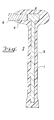
- Figure 1 illustrates a cross-sectional view of an embodiment of the present invention.
- the present invention is a low-contamination impact tool.
- the tool is designed especially to break semiconductor grade silicon into pieces without imparting significant contamination to the pieces.
- the low-contamination impact tool comprises: (A) a core forming a handle portion and a head portion, (B) a tungsten carbide alloy striking element having an end contacted with the head portion of the core and (C) a shell of synthetic resin encapsulating the core.
- the low-contamination impact tool comprises a core consisting of handle portion 1 and head portion 2 .
- the core can be formed from any metal, metal alloy, plastic or composite of sufficient rigidity and strength to deliver an impact to a surface. Preferred is when the core is formed from a metal or metal alloy, for example, carbon steel, stainless steel, inconel, monel or hasteloy. More preferred is when the core is formed from AISI 1018 cold rolled steel.
- the size of the core is not critical to the present invention. Those skilled in the art will recognize that the core must have sufficient cross-sectional area to prevent bending and breaking of the core during use of the low-contamination impact tool as a breaking instrument.
- the required cross-sectional area will depend upon the material from which the core is constructed as well as the length of handle portion 1 .
- AISI 1018 cold rolled steel is used as the material of construction of the core material, and the low-comtamination impact tool is to be used for the breaking of silicon
- a length of about 8 inches to 12 inches for handle portion 1 and a cross-sectional diameter of about 0.4 to 0.5 inches for handle portion 1 is suitable.
- Head portion 2 can be constructed of the same or different material than handle portion 1 . Preferred is when head portion 2 is formed from the same material as handle portion 1 .
- Head portion 2 and handle portion 1 are connected.
- the connection can be achieved by forming the core as a single element by, for example, molding, casting, stamping, cutting or machining, depending upon the particular material of fabrication.
- head portion 2 and handle portion 1 can be formed separately and connected by, for example, wedging, welding, brazing, fusing, threading or other standard means for connecting two solid objects.
- the core is formed from AISI 1018 cold rolled steel, it is preferred that head portion 2 and handle portion 1 be formed separately and connected by welding.
- head portion 2 is determined by the material of fabrication, the size of handle portion 1 , the method of securing striking element 4 and the size of striking element 4 .
- handle portion 1 and head portion 2 are formed from AISI 1018 cold rolled steel, it is preferred that head portion 2 has a length of about one inch to two inches and a diameter of about 0.5 to one inch.
- Head portion 2 is secured in contact with striking element 4 .
- the method of securing contact of head portion 2 with striking element 4 is not critical to the present invention.
- striking element 4 is secured in contact with head portion 2 during the process of encapsulating the core with a synthetic resin.
- the synthetic resin maintains the position of striking element 4 , as illustrated in Figure 1.
- the advantage of this method of securing striking element 4 is that the striking element can be easily recovered and reused if the remainder of the low-contamination impact tool is damaged.
- striking element 4 can be directly secured to head portion 2 by standard means, as described above, for attaching two solid objects.
- Striking element 4 is formed from a tungsten carbide alloy, where cobalt is the alloying metal. It is preferred that the tungsten carbide alloy contain about 8 to 15 weight percent cobalt. More preferred is when the tungsten carbide alloy contains about 10 to 13 weight percent cobalt.
- the shape of striking element 4 is not critical to the present invention. However, in a preferred embodiment of the present invention striking element 4 is formed in a generally cylindrical shape with a constricted central portion. The constricted central portion helps secure striking element 4 in contact with head portion 2 , when a synthetic resin is used as the securing means. The constriction can be about one to 30 percent of the diameter of striking element 4 . Preferred is when the constriction is about five to 20 percent of the diameter of striking element 4 .
- the diameter of striking element 4 is within a range of about 0.5 to one inch.
- Striking element 4 has striking face 5 .
- the radius of curvature of the edge of striking face 5 is important to minimize breaking of particles from striking element 4 during use.
- a radius of about 0.03 to 0.25 inch is considered useful.
- Preferred is a radius of about 0.07 to 0.12 inch.
- the core is encapsulated in a synthetic resin to form cover 3 .
- the purpose of encapsulating the core in the synthetic resin is to prevent the core from contacting the material to be broken with the low-contamination impact tool.
- the synthetic resin is selected so as to impart minimal undesirable contamination to the material to be broken.
- synthetic resin is meant highly cross-linked polymeric materials that are not naturally occurring.
- the synthetic resin can be for example, polyurethane, polypropylene, polyethylene or polycarbonate. Preferred is when the synthetic resin is polyurethane. Even more preferred is when the synthetic resin is a polyurethane having a Shore A Hardness of about 90 to 97.
- Cover 3 can be formed around the core and striking element 4 by injecting or casting the synthetic resin into a cavity of a mold which has the same shape as the external shape of cover 3 .
- the core is placed in the mold, striking element 4 positioned as illustrated in Figure 1 and the synthetic resin injected and cured, securing striking element 4 in contact with head portion 2 .
- Silicon samples were prepared by breaking a rod of polycrystalline silicon with an impact tool having a non-encapsulated handle and head formed from AISI 1018 cold rolled steel. A tungsten carbide alloy striking element was attached to the head of the impact tool. The tungsten carbide alloy contained about 12 weight percent cobalt. During the breaking process, care was taken to contact each piece of silicon with the handle of the impact tool. Samples of silicon pieces were analyzed for iron and phosphorus surface contamination by graphite furnace atomic absorption and photoluminesience techniques, respectively. The results are presented in Table 1. Table 1 Contamination of Silicon Pieces by Contact With Impact Tool Uncoated Handle Sample No. Fe ppb P ppb 1 0.90 0.27 2 0.74 0.29 3 0.79 0.43 4 0.80 0.37 5 0.63 0.07 6 0.67 0.20 Mean 0.76 0.27
- Silicon samples were prepared by breaking a rod of polycrystalline silicon with an impact tool having a polyurethane encapsulated handle and head.
- the handle and head were formed from AISI 1018 cold rolled steel.
- the polyurethane coating was formed-from a polyether based liquid, isocyanate-terminated prepolymer using (4,4′-methylene-bis(orthochloroaniline)) as catalyst to effect cure.
- the cured polyurethane had a Shore A durometer of about 95.
- a tungsten carbide alloy striking element was attached to the head of the impact tool by molding into the polyurethane.
- the tungsten carbide alloy was as described for Example 1.
- care was taken to contact each sample of silicon with the urethane coated handle of the impact tool.
- the silicon samples were analyzed as described in Example 1 and the results are presented in Table 2.
Landscapes
- Engineering & Computer Science (AREA)
- Mechanical Engineering (AREA)
- Physics & Mathematics (AREA)
- Fluid Mechanics (AREA)
- Percussive Tools And Related Accessories (AREA)
- Silicon Compounds (AREA)
Applications Claiming Priority (2)
| Application Number | Priority Date | Filing Date | Title |
|---|---|---|---|
| US78147691A | 1991-10-23 | 1991-10-23 | |
| US781476 | 1991-10-23 |
Publications (2)
| Publication Number | Publication Date |
|---|---|
| EP0539097A1 true EP0539097A1 (fr) | 1993-04-28 |
| EP0539097B1 EP0539097B1 (fr) | 1994-11-30 |
Family
ID=25122876
Family Applications (1)
| Application Number | Title | Priority Date | Filing Date |
|---|---|---|---|
| EP92309423A Expired - Lifetime EP0539097B1 (fr) | 1991-10-23 | 1992-10-15 | Outil de percussion à faible contamination pour casser le silicium |
Country Status (5)
| Country | Link |
|---|---|
| EP (1) | EP0539097B1 (fr) |
| JP (1) | JPH06218677A (fr) |
| KR (1) | KR100207163B1 (fr) |
| CA (1) | CA2081127A1 (fr) |
| DE (1) | DE69200756T2 (fr) |
Cited By (10)
| Publication number | Priority date | Publication date | Assignee | Title |
|---|---|---|---|---|
| GB2384741A (en) * | 2002-02-02 | 2003-08-06 | Keith England | Hammers and the like |
| EP1338682A3 (fr) * | 2002-02-20 | 2004-01-28 | Hemlock Semiconductor Corporation | Copeaux sous forme fluide, procédés et appareillage pour leur fabrication ainsi que leur utilisation |
| US6874713B2 (en) | 2002-08-22 | 2005-04-05 | Dow Corning Corporation | Method and apparatus for improving silicon processing efficiency |
| EP1553214A3 (fr) * | 2002-02-20 | 2007-03-28 | Hemlock Semiconductor Corporation | Copeaux sous forme fluide, procédés et appareillage pour leur fabrication ainsi que leur utilisation |
| WO2007101666A3 (fr) * | 2006-03-08 | 2008-03-27 | Schott Solar Gmbh | Procédé d'obtention et/ou de recyclage de matériaux |
| EP2030737A3 (fr) * | 2007-08-27 | 2009-04-29 | Mitsubishi Materials Corporation | Marteau pour concasser du silicium polycristallin |
| DE102012204050A1 (de) * | 2012-03-15 | 2013-09-19 | Sunicon GmbH | Vorrichtung und Verfahren zum Bearbeiten von Silizium-Stücken |
| US20140037959A1 (en) * | 2012-08-06 | 2014-02-06 | Wacker Chemie Ag | Polycrystalline silicon chunks and method for producing them |
| CN111727107A (zh) * | 2018-02-27 | 2020-09-29 | 株式会社德山 | 锤 |
| WO2021037366A1 (fr) | 2019-08-29 | 2021-03-04 | Wacker Chemie Ag | Procédé de production de fragments de silicium |
Families Citing this family (1)
| Publication number | Priority date | Publication date | Assignee | Title |
|---|---|---|---|---|
| US7270706B2 (en) * | 2004-10-04 | 2007-09-18 | Dow Corning Corporation | Roll crusher to produce high purity polycrystalline silicon chips |
Citations (6)
| Publication number | Priority date | Publication date | Assignee | Title |
|---|---|---|---|---|
| US3148716A (en) * | 1962-04-02 | 1964-09-15 | Vanghan & Bushnell Mfg Co | Impact tool with chip-resistant striking face |
| US3640324A (en) * | 1969-11-13 | 1972-02-08 | Vaughan & Bushnell Mfg Co | Hammer head having an antislip and wear-resistant striking face surface |
| DE2152761A1 (de) * | 1971-06-22 | 1972-12-28 | Custom Electronic Systems, Inc., Indianapolis, Ind. (V.StA.) | Schlagwerkzeug |
| FR2337612A1 (fr) * | 1976-01-12 | 1977-08-05 | Ces Inc | Marteau |
| DE3204848A1 (de) * | 1982-02-11 | 1983-08-18 | Lothar Laflör GmbH & Co, 5620 Velbert | Nothammer |
| FR2577458A1 (fr) * | 1985-02-21 | 1986-08-22 | Maeda Shell Service Co | Marteau moule monobloc a noyaux separes de tete et de manche |
-
1992
- 1992-10-15 EP EP92309423A patent/EP0539097B1/fr not_active Expired - Lifetime
- 1992-10-15 DE DE69200756T patent/DE69200756T2/de not_active Expired - Fee Related
- 1992-10-22 CA CA002081127A patent/CA2081127A1/fr not_active Abandoned
- 1992-10-23 JP JP4285935A patent/JPH06218677A/ja active Pending
- 1992-10-23 KR KR1019920019583A patent/KR100207163B1/ko not_active Expired - Fee Related
Patent Citations (6)
| Publication number | Priority date | Publication date | Assignee | Title |
|---|---|---|---|---|
| US3148716A (en) * | 1962-04-02 | 1964-09-15 | Vanghan & Bushnell Mfg Co | Impact tool with chip-resistant striking face |
| US3640324A (en) * | 1969-11-13 | 1972-02-08 | Vaughan & Bushnell Mfg Co | Hammer head having an antislip and wear-resistant striking face surface |
| DE2152761A1 (de) * | 1971-06-22 | 1972-12-28 | Custom Electronic Systems, Inc., Indianapolis, Ind. (V.StA.) | Schlagwerkzeug |
| FR2337612A1 (fr) * | 1976-01-12 | 1977-08-05 | Ces Inc | Marteau |
| DE3204848A1 (de) * | 1982-02-11 | 1983-08-18 | Lothar Laflör GmbH & Co, 5620 Velbert | Nothammer |
| FR2577458A1 (fr) * | 1985-02-21 | 1986-08-22 | Maeda Shell Service Co | Marteau moule monobloc a noyaux separes de tete et de manche |
Cited By (21)
| Publication number | Priority date | Publication date | Assignee | Title |
|---|---|---|---|---|
| GB2384741A (en) * | 2002-02-02 | 2003-08-06 | Keith England | Hammers and the like |
| EP1338682A3 (fr) * | 2002-02-20 | 2004-01-28 | Hemlock Semiconductor Corporation | Copeaux sous forme fluide, procédés et appareillage pour leur fabrication ainsi que leur utilisation |
| EP1553214A3 (fr) * | 2002-02-20 | 2007-03-28 | Hemlock Semiconductor Corporation | Copeaux sous forme fluide, procédés et appareillage pour leur fabrication ainsi que leur utilisation |
| US6874713B2 (en) | 2002-08-22 | 2005-04-05 | Dow Corning Corporation | Method and apparatus for improving silicon processing efficiency |
| US8118248B2 (en) | 2006-03-08 | 2012-02-21 | Schott Solar Ag | Method for recovering and/or recycling material |
| WO2007101666A3 (fr) * | 2006-03-08 | 2008-03-27 | Schott Solar Gmbh | Procédé d'obtention et/ou de recyclage de matériaux |
| EP2141121A1 (fr) | 2006-03-08 | 2010-01-06 | SCHOTT Solar AG | Broyeur déchiqueteur |
| US7694903B2 (en) | 2006-03-08 | 2010-04-13 | Schott Solar Ag | Method for recovering and/or recycling material |
| CN101376242B (zh) * | 2007-08-27 | 2012-11-14 | 三菱麻铁里亚尔株式会社 | 多晶硅破碎用锤 |
| US7950308B2 (en) | 2007-08-27 | 2011-05-31 | Mitsubishi Materials Corporation | Hammer for breaking polycrystalline silicon |
| EP2030737A3 (fr) * | 2007-08-27 | 2009-04-29 | Mitsubishi Materials Corporation | Marteau pour concasser du silicium polycristallin |
| DE102012204050A1 (de) * | 2012-03-15 | 2013-09-19 | Sunicon GmbH | Vorrichtung und Verfahren zum Bearbeiten von Silizium-Stücken |
| DE102012204050B4 (de) * | 2012-03-15 | 2017-03-23 | Solarworld Industries Sachsen Gmbh | Vorrichtung und Verfahren zum Bearbeiten von Silizium-Stücken |
| US20140037959A1 (en) * | 2012-08-06 | 2014-02-06 | Wacker Chemie Ag | Polycrystalline silicon chunks and method for producing them |
| US9266741B2 (en) * | 2012-08-06 | 2016-02-23 | Wacker Chemie Ag | Polycrystalline silicon chunks and method for producing them |
| CN111727107A (zh) * | 2018-02-27 | 2020-09-29 | 株式会社德山 | 锤 |
| EP3760384A4 (fr) * | 2018-02-27 | 2021-04-28 | Tokuyama Corporation | Marteau |
| US11794330B2 (en) | 2018-02-27 | 2023-10-24 | Tokuyama Corporation | Hammer |
| WO2021037366A1 (fr) | 2019-08-29 | 2021-03-04 | Wacker Chemie Ag | Procédé de production de fragments de silicium |
| CN114127011A (zh) * | 2019-08-29 | 2022-03-01 | 瓦克化学股份公司 | 用于生产硅块的方法 |
| CN114127011B (zh) * | 2019-08-29 | 2024-03-08 | 瓦克化学股份公司 | 用于生产硅块的方法 |
Also Published As
| Publication number | Publication date |
|---|---|
| KR100207163B1 (ko) | 1999-07-15 |
| CA2081127A1 (fr) | 1993-04-24 |
| JPH06218677A (ja) | 1994-08-09 |
| EP0539097B1 (fr) | 1994-11-30 |
| DE69200756D1 (de) | 1995-01-12 |
| KR930007591A (ko) | 1993-05-20 |
| DE69200756T2 (de) | 1995-04-06 |
Similar Documents
| Publication | Publication Date | Title |
|---|---|---|
| EP0539097B1 (fr) | Outil de percussion à faible contamination pour casser le silicium | |
| EP0354043B1 (fr) | Corps abrasif, compacté, diamanté, thermostable | |
| DE69317447T2 (de) | Bonding-Werkzeuge und ihre Herstellung | |
| US10022843B2 (en) | Methods of fabricating a polycrystalline diamond compact | |
| US3757878A (en) | Drill bits and method of producing drill bits | |
| CA2002385C (fr) | Grain multimetallique super-abrasif colle et sa fabrication | |
| EP0029187B1 (fr) | Procédé pour la fabrication des pièces compactes à base de diamant pour le forage de roches | |
| US5035771A (en) | Process for treating diamond grains | |
| IE46644B1 (en) | Temperature resistant abrasive compact and method for making same | |
| Taylor et al. | Anomalous slip in high-purity vanadium crystals | |
| CN109071362B (zh) | 具有填隙金刚石晶粒的多晶金刚石压坯及其制造方法 | |
| EP0233162B1 (fr) | Procédé de traitement de corps en carbure cémenté en fonction de leur composition et de leur structure | |
| EP0715833A2 (fr) | Fraise et procédé pour la pratique de coupe d'une dent humaine avec une telle fraise | |
| WO1989004226A1 (fr) | Procede de preparation d'un article massif en metal amorphe | |
| EP0652057B1 (fr) | Filière de filage en diamant polycristallin | |
| EP0014589B1 (fr) | Procédé de préparation de particules de diamant et corps abrasif avec liant métallique contenant ces particules | |
| EP0043542B1 (fr) | Procédé pour la préparation d'un composé à base de carbure de silicium | |
| US5494760A (en) | Object with an at least partly amorphous glass-metal film | |
| DE3614079A1 (de) | Einkristall einer iii/v-verbindung, insbesondere gaas und verfahren zu seiner herstellung | |
| EP0211571A1 (fr) | Fils métalliques amorphes fins | |
| WO1992000939A3 (fr) | Corps composites en ceramique a teneur reduite en metal | |
| JP4135405B2 (ja) | 種結晶保持治具及び単結晶の製造方法 | |
| Danford | Role of Grain Boundaries in Hydrogen Diffusion in Metals at 25 deg C | |
| Kabanova et al. | Habit Planes of the Face-Centred Cubic Phase Formed During Heating in Crystals of Martensite and Polyhedral Ferrite With a Body-Centred Cubic Lattice | |
| NESHPOR et al. | Fractural resistance of aluminum-lithium structural alloys(Soprotivlenie razrusheniiu konstruktsionnykh aliuminievo-litievykh splavov) |
Legal Events
| Date | Code | Title | Description |
|---|---|---|---|
| PUAI | Public reference made under article 153(3) epc to a published international application that has entered the european phase |
Free format text: ORIGINAL CODE: 0009012 |
|
| AK | Designated contracting states |
Kind code of ref document: A1 Designated state(s): DE FR GB |
|
| 17P | Request for examination filed |
Effective date: 19930528 |
|
| 17Q | First examination report despatched |
Effective date: 19930702 |
|
| GRAA | (expected) grant |
Free format text: ORIGINAL CODE: 0009210 |
|
| AK | Designated contracting states |
Kind code of ref document: B1 Designated state(s): DE FR GB |
|
| REF | Corresponds to: |
Ref document number: 69200756 Country of ref document: DE Date of ref document: 19950112 |
|
| ET | Fr: translation filed | ||
| PLBE | No opposition filed within time limit |
Free format text: ORIGINAL CODE: 0009261 |
|
| 26N | No opposition filed | ||
| PGFP | Annual fee paid to national office [announced via postgrant information from national office to epo] |
Ref country code: FR Payment date: 19970904 Year of fee payment: 6 Ref country code: DE Payment date: 19970904 Year of fee payment: 6 |
|
| PGFP | Annual fee paid to national office [announced via postgrant information from national office to epo] |
Ref country code: GB Payment date: 19970909 Year of fee payment: 6 |
|
| PG25 | Lapsed in a contracting state [announced via postgrant information from national office to epo] |
Ref country code: GB Free format text: LAPSE BECAUSE OF NON-PAYMENT OF DUE FEES Effective date: 19981015 |
|
| GBPC | Gb: european patent ceased through non-payment of renewal fee |
Effective date: 19981015 |
|
| PG25 | Lapsed in a contracting state [announced via postgrant information from national office to epo] |
Ref country code: FR Free format text: LAPSE BECAUSE OF NON-PAYMENT OF DUE FEES Effective date: 19990630 |
|
| REG | Reference to a national code |
Ref country code: FR Ref legal event code: ST |
|
| PG25 | Lapsed in a contracting state [announced via postgrant information from national office to epo] |
Ref country code: DE Free format text: LAPSE BECAUSE OF NON-PAYMENT OF DUE FEES Effective date: 19990803 |