EP0539737A1 - Mécanisme fiable d'allocation pour utilisation efficace du spectre dans des réseaux locaux multicellulaire sans fils - Google Patents
Mécanisme fiable d'allocation pour utilisation efficace du spectre dans des réseaux locaux multicellulaire sans fils Download PDFInfo
- Publication number
- EP0539737A1 EP0539737A1 EP92116597A EP92116597A EP0539737A1 EP 0539737 A1 EP0539737 A1 EP 0539737A1 EP 92116597 A EP92116597 A EP 92116597A EP 92116597 A EP92116597 A EP 92116597A EP 0539737 A1 EP0539737 A1 EP 0539737A1
- Authority
- EP
- European Patent Office
- Prior art keywords
- nodes
- node
- active
- controller
- mobile stations
- Prior art date
- Legal status (The legal status is an assumption and is not a legal conclusion. Google has not performed a legal analysis and makes no representation as to the accuracy of the status listed.)
- Granted
Links
Images




Classifications
-
- H—ELECTRICITY
- H04—ELECTRIC COMMUNICATION TECHNIQUE
- H04W—WIRELESS COMMUNICATION NETWORKS
- H04W72/00—Local resource management
- H04W72/50—Allocation or scheduling criteria for wireless resources
- H04W72/54—Allocation or scheduling criteria for wireless resources based on quality criteria
- H04W72/542—Allocation or scheduling criteria for wireless resources based on quality criteria using measured or perceived quality
-
- H—ELECTRICITY
- H04—ELECTRIC COMMUNICATION TECHNIQUE
- H04W—WIRELESS COMMUNICATION NETWORKS
- H04W28/00—Network traffic management; Network resource management
- H04W28/16—Central resource management; Negotiation of resources or communication parameters, e.g. negotiating bandwidth or QoS [Quality of Service]
- H04W28/18—Negotiating wireless communication parameters
Definitions
- the invention is in the field of wireless communications, and in particular is directed to runtime scheduling of traffic served by a multicell wireless network. Specifically, the invention is directed to making dynamic scheduling decisions in a state-dependent manner for overlapping cells.
- a user In a local area network (LAN) a user, such as a portable computer equipped with communication capability, gains access to the LAN via a physical connection in order to communicate with remote facilities or use shared resources, such as file servers, print servers, etc.
- LAN local area network
- all users In a stationary mode of operation, all users are static and each user gains access to the network via a fixed homing point.
- users In a mobile environment users are free to change their physical location and cannot be restricted to gain access to the network only through one of several homing points attached to the LAN.
- the homing points are fixed base stations that communicate with the mobile users through a wireless link. Examples of wireless links include radio frequency (RF) links, microwave links and infrared (IR) links.
- RF radio frequency
- IR infrared
- wireless communication networks having overlapping coverage areas or cells wherein the same frequencies are employed for the uplink and the downlink, respectively, within each coverage area.
- the use of the same frequencies in overlapping communication cells has the advantage that it eliminates a requirement that the mobile users switch frequencies when migrating from one cell to another.
- An additional advantage is that the effective wireless bandwidth can be increased by spatial reuse of frequencies in non-overlapping cells. This technique is called Frequency Reuse.
- the transmission and reception of messages in a cell of a multicell network requires control of interference between users.
- This interference may occur from several sources including uplink transmissions from mobile users that lie in overlapping areas between adjacent cells and downlink transmissions from base stations if their overlapping cell areas contain one or more mobile users.
- U.S. Patents show communication systems having overlapping coverage areas.
- Yamauchi et al. provide for a hand-off of a subscriber station from one base station to another by the base station continually monitoring the signal strength of the subscriber station.
- F. Gfeller et al. describe an infrared communication system that operates between a plurality of satellite stations and a plurality of terminal stations.
- a host computer communicates with the terminal stations via a cluster controller and the satellite stations, which may be ceiling mounted. Communication with the terminal stations is not interrupted even during movement of the terminal stations.
- Gfeller describes general control principles of an infrared wireless network incorporating multiple ceiling mounted transponders that couple a host/controller to multiple terminal stations. Access to the uplink channel is controlled by a Carrier Sense Multiple Access/Collision Detection (CSMA/CD) method.
- CSMA/CD Carrier Sense Multiple Access/Collision Detection
- a method includes a first step of receiving a message from a wired network with at least one base station.
- the message is a message type that authorizes a base station or base stations to transmit on a wireless network.
- a second step of the method is accomplished in a response to the received first message, and initiates wireless communications with any mobile communication units that are located within a communication cell served by the at least one base station.
- the message circulates around a token ring and activates base stations in turn.
- disjoint groups of base stations are predetermined by graphical techniques, including graph coloring methods.
- the predetermined group information is maintained by a network controller that thereafter selectively activates the base stations within the different groups.
- a wireless communications network includes a local area network connected to a plurality of nodes which perform bidirectional wireless communication with mobile stations as controlled by a controller.
- Each node has a geographic area, termed a cell, within which mobile stations can communicate with the node associated with the cell.
- a cell interference graph is read into the controller, and a maximal independent set of nodes is determined.
- Each node in the maximal independent set of nodes is put in a set termed ACTIVE for performing wireless communication with mobile stations in their respective cells.
- Nodes which are not in the maximal independent set of nodes is put in a set termed WAITING, to wait for permission to enter the set ACTIVE.
- a node in the set ACTIVE which has completed communications sends a completion signal to the controller.
- the controller then examines which of the nodes in the set WAITING is not adjacent to another node in the set ACTIVE, and such nodes are entered in a set termed CANDIDATES. Nodes in the set CANDIDATES are moved to the set ACTIVE according to a predetermined criteria.
- a multicell wireless network served by a high-speed backbone network must make effective spatial reuse of bandwidth in the wireless cells that generally operate at speeds considerably less than the backbone network.
- Users gain access to the network via one of a finite number of base stations that are physically attached to and interconnected by a wired backbone network.
- the physical link from the user to the base station is a wireless communication link.
- Each base station serves as a bridge between the wired backbone network on one side and a collection of portable computer users that can communicate with the base station using a wireless communication link.
- a cell corresponding to a base station consists of the geographic area within which a user can communicate with the base station. In general cells will overlap in coverage. It is assumed that a user in an overlap area will register with one of the base stations, called its Owner, that serves the communication needs of the user while he is within the cell covered by the owner.
- users in a cell access the network by sharing the wireless channel in a multiaccess-broadcast mode. It is assumed that within each cell, users transmit on a shared uplink at a certain frequency f up and receive messages on a broadcast channel from a corresponding base station at a different frequency f down . The same frequencies f up and f down are reused in each cell in the multicell wireless network.
- Intercell interference in such multiple overlapping cell networks can lead to poor performance. If the network is heavily used and not controlled at all (i.e., users and base station, can transmit at will anytime they have a message), then an increasing number of collisions will occur and this can accelerate the depletion of battery power in the portable computers carried by the mobile users. On the other hand, total control of the network (a situation in which the base stations and individual mobile users are coordinated and scheduled for message transmissions in a collision-free manner), in a cost-efficient implementation appears very difficult in practice.
- This invention adopts an intermediate approach in which the granularity of network control is at the level of scheduling cells for wireless operation. This means, the wireless operation of individual cells are controlled with a controller using dynamic scheduling mechanisms. Wireless operations within a cell (between mobile units and the base station) are permitted only during intervals of time designated by the controller.
- Fig. 1 there is shown a typical mobile office communication environment.
- Users having portable data processing devices referred to herein as mobile communication units or mobile units 10, are not restricted to gain access to a TOKEN-RING COMMUNICATION NETWORK 1 via predetermined homing points.
- Other wired networks such as FDDI and Ethernet can also be used.
- base stations or nodes 12, that are attached to the token-ring network 1 at specific points.
- the terms base station and node will be used interchangeably.
- Each base station 12 has both processing and storage capability to perform store-and-forward communication functions.
- Each base station 12 functions as a bridge between the wired token-ring LAN and a collection of mobile units 10.
- the mobile units 10 are in bidirectional communication with the base stations 12 using wireless communication links. Within an area of wireless coverage of a base station, or communication cell 2, the mobile units 10 transmit on a shared uplink at a first frequency (f up ) and receive messages on a broadcast downlink channel from the base station 12 at a second frequency (f down ). The same frequencies (f up ) and (f down ) are reused within each cell in the multicell wireless network.
- token ring network for practicing the teaching of the invention is disclosed in "IBM Token-Ring Network: Architecture Reference", SC30-3374-02, Third Edition, Sept. 1989 ("IBM” is a registered trademark of the International Business Machines Corporation). It should be realized however that the teaching of the invention is not restricted to only this particular network configuration or to token ring networks in general but may, instead, be practiced with a number of different wired network types.
- Each mobile unit 10 is associated with a unique base station (12), denoted as Owner (N), through which the mobile unit 10 accesses the wired token-ring network.
- a given base station (H) may own multiple mobile units 10 at the same time.
- the set of mobile units 10 owned by base station (H) is denoted Domain(H).
- the Owner-Domain relationships are logical and indicate for each base station (H) the set of mobile units 10 whose communication needs are managed by H.
- H base station
- uplink transmissions from S2 may interfere with transmissions by S1, S3, S4 and S5.
- S2 does not interfere with S6 because S2 and S6 can never transmit to the same base station 12.
- S2 and S7 do not interfere with one another.
- the interference is not limited to uplink transmissions alone.
- a mobile unit 10, such as S2, that is within an overlapping cell area can receive broadcast signals from multiple base stations 12 (S2 can receive from both H1 and H2). If a mobile unit 10 simultaneously receives broadcast messages from more than one base station 12 a collision occurs and the messages are received erroneously.
- the transmission and reception of messages in a cell of a multicell network of the type that employs identical communication frequencies in different cells requires control of interference.
- This interference may arise from several sources including an uplink transmission from mobile units 10 that lie in overlapping areas between adjacent cells 2 and from downlink transmissions from base stations 12 if their overlapping cell areas contain one or more mobile units 10.
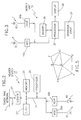
- Figs. 2 and 3 wherein embodiments of the base stations 12 and mobile units 10, respectively, are shown in block diagram form.
- the wireless communications channels are carried via an infrared (IR) data link.
- IR infrared
- Presently available optical devices readily provide for operation within the range of approximately 750 nanometers to approximately 1000 nanometers.
- the base station 12 is coupled to the LAN 1 via a connector 14.
- Connector 14 is coupled to a network adapter transceiver 22 which in turn is coupled to an internal bus 24.
- the base station 12 includes a processor 26 that is bidirectionally coupled to a memory 28 that stores program-related and other data, including packets of data transmitted to or received from the mobile units 10.
- Processor 26 also communicates with IR modulators and receivers; specifically a modulator 30a and a receiver 30b.
- the IR modulator and receiver have inputs coupled to suitable infrared emitting or receiving devices such as laser diodes, LEDs and photodetectors.
- the modulator 30a has an output coupled to a transmit diode (TD) and the receiver 30b has an input coupled to a receive photodiode (RD).
- TD transmit diode
- RD receive photodiode
- Mobile unit 10 includes a processor 32 coupled to an operator input device 34 and also coupled to an operator display device 36.
- Operator input device 34 may be a keyboard or any suitable data entry means.
- operator display device 36 may be a flat panel alphanumeric display or any suitable display means.
- processor 32 Also coupled to processor 32 is a memory 38 that stores program-related data and other data, such as packets of information received from or intended to be transmitted to the base station 12 and also an identification of the mobile unit 10.
- a modulator 40a and a receiver 40b are also coupled to processor 32.
- the data receivers of Figs. 2 and 3 include demodulators and filters and operate in a conventional manner to extract the modulated bit stream from the received optical signals.
- the modulators of Figs. 2 and 3 operate in a conventional manner to modulate the optical output in accordance with a transmitted bit stream.
- a preferred data transmission rate is in the range of approximately one to ten million bits per second (1-10 Mbits/sec), although any suitable data transmission rate may be employed.
- optical communication system of the invention all wireless communication is between the base station 12 and the mobile units 10. There is no direct communication between the mobile units 10.
- the network consists of a set of seven cells ⁇ A,B,C,D,E,F,G, ⁇ and 11 mobile units 10 numbered 1 through 11.
- the RIG has a plurality of vertices, each of which corresponds to a single cell of the multicell network. Two vertices of the RIG are considered to be connected if and only if the corresponding cells provide overlapping coverage, that is, if simultaneous wireless communication in the cells will interfere with one another.
- the RIG corresponding to the network of Fig. 4 is shown in Fig. 5 and has seven vertices, corresponding to the intersections of the seven cells of Fig. 4.
- V represents the set of cells.
- Such a graph is called the Cell Interference Graph or Region Interference Graph of the wireless network.
- the corresponding cell interference graph is shown in Fig. 5.
- the set of all cells is partitioned a priori into a collection ⁇ Group1, Group2, ..., Group K ⁇ of K disjoint sets of cells.
- the cells are pairwise spatially disjoint, i.e., no two cells in the set overlap overlap with each other.
- the scheduling algorithm allows all members of a disjoint set to perform wireless operations at the same time. This results in spatial reuse of frequencies without any intercell interference. When all the members have completed operations, then all members of another disjoint set are allowed to perform simultaneous wireless operations. After each disjoint set of cells (Group1, thru Group K ) is given its turn, the cycle of wireless operations is repeated again.
- a static scheduling algorithm is well suited to networks where the cells generate traffic with equal intensity.
- the intensity of traffic (packets per second) will depend on factors such as:
- This invention is directed to a robust scheduling method for scheduling traffic in multicell wireless local area networks.
- Robustness is the ability to achieve good spatial reuse without being very sensitive to variations in traffic intensities of cells.
- Wireless bandwidth of the cells is utilized in a manner driven by instantaneous traffic demands of cells.
- Robustness is achieved by dynamically scheduling wireless cell operations.
- the main idea of the method is to manage the initiation and termination of wireless operations in cells in a state-dependent manner. The method ensures that when a cell is scheduled to perform wireless operations, it will not conflict with any other wireless operation that may be going on at that instant.
- the method involves the selection and maintenance of simultaneous network wireless operations in a maximal independent set of nodes.
- a set of nodes in a graph is independent if no pair of nodes in the set is adjacent in the graph.
- set ⁇ A, F ⁇ is an independent set of nodes.
- a set of nodes is maximally independent if the addition of another node to the set will make the set not independent.
- ⁇ A, F, D ⁇ is a maximal independent set. Addition of another node to the set ⁇ A, F, D ⁇ will create a pair of nodes adjacent to each other.
- Scheduling of cell operations is performed by a central controller that is capable of sending control messages to and receiving control messages from the nodes (i.e., the base stations of the individual cells).
- a control message of the form ⁇ START_WIRELESS, BSID ⁇ is sent from the controller for initiating wireless operation at a node BSID.
- the node After completion of wireless operation in the cell corresponding to BSID, the node returns a control message to the controller.
- the controller initiates wireless operation in a maximal independent set of nodes, such as ⁇ A, F, D ⁇ , by sending ⁇ START_WIRELESS, A ⁇ , ⁇ START_WIRELESS, F ⁇ and ⁇ START_WIRELESS, D ⁇ messages.
- the remaining set of nodes, ⁇ B, C, E, G ⁇ are not initiated to perform wireless operation until one or more of the nodes ⁇ A, D, E ⁇ complete their wireless operation.
- the central controller has knowledge of the Cell Interference Graph. It always knows the state of all cells, i.e., which individual base stations are performing wireless operations at any given instant. Therefore, it can schedule the cell operations in a conflict-free manner.
- MaxTimeLimit is sent as a parameter of the START_WIRELESS message from the controller to Node u.
- the node receives the control message, it will perform wireless operation. If there is not enough traffic to communicate, then Node u performs wireless communication of all the traffic it has and then sends a completion signal before MaxTimeLimit has elapsed. If there is more traffic to communicate than can be accommodated within the time limit Node u uses all the allowed time and then sends a completion signal after exactly MaxTimeLimit has elapsed. All the traffic that was left over in this cycle of wireless operation will be held for transmission in a future cycle.
- the controller executes the while-loop on an indefinite basis (i.e., as long as the wireless network is in operation). It waits for change of state to occur in one or more nodes. Such a change occurs when an ACTIVE node completes its wireless operation and sends a message to the controller signifying completion.
- the controller On receiving such a signal from a node, say Node u, the controller invokes the procedure Initiate-Neighbors(u). Neighbors are adjacent nodes to u in the graph, which overlap u. In our example, let u be node c. The main purpose of the procedure is to examine which neighbors, if any, of Node u can be given another turn to perform wireless operation.
- nodes ⁇ B, D, F, G ⁇ qualify for wireless operation.
- nodes ⁇ A, D, G ⁇ do not qualify because they are adjacent to ACTIVE node E. If there are multiple neighbor nodes that qualify for another turn, the Initiate_Neighbors procedure prioritizes the qualifying nodes and activates one or more of them in that priority sequence.
- a set called CANDIDATES containing the neighbor nodes of u that can be activated is constructed.
- the set includes each node v that satisfies both of the following conditions: a) Node v is a neighbor of Node u, and b) Node v is in WAITING mode and all neighbors of Node v other than Node u are in WAITING mode (i.e., not performing wireless operation).
- CANDIDATES is ⁇ B, F ⁇ .
- the set CANDIDATES is formed, one of the following three outcomes are possible. If the set is null, then no neighbors of Node u can be activated. If the set contains exactly one element, then the choice of which node to activate is unique. If there are multiple elements in the set CANDIDATES, the procedure uses one of the following priority sequencing criteria Pri_Crit for ordering the candidate nodes.
- Such criteria may include:
- the neighbor nodes in set CANDIDATES have been prioritized. Let this be the set ⁇ B, F ⁇ .
- the first node in the set say Node v, is initiated by invoking Schedule(v). If w ⁇ CANDIDATES and Node w is adjacent to Node v, then the initiation of Node v will make Node w ineligible for wireless operation until Node v completes its latest turn. In such a case, Node w is removed from CANDIDATES.
- node F becomes ineligible for wireless operation at least until node B completes its wireless operation. Therefore node F is removed from the set CANDIDATES.
- the controller invokes Unschedule(u). Executing the function changes the state of Node u from ACTIVE to WAITING. The controller then waits for more completion messages to arrive before responding to them by scheduling additional wireless cell operations.
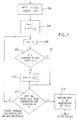
- Fig. 7 is a detailed block diagram of block 64 (Fig. 6a).
- G is input from block 62 (Fig. 6a) and S is the output; This means that S is a subset of V.
- a variable i is initialized to 1, and set S is initialized to V1.
- i is incremented by 1 to begin a loop to examine all elements of set V. That is, V1, v2, ..., v m .
- a determination is made whether V i is adjacent to any node in S. If not, S is set equal to S U ⁇ Vi ⁇ in block 210.
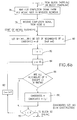
- Fig. 6a where S from block 64 is applied to block 66 where variable current-time is set to 0; WAITING is initialized to V, where WAITING is a set of vertices; ACTIVE is initialized to ⁇ , where ⁇ is a null set. A node is either in an ACTIVE or WAITING state. When ACTIVE there is wireless communication between the base station and mobile units owned by it. When WAITING, there is no such communication.
- a variable i is initialized to 1, with each i being indicative of a vertices in the set S.
- a scheduling function is implemented.
- ACTIVE is initialized to ACTIVE U ⁇ Vi ⁇ , where U denotes union, that is nodes may be added to the set ACTIVE. Waiting is decremented by ⁇ Vi ⁇ , by deleting node V i from the set WAITING. A node is either ACTIVE or WAITING, and may be moved between these two states. Wireless communication is started for node Vi with a maximum time limit set for communication. At block 72 i is incremented by 1, and at decision block 74 a determination is made if i ⁇ m, that is, have all nodes Vi in the set S been considered. If so, a return is made to block 70 to proceed as just explained. If not, proceed to Fig.
- block 76 to wait for a completion message from any ACTIVE node in the wireless network.
- a completion signal is received from one of the ACTIVE nodes U.
- An initiation of neighbor is begun at block 80 to determine which neighbors are candidates to go from WAITING state to ACTIVE state. Neighbors are adjacent nodes to U in the graph, which overlap U.
- W is the set of WAITING neighbors. Suppose W1, W2, ..., W k are k neighbors of node u.
- a variable y is set equal to Wi, where Wi is the set of candidates of waiting neighbors in block 80.
- a determination is made if all overlap neighbors of y, other than u, are in WAITING.
- a variable i is initialized to 1, and at decision block 100 a determination is made if all neighbors of ⁇ i, except U, are in WAITING. If all neighbors are in WAITING proceed to block 102 where a scheduling function is implemented which is similar to that implemented in block 70 (Fig. 6a). Again, a node is either ACTIVE or WAITING, and may be moved between these two states. Wireless communication is started for node ⁇ i with a maximum time limit set for communication.
- i is incremented by 1.
- decision block 106 a determination is made if i ⁇ t. If so, proceed to block 100 (Fig. 6c) and proceed as just explained. If not, proceed to block 108 where node U is moved from the ACTIVE state to the WAITING state. This is indicative of the completion of action based on a completion message from a node to the controller. Return to block 76 (Fig. 6b) to proceed as previously explained to wait for the next completion signal.
Landscapes
- Engineering & Computer Science (AREA)
- Quality & Reliability (AREA)
- Computer Networks & Wireless Communication (AREA)
- Signal Processing (AREA)
- Mobile Radio Communication Systems (AREA)
Applications Claiming Priority (2)
| Application Number | Priority Date | Filing Date | Title |
|---|---|---|---|
| US07/785,643 US5210753A (en) | 1991-10-31 | 1991-10-31 | Robust scheduling mechanm for efficient band-width usage in muliticell wireless local networks |
| US785643 | 1991-10-31 |
Publications (2)
| Publication Number | Publication Date |
|---|---|
| EP0539737A1 true EP0539737A1 (fr) | 1993-05-05 |
| EP0539737B1 EP0539737B1 (fr) | 1996-04-17 |
Family
ID=25136158
Family Applications (1)
| Application Number | Title | Priority Date | Filing Date |
|---|---|---|---|
| EP92116597A Expired - Lifetime EP0539737B1 (fr) | 1991-10-31 | 1992-09-29 | Mécanisme fiable d'allocation pour utilisation efficace du spectre dans des réseaux locaux multicellulaire sans fils |
Country Status (5)
| Country | Link |
|---|---|
| US (1) | US5210753A (fr) |
| EP (1) | EP0539737B1 (fr) |
| JP (1) | JPH0771331B2 (fr) |
| CA (1) | CA2077059C (fr) |
| DE (1) | DE69209968T2 (fr) |
Cited By (5)
| Publication number | Priority date | Publication date | Assignee | Title |
|---|---|---|---|---|
| US5956331A (en) * | 1995-09-29 | 1999-09-21 | Nokia Mobile Phones Limited | Integrated radio communication system |
| WO2000048367A3 (fr) * | 1999-02-10 | 2000-12-07 | Nokia Wireless Routers Inc | Protocole adaptatif de communication destine aux reseaux sans fil |
| WO2002021769A3 (fr) * | 2000-09-06 | 2003-02-27 | Nokia Networks | Coordination d'horaire d'emission entre des radios internet cosituees |
| US6836463B2 (en) | 1999-10-15 | 2004-12-28 | Nokia Corporation | System for communicating labeled routing trees to establish preferred paths and source routes with local identifiers in wireless computer networks |
| US7159035B2 (en) | 1998-12-23 | 2007-01-02 | Nokia Corporation | Unified routing scheme for ad-hoc internetworking |
Families Citing this family (42)
| Publication number | Priority date | Publication date | Assignee | Title |
|---|---|---|---|---|
| US5619551A (en) * | 1991-09-26 | 1997-04-08 | Nec Corporation | Cellular telephone exchange system which allows setting of connections between the base station transmitter-receivers and base station controllers base on movement of the mobile station |
| US5442633A (en) * | 1992-07-08 | 1995-08-15 | International Business Machines Corporation | Shortcut network layer routing for mobile hosts |
| JP3166796B2 (ja) * | 1992-07-29 | 2001-05-14 | ソニー株式会社 | コードレス電話 |
| CA2113750C (fr) * | 1993-04-30 | 1999-08-24 | Hamid Ahmadi | Un plan d'acces multiple pour reseaux locaux integres et mobiles |
| US5564070A (en) * | 1993-07-30 | 1996-10-08 | Xerox Corporation | Method and system for maintaining processing continuity to mobile computers in a wireless network |
| KR960015361B1 (ko) * | 1993-09-15 | 1996-11-09 | 엘지정보통신 주식회사 | 광역망 trs 및 그 운용방법 |
| US5546542A (en) * | 1993-11-29 | 1996-08-13 | Bell Communications Research, Inc. | Method for efficiently determining the direction for routing a set of anticipated demands between selected nodes on a ring communication network |
| US5452291A (en) * | 1993-11-30 | 1995-09-19 | Panasonic Technologies, Inc. | Combination brouter and cluster controller |
| US5636220A (en) * | 1994-03-01 | 1997-06-03 | Motorola, Inc. | Packet delivery method for use in a wireless local area network (LAN) |
| US5581707A (en) * | 1994-07-27 | 1996-12-03 | Psc, Inc. | System for wireless collection of data from a plurality of remote data collection units such as portable bar code readers |
| CA2129199C (fr) * | 1994-07-29 | 1999-07-20 | Roger Y.M. Cheung | Methode et appareil pour raccorder en derivation un reseau local sans fil et un reseau local cable |
| US6128648A (en) * | 1994-11-23 | 2000-10-03 | International Business Machines Corporation | Information handling system and method for maintaining coherency between network servers and mobile terminals |
| JP2778504B2 (ja) * | 1995-02-24 | 1998-07-23 | 日本電気株式会社 | ネットワーク管理システム |
| US5588005A (en) * | 1995-06-07 | 1996-12-24 | General Electric Company | Protocol and mechanism for primary and mutter mode communication for asset tracking |
| US5691980A (en) * | 1995-06-07 | 1997-11-25 | General Electric Company | Local communication network for power reduction and enhanced reliability in a multiple node tracking system |
| CA2240022C (fr) * | 1995-12-08 | 2002-02-19 | Amsc Subsidiary Corporation | Communications mobiles a partir d'un systeme de repartition assistee par ordinateur par l'intermediaire d'une passerelle d'abonne pour systeme de communication par satellite |
| US5880863A (en) * | 1996-02-13 | 1999-03-09 | Gte Laboratories Incorporated | Reconfigurable ring system for the transport of RF signals over optical fibers |
| US5923702A (en) * | 1996-06-10 | 1999-07-13 | Breeze Wireless Communications Ltd. | Frequency hopping cellular LAN system |
| US6058422A (en) * | 1996-09-17 | 2000-05-02 | Lucent Technologies Inc. | Wireless internet access system |
| JP3462024B2 (ja) * | 1996-12-04 | 2003-11-05 | 株式会社東芝 | ネットワークシステムの伝送制御方法 |
| US6295285B1 (en) * | 1997-04-17 | 2001-09-25 | Lucent Technologies Inc. | Global packet dynamic resource allocation for wireless networks |
| US6708029B2 (en) | 1997-06-02 | 2004-03-16 | Hughes Electronics Corporation | Broadband communication system for mobile users in a satellite-based network |
| US6032041A (en) * | 1997-06-02 | 2000-02-29 | Hughes Electronics Corporation | Method and system for providing wideband communications to mobile users in a satellite-based network |
| FI114769B (fi) * | 1997-09-04 | 2004-12-15 | Nokia Corp | Menetelmä puhelinnumeroiden käsittelemiseksi matkaviestimessä ja matkaviestin |
| JP2001045534A (ja) * | 1999-07-28 | 2001-02-16 | Ntt Docomo Inc | クラスタ構造形移動通信システム、基地局、クラスタ統括局、回線制御局及び移動局 |
| US6721331B1 (en) | 1999-12-15 | 2004-04-13 | At&T Corp. | Method and apparatus for decentralized prioritized scheduling in a CSMA/CA wireless system |
| US7562146B2 (en) * | 2003-10-10 | 2009-07-14 | Citrix Systems, Inc. | Encapsulating protocol for session persistence and reliability |
| US20050198379A1 (en) * | 2001-06-13 | 2005-09-08 | Citrix Systems, Inc. | Automatically reconnecting a client across reliable and persistent communication sessions |
| JP4637421B2 (ja) * | 2001-09-27 | 2011-02-23 | Kddi株式会社 | 無線チャネルスケジューリング方法及びその装置、移動通信システム |
| KR20030070438A (ko) * | 2002-02-25 | 2003-08-30 | 삼성전자주식회사 | 이동 통신 시스템에서 효율적인 데이터 송수신을 위한기지국 제어기와 기지국 간의 데이터 송수신 방법 |
| US7984157B2 (en) * | 2002-02-26 | 2011-07-19 | Citrix Systems, Inc. | Persistent and reliable session securely traversing network components using an encapsulating protocol |
| US7661129B2 (en) * | 2002-02-26 | 2010-02-09 | Citrix Systems, Inc. | Secure traversal of network components |
| US20040015202A1 (en) * | 2002-06-14 | 2004-01-22 | Chandler Gilbert S. | Combination epidural infusion/stimulation method and system |
| JP4094011B2 (ja) * | 2005-01-31 | 2008-06-04 | 沖電気工業株式会社 | 通信制御装置、通信制御方法、ノード及び通信システム |
| KR100785104B1 (ko) * | 2005-10-19 | 2007-12-12 | 엘지전자 주식회사 | 이동통신 단말기의 자원 관리 장치 및 방법 |
| JP2007166000A (ja) * | 2005-12-09 | 2007-06-28 | Fujitsu Ltd | 無線基地局グループによるチャネル割当て方法及び無線システム |
| US8140618B2 (en) | 2006-05-04 | 2012-03-20 | Citrix Online Llc | Methods and systems for bandwidth adaptive N-to-N communication in a distributed system |
| US8559908B2 (en) * | 2008-06-16 | 2013-10-15 | Qualcomm Incorporated | Jamming graph and its application in network resource assignment |
| JP5010726B2 (ja) * | 2010-10-29 | 2012-08-29 | 株式会社東芝 | アプリケーション実行制御装置及びアプリケーション実行制御方法 |
| US8849325B2 (en) | 2011-10-28 | 2014-09-30 | Qualcomm Incorporated | Determination of maximal independent sets of mobile devices |
| CN103747529B (zh) * | 2013-12-30 | 2017-04-26 | 上海华为技术有限公司 | 一种小区激活方法和装置 |
| CN114500579B (zh) * | 2021-12-27 | 2024-03-26 | 西安空间无线电技术研究所 | 一种基于订阅发布的天基计算自主服务发现及协同方法 |
Citations (3)
| Publication number | Priority date | Publication date | Assignee | Title |
|---|---|---|---|---|
| DE2739561A1 (de) * | 1977-09-02 | 1979-03-08 | Bosch Gmbh Robert | Gleichwellenfunksystem |
| US4639914A (en) * | 1984-12-06 | 1987-01-27 | At&T Bell Laboratories | Wireless PBX/LAN system with optimum combining |
| US4807222A (en) * | 1986-08-25 | 1989-02-21 | American Telephone And Telegraph Company At&T Bell Laboratories | Cordless accessed high-speed high-capacity local area networks |
Family Cites Families (2)
| Publication number | Priority date | Publication date | Assignee | Title |
|---|---|---|---|---|
| EP0112409B1 (fr) * | 1982-12-21 | 1988-03-16 | BBC Brown Boveri AG | Procédé de transmission radioélectrique pour un système de radiotéléphonie mobile |
| US5040238A (en) * | 1990-06-29 | 1991-08-13 | Motorola, Inc. | Trunking system communication resource reuse method |
-
1991
- 1991-10-31 US US07/785,643 patent/US5210753A/en not_active Expired - Lifetime
-
1992
- 1992-08-27 CA CA002077059A patent/CA2077059C/fr not_active Expired - Fee Related
- 1992-09-08 JP JP4239232A patent/JPH0771331B2/ja not_active Expired - Fee Related
- 1992-09-29 EP EP92116597A patent/EP0539737B1/fr not_active Expired - Lifetime
- 1992-09-29 DE DE69209968T patent/DE69209968T2/de not_active Expired - Fee Related
Patent Citations (3)
| Publication number | Priority date | Publication date | Assignee | Title |
|---|---|---|---|---|
| DE2739561A1 (de) * | 1977-09-02 | 1979-03-08 | Bosch Gmbh Robert | Gleichwellenfunksystem |
| US4639914A (en) * | 1984-12-06 | 1987-01-27 | At&T Bell Laboratories | Wireless PBX/LAN system with optimum combining |
| US4807222A (en) * | 1986-08-25 | 1989-02-21 | American Telephone And Telegraph Company At&T Bell Laboratories | Cordless accessed high-speed high-capacity local area networks |
Non-Patent Citations (1)
| Title |
|---|
| 37TH IEEE VEHICULAR TECHNOLOGY CONFERENCE June 1987, TAMPA, FL., US pages 405 - 411 K. SALLBERG ET AL. 'Hybrid Channel Assignment and Reuse Partitioning in a Cellular Mobile Telephone System' * |
Cited By (7)
| Publication number | Priority date | Publication date | Assignee | Title |
|---|---|---|---|---|
| US5956331A (en) * | 1995-09-29 | 1999-09-21 | Nokia Mobile Phones Limited | Integrated radio communication system |
| US7159035B2 (en) | 1998-12-23 | 2007-01-02 | Nokia Corporation | Unified routing scheme for ad-hoc internetworking |
| WO2000048367A3 (fr) * | 1999-02-10 | 2000-12-07 | Nokia Wireless Routers Inc | Protocole adaptatif de communication destine aux reseaux sans fil |
| US7184413B2 (en) | 1999-02-10 | 2007-02-27 | Nokia Inc. | Adaptive communication protocol for wireless networks |
| US6836463B2 (en) | 1999-10-15 | 2004-12-28 | Nokia Corporation | System for communicating labeled routing trees to establish preferred paths and source routes with local identifiers in wireless computer networks |
| WO2002021769A3 (fr) * | 2000-09-06 | 2003-02-27 | Nokia Networks | Coordination d'horaire d'emission entre des radios internet cosituees |
| US6928061B1 (en) | 2000-09-06 | 2005-08-09 | Nokia, Inc. | Transmission-scheduling coordination among collocated internet radios |
Also Published As
| Publication number | Publication date |
|---|---|
| CA2077059A1 (fr) | 1993-05-01 |
| JPH0771331B2 (ja) | 1995-07-31 |
| EP0539737B1 (fr) | 1996-04-17 |
| US5210753A (en) | 1993-05-11 |
| DE69209968T2 (de) | 1996-10-10 |
| JPH077760A (ja) | 1995-01-10 |
| DE69209968D1 (de) | 1996-05-23 |
| CA2077059C (fr) | 1998-05-05 |
Similar Documents
| Publication | Publication Date | Title |
|---|---|---|
| EP0539737B1 (fr) | Mécanisme fiable d'allocation pour utilisation efficace du spectre dans des réseaux locaux multicellulaire sans fils | |
| EP0483545B1 (fr) | Méthode de planification pour une réutilisation efficace fréquence dans un réseau multicellulaire sans fil, desservi par un réseau local câblé | |
| US5274841A (en) | Methods for polling mobile users in a multiple cell wireless network | |
| EP0709983B1 (fr) | Méthode et dispositif d'allocation pour la réutilisation des ressources de réseau dans un système de communication sans fils | |
| EP1344339B1 (fr) | Reseau a sauts de frequence a acces multiple evitant les interferences | |
| EP0483550B1 (fr) | Coordination de l'accès, par une pluralité de stations de base, à un milieu "sans fil" | |
| US5818828A (en) | Hybrid multiple access protocol for wireless frequency hopping microcells with adaptive backhaul and heartbeat | |
| US20020155839A1 (en) | Allocation of control channel in a communication system | |
| JPH04249443A (ja) | 移動通信ユニットの所有権を管理する方法及び無線通信システム | |
| WO1996004719A1 (fr) | Procede et appareil pour un systeme de communication radio a reservation de transmission variable | |
| US6810022B1 (en) | Full duplex communication slot assignment | |
| EP0483546B1 (fr) | Procédé d'interrogation pour utilizateurs mobiles dans un réseau sans fil à multiple cellules | |
| US7379462B2 (en) | WLAN access scheduling control | |
| JP5364785B2 (ja) | チャンネル時間を割り当てし両立性あるリンクを決める方法及びデータを処理するための装置 | |
| US5504750A (en) | Method and apparatus for a radio system operating on shared communication channels | |
| JP2011526430A5 (fr) | ||
| KR101096134B1 (ko) | 두 무선 통신 시스템들을 운영하기 위한 방법 | |
| CN101772135B (zh) | 一种网络通信方法、装置和系统 | |
| JP2846039B2 (ja) | 通信ネットワーク | |
| JPH0427236A (ja) | 最適チャネル割当て方式 |
Legal Events
| Date | Code | Title | Description |
|---|---|---|---|
| PUAI | Public reference made under article 153(3) epc to a published international application that has entered the european phase |
Free format text: ORIGINAL CODE: 0009012 |
|
| 17P | Request for examination filed |
Effective date: 19930217 |
|
| AK | Designated contracting states |
Kind code of ref document: A1 Designated state(s): DE FR GB IT |
|
| 17Q | First examination report despatched |
Effective date: 19950713 |
|
| GRAH | Despatch of communication of intention to grant a patent |
Free format text: ORIGINAL CODE: EPIDOS IGRA |
|
| GRAA | (expected) grant |
Free format text: ORIGINAL CODE: 0009210 |
|
| AK | Designated contracting states |
Kind code of ref document: B1 Designated state(s): DE FR GB IT |
|
| REF | Corresponds to: |
Ref document number: 69209968 Country of ref document: DE Date of ref document: 19960523 |
|
| ITF | It: translation for a ep patent filed | ||
| ET | Fr: translation filed | ||
| PLBE | No opposition filed within time limit |
Free format text: ORIGINAL CODE: 0009261 |
|
| 26N | No opposition filed | ||
| PGFP | Annual fee paid to national office [announced via postgrant information from national office to epo] |
Ref country code: FR Payment date: 19990917 Year of fee payment: 8 |
|
| PG25 | Lapsed in a contracting state [announced via postgrant information from national office to epo] |
Ref country code: FR Free format text: LAPSE BECAUSE OF NON-PAYMENT OF DUE FEES Effective date: 20010531 |
|
| REG | Reference to a national code |
Ref country code: FR Ref legal event code: ST |
|
| REG | Reference to a national code |
Ref country code: GB Ref legal event code: IF02 |
|
| PG25 | Lapsed in a contracting state [announced via postgrant information from national office to epo] |
Ref country code: IT Free format text: LAPSE BECAUSE OF NON-PAYMENT OF DUE FEES;WARNING: LAPSES OF ITALIAN PATENTS WITH EFFECTIVE DATE BEFORE 2007 MAY HAVE OCCURRED AT ANY TIME BEFORE 2007. THE CORRECT EFFECTIVE DATE MAY BE DIFFERENT FROM THE ONE RECORDED. Effective date: 20050929 |
|
| PGFP | Annual fee paid to national office [announced via postgrant information from national office to epo] |
Ref country code: DE Payment date: 20071004 Year of fee payment: 16 |
|
| REG | Reference to a national code |
Ref country code: GB Ref legal event code: 746 Effective date: 20080808 |
|
| PG25 | Lapsed in a contracting state [announced via postgrant information from national office to epo] |
Ref country code: DE Free format text: LAPSE BECAUSE OF NON-PAYMENT OF DUE FEES Effective date: 20090401 |
|
| PGFP | Annual fee paid to national office [announced via postgrant information from national office to epo] |
Ref country code: GB Payment date: 20110919 Year of fee payment: 20 |
|
| REG | Reference to a national code |
Ref country code: GB Ref legal event code: PE20 Expiry date: 20120928 |
|
| PG25 | Lapsed in a contracting state [announced via postgrant information from national office to epo] |
Ref country code: GB Free format text: LAPSE BECAUSE OF EXPIRATION OF PROTECTION Effective date: 20120928 |