EP0540037B1 - Verfahren zur Bestimmung einer immunologisch bindefähigen Substanz - Google Patents
Verfahren zur Bestimmung einer immunologisch bindefähigen Substanz Download PDFInfo
- Publication number
- EP0540037B1 EP0540037B1 EP92118637A EP92118637A EP0540037B1 EP 0540037 B1 EP0540037 B1 EP 0540037B1 EP 92118637 A EP92118637 A EP 92118637A EP 92118637 A EP92118637 A EP 92118637A EP 0540037 B1 EP0540037 B1 EP 0540037B1
- Authority
- EP
- European Patent Office
- Prior art keywords
- analyte
- binding
- partner
- conjugate
- binding pair
- Prior art date
- Legal status (The legal status is an assumption and is not a legal conclusion. Google has not performed a legal analysis and makes no representation as to the accuracy of the status listed.)
- Expired - Lifetime
Links
Classifications
-
- G—PHYSICS
- G01—MEASURING; TESTING
- G01N—INVESTIGATING OR ANALYSING MATERIALS BY DETERMINING THEIR CHEMICAL OR PHYSICAL PROPERTIES
- G01N33/00—Investigating or analysing materials by specific methods not covered by groups G01N1/00 - G01N31/00
- G01N33/48—Biological material, e.g. blood, urine; Haemocytometers
- G01N33/50—Chemical analysis of biological material, e.g. blood, urine; Testing involving biospecific ligand binding methods; Immunological testing
- G01N33/53—Immunoassay; Biospecific binding assay; Materials therefor
- G01N33/543—Immunoassay; Biospecific binding assay; Materials therefor with an insoluble carrier for immobilising immunochemicals
- G01N33/54393—Improving reaction conditions or stability, e.g. by coating or irradiation of surface, by reduction of non-specific binding, by promotion of specific binding
-
- G—PHYSICS
- G01—MEASURING; TESTING
- G01N—INVESTIGATING OR ANALYSING MATERIALS BY DETERMINING THEIR CHEMICAL OR PHYSICAL PROPERTIES
- G01N33/00—Investigating or analysing materials by specific methods not covered by groups G01N1/00 - G01N31/00
- G01N33/48—Biological material, e.g. blood, urine; Haemocytometers
- G01N33/50—Chemical analysis of biological material, e.g. blood, urine; Testing involving biospecific ligand binding methods; Immunological testing
- G01N33/53—Immunoassay; Biospecific binding assay; Materials therefor
- G01N33/543—Immunoassay; Biospecific binding assay; Materials therefor with an insoluble carrier for immobilising immunochemicals
- G01N33/54306—Solid-phase reaction mechanisms
-
- Y—GENERAL TAGGING OF NEW TECHNOLOGICAL DEVELOPMENTS; GENERAL TAGGING OF CROSS-SECTIONAL TECHNOLOGIES SPANNING OVER SEVERAL SECTIONS OF THE IPC; TECHNICAL SUBJECTS COVERED BY FORMER USPC CROSS-REFERENCE ART COLLECTIONS [XRACs] AND DIGESTS
- Y10—TECHNICAL SUBJECTS COVERED BY FORMER USPC
- Y10S—TECHNICAL SUBJECTS COVERED BY FORMER USPC CROSS-REFERENCE ART COLLECTIONS [XRACs] AND DIGESTS
- Y10S435/00—Chemistry: molecular biology and microbiology
- Y10S435/962—Prevention or removal of interfering materials or reactants or other treatment to enhance results, e.g. determining or preventing nonspecific binding
-
- Y—GENERAL TAGGING OF NEW TECHNOLOGICAL DEVELOPMENTS; GENERAL TAGGING OF CROSS-SECTIONAL TECHNOLOGIES SPANNING OVER SEVERAL SECTIONS OF THE IPC; TECHNICAL SUBJECTS COVERED BY FORMER USPC CROSS-REFERENCE ART COLLECTIONS [XRACs] AND DIGESTS
- Y10—TECHNICAL SUBJECTS COVERED BY FORMER USPC
- Y10S—TECHNICAL SUBJECTS COVERED BY FORMER USPC CROSS-REFERENCE ART COLLECTIONS [XRACs] AND DIGESTS
- Y10S435/00—Chemistry: molecular biology and microbiology
- Y10S435/969—Multiple layering of reactants
-
- Y—GENERAL TAGGING OF NEW TECHNOLOGICAL DEVELOPMENTS; GENERAL TAGGING OF CROSS-SECTIONAL TECHNOLOGIES SPANNING OVER SEVERAL SECTIONS OF THE IPC; TECHNICAL SUBJECTS COVERED BY FORMER USPC CROSS-REFERENCE ART COLLECTIONS [XRACs] AND DIGESTS
- Y10—TECHNICAL SUBJECTS COVERED BY FORMER USPC
- Y10S—TECHNICAL SUBJECTS COVERED BY FORMER USPC CROSS-REFERENCE ART COLLECTIONS [XRACs] AND DIGESTS
- Y10S435/00—Chemistry: molecular biology and microbiology
- Y10S435/975—Kit
-
- Y—GENERAL TAGGING OF NEW TECHNOLOGICAL DEVELOPMENTS; GENERAL TAGGING OF CROSS-SECTIONAL TECHNOLOGIES SPANNING OVER SEVERAL SECTIONS OF THE IPC; TECHNICAL SUBJECTS COVERED BY FORMER USPC CROSS-REFERENCE ART COLLECTIONS [XRACs] AND DIGESTS
- Y10—TECHNICAL SUBJECTS COVERED BY FORMER USPC
- Y10S—TECHNICAL SUBJECTS COVERED BY FORMER USPC CROSS-REFERENCE ART COLLECTIONS [XRACs] AND DIGESTS
- Y10S436/00—Chemistry: analytical and immunological testing
- Y10S436/825—Pretreatment for removal of interfering factors from sample
Definitions
- the invention relates to a method for determining an immunologically bindable substance.
- Streptavidin immobilized on inert material serves as a universal solid phase with high binding capacity for the corresponding biotinylated reagent.
- Well reproducible coating processes and excellent stability of the streptavidin matrix form the basis for the high precision that can be achieved with this technology.
- the object of the present invention was therefore to provide a method in which such bleeding effects do not impair the test result.
- Heterologous immunoassays are therefore suitable for methods according to the invention, in which the actual immune reaction between analyte and the first conjugate first takes place, then the complex formed from analyte and immunologically specifically bindable substance is immobilized on a solid phase and finally, after separation of the liquid phase from the solid phase new liquid phase is added which then enables the detection of the analyte by labeling a second analyte-specific substance contained therein (case 1).
- Conjugates with multiple binding sites for the solid phase partner are made by reacting the macromolecule with the other Binding partner in a molar excess of the binding partner, preferably from 5: 1 to 10: 1.
- an antibody or an antibody fragment is preferably used as the immunologically bindable substance.
- Monoclonal antibodies or fragments thereof eg F (ab ') 2 , Fab or Fab' fragments
- F (ab ') 2 Fab or Fab' fragments
- Fab or Fab' fragments are preferably used for the method according to the invention.
- a polyclonal antiserum can also be used.
- biotin / streptavidin is preferably used as the specific binding pair, with streptavidin again preferably being bound to the solid phase and biotin being bound to the substances present in the homogeneous phase, namely the specifically bindable substance and also the non-specific substance.
- streptavidin again preferably being bound to the solid phase and biotin being bound to the substances present in the homogeneous phase, namely the specifically bindable substance and also the non-specific substance.
- a binding pair consisting of hapten / specific antibody can also be used according to the invention, digoxin preferably being used as the hapten.
- the method according to the invention makes it possible to prevent a reduction in the biotin capacity present in the liquid phase, which is caused by streptavidin detached from the solid phase and neutralizing noticeable amounts of the biotinylated substance which is specifically capable of binding with the analyte.
- the procedure according to the invention can be applied to all immunological tests in which the final binding of the analyte to the solid phase is effected in heterologous immunoassays with the aid of a specific binding pair.
- a conjugate can preferably be used as the conjugate of macromolecule and the second partner of the binding pair, the conjugate being a macromolecule, a protein which can optionally be modified by sugar, phosphate or / and lipid residues, for example an unspecific antibody, ie one Antibodies (MW ⁇ 150,000) that show no specific binding with any component of the test system, or another protein, such as albumins (MG 68000) such as bovine serum albumin or aggregated albumin (MG> 1 million, see EP-A 0 269 092 ), contains.
- suitable macromolecules are, for example, carbohydrates, lipids, synthetic polymers and nucleic acids.
- the molecular weight of the macromolecules is preferably in the range from 50,000 to 2 million.
- the conjugates according to the invention are prepared in a manner known per se, preferably by reacting the activated binding partner (for example a reactive biotin derivative or a reactive hapten derivative, for example digoxin derivative) with reactive groups (for example NH 2 or SH groups) on the macromolecule.
- the activated binding partner for example a reactive biotin derivative or a reactive hapten derivative, for example digoxin derivative
- reactive groups for example NH 2 or SH groups
- Another object of the invention is a reagent for determining an analyte by a heterogeneous immunological test using a first partner of a binding pair fixed to a solid phase, which contains a first conjugate, consisting of (a) the second partner of the above-mentioned binding pair and (b) a first, substance which is specifically bindable immunologically with the analyte, and a second labeled substance which is specifically bindable with the analyte, which is characterized in that that it further contains a second conjugate consisting of (a) a macromolecule that is not capable of binding to the analyte and (b) the second partner of the above-mentioned binding pair.
- the second conjugate contained in the reagent according to the invention is (a) a macromolecule which is not capable of binding to the analyte and (b) the second partner of the binding pair is a conjugate which has several binding sites for the first partner of the binding pair which is immobilized on the solid phase is.
- Streptavidin / biotin is preferably used as the binding pair in the reagent according to the invention.
- the macromolecule contained in the reagent according to the invention is preferably a protein, particularly preferably an unspecific antibody or bovine serum albumin.
- the second conjugate of (a) a macromolecule which is not capable of binding to the analyte and (b) the second partner of the binding pair has several binding sites for the first partner of the binding pair.
- the monoclonal antibody against creatine kinase of the type MM used in the examples was deposited with the European Collection of Animal Cell Cultures (ECACC), Porton Down, GB-Salisbury, Wiltshire SP4 OJG under the accession number ECACC 88091404.
- Monoclonal antibodies against CK MM (ECACC 88091404) or against CA 125 (Boehringer Mannheim GmbH, catalog No. 11 22 789) are obtained according to JACS 100 (1978) 3585-3590 with D-biotinyl- ⁇ -aminocaproic acid-N-hydroxysuccinimide ester in a ratio of 7 : 1 (Biotin: IgG) implemented.
- RSA for biotinylation, RSA according to JACS 100 (1978), 3585-3590 is reacted with D-biotinyl- ⁇ -aminocaproic acid-N-hydroxysuccinimide ester in a ratio of 1: 5 or 1:10 (RSA: biotin).
- Table VIII shows that the addition of biotin alone is not suitable to significantly improve the precision of the test. Only the addition of a conjugate of high molecular weight RSA (TRSA, production according to EP-A 0 269 092) with biotin (TRSA-biotin) leads to an improvement in precision.
- TRSA high molecular weight RSA
Landscapes
- Health & Medical Sciences (AREA)
- Immunology (AREA)
- Life Sciences & Earth Sciences (AREA)
- Engineering & Computer Science (AREA)
- Chemical & Material Sciences (AREA)
- Urology & Nephrology (AREA)
- Hematology (AREA)
- Biomedical Technology (AREA)
- Molecular Biology (AREA)
- Medicinal Chemistry (AREA)
- Analytical Chemistry (AREA)
- Cell Biology (AREA)
- Chemical Kinetics & Catalysis (AREA)
- Food Science & Technology (AREA)
- Biotechnology (AREA)
- Physics & Mathematics (AREA)
- Microbiology (AREA)
- Biochemistry (AREA)
- General Health & Medical Sciences (AREA)
- General Physics & Mathematics (AREA)
- Pathology (AREA)
- Investigating Or Analysing Biological Materials (AREA)
- Medicines Containing Antibodies Or Antigens For Use As Internal Diagnostic Agents (AREA)
- Peptides Or Proteins (AREA)
Description
- Die Erfindung betrifft ein Verfahren zur Bestimmung einer immunologisch bindefähigen Substanz.
- Die Nutzung der hohen Bindungsstärke zwischen Streptavidin und Biotin zum Aufbau immunologischer Testverfahren ist bereits in vielfacher Form realisiert. Auf inertem Material (Polystyrolkugeln, -tubes etc.) immobilisiertes Streptavidin dient als universelle Festphase mit hoher Bindekapazität für das entsprechende biotinylierte Reagenz. Gut reproduzierbare Beschichtungssverfahren und ausgezeichnete Stabilitäten der Streptavidinmatrix bilden die Basis für die hohen Präzisionen, die mit dieser Technologie erreicht werden.
- Trotz der beschriebenen hohen Qualität von Streptavidin-Festphasen sind Inhomogenitäten und Störungen, wie insbesondere sogenannte "Blutungseffekte" durch Ablösung des Festphasengebundenen Streptavidins von der Membran, nicht vollständig auszuschließen. Entsprechend empfindliche Tests können darauf mit deutlichen Performanceeinbußen reagieren. Die Nachteile gegenüber direkt beschichteten Trägern werden besonders deutlich bei
1-Schritt-Sandwich-Assays mit nur einem Antikörper als Basis für Fänger- und Markerkomponente. Die zu wählende Stöchiometrie hinsichtlich der beiden Immunreagenzien repräsentiert ein auf die im Testansatz ablaufenden Reaktionen fein abgestimmtes Konzentrationsverhältnis. Nicht immer existieren "Plateaubereiche" für die biotinylierte Komponente, durch die Störungen geringeren Umfangs kompensiert werden. Entsprechend kritisch sind Stabilitätsprobleme und Produktionsschwankungen in diesen Fällen einzustufen. - Die Aufgabe der vorliegenden Erfindung war es daher, ein Verfahren bereitzustellen, bei dem derartige Ausblutungseffekte das Testergebnis nicht beeinträchtigen.
- Gelöst wird die Aufgabe erfindungsgemäß durch ein Verfahren zur Bestimmung eines Analyten durch einen heterogenen immunologischen Test unter Verwendung eines an einer Festphase fixierten ersten Partners eines Bindepaares, bei dem man eine den Analyten enthaltende Probelösung in Gegenwart der Festphase entweder
- (1) mit einem ersten Konjugat, bestehend aus (a) dem zweiten Partner des oben erwähnten Bindepaares und (b) einer ersten, mit dem Analyten immunologisch spezifisch bindefähigen Substanz, oder
- (2) mit einem ersten Konjugat, bestehend aus (a) dem zweiten Partner des oben erwähnten Bindepaares und (b) einer ersten, mit dem Analyten immunologisch spezifisch bindefähigen Substanz, sowie mit einer zweiten, mit dem Analyten immunologisch spezifisch bindefähigen markierten Substanz
- Für erfindungsgemäße Verfahren sind daher heterologe Immunoassays geeignet, bei denen zuerst die eigentliche Immunreaktion zwischen Analyt und dem ersten Konjugat stattfindet, dann der dabei gebildete Komplex aus Analyt und immunologisch spezifisch bindefähiger Substanz an einer Festphase immobilisiert wird und schließlich nach Abtrennung der flüssigen Phase zur Festphase eine neue flüssige Phase zugegeben wird, die dann über die Markierung einer darin enthaltenen zweiten, Analyt-spezifischen Substanz den Nachweis des Analyten ermöglicht (Fall 1). Desgleichen wird jedoch auch eine heterologe Verfahrensführung ermöglicht, bei der in der ersten flüssigen Phase sowohl das Konjugat, das aus (a) der ersten, mit dem Analyt immunologisch spezifisch bindefähige Substanz und (b) dem zur Bindung an die Festphase fähigen Partner besteht, als auch die zweite, immunologisch spezifisch bindefähige markierte Substanz (Fall 2) enthalten ist. Dabei wird in einer Flüssigkeitsphase der Analyt gleichzeitig markiert und an die Festphase gebunden und kann dann in immobilisiertem Zustand nach Entfernung überschüssiger Markierung mit der flüssigen Phase direkt bestimmt werden.
- Durch die erfindungsgemäße Zugabe eines zweiten Konjugats aus (a) einem Makromolekül, das nicht mit dem Analyten bindefähig ist, und (b) einer an die Festphase bindefähigen Substanz werden die durch Ausbluten der Festphase abgelösten Festphasenbindepartner neutralisiert und können den Ablauf der immunologischen Bestimmung nicht beeinträchtigen. Überraschenderweise wurde im Rahmen der Erfindung außerdem festgestellt, daß eine deutlich verbesserte Qualität der Eichkurve und damit der Empfindlichkeit zu beobachten ist. Einem nur geringfügigen Signalanstieg beim untersten Standard (10 bis 20 mE) steht eine um etwa 500 mE erhöhte Extinktion beim obersten Standard gegenüber. Von besonderem Vorteil ist die damit verbundene Optimierung der Differenzierbarkeit im Bereich sehr niedriger Konzentrationen. Die generell zunehmende Steilheit der Eichkurve führt bei gleicher Signalpräzision zwangsläufig zu niedrigeren Konzentrationsvariations-Koeffizienten. Möglicherweise ist dies dadurch verursacht, daß bereits abgelöste Festphasenpartner über das zweite Konjugat, das vorzugsweise mehrere Bindungsstellen für den Festphasenpartner aufweist, wieder an die Festphase gebunden werden. Konjugate mit mehreren Bindungsstellen für den Festphasenpartner werden durch Umsetzen des Makromoleküls mit dem anderen Bindepartner in einem molaren Überschuß des Bindepartners, vorzugsweise von 5 : 1 bis 10 : 1 hergestellt.
- Erneut überraschend zeigt sich bereits auf Signalebene ein auf ca. 50 % gesunkener Variationskoeffizient, der vermutlich auf die stärkere Absättigung der Festphasenwand zurückzuführen ist.
- Vorzugsweise wird im Rahmen des erfindungsgemäßen Verfahrens als immunologisch bindefähige Substanz ein Antikörper oder auch ein Antikörperfragment verwendet. Vorzugsweise werden für das erfindungsgemäße Verfahren monoklonale Antikörper oder Fragmente davon (z.B. F(ab')2-, Fab- oder Fab'-Fragmente) eingesetzt. Es kann aber ebenso ein polyklonales Antiserum verwendet werden.
- Als spezifisches Bindepaar wird im Rahmen der Erfindung vorzugsweise Biotin/Streptavidin verwendet, wobei wiederum bevorzugt das Streptavidin an die Festphase gebunden ist und Biotin an die in der homogenen Phase vorhandenen Substanzen, nämlich die spezifisch bindefähigen Substanz ebenso wie an die unspezifische Substanz gebunden ist. Beispielsweise kann erfindungsgemäß auch ein Bindungspaar bestehend aus Hapten/spezifischer Antikörper verwendet werden, wobei als Hapten vorzugsweise Digoxin eingesetzt wird.
- Das erfindungsgemäße Verfahren ermöglicht es, eine Reduktion der in der Flüssigphase vorhandenen Biotin-Kapazität, die durch von der Festphase abgelöstes Streptavidin verursacht wird, das merkliche Mengen der biotinylierten und mit dem Analyt spezifisch bindefähigen Substanz neutralisiert, zu verhindern. Die erfindungsgemäße Verfahrensführung läßt sich auf alle immunologischen Tests anwenden, bei denen in heterologen Immunoassays mit Hilfe eines spezifischen Bindepaares die letztendliche Bindung des Analyts an die feste Phase bewirkt wird.
- Im Rahmen der Erfindung kann als Konjugat aus Makromolekül und dem zweiten Partner des Bindepaares vorzugsweise ein Konjugat verwendet werden, das als Makromolekül ein Protein, das gegebenenfalls durch Zucker-, Phosphat- oder/und Lipidreste modifiziert sein kann, z.B. einen unspezifischen Antikörper, d.h. einen Antikörper (MG ∼ 150.000), der mit keiner Komponente des Testsystems eine spezifische Bindung zeigt, oder ein anderes Protein, wie z.B. Albumine (MG 68000) wie Rinderserumalbumin oder aggregiertes Albumin (MG > 1 Mio., vgl. EP-A 0 269 092), enthält. Weitere geeignete Makromoleküle sind z.B. Kohlehydrate, Lipide, synthetische Polymere und Nukleinsäuren. Vorzugsweise liegt das Molekulargewicht der Makromoleküle im Bereich von 50.000 bis 2 Mio. Die Herstellung der erfindungsgemäßen Konjugate erfolgt auf an sich bekannte Weise, vorzugsweise durch Reaktion des aktivierten Bindepartners (z.B. eines reaktiven Biotinderivats oder eines reaktiven Haptenderivats, z.B. Digoxinderivats) mit reaktiven Gruppen (z.B. NH2- oder SH-Gruppen) auf dem Makromolekül. Die Herstellung von reaktiven Biotin- und Haptenderivaten ist in JACS 100 (1978), 3585-3590 beschrieben.
- Ein weiterer Gegenstand der Erfindung ist ein Reagenz zur Bestimmung eines Analyten durch einen heterogenen immunologischen Test unter Verwendung eines an einer Festphase fixierten ersten Partners eines Bindepaares,
das ein erstes Konjugat, bestehend aus (a) dem zweiten Partner des oben erwähnten Bindepaares und (b) einer ersten, mit dem Analyten immunologisch spezifisch bindefähigen Substanz, sowie eine zweite, mit dem Analyten immunologisch spezifisch bindefähige markierte Substanz enthält, welches dadurch gekennzeichnet ist, daß es weiterhin ein zweites Konjugat, bestehend aus (a) einem Makromolekül, das nicht mit dem Analyten bindefähig ist, und (b) dem zweiten Partner des oben erwähnten Bindepaares enthält. - Vorzugsweise ist das im erfindungsgemäßen Reagenz enthaltene zweite Konjugat aus (a) einem Makromolekül, das nicht mit dem Analyten bindefähig ist und (b) dem zweiten Partner des Bindepaares ein Konjugat, das mehrere Bindungsstellen für den ersten Partner des Bindepaares, der an der Festphase immobilisiert ist, aufweist.
- Bei dem erfindungsgemäßen Reagenz wird als Bindepaar vorzugsweise Streptavidin/Biotin verwendet. Das im erfindungsgemäßen Reagenz enthaltene Makromolekül ist vorzugsweise ein Protein, besonders bevorzugt ein unspezifischer Antikörper oder Rinderserumalbumin.
- Weiterhin ist es bei dem erfindungsgemäßen Reagenz bevorzugt, daß das zweite Konjugat aus (a) einem Makromolekül, das nicht mit dem Analyten bindefähig ist, und (b) dem zweiten Partner des Bindepaares mehrere Bindungsstellen für den ersten Partner des Bindepaares aufweist.
- Der in den Beispielen verwendete monoklonale Antikörper gegen Creatinkinase vom Typ MM wurde bei der European Collection of Animal Cell Cultures (ECACC), Porton Down, GB-Salisbury, Wiltshire SP4 OJG unter der Hinterlegungsnummer ECACC 88091404 hinterlegt.
- Die folgenden Beispiele sollen die Erfindung weiter erläutern.
-
- CK MM:
- Creatinkinase vom Typ MM
- RSA:
- Rinderserumalbinum
- PEG 40.000:
- Polyethylenglycol (MG:40.000)
- R-IgG:
- Rinder-Immunglobulin G
- Monoklonale Antikörper gegen CK MM (ECACC 88091404) oder gegen CA 125 (Boehringer Mannheim GmbH, Katalog Nr. 11 22 789) werden gemäß JACS 100 (1978) 3585 - 3590 mit D-Biotinyl-ε-aminocapronsäure-N-hydroxysuccinimidester im Verhältnis 7:1 (Biotin: IgG) umgesetzt.
- Zur Biotinylierung wird RSA gemäß JACS 100 (1978), 3585 - 3590 mit D-Biotinyl-ε-aminocapronsäure-N-hydroxysuccinimidester im Verhältnis 1:5 oder 1:10 (RSA:Biotin) umgesetzt.
- 10 µg/ml nach Beispiel 1 hergestellter biotinylierter MAK gegen CA 125, gegebenenfalls 50 µg/ml biotinylierter MAK gegen CKMM oder 20 - 50 µg/ml biotinyliertes RSA (Beispiel 2) sowie ein Konjugat aus Peroxidase und MAK gegen CA 125 (Peroxidaseaktivität ca. 30 U/ml) werden mit Inkubationspuffer im Verhältnis 1:1:1:100 zur Arbeitslösung AL gemischt.
-
Substanz Konzentration Na-Phosphat 40 mmol/l Di-Na-tartrat 200 mmol/l Pluronic® F 68 0.6 % Phenol 0.01 % RSA 0.2 % PEG 40.000 0.75 % R-IgG 0.1 % - Waschlösung:
- 250 mg NaCl und 1 mg CuSO4 in 1 l H2O dest
- 100 µl Probe werden mit 1000 µl AL in mit Streptavidin beschichteten Polystyrolröhrchen (Herstellung nach EP-A 0 269 092) 180 min. inkubiert. Die Röhrchen werden ausgesaugt und zweimal mit Waschlösung gewaschen. Anschließend wird 1 ml Substratlösung (100 mmol/l Phosphat-Citrat-Puffer pH 5,0, 1,47 mmol/l Natriumperborat, 9,1 mmol/l 2,2'Azino-di-[3-ethyl-benzthiazolin-sulfonsäure(6)] diammoniumsalz) zugegeben 60 min inkubiert und die gebildete Farbe bei 420 nm photometrisch bestimmt. Die Ergebnisse sind aus den Tabellen I bis VII zu ersehen.
- Erläuterungen zu den Tabellen:
- MAK CK-Bi:
- Konjugat aus MAK gegen CK MM mit Biotin (unspezifisches Konjugat)
- MAK CA 125-Bi:
- Konjugat aus MAK gegen CA 125 mit Biotin (Analyt-bindendes Konjugat)
- a - e:
- CA 125-Standards
Konzentrationen von ca. 0 - 500 U/ml - Die Zahlenwerte der Tabellen sind jeweils Extinktionswerte gemessen bei 420 nm in mE (Tabelle VII: E).

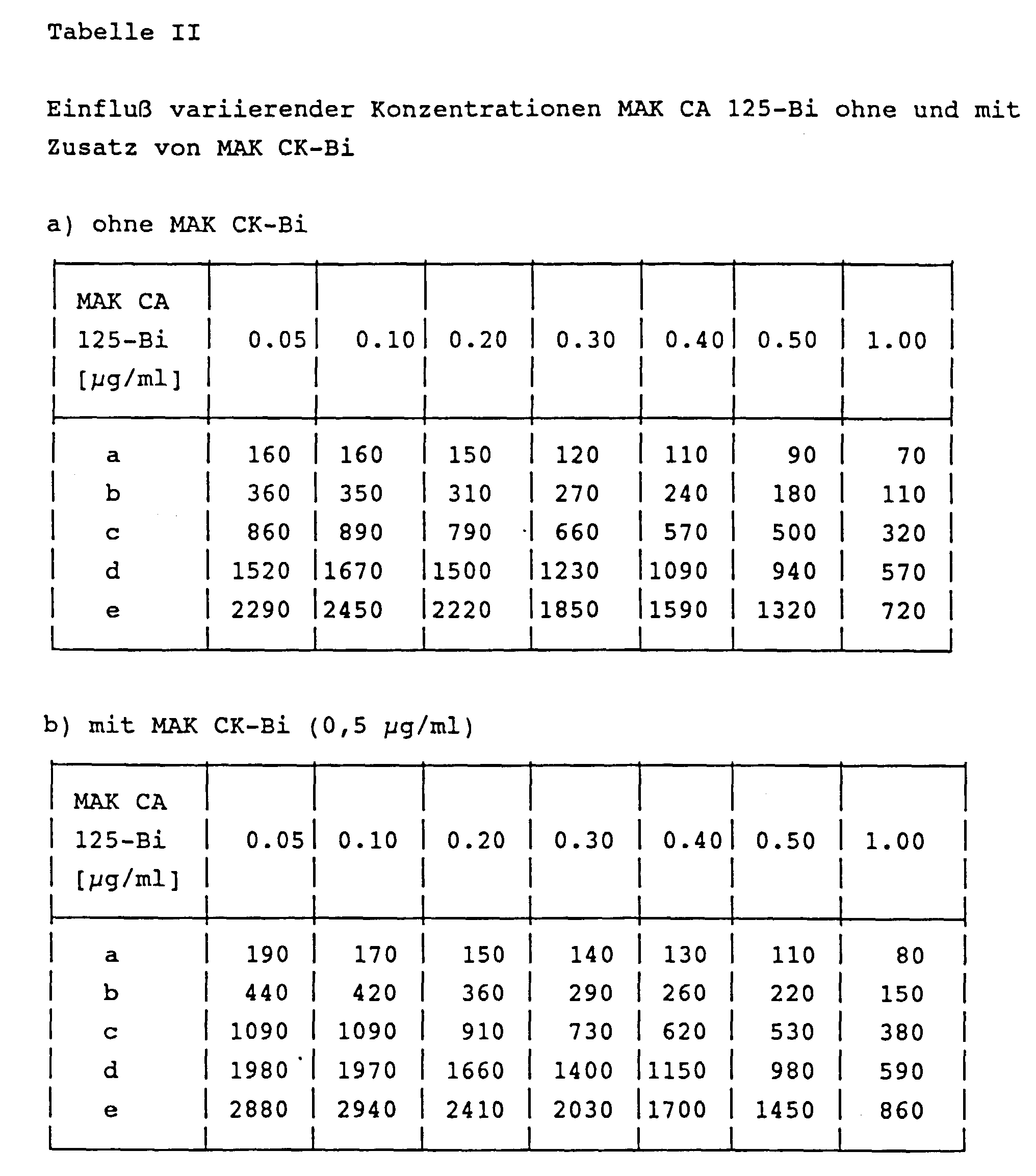
- Der Effekt der Zunahme der Signalintensität aufgrund der Anwesenheit des unspezifischen Konjugats MAK CK-Bi wird auch bei variierenden Konzentrationen des Analyt-spezifischen Konjugats MAK CA125-Bi gefunden. Die Wirkung ist besonders dann zu sehen, wenn ein Überschuß von MAK CK-Bi vorliegt.

Tabelle IV Präzision in der Serie ohne Zusatz von MAK CK-Bi, MAK CA 125-Bi: 0,1 µg/ml 20 Einzelbestimmungen Standardlösung Humanserum 1 Humanserum 2 x 7,02 U/ml 10,21 U/ml 18,14 U/ml s 4,50 U/ml 4,67 U/ml 4,46 U/ml VK 64 % 46 % 25 % Tabelle V Präzision in der Serie 0,1 µg/ml MAK CA 125-Bi (Biotinylierungsgrad 1:10) bei Zusatz von von 0,5 µg/ml MAK CK-Bi 20 Einzelbestimmungen Standardlösung Humanserum 1 Humanserum 2 x 4,92 U/ml 6,83 U/ml 12,34 U/ml s 1,90 U/ml 2,11 U/ml 1,26 U/ml VK 39 % 31 % 10 % - Ein Vergleich der Tabellen IV und V zeigt eine erhöhte Präzision der Bestimmung des Antigens CA-125 bei Zusatz des unspezifischen Konjugats MAK CK-Bi.
- x:
- Mittelwert aus 20 Bestimmungen
- s:
- Standardabweichung
- VK:
- Variationskoeffizient auf Konzentrationsbasis
- HS:
- Humanserum
- DB:
- Doppelbestimmung
- EB:
- Einzelbestimmung
- 100 µl Probe (Humanserum) werden in ein mit Streptavidin beschichtetes Polystyrol-Röhrchen gegeben und mit 70 ng eines biotinylierten Anti-Estradiol-Antikörpers (polyklonal, Herstellung gemäß G. Brown et al. in D. Catty (ed.), Antibodies, Vol. I, A practical approach, IRL-Press, Washington, 1988, 85; Immunisierung mit Estradiol (Boehringer Mannheim GmbH, Katalog Nr. 11 22 789)) ) in 500 µl Inkubationspuffer (100 mmol/l Phosphatpuffer pH 7,0) versetzt und 30 Minuten inkubiert.
- Nach Zugabe eines Konjugats aus Peroxidase und einem Anti-Estradiol-Antikörper (Boehringer Mannheim GmbH, Katalog Nr. 11 22 789, 150 mU/ml POD-Aktivität in 500 µl Inkubationspuffer) wird weitere 60 Minuten inkubiert. Nach Absaugen der flüssigen Phase und mehrmaligem Waschen der Röhrchen mit Waschlösung, wird 1 ml Substratlösung zugegeben, 30 Minuten inkubiert und die gebildete Farbe bei 420 nm photometrisch bestimmt. Die Ergebnisse sind aus der Tabelle VIII zu ersehen.
Tabelle VIII Probe Variante 1 Variante 2 Differenz 2/1 mE % VK mE % VK % 1 243 8,3 302 6,6 20 2 112 8,7 158 3,4 61 3 34 13,8 59 7,0 49 4 128 5,9 147 3,7 37 Mittelwert 9,2 5,2 44 - Variante 1:
- 3 ng Biotin /ml
- Variante 2:
- 1.5 µg TRSA-Biotin (1 : 15) /ml
- mE:
- Extinktion bei 420 nm in mE
- Tabelle VIII zeigt, daß der Zusatz von Biotin allein nicht geeignet ist, die Präzision des Tests wesentlich zu verbessern. Erst der Zusatz eines Konjugats aus hochmolekularem RSA (TRSA, Herstellung entsprechend EP-A 0 269 092) mit Biotin (TRSA-Biotin) führt zu einer Verbesserung der Präzision.

| Präzision in der Serie bei Zusatz von RSA-Biotin | |||||||||
| Proben | ohne Biotin-Konjugat | + 0,5 µg/ml RSA-Biotin (1 : 10) | |||||||
| Extinktion E | U/ml | Extinktion E | U/ml | ||||||
| 10 DB | 20 EB | 10 DB | 20 EB | 10 DB | 20 EB | 10 DB | 20 EB | ||
| Standard a | x | 0,116 | 0,116 | 4,68 | 5,24 | 0,113 | 0,115 | 2,83 | 3,12 |
| s | 0,005 | 0,006 | 2,58 | 2,15 | 0,004 | 0,005 | 0,96 | 1,38 | |
| VK | 5 % | 5 % | 55 % | 41 % | 3 % | 4 % | 34 % | 44 % | |
| HS 1 | x | 0,160 | 0,160 | 19,24 | 19,22 | 0,162 | 0,161 | 14,34 | 14,44 |
| s | 0,010 | 0,013 | 3,10 | 3,78 | 0,003 | 0,006 | 0,78 | 1,26 | |
| VK | 6 % | 8 % | 16 % | 20 % | 2 % | 3 % | 5 % | 9 % | |
| HS 2 | x | 0,166 | 0,166 | 20,94 | 20,93 | 0,174 | 0,173 | 17,01 | 17,01 |
| s | 0,010 | 0,011 | 3,04 | 3,33 | 0,003 | 0,008 | 0,64 | 1,73 | |
| VK | 6 % | 7 % | 15 % | 16 % | 2 % | 4 % | 4 % | 10 % | |
| HS 3 | x | 0,161 | 0,162 | 19,56 | 20,0 | 0,166 | 0,166 | 15,25 | 15,25 |
| s | 0,013 | 0,012 | 3,79 | 3,67 | 0,006 | 0,009 | 1,31 | 1,91 | |
| VK | 8 % | 8 % | 19 % | 18 % | 4 % | 5 % | 9 % | 13 % | |
| HS 4 | x | 0,174 | 0,174 | 23,39 | 23,39 | 0,184 | 0,184 | 19,32 | 19,32 |
| s | 0,011 | 0,011 | 3,07 | 3,24 | 0,004 | 0,006 | 0,92 | 1,41 | |
| VK | 6 % | 6 % | 13 % | 14 % | 2 % | 4 % | 5 % | 7 % | |
| HS 5 | x | 0,194 | 0,194 | 29,0 | 29,0 | 0,209 | 0,209 | 24,77 | 24,79 |
| s | 0,009 | 0,010 | 2,42 | 2,68 | 0,004 | 0,007 | 0,92 | 1,48 | |
| VK | 4 % | 5 % | 8 % | 9 % | 2 % | 3 % | 4 % | 6 % | |
Claims (10)
- Verfahren zur Bestimmung eines Analyten durch einen heterogenen immunologischen Test unter Verwendung eines an einer Festphase fixierten ersten Partners eines Bindepaares, bei dem man eine den Analyten enthaltende Probelösung in Gegenwart der Festphase entweder(1) mit einem ersten Konjugat, bestehend aus (a) dem zweiten Partner des oben erwähnten Bindepaares und (b) einer ersten, mit dem Analyten immunologisch spezifisch bindefähigen Substanz, oder(2) mit einem ersten Konjugat, bestehend aus (a) dem zweiten Partner des oben erwähnten Bindepaares und (b) einer ersten, mit dem Analyten immunologisch spezifisch bindefähigen Substanz, sowie mit einer zweiten, mit dem Analyten immunologisch spezifisch bindefähigen markierten Substanzinkubiert, danach die Phasen trennt, im Falle (1) die flüssige Phase durch eine weitere Lösung, die eine zweite, mit dem Analyten spezifisch bindefähige markierte Substanz enthält, ersetzt und erneut inkubiert und danach abtrennt, und in beiden Fällen die Markierung an der festen Phase oder in der zuletzt abgetrennten flüssigen Phase als Maß für die Analytmenge mißt,
dadurch gekennzeichnet,
daß man der flüssigen Phase vor der Inkubation außerdem ein zweites Konjugat aus (a) einem Makromolekül, das nicht mit dem Analyten bindefähig ist, und (b) dem zweiten Partner des oben erwähnten Bindepaares im ]berschuß gegenüber dem ersten Konjugat zusetzt. - Verfahren nach Anspruch 1,
dadurch gekennzeichnet,
daß man als erste und zweite mit dem Analyten immunologisch spezifisch bindefähige Substanzen Antikörper oder Antikörperfragmente verwendet. - Verfahren nach Anspruch 1 oder 2,
dadurch gekennzeichnet,
daß man erste und zweite immunologisch bindefähige Substanzen mit gleichartigen Analyt-Bindungsstellen verwendet. - Verfahren nach einem der vorhergehenden Ansprüche,
dadurch gekennzeichnet,
daß man das zweite Konjugat in einem Überschuß von 2 bis 10 gegenüber dem ersten Konjugat einsetzt. - Verfahren nach einem der Ansprüche 1 bis 4,
dadurch gekennzeichnet,
daß das zweite Konjugat aus (a) einem Makromolekül, das nicht mit dem Analyten bindefähig ist, und (b) dem zweiten Partner des Bindepaares mehrere Bindungsstellen für den ersten Partner des Bindepaares aufweist. - Verfahren nach Anspruch 5,
dadurch gekennzeichnet,
daß das zweite Konjugat 5 bis 10 Bindungsstellen für den ersten Partner des Bindepaares aufweist. - Reagenz zur Bestimmung eines Analyten durch einen heterogenen immunologischen Test unter Verwendung eines an einer Festphase fixierten ersten Partners eines Bindepaares,
das(1) ein erstes Konjugat, bestehend aus (a) dem zweiten Partner des oben erwähnten Bindepaares und (b) einer ersten, mit dem Analyten immunologisch spezifisch bindefähigen Substanz,(2) eine zweite, mit dem Analyten immunologisch spezifisch bindefähige markierte Substanz enthält,dadurch gekennzeichnet,
daß es
(3) ein zweites Konjugat, bestehend aus (a) einem Makromolekül, das nicht mit dem Analyten bindefähig ist, und (b) dem zweiten Partner des oben erwähnten Bindepaares enthält. - Reagenz nach Anspruch 7,
dadurch gekennzeichnet,
daß die ersten und zweiten, immunologisch spezifisch bindefähigen Substanzen Antikörper oder Antikörperfragmente darstellen. - Reagenz nach Anspruch 7 oder 8,
dadurch gekennzeichnet,
daß die ersten und zweiten, immunologisch spezifisch bindefähigen Substanzen gleichartige Analyt-Bindungsstellen aufweisen. - Reagenz nach einem der Ansprüche 7 bis 9,
dadurch gekennzeichnet,
daß das zweite Konjugat aus (a) einem Makromolekül, das nicht mit dem Analyten bindefähig ist, und (b) dem zweiten Partner des Bindepaares mehrere Bindungsstellen für den ersten Partner des Bindepaares aufweist.
Applications Claiming Priority (2)
| Application Number | Priority Date | Filing Date | Title |
|---|---|---|---|
| DE4136010 | 1991-10-31 | ||
| DE4136010A DE4136010A1 (de) | 1991-10-31 | 1991-10-31 | Verfahren zur bestimmung einer immunologisch bindefaehigen substanz |
Publications (3)
| Publication Number | Publication Date |
|---|---|
| EP0540037A2 EP0540037A2 (de) | 1993-05-05 |
| EP0540037A3 EP0540037A3 (de) | 1994-04-20 |
| EP0540037B1 true EP0540037B1 (de) | 1996-12-18 |
Family
ID=6443887
Family Applications (1)
| Application Number | Title | Priority Date | Filing Date |
|---|---|---|---|
| EP92118637A Expired - Lifetime EP0540037B1 (de) | 1991-10-31 | 1992-10-30 | Verfahren zur Bestimmung einer immunologisch bindefähigen Substanz |
Country Status (6)
| Country | Link |
|---|---|
| US (1) | US5278081A (de) |
| EP (1) | EP0540037B1 (de) |
| JP (1) | JPH0799370B2 (de) |
| AT (1) | ATE146595T1 (de) |
| DE (2) | DE4136010A1 (de) |
| ES (1) | ES2097851T3 (de) |
Families Citing this family (6)
| Publication number | Priority date | Publication date | Assignee | Title |
|---|---|---|---|---|
| US5705353A (en) * | 1995-06-07 | 1998-01-06 | Beckman Instruments, Inc. | Method of reducing interferences in assays |
| US20050112586A1 (en) * | 2003-11-24 | 2005-05-26 | Roland Janzen | Method and composition for stabilizing liquid reagents |
| WO2010129302A1 (en) * | 2009-04-28 | 2010-11-11 | Innovative Laboratory Technologies, Inc. | Lateral-flow immuno-chromatographic assay devices |
| CN102621302A (zh) * | 2012-03-22 | 2012-08-01 | 四川省新成生物科技有限责任公司 | 线性免疫法检测膜条及其制作工艺 |
| JP7307793B2 (ja) | 2018-11-16 | 2023-07-12 | エフ. ホフマン-ラ ロシュ アーゲー | 結合対のメンバーを有するストレプトアビジン被覆固相 |
| CN112129955B (zh) * | 2019-06-25 | 2023-04-07 | 迈克生物股份有限公司 | 睾酮检测试剂盒 |
Family Cites Families (4)
| Publication number | Priority date | Publication date | Assignee | Title |
|---|---|---|---|---|
| DE3134787A1 (de) * | 1981-09-02 | 1983-03-10 | Boehringer Mannheim Gmbh, 6800 Mannheim | Creatinin-antikoerper |
| IL75020A (en) * | 1984-05-10 | 1988-10-31 | Abbott Lab | Biotin-antibiotin immunoassay for the detection of ligands |
| US4870007A (en) * | 1987-12-18 | 1989-09-26 | Eastman Kodak Company | Immobilized biotinylated receptor in test device, kit and method for determining a ligand |
| US5164299A (en) * | 1990-03-20 | 1992-11-17 | E. I. Du Pont De Nemours And Company | Use of a mixture of conjugated and unconjugated solid phase binding reagent to enhance the performance of assays |
-
1991
- 1991-10-31 DE DE4136010A patent/DE4136010A1/de not_active Withdrawn
-
1992
- 1992-10-29 US US07/968,139 patent/US5278081A/en not_active Expired - Lifetime
- 1992-10-30 ES ES92118637T patent/ES2097851T3/es not_active Expired - Lifetime
- 1992-10-30 DE DE59207717T patent/DE59207717D1/de not_active Expired - Fee Related
- 1992-10-30 AT AT92118637T patent/ATE146595T1/de not_active IP Right Cessation
- 1992-10-30 JP JP4292563A patent/JPH0799370B2/ja not_active Expired - Fee Related
- 1992-10-30 EP EP92118637A patent/EP0540037B1/de not_active Expired - Lifetime
Also Published As
| Publication number | Publication date |
|---|---|
| US5278081A (en) | 1994-01-11 |
| DE4136010A1 (de) | 1993-08-12 |
| ES2097851T3 (es) | 1997-04-16 |
| EP0540037A3 (de) | 1994-04-20 |
| ATE146595T1 (de) | 1997-01-15 |
| DE59207717D1 (de) | 1997-01-30 |
| JPH0799370B2 (ja) | 1995-10-25 |
| EP0540037A2 (de) | 1993-05-05 |
| JPH05223817A (ja) | 1993-09-03 |
Similar Documents
| Publication | Publication Date | Title |
|---|---|---|
| EP0397113B1 (de) | Verfahren zum Nachweis spezifisch bindefähiger Substanzen in Körperflüssigkeiten | |
| EP0363942B1 (de) | Verfahren zur Bestimmung einer spezifisch bindefähigen Substanz | |
| EP0944832B1 (de) | ANTIGENSPEZIFISCHER IgM-NACHWEIS | |
| EP0944838B1 (de) | ANTIGENSPEZIFISCHER IgG-NACHWEIS | |
| DE69903899T2 (de) | Enzym-Antikörper-Komplex und eine Methode zur Herstellung desselben | |
| EP0407904B1 (de) | Verfahren zur Bestimmung eines Analyten | |
| DE60027910T2 (de) | Hochsensitiver zeitaufgelöster immunofluoreszenzassay zum nachweis von chemokinen | |
| EP0280211A2 (de) | Verfahren zur Bestimmung von Antikörpern | |
| EP0098590A2 (de) | Immunchemisches Messverfahren | |
| EP0811846A2 (de) | Stabilisierung von Metallkonjugaten | |
| DE3433652A1 (de) | Immunchemisches messverfahren fuer haptene und proteine | |
| DE60202008T2 (de) | Verfahren zum Auffinden von Reagenzien und Festphasenkomponenten in spezifischen Bindungsassays, frei von fortgeschrittenen Glykosylierungsendprodukten | |
| EP0825441B1 (de) | Sensitivitätssteigerung bei der immunchemischen Bestimmung eines Analyten | |
| EP0540037B1 (de) | Verfahren zur Bestimmung einer immunologisch bindefähigen Substanz | |
| DE69523027T2 (de) | Kalibrierung und Prüfung von Immunoassays zur Verminderung von Störungen | |
| DE68922606T2 (de) | Markierung von chemischen produkten zur feststellung der identität und der herkunft. | |
| EP0215457A2 (de) | Verfahren zur Bestimmung eines Partners einer Immunreaktion | |
| DE3883145T2 (de) | Verfahren zur Messung von humanen Insulin. | |
| EP0572845A1 (de) | Verfahren zur immunchemischen Bestimmung eines Analyten | |
| DE69529787T2 (de) | Testsatz und Methode für eine Bestimmung durch kompetitive spezifische Bindung | |
| EP0322813A2 (de) | Verfahren zur Bestimmung einer immunologisch aktiven Substanz | |
| DE69211371T2 (de) | Bestimmung von Analyten mit hohem Molekulargewicht | |
| EP0575999B1 (de) | Verfahren zum Nachweis eines Analyten enthaltend glykosidische Tenside | |
| EP0444561B1 (de) | Verfahren zur immunologischen Bestimmung von Liganden | |
| EP0601318A2 (de) | Verfahren zur Herstellung von Konjugaten aus einem spezifischen Bindungspartner und einem kohlenhydrathaltigen Protein |
Legal Events
| Date | Code | Title | Description |
|---|---|---|---|
| PUAI | Public reference made under article 153(3) epc to a published international application that has entered the european phase |
Free format text: ORIGINAL CODE: 0009012 |
|
| 17P | Request for examination filed |
Effective date: 19921030 |
|
| AK | Designated contracting states |
Kind code of ref document: A2 Designated state(s): AT BE CH DE DK ES FR GB GR IE IT LI LU NL PT SE |
|
| PUAL | Search report despatched |
Free format text: ORIGINAL CODE: 0009013 |
|
| AK | Designated contracting states |
Kind code of ref document: A3 Designated state(s): AT BE CH DE DK ES FR GB GR IE IT LI LU NL PT SE |
|
| GRAG | Despatch of communication of intention to grant |
Free format text: ORIGINAL CODE: EPIDOS AGRA |
|
| 17Q | First examination report despatched |
Effective date: 19960312 |
|
| GRAH | Despatch of communication of intention to grant a patent |
Free format text: ORIGINAL CODE: EPIDOS IGRA |
|
| GRAH | Despatch of communication of intention to grant a patent |
Free format text: ORIGINAL CODE: EPIDOS IGRA |
|
| GRAA | (expected) grant |
Free format text: ORIGINAL CODE: 0009210 |
|
| AK | Designated contracting states |
Kind code of ref document: B1 Designated state(s): AT BE CH DE DK ES FR GB GR IE IT LI LU NL PT SE |
|
| PG25 | Lapsed in a contracting state [announced via postgrant information from national office to epo] |
Ref country code: NL Free format text: LAPSE BECAUSE OF FAILURE TO SUBMIT A TRANSLATION OF THE DESCRIPTION OR TO PAY THE FEE WITHIN THE PRESCRIBED TIME-LIMIT Effective date: 19961218 Ref country code: GR Free format text: LAPSE BECAUSE OF FAILURE TO SUBMIT A TRANSLATION OF THE DESCRIPTION OR TO PAY THE FEE WITHIN THE PRESCRIBED TIME-LIMIT Effective date: 19961218 Ref country code: DK Effective date: 19961218 |
|
| REF | Corresponds to: |
Ref document number: 146595 Country of ref document: AT Date of ref document: 19970115 Kind code of ref document: T |
|
| GBT | Gb: translation of ep patent filed (gb section 77(6)(a)/1977) |
Effective date: 19961219 |
|
| REF | Corresponds to: |
Ref document number: 59207717 Country of ref document: DE Date of ref document: 19970130 |
|
| REG | Reference to a national code |
Ref country code: IE Ref legal event code: FG4D Free format text: 71058 |
|
| ET | Fr: translation filed | ||
| ITF | It: translation for a ep patent filed | ||
| PG25 | Lapsed in a contracting state [announced via postgrant information from national office to epo] |
Ref country code: SE Effective date: 19970318 Ref country code: PT Effective date: 19970318 |
|
| REG | Reference to a national code |
Ref country code: ES Ref legal event code: FG2A Ref document number: 2097851 Country of ref document: ES Kind code of ref document: T3 |
|
| NLV1 | Nl: lapsed or annulled due to failure to fulfill the requirements of art. 29p and 29m of the patents act | ||
| PG25 | Lapsed in a contracting state [announced via postgrant information from national office to epo] |
Ref country code: IE Free format text: LAPSE BECAUSE OF NON-PAYMENT OF DUE FEES Effective date: 19970818 |
|
| REG | Reference to a national code |
Ref country code: IE Ref legal event code: FD4D Ref document number: 71058 Country of ref document: IE |
|
| PLBE | No opposition filed within time limit |
Free format text: ORIGINAL CODE: 0009261 |
|
| STAA | Information on the status of an ep patent application or granted ep patent |
Free format text: STATUS: NO OPPOSITION FILED WITHIN TIME LIMIT |
|
| PG25 | Lapsed in a contracting state [announced via postgrant information from national office to epo] |
Ref country code: AT Free format text: LAPSE BECAUSE OF NON-PAYMENT OF DUE FEES Effective date: 19971030 |
|
| PG25 | Lapsed in a contracting state [announced via postgrant information from national office to epo] |
Ref country code: BE Free format text: LAPSE BECAUSE OF NON-PAYMENT OF DUE FEES Effective date: 19971031 Ref country code: CH Free format text: LAPSE BECAUSE OF NON-PAYMENT OF DUE FEES Effective date: 19971031 Ref country code: LU Free format text: LAPSE BECAUSE OF NON-PAYMENT OF DUE FEES Effective date: 19971031 Ref country code: LI Free format text: LAPSE BECAUSE OF NON-PAYMENT OF DUE FEES Effective date: 19971031 |
|
| 26N | No opposition filed | ||
| BERE | Be: lapsed |
Owner name: BOEHRINGER MANNHEIM G.M.B.H. Effective date: 19971031 |
|
| REG | Reference to a national code |
Ref country code: CH Ref legal event code: PL |
|
| REG | Reference to a national code |
Ref country code: GB Ref legal event code: IF02 |
|
| PGFP | Annual fee paid to national office [announced via postgrant information from national office to epo] |
Ref country code: GB Payment date: 20060915 Year of fee payment: 15 |
|
| PGFP | Annual fee paid to national office [announced via postgrant information from national office to epo] |
Ref country code: ES Payment date: 20061020 Year of fee payment: 15 |
|
| PGFP | Annual fee paid to national office [announced via postgrant information from national office to epo] |
Ref country code: DE Payment date: 20061031 Year of fee payment: 15 Ref country code: IT Payment date: 20061031 Year of fee payment: 15 |
|
| GBPC | Gb: european patent ceased through non-payment of renewal fee |
Effective date: 20071030 |
|
| PG25 | Lapsed in a contracting state [announced via postgrant information from national office to epo] |
Ref country code: DE Free format text: LAPSE BECAUSE OF NON-PAYMENT OF DUE FEES Effective date: 20080501 |
|
| REG | Reference to a national code |
Ref country code: FR Ref legal event code: ST Effective date: 20080630 |
|
| PGFP | Annual fee paid to national office [announced via postgrant information from national office to epo] |
Ref country code: FR Payment date: 20061003 Year of fee payment: 15 |
|
| PG25 | Lapsed in a contracting state [announced via postgrant information from national office to epo] |
Ref country code: GB Free format text: LAPSE BECAUSE OF NON-PAYMENT OF DUE FEES Effective date: 20071030 |
|
| REG | Reference to a national code |
Ref country code: ES Ref legal event code: FD2A Effective date: 20071031 |
|
| PG25 | Lapsed in a contracting state [announced via postgrant information from national office to epo] |
Ref country code: ES Free format text: LAPSE BECAUSE OF NON-PAYMENT OF DUE FEES Effective date: 20071031 Ref country code: FR Free format text: LAPSE BECAUSE OF NON-PAYMENT OF DUE FEES Effective date: 20071031 |
|
| PG25 | Lapsed in a contracting state [announced via postgrant information from national office to epo] |
Ref country code: IT Free format text: LAPSE BECAUSE OF NON-PAYMENT OF DUE FEES Effective date: 20071030 |