EP0540965A1 - Positiv arbeitendes strahlungsempfindliches Gemisch und Verfahren zur Herstellung von Reliefmustern - Google Patents
Positiv arbeitendes strahlungsempfindliches Gemisch und Verfahren zur Herstellung von Reliefmustern Download PDFInfo
- Publication number
- EP0540965A1 EP0540965A1 EP92118250A EP92118250A EP0540965A1 EP 0540965 A1 EP0540965 A1 EP 0540965A1 EP 92118250 A EP92118250 A EP 92118250A EP 92118250 A EP92118250 A EP 92118250A EP 0540965 A1 EP0540965 A1 EP 0540965A1
- Authority
- EP
- European Patent Office
- Prior art keywords
- radiation
- acid
- mixture according
- organic compound
- sensitive mixture
- Prior art date
- Legal status (The legal status is an assumption and is not a legal conclusion. Google has not performed a legal analysis and makes no representation as to the accuracy of the status listed.)
- Granted
Links
- 239000000203 mixture Substances 0.000 title claims abstract description 43
- 238000000034 method Methods 0.000 title claims description 13
- 230000015572 biosynthetic process Effects 0.000 title 1
- 230000005855 radiation Effects 0.000 claims abstract description 40
- 239000002253 acid Substances 0.000 claims abstract description 37
- 150000002894 organic compounds Chemical class 0.000 claims abstract description 23
- 239000011230 binding agent Substances 0.000 claims abstract description 19
- RTZKZFJDLAIYFH-UHFFFAOYSA-N Diethyl ether Chemical compound CCOCC RTZKZFJDLAIYFH-UHFFFAOYSA-N 0.000 claims abstract description 14
- 239000012670 alkaline solution Substances 0.000 claims abstract description 12
- 150000002148 esters Chemical class 0.000 claims abstract description 12
- 125000005587 carbonate group Chemical group 0.000 claims abstract description 8
- 125000000217 alkyl group Chemical group 0.000 claims description 9
- 125000001997 phenyl group Chemical group [H]C1=C([H])C([H])=C(*)C([H])=C1[H] 0.000 claims description 9
- 125000004432 carbon atom Chemical group C* 0.000 claims description 8
- 229920001577 copolymer Polymers 0.000 claims description 8
- FUGYGGDSWSUORM-UHFFFAOYSA-N 4-hydroxystyrene Chemical compound OC1=CC=C(C=C)C=C1 FUGYGGDSWSUORM-UHFFFAOYSA-N 0.000 claims description 6
- 125000003710 aryl alkyl group Chemical group 0.000 claims description 6
- 125000003118 aryl group Chemical group 0.000 claims description 6
- 125000000753 cycloalkyl group Chemical group 0.000 claims description 6
- 150000002989 phenols Chemical class 0.000 claims description 6
- JAGRUUPXPPLSRX-UHFFFAOYSA-N 4-prop-1-en-2-ylphenol Chemical compound CC(=C)C1=CC=C(O)C=C1 JAGRUUPXPPLSRX-UHFFFAOYSA-N 0.000 claims description 5
- 125000003545 alkoxy group Chemical group 0.000 claims description 5
- 229910052736 halogen Chemical group 0.000 claims description 5
- 150000002367 halogens Chemical group 0.000 claims description 5
- 238000010438 heat treatment Methods 0.000 claims description 5
- LBTAEJICTWJOKT-UHFFFAOYSA-N 2-phenylethenyl 2,2-dimethylbutanoate Chemical compound CCC(C)(C)C(=O)OC=CC1=CC=CC=C1 LBTAEJICTWJOKT-UHFFFAOYSA-N 0.000 claims description 4
- 238000004519 manufacturing process Methods 0.000 claims description 4
- WKBOTKDWSSQWDR-UHFFFAOYSA-N Bromine atom Chemical compound [Br] WKBOTKDWSSQWDR-UHFFFAOYSA-N 0.000 claims description 3
- ZAMOUSCENKQFHK-UHFFFAOYSA-N Chlorine atom Chemical compound [Cl] ZAMOUSCENKQFHK-UHFFFAOYSA-N 0.000 claims description 3
- SOGAXMICEFXMKE-UHFFFAOYSA-N alpha-Methyl-n-butyl acrylate Natural products CCCCOC(=O)C(C)=C SOGAXMICEFXMKE-UHFFFAOYSA-N 0.000 claims description 3
- GDTBXPJZTBHREO-UHFFFAOYSA-N bromine Substances BrBr GDTBXPJZTBHREO-UHFFFAOYSA-N 0.000 claims description 3
- 229910052794 bromium Inorganic materials 0.000 claims description 3
- 229910052801 chlorine Inorganic materials 0.000 claims description 3
- 239000000460 chlorine Substances 0.000 claims description 3
- AQEFLFZSWDEAIP-UHFFFAOYSA-N di-tert-butyl ether Chemical compound CC(C)(C)OC(C)(C)C AQEFLFZSWDEAIP-UHFFFAOYSA-N 0.000 claims description 3
- 125000006501 nitrophenyl group Chemical group 0.000 claims description 3
- SJMYWORNLPSJQO-UHFFFAOYSA-N tert-butyl 2-methylprop-2-enoate Chemical compound CC(=C)C(=O)OC(C)(C)C SJMYWORNLPSJQO-UHFFFAOYSA-N 0.000 claims description 3
- DEQJOAZEABVZEE-UHFFFAOYSA-N 2-(2,6-dimethylphenyl)ethenol Chemical compound CC1=CC=CC(C)=C1C=CO DEQJOAZEABVZEE-UHFFFAOYSA-N 0.000 claims description 2
- FXRQXYSJYZPGJZ-UHFFFAOYSA-N 2-[(2-methylpropan-2-yl)oxy]ethenylbenzene Chemical compound CC(C)(C)OC=CC1=CC=CC=C1 FXRQXYSJYZPGJZ-UHFFFAOYSA-N 0.000 claims description 2
- 150000001735 carboxylic acids Chemical class 0.000 claims description 2
- 125000004185 ester group Chemical group 0.000 claims description 2
- XTXNWQHMMMPKKO-UHFFFAOYSA-N tert-butyl 2-phenylethenyl carbonate Chemical compound CC(C)(C)OC(=O)OC=CC1=CC=CC=C1 XTXNWQHMMMPKKO-UHFFFAOYSA-N 0.000 claims description 2
- GJWMYLFHBXEWNZ-UHFFFAOYSA-N tert-butyl (4-ethenylphenyl) carbonate Chemical compound CC(C)(C)OC(=O)OC1=CC=C(C=C)C=C1 GJWMYLFHBXEWNZ-UHFFFAOYSA-N 0.000 claims 1
- 235000012431 wafers Nutrition 0.000 description 21
- -1 phthalic acid esters Chemical class 0.000 description 20
- 239000000243 solution Substances 0.000 description 13
- 239000010410 layer Substances 0.000 description 10
- CCTFMNIEFHGTDU-UHFFFAOYSA-N 3-methoxypropyl acetate Chemical compound COCCCOC(C)=O CCTFMNIEFHGTDU-UHFFFAOYSA-N 0.000 description 9
- 229920002120 photoresistant polymer Polymers 0.000 description 8
- 229920000642 polymer Polymers 0.000 description 8
- PPBRXRYQALVLMV-UHFFFAOYSA-N Styrene Chemical compound C=CC1=CC=CC=C1 PPBRXRYQALVLMV-UHFFFAOYSA-N 0.000 description 6
- YXFVVABEGXRONW-UHFFFAOYSA-N Toluene Chemical compound CC1=CC=CC=C1 YXFVVABEGXRONW-UHFFFAOYSA-N 0.000 description 6
- XLYOFNOQVPJJNP-UHFFFAOYSA-N water Chemical compound O XLYOFNOQVPJJNP-UHFFFAOYSA-N 0.000 description 6
- XUIMIQQOPSSXEZ-UHFFFAOYSA-N Silicon Chemical compound [Si] XUIMIQQOPSSXEZ-UHFFFAOYSA-N 0.000 description 5
- 150000001875 compounds Chemical class 0.000 description 5
- 230000035945 sensitivity Effects 0.000 description 5
- 229910052710 silicon Inorganic materials 0.000 description 5
- 239000010703 silicon Substances 0.000 description 5
- BBEAQIROQSPTKN-UHFFFAOYSA-N pyrene Chemical compound C1=CC=C2C=CC3=CC=CC4=CC=C1C2=C43 BBEAQIROQSPTKN-UHFFFAOYSA-N 0.000 description 4
- 239000002904 solvent Substances 0.000 description 4
- GRFNSWBVXHLTCI-UHFFFAOYSA-N 1-ethenyl-4-[(2-methylpropan-2-yl)oxy]benzene Chemical compound CC(C)(C)OC1=CC=C(C=C)C=C1 GRFNSWBVXHLTCI-UHFFFAOYSA-N 0.000 description 3
- ZWEHNKRNPOVVGH-UHFFFAOYSA-N 2-Butanone Chemical compound CCC(C)=O ZWEHNKRNPOVVGH-UHFFFAOYSA-N 0.000 description 3
- XLLXMBCBJGATSP-UHFFFAOYSA-N 2-phenylethenol Chemical class OC=CC1=CC=CC=C1 XLLXMBCBJGATSP-UHFFFAOYSA-N 0.000 description 3
- XEKOWRVHYACXOJ-UHFFFAOYSA-N Ethyl acetate Chemical compound CCOC(C)=O XEKOWRVHYACXOJ-UHFFFAOYSA-N 0.000 description 3
- RAHZWNYVWXNFOC-UHFFFAOYSA-N Sulphur dioxide Chemical compound O=S=O RAHZWNYVWXNFOC-UHFFFAOYSA-N 0.000 description 3
- 239000012080 ambient air Substances 0.000 description 3
- 239000000463 material Substances 0.000 description 3
- 150000003254 radicals Chemical class 0.000 description 3
- 150000003839 salts Chemical class 0.000 description 3
- 238000010517 secondary reaction Methods 0.000 description 3
- 239000007787 solid Substances 0.000 description 3
- 150000003459 sulfonic acid esters Chemical class 0.000 description 3
- 150000003460 sulfonic acids Chemical class 0.000 description 3
- ARXJGSRGQADJSQ-UHFFFAOYSA-N 1-methoxypropan-2-ol Chemical compound COCC(C)O ARXJGSRGQADJSQ-UHFFFAOYSA-N 0.000 description 2
- XLLIQLLCWZCATF-UHFFFAOYSA-N 2-methoxyethyl acetate Chemical compound COCCOC(C)=O XLLIQLLCWZCATF-UHFFFAOYSA-N 0.000 description 2
- DZRUNSUYJCQUIG-UHFFFAOYSA-N 2-methylbutan-2-yl hydrogen carbonate Chemical compound CCC(C)(C)OC(O)=O DZRUNSUYJCQUIG-UHFFFAOYSA-N 0.000 description 2
- PXGOKWXKJXAPGV-UHFFFAOYSA-N Fluorine Chemical compound FF PXGOKWXKJXAPGV-UHFFFAOYSA-N 0.000 description 2
- 239000007983 Tris buffer Substances 0.000 description 2
- 150000001241 acetals Chemical class 0.000 description 2
- MWPLVEDNUUSJAV-UHFFFAOYSA-N anthracene Chemical compound C1=CC=CC2=CC3=CC=CC=C3C=C21 MWPLVEDNUUSJAV-UHFFFAOYSA-N 0.000 description 2
- 230000003197 catalytic effect Effects 0.000 description 2
- 230000000052 comparative effect Effects 0.000 description 2
- JHIVVAPYMSGYDF-UHFFFAOYSA-N cyclohexanone Chemical compound O=C1CCCCC1 JHIVVAPYMSGYDF-UHFFFAOYSA-N 0.000 description 2
- BGTOWKSIORTVQH-UHFFFAOYSA-N cyclopentanone Chemical compound O=C1CCCC1 BGTOWKSIORTVQH-UHFFFAOYSA-N 0.000 description 2
- 238000000276 deep-ultraviolet lithography Methods 0.000 description 2
- SWXVUIWOUIDPGS-UHFFFAOYSA-N diacetone alcohol Chemical compound CC(=O)CC(C)(C)O SWXVUIWOUIDPGS-UHFFFAOYSA-N 0.000 description 2
- 239000000975 dye Substances 0.000 description 2
- 125000001033 ether group Chemical group 0.000 description 2
- 150000002170 ethers Chemical class 0.000 description 2
- VRZVPALEJCLXPR-UHFFFAOYSA-N ethyl 4-methylbenzenesulfonate Chemical compound CCOS(=O)(=O)C1=CC=C(C)C=C1 VRZVPALEJCLXPR-UHFFFAOYSA-N 0.000 description 2
- LYCAIKOWRPUZTN-UHFFFAOYSA-N ethylene glycol Natural products OCCO LYCAIKOWRPUZTN-UHFFFAOYSA-N 0.000 description 2
- GVEPBJHOBDJJJI-UHFFFAOYSA-N fluoranthrene Natural products C1=CC(C2=CC=CC=C22)=C3C2=CC=CC3=C1 GVEPBJHOBDJJJI-UHFFFAOYSA-N 0.000 description 2
- 229910052731 fluorine Inorganic materials 0.000 description 2
- 239000011737 fluorine Substances 0.000 description 2
- 238000009472 formulation Methods 0.000 description 2
- 125000002887 hydroxy group Chemical group [H]O* 0.000 description 2
- WGCNASOHLSPBMP-UHFFFAOYSA-N hydroxyacetaldehyde Natural products OCC=O WGCNASOHLSPBMP-UHFFFAOYSA-N 0.000 description 2
- JOXIMZWYDAKGHI-UHFFFAOYSA-N p-toluenesulfonic acid Substances CC1=CC=C(S(O)(=O)=O)C=C1 JOXIMZWYDAKGHI-UHFFFAOYSA-N 0.000 description 2
- 239000011148 porous material Substances 0.000 description 2
- 239000002356 single layer Substances 0.000 description 2
- LYPVBFXTKUJYDL-UHFFFAOYSA-N sulfanium;trifluoromethanesulfonate Chemical compound [SH3+].[O-]S(=O)(=O)C(F)(F)F LYPVBFXTKUJYDL-UHFFFAOYSA-N 0.000 description 2
- XKXIQBVKMABYQJ-UHFFFAOYSA-N tert-butyl hydrogen carbonate Chemical class CC(C)(C)OC(O)=O XKXIQBVKMABYQJ-UHFFFAOYSA-N 0.000 description 2
- YSWBUABBMRVQAC-UHFFFAOYSA-N (2-nitrophenyl)methanesulfonic acid Chemical class OS(=O)(=O)CC1=CC=CC=C1[N+]([O-])=O YSWBUABBMRVQAC-UHFFFAOYSA-N 0.000 description 1
- REQJVFGEMATQEE-UHFFFAOYSA-N (4-nitrophenyl)methyl 1,3-dimethoxyanthracene-2-sulfonate Chemical class COC1=CC2=CC3=CC=CC=C3C=C2C(OC)=C1S(=O)(=O)OCC1=CC=C([N+]([O-])=O)C=C1 REQJVFGEMATQEE-UHFFFAOYSA-N 0.000 description 1
- GYUSOUBDQANPRG-UHFFFAOYSA-N (4-nitrophenyl)methyl 2,3-dimethoxyanthracene-1-sulfonate Chemical class COC=1C(OC)=CC2=CC3=CC=CC=C3C=C2C=1S(=O)(=O)OCC1=CC=C([N+]([O-])=O)C=C1 GYUSOUBDQANPRG-UHFFFAOYSA-N 0.000 description 1
- VJOVMPOROUWIIQ-UHFFFAOYSA-N (4-nitrophenyl)methyl benzenesulfonate Chemical class C1=CC([N+](=O)[O-])=CC=C1COS(=O)(=O)C1=CC=CC=C1 VJOVMPOROUWIIQ-UHFFFAOYSA-N 0.000 description 1
- DHKHKXVYLBGOIT-UHFFFAOYSA-N 1,1-Diethoxyethane Chemical compound CCOC(C)OCC DHKHKXVYLBGOIT-UHFFFAOYSA-N 0.000 description 1
- 150000003923 2,5-pyrrolediones Chemical class 0.000 description 1
- HMFOYSVOOQLCHV-UHFFFAOYSA-N 2-(2-methylphenyl)ethenol Chemical compound CC1=CC=CC=C1C=CO HMFOYSVOOQLCHV-UHFFFAOYSA-N 0.000 description 1
- QFKZBYXKHJHWSO-UHFFFAOYSA-N 2-(4-aminophenyl)-3-[4-(dimethylamino)phenyl]propanenitrile Chemical compound C1=CC(N(C)C)=CC=C1CC(C#N)C1=CC=C(N)C=C1 QFKZBYXKHJHWSO-UHFFFAOYSA-N 0.000 description 1
- XNWFRZJHXBZDAG-UHFFFAOYSA-N 2-METHOXYETHANOL Chemical compound COCCO XNWFRZJHXBZDAG-UHFFFAOYSA-N 0.000 description 1
- POAOYUHQDCAZBD-UHFFFAOYSA-N 2-butoxyethanol Chemical compound CCCCOCCO POAOYUHQDCAZBD-UHFFFAOYSA-N 0.000 description 1
- ZNQVEEAIQZEUHB-UHFFFAOYSA-N 2-ethoxyethanol Chemical compound CCOCCO ZNQVEEAIQZEUHB-UHFFFAOYSA-N 0.000 description 1
- HPEVJTNZYIMANV-UHFFFAOYSA-N 2-methylbutyl 4-methylbenzenesulfonate Chemical compound CCC(C)COS(=O)(=O)C1=CC=C(C)C=C1 HPEVJTNZYIMANV-UHFFFAOYSA-N 0.000 description 1
- QTBSBXVTEAMEQO-UHFFFAOYSA-M Acetate Chemical compound CC([O-])=O QTBSBXVTEAMEQO-UHFFFAOYSA-M 0.000 description 1
- NIXOWILDQLNWCW-UHFFFAOYSA-M Acrylate Chemical compound [O-]C(=O)C=C NIXOWILDQLNWCW-UHFFFAOYSA-M 0.000 description 1
- 241001136792 Alle Species 0.000 description 1
- LSNNMFCWUKXFEE-UHFFFAOYSA-M Bisulfite Chemical compound OS([O-])=O LSNNMFCWUKXFEE-UHFFFAOYSA-M 0.000 description 1
- DKPFZGUDAPQIHT-UHFFFAOYSA-N Butyl acetate Natural products CCCCOC(C)=O DKPFZGUDAPQIHT-UHFFFAOYSA-N 0.000 description 1
- OKTJSMMVPCPJKN-UHFFFAOYSA-N Carbon Chemical compound [C] OKTJSMMVPCPJKN-UHFFFAOYSA-N 0.000 description 1
- VYZAMTAEIAYCRO-UHFFFAOYSA-N Chromium Chemical compound [Cr] VYZAMTAEIAYCRO-UHFFFAOYSA-N 0.000 description 1
- SNRUBQQJIBEYMU-UHFFFAOYSA-N Dodecane Natural products CCCCCCCCCCCC SNRUBQQJIBEYMU-UHFFFAOYSA-N 0.000 description 1
- LFQSCWFLJHTTHZ-UHFFFAOYSA-N Ethanol Chemical compound CCO LFQSCWFLJHTTHZ-UHFFFAOYSA-N 0.000 description 1
- 101000657326 Homo sapiens Protein TANC2 Proteins 0.000 description 1
- PEEHTFAAVSWFBL-UHFFFAOYSA-N Maleimide Chemical compound O=C1NC(=O)C=C1 PEEHTFAAVSWFBL-UHFFFAOYSA-N 0.000 description 1
- CERQOIWHTDAKMF-UHFFFAOYSA-M Methacrylate Chemical compound CC(=C)C([O-])=O CERQOIWHTDAKMF-UHFFFAOYSA-M 0.000 description 1
- AFVFQIVMOAPDHO-UHFFFAOYSA-N Methanesulfonic acid Chemical compound CS(O)(=O)=O AFVFQIVMOAPDHO-UHFFFAOYSA-N 0.000 description 1
- 229930192627 Naphthoquinone Natural products 0.000 description 1
- CTQNGGLPUBDAKN-UHFFFAOYSA-N O-Xylene Chemical compound CC1=CC=CC=C1C CTQNGGLPUBDAKN-UHFFFAOYSA-N 0.000 description 1
- 206010034972 Photosensitivity reaction Diseases 0.000 description 1
- 102100034784 Protein TANC2 Human genes 0.000 description 1
- 238000006044 Wolff rearrangement reaction Methods 0.000 description 1
- 150000001242 acetic acid derivatives Chemical class 0.000 description 1
- 150000007513 acids Chemical class 0.000 description 1
- 150000001252 acrylic acid derivatives Chemical class 0.000 description 1
- 239000000654 additive Substances 0.000 description 1
- 239000002318 adhesion promoter Substances 0.000 description 1
- 125000001931 aliphatic group Chemical group 0.000 description 1
- SRSXLGNVWSONIS-UHFFFAOYSA-M benzenesulfonate Chemical compound [O-]S(=O)(=O)C1=CC=CC=C1 SRSXLGNVWSONIS-UHFFFAOYSA-M 0.000 description 1
- 229940077388 benzenesulfonate Drugs 0.000 description 1
- 150000008107 benzenesulfonic acids Chemical class 0.000 description 1
- 150000001558 benzoic acid derivatives Chemical class 0.000 description 1
- 125000001797 benzyl group Chemical group [H]C1=C([H])C([H])=C(C([H])=C1[H])C([H])([H])* 0.000 description 1
- 125000004799 bromophenyl group Chemical group 0.000 description 1
- YFNONBGXNFCTMM-UHFFFAOYSA-N butoxybenzene Chemical group CCCCOC1=CC=CC=C1 YFNONBGXNFCTMM-UHFFFAOYSA-N 0.000 description 1
- 229910052799 carbon Inorganic materials 0.000 description 1
- 150000001732 carboxylic acid derivatives Chemical class 0.000 description 1
- 150000001733 carboxylic acid esters Chemical class 0.000 description 1
- 238000006555 catalytic reaction Methods 0.000 description 1
- 125000000068 chlorophenyl group Chemical group 0.000 description 1
- 239000011248 coating agent Substances 0.000 description 1
- 238000000576 coating method Methods 0.000 description 1
- 239000000356 contaminant Substances 0.000 description 1
- 238000011109 contamination Methods 0.000 description 1
- 125000000113 cyclohexyl group Chemical group [H]C1([H])C([H])([H])C([H])([H])C([H])(*)C([H])([H])C1([H])[H] 0.000 description 1
- 125000001511 cyclopentyl group Chemical group [H]C1([H])C([H])([H])C([H])([H])C([H])(*)C1([H])[H] 0.000 description 1
- 125000002704 decyl group Chemical group [H]C([H])([H])C([H])([H])C([H])([H])C([H])([H])C([H])([H])C([H])([H])C([H])([H])C([H])([H])C([H])([H])C([H])([H])* 0.000 description 1
- 230000004069 differentiation Effects 0.000 description 1
- 125000003438 dodecyl group Chemical group [H]C([H])([H])C([H])([H])C([H])([H])C([H])([H])C([H])([H])C([H])([H])C([H])([H])C([H])([H])C([H])([H])C([H])([H])C([H])([H])C([H])([H])* 0.000 description 1
- 238000001035 drying Methods 0.000 description 1
- 230000003628 erosive effect Effects 0.000 description 1
- 125000004494 ethyl ester group Chemical group 0.000 description 1
- 125000001495 ethyl group Chemical group [H]C([H])([H])C([H])([H])* 0.000 description 1
- 230000002349 favourable effect Effects 0.000 description 1
- 238000001914 filtration Methods 0.000 description 1
- UQSQSQZYBQSBJZ-UHFFFAOYSA-M fluorosulfonate Chemical compound [O-]S(F)(=O)=O UQSQSQZYBQSBJZ-UHFFFAOYSA-M 0.000 description 1
- 150000002366 halogen compounds Chemical class 0.000 description 1
- 125000001475 halogen functional group Chemical group 0.000 description 1
- 125000005842 heteroatom Chemical group 0.000 description 1
- FUZZWVXGSFPDMH-UHFFFAOYSA-N hexanoic acid Chemical compound CCCCCC(O)=O FUZZWVXGSFPDMH-UHFFFAOYSA-N 0.000 description 1
- 125000004051 hexyl group Chemical group [H]C([H])([H])C([H])([H])C([H])([H])C([H])([H])C([H])([H])C([H])([H])* 0.000 description 1
- 125000000959 isobutyl group Chemical group [H]C([H])([H])C([H])(C([H])([H])[H])C([H])([H])* 0.000 description 1
- 125000001449 isopropyl group Chemical group [H]C([H])([H])C([H])(*)C([H])([H])[H] 0.000 description 1
- 150000002576 ketones Chemical class 0.000 description 1
- QSHDDOUJBYECFT-UHFFFAOYSA-N mercury Chemical compound [Hg] QSHDDOUJBYECFT-UHFFFAOYSA-N 0.000 description 1
- 229910052753 mercury Inorganic materials 0.000 description 1
- 150000002734 metacrylic acid derivatives Chemical class 0.000 description 1
- 229910021645 metal ion Inorganic materials 0.000 description 1
- VUQUOGPMUUJORT-UHFFFAOYSA-N methyl 4-methylbenzenesulfonate Chemical compound COS(=O)(=O)C1=CC=C(C)C=C1 VUQUOGPMUUJORT-UHFFFAOYSA-N 0.000 description 1
- 125000002496 methyl group Chemical group [H]C([H])([H])* 0.000 description 1
- 238000001393 microlithography Methods 0.000 description 1
- 239000000178 monomer Substances 0.000 description 1
- 125000004108 n-butyl group Chemical group [H]C([H])([H])C([H])([H])C([H])([H])C([H])([H])* 0.000 description 1
- 125000000740 n-pentyl group Chemical group [H]C([H])([H])C([H])([H])C([H])([H])C([H])([H])C([H])([H])* 0.000 description 1
- 125000004123 n-propyl group Chemical group [H]C([H])([H])C([H])([H])C([H])([H])* 0.000 description 1
- PSZYNBSKGUBXEH-UHFFFAOYSA-N naphthalene-1-sulfonic acid Chemical class C1=CC=C2C(S(=O)(=O)O)=CC=CC2=C1 PSZYNBSKGUBXEH-UHFFFAOYSA-N 0.000 description 1
- 150000002791 naphthoquinones Chemical class 0.000 description 1
- IZJVVXCHJIQVOL-UHFFFAOYSA-N nitro(phenyl)methanesulfonic acid Chemical class OS(=O)(=O)C([N+]([O-])=O)C1=CC=CC=C1 IZJVVXCHJIQVOL-UHFFFAOYSA-N 0.000 description 1
- 229920003986 novolac Polymers 0.000 description 1
- 230000000269 nucleophilic effect Effects 0.000 description 1
- XNGIFLGASWRNHJ-UHFFFAOYSA-N o-dicarboxybenzene Natural products OC(=O)C1=CC=CC=C1C(O)=O XNGIFLGASWRNHJ-UHFFFAOYSA-N 0.000 description 1
- 125000002347 octyl group Chemical group [H]C([*])([H])C([H])([H])C([H])([H])C([H])([H])C([H])([H])C([H])([H])C([H])([H])C([H])([H])[H] 0.000 description 1
- 125000000962 organic group Chemical group 0.000 description 1
- 239000003960 organic solvent Substances 0.000 description 1
- 125000006503 p-nitrobenzyl group Chemical group [H]C1=C([H])C(=C([H])C([H])=C1[N+]([O-])=O)C([H])([H])* 0.000 description 1
- XLMFDCKSFJWJTP-UHFFFAOYSA-N pentane-2,3-diol Chemical compound CCC(O)C(C)O XLMFDCKSFJWJTP-UHFFFAOYSA-N 0.000 description 1
- 125000002080 perylenyl group Chemical group C1(=CC=C2C=CC=C3C4=CC=CC5=CC=CC(C1=C23)=C45)* 0.000 description 1
- CSHWQDPOILHKBI-UHFFFAOYSA-N peryrene Natural products C1=CC(C2=CC=CC=3C2=C2C=CC=3)=C3C2=CC=CC3=C1 CSHWQDPOILHKBI-UHFFFAOYSA-N 0.000 description 1
- ISWSIDIOOBJBQZ-UHFFFAOYSA-N phenol group Chemical group C1(=CC=CC=C1)O ISWSIDIOOBJBQZ-UHFFFAOYSA-N 0.000 description 1
- 230000036211 photosensitivity Effects 0.000 description 1
- 239000004014 plasticizer Substances 0.000 description 1
- 125000003367 polycyclic group Chemical group 0.000 description 1
- 229920006254 polymer film Polymers 0.000 description 1
- DSNYFFJTZPIKFZ-UHFFFAOYSA-N propoxybenzene Chemical group CCCOC1=CC=CC=C1 DSNYFFJTZPIKFZ-UHFFFAOYSA-N 0.000 description 1
- 239000010453 quartz Substances 0.000 description 1
- 230000008707 rearrangement Effects 0.000 description 1
- VYPSYNLAJGMNEJ-UHFFFAOYSA-N silicon dioxide Inorganic materials O=[Si]=O VYPSYNLAJGMNEJ-UHFFFAOYSA-N 0.000 description 1
- 241000894007 species Species 0.000 description 1
- 238000004528 spin coating Methods 0.000 description 1
- 239000000126 substance Substances 0.000 description 1
- BDHFUVZGWQCTTF-UHFFFAOYSA-M sulfonate Chemical compound [O-]S(=O)=O BDHFUVZGWQCTTF-UHFFFAOYSA-M 0.000 description 1
- 150000003457 sulfones Chemical class 0.000 description 1
- 238000005496 tempering Methods 0.000 description 1
- XKXIQBVKMABYQJ-UHFFFAOYSA-M tert-butyl carbonate Chemical compound CC(C)(C)OC([O-])=O XKXIQBVKMABYQJ-UHFFFAOYSA-M 0.000 description 1
- 125000000999 tert-butyl group Chemical group [H]C([H])([H])C(*)(C([H])([H])[H])C([H])([H])[H] 0.000 description 1
- 125000003944 tolyl group Chemical group 0.000 description 1
- ITMCEJHCFYSIIV-UHFFFAOYSA-M triflate Chemical compound [O-]S(=O)(=O)C(F)(F)F ITMCEJHCFYSIIV-UHFFFAOYSA-M 0.000 description 1
- 238000009281 ultraviolet germicidal irradiation Methods 0.000 description 1
- 239000000080 wetting agent Substances 0.000 description 1
- 239000008096 xylene Substances 0.000 description 1
- 125000005023 xylyl group Chemical group 0.000 description 1
Classifications
-
- G—PHYSICS
- G03—PHOTOGRAPHY; CINEMATOGRAPHY; ANALOGOUS TECHNIQUES USING WAVES OTHER THAN OPTICAL WAVES; ELECTROGRAPHY; HOLOGRAPHY
- G03F—PHOTOMECHANICAL PRODUCTION OF TEXTURED OR PATTERNED SURFACES, e.g. FOR PRINTING, FOR PROCESSING OF SEMICONDUCTOR DEVICES; MATERIALS THEREFOR; ORIGINALS THEREFOR; APPARATUS SPECIALLY ADAPTED THEREFOR
- G03F7/00—Photomechanical, e.g. photolithographic, production of textured or patterned surfaces, e.g. printing surfaces; Materials therefor, e.g. comprising photoresists; Apparatus specially adapted therefor
- G03F7/004—Photosensitive materials
- G03F7/0045—Photosensitive materials with organic non-macromolecular light-sensitive compounds not otherwise provided for, e.g. dissolution inhibitors
-
- Y—GENERAL TAGGING OF NEW TECHNOLOGICAL DEVELOPMENTS; GENERAL TAGGING OF CROSS-SECTIONAL TECHNOLOGIES SPANNING OVER SEVERAL SECTIONS OF THE IPC; TECHNICAL SUBJECTS COVERED BY FORMER USPC CROSS-REFERENCE ART COLLECTIONS [XRACs] AND DIGESTS
- Y10—TECHNICAL SUBJECTS COVERED BY FORMER USPC
- Y10S—TECHNICAL SUBJECTS COVERED BY FORMER USPC CROSS-REFERENCE ART COLLECTIONS [XRACs] AND DIGESTS
- Y10S430/00—Radiation imagery chemistry: process, composition, or product thereof
- Y10S430/1053—Imaging affecting physical property or radiation sensitive material, or producing nonplanar or printing surface - process, composition, or product: radiation sensitive composition or product or process of making binder containing
- Y10S430/1055—Radiation sensitive composition or product or process of making
- Y10S430/106—Binder containing
-
- Y—GENERAL TAGGING OF NEW TECHNOLOGICAL DEVELOPMENTS; GENERAL TAGGING OF CROSS-SECTIONAL TECHNOLOGIES SPANNING OVER SEVERAL SECTIONS OF THE IPC; TECHNICAL SUBJECTS COVERED BY FORMER USPC CROSS-REFERENCE ART COLLECTIONS [XRACs] AND DIGESTS
- Y10—TECHNICAL SUBJECTS COVERED BY FORMER USPC
- Y10S—TECHNICAL SUBJECTS COVERED BY FORMER USPC CROSS-REFERENCE ART COLLECTIONS [XRACs] AND DIGESTS
- Y10S430/00—Radiation imagery chemistry: process, composition, or product thereof
- Y10S430/1053—Imaging affecting physical property or radiation sensitive material, or producing nonplanar or printing surface - process, composition, or product: radiation sensitive composition or product or process of making binder containing
- Y10S430/1055—Radiation sensitive composition or product or process of making
- Y10S430/106—Binder containing
- Y10S430/111—Polymer of unsaturated acid or ester
-
- Y—GENERAL TAGGING OF NEW TECHNOLOGICAL DEVELOPMENTS; GENERAL TAGGING OF CROSS-SECTIONAL TECHNOLOGIES SPANNING OVER SEVERAL SECTIONS OF THE IPC; TECHNICAL SUBJECTS COVERED BY FORMER USPC CROSS-REFERENCE ART COLLECTIONS [XRACs] AND DIGESTS
- Y10—TECHNICAL SUBJECTS COVERED BY FORMER USPC
- Y10S—TECHNICAL SUBJECTS COVERED BY FORMER USPC CROSS-REFERENCE ART COLLECTIONS [XRACs] AND DIGESTS
- Y10S430/00—Radiation imagery chemistry: process, composition, or product thereof
- Y10S430/1053—Imaging affecting physical property or radiation sensitive material, or producing nonplanar or printing surface - process, composition, or product: radiation sensitive composition or product or process of making binder containing
- Y10S430/1055—Radiation sensitive composition or product or process of making
- Y10S430/114—Initiator containing
- Y10S430/122—Sulfur compound containing
Definitions
- the invention relates to positive-working radiation-sensitive mixtures which contain acid-labile groups and photoactive components, are sensitive to UV rays and have improved processing latitude. These radiation-sensitive mixtures are particularly suitable as resist materials for deposit resists for the production of relief patterns.
- Positive-working radiation-sensitive mixtures are known.
- Positive working resist materials containing o-quinonediazides in aqueous alkaline binders e.g. Containing novolaks are used commercially as photoresists, so that the processes for producing relief images are also known.
- alkali-insoluble organic carboxylic acid esters (benzoic acid esters, phthalic acid esters) and sulfonic acid esters (benzenesulfonic acid esters, p-toluenesulfonic acid ester and naphthalene sulfonic acid esters) are only described, however, the latter under the influence of high-energy radiation (electron, X-ray and y-rays) are able to form a carbon or sulfonic acid which differentiates the solubility of exposed and unexposed areas (see, for example, J 58114 030 A).
- high-energy radiation electron, X-ray and y-rays
- Sulfonic acid esters as acid-forming components in UV-sensitive mixtures are not yet known.
- photochemically acid-generating compounds examples include onium salts, halogen compounds, nitrobenzyl sulfonates, activated sulfonic acid esters such as benzointosylates (EP-A-330 406), phenyl alkyl sulfonic acid (EP-A-388 813), sulfones and disulfones, dimethoxyanthracen-2-sulfonic acid - p - nitrobenzyl esters, iminosulfonates and naphthoquinone - 4 - sulfonates are known.
- a good overview of photochemical acid donors is given by E. Reichmanis et. al. in Chem. Mater., 3, 394-407 (1991).
- esters of higher condensed aromatics do not dissociate to the corresponding sulfonic acids when irradiated with light of the wavelengths 436 nm, 365 nm and 254 nm.
- o-Nitrobenzylsulfonates as acid donors are e.g. in EP-A-330 386. These compounds react photoinduced to sulfonic acids according to the known o - nitrobenzyl rearrangement.
- onium salts or o-nitrobenzyl esters as photochemical acid donors have the disadvantage that they react very sensitively to the slightest basic contamination of the ambient air and thus have a very limited processing latitude, as at the SPIE conference 4/5. March 1991, Symposium on Microlithography, San Jose, CA, USA, publication [1466-01 "Airborne chemical contamina- nation of a chemically amplified resist” and [1466-02] "Preliminary lithographic characteristics of an all-organic chemically amplified resist formulation for single layer deep - UV lithography ".
- a narrow processing latitude can be seen from both publications; in the latter, storage up to 15 minutes after exposure shows resist profiles that are no longer usable.
- DE-A 3 721 741 proposes radiation-sensitive mixtures which contain a polymeric binder which is soluble in aqueous alkaline solutions and an organic compound whose solubility in an aqueous alkaline developer is increased by the action of acid and which comprises at least one Contains acid cleavable grouping, this organic compound generates a strong acid under the action of radiation.
- These mixtures also show limited processing latitude, especially if the ambient air contains contaminants, e.g. Bases.
- the object of the present invention is to show UV-radiation-sensitive mixtures with which purely organic single-layer photoresists based on acid catalytic reactions, in particular in the short-wave UV light-sensitive, positive-working coating materials containing acid-labile organic groups and organic photochemical acid donors, can be processed into relief patterns, a more practical one Processing latitude, especially with regard to storage times between exposure and heating steps, is made possible.
- Ar is phenyl, mono -, di - or tri-C i - to C 4 - alkyl -, - alkoxy - or halo - substituted phenyl or nitrophenyl,
- R represents C i to C 12 alkyl, cycloalkyl, aryl or aralkyl with up to 12 carbon atoms or alkyl, cycloalkyl, aryl or aralkyl with up to 12 carbon atoms which is mono- or polysubstituted by alkyl, alkoxy or halogen, or Ar with R together forms an optionally substituted five- or six-membered ring.
- Preferred acid-labile ether, ester or carbonate groups are tert. - Butyl ether of phenols, tert. - Alkyl carbonates of phenols or tert. - Butyl esters of carboxylic acids.
- poly-p-tert are preferred as acid-labile organic binder (a1) containing carbonate groups. - butoxycarbonyloxystyrene or a copolymer of p - tert. - Butoxycarbonyloxysty - rols, as organic binder containing acid labile ester groups (a1) poly - (tert. - butyl methacrylate) or a copolymer of tert. - Butyl methacrylate.
- Preferred examples of water-insoluble, polymeric binders (a2) soluble in aqueous alkaline solutions are poly (p-hydroxystyrene), poly (p-hydroxy- ⁇ -methylstyrene), copolymers of p-hydroxy - ( ⁇ -methyl) styrene with t-butoxycarbonyloxystyrene, t-amylcarbonyloxystyrene, t-butoxystyrene, t-butyl methacrylate, 2-methylhydroxystyrene and / or 2,6-dimethylhydroxystyrene, the proportion of the comonomers being chosen so that the binders are in an aqueous alkaline solvent suitable pH are soluble.
- the present invention also relates to a process for producing relief patterns by imagewise UV irradiation of a radiation-sensitive recording layer in such a dose that the solubility of the exposed areas, if appropriate after a thermal heating step at temperatures between 60 and 130 ° C., in aqueous alkaline solutions increases and these areas can be removed selectively with the aqueous-alkaline developer, the radiation-sensitive recording layer consisting essentially of a radiation-sensitive mixture according to the invention.
- the radiation-sensitive mixtures according to the invention surprisingly enable the production of relief patterns and relief images with high resolution with practical processability with sufficient processing latitude, in particular with tolerable storage times between exposure and baking step> 15 minutes.
- the sensitivity of the systems is very high due to the catalytic effect of the photochemically generated acids, and the contrast values are very high. These radiation sensitive mixtures are therefore very well suited for use in deep UV lithography.
- the polymers (a1) and (a2) generally have average molecular weights Mw between 2,000 and 100,000, preferably between 8,000 and 30,000.
- organic compounds (a2.1) which contain acid-labile groups, preferably t-alkyl ethers, t-alkyl esters, acetals or t-alkyl carbonates: and
- Particularly preferred organic compounds (a 2.1) are those of the general formula (II) in which R 1 , R 2 and R 3 are identical or different from one another and represent aliphatic and / or aromatic radicals, which may contain heteroatoms, or two of the radicals R 1 to R 3 are linked together to form a ring, with the proviso that at least one of the radicals R 1 to R 3 contains at least one acid-cleavable group, preferably t-butyl carbonates of phenols or t-alkyl ethers of phenols, one of the radicals R 1 to R 3 having one or more further sulfonium salt radicals , optionally linked via groups cleavable by acid, and X ⁇ is a non-nucleophilic counterion.
- R 1 , R 2 and R 3 are identical or different from one another and represent aliphatic and / or aromatic radicals, which may contain heteroatoms, or two of the radicals R 1 to R 3 are linked together to form a
- phenyl for example methoxyphenyl, ethoxyphenyl, propoxyphenyl, butoxyphenyl, halogen-substituted phenyl, such as chlorophenyl or bromophenyl or nitrophenyl, R for C 1 - to C 12 -, preferably C 1 - to C 6 - alkyl , for example methyl, ethyl, n-propyl, isopropyl, n-butyl, isobutyl, tert.
- cycloalkyl such as cyclohexyl or cyclopentyl
- aryl such as phenyl, aralkyl with up to 12 carbon atoms, such as benzyl
- alkyl, alkoxy or halogen such as eg fluorine, chlorine, bromine
- halogen such as eg fluorine, chlorine, bromine
- the compounds (b) are generally present in the mixture according to the invention in an amount of 0.5 to 20, preferably 1 to 15,% by weight, based on the total amount of the radiation-sensitive mixture.
- organic compounds (b) of the formula (I) can all be prepared by processes as have already been described in the literature, for example in Organikum, VEB-Verlag Berlin 1976, 15th edition, page 684.
- component (a2) is preferably in amounts of 90-40% by weight, component (a2.1) in amounts of 9 to 40% by weight and component (b) in amounts of 1 to 20% by weight, based on the total amount of components (a2) + (a2.1) + (b).
- mixtures of components (a2), (a2.1) and / or (a2.2) and (b) these are preferably in amounts of 97 to 60% by weight (a2), 1 to 20% by weight. % (a2.1), 1 to 20% by weight (a2.2) and 1 to 20% by weight (b), based on the total amount of these components, with the proviso that the sum of the percentages in each case is 100, and the components (a2.1) and (a2.2) can replace each other.
- the mixtures according to the invention are preferably dissolved in an organic solvent, the solids content usually being in the range between 5 and 40% by weight.
- Preferred solvents are aliphatic ketones, ethers and esters, and mixtures thereof.
- Alkylene glycol monoalkyl ethers such as, for example, ethyl cellosolve, butyl glycol, methyl cellosolve and 1-methoxy-2-propanol
- alkylene glycol alkyl ether esters such as, for example, methyl cellosolve acetate, methyl propylene glycol acetate, and ethyl propylene glycol, are particularly preferred.
- acetate and ketones such as, for example, cyclohexanone, cyclopentanone and methyl ethyl ketone, and also acetates, such as butyl acetate and aromatics, such as toluene and xylene, and also ethyl acetate and diacetone alcohol.
- acetate and ketones such as, for example, cyclohexanone, cyclopentanone and methyl ethyl ketone
- acetates such as butyl acetate and aromatics, such as toluene and xylene, and also ethyl acetate and diacetone alcohol.
- additives such as adhesion promoters, wetting agents, dyes and plasticizers can be added to the mixture according to the invention.
- sensitizers can also be added to sensitize the compounds in the longer-wave UV to the visible range.
- Polycyclic aromatics such as pyrene and perylene are preferred for this, but other dyes which act as sensitizers can also be used.
- a radiation-sensitive recording layer which essentially consists of the radiation-sensitive mixture according to the invention, is irradiated imagewise in such a dose that the solubility of the exposed areas, if appropriate after a thermal heating step at temperatures between 60 ° C and 130 ° C, increases in aqueous alkaline solvents and these areas can be removed selectively with the alkaline developer.
- the polymeric binder with acid-labile groups and 1-10 in particular 2 to 5% by weight of an arylsulfonic acid ester (b) according to the invention, based on the solids content of the radiation-sensitive mixture, dissolved in methoxypropyl acetate, the solids content being between 10 and 30% by weight .
- the solution can be filtered through a filter with a pore size of 0.2 ⁇ m.
- a resist film with a layer thickness of 2 to 0.5 .mu.m is produced on a surface-oxidized silicon wafer by spin-coating the resist solution at speeds between 1,000 and 10,000 rpm. The wafer is then baked for drying between 1 min and 5 min at temperatures between 60 and 120 ° C.
- the films are then e.g. Imaged through a chrome-coated structured quartz mask with UV light from a mercury high pressure lamp or with excimer laser light.
- the irradiated films are developed with aqueous-alkaline or alcohol-containing aqueous-alkaline developers or, if appropriate, preheated between 5 seconds and 5 minutes at temperatures between 60 ° C. and 130 ° C.
- the process according to the invention is characterized in particular by the fact that storage times in normal ambient air of more than 15 minutes can be tolerated between the process steps "exposure” and “baking out after exposure” without sacrificing performance, i.e. Sensitivity and structural quality to lose.
- a photoresist solution is prepared from 10 parts of ethyl 4-toluenesulfonate, 90 parts of poly (p -vinylphenol-co-p-t-butoxycarbonyloxistyrene) (molar ratio of the comonomers 8: 2) and 300 parts of methoxypropyl acetate. This solution is then filtered through a filter with a pore diameter of 0.2 ⁇ m.
- the ⁇ p value was determined from the contrast curves.
- the gamma value is defined as where Do and D 1 represent the extrapolated exposure energy doses from the dark erosion energy curve.
- a photoresist solution is prepared analogously to Example 1, but the sulfonate (-) - di-O-tosyl-2,3,0 - isopropylidene - L - threitol (Fluka) is used.
- This resist solution is spun onto an oxidized silicon wafer and the polymer film on the hotplate for 1 min. baked at 90 ° C.
- a wafer After exposure through a structured test mask, a wafer is heated immediately and a control wafer only after a waiting time of 2 hours (1 min. At 120 ° C.) and developed.
- a resist formulation is produced from 6 parts of tris - (4 t-butoxycarbonyloxiphenyl) sulfonium trifluoromethanesulfonate, 94 parts of poly (p-vinylphenol and 300 parts of methyl propylene glycol acetate.
- a photoresist solution consisting of 10 parts of p-toluenesulfonic acid-2-methylbutyl ester, 90 parts of poly- (p-vinylphenol-co-p-t-butoxicarbonyloxistyrene) (molar ratio of the comonomers 8: 2) and 300 parts of methoxypropyl acetate is prepared according to Example 1 spun oxidized silicon wafers and baked at 90 ° C for 1 min.
- a photoresist solution consisting of 10 parts of methyl p-toluenesulfonate, 90 parts of poly (p-vinylphenol-co-t-butoxycarbonyloxistyrene) (molar ratio of the comonomers 8: 2) and 300 parts of methoxypropyl acetate is treated analogously to Example 4, onto surface-oxidized Si wafers applied and dried. After structuring with an alkaline developer, the following remaining layer thicknesses were measured:
- a photoresist solution is prepared from 5 parts of 3-chloro-1,2-benzoxathial-1,1-dioxide, 95 parts of poly- (p-vinylphenol-co-pt-butoxycarbonyloxistyrene) (molar ratio of the comonomers 8: 2) and 300 parts of methoxypropyl acetate and treated analogously to Example 4, spun onto surface-oxidized Si wafers and dried. After development with an alkaline medium, the following remaining layer thicknesses can be determined:
- the wafers After exposure through a structured test mask with excimer laser light with a wavelength of 248 nm, the wafers are baked at various temperatures to determine the most favorable process parameters and then immediately developed. Good structures could be obtained after 1 min at temperatures between 110 ° C and 120 ° C. If the wafers are heated below 100 ° C, the structuring takes longer.
Landscapes
- Physics & Mathematics (AREA)
- Spectroscopy & Molecular Physics (AREA)
- General Physics & Mathematics (AREA)
- Materials For Photolithography (AREA)
- Exposure And Positioning Against Photoresist Photosensitive Materials (AREA)
Abstract
Description
- Die Erfindung betrifft positiv arbeitende strahlungsempfindliche Gemische, die säurelabile Gruppierun - gen und photoaktive Komponenten enthalten, sensitiv gegenüber UV - Strahlen sind und einen verbesserten Verarbeitungsspielraum aufweisen. Diese strahlungsempfindlichen Gemische eignen sich besonders als Resistmaterialien für Einlagenresiste zur Herstellung von Reliefmustern.
- Positiv arbeitende strahlungsempfindliche Gemische sind bekannt. Positiv arbeitende Resistmaterialien, die o-Chinondiazide in wäßrig alkalischen Bindemitteln, z.B. Novolake enthalten, werden kommerziell als Photoresiste eingesetzt, so daß auch die Verfahren zur Herstellung von Reliefbildern bekannt sind.
- Neben den o-Chinondiaziden, welche bei Belichtung über die Wolff - Umlagerung eine alkalilösliche Carbonsäure zur Löslichkeitsdifferenzierung ergeben, sind auch alkaliunlösliche organische Carbonsäureester (Benzoesäureester, Phthalsäureester) und Sulfonsäureester (Benzolsulfonsäureester, p - Toluolsulfon - säureester und Naphthalinsulfonsäureester) beschrieben, wobei letztere jedoch nur unter dem Einfluß hochenergetischer Strahlung (Elektronen -, Röntgen - und y - Strahlen) eine Carbon - bzw. Sulfonsäure zu bilden vermögen, welche die Löslichkeitsdifferenzierung von belichteten und unbelichteten Bereichen bewirkt (vgl. z.B. J 58114 030 A). Die Empfindlichkeit dieser Systeme gegenüber Strahlung ist jedoch teilweise unbefriedigend.
- Sulfonsäureester als säurebildende Komponente in UV-strahlungsempfindlichen Gemischen sind noch nicht bekannt.
- Man hat auch strahlungsempfindliche Systeme entwickelt, welche in der Primärphotoreaktion eine Spezies erzeugen, die dann unabhängig von der Strahlung eine katalytische Sekundärreaktion auslösen und dadurch die Empfindlichkeiten drastisch erhöhen. Solche Systeme, die photochemisch eine starke Säure erzeugen, die dann in einer Sekundärreaktion säurelabile Gruppen spalten, sind z.B. aus US - PS 3 923 514, US - PS 3 915 706 und DE - A 34 06 927 bekannt.
- Als solche photochemisch säureerzeugenden Verbindungen sind beispielsweise Oniumsalze, Halogen - verbindungen, Nitrobenzylsulfonate, aktivierte Sulfonsäureester wie Benzointosylate (EP-A-330 406), Alkylsulfonsäurephenylester (EP-A-388 813), Sulfone und Disulfone, Dimethoxyanthracen-2-sulfonsäure - p - nitrobenzylester, Iminosulfonate und Naphthochinon - 4 - sulfonate bekannt. Einen guten Überblick über photochemische Säurespender geben E. Reichmanis et. al. in Chem. Mater., 3, 394-407 (1991).
- In einer Publikation über die Dimethoxyanthracen - sulfonsäure - p - nitrobenzylester (Journal of Photo - polymer Science and Technology, Vol. 3, 275-280 (1990)) wird beschrieben, daß zwar die höherkondensierten aromatischen Sulfonsäure - p - nitrobenzylester, z.B. von Anthracen, Pyren etc., bei Belichtung zu den entsprechenden Sulfonsäuren dissoziieren, jedoch nicht die Toluol - bzw. Benzolsulfonsäure - p - nitrobenzylester. Verwendet man anstelle der p - Nitrobenzylester die Ethylester, dissozieren selbst die Ester von höherkondensierten Aromaten nicht zu den entsprechenden Sulfonsäuren bei Bestrahlung mit Licht der Wellenlängen 436 nm, 365 nm und 254 nm.
- o-Nitrobenzylsulfonate als Säurespender werden z.B. in EP-A-330 386 beschrieben. Diese Verbindungen reagieren photoinduziert entsprechend der bekannten o - Nitrobenzylumlagerung zu Sulfonsäuren.
- Resistsysteme basierend auf t-Butoxycarbonylgruppen als säurelabile Einheiten und entweder z.B. Oniumsalzen oder o - Nitrobenzylester als photochemischen Säurespendern haben allerdings den Nachteil, daß sie sehr empfindlich auf geringste basische Verunreinigungen der Umgebungsluft reagieren und damit einen sehr eingeschränkten Verarbeitungsspielraum aufweisen, wie auf der SPIE Konferenz 4/5. März 1991, Symposium on Microlithography, San Jose, CA, USA, Publikation [1466 - 01 "Airborne chemical contami - nation of a chemically amplified resist" und [1466 - 02] "Preliminary lithographic characteristics of an all - organic chemically amplified resist formulation for single layer deep - UV lithography" geschildert. Beiden Publikationen ist ein eingeengter Verarbeitungsspielraum zu entnehmen; im letzteren zeigt die Lagerung bis zu 15 Minuten nach der Belichtung schon nicht mehr verwendbare Resistprofile.
- Weiterhin werden in der DE-A 3 721 741 strahlungsempfindliche Gemische vorgeschlagen, die ein in wäßrig - alkalischen Lösungen lösliches polymeres Bindemittel enthalten sowie eine organische Verbin - dung, deren Löslichkeit in einem wäßrig alkalischen Entwickler durch Einwirkung von Säure erhöht wird und die mindestens eine durch Säure spaltbare Gruppierung enthält, wobei diese organische Verbindung unter Einwirkung von Strahlung eine starke Säure erzeugt. Auch diese Gemische zeigen einen eingeschränkten Verarbeitungsspielraum, insbesondere wenn die Umgebungsluft Verunreinigungen, z.B. Basen, enthält.
- Der Nachteil vieler dieser Systeme ist also deren Empfindlichkeit gegenüber Lagerzeiten, insbesondere zwischen dem Verfahrensschritt Belichtung und dem darauf folgendem Prozeß der Sekundärreaktion zur Abspaltung der säurelabilen Gruppen, die meist durch Ausheizen unterstützt wird. Lagerzeiten zwischen den Prozeßschritten "Belichtung" und "Ausheizen nach der Belichtung" führen im allgemeinen zu verlän - gerten Entwicklungszeiten bzw. nichtentwickelbaren Restschichten. Es besteht daher ein Bedarf nach UV-Photoresistsystemen mit hoher Lichtempfindlichkeit, guter Ätzresistenz, Metallionenfreiheit und ausrei - chendem Verarbeitungsspielraum.
- Aufgabe der vorliegenden Erfindung ist es, UV-strahlungsempfindliche Gemische aufzuzeigen, mit denen man rein organische Einlagenphotoresiste auf Basis säurekatalytischer Reaktionen, insbesondere im kurzwelligen UV lichtempfindlicher positiv arbeitender Beschichtungsmaterialien, enthaltend säurelabile organische Gruppierungen und organische photochemische Säurespender, zu Reliefmustern verarbeiten kann, wobei ein praxisgerechter Verarbeitungsspielraum, insbesondere in Bezug auf Lagerzeiten zwischen Belichtung und Ausheizschritten, ermöglicht wird.
- Diese Aufgabe läßt sich überraschenderweise sehr vorteilhaft durch die erfindungsgemäßen Gemische lösen.
- Gegenstand der vorliegenden Erfindung sind positiv arbeitende UVstrahlungsempfindliche Gemische, enthaltend
- (al) ein säurelabile Ether-, Ester- oder Carbonatgruppen enthaltendes, in Wasser unlösliches organisches Bindemittel, das durch Einwirkung von Säure in wäßrig - alkalischen Lösungen löslich wird, oder
- (a2) ein in Wasser unlösliches, in wäßrig - alkalischen Lösungen lösliches polymeres Bindemittel und
- (a2.1) eine organische Verbindung, deren Löslichkeit in einem wäßrigalkalischen Entwickler durch Einwirkung von Säure erhöht wird, oder
- (a2.2) eine organische Verbindung, deren Löslichkeit in einem wäßrigalkalischen Entwickler durch Einwirkung von Säure erhöht wird und die mindestens eine durch Säure spaltbare Gruppierung sowie zusätzlich eine Gruppierung, die unter Einwirkung von Strahlung eine Säure bildet, enthält oder ein Gemisch der organischen Verbindungen (a2.1) und (a2.2) und
- (b) eine organische Verbindung, welche unter Einwirkung von UV-Strahlung eine Säure erzeugt,
- die dadurch gekennzeichnet sind, daß als organische Verbindung (b) Arylsulfonsäureester der allgemeinen Formel (I)

worin - Ar für Phenyl, ein - , zwei - oder dreifach Ci - bis C4 - alkyl - , - alkoxi - oder halogen - substituiertes Phenyl oder Nitrophenyl,
- R für Ci - bis C12-Alkyl, Cycloalkyl, Aryl oder Aralkyl mit bis zu 12 Kohlenstoffatomen oder durch Alkyl, Alkoxy oder Halogen ein - oder mehrfach substituiertes Alkyl, Cycloalkyl, Aryl oder Aralkyl mit bis zu 12 Kohlenstoffatomen stehen oder Ar mit R zusammen einen, gegebenenfalls substituierten, fünf- oder sechsgliedrigen Ring bildet, eingesetzt werden.
- Als säurelabile Ether-, Ester- oder Carbonatgruppen bevorzugt sind tert. - Butylether von Phenolen, tert. - Alkylcarbonate von Phenolen oder tert. - Butylester von Carbonsäuren.
- Als säurelabile Carbonatgruppen enthaltendes organisches Bindemittel (a1) bevorzugt sind insbesondere Poly - p - tert. - butoxycarbonyloxystyrol oder ein Copolymerisat des p - tert. - Butoxycarbonyloxysty - rols, als säurelabile Estergruppen enthaltendes organisches Bindemittel (a1) Poly - (tert. - butylmethacrylat) oder ein Copolymerisat des tert. - Butylmethacrylats.
- Bevorzugte Beispiele für in Wasser unlösliche, in wäßrig-alkalischen Lösungen lösliche polymere Bindemittel (a2) sind Poly - (p - hydroxystyrol), Poly - (p - hydroxy - α - methylstyrol), Copolymere von p - Hydroxy - (α - methyl)styrol mit t - Butoxycarbonyloxystyrol, t - Amylcarbonyloxystyrol, t - Butoxystyrol, t-Butylmethacrylat, 2 - Methylhydroxystyrol und/oder 2,6 - Dimethylhydroxystyrol, wobei der Anteil der Co - monomeren so gewählt wird, daß die Bindemittel in einem wäßrig - alkalischen Lösungsmittel geeigneten pH - Wertes löslich sind.
- Gegenstand der vorliegenden Erfindung ist auch ein Verfahren zur Herstellung von Reliefmustern durch bildmäßige UV-Bestrahlung einer strahlungsempfindlichen Aufzeichnungsschicht in solcher Dosis, daß die Löslichkeit der belichteten Bereiche, gegebenenfalls nach einem thermischen Ausheizschritt bei Temperaturen zwischen 60 und 130°C, in wäßrig - alkalischen Lösungen zunimmt und diese Bereiche selektiv mit dem wäßrig - alkalisch Entwickler entfernt werden können, wobei die strahlungsempfindliche Aufzeichnungsschicht im wesentlichen aus einem erfindungsgemäßen strahlungsempfindlichen Gemisch besteht.
- Die erfindungsgemäßen strahlungsempfindlichen Gemische ermöglichen überraschenderweise die Herstellung von Reliefmustern und Reliefbildern mit hoher Auflösung bei praxisgerechter Verarbeitbarkeit mit genügend großem Verarbeitungsspielraum, insbesondere mit tolerierbaren Lagerzeiten zwischen Belichtung und Ausheizschritt > 15 Minuten.
- Weiterhin ist die Empfindlichkeit der Systeme durch die katalytische Wirkung der photochemisch erzeugten Säuren sehr hoch, und es ergeben sich sehr hohe Kontrastwerte. Diese strahlungsempfindlichen Gemische sind daher für die Anwendung in der Deep - UV Lithographie sehr gut geeignet.
- Zu den Aufbaukomponenten des erfindungsgemäßen strahlungsempfindlichen Gemisches ist im ein - zelnen folgendes auszuführen.
- (a1) Als säurelabile Ether-, Ester- oder Carbonatgruppen enthaltende, in Wasser unlösliche organische Bindemittel (a1), die durch Einwirkung von Säure in wäßrig - alkalischen Lösungen löslich werden, kommen Polymere auf Basis von Homo - oder Copolymeren des p - t - Butoxystyrols, p - t - Butox - ycarbonyloxystyrols oder t-Amylcarbonyloxystyrols, als Comonomereinheiten kommen dabei alle mit Styrol copolymerisierbaren Monomeren, beispielsweise Acrylate, Methacrylate, Styrol und dessen Deri - vate, Schwefeldioxid, Maleinimide, insbesondere jedoch p - Hydroxistyrol und/oder p-Hydroxy-a-methylstyrol und in o - Stellung zur OH - Gruppe mono - oder disubstituierte Hydroxistyrole in Betracht; bevorzugt sind Poly - (p - t - butoxycarbonyloxy)styrol und Poly - (p - t - butoxystyrol).
- Das polymere Bindemittel (a1) ist im erfindungsgemäßen Gemisch im allgemeinen in einer Menge von 55 bis 99, vorzugsweise 70 bis 97 Gew. - %, bezogen auf die Summe der Komponenten (a1) und (b) enthalten.
- (a2) Als in Wasser unlösliche, in wäßrig-alkalischen Lösungen lösliche polymere Bindemittel (a2) kommen Polymere auf Basis von Homo - oder Copolymeren des p - Hydroxistyrols und/oder p - Hydroxi -α - methylstyrols in Betracht, wobei als Comonomereinheiten besonders in o-Stellung zur Hydroxygruppe mono- oder disubstituierte Hydroxistyrole oder Hydroxistyrole, deren phenolische Gruppe mit säurelabilen Gruppierungen geschützt ist, in Frage kommen. Besonders bevorzugte säure - labile Gruppierungen sind dabei t-Alkylcarbonate, wie t-Butylcarbonate, t-Amylcarbonate, Ether und Acetale, wie t-Butylether sowie t-Butylester. Die Comonomereinheiten sind dabei nur in solchen Mengen vorhanden, daß das Polymere wäßrig alkalisch löslich ist, bevorzugt im Bereich von 10 bis 70 Mol%.
- Die Polymeren (a1) bzw. (a2) weisen im allgemeinen mittlere Molekulargewichte Mw zwischen 2 000 und 100 000, vorzugsweise zwischen 8 000 und 30 000 auf.
- Als organische Verbindungen (a2.1), welche säurelabile Gruppen, bevorzugt t - Alkylether, t-Alkylester, Acetale oder t-Alkylcarbonate enthalten, seien hier beispielhaft aufgeführt:




- Als organische Verbindungen (a2.2), deren Löslichkeit in einem wäßrig - alkalischen Entwickler durch Einwirkung von Säure erhöht wird und die mindestens eine durch Säure spaltbare Gruppierung sowie zusätzlich eine die unter Einwirkung von Strahlung eine starke Säure enthält, kommen insbesondere Oniumsalze, enthaltend säurelabile Gruppierungen, wie sie in US-A 4 883 740 beschrieben sind, in Frage.
- Besonders bevorzugte organische Verbindungen (a 2.1) sind solche der allgemeinen Formel (II)

worin R1, R2 und R3 untereinander gleich oder verschieden sind und für aliphatische und/oder aromatische Reste, die gegebenenfalls Heteroatome enthalten, stehen oder zwei der Reste R1 bis R3 miteinan - der zu einem Ring verknüpft sind, mit der Maßgabe, daß mindestens einer der Reste R1 bis R3 mindestens eine durch Säure spaltbare Gruppierung, vorzugsweise t - Butylcarbonate von Phenolen bzw. t-Alkyl-ether von Phenolen enthält, wobei einer der Reste R1 bis R3 mit einem oder mehreren weiteren Sulfoniumsalzresten, gegebenenfalls über durch Säure spaltbare Gruppierungen, verknpft sein kann und XΘ ein nichtnucleophiles Gegenion bedeutet. - Als Gegenion kommen bevorzugt starke organische Säureanionen wie Tosylat, Mesylat, Benzolsul - fonat, Trifluormethansulfonat und Fluorsulfonat, in Frage.
- b) Als organische Verbindungen (b) kommen erfindungsgemäß Arylsulfonsäureester der allgemeinen Formel (I)
- Ar - SO2 - O - R (I), in Frage, worin Ar für Phenyl, ein-, zwei - oder dreifach C1 - bis C4 - alkylsubstituiertes Phenyl, beispielsweise Tolyl, Xylyl, ein-, zwei- oder dreifach C1 - bis C4-alkox- ysubstituiertes Phenyl, beispielsweise Methoxyphenyl, Ethoxyphenyl, Propoxyphenyl, Butoxyphenyl, halogensubstituiertes Phenyl, wie z.B. Chlorphenyl oder Bromphenyl oder Nitrophenyl, R für C1 - bis C12 - , vorzugsweise C1 - bis C6 - Alkyl, beispielsweise Methyl, Ethyl, n - Propyl, Isopropyl, n - Butyl, Isobutyl, tert. - Butyl, Amyl, Hexyl, Octyl, 2 - Ethylhexyl, Decyl, Dodecyl, Cycloalkyl, wie z.B. Cyclohexyl oder Cyclopentyl, Aryl wie z.B. Phenyl, Aralkyl mit bis zu 12 Kohlenstoffatomen, wie z.B. Benzyl, für durch Alkyl, Alkoxy oder Halogen (wie z.B. Fluor, Chlor, Brom) ein - oder mehrfach substituiertes Alkyl, Cycloalkyl, Aryl oder Aralkyl mit bis zu 12 Kohlenstoffatomen, oder Ar mit R zusammen einen, gegebenenfalls durch Halogen, wie Fluor, Chlor oder Brom oder Alkyl mit 1 bis 2 Kohlenstoffatomen oder Alkoxy mit 1 bis 2 Kohlenstoffatomen substituierten, fünf- oder sechsgliedrigen Ring bildet, z.B.
-

- Beispiele für bevorzugte Verbindungen (b) sind



- Die Verbindungen (b) sind im erfindungsgemäßen Gemisch im allgemeinen in einer Menge von 0,5 bis 20, vorzugsweise 1 bis 15 Gew. - %, bezogen auf die Gesamtmenge des strahlungsempfindlichen Gemisches enthalten.
- Die organischen Verbindungen (b) der Formel (I) können alle im Prinzip nach Verfahren hergestellt werden, wie sie in der Literatur bereits beschrieben sind, beispielsweise in Organikum, VEB-Verlag Berlin 1976, 15. Auflage, Seite 684.
- Für den Fall von erfindungsgemäßen Gemischen der Komponenten (a2), (a2.1) und (b) ist die Komponente (a2) vorzugsweise in Mengen von 90 - 40 Gew. - %, die Komponente (a2.1) in Mengen von 9 bis 40 Gew. - % und die Komponente (b) in Mengen von 1 bis 20 Gew. - %, bezogen auf die Gesamtmenge der Komponenten (a2) + (a2.1) + (b) enthalten.
- Für den Fall von Gemischen der Komponenten (a2), (a2.1) und/oder (a2.2) und (b) sind diese vorzugsweise in Mengen von 97 bis 60 Gew. - % (a2), 1 bis 20 Gew. - % (a2.1), 1 bis 20 Gew. - % (a2.2) und 1 bis 20 Gew. - % (b), bezogen auf die Gesamtmenge dieser Komponenten enthalten, mit der Maßgabe, daß die Summe der Prozentzahlen jeweils gleich 100 ist, und wobei die Komponenten (a2.1) und (a2.2) sich gegenseitig ersetzen können.
- Die erfindungsgemäßen Gemische werden zur Herstellung von Resists, für Reliefmuster bevorzugt in einem organischen Lösungsmittel gelöst, wobei der Feststoffgehalt üblicherweise im Bereich zwischen 5 und 40 Gew. - % liegt. Als Lösungsmittel kommen bevorzugt aliphatische Ketone, Ether und Ester, sowie Mischungen derselben in Frage. Besonders bevorzugt sind Alkylenglykolmonoalkylether, wie beispiels - weise Ethyl - cellosolve, Butylglykol, Methyl - cellosolve und 1 - Methoxy - 2 - propanol, Alkylenglykolalkylether - ester, wie beispielsweise Methyl - cellosolve - acetat, Methyl - propylenglykol - acetat, und Ethyl - propylenglykol - acetat und Ketone, wie beispielsweise Cyclohexanon, Cyclopentanon und Methylethylketon, sowie Acetate, wie Butylacetat und Aromaten, wie Toluol und Xylol sowie Ethylacetat und Diacetonalkohol. Die Auswahl der entsprechenden Lösungsmittel, sowie deren Mi - schungen richtet sich nach der Wahl des jeweiligen Polymers und der photoaktiven Komponente.
- Weiterhin können dem erfindungsgemäßen Gemisch andere Zusätze wie Haftvermittler, Netzmittel, Farbstoffe und Weichmacher zugesetzt werden.
- Gegebenenfalls können auch Sensibilisatoren in geringen Mengen zugesetzt werden, um die Verbindungen im längerwelligen UV- bis hin zum sichtbaren Bereich zu sensibilisieren. Polycyclische Aromaten, wie Pyren und Perylen sind dafür bevorzugt, jedoch können auch andere Farbstoffe, die als Sensibilisatoren wirken, verwendet werden.
- Beim erfindungsgemäßen Verfahren zur Herstellung von Reliefmustern wird in üblicher Weise eine strahlungsempfindliche Aufzeichnungsschicht, die im wesentlichen aus dem erfindungsgemäßen strah - lungsempfindlichen Gemisch besteht, bildmäßig in solcher Dosis bestrahlt, daß die Löslichkeit der belichteten Bereiche, gegebenenfalls nach einem thermischen Ausheizschritt bei Temperaturen zwischen 60 ° C und 130°C, in wäßrig alkalischen Lösungsmitteln zunimmt und diese Bereiche selektiv mit dem alkalischen Entwickler entfernt werden können.
- Vorzugsweise werden z.B. das polymere Bindemittel mit säurelabilen Gruppierungen und 1 - 10, insbesondere 2 bis 5 Gew. - % eines erfindungsgemäßen Arylsulfonsäureesters (b), bezogen auf den Feststoffgehalt des strahlungsempfindlichen Gemisches, in Methoxypropylacetat gelöst, wobei der Feststoffgehalt zwischen 10 und 30 Gew. - % liegt. Die Lösung kann durch ein Filter mit der Porenweite von 0,2 um filtriert werden. Durch Aufschleudern der Resistlösung bei Umdrehungszahlen zwischen 1 000 und 10 000 U/min wird ein Resistfilm in einer Schichtdicke von 2 bis 0,5 um auf einem oberflächenoxidierten Siliziumwafer erzeugt. Der Wafer wird dann zur Trocknung zwischen 1 min und 5 min bei Temperaturen zwischen 60 und 120°C ausgeheizt. Die Filme werden dann z.B. durch eine chrombeschichtete strukturierte Quarzmaske mit UV-Licht einer Quecksilber - Hochdrucklampe oder mit Excimer-Laserlicht bildmäßig bestrahlt. Die bestrahlten Filme werden mit wäßrig - alkalischen oder alkoholhaltigen wäßrig - alkalischen Entwicklern entwickelt oder gegebenenfalls vorher zwischen 5 Se - kunden und 5 min bei Temperaturen zwischen 60 °C und 130°C ausgeheizt.
- Das erfindungsgemäße Verfahren zeichnet sich insbesondere dadurch aus, daß man Lagerzeiten in normaler Umgebungsluft größer 15 Minuten zwischen den Verfahrensschritten "Belichtung" und "Ausheizen nach der Belichtung" tolerieren kann ohne an Leistungsfähigkeit, d.h. Sensitivität und Strukturgüte, einzubüßen.
- Die in den Beispielen genannten Teile und Prozente sind, soweit nicht anders angegeben Gewichtsteile bzw. Gewichtsprozente.
- Eine Photoresistlösung wird aus 10 Teilen Ethyl - 4 toluolsulfonat, 90 Teilen Poly - (p -vinylphenol - co - p - t - butoxicarbonyloxistyrol) (molares Verhältnis der Comonomeren 8:2) und 300 Teilen Methoxypropylacetat hergestellt. Durch ein Filter mit einem Porendurchmesser von 0,2 um wird diese Lösung anschließend filtriert.
- Von dieser Lösung wird eine ca. 1 um dicke Schicht auf oberflächlich oxidierte Siliziumwafer aufge - schleudert und 1 min bei 90 °C ausgeheizt. Nach der Belichtung durch eine strukturierte Testmaske mit Excimer-Laserlicht der Wellenlänge 248 nm werden diese Wafer bei unterschiedlichen Temperaturen (Hotplatezeit/Hotplatetemperatur) ausgeheizt und mit einem alkalischen Entwickler strukturiert.
- Der Γp-Wert wurde aus den Kontrast-Kurven ermittelt. Für PositivResistsysteme ist der Gamma-Wert definiert als
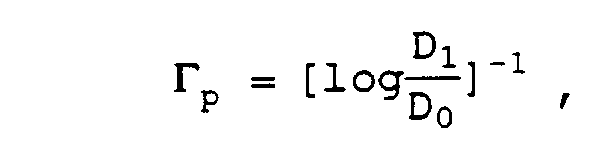
wobei Do und D1 die extrapolierten Belichtungsenergiedosen aus der Dunkelabtragsenergiekurve darstellen.
- Es werden mit der Resistlösung gemäß Beispiel 1 mehrere Wafer belackt, ausgeheizt und belichtet. Nach einer Lagerzeit von 1, 2 und 4 Stunden erfolgt die thermische Nachbehandlung (1 min bei 120°C). Alle Wafer lassen sich einwandfrei zu einem positiven Reliefmuster entwickeln. Es sind keine Unterschiede zwischen den unterschiedlich gelagerten Wafern festellbar.
- Wird Tris - (4- t - butoxicarbonyloxiphenyl- )sulfoniumtrifluormethansulfonat statt Ethyl- 4 - toluolsufo - nat verwendet, können bereits nach einer Stunde Lagerzeit die Wafer nicht mehr strukturiert werden.
- Eine Photoresistlösung wird analog Beispiel 1 hergestellt, jedoch wird als Sulfonat (-)-Di-O-tosyl-2,3,0 - isopropyliden - L - threitol (Fluka) verwendet.
- Diese Resistlösung wird auf einen oxidierten Siliziumwafer aufgeschleudert und der Polymerfilm auf der Hotplate 1 min. bei 90 °C ausgeheizt.
- Nach Belichtung durch eine strukturierte Testmaske wird ein Wafer sofort, ein Kontrollwafer erst nach einer Wartezeit von 2 Stunden ausgeheizt (1 min. bei 120°C) und entwickelt.
- Die Entwicklungszeit bei unterschiedlichen Belichtungsenergien der beiden Wafer wurde gemessen. Es lassen sich praktisch keine Unterschiede feststellen:

- Es wird eine Resistformulierung aus 6 Teilen Tris - (4 t - butoxicarbonyloxiphenyl- )sulfoniumtrifluo - rmethansulfonat, 94 Teilen Poly - (p - vinylphenol und 300 Teilen Methyl - propylenglycolacetat hergestellt.
- Diese Lösung wird analog Beispiel 3 verarbeitet. Nach 2 Stunden Lagerzeit zwischen Belichtung und Ausheizen ist das Resistmuster nicht mehr entwickelbar.
- Eine Photoresistlösung, bestehend aus 10 Teilen p - Toluolsulfonsäure - 2 - methylbutylester, 90 Teilen Poly - (p - vinylphenol - co - p - t - butoxicarbonyloxistyrol) (molares Verhältnis der Comonomeren 8:2) und 300 Teilen Methoxypropylacetat wird gemäß Beispiel 1 auf oxidierte Siliziumwafer aufgeschleudert und 1 min bei 90 °C ausgeheizt.
- Nach der Belichtung mit Excimer-Laserlicht der Wellenlänge 248 nm, dem Temperprozeß und der Strukturierung mit einem alkalischen Entwickler wurden folgende Restschichtdicken mit dem Profilometer gemessen:

- Eine Photoresistlösung, bestehend aus 10 Teilen p-Toluolsulfonsäuremethylester, 90 Teilen Poly-(p-vinylphenol-co-t-butoxicarbonyloxistyrol) (molares Verhältnis der Comonomeren 8:2) und 300 Teilen Methoxypropylacetat wird analog Beispiel 4 behandelt, auf oberflächenoxidierte Si - Wafer aufgetragen und getrocknet. Nach der Strukturierung mit einem alkalischen Entwickler wurden folgende Restschichtdicken gemessen:

- Eine Photoresistlösung wird aus 5 Teilen 3 - Chlor 1,2 - benzoxathial- 1,1 - dioxid, 95 Teilen Poly - (p-vinylphenol-co-p-t-butoxicarbonyloxistyrol) (molares Verhältnis der Comonomeren 8:2) und 300 Teilen Methoxypropylacetat hergestellt und analog Beispiel 4 behandelt, auf oberflächenoxidierte Si - Wafer aufgeschleudert und getrocknet. Es lassen sich nach der Entwicklung mit einem alkalischen Medium folgende Restschichtdicken ermitteln:

- Wafer, die nach der Belichtung gelagert werden, lassen sich auch nach einer Stunde noch gut entwickeln.
- 10 Teile (+)-1,4-Di-O-tosyl-2,3,0-isopropyliden-D-threitol und 90 Teile Poly-(p-vinylphenol-co-p-t-butoxicarbonyloxistyrol) (molares Verhältnis der Comonomeren 8:2) werden in 300 Teilen Methoxypropylacetat gelöst. Dann wurde analog Beispiel 4 weiterverfahren.
- Mit ca. 36 mJ/cm2 lassen sich Strukturen kleiner 1 um erzeugen. Auch nach Lagerung von 1 Stunde sind die Wafer noch gut entwickelbar.
- 10 Teile p - Toluolsulfonsäure - phenylester, 90 Teile Poly - (p - vinyl - phenol - co - p - t - butoxicarbo - nyloxistyrol) (molares Verhältnis der Comonomeren 8:2) werden in 300 Teilen Methoxypropylacetat gelöst. Nach der Filtration dieser Lösung, wird eine ca. 1 um dicke Polymerschicht auf oxidierte Siliziumwafer aufgeschleudert und 1 min bei 90 °C auf einer Hotplate ausgeheizt.
- Nach der Belichtung durch eine strukturierte Testmaske mit Excimer-Laserlicht der Wellenlänge 248 nm werden die Wafer zur Ermittlung der günstigsten Prozessparameter bei verschiedenen Temperaturen ausgeheizt und anschließend sofort entwickelt. Gute Strukturen waren bei Temperaturen zwischen 110°C und 120°C schon nach 1 min zu erhalten. Werden die Wafer unterhalb 100°C ausgeheizt, wird für die Strukturierung längere Zeit benötigt.
- Strukturierte Wafer, die belichtet mehrere Stunden gelagert und anschließend noch 1 min. bei 120°C gelagert wurden, waren gut zu entwickeln.
Claims (1)

worin

eingesetzt wird.

eingesetzt wird.

eingesetzt wird.

eingesetzt wird.

worin Hal für Chlor oder Brom steht, eingesetzt wird.
Applications Claiming Priority (2)
| Application Number | Priority Date | Filing Date | Title |
|---|---|---|---|
| DE4136213 | 1991-11-02 | ||
| DE4136213A DE4136213A1 (de) | 1991-11-02 | 1991-11-02 | Positiv arbeitendes strahlungsempfindliches gemisch und verfahren zur herstellung von reliefmustern |
Publications (2)
| Publication Number | Publication Date |
|---|---|
| EP0540965A1 true EP0540965A1 (de) | 1993-05-12 |
| EP0540965B1 EP0540965B1 (de) | 1999-06-09 |
Family
ID=6444012
Family Applications (1)
| Application Number | Title | Priority Date | Filing Date |
|---|---|---|---|
| EP92118250A Expired - Lifetime EP0540965B1 (de) | 1991-11-02 | 1992-10-24 | Positiv arbeitendes strahlungsempfindliches Gemisch und Verfahren zur Herstellung von Reliefmustern |
Country Status (4)
| Country | Link |
|---|---|
| US (1) | US5563022A (de) |
| EP (1) | EP0540965B1 (de) |
| JP (1) | JP3347168B2 (de) |
| DE (2) | DE4136213A1 (de) |
Cited By (2)
| Publication number | Priority date | Publication date | Assignee | Title |
|---|---|---|---|---|
| EP0616258A1 (de) * | 1993-03-01 | 1994-09-21 | BASF Aktiengesellschaft | Strahlungsempfindliches Gemisch und Verfahren zur Herstellung von Reliefstrukturen mit verbessertem Kontrast |
| EP0634696A1 (de) * | 1993-07-15 | 1995-01-18 | Japan Synthetic Rubber Co., Ltd. | Chemisch verstärkter Resist |
Families Citing this family (9)
| Publication number | Priority date | Publication date | Assignee | Title |
|---|---|---|---|---|
| JPH06324494A (ja) * | 1993-05-12 | 1994-11-25 | Fujitsu Ltd | パターン形成材料およびパターン形成方法 |
| US6004720A (en) * | 1993-12-28 | 1999-12-21 | Fujitsu Limited | Radiation sensitive material and method for forming pattern |
| JP3382081B2 (ja) * | 1995-06-01 | 2003-03-04 | 株式会社東芝 | レジストおよびこれを用いたパターン形成方法 |
| JP3589365B2 (ja) * | 1996-02-02 | 2004-11-17 | 富士写真フイルム株式会社 | ポジ画像形成組成物 |
| JP3052917B2 (ja) | 1997-10-24 | 2000-06-19 | 日本電気株式会社 | 化学増幅系レジスト |
| US6528240B1 (en) | 1999-03-12 | 2003-03-04 | Matsushita Electric Industrial Co., Ltd. | Pattern formation method |
| WO2003041206A1 (en) * | 2001-10-11 | 2003-05-15 | Silverman Martin S | Digital battery |
| KR100478982B1 (ko) * | 2002-05-02 | 2005-03-25 | 금호석유화학 주식회사 | 신규 산발생제 및 이를 함유한 박막 조성물 |
| JP4843710B2 (ja) * | 2007-03-20 | 2011-12-21 | 富士通株式会社 | 導電性反射防止膜形成用材料、導電性反射防止膜の形成方法、レジストパターン形成方法、半導体装置、及び磁気ヘッド |
Citations (2)
| Publication number | Priority date | Publication date | Assignee | Title |
|---|---|---|---|---|
| EP0388813A2 (de) * | 1989-03-20 | 1990-09-26 | Hitachi, Ltd. | Bildaufzeichnungsmaterial und Bildaufzeichnungsverfahren damit |
| EP0440376A2 (de) * | 1990-01-30 | 1991-08-07 | Matsushita Electric Industrial Co., Ltd. | Verfahren zur Herstellung einer Bildstruktur |
Family Cites Families (16)
| Publication number | Priority date | Publication date | Assignee | Title |
|---|---|---|---|---|
| US3915706A (en) * | 1974-03-11 | 1975-10-28 | Xerox Corp | Imaging system based on photodegradable polyaldehydes |
| US3923514A (en) * | 1974-06-27 | 1975-12-02 | Xerox Corp | Method for the preparation of relief printing masters |
| DE3406927A1 (de) * | 1984-02-25 | 1985-08-29 | Hoechst Ag, 6230 Frankfurt | Strahlungsempfindliches gemisch auf basis von saeurespaltbaren verbindungen |
| DE3721741A1 (de) * | 1987-07-01 | 1989-01-12 | Basf Ag | Strahlungsempfindliches gemisch fuer lichtempfindliche beschichtungsmaterialien |
| JP2623309B2 (ja) * | 1988-02-22 | 1997-06-25 | ユーシービー ソシエテ アノニム | レジストパターンを得る方法 |
| JP2540199B2 (ja) * | 1988-02-25 | 1996-10-02 | アメリカン テレフォン アンド テレグラフ カムパニー | デバイスの製造方法 |
| US4996136A (en) * | 1988-02-25 | 1991-02-26 | At&T Bell Laboratories | Radiation sensitive materials and devices made therewith |
| EP0412457A1 (de) * | 1989-08-08 | 1991-02-13 | Tosoh Corporation | Löslichkeitsinhibitor und positiv arbeitende Photolackzusammensetzung |
| JP2847414B2 (ja) * | 1990-01-30 | 1999-01-20 | 和光純薬工業株式会社 | レジスト材料 |
| JP2747735B2 (ja) * | 1990-01-30 | 1998-05-06 | 和光純薬工業株式会社 | レジスト材料 |
| JP2847413B2 (ja) * | 1990-01-30 | 1999-01-20 | 和光純薬工業株式会社 | レジスト材料 |
| US5071730A (en) * | 1990-04-24 | 1991-12-10 | International Business Machines Corporation | Liquid apply, aqueous processable photoresist compositions |
| DE4111283A1 (de) * | 1991-04-08 | 1992-10-15 | Basf Ag | Strahlungsempfindliches gemisch, enthaltend saeurelabile gruppierungen und verfahren zur herstellung von reliefmustern und reliefbildern |
| DE4112973A1 (de) * | 1991-04-20 | 1992-10-22 | Hoechst Ag | Positiv arbeitendes strahlungsempfindliches gemisch und damit hergestelltes strahlungsempfindliches aufzeichnungsmaterial |
| US5332650A (en) * | 1991-09-06 | 1994-07-26 | Japan Synthetic Rubber Co., Ltd. | Radiation-sensitive composition |
| US5344742A (en) * | 1993-04-21 | 1994-09-06 | Shipley Company Inc. | Benzyl-substituted photoactive compounds and photoresist compositions comprising same |
-
1991
- 1991-11-02 DE DE4136213A patent/DE4136213A1/de not_active Withdrawn
-
1992
- 1992-10-24 EP EP92118250A patent/EP0540965B1/de not_active Expired - Lifetime
- 1992-10-24 DE DE59209708T patent/DE59209708D1/de not_active Expired - Lifetime
- 1992-10-29 US US07/968,408 patent/US5563022A/en not_active Expired - Fee Related
- 1992-10-30 JP JP29333292A patent/JP3347168B2/ja not_active Expired - Fee Related
Patent Citations (2)
| Publication number | Priority date | Publication date | Assignee | Title |
|---|---|---|---|---|
| EP0388813A2 (de) * | 1989-03-20 | 1990-09-26 | Hitachi, Ltd. | Bildaufzeichnungsmaterial und Bildaufzeichnungsverfahren damit |
| EP0440376A2 (de) * | 1990-01-30 | 1991-08-07 | Matsushita Electric Industrial Co., Ltd. | Verfahren zur Herstellung einer Bildstruktur |
Non-Patent Citations (2)
| Title |
|---|
| MICROELECTRONIC ENGINEERING. Bd. 14, Nr. 3/4, September 1991, AMSTERDAM NL Seiten 215 - 226 REICHMANIS E., THOMPSON L.F. 'Chemistry and process for deep-UV resists' * |
| MICROELECTRONIC ENGINEERING. Bd. 14, Nr. 3/4, September 1991, AMSTERDAM NL Seiten 227 - 236 SCHLEGEL ET AL 'Highly sensitive positive deep-UV resist utilizing a sulfonate acid generator and a tetrahydropyranyl inhibitor' * |
Cited By (5)
| Publication number | Priority date | Publication date | Assignee | Title |
|---|---|---|---|---|
| EP0616258A1 (de) * | 1993-03-01 | 1994-09-21 | BASF Aktiengesellschaft | Strahlungsempfindliches Gemisch und Verfahren zur Herstellung von Reliefstrukturen mit verbessertem Kontrast |
| EP0634696A1 (de) * | 1993-07-15 | 1995-01-18 | Japan Synthetic Rubber Co., Ltd. | Chemisch verstärkter Resist |
| US5629135A (en) * | 1993-07-15 | 1997-05-13 | Japan Synthetic Rubber Co., Ltd. | Chemically amplified resist composition |
| US5916729A (en) * | 1993-07-15 | 1999-06-29 | Jsr Corporation | Chemically amplified resist composition |
| US6114086A (en) * | 1993-07-15 | 2000-09-05 | Jsr Corporation | Chemically amplified resist composition |
Also Published As
| Publication number | Publication date |
|---|---|
| US5563022A (en) | 1996-10-08 |
| EP0540965B1 (de) | 1999-06-09 |
| JP3347168B2 (ja) | 2002-11-20 |
| DE59209708D1 (de) | 1999-07-15 |
| JPH05265214A (ja) | 1993-10-15 |
| DE4136213A1 (de) | 1993-05-06 |
Similar Documents
| Publication | Publication Date | Title |
|---|---|---|
| EP0342498B1 (de) | Positiv und negativ arbeitende strahlungsempfindliche Gemische sowie Verfahren zur Herstellung von Reliefmustern | |
| EP0342496B1 (de) | Strahlungsempfindliches Gemisch und Verfahren zur Herstellung von Reliefmustern | |
| EP0342495B1 (de) | Strahlungsempfindliches Gemisch und Verfahren zur Herstellung von Reliefmustern | |
| EP0447868B1 (de) | Strahlungsempfindliches Gemisch | |
| EP0444493B1 (de) | Negativ arbeitendes strahlungsempfindliches Gemisch und daraus hergestelltes Aufzeichnungsmaterial | |
| EP0553737B1 (de) | Strahlungsempfindliches Gemisch | |
| DE3721741A1 (de) | Strahlungsempfindliches gemisch fuer lichtempfindliche beschichtungsmaterialien | |
| EP0616258B1 (de) | Strahlungsempfindliches Gemisch und Verfahren zur Herstellung von Reliefstrukturen mit verbessertem Kontrast | |
| EP0367131B1 (de) | Strahlungsempfindliches Gemisch | |
| EP0508174B1 (de) | Strahlungsempfindliches Gemisch, enthaltend säurelabile Gruppierungen und Verfahren zur Herstellung von Reliefmustern und Reliefbildern | |
| EP0540965B1 (de) | Positiv arbeitendes strahlungsempfindliches Gemisch und Verfahren zur Herstellung von Reliefmustern | |
| EP0762207B1 (de) | Positivarbeitendes strahlenempfindliches Gemisch und Verfahren zur Herstellung von Reliefstrukturen | |
| EP0510443B1 (de) | Negativ arbeitendes strahlungsempfindliches Gemisch und damit hergestelltes strahlungsempfindliches Aufzeichnungsmaterial | |
| EP0367132A2 (de) | Strahlungsempfindliches Gemisch | |
| EP0525625A1 (de) | Negativ arbeitendes strahlungsempfindliches Gemisch und damit hergestelltes strahlungsempfindliches Aufzeichnungsmaterial | |
| DE3935875A1 (de) | Strahlungsempfindliches gemisch und verfahren zur herstellung von reliefmustern | |
| DE112010003408B4 (de) | Chemisch verstärkte Fotolack-Zusammensetzung und Verfahren zu ihrer Verwendung | |
| EP0372408B1 (de) | Strahlungsempfindliches Gemisch | |
| EP0510446B1 (de) | Negativ arbeitendes strahlungsempfindliches Gemisch und damit hergestelltes strahlungsempfindliches Aufzeichnungsmaterial | |
| EP0520265B1 (de) | Positiv arbeitendes strahlungsempfindliches Gemisch mit Disulfonsäurespendern | |
| EP0443415A2 (de) | Strahlungsempfindliches Gemisch | |
| DE3940965A1 (de) | Strahlungsempfindliches gemisch und verfahren zur herstellung von reliefstrukturen | |
| DE69513929T2 (de) | Polymere | |
| EP0424737A2 (de) | Strahlungsempfindliches Gemisch und Verfahren zur Herstellung von Reliefmustern |
Legal Events
| Date | Code | Title | Description |
|---|---|---|---|
| PUAI | Public reference made under article 153(3) epc to a published international application that has entered the european phase |
Free format text: ORIGINAL CODE: 0009012 |
|
| 17P | Request for examination filed |
Effective date: 19930306 |
|
| AK | Designated contracting states |
Kind code of ref document: A1 Designated state(s): BE DE FR IT NL |
|
| 17Q | First examination report despatched |
Effective date: 19970509 |
|
| GRAG | Despatch of communication of intention to grant |
Free format text: ORIGINAL CODE: EPIDOS AGRA |
|
| GRAG | Despatch of communication of intention to grant |
Free format text: ORIGINAL CODE: EPIDOS AGRA |
|
| GRAH | Despatch of communication of intention to grant a patent |
Free format text: ORIGINAL CODE: EPIDOS IGRA |
|
| GRAH | Despatch of communication of intention to grant a patent |
Free format text: ORIGINAL CODE: EPIDOS IGRA |
|
| GRAA | (expected) grant |
Free format text: ORIGINAL CODE: 0009210 |
|
| AK | Designated contracting states |
Kind code of ref document: B1 Designated state(s): BE DE FR IT NL |
|
| REF | Corresponds to: |
Ref document number: 59209708 Country of ref document: DE Date of ref document: 19990715 |
|
| ET | Fr: translation filed | ||
| PG25 | Lapsed in a contracting state [announced via postgrant information from national office to epo] |
Ref country code: BE Free format text: LAPSE BECAUSE OF NON-PAYMENT OF DUE FEES Effective date: 19991031 |
|
| PLBE | No opposition filed within time limit |
Free format text: ORIGINAL CODE: 0009261 |
|
| STAA | Information on the status of an ep patent application or granted ep patent |
Free format text: STATUS: NO OPPOSITION FILED WITHIN TIME LIMIT |
|
| BERE | Be: lapsed |
Owner name: BASF A.G. Effective date: 19991031 |
|
| 26N | No opposition filed | ||
| PGFP | Annual fee paid to national office [announced via postgrant information from national office to epo] |
Ref country code: FR Payment date: 20020920 Year of fee payment: 11 |
|
| PGFP | Annual fee paid to national office [announced via postgrant information from national office to epo] |
Ref country code: NL Payment date: 20021011 Year of fee payment: 11 |
|
| PGFP | Annual fee paid to national office [announced via postgrant information from national office to epo] |
Ref country code: DE Payment date: 20021116 Year of fee payment: 11 |
|
| PG25 | Lapsed in a contracting state [announced via postgrant information from national office to epo] |
Ref country code: DE Free format text: LAPSE BECAUSE OF THE APPLICANT RENOUNCES Effective date: 20031117 |
|
| PG25 | Lapsed in a contracting state [announced via postgrant information from national office to epo] |
Ref country code: NL Free format text: LAPSE BECAUSE OF NON-PAYMENT OF DUE FEES Effective date: 20040501 |
|
| PG25 | Lapsed in a contracting state [announced via postgrant information from national office to epo] |
Ref country code: FR Free format text: LAPSE BECAUSE OF NON-PAYMENT OF DUE FEES Effective date: 20040630 |
|
| NLV4 | Nl: lapsed or anulled due to non-payment of the annual fee |
Effective date: 20040501 |
|
| REG | Reference to a national code |
Ref country code: FR Ref legal event code: ST |
|
| PG25 | Lapsed in a contracting state [announced via postgrant information from national office to epo] |
Ref country code: IT Free format text: LAPSE BECAUSE OF NON-PAYMENT OF DUE FEES Effective date: 20051024 |