EP0541271B1 - Système catalytique pour le traitement des gaz d'échappement d'un moteur à essence à combustion pauvre - Google Patents
Système catalytique pour le traitement des gaz d'échappement d'un moteur à essence à combustion pauvre Download PDFInfo
- Publication number
- EP0541271B1 EP0541271B1 EP92309657A EP92309657A EP0541271B1 EP 0541271 B1 EP0541271 B1 EP 0541271B1 EP 92309657 A EP92309657 A EP 92309657A EP 92309657 A EP92309657 A EP 92309657A EP 0541271 B1 EP0541271 B1 EP 0541271B1
- Authority
- EP
- European Patent Office
- Prior art keywords
- catalyst
- exhaust gas
- catalyst system
- copper
- stage
- Prior art date
- Legal status (The legal status is an assumption and is not a legal conclusion. Google has not performed a legal analysis and makes no representation as to the accuracy of the status listed.)
- Expired - Lifetime
Links
Images


Classifications
-
- B—PERFORMING OPERATIONS; TRANSPORTING
- B01—PHYSICAL OR CHEMICAL PROCESSES OR APPARATUS IN GENERAL
- B01D—SEPARATION
- B01D53/00—Separation of gases or vapours; Recovering vapours of volatile solvents from gases; Chemical or biological purification of waste gases, e.g. engine exhaust gases, smoke, fumes, flue gases, aerosols
- B01D53/34—Chemical or biological purification of waste gases
- B01D53/92—Chemical or biological purification of waste gases of engine exhaust gases
- B01D53/94—Chemical or biological purification of waste gases of engine exhaust gases by catalytic processes
- B01D53/9445—Simultaneously removing carbon monoxide, hydrocarbons or nitrogen oxides making use of three-way catalysts [TWC] or four-way-catalysts [FWC]
- B01D53/945—Simultaneously removing carbon monoxide, hydrocarbons or nitrogen oxides making use of three-way catalysts [TWC] or four-way-catalysts [FWC] characterised by a specific catalyst
-
- B—PERFORMING OPERATIONS; TRANSPORTING
- B01—PHYSICAL OR CHEMICAL PROCESSES OR APPARATUS IN GENERAL
- B01J—CHEMICAL OR PHYSICAL PROCESSES, e.g. CATALYSIS OR COLLOID CHEMISTRY; THEIR RELEVANT APPARATUS
- B01J23/00—Catalysts comprising metals or metal oxides or hydroxides, not provided for in group B01J21/00
- B01J23/38—Catalysts comprising metals or metal oxides or hydroxides, not provided for in group B01J21/00 of noble metals
- B01J23/54—Catalysts comprising metals or metal oxides or hydroxides, not provided for in group B01J21/00 of noble metals combined with metals, oxides or hydroxides provided for in groups B01J23/02 - B01J23/36
- B01J23/56—Platinum group metals
- B01J23/63—Platinum group metals with rare earths or actinides
-
- B—PERFORMING OPERATIONS; TRANSPORTING
- B01—PHYSICAL OR CHEMICAL PROCESSES OR APPARATUS IN GENERAL
- B01J—CHEMICAL OR PHYSICAL PROCESSES, e.g. CATALYSIS OR COLLOID CHEMISTRY; THEIR RELEVANT APPARATUS
- B01J35/00—Catalysts, in general, characterised by their form or physical properties
- B01J35/19—Catalysts containing parts with different compositions
-
- Y—GENERAL TAGGING OF NEW TECHNOLOGICAL DEVELOPMENTS; GENERAL TAGGING OF CROSS-SECTIONAL TECHNOLOGIES SPANNING OVER SEVERAL SECTIONS OF THE IPC; TECHNICAL SUBJECTS COVERED BY FORMER USPC CROSS-REFERENCE ART COLLECTIONS [XRACs] AND DIGESTS
- Y02—TECHNOLOGIES OR APPLICATIONS FOR MITIGATION OR ADAPTATION AGAINST CLIMATE CHANGE
- Y02T—CLIMATE CHANGE MITIGATION TECHNOLOGIES RELATED TO TRANSPORTATION
- Y02T10/00—Road transport of goods or passengers
- Y02T10/10—Internal combustion engine [ICE] based vehicles
- Y02T10/12—Improving ICE efficiencies
Definitions
- This invention relates to the technology of cleansing the exhaust from a gasoline-fueled automotive engine, and more particularly to catalysis technology that is operative with exhaust gases from a lean-burn internal combustion engine (excess oxygen providing a redox ratio of .03-.9).
- the HC, CO, and NO x conversions of the invented catalyst exceed the HC, CO, and NO x conversions of a conventional three-way catalyst.
- the invention is a catalyst system according to claim 1 for converting NO x , CO, and HC contained in the exhaust gas from a gasoline-fueled engine operating under certain lean-burn conditions such that the ratio of NO x to HC ranges between 1/3 and 3/1.
- the high surface area alumina support of the catalyst system is impregnated with an intimate mixture of 0.5-20% lanthana, .2-30% palladium, and, optionally, 0.1-20% titania.
- the titania, lanthana, and palladium are discontinuous so that each may be exposed to the exhaust gas.
- the washcoat predominantly consists of gamma-Al2O3.
- Alpha-alumina, NiO, CeO2, BaO, La2O3, and TiO2 are present in smaller quantities. These oxides serve to increase the catalytic activity, durability, thermal stability, and adhesion of the washcoat.
- Titanium butoxide is applied as an outer coating and is particularly helpful in increasing the NO x conversion at redox ratios of 0.8-0.9.
- Another aspect of this invention is a method according to claim 9 of treating the exhaust gas from a gasoline-fueled engine that operates under controlled lean-burn conditions.
- the degree of conversion for the said method of treatment is at least 38-50% for NO x and about 100% for CO and HC.
- the catalytic system of this invention operates to cleanse the exhaust gas generated by a fossil-fueled engine, particularly a gasoline-fueled internal combustion engine, operating under controlled lean-burn conditions.
- Lean-burn is generally used herein to mean: for a gasoline engine, redox ratio (R) between .03-.9 (R being the ratio of reducing components to oxidizing components in the exhaust gas), or air/fuel (A/F) ratio between 15-23, or lambda between 1.02-1.7 (lambda being the ratio of actual A/F ratio to the stoichiometric A/F ratio for a given fuel); for a diesel engine, R between 0.03-0.9, A/F ratio between 15.4-30, and lambda between 1.1-2.0.
- the catalyst system is designed to improve the conversion efficiency of the exhaust gas of a certain type of lean-burn engine, that is, a lean-burn engine that emits a ratio of NO x /HC which is in the range of 1/3 to 3/1; this is achieved by suitable adjustment of engine design variables such as valve and spark timing and compression ratio and by employing strategies such as Exhaust Gas Recycle (EGR).
- EGR Exhaust Gas Recycle
- the actual NO x /HC ratio depends on the speed and load of the vehicle.
- the simple catalyst system of this invention is effective in converting the noxious elements of such exhaust gas at an economic cost.
- This invention relies upon the naturally created hydrocarbons generated by lean-burn combustion.
- the hydrocarbons are used to convert the relatively low NO x emitted.
- Such hydrocarbon content will usually be in the range of 300-600 ppm, the principal components of which are slow-burning hydrocarbons (represented by propane) usually in the range of 100-200 ppm, and fast-burning hydrocarbons (represented by propylene) in the range of about 250-350 ppm.
- propane slow-burning hydrocarbons
- propylene fast-burning hydrocarbons
- Propylene is the more effective hydrocarbon that acts as a reductant for NO x over the first stage catalyst of this invention, and therefore its minimum content plays a significant role with respect to this invention.
- the NO x emissions from such a lean-burn engine be relatively low, in the range of 100-1000 ppm as a result of proper design of engine parameters.
- the amount of propylene present in the exhaust should exceed 250 ppm. This exhaust characterisation, when combined with the catalyst elements of this invention, promote enhanced conversion efficiency at relatively economic cost.
- the best mode of this invention is schematically illustrated in Figure 1 and comprises a first stage copper ion-exchange ZSM5 zeolite catalyst.
- the catalyst may contain a transition metal-containing zeolite, the zeolite having a SiO2/Al2O3 molar ratio greater than 10, preferably up to about 60 (see US-A-4,297,328, which is expressly incorporated herein by reference for teaching use of other zeolites that may be used herein).
- the transition metal such as copper
- the transition metal is incorporated into the zeolite by ion-exchange.
- the transition metal may be selected from the group consisting of Cu, Co, Ni, Cr, Fe, Mn, Ag, Zn, Ca, and compatible mixtures thereof.
- a sodium, hydrogen, or ammonium zeolite is contacted with an aqueous solution of another cation, in this case an aqueous solution of soluble copper compound such as copper acetate, wherein replacement of the sodium, hydrogen, or ammonium ion by copper takes place. It is advantageous to provide as much transition metal ion in the zeolite as possible since the amount of transition metal present in the zeolite is directly related to the catalytic activity of the first stage.
- this is at least 3% by weight of zeolite, up to a maximum determined by the SiO2/Al2O3 ratio.
- the zeolite is generally washed to remove excess surface transition metal compound. It is not necessary to do so, however.
- the first stage catalyst may also contain a transition metal oxide, such transition metal should be of the same type as that used in the ion exchange for the zeolite.
- this transition metal is copper and copper is particularly preferred because it is active at lower temperatures.
- the oxide is zirconia, although other oxides such as titania and silica, and very minor proportions of lanthana aluminate may be employed.
- One method of making a copper-containing zirconia comprises soaking a quantity of zirconia, in the form of a fine powder, repeatedly, if desired, in a solution of copper compound. The resulting product is subsequently dried, then calcined at an elevated temperature between 300-600°C, often at about 450°C.
- the copper compound should be one that is soluble or that can be dispersed in a liquid, that is, directly soluble in an aqueous solution or solubilized therein with the aid of an acid or base.
- Exemplary of such copper compounds are copper salts like copper nitrate and copper sulfate; organo-copper compounds like carboxylate of copper, copper acetate, and copper-cupric amines; organo-complexes of copper like diamine copper acetate; tetra-amine copper sulfate, and copper acetylacetonate.
- Soluble compounds, exemplary of other transition metal compounds include cobalt acetate, nickel acetate, ferric chloride, chromic nitrate, and manganese acetate.
- the copper compound When saturated zirconia is dried and calcined in air, the copper compound decomposes to form copper oxide. Copper is preferably present in an amount between .1-20% by weight of the copper-containing oxide.
- Each of the copper-containing oxide and the copper-containing zeolite may be ground to a fine powder, mixed together, and a slurry formed of them, and then applied to a substrate such as a metal or ceramic honeycomb. While it is preferable to make the catalyst in this way, it may be made by layering one material onto another.
- ZSM5 is a crystalline zeolite and is disclosed in U.S.-A-3,702,886, the disclosure of which is incorporated herein by reference.
- ZSM5 can have a SiO2/Al2O3 ratio ranging from about 10-1000.
- the copper ion-exchanged version of such zeolite may be obtained by stirring a proportion of copper acetate solution, preferably about .05 M, with the ZSM5 zeolite. The material is filtered, washed, and preferably ion-exchanged three times. It is then dried at about 120°C for about three hours and calcined at about 600°C for about three hours.
- the resulting material will contain copper exchanged for an ion of the zeolite as well as copper impregnated onto the zeolite, i.e., about 3% copper by weight of zeolite.
- the copper ions will replace the sodium ions in the zeolite.
- the limit is set by the amount of Al2O3 in the zeolite.
- the copper-exchanged zeolite may contain copper in the weight percent range of 1-8% and will be stable up to a temperature of about 600°C.
- the zeolite catalyst is advantageously coated onto a foraminous support which is placed in the exhaust stream.
- the second stage catalyst is a three-way catalyst for treating the effluent from the first stage by use of a high surface area alumina support impregnated with an intimate mixture of 0.5-20% lanthana, .2-30% palladium, and, optionally, 0.1-8% titanium oxide.
- the second stage catalyst may also possess a stabilising washcoat applied immediately to the support prior to the impregnation with palladium and lanthanum.
- Such stabilising washcoat may contain nickel oxide, cerium oxide, barium oxide, lanthanum oxide, and titanium oxide, but controlled to amounts within the range of 0.01-10%.
- the support must be a high surface area alumina, such as gamma alumina, rather than alpha forms of alumina because these latter forms have, among other factors, low surface area.
- gamma alumina the surface area will be significantly increased and be in the range of about 50-400 m2/g.
- the particle size of the gamma alumina should be less than 200 angstroms, and the monolithic carrier should have a cell size in the range of 100-600 cells per square inch (15.5 - 93.0 cells per square centimeter).
- Gamma alumina may also be modified with oxides of base, rare earth, and alkali metal such as barium, cerium, titanium, and nickel, as mentioned earlier.
- the lanthana impregnation is carried out to load the support with lanthana in the weight range of .5-20% of the catalyst washcoat system. If lanthana is added in an amount less than such range, then the beneficial effect of increase in the activity due to lanthana is not observed. If lanthana exceeds such range, then the support surface area decreases and no additional benefit is derived.
- Lanthana should be impregnated in a manner to provide its discontinuous presence thereon; this may be achieved by using salts of lanthanum soluble in aqueous or organic media (such as lanthanum nitrate, lanthanum acetate) as a precursor. Elements that are equivalent to the function of lanthana for purposes of this invention may include tungsten oxide.
- Palladium is impregnated in a manner to provide the presence of large crystalline particles, preferably in the particle size range of 5-1000 angstroms. With a palladium weight loading below 0.2%, there will be insufficient catalysis effect and therefore not promote the objects of this invention. If the palladium loading is in excess of 30%, the palladium surface area decreases and no additional benefit from palladium addition is derived.
- titanium oxide As an outer washcoat on the second stage catalyst because it significantly improves the NO x conversion efficiency in such a redox ratio range.
- titanium oxide outer washcoat offers little improvement.
- the method aspect of this invention is one for treating the exhaust from a gasoline-fueled engine controlled to operate under lean-burn conditions while emitting gases in which the NO x /hydrocarbon ratio is in the range of 1/3 to 3/1.
- the method comprises: (a) operating such gasoline-fueled engines under lean conditions while producing hydrocarbons and NO x that are within the ratio ranges indicated; (b) exposing the exhaust from such an engine operated under such parameters to a copper ion-exchanged ZSM5 zeolite; and (c) thereafter exposing the effluent from said first stage catalyst to a three-way catalyst comprised of a high surface area alumina support impregnated with an intimate mixture of 0.5-20% lanthana and .2-30% palladium.
- This method of treatment is capable of achieving NO x conversion levels of 38-50% when the NO x content of the exhaust emanating from the engine is 400-1300 ppm, and conversion levels of 50-80% when the NO x content of the exhaust is lowered in the range 200-400 ppm by varying the engine design parameters.
- a pre-washcoated monolithic cordierite substrate was dipped in an aqueous solution of lanthanum nitrate to deposit 10% lanthanum by weight of the washcoat.
- the monolithic cordierite substrate contained alumina, nickel oxide, ceria, lanthana, and titania.
- the substrate was dried at 120°C and calcined at 600°C.
- the substrate was then dipped in an aqueous solution of PdCl2 containing 4% by volume HNO3 to deposit 1% Pd by weight of the washcoat.
- the precursor was dried at 120°C and calcined at 600°C.
- the precursor was later dipped in a solution of titanium butoxide (dissolved in an organic solvent such as butanol) to deposit 1.2% titanium by weight of the washcoat.
- the resulting material was dried at 120°C and calcined at 600°C to form the three-way catalyst for the second stage.
- a zeolite (ZSM5) material was contacted with an aqueous solution of copper nitrate (under controlled pH) to exchange 5% by weight of copper.
- the resulting material was dried at 120°C.
- 5% Cu-ZSM5 powder was suspended in an aqueous slurry and deposited on a monolithic cordierite substrate.
- the resulting material was dried and calcined at 400°C to form the 5% Cu-ZSM5 catalyst.
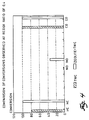
- the second stage catalyst only, was evaluated on a flow reactor.
- the feed gas used was as indicated in Figure 2.
- the oxygen concentration was varied and nitrogen was used as the carrier gas.
- Propane and propylene were used to simulate, respectively, the slow and fast-burning hydrocarbons present in the typical engine exhaust gas of a lean-burn engine.
- a high NO x content (1300 ppm) was used to test the invented catalyst system under worst conditions. Such NO x values are typically observed under high speed conditions.
- the oxygen concentration of the feed gas was about 4.0%, the feed gas resembled the engine out gas composition of a 1.9L lean-burn Escort engine.
- the performance results in Figure 2 show that the nitric oxide conversion efficiency drops to 0% at redox ratios lower than 0.8.
- This second stage catalyst would have to be operated at least about the stoichiometric point for efficient removal of the three constituents and this is undesirable from a fuel economy standpoint.
- expensive electronic controls are required to maintain stoichiometric
- Figure 3 shows the results for the first and second stage catalyst used together in accordance with this invention; they are evaluated on a flow reactor using the feed gas composition as shown in Figure 3.
- the space velocity for the specific flow reactor study of Figure 3 was 20,000 h ⁇ 1. Space velocity effects the conversion efficiency by changing the contact time between the catalyst and the gas.
- the nitric oxide and hydrocarbon conversion efficiency levels are significantly higher than those observed in Figure 2 in the lean region. This may be explained by the fact that the first stage catalyst makes use of the natural inherent hydrocarbon content of the exhaust gas to reduce NO; N2, CO2, and H2O are obtained as by-products.
- the first stage catalyst additionally converts NO by direct decomposition of NO to N2 and O2.
- the effluent delivered to the entrance of the second stage catalyst contains relatively low amounts of NO x .
- the CO content is reduced as a result of the first stage so that the effluent introduced to the second stage has a CO content which is about 10-50% of that entering the first stage.
- the gases reaching the second stage are in a form that allows the three-way catalyst to perform at maximum efficiency and thereby achieve a synergistically enhanced net result.
- hydrocarbon conversion is improved by at least 20% over the entire R range; the nitrous oxide conversion efficiency in the lean region is improved by at least 33%.
Landscapes
- Chemical & Material Sciences (AREA)
- Engineering & Computer Science (AREA)
- Chemical Kinetics & Catalysis (AREA)
- Organic Chemistry (AREA)
- Materials Engineering (AREA)
- Health & Medical Sciences (AREA)
- Analytical Chemistry (AREA)
- General Chemical & Material Sciences (AREA)
- Oil, Petroleum & Natural Gas (AREA)
- Environmental & Geological Engineering (AREA)
- Biomedical Technology (AREA)
- Combustion & Propulsion (AREA)
- Exhaust Gas Treatment By Means Of Catalyst (AREA)
- Catalysts (AREA)
Claims (11)
- Un dispositif catalytique permettant la conversion des NOx, du CO et des hydrocarbures contenus dans les gaz d'échappement en provenance d'un moteur fonctionnant à l'essence et prévu pour fonctionner à partir d'un mélange de carburation pauvre de telle sorte que le rapport des NOx sur les hydrocarbures au sein des gaz d'échappement soit compris dans un intervalle allant de 1/3 à 3/1, ce système comprenant :(a) un premier étage catalytique constitué d'une zéolite contenant un ou plusieurs métaux de transition; et(b) un dispositif catalytique à trois voies permettant le traitement des effluents en provenance dudit premier étage catalytique, comprenant un support monolithique constitué d'alumine gamma caractérisée par une surface spécifique élevée, dont la taille des particules est inférieure à 200 angströms et dont la dimension des alvéoles est comprise dans un intervalle allant de 100 à 600 alvéoles par pouce carré (15,5 à 93,0 alvéoles par centimètre carré), ledit support d'alumine de surface spécifique élevée ayant été imprégné à l'aide d'un mélange intime constitué de 0,5 à 20 % d'oxyde de lanthane et de 0,2 à 30 % de palladium.
- Un dispositif catalytique tel que revendiqué dans la revendication 1, dans lequel la zéolite contenant un ou plusieurs métaux de transition contient au moins 3 % en poids de métaux de transition.
- Un dispositif catalytique tel que revendiqué soit dans la revendication 1, soit dans la revendication 2, dans lequel le premier étage catalytique est constitué par une zéolite contenant du cuivre.
- Un dispositif catalytique tel que revendiqué dans l'une quelconque des revendications précédentes, dans lequel ledit oxyde de lanthane et ledit palladium sont répartis de façon discontinue sur la surface dudit support de telle sorte que chacun puisse entrer en contact avec les gaz d'échappement.
- Un dispositif catalytique tel que revendiqué dans l'une quelconque des revendications précédentes, dans lequel ledit second étage catalytique comporte en outre un revêtement d'enrobage externe constitué d'oxyde de titane, ledit composé additionnel entrant en jeu lorsque les gaz d'échappement présentent un rapport d'oxydoréduction compris entre 0,8 et 0,9.
- Un dispositif catalytique tel que revendiqué dans l'une quelconque des revendications précédentes, dans lequel ledit second étage catalytique comprend en outre, sur la surface dudit support, un revêtement stabilisant choisi parmi les oxydes de nickel, de cérium, de baryum, de lanthane et de titane.
- Un dispositif catalytique tel que revendiqué dans la revendication 6, dans lequel ledit revêtement stabilisant a une épaisseur comprise dans un intervalle allant de 0,005 mm à 0,1 mm.
- Un dispositif catalytique tel que revendiqué dans l'une quelconque des revendications précédentes, dans lequel ladite alumine gamma présente une surface spécifique comprise dans un intervalle allant de 50 à 400 m²/g.
- Une méthode permettant de traiter les gaz d'échappement en provenance d'un moteur fonctionnant à l'essence, comprenant :(a) le fonctionnement du moteur à partir d'un mélange pauvre de façon à produire du propylène au sein des gaz d'échappement en quantités supérieures à 250 ppm tout en régulant le rapport NOx/hydrocarbures des émissions de façon qu'il soit compris dans un intervalle allant de 1/3 à 3/1;(b) l'exposition des gaz d'échappement en question à l'action d'un catalyseur appartenant au premier étage catalytique comprenant une zéolite ZSM5 échangeuse d'ions porteuse d'ions cuivre;(c) la mise en contact des effluents en provenance dudit premier étage catalytique avec un catalyseur appartenant au dispositif à trois voies du second étage catalytique comprenant un support monolithique constitué d'alumine gamma caractérisée par une surface spécifique élevée, dont la taille des particules est inférieure à 200 angströms et dont la dimension des alvéoles est comprise dans un intervalle allant de 100 à 600 alvéoles par pouce carré (15,5 à 93,0 alvéoles par centimètre carré), ledit support d'alumine de surface spécifique élevée ayant été imprégné à l'aide d'un mélange intime constitué de 0,5 à 20 % d'oxyde de lanthane, de 0,2 à 30 % de palladium et, le cas échéant, de 0,1 à 20 % d'oxyde de titane.
- Une méthode telle que revendiquée dans la revendication 9, au (b) de laquelle la zéolite ZSM5 échangeuse d'ions porteuse d'ions cuivre contient au moins 3 % en poids de cuivre.
- Une méthode telle que revendiquée dans les revendications 9 ou 10, dans laquelle les catalyseurs des premier et second étages permettent d'obtenir une efficacité de conversion des NOx allant de 38 à 50 % lorsque la teneur en NOx des gaz d'échappement est comprise dans un intervalle allant de 400 à 1.300 ppm et une efficacité de conversion des NOx allant de 50 à 80 % lorsque la teneur en NOx des gaz d'échappement est comprise dans un intervalle allant d'environ 200 à 400 ppm.
Applications Claiming Priority (2)
| Application Number | Priority Date | Filing Date | Title |
|---|---|---|---|
| US789706 | 1991-11-08 | ||
| US07/789,706 US5185305A (en) | 1991-11-08 | 1991-11-08 | Catalyst system for treating the exhaust from a lean-burn gasoline-fueled engine |
Publications (2)
| Publication Number | Publication Date |
|---|---|
| EP0541271A1 EP0541271A1 (fr) | 1993-05-12 |
| EP0541271B1 true EP0541271B1 (fr) | 1996-02-07 |
Family
ID=25148448
Family Applications (1)
| Application Number | Title | Priority Date | Filing Date |
|---|---|---|---|
| EP92309657A Expired - Lifetime EP0541271B1 (fr) | 1991-11-08 | 1992-10-22 | Système catalytique pour le traitement des gaz d'échappement d'un moteur à essence à combustion pauvre |
Country Status (5)
| Country | Link |
|---|---|
| US (1) | US5185305A (fr) |
| EP (1) | EP0541271B1 (fr) |
| CA (1) | CA2081963A1 (fr) |
| DE (1) | DE69208206T2 (fr) |
| MX (1) | MX9205421A (fr) |
Cited By (5)
| Publication number | Priority date | Publication date | Assignee | Title |
|---|---|---|---|---|
| US9511350B2 (en) | 2013-05-10 | 2016-12-06 | Clean Diesel Technologies, Inc. (Cdti) | ZPGM Diesel Oxidation Catalysts and methods of making and using same |
| US9511358B2 (en) | 2013-11-26 | 2016-12-06 | Clean Diesel Technologies, Inc. | Spinel compositions and applications thereof |
| US9511353B2 (en) | 2013-03-15 | 2016-12-06 | Clean Diesel Technologies, Inc. (Cdti) | Firing (calcination) process and method related to metallic substrates coated with ZPGM catalyst |
| US9511355B2 (en) | 2013-11-26 | 2016-12-06 | Clean Diesel Technologies, Inc. (Cdti) | System and methods for using synergized PGM as a three-way catalyst |
| US9545626B2 (en) | 2013-07-12 | 2017-01-17 | Clean Diesel Technologies, Inc. | Optimization of Zero-PGM washcoat and overcoat loadings on metallic substrate |
Families Citing this family (35)
| Publication number | Priority date | Publication date | Assignee | Title |
|---|---|---|---|---|
| CA2046951A1 (fr) * | 1990-07-19 | 1992-01-20 | Akinori Eshita | Catalyseur servant a l'epuration des gaz d'echappement, et methode d'utilisation connexe |
| FR2670400B1 (fr) * | 1990-12-13 | 1993-04-02 | Inst Francais Du Petrole | Procede de preparation de catalyseurs multimetalliques. |
| JP3311012B2 (ja) * | 1992-03-23 | 2002-08-05 | 株式会社豊田中央研究所 | 排気ガス浄化用触媒および排気ガス浄化方法 |
| US6010673A (en) * | 1992-09-21 | 2000-01-04 | Toyota Jidosha Kabushiki Kaisha | Method for purifying exhaust gas |
| EP0593898B1 (fr) * | 1992-10-20 | 1997-01-29 | Corning Incorporated | Procédé de conversion de gaz d'échappement et disposition utilisant des zéolites thermiquement stables |
| EP0613714B1 (fr) * | 1993-01-11 | 2001-07-04 | Toyota Jidosha Kabushiki Kaisha | Procédé pour la purification de gaz d'échappements |
| GB9315679D0 (en) * | 1993-07-29 | 1993-09-15 | Rover Group | Base metal catalyst,catalytic support and two-stage process for the purification of vehicle exhaust gases |
| DE4326121C2 (de) * | 1993-08-04 | 1995-05-04 | Degussa | Verfahren zum Schutz von Katalysatoren für die Reinigung der Abgase von Verbrennungskraftmaschinen vor Katalysatorgiften |
| JP3291086B2 (ja) * | 1993-09-24 | 2002-06-10 | トヨタ自動車株式会社 | 排ガス浄化用触媒及び排ガス浄化方法 |
| FI94318C (fi) * | 1993-10-08 | 1995-08-25 | Kemira Oy | Katalyytti dieselmoottorin pakokaasujen puhdistamiseksi |
| JP3409894B2 (ja) * | 1993-11-17 | 2003-05-26 | トヨタ自動車株式会社 | 排ガス浄化用触媒及び排ガス浄化方法 |
| US5587137A (en) * | 1994-01-18 | 1996-12-24 | Corning Incorporated | Exhaust gas conversion method using thermally stable zeolites |
| US5925590A (en) * | 1994-05-25 | 1999-07-20 | Eltron Research, Inc. | Catalysts utilizing oxygen-deficient metal oxide compound for removal of exhaust gas constituents |
| EP0691459B1 (fr) * | 1994-07-05 | 1998-11-11 | Ford Motor Company Limited | Système catalytique |
| US6187709B1 (en) * | 1995-10-30 | 2001-02-13 | Ford Global Technologies, Inc. | Palladium catalyst pre-oxidation to reduce light-off temperature |
| US5727385A (en) * | 1995-12-08 | 1998-03-17 | Ford Global Technologies, Inc. | Lean-burn nox catalyst/nox trap system |
| DE19721440A1 (de) * | 1997-05-21 | 1998-11-26 | Degussa | Verfahren zur Reinigung eines mageren Abgases und Katalysatorsystem hierfür |
| EP1064985B1 (fr) | 1999-07-02 | 2008-02-20 | Nissan Motor Co., Ltd. | Système de purification de gaz d'échappement |
| CN1171676C (zh) | 1999-12-28 | 2004-10-20 | 康宁股份有限公司 | 沸石/氧化铝催化剂载体组合物及其制备方法 |
| JP4771639B2 (ja) | 1999-12-29 | 2011-09-14 | コーニング インコーポレイテッド | 高強度および高表面積の触媒、触媒支持体または吸着体組成物 |
| EP1174173B1 (fr) * | 2000-07-17 | 2013-03-20 | Mitsubishi Jidosha Kogyo Kabushiki Kaisha | Catalyseur pour la purification de gaz d'échappement |
| GB2376903A (en) * | 2001-04-05 | 2002-12-31 | Johnson Matthey Plc | Nitrogen oxides emission control under lean-burn conditions |
| BRPI0409451B1 (pt) | 2003-04-17 | 2018-04-17 | Johnson Matthey Public Limited Company | Método de decompor dióxido de nitrogênio (no2) em monóxido de nitrogênio (no) em um gás de exaustão de um motor de combustão interna de queima pobre |
| GB0422549D0 (en) | 2004-10-12 | 2004-11-10 | Johnson Matthey Plc | Method of decomposing nitrogen dioxide |
| DE502007003465D1 (de) * | 2007-02-23 | 2010-05-27 | Umicore Ag & Co Kg | Katalytisch aktiviertes Dieselpartikelfilter mit Ammoniak-Sperrwirkung |
| US8716165B2 (en) | 2008-04-30 | 2014-05-06 | Corning Incorporated | Catalysts on substrates and methods for providing the same |
| US20090324468A1 (en) * | 2008-06-27 | 2009-12-31 | Golden Stephen J | Zero platinum group metal catalysts |
| DE102009060290A1 (de) * | 2009-12-23 | 2011-06-30 | Volkswagen AG, 38440 | Abgasreinigung bei Ottomotoren mit Direkteinspritzung unter Verwendung von Adsorbern mit Partikelabscheidefunktion |
| US8293182B2 (en) * | 2010-05-05 | 2012-10-23 | Basf Corporation | Integrated SCR and AMOx catalyst systems |
| US9517434B2 (en) * | 2012-02-15 | 2016-12-13 | Toyota Jidosha Kabushika Kaisha | Catalyst system for exhaust gas purification utilizing base metals, and controlling method therefor |
| DE102012006449A1 (de) * | 2012-03-30 | 2013-10-02 | Man Truck & Bus Ag | Verfahren zur Anwendung in Verbindung mit einer Abgasnachbehandlungsanlage |
| US9512735B2 (en) * | 2014-10-24 | 2016-12-06 | United Technologies Corporation | Sliding seal |
| KR102085652B1 (ko) * | 2017-12-29 | 2020-03-06 | 현대자동차 주식회사 | 규칙적인 메조 기공을 가진 제오라이트 입자에 금속이 함침된 탄화수소 흡착제 및 그 제조방법 |
| CN111001434B (zh) * | 2018-10-08 | 2021-03-16 | 中自环保科技股份有限公司 | 一种当量燃烧天然气车集成催化剂体系及其制备方法 |
| EP3894071A1 (fr) * | 2018-12-13 | 2021-10-20 | Johnson Matthey Public Limited Company | Alumine dopée par un métal de transition pour améliorer les performances osc et twc |
Family Cites Families (8)
| Publication number | Priority date | Publication date | Assignee | Title |
|---|---|---|---|---|
| US4331644A (en) * | 1977-12-27 | 1982-05-25 | Union Carbide Corporation | Combustion catalyst and process for using same |
| US4791091A (en) * | 1987-09-30 | 1988-12-13 | Allied-Signal Inc. | Catalyst for treatment of exhaust gases from internal combustion engines and method of manufacturing the catalyst |
| JPH01159029A (ja) * | 1987-12-16 | 1989-06-22 | Toyota Motor Corp | ディーゼルエンジンの排気浄化装置 |
| JP2701433B2 (ja) * | 1989-03-07 | 1998-01-21 | トヨタ自動車株式会社 | 排気浄化触媒 |
| JPH0338250A (ja) * | 1989-07-06 | 1991-02-19 | Mazda Motor Corp | 排気ガス浄化用触媒 |
| US5021389A (en) * | 1989-11-22 | 1991-06-04 | Ford Motor Company | Three-way catalyst for automotive emission control and method of making the catalyst |
| JP2712758B2 (ja) * | 1990-05-28 | 1998-02-16 | トヨタ自動車株式会社 | 内燃機関の排気浄化装置 |
| US5051244A (en) * | 1990-07-20 | 1991-09-24 | Uop | Use of a molecular sieve bed to minimize emissions during cold start of internal combustion engines |
-
1991
- 1991-11-08 US US07/789,706 patent/US5185305A/en not_active Expired - Fee Related
-
1992
- 1992-09-23 MX MX9205421A patent/MX9205421A/es unknown
- 1992-10-22 DE DE69208206T patent/DE69208206T2/de not_active Expired - Fee Related
- 1992-10-22 EP EP92309657A patent/EP0541271B1/fr not_active Expired - Lifetime
- 1992-11-02 CA CA002081963A patent/CA2081963A1/fr not_active Abandoned
Cited By (6)
| Publication number | Priority date | Publication date | Assignee | Title |
|---|---|---|---|---|
| US9511353B2 (en) | 2013-03-15 | 2016-12-06 | Clean Diesel Technologies, Inc. (Cdti) | Firing (calcination) process and method related to metallic substrates coated with ZPGM catalyst |
| US9511350B2 (en) | 2013-05-10 | 2016-12-06 | Clean Diesel Technologies, Inc. (Cdti) | ZPGM Diesel Oxidation Catalysts and methods of making and using same |
| US9545626B2 (en) | 2013-07-12 | 2017-01-17 | Clean Diesel Technologies, Inc. | Optimization of Zero-PGM washcoat and overcoat loadings on metallic substrate |
| US9511358B2 (en) | 2013-11-26 | 2016-12-06 | Clean Diesel Technologies, Inc. | Spinel compositions and applications thereof |
| US9511355B2 (en) | 2013-11-26 | 2016-12-06 | Clean Diesel Technologies, Inc. (Cdti) | System and methods for using synergized PGM as a three-way catalyst |
| US9555400B2 (en) | 2013-11-26 | 2017-01-31 | Clean Diesel Technologies, Inc. | Synergized PGM catalyst systems including platinum for TWC application |
Also Published As
| Publication number | Publication date |
|---|---|
| DE69208206D1 (de) | 1996-03-21 |
| EP0541271A1 (fr) | 1993-05-12 |
| US5185305A (en) | 1993-02-09 |
| MX9205421A (es) | 1993-05-01 |
| DE69208206T2 (de) | 1996-06-27 |
| CA2081963A1 (fr) | 1993-05-09 |
Similar Documents
| Publication | Publication Date | Title |
|---|---|---|
| EP0541271B1 (fr) | Système catalytique pour le traitement des gaz d'échappement d'un moteur à essence à combustion pauvre | |
| KR102644446B1 (ko) | 희박/풍부 시스템을 위한 자동차 배출물로부터의 n₂o 제거 | |
| CA1328653C (fr) | Catalyseurs | |
| CA1335279C (fr) | Catalyseur pour purifier les gaz d'echappement de moteurs a combustion interne tout en reduisant les emissions de sulfure d'hydrogene produit par ledit catalyseur et methode d'utilisation dudit catalyseur | |
| US5318760A (en) | Exhaust treating system for lean-burn CNG engine | |
| US7666375B2 (en) | Method for catalytic reduction of nitrogen oxides | |
| CA2081933C (fr) | Traitement d'epuration de l'echappement d'un moteur brulant du gaz naturel comprime | |
| KR20140015295A (ko) | NOx 흡수제 촉매 | |
| EP1095702A1 (fr) | Catalyseur pour la purification des gaz d'echappement, procede de production dudit catalyseur et procede de purification de gaz d'echappement | |
| EP1875954A1 (fr) | Catalyseur pour reduction catalytique d'oxyde d'azote, structure de catalyseur et procede de reduction catalytique d'oxyde d'azote | |
| EP1337330A2 (fr) | Catalyseur et procede de reduction catalytique d'oxydes d'azote | |
| WO2014197773A1 (fr) | Systèmes et procédés d'utilisation de pd1+ dans un twc | |
| US7175822B2 (en) | Method for catalytic reduction of nitrogen oxides | |
| JP2004527372A (ja) | 窒素酸化物の接触還元のための触媒と方法 | |
| US6797247B2 (en) | Material with a channel structure for eliminating oxides of nitrogen | |
| US6551564B1 (en) | Process for eliminating oxides of nitrogen | |
| JP4290391B2 (ja) | 窒素酸化物を接触的に除去するための方法とそのための装置 | |
| JP3732124B2 (ja) | 窒素酸化物を接触還元する方法とそのための触媒 | |
| JP4194805B2 (ja) | 窒素酸化物を接触的に除去する方法とそのための触媒 | |
| JPS59162948A (ja) | 排気ガス浄化用触媒 | |
| JP3721112B2 (ja) | 窒素酸化物を接触還元する方法とそのための触媒 | |
| JP3745988B2 (ja) | 窒素酸化物を接触還元する方法とそのための触媒 | |
| JP2004209386A (ja) | 窒素酸化物を接触還元する方法とそのための触媒 | |
| JP2004068717A (ja) | 窒素酸化物を接触的に除去するための方法とそのための装置 | |
| JPH10244159A (ja) | 窒素酸化物除去触媒 |
Legal Events
| Date | Code | Title | Description |
|---|---|---|---|
| PUAI | Public reference made under article 153(3) epc to a published international application that has entered the european phase |
Free format text: ORIGINAL CODE: 0009012 |
|
| AK | Designated contracting states |
Kind code of ref document: A1 Designated state(s): DE FR GB |
|
| 17P | Request for examination filed |
Effective date: 19931007 |
|
| 17Q | First examination report despatched |
Effective date: 19941025 |
|
| GRAA | (expected) grant |
Free format text: ORIGINAL CODE: 0009210 |
|
| AK | Designated contracting states |
Kind code of ref document: B1 Designated state(s): DE FR GB |
|
| REF | Corresponds to: |
Ref document number: 69208206 Country of ref document: DE Date of ref document: 19960321 |
|
| ET | Fr: translation filed | ||
| PLBE | No opposition filed within time limit |
Free format text: ORIGINAL CODE: 0009261 |
|
| 26N | No opposition filed | ||
| PGFP | Annual fee paid to national office [announced via postgrant information from national office to epo] |
Ref country code: FR Payment date: 19981019 Year of fee payment: 8 |
|
| PGFP | Annual fee paid to national office [announced via postgrant information from national office to epo] |
Ref country code: GB Payment date: 19991006 Year of fee payment: 8 |
|
| REG | Reference to a national code |
Ref country code: FR Ref legal event code: TP Ref country code: FR Ref legal event code: CD |
|
| PGFP | Annual fee paid to national office [announced via postgrant information from national office to epo] |
Ref country code: DE Payment date: 20001005 Year of fee payment: 9 |
|
| PG25 | Lapsed in a contracting state [announced via postgrant information from national office to epo] |
Ref country code: GB Free format text: LAPSE BECAUSE OF NON-PAYMENT OF DUE FEES Effective date: 20001022 |
|
| GBPC | Gb: european patent ceased through non-payment of renewal fee |
Effective date: 20001022 |
|
| PG25 | Lapsed in a contracting state [announced via postgrant information from national office to epo] |
Ref country code: FR Free format text: LAPSE BECAUSE OF NON-PAYMENT OF DUE FEES Effective date: 20010629 |
|
| REG | Reference to a national code |
Ref country code: FR Ref legal event code: ST |
|
| PG25 | Lapsed in a contracting state [announced via postgrant information from national office to epo] |
Ref country code: DE Free format text: LAPSE BECAUSE OF NON-PAYMENT OF DUE FEES Effective date: 20020702 |