EP0541623B1 - Introduction de garnitures dans des tuyaux - Google Patents
Introduction de garnitures dans des tuyaux Download PDFInfo
- Publication number
- EP0541623B1 EP0541623B1 EP91913763A EP91913763A EP0541623B1 EP 0541623 B1 EP0541623 B1 EP 0541623B1 EP 91913763 A EP91913763 A EP 91913763A EP 91913763 A EP91913763 A EP 91913763A EP 0541623 B1 EP0541623 B1 EP 0541623B1
- Authority
- EP
- European Patent Office
- Prior art keywords
- liner
- pipe
- sealant
- connection
- terminator
- Prior art date
- Legal status (The legal status is an assumption and is not a legal conclusion. Google has not performed a legal analysis and makes no representation as to the accuracy of the status listed.)
- Expired - Lifetime
Links
Images
Classifications
-
- F—MECHANICAL ENGINEERING; LIGHTING; HEATING; WEAPONS; BLASTING
- F16—ENGINEERING ELEMENTS AND UNITS; GENERAL MEASURES FOR PRODUCING AND MAINTAINING EFFECTIVE FUNCTIONING OF MACHINES OR INSTALLATIONS; THERMAL INSULATION IN GENERAL
- F16L—PIPES; JOINTS OR FITTINGS FOR PIPES; SUPPORTS FOR PIPES, CABLES OR PROTECTIVE TUBING; MEANS FOR THERMAL INSULATION IN GENERAL
- F16L55/00—Devices or appurtenances for use in, or in connection with, pipes or pipe systems
- F16L55/16—Devices for covering leaks in pipes or hoses, e.g. hose-menders
- F16L55/162—Devices for covering leaks in pipes or hoses, e.g. hose-menders from inside the pipe
- F16L55/165—Devices for covering leaks in pipes or hoses, e.g. hose-menders from inside the pipe a pipe or flexible liner being inserted in the damaged section
-
- F—MECHANICAL ENGINEERING; LIGHTING; HEATING; WEAPONS; BLASTING
- F16—ENGINEERING ELEMENTS AND UNITS; GENERAL MEASURES FOR PRODUCING AND MAINTAINING EFFECTIVE FUNCTIONING OF MACHINES OR INSTALLATIONS; THERMAL INSULATION IN GENERAL
- F16L—PIPES; JOINTS OR FITTINGS FOR PIPES; SUPPORTS FOR PIPES, CABLES OR PROTECTIVE TUBING; MEANS FOR THERMAL INSULATION IN GENERAL
- F16L55/00—Devices or appurtenances for use in, or in connection with, pipes or pipe systems
- F16L55/16—Devices for covering leaks in pipes or hoses, e.g. hose-menders
- F16L55/162—Devices for covering leaks in pipes or hoses, e.g. hose-menders from inside the pipe
- F16L55/164—Devices for covering leaks in pipes or hoses, e.g. hose-menders from inside the pipe a sealing fluid being introduced in the pipe
Definitions
- This invention relates to inserting linings into pipes particularly, but not exclusively, to the insertion of a preformed lining into an underground gas service pipe extending from an underground gas main to a building.
- 'lining' and 'liner' are used herein to include any insert which is capable of conveying a fluid within the pipe, and the insert may or may not be a close fit in the pipe.
- Gas service pipes were made of steel or copper and they can be subject to corrosion in the ground and then leak.
- a procedure has been devised and is widely used for lining such gas services with a plastics tube. The procedure involves excavating a hole in the road or pavement to expose the connection between the gas service and the gas main, removing the section of service adjacent to the connection, pushing a length of plastics tube through the remaining length of service, and effecting connections at opposite ends of the plastics tube respectively with the main and with a meter cock.
- a method according to the preamble of claim 1 is known from GB-A-2 227 071.
- the present invention is aimed at avoiding the need in most cases to excavate a hole to expose the connection between the main and the service. Such holes are costly to produce and fill, and can be very inconvenient to the public.
- a method of lining a pipe as disclosed in claim 1 is provided.
- the liner can completely bypass any corroded portions of the pipe, and fluid cannot enter the annular space from the further pipe. Providing that an effective seal is made between the liner and the pipe in the region adjacent the connection, there is no need to expose the connection by excavating in the road or footpath.
- the seal is preferably effected by a sealant which is inserted in a flowable condition into the annular space from adjacent the free end of the pipe, following insertion of the liner into the pipe.
- Sealant detection means is provided to detect when the sealant closely reaches the connection, to enable the injection of sealant into the annular space to be terminated.
- the sealant detection means may comprise an electrical sensor means which is arranged in the liner adjacent the connection and produces an electrical signal when the sealant reaches or closely approaches the sensor means.
- the electrical sensor means may be an electromagnetic or inductive type but it is preferably a capacitative sensor.
- one electrode of the capacitative sensor is provided by the metal pipe being lined, and the other electrode by an insert which is arranged to be temporarily located within the liner, at a location spaced along the pipe by a predetermined amount from the underground end thereof.
- the insert is preferably carried by a flexible elongate carrier which is inserted into the liner, and is withdrawn from the liner after insertion of the sealant.
- a termination assembly for a liner which comprises a tubular terminator comprising a generally streamlined portion adapted to abut with that end of the liner which is inserted into a pipe to be lined, and a spigot portion adapted to be a firm fit within that end of the liner, the streamlined portion substantially covering the cut extremity of that end of the liner, and a plug which is adapted to seal the bore of the terminator and to be retractable from the terminator through the bore of the liner.
- termination assembly enables a plastics liner to be liveinserted into a gas service with a reduced risk of the extremity of the liner snagging on any steps in the gas service, and the shape of the terminator helps to displace sideways any debris in the service to enable the liner to pass the debris.
- the plug is located in place in the terminator during insertion of the liner, and thereby prevents gas flowing into the bore of the liner until the plug is subsequently retracted.
- the plug can be withdrawn from the terminator by an elongate flexible means which preferably carries a sealant detection means.
- the sealant detection means comprises a capacitor electrode
- said capacitor electrode is preferably mounted on said elongate flexible means adjacent to the connection between said flexible means and the plug.
- capacitor electrode extends axially adjacent to the spigot of the tubular terminator but preferably not within the spigot, and the terminator is of an electrically conductive material. This has the effect of increasing the sensitivity of the capacitative sensor means to the flow of sealant along the pipe as the sealant closely approaches the terminator.
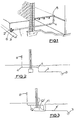
- Figure 1 shows the usual arrangement of steel gas service 1 connecting at 2 with a gas main 3, the service 1 incorporating bends, such as 4, rather than elbows. It is possible to line such a metal service by pushing through it a plastics pipe, typically of 20 mm external diameter and of thickness 2.22 mm. Other diameters, such as 16, 25, 32, 40, 63, 90 mm, can be used. Conventionally it would be necessary to dig a hole to expose the connection 2.
- the plastics pipe is pushed through the service from the meter cock end 5, hereinafter referred to as the 'free end' of the service, until it reaches that end 6 connected to the main, hereinafter referred to as the 'connected end' of the service.
- Adhesive tape is attached to the rod assembly to mark this position. (If it is not possible to negotiate the service, as in the arrangement of Figure 2 where elbows 4 are used, then a hole 11 is dug adjacent the building and part 12 of the service is abandoned. The remaining length 11, Figure 3, is lined as far as the service 1 of Figure 1, and the new length 121 is laid in a conventional manner.)
- the rod is then removed and a tube, not shown, of corresponding external diameter to that of the rod is inserted into the pipe 1 through the gland unit, until the tube enters the main.
- the tube is progressively withdrawn from the pipe 1 whilst a low viscosity, high wicking action anaerobic liquid, such as methacrylate, is fed into the tube either as a spray or by pouring the liquid into the tube.
- the anaerobic liquid can permanently seal a leaking service by coating the inside of service 1 with a sealant. This can be particularly important at the connection between the service 1 and the gas main 3.
- the coating may also be used to inhibit corrosion and thereby reduce the chances of a future leakage. This technique might also be used to provide an emergency repair of a leaking service prior to relaying of the service at a later date.
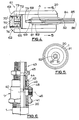
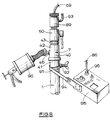
- a modified service head adaptor 7, Figure 6, is then attached, as shown in Figure 8.
- the service head adaptor comprises a lower body portion 40 adapted to be secured at its lower end 41 to the existing service pipe 1, and at its upper end 42 to be secured to alternative first and second service head adaptor upper end portions 47, 43 respectively.
- the second upper end portion 43 as shown in Figure 6, is adapted to be threadedly secured to the body 40 and to clamp a copper sealing ring 42 against a plastics liner 20 adjacent to the cut outer extremity 45 thereof, whereas the (alternative) first upper end portion, indicated at 47 in Figure 7, is similar to second end portion 43, but differs from end portion 43 in that the internal bore of the first end portion is sized to permit the liner 20 to extend therethrough.
- the body 7 is provided with a radial injection port 46.
- a rubber sealing ring 48, Figure 6, is secured in body 7 by adhesive or by a star washer against a shoulder 49 above port 46 and is adapted to seal with the outer surface of liner 20 when the liner is in position in the body 7.
- the service head adaptor shown in Figure 6 is a modification of the 'KONTITE' (TM) fitting manufactured by Kay & Co (Engineers) Ltd of Bolton, Lancashire.
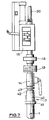
- Figure 7 shows the assembly of components which is mounted on the free end 5 of the existing service 1 to enable the plastics liner 20 to be inserted into the service with a minimum release of gas.
- a full bore valve 14 with integral gland unit 13 is mounted on top of the first upper end portion 47.
- a pushing machine 15 is then attached. Meanwhile outside the property a piece of plastics liner 20 is measured to about 1 metre longer than that length of the rod assembly 9 between the free end of the rod end unit 17 and tape marker and is cut.
- the additional length of 1 metre is to provide a sufficient length of liner to be engaged by the pushing machine, even when the liner 20 has reached the fully installed position.
- a termination assembly 61 comprises a tubular terminator 62 having a frusto-conical 'streamline' portion 63 covering the extremity 64 of the liner 20, and an integral spigot portion 66 adapted to be a tight fit within the liner 20.
- a plug 67 is adapted to have a snap-engagement with a screw 68 in the extremity of a polyamide tube 69 which constitutes an end portion of a flexible elongate means for withdrawing the plug 67 at the appropriate stage through the bore of the liner 20.
- Plug 67 is formed with a first external annular recess 70 in which is seated a replaceable 0-ring seal 701.
- the bore of terminator 62 is slightly reduced at its free end to prevent the plug 67 from passing outwardly of the terminator 2, ie to the left of the position shown in Figure 4.
- plug 67 The rear half of plug 67 is split to define a semicircular latch block 72 which is held captive to the main part of plug 67 by a circlip 73 located in a second annular recess in plug 67.
- the rear end of plug 67 has an axial blind bore 74, and an internal lip 75 at the entrance to bore 74 provides a snap connection with a frusto-conical head 79 on screw 68.
- the capacitative sensor comprises a length of tubular wire mesh forming an electrode 81 which is coaxially carried by the tube 69 and is encased by a shrink sleeving 82.
- the electrode 81 and sleeving 82 extend axially adjacent to the spigot portion 66, which is of an electrically conductive material. This has the effect of substantially increasing the sensitivity of the capacitative sensor, formed by the electrode 81 in conjunction with the metal pipe 1 being lined, to the flow of sealant material (along the annular gap between the sleeve 20 and the pipe) as the sealant closely approaches the position of the spigot 66.
- the sleeving 82 protects the electrode 81 against abrasion and increases the effective tensile strength of tube 69.
- the tube 69 may be filled with a flexible sealant to increase the rigidity and strength of the tube, and the tube 69 is adhesively secured within the end 84 of a further polyamide tube 85 which constitutes a main portion of the flexible elongate means.
- the inner core of a coaxial cable 86 extends through a hole A in the tube 69 to connect with the mesh 81.
- the terminator 62 is fitted to one end of the cut length of liner 20, following the insertion of a first plug 67 into the terminator 62, whereby the terminator 62 containing first plug 67 seals that end of liner 20.
- the liner 20 is then pressure tested at 100 mb for five minutes. No pressure drop is acceptable.
- the liner 20 On operating the pushing machine, the liner 20 is inserted to a datum position which is when the terminator 62 is arrested by the main 3 or by the connection 2 with the main.
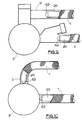
- connection 2 between service 1 and the main 3 is a direct connection, as shown in Figure 10, then the liner 20 will be arrested when the terminator 62 has traversed the interior of the main 3.
- the connection 2 is a TEE or branch connection as shown in Figure 9, then the terminator 62 will be arrested by that connection and will not enter the main 3.
- the nature of the connection 2 can be sensed by utilising the capacitative sensor 61 to measure whether or not the terminator 62 has entered the main 3.
- a second plug which is conveniently identical to first plug 67 shown in Figure 4, is snap-fitted to the screw 68, and tube 69 with accompanying capacitative sensor 81 and second plug are inserted into the free end of the liner 20 until the tube 69 is arrested by the abutment of the second plug with the first plug 67.
- the value of the capacitor formed by the sensor mesh 81 with the service 1 is then monitored as the tube 69 is withdrawn by about 1m.
- the capacitance is monitored as the second plug is retracted gradually from the first plug 67.
- the capacitance is measured by applying a fixed frequency signal to the capacitor via the coaxial cable 86, the outer conductor of which is driven in sympathy with the inner by means of a unity gain buffer amplifier. This cancels the shunting effect of the stray cable to service pipe capacitance and so allows the current to the sensor capacitor to be monitored.
- the measured value of the sensor capacitance will increase as the tube 69 is withdrawn if the terminator 62 is located within the main 3, but if, on the other hand, the terminator 62 had not entered the main 3, the capacitance will stay substantially constant as the tube 69 is withdrawn by 1 m.
- the liner 20 is withdrawn by the exact length corresponding to the diameter of main 3, to the position shown in Figure 10. If it is ascertained that the terminator 62 has not entered the main 3, because the connection 2 is as in Figure 9, the liner 20 is withdrawn by 50 mm to provide a sufficient clearance between the terminator 62 and the connection 2.
- the tube 69 and second plug are then removed completely from the liner 20.
- the pusher 15 and gland 13 are then detached.
- the liner 20 can then be cut to the correct length and upper portion 43 of the service head adaptor is fitted.
- a new meter cock 50 is then installed on the top of portion 43, and the other components shown in Figure 8 are then attached, namely a gas seal unit 89 which is part of the meter cock exchange kit, a sealant injection gun 90, and an earthing clamp 91 with pointed screw 92.
- the gas seal unit 89 is provided with a test nipple 93.
- Clamp 91 is connected by strap 94 to a control box 95 for monitoring the capacitance of the capacitative sensor, the coaxial lead 86 being plugged into a socket 96.
- the tube 69 without a plug attached is then inserted into the liner 20 through the gas seal unit 89 and is pushed through the liner as far as possible until the head 79 of screw 68 is arrested by the plug 67 located in terminator 62. It is important to ensure that the head 79 has engaged with the plug 67 because this engagement determines the precise axial position of the capacitance sensor 81 relative to the free end 64 of liner 20. This engagement can be tested by withdrawing the tube 69 by 50 mm and monitoring gas flow through nipple 93. If the head 79 has snap-engaged with the plug 67, then the plug will be withdrawn from terminator 62 thereby allowing some gas flow past 0-ring 701. The tube 69 is then fully re-inserted to reposition the plug 67 in terminator 62.
- Sealant is then injected by gun 90 into the annular space between the liner 20 and pipe 1 through injection port 46, and the value of the capacitance between the electrode 81 and the pipe 1 is monitored, as before, by the unit 95.
- a significant change in the measured capacitance is produced when the sealant closely approaches the region of the electrode 81, because the sealant provides a dielectric interposed between the plates of the capacitor.
- An indicator buzzer is activated by a capacitor monitor circuit in response to a preset threshold level being reached, and the operator ceases to operate the gun 90. Thus it is ensured that the sealant is not injected into the main 3, but stops short of the terminator 62.
- the tube 69 is then withdrawn, bringing with it the plug 67, which is withdrawn through the meter cock 50 and seal unit 89.
- the liner 20 is then purged, and the meter cock 50 is turned off.
- an 'air mover' (TM) device or similar coanda effect device can be attached to the existing riser so as to remove odours and small volumes of venting gas to outside the property.
- a suitable sealant for filling the annular space is a one-part methacrylate with a formulation to form a low base viscosity yet made thixotropic by the addition of thickening agents.
- the sealant used is typically of a one part anaerobic thixotropic gel type and the insertion nozzle consists of a disposable combined catalyst and mixer which triggers the gel to cure it.
- ANNERSEAL (TM) supplied by Chemence Limited of Princewood Road, Corby, Northamptonshire NN17 2XD.
- ANNERSEAL is a mixture of methacrylates, cumene hydroperoxide initiator and metal catalyst with trace additives.
- sealants for the annular gap can also be used, for example polyurethanes, epoxies, acrylics, cyanoacrylates, silicones, polyesters, polysulphides, latices or cement or clay based sealants.
Landscapes
- Engineering & Computer Science (AREA)
- General Engineering & Computer Science (AREA)
- Mechanical Engineering (AREA)
- Pipe Accessories (AREA)
Abstract
Claims (8)
- Une méthode de doublage de conduite (1) raccordée (2) à une autre conduite (3) par branchement souterrain, et consistant à insérer un tuyau (20) dans la conduite (1) à partir de son extrémité libre (5) opposée au branchement souterrain (2) de sorte que le tuyau atteigne le niveau du branchement ou le dépasse, et à mettre en oeuvre un joint entre le tuyau (20) et la conduite (2) en injectant un joint-mortier liquide qui permet de sceller l'espace en couronne compris entre le tuyau et la conduite dans le voisinage immédiat dudit branchement; le joint mortier étant introduit dans la conduite (1) à partir de l'extrémité (5) de cette dernière opposée au branchement; cette méthode étant caractérisée par le fait que le moyen de détection (81, 86, 94, 95) du joint-mortier sert à signaler que celui-ci s'approche du branchement (2), ce qui permet de terminer l'injection de joint-mortier dans l'espace en couronne.
- La méthode de la revendication 1 caractérisée par le fait que le dispositif de détection du joint-mortier se compose d'un moyen de détection (81) disposé dans le tuyau (20) contre le branchement (2) et produisant un signal lorsque le joint-mortier atteint le moyen de détection ou s'en approche.
- La méthode de la revendication 2 caractérisée par le fait que le signal produit par la sonde (81) est un signal électrique.
- La méthode de la revendication 3 caractérisée par le fait que le moyen de détection (81) est une sonde accumulatrice, et la conduite objet du doublage est en métal; une électrode de la sonde accumulatrice étant constituée de la conduite en métal (1) objet du doublage, et l'autre électrode étant constituée d'une tige (81) temporairement insérée dans le tuyau (20) et située en un point de la conduite (1) d'espacement prédéterminé par rapport au bout enterré de celle-ci.
- Une des méthodes revendiquées en 2, 3 ou 4 dans laquelle le moyen de détection (81) est porté par une tige semi-rigide (69) insérée dans le tuyau (20), puis retirée du tuyau (20) après insertion du joint-mortier.
- La méthode qui, d'après les revendications précédentes, se caractérise par un tuyau (20) sur lequel est monté un assemblage composé d'un terminal tubulaire (62) possédant une portion effilée (63) adaptée pour s'emmancher sur l'extrémité du tuyau (20) inséré dans la conduite (1) en cours de doublage, et équipée d'une clé (66) adaptée pour s'ajuster fermement à cette extrémité du tuyau; la portion effilée couvrant une bonne partie de l'extrémité coupée (64) de ce bout du tuyau, et un bouchon (67) adapté pour sceller l'alésage du terminal et pouvant se rétracter du terminal par la lumière du tuyau (20).
- La méthode selon la revendication 6 se rattachant directement ou indirectement à la revendication 4, dans laquelle l'électrode accumulatrice (81) est montée sur une tige semi-rigide (69) adjacente à un connecteur (68) adapté pour relier ladite tige semi-rigide (69) et le bouchon (67).
- La méthode qui, d'après les revendications 4 à 7 se caractérise par la mise en place du moyen de détection (81) dans le tuyau (20) contre l'extrémité enterrée du tuyau, et dans laquelle le moyen de détection (81) se rétracte sur une distance prédéterminée tout en mesurant l'accumumation électrique entre le moyen de détection (81) et la conduite métallique en cours de doublage; cette méthode exploite la caractéristique d'accumulation mesurée pour déterminer le type de branchement (2) entre la conduite (1) et la deuxième conduite (3) et repositionner ensuite le tuyau (20) en position axiale dans la conduite (1) en fonction du type de branchement détecté.
Applications Claiming Priority (5)
| Application Number | Priority Date | Filing Date | Title |
|---|---|---|---|
| GB909017081A GB9017081D0 (en) | 1990-08-03 | 1990-08-03 | Inserting linings into pipes |
| GB9017081 | 1990-08-03 | ||
| GB9025990 | 1990-11-29 | ||
| GB909025990A GB9025990D0 (en) | 1990-11-29 | 1990-11-29 | Inserting linings into pipes |
| PCT/GB1991/001327 WO1992002755A1 (fr) | 1990-08-03 | 1991-08-02 | Introduction de garnitures dans des tuyaux |
Publications (2)
| Publication Number | Publication Date |
|---|---|
| EP0541623A1 EP0541623A1 (fr) | 1993-05-19 |
| EP0541623B1 true EP0541623B1 (fr) | 1996-03-06 |
Family
ID=26297449
Family Applications (1)
| Application Number | Title | Priority Date | Filing Date |
|---|---|---|---|
| EP91913763A Expired - Lifetime EP0541623B1 (fr) | 1990-08-03 | 1991-08-02 | Introduction de garnitures dans des tuyaux |
Country Status (4)
| Country | Link |
|---|---|
| US (1) | US5468091A (fr) |
| EP (1) | EP0541623B1 (fr) |
| DE (1) | DE69117760D1 (fr) |
| WO (1) | WO1992002755A1 (fr) |
Families Citing this family (5)
| Publication number | Priority date | Publication date | Assignee | Title |
|---|---|---|---|---|
| US20050104600A1 (en) * | 2003-11-18 | 2005-05-19 | Radiodetection Limited | Vehicle for inspecting a pipe |
| US20070214994A1 (en) * | 2006-03-16 | 2007-09-20 | Pierson Construction Corporation | Pipeline traverse apparatus |
| GB0708018D0 (en) * | 2007-04-25 | 2007-06-06 | Steve Vick Internat Ltd | Closing off flow passages |
| US9784388B1 (en) | 2015-06-02 | 2017-10-10 | Interstate Power Systems, Inc. | Pipe liner for abrasive materials |
| US10458940B1 (en) | 2015-06-25 | 2019-10-29 | Atlas Sensors, LLC | Non-destructive instrument for detecting polymer inserts within polymer pipes fitted with a locator wire |
Family Cites Families (4)
| Publication number | Priority date | Publication date | Assignee | Title |
|---|---|---|---|---|
| US3294121A (en) * | 1963-06-07 | 1966-12-27 | Southern California Gas Co | Method and apparatus for inserting a tube into a pipe |
| GB2123919B (en) * | 1982-07-16 | 1986-04-30 | Vick Limited Steve | Sealing within pipes |
| DE3804674A1 (de) * | 1988-02-15 | 1989-08-24 | Rubin Gmbh & Co Kg Dipl Ing | Kapazitive fuellstandsmesssonde |
| GB8830111D0 (en) * | 1988-12-23 | 1989-02-22 | British Gas Plc | Method and system for enhancing service pipes |
-
1991
- 1991-08-02 WO PCT/GB1991/001327 patent/WO1992002755A1/fr not_active Ceased
- 1991-08-02 DE DE69117760T patent/DE69117760D1/de not_active Expired - Lifetime
- 1991-08-02 US US07/983,550 patent/US5468091A/en not_active Expired - Fee Related
- 1991-08-02 EP EP91913763A patent/EP0541623B1/fr not_active Expired - Lifetime
Also Published As
| Publication number | Publication date |
|---|---|
| WO1992002755A1 (fr) | 1992-02-20 |
| US5468091A (en) | 1995-11-21 |
| EP0541623A1 (fr) | 1993-05-19 |
| DE69117760D1 (de) | 1996-04-11 |
Similar Documents
| Publication | Publication Date | Title |
|---|---|---|
| EP0126648B1 (fr) | Appareil pour l'étanchement de raccords et de fuites | |
| FI84925B (fi) | Omfordring av avloppsroer och liknande. | |
| CA1134680A (fr) | Methode et dispositif de depistage des fuites a l'endroit d'une tuyauterie | |
| US4062376A (en) | Service connection between a main and a meter in a building and method of and equipment for installing the same | |
| US7707704B2 (en) | Sealing methods | |
| CN111271122B (zh) | 一种衬砌外水压力的监测方法 | |
| CA2146317C (fr) | Installation de tuyaux | |
| US7137308B2 (en) | Sliding pipe plug | |
| EP0541623B1 (fr) | Introduction de garnitures dans des tuyaux | |
| US20030068143A1 (en) | Method and apparatus providing fiber optic cables through gas service pipes | |
| US6199432B1 (en) | Fluid pressure testing | |
| PL180018B1 (en) | Method of and apparatus for installing a pipe in already existing pipeline | |
| US6024515A (en) | Live service pipe insertion apparatus and method | |
| US5200011A (en) | Non-digging tube reverse lining engineering method of conduit | |
| US20040130332A1 (en) | Sliding pipe plug | |
| US20070258773A1 (en) | Method and system for repairing subterranean structures | |
| US20110304336A1 (en) | Device and Method For Locating A Conduit | |
| US12474227B2 (en) | Rod-mounted pressure sensor | |
| JP2000074261A (ja) | 敷設管路の補修方法 | |
| JP3007516B2 (ja) | 供給管の閉塞方法 | |
| EP0555570A1 (fr) | Etanchement de tuyaux | |
| EP3064817A1 (fr) | Système et procédé de localisation de tuyau | |
| JP2001280904A (ja) | ガス導管長さ計測方法とガス導管長さ計測具 | |
| GB2247062A (en) | Sealing of pipes | |
| WO2004051210A1 (fr) | Bouchon de canalisation coulissant |
Legal Events
| Date | Code | Title | Description |
|---|---|---|---|
| PUAI | Public reference made under article 153(3) epc to a published international application that has entered the european phase |
Free format text: ORIGINAL CODE: 0009012 |
|
| 17P | Request for examination filed |
Effective date: 19930226 |
|
| AK | Designated contracting states |
Kind code of ref document: A1 Designated state(s): AT BE CH DE DK ES FR GB GR IT LI LU NL SE |
|
| RBV | Designated contracting states (corrected) |
Designated state(s): BE DE ES FR GB IT NL |
|
| 17Q | First examination report despatched |
Effective date: 19940810 |
|
| GRAH | Despatch of communication of intention to grant a patent |
Free format text: ORIGINAL CODE: EPIDOS IGRA |
|
| GRAA | (expected) grant |
Free format text: ORIGINAL CODE: 0009210 |
|
| AK | Designated contracting states |
Kind code of ref document: B1 Designated state(s): BE DE ES FR GB IT NL |
|
| PG25 | Lapsed in a contracting state [announced via postgrant information from national office to epo] |
Ref country code: NL Free format text: LAPSE BECAUSE OF FAILURE TO SUBMIT A TRANSLATION OF THE DESCRIPTION OR TO PAY THE FEE WITHIN THE PRESCRIBED TIME-LIMIT Effective date: 19960306 Ref country code: FR Effective date: 19960306 Ref country code: BE Effective date: 19960306 Ref country code: ES Free format text: THE PATENT HAS BEEN ANNULLED BY A DECISION OF A NATIONAL AUTHORITY Effective date: 19960306 Ref country code: IT Free format text: LAPSE BECAUSE OF FAILURE TO SUBMIT A TRANSLATION OF THE DESCRIPTION OR TO PAY THE FEE WITHIN THE PRE;WARNING: LAPSES OF ITALIAN PATENTS WITH EFFECTIVE DATE BEFORE 2007 MAY HAVE OCCURRED AT ANY TIME BEFORE 2007. THE CORRECT EFFECTIVE DATE MAY BE DIFFERENT FROM THE ONE RECORDED.SCRIBED TIME-LIMIT Effective date: 19960306 |
|
| REF | Corresponds to: |
Ref document number: 69117760 Country of ref document: DE Date of ref document: 19960411 |
|
| PG25 | Lapsed in a contracting state [announced via postgrant information from national office to epo] |
Ref country code: DE Effective date: 19960608 |
|
| NLV1 | Nl: lapsed or annulled due to failure to fulfill the requirements of art. 29p and 29m of the patents act | ||
| EN | Fr: translation not filed | ||
| PG25 | Lapsed in a contracting state [announced via postgrant information from national office to epo] |
Ref country code: GB Effective date: 19960802 |
|
| PLBE | No opposition filed within time limit |
Free format text: ORIGINAL CODE: 0009261 |
|
| STAA | Information on the status of an ep patent application or granted ep patent |
Free format text: STATUS: NO OPPOSITION FILED WITHIN TIME LIMIT |
|
| 26N | No opposition filed | ||
| GBPC | Gb: european patent ceased through non-payment of renewal fee |
Effective date: 19960802 |