EP0541729B1 - Reactif de diagnostic anoxique stabilise en solution - Google Patents
Reactif de diagnostic anoxique stabilise en solution Download PDFInfo
- Publication number
- EP0541729B1 EP0541729B1 EP91919544A EP91919544A EP0541729B1 EP 0541729 B1 EP0541729 B1 EP 0541729B1 EP 91919544 A EP91919544 A EP 91919544A EP 91919544 A EP91919544 A EP 91919544A EP 0541729 B1 EP0541729 B1 EP 0541729B1
- Authority
- EP
- European Patent Office
- Prior art keywords
- oxygen
- anoxic
- reagent
- reagent solution
- enzyme system
- Prior art date
- Legal status (The legal status is an assumption and is not a legal conclusion. Google has not performed a legal analysis and makes no representation as to the accuracy of the status listed.)
- Expired - Lifetime
Links
- 239000003153 chemical reaction reagent Substances 0.000 title claims abstract description 66
- QVGXLLKOCUKJST-UHFFFAOYSA-N atomic oxygen Chemical compound [O] QVGXLLKOCUKJST-UHFFFAOYSA-N 0.000 claims abstract description 72
- 239000001301 oxygen Substances 0.000 claims abstract description 71
- 229910052760 oxygen Inorganic materials 0.000 claims abstract description 71
- 239000012528 membrane Substances 0.000 claims abstract description 26
- 108010015776 Glucose oxidase Proteins 0.000 claims abstract description 17
- 239000004366 Glucose oxidase Substances 0.000 claims abstract description 17
- 229940116332 glucose oxidase Drugs 0.000 claims abstract description 17
- 235000019420 glucose oxidase Nutrition 0.000 claims abstract description 17
- 239000012634 fragment Substances 0.000 claims abstract description 16
- 239000000852 hydrogen donor Substances 0.000 claims abstract description 15
- 239000011230 binding agent Substances 0.000 claims abstract description 12
- 241000894006 Bacteria Species 0.000 claims abstract description 9
- 238000012546 transfer Methods 0.000 claims abstract description 9
- WQZGKKKJIJFFOK-VFUOTHLCSA-N beta-D-glucose Chemical compound OC[C@H]1O[C@@H](O)[C@H](O)[C@@H](O)[C@@H]1O WQZGKKKJIJFFOK-VFUOTHLCSA-N 0.000 claims abstract description 8
- BPYKTIZUTYGOLE-IFADSCNNSA-N Bilirubin Chemical group N1C(=O)C(C)=C(C=C)\C1=C\C1=C(C)C(CCC(O)=O)=C(CC2=C(C(C)=C(\C=C/3C(=C(C=C)C(=O)N\3)C)N2)CCC(O)=O)N1 BPYKTIZUTYGOLE-IFADSCNNSA-N 0.000 claims description 60
- 239000000243 solution Substances 0.000 claims description 46
- 102000004190 Enzymes Human genes 0.000 claims description 45
- 108090000790 Enzymes Proteins 0.000 claims description 45
- 229940088598 enzyme Drugs 0.000 claims description 45
- LFQSCWFLJHTTHZ-UHFFFAOYSA-N Ethanol Chemical compound CCO LFQSCWFLJHTTHZ-UHFFFAOYSA-N 0.000 claims description 22
- HEMHJVSKTPXQMS-UHFFFAOYSA-M Sodium hydroxide Chemical compound [OH-].[Na+] HEMHJVSKTPXQMS-UHFFFAOYSA-M 0.000 claims description 18
- XLYOFNOQVPJJNP-UHFFFAOYSA-N water Substances O XLYOFNOQVPJJNP-UHFFFAOYSA-N 0.000 claims description 18
- 238000000034 method Methods 0.000 claims description 17
- WQZGKKKJIJFFOK-GASJEMHNSA-N Glucose Natural products OC[C@H]1OC(O)[C@H](O)[C@@H](O)[C@@H]1O WQZGKKKJIJFFOK-GASJEMHNSA-N 0.000 claims description 16
- 239000008103 glucose Substances 0.000 claims description 16
- 239000004322 Butylated hydroxytoluene Substances 0.000 claims description 15
- NLZUEZXRPGMBCV-UHFFFAOYSA-N Butylhydroxytoluene Chemical compound CC1=CC(C(C)(C)C)=C(O)C(C(C)(C)C)=C1 NLZUEZXRPGMBCV-UHFFFAOYSA-N 0.000 claims description 15
- 235000010354 butylated hydroxytoluene Nutrition 0.000 claims description 15
- 229940095259 butylated hydroxytoluene Drugs 0.000 claims description 15
- 239000011159 matrix material Substances 0.000 claims description 13
- 102000016938 Catalase Human genes 0.000 claims description 12
- 108010053835 Catalase Proteins 0.000 claims description 12
- 239000000758 substrate Substances 0.000 claims description 10
- 239000000126 substance Substances 0.000 claims description 9
- 239000002516 radical scavenger Substances 0.000 claims description 8
- 108010088751 Albumins Proteins 0.000 claims description 7
- 102000009027 Albumins Human genes 0.000 claims description 7
- 108091003079 Bovine Serum Albumin Proteins 0.000 claims description 7
- 229940123457 Free radical scavenger Drugs 0.000 claims description 7
- 229940098773 bovine serum albumin Drugs 0.000 claims description 7
- 239000003963 antioxidant agent Substances 0.000 claims description 6
- 239000007989 BIS-Tris Propane buffer Substances 0.000 claims description 5
- 230000003078 antioxidant effect Effects 0.000 claims description 5
- HHKZCCWKTZRCCL-UHFFFAOYSA-N bis-tris propane Chemical compound OCC(CO)(CO)NCCCNC(CO)(CO)CO HHKZCCWKTZRCCL-UHFFFAOYSA-N 0.000 claims description 5
- -1 antibodies Substances 0.000 claims description 4
- 239000000427 antigen Substances 0.000 claims description 3
- 102000036639 antigens Human genes 0.000 claims description 3
- 108091007433 antigens Proteins 0.000 claims description 3
- 239000003814 drug Substances 0.000 claims description 3
- 239000005556 hormone Substances 0.000 claims description 3
- 229940088597 hormone Drugs 0.000 claims description 3
- 150000002632 lipids Chemical class 0.000 claims description 3
- 150000003431 steroids Chemical class 0.000 claims description 2
- JVTAAEKCZFNVCJ-UWTATZPHSA-N D-lactic acid Chemical group C[C@@H](O)C(O)=O JVTAAEKCZFNVCJ-UWTATZPHSA-N 0.000 claims 4
- 238000004164 analytical calibration Methods 0.000 claims 2
- 150000005206 1,2-dihydroxybenzenes Chemical class 0.000 claims 1
- 108010071390 Serum Albumin Proteins 0.000 claims 1
- 102000007562 Serum Albumin Human genes 0.000 claims 1
- MHAJPDPJQMAIIY-UHFFFAOYSA-N Hydrogen peroxide Chemical compound OO MHAJPDPJQMAIIY-UHFFFAOYSA-N 0.000 description 11
- 239000000203 mixture Substances 0.000 description 7
- 108010052444 Oxyrase Proteins 0.000 description 6
- 230000000694 effects Effects 0.000 description 6
- 238000009472 formulation Methods 0.000 description 6
- 239000007788 liquid Substances 0.000 description 6
- RGHNJXZEOKUKBD-UHFFFAOYSA-N D-gluconic acid Natural products OCC(O)C(O)C(O)C(O)C(O)=O RGHNJXZEOKUKBD-UHFFFAOYSA-N 0.000 description 5
- RGHNJXZEOKUKBD-SQOUGZDYSA-N Gluconic acid Natural products OC[C@@H](O)[C@@H](O)[C@H](O)[C@@H](O)C(O)=O RGHNJXZEOKUKBD-SQOUGZDYSA-N 0.000 description 5
- 238000006243 chemical reaction Methods 0.000 description 5
- 239000000174 gluconic acid Substances 0.000 description 5
- 235000012208 gluconic acid Nutrition 0.000 description 5
- 238000012360 testing method Methods 0.000 description 5
- MYMOFIZGZYHOMD-UHFFFAOYSA-N Dioxygen Chemical compound O=O MYMOFIZGZYHOMD-UHFFFAOYSA-N 0.000 description 4
- 235000006708 antioxidants Nutrition 0.000 description 4
- 238000004108 freeze drying Methods 0.000 description 4
- XEEYBQQBJWHFJM-UHFFFAOYSA-N iron Substances [Fe] XEEYBQQBJWHFJM-UHFFFAOYSA-N 0.000 description 4
- 239000000463 material Substances 0.000 description 4
- 230000003647 oxidation Effects 0.000 description 4
- 238000007254 oxidation reaction Methods 0.000 description 4
- LYCAIKOWRPUZTN-UHFFFAOYSA-N Ethylene glycol Chemical compound OCCO LYCAIKOWRPUZTN-UHFFFAOYSA-N 0.000 description 3
- 238000004458 analytical method Methods 0.000 description 3
- 230000015572 biosynthetic process Effects 0.000 description 3
- 239000002738 chelating agent Substances 0.000 description 3
- 229910001882 dioxygen Inorganic materials 0.000 description 3
- 230000008642 heat stress Effects 0.000 description 3
- 230000008569 process Effects 0.000 description 3
- 230000009467 reduction Effects 0.000 description 3
- 238000009662 stress testing Methods 0.000 description 3
- CIWBSHSKHKDKBQ-JLAZNSOCSA-N Ascorbic acid Chemical compound OC[C@H](O)[C@H]1OC(=O)C(O)=C1O CIWBSHSKHKDKBQ-JLAZNSOCSA-N 0.000 description 2
- IJGRMHOSHXDMSA-UHFFFAOYSA-N Atomic nitrogen Chemical compound N#N IJGRMHOSHXDMSA-UHFFFAOYSA-N 0.000 description 2
- 102000004316 Oxidoreductases Human genes 0.000 description 2
- 108090000854 Oxidoreductases Proteins 0.000 description 2
- 239000013543 active substance Substances 0.000 description 2
- 230000027455 binding Effects 0.000 description 2
- 239000000872 buffer Substances 0.000 description 2
- 239000007853 buffer solution Substances 0.000 description 2
- 230000009920 chelation Effects 0.000 description 2
- 238000004737 colorimetric analysis Methods 0.000 description 2
- 238000003745 diagnosis Methods 0.000 description 2
- 238000006911 enzymatic reaction Methods 0.000 description 2
- 239000004615 ingredient Substances 0.000 description 2
- 230000005764 inhibitory process Effects 0.000 description 2
- 238000004519 manufacturing process Methods 0.000 description 2
- 239000002609 medium Substances 0.000 description 2
- 238000006395 oxidase reaction Methods 0.000 description 2
- 238000001782 photodegradation Methods 0.000 description 2
- 239000000843 powder Substances 0.000 description 2
- 235000018102 proteins Nutrition 0.000 description 2
- 102000004169 proteins and genes Human genes 0.000 description 2
- 108090000623 proteins and genes Proteins 0.000 description 2
- 230000027756 respiratory electron transport chain Effects 0.000 description 2
- 210000002966 serum Anatomy 0.000 description 2
- 230000006641 stabilisation Effects 0.000 description 2
- 238000011105 stabilization Methods 0.000 description 2
- JVTAAEKCZFNVCJ-UWTATZPHSA-M (R)-lactate Chemical compound C[C@@H](O)C([O-])=O JVTAAEKCZFNVCJ-UWTATZPHSA-M 0.000 description 1
- CMCBDXRRFKYBDG-UHFFFAOYSA-N 1-dodecoxydodecane Chemical compound CCCCCCCCCCCCOCCCCCCCCCCCC CMCBDXRRFKYBDG-UHFFFAOYSA-N 0.000 description 1
- IEQAICDLOKRSRL-UHFFFAOYSA-N 2-[2-[2-[2-[2-[2-[2-[2-[2-[2-[2-[2-[2-[2-[2-[2-[2-[2-[2-[2-[2-[2-(2-dodecoxyethoxy)ethoxy]ethoxy]ethoxy]ethoxy]ethoxy]ethoxy]ethoxy]ethoxy]ethoxy]ethoxy]ethoxy]ethoxy]ethoxy]ethoxy]ethoxy]ethoxy]ethoxy]ethoxy]ethoxy]ethoxy]ethoxy]ethanol Chemical compound CCCCCCCCCCCCOCCOCCOCCOCCOCCOCCOCCOCCOCCOCCOCCOCCOCCOCCOCCOCCOCCOCCOCCOCCOCCOCCOCCO IEQAICDLOKRSRL-UHFFFAOYSA-N 0.000 description 1
- CYDQOEWLBCCFJZ-UHFFFAOYSA-N 4-(4-fluorophenyl)oxane-4-carboxylic acid Chemical compound C=1C=C(F)C=CC=1C1(C(=O)O)CCOCC1 CYDQOEWLBCCFJZ-UHFFFAOYSA-N 0.000 description 1
- 108010025188 Alcohol oxidase Proteins 0.000 description 1
- GWZYPXHJIZCRAJ-UHFFFAOYSA-N Biliverdin Natural products CC1=C(C=C)C(=C/C2=NC(=Cc3[nH]c(C=C/4NC(=O)C(=C4C)C=C)c(C)c3CCC(=O)O)C(=C2C)CCC(=O)O)NC1=O GWZYPXHJIZCRAJ-UHFFFAOYSA-N 0.000 description 1
- RCNSAJSGRJSBKK-NSQVQWHSSA-N Biliverdin IX Chemical compound N1C(=O)C(C)=C(C=C)\C1=C\C1=C(C)C(CCC(O)=O)=C(\C=C/2C(=C(C)C(=C/C=3C(=C(C=C)C(=O)N=3)C)/N\2)CCC(O)=O)N1 RCNSAJSGRJSBKK-NSQVQWHSSA-N 0.000 description 1
- CEAZRRDELHUEMR-URQXQFDESA-N Gentamicin Chemical compound O1[C@H](C(C)NC)CC[C@@H](N)[C@H]1O[C@H]1[C@H](O)[C@@H](O[C@@H]2[C@@H]([C@@H](NC)[C@@](C)(O)CO2)O)[C@H](N)C[C@@H]1N CEAZRRDELHUEMR-URQXQFDESA-N 0.000 description 1
- 229930182566 Gentamicin Natural products 0.000 description 1
- UFHFLCQGNIYNRP-UHFFFAOYSA-N Hydrogen Chemical compound [H][H] UFHFLCQGNIYNRP-UHFFFAOYSA-N 0.000 description 1
- XUJNEKJLAYXESH-REOHCLBHSA-N L-Cysteine Chemical compound SC[C@H](N)C(O)=O XUJNEKJLAYXESH-REOHCLBHSA-N 0.000 description 1
- 229920003171 Poly (ethylene oxide) Polymers 0.000 description 1
- LCTONWCANYUPML-UHFFFAOYSA-M Pyruvate Chemical compound CC(=O)C([O-])=O LCTONWCANYUPML-UHFFFAOYSA-M 0.000 description 1
- OUUQCZGPVNCOIJ-UHFFFAOYSA-M Superoxide Chemical compound [O-][O] OUUQCZGPVNCOIJ-UHFFFAOYSA-M 0.000 description 1
- 238000006993 Weiss annulation reaction Methods 0.000 description 1
- 238000002835 absorbance Methods 0.000 description 1
- 230000009471 action Effects 0.000 description 1
- 239000012491 analyte Substances 0.000 description 1
- 238000013459 approach Methods 0.000 description 1
- 239000012736 aqueous medium Substances 0.000 description 1
- 235000010323 ascorbic acid Nutrition 0.000 description 1
- 229960005070 ascorbic acid Drugs 0.000 description 1
- 239000011668 ascorbic acid Substances 0.000 description 1
- 230000001580 bacterial effect Effects 0.000 description 1
- 235000013361 beverage Nutrition 0.000 description 1
- QBUVFDKTZJNUPP-UHFFFAOYSA-N biliverdin-IXalpha Natural products N1C(=O)C(C)=C(C=C)C1=CC1=C(C)C(CCC(O)=O)=C(C=C2C(=C(C)C(C=C3C(=C(C=C)C(=O)N3)C)=N2)CCC(O)=O)N1 QBUVFDKTZJNUPP-UHFFFAOYSA-N 0.000 description 1
- 230000004071 biological effect Effects 0.000 description 1
- 230000015556 catabolic process Effects 0.000 description 1
- 239000003638 chemical reducing agent Substances 0.000 description 1
- 239000005515 coenzyme Substances 0.000 description 1
- 239000012141 concentrate Substances 0.000 description 1
- LBJNMUFDOHXDFG-UHFFFAOYSA-N copper;hydrate Chemical class O.[Cu].[Cu] LBJNMUFDOHXDFG-UHFFFAOYSA-N 0.000 description 1
- 235000018417 cysteine Nutrition 0.000 description 1
- XUJNEKJLAYXESH-UHFFFAOYSA-N cysteine Natural products SCC(N)C(O)=O XUJNEKJLAYXESH-UHFFFAOYSA-N 0.000 description 1
- 230000007423 decrease Effects 0.000 description 1
- 238000007872 degassing Methods 0.000 description 1
- 238000006731 degradation reaction Methods 0.000 description 1
- 238000006392 deoxygenation reaction Methods 0.000 description 1
- 239000003599 detergent Substances 0.000 description 1
- 230000002542 deteriorative effect Effects 0.000 description 1
- 201000010099 disease Diseases 0.000 description 1
- 208000037265 diseases, disorders, signs and symptoms Diseases 0.000 description 1
- 239000003792 electrolyte Substances 0.000 description 1
- 230000002255 enzymatic effect Effects 0.000 description 1
- 238000002474 experimental method Methods 0.000 description 1
- 239000012530 fluid Substances 0.000 description 1
- 229960002518 gentamicin Drugs 0.000 description 1
- LHGVFZTZFXWLCP-UHFFFAOYSA-N guaiacol Chemical class COC1=CC=CC=C1O LHGVFZTZFXWLCP-UHFFFAOYSA-N 0.000 description 1
- 231100001261 hazardous Toxicity 0.000 description 1
- 239000001257 hydrogen Substances 0.000 description 1
- 229910052739 hydrogen Inorganic materials 0.000 description 1
- 230000007062 hydrolysis Effects 0.000 description 1
- 238000006460 hydrolysis reaction Methods 0.000 description 1
- 239000003112 inhibitor Substances 0.000 description 1
- 239000000543 intermediate Substances 0.000 description 1
- 229910052742 iron Inorganic materials 0.000 description 1
- 229940001447 lactate Drugs 0.000 description 1
- 239000002207 metabolite Substances 0.000 description 1
- 229910052757 nitrogen Inorganic materials 0.000 description 1
- 239000002736 nonionic surfactant Substances 0.000 description 1
- 239000003960 organic solvent Substances 0.000 description 1
- 230000001590 oxidative effect Effects 0.000 description 1
- 239000008363 phosphate buffer Substances 0.000 description 1
- 229920005862 polyol Polymers 0.000 description 1
- 150000003077 polyols Chemical class 0.000 description 1
- 238000001556 precipitation Methods 0.000 description 1
- 238000004321 preservation Methods 0.000 description 1
- 235000013324 preserved food Nutrition 0.000 description 1
- 150000003254 radicals Chemical class 0.000 description 1
- 239000012047 saturated solution Substances 0.000 description 1
- 239000001540 sodium lactate Substances 0.000 description 1
- 235000011088 sodium lactate Nutrition 0.000 description 1
- 229940005581 sodium lactate Drugs 0.000 description 1
- 230000003381 solubilizing effect Effects 0.000 description 1
- 230000003595 spectral effect Effects 0.000 description 1
- 230000000087 stabilizing effect Effects 0.000 description 1
- 230000035882 stress Effects 0.000 description 1
- 239000004094 surface-active agent Substances 0.000 description 1
- 230000009466 transformation Effects 0.000 description 1
- 230000007306 turnover Effects 0.000 description 1
- 241001148471 unidentified anaerobic bacterium Species 0.000 description 1
Images

Classifications
-
- G—PHYSICS
- G01—MEASURING; TESTING
- G01N—INVESTIGATING OR ANALYSING MATERIALS BY DETERMINING THEIR CHEMICAL OR PHYSICAL PROPERTIES
- G01N33/00—Investigating or analysing materials by specific methods not covered by groups G01N1/00 - G01N31/00
- G01N33/48—Biological material, e.g. blood, urine; Haemocytometers
- G01N33/50—Chemical analysis of biological material, e.g. blood, urine; Testing involving biospecific ligand binding methods; Immunological testing
- G01N33/96—Chemical analysis of biological material, e.g. blood, urine; Testing involving biospecific ligand binding methods; Immunological testing involving blood or serum control standard
-
- G—PHYSICS
- G01—MEASURING; TESTING
- G01N—INVESTIGATING OR ANALYSING MATERIALS BY DETERMINING THEIR CHEMICAL OR PHYSICAL PROPERTIES
- G01N2333/00—Assays involving biological materials from specific organisms or of a specific nature
- G01N2333/435—Assays involving biological materials from specific organisms or of a specific nature from animals; from humans
- G01N2333/665—Assays involving proteins derived from pro-opiomelanocortin, pro-enkephalin or pro-dynorphin
- G01N2333/675—Assays involving proteins derived from pro-opiomelanocortin, pro-enkephalin or pro-dynorphin beta-Endorphins
-
- G—PHYSICS
- G01—MEASURING; TESTING
- G01N—INVESTIGATING OR ANALYSING MATERIALS BY DETERMINING THEIR CHEMICAL OR PHYSICAL PROPERTIES
- G01N2496/00—Reference solutions for assays of biological material
- G01N2496/80—Multi-analyte reference solutions containing cholesterol, glucose and the like
-
- G—PHYSICS
- G01—MEASURING; TESTING
- G01N—INVESTIGATING OR ANALYSING MATERIALS BY DETERMINING THEIR CHEMICAL OR PHYSICAL PROPERTIES
- G01N33/00—Investigating or analysing materials by specific methods not covered by groups G01N1/00 - G01N31/00
- G01N33/48—Biological material, e.g. blood, urine; Haemocytometers
- G01N33/50—Chemical analysis of biological material, e.g. blood, urine; Testing involving biospecific ligand binding methods; Immunological testing
- G01N33/72—Chemical analysis of biological material, e.g. blood, urine; Testing involving biospecific ligand binding methods; Immunological testing involving blood pigments, e.g. haemoglobin, bilirubin or other porphyrins; involving occult blood
-
- Y—GENERAL TAGGING OF NEW TECHNOLOGICAL DEVELOPMENTS; GENERAL TAGGING OF CROSS-SECTIONAL TECHNOLOGIES SPANNING OVER SEVERAL SECTIONS OF THE IPC; TECHNICAL SUBJECTS COVERED BY FORMER USPC CROSS-REFERENCE ART COLLECTIONS [XRACs] AND DIGESTS
- Y10—TECHNICAL SUBJECTS COVERED BY FORMER USPC
- Y10S—TECHNICAL SUBJECTS COVERED BY FORMER USPC CROSS-REFERENCE ART COLLECTIONS [XRACs] AND DIGESTS
- Y10S435/00—Chemistry: molecular biology and microbiology
- Y10S435/801—Anerobic cultivation
-
- Y—GENERAL TAGGING OF NEW TECHNOLOGICAL DEVELOPMENTS; GENERAL TAGGING OF CROSS-SECTIONAL TECHNOLOGIES SPANNING OVER SEVERAL SECTIONS OF THE IPC; TECHNICAL SUBJECTS COVERED BY FORMER USPC CROSS-REFERENCE ART COLLECTIONS [XRACs] AND DIGESTS
- Y10—TECHNICAL SUBJECTS COVERED BY FORMER USPC
- Y10T—TECHNICAL SUBJECTS COVERED BY FORMER US CLASSIFICATION
- Y10T436/00—Chemistry: analytical and immunological testing
- Y10T436/14—Heterocyclic carbon compound [i.e., O, S, N, Se, Te, as only ring hetero atom]
- Y10T436/145555—Hetero-N
- Y10T436/146666—Bile pigment
Definitions
- the present invention is directed to a stabilized anoxic diagnostic reagent solution containing an oxygen labile reagent which may be stored in a liquid form at temperatures as high as 45° C for at least four (4) days, and permit their direct use as reference standards in instrumental analysis without the necessity for addition of water to them.
- the invention relates to the use of oxygen reducing enzyme systems in oxygen labile reagent solutions, especially reagent solutions used for calibrators and controls.
- Biologically active substances such as found in sera, enzymes, lipids, hormones, electrolytes, and biologically active substrates or metabolites, are used widely in the diagnosis of diseases. They are used as reference standards for instrumental automated colorimetric analysis since they contain all or most of the components of the unknown to be analyzed. Once the diagnosing physician is aware of the basic concentration of components (differences vs. normal mean ranges of concentration of each components), the diagnosis can be made more objectively. In their natural form, when separated from their normal biological environment, such biologically active substances are unstable and undergo undesirable changes under the influence of heat, enzyme action, hydrolysis, oxidation and other influences causing undesirable molecular transformation therein. In the past, several methods of preservation have been utilized for such labile reagents.
- freeze-drying of the reagent involves freeze-drying of the reagent.
- the freeze-drying procedure essentially involves rapidly reducing the temperature of the reagent containing solution followed by de-watering to a very substantial, if not total, extent at reduced pressure. If the reagent was additionally subjected to oxygen reduction then further procedures would be necessary. Not only is this procedure expensive, but it also requires reconstituting (resupplying) the normal water prior to use of the stored reagent. Natural proteins tend to denature upon losing substantial concentrations of water. Thus, natural proteins could undergo compositional changes and loss of biological activity due to substantial de-watering occurring in the freeze-drying. Additionally, the freeze dried reagent often presents a turbid condition after it is reconstituted with water. This can cause analytical error because many of the automated analytical procedures basically involve colorimetry. During the reconstitution procedure, volume errors are sometimes introduced when, for example, the serum is reconstituted to its original liquid form by the addition of the water to the freeze-dried concentrate.
- bilirubin stabilized in this manner must be kept at - 20° C and it does not survive 45° C stress very well. Open vial stability of these materials is about 7 days.
- freeze-drying is the most frequently used method of stabilizing bilirubin. Once reconstituted, however, these materials do not have good stability, and errors in solubilizing the desiccated bilirubin may occur. These reconstituted standards generally require about 30 minutes for reconstituting.
- U.S. Patent 4,414,334 to Hitzman discloses the removal of ambient oxygen from aqueous liquids, including canned foods and beverage products, which are catalyzed by an enzymatic deoxygenation system comprising alcohol oxidase in the presence of alcohol, optionally with the addition of catalase.
- U.S. Patent 4,476,224 to Adler teaches the use of an enzyme system to promote the growth of anaerobic bacteria.
- the enzyme system of Adler comprises sterile membrane fragments derived from bacteria having membranes containing an electron transfer system which reduces oxygen to water.
- a hydrogen donor may be added to facilitate the reduction of water.
- a technical bulletin, TB890411 released by Oxyrase, Inc. entitled “Properties of the OxyraseTM Enzyme System” discloses that the OxyraseTM enzyme system (sterile membrane fragments) in the presence of a suitable hydrogen donor, reduces dissolved oxygen directly to water. The bulletin also teaches that the enzyme system can be incorporated into oxygen-sensitive analytes used in automated, diagnostic instruments.
- U.S. Patent 4,775,626 to Armenta, et al. teaches a method for reducing the oxygen content of a medium in which anaerobic cells are present.
- the method comprises having an effective amount of an oxidase and substrate for the oxidase in fluid contact with an aqueous medium.
- the medium can also contain a hydrogen peroxide scavenger.
- the conversion of bilirubin through oxidation to biliverdin and other products is the main disadvantage of most bilirubin solutions.
- a system to prevent this oxidative process has been developed and is the invention presented here.
- the present invention offers a diagnostic reagent solution that is stable at 45°C for at least four days, has at least six months of open vial stability, and the finished product is already in liquid form.
- the present invention is based upon the discovery of an aqueous bilirubin solution having sufficient stability that it can be shipped and stored for at least as long as six months at a temperature of 2-8°C and for at least four days at 45°C, has at least three weeks of open vial stability, and the finished product is already in liquid form.
- the stabilization of the reagent is achieved by using a combination of oxygen reducing enzyme systems in a synthetic matrix comprising a reagent binding agent such as albumin to prevent the oxidation of the reagent.
- the stabilized anoxic diagnostic reagent solution comprises an oxygen labile reagent, a reagent binding agent, a first oxygen reducing enzyme system which comprises glucose oxidase and its substrate glucose, and a second oxygen reducing enzyme system which comprises a hydrogen donor and sterile membrane fragments derived from bacteria having membranes containing an oxygen transfer system which reduces oxygen to water.
- the solution may also comprise catalase, however, in amounts of 150 u/ml or greater open vial stability decreases from that obtained with 50 u/ml. Additional components, such as antioxidant used as a free radical scavenger, alcohol, buffer and surfactant may also comprise the matrix. D-lactate is the preferred hydrogen donor.
- bilirubin is stabilized by removing molecular oxygen, providing free radical scavengers providing an anti-oxidant, providing a chelating agent, binding bilirubin to albumin, and providing for light protection in the final container. It is likely that several of these approaches work synergistically with the enzyme systems to bring about the stability obtained. It is known that oxygen increases photodegradation, thus by removing oxygen we also reduce photodegradation. Reducing agents and chelators also behave synergistically with anti-oxidants. The advantages obtained are greater heat stability, the product is a liquid, the product has at least three weeks open vial stability, and the product does not contain human materials, thereby making this less hazardous than many of the commercially available standards which do contain human serum.
- percent and parts refer to percent and parts by weight; g small means gram or grams; mg means milligram or milligrams; 1 means liter or liters; ml means milliliter or milliliters; dl means deciliter or deciliters; ul means microliter or microliters; and M means molar and equals the number of moles of a solute in one liter of a solution; mM means millimolar. All temperatures are in degree Centigrade, °C.
- the present invention involves the stabilization of a diagnostic reagent solution that comprises an oxygen labile reagent, or analyte, the addition of a reagent binding agent, and at least two oxygen reducing enzyme systems. It has been discovered that by adding an oxygen labile reagent to a matrix containing a reagent binding agent and the further addition of two oxygen reducing enzyme systems to that matrix a significant increase in the high temperature stability and open vial stability of the resulting reagent solution results.
- a stabilized bilirubin solution that has been developed for the purpose of instrumentation calibration and control is placed in a synthetic matrix.
- Enzyme systems are used to remove molecular oxygen.
- An antioxidant is used as a free radical scavenger and alcohol is used to solubilize the free radical scavenger wherein the alcohol may also be a known free radical scavenger.
- Albumin is used as the reagent binding agent to bind bilirubin which offers some additional stability.
- the enzymatic reactions, of our invention, used for oxygen removal are as follows: 1) Glucose + Glucose oxidase + Oxygen - - > Gluconic acid + Hydrogen peroxide 2) Hydrogen peroxide + catalase --- > oxygen + water 3) Oxygen generated in step 2) recycles into step 1) 4) Membrane fragments + Oxygen + Hydrogen doner - - > pyruvate + water Inhibition is by the binding action of a reagent binding agent such as albumin, gluconic acid and possibly by a buffer system.
- the glucose, glucose oxidase reaction removes oxygen and prevents the formation of oxygen (O 2 ).
- Catalase may be used to remove hydrogen peroxide.
- the sterile membrane fragments commercially available is Oxyrase, is a secondary oxygen removal system useful in the pre-reduction step of the following process.
- our invention should afford stability to many substances.
- Some substances which may have improved stability may be enzymes, reducing substances, pharmaceuticals, antibodies, antigens and substrates especially then linked to enzymes or other oxygen labile components.
- the following is an example of the formulation process for producing a stabilized anoxic solution containing bilirubin as the oxygen labile reagent.
- a matrix is prepared to contain the following in grams per liter. a. Ethanol 9.5 ⁇ to solubilize BHT ⁇ b. Polyoxyethylene 23 Lauryl Ether (BRIJ 35) 64.36 c. Bistrispropane 30.037 d. Glucose 5.3 e. Butylated Hydroxy Toluene (BHT) 0.213 f. FD-lactate 3.57 g. Bovine Serum Albumin (BSA) 53.15 h. Gentamicin 1.0 i. HCL As necessary to adjust pH j. NaOH 4 (To dissolve bilirubin powder)
- the pH is adjusted to 7.85.
- OxyraseTM enzyme system (Oxyrase, Inc., Ashland, OH) is spiked into the matrix so as to obtain 0.3 units/ml of Oxyrase.
- a unit of activity reduces 1.0% of the initially dissolved oxygen in each second per milliliter under standard conditions. The standard conditions are 37°C, pH of 8.4 in a 20 mM Phosphate buffer, 10 mM Sodium lactate as the hydrogen donor, and an air saturated solution.
- OxyraseTM enzyme system is described in the literature and patents (U.S. 4,476,224) as sterile membrane fragments derived from bacterial having membranes containing an electron transfer system (oxygen transfer) which reduces oxygen to water. Any such membrane fragments should operate similarly and could be substituted for Oxyrase. After the addition of the enzyme system room air must be excluded from the solution thereafter. This can be accomplished by maintaining nitrogen in the headspace.
- Catalase from about 0 to about 150 units/ml can be added to remove any hydrogen peroxide which may be generated by the glucose oxidase reaction. However it has been observed that catalase in amounts more than 50 units/ml reduced open vial stability may result. After the oxygen has been removed by the OxyraseTM enzymatic reaction or for about 60 minutes, glucose oxidase is spiked into the matrix so as to obtain 13 units/ml of glucose oxidase. Bilirubin dissolved in 0.1 M sodium hydroxide is then spiked in until the proper amount for that particular solution is achieved.
- the bilirubin powder (Phansthiel, Inc., Waukegan, Illinois) dissolved by sodium hydroxide must not be hazy, but clear and amber colored prior to its addition to the matrix solution.
- the bilirubin may be conjugated, unconjugated or both.
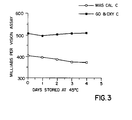
- Bilirubin calibrators at levels of 2 mg/dl(A), 10 mg/dl(B) and 20 mg/dl(C), were prepared by the method of Example 1 a set of vials of each calibrator level was kept at 45°C. Once each day the vials were tested and bilirubin levels were determined using a VisionTM analyzer and test cards. (Abbott Laboratories, Abbott Park, Illinois) according to the manufacture's instructions.
- control calibrators were stored at 2-8°C.
- Figure 1, 2 and 3 show the results of the above study as well as the results of a parallel test conducted on a commercially available bilirubin calibrator (supplied by Medical Analysis Systems) prepared to comparable levels.
- a commercially available bilirubin calibrator supplied by Medical Analysis Systems
- MAS CAL is the commercial calibrator
- GO & OXY CAL is the calibrator of this invention.
- the points plotted on the graphs are average values.
- the calibrators prepared with the two enzyme systems of this invention showed superior stability and activity over the commercial formulation.
- Vials of bilirubin calibrators at each of three levels were prepared as in Example 1.
- Table 2 shows the exact composition of the solutions and the results of the open vial study, discussed below, in days.
- the reagent solution was considered acceptable if it was within the following ranges when the activity was compared to the appropriate control: calibrator A 15%, calibrator B 5%, calibrator C 5%
- Bilirubin values were obtained by using a VisionTM analyzer (Abbott Laboratories, Abbott Park, Illinois) and test cards according to the manufacture's instructions. In our formulation the following reactions are prevented. Therefore it is probable that many products may have extended stability in the Table 1 formulation.
- the Haber-Weiss is prevented by the removal of molecular oxygen which prevents super-oxide formation.
- An alternate inhibitor of the Haber-Weiss reaction is the degradation of H 2 O 2 .
- the Fenton reaction is inhibited by the chelation of iron.
- BHT butylated hydroxyl anisole
- a stabilized anoxic solution containing an oxygen labile reagent could be prepared as in Example 1 which would comprise the substrate of Table 1. Additionally the solution could further comprise BHT or BHA from 0.001 to 0.04%, buffer such as bistrispropane with adequate strength to maintain a pH compatible with the system, a detergent and organic solvent as required for BHT micel formation. Low levels of glucose oxidase are generally adequate since the substrate turnover is very high, however high levels may lead greater stability. The absorbance of this yellow compound may be a limiting factor in spectral applications.
- Some enzymes and organic and inorganic chemicals are given stability by substances and reducing in nature. Cysteine and ascorbic acid, for example, when used in this fashion are of limited value since they are themselves subject to oxidation. In a matrix such as described in the above examples these oxygen labile substances could be stabilized so that they in turn could function as stabilizes.
- gluconic acid generation may be limited by limiting the glucose substrate. Degassing, pretreating with the membrane fragment enzyme system and then addition of glucose oxidase may also limit the generation of gluconic acid.
Landscapes
- Health & Medical Sciences (AREA)
- Life Sciences & Earth Sciences (AREA)
- Hematology (AREA)
- Engineering & Computer Science (AREA)
- Molecular Biology (AREA)
- Biomedical Technology (AREA)
- Chemical & Material Sciences (AREA)
- Immunology (AREA)
- Urology & Nephrology (AREA)
- Food Science & Technology (AREA)
- General Physics & Mathematics (AREA)
- Cell Biology (AREA)
- Biotechnology (AREA)
- Medicinal Chemistry (AREA)
- Physics & Mathematics (AREA)
- Analytical Chemistry (AREA)
- Biochemistry (AREA)
- General Health & Medical Sciences (AREA)
- Microbiology (AREA)
- Pathology (AREA)
- Measuring Or Testing Involving Enzymes Or Micro-Organisms (AREA)
- Enzymes And Modification Thereof (AREA)
- Medicines Containing Antibodies Or Antigens For Use As Internal Diagnostic Agents (AREA)
- Investigating Or Analysing Materials By Optical Means (AREA)
- Investigating Or Analyzing Non-Biological Materials By The Use Of Chemical Means (AREA)
- Investigating Or Analysing Biological Materials (AREA)
Claims (21)
- Solution stabilisée de réactif de diagnostic dépourvue d'oxygène qui comprend :un réactif à oxygène labile ;un agent de type réactif de fixation ;un premier système enzymatique de réduction de l'oxygène ledit premier système enzymatique comprenant du glucose et la glucose oxydase ;et un deuxième système enzymatique de réduction de l'oxygène qui comprend un donneur d'hydrogène et des fragments de membranes stériles en provenance de bactéries possédant des membranes contenant un système de transfert d'oxygène qui réduit l'oxygène en eau.
- Solution de réactif dépourvue d'oxygène selon la revendication 1 qui contient en outre de la catalase.
- Solution de réactif dépourvue d'oxygène selon la revendication 1 dans laquelle le réactif à oxygène labile est choisi dans le groupe constitué par les hormones, les lipides, les stéroïdes, les catéchols, les produits pharmaceutiques, les anticorps, les antigènes, les substrats ainsi que les substances réductrices.
- Solution de réactif dépourvue d'oxygène selon la revendication 1 dans laquelle le réactif à oxygène labile est la bilirubine.
- Solution de réactif dépourvue d'oxygène selon la revendication 1 dans laquelle l'agent de type réactif fixant est l'albumine.
- Solution de réactif dépourvue d'oxygène selon la revendication 5 dans laquelle l'albumine consiste en l'albumine de sérum bovin.
- Solution de réactif dépourvue d'oxygène selon la revendication 1 qui comprend en outre un piégeur de radicaux libres.
- Solution de réactif dépourvue d'oxygène selon la revendication 7 qui comprend en outre un antioxydant.
- Solution de réactif dépourvue d'oxygène selon la revendication 8 dans laquelle antioxydant et le piégeur de radicaux libres comprennent le BHT (hydroxytoluène butylé) et de l'éthanol.
- Solution de réactif dépourvue d'oxygène selon la revendication 1 dans laquelle le donneur d'hydrogène est le D-lactate.
- Solution de réactif dépourvue d'oxygène selon la revendication 1 ayant un pH d'environ 7,4 à environ 8,1.
- Solution de réactif de diagnostic dépourvue d'oxygène présentant un intervalle de pH d'environ 7,4 à environ 8,1 et constituée essentiellement d'un premier système enzymatique de réduction de l'oxygène, d'un deuxième système enzymatique de réduction de l'oxygène et de bilirubine dans une matrice de bistrispropane, glucose, D-lactate, NaOH, alcool, BHT et albumine de sérum bovin, dans laquelle ledit premier système enzymatique comprend la glucose oxydase et la catalase et ledit deuxième système enzymatique comprend un donneur d'hydrogène et des fragments de membranes stériles issues de bactéries ayant des membranes contenant un système de transfert d'oxygène qui réduit l'oxygène en eau.
- Solution de réactif dépourvue d'oxygène selon la revendication 12 dans laquelle l'alcool est l'éthanol.
- Solution de réactif dépourvue d'oxygène selon la revendication 13 dans laquelle l'éthanol est présent à raison d'environ 1 %.
- Solution de réactif dépourvue d'oxygène selon la revendication 12 dans laquelle le BHT est présent à raison d'environ 0,0016 % à environ 0,024 %.
- Solution de réactif dépourvue d'oxygène selon la revendication 12 dans laquelle l'albumine de sérum bovin est présente à raison d'environ 1 % à environ 6 %.
- Solution de réactif dépourvue d'oxygène selon la revendication 12 dans laquelle l'alcool consiste en de l'éthanol et est présent à raison d'environ 0,9 % à environ 1,1 %.
- Procédé de préparation d'une solution stabilisée dépourvue d'oxygène d'un réactif de diagnostic à oxygène labile comprenant l'étape consistant à associer en solution audit réactif à oxygène labile :un agent de type réactif de fixation ;un premier système enzymatique de réduction de l'oxygène ledit premier système enzymatique comprenant du glucose et la glucose oxydase ; etun deuxième système enzymatique de réduction de l'oxygène qui comprend un donneur d'hydrogène et des fragments de membranes stériles en provenance de bactéries possédant des membranes contenant un système de transfert d'oxygène qui réduit l'oxygène en eau.
- Procédé de préparation d'une solution stabilisée de réactif de diagnostic dépourvue d'oxygène comprenant la bilirubine, ledit procédé consistant essentiellement à associer en solution dans une matrice de bistrispropane, glucose, D-lactate, NaOH, alcool, BHT (hydroxytoluène butylé), albumine de sérum bovin :la bilirubine ;un premier système enzymatique comprenant la glucose oxydase et la catalase ; etun deuxième système enzymatique qui comprend un donneur d'hydrogène et des fragments de membranes stériles issues de bactéries ayant des membranes contenant un système de transfert d'oxygène qui réduit l'oxygène en eau ; etajuster le pH jusqu'à environ 7,4 à environ 8,1.
- Utilisation d'une solution stabilisée de réactif de diagnostic dépourvue d'oxygène qui comprend :un réactif à oxygène labile ;un agent de type réactif de fixation ;un premier système enzymatique de réduction de l'oxygène ledit premier système enzymatique comprenant du glucose et la glucose oxydase ; etun deuxième système enzymatique de réduction de l'oxygène qui comprend un donneur d'hydrogène et des fragments de membranes stériles en provenance de bactéries possédant des membranes contenant un système de transfert d'oxygène qui réduit l'oxygène en eau ;pour l'étalonnage et le contrôle d'appareils.
- Utilisation d'une solution de réactif de diagnostic dépourvue d'oxygène présentant un intervalle de pH d'environ 7,4 à environ 8,1 et constituée essentiellement d'un premier système enzymatique de réduction de l'oxygène, d'un deuxième système enzymatique de réduction de l'oxygène et de bilirubine dans une matrice de bistrispropane, glucose, D-lactate, NaOH, alcool, BHT et albumine de sérum bovin, dans laquelle ledit premier système enzymatique comprend la glucose oxydase et la catalase et ledit deuxième système enzymatique comprend un donneur d'hydrogène et des fragments de membranes stériles issues de bactéries ayant des membranes contenant un système de transfert d'oxygène qui réduit l'oxygène en eau,
pour l'étalonnage et le contrôle d'appareils.
Applications Claiming Priority (3)
| Application Number | Priority Date | Filing Date | Title |
|---|---|---|---|
| US60079790A | 1990-10-22 | 1990-10-22 | |
| US600797 | 1990-10-22 | ||
| PCT/US1991/007629 WO1992007088A1 (fr) | 1990-10-22 | 1991-10-18 | Reactif de diagnostic anoxique stabilise en solution |
Publications (3)
| Publication Number | Publication Date |
|---|---|
| EP0541729A1 EP0541729A1 (fr) | 1993-05-19 |
| EP0541729A4 EP0541729A4 (en) | 1994-09-28 |
| EP0541729B1 true EP0541729B1 (fr) | 1996-12-27 |
Family
ID=24405090
Family Applications (1)
| Application Number | Title | Priority Date | Filing Date |
|---|---|---|---|
| EP91919544A Expired - Lifetime EP0541729B1 (fr) | 1990-10-22 | 1991-10-18 | Reactif de diagnostic anoxique stabilise en solution |
Country Status (9)
| Country | Link |
|---|---|
| US (1) | US5401639A (fr) |
| EP (1) | EP0541729B1 (fr) |
| AT (1) | ATE146821T1 (fr) |
| AU (1) | AU8874591A (fr) |
| DE (1) | DE69123848T2 (fr) |
| DK (1) | DK0541729T3 (fr) |
| ES (1) | ES2098377T3 (fr) |
| GR (1) | GR3022831T3 (fr) |
| WO (1) | WO1992007088A1 (fr) |
Families Citing this family (15)
| Publication number | Priority date | Publication date | Assignee | Title |
|---|---|---|---|---|
| US5296377A (en) | 1992-12-15 | 1994-03-22 | Boehringer Mannheim Corporation | Control reagent containing a hydroxylamine or an antioxidant |
| KR970022316A (ko) * | 1995-10-27 | 1997-05-28 | 후루야 아끼라 | 빌리루빈의 정량 방법 |
| EP0797098B1 (fr) * | 1996-03-22 | 2002-10-02 | Roche Diagnostics GmbH | Procédé pour stabiliser la bilirubine dans des sérums de contrôle et des calibrateurs |
| US7374905B2 (en) * | 2000-11-08 | 2008-05-20 | Oxyrase, Inc. | Medium composition, method and device for selectively enhancing the isolation of anaerobic microorganisms contained in a mixed sample with facultative microorganisms |
| GB0207533D0 (en) | 2002-04-02 | 2002-05-08 | Oxford Glycosciences Uk Ltd | Protein |
| CA2579001C (fr) * | 2004-09-01 | 2014-07-08 | Maine Standards Company, Llc | Nouvelles normes de lipides stables |
| KR100579467B1 (ko) | 2005-04-18 | 2006-05-15 | (주)메드멕스 | 세포학적 진단을 위한 보조용액 |
| WO2008104803A2 (fr) | 2007-02-26 | 2008-09-04 | Oxford Genome Sciences (Uk) Limited | Protéines |
| EP2447719B1 (fr) | 2007-02-26 | 2016-08-24 | Oxford BioTherapeutics Ltd | Protéines |
| CA2750581A1 (fr) | 2009-01-21 | 2010-07-29 | Oxford Biotherapeutics Ltd. | Proteine pta089 |
| US20120282177A1 (en) | 2009-11-02 | 2012-11-08 | Christian Rohlff | ROR1 as Therapeutic and Diagnostic Target |
| PL2726094T3 (pl) | 2011-06-28 | 2017-06-30 | Oxford Biotherapeutics Ltd | Cel terapeutyczny i diagnostyczny |
| GB201213652D0 (en) | 2012-08-01 | 2012-09-12 | Oxford Biotherapeutics Ltd | Therapeutic and diagnostic target |
| GB201302447D0 (en) | 2013-02-12 | 2013-03-27 | Oxford Biotherapeutics Ltd | Therapeutic and diagnostic target |
| WO2022127933A1 (fr) * | 2020-12-18 | 2022-06-23 | 深圳市绘云生物科技有限公司 | Application d'un biomarqueur de l'atrésie biliaire néonatale et sa méthode de détection |
Family Cites Families (6)
| Publication number | Priority date | Publication date | Assignee | Title |
|---|---|---|---|---|
| CA1095819A (fr) * | 1977-01-14 | 1981-02-17 | Eastman Kodak Company | Element pour l'analyse des liquides |
| US4414334A (en) * | 1981-08-07 | 1983-11-08 | Phillips Petroleum Company | Oxygen scavenging with enzymes |
| US4476224A (en) * | 1982-05-10 | 1984-10-09 | Adler Howard I | Material and method for promoting the growth of anaerobic bacteria |
| JPS6040957A (ja) * | 1983-08-15 | 1985-03-04 | Toyobo Co Ltd | 抱合型ビリルビンの安定化法 |
| US4775626A (en) * | 1986-05-23 | 1988-10-04 | Syntex (U.S.A.) Inc. | Method and compositions for protecting anerobic microorganisms |
| US5047395A (en) * | 1990-07-17 | 1991-09-10 | Nagase Co., Ltd. | Reduction of oxyradical damage in biomedical applications |
-
1991
- 1991-10-18 AU AU88745/91A patent/AU8874591A/en not_active Abandoned
- 1991-10-18 ES ES91919544T patent/ES2098377T3/es not_active Expired - Lifetime
- 1991-10-18 AT AT91919544T patent/ATE146821T1/de not_active IP Right Cessation
- 1991-10-18 DE DE69123848T patent/DE69123848T2/de not_active Expired - Fee Related
- 1991-10-18 EP EP91919544A patent/EP0541729B1/fr not_active Expired - Lifetime
- 1991-10-18 DK DK91919544.6T patent/DK0541729T3/da active
- 1991-10-18 WO PCT/US1991/007629 patent/WO1992007088A1/fr not_active Ceased
-
1992
- 1992-08-25 US US07/935,677 patent/US5401639A/en not_active Expired - Fee Related
-
1997
- 1997-03-17 GR GR970400506T patent/GR3022831T3/el unknown
Also Published As
| Publication number | Publication date |
|---|---|
| WO1992007088A1 (fr) | 1992-04-30 |
| ES2098377T3 (es) | 1997-05-01 |
| US5401639A (en) | 1995-03-28 |
| DE69123848D1 (de) | 1997-02-06 |
| EP0541729A4 (en) | 1994-09-28 |
| EP0541729A1 (fr) | 1993-05-19 |
| GR3022831T3 (en) | 1997-06-30 |
| DK0541729T3 (da) | 1997-06-02 |
| AU8874591A (en) | 1992-05-20 |
| DE69123848T2 (de) | 1997-07-10 |
| ATE146821T1 (de) | 1997-01-15 |
Similar Documents
| Publication | Publication Date | Title |
|---|---|---|
| US5401639A (en) | Stabilized bilirubin calibrator solution and method therefor | |
| EP0383569B1 (fr) | Stockage de matériaux | |
| Cohen et al. | Hepatic sulfite oxidase: congruency in mitochondria of prosthetic groups and activity | |
| Hollinger et al. | Case management and plasma half-life in a case of brodifacoum poisoning | |
| USRE39497E1 (en) | Storage of materials | |
| EP0585987B2 (fr) | Reactif liquide de thromboplastine | |
| Libby et al. | Evidence that the type 2 copper centers are the site of nitrite reduction by Achromobacter cycloclastes nitrite reductase | |
| EP0772972A1 (fr) | Solution pour la préservation des cellules | |
| Gabig et al. | Deficient flavoprotein component of the NADPH-dependent O2-.-generating oxidase in the neutrophils from three male patients with chronic granulomatous disease. | |
| EP0222380B1 (fr) | Méthode pour stabiliser la créatine kinase | |
| US5300424A (en) | Composition for preservation of diagnostic test reagents | |
| Dick et al. | Alcohol loss arising from microbial contamination of drivers' blood specimens | |
| US5281536A (en) | Stable liquid control serum or calibration system for use in clinical diagnostics | |
| Harada et al. | Studies on Sorbic Acid: Part IV Inhibition of the Respiration in Yeast | |
| JPH0670798A (ja) | 尿酸測定用試薬組成物 | |
| Oltmann et al. | Characterization of purified nitrate reductase A and chlorate reductase C from Proteus mirabilis | |
| US4782023A (en) | Stabilized horseradish peroxidase conjugate composition | |
| US5876955A (en) | Endotoxin stabilizing agent, endotoxin composition and method for assaying endotoxin | |
| EP0152847A1 (fr) | Composition stabilisée contenant un conjugué d'enzyme | |
| JP4889396B2 (ja) | ロイコ色素の安定化方法 | |
| Dixon et al. | Mikamycin, an inhibitor of both mitochondrial protein synthesis and respiration | |
| US8623654B2 (en) | Stabilizing agent for control material, control material containing the stabilizing agent, and measurement kit comprising the control material | |
| Dahlqvist et al. | Accurate assay of low intestinal lactase activity with a fluorometric method | |
| US5382525A (en) | Method of effecting increased performance of diagnostic enzyme reaction systems using noble gases | |
| DE2711754A1 (de) | Stabilisierte fluessige enzymmasse |
Legal Events
| Date | Code | Title | Description |
|---|---|---|---|
| PUAI | Public reference made under article 153(3) epc to a published international application that has entered the european phase |
Free format text: ORIGINAL CODE: 0009012 |
|
| 17P | Request for examination filed |
Effective date: 19930121 |
|
| AK | Designated contracting states |
Kind code of ref document: A1 Designated state(s): AT BE CH DE DK ES FR GB GR IT LI LU NL SE |
|
| A4 | Supplementary search report drawn up and despatched | ||
| AK | Designated contracting states |
Kind code of ref document: A4 Designated state(s): AT BE CH DE DK ES FR GB GR IT LI LU NL SE |
|
| 17Q | First examination report despatched |
Effective date: 19950228 |
|
| GRAH | Despatch of communication of intention to grant a patent |
Free format text: ORIGINAL CODE: EPIDOS IGRA |
|
| GRAH | Despatch of communication of intention to grant a patent |
Free format text: ORIGINAL CODE: EPIDOS IGRA |
|
| GRAA | (expected) grant |
Free format text: ORIGINAL CODE: 0009210 |
|
| AK | Designated contracting states |
Kind code of ref document: B1 Designated state(s): AT BE CH DE DK ES FR GB GR IT LI LU NL SE |
|
| REF | Corresponds to: |
Ref document number: 146821 Country of ref document: AT Date of ref document: 19970115 Kind code of ref document: T |
|
| REF | Corresponds to: |
Ref document number: 69123848 Country of ref document: DE Date of ref document: 19970206 |
|
| ITF | It: translation for a ep patent filed | ||
| REG | Reference to a national code |
Ref country code: CH Ref legal event code: NV Representative=s name: A. BRAUN, BRAUN, HERITIER, ESCHMANN AG PATENTANWAE |
|
| ET | Fr: translation filed | ||
| REG | Reference to a national code |
Ref country code: ES Ref legal event code: FG2A Ref document number: 2098377 Country of ref document: ES Kind code of ref document: T3 |
|
| REG | Reference to a national code |
Ref country code: GR Ref legal event code: FG4A Free format text: 3022831 |
|
| REG | Reference to a national code |
Ref country code: DK Ref legal event code: T3 |
|
| PLBE | No opposition filed within time limit |
Free format text: ORIGINAL CODE: 0009261 |
|
| STAA | Information on the status of an ep patent application or granted ep patent |
Free format text: STATUS: NO OPPOSITION FILED WITHIN TIME LIMIT |
|
| 26N | No opposition filed | ||
| REG | Reference to a national code |
Ref country code: GB Ref legal event code: IF02 |
|
| PGFP | Annual fee paid to national office [announced via postgrant information from national office to epo] |
Ref country code: AT Payment date: 20020912 Year of fee payment: 12 |
|
| PGFP | Annual fee paid to national office [announced via postgrant information from national office to epo] |
Ref country code: GB Payment date: 20020913 Year of fee payment: 12 |
|
| PGFP | Annual fee paid to national office [announced via postgrant information from national office to epo] |
Ref country code: DK Payment date: 20020916 Year of fee payment: 12 |
|
| PGFP | Annual fee paid to national office [announced via postgrant information from national office to epo] |
Ref country code: NL Payment date: 20020919 Year of fee payment: 12 |
|
| PGFP | Annual fee paid to national office [announced via postgrant information from national office to epo] |
Ref country code: GR Payment date: 20020927 Year of fee payment: 12 |
|
| PGFP | Annual fee paid to national office [announced via postgrant information from national office to epo] |
Ref country code: FR Payment date: 20021003 Year of fee payment: 12 |
|
| PGFP | Annual fee paid to national office [announced via postgrant information from national office to epo] |
Ref country code: SE Payment date: 20021004 Year of fee payment: 12 |
|
| PGFP | Annual fee paid to national office [announced via postgrant information from national office to epo] |
Ref country code: ES Payment date: 20021014 Year of fee payment: 12 |
|
| PGFP | Annual fee paid to national office [announced via postgrant information from national office to epo] |
Ref country code: LU Payment date: 20021024 Year of fee payment: 12 |
|
| PGFP | Annual fee paid to national office [announced via postgrant information from national office to epo] |
Ref country code: DE Payment date: 20021031 Year of fee payment: 12 |
|
| PGFP | Annual fee paid to national office [announced via postgrant information from national office to epo] |
Ref country code: BE Payment date: 20021125 Year of fee payment: 12 |
|
| PGFP | Annual fee paid to national office [announced via postgrant information from national office to epo] |
Ref country code: CH Payment date: 20021223 Year of fee payment: 12 |
|
| PG25 | Lapsed in a contracting state [announced via postgrant information from national office to epo] |
Ref country code: LU Free format text: LAPSE BECAUSE OF NON-PAYMENT OF DUE FEES Effective date: 20031018 Ref country code: GB Free format text: LAPSE BECAUSE OF NON-PAYMENT OF DUE FEES Effective date: 20031018 Ref country code: AT Free format text: LAPSE BECAUSE OF NON-PAYMENT OF DUE FEES Effective date: 20031018 |
|
| PG25 | Lapsed in a contracting state [announced via postgrant information from national office to epo] |
Ref country code: SE Free format text: LAPSE BECAUSE OF NON-PAYMENT OF DUE FEES Effective date: 20031019 |
|
| PG25 | Lapsed in a contracting state [announced via postgrant information from national office to epo] |
Ref country code: ES Free format text: LAPSE BECAUSE OF NON-PAYMENT OF DUE FEES Effective date: 20031020 |
|
| PG25 | Lapsed in a contracting state [announced via postgrant information from national office to epo] |
Ref country code: LI Free format text: LAPSE BECAUSE OF NON-PAYMENT OF DUE FEES Effective date: 20031031 Ref country code: CH Free format text: LAPSE BECAUSE OF NON-PAYMENT OF DUE FEES Effective date: 20031031 Ref country code: BE Free format text: LAPSE BECAUSE OF NON-PAYMENT OF DUE FEES Effective date: 20031031 |
|
| BERE | Be: lapsed |
Owner name: *ABBOTT LABORATORIES Effective date: 20031031 |
|
| PG25 | Lapsed in a contracting state [announced via postgrant information from national office to epo] |
Ref country code: DK Free format text: LAPSE BECAUSE OF NON-PAYMENT OF DUE FEES Effective date: 20040430 |
|
| PG25 | Lapsed in a contracting state [announced via postgrant information from national office to epo] |
Ref country code: NL Free format text: LAPSE BECAUSE OF NON-PAYMENT OF DUE FEES Effective date: 20040501 Ref country code: DE Free format text: LAPSE BECAUSE OF NON-PAYMENT OF DUE FEES Effective date: 20040501 |
|
| PG25 | Lapsed in a contracting state [announced via postgrant information from national office to epo] |
Ref country code: GR Free format text: LAPSE BECAUSE OF NON-PAYMENT OF DUE FEES Effective date: 20040504 |
|
| EUG | Se: european patent has lapsed | ||
| REG | Reference to a national code |
Ref country code: DK Ref legal event code: EBP |
|
| GBPC | Gb: european patent ceased through non-payment of renewal fee |
Effective date: 20031018 |
|
| REG | Reference to a national code |
Ref country code: CH Ref legal event code: PL |
|
| PG25 | Lapsed in a contracting state [announced via postgrant information from national office to epo] |
Ref country code: FR Free format text: LAPSE BECAUSE OF NON-PAYMENT OF DUE FEES Effective date: 20040630 |
|
| NLV4 | Nl: lapsed or anulled due to non-payment of the annual fee |
Effective date: 20040501 |
|
| REG | Reference to a national code |
Ref country code: FR Ref legal event code: ST |
|
| REG | Reference to a national code |
Ref country code: ES Ref legal event code: FD2A Effective date: 20031020 |
|
| PG25 | Lapsed in a contracting state [announced via postgrant information from national office to epo] |
Ref country code: IT Free format text: LAPSE BECAUSE OF NON-PAYMENT OF DUE FEES;WARNING: LAPSES OF ITALIAN PATENTS WITH EFFECTIVE DATE BEFORE 2007 MAY HAVE OCCURRED AT ANY TIME BEFORE 2007. THE CORRECT EFFECTIVE DATE MAY BE DIFFERENT FROM THE ONE RECORDED. Effective date: 20051018 |