EP0542176A2 - Magnetooptisches Aufzeichnungsmedium - Google Patents
Magnetooptisches Aufzeichnungsmedium Download PDFInfo
- Publication number
- EP0542176A2 EP0542176A2 EP92119156A EP92119156A EP0542176A2 EP 0542176 A2 EP0542176 A2 EP 0542176A2 EP 92119156 A EP92119156 A EP 92119156A EP 92119156 A EP92119156 A EP 92119156A EP 0542176 A2 EP0542176 A2 EP 0542176A2
- Authority
- EP
- European Patent Office
- Prior art keywords
- magneto
- optical recording
- recording medium
- medium according
- layer
- Prior art date
- Legal status (The legal status is an assumption and is not a legal conclusion. Google has not performed a legal analysis and makes no representation as to the accuracy of the status listed.)
- Granted
Links
- 239000000758 substrate Substances 0.000 claims abstract description 41
- 229910045601 alloy Inorganic materials 0.000 claims abstract description 34
- 239000000956 alloy Substances 0.000 claims abstract description 34
- 239000000463 material Substances 0.000 claims abstract description 25
- -1 polycyclic olefins Chemical class 0.000 claims abstract description 21
- 229920000642 polymer Polymers 0.000 claims abstract description 8
- 239000004922 lacquer Substances 0.000 claims abstract description 6
- 238000007142 ring opening reaction Methods 0.000 claims abstract description 6
- VGGSQFUCUMXWEO-UHFFFAOYSA-N Ethene Chemical compound C=C VGGSQFUCUMXWEO-UHFFFAOYSA-N 0.000 claims abstract description 5
- 239000005977 Ethylene Substances 0.000 claims abstract description 5
- JFNLZVQOOSMTJK-KNVOCYPGSA-N norbornene Chemical compound C1[C@@H]2CC[C@H]1C=C2 JFNLZVQOOSMTJK-KNVOCYPGSA-N 0.000 claims abstract description 4
- 229910052723 transition metal Inorganic materials 0.000 claims description 19
- 239000000203 mixture Substances 0.000 claims description 18
- 229910052761 rare earth metal Inorganic materials 0.000 claims description 16
- BASFCYQUMIYNBI-UHFFFAOYSA-N platinum Substances [Pt] BASFCYQUMIYNBI-UHFFFAOYSA-N 0.000 claims description 14
- 239000000178 monomer Substances 0.000 claims description 11
- 239000011651 chromium Substances 0.000 claims description 9
- 125000004435 hydrogen atom Chemical group [H]* 0.000 claims description 9
- 229910052697 platinum Inorganic materials 0.000 claims description 9
- 229910052771 Terbium Inorganic materials 0.000 claims description 8
- 229920001038 ethylene copolymer Polymers 0.000 claims description 8
- 229910052742 iron Inorganic materials 0.000 claims description 7
- 229920001577 copolymer Polymers 0.000 claims description 6
- 229910052751 metal Inorganic materials 0.000 claims description 6
- 239000002184 metal Substances 0.000 claims description 6
- 238000006116 polymerization reaction Methods 0.000 claims description 6
- SFFFIHNOEGSAIH-UHFFFAOYSA-N bicyclo[2.2.1]hept-2-ene;ethene Chemical group C=C.C1C2CCC1C=C2 SFFFIHNOEGSAIH-UHFFFAOYSA-N 0.000 claims description 5
- 150000001925 cycloalkenes Chemical class 0.000 claims description 5
- 125000002015 acyclic group Chemical group 0.000 claims description 4
- 229910052782 aluminium Inorganic materials 0.000 claims description 4
- 125000004429 atom Chemical group 0.000 claims description 4
- 229910052804 chromium Inorganic materials 0.000 claims description 4
- 239000011521 glass Substances 0.000 claims description 4
- VYZAMTAEIAYCRO-UHFFFAOYSA-N Chromium Chemical compound [Cr] VYZAMTAEIAYCRO-UHFFFAOYSA-N 0.000 claims description 3
- 229910052692 Dysprosium Inorganic materials 0.000 claims description 3
- 229910052688 Gadolinium Inorganic materials 0.000 claims description 3
- XAGFODPZIPBFFR-UHFFFAOYSA-N aluminium Chemical compound [Al] XAGFODPZIPBFFR-UHFFFAOYSA-N 0.000 claims description 3
- 239000011669 selenium Substances 0.000 claims description 3
- 150000003624 transition metals Chemical class 0.000 claims description 3
- 229910017083 AlN Inorganic materials 0.000 claims description 2
- 229910017109 AlON Inorganic materials 0.000 claims description 2
- BUGBHKTXTAQXES-UHFFFAOYSA-N Selenium Chemical compound [Se] BUGBHKTXTAQXES-UHFFFAOYSA-N 0.000 claims description 2
- 229910003564 SiAlON Inorganic materials 0.000 claims description 2
- PMHQVHHXPFUNSP-UHFFFAOYSA-M copper(1+);methylsulfanylmethane;bromide Chemical compound Br[Cu].CSC PMHQVHHXPFUNSP-UHFFFAOYSA-M 0.000 claims description 2
- 150000002739 metals Chemical class 0.000 claims description 2
- 150000002910 rare earth metals Chemical class 0.000 claims description 2
- 229910052711 selenium Inorganic materials 0.000 claims description 2
- 229910052814 silicon oxide Inorganic materials 0.000 claims description 2
- 229910052715 tantalum Inorganic materials 0.000 claims description 2
- PBCFLUZVCVVTBY-UHFFFAOYSA-N tantalum pentoxide Inorganic materials O=[Ta](=O)O[Ta](=O)=O PBCFLUZVCVVTBY-UHFFFAOYSA-N 0.000 claims description 2
- 229910052719 titanium Inorganic materials 0.000 claims description 2
- 229910052726 zirconium Inorganic materials 0.000 claims description 2
- 229910004158 TaO Inorganic materials 0.000 claims 1
- 229910052802 copper Inorganic materials 0.000 claims 1
- 229910052737 gold Inorganic materials 0.000 claims 1
- 230000001681 protective effect Effects 0.000 claims 1
- 229910052709 silver Inorganic materials 0.000 claims 1
- 238000003860 storage Methods 0.000 abstract description 4
- 150000002848 norbornenes Chemical class 0.000 abstract description 2
- 230000005855 radiation Effects 0.000 abstract description 2
- 229920005604 random copolymer Polymers 0.000 abstract 1
- XEEYBQQBJWHFJM-UHFFFAOYSA-N Iron Chemical compound [Fe] XEEYBQQBJWHFJM-UHFFFAOYSA-N 0.000 description 14
- 229920000089 Cyclic olefin copolymer Polymers 0.000 description 8
- HEMHJVSKTPXQMS-UHFFFAOYSA-M Sodium hydroxide Chemical compound [OH-].[Na+] HEMHJVSKTPXQMS-UHFFFAOYSA-M 0.000 description 6
- 229910017052 cobalt Inorganic materials 0.000 description 6
- 239000010941 cobalt Substances 0.000 description 6
- GUTLYIVDDKVIGB-UHFFFAOYSA-N cobalt atom Chemical compound [Co] GUTLYIVDDKVIGB-UHFFFAOYSA-N 0.000 description 6
- YXFVVABEGXRONW-UHFFFAOYSA-N Toluene Chemical compound CC1=CC=CC=C1 YXFVVABEGXRONW-UHFFFAOYSA-N 0.000 description 5
- GZCRRIHWUXGPOV-UHFFFAOYSA-N terbium atom Chemical compound [Tb] GZCRRIHWUXGPOV-UHFFFAOYSA-N 0.000 description 5
- HEDRZPFGACZZDS-UHFFFAOYSA-N Chloroform Chemical compound ClC(Cl)Cl HEDRZPFGACZZDS-UHFFFAOYSA-N 0.000 description 4
- RTZKZFJDLAIYFH-UHFFFAOYSA-N Diethyl ether Chemical compound CCOCC RTZKZFJDLAIYFH-UHFFFAOYSA-N 0.000 description 4
- 238000000034 method Methods 0.000 description 4
- 239000004033 plastic Substances 0.000 description 4
- 229920003023 plastic Polymers 0.000 description 4
- CSCPPACGZOOCGX-UHFFFAOYSA-N Acetone Chemical compound CC(C)=O CSCPPACGZOOCGX-UHFFFAOYSA-N 0.000 description 3
- 229910017061 Fe Co Inorganic materials 0.000 description 3
- 238000010521 absorption reaction Methods 0.000 description 3
- 238000005260 corrosion Methods 0.000 description 3
- 230000007797 corrosion Effects 0.000 description 3
- 230000007774 longterm Effects 0.000 description 3
- 229910052720 vanadium Inorganic materials 0.000 description 3
- LEONUFNNVUYDNQ-UHFFFAOYSA-N vanadium atom Chemical compound [V] LEONUFNNVUYDNQ-UHFFFAOYSA-N 0.000 description 3
- XLYOFNOQVPJJNP-UHFFFAOYSA-N water Chemical compound O XLYOFNOQVPJJNP-UHFFFAOYSA-N 0.000 description 3
- XDTMQSROBMDMFD-UHFFFAOYSA-N Cyclohexane Chemical compound C1CCCCC1 XDTMQSROBMDMFD-UHFFFAOYSA-N 0.000 description 2
- CTQNGGLPUBDAKN-UHFFFAOYSA-N O-Xylene Chemical compound CC1=CC=CC=C1C CTQNGGLPUBDAKN-UHFFFAOYSA-N 0.000 description 2
- MHABMANUFPZXEB-UHFFFAOYSA-N O-demethyl-aloesaponarin I Natural products O=C1C2=CC=CC(O)=C2C(=O)C2=C1C=C(O)C(C(O)=O)=C2C MHABMANUFPZXEB-UHFFFAOYSA-N 0.000 description 2
- LSNNMFCWUKXFEE-UHFFFAOYSA-N Sulfurous acid Chemical compound OS(O)=O LSNNMFCWUKXFEE-UHFFFAOYSA-N 0.000 description 2
- 238000009825 accumulation Methods 0.000 description 2
- 150000001408 amides Chemical class 0.000 description 2
- 239000003054 catalyst Substances 0.000 description 2
- 238000000576 coating method Methods 0.000 description 2
- 150000002148 esters Chemical class 0.000 description 2
- 230000009477 glass transition Effects 0.000 description 2
- 230000007062 hydrolysis Effects 0.000 description 2
- 238000006460 hydrolysis reaction Methods 0.000 description 2
- 150000002576 ketones Chemical class 0.000 description 2
- 230000005415 magnetization Effects 0.000 description 2
- 239000004417 polycarbonate Substances 0.000 description 2
- 229920000515 polycarbonate Polymers 0.000 description 2
- 241001295925 Gegenes Species 0.000 description 1
- 239000004695 Polyether sulfone Substances 0.000 description 1
- 239000004697 Polyetherimide Substances 0.000 description 1
- 239000004793 Polystyrene Substances 0.000 description 1
- RTAQQCXQSZGOHL-UHFFFAOYSA-N Titanium Chemical compound [Ti] RTAQQCXQSZGOHL-UHFFFAOYSA-N 0.000 description 1
- FZNCGRZWXLXZSZ-CIQUZCHMSA-N Voglibose Chemical compound OCC(CO)N[C@H]1C[C@](O)(CO)[C@@H](O)[C@H](O)[C@H]1O FZNCGRZWXLXZSZ-CIQUZCHMSA-N 0.000 description 1
- QCWXUUIWCKQGHC-UHFFFAOYSA-N Zirconium Chemical compound [Zr] QCWXUUIWCKQGHC-UHFFFAOYSA-N 0.000 description 1
- FOPBMNGISYSNED-UHFFFAOYSA-N [Fe].[Co].[Tb] Chemical compound [Fe].[Co].[Tb] FOPBMNGISYSNED-UHFFFAOYSA-N 0.000 description 1
- 239000002253 acid Substances 0.000 description 1
- 150000007513 acids Chemical class 0.000 description 1
- 239000000654 additive Substances 0.000 description 1
- 230000000996 additive effect Effects 0.000 description 1
- 150000001298 alcohols Chemical class 0.000 description 1
- 238000005275 alloying Methods 0.000 description 1
- 230000004888 barrier function Effects 0.000 description 1
- 230000015572 biosynthetic process Effects 0.000 description 1
- 238000012662 bulk polymerization Methods 0.000 description 1
- 239000011248 coating agent Substances 0.000 description 1
- 230000001427 coherent effect Effects 0.000 description 1
- 150000001875 compounds Chemical class 0.000 description 1
- 238000002425 crystallisation Methods 0.000 description 1
- 230000008025 crystallization Effects 0.000 description 1
- 238000000151 deposition Methods 0.000 description 1
- 230000008021 deposition Effects 0.000 description 1
- 238000009792 diffusion process Methods 0.000 description 1
- 239000000428 dust Substances 0.000 description 1
- KBQHZAAAGSGFKK-UHFFFAOYSA-N dysprosium atom Chemical compound [Dy] KBQHZAAAGSGFKK-UHFFFAOYSA-N 0.000 description 1
- 238000005516 engineering process Methods 0.000 description 1
- 239000003822 epoxy resin Substances 0.000 description 1
- UIWYJDYFSGRHKR-UHFFFAOYSA-N gadolinium atom Chemical compound [Gd] UIWYJDYFSGRHKR-UHFFFAOYSA-N 0.000 description 1
- 230000001771 impaired effect Effects 0.000 description 1
- 238000004519 manufacturing process Methods 0.000 description 1
- 239000012968 metallocene catalyst Substances 0.000 description 1
- 150000004767 nitrides Chemical class 0.000 description 1
- 239000003973 paint Substances 0.000 description 1
- 229910052763 palladium Inorganic materials 0.000 description 1
- 230000010363 phase shift Effects 0.000 description 1
- 230000000704 physical effect Effects 0.000 description 1
- 229920003229 poly(methyl methacrylate) Polymers 0.000 description 1
- 229920002492 poly(sulfone) Polymers 0.000 description 1
- 229920000647 polyepoxide Polymers 0.000 description 1
- 229920006393 polyether sulfone Polymers 0.000 description 1
- 229920001601 polyetherimide Polymers 0.000 description 1
- 239000004926 polymethyl methacrylate Substances 0.000 description 1
- 229920002223 polystyrene Polymers 0.000 description 1
- 238000002360 preparation method Methods 0.000 description 1
- 229910000982 rare earth metal group alloy Inorganic materials 0.000 description 1
- 230000035945 sensitivity Effects 0.000 description 1
- 239000007787 solid Substances 0.000 description 1
- 238000004544 sputter deposition Methods 0.000 description 1
- 239000000126 substance Substances 0.000 description 1
- 238000003786 synthesis reaction Methods 0.000 description 1
- GUVRBAGPIYLISA-UHFFFAOYSA-N tantalum atom Chemical compound [Ta] GUVRBAGPIYLISA-UHFFFAOYSA-N 0.000 description 1
- 229910002058 ternary alloy Inorganic materials 0.000 description 1
- 239000010936 titanium Substances 0.000 description 1
- 231100000331 toxic Toxicity 0.000 description 1
- 230000002588 toxic effect Effects 0.000 description 1
- 239000013598 vector Substances 0.000 description 1
- 239000008096 xylene Substances 0.000 description 1
Images

Classifications
-
- G—PHYSICS
- G11—INFORMATION STORAGE
- G11B—INFORMATION STORAGE BASED ON RELATIVE MOVEMENT BETWEEN RECORD CARRIER AND TRANSDUCER
- G11B7/00—Recording or reproducing by optical means, e.g. recording using a thermal beam of optical radiation by modifying optical properties or the physical structure, reproducing using an optical beam at lower power by sensing optical properties; Record carriers therefor
- G11B7/24—Record carriers characterised by shape, structure or physical properties, or by the selection of the material
- G11B7/241—Record carriers characterised by shape, structure or physical properties, or by the selection of the material characterised by the selection of the material
- G11B7/252—Record carriers characterised by shape, structure or physical properties, or by the selection of the material characterised by the selection of the material of layers other than recording layers
- G11B7/253—Record carriers characterised by shape, structure or physical properties, or by the selection of the material characterised by the selection of the material of layers other than recording layers of substrates
-
- G—PHYSICS
- G11—INFORMATION STORAGE
- G11B—INFORMATION STORAGE BASED ON RELATIVE MOVEMENT BETWEEN RECORD CARRIER AND TRANSDUCER
- G11B11/00—Recording on or reproducing from the same record carrier wherein for these two operations the methods are covered by different main groups of groups G11B3/00 - G11B7/00 or by different subgroups of group G11B9/00; Record carriers therefor
- G11B11/10—Recording on or reproducing from the same record carrier wherein for these two operations the methods are covered by different main groups of groups G11B3/00 - G11B7/00 or by different subgroups of group G11B9/00; Record carriers therefor using recording by magnetic means or other means for magnetisation or demagnetisation of a record carrier, e.g. light induced spin magnetisation; Demagnetisation by thermal or stress means in the presence or not of an orienting magnetic field
- G11B11/105—Recording on or reproducing from the same record carrier wherein for these two operations the methods are covered by different main groups of groups G11B3/00 - G11B7/00 or by different subgroups of group G11B9/00; Record carriers therefor using recording by magnetic means or other means for magnetisation or demagnetisation of a record carrier, e.g. light induced spin magnetisation; Demagnetisation by thermal or stress means in the presence or not of an orienting magnetic field using a beam of light or a magnetic field for recording by change of magnetisation and a beam of light for reproducing, i.e. magneto-optical, e.g. light-induced thermomagnetic recording, spin magnetisation recording, Kerr or Faraday effect reproducing
- G11B11/10582—Record carriers characterised by the selection of the material or by the structure or form
-
- G—PHYSICS
- G11—INFORMATION STORAGE
- G11B—INFORMATION STORAGE BASED ON RELATIVE MOVEMENT BETWEEN RECORD CARRIER AND TRANSDUCER
- G11B11/00—Recording on or reproducing from the same record carrier wherein for these two operations the methods are covered by different main groups of groups G11B3/00 - G11B7/00 or by different subgroups of group G11B9/00; Record carriers therefor
- G11B11/10—Recording on or reproducing from the same record carrier wherein for these two operations the methods are covered by different main groups of groups G11B3/00 - G11B7/00 or by different subgroups of group G11B9/00; Record carriers therefor using recording by magnetic means or other means for magnetisation or demagnetisation of a record carrier, e.g. light induced spin magnetisation; Demagnetisation by thermal or stress means in the presence or not of an orienting magnetic field
- G11B11/105—Recording on or reproducing from the same record carrier wherein for these two operations the methods are covered by different main groups of groups G11B3/00 - G11B7/00 or by different subgroups of group G11B9/00; Record carriers therefor using recording by magnetic means or other means for magnetisation or demagnetisation of a record carrier, e.g. light induced spin magnetisation; Demagnetisation by thermal or stress means in the presence or not of an orienting magnetic field using a beam of light or a magnetic field for recording by change of magnetisation and a beam of light for reproducing, i.e. magneto-optical, e.g. light-induced thermomagnetic recording, spin magnetisation recording, Kerr or Faraday effect reproducing
- G11B11/10582—Record carriers characterised by the selection of the material or by the structure or form
- G11B11/10584—Record carriers characterised by the selection of the material or by the structure or form characterised by the form, e.g. comprising mechanical protection elements
-
- G—PHYSICS
- G11—INFORMATION STORAGE
- G11B—INFORMATION STORAGE BASED ON RELATIVE MOVEMENT BETWEEN RECORD CARRIER AND TRANSDUCER
- G11B5/00—Recording by magnetisation or demagnetisation of a record carrier; Reproducing by magnetic means; Record carriers therefor
- G11B5/62—Record carriers characterised by the selection of the material
- G11B5/73—Base layers, i.e. all non-magnetic layers lying under a lowermost magnetic recording layer, e.g. including any non-magnetic layer in between a first magnetic recording layer and either an underlying substrate or a soft magnetic underlayer
- G11B5/7368—Non-polymeric layer under the lowermost magnetic recording layer
-
- G—PHYSICS
- G11—INFORMATION STORAGE
- G11B—INFORMATION STORAGE BASED ON RELATIVE MOVEMENT BETWEEN RECORD CARRIER AND TRANSDUCER
- G11B5/00—Recording by magnetisation or demagnetisation of a record carrier; Reproducing by magnetic means; Record carriers therefor
- G11B5/62—Record carriers characterised by the selection of the material
- G11B5/73—Base layers, i.e. all non-magnetic layers lying under a lowermost magnetic recording layer, e.g. including any non-magnetic layer in between a first magnetic recording layer and either an underlying substrate or a soft magnetic underlayer
- G11B5/739—Magnetic recording media substrates
- G11B5/73923—Organic polymer substrates
-
- G—PHYSICS
- G11—INFORMATION STORAGE
- G11B—INFORMATION STORAGE BASED ON RELATIVE MOVEMENT BETWEEN RECORD CARRIER AND TRANSDUCER
- G11B5/00—Recording by magnetisation or demagnetisation of a record carrier; Reproducing by magnetic means; Record carriers therefor
- G11B5/62—Record carriers characterised by the selection of the material
- G11B5/73—Base layers, i.e. all non-magnetic layers lying under a lowermost magnetic recording layer, e.g. including any non-magnetic layer in between a first magnetic recording layer and either an underlying substrate or a soft magnetic underlayer
- G11B5/739—Magnetic recording media substrates
- G11B5/73923—Organic polymer substrates
- G11B5/73925—Composite or coated non-esterified substrates
-
- Y—GENERAL TAGGING OF NEW TECHNOLOGICAL DEVELOPMENTS; GENERAL TAGGING OF CROSS-SECTIONAL TECHNOLOGIES SPANNING OVER SEVERAL SECTIONS OF THE IPC; TECHNICAL SUBJECTS COVERED BY FORMER USPC CROSS-REFERENCE ART COLLECTIONS [XRACs] AND DIGESTS
- Y10—TECHNICAL SUBJECTS COVERED BY FORMER USPC
- Y10S—TECHNICAL SUBJECTS COVERED BY FORMER USPC CROSS-REFERENCE ART COLLECTIONS [XRACs] AND DIGESTS
- Y10S428/00—Stock material or miscellaneous articles
- Y10S428/90—Magnetic feature
-
- Y—GENERAL TAGGING OF NEW TECHNOLOGICAL DEVELOPMENTS; GENERAL TAGGING OF CROSS-SECTIONAL TECHNOLOGIES SPANNING OVER SEVERAL SECTIONS OF THE IPC; TECHNICAL SUBJECTS COVERED BY FORMER USPC CROSS-REFERENCE ART COLLECTIONS [XRACs] AND DIGESTS
- Y10—TECHNICAL SUBJECTS COVERED BY FORMER USPC
- Y10T—TECHNICAL SUBJECTS COVERED BY FORMER US CLASSIFICATION
- Y10T428/00—Stock material or miscellaneous articles
- Y10T428/26—Web or sheet containing structurally defined element or component, the element or component having a specified physical dimension
-
- Y—GENERAL TAGGING OF NEW TECHNOLOGICAL DEVELOPMENTS; GENERAL TAGGING OF CROSS-SECTIONAL TECHNOLOGIES SPANNING OVER SEVERAL SECTIONS OF THE IPC; TECHNICAL SUBJECTS COVERED BY FORMER USPC CROSS-REFERENCE ART COLLECTIONS [XRACs] AND DIGESTS
- Y10—TECHNICAL SUBJECTS COVERED BY FORMER USPC
- Y10T—TECHNICAL SUBJECTS COVERED BY FORMER US CLASSIFICATION
- Y10T428/00—Stock material or miscellaneous articles
- Y10T428/26—Web or sheet containing structurally defined element or component, the element or component having a specified physical dimension
- Y10T428/263—Coating layer not in excess of 5 mils thick or equivalent
- Y10T428/264—Up to 3 mils
- Y10T428/265—1 mil or less
Definitions
- the invention relates to a magneto-optical recording medium comprising at least four layers which are stacked on top of one another on a substrate and comprise two dielectric layers, a reflection layer and a magneto-optical recording layer.
- amorphous magneto-optical recording layers generally have a uniaxial perpendicular anisotropy.
- alloys of rare earth metals such as gadolinium, terbium, dysprosium, with transition metals, such as iron and cobalt, to which other components may have been added.
- transition metals such as iron and cobalt
- DE-OS 33 09 483 describes magneto-optical recording materials made of amorphous ternary alloys based on terbium, iron and cobalt which, for cobalt fractions Kob 40%, have an approximately linear relationship between the angle of the Kerr rotation and the Curie temperature with the cobalt content of the alloys. The same applies to the magneto-optical recording media which are described in DE-OS 35 36 210 and the journal "Journal of Applied Physics", 64 (1988), p. 262.
- DE-OS 35 36 210 describes a magneto-optical recording medium made of an amorphous film of the composition rare earth transition metals with a compensation temperature of 50 to 200 ° C or that of 0 ° C or less popular.
- the compensation temperature of 50 to 200 ° C is achieved by a composition with 24 to 30 atomic percent terbium, 7 to 20 atomic percent cobalt, remainder iron, while a compensation temperature of 0 ° C or less is achieved by a composition containing 18 to 21.5 atomic percent terbium, 8 to 10 atomic percent cobalt and the balance iron.
- control of the composition of the layer is therefore very important for the design of the sputtering process and a corresponding production system, as can be seen from the magazine “Solid State Technology", March 1988, p. 107.
- the deviation of the Tb concentration from the mean concentration in the layer volume should be less than 0.5%.
- magneto-optical recording materials have been described which are suitable for directly overwriting the information (US Pat. No. 4,694,358, US Pat. No. 4,649,519, EP-A2-0,225,141, EP-A2-0,227,480 and EP-A2-0,217 096).
- a structure of the magneto-optical recording medium is used in which two separate layers with different magnetic properties are stacked on top of one another.
- magneto-optical recording media are described in which a thermally insulating intermediate layer between the magneto-optical recording layer and a magnetic layer which generates a bias field is present in the structure.
- Such intermediate layers are used in the other literary passages mentioned above recommended, as otherwise alloy components may diffuse into the magnetic layer. Such diffusion of alloy components naturally changes the properties of the magneto-optical recording medium.
- the generally used plastic substrates made of polycarbonate, polymethyl methacrylate, epoxy resin, polysulfone, polyethersulfone, polyetherimide and the like. Materials are of particular importance, for example since the thermal dimensional stability and the birefringence of such substrate materials significantly affects the reproduction accuracy of the information and the moisture absorption of these materials, the corrosion properties and thus the long-term stability of the physical properties of the recording layers.
- the substrate materials made of known plastics have an inherent birefringence, i.e. an anisotropy of the molecular polarizability, which is caused, for example, by the plastic chains oriented in a certain direction of the substrate material.
- the amount of the phase difference is determined by the path length of the waves through the plate and the difference between the two different refractive indices.
- the birefringence itself as a measure of the anisotropy of the molecular polarizability is given by the difference between the two refractive indices. Because of the orientation states of such plastic chains in the substrate material, the birefringence can assume different values in different spatial directions.
- EP-A-0 310 680 discloses a recording medium with a substrate made of an amorphous ethylene tetracyclododecene copolymer, which carries a magneto-optical recording layer made of a quaternary amorphous rare earth transition metal alloy made of Tb, Fe, Co with Pt or Pd as a further alloy component. Furthermore, five-component alloys made of Pd Nd Dy Fe Co, Pd Tb Gd Fe Co are known from this document as magneto-optical recording layers.
- a magneto-optical recording layer made of Te50Ge40Cr10 is known from Example 4, which on a substrate made of an amorphous copolymer of ethylene with 1,4,5,8-dimethano-1,2,3,4,4a .5.8.8a-Octahydronaphthalen, abbreviated DMON, is sputtered on.
- DMON 1,4,5,8-dimethano-1,2,3,4,4a .5.8.8a-Octahydronaphthalen
- Other known materials for substrates are polymer alloys of polycarbonate and polystyrene and cycloolefin polymers, as are described in US Pat. No. 4,614,778 and in EP-A-0 387 018, column 5, lines 5 to 24.
- the object of the invention is to improve a multilayer recording medium for recording and reproducing data so that the thermal dimensional stability, the hydrolysis resistance is increased, and the moisture absorption and birefringence of the substrate material are reduced.
- a magneto-optical recording medium of the type described in the introduction in such a way that the substrate is formed from polymers of polycyclic olefins by polymerization without ring opening of at least one monomer of the formula I, II, III, IV, V or VI, wherein R1, R2, R3, R4, R5, R6, R7 and R8 are the same or different and represent a hydrogen atom or a C1-C8-alkyl radical, where the same radicals in the different formulas can have a different meaning.
- the substrate consists of a norbornene-ethylene or tetracyclododecene-ethylene copolymer, furthermore the substrate can be a copolymer of norbornene and ethylene and a thermal dimensional stability for a range the glass temperature from 140 ° C to 200 ° C.
- the magneto-optical recording layer of the recording medium consists of an amorphous rare earth transition metal alloy with the transition metals Fe and Co and at least one rare earth metal from the group Gd, Tb, Dy, the recording layer has an easy to magnetize axis perpendicular to the surface and a thickness between 18 and 30 nm and is at least one further element from the group Pt, Se, Cr part of the alloy.
- the thickness of the magneto-optical recording layer is expediently from 23 to 28 nm.
- a storage disk 9 consists of a recording medium 8, which is provided on both sides with an additional lacquer layer 1 and 7.
- the two layers of paint are cured with the help of ultraviolet radiation.
- the lacquer layer 1 on the base surface of the recording medium 8 which transmits the laser light applies in particular to increasing the scratch resistance and reducing the accumulation of dust on the front side of the storage disc 9 during disc operation, which results in a higher reliability of the reproduction of the data from the recording medium 8.
- the lacquer layer 7 serves primarily for the mechanical protection of the recording medium 8.
- the magneto-optical recording medium 8 comprises at least a four-layer structure which is layered on a substrate 2 in plate form.
- the four-layer structure on the substrate 2 consists, for example, of a dielectric layer 3, a magneto-optical recording layer 4, a further dielectric layer 5 and a reflection layer 6. It is also possible that the reflection layer 6 and the upper dielectric layer 5 are interchanged, so that the Reflection layer 6 rests directly on the magneto-optical recording layer 4.
- the substrate 2 consists of one or a mixture of polymers of polycyclic olefins, formed by polymerization without ring opening of at least one monomer of the formulas I, II, III, IV, V or VI, wherein R1, R2, R3, R4, R5, R6, R7 and R8 are the same or different and represent a hydrogen atom or a C1-C8-alkyl radical, where the same radicals in the different formulas can have a different meaning.
- a cycloolefin of the formula VII can additionally be incorporated into the material of the substrate 2, where n is a number from 2 to 10.
- the substrate 2 can be an acyclic 1-olefin of the formula VIII contain, wherein R9, R10, R11 and R12 are the same or different and represent a hydrogen atom or a C1-C8 alkyl radical.
- the cycloolefin copolymers preferably used for the substrate are cycloolefins, such as norbornene-ethylene or tetracyclododecene-ethylene copolymers.
- cycloolefins such as norbornene-ethylene or tetracyclododecene-ethylene copolymers.
- it is a copolymer of norbornene and Ethylene, which have a thermal dimensional stability for a glass temperature range of 140 ° C to 200 ° C.
- other norbornene derivatives can also be copolymerized with different 1-olefins. Alloys of different COC types can also be used.
- this is made from polymers of polycyclic olefins by polymerization without ring opening from 0.1 to 100 percent by weight, based on the total amount of monomers, of at least one monomer of the formulas I, II, III, IV, V or VI in which R1, R2, R3, R4, R5, R6, R7 and R8 are identical or different and denote a hydrogen atom or a C1-C8-alkyl radical, where the same radicals in the different formulas can have a different meaning, 0 to 99.0% by weight, based on the total monomers, of a cycloolefin of the formula VII wherein n is a number from 2 to 10, and 0 to 99.9% by weight, based on the total amount of monomers, of at least one acyclic 1-olefin of the formula VIII formed in which R9, R10, R11 and R12 are the same or different and represent a hydrogen atom or a C1-C8 alkyl radical.
- Another essential property of the basic COC types is their low inherent birefringence, i.e. a low anisotropy of the molecular polarizability, as well as their resistance to hydrolysis.
- Norbornene-ethylene copolymers are preferred over DMON-ethylene copolymers because norbornene-ethylene copolymers achieve a level of high isotropy of polarizability at higher glass transition temperatures than in the case of DMON-ethylene copolymers.
- the composition of the rare earth transition metal alloy (Tb x Fe y Co 1-xy ) is 1-b Cr, with 0.22 ⁇ x ⁇ 0.28, 0.58 ⁇ y ⁇ 0.70 and 0.03 ⁇ b ⁇ 0.08.
- the alloy component Cr for example, 6 atom percent of the alloy of terbium-iron-cobalt is preferred, so that it has, for example, the composition Tb 0.22 Fe 0.65 Co 0.07 Cr 0.06 .
- the rare earth-transition metal alloy of the recording layer 4 Chromium in the range of 3.0 to 8.0 atomic percent, based on the total alloy, platinum in the range of 0.7 to 5, in particular 1 to 3 atomic percent, or selenium in the range of 1 to 10 atomic percent.
- Such rare earth transition metal alloys with platinum have, for example, the composition (Tb x Fe y Co 1-xy ) 1-c Pt with 0.22 ⁇ x ⁇ 0.28; 0.64 ⁇ y ⁇ 0.70 and 0.007 ⁇ c ⁇ 0.05, especially 0.01 ⁇ c ⁇ 0.03.
- magneto-optical recording layers made of one of the rare earth transition metal alloys GdFeCo, TbGdFeCo, TbDyFeCo, TbGdDyCo, GdTbDyFeCo are also suitable for the recording medium 8.
- the two dielectric layers 3 and 5, which enclose the magneto-optical recording layer 4, are usually produced from the same connection, but it is also possible to use different materials for the two dielectric layers. Suitable materials are nitrides, such as SiN x with 0.9 ⁇ x ⁇ 1.4, SiON, SiAlON, AlN, AlON or oxides such as Ta2O5, TaO x , NbO x with 1 ⁇ x ⁇ 2.
- the thicknesses of the dielectric layers can be the same size or be different.
- the thickness of the first dielectric layer 3 between the substrate 2 and the magneto-optical recording layer 4 is in the range from 30 to 140 nm, in particular in the range from 50 to 80 nm.
- the refractive index n is between 1.9 and 2.2. With a thickness of the dielectric layer 3 of 50 to 80 nm, the refractive index n is Range from 2.0 to 2.1.
- the thickness of the second dielectric layer 5, which is arranged between the magneto-optical recording layer 4 and the reflection layer 6, is generally somewhat less than the thickness of the first dielectric layer 3 and is in the range from 10 to 60 nm, the refractive index n being 1 , Is 9 to 2.2.
- a thickness of the second dielectric layer 5 in the range from 25 to 40 nm is preferred, with a refractive index n in the range from 2.0 to 2.1.
- Another suitable material for the second dielectric layer 5 is i.a. Aluminum nitride, with a thickness of 20 to 50 nm.
- the reflection layer 6 also consists of aluminum, with the addition of a metal from the group of zirconium, tantalum, titanium, chromium. The alloying of this further metal to the reflection layer 6 made of aluminum takes place in such a way that the two metals have a concentration gradient perpendicular to the surface of the reflection layer 6.
Abstract
Description
- Die Erfindung betrifft ein magnetooptisches Aufzeichnungsmedium aus zumindest vier Lagen, die auf einem Substrat übereinander aufgeschichtet sind, und zwei dielektrische Schichten, eine Reflexions- und eine magnetooptische Aufzeichnungsschicht umfassen.
- Bekannte amorphe magnetooptische Aufzeichnungsschichten haben im allgemeinen eine uniaxiale senkrechte Anisotropie. Am meisten verbreitet sind Legierungen von Seltenerdmetallen, wie Gadolinium, Terbium, Dysprosium, mit Übergangsmetallen, wie Eisen und Kobalt, denen gegebenenfalls noch weitere Komponenten zugesetzt sind. Die magnetischen Eigenschaften dieser Legierungen hängen sehr stark von ihrer Zusammensetzung ab.
- In der DE-OS 33 09 483 sind magnetooptische Aufzeichnungsmaterialien aus amorphen ternären Legierungen auf der Basis von Terbium, Eisen und Kobalt beschrieben, die für Kobaltanteile ≦ 40 % einen näherungsweise linearen Zusammenhang des Winkels der Kerr-Drehung und der Curie-Temperatur mit dem Kobaltgehalt der Legierungen zeigen. Das gleiche gilt für die magnetooptischen Aufzeichnungsmedien, die in der DE-OS 35 36 210 und der Zeitschrift "Journal of Applied Physics", 64 (1988), S. 262, beschrieben sind. So ist aus der DE-OS 35 36 210 ein magnetooptisches Aufzeichnungsmedium aus einem amorphen Film der Zusammensetzung Seltenerd-Übergangsmetalle mit einer Kompensationstemperatur von 50 bis 200 °C oder einer solchen von 0 °C oder weniger bekannt. Bei Verwendung eines amorphen Films des Tb-Fe-Co-Systems wird die Kompensationstemperatur von 50 bis 200 °C durch eine Zusammensetzung mit 24 bis 30 Atomprozent Terbium, 7 bis 20 Atomprozent Kobalt, Rest Eisen, erreicht, wahrend eine Kompensationstemperatur von 0 °C oder weniger durch eine Zusammensetzung mit 18 bis 21,5 Atomprozent Terbium, 8 bis 10 Atomprozent Kobalt und dem Rest Eisen erzielt wird. Diese Zusammenhänge sind in der Offenlegungsschrift DE 35 36 210 ausführlich erläutert.
- In den Zeitschriften "Journal of Applied Physics", 61 (1987), ab Seite 2610, und "J. Vac. Sci. Technol. A5 (1987), ab Seite 1949 wird darauf hingewiesen, daß beispielsweise die Erhöhung des Terbiumgehaltes um 1 Atomprozent die Kompensationstempertur bis zu 40 °C verschieben kann.
- Die Kontrolle der Zusammensetzung der Schicht ist daher sehr wichtig für die Auslegung des Sputtervorgangs und einer entsprechenden Produktionsanlage, wie aus der Zeitschrift "Solid State Technology", März 1988, S. 107, hervorgeht.
- Im allgemeinen wird angegeben, daß die Abweichung der Tb-Konzentration von der mittleren Konzentration im Schichtvolumen weniger als 0,5 % betragen soll.
- Die angestrebte Gleichmäßigkeit der Zusammensetzung der Legierungsbestandteile im Tiefenprofil einer magnetooptischen Aufzeichnungsschicht sowie die Bemühungen, die Legierungszusammensetzung über die Beschichtungsbreite und -länge konstant zu halten, erfordern einen großen Aufwand, z.B. rotieren die zu beschichtenden Platten während des Beschichtungsvorgangs um ihre eigene Drehachse und laufen gleichzeitig auf einem größeren Kreis um.
- Ein weiterer Nachteil bekannter magnetooptischer Aufzeichnungsmaterialien ist ihre große Korrosionsanfälligkeit.
- Zur Vermeidung bzw. Verhinderung dieses Nachteils wird der Zusatz verschiedener korrosionsverhindernder Elemente zu den magnetooptischen Legierungen empfohlen (GB-A - 2.175.160 und EP-A1 - 0 229 292). Der Zusatz derartiger Elemente zum Gesamtvolumen der magnetooptichen Aufzeichnungsschicht verbessert die Korrosionsbeständigkeit, jedoch zu Lasten anderer erwünschter Eigenschaften, wie die eines möglichst großen Kerr-Winkels, einer hohen Koerzitivfeldstärke, hoher Schreibempfindlichkeit, großen Signal-zu-Rausch-Verhältnisses und dergleichen. Bei dem magnetooptischen Aufzeichnungsmedium gemäß der EP-A1 - 0 229 292 werden zu einem ersten Element weitere korrosionsverhindernde Elemente zugesetzt, um eine Anreicherung der korrosionsverhindernden Elemente an der Oberfläche des Aufzeichnungsmediums zu erreichen. Dabei ist nachteilig, daß durch den Zusatz weiterer Elemente die erwünschten magnetooptischen Eigenschaften noch stärker beeinträchtigt werden können.
- In der US-PS 4,740,430 sind dünne Barriereschichten aus korrosionsverhindernden Elementen beschrieben. Dabei handelt es sich um eine diskrete, mehrlagige Struktur des magnetooptischen Aufzeichnungsmediums.
- Um eine hohe Speicherdichte der magnetooptischen Aufzeichnungsmaterialien zu erreichen, müssen stabile, möglichst kleine Domänen in der magnetooptischen Aufzeichnungsschicht erzeugt werden können. Voraussetzung hierfür ist es, daß das Produkt aus Sättigungsmagnetisierung MS und Koerzitivfeldstärke Hc möglichst groß ist (Kryder et al., SPIE Proc. 420, S. 236 (1983)). Für bekannte magnetooptische Aufzeichnungsmaterialien wird ein möglichst großes Produkt aus Sättigungsmagnetisierung und Koerzitivfeldstärke nur in einem engen Temperaturbereich um die Kompensationstemperatur Tcomp erreicht.
- In neuerer Zeit wurden magnetooptische Aufzeichnungsmaterialien beschrieben, die sich für das direkte überschreiben der Information eignen (US-PS 4,694,358, US-PS 4,649,519, EP-A2 - 0 225 141, EP-A2 - 0 227 480 und EP-A2 - 0 217 096). In allen Fällen wird ein Aufbau des magnetooptischen Aufzeichnungsmediums verwendet, bei dem zwei getrennte Schichten mit unterschiedlichen magnetischen Eigenschaften übereinander geschichtet sind.
- In den Druckschriften EP-A2 - 0 217 096 und EP-A2 - 0 227 480 sind magnetooptische Aufzeichnungsmedien beschrieben, bei denen eine thermisch isolierende Zwischenschicht zwischen der magnetooptischen Aufzeichnungsschicht und einer magnetischen Schicht, die ein Vormagnetisierungsfeld erzeugt, im Aufbau vorhanden ist. In den übrigen, voranstehend erwähnten Literturstellen werden solche Zwischenschichten empfohlen, da es anderenfalls zur Diffusion von Legierungskomponenten in die Magnetschicht kommen kann. Eine derartige Diffusion von Legierungskomponenten ändert selbstverständlich die Eigenschaften des magnetooptischen Aufzeichnungsmediums.
- Ein anderer Weg der Erhöhung der Langzeitstabilität eines magnetooptischen Speichers wird in dem Verfahren gemäß der DE-OS 36 42 161 vorgeschlagen, bei dem während und/oder nach der Abscheidung einer dielektrischen Schicht, einer magnetooptischen Schicht sowie einer Deckschicht nacheinander auf einem Substrat in nahezu trockener Atmosphäre in einem Temperaturbereich von Raumtempertur bis knapp unterhalb der Kristallisationstemperatur der magnetooptischen Schicht getempert wird.
- Im Zusammenhang mit der Wiedergabegenauigkeit der aufgezeichneten Information und der Langzeitstabilität von magnetooptischen Aufzeichnungsmedien hat sich herausgestellt, daß den im allgemeinen verwendeten Kunststoffsubstraten aus Polycarbonat, Polymethylmethacrylat, Epoxyharz, Polysulfon, Polyethersulfon, Polyetherimid und dergl. Materialien eine besondere Bedeutung zukommt, da beispielsweise die thermische Formstabilität und die Doppelbrechung solcher Substratmaterialien die Wiedergabegenauigkeit der Information und die Feuchtigkeitsaufnahme dieser Materialien die Korrosionseigenschaften und somit die Langzeitstabilität der physikalischen Eigenschaften der Aufzeichnungsschichten wesentlich beeinflussen.
- Die Substratmaterialien aus bekannten Kunststoffen besitzen eine inhärente Doppelbrechung, d.h. eine Anisotropie der molekularen Polarisierbarkeit, die beispielsweise durch die in eine bestimmte Richtung des Substratmaterials orientierten Kunststoffketten verursacht wird. Zwei kohärente linear polarisierte Lichtwellen, deren elektrische Vektoren in zueinander senkrecht orientierten Richtungen ein Substratmaterial bzw. eine Substratplatte durchstrahlen, werden aufgrund der unterschiedlichen Polarisierbarkeit der Moleküle unterschiedlich stark gebrochen, wodurch es zu einer Phasenverschiebung der Wellen kommt. Der Betrag der Phasendifferenz ist durch die Weglänge der Wellen durch die Platte und die Differenz der beiden unterschiedlichen Brechungsindices bestimmt. Die Doppelbrechung selbst als Maß der Anisotropie der molekularen Polarisierbarkeit ist durch die Differenz der beiden Brechungsindices gegeben. Aufgrund der Orientierungszustände von solchen Kunststoffketten in dem Substratmaterial kann die Doppelbrechung in verschiedene Raumrichtungen unterschiedliche Werte annehmen.
- Aus der EP-A - 0 310 680 ist ein Aufzeichnungsmedium mit einem Substrat aus einem amorphen Ethylentetracyclododecencopolymer bekannt, das eine magnetooptische Aufzeichnungsschicht aus einer quaternären amorphen Seltenerd-Übergangsmetall-Legierung aus Tb, Fe, Co mit Pt oder Pd als weitere Legierungskomponente trägt. Desweiteren sind aus diesem Dokument auch Fünf-Komponentenlegierungen aus Pd Nd Dy Fe Co, Pd Tb Gd Fe Co als magnetooptische Aufzeichnungsschichten bekannt.
- Aus der EP-A - 0 387 016 ist aus Beispiel 4 eine magnetooptische Aufzeichnungsschicht aus Te₅₀Ge₄₀Cr₁₀ bekannt, die auf ein Substrat aus einem amorphen Copolymer von Ethylen mit 1,4,5,8-Dimethano-1,2,3,4,4a.5.8.8a-Octahydronaphthalen, abgekürzt DMON, aufgesputtert ist. Weitere bekannte Materialien für Substrate sind Polymerlegierungen von Polycarbonat und Polystyrol und Cykloolefinpolymere, wie sie in dem US-PS 4,614,778 und in der EP-A - 0 387 018, Spalte 5, Zeilen 5 bis 24 beschrieben sind.
- Aufgabe der Erfindung ist es, ein mehrlagiges Aufzeichnungsmedium für die Aufzeichnung und Wiedergabe von Daten so zu verbessern, daß die thermische Formstabilität, die Hydrolysebeständigkeit erhöht, sowie die Feuchtigkeitsaufnahme und die Doppelbrechung des Substratmaterials verringert werden.
- Diese Aufgabe wird erfindungsgemäß durch ein magnetooptisches Aufzeichnungsmedium der eingangs beschriebenen Art in der Weise gelöst, daß das Substrat aus Polymeren von polycyclischen Olefinen durch Polymerisation ohne Ringöffnung von mindestens einem Monomeren der Formel I, II, III, IV, V oder VI gebildet ist,

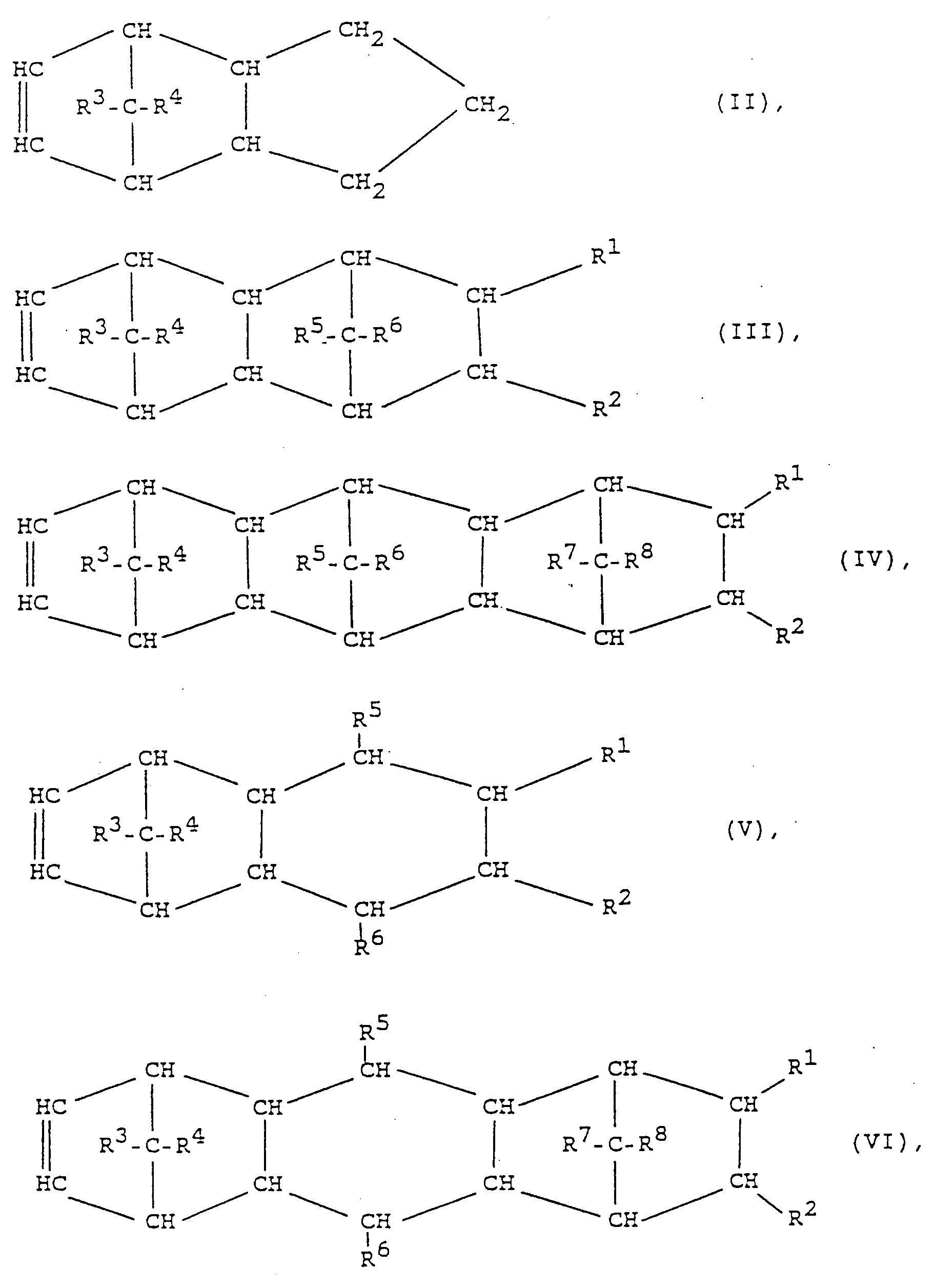
worin R¹, R², R³, R⁴, R⁵, R⁶, R⁷ und R⁸ gleich oder verschieden sind und ein Wasserstoffatom oder einen C₁-C₈-Alkylrest bedeuten, wobei gleiche Reste in den verschiedenen Formeln eine unterschiedliche Bedeutung haben können. - Die Weiterbildung des Substrats ergibt sich aus den Merkmalen der Patentansprüche 2 bis 5. Insbesondere besteht das Substrat aus einem Norbornen-Ethylen- oder Tetracyclododecen-Ethylen-Copolymer, desweiteren kann das Substrat ein Copolymer aus Norbornen und Ethylen sein und eine thermische Formbeständigkeit für einen Bereich der Glastemperatur von 140 °C bis 200 °C aufweisen.
- In Ausgestaltung der Erfindung besteht die magnetooptische Aufzeichnungsschicht des Aufzeichnungsmediums aus einer amorphen Seltenerd-Übergangsmetallegierung mit den Übergangsmetallen Fe und Co und zumindest einem Seltenerdmetall aus der Gruppe Gd, Tb, Dy, weist die Aufzeichnungsschicht eine leicht zu magnetisierende Achse senkrecht zur Oberfläche und eine Dicke zwischen 18 und 30 nm auf und ist zumindest ein weiteres Element aus der Gruppe Pt, Se, Cr Bestandteil der Legierung. Zweckmäßigerweise beträgt die Dicke der magnetooptischen Aufzeichnungsschicht 23 bis 28 nm.
- Die weitere Ausgestaltung der Erfindung ergibt sich aus den Merkmalen der Patentansprüche 9 bis 26.
- Die Erfindung wird im folgenden anhand eines zeichnerisch dargestellten Ausführungsbeispiels, das schematisch einen Schnitt durch ein Aufzeichnungsmedium nach der Erfindung zeigt, näher erläutert.
- Eine Speicherplatte 9 besteht aus einem Aufzeichnungsmedium 8, das von beiden Seiten mit je einer zusätzlichen Lackschicht 1 und 7 versehen ist. Die beiden Lackschichten werden mit Hilfe ultravioletter Strahlung gehärtet. Die Lackschicht 1 auf der das Laserlicht durchlassenden Grundfläche des Aufzeichnungsmediums 8 gilt insbesondere der Erhöhung der Kratzfestigkeit und reduziert die Anlagerung von Staub auf der Vorderseite der Speicherplatte 9 während des Plattenbetriebs, woraus eine höhere Zuverlässigkeit der Wiedergabe der Daten von dem Aufzeichnungsmedium 8 resultiert. Die Lackschicht 7 dient vor allem dem mechanischen Schutz des Aufzeichnungsmediums 8. Das magnetooptische Aufzeichnungsmedium 8 umfaßt zumindest eine Vierlagenstruktur, die auf einem Substrat 2 in Plattenform aufgeschichtet ist. Die Vierlagenstruktur auf dem Substrat 2 besteht beispielsweise aus einer dielektrischen Schicht 3, einer magnetooptischen Aufzeichnungsschicht 4, einer weiteren dielektrischen Schicht 5 und einer Reflexionsschicht 6. Ebenso ist es möglich, daß die Reflexionsschicht 6 und die obere dielektrische Schicht 5 vertauscht sind, so daß die Reflexionsschicht 6 unmittelbar auf der magnetooptischen Aufzeichnungsschicht 4 aufliegt. Das Substrat 2 besteht aus einem oder einer Mischung von Polymeren von polycyclischen Olefinen, gebildet durch Polymerisation ohne Ringöffnung von mindestens einem Monomeren der Formeln I, II, III, IV, V oder VI,


worin R¹, R², R³, R⁴, R⁵, R⁶, R⁷ und R⁸ gleich oder verschieden sind und ein Wasserstoffatom oder einen C₁-C₈-Alkylrest bedeuten, wobei gleiche Reste in den verschiedenen Formeln eine unterschiedliche Bedeutung haben können. - In das Material des Substrats 2 kann zusätzlich ein Cycloolefin der Formel VII eingebaut sein,

worin n eine Zahl von 2 bis 10 ist. Als weiteren Zusatz kann das Substrat 2 ein acyclisches 1-Olefin der Formel VIII
enthalten, worin R⁹, R¹⁰, R¹¹ und R¹² gleich oder verschieden sind und ein Wasserstoffatom oder einen C₁-C₈-Alkylrest bedeuten. - Die für das Substrat bevorzugt verwendeten Cycloolefincopolymere, weiterhin abgekürzt COC, sind Cycloolefine, wie Norbornen-Ethylen- oder Tetracyclododecen-Ethylen-Copolymere. Insbesondere handelt es sich um Copolymer aus Norbornen und Ethylen, die eine thermische Formbeständigkeit für einen Bereich der Glastemperatur von 140 °C bis 200 °C aufweisen. Abweichend von den COC-Basistypen können auch andere Norbornenderivate mit unterschiedlichen 1-Olefinen copolymerisiert werden. Ebenso sind Legierungen verschiedener COC-Typen verwendbar.
- In weiterer Ausgestaltung des Substrats 2 ist dieses aus Polymeren von polycyclischen Olefinen durch Polymerisation ohne Ringöffnung von 0,1 bis 100 Gewichtsprozent, bezogen auf die Gesamtmenge der Monomeren, mindestens eines Monomers der Formeln I, II, III, IV, V oder VI


worin R¹, R², R³, R⁴, R⁵, R⁶, R⁷ und R⁸ gleich oder verschieden sind und ein Wasserstoffatom oder einen C₁-C₈-Alkylrest bedeuten, wobei gleiche Reste in den verschiedenen Formeln eine unterschiedliche Bedeutung haben können,
0 bis 99,0 Gew.%, bezogen auf die Gesamtmente der Monomeren, eines Cycloolefins der Formel VII
worin n eine Zahl von 2 bis 10 ist, und
0 bis 99,9 Gew.%, bezogen auf die Gesamtmenge der Monomeren, mindestens eines acyclischen 1-Olefins der Formel VIII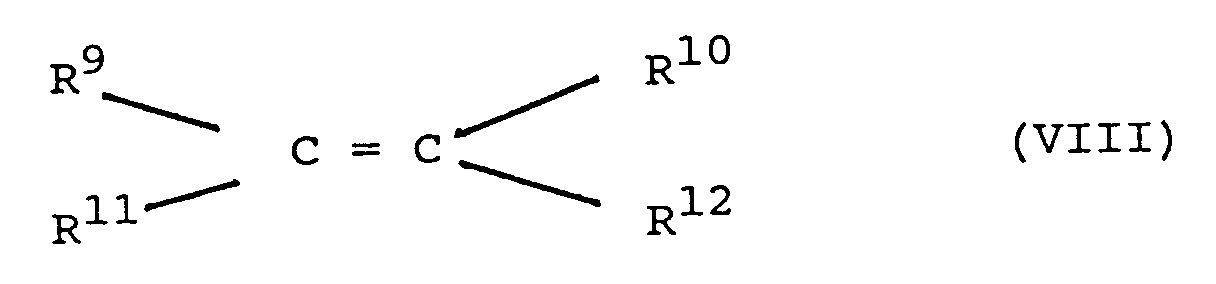
gebildet, worin R⁹, R¹⁰, R¹¹ und R¹² gleich oder verschieden sind und ein Wasserstoffatom oder einen C₁-C₈-Alkylrest bedeuten. - Die wesentlichen Eigenschaften der COC-Basistypen des Substrats 2 können wie folgt zusammengefaßt werden:
- das Material ist amorph und besitzt eine Glastemperatur bis etwa 200 °C;
- ist farblos und transparent;
- besitzt thermische Formbeständigkeit für einen Bereich der Glastemperatur von 140 bis 200 °C;
- eine Dichte von 1,01 bis 1,03 g/cm³;
- der Brechungsindex beträgt 1,52 bis 1,54;
- die Wasseraufnahme bei 23 °C und 85 % relativer Feuchtigkeit ist kleiner als 0,04 %;
- E-Modul beträgt 3,2 bis 3,6 GPa;
- die Reißspannung beträgt 40 bis 66 MPa;
- die Löslichkeit ist in Toluol, Xylol, Cyclohexan, Exxsol (hydrierte Dieselfraktion), Chloroform, Diethyläther gegeben;
- Unlöslichkeit in Wasser, Alkohole, Ketone (Aceton), Ester, Amide (DMF, DMAC, NMP) ist gegeben;
- chemische Resistenz gegen wäßrige und konzentrierte Säuren, wie HCl, H₂SO₃, und Basen NaOH, KOH ist gegeben.
- Eine weitere wesentliche Eigenschaft der COC-Basistypen ist ihre geringe inhärente Doppelbrechung, d.h. eine geringe Anisotropie der molekularen Polarisierbarkeit, sowie ihre Hydrolysebeständigkeit.
- Norbornen-Ethylen-Copolymere werden gegenüber DMON-Ethylen-Copolymeren bevorzugt, weil bei Norbornen-Ethylen-Copolymeren ein Niveau hoher Isotropie der Polarisierbarkeit bei höheren Glastemperaturen erreicht wird als im Falle von DMON-Ethylen-Copolymeren.
- Beispiele für die Synthese einzelner COC-Typen sowie die Beschreibung des Verfahrens zur Herstellung von COC-Typen mittels Massepolymerisation mit speziellen Metallocenkatalysatoren sind in der deutschen Patentanmeldung P 40 36 264.7 (Hoe 90/F 339) beschrieben.
- Eine Polymerisation unter Einsatz von Katalysatoren auf der Basis von Metallocenen wird nicht zuletzt wegen der gesundheitlichen Unbedenklichkeit dieser Verbindungen bevorzugt. Besonders bedenklich sind Verfahren zur Herstellung von Substratmaterialien unter Verwendung von Katalysatoren auf Vanadiumbasis. Vanadium ist äußerst giftig, und in der Regel bleiben Spuren von Vanadium im Substratmaterial zurück, was bei dessen Wiederaufarbeitung besondere Sicherheitsmaßnahmen erforderlich macht.
- Die magnetooptische Aufzeichnungsschicht ist eine Seltenerd-Übergangsmetallegierung, die beispielsweise eine Zusammensetzung gemäß der Formel
(Tbx Fey Co1-x-y)1-aMa
hat, mit M gleich einem Element aus der Gruppe Pt, Se, Cr. Für die einzelnen Legierungskomponenten gelten folgende Bereiche für ihren Anteil in - Atomprozenten:
- 0,20 ≦ x ≦ 0,28
0,64 ≦ y ≦ 0,72
0 ≦ a ≦ 0,10. - In einer speziellen Ausführungsform der magnetooptischen Aufzeichnungsschicht 4 lautet die Zusammensetzung der Seltenerd-Übergangsmetallegierung (Tbx Fey Co1-x-y)1-bCr, mit 0,22 ≦ x ≦ 0,28, 0,58 ≦ y ≦ 0,70 und 0,03 ≦ b ≦ 0,08. Für die Legierungskomponente Cr werden beispielsweise 6 Atomprozent an der Legierung aus Terbium-Eisen-Kobalt bevorzugt, so daß diese beispielsweise die Zusammensetzung Tb0,22 Fe0,65 Co0,07 Cr0,06 hat.
- Im allgemeinen gilt, daß der Seltenerd-Übergangsmetallegierung der Aufzeichnungsschicht 4 Chrom im Bereich von 3,o bis 8,0 Atomprozent, bezogen auf die Gesamtlegierung, Platin im Bereich von 0,7 bis 5, insbesondere 1 bis 3 Atomprozent, oder Selen im Bereich von 1 bis 10 Atomprozent zulegiert ist. Derartige Seltenerd-Übergangsmetallegierungen mit Platin haben beispielsweise die Zusammensetzung (Tbx Fey Co1-x-y)1-cPt mit 0,22 ≦ x ≦ 0,28; 0,64 ≦ y ≦ 0,70 und 0,007 ≦ c ≦ 0,05, insbesondere 0,01 ≦ c ≦ 0,03.
- Selbstverständlich sind auch andere magnetooptische Aufzeichnungsschichten aus einer der Seltenerd-Übergangsmetallegierungen GdFeCo, TbGdFeCo, TbDyFeCo, TbGdDyCo, GdTbDyFeCo für das Aufzeichnungsmedium 8 geeignet.
- Die beiden dielektrischen Schichten 3 und 5, die die magnetooptische Aufzeichnungsschicht 4 einschließen, sind üblicherweise aus der gleichen Verbindung hergestellt, jedoch ist es auch möglich, für die beiden dielektrischen Schichten unterschiedliche Materialien einzusetzen. Geeignete Materialien sind Nitride, wie SiNx mit 0,9 ≦ x ≦ 1,4, SiON, SiAlON, AlN, AlON oder Oxide wie Ta₂O₅, TaOx, NbOx mit 1 ≦ x ≦ 2. Die Dicken der dielektrischen Schichten können gleichgroß oder auch unterschiedlich sein. So liegt die Dicke der ersten dielektrischen Schicht 3 zwischen dem Substrat 2 und der magnetooptischen Aufzeichnungsschicht 4 im Bereich von 30 bis 140 nm, insbesondere im Bereich von 50 bis 80 nm. Bei einer Dicke der dielektrischen Schicht 3 im Bereich von 30 bis 140 nm liegt der Brechungsindex n zwischen 1,9 und 2,2. Bei einer Dicke der dielektrischen Schicht 3 von 50 bis 80 nm liegt der Brechungsindex n im Bereich von 2,0 bis 2,1. Die Dicke der zweiten dielektrischen Schicht 5, die zwischen der magnetooptischen Aufzeichnungsschicht 4 und der Reflexionsschicht 6 angeordnet ist, ist im allgemeinen etwas geringer als die Dicke der ersten dielektrischen Schicht 3 und liegt im Bereich von 10 bis 60 nm, wobei der Brechungsindex n gleich 1,9 bis 2,2 lautet. Bevorzugt ist eine Dicke der zweiten dielektrischen Schicht 5 im Bereich von 25 bis 40 nm, mit einem Brechungsindex n im Bereich von 2,0 bis 2,1.
- Ein weiteres geeignetes Material für die zweite dielektrische Schicht 5 ist u.a. Aluminiumnitrid, mit einer Dicke von 20 bis 50 nm.
- Die Reflexionsschicht 6 besteht gleichfalls aus Aluminium, mit einem Zusatz eines Metalls aus der Gruppe Zirkon, Tantal, Titan, Chrom. Die Zulegierung dieses weiteren Metalls zu der Reflexionsschicht 6 aus Aluminium erfolgt in der Weise, daß die beiden Metalle senkrecht zu der Oberfläche der Reflexionsschicht 6 einen Konzentrationsgradienten aufweisen.
Claims (26)
- Magnetooptisches Aufzeichnungsmedium aus zumindest vier Lagen, die auf einem Substrat übereinander aufgeschichtet sind und zwei dielektrische Schichten, eine Reflexions- und eine magnetooptische Aufzeichnungsschicht umfassen, dadurch gekennzeichnet, daß das Substrat (2) aus Polymeren von polycyclischen Olefinen durch Polymerisation ohne Ringöffnung von mindestens einem Monomeren der Formeln I, II, III, IV, V oder VI gebildet ist,


- Magnetooptisches Aufzeichnungsmedium nach Anspruch 1, dadurch gekennzeichnet, daß in das Material des Substrats (2) zusätzlich ein Cycloolefin der Formel VII

- Magnetooptisches Aufzeichnungsmedium nach Anspruch 1 oder 2, dadurch gekennzeichnet, daß das Substrat (2) zusätzlich mindestens ein acyclisches 1-Olefin der Formel VIII

- Magnetooptisches Aufzeichnungsmedium nach mehreren der Ansprüche 1 bis 3, dadurch gekennzeichnet, daß das Substrat (2) aus einer Mischung unterschiedlicher Polymere, die in den Ansprüchen 1 bis 3 genannt sind, besteht.
- Magnetooptisches Aufzeichnungsmedium aus zumindest vier Lagen, die auf einem Substrat übereinander aufgeschichtet sind und zwei dielektrische Schichten, eine Reflexions- und eine magnetooptische Aufzeichnungsschicht umfassen, dadurch gekennzeichnet, daß das Substrat (2) aus Polymeren von polycyclischen Olefinen durch Polymerisation ohne Ringöffnung von 0,1 bis 100 Gew.%, bezogen auf die Gesamtmenge der Monomeren, mindestens eines Monomers der Formeln I, II, III, IV, V oder VI


0 bis 99,0 Gew.%, bezogen auf die Gesamtmenge der Monomeren, eines Cycloolefins der Formel VII
0 bis 99,9 Gew.-%, bezogen auf die Gesamtmenge der Monomeren, mindestens eines acyclischen 1-Olefins der Formel VIII
- Magnetooptisches Aufzeichnungsmedium nach einem oder mehreren der Ansprüche 1 bis 5, dadurch gekennzeichnet, daß das Substrat (2) ein Norbornen-Ethylen-Copolymer oder ein Tetracyclododecen-Ethylen-Copolymer ist.
- Magnetooptisches Aufzeichnungsmedium nach einem oder mehreren der Ansprüche 1 bis 6, dadurch gekennzeichnet, daß das Substrat (2) aus Copolymeren aus Norbornen und Ethylen besteht und eine thermische Formbeständigkeit für einen Bereich der Glastemperatur von 140 °C bis 200 °C aufweist.
- Magnetooptisches Aufzeichnungsmedium nach einem oder mehreren der Ansprüche 1 bis 7, dadurch gekennzeichnet, daß die magnetooptische Aufzeichnungsschicht (4) aus einer amorphen seltenerd-Übergangsmetall-Legierung mit den Übergangsmetallen Fe und Co und zumindest einem Seltenerdmetall aus der Gruppe Gd, Tb, Dy besteht, daß die Aufzeichnungsschicht (4) eine leicht zu magnetisierende Achse senkrecht zur Oberfläche und eine Dicke zwischen 18 und 30 nm aufweist und daß zumindest ein weiteres Element aus der Gruppe Pt, Se, Cr Bestandteil der Legierung ist.
- Magnetooptisches Aufzeichnungsmedium nach Anspruch 8, dadurch gekennzeichnet, daß die Dicke der magnetooptischen Aufzeichnungsschicht 23 bis 28 nm beträgt.
- Magnetooptisches Aufzeichnungsmedium nach Anspruch 8, dadurch gekennzeichnet, daß die magnetooptische Aufzeichnungsschicht eine Seltenerd-Übergangsmetall-Legierung der Zusammensetzung
[Tbx Fey Co1-x-y]1-a Ma
mit
0,20 ≦ x ≦ 0,28
0,64 ≦ y ≦ 0,72
0 ≦ a ≦ 0,10
und M ein Element aus der Gruppe Pt, Se, Cr ist. - Magnetooptisches Aufzeichnungsmedium nach Anspruch 10, dadurch gekennzeichnet, daß die Aufzeichnungsschicht eine Seltenerd-Übergangsmetall-Legierung der Zusammensetzung
(Tbx Fey Co1-x-y)1-b Crb
mit
0,22 ≦ x ≦ 0,28
0,58 ≦ y ≦ 0,70
0,03 ≦ b ≦ 0,08
ist. - Magnetooptisches Aufzeichnungsmedium nach Anspruch 10, dadurch gekennzeichnet, daß die Aufzeichnungsschicht eine Seltenerd-Übergangsmetall-Legierung der Zusammensetzung
Tb0,22 Fe0,65 Co0,07 Cr0,06
ist. - Magnetooptisches Aufzeichnungsmedium nach Anspruch 10, dadurch gekennzeichnet, daß die Aufzeichnungsschicht eine Seltenerd-Übergangsmetall-Legierung der Zusammensetzung
(Tbx Fey Co1-x-y)1-c Ptc
mit
0,22 ≦ x ≦ 0,28
0,64 ≦ y ≦ 0,70
0,007≦ c ≦ 0,05
ist. - Magnetooptisches Aufzeichnungsmedium nach Anspruch 10, dadurch gekennzeichnet, daß die Aufzeichnungsschicht eine Seltenerd-Übergangsmetall-Legierung der Zusammensetzung
(Tbx Fey Co1-x-y)1-d Sed
mit
0,22 ≦ x ≦ 0,28
0,64≦ y ≦ 0,70
0,01 ≦ d ≦ 0,10
ist. - Magnetooptisches Aufzeichnungsmedium nach Anspruch 8, dadurch gekennzeichnet, daß die Aufzeichnungsschicht aus einer der Seltenerd-Übergangsmetall-Legierungen GdFeCo, TbGdFeCo, TbDyFeCo, TbGdDyCo, GdTbDyFeCo besteht und zusätzlich zumindest eines der Elemente Pt, Se, Cr enthält.
- Magnetooptisches Aufzeichnungsmedium nach Anspruch 15, dadurch gekennzeichnet, daß der Seltenerd-Übergangsmetall-Legierung der Aufzeichnungsschicht Chrom im Bereich von 3 bis 8 Atom%, bezogen auf die Gesamtlegierung, Platin im Bereich von 0,7 bis 5, insbesondere 1 bis 3 Atom%, oder Selen im Bereich von 1 bis 10 Atom% zulegiert ist.
- Magnetooptisches Aufzeichnungsmedium nach Anspruch 1, dadurch gekennzeichnet, daß die magnetooptische Aufzeichnungsschicht (4) von den beiden dielektrischen Schichten (3, 5) aus SiNx, SiON, SiAlON, AlN, AlON, Ta₂O₅, TaOx oder NbOx mit 0,9 ≦ x ≦ 1,4 für SiNx und 1 ≦ x ≦ 2 für TaOx und NbOx eingeschlossen ist.
- Magnetooptisches Aufzeichnungsmedium nach Anspruch 17, dadurch gekennzeichnet, daß die Dicke der ersten dielektrischen Schicht (3) zwischen dem Substrat (2) und der magnetooptischen Aufzeichnungsschicht (4) 30 bis 140 nm und der Brechungsindex n = 1,9 bis 2,2 beträgt.
- Magnetooptisches Aufzeichnungsmedium nach Anspruch 18, dadurch gekennzeichnet, daß die Dicke der dielektrischen Schicht (3) 50 bis 80 nm und der Brechungsindex n = 2,0 bis 2,1 beträgt.
- Magnetooptisches Aufzeichnungsmedium nach Anspruch 17, dadurch gekennzeichnet, daß die Dicke der zweiten dielektrischen Schicht (5), die zwischen der magnetooptischen Aufzeichnungsschicht (4) und der Reflexionsschicht (6) angeordnet ist, 10 bis 60 nm und der Brechungsindex n = 1,9 bis 2,2 beträgt.
- Magnetooptisches Aufzeichnungsmedium nach Anspruch 20, dadurch gekennzeichnet, daß die Dicke der zweiten dielektrischen Schicht (5) 25 bis 40 nm und der Brechungsindex n = 2,0 bis 2,1 beträgt.
- Magnetooptisches Aufzeichnungsmedium nach Anspruch 8, dadurch gekennzeichnet, daß die zweite dielektrische Schicht (5) aus Aluminiumnitrid, mit einer Dicke von 20 bis 50 nm besteht.
- Magnetooptisches Aufzeichnungsmedium nach einem oder mehreren der Ansprüche 1 bis 8, dadurch gekennzeichnet, daß die Reflexionsschicht (6) ein Metall aus der Gruppe Al, Cu, Ag, Au ist und ihre Dicke im Bereich von 20 bis 80 nm liegt.
- Magnetooptisches Aufzeichnungsmedium nach Anspruch 23, dadurch gekennzeichnet, daß die Reflexionsschicht (6) aus Aluminium, mit einem Zusatz eines Metalls aus der Gruppe Zr, Ta, Ti, Cr besteht.
- Magnetooptisches Aufzeichnungsmedium nach Anspruch 24, dadurch gekennzeichnet, daß die beiden Metalle der Reflexionsschicht (6) senkrecht zu ihrer Oberfläche einen Konzentrationsgradienten aufweisen.
- Magnetooptisches Aufzeichnungsmedium nach einem oder mehreren der Ansprüche 1 bis 25, dadurch gekennzeichnet, daß das Aufzeichnungsmedium (8) auf der Vorder- und der Rückseite mit einer Schutzlackschicht (7, 1) ausgestattet ist.
Applications Claiming Priority (2)
| Application Number | Priority Date | Filing Date | Title |
|---|---|---|---|
| DE4137427 | 1991-11-14 | ||
| DE4137427A DE4137427C1 (de) | 1991-11-14 | 1991-11-14 |
Publications (3)
| Publication Number | Publication Date |
|---|---|
| EP0542176A2 true EP0542176A2 (de) | 1993-05-19 |
| EP0542176A3 EP0542176A3 (en) | 1993-06-16 |
| EP0542176B1 EP0542176B1 (de) | 1997-03-05 |
Family
ID=6444775
Family Applications (1)
| Application Number | Title | Priority Date | Filing Date |
|---|---|---|---|
| EP92119156A Expired - Lifetime EP0542176B1 (de) | 1991-11-14 | 1992-11-09 | Magnetooptisches Aufzeichnungsmedium |
Country Status (4)
| Country | Link |
|---|---|
| US (1) | US5707728A (de) |
| EP (1) | EP0542176B1 (de) |
| JP (1) | JPH05217233A (de) |
| DE (2) | DE4137427C1 (de) |
Cited By (2)
| Publication number | Priority date | Publication date | Assignee | Title |
|---|---|---|---|---|
| EP1001408A3 (de) * | 1993-11-30 | 2000-06-14 | Sony Corporation | Magnetplattensubstrat und Magnetplatte welche dieses verwendet |
| US6885415B2 (en) | 2001-05-10 | 2005-04-26 | Sumitomo Chemical Company, Limited | Optical member and optical product provided therewith |
Families Citing this family (3)
| Publication number | Priority date | Publication date | Assignee | Title |
|---|---|---|---|---|
| DE19647954A1 (de) * | 1996-11-20 | 1998-06-04 | Hoechst Ag | Biaxial orientierte Folie aus cycloolefinischen Polymeren, Verfahren zu deren Herstellung und deren Verwendung |
| US6545974B1 (en) | 1998-11-18 | 2003-04-08 | Seagate Technology Llc | Disc media and methods for fabricating |
| US6335080B1 (en) | 1999-01-04 | 2002-01-01 | Seagate Technology Llc | Magnetic disk media and disk drives utilizing polymeric disk substrates |
Family Cites Families (22)
| Publication number | Priority date | Publication date | Assignee | Title |
|---|---|---|---|---|
| GB217516A (en) * | 1923-01-05 | 1924-06-08 | Lorenz Konrad Braren | Improvements in screw making and turning lathes |
| DE3309483C3 (de) * | 1982-03-17 | 2003-02-27 | Canon Kk | Magnetooptisches Aufzeichnungsmaterial und dessen Verwendung |
| US4670353A (en) * | 1982-03-17 | 1987-06-02 | Canon Kabushiki Kaisha | Magnetooptical recording medium |
| US4614778A (en) * | 1984-02-03 | 1986-09-30 | Hirokazu Kajiura | Random copolymer |
| DE3536210A1 (de) * | 1984-10-11 | 1986-04-17 | Hitachi, Ltd., Tokio/Tokyo | Magnetooptisches aufzeichnungsmedium |
| KR870006535A (ko) * | 1985-02-27 | 1987-07-13 | 나가이 아쯔시 | 광자기 기록 매체 |
| JPS61255546A (ja) * | 1985-05-09 | 1986-11-13 | Kokusai Denshin Denwa Co Ltd <Kdd> | 光磁気記録媒体 |
| US4649519A (en) * | 1985-09-30 | 1987-03-10 | International Business Machines Corporation | Self biasing thermal magneto-optic medium |
| US4794560A (en) * | 1985-09-30 | 1988-12-27 | International Business Machines Corporation | Eraseable self biasing thermal magneto-optic medium |
| US4694358A (en) * | 1985-10-28 | 1987-09-15 | Kerdix, Inc. | Magneto-optic recording structure and method |
| JPH07105082B2 (ja) * | 1985-11-28 | 1995-11-13 | ソニー株式会社 | 光磁気記録媒体 |
| JPH0695404B2 (ja) * | 1985-12-27 | 1994-11-24 | ソニー株式会社 | 光磁気記録方法 |
| DE3642161A1 (de) * | 1986-12-10 | 1988-06-23 | Philips Patentverwaltung | Verfahren zur herstellung eines magneto-optischen speichers |
| US4740430A (en) * | 1987-02-18 | 1988-04-26 | American Telephone And Telegraph Company, At&T Bell Laboratories | Magneto-optic memory |
| EP0310680A4 (en) * | 1987-04-17 | 1990-10-03 | Mitsui Petrochemical Industries, Ltd. | Photomagnetic recording membrane |
| EP0350010B1 (de) * | 1988-07-07 | 1993-09-29 | Oki Electric Industry Co., Ltd. | Magneto-optisches Speichermedium |
| CA2011590A1 (en) * | 1989-03-07 | 1990-09-07 | Koji Tsuzukiyama | Optical recording media |
| FI81887C (fi) * | 1989-03-08 | 1990-12-10 | Tampella Oy Ab | Mellanstyranordning foer bergborrningsmaskin. |
| CA2011384C (en) * | 1989-03-09 | 1994-05-03 | Shigenori Yanagi | Track access control apparatus for optical disk apparatus |
| CA2017284C (en) * | 1989-07-04 | 1995-10-03 | Kazutomi Suzuki | Optical recording medium |
| DE3922546A1 (de) * | 1989-07-08 | 1991-01-17 | Hoechst Ag | Verfahren zur herstellung von cycloolefinpolymeren |
| CA2041032A1 (en) * | 1990-04-24 | 1991-10-25 | Kiyotaka Shindo | Magnetooptical recording media |
-
1991
- 1991-11-14 DE DE4137427A patent/DE4137427C1/de not_active Expired - Fee Related
-
1992
- 1992-11-09 EP EP92119156A patent/EP0542176B1/de not_active Expired - Lifetime
- 1992-11-09 DE DE59208108T patent/DE59208108D1/de not_active Expired - Fee Related
- 1992-11-12 JP JP4302608A patent/JPH05217233A/ja active Pending
-
1995
- 1995-05-30 US US08/452,514 patent/US5707728A/en not_active Expired - Fee Related
Cited By (2)
| Publication number | Priority date | Publication date | Assignee | Title |
|---|---|---|---|---|
| EP1001408A3 (de) * | 1993-11-30 | 2000-06-14 | Sony Corporation | Magnetplattensubstrat und Magnetplatte welche dieses verwendet |
| US6885415B2 (en) | 2001-05-10 | 2005-04-26 | Sumitomo Chemical Company, Limited | Optical member and optical product provided therewith |
Also Published As
| Publication number | Publication date |
|---|---|
| DE4137427C1 (de) | 1993-01-14 |
| JPH05217233A (ja) | 1993-08-27 |
| EP0542176B1 (de) | 1997-03-05 |
| EP0542176A3 (en) | 1993-06-16 |
| DE59208108D1 (de) | 1997-04-10 |
| US5707728A (en) | 1998-01-13 |
Similar Documents
| Publication | Publication Date | Title |
|---|---|---|
| DE3534571C2 (de) | ||
| DE3382702T2 (de) | Magneto-optischer Speicher. | |
| EP0610813B1 (de) | Material aus einem Cycloolefin-Copolymer und Verfahren zu seiner Herstellung | |
| DE69112168T2 (de) | Magnetooptisches Aufzeichnungsmedium. | |
| DE3500314C2 (de) | ||
| DE69317719T2 (de) | Magnetooptische Speichervorrichtung und Verfahren zur Informationsaufnahme und -wiedergabe | |
| DE69417806T2 (de) | Magnetooptischer Aufzeichnungsträger | |
| DE69812248T2 (de) | Informationsaufzeichnungsträger und Verfahren zu dessen Herstellung | |
| DE69024747T2 (de) | Magnetooptisches Aufzeichnungsmedium | |
| EP0542176B1 (de) | Magnetooptisches Aufzeichnungsmedium | |
| EP0383216A2 (de) | Magnetooptische Schicht und Verfahren zu ihrer Herstellung | |
| DE3832126A1 (de) | Informationsspeichermedium | |
| DE69030991T2 (de) | Magnetooptisches medium | |
| DE3538442C2 (de) | ||
| DE68911014T2 (de) | Laminiertes Produkt, Verbindung zur Verwendung in dem laminierten Produkt und optischer Informationsspeicher, versehen mit dem laminierten Produkt. | |
| DE69225571T2 (de) | Substrat für optisches Aufzeichnungsmedium und magneto-optisches Aufzeichnungsmedium mit einem solchen Substrat | |
| DE69130441T2 (de) | Magnetooptischer Aufzeichnungsträger | |
| DE3780337T2 (de) | Optische platte. | |
| DE69028032T2 (de) | Informationsaufzeichnungsmedien | |
| DE69322222T2 (de) | Magnetooptischer Aufzeichnungsträger | |
| DE68915832T2 (de) | Optisches Aufzeichnungsmedium. | |
| DE68921257T2 (de) | Magneto-optisches Speichergerät. | |
| DE68925098T2 (de) | Magneto-optisches Aufzeichnungsmedium | |
| DE3686530T2 (de) | Aufzeichnungstraeger, versehen mit hochdichter information. | |
| DE3604642C2 (de) |
Legal Events
| Date | Code | Title | Description |
|---|---|---|---|
| PUAI | Public reference made under article 153(3) epc to a published international application that has entered the european phase |
Free format text: ORIGINAL CODE: 0009012 |
|
| PUAL | Search report despatched |
Free format text: ORIGINAL CODE: 0009013 |
|
| AK | Designated contracting states |
Kind code of ref document: A2 Designated state(s): BE DE FR GB IT NL |
|
| AK | Designated contracting states |
Kind code of ref document: A3 Designated state(s): BE DE FR GB IT NL |
|
| 17P | Request for examination filed |
Effective date: 19930916 |
|
| 17Q | First examination report despatched |
Effective date: 19951122 |
|
| GRAG | Despatch of communication of intention to grant |
Free format text: ORIGINAL CODE: EPIDOS AGRA |
|
| GRAH | Despatch of communication of intention to grant a patent |
Free format text: ORIGINAL CODE: EPIDOS IGRA |
|
| GRAH | Despatch of communication of intention to grant a patent |
Free format text: ORIGINAL CODE: EPIDOS IGRA |
|
| GRAA | (expected) grant |
Free format text: ORIGINAL CODE: 0009210 |
|
| AK | Designated contracting states |
Kind code of ref document: B1 Designated state(s): BE DE FR GB IT NL |
|
| REF | Corresponds to: |
Ref document number: 59208108 Country of ref document: DE Date of ref document: 19970410 |
|
| ET | Fr: translation filed | ||
| ITF | It: translation for a ep patent filed | ||
| GBT | Gb: translation of ep patent filed (gb section 77(6)(a)/1977) |
Effective date: 19970516 |
|
| PLBE | No opposition filed within time limit |
Free format text: ORIGINAL CODE: 0009261 |
|
| STAA | Information on the status of an ep patent application or granted ep patent |
Free format text: STATUS: NO OPPOSITION FILED WITHIN TIME LIMIT |
|
| 26N | No opposition filed | ||
| REG | Reference to a national code |
Ref country code: GB Ref legal event code: 732E |
|
| REG | Reference to a national code |
Ref country code: FR Ref legal event code: TP |
|
| REG | Reference to a national code |
Ref country code: GB Ref legal event code: IF02 |
|
| PGFP | Annual fee paid to national office [announced via postgrant information from national office to epo] |
Ref country code: DE Payment date: 20051031 Year of fee payment: 14 |
|
| NLS | Nl: assignments of ep-patents |
Owner name: TICONA GMBH Effective date: 20050825 |
|
| PGFP | Annual fee paid to national office [announced via postgrant information from national office to epo] |
Ref country code: FR Payment date: 20051110 Year of fee payment: 14 |
|
| PGFP | Annual fee paid to national office [announced via postgrant information from national office to epo] |
Ref country code: NL Payment date: 20051114 Year of fee payment: 14 |
|
| PGFP | Annual fee paid to national office [announced via postgrant information from national office to epo] |
Ref country code: GB Payment date: 20051121 Year of fee payment: 14 |
|
| PGFP | Annual fee paid to national office [announced via postgrant information from national office to epo] |
Ref country code: BE Payment date: 20051216 Year of fee payment: 14 |
|
| PG25 | Lapsed in a contracting state [announced via postgrant information from national office to epo] |
Ref country code: BE Free format text: LAPSE BECAUSE OF NON-PAYMENT OF DUE FEES Effective date: 20061130 |
|
| PGFP | Annual fee paid to national office [announced via postgrant information from national office to epo] |
Ref country code: IT Payment date: 20061130 Year of fee payment: 15 |
|
| PG25 | Lapsed in a contracting state [announced via postgrant information from national office to epo] |
Ref country code: NL Free format text: LAPSE BECAUSE OF NON-PAYMENT OF DUE FEES Effective date: 20070601 Ref country code: DE Free format text: LAPSE BECAUSE OF NON-PAYMENT OF DUE FEES Effective date: 20070601 |
|
| GBPC | Gb: european patent ceased through non-payment of renewal fee |
Effective date: 20061109 |
|
| NLV4 | Nl: lapsed or anulled due to non-payment of the annual fee |
Effective date: 20070601 |
|
| REG | Reference to a national code |
Ref country code: FR Ref legal event code: ST Effective date: 20070731 |
|
| PG25 | Lapsed in a contracting state [announced via postgrant information from national office to epo] |
Ref country code: GB Free format text: LAPSE BECAUSE OF NON-PAYMENT OF DUE FEES Effective date: 20061109 |
|
| BERE | Be: lapsed |
Owner name: *TICONA G.M.B.H. Effective date: 20061130 |
|
| PG25 | Lapsed in a contracting state [announced via postgrant information from national office to epo] |
Ref country code: FR Free format text: LAPSE BECAUSE OF NON-PAYMENT OF DUE FEES Effective date: 20061130 |
|
| PG25 | Lapsed in a contracting state [announced via postgrant information from national office to epo] |
Ref country code: IT Free format text: LAPSE BECAUSE OF NON-PAYMENT OF DUE FEES Effective date: 20071109 |