EP0542249A2 - Procédé de préparation du chitosane - Google Patents
Procédé de préparation du chitosane Download PDFInfo
- Publication number
- EP0542249A2 EP0542249A2 EP92119346A EP92119346A EP0542249A2 EP 0542249 A2 EP0542249 A2 EP 0542249A2 EP 92119346 A EP92119346 A EP 92119346A EP 92119346 A EP92119346 A EP 92119346A EP 0542249 A2 EP0542249 A2 EP 0542249A2
- Authority
- EP
- European Patent Office
- Prior art keywords
- chitosan
- extraction
- solution
- alkali
- temperature
- Prior art date
- Legal status (The legal status is an assumption and is not a legal conclusion. Google has not performed a legal analysis and makes no representation as to the accuracy of the status listed.)
- Withdrawn
Links
- 229920001661 Chitosan Polymers 0.000 title claims abstract description 75
- 238000000034 method Methods 0.000 title claims abstract description 23
- 239000000126 substance Substances 0.000 claims abstract description 20
- 241000233866 Fungi Species 0.000 claims abstract description 17
- 150000007524 organic acids Chemical class 0.000 claims abstract description 10
- 239000003513 alkali Substances 0.000 claims abstract description 8
- 238000010438 heat treatment Methods 0.000 claims abstract description 6
- 238000003756 stirring Methods 0.000 claims abstract description 5
- 239000006185 dispersion Substances 0.000 claims abstract description 4
- 238000002156 mixing Methods 0.000 claims abstract description 3
- QTBSBXVTEAMEQO-UHFFFAOYSA-N Acetic acid Chemical compound CC(O)=O QTBSBXVTEAMEQO-UHFFFAOYSA-N 0.000 claims description 33
- 239000000243 solution Substances 0.000 claims description 27
- 239000007864 aqueous solution Substances 0.000 claims description 21
- HEMHJVSKTPXQMS-UHFFFAOYSA-M Sodium hydroxide Chemical compound [OH-].[Na+] HEMHJVSKTPXQMS-UHFFFAOYSA-M 0.000 claims description 18
- JVTAAEKCZFNVCJ-UHFFFAOYSA-N lactic acid Chemical compound CC(O)C(O)=O JVTAAEKCZFNVCJ-UHFFFAOYSA-N 0.000 claims description 8
- MUBZPKHOEPUJKR-UHFFFAOYSA-N Oxalic acid Chemical compound OC(=O)C(O)=O MUBZPKHOEPUJKR-UHFFFAOYSA-N 0.000 claims description 6
- FERIUCNNQQJTOY-UHFFFAOYSA-N Butyric acid Chemical compound CCCC(O)=O FERIUCNNQQJTOY-UHFFFAOYSA-N 0.000 claims description 4
- 239000004310 lactic acid Substances 0.000 claims description 4
- 235000014655 lactic acid Nutrition 0.000 claims description 4
- 241001480490 Mucoraceae Species 0.000 claims description 3
- 235000006408 oxalic acid Nutrition 0.000 claims description 2
- 239000002028 Biomass Substances 0.000 abstract description 3
- 239000011324 bead Substances 0.000 abstract description 3
- 239000008394 flocculating agent Substances 0.000 abstract description 3
- 229920000642 polymer Polymers 0.000 abstract description 3
- 238000000605 extraction Methods 0.000 description 81
- 230000006196 deacetylation Effects 0.000 description 12
- 238000003381 deacetylation reaction Methods 0.000 description 12
- QAOWNCQODCNURD-UHFFFAOYSA-N Sulfuric acid Chemical compound OS(O)(=O)=O QAOWNCQODCNURD-UHFFFAOYSA-N 0.000 description 8
- 239000002253 acid Substances 0.000 description 7
- 239000000284 extract Substances 0.000 description 7
- 239000001963 growth medium Substances 0.000 description 5
- 241000238557 Decapoda Species 0.000 description 4
- VEXZGXHMUGYJMC-UHFFFAOYSA-N Hydrochloric acid Chemical compound Cl VEXZGXHMUGYJMC-UHFFFAOYSA-N 0.000 description 4
- 238000002474 experimental method Methods 0.000 description 4
- XLYOFNOQVPJJNP-UHFFFAOYSA-N water Substances O XLYOFNOQVPJJNP-UHFFFAOYSA-N 0.000 description 4
- 241000238424 Crustacea Species 0.000 description 3
- -1 i.e. Substances 0.000 description 3
- 239000007788 liquid Substances 0.000 description 3
- 150000007522 mineralic acids Chemical class 0.000 description 3
- 239000007858 starting material Substances 0.000 description 3
- 239000006228 supernatant Substances 0.000 description 3
- 239000002699 waste material Substances 0.000 description 3
- 241000293029 Absidia caerulea Species 0.000 description 2
- 229920002101 Chitin Polymers 0.000 description 2
- 238000005119 centrifugation Methods 0.000 description 2
- 238000005227 gel permeation chromatography Methods 0.000 description 2
- 238000005259 measurement Methods 0.000 description 2
- 239000000203 mixture Substances 0.000 description 2
- 230000007935 neutral effect Effects 0.000 description 2
- 239000002244 precipitate Substances 0.000 description 2
- 239000000725 suspension Substances 0.000 description 2
- 241000251468 Actinopterygii Species 0.000 description 1
- WQZGKKKJIJFFOK-GASJEMHNSA-N Glucose Natural products OC[C@H]1OC(O)[C@H](O)[C@@H](O)[C@@H]1O WQZGKKKJIJFFOK-GASJEMHNSA-N 0.000 description 1
- 238000004566 IR spectroscopy Methods 0.000 description 1
- 239000001888 Peptone Substances 0.000 description 1
- 108010080698 Peptones Proteins 0.000 description 1
- 229920003171 Poly (ethylene oxide) Polymers 0.000 description 1
- 206010039509 Scab Diseases 0.000 description 1
- 238000010521 absorption reaction Methods 0.000 description 1
- 238000000862 absorption spectrum Methods 0.000 description 1
- 150000007513 acids Chemical class 0.000 description 1
- 238000005273 aeration Methods 0.000 description 1
- 230000003113 alkalizing effect Effects 0.000 description 1
- 230000003466 anti-cipated effect Effects 0.000 description 1
- QVGXLLKOCUKJST-UHFFFAOYSA-N atomic oxygen Chemical compound [O] QVGXLLKOCUKJST-UHFFFAOYSA-N 0.000 description 1
- 229940041514 candida albicans extract Drugs 0.000 description 1
- 210000005056 cell body Anatomy 0.000 description 1
- 210000002421 cell wall Anatomy 0.000 description 1
- 229920002678 cellulose Polymers 0.000 description 1
- 239000001913 cellulose Substances 0.000 description 1
- 239000000084 colloidal system Substances 0.000 description 1
- 230000000850 deacetylating effect Effects 0.000 description 1
- 230000007423 decrease Effects 0.000 description 1
- 230000003247 decreasing effect Effects 0.000 description 1
- 230000003544 deproteinization Effects 0.000 description 1
- 238000003912 environmental pollution Methods 0.000 description 1
- 229910052564 epsomite Inorganic materials 0.000 description 1
- 230000004151 fermentation Effects 0.000 description 1
- 238000001914 filtration Methods 0.000 description 1
- 239000008103 glucose Substances 0.000 description 1
- 238000004519 manufacturing process Methods 0.000 description 1
- 244000005700 microbiome Species 0.000 description 1
- 239000004570 mortar (masonry) Substances 0.000 description 1
- 235000005985 organic acids Nutrition 0.000 description 1
- 229910052760 oxygen Inorganic materials 0.000 description 1
- 239000001301 oxygen Substances 0.000 description 1
- 239000002245 particle Substances 0.000 description 1
- 235000019319 peptone Nutrition 0.000 description 1
- 238000002360 preparation method Methods 0.000 description 1
- 239000012925 reference material Substances 0.000 description 1
- 239000002904 solvent Substances 0.000 description 1
- 238000004448 titration Methods 0.000 description 1
- 239000002351 wastewater Substances 0.000 description 1
- 239000012138 yeast extract Substances 0.000 description 1
Images
Classifications
-
- C—CHEMISTRY; METALLURGY
- C12—BIOCHEMISTRY; BEER; SPIRITS; WINE; VINEGAR; MICROBIOLOGY; ENZYMOLOGY; MUTATION OR GENETIC ENGINEERING
- C12P—FERMENTATION OR ENZYME-USING PROCESSES TO SYNTHESISE A DESIRED CHEMICAL COMPOUND OR COMPOSITION OR TO SEPARATE OPTICAL ISOMERS FROM A RACEMIC MIXTURE
- C12P19/00—Preparation of compounds containing saccharide radicals
- C12P19/26—Preparation of nitrogen-containing carbohydrates
Definitions
- the present invention relates to a method for preparing chitosan through cultivation of microorganisms and more particularly to a process for extracting chitosan.
- Chitosan has attracted special interest recently as a biomass second to cellulose. It has been anticipated that chitosan can be used in various fields such as flocculating agents for polymers, immobilization supports and porous beads.
- Chitosan has industrially been prepared by treating cuticle of Crustacea such as crusts of crabs and lobsters or shrimps with an acid and an alkali to perform the decalcification and deproteinization thereof and then deacetylating the isolated chitin with a hot concentrated alkali solution.
- Wastes discharged from fish factories have presently been used as the starting material, i.e., cuticle of Crustacea, for the preparation of chitosan, but demand exceeds the amount of the waste and there is not enough of such waste as the starting material in this country.
- the catches of these starting materials such as crabs are greatly influenced by years and seasons and hence the price thereof is likewise greatly influenced by the catches.
- a large amount of waste water generated during the deacetylation process for chitin leads to a great increase in the biochemical oxygen demand (BOD) of the environment and in turn results in environmental pollution.
- BOD biochemical oxygen demand
- the inventors of this invention take note of the fact that a large amount of chitosan is included in the cell wall of filamentous fungi belonging to the family Mucoraceae (see S. Bartnicki-Garcia, S. Ann. Rev. Microbiol., 1968, 22 , p. 87-108) and found a method for preparing chitosan through cultivation of filamentous fungi.
- This invention was already filed as a patent application (Japanese Patent Application Serial No. 3-231893).
- This method comprises the steps of deproteinizing cell bodies of a filamentous fungus obtained by cultivation with a hot diluted alkali solution to give alkali-insoluble substances; dissolving the alkali-insoluble substances in a diluted acid solution such as acetic acid to thus perform extraction of chitosan; removing insolubles remaining in the diluted acid solution through centrifugation; and alkalizing the resulting supernatant liquid with, for instance, sodium hydroxide to precipitate chitosan.
- an object of the present invention is to find out optimum conditions for the cultivation of the filamentous fungi and more specifically to provide a method for preparing chitosan which makes it possible to provide chitosan in a high productivity.
- the inventors of this invention have investigated factors which affect the yield of the extract obtained by treating alkali-insoluble substances derived from cultured filamentous fungi with a diluted acid, such as extraction temperature, acid concentrations in extraction solvents used and extraction time, as a result have found that the yield of the extract is substantially improved if an elevated extraction temperature is used and thus have completed the present invention.
- a method for preparing chitosan which comprises the steps of adding a 0.5 to 10 % (w/v) aqueous solution of an organic acid to an alkali-insoluble substances obtained by treating cultivated filamentous fungi with a hot alkaline aqueous solution; and extracting chitosan while maintaining the mixture at a temperature ranging from 50 to 100 °C and stirring the mixture.
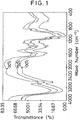
- Fig. 1 is a graph showing absorption curves of IR spectroscopic measurement observed at extraction temperatures of 30, 50 and 100 °C , the measurement being performed in Example 2.
- Absidia coerulea is particularly preferred for use in the method of the present invention.
- This strain is deposited with and managed by Juridical Foundation: Institute of Fermentation (Domicile: 17-85, Juso-honmachi 2-chome, Yodogawa-ku, Osaka-shi, Japan) under the accession number of IFO 5301 and available therefrom.
- Cultured filamentous fungi is deproteinized through a heat-treatment in an alkaline aqueous solution to give alkali-insoluble substances.
- Sodium hydroxide is particularly preferred as an alkali.
- the cultured filamentous fungi is treated by an aqueous solution of sodium hydroxide while heating the solution at a temperature on the order of 120 °C .
- an aqueous solution of an organic acid is added to the alkali-insoluble substances to carry out the extraction of chitosan.
- organic acids usable in the present invention include acetic acid, lactic acid, butyric acid and oxalic acid with acetic acid being particularly preferred. It is sufficient to adjust the concentration of the aqueous organic acid solution to about 0.5 to 10 % (w/v).
- the extraction temperature is adjusted to a range of from 50 to 100 °C and preferably 80 to 100 °C whereby the amount of chitosan extracted is substantially improved.
- the extractability of chitosan increases as the temperature of the extraction solution is raised by application of heat.
- the extraction has been conventionally carried out at a temperature on the order of 30 °C .
- the extraction temperature can be raised up to about 100 °C according to the present invention.
- the extractability at a temperature of 30 °C is limited to about 20 to 30 % of the alkali-insoluble substances, but it can be increased up to about 70 % by heating the extraction solution to 100 °C during the extraction.
- the viscosity of the extraction solution decreases as the temperature thereof is increased. This makes the operations for separating and recovering chitosan easy.
- the method for preparing chitosan according to the present invention can provide a high extractability of chitosan and this accordingly leads to a high productivity of chitosan. If the extraction of chitosan is carried out at a high temperature, the viscosity of the extraction solution is reduced. As a result, chitosan can easily be recovered and hence can be prepared without any difficulty. Moreover, the amount of residues remaining after the extraction of chitosan is substantially decreased and the productivity of chitosan per unit volume of the culture medium is also improved. This clearly results in the substantial reduction of the production cost of chitosan. The quality of chitosan extracted at a high temperature is not different from and almost identical to that of chitosan extracted at a low temperature.
- a culture medium (pH 6.0) which comprised 50 g/l of glucose, 25 g/l of peptone, 15 g/l of yeast extract, 15 g/l of malt extract and 10 g/l of MgSO4 ⁇ 7H2O.
- This culture medium was sterilized by exposing it to high pressure steam of 121 °C for 20 minutes, then precultured myceria (100 ml) of Absidia coerulea , strain IFO 5301 were inoculated upon the culture medium and cultured at 27 °C , a rate of aeration of 3 l/min and a number of rotation of 300 rpm for 70 hours.
- the resulting myceria were washed with water, suspended in a 2 % (w/v) aqueous solution of sodium hydroxide and heated to 121 °C for 60 minutes in an autoclave.
- the resulting alkali-insoluble substances were washed with water till the wash liquid became neutral, then lyophilized and stored.
- the first and second supernatants i.e., extracts each was subjected to filtration under suction to remove insolubles and the pH thereof was adjusted to not less than 8.5 by the addition of a 40 % (w/v) aqueous solution of sodium hydroxide to thus separate chitosan.
- the resulting chitosan was collected by centrifugation, washed with water till the wash liquid became neutral and then lyophilized. After the secondary extraction, the resulting extraction residue precipitated out was likewise alkalized, washed with water and then lyophilized. These three samples each was further dried in vacuo and then weighed.
- the conditions for the extraction of chitosan from the alkali-insoluble substances are a concentration of acetic acid solution of 2 % (w/v), a temperature of 30 °C and an extraction time of one hour while stirring. These conditions are hereinafter referred to as standard extraction conditions and this extraction procedure is referred to as "standard extraction”.
- the yield of chitosan at that temperature was 0.1791 g (starting from 0.5003 g of the alkali-insoluble substances), while that achieved by the standard extraction was 0.1119 g.
- the yield is thus 1.6 time greater than that achieved in the standard extraction.
- the degrees of deacetylation of chitosan were 75.7 % for the standard extraction and 80.1 % for the first experiment, the molecular weights thereof were 390,000 and 352,000 respectively.
- AIM 0.5006 0.5003 0.5003 0.5001 First Extraction (g) 0.1058 0.1517 0.1116 0.1133 Second Extraction (g) 0.0061 0.0274 0.0118 0.0017 Total Extraction (g) 0.1119 0.1791 0.1234 0.1150 Extraction Residue (g) 0.3375 0.2852 0.3368 0.3146 a/AIM 21.1% 30.3% 22.3% 22.7% b/AIM 1.2% 5.5% 2.4% 0.3% c/AIM 22.4% 35.8% 24.7% 23.0% d/AIM 89.8% 92.8% 92.0% 85.9% Degree of Deacetylation 75.7% 80.1% 72.4% 81.1% Molecular Weight 390000 352000 428000 472000 Degree of Non-uniformity 2.73 2.90 2.92 3.01 AIM: alkali-insoluble substances a: First Extraction; b: Second Extraction c: Total Extraction d: Total Extraction + Extraction Residue
- Example 2 To 100 ml of a 2 % (w/v) aqueous acetic acid solution, there was suspended 0.500 g of alkali-insoluble substances prepared in the same manner used in Example 1, the resulting suspension was extracted in the same manner used in Example 1 at an extraction temperature of 30, 50, 80 or 100 °C to give samples of chitosan. The extractability, molecular weight and degree of deacetylation of each sample were determined in the same manner used in Example 1. In addition, the viscosity of the extract was determined using an E-type viscometer (available from Tokyo Keiki Co., Ltd.). The results thus obtained are listed in the following Table 2.
- the extractability increases as the extraction temperature is increased. For instance, the extractability observed at an extraction temperature of 100 °C is about 2.4 times greater than that observed at an extraction temperature of 30 °C .
- the molecular weight of chitosan slightly increases as the extraction temperature increases, but the extraction temperature only slightly affects the degree of deacetylation. Further, the viscosity of the extract is lowered as the temperature increases. For instance, the viscosity thereof observed at 100 °C was reduced to 1/5 time that observed at 30 °C .
- chitosans obtained at extraction temperature of 30, 50 and 100 °C were analyzed by IR spectrometry and the results are shown in Fig. 1. As seen from Fig. 1, absorption spectra of these chitosan are quite similar to each other and thus it can be concluded that these chitosans are approximately identical.
- Samples of chitosan were prepared by repeating the procedures used in Example 1 except that, among the standard extraction conditions, various kinds of aqueous solutions detailed below were used for the extraction of chitosan and that the extraction temperature was set at 80 °C , using 0.500 g of alkali-insoluble substances obtained in the same manner used in Example 1.
- the aqueous solutions used were a 2 % (w/v) acetic acid aqueous solution (Soln. 1), a 2 % (w/v) lactic acid aqueous solution (Soln. 2), a 0.01 N hydrochloric acid aqueous solution (Soln. 3), a 0.01 N sulfuric acid aqueous solution (Soln.
- the extractabilities achieved by inorganic acids solutions are on the order of 10 to 20 % of that achieved by organic acid solutions, i.e., acetic acid and lactic acid solutions (Solns. 1 and 2).
- organic acid solutions i.e., acetic acid and lactic acid solutions
- the sulfuric acid concentration was increased from 0.01 N to 0.1 N, the extractability of chitosan was reduced.
- the amount of chitosan extracted was very small and, therefore, the degree of deacetylation thereof could not be determined.
- the molecular weights of chitosans recovered through the extraction with inorganic acids are in the order of 1/2 to 1/3 time those of the chitosans recovered through the extraction with the organic acid solutions. It would be assumed that the chitosans are hydrolyzed since they are heated in the presence of strong acids.
- a method for preparing chitosan comprises the steps of adding an aqueous organic acid solution having a concentration ranging from 0.5 to 10 % (w/v) to alkali-insoluble substances obtained by treating cultured filamentous fungi with a hot aqueous alkali solution and stirring and mixing the dispersion while heating it at a temperature ranging from 50 to 100 °C to extract chitosan.
- the method for preparing chitosan makes it possible to provide chitosan in a high productivity.
- Chitosan is an important biomass and may be used in various fields such as a flocculating agent for polymers, an immobilization support and porous beads.
Landscapes
- Life Sciences & Earth Sciences (AREA)
- Chemical & Material Sciences (AREA)
- Organic Chemistry (AREA)
- Health & Medical Sciences (AREA)
- Zoology (AREA)
- Engineering & Computer Science (AREA)
- Wood Science & Technology (AREA)
- Microbiology (AREA)
- General Chemical & Material Sciences (AREA)
- Chemical Kinetics & Catalysis (AREA)
- Biotechnology (AREA)
- Molecular Biology (AREA)
- Biochemistry (AREA)
- Bioinformatics & Cheminformatics (AREA)
- General Engineering & Computer Science (AREA)
- General Health & Medical Sciences (AREA)
- Genetics & Genomics (AREA)
- Polysaccharides And Polysaccharide Derivatives (AREA)
- Preparation Of Compounds By Using Micro-Organisms (AREA)
Applications Claiming Priority (2)
| Application Number | Priority Date | Filing Date | Title |
|---|---|---|---|
| JP297435/91 | 1991-11-13 | ||
| JP29743591A JPH05184378A (ja) | 1991-11-13 | 1991-11-13 | キトサンの製造方法 |
Publications (2)
| Publication Number | Publication Date |
|---|---|
| EP0542249A2 true EP0542249A2 (fr) | 1993-05-19 |
| EP0542249A3 EP0542249A3 (en) | 1994-08-10 |
Family
ID=17846487
Family Applications (1)
| Application Number | Title | Priority Date | Filing Date |
|---|---|---|---|
| EP19920119346 Withdrawn EP0542249A3 (en) | 1991-11-13 | 1992-11-12 | Method for preparing chitosan |
Country Status (3)
| Country | Link |
|---|---|
| EP (1) | EP0542249A3 (fr) |
| JP (1) | JPH05184378A (fr) |
| CA (1) | CA2082859A1 (fr) |
Cited By (7)
| Publication number | Priority date | Publication date | Assignee | Title |
|---|---|---|---|---|
| DE19960632A1 (de) * | 1999-12-16 | 2001-07-05 | Cognis Deutschland Gmbh | Kosmetische Mittel enthaltend natürliche Chitosane |
| CN1101406C (zh) * | 1999-05-06 | 2003-02-12 | 浙江大学 | 真菌细胞壁结构性多糖的制备方法 |
| WO2006086339A3 (fr) * | 2005-02-07 | 2006-12-28 | Du Pont | Fixation de chitosane sur des surfaces a l'aide d'un processus de rehydratation |
| AU2003215555B2 (en) * | 2002-02-12 | 2008-10-02 | Kitozyme S.A. | Cell wall derivatives from biomass and preparation thereof |
| EP1497335A4 (fr) * | 2002-04-02 | 2009-08-12 | Cargill Inc | Production de chitosane |
| CN103103233A (zh) * | 2013-01-25 | 2013-05-15 | 天津科技大学 | 一种利用半纤维素水解液中木糖制备壳聚糖的方法 |
| WO2021136882A1 (fr) * | 2019-12-30 | 2021-07-08 | Kemira Oyj | Chitosane non animal et procédés et utilisations s'y rapportant |
Families Citing this family (5)
| Publication number | Priority date | Publication date | Assignee | Title |
|---|---|---|---|---|
| KR100470610B1 (ko) * | 2002-02-28 | 2005-02-21 | 경상대학교산학협력단 | 균류를 이용한 키토산 생산방법 |
| CN108864323A (zh) * | 2018-06-09 | 2018-11-23 | 浙江亿丰海洋生物制品有限公司 | 一种虾壳渣中甲壳素的提取工艺 |
| CN116478441B (zh) * | 2023-02-23 | 2024-03-15 | 四川大学 | 一种可拼装可溶解的三维细胞培养载体及其制备方法 |
| DE202024104006U1 (de) | 2024-07-18 | 2024-07-31 | Cyber Clean Europe Gmbh | Dauerplastische, modellierbare Masse |
| WO2026017195A1 (fr) | 2024-07-18 | 2026-01-22 | Cyber Clean Europe Gmbh | Masse moulable en matière plastique permanente, son procédé de production, masse selon le procédé et son utilisation |
Family Cites Families (1)
| Publication number | Priority date | Publication date | Assignee | Title |
|---|---|---|---|---|
| JPH02215393A (ja) * | 1989-02-17 | 1990-08-28 | Nakano Vinegar Co Ltd | キトサン分解物の製造法 |
-
1991
- 1991-11-13 JP JP29743591A patent/JPH05184378A/ja active Pending
-
1992
- 1992-11-12 EP EP19920119346 patent/EP0542249A3/en not_active Withdrawn
- 1992-11-13 CA CA 2082859 patent/CA2082859A1/fr not_active Abandoned
Non-Patent Citations (4)
| Title |
|---|
| APPL. ENVIRON. MICROBIOL. vol. 38, no. 2 , 1979 pages 323 - 328 S. WHITE ET AL 'Production and isolation of chitosan from Mucor rouxii' * |
| BIOLOGICAL ABSTRACTS, xol. 87, no. 5 1989, Philadelphia, PA, US; abstract no. 52613, KOBAYASHI ET AL 'Distrubution of chitosan in Mucor strains and some properties of the chitosan isolated' page 917 ; & NIPPON NOGEIKAGAKU KAISHI vol. 62, no. 10 , 1988 pages 1471 - 1474 * |
| BIOTECHNOLOGY AND BIOENGINEERING. vol. 39 , 1992 , NEW YORK US pages 281 - 286 ARCIDIACONO, S. AND KAPLAN, D. 'Molecular weight distribution of chitosan isolated from Mucor rouxii under different culture conditions' * |
| PROCESS BIOCHEMISTRY vol. 19, no. 3 , 1984 pages 88 - 90 MCGAHREN W. ET AL 'Chitosan by fermentation' * |
Cited By (9)
| Publication number | Priority date | Publication date | Assignee | Title |
|---|---|---|---|---|
| CN1101406C (zh) * | 1999-05-06 | 2003-02-12 | 浙江大学 | 真菌细胞壁结构性多糖的制备方法 |
| DE19960632A1 (de) * | 1999-12-16 | 2001-07-05 | Cognis Deutschland Gmbh | Kosmetische Mittel enthaltend natürliche Chitosane |
| AU2003215555B2 (en) * | 2002-02-12 | 2008-10-02 | Kitozyme S.A. | Cell wall derivatives from biomass and preparation thereof |
| US7556946B2 (en) | 2002-02-12 | 2009-07-07 | Kitozyme S.A. | Cell wall derivatives from biomass and preparation thereof |
| EP1497335A4 (fr) * | 2002-04-02 | 2009-08-12 | Cargill Inc | Production de chitosane |
| WO2006086339A3 (fr) * | 2005-02-07 | 2006-12-28 | Du Pont | Fixation de chitosane sur des surfaces a l'aide d'un processus de rehydratation |
| CN103103233A (zh) * | 2013-01-25 | 2013-05-15 | 天津科技大学 | 一种利用半纤维素水解液中木糖制备壳聚糖的方法 |
| CN103103233B (zh) * | 2013-01-25 | 2015-02-18 | 天津科技大学 | 一种利用半纤维素水解液中木糖制备壳聚糖的方法 |
| WO2021136882A1 (fr) * | 2019-12-30 | 2021-07-08 | Kemira Oyj | Chitosane non animal et procédés et utilisations s'y rapportant |
Also Published As
| Publication number | Publication date |
|---|---|
| CA2082859A1 (fr) | 1993-05-14 |
| EP0542249A3 (en) | 1994-08-10 |
| JPH05184378A (ja) | 1993-07-27 |
Similar Documents
| Publication | Publication Date | Title |
|---|---|---|
| Crestini et al. | Production and isolation of chitosan by submerged and solid‐state fermentation from Lentinus edodes | |
| CA2077962C (fr) | Methode de preparation de la chitosane | |
| EP0542249A2 (fr) | Procédé de préparation du chitosane | |
| Amorim et al. | Faster chitosan production by mucoralean strains in submerged culture | |
| CN102440432A (zh) | 制备烟草浸出液的两步微生物发酵法 | |
| CN108149506B (zh) | 用酒糟生产高纯度纤维素、半纤维素及木质素的方法 | |
| JPH0559844B2 (fr) | ||
| Kath et al. | Mild enzymatic isolation of mannan and glucan from yeast Saccharomyces cerevisiae | |
| EP0549230B1 (fr) | Procédé de préparation de gomme de xanthane purifiée | |
| EP0621040B1 (fr) | Méthode de réduction du nombre de bactéries vivantes contaminantes dans la gomme de xanthane | |
| CN1313498C (zh) | 一种生产普鲁兰的方法 | |
| DE2920592C2 (fr) | ||
| JPH0739386A (ja) | バクテリアセルロースの製造方法 | |
| US5595892A (en) | Process for preparation of purified xanthan gum | |
| JPH04502171A (ja) | キトサンの製造方法 | |
| EP1397389B1 (fr) | Procede d'isolation de glucane immunostimulant provenant de pleurotes | |
| EP0491114A1 (fr) | Procédé pour la préparation de nouveaux complexes non-covalents protéine-polysaccharide doués d'activité pharmacologique | |
| CN112778797B (zh) | 一种绿僵菌中的天然绿色色素的提取方法 | |
| CN1764672A (zh) | 高粘度β-葡聚糖浓缩物的制备 | |
| WO2025000693A1 (fr) | Procédé de préparation de polysaccharide de monascus | |
| CN112760240B (zh) | 一种青霉真菌中天然绿色色素的提取方法 | |
| JPS6359679B2 (fr) | ||
| CN111334543A (zh) | 一种新的提取鱼软骨中硫酸软骨素的方法 | |
| JP2758475B2 (ja) | キトサンオリゴマー及びその製造法 | |
| EP0296965B1 (fr) | Procédé de fermentation pour l'obtention d'un polysaccharide de type xanthane |
Legal Events
| Date | Code | Title | Description |
|---|---|---|---|
| PUAI | Public reference made under article 153(3) epc to a published international application that has entered the european phase |
Free format text: ORIGINAL CODE: 0009012 |
|
| AK | Designated contracting states |
Kind code of ref document: A2 Designated state(s): CH DE FR GB LI |
|
| PUAL | Search report despatched |
Free format text: ORIGINAL CODE: 0009013 |
|
| AK | Designated contracting states |
Kind code of ref document: A3 Designated state(s): CH DE FR GB LI |
|
| 17P | Request for examination filed |
Effective date: 19950124 |
|
| 17Q | First examination report despatched |
Effective date: 19960214 |
|
| STAA | Information on the status of an ep patent application or granted ep patent |
Free format text: STATUS: THE APPLICATION IS DEEMED TO BE WITHDRAWN |
|
| 18D | Application deemed to be withdrawn |
Effective date: 19960625 |