EP0542801B1 - Flüssiges, fliess- und pumpfähiges tensidkonzentrat - Google Patents
Flüssiges, fliess- und pumpfähiges tensidkonzentrat Download PDFInfo
- Publication number
- EP0542801B1 EP0542801B1 EP91913983A EP91913983A EP0542801B1 EP 0542801 B1 EP0542801 B1 EP 0542801B1 EP 91913983 A EP91913983 A EP 91913983A EP 91913983 A EP91913983 A EP 91913983A EP 0542801 B1 EP0542801 B1 EP 0542801B1
- Authority
- EP
- European Patent Office
- Prior art keywords
- formula
- alkyl
- weight
- surfactant mixture
- stands
- Prior art date
- Legal status (The legal status is an assumption and is not a legal conclusion. Google has not performed a legal analysis and makes no representation as to the accuracy of the status listed.)
- Expired - Lifetime
Links
- 239000007788 liquid Substances 0.000 title claims description 9
- 239000012141 concentrate Substances 0.000 title abstract 2
- 239000000203 mixture Substances 0.000 claims abstract description 30
- -1 alkyl glycoside Chemical class 0.000 claims abstract description 28
- 229930182470 glycoside Natural products 0.000 claims abstract description 25
- 125000004432 carbon atom Chemical group C* 0.000 claims abstract description 18
- 150000001875 compounds Chemical class 0.000 claims abstract description 15
- 239000003599 detergent Substances 0.000 claims abstract description 11
- QGZKDVFQNNGYKY-UHFFFAOYSA-O Ammonium Chemical compound [NH4+] QGZKDVFQNNGYKY-UHFFFAOYSA-O 0.000 claims abstract description 7
- 239000003513 alkali Substances 0.000 claims abstract description 6
- XLYOFNOQVPJJNP-UHFFFAOYSA-N water Substances O XLYOFNOQVPJJNP-UHFFFAOYSA-N 0.000 claims abstract description 6
- 238000004519 manufacturing process Methods 0.000 claims abstract description 5
- 239000004094 surface-active agent Substances 0.000 claims description 22
- 150000008051 alkyl sulfates Chemical class 0.000 claims description 17
- 150000001298 alcohols Chemical class 0.000 claims description 8
- 239000003945 anionic surfactant Substances 0.000 claims description 7
- 238000006384 oligomerization reaction Methods 0.000 claims description 3
- 229910006127 SO3X Inorganic materials 0.000 claims description 2
- 229930182478 glucoside Natural products 0.000 claims 1
- 125000000217 alkyl group Chemical group 0.000 abstract description 6
- 239000012459 cleaning agent Substances 0.000 abstract description 4
- 238000003860 storage Methods 0.000 abstract description 4
- 125000002791 glucosyl group Chemical group C1([C@H](O)[C@@H](O)[C@H](O)[C@H](O1)CO)* 0.000 abstract description 2
- 150000002500 ions Chemical class 0.000 abstract 2
- 229910021653 sulphate ion Inorganic materials 0.000 abstract 2
- KRKNYBCHXYNGOX-UHFFFAOYSA-N citric acid Chemical compound OC(=O)CC(O)(C(O)=O)CC(O)=O KRKNYBCHXYNGOX-UHFFFAOYSA-N 0.000 description 6
- 239000003795 chemical substances by application Substances 0.000 description 4
- LFQSCWFLJHTTHZ-UHFFFAOYSA-N Ethanol Chemical compound CCO LFQSCWFLJHTTHZ-UHFFFAOYSA-N 0.000 description 3
- 239000007864 aqueous solution Substances 0.000 description 3
- 230000009969 flowable effect Effects 0.000 description 3
- 239000000178 monomer Substances 0.000 description 3
- 239000000126 substance Substances 0.000 description 3
- SRBFZHDQGSBBOR-IOVATXLUSA-N D-xylopyranose Chemical compound O[C@@H]1COC(O)[C@H](O)[C@H]1O SRBFZHDQGSBBOR-IOVATXLUSA-N 0.000 description 2
- SNRUBQQJIBEYMU-UHFFFAOYSA-N Dodecane Natural products CCCCCCCCCCCC SNRUBQQJIBEYMU-UHFFFAOYSA-N 0.000 description 2
- WQZGKKKJIJFFOK-GASJEMHNSA-N Glucose Natural products OC[C@H]1OC(O)[C@H](O)[C@@H](O)[C@@H]1O WQZGKKKJIJFFOK-GASJEMHNSA-N 0.000 description 2
- 239000013543 active substance Substances 0.000 description 2
- PYMYPHUHKUWMLA-UHFFFAOYSA-N arabinose Natural products OCC(O)C(O)C(O)C=O PYMYPHUHKUWMLA-UHFFFAOYSA-N 0.000 description 2
- SRBFZHDQGSBBOR-UHFFFAOYSA-N beta-D-Pyranose-Lyxose Natural products OC1COC(O)C(O)C1O SRBFZHDQGSBBOR-UHFFFAOYSA-N 0.000 description 2
- 239000007844 bleaching agent Substances 0.000 description 2
- 238000004140 cleaning Methods 0.000 description 2
- 125000003438 dodecyl group Chemical group [H]C([H])([H])C([H])([H])C([H])([H])C([H])([H])C([H])([H])C([H])([H])C([H])([H])C([H])([H])C([H])([H])C([H])([H])C([H])([H])C([H])([H])* 0.000 description 2
- 230000000694 effects Effects 0.000 description 2
- 150000002191 fatty alcohols Chemical class 0.000 description 2
- 239000008103 glucose Substances 0.000 description 2
- 239000003112 inhibitor Substances 0.000 description 2
- 125000001421 myristyl group Chemical group [H]C([*])([H])C([H])([H])C([H])([H])C([H])([H])C([H])([H])C([H])([H])C([H])([H])C([H])([H])C([H])([H])C([H])([H])C([H])([H])C([H])([H])C([H])([H])C([H])([H])[H] 0.000 description 2
- 239000002736 nonionic surfactant Substances 0.000 description 2
- 238000002360 preparation method Methods 0.000 description 2
- 239000000047 product Substances 0.000 description 2
- 230000019635 sulfation Effects 0.000 description 2
- 238000005670 sulfation reaction Methods 0.000 description 2
- AKEJUJNQAAGONA-UHFFFAOYSA-N sulfur trioxide Chemical compound O=S(=O)=O AKEJUJNQAAGONA-UHFFFAOYSA-N 0.000 description 2
- KEQGZUUPPQEDPF-UHFFFAOYSA-N 1,3-dichloro-5,5-dimethylimidazolidine-2,4-dione Chemical compound CC1(C)N(Cl)C(=O)N(Cl)C1=O KEQGZUUPPQEDPF-UHFFFAOYSA-N 0.000 description 1
- 235000013162 Cocos nucifera Nutrition 0.000 description 1
- 244000060011 Cocos nucifera Species 0.000 description 1
- WQZGKKKJIJFFOK-CBPJZXOFSA-N D-Gulose Chemical compound OC[C@H]1OC(O)[C@H](O)[C@H](O)[C@H]1O WQZGKKKJIJFFOK-CBPJZXOFSA-N 0.000 description 1
- WQZGKKKJIJFFOK-WHZQZERISA-N D-aldose Chemical compound OC[C@H]1OC(O)[C@@H](O)[C@@H](O)[C@H]1O WQZGKKKJIJFFOK-WHZQZERISA-N 0.000 description 1
- WQZGKKKJIJFFOK-IVMDWMLBSA-N D-allopyranose Chemical compound OC[C@H]1OC(O)[C@H](O)[C@H](O)[C@@H]1O WQZGKKKJIJFFOK-IVMDWMLBSA-N 0.000 description 1
- WQZGKKKJIJFFOK-QTVWNMPRSA-N D-mannopyranose Chemical compound OC[C@H]1OC(O)[C@@H](O)[C@@H](O)[C@@H]1O WQZGKKKJIJFFOK-QTVWNMPRSA-N 0.000 description 1
- HMFHBZSHGGEWLO-SOOFDHNKSA-N D-ribofuranose Chemical compound OC[C@H]1OC(O)[C@H](O)[C@@H]1O HMFHBZSHGGEWLO-SOOFDHNKSA-N 0.000 description 1
- 102000004190 Enzymes Human genes 0.000 description 1
- 108090000790 Enzymes Proteins 0.000 description 1
- IAYPIBMASNFSPL-UHFFFAOYSA-N Ethylene oxide Chemical compound C1CO1 IAYPIBMASNFSPL-UHFFFAOYSA-N 0.000 description 1
- RFSUNEUAIZKAJO-ARQDHWQXSA-N Fructose Chemical compound OC[C@H]1O[C@](O)(CO)[C@@H](O)[C@@H]1O RFSUNEUAIZKAJO-ARQDHWQXSA-N 0.000 description 1
- 229930091371 Fructose Natural products 0.000 description 1
- 239000005715 Fructose Substances 0.000 description 1
- 208000007976 Ketosis Diseases 0.000 description 1
- WQZGKKKJIJFFOK-VSOAQEOCSA-N L-altropyranose Chemical compound OC[C@@H]1OC(O)[C@H](O)[C@@H](O)[C@H]1O WQZGKKKJIJFFOK-VSOAQEOCSA-N 0.000 description 1
- 239000004435 Oxo alcohol Substances 0.000 description 1
- PYMYPHUHKUWMLA-LMVFSUKVSA-N Ribose Natural products OC[C@@H](O)[C@@H](O)[C@@H](O)C=O PYMYPHUHKUWMLA-LMVFSUKVSA-N 0.000 description 1
- 239000003082 abrasive agent Substances 0.000 description 1
- 239000002253 acid Substances 0.000 description 1
- 230000002378 acidificating effect Effects 0.000 description 1
- 150000007513 acids Chemical class 0.000 description 1
- 239000012190 activator Substances 0.000 description 1
- 150000001323 aldoses Chemical class 0.000 description 1
- 150000007824 aliphatic compounds Chemical class 0.000 description 1
- 229910052783 alkali metal Inorganic materials 0.000 description 1
- 150000001340 alkali metals Chemical group 0.000 description 1
- HMFHBZSHGGEWLO-UHFFFAOYSA-N alpha-D-Furanose-Ribose Natural products OCC1OC(O)C(O)C1O HMFHBZSHGGEWLO-UHFFFAOYSA-N 0.000 description 1
- WQZGKKKJIJFFOK-PHYPRBDBSA-N alpha-D-galactose Chemical compound OC[C@H]1O[C@H](O)[C@H](O)[C@@H](O)[C@H]1O WQZGKKKJIJFFOK-PHYPRBDBSA-N 0.000 description 1
- SRBFZHDQGSBBOR-STGXQOJASA-N alpha-D-lyxopyranose Chemical compound O[C@@H]1CO[C@H](O)[C@@H](O)[C@H]1O SRBFZHDQGSBBOR-STGXQOJASA-N 0.000 description 1
- 150000003863 ammonium salts Chemical class 0.000 description 1
- 239000004599 antimicrobial Substances 0.000 description 1
- PYMYPHUHKUWMLA-WDCZJNDASA-N arabinose Chemical compound OC[C@@H](O)[C@@H](O)[C@H](O)C=O PYMYPHUHKUWMLA-WDCZJNDASA-N 0.000 description 1
- 239000002585 base Substances 0.000 description 1
- WQZGKKKJIJFFOK-VFUOTHLCSA-N beta-D-glucose Chemical compound OC[C@H]1O[C@@H](O)[C@H](O)[C@@H](O)[C@@H]1O WQZGKKKJIJFFOK-VFUOTHLCSA-N 0.000 description 1
- 239000007795 chemical reaction product Substances 0.000 description 1
- XTHPWXDJESJLNJ-UHFFFAOYSA-N chlorosulfonic acid Substances OS(Cl)(=O)=O XTHPWXDJESJLNJ-UHFFFAOYSA-N 0.000 description 1
- 239000003086 colorant Substances 0.000 description 1
- 230000000052 comparative effect Effects 0.000 description 1
- 239000000470 constituent Substances 0.000 description 1
- 238000001816 cooling Methods 0.000 description 1
- 230000007797 corrosion Effects 0.000 description 1
- 238000005260 corrosion Methods 0.000 description 1
- 125000002704 decyl group Chemical group [H]C([H])([H])C([H])([H])C([H])([H])C([H])([H])C([H])([H])C([H])([H])C([H])([H])C([H])([H])C([H])([H])C([H])([H])* 0.000 description 1
- 238000007865 diluting Methods 0.000 description 1
- 238000010790 dilution Methods 0.000 description 1
- 239000012895 dilution Substances 0.000 description 1
- 238000004851 dishwashing Methods 0.000 description 1
- 238000005553 drilling Methods 0.000 description 1
- 238000007046 ethoxylation reaction Methods 0.000 description 1
- 238000002474 experimental method Methods 0.000 description 1
- 238000005188 flotation Methods 0.000 description 1
- 239000012530 fluid Substances 0.000 description 1
- 239000004872 foam stabilizing agent Substances 0.000 description 1
- 238000005187 foaming Methods 0.000 description 1
- 239000003205 fragrance Substances 0.000 description 1
- 229930182830 galactose Natural products 0.000 description 1
- 150000002338 glycosides Chemical class 0.000 description 1
- 125000002951 idosyl group Chemical class C1([C@@H](O)[C@H](O)[C@@H](O)[C@H](O1)CO)* 0.000 description 1
- 150000002584 ketoses Chemical class 0.000 description 1
- 230000007935 neutral effect Effects 0.000 description 1
- 238000006386 neutralization reaction Methods 0.000 description 1
- 125000002347 octyl group Chemical group [H]C([*])([H])C([H])([H])C([H])([H])C([H])([H])C([H])([H])C([H])([H])C([H])([H])C([H])([H])[H] 0.000 description 1
- 230000003287 optical effect Effects 0.000 description 1
- 125000000913 palmityl group Chemical group [H]C([*])([H])C([H])([H])C([H])([H])C([H])([H])C([H])([H])C([H])([H])C([H])([H])C([H])([H])C([H])([H])C([H])([H])C([H])([H])C([H])([H])C([H])([H])C([H])([H])C([H])([H])C([H])([H])[H] 0.000 description 1
- 229920000642 polymer Polymers 0.000 description 1
- 239000003755 preservative agent Substances 0.000 description 1
- 150000003138 primary alcohols Chemical class 0.000 description 1
- 239000002994 raw material Substances 0.000 description 1
- 230000015227 regulation of liquid surface tension Effects 0.000 description 1
- 239000002453 shampoo Substances 0.000 description 1
- 150000004760 silicates Chemical class 0.000 description 1
- 239000000243 solution Substances 0.000 description 1
- 239000002904 solvent Substances 0.000 description 1
- 230000001180 sulfating effect Effects 0.000 description 1
- 230000002195 synergetic effect Effects 0.000 description 1
- 238000005406 washing Methods 0.000 description 1
- 210000002268 wool Anatomy 0.000 description 1
- 239000010457 zeolite Substances 0.000 description 1
Classifications
-
- C—CHEMISTRY; METALLURGY
- C11—ANIMAL OR VEGETABLE OILS, FATS, FATTY SUBSTANCES OR WAXES; FATTY ACIDS THEREFROM; DETERGENTS; CANDLES
- C11D—DETERGENT COMPOSITIONS; USE OF SINGLE SUBSTANCES AS DETERGENTS; SOAP OR SOAP-MAKING; RESIN SOAPS; RECOVERY OF GLYCEROL
- C11D1/00—Detergent compositions based essentially on surface-active compounds; Use of these compounds as a detergent
- C11D1/66—Non-ionic compounds
- C11D1/83—Mixtures of non-ionic with anionic compounds
-
- C—CHEMISTRY; METALLURGY
- C11—ANIMAL OR VEGETABLE OILS, FATS, FATTY SUBSTANCES OR WAXES; FATTY ACIDS THEREFROM; DETERGENTS; CANDLES
- C11D—DETERGENT COMPOSITIONS; USE OF SINGLE SUBSTANCES AS DETERGENTS; SOAP OR SOAP-MAKING; RESIN SOAPS; RECOVERY OF GLYCEROL
- C11D1/00—Detergent compositions based essentially on surface-active compounds; Use of these compounds as a detergent
- C11D1/02—Anionic compounds
- C11D1/12—Sulfonic acids or sulfuric acid esters; Salts thereof
- C11D1/14—Sulfonic acids or sulfuric acid esters; Salts thereof derived from aliphatic hydrocarbons or mono-alcohols
- C11D1/146—Sulfuric acid esters
-
- C—CHEMISTRY; METALLURGY
- C11—ANIMAL OR VEGETABLE OILS, FATS, FATTY SUBSTANCES OR WAXES; FATTY ACIDS THEREFROM; DETERGENTS; CANDLES
- C11D—DETERGENT COMPOSITIONS; USE OF SINGLE SUBSTANCES AS DETERGENTS; SOAP OR SOAP-MAKING; RESIN SOAPS; RECOVERY OF GLYCEROL
- C11D1/00—Detergent compositions based essentially on surface-active compounds; Use of these compounds as a detergent
- C11D1/66—Non-ionic compounds
- C11D1/662—Carbohydrates or derivatives
-
- C—CHEMISTRY; METALLURGY
- C11—ANIMAL OR VEGETABLE OILS, FATS, FATTY SUBSTANCES OR WAXES; FATTY ACIDS THEREFROM; DETERGENTS; CANDLES
- C11D—DETERGENT COMPOSITIONS; USE OF SINGLE SUBSTANCES AS DETERGENTS; SOAP OR SOAP-MAKING; RESIN SOAPS; RECOVERY OF GLYCEROL
- C11D1/00—Detergent compositions based essentially on surface-active compounds; Use of these compounds as a detergent
- C11D1/66—Non-ionic compounds
- C11D1/72—Ethers of polyoxyalkylene glycols
Definitions
- the present invention relates to concentrated surfactant mixtures of alkyl glycosides, long-chain alkyl sulfates, short-chain alkyl sulfates and optionally alcohol ethoxylates as stable, free-flowing and pumpable liquids and their use as premixes (compounds) for the production of liquid washing and cleaning agents.
- alkyl glycosides with long-chain alkyl groups belong to the nonionic surfactants.
- the person skilled in the art also knows, for example in A.M. Schwartz, J.W. Perry, Surface Active Agents, Vol. I, Interscience Publishers, 1949, page 372 described that surfactant mixtures generally have synergistic effects and often have better cleaning properties than would result from the sum of the values of the individual components.
- Detergents which contain alkyl glycosides in combination with at least one customary anionic surfactant are described in European patent application EP 070 074. Detergents which contain alkyl glycosides and anionic surfactants are also known from European patent application EP 092 877. Furthermore, liquid detergents are known from European patent application EP 105 556, which contain alkyl glycosides, certain other nonionic surfactants and anionic surfactants. From international patent application W0 86/02943 alkylglycoside-containing liquid detergents are known which contain conventional anionic surfactants.
- the individual components are generally used as flowable solutions, each of which contains a substance or which, as premixes, known as compounds, consist of several substances which are customary in the finished agents.
- the components provided for the mixture into the finished agent should have the highest possible active substance content and at the same time be easy to handle, that is to say they should be as flowable and as possible be easy to pump and have the highest possible storage stability.
- Alkyl glycosides are usually obtained as highly viscous pastes.
- the object of the present invention was to develop a storage-stable, liquid, flowable and pumpable surfactant mixture from an alkyl glycoside paste.
- This object is achieved by an aqueous mixture of certain amounts of alkyl glycoside, synthetic anionic surfactant in the form of a long-chain alkyl sulfate and short-chain alkyl sulfate.
- long-chain compounds are understood to mean aliphatic compounds with 12 and more carbon atoms, which can be linear or branched one or more times, so that the longest chain of carbon atoms can also be shorter than 12.
- Short-chain compounds in the context of the present invention are accordingly, regardless of the degree of branching, those having a maximum of 10 carbon atoms.
- the compounds according to the invention are aqueous mixtures which consist essentially of 50 to 80% by weight, preferably 55 to 70% by weight of water, 5 to 30% by weight, preferably 10 to 25% by weight, of an alkyl glycoside of the formula I, R1-O (G) n (I) in which R1 is an alkyl radical having 8 to 22 carbon atoms, G is a glycose unit and n is a number between 1 and 10, 3 to 20% by weight, preferably 5 to 15% by weight, of a surface-active long-chain alkyl sulfate of the formula II, R2-O-SO3X (II) in which R2 is an alkyl radical having 12 to 22 carbon atoms and X is an alkali metal or ammonium ion, and 1 to 15% by weight, preferably 2 to 10% by weight, of a short-chain alkyl sulfate of the formula III, R3-O-SO3Y (III) in which R3 is an alkyl radical having 6 to 10 carbon
- the surfactant mixtures according to the invention preferably additionally contain 10 to 20% by weight, in particular 12 to 18% by weight, of an ethoxylated alcohol of the formula IV, R4O- (CH2CH2O) p -H (IV) in which R4 is an alkyl radical having 10 to 22 carbon atoms and p is a number between 1 and 20, in particular between 3 and 10.
- alkyl glycosides suitable for the surfactant mixtures according to the invention and their preparation are described, for example, in European patent applications EP 92 355, EP 301 298, EP 357 969 and EP 362 671 or the US Pat. No. 3,547,828.
- the glycoside components ((G) n in formula I) of such alkyl glycosides are oligomers or polymers from naturally occurring aldose or ketose monomers, in particular glucose, mannose, fructose, galactose, talose, gulose, altrose, allose , Idose, ribose, arabinose, xylose and lyxose.
- the oligomers consisting of such glycosidically linked monomers are characterized not only by the type of sugar they contain, but also by their number, the so-called degree of oligomerization.
- the degree of oligomerization (n in formula I) generally assumes fractional numerical values as the quantity to be determined analytically; it is between 1 and 10, for the alkyl glycosides preferably used below 1.5, in particular between 1.2 and 1.4.
- the preferred monomer building block is glucose because of its good availability.
- the alkyl part (R 1 in formula I) of the alkyl glycosides contained in the surfactant mixtures according to the invention preferably also originates from Easily accessible derivatives of renewable raw materials, in particular from fatty alcohols, although their branched chain isomers, in particular so-called oxo alcohols, can also be used to produce usable alkyl glycosides.
- the primary alcohols with linear octyl, decyl, dodecyl, tetradecyl, hexadecyl or octadecyl radicals and mixtures thereof are particularly useful.
- the alkyl glycosides can contain small amounts, for example 1 to 2%, of unconverted free long-chain alcohol, which does not have a disadvantageous effect on the properties of the surfactant mixtures produced therewith.
- Long-chain alkyl sulfates suitable for use in the surfactant mixtures according to the invention are the sulfation products of linear or branched chain alcohols.
- the derivatives of fatty alcohols with 12 to 22 C atoms, in particular with 12 to 16 C atoms, are particularly suitable.
- Such alkyl sulfates have long been known as effective anionic surfactants.
- Suitable short-chain alkyl sulfates are the sulfation products of linear or branched chain alcohols with 6 to 10 carbon atoms, preferably the derivatives of linear alcohols with 8 to 10 carbon atoms. Such alkyl sulfates are known to have little or no surfactant activity.
- the alkyl sulfates can be prepared in a known manner by reacting the corresponding long- or short-chain alcohol component with a customary sulfating agent, in particular sulfur trioxide or chlorosulfonic acid, and subsequent neutralization, preferably with alkali, ammonium or alkyl or hydroxyalkyl-substituted ammonium bases.
- a customary sulfating agent in particular sulfur trioxide or chlorosulfonic acid
- the ethoxylates suitable for use in the compounds according to the invention are derivatives of linear or branched-chain alcohols having 10 to 22 carbon atoms, preferably 12 to 16 carbon atoms.
- the degree of ethoxylation the alcohols (p in formula IV) are between 1 and 20, preferably between 3 and 10. They can be prepared in a known manner by reacting the corresponding alcohols with ethylene oxide.
- the preparation of the surfactant mixtures according to the invention presents no difficulties. It can be done easily by simply mixing the individual components, which can be present as such or preferably in aqueous solution.
- the mixtures according to the invention are notable for their low viscosities, their easy flowability and pumpability and their high storage stability.
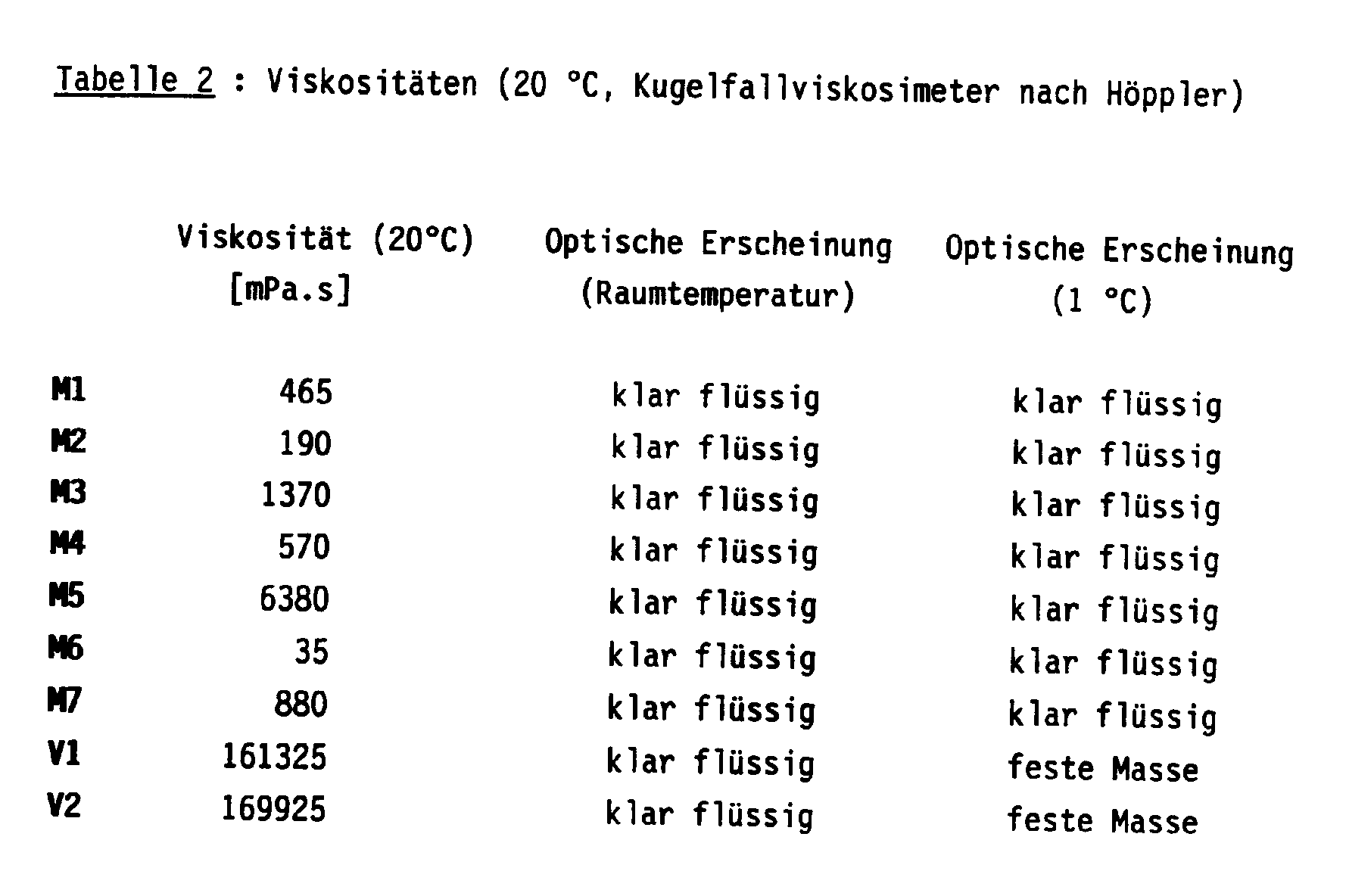
- the viscosity of the compounds according to the invention is generally from 20 mPa.s to 7000 mPa.s. They generally have basic pH values, for example from 9.8 to 10.5, but can be adjusted to largely neutral to weakly acidic pH values by adding conventional acids, in particular citric acid, without losing their advantageous properties .
- the compounds according to the invention are stable in storage over a long period of time, at least 30 days, at temperatures of about 1 ° C. to about 45 ° C.
- Another unexpected advantage of the compounds according to the invention is that the improvement in the rheological properties of the surfactant alkyl sulfate alkyl glycoside pastes is achieved by the addition of compounds which, despite their low surface activity, have the properties of the alkyl glycoside pastes relevant to use in end products, such as cleaning and Foaming power, do not negatively affect.
- the compounds according to the invention can be used, directly or after dilution with water, for technical applications, for example as flotation aids or drilling fluids. However, they are preferably used as premixes for the production of liquid detergents and cleaning agents, which include, in particular, mild detergents, wool detergents and dishwashing detergents, but also shampoos. Such agents can be prepared in a simple manner by diluting the compounds with water to the desired active substance concentration.
- compositions customary in such compositions, to which in particular builder substances, such as zeolites and layered silicates, corrosion inhibitors, bleaching agents, bleach activators, optical brighteners, enzymes, graying inhibitors, antimicrobial agents, water-miscible solvents, abrasives, foam stabilizers, preservatives, pH regulators, colorants and fragrances as well as additional surfactants are possible.
- builder substances such as zeolites and layered silicates, corrosion inhibitors, bleaching agents, bleach activators, optical brighteners, enzymes, graying inhibitors, antimicrobial agents, water-miscible solvents, abrasives, foam stabilizers, preservatives, pH regulators, colorants and fragrances as well as additional surfactants are possible.
- the surfactant mixtures M1 to M7 according to the invention characterized below in Table 1 by their composition and the compositions V1 and V2 used in comparative experiments were prepared.
- the surfactant mixtures M1 to M7 according to the invention had pH values of 9.8 to 10.5, and their pH values in 8.5% by weight aqueous solution were 8.5 to 9.9.
- Samples of the mixtures M1 to M7 according to the invention were stored at 1 ° C. or 10 ° C. for 30 days without a change in their consistency being found. When stored at 40 ° C for 30 days, slight cloudiness occurred in some cases, which disappeared when cooling to room temperature. If the compounds according to the invention were adjusted to pH values of 6.0 to 8.8 by adding small amounts of citric acid, which did not significantly change their viscosity, they could be stored at temperatures up to 45 ° C. without changing the consistency.
Landscapes
- Chemical & Material Sciences (AREA)
- Life Sciences & Earth Sciences (AREA)
- Engineering & Computer Science (AREA)
- Chemical Kinetics & Catalysis (AREA)
- Oil, Petroleum & Natural Gas (AREA)
- Wood Science & Technology (AREA)
- Organic Chemistry (AREA)
- Detergent Compositions (AREA)
- Agricultural Chemicals And Associated Chemicals (AREA)
- Emulsifying, Dispersing, Foam-Producing Or Wetting Agents (AREA)
- Table Devices Or Equipment (AREA)
- Cosmetics (AREA)
Description
- Die vorliegende Erfindung betrifft konzentrierte Tensidmischungen aus Alkylglykosiden, langkettigen Alkylsulfaten, kurzkettigen Alkylsulfaten und gegebenenfalls Alkoholethoxylaten als stabile, fließ- und pumpfähige Flüssigkeiten sowie deren Verwendung als Vorgemische (Compounds) zur Herstellung von flüssigen Wasch- und Reinigungsmitteln.
- Daß Alkylglykoside mit langkettigen Alkylgruppen zu den nichtionischen Tensiden gehören, ist seit langer Zeit bekannt. Ebenso weiß der Fachmann, wie zum Beispiel in A.M. Schwartz, J.W. Perry, Surface Active Agents, Vol. I, Interscience Publishers, 1949, Seite 372 beschrieben, daß Tensidmischungen in der Regel synergistische Effekte aufweisen und oft bessere Reinigungseigenschaften besitzen, als sich aus der Summe der Werte der Einzelkomponenten ergeben würde.
- Waschmittel, die Alkylglykoside in Kombination mit wenigstens einem üblichen anionischen Tensid enthalten, werden in der europäischen Patentanmeldung EP 070 074 beschrieben. Waschmittel, die Alkylglykoside und Aniontenside enthalten, sind auch aus der europäischen Patentanmeldung EP 092 877 bekannt. Des weiteren sind aus der europäischen Patentanmeldung EP 105 556 flüssige Waschmittel bekannt, die Alkylglykoside, bestimmte andere nichtionische Tenside und anionische Tenside enthalten. Aus der internationalen Patentanmeldung W0 86/02943 sind alkylglykosidhaltige Flüssigwaschmittel bekannt, die übliche Aniontenside enthalten.
- Bei der Herstellung flüssiger Wasch- und Reinigungsmittel werden die einzelnen Komponenten in der Regel als fließfähige Lösungen eingesetzt, die jeweils einen Stoff enthalten oder die als Vorgemische, sogenannte Compounds, aus mehreren in den fertigen Mitteln üblichen Stoffen bestehen. Die für die Mischung zum fertigen Mittel vorgesehenen Komponenten sollen einen möglichst hohen Aktivsubstanzgehalt aufweisen und gleichzeitig leicht handhabbar sein, das heißt, sie sollen möglichst fließfähig und leicht pumpbar sein und eine möglichst hohe Lagerstabilität besitzen. Alkylglykoside fallen normalerweise als hochviskose Pasten an.
- Der vorliegenden Erfindung lag die Aufgabe zugrunde, aus einer Alkylglykosid-Paste ein lagerstabiles, flüssiges, fließ- und pumpfähiges Tensidgemisch zu entwickeln.
- Diese Aufgabe wird durch eine wäßrige Mischung aus bestimmten Mengen an Alkylglykosid, synthetischem anionischem Tensid in Form eines langkettigen Alkylsulfats und kurzkettigem Alkylsulfat gelöst.
- Unter "langkettigen" Verbindungen werden im Rahmen der vorliegenden Erfindung aliphatische Verbindungen mit 12 und mehr C-Atomen verstanden, die linear oder ein- oder mehrfach verzweigt sein können, so daß die längste Kette aus C-Atomen auch kürzer als 12 sein kann. "Kurzkettige" Verbindungen im Rahmen der vorliegenden Erfindung sind demgemäß, unabhängig vom Verzweigungsgrad, solche mit höchstens 10 C-Atomen.
- Die erfindungsgemäßen Compounds sind wäßrige Mischungen, die im wesentlichen aus
50 bis 80 Gew.-%, vorzugsweise 55 bis 70 Gew.-% Wasser,
5 bis 30 Gew.-%, vorzugsweise 10 bis 25 Gew.-% eines Alkylglykosids der Formel I,
R¹-O(G)n (I)
in der R¹ einen Alkylrest mit 8 bis 22 C-Atomen, G eine Glykoseeinheit und n eine Zahl zwischen 1 und 10 bedeuten,
3 bis 20 Gew.-%, vorzugsweise 5 bis 15 Gew.-% eines oberflächenaktiven langkettigen Alkylsulfats der Formel II,
R²-O-SO₃X (II)
in der R² einen Alkylrest mit 12 bis 22 C-Atomen und X ein Alkali- oder Ammoniumion bedeuten, und
1 bis 15 Gew.-%, vorzugsweise 2 bis 10 Gew.-% eines kurzkettigen Alkylsulfats der Formel III,
R³-O-SO₃Y (III)
in der R³ einen Alkylrest mit 6 bis 10 C-Atomen und Y ein Alkali- oder Ammoniumion bedeuten, bestehen. - Vorzugsweise enthalten die erfindungsgemäßen Tensidmischungen zusätzlich 10 bis 20 Gew.-%, insbesondere 12 bis 18 Gew.-%, eines ethoxylierten Alkohols der Formel IV,
R⁴O-(CH₂CH₂O)p-H (IV)
in der R⁴ einen Alkylrest mit 10 bis 22 C-Atomen und p eine Zahl zwischen 1 und 20, insbesondere zwischen 3 und 10 bedeuten. - Die für die erfindungsgemäßen Tensidmischungen geeigneten Alkylglykoside und ihre Herstellung werden zum Beispiel in den europäischen Patentanmeldungen EP 92 355, EP 301 298, EP 357 969 und EP 362 671 oder der US-amerikanischen Patentschrift US 3 547 828 beschrieben. Bei den Glykosidkomponenten ((G)n in Formel I) derartiger Alkylglykoside handelt es sich um Oligo- oder Polymere aus natürlich vorkommenden Aldose- oder Ketose-Monomeren, zu denen insbesondere Glucose, Mannose, Fruktose, Galaktose, Talose, Gulose, Altrose, Allose, Idose, Ribose, Arabinose, Xylose und Lyxose gehören. Die aus derartigen glykosidisch verknüpften Monomeren bestehenden Oligomere werden außer durch die Art der in ihnen enthaltenen Zucker durch deren Anzahl, den sogenannten Oligomerisierungsgrad, charakterisiert. Der Oligomerisierungsgrad (n in Formel I) nimmt als analytisch zu ermittelnde Größe im allgemeinen gebrochene Zahlenwerte an; er liegt bei Werten zwischen 1 und 10, bei den vorzugsweise eingesetzten Alkylglykosiden unter einem Wert von 1,5, insbesondere zwischen 1,2 und 1,4. Bevorzugter Monomer-Baustein ist wegen der guten Verfügbarkeit Glucose.
- Der Alkylteil (R¹ in Formel I) der in den erfindungsgemäßen Tensidmischungen enthaltenen Alkylglykoside stammt bevorzugt ebenfalls aus leicht zugänglichen Derivaten nachwachsender Rohstoffe, insbesondere aus Fettalkoholen, obwohl auch deren verzweigtkettige Isomere, insbesondere sogenannte Oxoalkohole, zur Herstellung verwendbarer Alkylglykoside eingesetzt werden können. Brauchbar sind demgemäß insbesondere die primären Alkohole mit linearen Octyl-, Decyl-, Dodecyl-, Tetradecyl-, Hexadecyl- oder Octadecylresten sowie deren Gemische. Besonders geeignete Alkylglykoside enthalten einen Kokosfettalkylrest, das heißt Mischungen mit im wesentlichen R¹=Dodecyl und R¹=Tetradecyl.
- Die Alkylglykoside können herstellungsbedingt geringe Mengen, beispielsweise 1 bis 2 %, an nicht umgesetztem freiem langkettigem Alkohol enthalten, was sich nicht nachteilig auf die Eigenschaften der damit hergestellten Tensidmischungen auswirkt.
- Als für den Einsatz in den erfindungsgemäßen Tensidmischungen geeignete langkettige Alkylsulfate kommen die Sulfatierungsprodukte linearer oder verzweigtkettiger Alkohole in Frage. Besonders geeignet sind die Derivate der Fettalkohole mit 12 bis 22 C-Atomen, insbesondere mit 12 bis 16 C-Atomen. Derartige Alkylsulfate sind seit langer Zeit als gut wirksame Aniontenside bekannt.
- Geeignete kurzkettige Alkylsulfate sind die Sulfatierungsprodukte linearer oder verzweigtkettiger Alkohole mit 6 bis 10 C-Atomen, vorzugsweise die Derivate linearer Alkohole mit 8 bis 10 C-Atomen. Derartige Alkylsulfate besitzen bekanntlich keine oder nur geringe Tensidwirkung.
- Die Alkylsulfate können in bekannter Weise durch Reaktion der entsprechenden lang- oder kurzkettigen Alkoholkomponente mit einem üblichen Sulfatierungsreagenz, insbesondere Schwefeltrioxid oder Chlorsulfonsäure, und anschließende Neutralisation, vorzugsweise mit Alkali-, Ammonium- oder Alkyl- beziehungsweise Hydroxyalkyl-substituierten Ammoniumbasen, hergestellt werden.
- Die für den Einsatz in den erfindungsgemäßen Compounds in Frage kommenden Ethoxylate sind Derivate von linearen oder verzweigtkettigen Alkoholen mit 10 bis 22 C-Atomen, vorzugsweise 12 bis 16 C-Atomen. Der Ethoxylierungsgrad der Alkohole (p in Formel IV) liegt dabei zwischen 1 und 20, vorzugsweise zwischen 3 und 10. Sie können in bekannter Weise durch Umsetzung der entsprechenden Alkohole mit Ethylenoxid hergestellt werden.
- Die Herstellung der erfindungsgemäßen Tensidmischungen bereitet keinerlei Schwierigkeiten. Sie kann problemlos durch einfaches Mischen der Einzelkomponenten, die als solche oder vorzugsweise in wäßriger Lösung vorliegen können, erfolgen.
- Die erfindungsgemäßen Mischungen zeichnen sich durch ihre niedrigen Viskositäten, ihre leichte Fließfähigkeit und Pumpbarkeit und ihre hohe Lagerstabilität aus. Die Viskosität der erfindungsgemäßen Compounds liegt im allgemeinen bei 20 mPa.s bis 7000 mPa.s. Sie weisen in der Regel basische pH-Werte, etwa von 9,8 bis 10,5, auf, können jedoch durch Zugabe üblicher Säuren, insbesondere Zitronensäure, auf weitgehend neutrale bis schwach saure pH-Werte eingestellt werden, ohne ihre vorteilhaften Eigenschaften zu verlieren. Die erfindungsgemäßen Compounds sind über längere Zeit, mindestens 30 Tage, bei Temperaturen von etwa 1 °C bis etwa 45 °C lagerstabil.
- Als weiterer unerwarteter Vorteil der erfindungsgemäßen Compounds ist zu werten, daß die Verbesserung der rheologischen Eigenschaften der tensidischen Alkylsulfat-Alkylglykosidpasten durch den Zusatz von Verbindungen erreicht wird, die trotz ihrer geringen Oberflächenaktivität die für den Einsatz in Endprodukten relevanten Eigenschaften der Alkylglykosidpasten, wie Reinigungs- und Schäumvermögen, nicht negativ beeinflussen.
- Die erfindungsgemäßen Compounds können, direkt oder nach Verdünnen mit Wasser, für technische Anwendungen, zum Beispiel als Flotationshilfsmittel oder Bohrspülungen, eingesetzt werden. Vorzugsweise werden sie jedoch-als Vorgemische zur Herstellung flüssiger Wasch- und Reinigungsmittel verwendet, zu denen insbesondere Feinwaschmittel, Wollwaschmittel und Geschirrspülmittel, aber auch Shampoos gehören. Derartige Mittel können in einfacher Weise durch Verdünnen der Compounds mit Wasser auf die gewünschte Aktivsubstanzkonzentration hergestellt werden. Die Zugabe anderer in derartigen Mitteln üblicher Bestandteile, zu denen insbesondere Buildersubstanzen, wie Zeolithe und Schichtsilikate, Korrosionsinhibitoren, Bleichmittel, Bleichaktivatoren, optische Aufheller, Enzyme, Vergrauungsinhibitoren, antimikrobielle Wirkstoffe, wassermischbare Lösungsmittel, Abrasivmittel, Schaumstabilisatoren, Konservierungsmittel, pH-Regulatoren, Farb- und Duftstoffe sowie zusätzliche Tenside gehören, ist möglich.
- Durch einfaches Mischen der Komponenten, die als wäßrige Lösungen vorlagen, wurden die nachfolgend in Tabelle 1 durch ihre Zusammensetzung charakterisierten erfindungsgemäßen Tensidmischungen M1 bis M7 sowie die in Vergleichsversuchen verwendeten Mittel V1 und V2 hergestellt.

- Die erfindungsgemäßen Tensidmischungen M1 bis M7 besaßen pH-Werte von 9,8 bis 10,5, in 10-gewichtsprozentiger wäßriger Lösung lagen ihre pH-Werte bei 8,5 bis 9,9.
- Proben der erfindungsgemäßen Mischungen M1 bis M7 wurden je 30 Tage bei 1 °C oder 10 °C gelagert, ohne daß eine Veränderung ihrer Konsistenz festgestellt wurde. Bei Lagerung bei 40 °C über 30 Tage traten in manchen Fällen leichte Trübungen auf, die beim Abkühlen auf Raumtemperatur wieder verschwanden. Wurden die erfindungsgemäßen Compounds durch Zugabe geringer Mengen Zitronensäure auf pH-Werte von 6,0 bis 8,8 eingestellt, was ihre Viskosität nicht wesentlich veränderte, konnten sie ohne Konsistenzänderung bei Temperaturen bis zu 45 °C gelagert werden.
Claims (8)
- Wäßrige, fließfähige und pumpbare Tensidmischung, enthaltend ein Alkyl glykosid und ein synthetisches anionisches Tensid, dadurch gekennzeichnet, daß sie im wesentlichen besteht aus
50 bis 80 Gew.-% Wasser,
5 bis 30 Gew.-% eines Alkylglykosids der Formel I,
R¹-O(G)n (I)
in der R¹ einen Alkylrest mit 8 bis 22 C-Atomen, G eine Glykose-Einheit und n eine Zahl zwischen 1 und 10 bedeuten,
3 bis 20 Gew.-% eines oberflächenaktiven langkettigen Alkylsulfats der Formel II,
R²-O-SO₃X (II)
in der R² einen Alkylrest mit 12 bis 22 C-Atomen und X ein Alkalioder Ammoniumion bedeuten, und
1 bis 15 Gew.-% eines kurzkettigen Alkylsulfats der Formel III,
R³-O-SO₃Y (III)
in der R³ einen Alkylrest mit 6 bis 10 C-Atomen und Y ein Alkali- oder Ammoniumion bedeuten. - Tensidmischung nach Anspruch 1, dadurch gekennzeichnet, daß sie 55 bis 70 Gew.-% Wasser, 10 bis 25 Gew.-% Alkylglykosid gemäß Formel I, 5 bis 15 Gew.-% langkettiges Alkylsulfat gemäß Formel II und 2 bis 10 Gew.-% kurzkettiges Alkylsulfat gemäß Formel III enthält.
- Tensidmischung nach Anspruch 1 oder 2, dadurch gekennzeichnet, daß sie zusätzlich 10 bis 20 Gew.-%, insbesondere 12 bis 18 Gew.-%, eines ethoxylierten Alkohols der Formel IV,
R⁴O-(CH₂CH₂O)p-H (IV)
in der R⁴ einen Alkylrest mit 10 bis 22 C-Atomen, insbesondere mit 12 bis 16 C-Atomen, und p eine Zahl zwischen 1 und 20, insbesondere zwischen 3 und 10 bedeuten, enthält. - Tensidmischung nach einem der Ansprüche 1 bis 3, dadurch gekennzeichnet, daß das Alkylglykosid der Formel (I) einen Oligomerisierungsgrad n unter 1,5, insbesondere von 1,2 bis 1,4, besitzt.
- Tensidmischung nach einem der Ansprüche 1 bis 4, dadurch gekennzeichnet, daß das Alkylglykosid der Formel (I) ein Alkylglucosid ist.
- Tensidmischung nach einem der Ansprüche 1 bis 5, dadurch gekennzeichnet, daß das langkettige Alkylsulfat der Formel (II) einen Alkylrest R² mit 12 bis 16 C-Atomen besitzt.
- Tensidmischung nach einem der Ansprüche 1 bis 6, dadurch gekennzeichnet, daß das kurzkettige Alkylsulfat der Formel (III) einen Alkylrest R³ mit 8 bis 10 C-Atomen besitzt.
- Verwendung der Tensidmischung nach einem der Ansprüche 1 bis 7 als lagerstabiles, fließfähiges, pumpbares Vorgemisch für die Herstellung von flüssigen Wasch- oder Reinigungsmitteln.
Applications Claiming Priority (3)
| Application Number | Priority Date | Filing Date | Title |
|---|---|---|---|
| DE4025065 | 1990-08-08 | ||
| DE4025065A DE4025065A1 (de) | 1990-08-08 | 1990-08-08 | Fluessiges, giess- und pumpfaehiges tensidkonzentrat |
| PCT/EP1991/001436 WO1992002604A1 (de) | 1990-08-08 | 1991-07-31 | Flüssiges, fliess- und pumpfähiges tensidkonzentrat |
Publications (2)
| Publication Number | Publication Date |
|---|---|
| EP0542801A1 EP0542801A1 (de) | 1993-05-26 |
| EP0542801B1 true EP0542801B1 (de) | 1994-06-29 |
Family
ID=6411812
Family Applications (1)
| Application Number | Title | Priority Date | Filing Date |
|---|---|---|---|
| EP91913983A Expired - Lifetime EP0542801B1 (de) | 1990-08-08 | 1991-07-31 | Flüssiges, fliess- und pumpfähiges tensidkonzentrat |
Country Status (10)
| Country | Link |
|---|---|
| EP (1) | EP0542801B1 (de) |
| JP (1) | JPH05509347A (de) |
| CN (1) | CN1058804A (de) |
| AT (1) | ATE107956T1 (de) |
| BR (1) | BR9106754A (de) |
| DE (2) | DE4025065A1 (de) |
| ES (1) | ES2055994T3 (de) |
| MX (1) | MX9100568A (de) |
| RU (1) | RU2056458C1 (de) |
| WO (1) | WO1992002604A1 (de) |
Families Citing this family (18)
| Publication number | Priority date | Publication date | Assignee | Title |
|---|---|---|---|---|
| FR2667865B1 (fr) * | 1990-10-12 | 1992-12-11 | Saint Gobain Isover | Resine phenolique, procede de preparation de la resine et composition d'encollage de fibres minerales la contenant. |
| DE4117689A1 (de) * | 1991-05-29 | 1992-12-03 | Henkel Kgaa | Fluessige, giess- und pumpfaehige tensidzubereitung |
| TW211595B (de) * | 1991-12-07 | 1993-08-21 | Hoechst Ag | |
| CA2127255A1 (en) * | 1992-04-21 | 1993-10-28 | Gerhard Wolf | Method for the preparation of alkyl glycosides and their use |
| NZ247676A (en) * | 1992-06-08 | 1995-04-27 | Colgate Palmolive Co | Anionic surfactant compositions containing alkyl sulphates as viscosity modifiers; hair shampoo |
| DE4236506A1 (de) * | 1992-10-29 | 1994-05-05 | Henkel Kgaa | Verfahren zur Herstellung wäßriger Lösungen anionischer Tenside mit verbesserter Kältestabilität |
| EP0916719A3 (de) * | 1992-11-03 | 1999-07-14 | The Procter & Gamble Company | Reinigen mit kurzkettigen Tensiden |
| EP0616026A1 (de) * | 1993-03-19 | 1994-09-21 | The Procter & Gamble Company | Konzentrierte Reinigungszusammensetzungen |
| EP0616027A1 (de) * | 1993-03-19 | 1994-09-21 | The Procter & Gamble Company | Konzentrierte Reinigungszusammensetzungen |
| ES2159304T3 (es) * | 1993-09-20 | 2001-10-01 | Procter & Gamble | Composiciones detergentes acuosas espesadas, con comportamiento de limpieza mejorado. |
| DE4344991A1 (de) * | 1993-12-30 | 1995-07-06 | Huels Chemische Werke Ag | Verfahren zur Umwandlung hexagonal flüssig-kristalliner wäßriger Tensidphasen |
| ATE209674T1 (de) * | 1994-07-18 | 2001-12-15 | Procter & Gamble | Eine stabile konzentrierte vormischung und ihre verwendung zur herstellung von wässrigen waschmittelzusammensetzungen |
| EP0743542B1 (de) * | 1995-05-19 | 2002-10-09 | Bridgestone Corporation | Lichtwellenleiterrohr |
| US5866530A (en) * | 1995-11-25 | 1999-02-02 | Henkel Kommanditgesellschaft Auf Aktien | Non-aqueous liquid mixtures of alkyl polyglycoside and alkyl polyalkylene glycol ether useful in various detergent applications |
| EP0916718A1 (de) * | 1997-10-14 | 1999-05-19 | The Procter & Gamble Company | Reinigungs- und Desinfektionsmittel |
| DE19908563C2 (de) * | 1999-02-27 | 2002-11-14 | Cognis Deutschland Gmbh | Reinigungsmittel für harte Oberflächen |
| RU2660416C2 (ru) * | 2013-07-03 | 2018-07-06 | Басф Се | Смеси соединений, их получение и применение |
| CN105062705A (zh) * | 2015-08-14 | 2015-11-18 | 浙江赞宇科技股份有限公司 | 一种无水乙氧基化烷基硫酸盐浓缩物及其制备方法与装置 |
Family Cites Families (3)
| Publication number | Priority date | Publication date | Assignee | Title |
|---|---|---|---|---|
| AU556758B2 (en) * | 1981-07-13 | 1986-11-20 | Procter & Gamble Company, The | Foaming compositions based on alkylpolysaccharide |
| US4483787A (en) * | 1983-12-28 | 1984-11-20 | The Procter & Gamble Company | Concentrated aqueous detergent compositions |
| DE3838808A1 (de) * | 1988-11-17 | 1990-05-23 | Henkel Kgaa | Wasch- und reinigungsmittel, enthaltend ein tensidgemisch aus alkylglykosiden und aniontensiden |
-
1990
- 1990-08-08 DE DE4025065A patent/DE4025065A1/de not_active Withdrawn
-
1991
- 1991-07-31 JP JP3513139A patent/JPH05509347A/ja active Pending
- 1991-07-31 AT AT91913983T patent/ATE107956T1/de not_active IP Right Cessation
- 1991-07-31 DE DE59102082T patent/DE59102082D1/de not_active Expired - Fee Related
- 1991-07-31 ES ES91913983T patent/ES2055994T3/es not_active Expired - Lifetime
- 1991-07-31 EP EP91913983A patent/EP0542801B1/de not_active Expired - Lifetime
- 1991-07-31 RU RU9193004849A patent/RU2056458C1/ru active
- 1991-07-31 WO PCT/EP1991/001436 patent/WO1992002604A1/de not_active Ceased
- 1991-07-31 BR BR919106754A patent/BR9106754A/pt not_active Application Discontinuation
- 1991-08-07 CN CN91105417A patent/CN1058804A/zh active Pending
- 1991-08-07 MX MX9100568A patent/MX9100568A/es unknown
Also Published As
| Publication number | Publication date |
|---|---|
| RU2056458C1 (ru) | 1996-03-20 |
| DE4025065A1 (de) | 1992-02-13 |
| ES2055994T3 (es) | 1994-09-01 |
| CN1058804A (zh) | 1992-02-19 |
| BR9106754A (pt) | 1993-06-29 |
| ATE107956T1 (de) | 1994-07-15 |
| WO1992002604A1 (de) | 1992-02-20 |
| MX9100568A (es) | 1992-04-01 |
| DE59102082D1 (de) | 1994-08-04 |
| JPH05509347A (ja) | 1993-12-22 |
| EP0542801A1 (de) | 1993-05-26 |
Similar Documents
| Publication | Publication Date | Title |
|---|---|---|
| EP0542801B1 (de) | Flüssiges, fliess- und pumpfähiges tensidkonzentrat | |
| DE69212045T2 (de) | Milde flüssige Reinigungsmittelzusammensetzungen | |
| EP0703961B1 (de) | Flüssigkristalline wässrige tensidzubereitung | |
| EP0667893B1 (de) | Wässriges tensidkonzentrat | |
| EP0608285B1 (de) | Viskose wässrige tensidzubereitungen | |
| EP0532549A1 (de) | Flüssiges, fliess- und pumpfähiges tensidkonzentrat | |
| EP0535061A1 (de) | Flüssiges, giess- und pumpfähiges tensidkonzentrat | |
| DE4404199A1 (de) | Reinigungsmittel für harte Oberflächen | |
| EP0513138B2 (de) | Wässriges flüssiges reinigungsmittel | |
| EP0586429B1 (de) | Flüssige, giess- und pumpfähige tensidzubereitung | |
| EP0574448A1 (de) | Flüssige reinigungsmittel mit einem gehalt an sulfoölsauren disalzen | |
| EP0553099B1 (de) | Flüssiges waschmittel mit erhöhter viskosität | |
| DE4026809A1 (de) | Fluessiges waschmittel mit erhoehter viskositaet | |
| EP0670877B1 (de) | Viskose wässrige tensidzubereitungen | |
| WO1992001772A1 (de) | Flüssiges, fliess- und pumpfähiges tensidkonzentrat | |
| US6576603B2 (en) | Process for making low viscosity ether sulfates | |
| EP0596957B1 (de) | Fliessfähige wässrige alkylsulfatpasten | |
| DE4239677A1 (de) | Viskose wäßrige Tensidzubereitungen | |
| DE19805671A1 (de) | Verfahren zur Herstellung von trübungsfreien Detergensgemischen |
Legal Events
| Date | Code | Title | Description |
|---|---|---|---|
| PUAI | Public reference made under article 153(3) epc to a published international application that has entered the european phase |
Free format text: ORIGINAL CODE: 0009012 |
|
| 17P | Request for examination filed |
Effective date: 19930201 |
|
| AK | Designated contracting states |
Kind code of ref document: A1 Designated state(s): AT BE CH DE ES FR GB IT LI NL SE |
|
| 17Q | First examination report despatched |
Effective date: 19930920 |
|
| GRAA | (expected) grant |
Free format text: ORIGINAL CODE: 0009210 |
|
| AK | Designated contracting states |
Kind code of ref document: B1 Designated state(s): AT BE CH DE ES FR GB IT LI NL SE |
|
| REF | Corresponds to: |
Ref document number: 107956 Country of ref document: AT Date of ref document: 19940715 Kind code of ref document: T |
|
| REF | Corresponds to: |
Ref document number: 59102082 Country of ref document: DE Date of ref document: 19940804 |
|
| ET | Fr: translation filed | ||
| REG | Reference to a national code |
Ref country code: ES Ref legal event code: FG2A Ref document number: 2055994 Country of ref document: ES Kind code of ref document: T3 |
|
| ITF | It: translation for a ep patent filed | ||
| GBT | Gb: translation of ep patent filed (gb section 77(6)(a)/1977) |
Effective date: 19940923 |
|
| EAL | Se: european patent in force in sweden |
Ref document number: 91913983.2 |
|
| PLBE | No opposition filed within time limit |
Free format text: ORIGINAL CODE: 0009261 |
|
| STAA | Information on the status of an ep patent application or granted ep patent |
Free format text: STATUS: NO OPPOSITION FILED WITHIN TIME LIMIT |
|
| 26N | No opposition filed | ||
| PGFP | Annual fee paid to national office [announced via postgrant information from national office to epo] |
Ref country code: AT Payment date: 19960704 Year of fee payment: 6 |
|
| PGFP | Annual fee paid to national office [announced via postgrant information from national office to epo] |
Ref country code: CH Payment date: 19960705 Year of fee payment: 6 |
|
| PGFP | Annual fee paid to national office [announced via postgrant information from national office to epo] |
Ref country code: SE Payment date: 19960717 Year of fee payment: 6 |
|
| PGFP | Annual fee paid to national office [announced via postgrant information from national office to epo] |
Ref country code: GB Payment date: 19960722 Year of fee payment: 6 |
|
| PGFP | Annual fee paid to national office [announced via postgrant information from national office to epo] |
Ref country code: NL Payment date: 19960729 Year of fee payment: 6 |
|
| PGFP | Annual fee paid to national office [announced via postgrant information from national office to epo] |
Ref country code: BE Payment date: 19960911 Year of fee payment: 6 |
|
| PG25 | Lapsed in a contracting state [announced via postgrant information from national office to epo] |
Ref country code: LI Free format text: LAPSE BECAUSE OF NON-PAYMENT OF DUE FEES Effective date: 19970731 Ref country code: GB Free format text: LAPSE BECAUSE OF NON-PAYMENT OF DUE FEES Effective date: 19970731 Ref country code: CH Free format text: LAPSE BECAUSE OF NON-PAYMENT OF DUE FEES Effective date: 19970731 Ref country code: BE Free format text: LAPSE BECAUSE OF NON-PAYMENT OF DUE FEES Effective date: 19970731 Ref country code: AT Free format text: LAPSE BECAUSE OF NON-PAYMENT OF DUE FEES Effective date: 19970731 |
|
| PG25 | Lapsed in a contracting state [announced via postgrant information from national office to epo] |
Ref country code: SE Free format text: LAPSE BECAUSE OF NON-PAYMENT OF DUE FEES Effective date: 19970801 |
|
| BERE | Be: lapsed |
Owner name: HENKEL K.G.A.A. Effective date: 19970731 |
|
| PG25 | Lapsed in a contracting state [announced via postgrant information from national office to epo] |
Ref country code: NL Free format text: LAPSE BECAUSE OF NON-PAYMENT OF DUE FEES Effective date: 19980201 |
|
| REG | Reference to a national code |
Ref country code: CH Ref legal event code: PL |
|
| GBPC | Gb: european patent ceased through non-payment of renewal fee |
Effective date: 19970731 |
|
| NLV4 | Nl: lapsed or anulled due to non-payment of the annual fee |
Effective date: 19980201 |
|
| EUG | Se: european patent has lapsed |
Ref document number: 91913983.2 |
|
| PGFP | Annual fee paid to national office [announced via postgrant information from national office to epo] |
Ref country code: FR Payment date: 19980709 Year of fee payment: 8 |
|
| PGFP | Annual fee paid to national office [announced via postgrant information from national office to epo] |
Ref country code: ES Payment date: 19980720 Year of fee payment: 8 |
|
| PG25 | Lapsed in a contracting state [announced via postgrant information from national office to epo] |
Ref country code: FR Free format text: THE PATENT HAS BEEN ANNULLED BY A DECISION OF A NATIONAL AUTHORITY Effective date: 19990731 |
|
| PG25 | Lapsed in a contracting state [announced via postgrant information from national office to epo] |
Ref country code: ES Free format text: LAPSE BECAUSE OF NON-PAYMENT OF DUE FEES Effective date: 19990801 |
|
| REG | Reference to a national code |
Ref country code: FR Ref legal event code: ST |
|
| REG | Reference to a national code |
Ref country code: ES Ref legal event code: FD2A Effective date: 20000810 |
|
| PG25 | Lapsed in a contracting state [announced via postgrant information from national office to epo] |
Ref country code: IT Free format text: LAPSE BECAUSE OF NON-PAYMENT OF DUE FEES;WARNING: LAPSES OF ITALIAN PATENTS WITH EFFECTIVE DATE BEFORE 2007 MAY HAVE OCCURRED AT ANY TIME BEFORE 2007. THE CORRECT EFFECTIVE DATE MAY BE DIFFERENT FROM THE ONE RECORDED. Effective date: 20050731 |
|
| PGFP | Annual fee paid to national office [announced via postgrant information from national office to epo] |
Ref country code: DE Payment date: 20070726 Year of fee payment: 17 |
|
| PG25 | Lapsed in a contracting state [announced via postgrant information from national office to epo] |
Ref country code: DE Free format text: LAPSE BECAUSE OF NON-PAYMENT OF DUE FEES Effective date: 20090203 |