EP0543104A1 - Caméra avec dispositif d'entrée actionnable par l'utilisateur - Google Patents
Caméra avec dispositif d'entrée actionnable par l'utilisateur Download PDFInfo
- Publication number
- EP0543104A1 EP0543104A1 EP92115677A EP92115677A EP0543104A1 EP 0543104 A1 EP0543104 A1 EP 0543104A1 EP 92115677 A EP92115677 A EP 92115677A EP 92115677 A EP92115677 A EP 92115677A EP 0543104 A1 EP0543104 A1 EP 0543104A1
- Authority
- EP
- European Patent Office
- Prior art keywords
- image
- information
- user
- input device
- display
- Prior art date
- Legal status (The legal status is an assumption and is not a legal conclusion. Google has not performed a legal analysis and makes no representation as to the accuracy of the status listed.)
- Withdrawn
Links
Images


Classifications
-
- G—PHYSICS
- G03—PHOTOGRAPHY; CINEMATOGRAPHY; ANALOGOUS TECHNIQUES USING WAVES OTHER THAN OPTICAL WAVES; ELECTROGRAPHY; HOLOGRAPHY
- G03B—APPARATUS OR ARRANGEMENTS FOR TAKING PHOTOGRAPHS OR FOR PROJECTING OR VIEWING THEM; APPARATUS OR ARRANGEMENTS EMPLOYING ANALOGOUS TECHNIQUES USING WAVES OTHER THAN OPTICAL WAVES; ACCESSORIES THEREFOR
- G03B17/00—Details of cameras or camera bodies; Accessories therefor
- G03B17/24—Details of cameras or camera bodies; Accessories therefor with means for separately producing marks on the film, e.g. title, time of exposure
-
- G—PHYSICS
- G03—PHOTOGRAPHY; CINEMATOGRAPHY; ANALOGOUS TECHNIQUES USING WAVES OTHER THAN OPTICAL WAVES; ELECTROGRAPHY; HOLOGRAPHY
- G03B—APPARATUS OR ARRANGEMENTS FOR TAKING PHOTOGRAPHS OR FOR PROJECTING OR VIEWING THEM; APPARATUS OR ARRANGEMENTS EMPLOYING ANALOGOUS TECHNIQUES USING WAVES OTHER THAN OPTICAL WAVES; ACCESSORIES THEREFOR
- G03B2217/00—Details of cameras or camera bodies; Accessories therefor
- G03B2217/24—Details of cameras or camera bodies; Accessories therefor with means for separately producing marks on the film
- G03B2217/242—Details of the marking device
- G03B2217/243—Optical devices
-
- G—PHYSICS
- G03—PHOTOGRAPHY; CINEMATOGRAPHY; ANALOGOUS TECHNIQUES USING WAVES OTHER THAN OPTICAL WAVES; ELECTROGRAPHY; HOLOGRAPHY
- G03B—APPARATUS OR ARRANGEMENTS FOR TAKING PHOTOGRAPHS OR FOR PROJECTING OR VIEWING THEM; APPARATUS OR ARRANGEMENTS EMPLOYING ANALOGOUS TECHNIQUES USING WAVES OTHER THAN OPTICAL WAVES; ACCESSORIES THEREFOR
- G03B2217/00—Details of cameras or camera bodies; Accessories therefor
- G03B2217/24—Details of cameras or camera bodies; Accessories therefor with means for separately producing marks on the film
- G03B2217/246—Details of the markings
Definitions
- This invention relates to photographic equipment and in particular to a single lens reflex (SLR) camera with photographer-created text interactively entered onto the photograph.
- SLR single lens reflex
- Certain cameras have a date stamp documenting feature.
- an internal clock drives a digital display which the photographer can optionally have exposed onto the film, thereby documenting the date and time the photograph was taken.
- these cameras do not provide a means for further identifying the subject of the photograph.
- a camera has a user-operable input device, e.g., a writing pad, attached to its body.
- a user inputs information to be superimposed on a photographic negative onto the user-operable input device.
- a processor is connected to the user-operable input device.
- a display is also attached to the camera body and is connected to the processor. In one embodiment, the display is located on the camera back, at the location where the film is exposed.
- the processor transmits the information entered onto the user-operable input device to the display, where it is displayed immediately before or after the negative is exposed to the image being photographed, thus superimposing the information entered on the user-operable input device with the image of the subject being photographed.
- a user may enter a caption describing the subject directly onto the photograph.
- the image from the display is merged with image captured through the lens.
- the display information is reflected by a beam-splitter, the image from the lens is propagated through the same beam-splitter, and the image output from the beam-splitter is a composite of the two images. This composite image is used to expose the film, thereby causing the film negative to contain both the image of the subject and the text describing the subject.
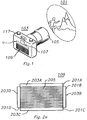
- FIG. 1 shows a preferred embodiment of camera 103 used to photograph subject 101.
- the camera 103 consists of lens 105 aimed at the subject 101 and attached to camera body 117.
- viewfinder 107 Located on the back of camera 103 is viewfinder 107, user-operable input device 109, and optional display 111.
- the photographer enters a caption to be placed onto a photograph by entering information using the user-operable input device 109.
- the caption is entered onto the photograph by exposing the film, and is displayed on the display 111 and in viewfinder 107.
- the user-operable input device 109 is a writing pad.
- alternate embodiments will be apparent to a person skilled in the art, e.g., user-operable input devices such as microphones, alphanumeric keypads, and electronic video sources.
- FIG. 2 is a detail of a preferred embodiment in which the user-operable input device 109 is a writing pad.
- the writing pad 109 consists of a matrix of touch sensitive cells. As a person skilled in the art knows, a grid of touch sensitive cells can be formed in many ways.
- the writing pad 109 consists of a top layer of resistive material 205 attached to connectors 203A and 203D, and a bottom layer of resistive material 206 attached to connectors 203B and 203C. These connectors are attached to external connectors 201A through 201D, respectively. When the photographer presses a pen against the layer 205 a connection is made between it and the layer 206 to close the circuits between connectors 201A through 201D, as shown in FIG.
- the point at which the layers 205 and 206 are pressed together is indicated by line 207.
- the total resistance in the X direction of either layer is R xt .
- the total resistance in the Y direction is R yt .
- X coordinate of the point indicated by line 207 is determined.
- Terminal 201D is connected to know, voltage V+ and terminal 201A is connected to ground.
- Terminal 201C is connected to V x .
- the layers 205 and 206 are of uniform resistivity. Therefore, V x is proportional to the distance between point 207 and terminal 203D.
- terminals 203C and 203B are connected to V+ and ground, respectively, and terminal 203A is connected to V y .
- the voltage V y is proportional to the distance between point 207 and terminal 203C.
- V x and V y can be used to determine the X and Y coordinates of point 207.
- the connections to terminals 201A through 201D are changed externally between time A and time B, so that both X and Y coordinates may be determined.
- the photographer creates a caption for the photograph by moving a pencil, or other point, across the writing pad.
- An erasure mode is activated by stroking a specific region of the writing pad 103, e.g., the upper left corner, to toggle modes. If a mistake is made, the photographer toggles the drawing mode, which "hides” the error. Then the photographer flips the mode to continue drawing.
- the photographer can also use the writing pad 109 to create graphical symbols, e.g., pointers and arrows, to assist the information delivery.
- this is a useful feature for documenting the contents of photographs, i.e., insurance adjusters can "highlight" problem areas while taking the picture. This enables the adjuster to more easily identify objects in the photographs after developing the film.
- Another application is one in which the marks made on the writing pad 109 are used to align a series of photographs. For example, if a series of pictures are used to create a panoramic view of a horizon, a mark can be used to indicate the vertical position of the horizon and another mark to indicate a landmark which indicates the horizontal location of the picture. These marks can then be used to line up the camera for the next frame in the panorama.
- the writing pad 109 is used by the user to create one character at a time. These characters are sequentially entered into a buffer (not shown), and displayed on an optional external display 111. As an alternative, an alpha-numeric key pad placed on the camera's back could perform this one-character at-a-time input function.
- FIG. 3 shows a detail of viewfinder 107. It shows the bitmap 113 created by the photographer on the writing pad 109 superimposed on the image of subject 101. Furthermore, it shows a date/time 115 generated by an internal clock (not shown).
- FIG. 4(a) shows one embodiment of modifications to a single lens reflex camera.
- the user-created caption is displayed in the viewfinder 107.
- the output of writing pad 109 is connected to a processor 119 which samples the writing pad and converts the information entered on writing pad 109 into signals which display the information on display 121.
- processor 119 One task of processor 119 is to change the external connections to writing pad 109 between times A and B, so that both X and Y coordinates may be determined.
- the light emitted from display 121 is refracted through lens 123 and reflected by beam-splitter 125.
- the image from the subject is projected through lens 105 and propagated through beam-splitter 125, such that the light rays 139 emitting from beam-splitter 125 is 90% light from subject 101 and 10% light from display 121.
- Mirror 127 is connected to the camera body 117 at fulcrum 129. Mirror 127 flips between position (a) and position (b). The mirror 127 is at position (b) during the composition phase of the photographic process and at position (a) during the film exposing phase.
- the mirror 127 When the mirror 127 is at position (b) the light rays 135 composed from display 121 and subject 101, are propagated to viewfinder 107. However, when the mirror 127 is at position (a) the light rays 139 composed from display 121 and subject 101, are reflected by mirror 127 and propagated through beam-splitter 131 onto a film 133, thus exposing the film 133.
- an image is derived from date/time stamp display 137 is combined with the light rays 139 by refracting the image through lens 135 and reflecting the light rays 139 on beam-splitter 131, while propagating light rays 139 through beam-splitter 131, thereby forming a combined image represented by light rays 141, which includes the image of the subject 101, the image of display 121, and the image of date/time stamp display 137.
- the information display 121 could be located next date/time stamp display 137, as shown by block 121B.
- block 121B is connected to processor 119 (this connection is not shown).
- Printer 120 and memory 118 are optional pieces of equipment which may be connected to processor 119.
- the memory 118 stores a table of the captions for each frame in a roll of film.
- the memory 118 can also store logos, e.g, company trademarks, to be entered onto every picture taken.
- Printer 120 is operable to print out a log of the pictures in a roll of film.
- FIG. 4(b) An alternative embodiment is shown in FIG. 4(b).
- the writing pad 109 is connected to processor 119.
- Processor 119 is connected to light emitting device 155, e.g., an array of light emitting diodes.
- the light emitting device 155 is located adjacent to the film 133 at the location at which the film is exposed. When the film 133 is exposed, or immediately before or after the film is exposed, the film is exposed by the light emitting device 155 so that the user created caption is entered onto the photograph.
- an optional external display 111 is provided for the operator to verify correct data entry prior to film exposure.
- writing pad 109, processor 119, light emitting device 155, and optional external display 111 are all placed on the camera back.
- an existing camera can be retrofitted by replacing the back on the camera with a back which contains elements 109, 119, 155 and 111.
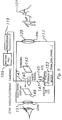
- FIG 5. shows the preferred embodiment for video and other electronic cameras.
- the image of subject 101 is refracted through lens 105 onto light sensitive sensors 143 to produce a video signal 145.
- a video signal 147 having information about the subject, is created by the user of the camera 117 by entering the information on writing pad 109, as described above in conjunction with figures 1 and 2.
- the information is output from writing pad 109 into processor 119, wherein it is converted into a video signal 147.
- Video signals 147 and 145 are input to electronic display 149, whereon the corresponding video images are displayed.
- the image may be viewed through lens 151.
- Video signals 147 and 145 are also transmitted to storage media 153, examples of which are random access memory, disk storage, video tape, and print media.
- writing pad 109 is replaced by either a microphone or a video source.
- processor 119 includes speech recognition circuitry for converting the microphone signal to text.
- This circuitry may incorporate digital signal processors which are programmed to convert spoken words into electronic representations corresponding to the text contained in the spoken words.
- the operator of the camera records the information to be entered onto the photograph by speaking into the microphone.
- the processor converts this spoken messages into a textual electronic representation. This text is transmitted to the display and exposed onto the film negative in the manner discussed above in conjunction with Figures 4(a) and 4(b).
- a microphone may also be used as an alternative to a writing pad as user-operable input device 109 in the video/electronic camera shown in FIG. 5.
- the processor 119 incorporates circuitry for converting information spoken through the microphone into electronic textual representation.
- the video source may be an electronic camera directed at a text image.
- the video source may also be a computer memory in which video images are stored.
- the memory may for example contain images of company logos.
Landscapes
- Physics & Mathematics (AREA)
- General Physics & Mathematics (AREA)
- Studio Devices (AREA)
- Camera Data Copying Or Recording (AREA)
- Studio Circuits (AREA)
Applications Claiming Priority (2)
| Application Number | Priority Date | Filing Date | Title |
|---|---|---|---|
| US765757 | 1991-09-26 | ||
| US07/765,757 US6134392A (en) | 1991-09-26 | 1991-09-26 | Camera with user operable input device |
Publications (1)
| Publication Number | Publication Date |
|---|---|
| EP0543104A1 true EP0543104A1 (fr) | 1993-05-26 |
Family
ID=25074405
Family Applications (1)
| Application Number | Title | Priority Date | Filing Date |
|---|---|---|---|
| EP92115677A Withdrawn EP0543104A1 (fr) | 1991-09-26 | 1992-09-14 | Caméra avec dispositif d'entrée actionnable par l'utilisateur |
Country Status (3)
| Country | Link |
|---|---|
| US (1) | US6134392A (fr) |
| EP (1) | EP0543104A1 (fr) |
| JP (1) | JPH05241232A (fr) |
Families Citing this family (10)
| Publication number | Priority date | Publication date | Assignee | Title |
|---|---|---|---|---|
| US6567120B1 (en) * | 1996-10-14 | 2003-05-20 | Nikon Corporation | Information processing apparatus having a photographic mode and a memo input mode |
| JP4429394B2 (ja) * | 1997-06-17 | 2010-03-10 | 株式会社ニコン | 情報処理装置および記録媒体 |
| US6374056B1 (en) * | 1999-03-19 | 2002-04-16 | Fuji Photo Optical Co., Ltd. | Camera with magnetic recording device |
| US6804652B1 (en) * | 2000-10-02 | 2004-10-12 | International Business Machines Corporation | Method and apparatus for adding captions to photographs |
| US20050149336A1 (en) * | 2003-12-29 | 2005-07-07 | Cooley Matthew B. | Voice to image printing |
| US20050254813A1 (en) * | 2004-05-12 | 2005-11-17 | Henry Brendzel | Apparatus for including user-provided message with still pictures |
| US7460782B2 (en) * | 2004-06-08 | 2008-12-02 | Canon Kabushiki Kaisha | Picture composition guide |
| US8004584B2 (en) * | 2005-04-29 | 2011-08-23 | Hewlett-Packard Development Company, L.P. | Method and apparatus for the creation of compound digital image effects |
| US7697827B2 (en) | 2005-10-17 | 2010-04-13 | Konicek Jeffrey C | User-friendlier interfaces for a camera |
| US8212805B1 (en) | 2007-01-05 | 2012-07-03 | Kenneth Banschick | System and method for parametric display of modular aesthetic designs |
Citations (4)
| Publication number | Priority date | Publication date | Assignee | Title |
|---|---|---|---|---|
| DE2654259A1 (de) * | 1975-12-12 | 1977-06-23 | Olympus Optical Co | Dateneintragvorrichtung fuer eine kamera |
| DE2449093B2 (de) * | 1973-10-15 | 1978-06-29 | Canon K.K., Tokio | Kamera mit Datenaufzeichnungsvorrichtung |
| US4232956A (en) * | 1978-10-03 | 1980-11-11 | Olympus Optical Co., Ltd. | Data recordable camera |
| US4330186A (en) * | 1980-02-04 | 1982-05-18 | Olympus Optical Co., Ltd. | Data recording device |
Family Cites Families (7)
| Publication number | Priority date | Publication date | Assignee | Title |
|---|---|---|---|---|
| JPS5184632A (en) * | 1975-01-24 | 1976-07-24 | Canon Kk | Deetakirokusochi |
| GB1522053A (en) * | 1975-03-20 | 1978-08-23 | Horikomi S | Hand-writing recording device |
| US4814760A (en) * | 1984-12-28 | 1989-03-21 | Wang Laboratories, Inc. | Information display and entry device |
| EP0196009A3 (fr) * | 1985-03-20 | 1987-01-14 | Casio Computer Company Limited | Caméra pour vues fixes |
| JPH0236825U (fr) * | 1988-09-02 | 1990-03-09 | ||
| US5103250A (en) * | 1989-06-30 | 1992-04-07 | Canon Kabushiki Kaisha | Data imprinting apparatus in a camera |
| US5162830A (en) * | 1990-10-09 | 1992-11-10 | Eastman Kodak Company | Stylus assembly for autographic camera |
-
1991
- 1991-09-26 US US07/765,757 patent/US6134392A/en not_active Expired - Lifetime
-
1992
- 1992-09-14 EP EP92115677A patent/EP0543104A1/fr not_active Withdrawn
- 1992-09-25 JP JP4256815A patent/JPH05241232A/ja active Pending
Patent Citations (4)
| Publication number | Priority date | Publication date | Assignee | Title |
|---|---|---|---|---|
| DE2449093B2 (de) * | 1973-10-15 | 1978-06-29 | Canon K.K., Tokio | Kamera mit Datenaufzeichnungsvorrichtung |
| DE2654259A1 (de) * | 1975-12-12 | 1977-06-23 | Olympus Optical Co | Dateneintragvorrichtung fuer eine kamera |
| US4232956A (en) * | 1978-10-03 | 1980-11-11 | Olympus Optical Co., Ltd. | Data recordable camera |
| US4330186A (en) * | 1980-02-04 | 1982-05-18 | Olympus Optical Co., Ltd. | Data recording device |
Also Published As
| Publication number | Publication date |
|---|---|
| US6134392A (en) | 2000-10-17 |
| JPH05241232A (ja) | 1993-09-21 |
Similar Documents
| Publication | Publication Date | Title |
|---|---|---|
| EP0851274B1 (fr) | Appareil photographique pour images fixes | |
| US5689742A (en) | Full frame annotation system for camera | |
| USRE39524E1 (en) | Hybrid camera system with electronic album control | |
| US5142310A (en) | Pseudo format camera system | |
| US7265851B2 (en) | Printing method and system for making print from photo picture frame and graphic image written by user | |
| US5682197A (en) | Electronic panoramic camera for use with an external processor | |
| JPH11167161A (ja) | 撮像及びプリント用装置 | |
| US6134392A (en) | Camera with user operable input device | |
| US20040066391A1 (en) | Method and apparatus for static image enhancement | |
| JPH01306821A (ja) | トリミング撮影可能なカメラ及び画像出力装置 | |
| US6064832A (en) | Camera with print information recording feature | |
| JP2002202558A (ja) | アナログ/デジタルカメラおよびその方法 | |
| US20030164879A1 (en) | Digital camera, print method, and print system | |
| US6804652B1 (en) | Method and apparatus for adding captions to photographs | |
| US20040218080A1 (en) | Digital camera with preview alternatives | |
| JP3650538B2 (ja) | 写真撮影方法および写真撮影システム | |
| JP2001174900A (ja) | カメラ、画像プリント装置および画像表示装置 | |
| JPH0326073A (ja) | 電子式スチールカメラ | |
| JP2004072146A (ja) | 記録材料及び撮影装置 | |
| US20050093979A1 (en) | System for creating and storing digital images | |
| JP2641019B2 (ja) | 記録写真用カメラ | |
| JPS6267525A (ja) | 写真装置 | |
| JPS61251381A (ja) | 電子カメラ | |
| JPH0829861A (ja) | 記憶媒体、現像機、プリンター、メモリカード及びその作成機 | |
| JP2002051259A (ja) | 画像出力装置およびカメラ |
Legal Events
| Date | Code | Title | Description |
|---|---|---|---|
| PUAI | Public reference made under article 153(3) epc to a published international application that has entered the european phase |
Free format text: ORIGINAL CODE: 0009012 |
|
| AK | Designated contracting states |
Kind code of ref document: A1 Designated state(s): DE FR GB IT NL |
|
| 17P | Request for examination filed |
Effective date: 19931008 |
|
| 17Q | First examination report despatched |
Effective date: 19950215 |
|
| 18D | Application deemed to be withdrawn |
Effective date: 19950627 |