EP0543319A1 - Matériau photographique couleur à l'halogénure d'argent sensible à la lumière - Google Patents
Matériau photographique couleur à l'halogénure d'argent sensible à la lumière Download PDFInfo
- Publication number
- EP0543319A1 EP0543319A1 EP92119589A EP92119589A EP0543319A1 EP 0543319 A1 EP0543319 A1 EP 0543319A1 EP 92119589 A EP92119589 A EP 92119589A EP 92119589 A EP92119589 A EP 92119589A EP 0543319 A1 EP0543319 A1 EP 0543319A1
- Authority
- EP
- European Patent Office
- Prior art keywords
- silver halide
- grains
- less
- silver
- emulsion
- Prior art date
- Legal status (The legal status is an assumption and is not a legal conclusion. Google has not performed a legal analysis and makes no representation as to the accuracy of the status listed.)
- Granted
Links
- -1 Silver halide Chemical class 0.000 title claims abstract description 119
- 229910052709 silver Inorganic materials 0.000 title claims abstract description 107
- 239000004332 silver Substances 0.000 title claims abstract description 107
- 239000000463 material Substances 0.000 title claims abstract description 59
- 239000000839 emulsion Substances 0.000 claims description 141
- 238000000034 method Methods 0.000 claims description 31
- 229910021612 Silver iodide Inorganic materials 0.000 claims description 26
- JKFYKCYQEWQPTM-UHFFFAOYSA-N 2-azaniumyl-2-(4-fluorophenyl)acetate Chemical compound OC(=O)C(N)C1=CC=C(F)C=C1 JKFYKCYQEWQPTM-UHFFFAOYSA-N 0.000 claims description 25
- 239000000203 mixture Substances 0.000 claims description 25
- 229940045105 silver iodide Drugs 0.000 claims description 25
- ZUNKMNLKJXRCDM-UHFFFAOYSA-N silver bromoiodide Chemical compound [Ag].IBr ZUNKMNLKJXRCDM-UHFFFAOYSA-N 0.000 claims description 22
- 239000013078 crystal Substances 0.000 claims description 17
- 238000002156 mixing Methods 0.000 claims description 15
- 229910052740 iodine Inorganic materials 0.000 claims description 13
- 239000011630 iodine Substances 0.000 claims description 13
- ZCYVEMRRCGMTRW-UHFFFAOYSA-N 7553-56-2 Chemical compound [I] ZCYVEMRRCGMTRW-UHFFFAOYSA-N 0.000 claims description 12
- 150000004820 halides Chemical class 0.000 claims description 8
- VAYROLOSUUAGTR-UHFFFAOYSA-N [Ag].[I] Chemical compound [Ag].[I] VAYROLOSUUAGTR-UHFFFAOYSA-N 0.000 claims 2
- GGCZERPQGJTIQP-UHFFFAOYSA-N sodium;9,10-dioxoanthracene-2-sulfonic acid Chemical compound [Na+].C1=CC=C2C(=O)C3=CC(S(=O)(=O)O)=CC=C3C(=O)C2=C1 GGCZERPQGJTIQP-UHFFFAOYSA-N 0.000 claims 1
- 239000010410 layer Substances 0.000 description 100
- 239000000975 dye Substances 0.000 description 25
- 230000001235 sensitizing effect Effects 0.000 description 25
- 108010010803 Gelatin Proteins 0.000 description 23
- 229920000159 gelatin Polymers 0.000 description 23
- 239000008273 gelatin Substances 0.000 description 23
- 235000019322 gelatine Nutrition 0.000 description 23
- 235000011852 gelatine desserts Nutrition 0.000 description 23
- 238000002360 preparation method Methods 0.000 description 20
- 238000009835 boiling Methods 0.000 description 16
- 239000003960 organic solvent Substances 0.000 description 16
- 239000000243 solution Substances 0.000 description 16
- QTBSBXVTEAMEQO-UHFFFAOYSA-N Acetic acid Chemical compound CC(O)=O QTBSBXVTEAMEQO-UHFFFAOYSA-N 0.000 description 14
- NLKNQRATVPKPDG-UHFFFAOYSA-M potassium iodide Chemical compound [K+].[I-] NLKNQRATVPKPDG-UHFFFAOYSA-M 0.000 description 9
- 230000035945 sensitivity Effects 0.000 description 9
- WSFSSNUMVMOOMR-UHFFFAOYSA-N Formaldehyde Chemical compound O=C WSFSSNUMVMOOMR-UHFFFAOYSA-N 0.000 description 8
- 230000000694 effects Effects 0.000 description 8
- IOLCXVTUBQKXJR-UHFFFAOYSA-M potassium bromide Chemical compound [K+].[Br-] IOLCXVTUBQKXJR-UHFFFAOYSA-M 0.000 description 8
- 206010070834 Sensitisation Diseases 0.000 description 6
- BQCADISMDOOEFD-UHFFFAOYSA-N Silver Chemical compound [Ag] BQCADISMDOOEFD-UHFFFAOYSA-N 0.000 description 6
- 239000000654 additive Substances 0.000 description 6
- 230000008313 sensitization Effects 0.000 description 6
- 239000002250 absorbent Substances 0.000 description 5
- 230000002745 absorbent Effects 0.000 description 5
- 229960000583 acetic acid Drugs 0.000 description 5
- XLYOFNOQVPJJNP-UHFFFAOYSA-N water Substances O XLYOFNOQVPJJNP-UHFFFAOYSA-N 0.000 description 5
- 239000007864 aqueous solution Substances 0.000 description 4
- 239000011248 coating agent Substances 0.000 description 4
- 238000000576 coating method Methods 0.000 description 4
- 230000000052 comparative effect Effects 0.000 description 4
- 239000011229 interlayer Substances 0.000 description 4
- JHJLBTNAGRQEKS-UHFFFAOYSA-M sodium bromide Chemical compound [Na+].[Br-] JHJLBTNAGRQEKS-UHFFFAOYSA-M 0.000 description 4
- 230000003595 spectral effect Effects 0.000 description 4
- 239000003381 stabilizer Substances 0.000 description 4
- OKKJLVBELUTLKV-UHFFFAOYSA-N Methanol Chemical compound OC OKKJLVBELUTLKV-UHFFFAOYSA-N 0.000 description 3
- KWYUFKZDYYNOTN-UHFFFAOYSA-M Potassium hydroxide Chemical compound [OH-].[K+] KWYUFKZDYYNOTN-UHFFFAOYSA-M 0.000 description 3
- 230000000996 additive effect Effects 0.000 description 3
- 239000011230 binding agent Substances 0.000 description 3
- 238000003889 chemical engineering Methods 0.000 description 3
- 239000003795 chemical substances by application Substances 0.000 description 3
- 150000001875 compounds Chemical class 0.000 description 3
- 239000002516 radical scavenger Substances 0.000 description 3
- FVAUCKIRQBBSSJ-UHFFFAOYSA-M sodium iodide Chemical compound [Na+].[I-] FVAUCKIRQBBSSJ-UHFFFAOYSA-M 0.000 description 3
- 238000005406 washing Methods 0.000 description 3
- VHUUQVKOLVNVRT-UHFFFAOYSA-N Ammonium hydroxide Chemical compound [NH4+].[OH-] VHUUQVKOLVNVRT-UHFFFAOYSA-N 0.000 description 2
- 206010034960 Photophobia Diseases 0.000 description 2
- CDBYLPFSWZWCQE-UHFFFAOYSA-L Sodium Carbonate Chemical compound [Na+].[Na+].[O-]C([O-])=O CDBYLPFSWZWCQE-UHFFFAOYSA-L 0.000 description 2
- QAOWNCQODCNURD-UHFFFAOYSA-L Sulfate Chemical compound [O-]S([O-])(=O)=O QAOWNCQODCNURD-UHFFFAOYSA-L 0.000 description 2
- NINIDFKCEFEMDL-UHFFFAOYSA-N Sulfur Chemical compound [S] NINIDFKCEFEMDL-UHFFFAOYSA-N 0.000 description 2
- 239000003513 alkali Substances 0.000 description 2
- 235000011114 ammonium hydroxide Nutrition 0.000 description 2
- 229940101006 anhydrous sodium sulfite Drugs 0.000 description 2
- 239000006185 dispersion Substances 0.000 description 2
- PCHJSUWPFVWCPO-UHFFFAOYSA-N gold Chemical compound [Au] PCHJSUWPFVWCPO-UHFFFAOYSA-N 0.000 description 2
- 229910052737 gold Inorganic materials 0.000 description 2
- 239000010931 gold Substances 0.000 description 2
- 239000003112 inhibitor Substances 0.000 description 2
- 208000013469 light sensitivity Diseases 0.000 description 2
- 239000000314 lubricant Substances 0.000 description 2
- 239000006224 matting agent Substances 0.000 description 2
- 238000000691 measurement method Methods 0.000 description 2
- 239000002245 particle Substances 0.000 description 2
- 230000000704 physical effect Effects 0.000 description 2
- 239000004014 plasticizer Substances 0.000 description 2
- 239000004848 polyfunctional curative Substances 0.000 description 2
- 239000011241 protective layer Substances 0.000 description 2
- ADZWSOLPGZMUMY-UHFFFAOYSA-M silver bromide Chemical compound [Ag]Br ADZWSOLPGZMUMY-UHFFFAOYSA-M 0.000 description 2
- SQGYOTSLMSWVJD-UHFFFAOYSA-N silver(1+) nitrate Chemical compound [Ag+].[O-]N(=O)=O SQGYOTSLMSWVJD-UHFFFAOYSA-N 0.000 description 2
- 238000003756 stirring Methods 0.000 description 2
- 239000011593 sulfur Substances 0.000 description 2
- 229910052717 sulfur Inorganic materials 0.000 description 2
- 239000002344 surface layer Substances 0.000 description 2
- PAWQVTBBRAZDMG-UHFFFAOYSA-N 2-(3-bromo-2-fluorophenyl)acetic acid Chemical compound OC(=O)CC1=CC=CC(Br)=C1F PAWQVTBBRAZDMG-UHFFFAOYSA-N 0.000 description 1
- QTLHLXYADXCVCF-UHFFFAOYSA-N 2-(4-amino-n-ethyl-3-methylanilino)ethanol Chemical compound OCCN(CC)C1=CC=C(N)C(C)=C1 QTLHLXYADXCVCF-UHFFFAOYSA-N 0.000 description 1
- NLXLAEXVIDQMFP-UHFFFAOYSA-N Ammonium chloride Substances [NH4+].[Cl-] NLXLAEXVIDQMFP-UHFFFAOYSA-N 0.000 description 1
- ZYLFSKYJKJKYFQ-UHFFFAOYSA-N CC(ON(CCN(OC(C)=O)OC(C)=O)OC(C)=O)=O.N.[Fe+2] Chemical compound CC(ON(CCN(OC(C)=O)OC(C)=O)OC(C)=O)=O.N.[Fe+2] ZYLFSKYJKJKYFQ-UHFFFAOYSA-N 0.000 description 1
- 229920002284 Cellulose triacetate Polymers 0.000 description 1
- AVXURJPOCDRRFD-UHFFFAOYSA-N Hydroxylamine Chemical compound ON AVXURJPOCDRRFD-UHFFFAOYSA-N 0.000 description 1
- GRYLNZFGIOXLOG-UHFFFAOYSA-N Nitric acid Chemical compound O[N+]([O-])=O GRYLNZFGIOXLOG-UHFFFAOYSA-N 0.000 description 1
- 229910021607 Silver chloride Inorganic materials 0.000 description 1
- 238000002441 X-ray diffraction Methods 0.000 description 1
- NNLVGZFZQQXQNW-ADJNRHBOSA-N [(2r,3r,4s,5r,6s)-4,5-diacetyloxy-3-[(2s,3r,4s,5r,6r)-3,4,5-triacetyloxy-6-(acetyloxymethyl)oxan-2-yl]oxy-6-[(2r,3r,4s,5r,6s)-4,5,6-triacetyloxy-2-(acetyloxymethyl)oxan-3-yl]oxyoxan-2-yl]methyl acetate Chemical compound O([C@@H]1O[C@@H]([C@H]([C@H](OC(C)=O)[C@H]1OC(C)=O)O[C@H]1[C@@H]([C@@H](OC(C)=O)[C@H](OC(C)=O)[C@@H](COC(C)=O)O1)OC(C)=O)COC(=O)C)[C@@H]1[C@@H](COC(C)=O)O[C@@H](OC(C)=O)[C@H](OC(C)=O)[C@H]1OC(C)=O NNLVGZFZQQXQNW-ADJNRHBOSA-N 0.000 description 1
- SJOOOZPMQAWAOP-UHFFFAOYSA-N [Ag].BrCl Chemical compound [Ag].BrCl SJOOOZPMQAWAOP-UHFFFAOYSA-N 0.000 description 1
- XEIPQVVAVOUIOP-UHFFFAOYSA-N [Au]=S Chemical compound [Au]=S XEIPQVVAVOUIOP-UHFFFAOYSA-N 0.000 description 1
- 239000012190 activator Substances 0.000 description 1
- 238000005267 amalgamation Methods 0.000 description 1
- QGZKDVFQNNGYKY-UHFFFAOYSA-N ammonia Natural products N QGZKDVFQNNGYKY-UHFFFAOYSA-N 0.000 description 1
- SWLVFNYSXGMGBS-UHFFFAOYSA-N ammonium bromide Chemical compound [NH4+].[Br-] SWLVFNYSXGMGBS-UHFFFAOYSA-N 0.000 description 1
- XYXNTHIYBIDHGM-UHFFFAOYSA-N ammonium thiosulfate Chemical compound [NH4+].[NH4+].[O-]S([O-])(=O)=S XYXNTHIYBIDHGM-UHFFFAOYSA-N 0.000 description 1
- 230000002421 anti-septic effect Effects 0.000 description 1
- 239000002216 antistatic agent Substances 0.000 description 1
- 238000000149 argon plasma sintering Methods 0.000 description 1
- 238000004061 bleaching Methods 0.000 description 1
- 238000005520 cutting process Methods 0.000 description 1
- 230000003247 decreasing effect Effects 0.000 description 1
- 238000011033 desalting Methods 0.000 description 1
- 229910003460 diamond Inorganic materials 0.000 description 1
- 239000010432 diamond Substances 0.000 description 1
- KYQODXQIAJFKPH-UHFFFAOYSA-N diazanium;2-[2-[bis(carboxymethyl)amino]ethyl-(carboxylatomethyl)amino]acetate Chemical compound [NH4+].[NH4+].OC(=O)CN(CC([O-])=O)CCN(CC(O)=O)CC([O-])=O KYQODXQIAJFKPH-UHFFFAOYSA-N 0.000 description 1
- 239000002612 dispersion medium Substances 0.000 description 1
- 238000009826 distribution Methods 0.000 description 1
- 238000001035 drying Methods 0.000 description 1
- 230000002708 enhancing effect Effects 0.000 description 1
- 239000012362 glacial acetic acid Substances 0.000 description 1
- 229910052736 halogen Inorganic materials 0.000 description 1
- 150000002367 halogens Chemical class 0.000 description 1
- 238000004519 manufacturing process Methods 0.000 description 1
- 238000005259 measurement Methods 0.000 description 1
- 150000004682 monohydrates Chemical class 0.000 description 1
- 229910017604 nitric acid Inorganic materials 0.000 description 1
- 229920003229 poly(methyl methacrylate) Polymers 0.000 description 1
- 239000004926 polymethyl methacrylate Substances 0.000 description 1
- BWHMMNNQKKPAPP-UHFFFAOYSA-L potassium carbonate Chemical compound [K+].[K+].[O-]C([O-])=O BWHMMNNQKKPAPP-UHFFFAOYSA-L 0.000 description 1
- 238000000634 powder X-ray diffraction Methods 0.000 description 1
- 230000002035 prolonged effect Effects 0.000 description 1
- 230000005070 ripening Effects 0.000 description 1
- 238000006748 scratching Methods 0.000 description 1
- 230000002393 scratching effect Effects 0.000 description 1
- HKZLPVFGJNLROG-UHFFFAOYSA-M silver monochloride Chemical compound [Cl-].[Ag+] HKZLPVFGJNLROG-UHFFFAOYSA-M 0.000 description 1
- 229910001961 silver nitrate Inorganic materials 0.000 description 1
- HAAYBYDROVFKPU-UHFFFAOYSA-N silver;azane;nitrate Chemical compound N.N.[Ag+].[O-][N+]([O-])=O HAAYBYDROVFKPU-UHFFFAOYSA-N 0.000 description 1
- 229910000029 sodium carbonate Inorganic materials 0.000 description 1
- HRZFUMHJMZEROT-UHFFFAOYSA-L sodium disulfite Chemical compound [Na+].[Na+].[O-]S(=O)S([O-])(=O)=O HRZFUMHJMZEROT-UHFFFAOYSA-L 0.000 description 1
- 235000009518 sodium iodide Nutrition 0.000 description 1
- DZCAZXAJPZCSCU-UHFFFAOYSA-K sodium nitrilotriacetate Chemical compound [Na+].[Na+].[Na+].[O-]C(=O)CN(CC([O-])=O)CC([O-])=O DZCAZXAJPZCSCU-UHFFFAOYSA-K 0.000 description 1
- 238000001179 sorption measurement Methods 0.000 description 1
- 230000000087 stabilizing effect Effects 0.000 description 1
- 238000003860 storage Methods 0.000 description 1
- 239000000126 substance Substances 0.000 description 1
- 230000002087 whitening effect Effects 0.000 description 1
Images


Classifications
-
- G—PHYSICS
- G03—PHOTOGRAPHY; CINEMATOGRAPHY; ANALOGOUS TECHNIQUES USING WAVES OTHER THAN OPTICAL WAVES; ELECTROGRAPHY; HOLOGRAPHY
- G03C—PHOTOSENSITIVE MATERIALS FOR PHOTOGRAPHIC PURPOSES; PHOTOGRAPHIC PROCESSES, e.g. CINE, X-RAY, COLOUR, STEREO-PHOTOGRAPHIC PROCESSES; AUXILIARY PROCESSES IN PHOTOGRAPHY
- G03C7/00—Multicolour photographic processes or agents therefor; Regeneration of such processing agents; Photosensitive materials for multicolour processes
- G03C7/30—Colour processes using colour-coupling substances; Materials therefor; Preparing or processing such materials
- G03C7/3022—Materials with specific emulsion characteristics, e.g. thickness of the layers, silver content, shape of AgX grains
Definitions
- This invention relates to a silver halide color photographic light sensitive material and particularly to a silver halide color photographic light sensitive material excellent in photosensitive speed, graininess and pressure resistive characteristics.
- Silver halide color photographic light sensitive materials have been required to have a high photosensitive speed and a high image quality and, at the same time, an excellent resistance against various pressures -the photographic characteristics are varied a few by applying some pressure thereto-, which may be applied accidentally or naturally thereto while they are handled.
- the numbers of light sensitive silver halide grains present in the region bounded by a and b of a subject light sensitive layer are counted at least not less than 50 positions, and the value obtained according to the following formula 1 is regarded as the dispersibility of the light sensitive layer.
- the light sensitive materials of the invention comprise at least one of the light sensitive layers each having a light sensitive silver halide grain dispersibility of not less than 85%, (the above-mentioned light sensitive layers are sometimes abbreviated to 'the light sensitive layers of the invention'). From the viewpoint of the effects of the invention, it is particularly desired that at least one of the green and/or blue sensitive layers of the light sensitive materials is to be the light sensitive layer of the invention. When two or more same color sensitive layers each having the different light sensitivity, it is desired that the layer having the higher light sensitivity is to be the light sensitive layer of the invention.
- the light sensitive silver halide grain dispersibility is to be desirably not less than 85%, more desirably not less than 88% and particularly not less than 90%.
- the light sensitive silver halide grains contained in the light sensitive layers of the invention 20% or more of all the whole projective areas thereof are to be constituted of silver halide grains having an aspect ratio of desirably not less than 3, more desirably not less than 40% and particularly not less than 60%.
- the silver halide grains having an aspect ratio of not less than 3 it is desirable when not less than 60% of all the grains in number are constituted of hexagonal tabular-shaped twinned crystal grains having a pair of twinned crystal planes comprising ⁇ 111 ⁇ faces parallel to each other. In particular, in the case of not less than 80%, it is more desirable.
- the possibility of lowering the silver halide grain dispersibility may be considered such a coating thickness variation occurred when coating a light sensitive layer.
- the possibility of such a dispersibility lowering as mentioned above is very little in the ordinary production techniques applicable to the art. For example, on the cross-sectional photographs of any ordinary light sensitive materials being currently marketed, any variation of the light sensitive layer thickness cannot be observed as serious as the silver halide grain dispersibility is affected.
- the light sensitive layers of the invention can be prepared by making use of a silver halide emulsion prepared in the method described later (hereinafter sometimes referred to as the silver halide emulsion relating to the invention).
- the present inventors conjecture that the light sensitive layers of the invention can be prepared because the above-mentioned grain cohesion and/or amalgamation can be inhibited.
- the silver halide emulsions relating to the invention can be prepared, for example, in at least a part of the grain forming stage where only the silver halide grains substantially having a fine grain size can be supplied to a mixing tank under the conditions of a mixing time for not shorter than 15 seconds.
- 'Grains are formed by supplying only the substantially minute sized silver halide grains' (hereinafter sometimes abbreviated to silver halide fine grains), herein means that not less than 90% of silver ions and halide ions each for being applied to form the silver halide grains are supplied in the form of silver halide fine grains.
- silver halide fine grains are dissolved and silver ions and halide ions are released to be supplied for the growing grains.
- the increase of the entropy produced with uniforming the compositions is the driving force which dissolve the supplied silver halide fine grains.
- the halide compositions of the silver halide fine grains to be supplied may be so selected as to be meet the halide compositions of any subject growing grains. It is also allowed to supply, at the same time, not less than two kinds of silver halide fine grains having the different halide compositions at any ratios so that a objective halide composition can be prepared.
- the grain sizes of the silver halide fine grains are desirably not larger than 0.2 ⁇ m, more desirably not larger than 0.1 ⁇ m, still more desirably not larger than 0.05 ⁇ m and still further desirably 0.03 ⁇ m.
- the silver halide fine grains in the form of a silver halide finely grained emulsion suspended in a dispersion medium and the finely grains emulsions can also be subjected to a desalting treatment, if required.
- the silver halide emulsions relating to the invention when the grains are formed by supplying the silver halide fine grains, it is preffered not less than 5% of total silver are supplied as the silver halide fine grains, more desirably not less than 10%, further desirably not less than 20% and still further desirably not less than 40%.
- the mixing time is desirably not shorter than 15 seconds, more desirably within the range of not shorter than 15 seconds and not longer than 35 seconds and further desirably within the range of not shorter than 17 seconds and not longer than 30 seconds.
- every silver halide having any desired compositions can be applied.
- it is allowed to use silver bromide, silver iodobromide, silver iodochlorobromide, silver chlorobromide, silver chloride or the mixtures thereof.
- silver iodobromide having an average silver iodide content within the range of, desirably, 1 to 20 mol% and, more desirably, 2 to 15 mol%.
- the silver halide emulsions applicable to the light sensitive layers of the light sensitive materials it is desired to use a core/shell type emulsions having an iodine content higher in the core section than in the shell section thereof.
- a core/shell type emulsion comprising the core section having an iodine content within the range of not less than 15 mol% and not more than 40 mol%.
- a silver halide emulsion comprising the grains having an apparent core/shell structure
- an emulsion comprising double-layer structured grains such as those given in JP OPI Publication No. 61-148442/1986
- an emulsion comprising multilayer structured grains such as those given in JP OPI Publication No. 61-245151/1986 are preferred.
- the silver halide emulsions comprising the grains having the apparent core/shell structures which are stated herein, can be clarified whether they are those or not in the X-ray diffracto-metric method detailed below.
- the standard measurement methods in which the above-mentioned technique is utilized include a method in which Cu is used as a target and K ⁇ rays of Cu is used as the ray source, and the diffraction pattern on the (420) faces of silver halide is measured at a tube voltage of 40 kV and a tube current of 100 mA in a powder X-ray diffractometry, so that the curve of the diffraction angles of a diffraction strength member.
- the expression, '--- has an apparent core/shell structure ---', means the case where a diffraction curve substantially has two diffraction peaks.
- the emulsions substantially having two diffraction peaks and an apparent core/shell structure as mentioned above include more desirably an emulsion comprising the grains each having an iodine content of which a single minimum point appears between a diffraction peak corresponding to a low iodine containing region and a diffraction signal peak corresponding to an internal high iodine containing region, and the strength of the diffraction peak corresponding to the high iodine containing region is so structured as to be 1/10 to 3/1 of the peak strength in the low iodine containing region.
- the diffraction peak strength ratio is to be within the range of, more desirably, 1/5 to 3/1 and, further desirably, 1/3 to 3/1.
- the other embodiments of the silver halide emulsions applicable to the light sensitive layers include, for example, an embodiment in which a silver iodide content is continuously varied from the center of a grain to the outside of the grain.
- a silver iodide content is continuously varied from the center of a grain to the outside of the grain.
- it is desired that the silver iodide content of a grain is to be continuously reduced from a point having the maximum silver iodide content inside the grain to the outside of the grain.
- the silver iodide content of the maximum point is to be within the range of, desirably, 15 to 45 mol% and, more desirably, 25 to 40 mol%.
- the silver iodide contents of the surface phase of the silver halide grains thereof are to be, desirably, not more than 6 mol% and, more desirably, within the range of 0 to 4 mol%.
- the grains have thin surface layer of high silver iodide content (i.e., not lower than 6 mol%).
- the average thickness of the thin surface layer is, desirably, not thicker than 100 ⁇ and, more distinctly, not thicker than 50 ⁇ .
- the other emulsions may be prepared in any one of the conventional preparation processes such as a single-jet process, a double-jet process and a controlled double-jet process.
- the controlled double-jet process is suitably applied.
- Iodine can be supplied in, for example, a method in which iodine is supplied in the form of iodine ions by making use of an aqueous solution of alkali halide such as potassium iodide and sodium iodide, or in an aqueous solution of the mixture of the alkali halide solution and potassium bromide or sodium bromide; or another method such as those described in EP 323215 in which iodine is supplied in the form of AgI (silver iodide) fine grains.
- alkali halide such as potassium iodide and sodium iodide
- potassium bromide or sodium bromide sodium bromide
- Another method such as those described in EP 323215 in which iodine is supplied in the form of AgI (silver iodide) fine grains.
- the latter method is preferred from the viewpoint that highly iodine containing cores can be efficiently and uniformly formed in the core/shell structures.
- the term, 'a monodispersion property' is defined when a standard deviation S of grain sizes is divided by an average grain size and the value obtained is multiplied by 100 (that is called a variation coefficient).
- r ⁇ an average grain size S represents a standard deviation in the general statistical sense.
- the above-mentioned monodisperse type silver halide grains may be formed in a double layered structure or a multilayered structure, as described before.
- the configuration of the monodisperse type silver halide grains may be regularly crystallized into a cube, octahedron or tetradecahedron, or crystallized into a spherical or tabular form.
- monodisperse type tabular formed grains may preferably be used.
- these grains are particularly preferable to be hexahedral, tabular formed, monodisperse type grains.
- 'a grain size' means a diameter obtained when the projective image of a grain is converted into a circular image having the same area.
- the grain size can be obtained in the manner that, for example, a grain is so projected as to be magnified 10,000 to 50,000 times through an electron microscope and the diameter of the printed grain image or the projected area thereof is practically measured, (provided that the numbers of the grains subject to the measurement are regarded to be not less than 1000 grains at random.)
- the grain size measurement method is to be accorded to the above-described manner and the average grain size thereof is to be obtained in an arithmetical mean.
- Average grain size ⁇ d1n1/ ⁇ n1
- An average grain size of the silver halide emulsions of the invention is to be within the range of, desirably, 0.1 to 10.0 ⁇ m, more desirably, 0.2 to 5.0 ⁇ m and, preferably, 0.3 to 3.0 ⁇ m.
- Couplers When constituting the color photographic light sensitive materials of the invention, various types of couplers may be used. The typical examples thereof are also given in the above-given Research Disclosures. The places corresponding thereto will be given below.
- [Coupler] [Page in RD308119] [RD17643] Yellow coupler 1001 VII-D VII-C ⁇ G Magenta coupler 1001 VII-D VII-C ⁇ G Cyan coupler 1001 VII-D VII-C ⁇ G Colored coupler 1002 VII-G VII-G DIR coupler 1001 VII-F VII-F BAR coupler 1002 VII-F Other useful residual group Releasing coupler 1001 VII-F Alkali-soluble coupler 1001 VII-E
- the additives applicable thereto can be added in the dispersion processes described in, for example, RD 308119, XIV.
- the supports detailed in, for example, the above-given RD 17643, p.28; RD 18716, pp.647 ⁇ 648 and RD 308119, XVII can be used.
- the color photographic light sensitive materials of the invention can be provided with an auxiliary layer including, for example, a filter layers and an interlayer, detailed in the above-given RD 308119, VII-K.
- the color photographic light sensitive materials of the invention may have various layer arrangements including, for example, a conventional layer arrangement, an inverted layer arrangement and a unit layer arrangement, of which detailed in, for example, RD 308119, VII-K.
- the color photographic light sensitive materials of the invention may suitably be applied to various types of color photographic light sensitive materials typified by, for example, a color negative film for general or cinematographic use, a color reversal film for slide or TV use, a color paper, a color positive film and a color reversal paper.
- the color photographic light sensitive materials of the invention may be developed in any ordinary methods including, for example, those detailed in RD 17643, pp.28-29; RD 18716, p.615 and RD 308119, XIX.
- a silver iodobromide emulsion was prepared by making use of silver iodobromide grains (having a silver iodide content of 1 mol%) which had an average grain size of 0.30 ⁇ m, but did not have any twinned crystals so as to serve as the seed crystals thereof.
- Solution ⁇ G-10 ⁇ contained in a reaction chamber was kept at a temperature of 70°C, a pAg of 7.8 and a pH of 7.2 and was then added with a seed emulsion in an amount equivalent to 0.286 mols while it was being stirred.
- ⁇ H-10 ⁇ , ⁇ S-10 ⁇ and ⁇ MC-10 ⁇ were each acceleratingly added into a reaction chamber at a flow rate required for constituting the silver halide composition shown in Fig.2 by taking a time for 110 minutes in a triple-jet process, so that a core phase (called A phase) could be formed.
- the pAg and pH thereof were controlled to be 7.8 and 7.2, respectively.
- Phase B the first shell phase
- Phase C the second shell phase
- each of the average mixing time was controlled as shown in Table 1.
- an aqueous potassium bromide solution and an aqueous acetic acid solution were used.
- JP Application Japanese Patent Application
- JP Application Japanese Patent Application No. 2-4003/1990.
- the grains were redispersed by adding gelatin and the pH and pAg thereof were adjusted to be 5.8 and 8.06 at 40°C, respectively.
- the resulting emulsion is named [EM-11].
- each of the average mixing time in the course of forming Phase C was controlled to have the values shown in Table 1.
- Phase C was formed by supplying ⁇ MC-11 ⁇ .
- Phase C was formed by supplying ⁇ MC-11 ⁇ and the average mixing time in the course of forming Phase C was controlled as shown in Table 1.
- Phases B and C were each formed by supplying ⁇ MC-12 ⁇ and ⁇ MC-11 ⁇ , and the average mixing time in the course of forming both Phases were controlled as shown in Table 1.
- a finely grained emulsion comprising 3 wt% of gelatin and silver iodide grains (having an average grain size of 0.04 ⁇ m) How to prepare will be given below.
- Each of 2000 ml of an aqueous solution containing 7.06 mols of silver nitrate and 2000 ml of an aqueous solution containing 7.06 mols of potassium iodide were added by taking a time for 10 minutes into 5000 ml of a 6.0 wt% gelatin solution containing 0.06 mols of potassium iodide.
- the pH thereof was controlled to be 2.0 with the use of nitric acid at 40°C.
- the pH was adjusted to be 6.0 with an aqueous sodium carbonate solution.
- a finely grained emulsion comprising silver iodobromide grains (having an average grain size of 0.03 ⁇ m) containing 1 mol% of silver iodide, which was prepared in the same manner as in ⁇ MC-10 ⁇ (wherein the temperature in the course of forming the fine grains was controlled to be at 28°C)
- a finely grained emulsion comprising silver bromide grains (having an average grain size of 0.03 ⁇ m), which was prepared in the same manner as in ⁇ MC-11 ⁇
- a finely grained emulsion comprising silver iodobromide grains (having an average grain size of 0.03 ⁇ m) containing 5 mol% of silver iodide, which was prepared in the same manner as in ⁇ MC-11 ⁇
- the multilayered color photographic light sensitive material samples were prepared in the following manner.
- Each of emulsions [EM-11] through [EM-16] was subject to an optimum gold sulfur sensitization and spectral sensitization and the resulting emulsions were coated onto a triacetyl cellulose film support so as to provide each of the layers having the following compositions, respectively.
- compositions of multilayered color photographic light sensitive material were as follows.
- the amounts of the materials added to the light sensitive material are indicated by grams per sq.meter unless otherwise expressly stated.
- the amounts of silver halides and colloidal silver are indicated upon converting them into the corresponding silver contents.
- the amounts of the sensitizing dyes added are indicated by mol numbers per mol of silver halide used.
- Layer 1 an antihalation layer Black colloidal silver 0.16 UV absorbent (UV-1) 0.20 High boiling point organic solvent (Oil-1) 0.16 Gelatin 1.23
- Layer 2 an interlayer Compound (SC-1) 0.15 High boiling point organic solvent (Oil-2) 0.17 Gelatin 1.27
- Layer 3 a low-speed red-sensitive layer
- Sensitizing dye (SD-1) 2.8x10 ⁇ 4 Sensitizing dye (SD-2) 1.9x10 ⁇ 4 Sensitizing dye (SD-3) 1.9x10 ⁇ 5 Sensitizing dye (SD-4)
- compositions Besides the above-given compositions, coating aid Su-1, dispersion aid Su-2, a viscosity controller, layer hardeners H-1 and H-2, stabilizer ST-1, antifoggant AF-1, two kinds of AF-2 having respectively the weight average molecular weights of 10,000 and 1,100,000, and antiseptic DI-1 were each added thereto.
- the amount of DI-1 added thereto was 9.4 mg/m2.
- composition C 50:46:4 (in mol ratio)
- each of [Sample-12] through [Sample-16] was prepared by making use of [EM-12] through [EM-16] in place of silver halide emulsion [EM-11] used in layers 5, 9 and 14 of the above-described [Sample-11].
- each of the samples was exposed to white light through a wedge and was then developed in the following processing steps.
- each of the samples was bent along the cylindrical pole having a diameter of 4mm or a pressure was applied each sample by scratching them with a 7 g-weight loaded diamond needle having a curvature diameter of 0.025mm and the scratched samples were each exposed to light and developed in the same manner.
- the processing steps were as follows. Processing steps 1. Color developing 3min.15sec. 38.0 ⁇ 0.1°C 2. Bleaching 6min.30sec. 38.0 ⁇ 3.0°C 3. Washing 3min.15sec. 24 ⁇ 41°C 4. Fixing 6min.30sec. 38.0 ⁇ 3.0°C 5. Washing 3min.15sec. 24 ⁇ 41°C 6. Stabilizing 3min.15sec. 38.0 ⁇ 3.0°C 7. Drying Not higher than 50°C
- the relative fog density is a value relative to the minimum density (Dmin), and the values thereof are indicated by a value 100 times as much as the Dmin value of [Sample-11].
- the relative sensitivity is a value relative to the reciprocal of an exposed quantity providing a density of Dmin+0.15 and the values thereof are indicated by a value 100 times as much as the sensitivity value of [Sample-11].
- the relative RMS value is measured at a density point of Dmin+0.15 where is the same point for measuring the above-mentioned relative sensitivity, and the relative RMS values are indicated by a value 100 times as much as the RMS value of [Sample-11]. It is meant that the smaller the values are, the more the graininess is excellent.
- the RMS values were measured in the method described in JP Application No. 3-134970/1991.
- the density variations in the portions applied with a pressure were indicated by a value 100 times as much as the value of [Sample-11] after measuring the density variation values of each samples by a microdensitometer at a density point of Dmin+0.15 and in accordance with Formula 3.
- a density of the portion applied with a pressure is increased more than in the portion not applied with any pressure, a plus mark was indicated in Table 3 and, when a density thereof is decreased, a minus mark was indicated therein.
- the photographic light sensitive materials of the invention can be low in fog density, high in sensitivity, excellent in graininess and capable of showing the excellent pressure resistance characteristics.
- the more effects can particularly be displayed when a green and/or blue sensitive layer is a light sensitive layer of the invention.
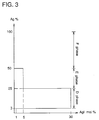
- Globular-shaped silver iodobromide grains (having a silver iodide content of 1 mol%), which had each two twinned crystal faces parallel to each other and having an average grain size of 0.30 ⁇ m, were used as the seed crystals, so that a silver iodobromide emulsion having the structure of such a silver halide composition as shown in Fig.3 could be prepared.
- Phase D a core phase
- the pAg, pH and average mixing time were controlled to be 7.8, 7.2 and 11 seconds, respectively.
- Phase E the first shell phase
- Phase F the second shell phase
- the pAg was continuously varied from 9.4 to 9.7.
- the average mixing time of Phase F and that in the courses of forming Phases F were each controlled to be 18 seconds.
- the pAg and pH thereof were controlled by making use of an aqueous potassium bromide solution and an aqueous acetic acid solution, respectively.
- the resulting emulsion was a twinned crystal monodisperse type emulsion having an average grain size of 1.1 ⁇ m (or a grain size of 1.0 ⁇ m which was obtained by converting the grain configuration into the spheres) and a variation coefficient of 10.3%.
- [EM-22] was prepared in almost the same manner as in [EM-21], provided, wherein the pAg thereof in the course of forming Phase D was controlled to be 8.4.
- a hexagonal, tabular-shaped, monodisperse type emulsion could be so prepared as to have an average grain size of 1.23 ⁇ m (or a 1.0 ⁇ m obtained by converting the grain configuration into the spheres), an aspect ratio thereof was 2.8 and the variation coefficient of 12.1%.
- [EM-23] was prepared in almost the same manner as in [EM-21], provided, wherein the pAg thereof in the course of forming Phase D was controlled to be 8.8.
- a hexagonal, tabular-shaped, monodisperse type emulsion could be so prepared as to have an average grain size of 1.29 ⁇ m (or a 1.0 ⁇ m obtained by converting the grain configuration into the spheres), an aspect ratio thereof was 3.2 and the variation coefficient of 12.7%.
- [EM-24] was prepared in almost the same manner as in [EM-21], provided, wherein the pAg thereof in the course of forming Phase D was controlled to be 9.2 and the pAg of Phase E and that in the course of forming Phase F were each continuously varied from 94. to 10.1, respectively.
- a hexagonal, tabular-shaped, monodisperse type emulsion could be so prepared as to have an average grain size of 1.50 ⁇ m (or a 1.0 ⁇ m obtained by converting the grain configuration into the spheres), an aspect ratio thereof was 5.1 and the variation coefficient of 13.9%.
- each of emulsions [EM-21] through [EM-24] was subject to the optimum gold ⁇ sulfur sensitization and spectral sensitization.
- the multilayered color photographic light sensitive material [Sample-21] through [Sample-24] were each prepared in the same manner as in Example-1 and the samples were then evaluated.
- [EM-21] and [EM-23] were mixed up together at the proportions shown in Table 5, so that [EM-31] through [EM-36] could be prepared.
- Table 5 Emulsion No. Emulsion [EM-21] proportion [EM-23] Grain area ratio at an aspect ratio ⁇ 3 [EM-31] 95% 5% 6.7% [EM-32] 91% 9% 13.3% [EM-33] 87% 13% 17.0% [EM-34] 83% 17% 22.0% [EM-35] 79% 21% 26.8% [EM-36] 75% 25% 31.4%
- each of the resulting emulsions was subject to the optimum gold ⁇ sulfur sensitization and spectral sensitization.
- the multilayered color photographic light sensitive material [Sample-31] through [Sample-36] were each prepared in the same manner as in Example-1 and the samples were then evaluated.
- the effects of the invention can be particularly remarkable when the light sensitive layers of the invention are comprised of the grains each having a different aspect ratio and when the tabular-shaped grains each having an aspect ratio of not less than 3 have an area proportion of not less than 20%.
Landscapes
- Physics & Mathematics (AREA)
- General Physics & Mathematics (AREA)
- Silver Salt Photography Or Processing Solution Therefor (AREA)
Applications Claiming Priority (2)
| Application Number | Priority Date | Filing Date | Title |
|---|---|---|---|
| JP3305078A JP2961579B2 (ja) | 1991-11-20 | 1991-11-20 | ハロゲン化銀カラー写真感光材料 |
| JP305078/91 | 1991-11-20 |
Publications (2)
| Publication Number | Publication Date |
|---|---|
| EP0543319A1 true EP0543319A1 (fr) | 1993-05-26 |
| EP0543319B1 EP0543319B1 (fr) | 1999-02-03 |
Family
ID=17940851
Family Applications (1)
| Application Number | Title | Priority Date | Filing Date |
|---|---|---|---|
| EP92119589A Expired - Lifetime EP0543319B1 (fr) | 1991-11-20 | 1992-11-17 | Matériau photographique couleur à l'halogénure d'argent sensible à la lumière |
Country Status (4)
| Country | Link |
|---|---|
| US (1) | US5420002A (fr) |
| EP (1) | EP0543319B1 (fr) |
| JP (1) | JP2961579B2 (fr) |
| DE (1) | DE69228359T2 (fr) |
Cited By (2)
| Publication number | Priority date | Publication date | Assignee | Title |
|---|---|---|---|---|
| EP0634690A1 (fr) * | 1993-07-15 | 1995-01-18 | Konica Corporation | Emulsion photographique d'halogénure d'argent sensible à la lumière, matériau photographique d'halogénure d'argent sensible à la lumière, et méthode de traitement de matériaux photographiques d'halogénure |
| EP0678780A3 (fr) * | 1994-04-11 | 1996-10-23 | Du Pont Deutschland | Film photographique à révélation rapide pour la radiographie médicale. |
Families Citing this family (1)
| Publication number | Priority date | Publication date | Assignee | Title |
|---|---|---|---|---|
| EP0678773B1 (fr) * | 1994-04-21 | 2000-10-04 | Tulalip Consultoria Comercial Sociedade Unipessoal S.A. | Emulsion au bromoiodure d'argent comprenant des grains noyeau/enveloppe |
Citations (2)
| Publication number | Priority date | Publication date | Assignee | Title |
|---|---|---|---|---|
| EP0326853A1 (fr) * | 1988-01-18 | 1989-08-09 | Fuji Photo Film Co., Ltd. | Emulsions photographiques à l'halogénure d'argent et procédé pour les préparer |
| EP0451859A1 (fr) * | 1990-04-12 | 1991-10-16 | Fuji Photo Film Co., Ltd. | Matériau photographique couleur à l'halogénure d'argent sensible à la lumière |
Family Cites Families (2)
| Publication number | Priority date | Publication date | Assignee | Title |
|---|---|---|---|---|
| JP2700676B2 (ja) * | 1988-12-22 | 1998-01-21 | 富士写真フイルム株式会社 | ハロゲン化銀粒子の製造方法 |
| US5147773A (en) * | 1991-05-14 | 1992-09-15 | Eastman Kodak Company | Process of preparing a reduced dispersity tabular grain emulsion |
-
1991
- 1991-11-20 JP JP3305078A patent/JP2961579B2/ja not_active Expired - Fee Related
-
1992
- 1992-11-06 US US07/973,085 patent/US5420002A/en not_active Expired - Fee Related
- 1992-11-17 EP EP92119589A patent/EP0543319B1/fr not_active Expired - Lifetime
- 1992-11-17 DE DE69228359T patent/DE69228359T2/de not_active Expired - Fee Related
Patent Citations (2)
| Publication number | Priority date | Publication date | Assignee | Title |
|---|---|---|---|---|
| EP0326853A1 (fr) * | 1988-01-18 | 1989-08-09 | Fuji Photo Film Co., Ltd. | Emulsions photographiques à l'halogénure d'argent et procédé pour les préparer |
| EP0451859A1 (fr) * | 1990-04-12 | 1991-10-16 | Fuji Photo Film Co., Ltd. | Matériau photographique couleur à l'halogénure d'argent sensible à la lumière |
Cited By (3)
| Publication number | Priority date | Publication date | Assignee | Title |
|---|---|---|---|---|
| EP0634690A1 (fr) * | 1993-07-15 | 1995-01-18 | Konica Corporation | Emulsion photographique d'halogénure d'argent sensible à la lumière, matériau photographique d'halogénure d'argent sensible à la lumière, et méthode de traitement de matériaux photographiques d'halogénure |
| US5591570A (en) * | 1993-07-15 | 1997-01-07 | Konica Corporation | Light-sensitive silver halide photographic emulsion, silver halide photographic light sensitive material and method for processing silver halide photographic light-sensitive material |
| EP0678780A3 (fr) * | 1994-04-11 | 1996-10-23 | Du Pont Deutschland | Film photographique à révélation rapide pour la radiographie médicale. |
Also Published As
| Publication number | Publication date |
|---|---|
| EP0543319B1 (fr) | 1999-02-03 |
| DE69228359T2 (de) | 1999-06-17 |
| JP2961579B2 (ja) | 1999-10-12 |
| DE69228359D1 (de) | 1999-03-18 |
| JPH05142722A (ja) | 1993-06-11 |
| US5420002A (en) | 1995-05-30 |
Similar Documents
| Publication | Publication Date | Title |
|---|---|---|
| JPH0670708B2 (ja) | ハロゲン化銀乳剤及びそれを用いた写真感光材料 | |
| US4835095A (en) | Photosensitive tabular core/shell silver halide emulsion | |
| EP0543319B1 (fr) | Matériau photographique couleur à l'halogénure d'argent sensible à la lumière | |
| US5262294A (en) | Silver halide photographic light sensitive material | |
| EP0531052B1 (fr) | Emulsion photographique à l'halogénure d'argent | |
| EP0645668A1 (fr) | Emulsion photographique à l'halogénure d'argent et matériau photographique à l'halogénure d'argent sensible à la lumière | |
| CA2026732A1 (fr) | Materiau de photographie photosensible a l'halogenure d'argent ayant une sensibilite, un effet de voile attenue et une meilleure granularite et methode de fabrication de ce materiau | |
| US5358839A (en) | Process for producing silver halide photographic light-sensitive material and product thereby | |
| US5578438A (en) | Silver halide photographic emulsion and silver halide photographic light-sensitive material | |
| JPH03241336A (ja) | ハロゲン化銀写真感光材料 | |
| EP0660176B1 (fr) | Produit photographique couleur à l'halogénure d'argent sensible à la lumière | |
| US5372975A (en) | Silver halide photographic emulsion | |
| JP2929325B2 (ja) | 新規なハロゲン化銀乳剤及び該乳剤を含有するハロゲン化銀写真感光材料 | |
| USH1550H (en) | Silver halide photographic emulsion | |
| JPH06337493A (ja) | ハロゲン化銀カラー写真感光材料 | |
| JP3155102B2 (ja) | ハロゲン化銀写真乳剤 | |
| USH1300H (en) | Silver halide light sensitive color photographic material | |
| JP2756798B2 (ja) | ネガ型ハロゲン化銀カラー写真感光材料 | |
| EP0564878A2 (fr) | Emulsion photographique à l'halogénure d'argent | |
| EP0572912B1 (fr) | Matériau photographique sensible à la lumière à l'halogénure d'argent | |
| EP0576920A2 (fr) | Emulsion photographique à l'halogénure d'argent et procédé pour leur préparation | |
| EP0424923A1 (fr) | Matériau photographique à l'halogénure d'argent sensible à la lumière ayant une sensibilitée élevée et capable de former une image de qualité et gradiation excellentes | |
| JPH03238443A (ja) | ハロゲン化銀写真乳剤 | |
| EP0549198A1 (fr) | Matériau photographique couleur à l'halogénure d'argent sensible à la lumière | |
| JPH05210186A (ja) | ハロゲン化銀乳剤及びハロゲン化銀カラー写真感光材料 |
Legal Events
| Date | Code | Title | Description |
|---|---|---|---|
| PUAI | Public reference made under article 153(3) epc to a published international application that has entered the european phase |
Free format text: ORIGINAL CODE: 0009012 |
|
| AK | Designated contracting states |
Kind code of ref document: A1 Designated state(s): DE FR GB NL |
|
| 17P | Request for examination filed |
Effective date: 19931028 |
|
| 17Q | First examination report despatched |
Effective date: 19961219 |
|
| GRAG | Despatch of communication of intention to grant |
Free format text: ORIGINAL CODE: EPIDOS AGRA |
|
| GRAG | Despatch of communication of intention to grant |
Free format text: ORIGINAL CODE: EPIDOS AGRA |
|
| GRAG | Despatch of communication of intention to grant |
Free format text: ORIGINAL CODE: EPIDOS AGRA |
|
| GRAH | Despatch of communication of intention to grant a patent |
Free format text: ORIGINAL CODE: EPIDOS IGRA |
|
| GRAH | Despatch of communication of intention to grant a patent |
Free format text: ORIGINAL CODE: EPIDOS IGRA |
|
| GRAA | (expected) grant |
Free format text: ORIGINAL CODE: 0009210 |
|
| AK | Designated contracting states |
Kind code of ref document: B1 Designated state(s): DE FR GB NL |
|
| PG25 | Lapsed in a contracting state [announced via postgrant information from national office to epo] |
Ref country code: NL Free format text: LAPSE BECAUSE OF FAILURE TO SUBMIT A TRANSLATION OF THE DESCRIPTION OR TO PAY THE FEE WITHIN THE PRESCRIBED TIME-LIMIT Effective date: 19990203 Ref country code: FR Free format text: LAPSE BECAUSE OF FAILURE TO SUBMIT A TRANSLATION OF THE DESCRIPTION OR TO PAY THE FEE WITHIN THE PRESCRIBED TIME-LIMIT Effective date: 19990203 |
|
| REF | Corresponds to: |
Ref document number: 69228359 Country of ref document: DE Date of ref document: 19990318 |
|
| NLV1 | Nl: lapsed or annulled due to failure to fulfill the requirements of art. 29p and 29m of the patents act | ||
| EN | Fr: translation not filed | ||
| PGFP | Annual fee paid to national office [announced via postgrant information from national office to epo] |
Ref country code: GB Payment date: 19991117 Year of fee payment: 8 |
|
| PLBE | No opposition filed within time limit |
Free format text: ORIGINAL CODE: 0009261 |
|
| STAA | Information on the status of an ep patent application or granted ep patent |
Free format text: STATUS: NO OPPOSITION FILED WITHIN TIME LIMIT |
|
| 26N | No opposition filed | ||
| PG25 | Lapsed in a contracting state [announced via postgrant information from national office to epo] |
Ref country code: GB Free format text: LAPSE BECAUSE OF NON-PAYMENT OF DUE FEES Effective date: 20001117 |
|
| GBPC | Gb: european patent ceased through non-payment of renewal fee |
Effective date: 20001117 |
|
| PGFP | Annual fee paid to national office [announced via postgrant information from national office to epo] |
Ref country code: DE Payment date: 20011203 Year of fee payment: 10 |
|
| PG25 | Lapsed in a contracting state [announced via postgrant information from national office to epo] |
Ref country code: DE Free format text: LAPSE BECAUSE OF NON-PAYMENT OF DUE FEES Effective date: 20030603 |