EP0543530A2 - Verfahren und Vorrichtung zur Sanierung von Material das mit Kohlenwasserstoffen verunreinigt ist - Google Patents
Verfahren und Vorrichtung zur Sanierung von Material das mit Kohlenwasserstoffen verunreinigt ist Download PDFInfo
- Publication number
- EP0543530A2 EP0543530A2 EP92310068A EP92310068A EP0543530A2 EP 0543530 A2 EP0543530 A2 EP 0543530A2 EP 92310068 A EP92310068 A EP 92310068A EP 92310068 A EP92310068 A EP 92310068A EP 0543530 A2 EP0543530 A2 EP 0543530A2
- Authority
- EP
- European Patent Office
- Prior art keywords
- volatilized
- soil
- unit
- gases
- separator
- Prior art date
- Legal status (The legal status is an assumption and is not a legal conclusion. Google has not performed a legal analysis and makes no representation as to the accuracy of the status listed.)
- Granted
Links
Images
Classifications
-
- F—MECHANICAL ENGINEERING; LIGHTING; HEATING; WEAPONS; BLASTING
- F23—COMBUSTION APPARATUS; COMBUSTION PROCESSES
- F23G—CREMATION FURNACES; CONSUMING WASTE PRODUCTS BY COMBUSTION
- F23G7/00—Incinerators or other apparatus for consuming industrial waste, e.g. chemicals
- F23G7/14—Incinerators or other apparatus for consuming industrial waste, e.g. chemicals of contaminated soil, e.g. by oil
-
- B—PERFORMING OPERATIONS; TRANSPORTING
- B01—PHYSICAL OR CHEMICAL PROCESSES OR APPARATUS IN GENERAL
- B01D—SEPARATION
- B01D53/00—Separation of gases or vapours; Recovering vapours of volatile solvents from gases; Chemical or biological purification of waste gases, e.g. engine exhaust gases, smoke, fumes, flue gases, aerosols
- B01D53/34—Chemical or biological purification of waste gases
- B01D53/46—Removing components of defined structure
- B01D53/72—Organic compounds not provided for in groups B01D53/48 - B01D53/70, e.g. hydrocarbons
-
- B—PERFORMING OPERATIONS; TRANSPORTING
- B09—DISPOSAL OF SOLID WASTE; RECLAMATION OF CONTAMINATED SOIL
- B09C—RECLAMATION OF CONTAMINATED SOIL
- B09C1/00—Reclamation of contaminated soil
- B09C1/06—Reclamation of contaminated soil thermally
Definitions
- the present invention relates to apparatus and methods for remediating materials contaminated with hydrocarbons, and particularly relates to apparatus and methods using a tandem dryer arrangement for sequentially volatilizing the low boiling fraction and the remaining higher boiling fractions of the volatile organic contaminants in the materials undergoing remediation and subsequently eliminating, e.g., oxidizing all such volatil - ized components.
- the present invention relates to apparatus and methods for remediating soil contaminated with hydrocarbons.
- the present invention may be used to eliminate volatile organics from metal turnings, sludges, drilling muds, inorganic chemicals, etc.
- Soils are frequently contaminated with volatile organics, i.e., hydrocarbon products, and this con - stitutes a highly significant and major pollution problem.
- the contaminants may range from gaso - line through heavy hydrocarbon products and hy - drocarbon chemicals, such as PCBs.
- Various efforts have been directed to remediating the soil and one of the most effective is to thermally treat the soil.
- High cost is an inhibiting factor and, in many cases, is the result of inefficiently designed equipment and limited equipment capacities.
- a major factor affecting the cost is fuel efficiency as well as the down - stream treatment of the residual gaseous compo - nents driven off from the soil.
- Thermal efficiency is often disregarded in many systems. For example, heat recovery and high temperature fume incineration is frequently ignored.
- the basic process for cleaning the soil is to expose it to high temperatures, where the contaminants are volatilized and subsequently oxidized or processed in a reducing environment to leave a carbon char material in the soil.
- the temperatures at which the soils must be processed can vary substantially from as low as 150 F F to over 1100 F F in order to obtain satisfactory low levels of total residual petroleum hydrocarbons.
- a separator for use in soil remediation processes may comprise a baghouse having a series of bags depending from a support structure, the volatilized hydrocarbon gases passing through the bags for subsequent elimination, e.g., oxidation and the dust being separated out for further remediation, e.g., by return to the heated hydrocarbon contaminant-free soil. It will be appreciated that the hydrocarbon contaminants contain low, intermediate and high boiling fractions having different condensation temperatures.
- the maximum operating temperature of a baghouse is about 400 - 450 ° F. With exotic bag materials, the maxi - mum baghouse temperature may reach about 550 ° F. Such exotic materials, however, have de - creased separation capacity and are generally not desirable. At or below that maximum operating temperature for the baghouse, it will be appreciated that certain of the intermediate and high boiling fractions will condense. Should this occur, these heavier hydrocarbon fractions will condense either back onto the soil or will be carried into the baghouse and form liquid droplets and eventually an oil film covering the interstices of the bags. Consequently, the efficiency of the baghouse filters deteriorates and the possibility of a fire in the baghouse is substantially increased.
- a first-stage heating unit e.g., a rotatable drum dryer.
- This first dryer preferably has a burner at one end and an inlet at its opposite end for receiving the contaminated soil whereby the con - taminated soil is heated, preferably in counterflow relation to the hot gases of combustion.
- a rotatable drum dryer is preferred, particularly for soil remediation, other types of dryers may be used such as a fluid bed, flash or a rotary hearth dryer.
- the first unit is operated in a relatively low temperature range, for example, on the order of 150 - 450 ° F, such that only the low boilers of the low boiling fraction are volatilized.
- the first unit also evaporates the moisture content of the con - taminated soil.
- the partially remediated soil is then passed to a second-stage heating unit, e.g., a second rotatable drum, which similarly and preferably has a burner at one end and an inlet at the opposite end for receiving the partially contami - nated soil from the first-stage heating unit.
- the soil passes through the second drum, preferably in counterflow relation to the combustion gases.
- the second - stage heating unit is op - erated at a temperature substantially higher than the operating temperature of the first - stage heating unit. Consequently, the remaining intermediate and high boiling fractions consisting of the intermediate and high boilers are volatilized.
- the soil exiting the second unit is therefore substantially free of hydrocarbon contaminants and exits the second unit at an elevated temperature.
- the con - taminated free soil is then passed through a cooler, where its temperature is reduced and water is added to return the soil to its proper moisture levels.
- a significant feature of the present invention resides in passing the remaining volatilized con - taminants from the second - stage heating unit to the burner of the first-stage heating unit. Substantially all of the volatilized contaminants received from the second unit are at least partially oxidized by the burner of the first unit. Thus, the intermediate and high boilers of the second unit are used as a source of fuel for the burner of the first unit. By at least partially oxidizing these con - taminants received from the second unit, portions of the intermediate and higher fractions are con - verted to the lower fractions or lighter oils.
- Exhaust gases from the first unit thus include the portion of the contaminants volatilized in the first unit, any remaining non-oxidized volatilized portion of the remaining contaminants from the second unit and dust from the contaminated soil.
- the temperature of the exhaust gas stream from the first unit does not exceed the maximum operating temperature of the separator, e.g., the baghouse. Without exotic filter bag materials, the baghouse operating temperature should not exceed about 400 ° F. The baghouse, therefore, efficiently sepa - rates the dust and the volatilized hydrocarbons one from the other without danger of hydrocarbon contaminants condensing on the filter bags.
- the dust separated in the baghouse contains hydrocarbon contaminants, those contaminants are subsequently eliminated.
- such dust may be returned for mixing with the heated hydrocarbon contaminant-free soil exiting the second unit.
- the elevated temperature of that soil volatilises any residual hydrocarbons for later elimination.
- the off-gases containing the residual volatilized hydrocarbons may then be conveyed to a thermal oxidizer for complete incin - eration and destruction.
- Other methods may be used to destroy these residual volatilized hydro - carbons, for example, by carbon adsorption, chemical reaction, condensation or the like.
- the dust may be remediated by other methods and later combined or not with the remediated soil.
- the exhaust gases from the preferred thermal oxidizer may be disposed in heat exchange relation with the incoming volatilized exhaust gases from the separator prior to those gases passing into the thermal oxidizer. Consequently, the exhaust gases of the thermal oxidizer preheat the volatilized exhaust gases from the first-stage heating unit before they enter the thermal oxidizer, thereby economizing fuel and in - creasing efficiency.
- apparatus for remediating material contaminated with hydrocarbons comprising a first-stage heating unit for receiving the contaminated material, means for heating the material in the first-stage heating unit to a first predetermined temperature to volatilize a portion of the hydrocarbon contaminants in the contaminated material and a second - stage heat - ing unit for receiving the heated material from the first-stage heating unit.
- Means are provided for heating the material in the second - stage heating unit to a second predetermined temperature higher than the first predetermined temperature to volatil - ize substantially all of the remaining hydrocarbon contaminants in the contaminated material leaving substantially contaminant-free material.
- Means are provided for conveying the volatilized remaining contaminants from the second - stage heating unit to the heating means of the first-stage heating unit and means including the heating means of the first-stage heating unit are used for at least partially oxidizing substantially all of the remaining volatilized contaminants received from the second - stage heating unit.
- separator and means for conveying gases from the first-stage heating unit including the portion of the contaminants volatilized in the first-stage heating unit, any remaining non - oxidized volatilized portion of the remaining contaminants from the second-stage heating unit and any air-borne particulate matter from the contaminated material to the separator, the separator separating the volatilized gases and the particulate matter one from the other into discrete exhaust streams, respectively, and means for eliminating the hydro - carbons in the volatilized exhaust gas stream from the separator.
- apparatus for remediating contaminated soil including a first-stage heating unit for receiving the contaminated soil, a burner for heating the soil in the first unit to a first predetermined temperature to volatilize a portion of the contaminants in the contaminated soil, a second-stage heating unit for receiving the heated soil from the first unit and a burner for heating the soil in the second dryer to a second predetermined temperature higher than the first predetermined temperature to volatilize substan - tially all of the remaining contaminants in the con - taminated soil leaving substantially contaminant-free soil.
- Means are provided for conveying the volatilized remaining contaminants from the second unit to the burner of the first unit, in combination with means including the burner of the first unit for at least partially oxidizing substantially all of the remaining volatilized contaminants received from the second unit.
- the apparatus further includes means for oxidizing the volatilized gases from the separator.
- a method for remediating soil contaminated with hydrocarbons comprising the steps of disposing soil con - taminated with hydrocarbons in a first-stage heating unit, heating the soil in the first unit to a first predetermined temperature to volatilize a por - tion of the contaminants in the contaminated soil, disposing the heated soil from the first unit in a second-stage heating unit, heating the soil in the second unit to a second predetermined temperature higher than the first predetermined temperature to volatilize substantially all of the remaining contaminants in the contaminated soil leaving substantially contaminant-free soil, conveying the volatilized remaining contaminants from the second unit to the burner of the first unit, at least partially oxidizing substantially all of the remaining volatil - ized contaminants received from the second unit by the burner of the first unit, conveying gases from the first unit including the portion of the con - taminants volatilized in the first unit, any remaining non-oxidized volatilized portion of the remaining contaminants from the
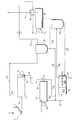
- the sole drawing figure is a schematic repre - sentation of apparatus and methods employed in material remediation according to the present in - vention.
- the present invention is useful for eliminating hydrocarbon contaminants from a wide variety of materials, for example, sludges, drilling muds, metal turnings, inorganic chemicals and has particular applicability to remediating hydrocarbon - contaminated soil.
- remediating hydrocarbon - contaminated soil it will be appre - ciated that it has applicability to the remediation of other hydrocarbon - contaminated materials.
- a first-stage heating unit for example, a rotatable drum dryer 10 for receiving contaminated soil from a hopper 12 or other suitable soil delivery apparatus.
- Rotary drum dryer 10 preferably has an inlet 14 for receiving contaminated soil at one end of the dryer and a burner 16 at its opposite end.
- the cylindrical interior surface of dryer 10 is preferably provided with a plurality of circumferentially and axially spaced flights, not shown, whereby, upon rotation of the dryer about its axis, the contaminated soil is lifted and permitted to veil through the hot gases passing through the dryer.
- a soil outlet 18 is disposed adjacent the burner end of dryer 10. Also, disposed adjacent the inlet end of dryer 10 is an exhaust gas outlet 20. While a rotatable drum dryer is the preferred form of dryer for the first-stage heating unit hereof, other types of dryers, for example, fluidized bed, flash or rotary hearth dryers may be used to achieve the thermal drying of the material inlet to the first - stage heating unit.
- the partially remediated soil from the first dryer 10 flows, by a suitable conveying means, through inlet 22 into a second-stage heating unit 24.
- Unit 24 is preferably a high-temperature heating and volatilizing unit, e.g., a rotary drum lined with a refractory material or material capable of withstanding high temperatures.
- a burner 26 At the opposite end of unit 24 from inlet 22, there is disposed a burner 26 whereby the hot gases of combustion from burner 26 and the soil flowing into drum unit 24 through inlet 22 are in counterflow relation one to the other.
- the second unit 24 is operated at a higher temperature than the first unit 10.
- Unit 24 is therefore essentially a desorber, i.e., a unit which thermally drives organics from the soil. Consequently, the soil, upon exiting the second unit 24 at outlet 28, is substan - tially free of hydrocarbon contaminants.
- This soil is conveyed, as indicated at 30, to a cooler 32 where the soil, at elevated temperature, is cooled and remoisturized by the addition of cooling water.
- the remoisturized remediated soil is outlet at 34 from cooler 32 for suitable disposition.
- Cooler 32 may comprise a single rotary drum with tandem compartments.
- a first compartment 32a may receive the heated contaminant-free soil for mixing with dust from the soil (as described hereinafter) for remediating the dust at high tern- peratures.
- a second compartment 32b receives the mixed soil and a spray apparatus may apply water to the soil to remoisturize it.
- a significant feature of the present invention resides in employing the volatilized contaminants from the second unit as fuel for the burner 16 of the first unit 10. These volatilized contaminants exit the second unit 24 at outlet 33 for conveyance to burner 16 or for flow into the flame. Thus, sub - stantially all of the volatilized contaminants received from the second unit are at least partially oxidized by the burner 16 of the first unit 10. Also, certain of the volatilized intermediate and high boiling fraction contaminants from the second unit 24 are reduced to the lower boiling fractions.
- the gases exhausting from the first unit 10 at the exhaust gas outlet 20 include the portion of the contaminants volatilized in unit 10, i.e., the low boilers, any remaining non-oxidized, volatilized portion of the remaining contaminants from the second unit and any dust from the con - taminated soil.
- Separator 38 is preferably a baghouse which conventionally has a plurality of filtration bags, not shown, which depend from a support structure for separating the soil dust and the volatilized contaminants one from the other.
- the gas stream flowing into the baghouse 38 via line 36 is exposed to the bags with the dust unable to penetrate the bags. The dust therefore settles out, while the volatilized contaminants flow through the bags for egress from separator 38 via line 40.
- the dust separated in separator 38 from the volatilized contaminants flows via line 42 for combination with the hydrocarbon contaminant-free soil exiting the second unit 24. That is, line 42 communicates with line 30 whereby the combined soil and dust is supplied cooler 32 for cooling and remoisturizing.
- the volatilized contaminants separated from the gas stream in baghouse 38 are eliminated before the gases are set free into the atmosphere.
- a thermal oxidizer 42 although it will be appreciated that other apparatus could be used to eliminate the volatile organic compounds from the exhaust gas stream.
- carbon adsorption, chemical reaction, and condensation equipment may be used.
- the preferred thermal oxidizer 42 includes a burner 44 for incinerating the volatilized contaminants.
- the gas stream 40 containing the volatilized contamin - ants first passes in heat exchange relation with the exhaust 46 from the thermal oxidizer in a heat exchanger 48.
- the exhaust gases from the thermal oxidizer thus preheat the volatilized contaminants before their oxidation in the thermal oxidizer 42.
- the exhaust gases then flow to a stack, not shown, for return to the atmosphere.
- the contaminated soil is conveyed from hopper 12 into the first unit 10 for heat exchange relation with the hot combustion gases from burner 16, preferably a counterflow heat exchange relation.
- the first unit 10 is essentially a low temperature drying operation for vaporizing the moisture contained in the soil and also for volatilizing the low boiling fraction consisting of the low boilers of the hydrocarbon contaminants on the soil. These are the volatilized contaminants which will not con - dense out at the maximum operating temperature of the baghouse.
- the first unit 10 is preferably operated in a range to provide a soil discharge temperature of about 150 - 450 0 F, the temperature being adjustable depending upon the nature of the hydrocarbons contained in the contaminated soil and preferably at a range of 200 - 350 ° F. Stated differently, the soil discharge temperature from first unit 10 should be low enough to retain the heavy and intermediate hydrocarbon fractions in the soil without volatilization.
- the second-stage heating unit 24 receives the partially remediated soil which remains con - taminated with the intermediate and high boiling fractions comprising the intermediate and high boilers.
- the second unit 24 is operated at a higher temperature than the first dryer. For example, it may be operated within a range of 200 - 1500 ° F and is preferably operated within a range of 1000 - 1100 F.
- the intermediate and high boilers are volatilized and the soil discharged the second unit is accordingly substantially free of hydrocarbon contaminants.
- the soil is conveyed to the cooler 32 for cooling and remoisturization whereupon it constitutes wholly remediated soil.
- the exhaust gases carrying the intermediate and high boilers from the second unit 24 are input via line 35 to burner 16 of the first unit 10 or its flame at a relatively high temperature, i.e., on the order of 300° - 800 °F. Burner 16 thus at least partially oxidizes substantially all of the volatilized con - taminants received from the second unit.
- the quantity of fuel necessary to maintain burner 16 operating suffi - ciently to provide a first unit temperature within the prescribed range of about 150-450° F and pref - erably in a range of 200 - 350 ° F may be less than the fuel supplied to the burner by the volatilized contaminants received from the second unit.
- all of the volatilized contaminants from the first and second - stage heating units and the dust from the contaminated soil exit the first unit 10 via line 36 for passage through the separator.
- the temperature of those materials does not exceed the maximum operating temperature of the separator and may be up to about 400 - 450 ° F, but is preferably lower.
- the dust is separated from the volatilized contaminants in separator 38.
- the dust may contain residual hydrocarbon contaminants. To eliminate those, the dust is remediated separately by a thermal or other reaction process. Preferably, the dust is returned via line 30 to the soil discharged from the second unit 24 at elevated temperatures. Those elevated temperatures are sufficient to drive off the residual volatile organic compounds on the dust. These off-gases may be removed from the cooler 32, i.e., the mixer 32a, by a conduit 50 connected to line 35 for ultimate oxidation in burner 16 , or by conduit 52, indicated by the dashed line, for oxidation in thermal oxidizer 42.
- the off - gases con - taining the volatilized residual contaminants on the dust are eliminated by oxidation via lines 50 and 35 by burner 16 or via lines 50 and 52 by thermal oxidizer 42, respectively.
- oxidation via lines 50 and 35 by burner 16 or via lines 50 and 52 by thermal oxidizer 42, respectively.
- other appara - tus such as those noted previously, may be used to eliminate these residual contaminants.
- the volatilized contaminants separated from the dust at separator 38 are passed to the thermal oxidizer 42. They are, however, first preheated by placing them in heat exchange relation with the products of oxidation from thermal oxidizer 42 in heat economizer 48. These preheated volatilized contaminants are subsequently incinerated in oxidizer 42 and the exhaust products of oxidation are passed to a stack, not shown.
- auxiliary baghouse 54 there may also be provided an auxiliary baghouse 54. Steam generated in cooler 32b upon remoisturization of the soil may carry with it dust from the remediated soil. This hydrocarbon-free steam-carried dust may flow via line 56 to baghouse 54 for separation. The dust separated from the steam at baghouse 54 may be returned to the remediated soil via line 58.
Landscapes
- Engineering & Computer Science (AREA)
- Environmental & Geological Engineering (AREA)
- Life Sciences & Earth Sciences (AREA)
- Soil Sciences (AREA)
- Chemical & Material Sciences (AREA)
- Health & Medical Sciences (AREA)
- Physics & Mathematics (AREA)
- Thermal Sciences (AREA)
- General Engineering & Computer Science (AREA)
- Biomedical Technology (AREA)
- Mechanical Engineering (AREA)
- Analytical Chemistry (AREA)
- General Chemical & Material Sciences (AREA)
- Oil, Petroleum & Natural Gas (AREA)
- Chemical Kinetics & Catalysis (AREA)
- Processing Of Solid Wastes (AREA)
- Processing And Handling Of Plastics And Other Materials For Molding In General (AREA)
Applications Claiming Priority (2)
| Application Number | Priority Date | Filing Date | Title |
|---|---|---|---|
| US07/792,279 US5170726A (en) | 1991-11-18 | 1991-11-18 | Apparatus and methods for remediating materials contaminated with hydrocarbons |
| US792279 | 1997-01-31 |
Publications (3)
| Publication Number | Publication Date |
|---|---|
| EP0543530A2 true EP0543530A2 (de) | 1993-05-26 |
| EP0543530A3 EP0543530A3 (en) | 1993-10-13 |
| EP0543530B1 EP0543530B1 (de) | 1996-09-04 |
Family
ID=25156347
Family Applications (1)
| Application Number | Title | Priority Date | Filing Date |
|---|---|---|---|
| EP92310068A Expired - Lifetime EP0543530B1 (de) | 1991-11-18 | 1992-11-03 | Verfahren und Vorrichtung zur Sanierung von Material das mit Kohlenwasserstoffen verunreinigt ist |
Country Status (7)
| Country | Link |
|---|---|
| US (1) | US5170726A (de) |
| EP (1) | EP0543530B1 (de) |
| AT (1) | ATE142326T1 (de) |
| AU (1) | AU658939B2 (de) |
| CA (1) | CA2082103A1 (de) |
| DE (1) | DE69213397T2 (de) |
| ES (1) | ES2093213T3 (de) |
Families Citing this family (17)
| Publication number | Priority date | Publication date | Assignee | Title |
|---|---|---|---|---|
| US5352275A (en) * | 1989-07-31 | 1994-10-04 | Cyclean, Inc. | Method of producing hot mix asphalt |
| AU658297B2 (en) * | 1992-06-22 | 1995-04-06 | Successful Ventures Enterprises Inc. | Method for treating soil contaminated with hydrocarbons |
| US5435258A (en) * | 1994-06-22 | 1995-07-25 | Piette; Michel | Method and apparatus for regenerating desiccants |
| US5658094A (en) * | 1996-01-05 | 1997-08-19 | Cedarapids, Inc | Energy recuperative soil remediation system |
| US5782188A (en) * | 1996-09-25 | 1998-07-21 | Evans; Marvin | Pyrolytic combustion apparatus and method |
| WO1998013151A1 (en) * | 1996-09-27 | 1998-04-02 | Rmt, Inc. | Method and system for the treatment of contaminated media as eg coal tar loaded soil |
| AUPP618598A0 (en) * | 1998-09-28 | 1998-10-22 | Innova Soil Technology Pty Ltd | Soil remediation system |
| US6464430B1 (en) * | 1999-10-27 | 2002-10-15 | Tom L. Maleck | Soil decontamination apparatus and method |
| DE102005052753A1 (de) * | 2005-11-04 | 2007-05-10 | Polysius Ag | Anlage und Verfahren zur Herstellung von Zementklinker |
| US7458325B1 (en) * | 2005-11-15 | 2008-12-02 | Bio-Solids Remediation Corp. | Process and apparatus for thermally treating bio-solids |
| US8080095B2 (en) * | 2006-05-10 | 2011-12-20 | The Board Of Trustees Of The University Of Illinois | Steady state tracking desorption system and method |
| ES2330707B1 (es) * | 2007-10-31 | 2010-06-29 | Empresa Para La Gestion De Residuos Industriales, S.A. (Emgrisa) | Sistema de descontaminacion termica de suelos. |
| DE102009025361B4 (de) * | 2009-06-18 | 2012-03-01 | Eisenmann Ag | Verfahren und Anlage zur Aufbereitung von Straßenaufbruchmaterial |
| FI20105165A7 (fi) * | 2010-02-19 | 2011-10-17 | Migliore Waste Solutions Oy Ltd | Menetelmä saastuneiden materiaalien käsittelemiseksi korkeassa lämpötilassa |
| WO2013075681A1 (de) * | 2011-11-25 | 2013-05-30 | Topf, Ulrike | Verfahren zur dekontamination von mit verdampfbaren metallischen und/oder verdampfbaren kohlenstoffhaltigen organischen schadstoffen belastetem erdreich |
| TWI498150B (zh) * | 2014-08-21 | 2015-09-01 | China Steel Corp | 含塵且含可冷凝成分之氣體的處理設備與方法 |
| CN110369477B (zh) * | 2019-08-30 | 2025-02-18 | 浙江宜可欧环保科技有限公司 | 基于直接热解脱附的土壤热解处理方法及设备 |
Family Cites Families (25)
| Publication number | Priority date | Publication date | Assignee | Title |
|---|---|---|---|---|
| US3618537A (en) * | 1969-12-15 | 1971-11-09 | John C Bogue | Solid waste disposal system |
| FR206069A (de) * | 1970-06-09 | |||
| US4374704A (en) * | 1978-08-24 | 1983-02-22 | Young William P | Apparatus for pyrolysis of hydrocarbon bearing materials |
| SE423928B (sv) * | 1978-09-12 | 1982-06-14 | Stal Laval Turbin Ab | Virvelbeddsbrennkammare |
| NL188101C (nl) * | 1981-05-18 | 1992-04-01 | Stevin Wegenbouw | Inrichting voor het behandelen van met giftige bestanddelen verontreinigd bodemmateriaal. |
| US4374650A (en) * | 1981-05-18 | 1983-02-22 | Allis-Chalmers Corporation | Bi-flow rotary kiln coal gasification process |
| US4431405A (en) * | 1982-02-23 | 1984-02-14 | Down River International, Inc. | Gas pollution control apparatus and method and wood drying system employing same |
| US4563246A (en) * | 1983-05-17 | 1986-01-07 | Pedco, Inc. | Apparatus for retorting particulate solids having recoverable volatile constituents |
| EP0141932A3 (de) * | 1983-08-25 | 1986-11-26 | Klöckner-Humboldt-Deutz Aktiengesellschaft | Verfahren und Anlage zur schadstofffreien Beseitigung von Schad- und Abfallstoffen mit geringem Heizwert, insbesondere Müll, durch Verbrennung |
| US4572781A (en) * | 1984-02-29 | 1986-02-25 | Intevep S.A. | Solvent deasphalting in solid phase |
| NL8400652A (nl) * | 1984-02-29 | 1985-09-16 | Ecotechniek Bv | Werkwijze en inrichting voor het reinigen van met giftige stoffen verontreinigde grond. |
| DE3520819C2 (de) * | 1985-06-11 | 1994-09-29 | Zueblin Ag | Verfahren zur thermischen Behandlung von mit Schadstoffen belasteten Massen sowie Anlage zur Durchführung eines solchen Verfahrens |
| US4748921A (en) * | 1986-03-27 | 1988-06-07 | Mendenhall Robert Lamar | Method for removing flammable hazardous liquid waste from soils |
| US4700638A (en) * | 1986-08-11 | 1987-10-20 | M & S Engineering And Manufacturing Co., Inc. | Method and apparatus for soil detoxification |
| US4667609A (en) * | 1986-09-08 | 1987-05-26 | Robert Hardison | Apparatus and method for treatment of soil contaminated with hydrocarbons |
| US4951417A (en) * | 1987-04-03 | 1990-08-28 | Canonie Environmental Services Corp. | Method of contaminated soil remediation and apparatus therefor |
| WO1989004730A1 (fr) * | 1987-11-19 | 1989-06-01 | Still Otto Gmbh | Procede et dispositif de traitement thermique de matieres en vrac contaminees |
| US4864942A (en) * | 1988-01-14 | 1989-09-12 | Chemical Waste Management Inc. | Process and apparatus for separating organic contaminants from contaminated inert materials |
| KR900700824A (ko) * | 1988-03-18 | 1990-08-17 | 원본미기재 | 고체물질로 부터 휘발성 유기 화합물을 박리시키는 방법 및 장치 |
| US4827854A (en) * | 1988-05-16 | 1989-05-09 | Collette Jerry R | Reflux volatilization system |
| US4945839A (en) * | 1989-01-06 | 1990-08-07 | Collette Jerry R | Dual chamber volatilization system |
| US4961391A (en) * | 1989-03-29 | 1990-10-09 | International Technology Corporation | Thermal treatment process for organically contaminated material |
| US5005493A (en) * | 1989-11-08 | 1991-04-09 | American Combustion, Inc. | Hazardous waste multi-sectional rotary kiln incinerator |
| US4974528A (en) * | 1989-12-08 | 1990-12-04 | Ryan-Murphy, Inc. | Method and apparatus for the treatment of contaminated soil |
| US5072674A (en) * | 1990-12-13 | 1991-12-17 | Roy F. Weston, Inc. | Apparatus and method for low temperature thermal stripping of volatile organic compounds from soil with non-oxidative cross-sweep gases |
-
1991
- 1991-11-18 US US07/792,279 patent/US5170726A/en not_active Expired - Lifetime
-
1992
- 1992-11-03 EP EP92310068A patent/EP0543530B1/de not_active Expired - Lifetime
- 1992-11-03 ES ES92310068T patent/ES2093213T3/es not_active Expired - Lifetime
- 1992-11-03 DE DE69213397T patent/DE69213397T2/de not_active Expired - Fee Related
- 1992-11-03 AT AT92310068T patent/ATE142326T1/de not_active IP Right Cessation
- 1992-11-04 CA CA002082103A patent/CA2082103A1/en not_active Abandoned
- 1992-11-05 AU AU28136/92A patent/AU658939B2/en not_active Ceased
Also Published As
| Publication number | Publication date |
|---|---|
| ES2093213T3 (es) | 1996-12-16 |
| DE69213397T2 (de) | 1997-02-20 |
| CA2082103A1 (en) | 1993-05-19 |
| AU658939B2 (en) | 1995-05-04 |
| AU2813692A (en) | 1993-05-20 |
| EP0543530B1 (de) | 1996-09-04 |
| US5170726A (en) | 1992-12-15 |
| EP0543530A3 (en) | 1993-10-13 |
| ATE142326T1 (de) | 1996-09-15 |
| DE69213397D1 (de) | 1996-10-10 |
Similar Documents
| Publication | Publication Date | Title |
|---|---|---|
| US5170726A (en) | Apparatus and methods for remediating materials contaminated with hydrocarbons | |
| US6213029B1 (en) | Process and apparatus for treating process streams from a system for separating consituents from contaminated material | |
| EP0224353B1 (de) | Verfahren und Vorrichtung zur Behandlung von Schlämmen | |
| US5405579A (en) | Decontamination of polluted soils | |
| CA2468720C (en) | Thermal remediation process | |
| US7019190B1 (en) | Soil remediation system | |
| EP0561906B1 (de) | Verfahren zur entseuchung kontaminierten bodens | |
| US4881473A (en) | Method and apparatus for treating oil-water-solids sludges and refinery waste streams | |
| US4901654A (en) | Deodorization and cleaning of medium temperature wet off-gases derived from burning of wet waste sludge | |
| JP2007519520A (ja) | 高度汚染物質処理システム | |
| DK169810B1 (da) | Fremgangsmåde og anlæg til oparbejdning af kontamineret jord | |
| US6183707B1 (en) | Incineration of waste gases containing contaminant aerosols | |
| US6019597A (en) | Process for minimizing condensibles in process streams treated by thermal oxidizers | |
| US5069689A (en) | Closed loop pollution control system | |
| JPS6217511A (ja) | 廃棄物を処理する方法 | |
| US5252124A (en) | Convertible asphalt and soil remediation plant and methods of operation | |
| AU2003204208B2 (en) | Soil remediation system | |
| AU2006202587B2 (en) | Soil remediation system | |
| Hawk et al. | High vacuum indirectly-heated rotary kiln for the removal and recovery of mercury from air pollution control scrubber waste | |
| CA2074290C (en) | Incineration of waste gas containing toxic or other fumes in the form of liquid droplets | |
| AU5962899A (en) | Soil remediation system | |
| WO1995035147A1 (en) | Treatment of contaminants |
Legal Events
| Date | Code | Title | Description |
|---|---|---|---|
| PUAI | Public reference made under article 153(3) epc to a published international application that has entered the european phase |
Free format text: ORIGINAL CODE: 0009012 |
|
| AK | Designated contracting states |
Kind code of ref document: A2 Designated state(s): AT DE DK ES FR GB GR IT NL SE |
|
| PUAL | Search report despatched |
Free format text: ORIGINAL CODE: 0009013 |
|
| AK | Designated contracting states |
Kind code of ref document: A3 Designated state(s): AT DE DK ES FR GB GR IT NL SE |
|
| 17P | Request for examination filed |
Effective date: 19940222 |
|
| 17Q | First examination report despatched |
Effective date: 19950308 |
|
| GRAG | Despatch of communication of intention to grant |
Free format text: ORIGINAL CODE: EPIDOS AGRA |
|
| GRAH | Despatch of communication of intention to grant a patent |
Free format text: ORIGINAL CODE: EPIDOS IGRA |
|
| GRAH | Despatch of communication of intention to grant a patent |
Free format text: ORIGINAL CODE: EPIDOS IGRA |
|
| GRAA | (expected) grant |
Free format text: ORIGINAL CODE: 0009210 |
|
| AK | Designated contracting states |
Kind code of ref document: B1 Designated state(s): AT DE DK ES FR GB GR IT NL SE |
|
| PG25 | Lapsed in a contracting state [announced via postgrant information from national office to epo] |
Ref country code: NL Free format text: LAPSE BECAUSE OF FAILURE TO SUBMIT A TRANSLATION OF THE DESCRIPTION OR TO PAY THE FEE WITHIN THE PRESCRIBED TIME-LIMIT Effective date: 19960904 Ref country code: GR Free format text: LAPSE BECAUSE OF FAILURE TO SUBMIT A TRANSLATION OF THE DESCRIPTION OR TO PAY THE FEE WITHIN THE PRESCRIBED TIME-LIMIT Effective date: 19960904 Ref country code: DK Effective date: 19960904 Ref country code: AT Effective date: 19960904 |
|
| REF | Corresponds to: |
Ref document number: 142326 Country of ref document: AT Date of ref document: 19960915 Kind code of ref document: T |
|
| REF | Corresponds to: |
Ref document number: 69213397 Country of ref document: DE Date of ref document: 19961010 |
|
| ITF | It: translation for a ep patent filed | ||
| ET | Fr: translation filed | ||
| PG25 | Lapsed in a contracting state [announced via postgrant information from national office to epo] |
Ref country code: SE Effective date: 19961204 |
|
| REG | Reference to a national code |
Ref country code: ES Ref legal event code: FG2A Ref document number: 2093213 Country of ref document: ES Kind code of ref document: T3 |
|
| NLV1 | Nl: lapsed or annulled due to failure to fulfill the requirements of art. 29p and 29m of the patents act | ||
| PLBE | No opposition filed within time limit |
Free format text: ORIGINAL CODE: 0009261 |
|
| 26N | No opposition filed | ||
| PGFP | Annual fee paid to national office [announced via postgrant information from national office to epo] |
Ref country code: FR Payment date: 20001023 Year of fee payment: 9 |
|
| PGFP | Annual fee paid to national office [announced via postgrant information from national office to epo] |
Ref country code: GB Payment date: 20001025 Year of fee payment: 9 |
|
| PGFP | Annual fee paid to national office [announced via postgrant information from national office to epo] |
Ref country code: ES Payment date: 20001030 Year of fee payment: 9 |
|
| PGFP | Annual fee paid to national office [announced via postgrant information from national office to epo] |
Ref country code: DE Payment date: 20001124 Year of fee payment: 9 |
|
| PG25 | Lapsed in a contracting state [announced via postgrant information from national office to epo] |
Ref country code: GB Free format text: LAPSE BECAUSE OF NON-PAYMENT OF DUE FEES Effective date: 20011103 |
|
| PG25 | Lapsed in a contracting state [announced via postgrant information from national office to epo] |
Ref country code: ES Free format text: LAPSE BECAUSE OF NON-PAYMENT OF DUE FEES Effective date: 20011104 |
|
| REG | Reference to a national code |
Ref country code: GB Ref legal event code: IF02 |
|
| GBPC | Gb: european patent ceased through non-payment of renewal fee |
Effective date: 20011103 |
|
| PG25 | Lapsed in a contracting state [announced via postgrant information from national office to epo] |
Ref country code: DE Free format text: LAPSE BECAUSE OF NON-PAYMENT OF DUE FEES Effective date: 20020702 |
|
| PG25 | Lapsed in a contracting state [announced via postgrant information from national office to epo] |
Ref country code: FR Free format text: LAPSE BECAUSE OF NON-PAYMENT OF DUE FEES Effective date: 20020730 |
|
| REG | Reference to a national code |
Ref country code: FR Ref legal event code: ST |
|
| REG | Reference to a national code |
Ref country code: FR Ref legal event code: ST |
|
| REG | Reference to a national code |
Ref country code: ES Ref legal event code: FD2A Effective date: 20021213 |
|
| PG25 | Lapsed in a contracting state [announced via postgrant information from national office to epo] |
Ref country code: IT Free format text: LAPSE BECAUSE OF NON-PAYMENT OF DUE FEES;WARNING: LAPSES OF ITALIAN PATENTS WITH EFFECTIVE DATE BEFORE 2007 MAY HAVE OCCURRED AT ANY TIME BEFORE 2007. THE CORRECT EFFECTIVE DATE MAY BE DIFFERENT FROM THE ONE RECORDED. Effective date: 20051103 |