EP0543608B1 - Automatisiertes Analysegerät zur Kontrolle des Gehaltes von Chloriden in Industrieprozessströmen - Google Patents
Automatisiertes Analysegerät zur Kontrolle des Gehaltes von Chloriden in Industrieprozessströmen Download PDFInfo
- Publication number
- EP0543608B1 EP0543608B1 EP92310461A EP92310461A EP0543608B1 EP 0543608 B1 EP0543608 B1 EP 0543608B1 EP 92310461 A EP92310461 A EP 92310461A EP 92310461 A EP92310461 A EP 92310461A EP 0543608 B1 EP0543608 B1 EP 0543608B1
- Authority
- EP
- European Patent Office
- Prior art keywords
- hydrocarbon
- vessel
- liquified
- deionized water
- liquified hydrocarbon
- Prior art date
- Legal status (The legal status is an assumption and is not a legal conclusion. Google has not performed a legal analysis and makes no representation as to the accuracy of the status listed.)
- Expired - Lifetime
Links
Images


Classifications
-
- G—PHYSICS
- G01—MEASURING; TESTING
- G01N—INVESTIGATING OR ANALYSING MATERIALS BY DETERMINING THEIR CHEMICAL OR PHYSICAL PROPERTIES
- G01N1/00—Sampling; Preparing specimens for investigation
- G01N1/28—Preparing specimens for investigation including physical details of (bio-)chemical methods covered elsewhere, e.g. G01N33/50, C12Q
- G01N1/40—Concentrating samples
- G01N1/405—Concentrating samples by adsorption or absorption
-
- G—PHYSICS
- G01—MEASURING; TESTING
- G01N—INVESTIGATING OR ANALYSING MATERIALS BY DETERMINING THEIR CHEMICAL OR PHYSICAL PROPERTIES
- G01N33/00—Investigating or analysing materials by specific methods not covered by groups G01N1/00 - G01N31/00
- G01N33/26—Oils; Viscous liquids; Paints; Inks
- G01N33/28—Oils, i.e. hydrocarbon liquids
- G01N33/2835—Specific substances contained in the oils or fuels
-
- G—PHYSICS
- G01—MEASURING; TESTING
- G01N—INVESTIGATING OR ANALYSING MATERIALS BY DETERMINING THEIR CHEMICAL OR PHYSICAL PROPERTIES
- G01N1/00—Sampling; Preparing specimens for investigation
- G01N1/28—Preparing specimens for investigation including physical details of (bio-)chemical methods covered elsewhere, e.g. G01N33/50, C12Q
- G01N1/40—Concentrating samples
- G01N1/4055—Concentrating samples by solubility techniques
- G01N2001/4066—Concentrating samples by solubility techniques using difference of solubility between liquid and gas, e.g. bubbling, scrubbing or sparging
-
- Y—GENERAL TAGGING OF NEW TECHNOLOGICAL DEVELOPMENTS; GENERAL TAGGING OF CROSS-SECTIONAL TECHNOLOGIES SPANNING OVER SEVERAL SECTIONS OF THE IPC; TECHNICAL SUBJECTS COVERED BY FORMER USPC CROSS-REFERENCE ART COLLECTIONS [XRACs] AND DIGESTS
- Y10—TECHNICAL SUBJECTS COVERED BY FORMER USPC
- Y10T—TECHNICAL SUBJECTS COVERED BY FORMER US CLASSIFICATION
- Y10T436/00—Chemistry: analytical and immunological testing
- Y10T436/11—Automated chemical analysis
- Y10T436/115831—Condition or time responsive
-
- Y—GENERAL TAGGING OF NEW TECHNOLOGICAL DEVELOPMENTS; GENERAL TAGGING OF CROSS-SECTIONAL TECHNOLOGIES SPANNING OVER SEVERAL SECTIONS OF THE IPC; TECHNICAL SUBJECTS COVERED BY FORMER USPC CROSS-REFERENCE ART COLLECTIONS [XRACs] AND DIGESTS
- Y10—TECHNICAL SUBJECTS COVERED BY FORMER USPC
- Y10T—TECHNICAL SUBJECTS COVERED BY FORMER US CLASSIFICATION
- Y10T436/00—Chemistry: analytical and immunological testing
- Y10T436/11—Automated chemical analysis
- Y10T436/115831—Condition or time responsive
- Y10T436/116664—Condition or time responsive with automated titrator
-
- Y—GENERAL TAGGING OF NEW TECHNOLOGICAL DEVELOPMENTS; GENERAL TAGGING OF CROSS-SECTIONAL TECHNOLOGIES SPANNING OVER SEVERAL SECTIONS OF THE IPC; TECHNICAL SUBJECTS COVERED BY FORMER USPC CROSS-REFERENCE ART COLLECTIONS [XRACs] AND DIGESTS
- Y10—TECHNICAL SUBJECTS COVERED BY FORMER USPC
- Y10T—TECHNICAL SUBJECTS COVERED BY FORMER US CLASSIFICATION
- Y10T436/00—Chemistry: analytical and immunological testing
- Y10T436/12—Condition responsive control
-
- Y—GENERAL TAGGING OF NEW TECHNOLOGICAL DEVELOPMENTS; GENERAL TAGGING OF CROSS-SECTIONAL TECHNOLOGIES SPANNING OVER SEVERAL SECTIONS OF THE IPC; TECHNICAL SUBJECTS COVERED BY FORMER USPC CROSS-REFERENCE ART COLLECTIONS [XRACs] AND DIGESTS
- Y10—TECHNICAL SUBJECTS COVERED BY FORMER USPC
- Y10T—TECHNICAL SUBJECTS COVERED BY FORMER US CLASSIFICATION
- Y10T436/00—Chemistry: analytical and immunological testing
- Y10T436/19—Halogen containing
-
- Y—GENERAL TAGGING OF NEW TECHNOLOGICAL DEVELOPMENTS; GENERAL TAGGING OF CROSS-SECTIONAL TECHNOLOGIES SPANNING OVER SEVERAL SECTIONS OF THE IPC; TECHNICAL SUBJECTS COVERED BY FORMER USPC CROSS-REFERENCE ART COLLECTIONS [XRACs] AND DIGESTS
- Y10—TECHNICAL SUBJECTS COVERED BY FORMER USPC
- Y10T—TECHNICAL SUBJECTS COVERED BY FORMER US CLASSIFICATION
- Y10T436/00—Chemistry: analytical and immunological testing
- Y10T436/19—Halogen containing
- Y10T436/193333—In aqueous solution
-
- Y—GENERAL TAGGING OF NEW TECHNOLOGICAL DEVELOPMENTS; GENERAL TAGGING OF CROSS-SECTIONAL TECHNOLOGIES SPANNING OVER SEVERAL SECTIONS OF THE IPC; TECHNICAL SUBJECTS COVERED BY FORMER USPC CROSS-REFERENCE ART COLLECTIONS [XRACs] AND DIGESTS
- Y10—TECHNICAL SUBJECTS COVERED BY FORMER USPC
- Y10T—TECHNICAL SUBJECTS COVERED BY FORMER US CLASSIFICATION
- Y10T436/00—Chemistry: analytical and immunological testing
- Y10T436/19—Halogen containing
- Y10T436/196666—Carbon containing compound [e.g., vinylchloride, etc.]
-
- Y—GENERAL TAGGING OF NEW TECHNOLOGICAL DEVELOPMENTS; GENERAL TAGGING OF CROSS-SECTIONAL TECHNOLOGIES SPANNING OVER SEVERAL SECTIONS OF THE IPC; TECHNICAL SUBJECTS COVERED BY FORMER USPC CROSS-REFERENCE ART COLLECTIONS [XRACs] AND DIGESTS
- Y10—TECHNICAL SUBJECTS COVERED BY FORMER USPC
- Y10T—TECHNICAL SUBJECTS COVERED BY FORMER US CLASSIFICATION
- Y10T436/00—Chemistry: analytical and immunological testing
- Y10T436/21—Hydrocarbon
-
- Y—GENERAL TAGGING OF NEW TECHNOLOGICAL DEVELOPMENTS; GENERAL TAGGING OF CROSS-SECTIONAL TECHNOLOGIES SPANNING OVER SEVERAL SECTIONS OF THE IPC; TECHNICAL SUBJECTS COVERED BY FORMER USPC CROSS-REFERENCE ART COLLECTIONS [XRACs] AND DIGESTS
- Y10—TECHNICAL SUBJECTS COVERED BY FORMER USPC
- Y10T—TECHNICAL SUBJECTS COVERED BY FORMER US CLASSIFICATION
- Y10T436/00—Chemistry: analytical and immunological testing
- Y10T436/25—Chemistry: analytical and immunological testing including sample preparation
- Y10T436/25125—Digestion or removing interfering materials
-
- Y—GENERAL TAGGING OF NEW TECHNOLOGICAL DEVELOPMENTS; GENERAL TAGGING OF CROSS-SECTIONAL TECHNOLOGIES SPANNING OVER SEVERAL SECTIONS OF THE IPC; TECHNICAL SUBJECTS COVERED BY FORMER USPC CROSS-REFERENCE ART COLLECTIONS [XRACs] AND DIGESTS
- Y10—TECHNICAL SUBJECTS COVERED BY FORMER USPC
- Y10T—TECHNICAL SUBJECTS COVERED BY FORMER US CLASSIFICATION
- Y10T436/00—Chemistry: analytical and immunological testing
- Y10T436/25—Chemistry: analytical and immunological testing including sample preparation
- Y10T436/25375—Liberation or purification of sample or separation of material from a sample [e.g., filtering, centrifuging, etc.]
-
- Y—GENERAL TAGGING OF NEW TECHNOLOGICAL DEVELOPMENTS; GENERAL TAGGING OF CROSS-SECTIONAL TECHNOLOGIES SPANNING OVER SEVERAL SECTIONS OF THE IPC; TECHNICAL SUBJECTS COVERED BY FORMER USPC CROSS-REFERENCE ART COLLECTIONS [XRACs] AND DIGESTS
- Y10—TECHNICAL SUBJECTS COVERED BY FORMER USPC
- Y10T—TECHNICAL SUBJECTS COVERED BY FORMER US CLASSIFICATION
- Y10T436/00—Chemistry: analytical and immunological testing
- Y10T436/25—Chemistry: analytical and immunological testing including sample preparation
- Y10T436/25375—Liberation or purification of sample or separation of material from a sample [e.g., filtering, centrifuging, etc.]
- Y10T436/255—Liberation or purification of sample or separation of material from a sample [e.g., filtering, centrifuging, etc.] including use of a solid sorbent, semipermeable membrane, or liquid extraction
-
- Y—GENERAL TAGGING OF NEW TECHNOLOGICAL DEVELOPMENTS; GENERAL TAGGING OF CROSS-SECTIONAL TECHNOLOGIES SPANNING OVER SEVERAL SECTIONS OF THE IPC; TECHNICAL SUBJECTS COVERED BY FORMER USPC CROSS-REFERENCE ART COLLECTIONS [XRACs] AND DIGESTS
- Y10—TECHNICAL SUBJECTS COVERED BY FORMER USPC
- Y10T—TECHNICAL SUBJECTS COVERED BY FORMER US CLASSIFICATION
- Y10T436/00—Chemistry: analytical and immunological testing
- Y10T436/25—Chemistry: analytical and immunological testing including sample preparation
- Y10T436/25875—Gaseous sample or with change of physical state
Definitions
- the present invention relates to a method and apparatus for the automated analysis of chemical plant process streams and in particular to a method and apparatus for the automated analysis of a liquified hydrocarbon stream such as isobutane feed to a propylene oxide/tertiary butyl alcohol plant to monitor the inorganic chloride content of the hydrocarbon feed.
- a liquified hydrocarbon stream such as isobutane feed to a propylene oxide/tertiary butyl alcohol plant to monitor the inorganic chloride content of the hydrocarbon feed.
- isobutane is an essential feed stream to commercial plants which co-produce propylene oxide (PO) and tertiary butyl alcohol (TBA) by procedures described, for example, in U.S. Patent 3,351,635.
- PO propylene oxide
- TSA tertiary butyl alcohol
- U.S. Patent 4,942,133 provides a procedure for the continuous analysis of the chloride ion content of overhead waters downstream of a hydrocarbon distillation column, but this does not relate to automated chloride analysis of hydrocarbon feed to a chemical plant.
- U.S. Patent 4,650,768 relates to automated methods for determination of chloride in an aqueous fluid sample, but this does not relate to automated chloride analysis of hydrocarbon feed to a chemical plant.
- GB-A-1007315 and US-A-4434233 describe methods and apparatus for determining the concentration of ion-forming contaminants in a liquid hydrocarbon by extracting the contaminant into water and measuring the conductivity of the water containing the extracted contaminant.
- GB-A-1007315 nor US-A-4434233 is concerned with analysis of streams which are under pressure. While GB-A-1007315 states that the "nonpolar liquid carrier" may or may not be normally liquid, there is no teaching as to how the process would operate under pressure: the specific embodiment is clearly designed to operate at atmospheric pressure and the separation of the nonpolar liquid carrier from the liquid solvent is achieved by gravity.
- an automated sampling method and system has been developed for the effective monitoring of the amount of chloride or other water-extractable impurity in a liquified plant hydrocarbon feed stream such as the isobutane feed to a PO/TBA plant.
- an automated analysis system comprising a hydrocarbon capture vessel for liquified hydrocarbon, conduit means for passing a predetermined sample amount of liquified hydrocarbon to said capture vessel, a water scrubbing vessel, conduit means for passing a predetermined amount of deionized water to said scrubbing vessel, conduit means connecting the capture vessel and the scrubbing vessel for transferring the predetermined sample amount of liquified hydrocarbon to the water containing scrubbing vessel and therein contacting said liquified hydrocarbon sample with the predetermined amount of deionized water to extract the water soluble impurities from the liquified hydrocarbon sample; pressure reducing means for reducing pressure in said water scrubbing vessel to a level at which liquified hydrocarbon contained thereon vaporizes; conduit means for the removal and discard of hydrocarbon vapor from the scrubbing vessel; titration means for analyzing the deionized water extract to determine the amount of impurities extracted from said
- the present invention also provides a method of monitoring chloride content of a liquified hydrocarbon having 2 to 5 carbon atoms which comprises periodically:
- sampling frequency can be increased and the time required for analysis can be decreased.
- the present invention is for the automated analysis of hydrocarbons which are normally gaseous and which can be readily liquified.
- hydrocarbons having 2 to 5 carbon atoms are suitably analyzed in accordance with the invention; examples of such hydrocarbons are ethylene, ethane, propylene, propane, n-butane, isobutane, the butylenes, the pentanes and the pentenes.
- the automated analysis system functions to determine the chloride content of the hydrocarbon.
- the system is readily adapted to the determination of other impurities such as sulfur and the like in the feed.
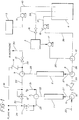
- each drawing represents a separate step in the automated analysis sequence and shows the valve positioning and flows of the various streams as the automated analysis sequence is carried out.
- vessel 1 represents a sample capture vessel
- vessel 2 represents a water scrubbing vessel
- vessel 3 represents a deionized water reservoir vessel
- vessel 4 represents a conventional titration zone
- vessel 5 represents a standard solution-containing vessel
- valves 6, 7, 8, 9 and 10 are conventional valves functioning to direct a fluid stream to either of two conduits
- valves 11 and 12 are conventional pressure regulating valves
- valves 13, 14, 15 and 16 are conventional valves which can be opened or closed to regulate fluid flow.
- Pumps 17, 18 and 19 are provided to accomplish liquid transfer.
- Step 1 of the automated analysis sequence is illustrated in Figure 1 in connection with the analysis of isobutane for chloride content.
- a stream of liquid isobutane at elevated pressure sufficient to maintain the isobutane in liquid state eg. 690 kPa gauge (100 psig)
- Sample collection vessel 1 is made of an appropriate material such as stainless steel and has a measured capacity, eg. 500 ml.
- Liquid isobutane fills collection vessel 1, with excess isobutane passing via line 22 to valve 7 and then via line 23 to pressure regulating valve 11 and then finally via line 24 to flare.
- Pressure regulating valve 11 maintains a sufficient back-pressure on vessel 1, eg. 552 kPa gauge (80 psig), to maintain the isobutane in the liquid phase therein.
- a measured amount of deionized water eg. 50 ml.
- a measured amount of deionized water is pumped from zone 3 via pump 17 and lines 25, 26 and 27 through valves 10 and 8 to scrubbing vessel 2. While the deionized water is being charged to scrubbing vessel 2, this vessel is vented to the atmosphere via line 28, valve 9, line 29, valve 15 and line 30.
- step 2 which is illustrated in Figure 2.
- Nitrogen at elevated pressure eg. at 552 kPa gauge (80 psig) is provided to capture vessel 1 via line 31, valve 7 and line 22. This nitrogen forces the liquid isobutane from vessel 1 via line 21, valve 6, line 32, valve 13, line 33, valve 8 and line 27 into scrubbing vessel 2.
- the liquid isobutane passes upwardly in intimate contact with the previously charged deionized water due to the density differences between the fluids.
- the chloride compounds contained in the liquid isobutane sample are extracted from the isobutane into the deionized water phase. Because the volumes of isobutane and deionized water are fixed, the impurities extracted from the isobutane are concentrated by a known factor in the deionized water.
- the isobutane passes upwardly through scrubbing vessel 2 with excess exiting via line 28, valve 9, line 34, pressure regulating valve 12, line 35 and line 24 to the flare.
- Pressure regulating valve 12 maintains sufficient pressure, for example 276 kPa gauge (40 psig), to ensure that liquid-liquid extraction contact occurs in scrubbing vessel 2 between the isobutane and the deionized water.
- step 3 the automated analysis system proceeds to step 3 which is illustrated in Figure 3.
- the pressure in vessel 2 is reduced to allow isobutane to evaporate from vessel 2.
- Check valve 14 is set at lower pressure, eg. 20.7 kPa gauge (3 psig), to allow the great bulk of the isobutane to pass as vapor to flare via line 28, valve 9, check valve 14 and line 38.
- scrubbing vessel 2 is provided with a source of heat, for example a heat tape, to prevent freezing of the deionized water as the isobutane evaporates.
- valve 15 opens to atmosphere to allow complete depressurization of the scrubbing vessel and removal of the remaining very small amount of isobutane.
- titrator 4 After the scrubbing vessel 2 is vented to atmospheric pressure via line 28, valve 9, line 29, valve 15 and line 30, the aqueous phase from scrubbing vessel 2 is transferred via 27, valve 8, line 26, valve 10, line 36, pump 18, and line 37 to titrator 4.
- titrator 4 the aqueous phase containing chloride extracted from the isobutane is titrated using known methods and equipment in order to determine the chloride content of the aqueous extract.
- a suitable and preferred titrating apparatus is a Tytronics Incorporated process titrator such as the Tytronics FPA 300 TM Series employing standard silver nitrate titration methods.
- Such apparatus is fully automated and capable of receiving the aqueous extract sample, titrating with silver nitrate and reporting chloride content of the sample. Results of the titration are immediately transferred to the process control room, thus providing a convenient and accurate measure of the chloride content of the isobutane feed stream sample.
- the titration in titrator 4 is carried out in accordance with known procedures. Basically, a known volume of the chloride-containing sample from the scrubbing vessel is titrated with a standard aqueous silver nitrate solution and the potential between a silver electrode and a non-chloride-containing reference electrode is continuously measured. Chloride in the sample being titrated forms silver chloride with the titrating solution and immediately precipitates. When all the chloride in the sample being analyzed has reacted, the presence of silver ions in the sample is detected by the sharp potential increase.
- the silver nitrate titrating solution eg.
- an 0.01 molar aqueous solution is added at a known and constant rate so that the time before appearance of silver ions can be determined and automatically compared with the time for appearance of silver ions in a standard calibrating solution for which the chloride content is known. By the ratio of these times, the chloride content of the sample, and thus of the hydrocarbon, is directly determined.
- a suitable cycle for the automated analysis system is a 15-minute cycle, that is, every 15 minutes the analysis process described above is repeated.
- deionized water passes from vessel 3 through valve 16 and via line 39 to titrator 4 in order to thoroughly wash and clean the titration apparatus.
- a further feature is that at periodic intervals, preferably once a day, the system auto-calibrates by means of a standard solution passed from vessel 5 via pump 19 and line 40 to titrator 4 in order to ensure accuracy of the operation.
- the automated analysis system of the present invention provides a sturdy and durable apparatus which is capable of a high degree of accuracy in the analysis of liquified hydrocarbons for impurities such as chlorine and chloride compounds.
- the apparatus requires only low maintenance and has been demonstrated to be extremely accurate and reliable.
Landscapes
- Chemical & Material Sciences (AREA)
- Health & Medical Sciences (AREA)
- Life Sciences & Earth Sciences (AREA)
- Immunology (AREA)
- Analytical Chemistry (AREA)
- Biochemistry (AREA)
- General Health & Medical Sciences (AREA)
- General Physics & Mathematics (AREA)
- Physics & Mathematics (AREA)
- Pathology (AREA)
- Engineering & Computer Science (AREA)
- Chemical Kinetics & Catalysis (AREA)
- General Chemical & Material Sciences (AREA)
- Oil, Petroleum & Natural Gas (AREA)
- Food Science & Technology (AREA)
- Medicinal Chemistry (AREA)
- Investigating Or Analyzing Non-Biological Materials By The Use Of Chemical Means (AREA)
Claims (5)
- Automatisiertes Analysengerät, enthaltend einen Kohlenwasserstoff-Auffangtank für verflüssigten Kohlenwasserstoff (1), Leitungen (20,21) zum Durchleiten einer definierten Probenmenge an verflüssigtem Kohlenwasserstoff zum Auffangtank, einen Tank zum Waschen mit Wasser (2), Leitungen (25,26,27) zum Einleiten einer definierten Menge entionisierten Wassers in den Waschtank, den Auffangtank und den Waschtank verbindende Leitungen (21,32,33,27) zum Überführen der definierten Probenmenge an verflüssigtem Kohlenwasserstoff in den Wasser enthaltenden Waschtank, worin die definierte Probenmenge an verflüssigtem Kohlenwasserstoff mit der definierten Menge an entionisiertem Wasser in Kontakt gebracht wird, um die wasserlöslichen Verunreinigungen aus der Probe aus verflüssigtem Kohlenwasserstoff zu extrahieren, eine Vorrichtung (4) zum Analysieren des Extraktes aus entionisiertem Wasser, um die aus der Probe verflüssigten Kohlenwasserstoff extrahierte Menge an Verunreinigungen zu bestimmen, sowie zwischen dem Waschtank und der Analysenvorrichtung angeordnete Leitungen (26,36,37) zum Überführen des Extraktes aus entionisiertem Wasser aus dem Waschtank in die Analysenvorrichtung, dadurch gekennzeichnet, daß das Gerät zusätzlich Vorrichtungen zum Verringern des Drucks (14,15), um den Druck im Wasserwaschtank auf ein Niveau zu reduzieren, bei dem der darin enthaltene verflüssigte Kohlenwasserstoff verdampft, und Leitungen (28,29,30) zum Entfernen und Entsorgen des Kohlenwasserstoffdampfes aus dem Waschtank umfaßt und die Analysenvorrichtung eine Titriervorrichtung ist.
- Automatisiertes Analysengerät gemäß Anspruch 1, bei dem die Titriervorrichtung ein automatisches Titriergerät darstellt.
- Automatisiertes Analysengerät gemäß Anspruch 1 oder 2, das zusätzlich eine Vorrichtung (5,19) für eine periodische Selbstkalibrierung der Titriervorrichtung enthält.
- Verfahren zum Überwachen des Chloridgehalts eines verflüssigten Kohlenwasserstoffs mit 2 bis 5 Kohlenstoffatomen, bei dem man periodisch(a) eine definierte Menge des verflüssigten Kohlenwasserstoff abfängt,(b) diese definierte Menge an verflüssigtem Kohlenwasserstoff in eine Zone für wäßrige Extraktion überführt,(c) den verflüssigten Kohlenwasserstoff in der Extraktionszone mit einer definierten Menge an entionisiertem Wasser in Kontakt bringt und zwar bei erhöhtem Druck, um einen flüssig-flüssig-Extraktionskontakt sicherzustellen,(d) den Druck verringert und den verflüssigten Kohlenwasserstoff in der Extraktionszone verdampft,(e) den Kohlenwasserstoffdampf aus der Extraktionszone entfernt,(f) das entionisierte Wasser, das aus dem verflüssigten Kohlenwasserstoff extrahiertes Chlorid enthält, von der Extraktionszone in eine Titrationszone überführt und(g) das entionisierte Wasser zum Bestimmen der darin enthaltenen Chloridmenge titriert.
- Verfahren gemäß Anspruch 4, bei dem der Kohlenwasserstoff Isobutan ist.
Applications Claiming Priority (2)
| Application Number | Priority Date | Filing Date | Title |
|---|---|---|---|
| US794278 | 1991-11-19 | ||
| US07/794,278 US5260220A (en) | 1991-11-19 | 1991-11-19 | Method and apparatus for monitoring impurities in a liquified hydrocarbon stream |
Publications (2)
| Publication Number | Publication Date |
|---|---|
| EP0543608A1 EP0543608A1 (de) | 1993-05-26 |
| EP0543608B1 true EP0543608B1 (de) | 1996-01-31 |
Family
ID=25162199
Family Applications (1)
| Application Number | Title | Priority Date | Filing Date |
|---|---|---|---|
| EP92310461A Expired - Lifetime EP0543608B1 (de) | 1991-11-19 | 1992-11-17 | Automatisiertes Analysegerät zur Kontrolle des Gehaltes von Chloriden in Industrieprozessströmen |
Country Status (3)
| Country | Link |
|---|---|
| US (2) | US5260220A (de) |
| EP (1) | EP0543608B1 (de) |
| DE (1) | DE69208045D1 (de) |
Families Citing this family (4)
| Publication number | Priority date | Publication date | Assignee | Title |
|---|---|---|---|---|
| DE4416203C2 (de) * | 1994-05-06 | 1996-03-14 | Siemens Ag | Einrichtung zum Bestimmen von Schadstoffen in einem flüssigen Brennstoff |
| US7052922B2 (en) * | 2003-07-21 | 2006-05-30 | Micron Technology, Inc. | Stable electroless fine pitch interconnect plating |
| WO2012141740A1 (en) * | 2011-04-14 | 2012-10-18 | Exxonmobil Upstream Research Company | Method for preparing petroleum based sample for analysis of elemental and isotopic species |
| GB201710412D0 (en) * | 2017-06-29 | 2017-08-16 | Johnson Matthey Plc | A system and method for measuring total chloride content in a process product stream |
Family Cites Families (13)
| Publication number | Priority date | Publication date | Assignee | Title |
|---|---|---|---|---|
| DE1261691B (de) * | 1961-07-21 | 1968-02-22 | Universal Oil Prod Co | Verfahren und Anordnung zur Ermittlung der Konzentration von lonen bildenden Bestandteilen in unpolaren Traegermedien |
| US3271111A (en) * | 1965-01-28 | 1966-09-06 | Universal Oil Prod Co | Method and apparatus for boron trihalide analysis |
| US3351635A (en) * | 1966-03-14 | 1967-11-07 | Halcon International Inc | Epoxidation process |
| US3495943A (en) * | 1966-11-30 | 1970-02-17 | Standard Oil Co | Process and apparatus for detection of ionic contaminants |
| US3660035A (en) * | 1969-03-26 | 1972-05-02 | Robin S Marsh | Method and apparatus for determination of hydrogen sulfide in hydrogen sulfide petroleum products |
| US4434233A (en) * | 1981-03-03 | 1984-02-28 | Carrier Corporation | Method of testing oil for ionic contaminants |
| US4650768A (en) * | 1985-02-01 | 1987-03-17 | Miles Laboratories, Inc. | Stable chloride test device |
| US5013667A (en) * | 1987-06-08 | 1991-05-07 | Dexsil Corporation | Apparatus and method for measuring halogen content |
| FR2624975B1 (fr) * | 1987-12-21 | 1990-09-21 | Total France | Procede d'analyse en continu des ions chlorures presents dans les eaux de tete d'une colonne de distillation d'hydrocarbures et analyseur pour la mise en oeuvre de ce procede |
| US5028543A (en) * | 1988-03-18 | 1991-07-02 | Dexsil Corporation | Method for measuring the content of halogenated organic compounds in soil samples |
| US4808299A (en) * | 1988-04-14 | 1989-02-28 | Phillips Petroleum Company | Removal of copper and iron from oil |
| US5122236A (en) * | 1990-05-21 | 1992-06-16 | Smith Jr Lawrence A | Method for removal of dimethyl ether and methanol from c4 hydrocarbon streams |
| US5192509A (en) * | 1991-08-22 | 1993-03-09 | Halliburton Company | Apparatus for automatic titration |
-
1991
- 1991-11-19 US US07/794,278 patent/US5260220A/en not_active Expired - Fee Related
-
1992
- 1992-11-17 DE DE69208045T patent/DE69208045D1/de not_active Expired - Lifetime
- 1992-11-17 EP EP92310461A patent/EP0543608B1/de not_active Expired - Lifetime
-
1993
- 1993-06-14 US US08/076,620 patent/US5368819A/en not_active Expired - Fee Related
Also Published As
| Publication number | Publication date |
|---|---|
| DE69208045D1 (de) | 1996-03-14 |
| EP0543608A1 (de) | 1993-05-26 |
| US5368819A (en) | 1994-11-29 |
| US5260220A (en) | 1993-11-09 |
Similar Documents
| Publication | Publication Date | Title |
|---|---|---|
| US5326482A (en) | On-line acid monitor and neutralizer feed control of the overhead water in oil refineries | |
| US5324665A (en) | On-line method for monitoring chloride levels in a fluid stream | |
| KR101507025B1 (ko) | 수중 유기오염물질 실시간 자동분석 장치 | |
| US10100637B2 (en) | Device for automatically calibrating an analyzer used for mud gas or fluid logging, associated analysis system and drilling rig | |
| US20020011096A1 (en) | Analytical apparatus for measurement of low concentration constituent, method of measurement and calibration using the same | |
| Goulden et al. | Determination of submicrogram levels of phenol in water | |
| RU2745752C1 (ru) | Пробоотборные устройства непрерывного и циклического типа и способ обнаружения компонентов смеси с использованием пробоотборных устройств | |
| US4229971A (en) | Liquid sampling system | |
| US5260220A (en) | Method and apparatus for monitoring impurities in a liquified hydrocarbon stream | |
| US5994147A (en) | System and method for determining acid-gas (CO2, H2 S) loadings in an alkanolamine system | |
| CN111272524A (zh) | 稀释样品液体的方法和用于后续分析的稀释单元 | |
| CN219915507U (zh) | 色谱辅助进样装置 | |
| US20100281950A1 (en) | Method and apparatus for analysis of mixed streams | |
| JPH11344477A (ja) | 有害有機物質の分解処理装置の排水のモニタリング方法及び装置 | |
| CN100548439C (zh) | 用于测量气体管线内气体中的硫元素的方法和设备 | |
| KR102169404B1 (ko) | 휴대용 실시간 환경오염물질 측정 시스템 | |
| US20090277255A1 (en) | Real-Time, On-Line Analysis for the Quantification of Trihalomethane Species Within Drinking Water Supplies | |
| US5734097A (en) | Analyzer and method for measuring water in liquids | |
| KR101507019B1 (ko) | 실시간 spme-gc 또는 spme-gc/ms 분석시스템을 이용한 유기오염물질의 실시간 자동분석 방법 | |
| JPH0510939A (ja) | 有機金属化合物中の不純物分析法 | |
| US4740474A (en) | Method for determining the presence of diborane in air | |
| CN220271242U (zh) | 异辛烷烃类气相色谱分析仪进样预处理装置 | |
| US11821823B2 (en) | Creating a hydrogen sulfide crude oil reference standard | |
| DE2713621A1 (de) | Verfahren und vorrichtung zur wasserueberwachung | |
| CA2040114A1 (en) | Method and system for continuously monitoring and controlling a process stream for dechlorination residual |
Legal Events
| Date | Code | Title | Description |
|---|---|---|---|
| PUAI | Public reference made under article 153(3) epc to a published international application that has entered the european phase |
Free format text: ORIGINAL CODE: 0009012 |
|
| AK | Designated contracting states |
Kind code of ref document: A1 Designated state(s): BE DE ES FR GB IT NL |
|
| 17P | Request for examination filed |
Effective date: 19930603 |
|
| 17Q | First examination report despatched |
Effective date: 19940309 |
|
| GRAA | (expected) grant |
Free format text: ORIGINAL CODE: 0009210 |
|
| AK | Designated contracting states |
Kind code of ref document: B1 Designated state(s): BE DE ES FR GB IT NL |
|
| PG25 | Lapsed in a contracting state [announced via postgrant information from national office to epo] |
Ref country code: IT Free format text: LAPSE BECAUSE OF FAILURE TO SUBMIT A TRANSLATION OF THE DESCRIPTION OR TO PAY THE FEE WITHIN THE PRE;WARNING: LAPSES OF ITALIAN PATENTS WITH EFFECTIVE DATE BEFORE 2007 MAY HAVE OCCURRED AT ANY TIME BEFORE 2007. THE CORRECT EFFECTIVE DATE MAY BE DIFFERENT FROM THE ONE RECORDED.SCRIBED TIME-LIMIT Effective date: 19960131 Ref country code: ES Free format text: THE PATENT HAS BEEN ANNULLED BY A DECISION OF A NATIONAL AUTHORITY Effective date: 19960131 Ref country code: BE Effective date: 19960131 |
|
| REF | Corresponds to: |
Ref document number: 69208045 Country of ref document: DE Date of ref document: 19960314 |
|
| ET | Fr: translation filed | ||
| PG25 | Lapsed in a contracting state [announced via postgrant information from national office to epo] |
Ref country code: DE Effective date: 19960501 |
|
| PG25 | Lapsed in a contracting state [announced via postgrant information from national office to epo] |
Ref country code: GB Effective date: 19961117 |
|
| PLBE | No opposition filed within time limit |
Free format text: ORIGINAL CODE: 0009261 |
|
| 26N | No opposition filed | ||
| GBPC | Gb: european patent ceased through non-payment of renewal fee |
Effective date: 19961117 |
|
| PGFP | Annual fee paid to national office [announced via postgrant information from national office to epo] |
Ref country code: FR Payment date: 20021030 Year of fee payment: 11 |
|
| PGFP | Annual fee paid to national office [announced via postgrant information from national office to epo] |
Ref country code: NL Payment date: 20021031 Year of fee payment: 11 |
|
| PG25 | Lapsed in a contracting state [announced via postgrant information from national office to epo] |
Ref country code: NL Free format text: LAPSE BECAUSE OF NON-PAYMENT OF DUE FEES Effective date: 20040601 |
|
| PG25 | Lapsed in a contracting state [announced via postgrant information from national office to epo] |
Ref country code: FR Free format text: LAPSE BECAUSE OF NON-PAYMENT OF DUE FEES Effective date: 20040730 |
|
| NLV4 | Nl: lapsed or anulled due to non-payment of the annual fee |
Effective date: 20040601 |
|
| REG | Reference to a national code |
Ref country code: FR Ref legal event code: ST |