EP0543625A2 - Machines dynamo-électriques à aimants permanents - Google Patents
Machines dynamo-électriques à aimants permanents Download PDFInfo
- Publication number
- EP0543625A2 EP0543625A2 EP92310500A EP92310500A EP0543625A2 EP 0543625 A2 EP0543625 A2 EP 0543625A2 EP 92310500 A EP92310500 A EP 92310500A EP 92310500 A EP92310500 A EP 92310500A EP 0543625 A2 EP0543625 A2 EP 0543625A2
- Authority
- EP
- European Patent Office
- Prior art keywords
- pole
- stator
- rotor
- salient
- dynamoelectric machine
- Prior art date
- Legal status (The legal status is an assumption and is not a legal conclusion. Google has not performed a legal analysis and makes no representation as to the accuracy of the status listed.)
- Withdrawn
Links
Images



Classifications
-
- H—ELECTRICITY
- H02—GENERATION; CONVERSION OR DISTRIBUTION OF ELECTRIC POWER
- H02K—DYNAMO-ELECTRIC MACHINES
- H02K23/00—DC commutator motors or generators having mechanical commutator; Universal AC/DC commutator motors
- H02K23/40—DC commutator motors or generators having mechanical commutator; Universal AC/DC commutator motors characterised by the arrangement of the magnet circuits
- H02K23/42—DC commutator motors or generators having mechanical commutator; Universal AC/DC commutator motors characterised by the arrangement of the magnet circuits having split poles, i.e. zones for varying reluctance by gaps in poles or by poles with different spacing of the air gap
-
- H—ELECTRICITY
- H02—GENERATION; CONVERSION OR DISTRIBUTION OF ELECTRIC POWER
- H02K—DYNAMO-ELECTRIC MACHINES
- H02K21/00—Synchronous motors having permanent magnets; Synchronous generators having permanent magnets
- H02K21/12—Synchronous motors having permanent magnets; Synchronous generators having permanent magnets with stationary armatures and rotating magnets
- H02K21/14—Synchronous motors having permanent magnets; Synchronous generators having permanent magnets with stationary armatures and rotating magnets with magnets rotating within the armatures
- H02K21/16—Synchronous motors having permanent magnets; Synchronous generators having permanent magnets with stationary armatures and rotating magnets with magnets rotating within the armatures having annular armature cores with salient poles
-
- H—ELECTRICITY
- H02—GENERATION; CONVERSION OR DISTRIBUTION OF ELECTRIC POWER
- H02K—DYNAMO-ELECTRIC MACHINES
- H02K29/00—Motors or generators having non-mechanical commutating devices, e.g. discharge tubes or semiconductor devices
- H02K29/03—Motors or generators having non-mechanical commutating devices, e.g. discharge tubes or semiconductor devices with a magnetic circuit specially adapted for avoiding torque ripples or self-starting problems
Definitions
- the present invention generally relates to dynamo-electric machines such as motors and generators.
- the present invention relates to a permanent magnet brushless DC motor having an improved stator configuration to reduce cogging.
- conventional permanent magnet brush-type DC motors are typically constructed having a stator and a rotor.
- the stator generally includes a number of permanent magnets housed within its core to provide the magnetic field for the rotor.
- the armature winding of the DC motor is typically placed in slots distributed across the face of an iron laminated rotor structure, wherein the armature coils are connected to the DC supply using a conventional brush/commutator arrangement.
- brush-commutated DC motors have several advantageous characteristics, including convenience of changing operational speeds, several disadvantages are also present. These disadvantages include brush and commutator heating, erosion of commutator and brush surfaces, electrical resistance, electrical noise, and radio frequency interference caused by sparking between the brushes and the segmented commutator. These disadvantages may limit the applicability of brush-type DC motors in some fields, such as the heating, ventilation, and air conditioning (HVAC) industry.
- HVAC heating, ventilation, and air conditioning
- the brushless DC motor is basically a permanent magnet DC motor, wherein the commutator and brushes of the conventional DC motor have been replaced by electronic switches to perform the commutation.
- ECM electronically commutated motor
- the electronics switch the motor windings at the appropriate time to control the rotation of the machine.
- a permanent magnet rotor is housed within a stator core having an electronically commutated winding distributed among the stator teeth.
- cogging is the non-uniform rotation of the rotor caused by the tendency of the rotor to prefer certain discrete angular positions.
- the degree of cogging is not only affected by the number of salient poles in the stator, but also by the structural configuration of the face of the salient pole.
- the cogging torque may be reduced by providing a substantially constant air gap energy.
- the high permeability of the pole shoe provides a low reluctance shunt path for the armature reaction flux around the permanent magnet, thus protecting it from being demagnetized.
- the continuity of any magnetic flux shunt path around the permanent magnet is interrupted by the notches.
- Embodiments of the invention seek to provide: an improved stator configuration for a dynamoelectric machine; an improved permanent magnet brushless DC motor having reduced cogging; and/or an improved salient pole configuration for a permanent magnet motor which does not degrade either the demagnetization margin or the overall efficiency.
- Embodiments of the present invention seek to provide an improved salient pole configuration for a dynamoelectric machine, particularly for a permanent magnet brushless DC motor wherein cogging would otherwise be a problem.
- a dynamoelectric machine comprises: a movable member having a face, the movable member having means for producing a magnetic field; arid a stationary member having a core and a plurality of salient poles projecting from the core and toward the movable member, each of the plurality of salient poles having a winding at least partially disposed within the magnetic field and having a head portion having a pole face disposed substantially adjacent to the movable member face to form an air gap therebetween, at least one of the plurality of salient poles having at least one aperture disposed within the pole head portion and substantially adjacent but not adjoining the pole face.
- the aperture in the pole head portion creates a nonuniform reluctance path within the pole head for magnetic flux between the movable member face and the stator core to reduce cogging.
- a permanent magnet brushless DC motor is comprised of a permanent magnet rotor having a central axis and an external surface; and a stator having a stator core surrounding the rotor and having a central axis coincident with the rotor central axis, the stator having a plurality of salient poles projecting inwardly from the stator core and toward the rotor, each of the plurality of salient poles having a head portion forming a pole face disposed substantially adjacent to the rotor surface, at least one of the plurality of salient poles having at least one aperture disposed within the pole head portion and substantially adjacent but not adjoining the pole face, thereby forming a bridge between the aperture and the pole face.
- a permanent magnet brushless DC motor is comprised of a stator having a stator core and having a central axis; and a permanent magnet rotor surrounding the stator and having a central axis coincident with the stator central axis, the rotor having an internal surface; the stator having a plurality of salient poles projecting outwardly from the stator core and toward the rotor, each of the plurality of salient poles having a head portion forming a pole face disposed substantially adjacent to the rotor surface, at least one of the plurality of salient poles having at least one aperture disposed within the pole head portion and substantially adjacent but not adjoining the pole face, thereby forming a bridge between the aperture and the pole face.
- a stator lamination ring comprising a substantially flat member having a thickness T, having a substantially circular empty space adapted for a rotor, and having an outer stator core portion surrounding the rotor space, the stator core portion having a plurality N of salient pole portions projecting inwardly from the stator core portion and toward the rotor space, each of the plurality of salient poles having a root portion and a pole head portion forming a pole face disposed substantially adjacent to the rotor space, the root portion having a width R, the pole head portion having a width S, wherein the width R is less than the width S, at least one of the plurality of salient pole portions having at least one aperture disposed within the pole head portion and substantially adjacent but not adjoining the pole face, thereby forming a bridge having a width U between the aperture and the pole face.
- the aperture or "reluctance hole" in the pole head portion of the stator salient pole functions to reduce cogging in the permanent magnet motor in much the same manner as the notches placed in the face of the salient pole.
- the use of a reluctance hole instead of a notch allows for the face of the salient pole head portion to remain smooth, while the reluctance hole bridge provides a low reluctance shunt path for the armature reaction flux around the permanent magnet.
- the demagnetization margin of the motor is significantly increased. Futhermore, improved efficiency of the motor results from the use of the reluctance hole, since the bridge provides an additional flux path across the air gap to the rotor.
- a permanent magnet brushless direct current (DC) motor generally designated as 10, is shown in a simplified perspective view.
- the DC motor includes a shaft 12, a rotating assembly or rotor 14, and a stationary assembly or stator 16. Since the preferred embodiment of the dynamoelectric machine is a one-horsepower permanent magnet brushless DC motor for HVAC applications, the shaft 12 would normally operate to power a load. However, if the dynamoelectric machine was a generator, a prime mover would rotate the shaft 12 and develop electric power in the stator 16.
- the motor 10 is shown in Figure 1 as being disassembled for purposes of illustration, the rotor 14 and stator 16 would normally be assembled such that the central axis of the rotor, running through the center of the shaft 12, would be coincident with the central axis of the stator, such that the rotor and the stator would be in magnetic coupling relation.
- the rotor 14 includes a number of permanent magnet elements 18 which rotate about the rotor's central axis of rotation.
- four magnet elements 18 form a four-pole rotor.
- the magnets 18 are affixed to the external surface of the rotor 14 by gluing, embedding, or retaining them in an appropriate manner as known in the art.
- the stator 16 includes a stator core 20 formed in the shape of a cylinder having a central axis coincident with the rotor central axis.
- the stator core 20 is typically formed from a number of individual stator rings stacked and laminated together.
- a number of salient poles 22 project inwardly from the stator core toward the rotor.
- each of the salient poles 22 has an upper or head portion including at least one aperture or "reluctance hole" 24 disposed therein.
- An armature winding 26 is disposed around the base of each of the salient poles 22 to create the magnetic field, as opposed to being distributed in the gap between the salient poles or being wound around several salient poles.
- the embodiment of the present invention shown in Figure 1 is a permanent magnet brushless DC motor having an armature winding on salient poles located in the stator 16, the invention is not limited to such an embodiment.
- the permanent magnet rotor can be configured as an outer collar or shell which rotates about an inner stator core.
- the rotor may include the armature windings, while the field windings would be disposed around the base of the salient poles in the stator. In either case, at least one aperture is disposed in the upper portion of the stator salient poles.
- FIG. 2 is a cross-sectional view of the DC brushless motor of Figure 1, illustrating a cross-section of the rotor 14 located within the stator 16.
- Six salient poles 22 project inwardly from the stator core 20 toward the external surface 28 of the permanent magnet rotor 14.
- Each of the salient poles 22 includes a root portion 30 around which the armature windings 26 are wound.
- the distal end of each of the salient poles 22 defines a head portion 32, the uppermost surface of which forms a pole face 34 disposed substantially parallel to and adjacent the external surface 28 of the rotor.
- An air gap 36 lies between the external surface 28 of the rotor and the pole face 34.
- the head portion 32 of each salient pole 22 has a width which is greater than that of the root portion 30. However, depending upon the particular application for the motor, this may not always be the case.
- One or more apertures 24 are disposed within the pole head portion 32 of each of the salient poles 22 as shown.
- the apertures in the pole head portion are air-filled; however, the apertures could be filled with any material that has a magnetic permeability sufficiently lower than that of magnetic steel, and preferably close to that of air, i.e., plastic, aluminum, etc.
- the apertures create a nonuniform reluctance path within the pole head for magnetic flux emanating from the rotor across the air gap to the stator core.
- the apertures 24, or reluctance holes are positioned substantially adjacent the pole face 34, but not adjoining it. In this manner, a portion of the pole head material remains between the edge of the reluctance hole 24 and the pole face 34 to form a bridge 38.
- the reluctance hole bridge 38 provides a reluctance shunt path for the armature reaction flux around the permanent magnet element 18, thereby increasing the demagnetization margin of the DC motor.
- the bridge 38 also provides an additional flux path across the air gap 36 to the rotor 14, thereby resulting in improved efficiency, as will also be seen below.
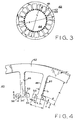
- FIG 3 is plan view of a stator lamination ring 40 constructed in accordance with the present invention. Perhaps hundreds of these stator lamination rings 40 would be used to construct a stator core 20 for a motor. Each stator lamination ring 40 would be punched or die cut from a flat sheet of steel to have the correct salient pole and reluctance hole configuration.
- the stator lamination ring 40 is comprised of a substantially circular outer ring forming the stator core portion 42, with a substantially circular empty space 44 in the center which is adapted for the rotor 14.
- the outer stator core portion 42 surrounds the rotor space 44 as shown.
- the stator core portion 42 has a number of salient pole portions 46 projecting inwardly from the stator core portion 42 and towards the rotor space 44.
- a number of salient pole portions 46 projecting inwardly from the stator core portion 42 and towards the rotor space 44.
- eighteen salient pole portions 46 are used.
- the number of salient poles is generally determined by the size of the motor, i.e., only large motors would use this many salient poles.
- stator lamination rings 40 which comprise the stator core 20 would be identical. That is, each stator lamination ring 40 would have two reluctance holes disposed in each salient pole head portion. Using this configuration, the laminated stator core would appear to have two reluctance holes bored through the head portion of each salient pole in the direction of the central axis of the stator core and extending from one end of the stator core to the other. If, however, the stator lamination ring at each end of the stator core were replaced with one having no reluctance holes, then it would not be apparent that any reluctance holes were disposed in the stator salient poles.
- stator lamination ring without reluctance holes could be placed at the ends of the stator, or placed between lamination rings having reluctance holes, in order to provide various aperture configurations and/or depths.
- numerous reluctance hole configurations can be used, so long as at least one aperture is disposed within the pole head portion of at least one salient pole.
- FIG 4 is an enlarged partial perspective view of the stator lamination ring 40 of Figure 3.
- each of the eighteen salient poles 46 has a root portion 48 and a pole head portion 50.
- stator lamination ring having an overall outside diameter (dimension “x” of Figure 4) of approximately 5.48 inches and an inner diameter “y” of approximately 4.88 inches, giving a stator core portion 42 width of approximately 0.30 inches, the height dimension (dimension “a” of Figure 4) of each of the salient poles is approximately 0.88 inches, the width "b" of the root portion of each of the poles is approximately 0.15 inches, while the width "c” of the pole head portion 50 is approximately 0.45 inches.
- the height “d” of the pole head portion 50 is approximately 0.01 inches.
- each of the eighteen salient pole portions 46 has at least one aperture or reluctance hole 52 disposed within the pole head portion 50.
- the reluctance hole 52 is positioned such that it is substantially adjacent the pole face 54, but not physically lying within or adjoining the pole face. Using this configuration, a bridge portion 56 remains between the reluctance hole 52 and the pole face 54.
- rectangularly-shaped reluctance holes are shown in Figure 4. In this embodiment, the width "e" of the rectangular reluctance hole is approximately 0.04 inches, while the length "f" is approximately 0.09 inches.
- the bridge portion 56 has a width "i” of approximately 0.02 inches.
- the thickness "j" of each of the stator lamination rings is approximately 0.03 inches.
- the number of reluctance holes disposed in each salient pole depends upon the total number of stator salient poles and rotor magnetic poles.
- the ratio of six stator salient poles to four rotor magnetic poles is also 1.5, such that two reluctance holes are again used.
- a different number of reluctance holes and/or salient pole configurations can be used.
- Figures 5A-5E are enlarged partial plan views of various embodiments of the salient pole head portions 50 showing numerous configurations for the size, shape, and location of the reluctance holes.
- two reluctance holes 52 exhibit a rectangular shape having the dimensions described in conjunction with Figure 4.
- the reluctance holes 58 have been changed to exhibit a semicircular or "D-shape", wherein the bottom of the reluctance hole which lies parallel to the face 54 of the pole head portion is flattened as shown .
- This configuration allows for the maximum amount of material to be removed from the pole head portion for purposes of cogging reduction, while at the same time maintains a sufficiently-wide bridge portion 56 for purposes of improving the demagnetization margin.
- Figure 5C illustrates the head portion 50 of a salient pole 46 having a single reluctance hole 62 disposed therein.
- the reluctance hole 62 in this embodiment, has an oblong shape which is elongated in the direction parallel to the pole face 54 as shown.
- One reluctance hole, such as shown here, could be used in a DC brushless motor having twelve salient poles and ten rotor magnetic poles.
- Figure 5D illustrates that three reluctance holes 64 could also be used, preferably, for a DC brushless motor having a very high number of rotor magnetic poles. The exact location of the holes 64 would be determined by the location of the rotor magnetic poles with respect to the gap between the pole head portions.
- the shape of the salient pole 66 may prescribe the shape of the reluctance holes 68.
- the reluctance holes are substantially triangular having a bottom edge parallel to the pole face 54.
- one or more reluctance holes could be disposed in only certain salient poles, such as, for example, alternating salient poles, or only the salient poles of the inside lamination rings.
- the number of reluctance holes could also vary depending upon whether or not the stator core includes one or more auxiliary poles or "inter-poles" disposed in the gap between the salient poles. The inter-poles themselves may also exhibit the reluctance hole configuration of the present invention.
- Figure 6 is a graphical representation of the air gap magnetic flux density (B) distribution as a function of angular position ( ⁇ ) of the rotor for a brushless DC motor having notches in the face of the salient poles.
- B air gap magnetic flux density
- ⁇ angular position
- FIG. 6 A number of salient poles 70 are shown at the top of the figure, wherein each of the pole head portions contains two notches 72 which extend from the pole face 34 into the pole head.
- An air gap 36 lies between the pole face 34 and the external surface 28 of the rotor, which is only partially shown as having a number of permanent magnets 18.
- the air gap flux density distribution B( ⁇ ) is shown for one of the rotor magnetic pole segments (north) as a function of the angular position ( ⁇ ) of the rotor.
- the flux density B is highest at the center of the salient pole, and lowest at the gap between the pole head portions.
- the flux density B also drops significantly at the position of each of the notches 72.
- the change in flux density ⁇ B over the pole face can be seen to exhibit a highly irregular ripple having an average flux density which is much lower than that which would normally be exhibited by a motor having salient poles without the notches 72.
- a brushless DC motor having much a flux density distribution would typically exhibit an efficiency of approximately 78%.
- the demagnetization margin would be significantly degraded.
- Figure 7 is a graphical representation of the magnetic flux density distribution B( ⁇ ) for a brushless DC motor having the reluctance hole configuration in accordance with the present invention.
- two reluctance holes 24 are disposed in the head portion of each of the salient poles 22 in the manner shown in Figure 2.
- the maximum flux density distribution again lies at the center of the salient pole 22, while the minimum lies in the gap between adjacent salient pole head portions.
- the flux density distribution at the reluctance holes 24 is significantly higher than that of the flux density distribution at the notches shown in Figure 6.
- Figure 7 illustrates that the change in flux density distribution ⁇ B over each pole face is significantly reduced from that of Figure 6, such that the flux density distribution across the air gap is much less irregular.
- the average flux density distribution is much higher when reluctance holes are used as opposed to notches in the pole face. Hence, the reluctance holes exhibit less losses, which results in improved efficiencies.
- Figure 8 is a cross-sectional view of still another embodiment of the present invention, illustrating a permanent magnet DC brushless motor 80 having a three-salient pole stator 82 located within a two-pole rotor 84.
- the configuration of Figure 8 is basically the "inside-out" version of the brushless DC motor shown in Figure 2 with different numbers of poles.
- the permanent magnet rotor 84 having two permanent magnets 86 affixed to the inside surface of an outer collar or shell 88, rotates on bearings (not shown) around the central axis of the stator 82.
- the stator itself is comprised of three salient poles 90 projecting outwardly from a stator core 91 and having armature windings 92 surrounding the root portion of the salient poles, and having reluctance holes 94 disposed in the head portion 96 of each of the salient poles.
- the reluctance holes perform the same function of reducing cogging torque while at the same time maintaining an adequate demagnetization margin.
- stator 84 has a number of salient poles 90 projecting outwardly from the stator core 91 and toward the rotor 84.
- Each of the salient poles 90 has a head portion 96 which forms a pole face 97 disposed substantially adjacent to the internal surface 98 of the rotor 84.
- the reluctance holes 94 are disposed in the pole head portion substantially adjacent but not adjoining the pole lace 97, thereby forming a bridge 99 between each reluctance hole 94 and the pole face 97.
- FIG. 9 is a cross-sectional view of a DC generator 100 having stator salient poles constructed in accordance with the present invention.
- the generator 100 is comprised of a stator 102 and a rotor 104, wherein the stator 102 includes a stator core 106, two stator salient poles 108, and a number of salient pole exciting windings 110.
- the head portion 112 of each of the salient poles 108 includes one or more reluctance holes 114 disposed therein and substantially adjacent but not adjoining the pole face.
- the rotor 104 itself includes a number of armature windings 116 distributed within slots in the face of the rotor.
- the present invention provides an improved stator configuration for a dynamoelectric machine, particularly for a permanent magnet brushless DC motor having salient poles, wherein cogging and demagnetization problems must be addressed.
- the presence of an aperture or a reluctance hole in the pole head portion of the salient pole serves to reduce cogging in the permanent magnet motor in much the same manner as notches placed in the face of the salient pole, while avoiding the demagnetization and efficiency problems associated with such notches.
- the use of a reluctance hole instead of a notch provides a bridge portion to shunt the armature reaction flux around the permanent magnet to improve the demagnetization margin.
- the efficiency of the dynamoelectric machine is also improved, since the bridge provides an additional flux path across the air gap.
- the performance of the brushless DC motor is significantly improved, particularly for one-half to one-horsepower motors used for HVAC applications.
- the reluctance hole configuration of the present invention may be used with any type of dynamoelectric machine, such as, for example, DC motors, generators, etc.
- the particular salient pole configurations and reluctance hole dimensions of the preferred embodiment could readily be modified for different machines and/or different applications. Accordingly, the appended claims are intended to cover all such modifications and alternative constructions that fall within the true scope and spirit of the invention.
Landscapes
- Engineering & Computer Science (AREA)
- Power Engineering (AREA)
- Iron Core Of Rotating Electric Machines (AREA)
- Brushless Motors (AREA)
Applications Claiming Priority (2)
| Application Number | Priority Date | Filing Date | Title |
|---|---|---|---|
| US796041 | 1985-11-07 | ||
| US07/796,041 US5250867A (en) | 1991-11-20 | 1991-11-20 | Permanent magnet brushless DC motor having reduced cogging |
Publications (2)
| Publication Number | Publication Date |
|---|---|
| EP0543625A2 true EP0543625A2 (fr) | 1993-05-26 |
| EP0543625A3 EP0543625A3 (en) | 1994-09-07 |
Family
ID=25167115
Family Applications (1)
| Application Number | Title | Priority Date | Filing Date |
|---|---|---|---|
| EP19920310500 Withdrawn EP0543625A3 (en) | 1991-11-20 | 1992-11-18 | Permanent magnet dynamoelectric machines |
Country Status (3)
| Country | Link |
|---|---|
| US (1) | US5250867A (fr) |
| EP (1) | EP0543625A3 (fr) |
| CA (1) | CA2080149C (fr) |
Cited By (9)
| Publication number | Priority date | Publication date | Assignee | Title |
|---|---|---|---|---|
| EP0709947A3 (fr) * | 1994-10-28 | 1996-08-07 | Hewlett Packard Co | Equilibrage de forces radiaux à réluctance dans un moteur à courant continu |
| EP0778654A3 (fr) * | 1995-12-07 | 1998-10-07 | FER Fahrzeugelektrik GmbH | Alternateur triphasé pour bicyclettes |
| FR2844112A1 (fr) * | 2002-08-29 | 2004-03-05 | Mitsubishi Electric Corp | Moteur synchrone a aimant permanent |
| WO2008015149A1 (fr) * | 2006-07-31 | 2008-02-07 | Siemens Aktiengesellschaft | Moteur linéaire à compensation de l'ondulation de force |
| EP2066009A3 (fr) * | 1999-06-29 | 2012-06-27 | Sanyo Electric Co., Ltd. | Moteur CC sans balai et compresseur réfrigérant utilisant le moteur |
| GB2527101A (en) * | 2014-06-12 | 2015-12-16 | Jaguar Land Rover Ltd | A switched reluctance motor with reduced torque ripple |
| EP3136568A1 (fr) * | 2015-08-28 | 2017-03-01 | Johnson Electric S.A. | Moteur à aimant permanent à phase unique et son procédé de fabrication |
| EP2026445A3 (fr) * | 2007-08-17 | 2017-03-08 | Brose Fahrzeugteile GmbH & Co. KG, Würzburg | Machine synchrone à ondulation de couple réduite |
| WO2021052688A1 (fr) * | 2019-09-16 | 2021-03-25 | Magna powertrain gmbh & co kg | Machine électrique pour véhicule automobile |
Families Citing this family (80)
| Publication number | Priority date | Publication date | Assignee | Title |
|---|---|---|---|---|
| US5475277A (en) * | 1993-07-21 | 1995-12-12 | Fluidmaster, Inc. | Differential torque motor |
| JPH07177720A (ja) * | 1993-12-22 | 1995-07-14 | Matsushita Electric Ind Co Ltd | ブラシレスモータ |
| US5682072A (en) * | 1994-01-20 | 1997-10-28 | Nsk Ltd. | Three-phase brushless motor |
| US5523637A (en) * | 1994-04-28 | 1996-06-04 | Ford Motor Company | Permanent magnet electrical machine with low reluctance torque |
| JP3446350B2 (ja) * | 1994-11-29 | 2003-09-16 | アイシン精機株式会社 | スイッチドリラクタンスモータ |
| EP0748027B1 (fr) | 1995-06-07 | 2006-09-06 | General Electric Company | Machine dynamo-électrique et construction de rotor pour celle-ci |
| JP3376373B2 (ja) * | 1995-06-07 | 2003-02-10 | ミネベア株式会社 | モータ構造 |
| US5710474A (en) * | 1995-06-26 | 1998-01-20 | Cleveland Machine Controls | Brushless DC motor |
| JP3500822B2 (ja) * | 1995-12-26 | 2004-02-23 | アイシン・エィ・ダブリュ株式会社 | 永久磁石式同期電動機 |
| JPH1042531A (ja) * | 1996-05-24 | 1998-02-13 | Matsushita Electric Ind Co Ltd | 電動機 |
| JP3308828B2 (ja) * | 1996-10-18 | 2002-07-29 | 株式会社日立製作所 | 永久磁石回転電機及びそれを用いた電動車両 |
| JP3514929B2 (ja) * | 1996-12-04 | 2004-04-05 | 株式会社三協精機製作所 | モータ |
| US5955853A (en) * | 1997-01-31 | 1999-09-21 | Hewlett-Packard Company | Direct current motor for closed-loop feedback control |
| US5869939A (en) * | 1997-01-31 | 1999-02-09 | Hewlett-Packard Company | Direct current motor with imbalanced winding for closed-loop feedback control |
| US6940205B1 (en) * | 1997-09-08 | 2005-09-06 | Matsushita Electric Industrial Co., Ltd. | Permanent magnet synchronous motor |
| EP1014541B1 (fr) * | 1997-09-08 | 2009-04-29 | Panasonic Corporation | Moteur synchrone a aimant permanent |
| KR200210795Y1 (ko) * | 1998-03-20 | 2001-02-01 | 윤종용 | 영구자석 매립형 모터 |
| US6278212B1 (en) | 1999-07-07 | 2001-08-21 | American Superconductor Corp. | Exciter with axial gap |
| US6664696B1 (en) * | 2000-02-29 | 2003-12-16 | Seagate Technology Llc | Tooth saturation for reduced electromagnetic harmonics |
| US6720686B1 (en) | 2000-10-03 | 2004-04-13 | Emerson Electric Co. | Reduced noise dynamoelectric machine |
| US7245054B1 (en) | 2000-11-01 | 2007-07-17 | Emerson Electric Co. | Permanent magnet electric machine having reduced cogging torque |
| US6597078B2 (en) | 2000-12-04 | 2003-07-22 | Emerson Electric Co. | Electric power steering system including a permanent magnet motor |
| US6707209B2 (en) | 2000-12-04 | 2004-03-16 | Emerson Electric Co. | Reduced cogging torque permanent magnet electric machine with rotor having offset sections |
| JP2003018773A (ja) * | 2001-06-28 | 2003-01-17 | Sankyo Seiki Mfg Co Ltd | コア付きモータ |
| US20030230947A1 (en) * | 2002-06-14 | 2003-12-18 | Islam Mohammad S. | Fault tolerant motor actuator for steer by wire system |
| DE10236942A1 (de) * | 2002-08-12 | 2004-03-04 | Siemens Ag | Blechpaket für eine elektrische Maschine |
| US6858960B1 (en) | 2002-09-17 | 2005-02-22 | Dana Corporation | Low cogging permanent magnet motor |
| US7247964B2 (en) * | 2003-07-24 | 2007-07-24 | A.O. Smith Corporation | Electrical machine with magnetized rotor |
| US6940198B2 (en) * | 2003-07-24 | 2005-09-06 | A. O. Smith Corporation | Brushless permanent magnet machine with reduced cogging and torque ripple and method of producing the same |
| US6867525B2 (en) * | 2003-07-24 | 2005-03-15 | A.O. Smith Corporation | Brushless permanent magnet machine with axial modules of rotor magnetization skew and method of producing the same |
| US20050067913A1 (en) * | 2003-09-30 | 2005-03-31 | Valeo Electrical Systems, Inc. | Reduction of cogging torque in electric motors |
| US20080078631A1 (en) * | 2004-02-05 | 2008-04-03 | Erlston Lester J | Disc brake in combination with brushless electric motor-generator |
| FR2887697B1 (fr) * | 2005-06-28 | 2010-11-19 | Valeo Equip Electr Moteur | Machine electrique tournante possedant des moyens de reduction de pertes |
| US7301310B2 (en) * | 2005-08-24 | 2007-11-27 | Honeywell International, Inc. | Excitation controlled synchronous permanent magnet machine |
| US7385328B2 (en) | 2006-05-23 | 2008-06-10 | Reliance Electric Technologies, Llc | Cogging reduction in permanent magnet machines |
| ES2318963B1 (es) * | 2006-05-30 | 2010-02-04 | GAMESA INNOVATION & TECHNOLOGY, S.L. | Utilizacion de laminacion de grano orientado en un generador de turbina eolica. |
| US20080161974A1 (en) * | 2006-08-17 | 2008-07-03 | Gerald Allen Alston | Environmental control and power system |
| US20090228149A1 (en) * | 2006-08-17 | 2009-09-10 | Glacier Bay, Inc. | Environmental control and power system |
| US7710081B2 (en) | 2006-10-27 | 2010-05-04 | Direct Drive Systems, Inc. | Electromechanical energy conversion systems |
| US8672733B2 (en) | 2007-02-06 | 2014-03-18 | Nordyne Llc | Ventilation airflow rate control |
| US7932658B2 (en) * | 2007-03-15 | 2011-04-26 | A.O. Smith Corporation | Interior permanent magnet motor including rotor with flux barriers |
| WO2008137709A2 (fr) * | 2007-05-04 | 2008-11-13 | A. O. Smith Corporation | Moteur et rotor à aimants permanents internes |
| US7770806B2 (en) | 2007-06-19 | 2010-08-10 | Nordyne Inc. | Temperature control in variable-capacity HVAC system |
| US8040007B2 (en) | 2008-07-28 | 2011-10-18 | Direct Drive Systems, Inc. | Rotor for electric machine having a sleeve with segmented layers |
| EP2304863B1 (fr) * | 2008-07-30 | 2018-06-27 | Regal Beloit America, Inc. | Moteur à aimants permanents intérieurs comprenant un rotor avec des pôles inégaux |
| US20100156226A1 (en) * | 2008-12-19 | 2010-06-24 | Gm Global Technology Operations, Inc. | Brush type motor |
| JP5537964B2 (ja) * | 2010-01-19 | 2014-07-02 | 株式会社日立製作所 | 回転電機 |
| CN102237735B (zh) * | 2010-03-09 | 2014-04-16 | 中山大洋电机制造有限公司 | 一种永磁转子结构及其应用的电机 |
| GB201008458D0 (en) * | 2010-05-20 | 2010-07-07 | Switched Reluctance Drives Ltd | Stress reduction in electrical machines |
| US9138818B2 (en) * | 2010-08-16 | 2015-09-22 | Emerson Electric Co. | Systems and devices for performing powered threading operations |
| US20120043845A1 (en) * | 2010-08-20 | 2012-02-23 | Alex Horng | Sensorless Three-Phased BLDC Motor and Stator thereof |
| DE102011110752A1 (de) | 2010-08-20 | 2012-03-15 | Johnson Electric S.A. | Bürstenloser Motor |
| US9312733B2 (en) | 2010-11-03 | 2016-04-12 | Regal Beloit America, Inc. | High power density SRM |
| CN104285363A (zh) | 2012-06-06 | 2015-01-14 | 尼得科电机有限公司 | 具有采用间隔开的极片的辐条式外转子的电机 |
| JP2014068495A (ja) * | 2012-09-27 | 2014-04-17 | Hitachi Automotive Systems Ltd | 回転電機およびそれを用いた電動パワーステアリング装置 |
| CN103795212A (zh) * | 2012-10-29 | 2014-05-14 | 上海稳得新能源科技有限公司 | 交直流单电枢绕组双发电机 |
| CN102931796A (zh) * | 2012-10-29 | 2013-02-13 | 上海稳得新能源科技有限公司 | Dc/ac自耦逆变发电机 |
| US10396615B2 (en) | 2013-02-28 | 2019-08-27 | General Electric Company | Electric machine stator lamination with dual phase magnetic material |
| US20140239763A1 (en) * | 2013-02-28 | 2014-08-28 | General Electric Company | Dual magnetic phase stator laminations for stator permanent magnet electric machines |
| US10734850B2 (en) | 2013-08-09 | 2020-08-04 | Johnson Electric International AG | Single-phase motor |
| CN105322731B (zh) * | 2014-07-02 | 2017-12-05 | 东元电机股份有限公司 | 定子靴部的削角方法 |
| KR101696712B1 (ko) * | 2015-01-22 | 2017-01-16 | 엘지전자 주식회사 | 비엘디시 모터 및 그를 갖는 청소기 |
| CN106487186A (zh) * | 2015-08-28 | 2017-03-08 | 德昌电机(深圳)有限公司 | 单相永磁电机 |
| CN106487187B (zh) * | 2015-08-28 | 2020-11-10 | 德昌电机(深圳)有限公司 | 单相永磁电机及使用该电机的吹风机 |
| DE102016115366A1 (de) * | 2015-08-28 | 2017-03-02 | Johnson Electric S.A. | Einphasiger Permanentmagnetmotor |
| CN106487191B (zh) * | 2015-08-28 | 2021-06-01 | 德昌电机(深圳)有限公司 | 单相无刷电机 |
| CN106487183A (zh) * | 2015-08-28 | 2017-03-08 | 德昌电机(深圳)有限公司 | 单相永磁电机 |
| CN106533000A (zh) * | 2015-09-10 | 2017-03-22 | 德昌电机(深圳)有限公司 | 单相永磁电机 |
| CN108258870A (zh) * | 2016-12-29 | 2018-07-06 | 德昌电机(深圳)有限公司 | 电机及电机磁芯 |
| CN106655561B (zh) * | 2017-01-11 | 2023-09-29 | 聊城市鲁杰电机有限公司 | 一种永磁有刷直流电动机磁极结构 |
| GB201704579D0 (en) * | 2017-03-23 | 2017-05-10 | Rolls Royce Plc | An electrical machine |
| CN108696013A (zh) * | 2017-04-07 | 2018-10-23 | 章宪 | 交流永磁电机 |
| CN112564320A (zh) * | 2020-11-30 | 2021-03-26 | 安徽美芝精密制造有限公司 | 定子铁芯、定子、永磁同步电机、压缩机和制冷设备 |
| US11661646B2 (en) | 2021-04-21 | 2023-05-30 | General Electric Comapny | Dual phase magnetic material component and method of its formation |
| US11926880B2 (en) | 2021-04-21 | 2024-03-12 | General Electric Company | Fabrication method for a component having magnetic and non-magnetic dual phases |
| KR20230022603A (ko) * | 2021-08-09 | 2023-02-16 | 엘지이노텍 주식회사 | 모터 |
| CN114441959B (zh) * | 2022-01-20 | 2025-06-13 | 安徽大学 | 一种永磁同步电机的退磁故障诊断方法 |
| US20230291252A1 (en) * | 2022-03-09 | 2023-09-14 | Jing-Jin Electric Technologies Co., Ltd. | Induction motor rotor and induction motor having the same |
| CN115765370B (zh) * | 2022-12-07 | 2025-08-26 | 中国电建集团华东勘测设计研究院有限公司 | 四相双定子式双凸极电机 |
| US12368331B2 (en) * | 2023-04-14 | 2025-07-22 | GM Global Technology Operations LLC | Motor with stator tooth tip cooling |
Family Cites Families (24)
| Publication number | Priority date | Publication date | Assignee | Title |
|---|---|---|---|---|
| US830262A (en) * | 1905-05-06 | 1906-09-04 | Ludwig Torda | Continuous-current electric motor and generator. |
| DE877025C (de) * | 1950-11-17 | 1953-05-18 | Siemens Ag | Gleichstrommaschine mit Kompensationswicklung |
| US3956678A (en) * | 1972-03-01 | 1976-05-11 | John Byrne | Electrodynamic system comprising a variable reluctance machine |
| US4169990A (en) * | 1974-06-24 | 1979-10-02 | General Electric Company | Electronically commutated motor |
| US4112319A (en) * | 1976-12-23 | 1978-09-05 | Sigma Instruments, Inc. | Synchronous motor with heterogeneously pitched teeth |
| DE2703791B2 (de) * | 1977-01-29 | 1978-11-09 | Gerhard Berger Gmbh & Co Fabrik Elektrischer Messgeraete, 7630 Lahr | Schrittmotor |
| GB1603969A (en) * | 1977-05-26 | 1981-12-02 | Matsushita Electric Industrial Co Ltd | Rotary electrical machine |
| FR2414816A1 (fr) * | 1978-01-11 | 1979-08-10 | Citroen Sa | Perfectionnements apportes aux moteurs electriques alimentes par un courant hache |
| JPS6046633B2 (ja) * | 1978-01-24 | 1985-10-17 | 松下電器産業株式会社 | 電動機 |
| JPS6046634B2 (ja) * | 1978-11-22 | 1985-10-17 | 松下電器産業株式会社 | 回転電機 |
| JPS5630775A (en) * | 1979-08-21 | 1981-03-27 | Oki Electric Ind Co Ltd | Light emitting diode |
| DE3026797C2 (de) * | 1980-07-15 | 1986-09-11 | Ebm Elektrobau Mulfingen Gmbh & Co, 7119 Mulfingen | Kollektorloser Gleichstrommotor |
| US4354668A (en) * | 1981-08-20 | 1982-10-19 | Jones & Laughlin Steel Incorporated | Method and apparatus for determining completion of a cast in blast furnace casthouse pollution suppression system |
| JPS5842707A (ja) * | 1981-09-07 | 1983-03-12 | Kawasaki Steel Corp | 高炉の内張り耐火物構造 |
| GB2118785B (en) * | 1982-03-10 | 1986-08-13 | Japan Servo | Direct-current brushless motor |
| US4499407A (en) * | 1983-01-21 | 1985-02-12 | Applied Motion Products, Inc. | Brushless DC motor assembly with improved stator pole |
| US4583015A (en) * | 1983-08-20 | 1986-04-15 | Pioneer Electronic Corporation | Single-phase brushless motor with multisector stator armature poles having different cross-sections |
| US4516048A (en) * | 1983-09-29 | 1985-05-07 | The Superior Electric Company | Stator with nonuniformly spaced teeth for rotating electromagnetic device |
| JPS60226759A (ja) * | 1984-04-23 | 1985-11-12 | Yaskawa Electric Mfg Co Ltd | ブラシレスモ−タ |
| KR920000717B1 (ko) * | 1984-07-25 | 1992-01-20 | 가부시기가이샤 히다찌세이사꾸쇼 | 영구자석전기 |
| US4912833A (en) * | 1984-10-12 | 1990-04-03 | General Electric Company | Method of forming an edgewise wound core and method of operating apparatus |
| US4874975A (en) * | 1984-11-13 | 1989-10-17 | Digital Equipment Corporation | Brushless DC motor |
| US4788465A (en) * | 1987-09-10 | 1988-11-29 | Digital Equipment Corporation | Armature for DC motor |
| US4933584A (en) * | 1988-12-22 | 1990-06-12 | General Electric Company | Electronically commutated motor having skewed magnetics |
-
1991
- 1991-11-20 US US07/796,041 patent/US5250867A/en not_active Expired - Fee Related
-
1992
- 1992-10-08 CA CA002080149A patent/CA2080149C/fr not_active Expired - Fee Related
- 1992-11-18 EP EP19920310500 patent/EP0543625A3/en not_active Withdrawn
Cited By (13)
| Publication number | Priority date | Publication date | Assignee | Title |
|---|---|---|---|---|
| EP0709947A3 (fr) * | 1994-10-28 | 1996-08-07 | Hewlett Packard Co | Equilibrage de forces radiaux à réluctance dans un moteur à courant continu |
| EP0778654A3 (fr) * | 1995-12-07 | 1998-10-07 | FER Fahrzeugelektrik GmbH | Alternateur triphasé pour bicyclettes |
| EP2066009A3 (fr) * | 1999-06-29 | 2012-06-27 | Sanyo Electric Co., Ltd. | Moteur CC sans balai et compresseur réfrigérant utilisant le moteur |
| US6882080B2 (en) | 2002-08-29 | 2005-04-19 | Mitsubishi Denki Kabushiki Kaisha | Permanent magnet synchronous motor |
| FR2844112A1 (fr) * | 2002-08-29 | 2004-03-05 | Mitsubishi Electric Corp | Moteur synchrone a aimant permanent |
| WO2008015149A1 (fr) * | 2006-07-31 | 2008-02-07 | Siemens Aktiengesellschaft | Moteur linéaire à compensation de l'ondulation de force |
| US8076804B2 (en) | 2006-07-31 | 2011-12-13 | Siemens Aktiengesellschaft | Linear motor with force ripple compensation |
| EP2026445A3 (fr) * | 2007-08-17 | 2017-03-08 | Brose Fahrzeugteile GmbH & Co. KG, Würzburg | Machine synchrone à ondulation de couple réduite |
| GB2527101A (en) * | 2014-06-12 | 2015-12-16 | Jaguar Land Rover Ltd | A switched reluctance motor with reduced torque ripple |
| GB2527101B (en) * | 2014-06-12 | 2016-10-19 | Jaguar Land Rover Ltd | A switched reluctance motor with reduced torque ripple |
| US10312784B2 (en) | 2014-06-12 | 2019-06-04 | Jaguar Land Rover Limited | Switched reluctance motor with reduced torque ripple |
| EP3136568A1 (fr) * | 2015-08-28 | 2017-03-01 | Johnson Electric S.A. | Moteur à aimant permanent à phase unique et son procédé de fabrication |
| WO2021052688A1 (fr) * | 2019-09-16 | 2021-03-25 | Magna powertrain gmbh & co kg | Machine électrique pour véhicule automobile |
Also Published As
| Publication number | Publication date |
|---|---|
| EP0543625A3 (en) | 1994-09-07 |
| CA2080149C (fr) | 2002-04-02 |
| US5250867A (en) | 1993-10-05 |
| CA2080149A1 (fr) | 1993-05-21 |
Similar Documents
| Publication | Publication Date | Title |
|---|---|---|
| US5250867A (en) | Permanent magnet brushless DC motor having reduced cogging | |
| EP1734638B1 (fr) | Moteur à aimants permanents | |
| JP5484688B2 (ja) | 電機子ラミネーション | |
| US4933584A (en) | Electronically commutated motor having skewed magnetics | |
| US5086245A (en) | Brushless DC motor slotted tooth lamination | |
| JP3793170B2 (ja) | 電気モータ | |
| US4719378A (en) | Brushless motor having permanent magnet rotor and salient pole stator | |
| US7057323B2 (en) | Modular flux controllable permanent magnet dynamoelectric machine | |
| US6057621A (en) | Cylindrical radial gap type motor structure | |
| KR100822989B1 (ko) | 브러시리스 dc 모터 | |
| KR20070005659A (ko) | 단상 전동기 및 밀폐형 압축기 | |
| US6946760B2 (en) | Brushless permanent magnet motor with high power density, low cogging and low vibration | |
| JPH10322948A (ja) | 永久磁石埋込形回転子 | |
| JP3704857B2 (ja) | リラクタンスモータ | |
| KR100337665B1 (ko) | 영구자석전동기 | |
| WO2001097363A1 (fr) | Moteur synchrone a aimant permanent | |
| US6140726A (en) | Radial gap cylindrical motor having an increased number of slots | |
| EP0414507B1 (fr) | Perfectionnement aux machines électriques à réluctance | |
| KR100912637B1 (ko) | 회전기기 및 전자기 머신 | |
| US8933607B1 (en) | High efficiency air core motor-generator | |
| JPH09308198A (ja) | 永久磁石モータ | |
| CN114552836A (zh) | 旋转电机 | |
| US5925963A (en) | Magnetic circuit structure for a DC electrical machine having high resistance to cross magnetic flux | |
| US20250167654A1 (en) | Electric motor and corresponding application | |
| JP4363600B2 (ja) | 平滑電機子形3相ブラシレスモータ |
Legal Events
| Date | Code | Title | Description |
|---|---|---|---|
| PUAI | Public reference made under article 153(3) epc to a published international application that has entered the european phase |
Free format text: ORIGINAL CODE: 0009012 |
|
| AK | Designated contracting states |
Kind code of ref document: A2 Designated state(s): AT DE DK FR GB IT |
|
| PUAL | Search report despatched |
Free format text: ORIGINAL CODE: 0009013 |
|
| AK | Designated contracting states |
Kind code of ref document: A3 Designated state(s): AT DE DK FR GB IT |
|
| 17P | Request for examination filed |
Effective date: 19950307 |
|
| 17Q | First examination report despatched |
Effective date: 19951017 |
|
| 18D | Application deemed to be withdrawn |
Effective date: 19960430 |