EP0545309A2 - Mischungen aus flüssigkristallinen Copolymeren, Polyetherimiden und Verträglichkeitsvermittlern sowie deren Verwendung - Google Patents
Mischungen aus flüssigkristallinen Copolymeren, Polyetherimiden und Verträglichkeitsvermittlern sowie deren Verwendung Download PDFInfo
- Publication number
- EP0545309A2 EP0545309A2 EP92120300A EP92120300A EP0545309A2 EP 0545309 A2 EP0545309 A2 EP 0545309A2 EP 92120300 A EP92120300 A EP 92120300A EP 92120300 A EP92120300 A EP 92120300A EP 0545309 A2 EP0545309 A2 EP 0545309A2
- Authority
- EP
- European Patent Office
- Prior art keywords
- units
- mol
- mixture according
- carbon atoms
- radical
- Prior art date
- Legal status (The legal status is an assumption and is not a legal conclusion. Google has not performed a legal analysis and makes no representation as to the accuracy of the status listed.)
- Granted
Links
Classifications
-
- C—CHEMISTRY; METALLURGY
- C08—ORGANIC MACROMOLECULAR COMPOUNDS; THEIR PREPARATION OR CHEMICAL WORKING-UP; COMPOSITIONS BASED THEREON
- C08L—COMPOSITIONS OF MACROMOLECULAR COMPOUNDS
- C08L79/00—Compositions of macromolecular compounds obtained by reactions forming in the main chain of the macromolecule a linkage containing nitrogen with or without oxygen or carbon only, not provided for in groups C08L61/00 - C08L77/00
- C08L79/04—Polycondensates having nitrogen-containing heterocyclic rings in the main chain; Polyhydrazides; Polyamide acids or similar polyimide precursors
- C08L79/08—Polyimides; Polyester-imides; Polyamide-imides; Polyamide acids or similar polyimide precursors
-
- C—CHEMISTRY; METALLURGY
- C08—ORGANIC MACROMOLECULAR COMPOUNDS; THEIR PREPARATION OR CHEMICAL WORKING-UP; COMPOSITIONS BASED THEREON
- C08L—COMPOSITIONS OF MACROMOLECULAR COMPOUNDS
- C08L67/00—Compositions of polyesters obtained by reactions forming a carboxylic ester link in the main chain; Compositions of derivatives of such polymers
-
- C—CHEMISTRY; METALLURGY
- C08—ORGANIC MACROMOLECULAR COMPOUNDS; THEIR PREPARATION OR CHEMICAL WORKING-UP; COMPOSITIONS BASED THEREON
- C08L—COMPOSITIONS OF MACROMOLECULAR COMPOUNDS
- C08L67/00—Compositions of polyesters obtained by reactions forming a carboxylic ester link in the main chain; Compositions of derivatives of such polymers
- C08L67/04—Polyesters derived from hydroxycarboxylic acids, e.g. lactones
-
- C—CHEMISTRY; METALLURGY
- C08—ORGANIC MACROMOLECULAR COMPOUNDS; THEIR PREPARATION OR CHEMICAL WORKING-UP; COMPOSITIONS BASED THEREON
- C08L—COMPOSITIONS OF MACROMOLECULAR COMPOUNDS
- C08L77/00—Compositions of polyamides obtained by reactions forming a carboxylic amide link in the main chain; Compositions of derivatives of such polymers
- C08L77/12—Polyester-amides
-
- C—CHEMISTRY; METALLURGY
- C08—ORGANIC MACROMOLECULAR COMPOUNDS; THEIR PREPARATION OR CHEMICAL WORKING-UP; COMPOSITIONS BASED THEREON
- C08L—COMPOSITIONS OF MACROMOLECULAR COMPOUNDS
- C08L2205/00—Polymer mixtures characterised by other features
- C08L2205/08—Polymer mixtures characterised by other features containing additives to improve the compatibility between two polymers
Definitions
- the invention relates to mixtures of liquid-crystalline copolymers, polyetherimides and compatibilizers which have improved elongation at break and tensile strength values and the use thereof.
- LCP liquid crystalline copolyesters
- copolyesteramides have been the subject of a large number of publications.
- a common process for their preparation is the melt condensation of the starting compounds, which ensures a high purity and a high molecular weight of the polymers (US Pat. No. 4,161,470; US Pat. No. 3,637,595).
- the object of the present invention is to improve the tensile strength and elongation at break values of such mixtures.
- the invention therefore relates to a mixture of at least A) a liquid-crystalline copolymer, B) a polyetherimide and C) a compatibilizer.
- Mw weight average
- a class of liquid-crystalline polymers suitable for the mixtures according to the invention is described in US Pat. No. 4,161,470.
- naphthoyl copolyesters with recurring structural units of the formula I and II wherein T is selected from an alkyl radical, an alkoxy radical, each having 1 to 4 carbon atoms or a halogen, preferably chlorine, bromine or fluorine, s is zero or an integer 1, 2, 3 or 4, in the case of several radicals T these are independently the same or different.
- the naphthoyl copolyesters contain 10 to 90, preferably 25 to 45 mol% of structural units of the formula I and 90 to 10, preferably 85 to 55 mol% of the formula II.
- liquid-crystalline polyesters used for the mixtures according to the invention are described in EP-A-0 278 066 and US-A-3 637 595.
- the oxybenzoyl copolyesters listed there contain structural units of the formulas III, IV and V, it being possible for one or more of the structural units mentioned to be present.
- k is zero or 1
- v, w and x are integers which are equal to or greater than 1
- D is selected from an alkyl radical having 1 to 4 carbon atoms, an aryl radical, an aralkyl radical each with 6 to 10 carbon atoms or a halogen such as fluorine, chlorine or bromine, s has the abovementioned meaning, where in the case of a plurality of radicals D these are, independently of one another, identical or different.
- the sum of the index numbers v, w and x has values from 30 to 600.
- the oxybenzoyl copolyesters generally contain 0.6 to 60, preferably 8 to 48 mol% of structural units of the formula III, 0.4 to 98.5, preferably 5 to 85 mol% of structural units of the formula IV and 1 to 60, preferably 8 to 48 mol% of structural units of the formula V, the proportions of the structural units of the formulas III, IV and V adding up to 100 mol%.
- Copolyesters containing only structural units of the formulas III and V are also suitable for the mixtures.
- These liquid-crystalline polymers generally contain 40 to 60 mol% of the structural units of the formula III and 60 to 40 mol% of structural units of the formula V. A molar ratio of 1 to 1 is preferred here.
- Such polyesters are described, for example, in US Pat 600 765; US-A-4 614 790 and US-A-4 614 791.
- copolyesters which, in addition to the structural units selected from the formulas III to V, also contain those of the formulas I and / or II; e.g. with a proportion of structural units of the formula I from 15 to 1 mol%, the formula II from 50 to 79 mol%, the formula III from 20 to 10 mol% and the formula V from 20 to 10 mol%.
- copolyesteramides which, in addition to one or more structural units of the formulas I to V, additionally have at least one structural unit of the formula VI contain, where T and s have the meaning already described.
- the alloys according to the invention contain as component B) polyetherimides with recurring units of the formula: wherein R1 is selected from a substituted or unsubstituted aromatic radical of the formula or a divalent radical of the formula in which R3 is C1-C6-alkyl or halogen such as fluorine, chlorine or bromine and R4 is a direct bond or a divalent radical -O-, -S-, -CO-, SO2-, -SO, alkylene and alkylidene with each Represents 1 to 6 carbon atoms or cycloalkylene and cycloalkylidene each having 4 to 8 carbon atoms.
- R2 is an aromatic hydrocarbon residue having 6 to 20, preferably 6 to 12 carbon atoms, or a halogen or alkyl substituted derivative thereof, the alkyl group containing 1 to 6 carbon atoms, an alkylene or cycloalkylene residue having 2 to 20, preferably 2 to 6 carbon atoms or a divalent radical of the formula where R3 has the above meaning.
- polyetherimides that can be used as alloy components include those with the following repeating units of the formula in which R1 and R2 are as defined above and wherein stands.
- R5 in the radical -OZ independently of one another hydrogen, alkyl or alkoxy having 1 to 6 carbon atoms in the alkyl radical, or stands for wherein the oxygen is linked to one of the rings and is ortho or para to one of the bonds of the imide carbonyl group.
- a preferred polyetherimide has the repeating units on.
- polyetherimide includes homopolymers, copolymers, terpolymers and block copolymers.
- the polyetherimides used have Staudinger indices of 0.1 to 3, preferably 0.3 to 1.5 and in particular 0.3 to 1 dl / g, measured at 25 ° C. in N-methylpyrrolidone or methylene chloride.
- polyetherimides used in accordance with the invention are known (US-A-3,847,867; 3,847,869; 3,850,885; 3,852,242; 3,855,178; 3,887,558; 4,017,511; 4,024,110; 4,250,279).
- Compatibility promoters C) used according to the invention are condensable aryl and alkyl compounds or mixtures of aryl and alkyl compounds with at least two functional groups.
- a preferred class of compatibilizers is composed of structural units of the formula IX: (X-) i - ((R7) l - (Y) m - (R8) n ) j - (- Z) p (IX) wherein X and Z are the same or different and independently of one another represent a hydroxy or amino group and represent COOH, -CO-O-CO- or -COOR.
- the indices i and p are each the same or different and represent integers, the sum of the two being 2 to 10, preferably 2 to 6.
- R7 and R8 are each the same or different and are alkyl radicals having 1 to 8, preferably 1 to 4, carbon atoms or aryl radicals having 6 to 30, preferably 6 to 12, carbon atoms or mixtures of the two.
- the indices l and n are zero or 1, the sum of the two being at least 1.
- m is zero or 1 and j is an integer 1, 2 or 3. Examples of such compounds are preferably para-aminobenzoic acid (PAB) and pyromellitic dianhydride (PMDA).
- PAB para-aminobenzoic acid
- PMDA pyromellitic dianhydride
- the proportion of polyetherimides B) in the mixtures is 5 to 95% by weight, preferably 5 to 50% by weight and the proportion of liquid-crystalline polyesters (A) 95 to 5% by weight, preferably 95 to 50% by weight. % .; based on the sum of components A and B.
- the proportion of compatibilizers C) in the mixtures, based on the total polymer mixture, is 0.5 to 10 wt .-%, preferably 0.5 to 5 wt .-%.
- the mixtures according to the invention can each contain at least one polyetherimide, a liquid-crystalline polyester and a compatibilizer, and also modified polyetherimides and modified liquid-crystalline polyesters.
- the mixtures according to the invention are produced and processed according to known standard methods, as are customary for thermoplastics, e.g. B. by kneading, extruding, pressing or injection molding.
- the mixtures can additionally contain conventional additives, for example thermal stabilizers, UV stabilizers, antistatic agents, flame retardants, dyes, pigments, inorganic and organic fillers, i.e. H. in particular also reinforcing additives such as glass, carbon or high-modulus fibers.
- additives for example thermal stabilizers, UV stabilizers, antistatic agents, flame retardants, dyes, pigments, inorganic and organic fillers, i.e. H. in particular also reinforcing additives such as glass, carbon or high-modulus fibers.
- the mixtures are suitable for the production of moldings, for example in the form of plates, fibers, foils, connector strips and hoses, produced by the injection molding or extrusion process, but in particular also as a matrix material for composite materials.
- the polyetherimide (B) used contains repeating units of the formula Para-aminobenzoic acid (PAB) and pyromellitic dianhydride (PMDA) were used as compatibilizers.
- PAB Para-aminobenzoic acid
- PMDA pyromellitic dianhydride
- the materials were first dried (140 ° C, 24h) and then in different weight ratios in a kneader, type Rheocord System 90 / Rheomix 600 from Haake (Karlsruhe, Federal Republic of Germany) under protective gas (nitrogen) at temperatures from 310 ° C to Kneaded 340 ° C and the resulting mixtures processed into molded parts such as shoulder bars or plates and examined for their physical and thermal properties.
- the following devices were used for this: A tensile strain machine, type 43.02 H 3570 from Instron (Offenbach / M, Federal Republic of Germany) for determining the tensile strength, elongation at break and the tensile modulus of elasticity.
- Table 1 (A1): B: PAB 60: 40: 0 60: 40: 2 60: 40: 4 Tensile strength (MPa) 33 51 37 Elongation at break (%) 1.6 3.2 1.8 Tensile modulus (MPa) 2310 3000 2500
- Table 2 shows the thermal properties of the mixtures: (A1): B: PAB 60: 40: 0 60: 40: 2 60: 40: 4 Glass transition temperature (° C) 209 203.8 203 Melting temperature (° C) 333 327 329 Enthalpy of fusion (J / g) 0.9 1.5 1.1 2)
- Using the kneader as in Example 1 60% by weight of the liquid-crystalline copolyester (A1), 40% by weight of the polyetherimide B) and different% by weight of PMDA were kneaded together under nitrogen after intensive drying.
- Table 3 shows the mechanical properties of the mixtures determined therefrom.
- Table 4 shows the thermal properties of the mixtures: (A1): B: PMDA 60: 40: 0 60: 40: 2 60: 40: 4 Glass transition temperature (° C) 209 209 210 Melting temperature (° C) 333 320 nd Enthalpy of fusion (J / g) 0.9 0.5 nd nd: not determinable
Landscapes
- Chemical & Material Sciences (AREA)
- Health & Medical Sciences (AREA)
- Chemical Kinetics & Catalysis (AREA)
- Medicinal Chemistry (AREA)
- Polymers & Plastics (AREA)
- Organic Chemistry (AREA)
- Compositions Of Macromolecular Compounds (AREA)
- Macromolecular Compounds Obtained By Forming Nitrogen-Containing Linkages In General (AREA)
Abstract
Description
- Die Erfindung betrifft Mischungen aus flüssigkristallinen Copolymeren, Polyetherimiden und Verträglichkeitsvermittlern, die verbesserte Reißdehnungs- und Reißfestigkeitswerte aufweisen sowie deren Verwendung.
- Die Synthese und Eigenschaften flüssigkristalliner Copolyester (LCP) und Copolyesteramide sind Gegenstand einer Vielzahl von Veröffentlichungen. Ein gängiges Verfahren zu ihrer Herstellung ist die Schmelzkondensation der Ausgangverbindungen, wodurch eine hohe Reinheit und ein hohes Molekulargewicht der Polymere gewährleistet wird (US-A-4 161 470; US-A-3 637 595).
- In jüngster Zeit hat das Interesse an flüssigkristallinen Polyestern zugenommen, wie das Erscheinen einer Reihe von Publikationen zeigt (EP-A-0 394 813; EP-A-0 390 489). Alle diese Veröffentlichungen weisen auf die außergewöhnlichen mechanischen und rheologischen Eigenschaften der Materialien hin. Hervorzuheben sind dabei insbesondere ihre hohen Elastizitätsmoduln sowie die hervorragenden Fließfähigkeiten bei hohen Scherraten.
- Für viele Anwendungen reicht jedoch weder die Reißfestigkeit noch die Reißdehnung aus. Diese Nachteile können auch durch eine Zugabe von amorphen Polymeren z. B. Polyetherimiden (PEI) zu den LCP's nicht verbessert werden (EP-A-0 278 066).
- Die Aufgabe der vorliegenden Erfindung besteht darin, die Reißfestigkeits- und Reißdehungswerte derartiger Mischungen zu verbessern.
- Aus der Literatur ist ferner bekannt, daß der Zusatz sogenannter Verträglichkeitsvermittler zu Polymerlegierungen eine Verbesserung der Eigenschaften dieser Legierungen bewirken kann (S.B. Brown, C.M. Orlando, "Reactive Extrusion", Encycl. Polym. Sci. Eng., Bd. 14, 1988; K. Kreisher, "Plastics Technology", Febr. 1989 "Compatibilzers and reactive compounding"). Man ist jedoch bis heute weit davon entfernt, die durch diese Zugabe erzielbaren Eigenschaften gesichert vorhersagen zu können. Der Zusatz solcher Substanzen bleibt daher im Hinblick auf die Resultate weitgehend empirisch.
- Es zeigte sich, daß die genannte Aufgabe durch Zusatz von bestimmten Verträglichkeitsvermittlern zu Legierungen aus flüssigkristallinen Copolyestern oder Copolyesteramiden und Polyetherimiden gelöst wurde. Diese modifizierten Legierungen weisen mechanische Eigenschaften auf, die denen der Legierung allein bzw. den Einzelkomponenten überlegen sind.
- Die Erfindung bezieht sich daher auf eine Mischung aus jeweils mindestens A) einem flüssigkristallinen Copolymeren, B) einem Polyetherimid und C) einem Verträglichkeitsvermittler.
- Die in den Mischungen gemäß der Erfindung eingesetzten flüssigkristallinen Polymere A) sind im allgemeinen vollaromatische Polyester, die anisotrope Schmelzen bilden und mittlere Molekulargewichte (Mw=Gewichtsmittel) von 2000 bis 200000, bevorzugt von 3500 bis 50000 und insbesondere von 4000 bis 30000 g/mol aufweisen. Eine für die Mischungen gemäß der Erfindung geeignete Klasse flüssigkristalliner Polymere ist beschrieben in US-A-4 161 470. Es handelt sich dabei um Naphtoyl-Copolyester mit wiederkehrenden Struktureinheiten der Formel I und II

worin T ausgewählt ist aus einem Alkylrest, einem Alkoxyrest, jeweils mit 1 bis 4 Kohlenstoffatomen oder einem Halogen, vorzugsweise Chlor, Brom oder Fluor, s bedeutet Null oder eine ganze Zahl 1,2,3 oder 4, wobei im Falle mehrerer Reste T diese unabhängig voneinander gleich oder verschieden sind. Die Naphthoyl-Copolyester enthalten 10 bis 90, vorzugsweise 25 bis 45 Mol-% Struktureinheiten der Formel I und 90 bis 10, vorzugsweise 85 bis 55 Mol-% der Formel II. - Weitere für die Mischungen gemäß der Erfindung eingesetzte flüssigkristalline Polyester sind in EP-A-0 278 066 und US-A-3 637 595 beschrieben. Die dort angeführten Oxybenzoylcopolyester enthalten Struktureinheiten der Formeln III, IV und V, wobei jeweils ein oder mehrere genannte Struktureinheiten vorliegen können.


In den Formeln III, IV und V ist k Null oder 1, v, w und x sind ganze Zahlen, die gleich oder größer als 1 sind, D ist ausgewählt aus einem Alkylrest mit 1 bis 4 Kohlenstoffatomen, einem Arylrest, einem Aralkylrest mit jeweils 6 bis 10 Kohlenstoffatomen oder einem Halogen wie Fluor, Chlor oder Brom, s hat die obengenannte Bedeutung, wobei bei mehreren Resten D diese unabhängig voneinander gleich oder verschieden sind. Die Summe der Indexzahlen v, w und x weist Werte von 30 bis 600 auf. Die Oxybenzoylcopolyester enthalten im allgemeinen 0,6 bis 60, vorzugsweise 8 bis 48 Mol-% Struktureinheiten der Formel III, 0,4 bis 98,5, vorzugsweise 5 bis 85 Mol-% Struktureinheiten der Formel IV und 1 bis 60, vorzugsweise 8 bis 48 Mol-% Struktureinheiten der Formel V, wobei sich die Anteile der Struktureinheiten der Formeln III, IV und V auf 100 Mol-% ergänzen. - Für die Mischungen sind ebenfalls Copolyester geeignet, die nur Struktureinheiten der Formeln III und V enthalten. Diese flüssigkristallinen Polymere enthalten im allgemeinen 40 bis 60 Mol-% der Struktureinheiten der Formel III und 60 bis 40 Mol-% Struktureinheiten der Formel V. Bevorzugt ist hierbei ein Molverhältnis von 1 zu 1. Solche Polyester werden zum Beispiel in US-A-4 600 765; US-A-4 614 790 und US-A-4 614 791 beschrieben.
- Ebenfalls geeignet sind solche Copolyester, die neben den Struktureinheiten ausgewählt aus den Formeln III bis V, auch solche der Formeln I und/oder II enthalten; z.B. mit einem Anteil an Struktureinheiten der Formel I von 15 bis 1 Mol-%, der Formel II von 50 bis 79 Mol-%, der Formel III von 20 bis 10 Mol-% und der Formel V von 20 bis 10 Mol-%.
- Für die Mischungen gemäß der Erfindung sind außerdem Copolyesteramide geeignet, die neben einer oder mehreren Struktureinheiten der Formeln I bis V noch zusätzlich mindestens eine Struktureinheit der Formel VI

enthalten, worin T und s die bereits beschriebene Bedeutung besitzen. - Die Legierungen gemäß der Erfindung enthalten als Komponente B) Polyetherimide mit wiederkehrenden Einheiten der Formel:

wobei R¹ ausgewählt ist aus einem substituierten oder unsubstituierten aromatischen Rest der Formel
oder einem zweiwertigen Rest der Formel
in denen R³ für C₁-C₆-Alkyl oder Halogen wie Fluor, Chlor oder Brom steht und R⁴ eine direkte Bindung oder ein divalenter Rest -O-, -S-, -CO-, SO₂-, -SO, Alkylen und Alkyliden mit jeweils 1 bis 6 Kohlenstoffatomen oder Cycloalkylen und Cycloalkyliden mit jeweils 4 bis 8 Kohlenstoffatomen darstellt. R² ist ein aromatischer Kohlenwasserstoffrest mit 6 bis 20, vorzugsweise 6 bis 12 Kohlenstoffatomen, oder ein halogen- oder alkylsubstituiertes Derivat davon, wobei die Alkylgruppe 1 bis 6 Kohlenstoffatome enthält, ein Alkylen- oder Cycloalkylenrest mit 2 bis 20, vorzugsweise 2 bis 6 Kohlenstoffatomen oder ein zweiwertiger Rest der Formel
wobei R³ die obige Bedeutung hat. - Weitere Polyetherimide, die als Legierungsbestandteil eingesetzt werden können, umfassen solche mit folgenden wiederkehrenden Einheiten der Formel

in der R¹ und R² wie oben definiert ist und wobei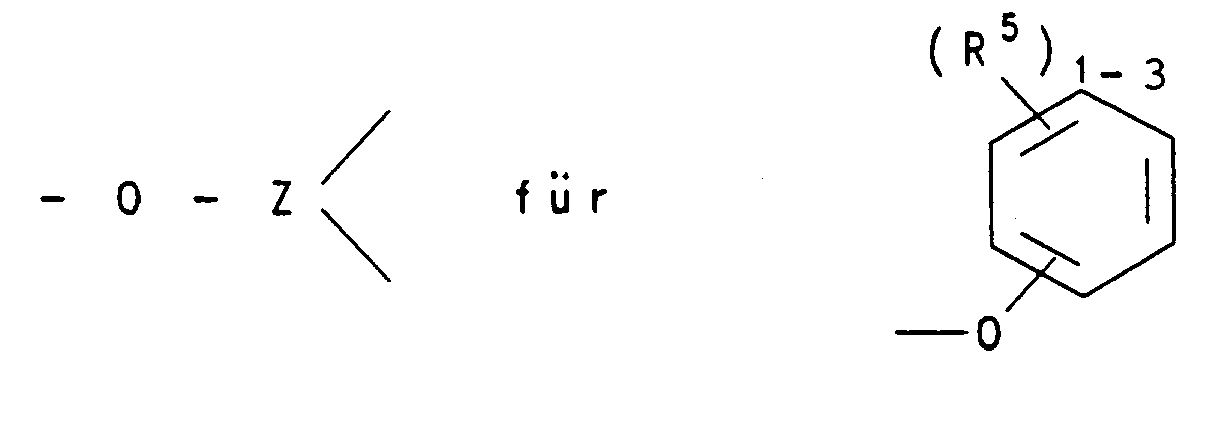
steht. R⁵ ist in dem Rest -O-Z= unabhängig voneinander Wasserstoff, Alkyl oder Alkoxy mit 1 bis 6 C-Atomen im Alkyrest, oder steht für
wobei der Sauerstoff mit einem der Ringe verknüpft ist und in ortho- oder para-Stellung zu einer der Bindungen der Imidcarbonylgruppe steht. - Ein bevorzugtes Polyetherimid weist die wiederkehrenden Einheiten

auf. - Der Begriff Polyetherimid schließt Homopolymere, Copolymere, Terpolymere und Blockcopolymere ein. Die verwendeten Polyetherimide haben Staudingerindizes von 0,1 bis 3, bevorzugt 0,3 bis 1,5 und insbesondere 0,3 bis 1 dl/g, gemessen bei 25°C in N-Methylpyrrolidon oder Methylenchlorid.
- Die gemäß der Erfindung eingesetzten Polyetherimide sind bekannt (US-A-3,847,867; 3,847,869; 3,850,885; 3,852,242; 3,855,178; 3,887,558; 4,017,511; 4,024,110; 4,250,279).
- Gemäß der Erfindung eingesetzte Verträglichkeitsvermittler C) sind kondensationsfähige Aryl- und Alkylverbindungen oder Mischungen aus Aryl- und Alkylverbindungen mit mindestens zwei funktionellen Gruppen.
- Eine bevorzugte Klasse von Verträglichkeitsvermittlern setzt sich aus Struktureinheiten der Formel IX zusammen:
(X-)i--((R⁷)l-(Y)m-(R⁸)n)j--(-Z)p (IX)
worin X und Z gleich oder verschieden sind und unabhängig voneinander für eine Hydroxy- oder Aminogruppe stehen sowie COOH, -CO-O-CO- oder -COOR darstellen. Die Indizes i und p sind jeweils gleich oder verschieden und stellen ganze Zahlen dar, wobei die Summe aus beiden 2 bis 10, vorzugsweise 2 bis 6 beträgt.
R⁷ und R⁸ sind jeweils gleich oder verschieden bedeuten Alkylreste mit 1 bis 8, vorzugsweise 1 bis 4 Kohlenstoffatomen oder Arylreste mit 6 bis 30, vorzugsweise 6 bis 12 C-Atomen oder Mischungen aus beiden. Die Indizes l und n sind Null oder 1, wobei die Summe aus beiden mindestens 1 ist. Y steht für eine divalente Gruppe O, C=O, SO₂, SO, S und NR⁹, wobei R⁹ eine substituierte oder unsubstituierte Alkyl- oder Arylgruppe mit 1 bis 18, vorzugsweise 1 bis 6 Kohlenstoffatomen bedeutet. m ist Null oder 1 und j eine ganze Zahl 1,2 oder 3. Beispiele für derartige Verbindungen sind vorzugsweise para-Aminobenzoesäure (PAB) und Pyromellithsäuredianhydrid (PMDA). - Der Anteil der Polyetherimide B) in den Mischungen beträgt 5 bis 95 Gew.-%, vorzugsweise 5 bis 50 Gew.-% und der Anteil an flüssigkristallinen Polyestern (A) 95 bis 5 Gew.-%, vorzugsweise 95 bis 50 Gew.-%.; bezogen auf die Summe der Komponenten A und B. Der Anteil an Verträglichkeitsvermittlern C) in den Mischungen, bezogen auf die gesamte Polymermischung, beträgt 0,5 bis 10 Gew.-%, vorzugsweise 0,5 bis 5 Gew.-%. Die Mischungen gemäß der Erfindung können jeweils mindestens ein Polyetherimid, einen flüssigkristallinen Polyester und einen Verträglichkeitvermittler, sowie modifizierte Polyetherimide und modifizierte flüssigkristalline Polyester enthalten.
- Die Mischungen gemäß der Erfindung werden nach bekannten Standardmethoden hergestellt und verarbeitet, wie sie für Thermoplasten üblich sind, z. B. durch Kneten, Extrudieren, Pressen oder Spritzgießen.
- Die Mischungen können zusätzlich übliche Additive enthalten, beispielsweise thermische Stabilisatoren, UV-Stabilisatoren, Antistatika, Flammschutzmittel, Farbstoffe, Pigmente, anorganische und organische Füllstoffe, d. h. insbesondere auch verstärkende Zusätze wie Glas-, Kohle- oder Hochmodulfasern. Die Mischungen eignen sich zur Herstellung von Formkörpern, beispielsweise in Form von Platten, Fasern, Folien, Steckerleisten und Schläuchen, hergestellt nach dem Spritzguß- oder Extrusionsverfahren, insbesondere aber auch als Matrixmaterial für Verbundwerkstoffe.
- Folgende Materialien wurden in den Beispielen eingesetzt:
- (A1) Flüssigkristalliner Copolyester mit Struktureinheiten der Formel

- Das eingesetzte Polyetherimid (B) enthält Wiederholungseinheiten der Formel

Als Verträglichkeitsvermittler wurden para-Aminobenzoesäure (PAB) und Pyromellithsäuredianhydrid (PMDA) eingesetzt. - Die Materialien wurden zunächst getrocknet (140°C, 24h) und anschließend in verschiedenen Gewichtsvehältnissen in einem Kneter, Typ Rheocord System 90/Rheomix 600 der Fa. Haake (Karlsruhe, Bundesrepublik Deutschland) unter Schutzgas (Stickstoff) bei Temperaturen von 310°C bis 340°C geknetet und die erhaltenen Mischungen zu Formteilen wie Schulterstäben oder Platten verarbeitet und auf ihre physikalischen und thermischen Eigenschaften hin untersucht. Dazu wurden folgende Geräte verwendet:
Eine Zug-Dehnungsmaschine, Typ 43.02 H 3570 der Fa. Instron (Offenbach/M, Bundesrepulik Deutschland) zur Bestimmung der Reißfestigkeit, Reißdehnung und des Zug-E-Moduls. - Ein Kalorimeter, Typ DSC7 der Fa. Perkin-Elmer (Überlingen, Bundesrepulik Deutschland) zur Bestimmung der thermischen Eigenschaften.
-
1) Mittels des angegebenen Kneters wurden 60 Gew.-% des flüssigkristallinen Copolyesters (A1), 40 Gew.-% des Polyetherimids sowie unterschiedliche Gew.-% an PAB nach intensiver Trocknung gemeinsam unter Stickstoff geknetet. Die Knetmasse wurde anschließend nach intensiver Trocknung zu Preßplatten verarbeitet. Aus diesen Platten wurden Schulterstäbe ausgefräßt. Die Tabelle 1 zeigt die daraus ermittelten mechanischen Eigenschaften der Mischungen.Tabelle 1 (A1):B:PAB 60:40:0 60:40:2 60:40:4 Reißfestigkeit (MPa) 33 51 37 Reißdehung (%) 1,6 3,2 1,8 Zug-E-Modul (MPa) 2310 3000 2500
Der Tabelle 2 sind die ermittelten thermischen Eigenschaften der Mischungen zu entnehmen:Tabelle 2 (A1) : B: PAB 60:40:0 60:40:2 60:40:4 Glasübergangstemperatur (°C) 209 203,8 203 Schmelztemperatur (°C) 333 327 329 Schmelzenthalpie (J/g) 0,9 1,5 1,1
2) Mittels des Kneters wie in Beispiel 1 wurden 60 Gew.-% des flüssigkristallinen Copolyesters (A1), 40 Gew.-% des Polyetherimid B) sowie unterschiedliche Gew.-% an PMDA nach intensiver Trocknung gemeinsam unter Stickstoff geknetet. Die Knetmasse wurde anschließend nach intensiver Trocknung zu Preßplatten verarbeitet. Aus diesen Platten wurden Schulterstäbe ausgefräßt. Die Tabelle 3 zeigt die daraus ermittelten mechanischen Eigenschaften der Mischungen.Tabelle 3 (A1):B:PMDA 60:40:0 60:40:2 60:40:4 Reißfestigkeit (MPa) 33 43 33 Reißdehung (%) 1,6 1,8 1,6 Zug-E-Modul (MPa) 2310 3100 2600
Der Tabelle 4 sind die ermittelten thermischen Eigenschaften der Mischungen zu entnehmen:Tabelle 4 (A1) : B : PMDA 60:40:0 60:40:2 60:40:4 Glasübergangstemperatur (°C) 209 209 210 Schmelztemperatur (°C) 333 320 n.d. Schmelzenthalpie (J/g) 0,9 0,5 n.d. n.d.: nicht bestimmbar
Claims (17)
- Mischung aus jeweils mindestens einem A) flüssigkristallinen Copolymeren, B) Polyetherimid und C) Verträglichkeitsvermittler.
- Mischung nach Anspruch 1, dadurch gekennzeichnet, daß der Anteil der Komponenten A) und B) jeweils 5 bis 95 Gew.-%, bezogen auf die Summe beider Komponenten beträgt und der Verträglichkeitsvermittler C) in Mengen von 0,5 - 10 Gew.-% bezogen auf die Polymermischung A) und B) eingesetzt wird.
- Mischung nach Anspruch 1 oder 2, dadurch gekennzeichnet, daß die Komponente A) ein aromatischer Polyester mit einem mittleren Molekulargericht von 200 bis 200000 oder ein Copolyesteramid ist.
- Mischung nach einem oder mehreren der Ansprüche 1 bis 3, dadurch gekennzeichnet, daß die Komponente A) wiederkehrende Einheiten der Formel

- Mischung nach einem oder mehreren der Ansprüche 1 bis 3, dadurch gekennzeichnet, daß die Komponente A) mindestens zwei wiederkehrende Einheiten der Formeln

- Mischung nach Anspruch 5, dadurch gekennzeichnet, daß die Summe der Indexzahlen v, w und x 30 bis 600 beträgt und der Anteil der Einheiten 0,6 bis 60 Mol% (III), 0,4 bis 98,5 Mol-% (IV) und 1 bis 60 Mol-% (V) ist, bezogen auf 100 Mol-%.
- Mischung nach Anspruch 5 oder 6, dadurch gekennzeichnet, daß die Komponente A) aus 40 bis 60 Mol-% der Einheiten (III) und 40 bis 60 Mol-% der Einheiten (V) besteht.
- Mischung nach einem oder mehreren der Ansprüche 1 bis 7, dadurch gekennzeichnet, daß die Komponente A) neben den ausgewählten Einheiten aus (III) bis (V) auch solche der Einheiten (I) und/oder (II) enthält.
- Mischung nach einem oder mehreren der Ansprüche 1 bis 8, dadurch gekennzeichnet, daß die Komponente A) neben Einheiten (I) bis (V) zusätzlich mindestens eine Struktureinheit

- Mischungen nach einem oder mehreren der Ansprüche 1 bis 9, dadurch gekennzeichnet, daß die Komponente A) die Struktureinheiten enthält: (I) 1 bis 15 Mol%, (II) 50 bis 79 Mol-% (III) 10 bis 20 Mol-% und (V) 10 bis 20 Mol-%, wobei die Summe aller Einheiten stets 100 Mol-% ist.
- Mischung nach einem oder mehreren der Ansprüche 1 bis 10, dadurch gekennzeichnet, daß die Komponente B) Polyetherimide mit wiederkehrenden Einheiten der Formeln darstellen:a)


 b)
b)
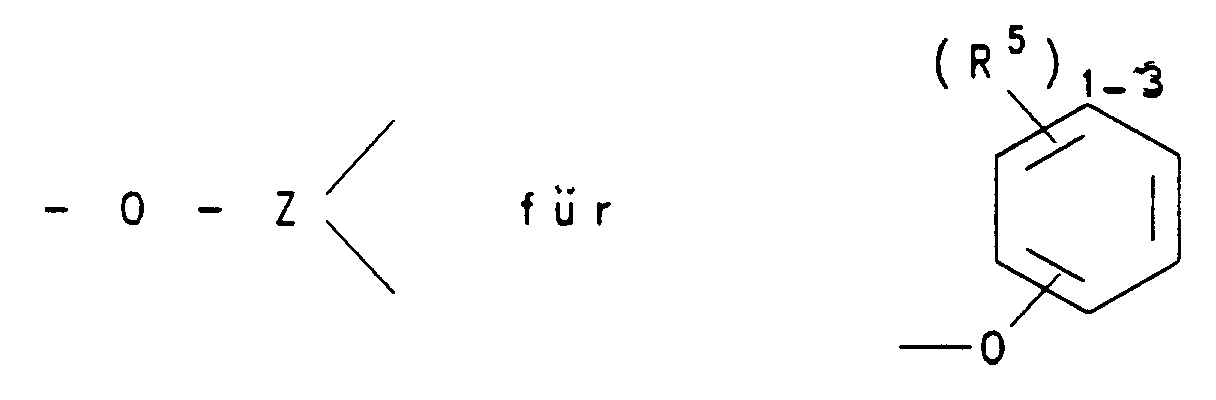

- Mischung nach Anspruch 11, dadurch gekennzeichnet, daß das Polyetherimid die wiederkehrenden Einheiten

- Mischung nach einem der Ansprüche 1 bis 12, dadurch gekennzeichnet, daß als Komponente C) kondensationsfähige Alkyl- und/oder Arylverbindungen mit mindesten zwei funktionellen Gruppen eingesetzt werden.
- Mischungen nach Anspruch 13, dadurch gekennzeichnet, daß die Komponente C) Struktureinheiten der Formel
(X-)i--((R⁷)i-(Y)m-(R⁸)n)j--(-Z)p (IX)
aufweist, worin X und Z gleich oder verschieden sind und unabhängig voneinander für eine Hydroxy- oder Aminogruppe stehen sowie COOH, -CO-O-CO- oder -COOR darstellen, i und p sind jeweils gleich oder verschieden und stellen ganze Zahlen dar, wobei die Summe aus beiden 2 bis 10, vorzugsweise 2 bis 6 beträgt, R⁷ und R⁸ sind jeweils gleich oder verschieden bedeuten Alkylreste mit 1 bis 8 Kohlenstoffatome oder Arylreste mit 6 bis 30 C-Atomen oder Mischungen aus beiden, l und n sind Null oder 1, wobei die Summe aus beiden mindestens 1 ist, Y steht für eine divalente Gruppe O, C=O, SO₂, SO, S und NR⁹, wobei R⁹ eine substituierte oder unsubstituierte Alkyl- oder Arylgruppe mit 1 bis 18 Kohlenstoffatomen bedeutet, m ist Null oder 1 und j eine ganze Zahl 1, 2 oder 3. - Mischung nach Anspruch 14, dadurch gekennzeichnet, daß als Komponente C) para-Aminobenzoesäure (PAB) und Pyromellithsäuredianhydrid (PMDA) eingesetzt wird.
- Mischung nach einem oder mehreren der Ansprüche 1 bis 15 dadurch gekennzeichnet, daß sie zusätzlich übliche Additive enthält.
- Verwendung der Mischung gemäß einem oder mehreren der Ansprüche 1 bis 15 zur Herstellung von Formkörpern oder als Matrixmaterial für Verbundwerkstoffe.
Applications Claiming Priority (2)
| Application Number | Priority Date | Filing Date | Title |
|---|---|---|---|
| DE4139532 | 1991-11-30 | ||
| DE4139532 | 1991-11-30 |
Publications (3)
| Publication Number | Publication Date |
|---|---|
| EP0545309A2 true EP0545309A2 (de) | 1993-06-09 |
| EP0545309A3 EP0545309A3 (en) | 1993-08-04 |
| EP0545309B1 EP0545309B1 (de) | 2000-02-09 |
Family
ID=6445972
Family Applications (1)
| Application Number | Title | Priority Date | Filing Date |
|---|---|---|---|
| EP92120300A Expired - Lifetime EP0545309B1 (de) | 1991-11-30 | 1992-11-27 | Mischungen aus flüssigkristallinen Copolymeren, Polyetherimiden und Verträglichkeitsvermittlern sowie deren Verwendung |
Country Status (4)
| Country | Link |
|---|---|
| US (1) | US5366663A (de) |
| EP (1) | EP0545309B1 (de) |
| JP (1) | JPH05320490A (de) |
| DE (1) | DE59209811D1 (de) |
Families Citing this family (8)
| Publication number | Priority date | Publication date | Assignee | Title |
|---|---|---|---|---|
| WO2000068318A1 (en) * | 1999-05-10 | 2000-11-16 | Teijin Limited | Resin composition containing crystalline polyimide |
| EP1328606A4 (de) | 2000-09-01 | 2005-03-30 | Ticona Llc | Mischungen von dehnbar flüssigkristallinen polymeren mit thermoplastischen kunststoffen |
| TWI297089B (en) * | 2002-11-25 | 2008-05-21 | Sipix Imaging Inc | A composition for the preparation of microcups used in a liquid crystal display, a liquid crystal display comprising two or more layers of microcup array and process for its manufacture |
| US8023071B2 (en) * | 2002-11-25 | 2011-09-20 | Sipix Imaging, Inc. | Transmissive or reflective liquid crystal display |
| JP2024514797A (ja) * | 2021-04-05 | 2024-04-03 | エスエイチピーピー グローバル テクノロジーズ べスローテン フェンノートシャップ | 熱可塑性組成物およびその使用法 |
| CN113580702B (zh) * | 2021-07-29 | 2023-08-18 | 宁波长阳科技股份有限公司 | 液晶高分子薄膜及其制备方法和应用 |
| CN117089198A (zh) * | 2023-08-15 | 2023-11-21 | 乌镇实验室 | 一种高流动性的聚醚酰亚胺复合材料及其制备方法 |
| EP4578930A1 (de) | 2023-12-29 | 2025-07-02 | SHPP Global Technologies B.V. | Polymerzusammensetzungen mit verbesserter zahnschutz- und partikelfreisetzung |
Family Cites Families (12)
| Publication number | Priority date | Publication date | Assignee | Title |
|---|---|---|---|---|
| US4161470A (en) * | 1977-10-20 | 1979-07-17 | Celanese Corporation | Polyester of 6-hydroxy-2-naphthoic acid and para-hydroxy benzoic acid capable of readily undergoing melt processing |
| US4250279A (en) * | 1979-12-26 | 1981-02-10 | Union Carbide Corporation | Polyarylate blends with polyetherimides |
| US4299756A (en) * | 1980-03-10 | 1981-11-10 | Celanese Corporation | Polyester of phenyl-4-hydroxybenzoic acid, aromatic diol, and aromatic diacid capable of forming an anisotropic melt |
| US4448937A (en) * | 1983-04-21 | 1984-05-15 | General Electric Company | Blends of polyetherimides and block poly(esteramides) |
| US4600765A (en) * | 1984-02-17 | 1986-07-15 | Owens-Corning Fiberglas Corporation | Melt processable optically anisotropic polymers |
| US4614791A (en) * | 1984-11-05 | 1986-09-30 | Owens-Corning Fiberglas Corporation | Melt processable optically anisotropic polyesters |
| US4614790A (en) * | 1984-11-05 | 1986-09-30 | Owens-Corning Fiberglas Corporation | Melt processable optically anisotropic polyesters |
| US4879354A (en) * | 1986-08-07 | 1989-11-07 | Amoco Corporation | Miscible blends of an amide and/or imide containing polymer and a polyarylate |
| US5084526A (en) * | 1986-08-07 | 1992-01-28 | Amoco Corporation | Miscible blends of an amide and/or imide containing polymer and a polyarylate |
| US4871817A (en) * | 1986-12-31 | 1989-10-03 | General Electric Company | Polyetherimide-liquid crystal polymer blends |
| US4835047A (en) * | 1987-05-14 | 1989-05-30 | Avraam Isayev | Wholly aromatic polyester fiber-reinforced polyetherimide composite and process for preparing same |
| FR2652514A1 (fr) * | 1989-06-22 | 1991-04-05 | Rhone Poulenc Sante | Nouveau catalyseur a base de palladium et son emploi. |
-
1992
- 1992-11-25 US US07/981,560 patent/US5366663A/en not_active Expired - Fee Related
- 1992-11-27 DE DE59209811T patent/DE59209811D1/de not_active Expired - Fee Related
- 1992-11-27 JP JP4319102A patent/JPH05320490A/ja active Pending
- 1992-11-27 EP EP92120300A patent/EP0545309B1/de not_active Expired - Lifetime
Also Published As
| Publication number | Publication date |
|---|---|
| EP0545309A3 (en) | 1993-08-04 |
| DE59209811D1 (de) | 2000-03-16 |
| EP0545309B1 (de) | 2000-02-09 |
| JPH05320490A (ja) | 1993-12-03 |
| US5366663A (en) | 1994-11-22 |
Similar Documents
| Publication | Publication Date | Title |
|---|---|---|
| DE2622414C2 (de) | Polybutylenterephthalatabmischungen mit hoher Schlagzähigkeit und ihre Verwendung | |
| DE2920246A1 (de) | Polyestermasse fuer die herstellung von formkoerpern und die daraus hergestellten formkoerper | |
| DE3750485T2 (de) | Harzzusammensetzung mit anisotropischen Schmelzeigenschaften. | |
| DE4039924A1 (de) | Legierungen aus teilkristallinen und amorphen polyaryletherketonen | |
| DE2433189C3 (de) | Schwer entflammbare, glasfaserverstärkte Polytetramethylenterephthalatformmasse | |
| EP0545309B1 (de) | Mischungen aus flüssigkristallinen Copolymeren, Polyetherimiden und Verträglichkeitsvermittlern sowie deren Verwendung | |
| DE3000282A1 (de) | Modifizierte polyester-zusammensetzungen | |
| DE2457148B2 (de) | Flammfeste Harzmassen | |
| EP0310976B1 (de) | Glasfaserverstärkte thermoplastische Formmassen auf der Basis von Polyestern und Pfropfpolymerisaten | |
| EP0518022A1 (de) | Formmassen auf Basis aromatischer Polyamide | |
| DE69117600T2 (de) | Verwendung von Polyethylen in Poly(arylensulfid)-Zusammensetzungen zur Verminderung der Schrumpfung | |
| EP0613916A1 (de) | Formmasse auf der Grundlage von Polyarylenethern mit Anhydridendgruppen | |
| EP0392357A2 (de) | Glasfaserverstärkte thermoplastische Formmassen auf der Basis von Polyestern und Pfropfpolymerisaten | |
| DE2745999A1 (de) | Thermoplastische formmasse | |
| EP0310978B1 (de) | Glasfaserverstärkte thermoplastische Formmassen auf der Basis von Polyestern und Pfropfpolymerisaten | |
| DE4113826C2 (de) | Propylenharzmasse | |
| EP0360103A2 (de) | Blends von thermotropen Polymeren mit Polyestern und Polycarbonat | |
| EP0545308A2 (de) | Mischungen aus flüssigkristallinen Copolymeren und Fluorthermoplasten sowie deren Verwendung | |
| DE69007517T2 (de) | Polymermischung aus aromatischem Polycarbonat, Polyester und thermoplastischem Elastomer, Formkörper daraus. | |
| DE3000660A1 (de) | Nicht-ausbluehende flammhemmende thermoplastische zusammensetzung | |
| EP0569001A1 (de) | Mischungen aus flüssigkristallinen Copolymeren und Polyarylaten | |
| EP0571398B1 (de) | Ternäre polymerlegierungen auf basis von polyaryletherketonen mit einer glastemperatur | |
| EP0414124A2 (de) | Mehrkomponentenlegierung mit einer Glastemperatur | |
| DE2364399A1 (de) | Stabilisierte form- und pressmassen | |
| EP0414060A1 (de) | Polyoxymethylen-Polyurethan-Formmassen mit verbesserter Lichtbeständigkeit, Verfahren zu ihrer Herstellung und ihre Verwendung |
Legal Events
| Date | Code | Title | Description |
|---|---|---|---|
| PUAI | Public reference made under article 153(3) epc to a published international application that has entered the european phase |
Free format text: ORIGINAL CODE: 0009012 |
|
| AK | Designated contracting states |
Kind code of ref document: A2 Designated state(s): BE CH DE ES FR GB IT LI LU NL SE |
|
| PUAL | Search report despatched |
Free format text: ORIGINAL CODE: 0009013 |
|
| AK | Designated contracting states |
Kind code of ref document: A3 Designated state(s): BE CH DE ES FR GB IT LI LU NL SE |
|
| 17P | Request for examination filed |
Effective date: 19940131 |
|
| 17Q | First examination report despatched |
Effective date: 19951120 |
|
| RAP1 | Party data changed (applicant data changed or rights of an application transferred) |
Owner name: TICONA GMBH |
|
| RAP1 | Party data changed (applicant data changed or rights of an application transferred) |
Owner name: TICONA GMBH |
|
| GRAG | Despatch of communication of intention to grant |
Free format text: ORIGINAL CODE: EPIDOS AGRA |
|
| GRAG | Despatch of communication of intention to grant |
Free format text: ORIGINAL CODE: EPIDOS AGRA |
|
| GRAH | Despatch of communication of intention to grant a patent |
Free format text: ORIGINAL CODE: EPIDOS IGRA |
|
| RBV | Designated contracting states (corrected) |
Designated state(s): DE GB |
|
| GRAH | Despatch of communication of intention to grant a patent |
Free format text: ORIGINAL CODE: EPIDOS IGRA |
|
| GRAA | (expected) grant |
Free format text: ORIGINAL CODE: 0009210 |
|
| AK | Designated contracting states |
Kind code of ref document: B1 Designated state(s): DE GB |
|
| REF | Corresponds to: |
Ref document number: 59209811 Country of ref document: DE Date of ref document: 20000316 |
|
| GBT | Gb: translation of ep patent filed (gb section 77(6)(a)/1977) |
Effective date: 20000323 |
|
| EN | Fr: translation not filed | ||
| PLBE | No opposition filed within time limit |
Free format text: ORIGINAL CODE: 0009261 |
|
| STAA | Information on the status of an ep patent application or granted ep patent |
Free format text: STATUS: NO OPPOSITION FILED WITHIN TIME LIMIT |
|
| PGFP | Annual fee paid to national office [announced via postgrant information from national office to epo] |
Ref country code: DE Payment date: 20001215 Year of fee payment: 9 |
|
| 26N | No opposition filed | ||
| PGFP | Annual fee paid to national office [announced via postgrant information from national office to epo] |
Ref country code: GB Payment date: 20011012 Year of fee payment: 10 |
|
| REG | Reference to a national code |
Ref country code: GB Ref legal event code: IF02 |
|
| PG25 | Lapsed in a contracting state [announced via postgrant information from national office to epo] |
Ref country code: DE Free format text: LAPSE BECAUSE OF NON-PAYMENT OF DUE FEES Effective date: 20020702 |
|
| PG25 | Lapsed in a contracting state [announced via postgrant information from national office to epo] |
Ref country code: GB Free format text: LAPSE BECAUSE OF NON-PAYMENT OF DUE FEES Effective date: 20021127 |
|
| GBPC | Gb: european patent ceased through non-payment of renewal fee |