EP0545557A2 - Diskontinuierliches Aufbereitungsverfahren in mehrere Zonen - Google Patents
Diskontinuierliches Aufbereitungsverfahren in mehrere Zonen Download PDFInfo
- Publication number
- EP0545557A2 EP0545557A2 EP92310175A EP92310175A EP0545557A2 EP 0545557 A2 EP0545557 A2 EP 0545557A2 EP 92310175 A EP92310175 A EP 92310175A EP 92310175 A EP92310175 A EP 92310175A EP 0545557 A2 EP0545557 A2 EP 0545557A2
- Authority
- EP
- European Patent Office
- Prior art keywords
- zone
- treatment
- wastewater
- zones
- treatment zone
- Prior art date
- Legal status (The legal status is an assumption and is not a legal conclusion. Google has not performed a legal analysis and makes no representation as to the accuracy of the status listed.)
- Withdrawn
Links
Images




Classifications
-
- C—CHEMISTRY; METALLURGY
- C02—TREATMENT OF WATER, WASTE WATER, SEWAGE, OR SLUDGE
- C02F—TREATMENT OF WATER, WASTE WATER, SEWAGE, OR SLUDGE
- C02F3/00—Biological treatment of water, waste water, or sewage
- C02F3/02—Aerobic processes
- C02F3/12—Activated sludge processes
- C02F3/1205—Particular type of activated sludge processes
- C02F3/1226—Particular type of activated sludge processes comprising an absorbent material suspended in the mixed liquor
-
- C—CHEMISTRY; METALLURGY
- C02—TREATMENT OF WATER, WASTE WATER, SEWAGE, OR SLUDGE
- C02F—TREATMENT OF WATER, WASTE WATER, SEWAGE, OR SLUDGE
- C02F1/00—Treatment of water, waste water, or sewage
- C02F1/006—Water distributors either inside a treatment tank or directing the water to several treatment tanks; Water treatment plants incorporating these distributors, with or without chemical or biological tanks
-
- C—CHEMISTRY; METALLURGY
- C02—TREATMENT OF WATER, WASTE WATER, SEWAGE, OR SLUDGE
- C02F—TREATMENT OF WATER, WASTE WATER, SEWAGE, OR SLUDGE
- C02F3/00—Biological treatment of water, waste water, or sewage
- C02F3/02—Aerobic processes
- C02F3/10—Packings; Fillings; Grids
-
- C—CHEMISTRY; METALLURGY
- C02—TREATMENT OF WATER, WASTE WATER, SEWAGE, OR SLUDGE
- C02F—TREATMENT OF WATER, WASTE WATER, SEWAGE, OR SLUDGE
- C02F3/00—Biological treatment of water, waste water, or sewage
- C02F3/02—Aerobic processes
- C02F3/12—Activated sludge processes
- C02F3/1205—Particular type of activated sludge processes
- C02F3/121—Multistep treatment
-
- C—CHEMISTRY; METALLURGY
- C02—TREATMENT OF WATER, WASTE WATER, SEWAGE, OR SLUDGE
- C02F—TREATMENT OF WATER, WASTE WATER, SEWAGE, OR SLUDGE
- C02F3/00—Biological treatment of water, waste water, or sewage
- C02F3/02—Aerobic processes
- C02F3/12—Activated sludge processes
- C02F3/1236—Particular type of activated sludge installations
- C02F3/1263—Sequencing batch reactors [SBR]
-
- C—CHEMISTRY; METALLURGY
- C02—TREATMENT OF WATER, WASTE WATER, SEWAGE, OR SLUDGE
- C02F—TREATMENT OF WATER, WASTE WATER, SEWAGE, OR SLUDGE
- C02F3/00—Biological treatment of water, waste water, or sewage
- C02F3/30—Aerobic and anaerobic processes
- C02F3/302—Nitrification and denitrification treatment
-
- Y—GENERAL TAGGING OF NEW TECHNOLOGICAL DEVELOPMENTS; GENERAL TAGGING OF CROSS-SECTIONAL TECHNOLOGIES SPANNING OVER SEVERAL SECTIONS OF THE IPC; TECHNICAL SUBJECTS COVERED BY FORMER USPC CROSS-REFERENCE ART COLLECTIONS [XRACs] AND DIGESTS
- Y02—TECHNOLOGIES OR APPLICATIONS FOR MITIGATION OR ADAPTATION AGAINST CLIMATE CHANGE
- Y02W—CLIMATE CHANGE MITIGATION TECHNOLOGIES RELATED TO WASTEWATER TREATMENT OR WASTE MANAGEMENT
- Y02W10/00—Technologies for wastewater treatment
- Y02W10/10—Biological treatment of water, waste water, or sewage
-
- Y—GENERAL TAGGING OF NEW TECHNOLOGICAL DEVELOPMENTS; GENERAL TAGGING OF CROSS-SECTIONAL TECHNOLOGIES SPANNING OVER SEVERAL SECTIONS OF THE IPC; TECHNICAL SUBJECTS COVERED BY FORMER USPC CROSS-REFERENCE ART COLLECTIONS [XRACs] AND DIGESTS
- Y10—TECHNICAL SUBJECTS COVERED BY FORMER USPC
- Y10S—TECHNICAL SUBJECTS COVERED BY FORMER USPC CROSS-REFERENCE ART COLLECTIONS [XRACs] AND DIGESTS
- Y10S210/00—Liquid purification or separation
- Y10S210/902—Materials removed
- Y10S210/903—Nitrogenous
Definitions
- This invention relates to a multiple zone batch treatment process for biological or biophysical treatment of wastewaters.
- SBR sequenced batch reactor
- U.S. Patents Nos. 4,810,386 and 4,897,196 describe a number of two-stage wastewater treatment processes which include continuous flow and batch process in combination, as well as a two-stage batch-batch process.
- U.S. Patent No. 4,952,316 discloses a continuous aeration-batch clarification wastewater treatment process where both the aeration and clarification steps are performed in separate vessels in the SBR mode of operation.
- the system comprises a first carbonaceous removal SBR, nitrification in a second trickling filter with a surge tank, and a third SBR for denitrification.
- An objective of the invention is to provide for more effective use of the decant and fill steps in the operation of a multiple zone batch treatment system for wastewaters.
- the invention is a process for operating a multiple zone batch treatment system for wastewater, said system comprising at least a first batch treatment zone and a last batch treatment zone, influent wastewater treated by sequential passage from said first zone, through any intervening zones, to said last zone.
- Each treatment zone is equipped with means to produce plug flow of liquid through that zone.
- Biosolids and wastewater are first mixed within each treatment zone. Next mixing ceases and a settled solids phase and a clarified liquid phase are produced by settling.
- Wastewater then is transferred between adjacent zones in said system by adding a predetermined volume of influent liquid in a plug flow mode to at least one of said treatment zones, said added volume of influent liquid displacing a like volume of clarified liquid phase in a plug flow mode from that treatment zone to a following treatment zone. The process is then repeated.
- a first volume of influent wastewater is added to said first treatment zone via said plug flow producing means, displacing clarified liquid phase in a plug flow mode from said first zone, through any intervening treatment zones in a plug flow mode via said plug flow producing means therein, thereby displacing a second predetermined volume of clarified liquid phase effluent, essentially equal to said added first predetermined volume, from said last batch treatment zone. The process is then repeated.
- a first predetermined volume of clarified liquid phase effluent is removed from said last batch treatment zone.
- a second predetermined volume of influent wastewater is added to said first batch treatment zone through said plug flow producing means therein to displace clarified liquid phase in a plug flow mode from said first zone, through any intervening treatment zones in a plug flow mode via said plug flow producing means therein, to said last treatment zone. The process is then repeated.
- Each treatment zone of the system may operate in an aerobic mode or in an anoxic/anaerobic mode, depending on treatment requirements.
- a powdered adsorbent such as powdered activated carbon is added to the system to effect biophysical treatment of the wastewater.
- the system includes a first aerobic carbonaceous removal zone, a second aerobic nitrification zone, a third anoxic denitrification zone and a fourth aerobic adsorbent treatment zone.
- Influent wastewater is treated by sequential passage from said first zone, through said second and third zones, to said fourth zone and then exiting said treatment system.
- the zones are each fitted with an inlet means, such as a pipe manifold or perforated baffle, to produce plug flow of liquid into and out of each of the zones.
- a wastewater containing carbonaceous COD and BOD is treated sequentially in two batch operated treatment zones.
- the treatment train is made up of a first batch treatment zone 10 and a last batch treatment zone 12.
- the zones are connected by a conduit 14 which allows liquid to flow from the first zone 10 to the last zone 12 but not in the opposite direction.
- the treatment process begins by mixing a biomass solids mixture with the wastewater within each treatment zone.
- the mixing may be by aeration for aerobic processes or by mechanical means for anoxic/anaerobic processes. Neither mixing means is shown in FIG. 1.
- mixing ceases and the settling step occurs.
- a settled solid phase forms in the lower portion, 16 and 18 respectively, within each treatment zone and a clarified liquid phase forms in the upper portion, 20 and 22 respectively, within each treatment zone.
- a predetermined first volume of influent wastewater is added from a pump 24 via a conduit 26 to the first treatment zone.
- the influent wastewater enters the first treatment zone 10 through an inlet means, such as a pipe manifold 28 with multiple outlets, which displaces clarified liquid phase in a plug flow mode from the upper portion 20 of the zone 10, through the connecting conduit 14.
- the clarified liquid phase from the conduit 14 flows into the last treatment zone 12 through an inlet means, such as a conduit 26A and a pipe manifold 28A with multiple outlets. This displaces clarified liquid phase, with reduced carbonaceous COD and BOD, in a plug flow mode from the upper portion 22 of the zone 12, and out of the system via a conduit 14A.
- the volume of influent wastewater added to the system in the first treatment zone and subsequently removed from the last treatment zone is determined by a controller 30 which operates the influent pump 24.
- the volume of influent wastewater added, and effluent wastewater displaced, is generally less than the smaller of the clarified liquid phase volumes in each of the treatment zones.
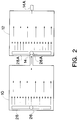
- the inlet pipes 26 and 26A and pipe manifolds 28 and 28A are more easily seen in FIG. 2, a partial top view of the system of FIG. 1.
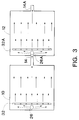
- the inlet means alternatively may comprise a baffle with multiple apertures therein positioned at the inlet end of each zone to produce plug flow of influent liquid into the treatment zone and plug flow of effluent liquid out of the treatment zone.
- the inlet conduits 26 and 26A and the baffles 32 and 32A are illustrated in FIG. 3, a partial top view of the system of FIG. 1 with the baffles replacing the pipe manifold.
- This concurrent decanting of clarified liquid from the first zone 10 to the last zone 12 and from the last zone 12 exiting the system, and filling of the first zone 10 with additional influent wastewater reduces the sequence time and thus increases throughput for the treatment system.
- the mixing or "react" step may commence for each treatment zone.
- a wastewater containing carbonaceous COD and BOD is treated sequentially in two batch operated treatment zones.
- the treatment train is made up of a first batch treatment zone 10 and a last batch treatment zone 12.
- the zones are connected by a conduit 14 which allows liquid to flow from the first zone 10 to the last zone 12 but not in the opposite direction.
- the treatment process begins by mixing a biomass solids mixture with the wastewater within each treatment zone.
- the mixing may be by aeration for aerobic processes or by mechanical means for anoxic/anaerobic processes. Neither mixing means is shown in FIG. 4.
- mixing After a specified mixing time, also termed the "react" step, mixing ceases and the settling step occurs.
- a settled solid phase forms in the lower portion, 16 and 18 respectively, within each treatment zone and a clarified liquid phase forms in the upper portion, 20 and 22 respectively, within each treatment zone.
- a predetermined first volume of clarified liquid phase with reduced carbonaceous COD and BOD is then removed from the last batch treatment zone 12 via a conduit 34 and a decanting means, such as a pump 36, and sent to discharge or further treatment.
- a predetermined second volume of influent wastewater is added from a pump 24 via a conduit 26 to the first treatment zone.
- the influent wastewater enters the first treatment zone 10 through an inlet means, such as a pipe manifold 28 with multiple outlets, which displaces clarified liquid phase in a plug flow mode from the upper portion 20 of the zone 10, through the connecting conduit 14 and into the partially empty last treatment zone 12.
- the inlet pipe 26 and pipe manifold 28 are more easily seen in FIG. 5, a partial top view of the system of FIG. 4.
- the inlet means alternatively may comprise a baffle with multiple apertures therein positioned at the inlet end of the first zone to produce plug flow of influent liquid into the treatment zone and plug flow of effluent liquid out of the treatment zone.
- the inlet conduit 26 and the baffle 32 are illustrated in FIG. 6, a partial top view of the system of FIG. 1 with the baffle 32 replacing the pipe manifold.
- the transfer of liquid through the treatment system can be controlled and monitored by a controller 30.
- the controller 30 activates the effluent decanting means, a pump 36, to remove clarified liquid effluent from the last zone 12 until the liquid level therein drops to a lower level sensor 38.
- the effluent decanting means, the pump 36 ceases removal of clarified liquid effluent.
- the influent pump 24 delivers influent wastewater to the first zone 10, displacing clarified liquid via the conduit 14 into the last zone 12, until the liquid levels in both zones rise to an upper level sensor 40. With the wastewater flowing by gravity from the first to last zone, the upper level sensor 40 controls the wastewater level for both zones at a specific maximum level.
- the influent pump 24 then shuts off and the mixing/aerating step again commences for each zone.
- the transfer conduit 14 is positioned at the full level for both treatment zones.
- first and last treatment zones are shown as separate tanks, the two zones may be formed by partitioning a larger tank into two smaller zones with a passage in the partition for wastewater replacing the conduit 14.
- the two treatment zones, 10 and 12 may both be aerobic where aeration is used for mixing the biomass and wastewater, or the first treatment zone 10 may be anoxic/anaerobic with mechanical mixing and the last treatment zone 12 aerobic where aeration mixing is used. In the latter situation, the first treatment zone 10 would require a covered top which excludes atmospheric oxygen thus allowing the anoxic/anaerobic treatment in that zone to proceed unimpeded. Mechanical mixing would also be required.
- this treatment system combines the features of FIGS. 1 and 4.
- the component common to FIGS. 1, 4 and 7 are denoted with the same indica.
- the controller 30 activates both a decanting means, pump 36, and an influent pump 24 simultaneously. This results in a first predetermined volume of clarified liquid phase being removed from the last treatment zone 12 via a conduit 34, and a second predetermined volume of influent wastewater, essentially equal to said first volume, simultaneously added to said first treatment zone via a conduit 26.
- the influent wastewater enters the first treatment zone 10 via a plug flow producing means, such as a pipe manifold 28 with multiple outlets, which displaces clarified liquid phase in a plug flow mode from the upper portion 20 of the zone 10, through the connecting conduit 14 and into the last treatment zone 12 through an inlet conduit 26A and a pipe manifold 28A with multiple outlets.
- Perforated baffles may be substituted for the pipe manifolds 28 and 28A as described above.
- the volume of wastewater added to the first treatment zone 10 is less than the volume of clarified liquid phase therein, thus preventing flow of untreated influent wastewater into the last treatment zone. This is easily monitored by the controller 30.
- the biological treatment systems of FIGS. 1, 4 and 7 may be modified to a biophysical treatment system by operating with both biomass and powdered adsorbent in each treatment zone.
- the preferred adsorbent is powdered activated carbon.
- the most effective usage of the powdered adsorbent is made by adding fresh adsorbent to the last treatment zone, preferably during the mixing step, transferring a mixture of adsorbent and biomass solids from the last treatment zone to the first treatment zone via a conduit 42 and a pump 44, and controlling the solids concentrations in the treatment system by wasting solids from the first treatment zone via a conduit 46 and a pump 48.
- the overall movement of the powdered adsorbent is countercurrent to the flow of the wastewater in the treatment system.
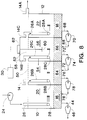
- FIG. 8 a wastewater containing carbonaceous COD and BOD, ammonia nitrogen, and adsorbable pollutants is treated sequentially in four batch operated treatment zones. Those elements common to FIGS. 1 and 8 are denoted by the same indica.
- the treatment train of FIG. 8 is similar to that of FIG. 1 except in FIG. 8, two additional batch treatment zones, 50 and 52, are included between the first batch treatment zone 10 and the last zone 12.
- the influent liquid flows into the first zone, then to the second zone, then to the third zone and from there to the last treatment zone and finally to effluent.
- Each of the added zones, 50 and 52 is connected with adjacent zones by conduits, 14, 14B and 14C, positioned at the full level for all treatment zones.
- Each zone, 50 and 52 also has an inlet conduit, 26B and 26C respectively, plus pipe manifold, 28B and 28C respectively, which receives effluent from the prior zone and displaces clarified liquid phase in a plug flow mode from the upper portion, 54 and 56 respectively, through the conduits, 14B and 14C, into the following treatment zone.
- Effluent with reduced carbonaceous COD, BOD, ammonia and adsorbable organics is removed from the system via the exit conduit 14A.
- the third treatment zone 52 also has a cover 58 to exclude atmospheric oxygen and maintain anaerobic/anoxic conditions within that zone. Mechanical mixing within the anaerobic zone 52 is provided by a stirrer 60 powered by a motor 62.
- a powdered adsorbent such as powdered activated carbon
- the first treatment zone 10 provides for carbonaceous removal.
- the second treatment zone 50 provides for nitrification of ammonia while denitrification occurs within the third treatment zone 52.
- the last treatment zone 12 is an adsorbent contact zone and/or aeration zone where a final adsorption contact/polishing step occurs which further purifies the final system effluent.
- the treatment process begins by mixing a biomass solids and powdered adsorbent particles mixture with the wastewater within each treatment zone.
- the mixing within the first, second and last zones is by aeration with aerating means (not shown), while mixing in the third zone is by mechanical means.
- mixing ceases and the settling step occurs.
- a settled solids phase forms in the lower portion, 16, 64, 66 and 18 respectively, within each treatment zone and a clarified liquid phase forms in the upper portion, 20, 54, 56 and 22 respectively, within each treatment zone.
- a predetermined first volume of influent wastewater is added from a pump 24 via a conduit 26 to the first treatment zone.
- the influent wastewater enters the first treatment zone 10 through an inlet means, such as a pipe manifold 28 with multiple outlets, which displaces clarified liquid phase in a plug flow mode from the upper portion 20 of the zone 10, through the connecting conduit 14.
- the clarified liquid phase from the conduit 14 flows into the second treatment zone 50 through an inlet means, such as a conduit 26B and a pipe manifold 28B with multiple outlets. This displaces clarified liquid phase in a plug flow mode from the upper portion 54 of the zone 50, through the connecting conduit 14B.
- the clarified liquid phase from the conduit 14B flows into the third treatment zone 52 through an inlet means, such as a conduit 26C and a pipe manifold 28C with multiple outlets. This, in turn, displaces clarified liquid phase in a plug flow mode from the upper portion 56 of treatment zone 52 through a connecting conduit 14C.
- the clarified liquid phase from the conduit 14C flows into the last treatment zone 12 through an inlet means, such as a conduit 26A and a pipe manifold 28A with multiple outlets. This displaces clarified liquid phase in a plug flow mode from the upper portion 22 of the zone 12 and out of the system via a conduit 14A.
- the volume of influent wastewater added to the system in the first treatment zone and subsequently removed from the last treatment zone is determined by a controller 30 which operates the influent pump 24.
- the volume added to the system will be less than the volume of clarified liquid phase in the smallest of the treatment zones of the system, to ensure proper treatment of the wastewater.
- the most effective usage of the powdered adsorbent is made by adding fresh adsorbent to the last treatment zone, preferably during the mixing step, transferring a mixture of adsorbent and biomass solids from the last treatment zone to the third treatment zone via a conduit 68 and a pump 70, from the third zone to the second zone via a conduit 72 and a pump 74, and from the second zone to the first treatment zone via a conduit 76 and a pump 78.
- Control of the solids concentrations in the treatment system by achieved by wasting solids from the first treatment zone via a conduit 44 and a pump 46.
- the overall movement of the powdered adsorbent is countercurrent to the flow of the wastewater in the treatment system.
- the freshest adsorbent contacts the wastewater just prior to discharge to effect maximum removal of adsorbable components from the effluent.
- a wastewater containing carbonaceous COD and BOD is treated sequentially in four batch operated treatment zones as in FIG. 8.
- the mixing and settling steps are also carried out within each zone as described for FIG. 8.
- a predetermined first volume of clarified liquid phase with reduced carbonaceous COD, BOD, ammonia nitrogen and adsorbable pollutants is then removed from the last batch treatment zone 12 via a conduit 34 and a decanting means, a pump 36, and sent to discharge or further treatment. This provides for a very clean separation of settled solids and clarified liquid phase effluent.
- a predetermined second volume of influent wastewater is added from a pump 24 via a conduit 26 to the first treatment zone.
- the influent wastewater enters the first treatment zone 10 through a pipe manifold 28 with multiple outlets which displaces clarified liquid phase in a plug flow mode from the upper portion 20 of the zone 10, through the connecting conduit 14 and into the second treatment zone 50.
- This incoming liquid enters the second treatment zone through an inlet pipe 26A and a pipe manifold 28A with multiple outlets which displaces clarified liquid phase in a plug flow mode from the upper portion 54 of zone 50, through the connecting conduit 14B and into the third treatment zone 52.
- This incoming liquid enters the third treatment zone through an inlet pipe 26C and a pipe manifold 28C with multiple outlets which displaces clarified liquid phase in a plug flow mode from the upper portion 56 of zone 52, through the connecting conduit 14C and into the last treatment zone 12.
- This concurrent decanting of clarified liquid from the first zone 10 to the second zone 50 to the third zone 52 and finally to the last zone 12, and filling of the first zone 10 with additional influent wastewater reduces the sequence time and thus increases throughput for the treatment system.
- the mixing or "react" step may commence for each.
- the most effective usage of the powdered adsorbent is made by adding fresh adsorbent to the last treatment zone, preferably during the mixing step, transferring a mixture of adsorbent and biomass solids from the last treatment zone to the third treatment zone via a conduit 68 and a pump 70, from the third zone to the second zone via a conduit 72 and a pump 74, and from the second zone to the first treatment zone via a conduit 76 and a pump 78.
- Control of the solids concentrations in the treatment system by achieved by wasting solids from the first treatment zone via a conduit 44 and a pump 46.
- the overall movement of the powdered adsorbent is countercurrent to the flow of the wastewater in the treatment system.
- the freshest adsorbent contacts the wastewater just prior to discharge to effect maximum removal of adsorbable components from the effluent.
- the first treatment zone is operated in an anoxic/anaerobic mode where carbonaceous COD and BOD removal occurs prior to nitrification in the second zone, denitrification in the third zone and adsorbent contact treatment in the last zone.
- carbonaceous COD and BOD removal occurs prior to nitrification in the second zone, denitrification in the third zone and adsorbent contact treatment in the last zone.
- the movement of adsorbent and biosolids through this system is as described above.
- the transfer of liquid through the treatment system can be controlled and monitored by a controller 30.
- the controller 30 activates the effluent decanting means, the pump 36, to remove clarified liquid effluent from the last zone 12 until the liquid level therein drops to a lower level sensor 38.
- the effluent decanting pump 36 ceases removal of clarified effluent.
- the influent pump 24 delivers influent wastewater to the first zone 10, displacing clarified liquid via the conduits 14, 14B and 14C into the last zone 12, until the liquid levels in all four zones rise to an upper level sensor 40.
- the influent pump 24 then shuts off and the mixing/aerating step again commences for each zone.
- the transfer conduits 14, 14B and 14C are positioned at the full level for all four treatment zones.
- a conduit between the upper portion 56 of anaerobic zone 52 and aerobic first zone 10, fitted with a pump, could recycle a selected portion of denitrified clarified liquid phase to the aerobic first zone 10 for addition nitrification of ammonia.
- the recycle of clarified liquid occurs during addition of influent wastewater to the head of the treatment system.
Landscapes
- Life Sciences & Earth Sciences (AREA)
- Hydrology & Water Resources (AREA)
- Engineering & Computer Science (AREA)
- Environmental & Geological Engineering (AREA)
- Water Supply & Treatment (AREA)
- Chemical & Material Sciences (AREA)
- Organic Chemistry (AREA)
- Biodiversity & Conservation Biology (AREA)
- Microbiology (AREA)
- Water Treatment By Sorption (AREA)
Applications Claiming Priority (2)
| Application Number | Priority Date | Filing Date | Title |
|---|---|---|---|
| US801211 | 1991-12-02 | ||
| US07/801,211 US5192442A (en) | 1991-12-02 | 1991-12-02 | Multiple zone batch treatment process |
Publications (2)
| Publication Number | Publication Date |
|---|---|
| EP0545557A2 true EP0545557A2 (de) | 1993-06-09 |
| EP0545557A3 EP0545557A3 (en) | 1993-08-04 |
Family
ID=25180477
Family Applications (1)
| Application Number | Title | Priority Date | Filing Date |
|---|---|---|---|
| EP19920310175 Withdrawn EP0545557A3 (en) | 1991-12-02 | 1992-11-06 | Multiple zone batch treatment process |
Country Status (5)
| Country | Link |
|---|---|
| US (1) | US5192442A (de) |
| EP (1) | EP0545557A3 (de) |
| AU (1) | AU661870B2 (de) |
| CA (1) | CA2082085A1 (de) |
| MX (1) | MX9206928A (de) |
Cited By (8)
| Publication number | Priority date | Publication date | Assignee | Title |
|---|---|---|---|---|
| EP0784598A4 (de) * | 1994-09-28 | 1999-02-03 | Rjjb & G Inc | Behandlung von nährstoffreichem wasser |
| EP0968965A1 (de) * | 1998-06-29 | 2000-01-05 | Zapf Gmbh + Co. | Vorrichtung und diskontinuierliches Verfahren zur biologischen Abwasserreinigung |
| EP1099668A1 (de) * | 1999-11-10 | 2001-05-16 | INGERLE, Kurt | Verfahren zur Reinigung von kommunalem oder ähnlichem Abwasser |
| EP0834474A3 (de) * | 1996-10-02 | 2001-06-13 | Niels Dr. Holm | Verfahren zur diskontinuierlichen Abwasserreinigung und Anlage zur Durchführung dieses Verfahrens |
| EP1094163A3 (de) * | 1999-10-22 | 2003-07-02 | Gerd Bednarsch | Mehrzweckschacht, Kleinkläranlage und Abwasserbehandlungsverfahren |
| WO2006066042A1 (en) * | 2004-12-15 | 2006-06-22 | Ecovation, Inc. | Method and apparatus for the anaerobic treatment of waste |
| DE102005007408A1 (de) * | 2005-02-18 | 2006-08-24 | Holm, Niels Christian, Dr. | Verfahren zur Verbesserung der Denitrifikation und Bio-P-Elimination beim SBR-Verfahren |
| DE19812397B4 (de) * | 1998-03-20 | 2015-04-02 | Ökoservice Gesellschaft Für Umweltanalytik Und Kläranlagenbetreuung Mbh | Vollbiologische Kleinkläranlage mit zwei belüfteten Belebungsbecken |
Families Citing this family (79)
| Publication number | Priority date | Publication date | Assignee | Title |
|---|---|---|---|---|
| GB9118560D0 (en) * | 1991-08-30 | 1991-10-16 | Pirtferm Ltd | Process for degrading organic matter |
| US5310484A (en) * | 1992-08-24 | 1994-05-10 | Zimpro Passavatn Environmental Sys. | Preaeration treatment of volatile wastewater components |
| US5354471A (en) * | 1992-10-19 | 1994-10-11 | Timpany Peter L | Method of treating wastewater |
| US5338452A (en) * | 1993-01-14 | 1994-08-16 | The Lemna Corporation | High rate anaerobic reactor for primary treatment of high strength wastewater |
| US5514278A (en) * | 1993-04-12 | 1996-05-07 | Khudenko; Boris M. | Counterflow microbiological processes |
| US5902484A (en) * | 1993-09-30 | 1999-05-11 | Timpany; Peter L. | Method and system for treatment of water and wastewater |
| US5556538A (en) * | 1994-11-22 | 1996-09-17 | Beard; Gary J. | Denitrification system |
| US5624563A (en) * | 1995-08-25 | 1997-04-29 | Hawkins; John C. | Process and apparatus for an activated sludge treatment of wastewater |
| US5776344A (en) * | 1995-10-26 | 1998-07-07 | Tetra Technologies Inc. | Method for removing nitrogen from wastewater |
| US5599450A (en) * | 1995-11-20 | 1997-02-04 | Jet Tech, Inc. | Anaerobic upflow batch reactor |
| US5733454A (en) * | 1996-04-26 | 1998-03-31 | Ehh Holding Co., Inc. | Process and apparatus for the treatment of flowable waste |
| US5885460A (en) * | 1996-05-03 | 1999-03-23 | Iowa State University Research Foundation, Inc. | Anaerobic migrating blanket reactor |
| GB2317169A (en) * | 1996-09-13 | 1998-03-18 | Kvaerner Davy Ltd | Anoxic and aerobic metabolisation of waste |
| BR9707612A (pt) * | 1996-12-09 | 2000-01-04 | Khudenko Enginnering | Aparelho de multi-estágio para tratamento quìmico, fìsico-quìmico e biológico e equalização de fluxo variáveis de material afluente |
| AU721064B2 (en) * | 1996-12-20 | 2000-06-22 | Evoqua Water Technologies Llc | Scouring method |
| US6004456A (en) * | 1997-12-09 | 1999-12-21 | Khudenko; Boris Mikhallovich | Equalization basin-reactor system |
| JP4801256B2 (ja) * | 1998-03-04 | 2011-10-26 | マント、ミッケル、ジー | サージ無酸素性混合連続回分反応システム |
| GB9805714D0 (en) | 1998-03-17 | 1998-05-13 | Kvaerner Construction Limited | Liquid effluent treatment process and plant |
| US6136185A (en) * | 1998-06-19 | 2000-10-24 | Sheaffer International Ltd. | Aerobic biodegradable waste treatment system for large scale animal husbandry operations |
| ATE280135T1 (de) * | 1998-07-24 | 2004-11-15 | Dhv Water Bv | Verfahren zur behandlung von spezifischen verbindungen, z.b. ammoniak enthaltendem abwasser |
| US6436288B1 (en) | 1999-02-08 | 2002-08-20 | Mississippi State University | Bast medium biological reactor treatment system for remediation and odor suppression of organic waste streams |
| AUPR421501A0 (en) | 2001-04-04 | 2001-05-03 | U.S. Filter Wastewater Group, Inc. | Potting method |
| IL159118A0 (en) * | 2001-05-29 | 2004-05-12 | Aqwise Wise Water Technologies | Method, apparatus and biomass support element for biological wastewater treatment |
| US6616845B2 (en) * | 2001-05-29 | 2003-09-09 | Aqwise Wise Water Technologies, Ltd. | Method and apparatus for biological wastewater treatment |
| US6726838B2 (en) | 2002-01-07 | 2004-04-27 | Agwise Wise Water Technologies Ltd. | Biofilm carrier, method of manufacture thereof and waste water treatment system employing biofilm carrier |
| AUPR692401A0 (en) * | 2001-08-09 | 2001-08-30 | U.S. Filter Wastewater Group, Inc. | Method of cleaning membrane modules |
| US7247238B2 (en) * | 2002-02-12 | 2007-07-24 | Siemens Water Technologies Corp. | Poly(ethylene chlorotrifluoroethylene) membranes |
| AUPS300602A0 (en) * | 2002-06-18 | 2002-07-11 | U.S. Filter Wastewater Group, Inc. | Methods of minimising the effect of integrity loss in hollow fibre membrane modules |
| US7938966B2 (en) * | 2002-10-10 | 2011-05-10 | Siemens Water Technologies Corp. | Backwash method |
| AU2002953111A0 (en) * | 2002-12-05 | 2002-12-19 | U. S. Filter Wastewater Group, Inc. | Mixing chamber |
| US8268176B2 (en) | 2003-08-29 | 2012-09-18 | Siemens Industry, Inc. | Backwash |
| US7056438B2 (en) * | 2003-09-05 | 2006-06-06 | Dharma Living Systems, Inc. | Flood and drain wastewater treatment system and associated methods |
| US7850822B2 (en) * | 2003-10-29 | 2010-12-14 | Siemens Water Technologies Holding Corp. | System and method of wet oxidation of a viscose process stream |
| AU2004289373B2 (en) | 2003-11-14 | 2010-07-29 | Evoqua Water Technologies Llc | Improved module cleaning method |
| US20050171390A1 (en) * | 2003-12-17 | 2005-08-04 | Usfilter Corporation | Wet oxidation process and system |
| WO2005092799A1 (en) | 2004-03-26 | 2005-10-06 | U.S. Filter Wastewater Group, Inc. | Process and apparatus for purifying impure water using microfiltration or ultrafiltration in combination with reverse osmosis |
| AU2005240524C1 (en) * | 2004-04-22 | 2009-12-24 | Evoqua Water Technologies Llc | Filtration apparatus comprising a membrane bioreactor and a treatment vessel for digesting organic materials |
| US7347940B2 (en) * | 2004-06-17 | 2008-03-25 | Worrell Water Technologies, Llc | Nitrogen removal system and method for wastewater treatment lagoons |
| US7309434B2 (en) * | 2004-06-28 | 2007-12-18 | Potts David A | Apparatus and method for wastewater treatment |
| JP4958779B2 (ja) * | 2004-08-20 | 2012-06-20 | シーメンス・ウォーター・テクノロジーズ・コーポレイション | 正方形のmbrマニホールド・システム |
| WO2006026814A1 (en) * | 2004-09-07 | 2006-03-16 | Siemens Water Technologies Corp. | Reduction of backwash liquid waste |
| JP4896025B2 (ja) | 2004-09-14 | 2012-03-14 | シーメンス・ウォーター・テクノロジーズ・コーポレイション | 膜モジュールから固形分を除去するための方法および装置 |
| JP4954880B2 (ja) | 2004-09-15 | 2012-06-20 | シーメンス・ウォーター・テクノロジーズ・コーポレーション | 連続的に変化する通気 |
| US7591950B2 (en) * | 2004-11-02 | 2009-09-22 | Siemens Water Technologies Corp. | Submerged cross-flow filtration |
| JP2008518748A (ja) * | 2004-11-02 | 2008-06-05 | シーメンス・ウォーター・テクノロジーズ・コーポレーション | 浸漬クロスフロー濾過 |
| EP1838422A4 (de) | 2004-12-24 | 2009-09-02 | Siemens Water Tech Corp | Einfaches gasspülverfahren und entsprechende vorrichtung |
| WO2006066319A1 (en) | 2004-12-24 | 2006-06-29 | Siemens Water Technologies Corp. | Cleaning in membrane filtration systems |
| CN101184548B (zh) | 2005-04-29 | 2011-10-05 | 西门子水技术公司 | 用于膜滤器的化学清洗剂 |
| JP2009504399A (ja) | 2005-08-22 | 2009-02-05 | シーメンス・ウォーター・テクノロジーズ・コーポレーション | 管状マニホールドを使用して逆洗を最小化する水濾過のためのアセンブリ |
| WO2007044345A2 (en) | 2005-10-05 | 2007-04-19 | Siemens Water Technologies Corp. | Method and apparatus for treating wastewater |
| WO2007044415A2 (en) | 2005-10-05 | 2007-04-19 | Siemens Water Technologies Corp. | Method and apparatus for treating wastewater |
| US7481934B2 (en) * | 2006-01-20 | 2009-01-27 | Renewable Fibers, Llc | Methods for treatment of wastewater with powdered natural lignocellulosic material |
| US7455765B2 (en) | 2006-01-25 | 2008-11-25 | Siemens Water Technologies Corp. | Wastewater treatment system and method |
| WO2008024445A2 (en) | 2006-08-23 | 2008-02-28 | Siemens Water Technologies Corp. | Sequencing batch reactor with continuous membrane filtration and solids reduction |
| US8293098B2 (en) | 2006-10-24 | 2012-10-23 | Siemens Industry, Inc. | Infiltration/inflow control for membrane bioreactor |
| WO2008123972A1 (en) | 2007-04-02 | 2008-10-16 | Siemens Water Technologies Corp. | Improved infiltration/inflow control for membrane bioreactor |
| US9764288B2 (en) | 2007-04-04 | 2017-09-19 | Evoqua Water Technologies Llc | Membrane module protection |
| AU2008263139B2 (en) | 2007-05-29 | 2011-08-25 | Evoqua Water Technologies Llc | Membrane cleaning with pulsed airlift pump |
| US7731842B2 (en) * | 2007-09-19 | 2010-06-08 | Brentwood Industries, Inc. | Submerged fixed film anoxic bioreactor |
| BRPI0819580A2 (pt) | 2007-12-19 | 2015-05-05 | Saudi Arabian Oil Co | Sistema de reator de membrana biológica de tratamento de água residual industrial, processo para purificar uma corrente de água residual industrial que contém compostos biologicamente refratários e/ou bio-inibidores e processo para tratar uma corrente de água residual industrial processada por um reator de membrana biológica |
| JP2013500144A (ja) | 2008-07-24 | 2013-01-07 | シーメンス インダストリー インコーポレイテッド | 濾過システムにおける濾過膜モジュールアレイに対して構造的支持を施すための方法および濾過システム |
| NZ591259A (en) | 2008-08-20 | 2013-02-22 | Siemens Industry Inc | A hollow membrane filter backwash system using gas pressurised at at least two pressures feed from the down stream side to push water through the filter to clean it |
| US8753511B2 (en) * | 2008-09-03 | 2014-06-17 | AQ-WISE—Wise Water Technologies Ltd. | Integrated biological wastewater treatment and clarification |
| AU2010101488B4 (en) | 2009-06-11 | 2013-05-02 | Evoqua Water Technologies Llc | Methods for cleaning a porous polymeric membrane and a kit for cleaning a porous polymeric membrane |
| TWI568687B (zh) * | 2009-06-15 | 2017-02-01 | 沙烏地阿拉伯油品公司 | 包含懸浮系統與多重生物反應器區域的經懸浮介質膜生物反應器系統及方法 |
| MY156850A (en) | 2009-07-08 | 2016-04-15 | Saudi Arabian Oil Co | Low concentration wastewater treatment system and process |
| WO2011005928A1 (en) * | 2009-07-08 | 2011-01-13 | Saudi Arabian Oil Company | Wastewater treatment system and process including irradiation of primary solids |
| US8758613B2 (en) * | 2009-10-16 | 2014-06-24 | Aqwise-Wise Water Technologies Ltd | Dynamic anaerobic aerobic (DANA) reactor |
| ES2738898T3 (es) | 2010-04-30 | 2020-01-27 | Evoqua Water Tech Llc | Dispositivo de distribución de flujo de fluido |
| AU2011305377B2 (en) | 2010-09-24 | 2014-11-20 | Evoqua Water Technologies Llc | Fluid control manifold for membrane filtration system |
| CA2850309C (en) | 2011-09-30 | 2020-01-07 | Evoqua Water Technologies Llc | Improved manifold arrangement |
| CN103958034B (zh) | 2011-09-30 | 2017-03-22 | 伊沃夸水处理技术有限责任公司 | 隔离阀 |
| US9533261B2 (en) | 2012-06-28 | 2017-01-03 | Evoqua Water Technologies Llc | Potting method |
| AU2013231145B2 (en) | 2012-09-26 | 2017-08-17 | Evoqua Water Technologies Llc | Membrane potting methods |
| CN104684631A (zh) | 2012-09-26 | 2015-06-03 | 伊沃夸水处理技术有限责任公司 | 膜固定设备 |
| EP2900356A1 (de) | 2012-09-27 | 2015-08-05 | Evoqua Water Technologies LLC | Gaswäscher für tauchmembranen |
| EP3052221B1 (de) | 2013-10-02 | 2022-12-14 | Rohm & Haas Electronic Materials Singapore Pte. Ltd | Vorrichtung zur reparatur eines membranfiltrationsmoduls |
| WO2017011068A1 (en) | 2015-07-14 | 2017-01-19 | Evoqua Water Technologies Llc | Aeration device for filtration system |
| WO2017014627A1 (en) * | 2015-07-22 | 2017-01-26 | Haskoningdhv Nederland B.V. | Reactor vessel for treating wastewater by means of aerobic granular sludge technology |
Family Cites Families (15)
| Publication number | Priority date | Publication date | Assignee | Title |
|---|---|---|---|---|
| DE895124C (de) * | 1949-04-10 | 1955-09-05 | Hellmut Dr-Ing Geiger | Einlaufeinrichtung fuer Absetzbecken |
| DE840376C (de) * | 1950-10-25 | 1952-06-03 | Erwin Stengel | Vorkammer fuer rechteckige Absetzbecken |
| CH331225A (fr) * | 1956-07-02 | 1958-07-15 | Pista Sa | Dispositif de répartition d'eau brute dans un bassin |
| GB1210562A (en) * | 1968-01-25 | 1970-10-28 | Drysdale & Co Ltd | Improvements relating to the treatment of sewage and like industrial waste |
| US3679053A (en) * | 1970-07-27 | 1972-07-25 | Pollution Control Products Inc | Batch sewage treatment system |
| DE2125983B2 (de) * | 1971-05-26 | 1978-12-07 | Menzel & Co, 7000 Stuttgart | Biologische Abwasserreinigungsanlage, insbesondere für organisch hochbelastete Abwässer |
| JPS58199098A (ja) * | 1982-05-14 | 1983-11-19 | Hitachi Plant Eng & Constr Co Ltd | 廃水中のりんを除去する方法 |
| DK149767C (da) * | 1983-07-28 | 1987-02-23 | Krueger As I | Fremgangsmaade til biologisk rensning af spildevand |
| US4663044A (en) * | 1985-09-13 | 1987-05-05 | Transfield, Incorporated | Biological treatment of wastewater |
| US4810386A (en) * | 1988-01-04 | 1989-03-07 | Zimpro/Passavant Inc. | Two-stage wastewater treatment |
| US4897196A (en) * | 1988-02-17 | 1990-01-30 | Zimpro/Passavant Inc. | Two-stage batch wastewater treatment |
| DE3906943C2 (de) * | 1989-03-02 | 1994-03-03 | Biodetox Ges Zur Biolog Schads | Verfahren zur Abwasserreinigung und Belebtschlammanlage zur Durchführung des Verfahrens |
| US4948570A (en) * | 1989-07-11 | 1990-08-14 | Teledyne Industries, Inc. | Process for lowering residual tantalum values in niobium |
| US4952316A (en) * | 1989-09-25 | 1990-08-28 | Zimpro/Passavant Inc. | Continuous aeration-batch clarification wastewater treatment |
| US5102548A (en) * | 1990-01-16 | 1992-04-07 | Richard C. Baxter | Septage pretreatment and treatment batch processing |
-
1991
- 1991-12-02 US US07/801,211 patent/US5192442A/en not_active Expired - Lifetime
-
1992
- 1992-11-04 CA CA 2082085 patent/CA2082085A1/en not_active Abandoned
- 1992-11-05 AU AU28142/92A patent/AU661870B2/en not_active Ceased
- 1992-11-06 EP EP19920310175 patent/EP0545557A3/en not_active Withdrawn
- 1992-12-01 MX MX9206928A patent/MX9206928A/es unknown
Cited By (9)
| Publication number | Priority date | Publication date | Assignee | Title |
|---|---|---|---|---|
| EP0784598A4 (de) * | 1994-09-28 | 1999-02-03 | Rjjb & G Inc | Behandlung von nährstoffreichem wasser |
| EP0834474A3 (de) * | 1996-10-02 | 2001-06-13 | Niels Dr. Holm | Verfahren zur diskontinuierlichen Abwasserreinigung und Anlage zur Durchführung dieses Verfahrens |
| DE19812397B4 (de) * | 1998-03-20 | 2015-04-02 | Ökoservice Gesellschaft Für Umweltanalytik Und Kläranlagenbetreuung Mbh | Vollbiologische Kleinkläranlage mit zwei belüfteten Belebungsbecken |
| EP0968965A1 (de) * | 1998-06-29 | 2000-01-05 | Zapf Gmbh + Co. | Vorrichtung und diskontinuierliches Verfahren zur biologischen Abwasserreinigung |
| EP1094163A3 (de) * | 1999-10-22 | 2003-07-02 | Gerd Bednarsch | Mehrzweckschacht, Kleinkläranlage und Abwasserbehandlungsverfahren |
| EP1099668A1 (de) * | 1999-11-10 | 2001-05-16 | INGERLE, Kurt | Verfahren zur Reinigung von kommunalem oder ähnlichem Abwasser |
| WO2006066042A1 (en) * | 2004-12-15 | 2006-06-22 | Ecovation, Inc. | Method and apparatus for the anaerobic treatment of waste |
| US7390410B2 (en) | 2004-12-15 | 2008-06-24 | Ecovation, Inc. | Method and apparatus for the anaerobic treatment of waste |
| DE102005007408A1 (de) * | 2005-02-18 | 2006-08-24 | Holm, Niels Christian, Dr. | Verfahren zur Verbesserung der Denitrifikation und Bio-P-Elimination beim SBR-Verfahren |
Also Published As
| Publication number | Publication date |
|---|---|
| EP0545557A3 (en) | 1993-08-04 |
| CA2082085A1 (en) | 1993-06-03 |
| US5192442A (en) | 1993-03-09 |
| MX9206928A (es) | 1993-06-01 |
| AU2814292A (en) | 1993-06-03 |
| AU661870B2 (en) | 1995-08-10 |
Similar Documents
| Publication | Publication Date | Title |
|---|---|---|
| US5192442A (en) | Multiple zone batch treatment process | |
| JP2732536B2 (ja) | 二段廃水処理 | |
| US5616241A (en) | Treatment of wastewater and sludges | |
| US6015496A (en) | In-sewer treatment of wastewater and sludges | |
| KR100524426B1 (ko) | 다단계 이중 사이클 유입 방법 | |
| US7172699B1 (en) | Energy efficient wastewater treatment for nitrogen and phosphorus removal | |
| KR960013341B1 (ko) | 이단계 배치식 폐수처리법 | |
| US6787035B2 (en) | Bioreactor for treating wastewater | |
| CA2244108C (en) | System for removing nutrients from wastewater | |
| KR101679174B1 (ko) | 연속회분식 반응시스템 | |
| US4952316A (en) | Continuous aeration-batch clarification wastewater treatment | |
| CN110386731A (zh) | 一种基于mbbr的主流自养脱氮系统及方法 | |
| US6592757B2 (en) | Selector contact stabilization process and apparatus for wastewater treatment | |
| KR20030059178A (ko) | 개선된 고형물 저감 기능을 가지는 폐수 처리 장치 및 방법 | |
| KR100420647B1 (ko) | 연속 유입 회분식 오폐수 처리방법 | |
| KR100195903B1 (ko) | 유기성 폐수의 질소.인 제거방법 및 그 장치 | |
| KR100825518B1 (ko) | 제올라이트와 멤브레인을 이용한 하/폐수의 처리 장치 및 방법 | |
| KR0140421B1 (ko) | 유기성 오.폐수정화장치 | |
| US4915829A (en) | Activated-sludge aeration system | |
| CA1140278A (en) | Method and apparatus for purifying sewage by means of activated sludge | |
| Wang et al. | Sequencing Batch Reactors Fundamentals and Innovations | |
| DK168989B1 (da) | Fremgangsmåde til biologisk fjernelse af nitrogen fra spildevand | |
| EP1433755A1 (de) | Verfahren und Vorrichtung zur Abwasserbehandlung mit Belebtschlammverfahren | |
| JPH0421558B2 (de) |
Legal Events
| Date | Code | Title | Description |
|---|---|---|---|
| PUAI | Public reference made under article 153(3) epc to a published international application that has entered the european phase |
Free format text: ORIGINAL CODE: 0009012 |
|
| AK | Designated contracting states |
Kind code of ref document: A2 Designated state(s): AT BE CH DE DK ES FR GB GR IE IT LI LU MC NL PT SE |
|
| PUAL | Search report despatched |
Free format text: ORIGINAL CODE: 0009013 |
|
| AK | Designated contracting states |
Kind code of ref document: A3 Designated state(s): AT BE CH DE DK ES FR GB GR IE IT LI LU MC NL PT SE |
|
| RAP1 | Party data changed (applicant data changed or rights of an application transferred) |
Owner name: ZIMPRO ENVIRONMENTAL, INC. |
|
| 18D | Application deemed to be withdrawn |
Effective date: 19940205 |