EP0545632A1 - Aromes fixés dans un substrat hydrate de carbone par séchage par pulvérisation et procédé - Google Patents
Aromes fixés dans un substrat hydrate de carbone par séchage par pulvérisation et procédé Download PDFInfo
- Publication number
- EP0545632A1 EP0545632A1 EP92310811A EP92310811A EP0545632A1 EP 0545632 A1 EP0545632 A1 EP 0545632A1 EP 92310811 A EP92310811 A EP 92310811A EP 92310811 A EP92310811 A EP 92310811A EP 0545632 A1 EP0545632 A1 EP 0545632A1
- Authority
- EP
- European Patent Office
- Prior art keywords
- spray
- dried
- flavor
- carbohydrate
- solids
- Prior art date
- Legal status (The legal status is an assumption and is not a legal conclusion. Google has not performed a legal analysis and makes no representation as to the accuracy of the status listed.)
- Granted
Links
Images

Classifications
-
- A—HUMAN NECESSITIES
- A23—FOODS OR FOODSTUFFS; TREATMENT THEREOF, NOT COVERED BY OTHER CLASSES
- A23L—FOODS, FOODSTUFFS OR NON-ALCOHOLIC BEVERAGES, NOT OTHERWISE PROVIDED FOR; PREPARATION OR TREATMENT THEREOF
- A23L27/00—Spices; Flavouring agents or condiments; Artificial sweetening agents; Table salts; Dietetic salt substitutes; Preparation or treatment thereof
- A23L27/70—Fixation, conservation, or encapsulation of flavouring agents
- A23L27/72—Encapsulation
Definitions
- the present invention relates to a method for fixing volatile substances, and more particularly to a method for fixing a volatile substance in an amorphous substrate and the products derived therefrom.
- Dry comestible mix systems present special problems when one tries to introduce volatile or aromatic flavorants therein. For example, such materials escape through and from the mix, or react so as to degrade or oxidize into compounds which are recognized to be less desirable. Therefore, there has been a longstanding need to fix by encapsulation, and prevent the escape of volatiles within a "powdered-mix" comestible.
- the method for fixing a volatile must produce a product which is easily reconstitutable and is capable of holding the fix over prolonged periods and under adverse storage conditions.
- a major problem inherent in fixing aromatics in food acceptable substrates is the fact that those fixation substrates display idiosyncratic fixation characteristics.
- the substrate media may be sensitive to moisture, react with the entrained volatile or produce flavor off-notes.
- Carbohydrates as a class offer a food-acceptable substrate in which volatiles and aromatics have been fixed, however, most water-soluble carbohydrate substrates are hygroscopic and will not reliably hold the fix for long periods.
- flavor encapsulation technology merely strived to furnish dry forms of liquid flavors, for the convenience of handling and uniformity of strength.
- An empirical approach prevailed.
- quality and better understanding of flavor encapsulation brought additional demands.
- the initial efforts concentrated on the overall retention of flavor (yield) and process economics, followed by the more specific inquiries into retention of individual flavor notes and maintenance of the flavor profile.
- U.S. Patent No. 2,856,291 and U.S. Patent No. 2,857,281, issued to Schultz, disclose a method for incorporating a volatile flavoring substance in a sugar substrate.
- a mixture of the sugar, flavor oil and water, is prepared and blended to form an emulsion.
- flavor oils such as orange oil and lemon oil
- synthetic agents such as aldehydes, alcohols, esters, and other volatile agents.
- U.S. Patent No. 2,809,895 to Swisher, describes a process for encapsulation of an essential oil, such as lemon, lime or grapefruit oils, in a matrix comprising corn syrups, antioxidant and a dispersing agent.
- the essential oil, antioxidant and dispersing agent are added to the corn syrup, the resultant mixture is heated to 85° to 125°C and extruded to produce an emulsion in pellet form, and the resultant particles are washed with an essential oil solvent and dried under vacuum to remove the solvent.
- U.S. Patent No. 2,919,989, to Schultz describes a modification of the process of the aforementioned U.S. Patent No. 2,856,291, in which the sugar base used comprises, by weight, 15% to 40% sucrose, 10% to 50% lactose, 5% to 14% maltose, 10% to 50% dextrose and not more than 15% dextrin.
- U.S. Patent No. 3,041,180, to Swisher describes an essential oil flavoring composition produced by mixing glycerol and 42 DE corn syrup solids into an aqueous, semiplastic mass, which is then combined with the essential oil by means of an emulsifier. The resulting mixture is extruded into a cold solvent to form an extruded solid in which the essential oil is encapsulated by the glycerol and corn syrup solids. This extruded solid is then dried and an anti-caking agent added to produce an extruded particulate solid having an extended shelf life.
- U.S. Patent No 3,704,137 to Beck, describes an essential oil composition formed by mixing oil with an antioxidant, separately mixing water, sucrose and hydrolyzed cereal solids (dextrose equivalent (DE) substantially below 29, and preferably between 10 and 15), emulsifying the two mixtures together, extruding the resultant mixture in the form of rods into a solvent, removing excess solvent and finally adding an anti-caking agent, preferably silica.
- U.S. Patent No. 3,971,852 to Brenner, et al., describes a process for encapsulating an oil in a matrix comprising a polysaccharide (which may be dextrinized starch or hydrolyzed starch having a DE of 10 to 25) and a polyhydroxy material, which can be glucose, maltose or fructose.
- the ingredients are emulsified and spray dried.
- U.S. Patent No. 4,689,235 to Barnes, et al., describes a process which involves generally the same steps as in the aforementioned U.S. Patent No. 4,610,890 but in which the solution used for encapsulation comprises a mixture of a malto-dextrin and hydrogen octenyl butanedioate.
- U.S. Patent No. 3,314,803 issued to Dame, et al., provides a method for fixing a volatile flavor such as acetaldehyde in a mannitol substrate.
- the acetaldehyde is fixed in mannitol by first forming a solution of mannitol and water and preferably a supersaturated solution of mannitol of between 25% to 45% by weight.
- the supersaturated solution is formed by heating with agitation 2 to 10 parts by weight of mannitol with 10 parts by weight of water at 180° to 212°F (82.2° to 100°C) until all of the mannitol is dissolved in the water and no mannitol crystals remain in the solution.
- the solution is then cooled while acetaldehyde is added thereto.
- the reference solution is then spray-dried.
- U.S. Patent No. 3,554,768, issued to Feldman, provides a method for fixing acetaldehyde in selected carbohydrates, by uniformly mixing the acetaldehyde and carbohydrate in water and drying to form a flavor enhancing composition.
- the disadvantage of using the above-enumerated compounds or methodologies is the low fix obtained therefrom, or the moisture-lability of the resultant product. Stability of previously available products is in most cases dependent on a hermetically-sealed product environment, which is kept free from ambient moisture levels and from oxygen.
- antioxidants have to be added to prevent oxidation of the flavors fixed in the dry substrate.
- an extruded glassy matrix for volatiles comprising 40% to 80% chemically modified starch, 10% to 40% by weight malto-dextrin, 5% to 20% by weight corn syrup solid or a polyglucose and 5% to 20% mono and disaccharide.
- U.S. Patent No. 4,532,145 issued to Saleeb, et al., provides a method of fixing volatiles, such as acetaldehyde in a spray-dried amorphous substrate of 10% to 30% low molecular weight carbohydrate and at least 70% high molecular weight material such as maltro-dextrin.
- volatiles such as acetaldehyde
- a spray-dried amorphous substrate of 10% to 30% low molecular weight carbohydrate and at least 70% high molecular weight material such as maltro-dextrin.
- the fix in the lower weight spray-dried product was better than using earlier carbohydrate systems but not as good as obtained by extrusion.
- Naturally occurring citrus oils are susceptible toward oxidation - by atmospheric oxygen or otherwise - and are thus often protected by the addition of synthetic or natural antioxidants such as BHA or mixed tocopherols.
- synthetic or natural antioxidants such as BHA or mixed tocopherols.
- preservatives are seen as being less desirable on labels of food products. Indeed, it is possible to reason that the perfect "encapsulation” would alleviate the need for any preservative whatsoever -- if the oil were sufficiently well protected, oxygen could not access it, and the volatiles would remain sealed. Shelf-life would be extremely long.
- One of the objectives of the current invention is to provide spray-dried encapsulated flavor which would in its properties approach if not completely attain or exceed the advantages provided by the extruded flavors while still keeping those benefits associated with the spray-drying technology.
- the volatile or aromatic substance is fixed within an amorphous carbohydrate substrate consisting of an admixture of low molecular weight, water-soluble mono or disaccharide containing a major amount of maltose, a film forming high molecular weight material such as a gum and/or chemically modified starch and a high molecular weight, water-soluble polymer such as malto-dextrin.
- Fruit solids are included in the amount of mono and disaccharide employed.
- the combination of materials is dissolved in water to form an aqueous solution with the temperature being maintained at around 10° to 90°C. In the case of highly volatile substance the solution is allowed to cool to about the boiling point of the substance or below.
- the volatile or aromatic flavorant is then added to the solution, the solution being preferably maintained at from 10° to 50°C.
- the solution is then spray-dried in an atmospheric spray-dryer wherein the inlet temperature is typically about 100° to 180°C and the outlet temperature typically 70°C to 100°C.
- the resultant moisture-stable, fixed product has a bulk free flow density of at least 0.50 g/cc, excellent retention of volatiles over time and a prolonged shelf life without unacceptable oxidation. No antioxidant is added or made part of the final product.
- Another objective of this invention is to devise a spray-dried encapsulated flavor of such quality that it could be rendered as "preservative-free", i.e. without use of synthetic or natural antioxidant preservatives and yet afford sufficient protection during the distribution and use of such an ingredient in instant food mixes.
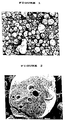
- FIG. 1 is a spray-dried material made in accordance with this invention, magnified 100X using an electron microscope.
- FIG. 2 is broken spray-dried material shown in FIG. 1 magnified 1000X.
- FIG. 3 is unbroken, spray-dried, hollow particles produced in accordance with prior art technology magnified 100X.
- FIG. 4 is broken, spray-dried particles (shown unbroken in FIG. 3) magnified 1000X.
- the volatile agent will be described as an essential oil (e.g. orange oil) product although other volatile flavorants may be operatively substituted.
- high molecular weight water-soluble polymer includes such materials as malto-dextrin, a material possessing a predominate amount of polysaccharide.
- malto-dextrin has a D.E. (dextrose equivalent) of from 4 to 20 and is composed of varying numbers of monosaccharides, dissacharides and larger saccharide units.
- LO-DEXTM 5 and 15 (malto-dextrins manufactured by American Maize Products Company,) contain less than 1% monosaccharides, less than 2% disaccharides and less than 2% trisaccharides for LO-DEXTM 5 and less than 3% monosaccharides, 2% disaccharides, and 2% trisaccharides for LO-DEXTM 15.
- the content of tetrasaccharides or higher member carbohydrates exceeds 93% by weight of the malto-dextrin.
- Low molecular weight water-soluble materials for illustrative purposes of the present invention, are mono and disaccharides such as glucose, fructose, maltose, sucrose or materials high in such sugars such as fruit juice solids. At least 50% of the mono and disaccharide material used in this invention is maltose.
- the film forming carbohydrate can be gums, such as gum arabic, gum accacia, a chemically modified starch, such as N-Lok manufactured by National Starch Chemical Corp. or mixtures thereof.
- the carbohydrate matrix includes from 22% to 50%, preferably 25% to 45% mono and disaccharides or substances containing these sugars such as fruit juice solids.
- disaccharides are preferred over monosaccharides because the higher molecular weight of the disaccharides gives them a higher melting temperature and a lower hygroscopicity.
- maltose is preferred over sucrose, because maltose melts at a much lower temperature than does sucrose.
- maltose Of the mono and disaccharides and juice solids at least 50% must be maltose, preferably present at from 15% to 30% and more preferably from 20% to 25% of the carbohydrate mixture.
- the maltose can be obtained using high maltose corn syrup at from 10% to 30%, preferably 15% to 25% of the carbohydrate mixture.
- Juice solids may range from 0% to 20%, preferably 5% to 20% and more preferably from 10% to 15% of the carbohydrate matrix.
- the carbohydrate matrix also includes from 25% to 60%, preferably from 30% to 50% and most preferably from 35% to 45% by weight of a malto-dextrin.
- the malto-dextrin will preferably have a dextrose equivalent in the range of about 5 to 15.
- Preferred malto-dextrins are those having a DE in the range of about 8 to about 12.
- specific malto-dextrins which have been found to give good results in the present process are sold as Lodex 5, 10 or 15 by American Maize-Products Co., Hammond, Ind.
- the carbohydrate film former used herein is present in from 10% to 40%, preferably from 15% to 35% and most preferably from 20% to 30% of the carbohydrate forming the matrix.
- Suitable film formers are film forming gums or hydrocolloids and chemically modified starch. Effective gums are gum arabic and gum accacia.
- Suitable chemically modified starch is N-Lok or Capsul (National Starch and Chemical Corp).
- carbohydrate can be corn syrup solids or polydextrose.
- corn syrup solids is conventionally used to denote the mixture of carbohydrates produced by hydrolysis of corn starch.
- any carbohydrates having the required dextrose equivalents may be employed in the matrices of the present invention.
- such carbohydrates may be produced by polymerization of lower molecular weight carbohydrates rather than hydrolysis of high molecular weight starches.
- Polydextrose produced commercially by Pfizer, is the trade name for a glucose oligomer having a glass transition temperature comparable to that of medium dextrose equivalent corn syrup solids, and such polydextrose may be employed in place of corn syrup solids.
- the carbohydrate matrix may be softened by the addition of up to 5% of an edible polyol such as glycerine, preferably 1% to 3% of the fixed product.
- an edible polyol such as glycerine
- the final spray dried product is capable of protecting and retaining up to 50% flavorant depending of the flavorant, up to 25% for essential oils, and preferably from 10% to 20% on a solids basis for essential citrus oils.
- a special feature of this invention is the provision that the final product does not contain antioxidants, the carbohydrate matrix being sufficient for the first time to prevent oxidation of spray-dried fixed essential oils during storage for up to one year.
- the procedure of spray-drying for purposes of the present invention may be defined as follows.
- a solution of the product one wishes to make is prepared.
- the term solution is understood to mean mixtures of solutes and solvents encompassing such mixtures as emulsions or dispersions.
- the solution is fed into an atomizer which creates a fine mist, composed of regular-sized droplets.
- the misted-solution is introduced, usually through the top of a drying tower or chamber. Heated air is fed into the chamber so that as the droplets fall from the top of the chamber evaporation of the liquid phase or drying occurs.
- the product is collected from an outlet port.
- spray-drying apparatus are the Anhydro Dryers (manufactured by Anhydro Corp. of Attleboro Falls, Mass.) or the Niro Dryer (manufactured by Niro Atomizer Ltd, Copenhagen, Denmark).
- Spray-drying is preferably employed using flavorant containing carbohydrate mixtures having at least 30%, preferably at least 40% solids which when dried using an outlet temperature normally below 100°C there can be obtained dense, oxidative resistant fixed flavors.
- a solution to the problem of how to optimize the inherent poor fixative properties of polysacchararides or other higher molecular weight materials is solved by combining the high molecular weight material with film formers and mono and disaccharides high in maltose.
- the mono and disaccharides are at least 50% and preferably all maltose to increase the structural integrity of the structurally weak high molecular weight material which is normally malto-dextrin.
- This combination forms unexpectedly dense substrates which are relatively non-hygroscopic. It appears film formers and low molecular weight materials, such as maltose, beneficially affect the fixation qualities of the high molecular weight malto-dextrin materials.
- the carbohydrate mixture forms a matrix around the individual particles of flavorant preventing their loss on storage.
- the spray-dried carbohydrate mixture of this invention has a free flow bulk density of at least 0.55 g/cc, preferably 0.6 g/cc or greater and a void or free volume of less than 20%, preferably less than 10% of the total spray dried particle volume.
- This freedom from voids in the spray-dried product of this invention insures more carbohydrate surrounds the particles of flavorant without cracks or voids allowing a means for the flavorant to escape from the carbohydrate matrix.
- the difference in void structure is easily seen by comparing Figures 1 and 2 with Figures 3 and 4.
- the quality of encapsulated flavors is measured and quantified in several ways in the following examples.
- Oil load, or flavor "fix” (in weight percent) is usually assayed by dissolving the matrix and distilling over the immiscible oil, which is then volumetrically measured and recalculated to the original flavor amount (hydrodistillation with the Clevenger collection trap).
- Surface, or unencapsulated, oil (in weight percent) is measured by washing the encapsulate with a light organic solvent for oil which however does not dissolve the matrix (e.g., hexane); the washings are assayed for the citrus oil content by UV spectrophotometry or gas chromatography. If standard spray-dried flavor of 15% to 20% load has a surface oil content of 0.10% or more of an unpreserved citrus oil - the product will not be stable in storage. Oxidized surface oil will impair odor, aroma and flavor of the prepared beverage.
- Absolute or True, density of an encapsulate can be measured using helium gas as the picnometric fluid, and there are commercial instruments designed for this purpose. Since solids densities of matrix components and citrus oil are known, it is possible to find the percent void in the particle. A fuller particle with less than 20%, preferably less than 15% and most preferably less than 10% void space is mechanically stronger and more desirable.
- Microscopy can reveal structural and morphological features of encapsulated particles, e.g. surface irregularities or cracks, particle damage, wall thickness and uniformity of oil globules in the matrix. Desirable qualities of these individual features will be obvious to those skilled in the art and are amply illustrated in Fig. 2.
- Oxygen uptake is a measure of matrix permeability to oxygen and thus related to the oxidative stability of an encapsulate.
- the encapsulate can be placed in a hermetically-capped glass bottle and exposed to an elevated temperature (e.g. 140°F [60°C]) for a standard period of time (e.g. 1 week). If oxygen content is measured initially and after storage, for example by gas chromatographic analysis of the headspace above the sample, then the amount of oxygen disappeared (taken up) can be calculated on the basis of the encapsulate oil content and thus standardized. It is assumed that the bottle; stopper; or matrix either do not consume oxygen, consume a negligibly small amount, or consume such amount that can be corrected by running a blank sample in parallel.
- a prefered embodiment of this invention is a spray-dried fixed flavor having a free flow density of 0.5 g/cc or greater, preferably 0.55 g/cc and most preferably 0.6 g/cc or more and void volume of less than 20%, preferably less than 15% and most preferably less than 10% comprising from 10% to 20% totally antioxidant free and preferably preservative free essential citrus oil, from 10% to 30%, preferably 15% to 25% and most preferably about 20%, mono and disaccharide, having at least 50% maltose and more preferably 80% or more maltose and most preferably all maltose, from 10% to 30%, preferably 15% to 25% and most preferably about 20% film forming gum or modified starch, preferably a major amount of which is gum arabic and most preferably all gum arabic, from 20% to 50%, preferably 25% to 40% and most preferably about 33% malto-dextrin, from 1% to 20%, preferably 5% to 15% and most preferably about 10% fruit juice solids, from 1% to 5% polyol
- EXAMPLE 1 EXAMPLE 2
- EXAMPLE 3 Composition, in parts: N-Lok modified food starch 18 16 - Lodex-10 malto-dextrin 18 16 - Gum Arabic - - 27 Water 60 60 70 Lemon Oil, unpreserved 4 8 3 Total 100 100 100 % solids in feed 40 40 30 % oil load in solids 10 20 10 Bulk density, g/cc 0.37 0.36 - % surface oil 0.01 0.17 0.20 O2 uptake, meg/kg oil 840 971 222 Acceptability - after 12 wks/90°F (32.2°C) Bordeline Still Acc. Still Acc. - after 1 yr/70°F (21.1°C) Unacceptable Unacceptable Unacceptable Unacceptable
- Encapsulate stability was evaluated by measuring % surface oil, oxygen uptake and acceptability in dry beverage mix stored through the indicated time/temperature regimens. Unacceptable quality can be characterised as a "terpeney" flavor with solvent-like flavor notes.
- the Lemon oil from Examples 1 to 3 was encapsulated using the carbohydrate carrier composition of this invention.
- Example 3 The raw materials were combined and processed as in Example 1-3.
- the citrus oil was California single-fold, cold-pressed orange oil. For comparison, oil was used without any added antioxidant preservatives or with 0.5% BHA antioxidant (as indicated below).
- EXAMPLE 5 EXAMPLE 6
- EXAMPLE 7 Composition, in parts: N-Lok Starch 16 16 - Corn Syrup Solids 16 16 - Gum Arabic - - 27 Water 60 60 70 Orange Oil, 8, unpres. 8, w. BHA 3, unpres.
- Orange oil from Example 5-7 were encapsulated using the process and carrier composition of this invention. Homogenization was carried out in a Manton-Gaulin homogenizer at 6,000 psig (414.4 bar). The emulsified flavor solution was dried in pilot-scale spray-dryer (Niro, model Utility) using rotary plate atomizer at 15,000 RPM. Inlet air temperature was 195° to 200°C, and the outlet temperature was in the 94° to 97°C range. EXAMPLE 8 Composition, in parts: % Dry basis % d.b.
- EXAMPLE 9 Composition, in parts: Lodex-10 malto-dextrin 14.5 High Maltose Corn Syrup Solids 8.3 Gum Arabic 8.8 Orange Juice Concentrate, 62°Brix 7.1 Glycerol 0.9 Orange Oil, unpreserved 7.0 Water 53.4 Total 100.0 % solids in feed 43.8 % oil load in solids 16.0 % moisture 4.3 Bulk density, g/cc 0.65 % surface oil 0.04 O2 uptake, meq/kg oil 60.0 Acceptability - after 12 wks/90°F (32.2°C) Still Acc. - after 1 yr/70°F (21.1°C) Still Acc.
- Preservative-free Orange Dry Flavor (%) wt.(DB) [kg(DB)] wt. (as is) [kg (as is)] Orange oil 16.0 499.9 [226.75] 499.9 lbs. [226.75] HMCS, dry (Satinsweet 65) 19.0 593.7 [269.30] 593.7 [269.30] Emulgum 29,000 gum-arabic 20.0 624.9 [283.45] 624.9 [283.45] Lodex 10-malto-dextrin 33.0 1031.0 [467.65] 1031.0 [467.65] Glycerin 2.0 62.5 [28.35] 62.5 [28.35] Orange Juice, 63.4 Brix 10.0 312.3 [141.66] 492.5 [223.39] Total 100.0 3124.3 lbs.
- the moisture of the fixed dry product ranged from 2% to 4.5% and the free flow bulk density from 0.57 g/cc to 0.70 g/cc.
- Spray-drying appears to be the method of choice in the present invention. Other drying techniques compromise the integrity of either the structure of the substrate or the presence of the volatile flavorant. Freeze-drying results in a product with a porous substrate from which a volatile would easily escape. Drum-drying requires maintaining fairly high temperatures for prolonged periods of time during which volatile flavorant loss from volatilization or degradation can occur. Spray-drying yields a substrate of a density of at least 0.55 g/cc and appears to have the least deleterious effect on the volatile flavorant.
- Figures 1 and 2 Photomicrographs of this product are shown as Figures 1 and 2.
- Figures 3 and 4 represent the prior art product of a carbohydrate matrix of 50% N-Lok modified starch and 50% Lodex malto-dextrin dissolved in water, emulsified with oil and dried in a manner similar to Example 11.
- the lack of voids in the product of Example 11 insure a stable preservative free dried flavor while the prior art product is subject to oxidation because of poor carbohydrate matrix protection giving an unacceptable product flavor on storage.
Landscapes
- Nutrition Science (AREA)
- Life Sciences & Earth Sciences (AREA)
- Chemical & Material Sciences (AREA)
- Engineering & Computer Science (AREA)
- Food Science & Technology (AREA)
- Polymers & Plastics (AREA)
- Health & Medical Sciences (AREA)
- Seasonings (AREA)
- Fats And Perfumes (AREA)
- Vaporization, Distillation, Condensation, Sublimation, And Cold Traps (AREA)
- Cosmetics (AREA)
- Seeds, Soups, And Other Foods (AREA)
- Medicinal Preparation (AREA)
- General Preparation And Processing Of Foods (AREA)
- Compositions Of Macromolecular Compounds (AREA)
- Food Preservation Except Freezing, Refrigeration, And Drying (AREA)
- Jellies, Jams, And Syrups (AREA)
Applications Claiming Priority (2)
| Application Number | Priority Date | Filing Date | Title |
|---|---|---|---|
| US07/798,332 US5124162A (en) | 1991-11-26 | 1991-11-26 | Spray-dried fixed flavorants in a carbohydrate substrate and process |
| US798332 | 1991-11-26 |
Publications (2)
| Publication Number | Publication Date |
|---|---|
| EP0545632A1 true EP0545632A1 (fr) | 1993-06-09 |
| EP0545632B1 EP0545632B1 (fr) | 1996-01-31 |
Family
ID=25173137
Family Applications (1)
| Application Number | Title | Priority Date | Filing Date |
|---|---|---|---|
| EP92310811A Expired - Lifetime EP0545632B1 (fr) | 1991-11-26 | 1992-11-26 | Aromes fixés dans un substrat hydrate de carbone par séchage par pulvérisation et procédé |
Country Status (14)
| Country | Link |
|---|---|
| US (1) | US5124162A (fr) |
| EP (1) | EP0545632B1 (fr) |
| JP (1) | JPH06220485A (fr) |
| CN (1) | CN1031615C (fr) |
| AT (1) | ATE133538T1 (fr) |
| AU (1) | AU648208B2 (fr) |
| BR (1) | BR9204879A (fr) |
| CA (1) | CA2083444A1 (fr) |
| DE (1) | DE69208058T2 (fr) |
| ES (1) | ES2084952T3 (fr) |
| HK (1) | HK151996A (fr) |
| MX (1) | MX9206804A (fr) |
| MY (1) | MY108255A (fr) |
| NZ (1) | NZ245237A (fr) |
Cited By (7)
| Publication number | Priority date | Publication date | Assignee | Title |
|---|---|---|---|---|
| US5952019A (en) * | 1996-03-14 | 1999-09-14 | Wm. Wrigley Jr. Company | Chewing gum containing gum talha |
| WO2001035764A1 (fr) * | 1999-11-18 | 2001-05-25 | Quest International B.V. | Composition stable sechee par pulverisation incorporee dans un substrat d'hydrates de carbone et procede de production de cette composition |
| EP1103192A1 (fr) * | 1999-11-26 | 2001-05-30 | Quest International B.V. | Compositions stables dans un substrat hydrate de carbone par séchage par pulvérisation et procédé pour leur préparation |
| EP1106081A1 (fr) * | 1999-11-18 | 2001-06-13 | Quest International B.V. | Compositions stables dans un substrat hydrate de carbone par séchage par pulvérisation et procédé pour leur préparation |
| WO2002000039A3 (fr) * | 2000-06-27 | 2002-04-25 | Nestle Sa | Composition de parfum |
| EP1123660A3 (fr) * | 1993-04-16 | 2004-01-07 | McCORMICK & COMPANY, INC. | Compositions d'encapsulation |
| WO2006103514A1 (fr) * | 2005-03-31 | 2006-10-05 | Council Of Scientific And Industrial Research | Melange sec de boisson a base de pomme de cajou et procede destine a son elaboration |
Families Citing this family (118)
| Publication number | Priority date | Publication date | Assignee | Title |
|---|---|---|---|---|
| AU659645B2 (en) * | 1991-06-26 | 1995-05-25 | Inhale Therapeutic Systems | Storage of materials |
| US6509006B1 (en) | 1992-07-08 | 2003-01-21 | Inhale Therapeutic Systems, Inc. | Devices compositions and methods for the pulmonary delivery of aerosolized medicaments |
| US6582728B1 (en) | 1992-07-08 | 2003-06-24 | Inhale Therapeutic Systems, Inc. | Spray drying of macromolecules to produce inhaleable dry powders |
| US5792505A (en) * | 1992-09-22 | 1998-08-11 | Mccormick & Company, Inc. | Flavor encapsulation |
| US6024090A (en) * | 1993-01-29 | 2000-02-15 | Aradigm Corporation | Method of treating a diabetic patient by aerosolized administration of insulin lispro |
| US7448375B2 (en) * | 1993-01-29 | 2008-11-11 | Aradigm Corporation | Method of treating diabetes mellitus in a patient |
| US5476678A (en) * | 1993-04-23 | 1995-12-19 | Amway Corporation | Composition for and method of producing a fiber fortified chewy or soft-textured confection candy |
| ZA944294B (en) * | 1993-06-23 | 1995-02-13 | Nabisco Inc | Chewing gum containing hydrophobic flavorant encapsulated in a hydrophilic shell |
| US5523106A (en) * | 1994-02-03 | 1996-06-04 | Nabisco, Inc. | Juice-based expanded snacks and process for preparing them |
| ES2218543T3 (es) * | 1994-03-07 | 2004-11-16 | Nektar Therapeutics | Procedimiento y preparacion para la administracion de insulina por via pulmonar. |
| CA2177384C (fr) | 1994-10-17 | 2007-05-22 | Anthony Blake | Compositions aromatisantes particulaires et leur procede de preparation |
| US5756136A (en) * | 1995-06-02 | 1998-05-26 | Mccormick & Company, Inc. | Controlled release encapsulation compositions |
| US6231627B1 (en) | 1996-07-08 | 2001-05-15 | Hazen Research, Inc. | Method to reduce oxidative deterioration of bulk materials |
| US6245366B1 (en) | 1996-10-25 | 2001-06-12 | Mccormick & Company, Inc. | Fat-coated encapsulation compositions and method for preparing the same |
| US20060029653A1 (en) * | 1997-01-29 | 2006-02-09 | Cronk Peter J | Therapeutic delivery system |
| US6244265B1 (en) * | 1997-01-29 | 2001-06-12 | Peter J. Cronk | Adhesively applied external nasal strips and dilators containing medications and fragrances |
| US5972395A (en) * | 1997-04-25 | 1999-10-26 | Kraft Foods, Inc. | Method of preparing glass stabilized material |
| US5902626A (en) * | 1997-10-07 | 1999-05-11 | Kraft Foods, Inc. | Herb and/or spice blends having improved dispersibility and hydration |
| US6444246B1 (en) | 1997-12-16 | 2002-09-03 | Mccormick & Company, Inc. | Cake-resistant, hygroscopically sensitive materials and process for producing the same |
| US6068705A (en) * | 1998-04-27 | 2000-05-30 | Roquette Freres | Process for producing low De starch hydrolysates by nanofiltration fractionation, products obtained thereby, and use of such products |
| ZA200003120B (en) | 1999-06-30 | 2001-01-02 | Givaudan Roure Int | Encapsulation of active ingredients. |
| DE60014255T2 (de) * | 1999-07-06 | 2005-11-03 | Dsm Ip Assets B.V. | Zusammensetzung, die fettlösliche Substanzen in einer Kohlenhydratmatrix enthält |
| JP4510184B2 (ja) * | 1999-08-27 | 2010-07-21 | 小川香料株式会社 | 粉末香料の製造方法 |
| DE19954528A1 (de) * | 1999-11-12 | 2001-05-17 | Haarmann & Reimer Gmbh | Eingekapseltes Aroma |
| US6200949B1 (en) * | 1999-12-21 | 2001-03-13 | International Flavors And Fragrances Inc. | Process for forming solid phase controllably releasable fragrance-containing consumable articles |
| US6422494B1 (en) | 2000-02-03 | 2002-07-23 | Hazen Research, Inc. | Methods of controlling the density and thermal properties of bulk materials |
| AU2001243338A1 (en) * | 2000-02-28 | 2001-09-12 | Grain Processing Corporation | High purity maltose process and products |
| US6786941B2 (en) | 2000-06-30 | 2004-09-07 | Hazen Research, Inc. | Methods of controlling the density and thermal properties of bulk materials |
| US6887493B2 (en) * | 2000-10-25 | 2005-05-03 | Adi Shefer | Multi component controlled release system for oral care, food products, nutraceutical, and beverages |
| WO2002043510A2 (fr) * | 2000-11-29 | 2002-06-06 | Mann Douglas G | Procede de stabilisation de poudres de concentres de fruits |
| EP1214892B1 (fr) * | 2000-12-15 | 2005-03-09 | Quest International B.V. | Composition stable à l'humidité et l'oxygène, et procédé de preparation |
| US6790453B2 (en) * | 2001-03-14 | 2004-09-14 | Mccormick & Company, Inc. | Encapsulation compositions and process for preparing the same |
| US6723359B2 (en) * | 2001-10-18 | 2004-04-20 | Firmenich Sa | Spray-dried compositions and method for their preparation |
| US20030198682A1 (en) * | 2002-02-12 | 2003-10-23 | Gruber James V. | Composition and method for protecting labile active components during high temperature drying |
| AU2003254055A1 (en) * | 2002-07-23 | 2004-02-09 | Wm. Wrigley Jr. Company | Encapsulated flavors and chewing gum using same |
| US7488503B1 (en) * | 2003-03-31 | 2009-02-10 | Mccormick & Company, Inc. | Encapsulation compositions and processes for preparing the same |
| DE60335264D1 (de) * | 2003-10-09 | 2011-01-20 | Kraft Foods R & D Inc | Aromatisierte Partikeln enthaltend Kaffeearomastoffe |
| WO2005061088A1 (fr) * | 2003-12-22 | 2005-07-07 | Finlay Warren H | Fomation de poudre par lyophilisation par vaporisation atmospherique |
| JP2005200564A (ja) * | 2004-01-16 | 2005-07-28 | Aura:Kk | 精油乳化物の製法 |
| EP1722643B1 (fr) * | 2004-01-23 | 2007-11-14 | Firmenich SA | Billes de grande taille sous forme vitrifiee |
| US20050186256A1 (en) * | 2004-02-20 | 2005-08-25 | Dihel Deborah L. | Dissolvable film comprising an active ingredient and method of manufacture |
| US20060090769A1 (en) * | 2004-11-02 | 2006-05-04 | Philip Morris Usa Inc. | Temperature sensitive powder for enhanced flavor delivery in smoking articles |
| JP2006238783A (ja) * | 2005-03-03 | 2006-09-14 | National Food Research Institute | 機能性米菓 |
| US8182858B2 (en) | 2005-09-15 | 2012-05-22 | Triad Resource Technologies, Llc | Compositions for improving flavor and safety of marinated meat products |
| US20070082029A1 (en) * | 2005-10-07 | 2007-04-12 | Aimutis William R | Fiber satiety compositions |
| US20070082030A1 (en) * | 2005-10-07 | 2007-04-12 | Aimutis William R | Fiber satiety compositions |
| WO2007045566A1 (fr) | 2005-10-21 | 2007-04-26 | Symrise Gmbh & Co. Kg | Melanges ayant un gout sale |
| EP1993377B1 (fr) * | 2006-03-03 | 2012-01-04 | Symrise AG | Agglomérats pressés adaptés à la consommation qui présentent une libération retardée d'arôme |
| ES2462925T3 (es) * | 2006-06-14 | 2014-05-26 | Symrise Ag | Compuestos con efecto antimicrobiano para el tratamiento de fetidez oral |
| EP1886662B1 (fr) | 2006-06-14 | 2014-04-09 | Symrise AG | Compositions actives anti-microbiennes destinées au traitement de la mauvaise haleine |
| GB0612695D0 (en) * | 2006-06-27 | 2006-08-09 | Univ Gent | Process for preparing a solid dosage form |
| RU2009111263A (ru) | 2006-08-30 | 2010-10-10 | Дэвид Уилльям СМИТ (US) | Способ придания одноосевой или многоосевой жесткости экструдированным материалам, а также изделия, получаемые из них |
| US20080085354A1 (en) * | 2006-10-06 | 2008-04-10 | Teresa Marie Paeschke | Controlled hydration of hydrocolloids |
| DE502008000732D1 (de) * | 2007-05-08 | 2010-07-15 | Symrise Gmbh & Co Kg | Substituierte Cyclopropancarbonsäure(3-methyl-cyclohexyl)amide als Geschmacksstoffe |
| CA2710411A1 (fr) * | 2007-10-19 | 2009-04-23 | Bayer Materialscience Ag | Procede de preparation de mousses a macher aromatisees pour produits cosmetiques |
| EP2064959B1 (fr) | 2007-10-31 | 2012-07-25 | Symrise AG | Néomenthylamides aromatiques en tant qu'agents aromatisants |
| WO2009058381A1 (fr) * | 2007-10-31 | 2009-05-07 | Swedish Match North America, Inc. | Procédé de fabrication de dispersions particulaires solides aromatisées |
| WO2009062042A2 (fr) * | 2007-11-07 | 2009-05-14 | Wisconsin Alumni Research Foundation | Procédés et compositions pour de meilleures longévité du bétail et production de lait |
| EP2075320A1 (fr) | 2007-12-17 | 2009-07-01 | Symrise GmbH & Co. KG | Procédé destiné à la fabrication d'un concentré d'arômes et concentré d'arômes |
| US8158180B2 (en) | 2007-12-17 | 2012-04-17 | Symrise Gmbh & Co. Kg | Process for the preparation of a flavoring concentrate |
| NL2001320C2 (nl) * | 2008-02-25 | 2009-08-26 | Friesland Brands Bv | Systeem voor aroma-afgifte. |
| US20090253612A1 (en) * | 2008-04-02 | 2009-10-08 | Symrise Gmbh & Co Kg | Particles having a high load of fragrance or flavor oil |
| BRPI0912195A2 (pt) * | 2008-05-09 | 2019-09-24 | Cargill Inc | xaropes com açúcar reduzido e baixa viscosidade, métodos de preparação e uso dos mesmos. |
| US9730464B2 (en) | 2008-05-09 | 2017-08-15 | Cargill, Incorporated | Carbohydrate compositions |
| DE102008024206A1 (de) | 2008-05-14 | 2009-11-19 | Symrise Gmbh & Co. Kg | Aromakompositionen und Zubereitungen umfassend Nα-β-Alanyl-Dipeptide |
| EP2135516B1 (fr) | 2008-06-13 | 2012-08-15 | Symrise AG | Néo-dérivés de menthyle en tant qu'arômes artificiels |
| DE102008042421A1 (de) * | 2008-09-26 | 2010-04-01 | Symrise Gmbh & Co. Kg | Geranylaminderivate der Oxalsäure |
| US20110000483A1 (en) * | 2009-05-01 | 2011-01-06 | Matthias Joseph A | External nasal dilator |
| DE102009020729A1 (de) | 2009-05-11 | 2010-11-18 | Symrise Gmbh & Co. Kg | Verwendung von Benzoesäure-Derivaten als Antioxidationsmittel |
| DE102009027744A1 (de) | 2009-07-15 | 2011-01-20 | Deutsches Institut Für Ernährungsforschung Potsdam-Rehbrücke | Prekursor-Verbindungen von Süßrezeptor-Antagonisten zur Prävention oder Behandlung von Krankheiten |
| US20110086085A1 (en) * | 2009-10-13 | 2011-04-14 | Wenzel Scott W | Carbohydrate Entrapped Active Agent Delivery Composition and Articles Using the Same |
| US9993019B2 (en) * | 2010-03-26 | 2018-06-12 | Philip Morris Usa Inc. | Method for making particle of a hydrophobic additive and a polysaccharide coating and tobacco products containing particle of a hydrophobic additive and a polysaccharide coating |
| US9119411B2 (en) | 2010-04-16 | 2015-09-01 | Mccormick & Company, Incorporated | Melt extrusion encapsulation of flavors and other encapsulates in a carrier containing spices and herbs |
| US9332776B1 (en) | 2010-09-27 | 2016-05-10 | ZoomEssence, Inc. | Methods and apparatus for low heat spray drying |
| US8939388B1 (en) | 2010-09-27 | 2015-01-27 | ZoomEssence, Inc. | Methods and apparatus for low heat spray drying |
| EP2680712B1 (fr) * | 2011-03-04 | 2018-12-26 | International Flavors & Fragrances Inc. | Procédé pour la fabrication des compositions séchées par pulvérisation capables de retenir des composés volatils |
| US20130022728A1 (en) * | 2011-03-04 | 2013-01-24 | International Flavor & Fragrances Inc. | Spray-Dried Compositions Capable of Retaining Volatile Compounds and Methods of Producing the Same |
| ES2433004T3 (es) | 2011-05-31 | 2013-12-05 | Symrise Ag | Amidas de ácido cinámico como sustancias saporíferas especiadas |
| CN103687502A (zh) * | 2011-07-22 | 2014-03-26 | 雀巢产品技术援助有限公司 | 来自未加工的原材料的干燥果蔬肉质制品 |
| DE102011085136A1 (de) | 2011-10-24 | 2013-04-25 | Deutsches Institut für Ernährungsforschung - Stiftung des öffentlichen Rechts - | Aromatische N-Acylguanidine als Geschmacksstoffe |
| EP2614727B1 (fr) | 2012-01-10 | 2016-09-07 | Symrise AG | N-nonanoylvanillylamine comme moyen de réduction de l'appétit, comme moyen de transmission d'une sensation de satiété ainsi que produits consommables oralement et procédé |
| GB2499463B (en) | 2012-01-31 | 2014-04-02 | Verenium Corp | Reduced sugar syrups and methods of making reduced sugar syrups |
| US10681929B2 (en) | 2012-02-17 | 2020-06-16 | Conagra Foods Rdm, Inc. | Food product and coating |
| EP2633885A1 (fr) | 2012-03-02 | 2013-09-04 | Symrise AG | Liaisons et mélanges destinés à influencer les états inflammatoires |
| WO2013135511A1 (fr) | 2012-03-12 | 2013-09-19 | Imax Discovery Gmbh | N-(2,4-dimethylpentan-3-yl-méthylbenzamides et leur utilisation comme agents aromatisants |
| ES2688879T3 (es) | 2012-05-16 | 2018-11-07 | Prairie Berry Europe Gmbh | Ácidos triterpénicos pentacíclicos polihidroxilados como inhibidores de la HMG-CoA reductasa |
| US10829621B2 (en) | 2013-01-11 | 2020-11-10 | Monosol, Llc | Edible water-soluble film |
| EP2767174B2 (fr) | 2013-02-16 | 2020-07-01 | Symrise AG | Compositions orales |
| CA2906984A1 (fr) | 2013-03-15 | 2014-09-18 | Cargill, Incorporated | Compositions d'hydrate de carbone |
| EP2801263B1 (fr) * | 2013-05-09 | 2021-04-14 | Symrise AG | Procédé de préparation d'une composition réfrigérante sous forme de granulés |
| RU2636166C2 (ru) * | 2013-06-26 | 2017-11-21 | Фирмениш Са | Порошки, покрытые ароматизатором |
| EP2832234A1 (fr) | 2013-07-30 | 2015-02-04 | IMAX Discovery GmbH | Dérivés d'Imidazo [1,2-a] pyridine-ylmethyl et leur utilisation en tant qu'aromatisants |
| EP2832233A1 (fr) | 2013-07-30 | 2015-02-04 | IMAX Discovery GmbH | Dérivés de 1H-pyrrole-2,4-dicarbonyl et leur utilisation en tant qu'aromatisants |
| JP6448631B2 (ja) | 2013-10-01 | 2019-01-09 | ビューラー・アクチエンゲゼルシャフトBuehler AG | 非晶質に固化された生体高分子からなる球状粒子、その製法及びその使用 |
| EP2918270A1 (fr) | 2014-03-12 | 2015-09-16 | Symrise AG | Dérivées d'acides alkenoique aromatiques pour réduire l'appétite et améliorer l'humeur |
| BR102015005693A2 (pt) * | 2014-03-13 | 2015-12-15 | Int Flavors & Fragrances Inc | composição de sabor seca por pulverização, e, bebida líquida ou concentrado de bebida líquida |
| US20230255249A1 (en) * | 2014-09-08 | 2023-08-17 | Givaudan S.A. | Composition and method for manufacturing clear beverages comprising nanoemulsions with quillaja saponins |
| EP3628398B1 (fr) | 2015-01-28 | 2021-08-04 | Fona Technologies, Inc. | Procédé pour la préparation d'un produit encapsulé et produit encapsulé |
| KR102742015B1 (ko) * | 2015-05-27 | 2024-12-11 | 지보당 에스아 | 분무 건조 |
| CN105077162B (zh) * | 2015-08-11 | 2018-10-02 | 广州市名花香料有限公司 | 柑橘香精组合物及其制备方法 |
| KR20190021194A (ko) | 2016-04-28 | 2019-03-05 | 시므라이즈 아게 | 염증 상태에 영향을 미치는 신규 화합물 및 이들의 혼합물 |
| EP3474833A1 (fr) | 2016-06-24 | 2019-05-01 | Symrise AG | Dérivés de l'alcool cinnamique pour réduire l'appétit et pour procurer une sensation de satiété |
| EP3585185B1 (fr) | 2017-02-27 | 2024-04-10 | Symrise AG | Procédé pour produire des mélanges contenant de la rotundone |
| EP3398442A1 (fr) | 2017-05-05 | 2018-11-07 | Takasago International Corporation | Utilisation de composés d'acide gras acétylénique comme arôme de kokumi |
| US20200146322A1 (en) * | 2017-06-08 | 2020-05-14 | International Flavors & Fragrances Inc. | Carbohydrate-based flavor-containing granules and method for producing the same |
| BR112019021309A2 (pt) * | 2017-06-28 | 2020-05-19 | Firmenich & Cie | sistemas de transferência de flavorizante estável em prateleira de rótulo limpo |
| US10155234B1 (en) | 2017-08-04 | 2018-12-18 | ZoomEssence, Inc. | Ultrahigh efficiency spray drying apparatus and process |
| US9861945B1 (en) | 2017-08-04 | 2018-01-09 | ZoomEssence, Inc. | Ultrahigh efficiency spray drying apparatus and process |
| US10486173B2 (en) | 2017-08-04 | 2019-11-26 | ZoomEssence, Inc. | Ultrahigh efficiency spray drying apparatus and process |
| AU2018312095B2 (en) | 2017-08-04 | 2021-10-28 | ZoomEssence, Inc. | Ultrahigh efficiency spray drying apparatus and process |
| US9993787B1 (en) | 2017-08-04 | 2018-06-12 | ZoomEssence, Inc. | Ultrahigh efficiency spray drying apparatus and process |
| US10569244B2 (en) | 2018-04-28 | 2020-02-25 | ZoomEssence, Inc. | Low temperature spray drying of carrier-free compositions |
| CN112566507A (zh) | 2018-08-17 | 2021-03-26 | 西姆莱斯有限公司 | 从果蔬汁或醇类饮料中获得挥发性馏分 |
| FR3089391A1 (fr) | 2018-12-05 | 2020-06-12 | V. Mane Fils | Méthode d’amelioration de l’expérience sensorielle d’un arome |
| WO2020126443A1 (fr) * | 2018-12-20 | 2020-06-25 | Givaudan Sa | Particules séchées par pulvérisation stables et leur procédé d'obtention |
| EP3945858A4 (fr) * | 2019-03-25 | 2022-12-21 | Zoomessence Inc. | Poudres séchées par pulvérisation |
| JP7698574B2 (ja) * | 2019-04-26 | 2025-06-25 | サントリーホールディングス株式会社 | 粉末組成物 |
| WO2021104619A1 (fr) * | 2019-11-27 | 2021-06-03 | Symrise Ag | Produits particulaires et leur procédé de production |
Citations (9)
| Publication number | Priority date | Publication date | Assignee | Title |
|---|---|---|---|---|
| US2857281A (en) * | 1956-02-07 | 1958-10-21 | Thomas H Schultz | Production of flavoring oil compositions |
| US2919989A (en) * | 1958-03-05 | 1960-01-05 | Thomas H Schultz | Solid flavoring composition and method of producing the same |
| US3041180A (en) * | 1957-10-11 | 1962-06-26 | Sunkist Growers Inc | Solid essential oil flavoring composition and process for preparing the same |
| GB1203519A (en) * | 1967-08-01 | 1970-08-26 | Gen Foods Corp | Flavor enhancing composition |
| US3704137A (en) * | 1970-06-11 | 1972-11-28 | Eugene E Beck | Essential oil composition and method of preparing the same |
| EP0146308A2 (fr) * | 1983-12-19 | 1985-06-26 | General Foods Corporation | Fixation d'éléments volatils sur un substrat amorphe et produits obtenus |
| EP0155848A2 (fr) * | 1984-03-19 | 1985-09-25 | General Foods Corporation | Procédé pour fixer l'acétaldéhyde |
| WO1986000502A1 (fr) * | 1984-07-16 | 1986-01-30 | Sunkist Growers, Inc. | Composition aromatique d'huile essentielle solide et son procede de production |
| US5009900A (en) * | 1989-10-02 | 1991-04-23 | Nabisco Brands, Inc. | Glassy matrices containing volatile and/or labile components, and processes for preparation and use thereof |
Family Cites Families (8)
| Publication number | Priority date | Publication date | Assignee | Title |
|---|---|---|---|---|
| US2809895A (en) * | 1955-07-05 | 1957-10-15 | Sunkist Growers Inc | Solid flavoring composition and method of preparing the same |
| US2856291A (en) * | 1957-03-18 | 1958-10-14 | Thomas H Schultz | Preparation of solid flavoring compositions |
| US3314803A (en) * | 1966-01-26 | 1967-04-18 | Gen Foods Corp | Mannitol fixed flavor and method of making same |
| US3971852A (en) * | 1973-06-12 | 1976-07-27 | Polak's Frutal Works, Inc. | Process of encapsulating an oil and product produced thereby |
| US4689235A (en) * | 1984-01-31 | 1987-08-25 | Scm Corporation | Encapsulation matrix composition and encapsulate containing same |
| US4820534A (en) * | 1984-03-19 | 1989-04-11 | General Foods Corporation | Fixation of volatiles in extruded glass substrates |
| US4707367A (en) * | 1984-07-16 | 1987-11-17 | Sunkist Growers, Inc. | Solid essential oil flavor composition |
| FI905333A7 (fi) * | 1989-10-31 | 1991-05-01 | Warner Lambert Co | Kapseloitu antosysteemi makeutus- ja aromiaineita varten ja menetelmä sen valmistamiseksi |
-
1991
- 1991-11-26 US US07/798,332 patent/US5124162A/en not_active Expired - Lifetime
-
1992
- 1992-11-20 CA CA002083444A patent/CA2083444A1/fr not_active Abandoned
- 1992-11-24 AU AU28593/92A patent/AU648208B2/en not_active Expired - Fee Related
- 1992-11-24 NZ NZ245237A patent/NZ245237A/en unknown
- 1992-11-24 MY MYPI92002137A patent/MY108255A/en unknown
- 1992-11-25 CN CN92114811A patent/CN1031615C/zh not_active Expired - Fee Related
- 1992-11-26 EP EP92310811A patent/EP0545632B1/fr not_active Expired - Lifetime
- 1992-11-26 AT AT92310811T patent/ATE133538T1/de not_active IP Right Cessation
- 1992-11-26 JP JP4353809A patent/JPH06220485A/ja active Pending
- 1992-11-26 MX MX9206804A patent/MX9206804A/es unknown
- 1992-11-26 BR BR9204879A patent/BR9204879A/pt not_active Application Discontinuation
- 1992-11-26 DE DE69208058T patent/DE69208058T2/de not_active Expired - Fee Related
- 1992-11-26 ES ES92310811T patent/ES2084952T3/es not_active Expired - Lifetime
-
1996
- 1996-08-08 HK HK151996A patent/HK151996A/en not_active IP Right Cessation
Patent Citations (9)
| Publication number | Priority date | Publication date | Assignee | Title |
|---|---|---|---|---|
| US2857281A (en) * | 1956-02-07 | 1958-10-21 | Thomas H Schultz | Production of flavoring oil compositions |
| US3041180A (en) * | 1957-10-11 | 1962-06-26 | Sunkist Growers Inc | Solid essential oil flavoring composition and process for preparing the same |
| US2919989A (en) * | 1958-03-05 | 1960-01-05 | Thomas H Schultz | Solid flavoring composition and method of producing the same |
| GB1203519A (en) * | 1967-08-01 | 1970-08-26 | Gen Foods Corp | Flavor enhancing composition |
| US3704137A (en) * | 1970-06-11 | 1972-11-28 | Eugene E Beck | Essential oil composition and method of preparing the same |
| EP0146308A2 (fr) * | 1983-12-19 | 1985-06-26 | General Foods Corporation | Fixation d'éléments volatils sur un substrat amorphe et produits obtenus |
| EP0155848A2 (fr) * | 1984-03-19 | 1985-09-25 | General Foods Corporation | Procédé pour fixer l'acétaldéhyde |
| WO1986000502A1 (fr) * | 1984-07-16 | 1986-01-30 | Sunkist Growers, Inc. | Composition aromatique d'huile essentielle solide et son procede de production |
| US5009900A (en) * | 1989-10-02 | 1991-04-23 | Nabisco Brands, Inc. | Glassy matrices containing volatile and/or labile components, and processes for preparation and use thereof |
Cited By (9)
| Publication number | Priority date | Publication date | Assignee | Title |
|---|---|---|---|---|
| EP1123660A3 (fr) * | 1993-04-16 | 2004-01-07 | McCORMICK & COMPANY, INC. | Compositions d'encapsulation |
| US5952019A (en) * | 1996-03-14 | 1999-09-14 | Wm. Wrigley Jr. Company | Chewing gum containing gum talha |
| WO2001035764A1 (fr) * | 1999-11-18 | 2001-05-25 | Quest International B.V. | Composition stable sechee par pulverisation incorporee dans un substrat d'hydrates de carbone et procede de production de cette composition |
| EP1106081A1 (fr) * | 1999-11-18 | 2001-06-13 | Quest International B.V. | Compositions stables dans un substrat hydrate de carbone par séchage par pulvérisation et procédé pour leur préparation |
| US6746529B1 (en) | 1999-11-18 | 2004-06-08 | Quest International, B.V. | Stable, spray-dried composition in a carbohydrate substrate and process for obtaining said composition |
| AU782212B2 (en) * | 1999-11-18 | 2005-07-14 | Quest International B.V. | Stable, spray-dried composition in a carbohydrate substrate and process for obtaining said composition |
| EP1103192A1 (fr) * | 1999-11-26 | 2001-05-30 | Quest International B.V. | Compositions stables dans un substrat hydrate de carbone par séchage par pulvérisation et procédé pour leur préparation |
| WO2002000039A3 (fr) * | 2000-06-27 | 2002-04-25 | Nestle Sa | Composition de parfum |
| WO2006103514A1 (fr) * | 2005-03-31 | 2006-10-05 | Council Of Scientific And Industrial Research | Melange sec de boisson a base de pomme de cajou et procede destine a son elaboration |
Also Published As
| Publication number | Publication date |
|---|---|
| MY108255A (en) | 1996-08-30 |
| MX9206804A (es) | 1993-07-01 |
| ES2084952T3 (es) | 1996-05-16 |
| ATE133538T1 (de) | 1996-02-15 |
| CN1031615C (zh) | 1996-04-24 |
| US5124162A (en) | 1992-06-23 |
| DE69208058T2 (de) | 1996-08-22 |
| CA2083444A1 (fr) | 1993-05-27 |
| EP0545632B1 (fr) | 1996-01-31 |
| JPH06220485A (ja) | 1994-08-09 |
| HK151996A (en) | 1996-08-16 |
| AU2859392A (en) | 1993-05-27 |
| BR9204879A (pt) | 1993-06-01 |
| NZ245237A (en) | 1993-11-25 |
| CN1074933A (zh) | 1993-08-04 |
| AU648208B2 (en) | 1994-04-14 |
| DE69208058D1 (de) | 1996-03-14 |
Similar Documents
| Publication | Publication Date | Title |
|---|---|---|
| EP0545632B1 (fr) | Aromes fixés dans un substrat hydrate de carbone par séchage par pulvérisation et procédé | |
| US5972395A (en) | Method of preparing glass stabilized material | |
| US5506353A (en) | Particulate hydrogenated starch hydrolysate based flavoring materials and use of same | |
| DE60019199T2 (de) | Einkapselung von Aktivsubstanzen | |
| US4689235A (en) | Encapsulation matrix composition and encapsulate containing same | |
| EP0146308B1 (fr) | Fixation d'éléments volatils sur un substrat amorphe et produits obtenus | |
| EP1124443B1 (fr) | Systeme de liberation solide pour ingredients aromatiques | |
| US5958502A (en) | Flavor encapsulation | |
| DE69429873T2 (de) | Teilchenförmige aromazusammenstellungen und verfahren zur herstellung derselben | |
| US3554768A (en) | Carbohydrate fixed acetaldehyde | |
| EP1064856B1 (fr) | Mise en capsules de substances actives | |
| US20070128234A1 (en) | Process for the incorporation of a flavor or fragrance ingredient or composition into a carbohydrate matrix | |
| US5601865A (en) | Flavor encapsulation | |
| EP0169893A1 (fr) | Composition de matrice d'encapsulage et produit encapsule la contenant | |
| EP1504675B1 (fr) | Composition en poudre | |
| CA2025647A1 (fr) | Matrices vitreuses contenant des composantes volatiles et (ou) labiles et procede de preparation | |
| US3660115A (en) | Solid particulate aromatic materials and process for preparing same | |
| CA2124010A1 (fr) | Encapsulation de saveurs | |
| Jedlińska et al. | Physicochemical properties of vanilla and raspberry aromas microencapsulated in the industrial conditions by spray drying | |
| CA2200849A1 (fr) | Encapsulation d'aromes | |
| US4582716A (en) | Method for fixing acetaldehyde | |
| WO2023165886A1 (fr) | Systèmes de distribution solides | |
| HU193195B (en) | Method for producing instant soluble food granules containing aroma in fluidized layer |
Legal Events
| Date | Code | Title | Description |
|---|---|---|---|
| PUAI | Public reference made under article 153(3) epc to a published international application that has entered the european phase |
Free format text: ORIGINAL CODE: 0009012 |
|
| AK | Designated contracting states |
Kind code of ref document: A1 Designated state(s): AT BE CH DE DK ES FR GB GR IE IT LI LU MC NL PT SE |
|
| 17P | Request for examination filed |
Effective date: 19931104 |
|
| 17Q | First examination report despatched |
Effective date: 19950323 |
|
| RAP1 | Party data changed (applicant data changed or rights of an application transferred) |
Owner name: KRAFT FOODS, INC. |
|
| GRAA | (expected) grant |
Free format text: ORIGINAL CODE: 0009210 |
|
| AK | Designated contracting states |
Kind code of ref document: B1 Designated state(s): AT BE CH DE DK ES FR GB GR IE IT LI LU MC NL PT SE |
|
| PG25 | Lapsed in a contracting state [announced via postgrant information from national office to epo] |
Ref country code: NL Free format text: LAPSE BECAUSE OF FAILURE TO SUBMIT A TRANSLATION OF THE DESCRIPTION OR TO PAY THE FEE WITHIN THE PRESCRIBED TIME-LIMIT Effective date: 19960131 Ref country code: LI Effective date: 19960131 Ref country code: GR Free format text: LAPSE BECAUSE OF FAILURE TO SUBMIT A TRANSLATION OF THE DESCRIPTION OR TO PAY THE FEE WITHIN THE PRESCRIBED TIME-LIMIT Effective date: 19960131 Ref country code: DK Effective date: 19960131 Ref country code: CH Effective date: 19960131 Ref country code: AT Effective date: 19960131 |
|
| REF | Corresponds to: |
Ref document number: 133538 Country of ref document: AT Date of ref document: 19960215 Kind code of ref document: T |
|
| REG | Reference to a national code |
Ref country code: IE Ref legal event code: FG4D Free format text: 67091 |
|
| REF | Corresponds to: |
Ref document number: 69208058 Country of ref document: DE Date of ref document: 19960314 |
|
| ITF | It: translation for a ep patent filed | ||
| PG25 | Lapsed in a contracting state [announced via postgrant information from national office to epo] |
Ref country code: SE Effective date: 19960430 Ref country code: PT Effective date: 19960430 |
|
| ET | Fr: translation filed | ||
| REG | Reference to a national code |
Ref country code: ES Ref legal event code: FG2A Ref document number: 2084952 Country of ref document: ES Kind code of ref document: T3 |
|
| NLV1 | Nl: lapsed or annulled due to failure to fulfill the requirements of art. 29p and 29m of the patents act | ||
| PGFP | Annual fee paid to national office [announced via postgrant information from national office to epo] |
Ref country code: FR Payment date: 19961021 Year of fee payment: 5 |
|
| PGFP | Annual fee paid to national office [announced via postgrant information from national office to epo] |
Ref country code: GB Payment date: 19961025 Year of fee payment: 5 |
|
| PGFP | Annual fee paid to national office [announced via postgrant information from national office to epo] |
Ref country code: DE Payment date: 19961028 Year of fee payment: 5 |
|
| PGFP | Annual fee paid to national office [announced via postgrant information from national office to epo] |
Ref country code: BE Payment date: 19961029 Year of fee payment: 5 |
|
| PGFP | Annual fee paid to national office [announced via postgrant information from national office to epo] |
Ref country code: ES Payment date: 19961108 Year of fee payment: 5 |
|
| PG25 | Lapsed in a contracting state [announced via postgrant information from national office to epo] |
Ref country code: IE Free format text: LAPSE BECAUSE OF NON-PAYMENT OF DUE FEES Effective date: 19961126 |
|
| PG25 | Lapsed in a contracting state [announced via postgrant information from national office to epo] |
Ref country code: LU Free format text: LAPSE BECAUSE OF NON-PAYMENT OF DUE FEES Effective date: 19961130 |
|
| PLBE | No opposition filed within time limit |
Free format text: ORIGINAL CODE: 0009261 |
|
| 26N | No opposition filed | ||
| PG25 | Lapsed in a contracting state [announced via postgrant information from national office to epo] |
Ref country code: MC Effective date: 19970531 |
|
| PG25 | Lapsed in a contracting state [announced via postgrant information from national office to epo] |
Ref country code: GB Free format text: LAPSE BECAUSE OF NON-PAYMENT OF DUE FEES Effective date: 19971126 |
|
| PG25 | Lapsed in a contracting state [announced via postgrant information from national office to epo] |
Ref country code: ES Free format text: LAPSE BECAUSE OF EXPIRATION OF PROTECTION Effective date: 19971127 |
|
| PG25 | Lapsed in a contracting state [announced via postgrant information from national office to epo] |
Ref country code: FR Free format text: THE PATENT HAS BEEN ANNULLED BY A DECISION OF A NATIONAL AUTHORITY Effective date: 19971130 Ref country code: BE Free format text: LAPSE BECAUSE OF NON-PAYMENT OF DUE FEES Effective date: 19971130 |
|
| BERE | Be: lapsed |
Owner name: KRAFT FOODS INC. Effective date: 19971130 |
|
| GBPC | Gb: european patent ceased through non-payment of renewal fee |
Effective date: 19971126 |
|
| PG25 | Lapsed in a contracting state [announced via postgrant information from national office to epo] |
Ref country code: DE Free format text: LAPSE BECAUSE OF NON-PAYMENT OF DUE FEES Effective date: 19980801 |
|
| REG | Reference to a national code |
Ref country code: FR Ref legal event code: ST |
|
| REG | Reference to a national code |
Ref country code: ES Ref legal event code: FD2A Effective date: 20010301 |
|
| PG25 | Lapsed in a contracting state [announced via postgrant information from national office to epo] |
Ref country code: IT Free format text: LAPSE BECAUSE OF NON-PAYMENT OF DUE FEES;WARNING: LAPSES OF ITALIAN PATENTS WITH EFFECTIVE DATE BEFORE 2007 MAY HAVE OCCURRED AT ANY TIME BEFORE 2007. THE CORRECT EFFECTIVE DATE MAY BE DIFFERENT FROM THE ONE RECORDED. Effective date: 20051126 |
|
| REG | Reference to a national code |
Ref country code: CH Ref legal event code: PL Ref country code: CH Ref legal event code: EP |