EP0545957B1 - Leichtgewichtmetall mit isolierten poren sowie seine herstellung - Google Patents
Leichtgewichtmetall mit isolierten poren sowie seine herstellung Download PDFInfo
- Publication number
- EP0545957B1 EP0545957B1 EP91914312A EP91914312A EP0545957B1 EP 0545957 B1 EP0545957 B1 EP 0545957B1 EP 91914312 A EP91914312 A EP 91914312A EP 91914312 A EP91914312 A EP 91914312A EP 0545957 B1 EP0545957 B1 EP 0545957B1
- Authority
- EP
- European Patent Office
- Prior art keywords
- metal
- composite
- process according
- pores
- stabilizer particles
- Prior art date
- Legal status (The legal status is an assumption and is not a legal conclusion. Google has not performed a legal analysis and makes no representation as to the accuracy of the status listed.)
- Expired - Lifetime
Links
Images

Classifications
-
- C—CHEMISTRY; METALLURGY
- C22—METALLURGY; FERROUS OR NON-FERROUS ALLOYS; TREATMENT OF ALLOYS OR NON-FERROUS METALS
- C22C—ALLOYS
- C22C1/00—Making non-ferrous alloys
- C22C1/08—Alloys with open or closed pores
-
- C—CHEMISTRY; METALLURGY
- C22—METALLURGY; FERROUS OR NON-FERROUS ALLOYS; TREATMENT OF ALLOYS OR NON-FERROUS METALS
- C22C—ALLOYS
- C22C1/00—Making non-ferrous alloys
- C22C1/10—Alloys containing non-metals
- C22C1/1036—Alloys containing non-metals starting from a melt
-
- B—PERFORMING OPERATIONS; TRANSPORTING
- B22—CASTING; POWDER METALLURGY
- B22D—CASTING OF METALS; CASTING OF OTHER SUBSTANCES BY THE SAME PROCESSES OR DEVICES
- B22D25/00—Special casting characterised by the nature of the product
- B22D25/005—Casting metal foams
-
- C—CHEMISTRY; METALLURGY
- C22—METALLURGY; FERROUS OR NON-FERROUS ALLOYS; TREATMENT OF ALLOYS OR NON-FERROUS METALS
- C22C—ALLOYS
- C22C1/00—Making non-ferrous alloys
- C22C1/08—Alloys with open or closed pores
- C22C1/083—Foaming process in molten metal other than by powder metallurgy
Definitions
- This invention relates to a lightweight gas-metal composite with isolated particle-stabilized pores, particularly a lightweight aluminum composite, and its production.
- Lightweight foamed metals have high strength-to-weight ratios and are extremely useful as load-bearing materials and as thermal insulators.
- Metallic foams are characterized by high impact energy absorption capacity, low thermal conductivity, good electrical conductivity and high absorptive acoustic properties.
- Foamed metals have been described previously, e.g. in U.S. Patent Nos. 2,895,819, 3,300,296 and 3,297,431.
- foams are produced by adding a gas-evolving compound to a molten metal.
- the gas evolves to expand and foam the molten metal.
- the resulting body is cooled to solidify the foamed mass thereby forming a foamed metal solid.
- the gas-forming compound can be metal hydride, such as titanium hydride, zirconium hydride, lithium hydride, etc. as described in U.S. Patent No. 2,983,597.
- a composite of a metal matrix and finely divided solid stabilizer particles is heated above the liquidus temperature of the metal matrix.
- the molten metal composite is then vigorously mixed such that a vortex is formed.
- Gas on the surface of the molten metal composite is by way of the action of the vortex drawn into the molten composite.
- the gas is drawn in as mixing continues such that the hot molten metal composite eventually forms into an expanded material having a pasty or viscous consistency. The gas is distributed throughout this expanded, viscous material in the form of small isolated pores.
- any of the usual techniques normally applied to either liquids or solids exclusively can be used to shape the small pore three-phase mixtures of this invention.
- die-casting may be used, which is normally utilized only with liquids.
- thixotropic shaping techniques M.C. Flemings, Rheocasting, Pages 4241 to 4243 Encyclopedia of Material Sciences and Engineering. Edited by M.B. Bever. Published by Pergamon Press, 1986, such as thixo-extrusion or thixo-forging.
- the expanded metal product of this invention can be allowed to solidify and can be remelted for forming into a shaped product without breakdown of the expanded structure.
- the product of the invention as defined in claim 14 is a stabilized, lightweight metal body comprising a metal matrix having finely divided solid stabilizer particles dispersed therethrough. Also dispersed through the body are a plurality of closed and isolated generally spherical pores having diameters in the range of 50-100 ⁇ m, with the stabilizer particles contained in the matrix being concentrated adjacent the interfaces between the matrix metal and the closed pores.
- the pores are relatively uniformly spaced through the matrix with substantial amounts of matrix material between the pores. In a typical structure, there are widely spaced pores of large diameter with pores of small diameter in the matrix material between the large pores.
- the spacing between pores is an average at least 50 ⁇ m and typically 100 ⁇ m or more. It is an important feature of the present invention that there be a substantial mass of metal composite between the pores.
- the product preferably has a relative density (P*/P s ) of about 0.3 to ⁇ 1, where P* is the density of the porous material and P s is the density of the solid composite.
- a wide variety of refractory materials may be used as the finely divided solid stabilizer particles.
- the main requirements of such particles are that they be capable of being incorporated in and distributed throughout the metal matrix and being capable of at least substantially maintaining their integrity as incorporated rather than losing their form or identity by dissolution in or by extensive chemical combination with the metal matrix.
- suitable solid stabilizer materials include alumina, titanium diboride, zirconia, silicon carbide, silicon nitride, etc.
- the volume fraction of particles in the foam is typically less than 25% and is preferably in the range of about 5 to 15%.
- the particle sizes can range quite widely, e.g. from about 0.1 to 50 ⁇ m, but generally particle sizes will be in the range of about 0.5 to 25 ⁇ m with a particle size range of about 1 to 20 ⁇ m being preferred.
- the metal matrix may consist of a wide variety of metals capable of being mixed in the molten state by vortex mixing. Examples of these include aluminum, magnesium, steel, zinc, lead, nickel, copper and alloys thereof. Of particular interest are standard wrought, cast or other aluminum alloys, for example alloys available under Aluminum Association (AA) designations 6061, 2024, 7075, 7079 and A 356.
- AA Aluminum Association
- the gas forming the pores may typically be selected from the group consisting of air, carbon dioxide, oxygen, inert gases, etc. Because of its ready availability, air is usually preferred.
- the mixing may be done by any means capable of producing a vortex.
- a mechanical impeller or an electromagnetic mixing system may be used.
- the stabilizer particles adhere to the gas-liquid interface of the pores. This occurs because the total energy of this state is lower than the surface energy of the separate liquid-vapour and liquid-solid state. The presence of the particles around the periphery of the pores tends to stabilize the expanded lightweight material.
- the products of this invention are capable of wide industrial application where lightweight metal castings shaped to close dimensional tolerances are required, e.g. parts for the automotive industry.
- a crucible 35 contains a rotatable shaft 36 with an impeller 37.
- the crucible has a diameter of 32 cm and the blades of the impeller are rectangular, measuring about 76 mm x 127 mm.
- a molten metal composite is filled to the level 38.
- the impeller is then rotated at high speed to form a vortex 39.
- a blanket of gas is provided on the surface of the melt vortex, and the gas is drawn into the melt to eventually form an expanded porous material.
- the expansion is continued until the crucible is substantially filled. At that point, the mixing is stopped and the material is removed from the crucible for forming into desired shapes.
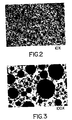
- the impeller was rotated at 900 rpm. After 10 minutes of mixing, the composite melt started to expand. When the expansion reached the top of the crucible, the impeller was stopped and samples of the expanded, viscous molten material were collected and cast in a sample mould. The cast was sectioned and examined microscopically and the results are shown in the photomicrographs of Figures 2 and 3.
- This expanded material was found to have pores which were very small, spherical-shaped and quite evenly distributed.
- the bulk density of the expanded metal composite material was in the range of 1-1.5 g/cc, with an average pore size of about 250 microns and an average spacing between pores of about 100 microns.
Landscapes
- Chemical & Material Sciences (AREA)
- Engineering & Computer Science (AREA)
- Mechanical Engineering (AREA)
- Materials Engineering (AREA)
- Metallurgy (AREA)
- Organic Chemistry (AREA)
- Manufacture Of Alloys Or Alloy Compounds (AREA)
- Porous Artificial Stone Or Porous Ceramic Products (AREA)
- Catalysts (AREA)
Claims (22)
- Verfahren zur Herstellung eines leichtgewichtigen Gas-Metall-Verbundwerkstoffs, der isolierte teilchenstabilisierte Poren enthält, umfassend die Schritte:Erhitzen eines Verbundwerkstoffs aus einer Metallmatrix und feinverteilten festen Stabilisatorteilchen über die Schmelztemperatur der Metallmatrix zur Bildung eines geschmolzenen Metall-Verbundwerkstoffs;Mischen des geschmolzenen Metall-Verbundwerkstoffs, wodurch ein Wirbel gebildet wird, und Fortführung des Mischens während ein Gas über den Wirbel in den geschmolzenen Verbundwerkstoff eingesogen wird, bis sich ein ausgedehntes viskoses, geschmolzenes Verbundwerkstoffmaterial gebildet hat; undAbkühlen des expandierten Materials unter die Erstarrungstemperatur der Schmelze unter Bildung eines leichtgewichtigen festen Metallprodukts mit einer darin verteilten Vielzahl kleiner isolierter teilchenstabilisierter Poren.
- Verfahren gemäss Anspruch 1, worin die Stabilisatorteilchen in dem Metallmatrix-Verbundwerkstoff in einer Menge von weniger als 25 Vol.% vorhanden sind.
- Verfahren gemäss Anspruch 2, worin die Stabilisatorteilchen Grössen im Bereich von etwa 0,1 bis 50 µm aufweisen.
- Verfahren gemäss Anspruch 3, worin die Stabilisatorteilchen Grössen im Bereich von etwa 0,5 bis 25 µm aufweisen und in dem Verbundwerkstoff in einer Menge von 5 bis 15 Vol.% vorhanden sind.
- Verfahren gemäss Anspruch 3, worin die Stabilisatorteilchen keramische oder intermetallische Teilchen sind.
- Verfahren gemäss Anspruch 3, worin die Stabilisatorteilchen Metalloxide, Carbide, Nitride oder Boride sind.
- Verfahren gemäss Anspruch 3, worin die Stabilisatorteilchen ausgewählt sind aus Aluminiumoxid, Titandiborid, Zirkonoxid, Siliciumcarbid und Siliciumnitrid.
- Verfahren gemäss Anspruch 3, worin das Mischen fortgeführt wird, bis der expandierte geschmolzene Metall-Verbundwerkstoff eine pastöse oder viskose Konsistenz besitzt.
- Verfahren gemäss Anspruch 1, worin das expandierte viskose, geschmolzene Verbundwerkstoffmaterial zu einem geformten leichtgewichtigen Metallprodukt ausgebildet wird.
- Verfahren gemäss Anspruch 1, worin das feste Metallprodukt umgeschmolzen und zu einem geformten leichtgewichtigen Metallprodukt ausgestaltet wird.
- Verfahren gemäss Anspruch 9 oder 10, worin die Formgebung Formgiessen oder thixotrope Formgebung umfasst.
- Verfahren gemäss Anspruch 11, worin die thixotrope Formgebung Thixoextrusion oder Thixoschmiedung ist.
- Verfahren gemäss Anspruch 1, worin die Metallmatrix Aluminium oder eine Legierung davon ist.
- Stabilisierter leichtgewichtiger Metallkörper, umfassend eine Metallmatrix mit darin dispergierten, feinverteilten, festen Stabilisatorteilchen; und besagter Körper weist ebenso darin dispergiert eine Vielzahl an geschlossenen und isolierten, im allgemeinen sphärischen Poren mit Grössen im Bereich von 10 bis 500 µm auf, die in der Matrix enthaltenen Stabilisatorteilchen sind in der Umgebung der Grenzflächen zwischen dem Matrixmetall und den geschlossenen Poren konzentriert.
- Metallkörper gemäss Anspruch 14, worin die Poren durch eine durchschnittliche Distanz von etwa 50 bis 100 µm voneinander räumlich getrennt sind.
- Metallkörper gemäss Anspruch 15, worin der Metallkörper ein geformter Körper mit glatten Aussenflächen und einem Kern mit den besagten, räumlich getrennten Poren ist.
- Metallkörper gemäss Anspruch 15, worin die Stabilisatorteilchen in dem Metallmatrix-Verbundwerkstoff in einer Menge von weniger als 25 Vol.% vorhanden sind.
- Metallkörper gemäss Anspruch 17, worin die Stabilisatorteilchen Grössen im Bereich von etwa 0,1 bis 50 µm aufweisen.
- Metallkörper gemäss Anspruch 18, worin die Stabilisatorteilchen keramische oder intermetallische Teilchen sind.
- Metallkörper gemäss Anspruch 19, worin die Metallmatrix Aluminium oder eine Legierung davon ist.
- Metallkörper gemäss Anspruch 20, worin die Stabilisatorteilchen Metalloxide, Carbide, Nitride oder Boride sind.
- Metallkörper gemäss Anspruch 14, der eine relative Dichte von etwa 0,3 bis etwa 1 aufweist.
Applications Claiming Priority (5)
| Application Number | Priority Date | Filing Date | Title |
|---|---|---|---|
| US573716 | 1990-08-27 | ||
| US07/573,716 US5112697A (en) | 1989-09-06 | 1990-08-27 | Stabilized metal foam body |
| CA002046814A CA2046814C (en) | 1991-07-11 | 1991-07-11 | Lightweight metal with isolated pores and its production |
| CA2046814 | 1991-07-11 | ||
| PCT/CA1991/000300 WO1992003582A1 (en) | 1990-08-27 | 1991-08-26 | Lightweight metal with isolated pores and its production |
Publications (2)
| Publication Number | Publication Date |
|---|---|
| EP0545957A1 EP0545957A1 (de) | 1993-06-16 |
| EP0545957B1 true EP0545957B1 (de) | 1996-08-07 |
Family
ID=25674691
Family Applications (1)
| Application Number | Title | Priority Date | Filing Date |
|---|---|---|---|
| EP91914312A Expired - Lifetime EP0545957B1 (de) | 1990-08-27 | 1991-08-26 | Leichtgewichtmetall mit isolierten poren sowie seine herstellung |
Country Status (7)
| Country | Link |
|---|---|
| EP (1) | EP0545957B1 (de) |
| JP (1) | JPH06500359A (de) |
| AT (1) | ATE141108T1 (de) |
| AU (1) | AU8326791A (de) |
| DE (1) | DE69121242T2 (de) |
| MX (1) | MX9100828A (de) |
| WO (1) | WO1992003582A1 (de) |
Families Citing this family (11)
| Publication number | Priority date | Publication date | Assignee | Title |
|---|---|---|---|---|
| DE4326982C1 (de) * | 1993-08-11 | 1995-02-09 | Alcan Gmbh | Verfahren und Vorrichtung zur Herstellung von Formteilen aus Metallschaum |
| US6555515B1 (en) | 1995-12-06 | 2003-04-29 | Henkel Kommanitgesellschaft Auf Aktien | Formulations for cleaning hard surfaces based on at least partly branched-chain alkyl oligoglucosides |
| AUPO110296A0 (en) | 1996-07-18 | 1996-08-08 | University Of Melbourne, The | Liquidus casting of alloys |
| JP3823024B2 (ja) * | 1997-08-30 | 2006-09-20 | ホンゼル ゲゼルシャフト ミット ベシュレンクテル ハフツング ウント コンパニー コマンディートゲゼルシャフト | 発泡可能なアルミニウム合金および発泡可能なアルミニウム合金からアルミニウム発泡体を製造する方法 |
| DE19749294C1 (de) | 1997-11-07 | 1999-04-01 | Daimler Benz Ag | Karosseriestruktur mit wenigstens einer Querverbindung |
| US6250362B1 (en) | 1998-03-02 | 2001-06-26 | Alcoa Inc. | Method and apparatus for producing a porous metal via spray casting |
| WO1999064287A1 (de) * | 1998-06-09 | 1999-12-16 | M.I.M. Hüttenwerke Duisburg Gmbh | Verfahren zur herstellung einer verstärkung in einem hohlraum eines kfz-bauteils |
| US7195662B2 (en) | 2001-06-15 | 2007-03-27 | Huette Klein-Reichenbach Gesellschaft Mbh | Device and process for producing metal foam |
| JP3805694B2 (ja) * | 2002-02-15 | 2006-08-02 | 本田技研工業株式会社 | 発泡/多孔質金属の製造方法 |
| DE102008000100B4 (de) | 2008-01-18 | 2013-10-17 | Fraunhofer-Gesellschaft zur Förderung der angewandten Forschung e.V. | Verfahren zur Herstellung eines leichtgewichtigen Grünkörpers, danach hergestellter leichtgewichtiger Grünkörper und Verfahren zur Herstellung eines leichtgewichtigen Formkörpers |
| CN110029256B (zh) * | 2019-04-19 | 2020-10-23 | 青海民族大学 | 一种提高az91镁合金耐腐蚀性能的方法 |
Family Cites Families (4)
| Publication number | Priority date | Publication date | Assignee | Title |
|---|---|---|---|---|
| FR2282479A1 (fr) * | 1974-08-19 | 1976-03-19 | Pechiney Aluminium | Pieces en alliage d'aluminium poreux et moyen de les preparer |
| NO155447C (no) * | 1984-01-25 | 1987-04-01 | Ardal Og Sunndal Verk | Anordning ved anlegg for behandling av en vaeske, f.eks. en aluminiumssmelte. |
| DE3665739D1 (en) * | 1985-07-19 | 1989-10-26 | Agency Ind Science Techn | Foamed metal and method of producing same |
| US5112697A (en) * | 1989-09-06 | 1992-05-12 | Alcan International Limited | Stabilized metal foam body |
-
1991
- 1991-08-26 AU AU83267/91A patent/AU8326791A/en not_active Abandoned
- 1991-08-26 DE DE69121242T patent/DE69121242T2/de not_active Expired - Lifetime
- 1991-08-26 JP JP3513820A patent/JPH06500359A/ja active Pending
- 1991-08-26 EP EP91914312A patent/EP0545957B1/de not_active Expired - Lifetime
- 1991-08-26 WO PCT/CA1991/000300 patent/WO1992003582A1/en not_active Ceased
- 1991-08-26 AT AT91914312T patent/ATE141108T1/de not_active IP Right Cessation
- 1991-08-27 MX MX9100828A patent/MX9100828A/es unknown
Also Published As
| Publication number | Publication date |
|---|---|
| WO1992003582A1 (en) | 1992-03-05 |
| DE69121242D1 (de) | 1996-09-12 |
| MX9100828A (es) | 1992-04-01 |
| DE69121242T2 (de) | 1997-01-23 |
| ATE141108T1 (de) | 1996-08-15 |
| JPH06500359A (ja) | 1994-01-13 |
| AU8326791A (en) | 1992-03-17 |
| EP0545957A1 (de) | 1993-06-16 |
Similar Documents
| Publication | Publication Date | Title |
|---|---|---|
| US5221324A (en) | Lightweight metal with isolated pores and its production | |
| Gergely et al. | The FORMGRIP process: foaming of reinforced metals by gas release in precursors | |
| Banhart | Manufacturing routes for metallic foams | |
| US5281251A (en) | Process for shape casting of particle stabilized metal foam | |
| US5112697A (en) | Stabilized metal foam body | |
| Tham et al. | Influence of processing parameters during disintegrated melt deposition processing on near net shape synthesis of aluminium based metal matrix composites | |
| US4973358A (en) | Method of producing lightweight foamed metal | |
| Hashim et al. | Metal matrix composites: production by the stir casting method | |
| US5622542A (en) | Particle-stabilized metal foam and its production | |
| CA2238520C (en) | Machinable mmc and liquid metal infiltration process | |
| JP2635817B2 (ja) | 粒子で補強した金属発泡体の製法 | |
| EP0545957B1 (de) | Leichtgewichtmetall mit isolierten poren sowie seine herstellung | |
| US6254998B1 (en) | Cellular structures and processes for making such structures | |
| JP2002371327A (ja) | 発泡金属の製造方法 | |
| Finkelstein et al. | Microstructures, mechanical properties ingot AlSi7Fe1 after blowing oxygen through melt | |
| Svyatoslav et al. | Aluminum metallic foams made by carbonate foaming agents | |
| CA2046814C (en) | Lightweight metal with isolated pores and its production | |
| Asthana et al. | Solidification synthesis of pressure-infiltrated Al alloy 2014-SiC platelet composites | |
| US5193605A (en) | Techniques for preparation of ingot metallurgical discontinuous composites | |
| Surace¹ et al. | Investigation and comparison of aluminium foams manufactured by different techniques | |
| Asthana | Solidification Processing of Reinforced Metals: Frabrication Techniques | |
| CA2154246C (en) | Production of particle-stabilized metal foams | |
| MXPA06013871A (es) | Metodo para reciclar partes de material ligero. | |
| El-Mahallawy et al. | Casting Process Developments for Improving Quality | |
| Wannasin | Centrifugal infiltration of particulate metal matrix composites: process development and fundamental studies |
Legal Events
| Date | Code | Title | Description |
|---|---|---|---|
| PUAI | Public reference made under article 153(3) epc to a published international application that has entered the european phase |
Free format text: ORIGINAL CODE: 0009012 |
|
| 17P | Request for examination filed |
Effective date: 19930225 |
|
| AK | Designated contracting states |
Kind code of ref document: A1 Designated state(s): AT BE CH DE DK ES FR GB IT LI NL SE |
|
| 17Q | First examination report despatched |
Effective date: 19940822 |
|
| GRAH | Despatch of communication of intention to grant a patent |
Free format text: ORIGINAL CODE: EPIDOS IGRA |
|
| GRAH | Despatch of communication of intention to grant a patent |
Free format text: ORIGINAL CODE: EPIDOS IGRA |
|
| GRAA | (expected) grant |
Free format text: ORIGINAL CODE: 0009210 |
|
| AK | Designated contracting states |
Kind code of ref document: B1 Designated state(s): AT BE CH DE DK ES FR GB IT LI NL SE |
|
| PG25 | Lapsed in a contracting state [announced via postgrant information from national office to epo] |
Ref country code: IT Free format text: LAPSE BECAUSE OF FAILURE TO SUBMIT A TRANSLATION OF THE DESCRIPTION OR TO PAY THE FEE WITHIN THE PRE;WARNING: LAPSES OF ITALIAN PATENTS WITH EFFECTIVE DATE BEFORE 2007 MAY HAVE OCCURRED AT ANY TIME BEFORE 2007. THE CORRECT EFFECTIVE DATE MAY BE DIFFERENT FROM THE ONE RECORDED.SCRIBED TIME-LIMIT Effective date: 19960807 Ref country code: NL Free format text: LAPSE BECAUSE OF FAILURE TO SUBMIT A TRANSLATION OF THE DESCRIPTION OR TO PAY THE FEE WITHIN THE PRESCRIBED TIME-LIMIT Effective date: 19960807 Ref country code: AT Effective date: 19960807 Ref country code: FR Effective date: 19960807 Ref country code: ES Free format text: THE PATENT HAS BEEN ANNULLED BY A DECISION OF A NATIONAL AUTHORITY Effective date: 19960807 Ref country code: BE Effective date: 19960807 Ref country code: DK Effective date: 19960807 Ref country code: LI Free format text: LAPSE BECAUSE OF FAILURE TO SUBMIT A TRANSLATION OF THE DESCRIPTION OR TO PAY THE FEE WITHIN THE PRESCRIBED TIME-LIMIT Effective date: 19960807 Ref country code: CH Free format text: LAPSE BECAUSE OF FAILURE TO SUBMIT A TRANSLATION OF THE DESCRIPTION OR TO PAY THE FEE WITHIN THE PRESCRIBED TIME-LIMIT Effective date: 19960807 |
|
| REF | Corresponds to: |
Ref document number: 141108 Country of ref document: AT Date of ref document: 19960815 Kind code of ref document: T |
|
| REF | Corresponds to: |
Ref document number: 69121242 Country of ref document: DE Date of ref document: 19960912 |
|
| PG25 | Lapsed in a contracting state [announced via postgrant information from national office to epo] |
Ref country code: SE Effective date: 19961107 |
|
| EN | Fr: translation not filed | ||
| NLV1 | Nl: lapsed or annulled due to failure to fulfill the requirements of art. 29p and 29m of the patents act | ||
| REG | Reference to a national code |
Ref country code: CH Ref legal event code: PL |
|
| PLBE | No opposition filed within time limit |
Free format text: ORIGINAL CODE: 0009261 |
|
| STAA | Information on the status of an ep patent application or granted ep patent |
Free format text: STATUS: NO OPPOSITION FILED WITHIN TIME LIMIT |
|
| 26N | No opposition filed | ||
| REG | Reference to a national code |
Ref country code: GB Ref legal event code: IF02 |
|
| PGFP | Annual fee paid to national office [announced via postgrant information from national office to epo] |
Ref country code: DE Payment date: 20100827 Year of fee payment: 20 |
|
| PGFP | Annual fee paid to national office [announced via postgrant information from national office to epo] |
Ref country code: GB Payment date: 20100825 Year of fee payment: 20 |
|
| REG | Reference to a national code |
Ref country code: DE Ref legal event code: R071 Ref document number: 69121242 Country of ref document: DE |
|
| REG | Reference to a national code |
Ref country code: DE Ref legal event code: R071 Ref document number: 69121242 Country of ref document: DE |
|
| PG25 | Lapsed in a contracting state [announced via postgrant information from national office to epo] |
Ref country code: GB Free format text: LAPSE BECAUSE OF EXPIRATION OF PROTECTION Effective date: 20110825 |
|
| PG25 | Lapsed in a contracting state [announced via postgrant information from national office to epo] |
Ref country code: DE Free format text: LAPSE BECAUSE OF EXPIRATION OF PROTECTION Effective date: 20110827 |