EP0546449A2 - Benzofuranderivate als Angiotensin II Antagonisten - Google Patents
Benzofuranderivate als Angiotensin II Antagonisten Download PDFInfo
- Publication number
- EP0546449A2 EP0546449A2 EP92120651A EP92120651A EP0546449A2 EP 0546449 A2 EP0546449 A2 EP 0546449A2 EP 92120651 A EP92120651 A EP 92120651A EP 92120651 A EP92120651 A EP 92120651A EP 0546449 A2 EP0546449 A2 EP 0546449A2
- Authority
- EP
- European Patent Office
- Prior art keywords
- imidazo
- formula
- benzofuran
- butyl
- benzyl
- Prior art date
- Legal status (The legal status is an assumption and is not a legal conclusion. Google has not performed a legal analysis and makes no representation as to the accuracy of the status listed.)
- Withdrawn
Links
- 0 CC1=*C(*OC*2)[C@@]2N1 Chemical compound CC1=*C(*OC*2)[C@@]2N1 0.000 description 2
Classifications
-
- C—CHEMISTRY; METALLURGY
- C07—ORGANIC CHEMISTRY
- C07D—HETEROCYCLIC COMPOUNDS
- C07D471/00—Heterocyclic compounds containing nitrogen atoms as the only ring hetero atoms in the condensed system, at least one ring being a six-membered ring with one nitrogen atom, not provided for by groups C07D451/00 - C07D463/00
- C07D471/02—Heterocyclic compounds containing nitrogen atoms as the only ring hetero atoms in the condensed system, at least one ring being a six-membered ring with one nitrogen atom, not provided for by groups C07D451/00 - C07D463/00 in which the condensed system contains two hetero rings
- C07D471/04—Ortho-condensed systems
-
- A—HUMAN NECESSITIES
- A61—MEDICAL OR VETERINARY SCIENCE; HYGIENE
- A61P—SPECIFIC THERAPEUTIC ACTIVITY OF CHEMICAL COMPOUNDS OR MEDICINAL PREPARATIONS
- A61P27/00—Drugs for disorders of the senses
- A61P27/02—Ophthalmic agents
-
- A—HUMAN NECESSITIES
- A61—MEDICAL OR VETERINARY SCIENCE; HYGIENE
- A61P—SPECIFIC THERAPEUTIC ACTIVITY OF CHEMICAL COMPOUNDS OR MEDICINAL PREPARATIONS
- A61P5/00—Drugs for disorders of the endocrine system
- A61P5/38—Drugs for disorders of the endocrine system of the suprarenal hormones
-
- A—HUMAN NECESSITIES
- A61—MEDICAL OR VETERINARY SCIENCE; HYGIENE
- A61P—SPECIFIC THERAPEUTIC ACTIVITY OF CHEMICAL COMPOUNDS OR MEDICINAL PREPARATIONS
- A61P9/00—Drugs for disorders of the cardiovascular system
-
- A—HUMAN NECESSITIES
- A61—MEDICAL OR VETERINARY SCIENCE; HYGIENE
- A61P—SPECIFIC THERAPEUTIC ACTIVITY OF CHEMICAL COMPOUNDS OR MEDICINAL PREPARATIONS
- A61P9/00—Drugs for disorders of the cardiovascular system
- A61P9/08—Vasodilators for multiple indications
-
- A—HUMAN NECESSITIES
- A61—MEDICAL OR VETERINARY SCIENCE; HYGIENE
- A61P—SPECIFIC THERAPEUTIC ACTIVITY OF CHEMICAL COMPOUNDS OR MEDICINAL PREPARATIONS
- A61P9/00—Drugs for disorders of the cardiovascular system
- A61P9/10—Drugs for disorders of the cardiovascular system for treating ischaemic or atherosclerotic diseases, e.g. antianginal drugs, coronary vasodilators, drugs for myocardial infarction, retinopathy, cerebrovascula insufficiency, renal arteriosclerosis
-
- A—HUMAN NECESSITIES
- A61—MEDICAL OR VETERINARY SCIENCE; HYGIENE
- A61P—SPECIFIC THERAPEUTIC ACTIVITY OF CHEMICAL COMPOUNDS OR MEDICINAL PREPARATIONS
- A61P9/00—Drugs for disorders of the cardiovascular system
- A61P9/12—Antihypertensives
Definitions
- the object of the invention was to find new compounds with valuable properties, in particular those which can be used for the production of medicaments.
- the compounds of the formula I and their salts have very valuable pharmacological properties with good tolerability.
- they show angiotensin II antagonistic properties and can therefore be used for the treatment of angiotensin II-dependent hypertension, aldosteronism and heart failure and disorders of the central nervous system.
- These effects can be determined by conventional in vitro or in vivo methods, e.g. in U.S. Patent 4,880,804 and WO 91/14367, further described by A.T. Chiu et al., J. Pharmacol. Exp. Therap. 250, 867-874 (1989), and by P.C. Wong et al., Ibid. 252, 719-725 (1990; in vivo, on rats).
- the compounds of formula I can be used as active pharmaceutical ingredients in human and veterinary medicine, in particular for the prophylaxis and / or therapy of cardiovascular and vascular diseases, especially hypertension, heart failure and hyperaldosteronism.
- hypertrophy and hyperplasia of the blood vessels and the heart also hypertrophy and hyperplasia of the blood vessels and the heart, angina pectoris, heart attacks, stroke, ristenosis after angioplasty or by-pass surgery, arteriosclerosis, increased intraocular pressure, glaucoma, macular degeneration, hyperuricaemia, kidney dysfunction, e.g. Renal failure, nephropathia diabetica, retinopathia diabetica, psoriasis, angiotensin II-mediated disorders in female reproductive organs, perceptual disorders, e.g. Dementia, amnesia, memory disorders, anxiety, depression and / or epilepsy.
- alkyl has 1-6, preferably 1, 2, 3, or 4 carbon atoms.
- Alkyl preferably means methyl, furthermore ethyl, propyl, isopropyl, butyl, isobutyl, sec-butyl or tert-butyl, furthermore also pentyl, 1-, 2- or 3-methylbutyl, 1,1-, 1,2 - or 2,2-dimethylpropyl, 1-ethylpropyl, hexyl, 1-, 2-, 3- or 4-methylpentyl, 1,1-, 1,2-, 1,3-, 2,2-, 2,3 - or 3,3-dimethylbutyl, 1- or 2-ethylbutyl, 1-ethyl-1-methylpropyl, 1-ethyl-2-methylpropyl, 1,1,2- or 1,2,2-trimethylpropyl.
- Alkenyl is preferably vinyl, 1- or 2-propenyl, 1-butenyl, furthermore 1-pentenyl or 1-hexenyl.
- Alkynyl is preferably ethynyl, 1- or 2-propynyl, furthermore 1-butynyl, 1-pentynyl or 1-hexynyl.
- Hal is preferably F, CI or Br, but also J.
- the H atoms on the C atoms in the radicals -ABCD- can be substituted by alkyl (preferably methyl), Hal (preferably F or CI), COOR 3 (preferably COOH, COOCH 3 or COOC 2 Hs), CN and / or 5-tetrazolyl. CH 3 and COOH are preferred as substituents. Preferably only one or two of these H atoms are substituted by one of the stated substituents.
- the compounds of the formula I include those of the formulas Ia to Ih, in which R has the meaning given under (a) to (h).
- the radical R 1 is preferably H or Br.
- the radical R 2 is preferably CN, further preferably 5-tetrazolyl, COOH, COOCH 3 , COOC 2 Hs or NHS0 2 CF 3 .
- the radical R 3 (unless it is H) is preferably straight-chain and is preferably alkyl or alkenyl each having 2-6 C atoms, in particular butyl, furthermore ethyl or propyl, furthermore pentyl, hexyl, allyl or 1-propenyl, furthermore 1-butenyl, 1-pentenyl, 1-hexenyl, ethynyl, 1-propynyl, 1-butynyl, 1-pentynyl or 1-hexynyl.
- the radical R 4 is preferably H, further preferably alkyl (in particular CH 3 ), cyanoalkyl (in particular cyanomethyl, 2-cyanoethyl, 3-cyanopropyl), AOOC-alkyl (in particular methoxycarbonylmethyl, ethoxycarbonylmethyl, 2-methoxycarbonyl-ethyl, 2-ethoxycarbonyl- ethyl), carboxyalkyl (especially carboxymethyl, 2-carboxyethyl, 3-carboxypropyl), 5-tetrazolyl-alkyl [especially 5-tetrazolyl-methyl, 2- (5-tetrazolyl) -ethyl, 3- (5-tetrazolyl) propyl) , all of these radicals preferably each containing up to 6 carbon atoms in total.
- alkyl in particular CH 3
- cyanoalkyl in particular cyanomethyl, 2-cyanoethyl, 3-cyanopropyl
- the radical R 4 is preferably Ar-alkyl having 7-11 C atoms, in particular benzyl, 1- or 2-phenylethyl, 1-, 2- or 3-phenylpropyl, 1-, 2-, 3- or 4-phenylbutyl , o-, m- or p-fluorobenzyl, (preferably) o-, m- or p-chlorobenzyl, o-, m- or p-bromobenzyl, o-, m- or p-methylbenzyl, o-, m- or p-trifluoromethylbenzyl, o-, m- or p-methoxycarbonylbenzyl, o-, m- or p-ethoxycarbonylbenzyl, (preferably) o-, m- or p-cyanobenzyl, o-, m- or p-carboxybenzyl, o-, m- or p-nitrobenzyl,
- the compounds of the formula I can have one or more chiral centers and therefore exist in various forms, optically active or optically inactive. Formula I encompasses all of these forms.
- the invention relates in particular to those compounds of the formula I in which at least one of the radicals mentioned has one of the preferred meanings indicated above.
- Some preferred groups of compounds can be expressed by the following sub-formulas li, Ij, lai to Ihi and laj to Ihj, which correspond to the formulas I and la to Ih and in which the radicals which are not specified are those given in the formulas I and la to Ih Meanings: Compounds of the formula li and lai, Ibi, Ici, Idi, lei, lfi, Igi and Ihi: these correspond to the formulas I and la to Ih, but in addition R 1 is H.
- the starting materials can also be formed in situ, so that they are not isolated from the reaction mixture, but instead are immediately reacted further to give the compounds of the formula I.
- the compounds of the formula I can preferably be obtained by reacting compounds of the formula II with compounds of the formula III.
- E preferably denotes Cl, Br, 1 or a reactive, functionally modified OH group such as alkylsulfonyloxy with 1-6 C atoms (preferably methylsulfonyloxy) or arylsulfonyloxy with 6-10 C atoms (preferably phenyl or p -Tolylsulfonyloxy).
- a reactive, functionally modified OH group such as alkylsulfonyloxy with 1-6 C atoms (preferably methylsulfonyloxy) or arylsulfonyloxy with 6-10 C atoms (preferably phenyl or p -Tolylsulfonyloxy).
- the reaction of II with III is advantageously carried out by first converting III into a salt by treatment with a base, for example with an alkali metal alcoholate such as CH 3 0Na or K-tert-butoxide in an alcohol such as CH 3 0H or with an alkali metal hydride such as NaH or an alkali metal alcoholate in dimethylformamide (DMF), and this then reacted with II in an inert solvent, for example an amide such as DMF or dimethylacetamide or a sulfoxide such as dimethyl sulfoxide (DMSO), advantageously at temperatures between -20 and 100 °, preferably between 10 and 30 °.
- Alkali metal carbonates such as Na 2 CO 3 or K 2 CO 3 or alkali metal bicarbonates such as NaHCO 3 or KHCO 3 are also suitable as bases.
- a compound of formula I can also be liberated from one of its functional derivatives by treatment with a solvolysing (e.g. hydrolyzing) or hydrogenolysing agent.
- a solvolysing e.g. hydrolyzing
- hydrogenolysing agent e.g. hydrogenolysing agent
- Suitable protective groups are, for example: triphenylmethyl, which can be split off with HCl or formic acid in an inert solvent or solvent mixture, for example ether / dichloromethane / methanol; 2-cyanoethyl, removable with NaOH in water / THF; p-Nitrobenzyl, can be split off with H 2 / Raney nickel in ethanol (cf. EP-A2-0 291 969).
- a compound of the formula I into another compound of the formula I by converting one or more of the radicals R 1 , R 2 and / or R into other radicals R 1 , R 2 and / or R, for example by reducing nitro groups (for example by hydrogenation on Raney nickel in an inert solvent such as methanol or ethanol) to amino groups and / or modifying free amino and / or hydroxyl groups and / or modifying functionally modified amino and / or hydroxyl groups by solvolysis or hydrogenolysis releases and / or halogen atoms (e.g.
- free amino groups can be acylated in the usual way with an acid chloride or anhydride, or free hydroxy and / or NH groups can be alkylated with an unsubstituted or substituted alkyl or aralkyl halide, advantageously in an inert solvent such as dichloromethane or THF and / or in the presence of a base such as triethylamine or pyridine at temperatures between -60 and + 30 °.
- an inert solvent such as dichloromethane or THF
- a base such as triethylamine or pyridine
- an acid amide such as DMF, N-methylpyrrolidone, 1,3-dimethyl-2-oxo-hexahydropyrimidine or phosphoric acid hexamethyl-triamide, an alcohol such as methanol or tert-butanol, an ether such as THF or a halogenated hydrocarbon such as dichloromethane or mixtures thereof as a solvent and / or in the presence of an alkali metal alcoholate such as sodium methylate or potassium tert-butoxide, an alkali metal hydride such as sodium or potassium hydride, an alkali metal carbonate such as sodium or potassium carbonate, an alkali metal bicarbonate such as sodium or potassium bicarbonate Amines such as triethylamine or ethyldiisopropylamine at temperatures between about -30 and 200, preferably between 20 and 60 °.
- a functionally modified amino and / or hydroxyl group in a compound of the formula 1 can be liberated by solvolysis or hydrogenolysis by customary methods.
- So z. B. a compound of formula I, which contains an NHCOCF 3 - or a COOR 3 group (in which R 3 is different from H), can be converted into the corresponding compound of formula I, which instead has an NH 2 - or a HOOC- Group contains.
- Ester groups can be saponified, for example, with NaOH or KOH in water, water-THF or water-dioxane at temperatures between 0 and 100.
- Trialkyltin azides such as trimethyltin azide are preferably used in an inert solvent, for example an aromatic hydrocarbon such as toluene at temperatures between 20 and 150 °, preferably between 80 and 140 °, or sodium azide in N-methylpyrrolidone at temperatures between about 100 and 200 °.
- a base of formula 1 can be converted into the associated acid addition salt using an acid.
- acids which provide physiologically acceptable salts are suitable for this reaction.
- inorganic acids can be used, for example sulfuric acid, nitric acid, hydrohalic acids such as hydrochloric acid or hydrobromic acid, phosphoric acids such as ortho phosphoric acid, sulfamic acid, also organic acids, in particular aliphatic, alicyclic, araliphatic, aromatic or heterocyclic mono- or polybasic carboxylic, sulfonic or sulfuric acids, for example formic acid, acetic acid, propionic acid, pivalic acid, diethyl acetic acid, malonic acid, succinic acid, pimelic acid, maleic acid, fumaric acid , Lactic acid, tartaric acid, malic acid, citric acid, gluconic acid, ascorbic acid, nicotinic acid, isonicotinic acid, methane or ethanesulfonic acid,
- compounds of formula I which contain COOH or tetrazolyl groups can be converted with bases (e.g. sodium or potassium hydroxide or carbonate) into the corresponding metal, in particular alkali metal or alkaline earth metal, or into the corresponding ammonium salts.
- bases e.g. sodium or potassium hydroxide or carbonate
- the potassium salts of the tetrazolyl derivatives are particularly preferred.
- the new compounds of formula I and their physiologically acceptable salts can be used for the production of pharmaceutical preparations by combining them in a suitable dosage form together with at least one carrier or auxiliary and, if desired, together with one or more further active ingredient (s) brings.
- the preparations thus obtained can be used as pharmaceuticals in human or veterinary medicine.
- Suitable carrier substances are organic or inorganic substances which are suitable for enteral (for example oral or rectal) or parenteral application or for application in the form of an inhalation spray and do not react with the new compounds, for example water, vegetable oils, benzyl alcohols , Polyethylene glycols, glycerol triacetate and other fatty acid glycerides, gelatin, soy lecithin, carbohydrates such as lactose or starch, magnesium stearate, talc, cellulose. Tablets, coated tablets, capsules, syrups, juices or drops are used in particular for oral use; of particular interest are coated tablets and capsules with enteric coatings or capsule shells.
- Suppositories are used for rectal administration, solutions are used for parenteral administration, preferably oily or aqueous solutions, furthermore suspensions, emulsions or implants.
- parenteral administration preferably oily or aqueous solutions, furthermore suspensions, emulsions or implants.
- sprays can be used that contain the active ingredient either dissolved or suspended in a propellant gas mixture (e.g. chlorofluorocarbons).
- the active ingredient is expediently used in micronized form, it being possible for one or more additional physiologically acceptable solvents to be present, e.g. Ethanol.
- Inhalation solutions can be administered using standard inhalers.
- the new compounds can also be lyophilized and the resulting lyophilisates e.g. can be used for the production of injectables.
- the specified preparations can be sterilized and / or contain auxiliaries such as preservatives, stabilizers and / or wetting agents, emulsifiers, salts for influencing the osmotic pressure, buffer substances, colors and / or flavorings. If desired, they can also contain one or more other active ingredients, e.g. one or more vitamins, diuretics, anti-inflammatory drugs.
- the substances according to the invention are generally administered in analogy to other known, commercially available preparations, but in particular in analogy to the compounds described in US Pat. No. 4,880,804, preferably in doses between about 1 mg and 1 g, in particular between 50 and 500 mg per dosage unit.
- the daily dosage is preferably between about 0.1 and 50 mg / kg, in particular 1 and 100 mg / kg body weight.
- the specific dose for each particular patient depends on a variety of factors, for example on the effectiveness of the particular compound used, on the age, body weight, general health, sex, on the diet, on the time and route of administration, on the rate of elimination, combination of drugs and The severity of the disease to which the therapy applies. Oral application is preferred.
- a solution of 0.23 g of Na in 20 ml of methanol is added dropwise within 15 minutes to a solution of 3.2 g of 2-butyl-1 (or 3) H-imidazo [4,5-b] pyridine in 75 ml of methanol .
- the mixture is stirred for a further 30 minutes at 200, evaporated, the residue is dissolved in 20 ml of DMF and a solution of 3.45 g of 5-bromomethyl-2- (2-methoxycarbonylphenyl) benzofuran in 10 ml of DMF is added dropwise at 0 ° while stirring added.
- the starting material "A” is obtained as follows:
- the corresponding K salt is produced therefrom in the usual way.
- Example A tablets and coated tablets
- Tablets of the following composition are pressed in a conventional manner and, if necessary, are coated with a conventional coated blanket based on sucrose:
- Usual soft gelatin capsules are filled with a mixture of 50 mg active ingredient and 250 mg olive oil.
- a solution of 200 g of active ingredient in 2 kg of 1,2-propanediol is made up to 10 l with water and filled into ampoules so that each ampoule contains 20 mg of active ingredient.
- Example E Aqueous suspension for oral application
- An aqueous suspension is prepared in the usual way.
- the unit dose (5 ml) contains 100 mg active ingredient, 100 mg Na carboxymethyl cellulose, 5 ml Na benzoate and 100 mg sorbitol.
Landscapes
- Health & Medical Sciences (AREA)
- Chemical & Material Sciences (AREA)
- Organic Chemistry (AREA)
- Engineering & Computer Science (AREA)
- Bioinformatics & Cheminformatics (AREA)
- Life Sciences & Earth Sciences (AREA)
- Public Health (AREA)
- General Chemical & Material Sciences (AREA)
- Medicinal Chemistry (AREA)
- Nuclear Medicine, Radiotherapy & Molecular Imaging (AREA)
- Chemical Kinetics & Catalysis (AREA)
- Pharmacology & Pharmacy (AREA)
- Veterinary Medicine (AREA)
- Animal Behavior & Ethology (AREA)
- General Health & Medical Sciences (AREA)
- Heart & Thoracic Surgery (AREA)
- Cardiology (AREA)
- Diabetes (AREA)
- Endocrinology (AREA)
- Urology & Nephrology (AREA)
- Vascular Medicine (AREA)
- Ophthalmology & Optometry (AREA)
- Pharmaceuticals Containing Other Organic And Inorganic Compounds (AREA)
- Nitrogen Condensed Heterocyclic Rings (AREA)
Abstract
Neue Benzofurane der Formel I

worin
R den Rest 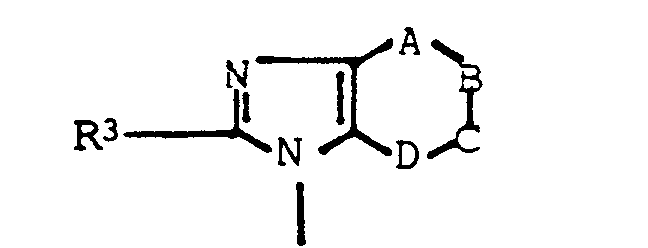
bedeutet und
R1 bis R3 sowie
-A-B-C-D- die in Anspruch 1 angegebene Bedeutung haben, sowie deren Salze zeigen angiotensin II-antagonistische Eigenschaften und können zur Behandlung von Hypertension, Aldosteronismus und Herzinsuffizienz verwendet werden.
worin
R den Rest
bedeutet und
R1 bis R3 sowie
-A-B-C-D- die in Anspruch 1 angegebene Bedeutung haben, sowie deren Salze zeigen angiotensin II-antagonistische Eigenschaften und können zur Behandlung von Hypertension, Aldosteronismus und Herzinsuffizienz verwendet werden.
Description
- Die Erfindung betrifft neue Benzofurane der Formel I

worin - R den Rest

- R1 H, Hal, COOH, CONH2, CHO, CN, NH2 oder 5-Tetrazolyl,
- R2 H, COOH, COOR3, CN, N02, NH2, NHCOCF3, NHS02CF3 oder 5-Tetrazolyl,
- R3 H, Alkyl, Alkenyl oder Alkinyl mit jeweils bis zu 6 C-Atomen,
- R4 H, Alkyl mit 1-6 C-Atomen, Cyan-alkyl, R300C-alkyl, 5-Tetrazolyl-alkyl oder Ar-alkyl mit jeweils 1-6 C-Atomen im "alkyl"-Teil,
- -A-B-C-D- eine der Gruppen -CH = CH-CH = N-, -CH = CH-N = CH-, -CH = N-CH = CH-, -N = CH-CH = CH-, -CH = CH-CO-NR 4-, -CH = CH-NR 4- CO-, -CO-NR4-CH = CH- oder -NR4- CO-CH = CH-, worin die H-Atome der -CH-Gruppen durch Alkyl mit 1-6 C-Atomen, Hal, COOR3, CN und/oder 5-Tetrazolyl substituiert sein können,
- Ar unsubstituiertes oder ein- oder zweifach durch Hal, R3, CF3, COOR3, CN, OR3, N02, NH2, NHCOCF3, NHS02CF3 oder 5-Tetrazolyl substituiertes Phenyl und
- Hal F, Cl, Br oder I bedeuten,
- Ähnliche Verbindungen sind aus der EP-A2-0430 709 bekannt, sie enthalten jedoch einen Benzothiophen-Ring an Stelle des Benzofuran-Rings und eine gegebenenfalls substituierte Imidazolylgruppe an Stelle des Restes R.
- Der Erfindung lag die Aufgabe zugrunde, neue Verbindungen mit wertvollen Eigenschaften aufzufinden, insbesondere solche, die zur Herstellung von Arzneimitteln verwendet werden können.
- Es wurde gefunden, daß die Verbindungen der Formel I und ihre Salze bei guter Verträglichkeit sehr wertvolle pharmakologische Eigenschaften besitzen. Insbesondere zeigen sie angiotensin II-antagonistische Eigenschaften und können daher zur Behandlung der angiotensin II-abhängigen Hypertension, des Aldosteronismus und der Herzinsuffizienz sowie von Störungen des Zentralnervensystems eingesetzt werden. Diese Wirkungen können nach üblichen in vitro- oder in vivo-Methoden ermittelt werden, wie sie z.B. in der US-PS 4 880 804 und in der WO 91/14367 beschrieben sind, ferner von A.T. Chiu et al., J. Pharmacol. Exp. Therap. 250, 867-874 (1989), und von P.C. Wong et al., ibid. 252, 719-725 (1990; in vivo, an Ratten).
- Die Verbindungen der Formel I können als Arzneimittelwirkstoffe in der Human- und Veterinärmedizin eingesetzt werden, insbesondere zur Prophylaxe und/oder Therapie von Herz-, Kreislauf- und Gefäßkrankheiten, vor allem von Hypertonie, Herzinsuffizienz und Hyperaldosteronismus,
- ferner von Hypertrophie und Hyperplasie der Blutgefäße und des Herzens, Angina pectoris, Herzinfarkten, Schlaganfall, Ristenosen nach Angioplastie oder By-pass-Operation, Arteriosklerose, erhöhtem Augeninnendruck, Glaukomen, macularer Degeneration, Hyperurikämie, Nierenfunktionsstörungen, z.B. Nierenversagen, Nephropathia diabetica, Retinopathia diabetica, Psoriasis, angiotensin II-vermittelten Störungen in weiblichen Fortpflanzungsorgaren, Wahrnehmungsstörungen, z.B. Demenz, Amnesie, Gedächtnisfunktionsstörungen, Angstzuständen, Depression und/oder Epilepsie.
- Gegenstand der Erfindung sind die Verbindungen der Formel I und ihre Salze sowie ein Verfahren zur Herstellung dieser Verbindungen sowie ihrer Salze, dadurch gekennzeichnet, daß man eine Verbindung der Formel 11

worin - E Cl, Br, 1 oder eine freie oder reaktionsfähig funktionell abgewandelte OH-Gruppe bedeutet und
- R1 und R2 die in Anspruch 1 angegebene Bedeutung haben,
- worin
R die in Anspruch 1 angegebene Bedeutung hat, - umsetzt,
- oder daß man eine Verbindung der Formel I aus einem ihrer funktionellen Derivate durch Behandeln mit einem solvolysierenden oder hydrogenolysierenden Mittel in Freiheit setzt,
- und/oder daß man in einer Verbindung der Formel I einen oder mehrere Rest(e) R1, R2 und/oder R in einen oder mehrere andere Reste R1, R2 und/oder R umwandelt und/oder eine Base oder Säure der Formel I in eines ihrer Salze überführt.
- Vor- und nachstehend haben die Reste bzw. Parameter R, R1 bis R4, -A-B-C-D-, Ar, Hal und E die bei den Formeln I und II angegebenen Bedeutungen, falls nicht ausdrücklich etwas anderes angegeben ist.
- In den vorstehenden Formeln hat "Alkyl" 1-6, vorzugsweise 1, 2, 3, oder 4 C-Atome. "Alkyl" bedeutet vorzugsweise Methyl, weiterhin Ethyl, Propyl, Isopropyl, Butyl, Isobutyl, sek.-Butyl oder tert.-Butyl, ferner auch Pentyl, 1-, 2- oder 3-Methylbutyl, 1,1-, 1,2- oder 2,2-Dimethylpropyl, 1-Ethylpropyl, Hexyl, 1-, 2-, 3-oder 4-Methylpentyl, 1,1-, 1,2-, 1,3-, 2,2-, 2,3- oder 3,3-Dimethylbutyl, 1- oder 2-Ethylbutyl, 1-Ethyl-1-methylpropyl, 1-Ethyl-2-methylpropyl, 1,1,2- oder 1,2,2-Trimethylpropyl. Alkenyl steht vorzugsweise für Vinyl, 1- oder 2-Propenyl, 1-Butenyl, ferner 1-Pentenyl oder 1-Hexenyl. Alkinyl steht vorzugsweise für Ethinyl, 1- oder 2-Propinyl, ferner 1-Butinyl, 1-Pentinyl oder 1-Hexinyl.
- Hal bedeutet vorzugsweise F, CI oder Br, aber auch J.
- R ist ein von 1 H- oder 3H-Imidazo[4,5-b]pyridin oder ein von 1H- oder 3H-Imidazo[4,5-c]pyridin abgeleiteter Rest, genauer:
- (a) 2-R3-3H-imidazo[4,5-b]pyridin-3yl (falls -A-B-C-D- = -CH = CH-CH = N-),
- (b) 2-R3-3H-imidazo[4,5-c]pyridin-3-yl (falls -A-B-C-D- = -CH = CH-N = CH-),
- (c) 2-R3-1 H-imidazo[4,5-c]pyridin-1-yl (falls -A-B-C-D- = -CH = N-CH = CH-),
- (d) 2-R3-1 H-imidazo[4,5-b]pyridin-1-yl (falls -A-B-C-D- = -N = CH-CH = CH-),
- (e) 2-R3-4-R4-4,5-dihydro-5-oxo-3H-imidazo[4,5-b]pyridin-3-yl (falls -A-B-C-D- = -CH-CH-CO-NR4-),
- (f) 2-R3-5-R4-4,5-dihydro-4-oxo-3H-imidazo[4,5-c]pyridin-3-yl (falls -A-B-C-D- = CH-CH-NR4-CO-),
- (g) 2-R3-5-R4-4,5-dihydro-4-oxo-1 H-imidazo[4,5-c]pyridin-3-yl (falls -A-B-C-D- = -CO-NR4-CH = CH-),
- (h) 2-R3-4-R4-4,5-dihydro-5-oxo-1 H-imidazo[4,5-b]pyridin-3-yl (falls -A-B-C-D- -NR4-CO-CH = CH-).
- Dabei können in den Resten -A-B-C-D- die an den C-Atomen befindlichen H-Atome durch Alkyl (vorzugsweise Methyl), Hal (vorzugsweise F oder CI), COOR3 (vorzugsweise COOH, COOCH3 oder COOC2Hs), CN und/oder 5-Tetrazolyl substituiert sein. Als Substituenten sind bevorzugt CH3 und COOH. Vorzugsweise sind nur eines oder zwei dieser H-Atome durch einen der angegebenen Substituenten substituiert.
- Dementsprechend umschließen die Verbindungen der Formel I solche der Formel la bis Ih, worin R die jeweils unter (a) bis (h) angegebene Bedeutung hat. Die Verbindungen der Formeln la und If sind bevorzugt.
- Der Rest R1 ist vorzugsweise H oder Br.
- Der Rest R2 ist vorzugsweise CN, ferner bevorzugt 5-Tetrazolyl, COOH, COOCH3, COOC2Hs oder NHS02CF3.
- Der Rest R3 (sofern er nicht H bedeutet) ist vorzugsweise geradkettig und steht bevorzugt für Alkyl oder Alkenyl mit jeweils 2-6 C-Atomen, insbesondere Butyl, ferner Ethyl oder Propyl, weiterhin Pentyl, Hexyl, Allyl oder 1-Propenyl, ferner 1-Butenyl, 1-Pentenyl, 1-Hexenyl, Ethinyl, 1-Propinyl, 1-Butinyl, 1-Pentinyl oder 1-Hexinyl.
- Der Rest R4 ist vorzugsweise H, ferner bevorzugt Alkyl (insbesondere CH3), Cyanalkyl (insbesondere Cyanmethyl, 2-Cyanethyl, 3-Cyanpropyl), AOOC-alkyl (insbesondere Methoxycarbonylmethyl, Ethoxycarbonylmethyl, 2-Methoxycarbonyl-ethyl, 2-Ethoxycarbonyl-ethyl), Carboxyalkyl (insbesondere Carboxymethyl, 2-Carboxyethyl, 3-Carboxypropyl), 5-Tetrazolyl-alkyl [insbesondere 5-Tetrazolyl-methyl, 2-(5-Tetrazolyl)-ethyl, 3-(5-Tetrazolyl)-propyl), wobei alle diese Reste vorzugsweise jeweils insgesamt bis zu 6 C-Atome enthalten können. Außerdem ist der Rest R4 vorzugsweise Ar-alkyl mit 7-11 C-Atomen, insbesondere Benzyl, 1- oder 2-Phenylethyl, 1-, 2- oder 3-Phenylpropyl, 1-, 2-, 3- oder 4-Phenylbutyl, o-, m- oder p-Fluorbenzyl, (bevorzugt) o-, m- oder p-Chlorbenzyl, o-, m-oder p-Brombenzyl, o-, m- oder p-Methylbenzyl, o-, m- oder p-Trifluormethylbenzyl, o-, m- oder p-Methoxycarbonylbenzyl, o-, m- oder p-Ethoxycarbonylbenzyl, (bevorzugt) o-, m- oder p-Cyanbenzyl, o-, m- oder p-Carboxybenzyl, o-, m- oder p-Nitrobenzyl, (bevorzugt) o-, m- oder p-Aminobenzyl, (bevorzugt) o-, m- oder p-(5-Tetrazolyl)-benzyl.
- Die Verbindungen der Formel I können ein oder mehrere chirale Zentren besitzen und daher in verschiedenen - optisch-aktiven oder optisch-inaktiven - Formen vorkommen. Die Formel I umschließt alle diese Formen.
- Dementsprechend sind Gegenstand der Erfindung insbesondere diejenigen Verbindungen der Formel I, in denen mindestens einer der genannten Reste eine der vorstehend angegebenen bevorzugten Bedeutungen hat. Einige bevorzugte Gruppen von Verbindungen können durch die folgenden Teilformeln li, Ij, lai bis Ihi und laj bis Ihj ausgedrückt werden, die den Formeln I sowie la bis Ih entsprechen und worin die nicht näher bezeichneten Reste die bei den Formeln I sowie la bis Ih angegebenen Bedeutungen haben: Verbindungen der Formel li sowie lai, Ibi, Ici, Idi, lei, lfi, Igi und Ihi: diese entsprechen den Formeln I sowie la bis Ih, zusätzlich bedeutet in ihnen jedoch R1 H.
- Verbindungen der Formeln Ij sowie laj, lbj, lcj, Idj, lej, Ifj, Igj, lhj, lij, laij, Ibij, Icij, Idij, leij, lfij, Igij und Ihij: diese entsprechen den Formeln I sowie la bis li und lai bis Ihi, zusätzlich bedeutet in ihnen jedoch R2 CN oder (bevorzugt) 5-Tetrazolyl.
- Eine weitere ausgewählte Gruppe bevorzugter Verbindungen entspricht der Formel I, worin R1 H, R2 5-Tetrazolyl, R3 Alkyl mit 2-4 C-Atomen und -A-B-C-D- -C(CH3) = CH-CH = N-,-C (CH3) = CH-C(CH3) = N-, -CH = CH-N(O-HOOC-C6 H4-CH2)-CO-, -CH = CH-NH-CO-oder -CH = CH-N(CH2COOH)-CO- bedeuten.
- Die Verbindungen der Formel I und auch die Ausgangsstoffe zu ihrer Herstellung werden im übrigen nach an sich bekannten Methoden hergestellt, wie sie in der Literatur (z.B. in den Standardwerken wie Houben-Weyl, Methoden der organischen Chemie, Georg-Thieme-Verlag, Stuttgart; insbesondere aber in der EP-A2-0 430 709 und in der US-PS 4 880 804) beschrieben sind, und zwar unter Reaktionsbedingungen, die für die genannten Umsetzungen bekannt und geeignet sind. Dabei kann man auch von an sich bekannten, hier nicht näher erwähnten Varianten Gebrauch machen.
- Die Ausgangsstoffe können, falls erwünscht, auch in situ gebildet werden, so daß man sie aus dem Reaktionsgemisch nicht isoliert, sondern sofort weiter zu den Verbindungen der Formel I umsetzt.
- Die Verbindungen der Formel I können vorzugsweise erhalten werden, indem man Verbindungen der Formel II mit Verbindungen der Formel III umsetzt.
- In den Verbindungen der Formel II bedeutet E vorzugsweise Cl, Br, 1 oder eine reaktionsfähig funktionell abgewandelte OH-Gruppe wie Alkylsulfonyloxy mit 1-6 C-Atomen (bevorzugt Methylsulfonyloxy) oder Arylsulfonyloxy mit 6-10 C-Atomen (bevorzugt Phenyl- oder p-Tolylsulfonyloxy).
- Die Umsetzung von II mit III erfolgt zweckmäßig, indem man zunächst III durch Behandeln mit einer Base in ein Salz umwandelt, z.B. mit einem Alkalimetallalkoholat wie CH30Na oder K-tert.-Butylat in einem Alkohol wie CH30H oder mit einem Alkalimetallhydrid wie NaH oder einem Alkalimetallalkoholat in Dimethylformamid (DMF), und dieses dann in einem inerten Lösungsmittel, z.B. einem Amid wie DMF oder Dimethylacetamid oder einem Sulfoxid wie Dimethylsulfoxid (DMSO), mit II umsetzt, zweckmäßig bei Temperaturen zwischen -20 und 100°, vorzugsweise zwischen 10 und 30°. Als Basen eignen sich auch Alkalimetallcarbonate wie Na2C03 oder K2C03 oder Alkalimetallhydrogencarbonate wie NaHCO3 oder KHCO3 .
- Die Ausgangsstoffe, insbesondere diejenigen der Formel III, sind teilweise bekannt. Falls sie nicht bekannt sind, können sie nach bekannten Methoden in Analogie zu bekannten Stoffen hergestellt werden.
- Verbindungen der Formel II sind neu. Solche der Formel II (E = Br) sind z.B. erhältlich durch Reaktion von 5-Methylsalicylaldehyd mit einem a-R'-2-R2-benzylbromid der Formel IV zu einem α-R1-2-R2-benzyle- ther der Formel V, Cyclisierung

unter Wasserabspaltung (z.B. mit NaH/DMF) zum entsprechenden 3-R1-2-(2-R2-phenyl)-5-methylbenzofuran (Formel 11, aber H an Stelle von E) und Bromierung (z.B. mit N-Bromsuccinimid). - Man kann ferner eine Verbindung der Formel I aus einem ihrer funktionellen Derivate durch Behandeln mit einem solvolysierenden (z.B. hydrolysierenden) oder hydrogenolysierenden Mittel in Freiheit setzen.
- So ist es möglich, nach einer der angegebenen Methoden eine Verbindung herzustellen, die der Formel I entspricht, aber an Stelle einer 5-Tetrazolylgruppe eine in 1-Stellung funktionell abgewandelte (durch eine Schutzgruppe geschützte) 5-Tetrazolylgruppe enthält. Als Schutzgruppen eignen sich beispielsweise: Triphenylmethyl, abspaltbar mit HCI oder Ameisensäure in einem inerten Lösungsmittel oder Lösungsmittelgemisch, z.B. Ether/ Dichlormethan/Methanol; 2-Cyanethyl, abspaltbar mit NaOH in Wasser/THF; p-Nitrobenzyl, abspaltbar mit H2/Raney-Nickel in Ethanol (vgl. EP-A2-0 291 969).
- Es ist ferner möglich, eine Verbindung der Formel I in eine andere Verbindung der Formel I umzuwandeln, indem man einen oder mehrere der Reste R1, R2 und/oder R in andere Reste R1, R2 und/oder R umwandelt, z.B. indem man Nitrogruppen (beispielsweise durch Hydrierung an Raney-Nickel in einem inerten Lösungsmittel wie Methanol oder Ethanol) zu Aminogruppen reduziert und/oder freie Amino-und/oder Hydroxygruppen funktionell abwandelt und/oder funktionell abgewandelte Amino- und/oder Hydroxygruppen durch Solvolyse oder Hydrogenolyse freisetzt und/oder Halogenatome (z.B. durch Reaktion mit Kupfer(I)cyanid) durch CN-Gruppen ersetzt und/oder Nitrilgruppen zu COOH-Gruppen hydrolysiert oder mit Derivaten der Stickstoffwasserstoffsäure, z.B. Natriumazid in N-Methylpyrrolidon oder Trimethylzinnazid in Toluol, zu Tetrazolylgruppen umsetzt.
- So kann man beispielsweise freie Aminogruppen in üblicher Weise mit einem Säurechlorid oder -anhydrid acylieren oder freie Hydroxy- und/oder NH-Gruppen mit einem unsubstituierten oder substituierten Alkyl- oder Ar-alkylhalogenid alkylieren, zweckmäßig in einem inerten Lösungsmittel wie Dichlormethan oder THF und/oder in Gegenwart einer Base wie Triethylamin oder Pyridin bei Temperaturen zwischen -60 und + 30 ° . Von Bedeutung ist die Umwandlung eines Restes R, worin R4 = H ist, in einen anderen Rest R, worin R4 von H verschieden ist. Hier arbeitet man bevorzugt in einem Säureamid wie DMF, N-Methylpyrrolidon, 1,3-Dimethyl-2-oxo-hexahydropyrimidin oder Phosphorsäure-hexamethyl-triamid, einem Alkohol wie Methanol oder tert.-Butanol, einem Ether wie THF oder einem halogenierten Kohlenwasserstoff wie Dichlormethan oder Gemischen davon als Lösungsmittel und/oder in Gegenwart eines Alkalimetallalkoholats wie Natriummethylat oder Kalium-tert.-butylat, eines Alkalimetallhydrids wie Natrium- oder Kaliumhydrid, eines Alkalimetallcarbonats wie Natrium- oder Kaliumcarbonat, eines Alkalimetallbicarbonats wie Natrium- oder Kaliumbicarbonat oder eines tertiären Amins wie Triethylamin oder Ethyldiisopropylamin bei Temperaturen Zwischen etwa -30 und 200, vorzugsweise zwischen 20 und 60 °.
- Gewünschtenfalls kann in einer Verbindung der Formel 1 eine funktionell abgewandelte Amino- und/oder Hydroxygruppe durch Solvolyse oder Hydrogenolyse nach üblichen Methoden in Freiheit gesetzt werden. So kann z. B. eine Verbindung der Formel I, die eine NHCOCF3- oder eine COOR3-Gruppe (worin R3 von H verschieden ist) enthält, in die entsprechende Verbindung der Formel I umgewandelt werden, die stattdessen eine NH2- oder eine HOOC-Gruppe enthält. Estergruppen können z.B. mit NaOH oder KOH in Wasser, Wasser-THF oder Wasser-Dioxan bei Temperaturen zwischen 0 und 100 verseift werden.
- Umsetzung von Nitrilen der Formel I (R1 und/oder R2 = CN) mit Derivaten der Stickstoffwasserstoffsäure führt zu Tetrazolen der Formel I (R1 und/oder R2 = 5-Tetrazolyl). Bevorzugt verwendet man Trialkylzinnazide wie Trimethylzinnazid in einem inerten Lösungsmittel, z.B. einem aromatischen Kohlenwasserstoff wie Toluol bei Temperaturen zwischen 20 und 150°, vorzugsweise zwischen 80 und 140°, oder Natriumazid in N-Methylpyrrolidon bei Temperaturen zwischen etwa 100 und 200°.
- Eine Base der Formel 1 kann mit einer Säure in das zugehörige Säureadditionssalz übergeführt werden. Für diese Umsetzung kommen insbesondere Säuren in Frage, die physiologisch unbedenkliche Salze liefern, So können anorganische Säuren verwendet werden, z.B. Schwefelsäure, Salpetersäure, Halogenwasserstoffsäuren wie Chlorwasserstoffsäure oder Bromwasserstoffsäure, Phosphorsäuren wie Orthophosphorsäure, Sulfaminsäure, ferner organische Säuren, insbesondere aliphatische, alicyclische, araliphatische, aromatische oder heterocyclische ein- oder mehrbasige Carbon-, Sulfon- oder Schwefelsäuren, z.B. Ameisensäure, Essigsäure, Propionsäure, Pivalinsäure, Diethylessigsäure, Malonsäure, Bernsteinsäure, Pimelinsäure, Fumarsäure, Maleinsäure, Milchsäure, Weinsäure, Äpfelsäure, Citronensäure, Gluconsäure, Ascorbinsäure, Nicotinsäure, Isonicotinsäure, Methan- oder Ethansulfonsäure, Ethandisulfonsäure, 2-Hydroxyethansulfonsäure, Benzolsulfonsäure, p-Toluolsulfonsäure, Naphthalin-mono-und -disulfonsäuren, Laurylschwefelsäure. Salze mit physiologisch nicht unbedenklichen Säuren, z.B. Pikrate, können zur Isolierung und/oder Aufreinigung der Verbindungen der Formel I verwendet werden.
- Andererseits können Verbindungen der Formel I, die COOH- oder Tetrazolylgruppen enthalten, mit Basen (z.B. Natrium- oder Kaliumhydroxid oder -carbonat) in die entsprechenden Metall-, insbesondere Alkalimetall- oder Erdalkalimetall-, oder in die entsprechenden Ammoniumsalze umgewandelt werden. Die Kaliumsalze der Tetrazolylderivate sind besonders bevorzugt.
- Die neuen Verbindungen der Formel I und ihre physiologisch unbedenklichen Salze können zur Herstellung pharmazeutischer Präparate verwendet werden, indem man sie zusammen mit mindestens einem Träger- oder Hilfsstoff und, falls erwünscht, zusammen mit einem oder mehreren weiteren Wirkstoff-(en) in eine geeignete Dosierungsform bringt. Die so erhaltenen Zubereitungen können als Arzneimittel in der Human- oder Veterinärmedizin eingesetzt werden. Als Trägersubstanzen kommen organische oder anorganische Stoffe in Frage, die sich für die enterale (z.B. orale oder rektale) oder parenterale Applikation oder für eine Applikation in Form eines Inhalations-Sprays eignen und mit den neuen Verbindungen nicht reagieren, beispielsweise Wasser, pflanzliche Öle, Benzylalkohole, Polyethylenglykole, Glycerintriacetat und andere Fettsäureglyceride, Gelatine, Sojalecithin, Kohlehydrate wie Lactose oder Stärke, Magnesiumstearat, Talk, Cellulose. Zur oralen Anwendung dienen insbesondere Tabletten, Dragees, Kapseln, Sirupe, Säfte oder Tropfen; von Interesse sind speziell Lacktabletten und Kapseln mit magensaftresistenten Überzügen bzw. Kapselhüllen. Zur rektalen Anwendung dienen Suppositorien, zur parenteralen Applikation Lösungen, vor zugsweise ölige oder wässerige Lösungen, ferner Suspensionen, Emulsionen oder Implantate. Für die Applikation als Inhalations-Spray können Sprays verwendet werden, die den Wirkstoff entweder gelöst oder suspendiert in einem Treibgasgemisch (z.B. Fluorchlorkohlenwasserstoffen) enthalten. Zweckmäßig verwendet man den Wirkstoff dabei in mikronisierter Form, wobei ein oder mehrere zusätzliche physiologisch verträgliche Lösungsmittel zugegen sein können, z.B. Ethanol. Inhalationslösungen können mit Hilfe üblicher Inhalatoren verabfolgt werden. Die neuen Verbindungen können auch lyophilisiert und die erhaltenen Lyophilisate z.B. zur Herstellung von Injektionspräparaten verwendet werden. Die angegebenen Zubereitungen können sterilisiert sein und/oder Hilfsstoffe wie Konservierungs-, Stabilisierungs- und/oder Netzmittel, Emulgatoren, Salze zur Beeinflussung des osmotischen Druckes, Puffersubstanzen, Farb- und/oder Aromastoffe enthalten. Sie können, falls erwünscht, auch einen oder mehrere weitere Wirkstoffe enthalten, z.B. ein oder mehrere Vitamine, Diuretika, Antiphlogistika.
- Die erfindungsgemäßen Substanzen werden in der Regel in Analogie zu anderen bekannten, im Handel befindlichen Präparaten, insbesondere aber in Analogie zu den in der US-PS 4 880 804 beschriebenen Verbindungen verabreicht, vorzugsweise in Dosierungen zwischen etwa 1 mg und 1 g, insbesondere zwischen 50 und 500 mg pro Dosierungseinheit. Die tägliche Dosierung liegt vorzugsweise zwischen etwa 0,1 und 50 mg/kg, insbesondere 1 und 100 mg/kg Körpergewicht. Die spezielle Dosis für jeden bestimmten Patienten hängt jedoch von den verschiedensten Faktoren ab, beispielsweise von der Wirksamkeit der eingesetzten speziellen Verbindung, vom Alter, Körpergewicht, allgemeinen Gesundheitszustand, Geschlecht, von der Kost, vom Verabfolgungszeitpunkt und -weg, von der Ausscheidungsgeschwindigkeit, Arzneistoffkombination und Schwere der jeweiligen Erkrankung, welcher die Therapie gilt. Die orale Applikation ist bevorzugt.
- Vor- und nachstehend sind alle Temperaturen in °C angegeben. In den nachfolgenden Beispielen bedeutet "ubliche Aufarbeitung": Man gibt, falls erforderlich, Wasser hinzu, stellt, falls erforderlich, je nach Konstitution des Endprodukts auf pH-Werte zwischen 2 und 10 ein, extrahiert mit Ethylacetat oder Dichlormethan, trennt ab, trocknet die organische Phase über Natriumsulfat, dampft ein und reinigt durch Chromatographie an Kieselgel und/oder durch Kristallisation. MS (FAB) = Massenspektrum (erhalten nach der "fast atom bombardment"-Methode).
- Eine Lösung von 0,23 g Na in 20 ml Methanol wird innerhalb 15 Min. zugetropft zu einer Lösung von 3,2 g 2-Butyl-1 (oder 3)H-imidazo[4,5-b]pyridin in 75 ml Methanol. Man rührt noch 30 Min. bei 200, dampft ein, löst den Rückstand in 20 ml DMF und tropft bei 0° unter Rühren eine Lösung von 3,45 g 5-Brommethyl-2-(2-methoxycarbonylphenyl)-benzofuran in 10 ml DMF hinzu. Man rührt 16 Std. bei 20°, dampft ein, arbeitet wie üblich auf, chromatographiert an Kieselgel und erhält 2-Butyl-3-(2-(2-methoxyca- rbonylphenyl)-benzofuran-5-yl-methyl)-3H-imidazo[4,5-b]pyridin.
- (a) Man löst 1,89 g 2-Buty-7-methyl-3H-imidazo[4,5-b]pyridin (F. 75-76°) in 60 ml DMF, gibt bei -10 bis -14° 1,44 g Kaliumcarbonat hinzu, rührt 40 Min. bei -14° und tropft eine Lösung von 5,97 g 5-Brommethyl-2-(2-(1-triphenylmethyl-1 H-tetrazol-5-yl)-phenyl)-benzofuran ("A") in 120 ml DMF hinzu. Das Gemisch wird dann noch 2 Std. bei -14° und 16 Std. bei 20 gerührt, eingedampft und mit Wasser/Ethylacetat aufgearbeitet. Nach Chromatographie zunächst mit Dichlormethan/Methanol 98:2, dann mit Toluol/Ethylacetat 8:2 erhält man 2-Butyl-7-methyl-3-(2-(2-(1-triphenylmethyl-1 H-tetrazol-5-yl)-phenyl)-benzofuran-5-yl-methyl)-3H-imidazo[4,5-b]pyridin, Rf 0,61 (Dichlormethan/Methanol 97:3); MS (FAB) 706.
- Das Ausgangsmaterial "A" wird wie folgt erhalten:
- Bromierung von o-Tolunitril in Tetrachlormethan (UV-Bestrahlung) liefert o-Brommethyl-benzonitril (F. 69°). Dieses wird mit 5-Methylsalicylaldhyd in Aceton in Gegenwart von Kaliumcarbonat zu 2-(o-Cyanbenzyloxy)-5-methylbenzaldehyd (F. 99°) umgesetzt. Cyclisierung mit NaH in DMF unter Argon bei 20° gibt 2-o-Cyanphenyl-5-methyl-benzofuran (F. 112-113° das mit Trimethylzinnazid in siedendem Toluol mit 2-o-(1-Trimethylstannyl-1 H-tetrazol-5-yl)-phenyl-5-methyl-benzofuran [F. 289°(Zers.)] übergeführt wird. Abspaltung der Schutzgruppe mit HCI in Methanol/Ether führt zu 2-[2-(1 H-Tetrazol-5-yl)-phenyl]-5-methyl-benzofuran, das in rohem Zustand mit Triphenylchlormethan in Dichlormethan in Gegenwart von Triethylamin in 2-[2-(1-Triphenylmethyl-1 H-tetrazol-5-yl)-phenyl]-5-methyl-benzofuran (F. 167°) umgewandelt wird. Bromierung mit N-Bromsuccinimid gibt "A" (F. 169°).
(b) Das nach (a) erhaltene Produkt (Rf 0,61; 1 g) wird in 60 ml 4 n HCI in Dioxan gelöst und 16 Std. bei 20° gerührt. Nach Eindampfen und üblicher Aufarbeitung erhält man 2-Butyl-7-methyl-3-(2-(2-(1H-tetrazol-5yl)-phenyl)benzofuran-5-yl-methyl)-3H-imidazo[4,5-b]pyridin, F. 250 °(Zers.); MS (FAB) 464. - Analog erhält man:
- aus 2-Ethyl-5,7-dimethyl-3H-imidazo[4,5-b]pyridin und "A" das 2-Ethyl-5,7-dimethyl-3-(2-(2-(1-triphenylmethyl-1 H-tetrazol-5-yl)-phenyl)-benzofuran-5-yl-methyl)-3H-imidazo[4,5-b]pyridin und daraus mit HCI/Dioxan das 2-Ethyl-5,7-dimethyl-3-(2-(2-(1H-tetrazol-5-yl)-phenyl)benzofuran-5-yl-methyl)-3H-imidazo-[4,5-b]pyridin, F. 256°;
- aus 2-Butyl-5-(2-carboxybenzyl)-4,5-dihydro-4-oxo-3H-imidazo[4,5-c]pyridin ("C"; erhältlich durch Hydrogenolyse von 3-Benzyl-5-(2-benzyloxycarbonyl-benzyl)-2-butyl-4,5-dihydro-4-oxo-3H-imidazo[4,5-c]pyridin) und "A" das 2-Butyl-5-(2-carboxybenzyl)-4,5-dihydro-4-oxo-3-(2-(2-(1-triphenylme thyl-1 H-tetrazol-5-yl)-phenyl)-benzofuran-5-yl-methyl)-3H-imidazo[4,5-c]pyridin und daraus mit HCI/Dioxan das 2-Butyl-5-(2-carboxybenzyl)-4,5-dihydro-4-oxo-3-(2-(2-(1 H-tetrazol-5-yl)-phenyl)-benzofuran-5-yl-methyl)-3H-imidazo[4,5-c]-pyridin;
- aus 2-Butyl-4,5-dihydro-4-oxo-3H-imidazo[4,5-c]pyridin und "A" das 2-Butyl-4,5-dihydro-4-oxo-3-(2-(2-(1-triphenylmethyl-1H-tetrazol-5-yl)-phenyl)-benzofuran-5-yl-methyl)-3H-imidazo[4,5-c]pyridin und daraus mit HCI/Dioxan das 2-Butyl-4,5-dihydro-4-oxo-3-(2-(2-(1 H-tetrazol-5-yl)-phenyl)-benzofuran-5-yl-methyl)-3H-imidazo[4,5-c]pyridin;
- aus 2-Butyl-5-carboxymethyl-4,5-dihydro-4-oxo-3H-imidazo[4,5-c]pyridin (erhältlich durch Hydrogenolyse von 3-Benzyl-5-benzyloxycarbonylmethyl-2-butyl-4,5-dihydro-4-oxo-3H-imidazo[4,5-c]pyridin) und "A" das 2-Butyl-5-carboxymethyl-4,5-dihydro-4-oxo-3-(2-(2-(1-triphenylmethyl-1 H-tetrazol-5-yl)-phenyl)-benzofuran-5-yl-methyl)-3H-imidazo[4,5-c]pyridin und daraus mit HCI/ Dioxan das 2-Butyl-5-carboxymethyl-4,5-dihydro-4-oxo-3-(2-(2-(1 H-tetrazol-5-yl)-phenyl)-benzofuran-5-yl-methyl)-3H-imidazo[4,5-c]pyridin.
- Analog Beispiel 2a) erhält man mit 5-Brommethyl-2-(2-cyanphenyl)-benzofuran: 2-Butyl-3-(2-(2-cyanphenyl)-benzofuran-5-yl-methyl)-7-methyl-3H-imidazo[4,5-b]pyridin 3-(2-(2-Cyanphenyl)-benzofuran-5-yl-methyl)-2-ethyl-5,7-dimethyl-3H-imidazo[4,5-b]pyridin 2-Butyl-5-(2-carboxybenzyl)-3-(2-(2-cyanphenyl)-benzofuran-5-yl-methyl)-4,5-dihydro-4-oxo-3H-imidazo[4,5-c]pyridin 2-Butyl-3-(2-(2-cyanphenyl)-benzofuran-5-yl-methyl)-4,5-dihydro-4-oxo-3H-imidazo[4,5-c]pyridin 2-Butyl-5-carboxymethyl-3(2-(2-cyanphenyl)-benzofuran-5-yl)-methyl-4,5-dihydro-4-oxo-3H-imidazo[4,5-c]-pyridin.
- Analog Beispiel 2 erhält man aus den dort angegebenen Ausgangsstoffen der Formel III mit 3-Brom-5- brommethyl-2-(2-(1-triphenylmethyl-1 H-tetrazol-5-yl-phenyl)-benzofuran:
- 3-(3-Brom-2-(2-(1-triphenylmethyl-1 H-tetrazol-5-yl)-phenylbenzofuran-5-yl-methyl)-2-butyl-7-methyl-3H-imidazo[4,5-b]pyridin und daraus 3-(3-Brom-2-(2-(1 H-tetrazol-5-yl)-phenyl)-benzofuran-5yl-methyl)-2-buty1-7-methyl-3H-imidazo[4,5-b] pyridin; 3-(3-Brom-2-(2-(1-triphenylmethyl-1 H-tetrazol-5-yl)-phenyl)-benzofuran-5-yl-methyl)-2-ethyl-5,7-dimethyl-3H-imidazo[4,5-b]pyridin und daraus 3-(3-Brom-2-(2-(1 H-tetrazol-5-yl)-phenyl)-benzofuran-5-yl-methyl)-2-ethyl-5,7-dimethyl-3H-imidazo[4,5-b]pyridin; 3-(3-Brom-2-(2-(1-triphenylmethyl-1 H-tetrazol-5-yl)-phenyl)-benzofuran-5-yl-methyl)-2-butyl-5-(2-carboxybenzyl)-4,5-dihydro-4-oxo-3H-imidazo[4,5-c]pyridin und daraus 3-(3-Brom-2-(2-(1 H-tetrazol-5-yl)-phenyl)-benzofuran-5-yl-methyl)-2-butyl-5-(2-carboxybenzyl)-4,5-dihydro-4-oxo-3H-imidazo[4,5-c]pyridin; 3-(3-Brom-2-(2-(1-triphenylmethyl-1 H-tetrazol-5-yl)-phenyl)-benzofuran-5-yl-methyl)-2-butyl-4,5-dihydro-4-oxo-3H-imidazo[4,5-c]-pyridin und daraus 3-(3-Brom-2-(2-(1 H-tetrazol-5-yl)-phenyl-benzofuran-5-yl-methyl)-2-butyl-4,5-dihydro-4-oxo-3H-imidazo[4,5-c]pyridin;
- 3-(3-Brom-2-(2-(1-triphenylmethyl-1 H-tetrazol-5-yl)-phenyl)-benzofuran-5-yl-methyl)-2-butyl-5-carboxymethyl-4,5-dihydro-4-oxo-3H-imidazo[4,5-c]pyridin und daraus 3-(3-Brom-2-(2-(1 H-tetrazol-5-yl)-phenyl)-benzofuran-5-yl-methyl)-2-methyl-5-carboxymethyl-4,5-dihydro-4-oxo-3H-imidazo[4,5-c]pyridin.
- Analog Beispiel 2a) erhält man aus 2-Butyl-1 (oder3)H-imidazo [4,5-b]-pyridin: mit 5-Brommethyl-2-(2-nitrophenyl)-benzofuran das 2-Butyl-3-(2-(2-nitrophenyl)-benzofuran-5-yl-methyl)-3H-imidazo[4,5-b]pyridin, mit 5-Brommethyl-2-(2-trifluoracetamido-phenyl)-benzofuran das 2-Butyl-3-(2-(2-trifluoracetamido-phenyl)-benzofuran-5-yl-methyl)-3H-imidazo[4,5-b]pyridin; mit 5-Brommethyl-2-(2-cyanphenyl)-3-fluor-benzofuran das 2-Butyl-3-(2-(2-cyanphenyl)-3-fluor-benzofuran-5-yl-methyl)-3H-imidazo[4,5-b]pyridin; mit 5-Brommethyl-3-chlor-2-(2-ethoxycarbonyl-phenyl)-benzofuran das 2-Butyl-3-(3-chlor-2-(2- ethoxycarbonyl-phenyl)-benzofuran-5-yl-methyl)-3H-imidazo[4,5-b]pyridin.
- Ein Gemisch von 1 g 2-Butyl-3-(2-(2-methoxycarbonylphenyl)-benzofuran-5-yl-methyl)-3H-imidazo[4,5-b]pyridin, 12 ml wässeriger 2 n NaOH-Lösung und 48 ml Ethanol wird 2 Std. gekocht, dann eingedampft. Nach Ansäuern mit HCI auf pH 3 erhält man 2-Butyl-3-(2-(2-carboxyphenyl)-benzofuran-5-yl-methyl)-3H-imidazo[4,5-b]pyridin, das abfiltriert, mit Wasser gewaschen und getrocknet wird.
- Ein Gemisch von 420 mg 2-Butyl-3-(2-cyanphenyl)-benzofuran-5-yl-methyl)-7-methyl-3H-imidazo[4,5-b]-pyridin, 206 mg Trimethylzinnazid und 15 ml Xylol wird 96 Std. gekocht. Nach 48 Stunden gibt man nochmals 0,2 g Trimethylzinnazid hinzu. Man kühlt ab, versetzt mit etherischer Salzsäure und dampft ein. Nach üblicher Aufarbeitung erhält man 2-Butyl-7-methyl-3-(2-(2-(1H-tetrazol-5-yl)-phenyl)-benzofuran-5-yl- methyl)-3H-imidazo[4,5-b]pyridin, F. 250 °(Zers.).
- In üblicher Weise wird daraus das entsprechende K-Salz hergestellt.
- Eine Lösung von 1 g 2-Butyl-3-(2-(2-nitrophenyl)-benzofuran-5-yl-methyl)-3H-imidazo[4,5-b]pyridin in 30 ml Ethanol wird an 1 g Raney-Ni bis zum Stillstand der H2-Aufnahme bei 20° und Normaldruck hydriert. Man filtriert, dampft ein und erhält 3-(2-(2-Aminophenyl)-benzofuran-5-yl-methyl)-2-butyl-3H-imidazo[4,5-b]-pyridin.
- Eine Lösung von 2,82 g Trifluormethansulfonsäureanhydrid in 10 ml Dichlormethan wird bei -50 bis -60 zugetropft zu einer Lösung von 3,96 g 3-(2-(2-Aminophenyl)-benzofuran-5-yl-methyl)-2-butyl-3H-imidazo[4,5-b]pyridin und 1,01 g Triethylamin in 30 ml Dichlormethan. Man läßt auf 20 erwärmen, gießt in
- verdünnte Essigsäure und erhält nach üblicher Aufarbeitung 2-Butyl-3-(2-(2-trifluormethansulfonamido- phenyl)-benzofuran-5-yl-methyl)-3H-imidazo[4,5-b]pyridin.
- Eine Lösung von 7,07 g 2-Butyl-3-(2-(2-(1-triphenylmethyl-1 H-tetrazol-5-yl)-phenyl)-benzofuran-5-yl-methyl)-4,5-dihydro-4-oxo-3H-imidazo[4,5-c]pyridin und 1,17 g K-tert.-butylat in 25 ml DMF wird unter Rühren bei 20 tropfenweise mit einer Lösung von 0,79 g Chloracetonitril in 5 ml DMF versetzt. Man rührt noch 30 Min. bei 200, gießt auf Eis, gibt Salzsäure bis pH 6 hinzu, arbeitet wie üblich auf und erhält 2-Butyl-5- cyanmethyl-3-(2-(2-(1 -triphenylmethyl-1 H-tetrazol-5-yl)-phenyl)-benzofuran-5-yl-methyl)-4,5-dihydro-4-oxo-3H-imidazo[4,5-c]pyridin.
- Analog erhält man die folgenden 2-Butyl-3-(2-(2-(1-triphenylmethyl-1 H-tetrazol-5-yl)-phenyl-benzofuran-5-yl-methyl)-4,5-dihydro-4-oxo-5-R4-3H-imidazo[4,5-c]pyridine:
- mit Methyliodid: 5-Methyl-
- mit Ethyliodid: 5-Ethyl-
- mit Isopropyliodid: 5-lsopropyl-
- mit Butylbromid: 5-Butyl-
- mit tert.-Butylbromid: 5-tert.-Butyl-
- mit 3-Brompropionitril: 5-(2-Cyanethyl)-
- mit 4-Brombutyronitril: 5-(3-Cyanpropyl)-
- mit Bromessigsäuremethylester: 5-Methoxycarbonylmethyl-
- mit 3-Brompropionsäureethyl-ester: 5-(2-Ethoxycarbonyl-ethyl)-
- mit Benzylbromid: 5-Benzyl-
- mit o-Fluorbenzylbromid: 5-(o-Fluorbenzyl)-
- mit m-Fluorbenzylbromid: 5-(m-Fluorbenzyl)-
- mit p-Fluorbenzylbromid: 5-(p-Fluorbenzyl)-
- mit o-Chlorbenzylbromid: 5-(o-Chlorbenzyl)-
- mit m-Chlorbenzylbromid: 5-(m-Chlorbenzyl)-
- mit p-Chlorbenzylbromid: 5-(p-Chlorbenzyl)-
- mit o-Brombenzylbromid: 5-(o-Brombenzyl)-
- mit m-Brombenzylbromid: 5-(m-Brombenzyl)-
- mit p-Brombenzylbromid: 5-(p-Brombenzyl)-
- mit p-Methylbenzylbromid: 5-(p-Methylbenzyl)-
- mit o-Trifluormethylbenzyl-bromid: 5-(o-Trifluormethylbenzyl)-
- mit m-Trifluormethylbenzylbromid: 5-(m-Trifluormethylbenzyl)-
- mit p-Trifluormethylbenzylbromid: 5-(p-Trifluormethylbenzyl)-
- mit o-Methoxycarbonylbenzyl-bromid: 5-(o-Methoxycarbonylbenzyl)-
- mit m-Methoxycarbonylbenzylbromid: 5-(m-Methoxycarbonylbenzyl)-
- mit p-Methoxycarbonylbenzylbromid: 5-(p-Methoxycarbonylbenzyl)-
- mit o-Cyanbenzylbromid: 5-(o-Cyanbenzyl)-
- mit m-Cyanbenzylbromid: 5-(m-Cyanbenzyl)-
- mit p-Cyanbenzylbromid: 5-(p-Cyanbenzyl)-
- mit o-Nitrobenzylchlorid: 5-(o-Nitrobenzyl)-
- mit m-Nitrobenzylchlorid: 5-(m-Nitrobenzyl)-
- mit p-Nitrobenzylchlorid: 5-(p-Nitrobenzyl)-
- mit o-Trifluoracetamidobenzylbromid: 5-(o-Trifluoracetamidobenzyl)-
- mit m-Trifluoracetamidobenzylbromid: 5-(m-Trifluoracetamidobenzyl)-
- mit p-Trifluoracetamidobenzylbromid: 5-(p-Trifluoracetamidobenzyl)-
- mit o-Trifluormethylsulfonamidobenzylbromid: 5-(o-Trifluormethylsulfonamido-benzyl)-
- mit m-Trifluormethylsulfonamidobenzylbromid: 5-(m-Trifluormethylsulfonamido-benzyl)-
- mit p-Trifluormethylsulfonamidobenzylbromid: 5-(p-Trifluormethylsulfon-amido-benzyl)-.
- Aus den in Beispiel 10 beschriebenen Verbindungen erhält man analog Beispiel 2(b) die nachstehenden 2-Butyl-4,5-dihydro-4-oxo-3-(2-(2-(1 H-tetrazol-5-yl)-phenyl)-benzofuran-5-yl-methyl)-5-R4-3H-imidazo[4,5-c]-pyridine:
- 5-Cyanmethyl-
- 5-Methyl-
- 5-Ethyl-
- 5-lsopropyl-
- 5-Butyl-
- 5-tert.-Butyl-
- 5-(2-Cyanethyl)-
- 5-(3-Cyanpropyl)-
- 5-Methoxycarbonylmethyl- (neben 5-Carboxymethyl-)
- 5-(2-Ethoxycarbonyl-ethyl)- [neben 5-(2-Carboxy-ethyl)-]
- 5-Benzyl-
- 5-(o-Fluorbenzyl)-
- 5-(m-Fluorbenzyl)-
- 5-(p-Fluorbenzyl)-
- 5-(o-Chlorbenzyl)-
- 5-(m-Chlorbenzyl)-
- 5-(p-Chlorbenzyl)-
- 5-(o-Brombenzyl)-
- 5-(m-Brombenzyl)-
- 5-(p-Brombenzyl)-
- 5-(p-Methylbenzyl)-
- 5-(o-Trifluormethyl-benzyl)-
- 5-(m-Trifluormethyl-benzyl)-
- 5-(p-Trifluormethyl-benzyl)-
- 5-(o-Methoxycarbonyl-benzyl)- [neben 5-(o-Carboxy-benzyl)-]
- 5-(m-Methoxycarbonyl-benzyl)- [neben 5-(m-Carboxy-benzyl)-]
- 5-(p-Methoxycarbonyl-benzyl)- [neben 5-(p-Carboxy-benzyl)-]
- 5-(o-Cyanbenzyl)-
- 5-(m-Cyanbenzyl)-
- 5-(p-Cyanbenzyl)-
- 5-(o-Nitrobenzyl)-
- 5-(m-Nitrobenzyl)-
- 5-(p-Nitrobenzyl)-
- 5-(o-Trifluoracetamido-benzyl)-
- 5-(m-Trifluoracetamido-benzyl)-
- 5-(p-Trifluoracetamido-benzyl)-
- 5-(o-Trifluormethylsulfonamido-benzyl)-
- 5-(m-Trifluormethylsulfonamido-benzyl)-
- 5-(p-Trifluormethylsulfonamido-benzyl)-.
- Analog Beispiel 10 erhält man durch Reaktion von 3-(3-Brom-2-(2-(1-triphenylmethyl-1 H-tetrazol-5-yl)-phenyl)-benzofuran-5-yl-methyl)-2-butyl-4,5-dihydro-4-oxo-3H-imidazo[4,5-c]pyridin mit Chloracetonitril bzw. mit den anderen dort angegebenen Alkylierungsmitteln die nachstehenden 3-(3-Brom-2-(2-(1-triphenylme thyl-1 H-tetrazol-5-yl)-phenyl)-benzofuran-5-yl-methyl)-2-butyl-4,5-dihydro-4-oxo-5-R4-3H-imidazo[4,5-c]-pyridine:
- 5-Cyanmethyl-
- 5-Methyl-
- 5-Ethyl-
- 5-lsopropyl-
- 5-tert.-Butyl-
- 5-(2-Cyanethyl)-
- 5-(3-Cyanpropyl)-
- 5-Methoxycarbonylmethyl-
- 5-(2-Ethoxycarbonyl-ethyl)-
- 5-Benzyl-
- 5-(o-Fluorbenzyl)-
- 5-(m-Fluorbenzyl)-
- 5-(p-Fluorbenzyl)-
- 5-(o-Chlorbenzyl)-
- 5-(m-Chlorbenzyl)-
- 5-(p-Chlorbenzyl)-
- 5-(o-Brombenzyl)-
- 5-(m-Brombenzyl)-
- 5-(p-Brombenzyl)-
- 5-(p-Methylbenzyl)-
- 5-(o-Trifluormethyl-benzyl)-
- 5-(m-Trifluormethyl-benzyl)-
- 5-(p-Trifluormethyl-benzyl)-
- 5-(o-Methoxycarbonyl-benzyl)-
- 5-(m-Methoxycarbonyl-benzyl)-
- 5-(p-Methoxycarbonyl-benzyl)-
- 5-(o-Cyanbenzyl)-
- 5-(m-Cyanbenzyl)-
- 5-(p-Cyanbenzyl)-
- 5-(o-Nitrobenzyl)-
- 5-(m-Nitrobenzyl)-
- 5-(p-Nitrobenzyl)-
- 5-(o-Trifluoracetamido-benzyl)-
- 5-(m-Trifluoracetamido-benzyl)-
- 5-(p-Trifluoracetamido-benzyl)-
- 5-(o-Trifluormethylsulfonamido-benzyl)-
- 5-(m-Trifluormethylsulfonamido-benzyl)-
- 5-(p-Trifluormethylsulfonamido-benzyl)-
- Analog Beispiel 2 (b) erhält man aus den in Beispiel 12 beschriebenen Verbindungen die nachstehenden 3-(3-Brom-2-(2-(1 H-tetrazol-5-yl)-phenyl)-benzofuran-5-yl-methyl)-2-butyl-4,5-dihydro-4-oxo-5-R4-3H-imidazo[4,5-c]pyridine:
- 5-Cyanmethyl-
- 5-Methyl-
- 5-Ethyl-
- 5-lsopropyl-
- 5-tert.-Butyl-
- 5-(2-Cyanethyl)-
- 5-(3-Cyanpropyl)-
- 5-Methoxycarbonylmethyl- (neben 5-Carboxymethyl-)
- 5-(2-Ethoxycarbonyl-ethyl)- [neben 5-(2-Carboxy-ethyl)-]
- 5-Benzyl-
- 5-(o-Fluorbenzyl)-
- 5-(m-Fluorbenzyl)-
- 5-(p-Fluorbenzyl)-
- 5-(o-Chlorbenzyl)-
- 5-(m-Chlorbenzyl)-
- 5-(p-Chlorbenzyl)-
- 5-(o-Brombenzyl)-
- 5-(m-Brombenzyl)-
- 5-(p-Brombenzyl)-
- 5-(p-Methylbenzyl)-
- 5-(o-Trifluormethyl-benzyl)-
- 5-(m-Trifluormethyl-benzyl)-
- 5-(p-Trifluormethyl-benzyl)-
- 5-(o-Methoxycarbonyl-benzyl)- [neben 5-(o-Carboxy-benzyl)-]
- 5-(m-Methoxycarbonyl-benzyl)- [neben 5-(m-Carboxy-benzyl)-]
- 5-(p-Methoxycarbonyl-benzyl)- [neben 5-(p-Carboxy-benzyl)-]
- 5-(o-Cyanbenzyl)-
- 5-(m-Cyanbenzyl)-
- 5-(p-Cyanbenzyl)-
- 5-(o-Nitrobenzyl)-
- 5-(m-Nitrobenzyl)-
- 5-(p-Nitrobenzyl)-
- 5-(o-Trifluoracetamido-benzyl)-
- 5-(m-Trifluoracetamido-benzyl)-
- 5-(p-Trifluoracetamido-benzyl)-
- 5-(o-Trifluormethylsulfonamido-benzyl)-
- 5-(m-Trifluormethylsulfonamido-benzyl)-
- 5-(p-Trifluornethylsulfonamido-benzyl)-.
- Eine Lösung von 1 g 2-Butyl-4,5-dihydro-5-(o-nitrobenzyl)-4-oxo-3-(2-(2-(1H-tetrazol-5-yl)-phenyl)-benzofuran-5-yl-methyl)-3H-imidazo[4,5-c]pyridin in 20 ml Methanol wird an 0,3 g 5%ig Pd-Kohle bei 20 und Normaldruck bis zur Aufnahme der berechneten H2-Menge hydriert. Man filtriert den Katalysator ab, dampft ein und erhält 5-(o-Aminobenzyl)-2-butyl-4,5-dihydro-4-oxo-3-(2-(2-(1 H-tetrazol-5-yl)-phenyl)-benzofuran-5-yl-methyl)-3H-imidazo[4,5-c]pyridin.
- Analog erhält man durch Hydrierung der entsprechenden in Beispiel 11 bzw. 13 genannten Nitroverbindungen die nachstehenden 2-Butyl-4,5-dihydro-4-oxo-3-(2-(2-(1 H-tetrazol-5-yl)-phenyl)-benzofuran-5-yl-methyl)-3H-imidazo[4,5-c]pyridine:
- 5-(m-Aminobenzyl)-
- 5-(p-Aminobenzyl)-,
- bzw. die nachstehenden 3-(3-Brom-2-(2-(1 H-tetrazol-5-yl)-phenyl)-benzofuran-5-yl-methyl)-2-butyl-4,5-dihydro-4-oxo-4H-imidazo[4,5-c]-pyridine:
- 5-(o-Aminobenzyl)-
- 5-(m-Aminobenzyl)-
- 5-(p-Aminobenzyl)-.
- Die nachstehenden Beispiele betreffen pharmazeutische Zubereitungen, die Wirkstoffe der Formel I oder ihre Salze enthalten.
- In üblicher Weise werden Tabletten folgender Zusammensetzung gepreßt, die bei Bedarf mit einer üblichen Drageedecke auf Sucrosegrundlage überzogen werden:

- Übliche zweiteilige Hartgelatine-Kapseln werden jeweils gefüllt mit

- Übliche Weichgelatine-Kapseln werden mit einem Gemisch aus jeweils 50 mg Wirkstoff und 250 mg Olivenöl gefüllt.
- Eine Lösung von 200 g Wirkstoff in 2 kg 1,2-Propandiol wird mit Wasser auf 10 I aufgefüllt und in Ampullen gefüllt, so daß jede Ampulle 20 mg Wirkstoff enthält.
- Eine wässerige Suspension wird in üblicher Weise hergestellt. Die Einheitsdosis (5 ml) enthält 100 mg Wirkstoff, 100 mg Na-Carboxymethylcellulose, 5 ml Na-Benzoat und 100 mg Sorbit.
sowie ihre Salze.
mit einer Verbindung der Formel III
Claims (9)
1. Benzofurane der Formel I

worin
sowie ihre Salze.
worin
R den Rest

R1 H, Hal, COOH, CONH2, CHO, CN, NH2 oder 5-Tetrazolyl,
R2 H, COOH, COOR3, CN, N02, NH2, NHCOCF3, NHS02CF3 oder 5-Tetrazolyl, R3 H, Alkyl, Alkenyl oder Alkinyl mit jeweils bis zu 6 C-Atomen,
R4 H, Alkyl mit 1-6 C-Atomen, Cyan-alkyl, R300C-alkyl, 5-Tetrazolyl-alkyl oder Ar-alkyl mit jeweils 1-6 C-Atomen im "alkyl"-Teil,
-A-B-C-D- eine der Gruppen -CH=CH-CH=N, -CH=CH-N=CH-, -CH=N-CH=CH-, - N=CH-CH=CH-, -CH=CH-CO-NR4-, -CH=CH-NR4-CO-, -CO-NR4-CH=CH-oder -NR4-CO-CH = CH-, worin die H-Atome der -CH-Gruppen durch Alkyl mit 1-6 C-Atomen, Hal, COOR3, CN und/oder 5-Tetrazolyl substituiert sein können,
Ar unsubstituiertes oder ein- oder zweifach durch Hal, R3, CF3, COOR3, CN, OR3, N02, NH2, NH2, NHCOCF3, NHS02CF3 oder 5-Tetrazolyl substituiertes Phenyl und
Hal F, Cl, Br oder I bedeuten,
sowie ihre Salze.
2.
a) 2-Butyl-7-methyl-3-(2-(2-(1 H-tetrazol-5-yl)-phenyl)-benzofuran-5-yl-methyl)-3H-imidazo[4,5-b]-pyridin.
b) 2-Ethyl-5,7-dimethyl-3-(2-(2-(1 H-tetrazol-5-yl)-phenyl)-benzofuran-5-yl-methyl)-3H-imidazo [4,5-b]-pyridin.
c) 2-Butyl-5-(2-carboxybenzyl)-4,5-dihydro-4-oxo-3-(2-(2-(1 H-tetrazol-5-yl)-phenyl)-benzofuran-5-yl- methyl)-3H-imidazo[4,5-c]pyridin.
d) 2-Butyl-4,5-dihydro-4-oxo-3-(2-(2-(1 H-tetrazol-5-yl)-phenyl)-benzofuran-5-yl-methyl)-3H-imidazo-[4,5-c]pyridin.
e) 2-Butyl-5-carboxymethyl-4,5-dihydro-4-oxo-3-(2-(2-(1 H-tetrazol-5-yl)-phenyl)-benzofuran-5-yl-methyl)-3H-imidazo[4,5-c]pyridin.
3. Verfahren zur Herstellung von Benzofuranen der Formel 1 nach Anspruch 1 sowie ihrer Salze, dadurch gekennzeichnet, daß man
eine Verbindung der Formel II 
worin
mit einer Verbindung der Formel III
H-R III
worin
eine Verbindung der Formel II
worin
E Cl, Br, 1 oder eine freie oder reaktionsfähig funktionell abgewandelte OH-Gruppe bedeutet und
R1 und R2 die in Anspruch 1 angegebene Bedeutung haben,
mit einer Verbindung der Formel III
H-R III
worin
R die in Anspruch 1 angegebene Bedeutung hat,
umsetzt,
umsetzt,
oder daß man eine Verbindung der Formel I aus einem ihrer funktionellen Derivate durch Behandeln mit einem solvolysierenden oder hydrogenolysierenden Mittel in Freiheit setzt,
und/oder daß man in einer Verbindung der Formel I einen oder mehrere Rest(e) R1, R2 und/oder R in einen oder mehrere andere Reste R1, R2 und/oder R umwandelt und/oder eine Base oder Säure der Formel I in eines ihrer Salze überführt.
4. Verfahren zur Herstellung pharmazeutischer Zubereitungen, dadurch gekennzeichnet, daß man eine Verbindung der Formel 1 nach Anspruch 1 und/oder eines ihrer physiologisch unbedenklichen Säureadditionssalze zusammen mit mindestens einem festen, flüssigen oder halbflüssigen Träger- oder Hilfsstoff in eine geeignete Dosierungsform bringt.
5. Pharmazeutische Zubereitung, gekennzeichnet durch einen Gehalt an mindestens einer Verbindung der Formel I nach Anspruch 1 und/oder einem ihrer physiologisch unbedenklichen Säureadditionssalze.
6. Verbindungen der Formel I nach Anspruch 1 und ihre physiologisch unbedenklichen Säureadditionssalze zur Bekämpfung von Krankheiten.
7. Verwendung von Verbindungen der Formel I nach Anspruch 1 und/oder ihrer physiologisch unbedenklichen Säureadditionssalze zur Herstellung eines Arzneimittels.
8. Verwendung von Verbindungen der Formel I nach Anspruch 1 und/oder ihrer physiologisch unbedenklichen Säureadditionssalze bei der Bekämpfung von Krankheiten.
Applications Claiming Priority (2)
| Application Number | Priority Date | Filing Date | Title |
|---|---|---|---|
| DE4140519A DE4140519A1 (de) | 1991-12-09 | 1991-12-09 | Benzofurane |
| DE4140519 | 1991-12-09 |
Publications (2)
| Publication Number | Publication Date |
|---|---|
| EP0546449A2 true EP0546449A2 (de) | 1993-06-16 |
| EP0546449A3 EP0546449A3 (en) | 1993-07-14 |
Family
ID=6446602
Family Applications (1)
| Application Number | Title | Priority Date | Filing Date |
|---|---|---|---|
| EP19920120651 Withdrawn EP0546449A3 (en) | 1991-12-09 | 1992-12-03 | Benzofuranderivatives as angiotensin ii antagonists |
Country Status (10)
| Country | Link |
|---|---|
| EP (1) | EP0546449A3 (de) |
| JP (1) | JPH05262768A (de) |
| AU (1) | AU2993792A (de) |
| CA (1) | CA2084736A1 (de) |
| DE (1) | DE4140519A1 (de) |
| HU (1) | HU9203893D0 (de) |
| MX (1) | MX9207070A (de) |
| NO (1) | NO924745L (de) |
| PL (1) | PL296865A2 (de) |
| ZA (1) | ZA929513B (de) |
Cited By (2)
| Publication number | Priority date | Publication date | Assignee | Title |
|---|---|---|---|---|
| US5607944A (en) * | 1993-07-22 | 1997-03-04 | Karl Thomae Gmbh | Bicyclic heterocyclic compounds, pharmaceutical preparations containing these compounds and processes for their preparations |
| WO2000020416A1 (de) * | 1998-10-01 | 2000-04-13 | Merck Patent Gmbh | Imidazo[4,5-c-]-pyridin-4-on-derivate mit faktor xa hemmender wirkung |
Families Citing this family (5)
| Publication number | Priority date | Publication date | Assignee | Title |
|---|---|---|---|---|
| AU1751192A (en) * | 1991-05-16 | 1992-12-30 | Glaxo Group Limited | Benzofuran derivatives |
| GB9110636D0 (en) * | 1991-05-16 | 1991-07-03 | Glaxo Group Ltd | Chemical compounds |
| JP4866723B2 (ja) | 2004-02-26 | 2012-02-01 | 協和発酵キリン株式会社 | 好中球性炎症疾患の予防及び/または治療剤 |
| EP4530282A4 (de) * | 2022-04-28 | 2026-05-06 | Sds Biotech Corp | Haloalkylsulfonanilidverbindung und herbizid damit |
| WO2025089147A1 (ja) * | 2023-10-27 | 2025-05-01 | 株式会社エス・ディー・エス バイオテック | 除草性組成物 |
Family Cites Families (3)
| Publication number | Priority date | Publication date | Assignee | Title |
|---|---|---|---|---|
| IL94390A (en) * | 1989-05-30 | 1996-03-31 | Merck & Co Inc | The 6-membered trans-nitrogen-containing heterocycles are compressed with imidazo and pharmaceutical preparations containing them |
| GB8927277D0 (en) * | 1989-12-01 | 1990-01-31 | Glaxo Group Ltd | Chemical compounds |
| AU1751192A (en) * | 1991-05-16 | 1992-12-30 | Glaxo Group Limited | Benzofuran derivatives |
-
1991
- 1991-12-09 DE DE4140519A patent/DE4140519A1/de not_active Withdrawn
-
1992
- 1992-12-03 EP EP19920120651 patent/EP0546449A3/de not_active Withdrawn
- 1992-12-07 MX MX9207070A patent/MX9207070A/es unknown
- 1992-12-07 PL PL29686592A patent/PL296865A2/xx unknown
- 1992-12-07 AU AU29937/92A patent/AU2993792A/en not_active Abandoned
- 1992-12-07 CA CA002084736A patent/CA2084736A1/en not_active Abandoned
- 1992-12-08 NO NO92924745A patent/NO924745L/no unknown
- 1992-12-08 JP JP4328030A patent/JPH05262768A/ja active Pending
- 1992-12-08 ZA ZA929513A patent/ZA929513B/xx unknown
- 1992-12-09 HU HU9203893A patent/HU9203893D0/hu unknown
Cited By (2)
| Publication number | Priority date | Publication date | Assignee | Title |
|---|---|---|---|---|
| US5607944A (en) * | 1993-07-22 | 1997-03-04 | Karl Thomae Gmbh | Bicyclic heterocyclic compounds, pharmaceutical preparations containing these compounds and processes for their preparations |
| WO2000020416A1 (de) * | 1998-10-01 | 2000-04-13 | Merck Patent Gmbh | Imidazo[4,5-c-]-pyridin-4-on-derivate mit faktor xa hemmender wirkung |
Also Published As
| Publication number | Publication date |
|---|---|
| HU9203893D0 (en) | 1993-03-29 |
| CA2084736A1 (en) | 1993-06-10 |
| MX9207070A (es) | 1993-06-01 |
| JPH05262768A (ja) | 1993-10-12 |
| NO924745L (no) | 1993-06-10 |
| DE4140519A1 (de) | 1993-06-17 |
| NO924745D0 (no) | 1992-12-08 |
| PL296865A2 (en) | 1993-06-14 |
| AU2993792A (en) | 1993-06-10 |
| ZA929513B (en) | 1993-06-15 |
| EP0546449A3 (en) | 1993-07-14 |
Similar Documents
| Publication | Publication Date | Title |
|---|---|---|
| EP0505893B1 (de) | Imidazopyridine | |
| EP1102767B1 (de) | Substituierte pyrazolderivate | |
| EP0602521A1 (de) | Imidazopyridine | |
| EP0944631B1 (de) | Neue substituierte pyrazolderivate zur behandlung von herzkreislauferkrankungen | |
| EP0657454A1 (de) | Imidazopyridazine mit Angiotensin II antagonistischen Eigenschaften | |
| DE69909818T2 (de) | Pyrazolopyimidinon-derivate zur behandlung von impotenz | |
| EP0547514A2 (de) | Imidazopyridinderivate mit angiotensin-II antagonistischen Eigenschaften | |
| EP0702013B1 (de) | Imidazopyridine | |
| EP0574846A2 (de) | Imidazopyridine als Angiotensin II Antigonisten | |
| EP1226143B1 (de) | Imidazopyridinderivate als phosphodiesterase vii-hemmer | |
| EP0657452A1 (de) | Imidazopyridine | |
| EP0530702A1 (de) | 1,2-Dihydro-2-oxopyridine als Angiotensin II-Antagonisten | |
| DE19846514A1 (de) | Neue Heterocyclyl-methyl-substituierte Pyrazole | |
| DE4237656A1 (de) | Benzimidazolderivate | |
| EP1228073B1 (de) | Imidazolverbindungen als phosphodiesterase vii-hemmer | |
| EP0628556A1 (de) | Imidazopyridine | |
| EP0546449A2 (de) | Benzofuranderivate als Angiotensin II Antagonisten | |
| EP0564960A1 (de) | Imidazopyridine als Angiotensin II antagonisten | |
| EP0595151A2 (de) | Imidazopyridinderivate als Angiotensin II Antagonisten | |
| DE4230464A1 (de) | Imidazolderivate | |
| EP0308792B1 (de) | Azachromanderivate | |
| WO1998027091A1 (de) | Endothelin-rezeptor-antagonisten als pestizide | |
| EP0647627A1 (de) | 1,2-Dihydro-2-oxo-3-Methylsulfonylaminomethyl-Pyridine als Angiotensin II Antagonisten | |
| EP0657435A2 (de) | 1,2-Dihydro-2-oxo-pyridine | |
| EP0589201A1 (de) | Di- bzw. Triazindione |
Legal Events
| Date | Code | Title | Description |
|---|---|---|---|
| PUAI | Public reference made under article 153(3) epc to a published international application that has entered the european phase |
Free format text: ORIGINAL CODE: 0009012 |
|
| PUAL | Search report despatched |
Free format text: ORIGINAL CODE: 0009013 |
|
| AK | Designated contracting states |
Kind code of ref document: A2 Designated state(s): AT BE CH DE DK ES FR GB GR IE IT LI LU NL PT SE |
|
| AK | Designated contracting states |
Kind code of ref document: A3 Designated state(s): AT BE CH DE DK ES FR GB GR IE IT LI LU NL PT SE |
|
| STAA | Information on the status of an ep patent application or granted ep patent |
Free format text: STATUS: THE APPLICATION IS DEEMED TO BE WITHDRAWN |
|
| 18D | Application deemed to be withdrawn |
Effective date: 19940115 |