EP0548361A1 - Polyester gepfropftes polyamid, herstellung, und thermoplastische harzzusammensetzung - Google Patents
Polyester gepfropftes polyamid, herstellung, und thermoplastische harzzusammensetzung Download PDFInfo
- Publication number
- EP0548361A1 EP0548361A1 EP91912372A EP91912372A EP0548361A1 EP 0548361 A1 EP0548361 A1 EP 0548361A1 EP 91912372 A EP91912372 A EP 91912372A EP 91912372 A EP91912372 A EP 91912372A EP 0548361 A1 EP0548361 A1 EP 0548361A1
- Authority
- EP
- European Patent Office
- Prior art keywords
- polyamide
- polyester
- group
- grafted
- nylon
- Prior art date
- Legal status (The legal status is an assumption and is not a legal conclusion. Google has not performed a legal analysis and makes no representation as to the accuracy of the status listed.)
- Granted
Links
- 239000004952 Polyamide Substances 0.000 title claims abstract description 157
- 229920002647 polyamide Polymers 0.000 title claims abstract description 154
- -1 production thereof Polymers 0.000 title claims description 31
- 229920005992 thermoplastic resin Polymers 0.000 title claims description 21
- 239000011342 resin composition Substances 0.000 title claims description 14
- 238000004519 manufacturing process Methods 0.000 title claims description 11
- 229920000728 polyester Polymers 0.000 claims abstract description 54
- 229920003229 poly(methyl methacrylate) Polymers 0.000 claims abstract description 20
- 239000004926 polymethyl methacrylate Substances 0.000 claims abstract description 20
- 238000005227 gel permeation chromatography Methods 0.000 claims abstract description 17
- 229920001169 thermoplastic Polymers 0.000 claims abstract description 14
- 239000004416 thermosoftening plastic Substances 0.000 claims abstract description 14
- BYEAHWXPCBROCE-UHFFFAOYSA-N 1,1,1,3,3,3-hexafluoropropan-2-ol Chemical compound FC(F)(F)C(O)C(F)(F)F BYEAHWXPCBROCE-UHFFFAOYSA-N 0.000 claims abstract description 6
- 229920006122 polyamide resin Polymers 0.000 claims description 35
- 229920006230 thermoplastic polyester resin Polymers 0.000 claims description 27
- 239000000203 mixture Substances 0.000 claims description 24
- 125000004432 carbon atom Chemical group C* 0.000 claims description 17
- 238000005809 transesterification reaction Methods 0.000 claims description 17
- 125000002947 alkylene group Chemical group 0.000 claims description 15
- 239000002253 acid Substances 0.000 claims description 11
- 238000002156 mixing Methods 0.000 claims description 10
- 125000004435 hydrogen atom Chemical group [H]* 0.000 claims description 8
- 150000007513 acids Chemical class 0.000 claims description 5
- 150000002334 glycols Chemical class 0.000 claims description 4
- 125000005843 halogen group Chemical group 0.000 claims description 4
- 150000002989 phenols Chemical class 0.000 claims description 4
- 125000000843 phenylene group Chemical group C1(=C(C=CC=C1)*)* 0.000 claims description 3
- 125000001183 hydrocarbyl group Chemical group 0.000 claims 2
- 229920000642 polymer Polymers 0.000 abstract description 51
- 239000003607 modifier Substances 0.000 abstract description 2
- 229920006149 polyester-amide block copolymer Polymers 0.000 abstract description 2
- 229920002292 Nylon 6 Polymers 0.000 description 30
- LYCAIKOWRPUZTN-UHFFFAOYSA-N Ethylene glycol Chemical compound OCCO LYCAIKOWRPUZTN-UHFFFAOYSA-N 0.000 description 25
- 229920001707 polybutylene terephthalate Polymers 0.000 description 25
- WERYXYBDKMZEQL-UHFFFAOYSA-N butane-1,4-diol Chemical compound OCCCCO WERYXYBDKMZEQL-UHFFFAOYSA-N 0.000 description 24
- 239000004677 Nylon Substances 0.000 description 21
- 229920001778 nylon Polymers 0.000 description 21
- 238000006243 chemical reaction Methods 0.000 description 20
- OKKJLVBELUTLKV-UHFFFAOYSA-N Methanol Chemical compound OC OKKJLVBELUTLKV-UHFFFAOYSA-N 0.000 description 18
- WOZVHXUHUFLZGK-UHFFFAOYSA-N dimethyl terephthalate Chemical compound COC(=O)C1=CC=C(C(=O)OC)C=C1 WOZVHXUHUFLZGK-UHFFFAOYSA-N 0.000 description 18
- 229920005989 resin Polymers 0.000 description 17
- 239000011347 resin Substances 0.000 description 17
- 238000000034 method Methods 0.000 description 16
- 238000002360 preparation method Methods 0.000 description 16
- IJGRMHOSHXDMSA-UHFFFAOYSA-N Atomic nitrogen Chemical compound N#N IJGRMHOSHXDMSA-UHFFFAOYSA-N 0.000 description 15
- 229920002302 Nylon 6,6 Polymers 0.000 description 15
- 239000002994 raw material Substances 0.000 description 12
- 238000010521 absorption reaction Methods 0.000 description 11
- 239000003054 catalyst Substances 0.000 description 11
- 125000002887 hydroxy group Chemical group [H]O* 0.000 description 11
- 229920000139 polyethylene terephthalate Polymers 0.000 description 10
- 239000005020 polyethylene terephthalate Substances 0.000 description 10
- 229920000299 Nylon 12 Polymers 0.000 description 9
- 230000000052 comparative effect Effects 0.000 description 9
- 229920000578 graft copolymer Polymers 0.000 description 9
- FPCJKVGGYOAWIZ-UHFFFAOYSA-N butan-1-ol;titanium Chemical compound [Ti].CCCCO.CCCCO.CCCCO.CCCCO FPCJKVGGYOAWIZ-UHFFFAOYSA-N 0.000 description 8
- 229920001971 elastomer Polymers 0.000 description 8
- 239000000806 elastomer Substances 0.000 description 8
- 238000003756 stirring Methods 0.000 description 8
- 238000000862 absorption spectrum Methods 0.000 description 7
- 239000000835 fiber Substances 0.000 description 7
- 229910052757 nitrogen Inorganic materials 0.000 description 7
- 239000004417 polycarbonate Substances 0.000 description 7
- 238000006068 polycondensation reaction Methods 0.000 description 7
- JHWNWJKBPDFINM-UHFFFAOYSA-N Laurolactam Chemical compound O=C1CCCCCCCCCCCN1 JHWNWJKBPDFINM-UHFFFAOYSA-N 0.000 description 6
- KKEYFWRCBNTPAC-UHFFFAOYSA-N Terephthalic acid Chemical compound OC(=O)C1=CC=C(C(O)=O)C=C1 KKEYFWRCBNTPAC-UHFFFAOYSA-N 0.000 description 6
- 229920001400 block copolymer Polymers 0.000 description 6
- 238000001460 carbon-13 nuclear magnetic resonance spectrum Methods 0.000 description 6
- 239000003795 chemical substances by application Substances 0.000 description 6
- 239000013078 crystal Substances 0.000 description 6
- 150000004985 diamines Chemical class 0.000 description 6
- WGCNASOHLSPBMP-UHFFFAOYSA-N hydroxyacetaldehyde Natural products OCC=O WGCNASOHLSPBMP-UHFFFAOYSA-N 0.000 description 6
- QQVIHTHCMHWDBS-UHFFFAOYSA-N isophthalic acid Chemical compound OC(=O)C1=CC=CC(C(O)=O)=C1 QQVIHTHCMHWDBS-UHFFFAOYSA-N 0.000 description 6
- 239000008188 pellet Substances 0.000 description 6
- 230000000704 physical effect Effects 0.000 description 6
- 238000000425 proton nuclear magnetic resonance spectrum Methods 0.000 description 6
- IAYPIBMASNFSPL-UHFFFAOYSA-N Ethylene oxide Chemical compound C1CO1 IAYPIBMASNFSPL-UHFFFAOYSA-N 0.000 description 5
- OFOBLEOULBTSOW-UHFFFAOYSA-N Malonic acid Chemical compound OC(=O)CC(O)=O OFOBLEOULBTSOW-UHFFFAOYSA-N 0.000 description 5
- 150000001875 compounds Chemical class 0.000 description 5
- 238000001816 cooling Methods 0.000 description 5
- 229920001577 copolymer Polymers 0.000 description 5
- 125000004836 hexamethylene group Chemical group [H]C([H])([*:2])C([H])([H])C([H])([H])C([H])([H])C([H])([H])C([H])([H])[*:1] 0.000 description 5
- 229920001230 polyarylate Polymers 0.000 description 5
- 238000006116 polymerization reaction Methods 0.000 description 5
- 239000000843 powder Substances 0.000 description 5
- 125000000383 tetramethylene group Chemical group [H]C([H])([*:1])C([H])([H])C([H])([H])C([H])([H])[*:2] 0.000 description 5
- KXDHJXZQYSOELW-UHFFFAOYSA-N Carbamic acid Chemical compound NC(O)=O KXDHJXZQYSOELW-UHFFFAOYSA-N 0.000 description 4
- 238000002441 X-ray diffraction Methods 0.000 description 4
- IISBACLAFKSPIT-UHFFFAOYSA-N bisphenol A Chemical compound C=1C=C(O)C=CC=1C(C)(C)C1=CC=C(O)C=C1 IISBACLAFKSPIT-UHFFFAOYSA-N 0.000 description 4
- 238000002425 crystallisation Methods 0.000 description 4
- 230000008025 crystallization Effects 0.000 description 4
- 230000004927 fusion Effects 0.000 description 4
- 150000003951 lactams Chemical class 0.000 description 4
- 239000012778 molding material Substances 0.000 description 4
- 229920000515 polycarbonate Polymers 0.000 description 4
- XLYOFNOQVPJJNP-UHFFFAOYSA-N water Substances O XLYOFNOQVPJJNP-UHFFFAOYSA-N 0.000 description 4
- 238000001644 13C nuclear magnetic resonance spectroscopy Methods 0.000 description 3
- 239000004721 Polyphenylene oxide Substances 0.000 description 3
- DNIAPMSPPWPWGF-UHFFFAOYSA-N Propylene glycol Chemical compound CC(O)CO DNIAPMSPPWPWGF-UHFFFAOYSA-N 0.000 description 3
- DTQVDTLACAAQTR-UHFFFAOYSA-N Trifluoroacetic acid Chemical compound OC(=O)C(F)(F)F DTQVDTLACAAQTR-UHFFFAOYSA-N 0.000 description 3
- 239000000654 additive Substances 0.000 description 3
- 125000003368 amide group Chemical group 0.000 description 3
- 238000001938 differential scanning calorimetry curve Methods 0.000 description 3
- 239000003480 eluent Substances 0.000 description 3
- 125000004185 ester group Chemical group 0.000 description 3
- 125000000816 ethylene group Chemical group [H]C([H])([*:1])C([H])([H])[*:2] 0.000 description 3
- 230000007062 hydrolysis Effects 0.000 description 3
- 238000006460 hydrolysis reaction Methods 0.000 description 3
- 238000001746 injection moulding Methods 0.000 description 3
- 238000004898 kneading Methods 0.000 description 3
- 229920000570 polyether Polymers 0.000 description 3
- 125000004805 propylene group Chemical group [H]C([H])([H])C([H])([*:1])C([H])([H])[*:2] 0.000 description 3
- 125000001989 1,3-phenylene group Chemical group [H]C1=C([H])C([*:1])=C([H])C([*:2])=C1[H] 0.000 description 2
- 125000001140 1,4-phenylene group Chemical group [H]C1=C([H])C([*:2])=C([H])C([H])=C1[*:1] 0.000 description 2
- KWKAKUADMBZCLK-UHFFFAOYSA-N 1-octene Chemical group CCCCCCC=C KWKAKUADMBZCLK-UHFFFAOYSA-N 0.000 description 2
- 238000005160 1H NMR spectroscopy Methods 0.000 description 2
- 239000004953 Aliphatic polyamide Substances 0.000 description 2
- VTYYLEPIZMXCLO-UHFFFAOYSA-L Calcium carbonate Chemical compound [Ca+2].[O-]C([O-])=O VTYYLEPIZMXCLO-UHFFFAOYSA-L 0.000 description 2
- 229920003656 Daiamid® Polymers 0.000 description 2
- 229920000571 Nylon 11 Polymers 0.000 description 2
- 229920000305 Nylon 6,10 Polymers 0.000 description 2
- 229920000572 Nylon 6/12 Polymers 0.000 description 2
- ISWSIDIOOBJBQZ-UHFFFAOYSA-N Phenol Chemical compound OC1=CC=CC=C1 ISWSIDIOOBJBQZ-UHFFFAOYSA-N 0.000 description 2
- 229920002614 Polyether block amide Polymers 0.000 description 2
- QAOWNCQODCNURD-UHFFFAOYSA-N Sulfuric acid Chemical compound OS(O)(=O)=O QAOWNCQODCNURD-UHFFFAOYSA-N 0.000 description 2
- WNLRTRBMVRJNCN-UHFFFAOYSA-N adipic acid Chemical compound OC(=O)CCCCC(O)=O WNLRTRBMVRJNCN-UHFFFAOYSA-N 0.000 description 2
- 235000011037 adipic acid Nutrition 0.000 description 2
- 229920003231 aliphatic polyamide Polymers 0.000 description 2
- 239000004760 aramid Substances 0.000 description 2
- 229920003235 aromatic polyamide Polymers 0.000 description 2
- FDQSRULYDNDXQB-UHFFFAOYSA-N benzene-1,3-dicarbonyl chloride Chemical compound ClC(=O)C1=CC=CC(C(Cl)=O)=C1 FDQSRULYDNDXQB-UHFFFAOYSA-N 0.000 description 2
- 230000000903 blocking effect Effects 0.000 description 2
- CDQSJQSWAWPGKG-UHFFFAOYSA-N butane-1,1-diol Chemical compound CCCC(O)O CDQSJQSWAWPGKG-UHFFFAOYSA-N 0.000 description 2
- 238000009833 condensation Methods 0.000 description 2
- 230000005494 condensation Effects 0.000 description 2
- 229920006037 cross link polymer Polymers 0.000 description 2
- JBKVHLHDHHXQEQ-UHFFFAOYSA-N epsilon-caprolactam Chemical compound O=C1CCCCCN1 JBKVHLHDHHXQEQ-UHFFFAOYSA-N 0.000 description 2
- 239000003365 glass fiber Substances 0.000 description 2
- 150000004820 halides Chemical class 0.000 description 2
- NAQMVNRVTILPCV-UHFFFAOYSA-N hexane-1,6-diamine Chemical compound NCCCCCCN NAQMVNRVTILPCV-UHFFFAOYSA-N 0.000 description 2
- 150000002430 hydrocarbons Chemical group 0.000 description 2
- 238000002347 injection Methods 0.000 description 2
- 239000007924 injection Substances 0.000 description 2
- 229910052751 metal Inorganic materials 0.000 description 2
- 239000002184 metal Substances 0.000 description 2
- 229920000233 poly(alkylene oxides) Polymers 0.000 description 2
- 229920006146 polyetheresteramide block copolymer Polymers 0.000 description 2
- 230000000379 polymerizing effect Effects 0.000 description 2
- 230000002787 reinforcement Effects 0.000 description 2
- 238000007151 ring opening polymerisation reaction Methods 0.000 description 2
- CXMXRPHRNRROMY-UHFFFAOYSA-N sebacic acid Chemical compound OC(=O)CCCCCCCCC(O)=O CXMXRPHRNRROMY-UHFFFAOYSA-N 0.000 description 2
- KKEYFWRCBNTPAC-UHFFFAOYSA-L terephthalate(2-) Chemical compound [O-]C(=O)C1=CC=C(C([O-])=O)C=C1 KKEYFWRCBNTPAC-UHFFFAOYSA-L 0.000 description 2
- LXEJRKJRKIFVNY-UHFFFAOYSA-N terephthaloyl chloride Chemical compound ClC(=O)C1=CC=C(C(Cl)=O)C=C1 LXEJRKJRKIFVNY-UHFFFAOYSA-N 0.000 description 2
- TXUICONDJPYNPY-UHFFFAOYSA-N (1,10,13-trimethyl-3-oxo-4,5,6,7,8,9,11,12,14,15,16,17-dodecahydrocyclopenta[a]phenanthren-17-yl) heptanoate Chemical compound C1CC2CC(=O)C=C(C)C2(C)C2C1C1CCC(OC(=O)CCCCCC)C1(C)CC2 TXUICONDJPYNPY-UHFFFAOYSA-N 0.000 description 1
- RTBFRGCFXZNCOE-UHFFFAOYSA-N 1-methylsulfonylpiperidin-4-one Chemical compound CS(=O)(=O)N1CCC(=O)CC1 RTBFRGCFXZNCOE-UHFFFAOYSA-N 0.000 description 1
- GUOSQNAUYHMCRU-UHFFFAOYSA-N 11-Aminoundecanoic acid Chemical compound NCCCCCCCCCCC(O)=O GUOSQNAUYHMCRU-UHFFFAOYSA-N 0.000 description 1
- RNFJDJUURJAICM-UHFFFAOYSA-N 2,2,4,4,6,6-hexaphenoxy-1,3,5-triaza-2$l^{5},4$l^{5},6$l^{5}-triphosphacyclohexa-1,3,5-triene Chemical compound N=1P(OC=2C=CC=CC=2)(OC=2C=CC=CC=2)=NP(OC=2C=CC=CC=2)(OC=2C=CC=CC=2)=NP=1(OC=1C=CC=CC=1)OC1=CC=CC=C1 RNFJDJUURJAICM-UHFFFAOYSA-N 0.000 description 1
- WMRCTEPOPAZMMN-UHFFFAOYSA-N 2-undecylpropanedioic acid Chemical compound CCCCCCCCCCCC(C(O)=O)C(O)=O WMRCTEPOPAZMMN-UHFFFAOYSA-N 0.000 description 1
- XKACUVXWRVMXOE-UHFFFAOYSA-N 4-[2-(4-carboxyphenyl)propan-2-yl]benzoic acid Chemical compound C=1C=C(C(O)=O)C=CC=1C(C)(C)C1=CC=C(C(O)=O)C=C1 XKACUVXWRVMXOE-UHFFFAOYSA-N 0.000 description 1
- SLXKOJJOQWFEFD-UHFFFAOYSA-N 6-aminohexanoic acid Chemical compound NCCCCCC(O)=O SLXKOJJOQWFEFD-UHFFFAOYSA-N 0.000 description 1
- XDOLZJYETYVRKV-UHFFFAOYSA-N 7-Aminoheptanoic acid Chemical compound NCCCCCCC(O)=O XDOLZJYETYVRKV-UHFFFAOYSA-N 0.000 description 1
- HTVITOHKHWFJKO-UHFFFAOYSA-N Bisphenol B Chemical compound C=1C=C(O)C=CC=1C(C)(CC)C1=CC=C(O)C=C1 HTVITOHKHWFJKO-UHFFFAOYSA-N 0.000 description 1
- WKBOTKDWSSQWDR-UHFFFAOYSA-N Bromine atom Chemical group [Br] WKBOTKDWSSQWDR-UHFFFAOYSA-N 0.000 description 1
- 229920000049 Carbon (fiber) Polymers 0.000 description 1
- 229920001634 Copolyester Polymers 0.000 description 1
- 229920003678 Daiamid® L2140 Polymers 0.000 description 1
- LFQSCWFLJHTTHZ-UHFFFAOYSA-N Ethanol Chemical compound CCO LFQSCWFLJHTTHZ-UHFFFAOYSA-N 0.000 description 1
- VEXZGXHMUGYJMC-UHFFFAOYSA-N Hydrochloric acid Chemical compound Cl VEXZGXHMUGYJMC-UHFFFAOYSA-N 0.000 description 1
- 238000005481 NMR spectroscopy Methods 0.000 description 1
- 229920003189 Nylon 4,6 Polymers 0.000 description 1
- ZMBUHRQOZGBLKH-UHFFFAOYSA-N OC1=CC=C(C=C1)C1(CC=C(C=C1)C(C)(C)C1=CC=C(C=C1)O)C(C)C Chemical compound OC1=CC=C(C=C1)C1(CC=C(C=C1)C(C)(C)C1=CC=C(C=C1)O)C(C)C ZMBUHRQOZGBLKH-UHFFFAOYSA-N 0.000 description 1
- 229920001283 Polyalkylene terephthalate Polymers 0.000 description 1
- 239000004962 Polyamide-imide Substances 0.000 description 1
- 239000004642 Polyimide Substances 0.000 description 1
- 229920000297 Rayon Polymers 0.000 description 1
- 229910021626 Tin(II) chloride Inorganic materials 0.000 description 1
- GWEVSGVZZGPLCZ-UHFFFAOYSA-N Titan oxide Chemical compound O=[Ti]=O GWEVSGVZZGPLCZ-UHFFFAOYSA-N 0.000 description 1
- FDLQZKYLHJJBHD-UHFFFAOYSA-N [3-(aminomethyl)phenyl]methanamine Chemical compound NCC1=CC=CC(CN)=C1 FDLQZKYLHJJBHD-UHFFFAOYSA-N 0.000 description 1
- 239000012790 adhesive layer Substances 0.000 description 1
- 239000001361 adipic acid Substances 0.000 description 1
- 150000001279 adipic acids Chemical class 0.000 description 1
- 150000001408 amides Chemical class 0.000 description 1
- 229960002684 aminocaproic acid Drugs 0.000 description 1
- 238000004458 analytical method Methods 0.000 description 1
- JFCQEDHGNNZCLN-UHFFFAOYSA-N anhydrous glutaric acid Natural products OC(=O)CCCC(O)=O JFCQEDHGNNZCLN-UHFFFAOYSA-N 0.000 description 1
- 239000003963 antioxidant agent Substances 0.000 description 1
- 230000003078 antioxidant effect Effects 0.000 description 1
- 229920006231 aramid fiber Polymers 0.000 description 1
- 150000007860 aryl ester derivatives Chemical group 0.000 description 1
- 125000003118 aryl group Chemical group 0.000 description 1
- 239000010425 asbestos Substances 0.000 description 1
- CJYXCQLOZNIMFP-UHFFFAOYSA-N azocan-2-one Chemical compound O=C1CCCCCCN1 CJYXCQLOZNIMFP-UHFFFAOYSA-N 0.000 description 1
- 230000009286 beneficial effect Effects 0.000 description 1
- QVYARBLCAHCSFJ-UHFFFAOYSA-N butane-1,1-diamine Chemical compound CCCC(N)N QVYARBLCAHCSFJ-UHFFFAOYSA-N 0.000 description 1
- 229910000019 calcium carbonate Inorganic materials 0.000 description 1
- 239000004917 carbon fiber Substances 0.000 description 1
- 239000000919 ceramic Substances 0.000 description 1
- 229910052801 chlorine Inorganic materials 0.000 description 1
- 125000001309 chloro group Chemical group Cl* 0.000 description 1
- 239000004927 clay Substances 0.000 description 1
- 229910052570 clay Inorganic materials 0.000 description 1
- 229920006039 crystalline polyamide Polymers 0.000 description 1
- 150000001991 dicarboxylic acids Chemical class 0.000 description 1
- 150000005690 diesters Chemical class 0.000 description 1
- 238000000113 differential scanning calorimetry Methods 0.000 description 1
- VNGOYPQMJFJDLV-UHFFFAOYSA-N dimethyl benzene-1,3-dicarboxylate Chemical compound COC(=O)C1=CC=CC(C(=O)OC)=C1 VNGOYPQMJFJDLV-UHFFFAOYSA-N 0.000 description 1
- 229910001873 dinitrogen Inorganic materials 0.000 description 1
- HPGJOUYGWKFYQW-UHFFFAOYSA-N diphenyl benzene-1,4-dicarboxylate Chemical compound C=1C=C(C(=O)OC=2C=CC=CC=2)C=CC=1C(=O)OC1=CC=CC=C1 HPGJOUYGWKFYQW-UHFFFAOYSA-N 0.000 description 1
- NJLLQSBAHIKGKF-UHFFFAOYSA-N dipotassium dioxido(oxo)titanium Chemical compound [K+].[K+].[O-][Ti]([O-])=O NJLLQSBAHIKGKF-UHFFFAOYSA-N 0.000 description 1
- QFTYSVGGYOXFRQ-UHFFFAOYSA-N dodecane-1,12-diamine Chemical compound NCCCCCCCCCCCCN QFTYSVGGYOXFRQ-UHFFFAOYSA-N 0.000 description 1
- 230000008030 elimination Effects 0.000 description 1
- 238000003379 elimination reaction Methods 0.000 description 1
- 150000002148 esters Chemical class 0.000 description 1
- 125000001495 ethyl group Chemical group [H]C([H])([H])C([H])([H])* 0.000 description 1
- 239000010408 film Substances 0.000 description 1
- 239000003063 flame retardant Substances 0.000 description 1
- 229910052731 fluorine Chemical group 0.000 description 1
- 125000001153 fluoro group Chemical group F* 0.000 description 1
- 239000007789 gas Substances 0.000 description 1
- 239000011521 glass Substances 0.000 description 1
- 239000012760 heat stabilizer Substances 0.000 description 1
- ACCCMOQWYVYDOT-UHFFFAOYSA-N hexane-1,1-diol Chemical compound CCCCCC(O)O ACCCMOQWYVYDOT-UHFFFAOYSA-N 0.000 description 1
- 229920001519 homopolymer Polymers 0.000 description 1
- 229910000041 hydrogen chloride Inorganic materials 0.000 description 1
- IXCSERBJSXMMFS-UHFFFAOYSA-N hydrogen chloride Substances Cl.Cl IXCSERBJSXMMFS-UHFFFAOYSA-N 0.000 description 1
- 238000011065 in-situ storage Methods 0.000 description 1
- 150000002531 isophthalic acids Chemical class 0.000 description 1
- 239000004611 light stabiliser Substances 0.000 description 1
- 239000004973 liquid crystal related substance Substances 0.000 description 1
- 239000000314 lubricant Substances 0.000 description 1
- 238000005259 measurement Methods 0.000 description 1
- 238000002844 melting Methods 0.000 description 1
- 230000008018 melting Effects 0.000 description 1
- VNWKTOKETHGBQD-UHFFFAOYSA-N methane Chemical compound C VNWKTOKETHGBQD-UHFFFAOYSA-N 0.000 description 1
- 125000002496 methyl group Chemical group [H]C([H])([H])* 0.000 description 1
- 239000010445 mica Substances 0.000 description 1
- 229910052618 mica group Inorganic materials 0.000 description 1
- 239000000178 monomer Substances 0.000 description 1
- 238000000465 moulding Methods 0.000 description 1
- SLCVBVWXLSEKPL-UHFFFAOYSA-N neopentyl glycol Chemical compound OCC(C)(C)CO SLCVBVWXLSEKPL-UHFFFAOYSA-N 0.000 description 1
- SXJVFQLYZSNZBT-UHFFFAOYSA-N nonane-1,9-diamine Chemical compound NCCCCCCCCCN SXJVFQLYZSNZBT-UHFFFAOYSA-N 0.000 description 1
- TWNQGVIAIRXVLR-UHFFFAOYSA-N oxo(oxoalumanyloxy)alumane Chemical compound O=[Al]O[Al]=O TWNQGVIAIRXVLR-UHFFFAOYSA-N 0.000 description 1
- 239000002245 particle Substances 0.000 description 1
- 238000005191 phase separation Methods 0.000 description 1
- 239000000049 pigment Substances 0.000 description 1
- 239000004014 plasticizer Substances 0.000 description 1
- 229920003207 poly(ethylene-2,6-naphthalate) Polymers 0.000 description 1
- 229920006111 poly(hexamethylene terephthalamide) Polymers 0.000 description 1
- 229920002285 poly(styrene-co-acrylonitrile) Polymers 0.000 description 1
- 229920002312 polyamide-imide Polymers 0.000 description 1
- 229920001748 polybutylene Polymers 0.000 description 1
- 229920001610 polycaprolactone Polymers 0.000 description 1
- 239000004632 polycaprolactone Substances 0.000 description 1
- 229920001225 polyester resin Polymers 0.000 description 1
- 239000004645 polyester resin Substances 0.000 description 1
- 239000011112 polyethylene naphthalate Substances 0.000 description 1
- 229920006123 polyhexamethylene isophthalamide Polymers 0.000 description 1
- 229920001721 polyimide Polymers 0.000 description 1
- 229920002635 polyurethane Polymers 0.000 description 1
- 239000004814 polyurethane Substances 0.000 description 1
- 239000012255 powdered metal Substances 0.000 description 1
- 239000011541 reaction mixture Substances 0.000 description 1
- 229910052895 riebeckite Inorganic materials 0.000 description 1
- 239000007787 solid Substances 0.000 description 1
- 239000007790 solid phase Substances 0.000 description 1
- 239000002904 solvent Substances 0.000 description 1
- 239000001119 stannous chloride Substances 0.000 description 1
- 235000011150 stannous chloride Nutrition 0.000 description 1
- 125000001424 substituent group Chemical group 0.000 description 1
- 230000002194 synthesizing effect Effects 0.000 description 1
- 239000000454 talc Substances 0.000 description 1
- 229910052623 talc Inorganic materials 0.000 description 1
- 150000003504 terephthalic acids Chemical class 0.000 description 1
- 125000000999 tert-butyl group Chemical group [H]C([H])([H])C(*)(C([H])([H])[H])C([H])([H])[H] 0.000 description 1
- 239000012815 thermoplastic material Substances 0.000 description 1
- OGIDPMRJRNCKJF-UHFFFAOYSA-N titanium oxide Inorganic materials [Ti]=O OGIDPMRJRNCKJF-UHFFFAOYSA-N 0.000 description 1
- KLNPWTHGTVSSEU-UHFFFAOYSA-N undecane-1,11-diamine Chemical compound NCCCCCCCCCCCN KLNPWTHGTVSSEU-UHFFFAOYSA-N 0.000 description 1
- 125000006839 xylylene group Chemical group 0.000 description 1
Images



Classifications
-
- C—CHEMISTRY; METALLURGY
- C08—ORGANIC MACROMOLECULAR COMPOUNDS; THEIR PREPARATION OR CHEMICAL WORKING-UP; COMPOSITIONS BASED THEREON
- C08L—COMPOSITIONS OF MACROMOLECULAR COMPOUNDS
- C08L67/00—Compositions of polyesters obtained by reactions forming a carboxylic ester link in the main chain; Compositions of derivatives of such polymers
-
- C—CHEMISTRY; METALLURGY
- C08—ORGANIC MACROMOLECULAR COMPOUNDS; THEIR PREPARATION OR CHEMICAL WORKING-UP; COMPOSITIONS BASED THEREON
- C08G—MACROMOLECULAR COMPOUNDS OBTAINED OTHERWISE THAN BY REACTIONS ONLY INVOLVING UNSATURATED CARBON-TO-CARBON BONDS
- C08G63/00—Macromolecular compounds obtained by reactions forming a carboxylic ester link in the main chain of the macromolecule
-
- C—CHEMISTRY; METALLURGY
- C08—ORGANIC MACROMOLECULAR COMPOUNDS; THEIR PREPARATION OR CHEMICAL WORKING-UP; COMPOSITIONS BASED THEREON
- C08G—MACROMOLECULAR COMPOUNDS OBTAINED OTHERWISE THAN BY REACTIONS ONLY INVOLVING UNSATURATED CARBON-TO-CARBON BONDS
- C08G81/00—Macromolecular compounds obtained by interreacting polymers in the absence of monomers, e.g. block polymers
-
- C—CHEMISTRY; METALLURGY
- C08—ORGANIC MACROMOLECULAR COMPOUNDS; THEIR PREPARATION OR CHEMICAL WORKING-UP; COMPOSITIONS BASED THEREON
- C08G—MACROMOLECULAR COMPOUNDS OBTAINED OTHERWISE THAN BY REACTIONS ONLY INVOLVING UNSATURATED CARBON-TO-CARBON BONDS
- C08G81/00—Macromolecular compounds obtained by interreacting polymers in the absence of monomers, e.g. block polymers
- C08G81/02—Macromolecular compounds obtained by interreacting polymers in the absence of monomers, e.g. block polymers at least one of the polymers being obtained by reactions involving only carbon-to-carbon unsaturated bonds
- C08G81/024—Block or graft polymers containing sequences of polymers of C08C or C08F and of polymers of C08G
-
- C—CHEMISTRY; METALLURGY
- C08—ORGANIC MACROMOLECULAR COMPOUNDS; THEIR PREPARATION OR CHEMICAL WORKING-UP; COMPOSITIONS BASED THEREON
- C08L—COMPOSITIONS OF MACROMOLECULAR COMPOUNDS
- C08L77/00—Compositions of polyamides obtained by reactions forming a carboxylic amide link in the main chain; Compositions of derivatives of such polymers
Definitions
- the present invention relates to a novel graft polymer, a process for preparing the same and a thermoplastic resin composition containing the same.
- the present invention relates to a novel graft polymer useful as a modifier or compatibilizing agent for thermoplastic polyester, polyamide resin and the like which are used for fibers and molding materials and exhibit excellent performances, a process for preparing the same, and a thermoplastic polyester and/or polyamide resin composition which is improved by the addition of the same and therefore is highly valuable as a thermoplastic material.
- a polyamide resin exhibits excellent strengths, toughness and heat resistance and has been widely used as fiber, molding material and so on. However, it has a disadvantage that it tends to absorb water to cause dimensional change and lowering in the mechanical properties. Further, a crystalline polyamide resin has another disadvantage of significantly shrinking during the cooling after melt molding to give a molded article suffering from dimensional distortion or warpage.
- Japanese Patent Laid-open No. 103191/1976 disclosed a process for melt-kneading polyamide together with polybutylene terephthalate and subjecting the obtained mixture to solid-phase polymerization. According to this process, however, the preparation of a block copolymer tooks a long time and terminal condensation occurred only partially, so that the diameter of each particle dispersed in the resulting melt blend chip was as long as about 10 ⁇ m unfavorably. Further, Japanese Patent Liad-Open No.
- polyadipamide nylon 6
- the inventors of the present invention have intensively studied to solve the above problems and have found a polyester-grafted polyamide, a process for preparing the same and the facts that an excellent resin composition can be obtained by adding this graft polymer to a polyamide resin, a thermoplastic polyester resin, a mixture of the both, an arbitrary thermoplastic resin or a mixture of two or more thermoplastic resins and that the graft polymer is extremely excellent as a compatibilizing agent or adhesive layer resin for a system comprising a polyamide and a thermoplastic polyester resin.
- the present invention has been accomplished on the basis of these findings.
- the present invention provides
- the hydroxylated polyamide to be used in the present invention can be prepared by introducing a hydroxyl group into the conventional polyamide or by conducting the ring-opening polymerization of a lactam, the polycondensation of a diamine with a dicarboxylic acid or the polycondensation of an amino carboxylic acid in the presence of a monomer having a hydroxyl group or a substituent easily convertible into a hydroxyl group.
- the "conventional polyamide” described above is one prepared by the ring-opening polymerization of a lactam, the polycondensation of a diamine with a dicarboxylic acid or the polycondensation of an amino carboxylic acid and examples thereof include nylon 6, nylon 66, nylon 610, nylon 612, nylon 11 and nylon 12.
- the "conventional polyamide” includes copolymers prepared from two or more diamines and dicarboxylic acids, copolymers prepared from two or more amino carboxylic acids, and copolymers prepared from a diamine, a dicarboxylic acid, a lactam and an amino carboxylic acid.
- it includes multi-block copolymers called "polyether amide” or "polyether ester amide", which comprise polyamide and polyether segments.
- ⁇ -hydroxyalkylated polyamide are represented by the following general formulas [V] and [VI]: wherein R1 stands for an alkylene group having 4 to 8 carbon atoms or a phenylene group which may be substituted; R2 stands for an alkylene group having 4 to 14 carbon atoms; R3 stands for an alkylene group having 2 to 4 carbon atoms; l is a positive number of 1 to 1,000; m is a positive number of 1 to 10; and n1 and n2 are each a positive number of 0 to 50, with the proviso that the relationship: n1 + n2 ⁇ 0 must be satisfied.
- R1, R2 and R3 are as follows: R1 is butylene group, hexylene group, octylene group, 1,3-phenylene group, 1,4-phenylene group or m-xylylene group; R2 is butylene group, hexylene group, nonylene group, decylene group, undecylene group or dodecylene group; and R3 is ethylene group or propylene group. If too many hydroxyl groups are present in one polyamide chain, the polyamide chains will be bonded to each other through a polyester prepolymer to give an unfavorable crosslinked polymer.
- the ranges of l, m, n, n1, n2 and n3 are as follows: l is a positive number of 1 to 1,000, m is a positive number of 1 to 10, and n1 and n2 are each a positive number of 0 to 50, and must not be 0 simultaneously.
- l is below its range described above and m is above its range, the resulting polyamide chain will contain too many hydroxyl groups bonded thereto, so that an unfavorable crosslinked polymer will be formed in the grafting of a polyester onto the polyamide.
- n1 or n2 exceeds 50, the resulting polyamide will lose the advantages inherent in the polyamide unfavorably owing to the presence of too much polyalkylene oxide chain component therein.
- Z stands for a terminal group of a thermoplastic polyester or a hydrogen atom when neither alkylene oxide segment nor thermoplastic polyester segment is present (i.e., when either the sum of n1 and n3 or that of n2 and n4 is 0).
- the hydroxylated polyamide to be used in the present invention is not particularly limited in respect of molecular weight, it is preferable that it have a number-average molecular weight in terms of standard polymethyl methacrylate (hereinafter referred to as "molecular weight in terms of PMMA") of 30,000 to 200,000 as determined by gel permeation chromatography (hereinafter referred to as "GPC") using 1,1,1,3,3,3-hexafluoro-2-propanol (hereinafter abbreviated to "HFIP”) as an eluent (which is corresponding to a number-average molecular weight of 10,000 to 40,000 as determined with 98% sulfuric acid at a polymer concentration of 1 g/100 ml at 25°C).
- GPC gel permeation chromatography
- HFIP 1,1,1,3,3,3-hexafluoro-2-propanol
- the apparent number-average molecular weight of a polyamide in terms of standard polymethyl methacrylate as determined by GPC in HFIP tends to be larger than its actual one.
- the polyester-grafted polyamide of the present invention has a structure comprising a hydroxylated polyamide as the backbone and a thermoplastic polyester as the graft.
- R1, R2 and R3 are as follows: R1 is butylene group, hexylene group, octylene group, 1,3-phenylene group, 1,4-phenylene group or m-xylylene group; R2 is butylene group, hexylene group, nonylene group, decylene group, undecylene group or dodecylene group; and R3 is ethylene group or propylene group.
- polyalkylene oxide chain segment constituting the polyester-grafted polyamide represented by the general formula [I] or [II] be as short as possible, because only the terminal hydroxyl group of the chain segment is necessary for the reaction with a polyester prepolymer.
- the number of the polyester chains to be grafted onto one polyamide chain and the molecular weight of the polyester chain may be arbitrarily selected depending upon the use of the polyester-grafted polyamide.
- the ranges of l, m, n1, n2 n3 and n4 are as follows: l must be 1 to 1,000; m must be 1 to 10; n1 and n2 must be each a positive number of 0 to 50; n3 and n4 must be each a positive number of 0 to 500; and the relationships: n1 + n2 ⁇ 0 and n1 x n3 + n2 x n4 ⁇ 0 must be satisfied.
- n1 and n2 are each a positive number of 0 to 10
- n3 and n4 are each a positive number of 10 to 200
- the relationships: n1 + n2 ⁇ 0 and n1 x n3 + n2 x n4 ⁇ 0 are satisfied is most desirable from the standpoint of practicality.
- polyester-grafted polyamide in the polyester-grafted polyamide according to the present invention, whether a polyester chain has been grafted onto a polyamide chain without fail or not can be judged by, for example, a method of determining the molecular weight in terms of PMMA of a product by GPC using HFIP as an eluent (which will be described in Experimental Example 1).
- the molecular weight in terms of PMMA of a polyester-grafted polyamide is higher than that of the hydroxylated polyamide used as the raw material.
- the molecular weight in terms of PMMA of a polyamide in HFIP tends to be determined as if it were much higher than the actual one, so that the difference between a polyester-grafted polyamide and a hydroxylated polyamide as the raw material in molecular weight in terms of PMMA tends to become less.
- This phenomenon is due to the difference in behavior between a polyamide which is thought to be present in the linear form in HFIP and a polyester-grafted polyamide which is thought to be present in the bulky form therein.
- the molecular weight of the polyester-grafted polyamide according to the present invention is not particularly limited, it is preferable that the molecular weight in terms of PMMA thereof as determined by GPC using HFIP range from 50,000 to 500,000. GPC not only serves to reveal the number-average molecular weight of the polyester-grafted polyamide, but also gives information with respect to the polyester homopolymer and oligomer which may be contained in the polyester-grafted polyamide, thus being very beneficial.
- the difference in properties between the polyester-grafted polyamide of the present invention and the hydroxylated polyamide used as the raw material can be also ascertained by differential scanning calorimetry (hereinafter referred to as "DSC" and will be described in Experimental Example 2) and wide-angle X-ray diffractometry (which will be described in Experimental Example 3).
- DSC differential scanning calorimetry
- wide-angle X-ray diffractometry which will be described in Experimental Example 3
- the polyester-grafted polyamide became transparent and a non-crystalline state was observed, when the polyester-grafted polyamide was solidified from a molten state by cooling at a proper rate.
- the polyamide to be used as the raw material was solidified by cooling under the same conditions, a crystalline state was observed.
- the difference between the both in properties can be clearly ascertained.
- polyester-grafted polyamide include graft polymers which are prepared by polymerizing a polyester prepolymer represented by the following structural formula: in the presence of nylon 6, nylon 66 or nylon 12 having hydroxy groups in its molecule and a molecular weight in terms of PMMA of 30,000 to 200,000 as determined by GPC using HFIP through transesterification and which have a molecular weight in terms of PMMA of 50,000 to 500,000 as determined by GPC using HFIP and give only an amorphous peak when cooled from a molten state at a constant rate of 80°C/min and subjected to wide-angle X-ray diffractometry, and in which no endothermic peak accompanying the fusion of the crystal is observed in DSC.
- graft polymers which are prepared by polymerizing a polyester prepolymer represented by the following structural formula: in the presence of nylon 6, nylon 66 or nylon 12 having hydroxy groups in its molecule and a molecular weight in terms of PMMA of 30,000 to 200,000 as determined by GPC
- the polyester prepolymer to be used in the present invention is at least one compound selected from the group consisting of those represented by the above general formulas [III] and [IV].
- general formulas [III] and [IV] definite examples of X and R are as follows: X is a hydrogen atom, methyl group, ethyl group or t-butyl group or a fluorine atom, a chlorine atom or a bromine atom; and R is ethylene group, propylene group, butylene group, neopentylene group or hexylene group.
- n is a positive number of 1 to 200.
- the use of a polyester prepolymer represented by the formula [III] or [IV] wherein n exceeds 200 is unfavorable, because such a polyester prepolymer reacts very difficultly with the hydroxyl group of the polyamide through transesterification.
- n range from 1 to 20.
- the above polyester prepolymer can be easily prepared by reacting terephthalic acid or isophthalic acid, a ring-halogenated or -alkylated derivative thereof or a mono- or di-ester thereof with a glycol having 2 to 6 carbon atoms.
- One example of the processes for preparing the polyester-grafted polyamide of the present invention comprises mixing 100 parts by weight of a hydroxylated polyamide with 0.01 to 10 parts by weight of a transesterification catalyst and 10 to 10,000 parts by weight of a polyester prepolymer in a molten state.
- the above mixing be conducted under a reduced pressure, because the reaction proceeds more rapidly under such a condition.
- the amount of the polyester prepolymer to be reacted with 100 parts by weight of a hydroxylated polyamide is smaller than 10 parts by weight, the properties of the resulting graft polymer will be little different from those of the polyamide used as the raw material.
- it exceeds 10,000 parts by weight the properties of the resulting graft polymer will be little different from those of a polyester formed by the homopolymerization of the fed polyester prepolymer.
- a process characterized by synthesizing the polyester prepolymer to be grafted onto the polyamide in situ is also effective.
- a process for preparing a polyester-grafted polyamide which comprises reacting dimethyl terephthalate with twice by mole as much a glycol such as 1,4-butanediol and 1,2-ethylene glycol in the presence of a hydroxylated polyamide by using a transesterification catalyst while removing formed methanol from the reaction system to form a polyester prepolymer and then keeping the resulting reaction mixture in a molten state under a reduced pressure to advance polymerization can be favorably employed.
- polyester prepolymer molecules are reacted with each other through transesterification with the elimination of a glycol component, by which the polymerization of the prepolymer proceeds.
- the transesterification between the polyester component and the hydroxyl group of the polyamide also occurs, by which the polyester component is grafted onto the polyamide chain.
- the transesterification catalyst to be used may be the conventional one for the preparation of polyesters, titanium (IV) tetrabutoxide and stannous chloride are particularly preferably used.
- Another example of the process for preparing the polyester-grafted polyamide according to the present invention comprises mixing a hydroxylated polyamide with at least one member selected from the group consisting of dibasic acids and derivatives thereof, at least one member selected from the group consisting of dihydric glycols and dihydric phenols and, if necessary, a condensation catalyst for the preparation of thermoplastic polyesters in a molten state at such a ratio as to form a thermoplastic polyester in an amount of 10 to 1,000 parts by weight per 100 parts by weight of the polyamide.
- the amount of the formed thermoplastic polyester is lower than 10 parts by weight or larger than 1,000 parts by weight, based on 100 parts by weight of the polyamide, the properties of the obtained polyester-grafted polyamide will be little different from those of the polyamide or polyester unfavorably.
- dibasic acid to be used in the above process examples include terephthalic, isophthalic, and adipic acids; 2,2-bis(4-carboxyphenyl)propane; ring-alkylated or -halogenated derivative of these dibasic acids; and ester and acid halide derivatives thereof.
- Preferred examples thereof include dimethyl terephthalate, dimethyl isophthalate, diphenyl terephthalate, terephthaloyl dichloride and isophthaloyl dichloride.
- dihydric glycol to be used in the above process include aliphatic glycols having 2 to 6 carbon atoms, among which 1,2-ethylene glycol and 1,4-butanediol are preferred.
- the dihydric phenol to be used in the above process may be any one used for the preparation of polyarylates or polycarbonates and specific examples thereof include 2,2-bis(4-hydroxyphenyl)propane, 2,2-bis(4-hydroxyphenyl)butane, 1,1'-bis(4-hydroxyphenyl)-p-diisopropylbenzene, and dihydroxydiphenyl; and ring-alkylated or -halogenated derivatives thereof.
- the polyestergrafted polyamide can be prepared by polycondensing at least one member selected from the group consisting of dibasic acids and derivatives thereof with at least one member selected from the group consisting of dihydric glycols and dihydric phenols in the presence of a hydroxylated polyamide according to an arbitrary process, while distilling away format water, alcohol, hydrogen chloride and so on.
- the thermoplastic polyester resin includes those having a skeleton formed with a glycol having 2 to 6 carbon atoms such as ethylene glycol, propylene glycol, butanediol, neopentyl glycol or hexanediol and a dicarboxylic acid such as terephthalic or isophthalic acid or a ring-halogenated or -alkylated derivative thereof.
- a glycol having 2 to 6 carbon atoms such as ethylene glycol, propylene glycol, butanediol, neopentyl glycol or hexanediol and a dicarboxylic acid such as terephthalic or isophthalic acid or a ring-halogenated or -alkylated derivative thereof.
- polyethylene terephthalate and polybutylene terephthalate which exhibit well-balanced mechanical properties and moldability are preferably used.
- thermoplastic polyester resin to be used in the present invention also includes polyester resins called "aromatic polyesters" or “polyarylates” which are prepared by the polycondensation of a dibasic acid halide such as terephthaloyl dichloride or isophthaloyl dichloride with a dihydric phenol such as 2,2-bis(4-hydroxyphenyl)propane.
- aromatic polyesters or "polyarylates” which are prepared by the polycondensation of a dibasic acid halide such as terephthaloyl dichloride or isophthaloyl dichloride with a dihydric phenol such as 2,2-bis(4-hydroxyphenyl)propane.
- thermoplastic polyester resin to be used in the present invention have a number-average molecular weight of 10,000 to 35,000.
- the polyamide resin to be used in the present invention includes various ones prepared by the polycondensation of a three-membered or higher lactam or an ⁇ -amino carboxylic acid or that of a dibasic acid with a diamine.
- polyamide resin examples include polymers of ⁇ -caprolactam, aminocaproic acid, enantholactam, 7-aminoheptanoic acid and 11-aminoundecanoic acid; polymers prepared by the polycondensation of a diamine such as butanediamine, hexamethylenediamine, nonamethylenediamine, undecamethylenediamine, dodecamethylenediamine and m-xylylenediamine with a dicarboxylic acid such as terephthalic acid, isophthalic acid, adipic acid, sebacic acid, dodecanedicarboxylic acid or glutaric acid; and copolymers thereof.
- a diamine such as butanediamine, hexamethylenediamine, nonamethylenediamine, undecamethylenediamine, dodecamethylenediamine and m-xylylenediamine
- a dicarboxylic acid such as terephthalic acid, isophthalic acid,
- More specific examples thereof include aliphatic polyamides such as nylon 46, nylon 6, nylon 66, nylon 610, nylon 11, nylon 12 and nylon 612; aromatic polyamides such as polyhexamethylene- terephthalamide, polyhexamethyleneisophthalamide and xylylene-containing polyamides; and multi-block copolymers called "polyether amide” or "polyether ester amide” which comprise polyamide and polyether segments.
- polyamide resins nylon 6, nylon 66 and nylon 12 are particularly preferable.
- the polyamide resin to be used in the present invention have a number-average molecular weight of 10,000 to 35,000.
- the polyester-grafted polyamide is homogeneously mixed with 5 to 99.5 parts by weight of a thermoplastic polyester resin, a polyamide resin or a mixture of the both.
- polyester-grafted polyamide of the present invention is well compatible with both a thermoplastic polyester resin and a polyamide resin.
- the polyester-grafted polyamide When the polyester-grafted polyamide is blended with a thermoplastic polyester resin, the resulting composition is improved in toughness, resistance to hydrolysis, gloss, flow processability and impact resistance and the molded article made from the composition is free from sinkmark and warpage. Further, when it is blended with a polyamide resin, the resulting composition is improved in dimensional stability, weathering resistance, slipperiness, flow processability and acid resistance.
- the polyester-grafted polyamide exhibits excellent performances as a compatibilizing agent for a system comprising a thermoplastic polyester resin and a polyamide resin, so that the additon of a small amount of the polyester-grafted polyamide to a mixture comprising a thermoplastic polyester resin and a polyamide resin at an arbitrary ratio gives an excellent resin composition which is improved as compared with the thermoplastic polyester resin in respect of toughness and resistance to hydrolysis and exhibits a lower water absorption than that of the polyamide resin without lowering the various excellent physical properties inherent in both the resins.
- the polyester-grafted polyamide When the polyester-grafted polyamide is added to a thermoplastic polyester resin, a polyamide resin or a mixture of the both at a ratio of 95% by weight or above, the resulting composition will exhibit characteristics nearly equal to those of the polyester-grafted polyamide, so that such addition is meaningless, while the addition of the polyester-grafted polyamide at a ratio of 0.5% by weight or below will be little effective in modifying a thermoplastic polyester resin or a polyamide resin. Further, when the polyester-grafted polyamide is used as a compatibilizing agent for a system comprising a thermoplastic polyester resin and a polyamide resin, the use thereof at a ratio of 0.5% by weight or below will be also little effective and unfavorable.
- polyester-grafted polyamide When the polyester-grafted polyamide is used as a compatibilizing agent, it is preferable to add it in an amount of 10 to 0.5% by weight based on entire resin composition.
- polyester-grafted polyamide is mixed with a thermoplastic polyester resin, a polyamide resin or a mixture of the both, it is preferable that the repeating units constituting the polyester or polyamide chain of the polyester-grafted polyamide are the same as those of the thermoplastic polyester resin or the polyamide resin.
- thermoplastic resin may be used as the thermoplastic resin or mixture of two or more of them.
- thermoplastic resin and polyamide resin which are well compatible with the polyester-grafter polyamide of the present invention; but also liquid-crystal polyarylate, polycarbonate, polyurethane, polyester elastomer, polycaprolactone, polyimide, polyamide imide, styrene-acrylonitrile copolymer (AS) and styrene-acrylonitrile-butadiene copolymer (ABS).
- thermoplastic resin composition can be easily prepared by melt-kneading the polyester-grafted polyamide together with an arbitrary thermoplastic resin and, if necessary, various additives by the conventional means, though the process for preparing thereof is not particularly limited.
- An extruder, Banbury mixer, supermixer, roll, kneader and the like are used as a kneader.
- the polyester-grafted polyamide and thermoplastic resin composition according to the present invention may contain a fibrous reinforcement such as glass fiber, metal fiber, aramid fiber, ceramic fiber, carbon fiber, potassium titanate whisker and asbestos; or a powdery reinforcement such as talc, calcium carbonate, mica, clay, titanium oxide, aluminum oxide, glass flake, milled fiber, metal flake or powdered metal.
- a fibrous reinforcement such as glass fiber, metal fiber, aramid fiber, ceramic fiber, carbon fiber, potassium titanate whisker and asbestos
- a powdery reinforcement such as talc, calcium carbonate, mica, clay, titanium oxide, aluminum oxide, glass flake, milled fiber, metal flake or powdered metal.
- the polyester-grafted polyamide and thermoplastic resin composition according to the present invention can be remarkably improved in mechanical strengths and heat deformation temperature by adding a glass fiber of a chopped strand type in a weight ratio of the resin to the fiber of between 50 : 50 and 90 : 10.
- polyester-grafted polyamide and thermoplastic resin composition according to the present invention may contain one or more additives selected from among heat stabilizer, antioxidant, light stabilizer, lubricant, pigment, flame retardant, plasticizer, and so on.
- polyester-grafted polyamide prepared by grafting a thermoplastic polyester onto a hydroxylated polyamide chain through the reaction at the hydroxyl group of the polyamide or on the process for the preparation thereof. Accordingly, the above-described one will be useful as a means for modifying various polymers in future.
- the polyester-grafted polyamide of the present invention serves to improve the toughness, impact resistance, gloss, antistatic properties and hydrolysis resistance of a thermoplastic polyester resin, and the dimensional stability, weathering resistance, slipperiness and acid resistance of a polyamide resin.
- polyester-grafted polyamide exhibits excellent performances as a compatibilizing agent for a system comprising a thermoplastic polyester resin and a polyamide resin to give a blend which is improved not only in mechanical strengths but also in flow processability, colorability and dispersibility of additives.
- thermoplastic resins with the polyester-grafted polyamide.
- Figs. 1 to 6 show the data of the analysis of the products obtained in Examples.
- polyester-grafted polyamide according to the present invention will sometimes be referred to as "(polyester)-g-(polyamide) polymer".
- polybutylene terephthalate-grafted polycaproamide will sometimes be referred to as "PBT-g-nylon 6 polymer”.
- ⁇ -Hydroxyalkylated polyamide (a product of Nisso Petrochemical Industry Co., Ltd., nylon 6-EOA-YIK-2S1, hereinafter abbreviated to "EOA Ny-1") prepared by conducting the addition of 10 parts of ethylene oxide to 100 parts of nylon 6 powder (a product of Ube Industries, Ltd., Ube Nylon 6, P1022) in the presence of an alkaline compound was used as the hydroxylated polyamide.
- the reaction system was evacuated to 0.4 mmHg with a vacuum pump and heated to 240°C to strip excess 1,4-butanediol, by which the polymerization of polybutylene terephthalate (hereinafter abbreviated to "PBT") was advanced. After 3 hours, it was ascertained that no more 1,4-butanediol was discharged.
- PBT polybutylene terephthalate
- the reaction system was brought to a normal pressure to give 115 g of PBT-g-nylon 6 polymer (1).
- the infrared absorption spectrum of the PBT-g-nylon 6 (1) is shown in Fig. 1. Absorption peaks assignable to the amide group of nylon 6 were observed at 3300, 1650 and 1550 cm ⁇ 1, while an absorption peak assignable to the ester group of PBT was observed at 1720 cm ⁇ 1.
- 1H- and 13C-nuclear magnetic resonance absorption spectra (hereinafter abbreviated to "1H- and 13C-NMR") of the PBT-g-nylon 6 polymer (1) are shown in Figs. 2 and 3, respectively.
- peaks of the 1H-NMR spectrum those assignable to PBT are observed at the ⁇ values of 2.17(s), 4.64(s), and 8.23(s)) (in CF3COOH), while the other peaks are assignable to EOA Ny-1.
- ⁇ -Hydroxyalkylated polyamide (a product of Nisso Petrochemical Industry Co., Ltd., nylon 6-EOA-YIK-2S2, hereinafter abbreviated to "EOA Ny-2") prepared by conducting the addition of 20 parts of ethylene oxide to 100 parts of the same nylon 6 powder (1022P) as that used in the Example 1 in the presence of an alkaline compound was used as the hydroxylated polyamide.
- the reaction system was brought to a normal pressure to give 125.3 g of PBT-g-nylon 6 polymer (2).
- the infrared absorption spectrum and 1H-and 13C-NMR spectra of the polymer (2) were identical with those of the PBT-g-nylon 6 polymer (1) prepared in the Example 1.
- ⁇ -Hydroxyalkylated polyamide (hereinafter abbreviated to "EOA Ny-66") prepared by the addition of 5 parts of ethylene oxide to 100 parts of a powder of nylon 66 (a product of Polyplastics Co., Ltd.; Polypla nylon 66 1000-2) was used as the hydroxylated polyamide.
- PET-g-nylon 66 In the infrared absorption spectrum of the PET-g-nylon 66 polymer, absorption peaks assignable to the amide group were observed at 3300, 1650 and 1550 cm ⁇ 1 and an absorption peak assignable to the ester group of polyethylene terephthalate (hereinafter abbreviated to "PET") was observed at 1725 cm ⁇ 1. Further, the PET-g-nylon 66 polymer was subjected to 1H- and 13C-NMR spectroscopy. In the 1H-NMR spectrum, the peaks (CF3COOH, ⁇ : 2.9(s) and 8.2(s)) are assignable to PET, while the others are assignable to EOA Ny-66.
- PET polyethylene terephthalate
- EOA Ny-PAE ⁇ -Hydroxyalkylated polyamide
- ⁇ -Hydroxyalkylated polyamide (hereinafter abbreviated to "EOA Ny-12") prepared by the addition of 5 parts of ethylene oxide to 100 parts of a powder of nylon 12 (a product of Daicel-Hüls Ltd.; Daiamid L2140) was used as the hydroxylated polyamide.
- the molecular weights in terms of PMMA of the polyester-grafted polyamides prepared in the Examples 1 to 5 are larger than that of the polyamide (EOA Ny) used as the raw material for the preparation thereof, which proves that the grafting of the polyester onto the polyamide has proceeded. Further, no peak was observed on the lower molecular weight side, which means that a low molecular compound such as polyester oligomer is absent.
- the molecular weight in terms of PMMA of PBT-A as determined by GPC was 25,000 and the GPC peak thereof was nearly identical with that of a commercially available PBT having a number-average molecular weight of 19,000.
- PBT-A was used in Experimental Examples 2 and 3 as a sample for the comparison with the polyester-grafted polyamide.
- NB resin a polymer (hereinafter referred to as "NB resin").
- NB resin was used in Experimental Examples 2 and 3 as a sample for the comparison with the polyester-grafted polyamide.
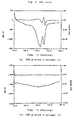
- polyester-grafted polyamides prepared in the Examples 1 to 5 and the Comparative Samples were examined for thermal behavior with a differential scanning calorimeter. Each test sample was subjected to DSC (temperature range: from room temperature to 300°C, temperature rise rate: 20°C/min) and the obtained DSC curve was termed the first heat.
- DSC temperature range: from room temperature to 300°C, temperature rise rate: 20°C/min
- the resulting molten sample was cooled at a constant rate of 20°C/min and immediately subjected to DSC (temperature range: from room temperature to 300°C, temperature rise rate: 20°C/min).
- the obtained DSC curve was termed the Second heat.
- the second heat of the PBT-g-nylon 6 polymer (1) prepared in the Example 1 is shown in Fig. 5 (a), while that of the PBT-g-nylon 6 polymer (2) prepared in the Example 2 is shown in Fig. 5 (b).
- the endothermic peaks ascribable to the fusion of crystals of the polyester-grafted polyamides prepared in the Examples 1 to 5, the polyamides (EOA Nys) used as the raw materials and PBT-A and NB resin used as the comparative samples are given together in Table 2.
- the PBT-g-nylon 6 polymer (1) exhibits two endothermic peaks, both of which have shifted to the lower temperature side than the fusion peaks of EOA Ny-1 used as the raw material, which is presumably because the melting point of the nylon 6 chain component may be lowered by the grafting of PBT thereonto and the endothermic peak of the PBT chain component may also shift to the lower temperature side thereby, though it ought to be present near 224°C originally.
- polyester-grafted polyamides prepared in the Examples 1 to 5 were examined for the crystalline state by wide-angle X-ray diffractometry.
- the appearances and diffraction peaks of the polyester-grafted polyamides prepared in the Examples 1 to 5 and PBT-A and NB resin as the comparative samples as determined by cooling them in a DSC from a molten state at the rates of 20°C/min and 80°C/min are gived together in Table 3.
- the diffraction peaks of the PBT-g-nylon 6 polymer (1) prepared in the Example 1 as determined by cooling it from a molten state at the rates of 20°C/min and 80°C/min are given in Fig. 6 (a) and (b), respectively.
- polyester-grafted polyamides prepared in a similar manner to that of the Examples 1 to 5 and the following polyamide resins, thermoplastic polyester resins and polycarbonate were used in the following Examples 6 to 18 and Comparative Examples 1 to 10.
- the PBT-g-nylon 6 polymer (2) and PBT-g-nylon elastomer polymer prepared in the Examples 2 and 4, 6-nylon and PBT 400FP were mixed at ratios specified in Table 4 on a Henschel mixer at room temperature for 15 minutes.
- the obtained resin mixtures were each melt-kneaded on a single screw extruder (40 mm ⁇ ) at 240°C to give pellets.
- the pellets were molded into predetermined test pieces at 240°C on a screw injection molding machine. The test pieces thus prepared were examined for tensile strength (test piece No.
- PBT 400FP and 6-nylon were each melt-kneaded and injection-molded into a test pieces in a similar manner to that of the Example 6 to 9.
- the test pieces thus prepared were examined for physical properties in a similar manner to that of the Examples 6 to 9.
- the PBT-g-nylon 6 polymer (1), PET-g-nylon 66 polymer, PBT-g-nylon 12 polymer prepared in the Examples 1, 3 and 5, PBT 400FP, PET 523V, 6-nylon, 12-nylon and 66-nylon were mixed at ratios specified in Table 5 on a Henschel mixer at room temperature for 15 minutes.
- the obtained resin mixtures were each melt-kneaded at 240 to 280°C on a single-screw extruder (40 mm ⁇ ) to give pellets.
- the pellets were molded into predetermined test pieces on a screw injection molding machine at 240 to 280°C.
- test pieces thus prepared were examined for physical properties in a similar manner to that of the Examples 6 to 9, The results are given together in Table 5.
- the PET-g-nylon 66 polymer prepared in the Example 3, 66-nylon, U Polymer and PC were mixed at ratios specified in Table 7 on a Henschel mixer at room temperature for 15 minutes.
- the obtained resin mixtures were each melt-kneaded on a single-screw extruder (40 mm ⁇ ) at 280°C to give pellets.
- the pellets were molded into predetermined test pieces on a screw injection molding machine at 280°C.
- test pieces thus prepared were each examined for physical properties in a similar manner to that of the Examples 6 to 9.
Landscapes
- Chemical & Material Sciences (AREA)
- Health & Medical Sciences (AREA)
- Chemical Kinetics & Catalysis (AREA)
- Medicinal Chemistry (AREA)
- Polymers & Plastics (AREA)
- Organic Chemistry (AREA)
- Polyamides (AREA)
- Compositions Of Macromolecular Compounds (AREA)
- Graft Or Block Polymers (AREA)
- Polyesters Or Polycarbonates (AREA)
Applications Claiming Priority (1)
| Application Number | Priority Date | Filing Date | Title |
|---|---|---|---|
| PCT/JP1991/000933 WO1993001225A1 (fr) | 1991-07-11 | 1991-07-11 | Polyamide greffe a un polyester, production, et composition de resine thermoplastique elaboree a partir de ce polyamide |
Publications (3)
| Publication Number | Publication Date |
|---|---|
| EP0548361A1 true EP0548361A1 (de) | 1993-06-30 |
| EP0548361A4 EP0548361A4 (de) | 1994-03-09 |
| EP0548361B1 EP0548361B1 (de) | 1997-10-29 |
Family
ID=14014506
Family Applications (1)
| Application Number | Title | Priority Date | Filing Date |
|---|---|---|---|
| EP91912372A Expired - Lifetime EP0548361B1 (de) | 1991-07-11 | 1991-07-11 | Polyester gepfropftes polyamid, herstellung, und thermoplastische harzzusammensetzung |
Country Status (4)
| Country | Link |
|---|---|
| EP (1) | EP0548361B1 (de) |
| JP (1) | JP3034601B2 (de) |
| DE (1) | DE69128090T2 (de) |
| WO (1) | WO1993001225A1 (de) |
Cited By (1)
| Publication number | Priority date | Publication date | Assignee | Title |
|---|---|---|---|---|
| EP0730005A3 (de) * | 1995-03-01 | 1997-07-16 | Gen Electric | Mischungen von Polycarbonaten und Polyesteramiden |
Families Citing this family (1)
| Publication number | Priority date | Publication date | Assignee | Title |
|---|---|---|---|---|
| CN111909364B (zh) * | 2020-08-11 | 2022-05-17 | 常州美胜生物材料有限公司 | 一种银系抗菌母粒的制备方法 |
Family Cites Families (2)
| Publication number | Priority date | Publication date | Assignee | Title |
|---|---|---|---|---|
| JPS56141320A (en) * | 1980-04-07 | 1981-11-05 | Asahi Chem Ind Co Ltd | Novel aromatic polyamide |
| JP2786505B2 (ja) | 1990-03-06 | 1998-08-13 | ダイセル化学工業株式会社 | ポリエステルグラフト化ポリアミドおよびその製造法 |
-
1991
- 1991-07-11 JP JP03511901A patent/JP3034601B2/ja not_active Expired - Fee Related
- 1991-07-11 DE DE69128090T patent/DE69128090T2/de not_active Expired - Fee Related
- 1991-07-11 WO PCT/JP1991/000933 patent/WO1993001225A1/ja not_active Ceased
- 1991-07-11 EP EP91912372A patent/EP0548361B1/de not_active Expired - Lifetime
Non-Patent Citations (1)
| Title |
|---|
| See references of WO9301225A1 * |
Cited By (1)
| Publication number | Priority date | Publication date | Assignee | Title |
|---|---|---|---|---|
| EP0730005A3 (de) * | 1995-03-01 | 1997-07-16 | Gen Electric | Mischungen von Polycarbonaten und Polyesteramiden |
Also Published As
| Publication number | Publication date |
|---|---|
| DE69128090T2 (de) | 1998-02-26 |
| JP3034601B2 (ja) | 2000-04-17 |
| EP0548361A4 (de) | 1994-03-09 |
| WO1993001225A1 (fr) | 1993-01-21 |
| DE69128090D1 (de) | 1997-12-04 |
| EP0548361B1 (de) | 1997-10-29 |
Similar Documents
| Publication | Publication Date | Title |
|---|---|---|
| US4501861A (en) | Thermoplastic polyamide compositions | |
| CZ298957B6 (cs) | Zpusob kondenzace polyamidu | |
| EP0637613B1 (de) | Harzzusammensetzung | |
| US5321099A (en) | Blends of semi-crystalline polyamides and polyesteramides | |
| US5446109A (en) | Polyamide/aliphatic polyester block copolymer, process for the production thereof, and blend containing the same | |
| US4433117A (en) | Copolyesteramide and production of the same | |
| US5457169A (en) | Molding materials based on polyarylene ethers having terminal anhydride groups | |
| EP1478679B1 (de) | Copolymer enthaltend ein oder mehrere amid-segmente | |
| US5317066A (en) | Polyester-grafted polyamide, process for preparing the same, and thermoplastic resin composition containing the same | |
| EP0548361B1 (de) | Polyester gepfropftes polyamid, herstellung, und thermoplastische harzzusammensetzung | |
| JP2557348B2 (ja) | 成形材料用ポリアミドおよび成形材料用ポリアミド組成物 | |
| US5691412A (en) | Polyamide/aliphatic polyester block copolymer, process for the production thereof, and blend containing the same | |
| JPS62187760A (ja) | 非晶質ポリアミドを含有する熱可塑性ブレンド | |
| US4777223A (en) | Addition of polyhydroxyether to blends of a polyarylate and a polyamide | |
| US4749754A (en) | Impact modified polyamide/polycarbonate | |
| EP0361313A2 (de) | Herstellung von Polyamid-Zusammensetzungen mittels eines reaktiven Verfahrens | |
| US5670584A (en) | Polyester compositions suitable for the manufacture of fibres and films with high elastic modulus | |
| JP3132854B2 (ja) | 高分子系帯電防止剤 | |
| EP0090014B1 (de) | Gemische eines Polyesterpolykarbonat-Kopolymers oder Terpolymers und eines Polykarbonatharzes | |
| JPH08508530A (ja) | 高耐衝撃性ポリエステル組成物 | |
| JPWO1993001225A1 (ja) | ポリエステルグラフト化ポリアミド、その製造法およびこれを用いた熱可塑性樹脂組成物 | |
| JP2795955B2 (ja) | 樹脂組成物 | |
| JP2000119391A (ja) | ポリ(エチレンテレフタレート・エチレンテレフタルアミド)共重合体及びその製造法 | |
| JP2786505B2 (ja) | ポリエステルグラフト化ポリアミドおよびその製造法 | |
| JP2744667B2 (ja) | 樹脂組成物 |
Legal Events
| Date | Code | Title | Description |
|---|---|---|---|
| PUAI | Public reference made under article 153(3) epc to a published international application that has entered the european phase |
Free format text: ORIGINAL CODE: 0009012 |
|
| AK | Designated contracting states |
Kind code of ref document: A1 Designated state(s): DE FR GB NL |
|
| 17P | Request for examination filed |
Effective date: 19930720 |
|
| A4 | Supplementary search report drawn up and despatched |
Effective date: 19940120 |
|
| AK | Designated contracting states |
Kind code of ref document: A4 Designated state(s): DE FR GB NL |
|
| 17Q | First examination report despatched |
Effective date: 19950703 |
|
| GRAG | Despatch of communication of intention to grant |
Free format text: ORIGINAL CODE: EPIDOS AGRA |
|
| GRAH | Despatch of communication of intention to grant a patent |
Free format text: ORIGINAL CODE: EPIDOS IGRA |
|
| GRAH | Despatch of communication of intention to grant a patent |
Free format text: ORIGINAL CODE: EPIDOS IGRA |
|
| GRAA | (expected) grant |
Free format text: ORIGINAL CODE: 0009210 |
|
| AK | Designated contracting states |
Kind code of ref document: B1 Designated state(s): DE FR GB NL |
|
| REF | Corresponds to: |
Ref document number: 69128090 Country of ref document: DE Date of ref document: 19971204 |
|
| ET | Fr: translation filed | ||
| PLBE | No opposition filed within time limit |
Free format text: ORIGINAL CODE: 0009261 |
|
| STAA | Information on the status of an ep patent application or granted ep patent |
Free format text: STATUS: NO OPPOSITION FILED WITHIN TIME LIMIT |
|
| 26N | No opposition filed | ||
| REG | Reference to a national code |
Ref country code: GB Ref legal event code: IF02 |
|
| PGFP | Annual fee paid to national office [announced via postgrant information from national office to epo] |
Ref country code: GB Payment date: 20020710 Year of fee payment: 12 |
|
| PGFP | Annual fee paid to national office [announced via postgrant information from national office to epo] |
Ref country code: NL Payment date: 20020730 Year of fee payment: 12 |
|
| PG25 | Lapsed in a contracting state [announced via postgrant information from national office to epo] |
Ref country code: GB Free format text: LAPSE BECAUSE OF NON-PAYMENT OF DUE FEES Effective date: 20030711 |
|
| PG25 | Lapsed in a contracting state [announced via postgrant information from national office to epo] |
Ref country code: NL Free format text: LAPSE BECAUSE OF NON-PAYMENT OF DUE FEES Effective date: 20040201 |
|
| GBPC | Gb: european patent ceased through non-payment of renewal fee |
Effective date: 20030711 |
|
| NLV4 | Nl: lapsed or anulled due to non-payment of the annual fee |
Effective date: 20040201 |
|
| PGFP | Annual fee paid to national office [announced via postgrant information from national office to epo] |
Ref country code: DE Payment date: 20060706 Year of fee payment: 16 |
|
| PGFP | Annual fee paid to national office [announced via postgrant information from national office to epo] |
Ref country code: FR Payment date: 20060719 Year of fee payment: 16 |
|
| PG25 | Lapsed in a contracting state [announced via postgrant information from national office to epo] |
Ref country code: DE Free format text: LAPSE BECAUSE OF NON-PAYMENT OF DUE FEES Effective date: 20080201 |
|
| REG | Reference to a national code |
Ref country code: FR Ref legal event code: ST Effective date: 20080331 |
|
| PG25 | Lapsed in a contracting state [announced via postgrant information from national office to epo] |
Ref country code: FR Free format text: LAPSE BECAUSE OF NON-PAYMENT OF DUE FEES Effective date: 20070731 |