EP0548582B1 - Procédé permettant d'obtenir des informations sur la composition de feuilles multicouches - Google Patents
Procédé permettant d'obtenir des informations sur la composition de feuilles multicouches Download PDFInfo
- Publication number
- EP0548582B1 EP0548582B1 EP92120253A EP92120253A EP0548582B1 EP 0548582 B1 EP0548582 B1 EP 0548582B1 EP 92120253 A EP92120253 A EP 92120253A EP 92120253 A EP92120253 A EP 92120253A EP 0548582 B1 EP0548582 B1 EP 0548582B1
- Authority
- EP
- European Patent Office
- Prior art keywords
- spectrum
- spectra
- sample
- web
- specimen
- Prior art date
- Legal status (The legal status is an assumption and is not a legal conclusion. Google has not performed a legal analysis and makes no representation as to the accuracy of the status listed.)
- Expired - Lifetime
Links
Images




Classifications
-
- G—PHYSICS
- G01—MEASURING; TESTING
- G01N—INVESTIGATING OR ANALYSING MATERIALS BY DETERMINING THEIR CHEMICAL OR PHYSICAL PROPERTIES
- G01N21/00—Investigating or analysing materials by the use of optical means, i.e. using sub-millimetre waves, infrared, visible or ultraviolet light
- G01N21/17—Systems in which incident light is modified in accordance with the properties of the material investigated
- G01N21/25—Colour; Spectral properties, i.e. comparison of effect of material on the light at two or more different wavelengths or wavelength bands
- G01N21/31—Investigating relative effect of material at wavelengths characteristic of specific elements or molecules, e.g. atomic absorption spectrometry
- G01N21/35—Investigating relative effect of material at wavelengths characteristic of specific elements or molecules, e.g. atomic absorption spectrometry using infrared light
- G01N21/3554—Investigating relative effect of material at wavelengths characteristic of specific elements or molecules, e.g. atomic absorption spectrometry using infrared light for determining moisture content
- G01N21/3559—Investigating relative effect of material at wavelengths characteristic of specific elements or molecules, e.g. atomic absorption spectrometry using infrared light for determining moisture content in sheets, e.g. in paper
-
- G—PHYSICS
- G01—MEASURING; TESTING
- G01N—INVESTIGATING OR ANALYSING MATERIALS BY DETERMINING THEIR CHEMICAL OR PHYSICAL PROPERTIES
- G01N21/00—Investigating or analysing materials by the use of optical means, i.e. using sub-millimetre waves, infrared, visible or ultraviolet light
- G01N21/17—Systems in which incident light is modified in accordance with the properties of the material investigated
- G01N21/25—Colour; Spectral properties, i.e. comparison of effect of material on the light at two or more different wavelengths or wavelength bands
- G01N21/31—Investigating relative effect of material at wavelengths characteristic of specific elements or molecules, e.g. atomic absorption spectrometry
- G01N21/35—Investigating relative effect of material at wavelengths characteristic of specific elements or molecules, e.g. atomic absorption spectrometry using infrared light
- G01N21/3563—Investigating relative effect of material at wavelengths characteristic of specific elements or molecules, e.g. atomic absorption spectrometry using infrared light for analysing solids; Preparation of samples therefor
-
- G—PHYSICS
- G01—MEASURING; TESTING
- G01N—INVESTIGATING OR ANALYSING MATERIALS BY DETERMINING THEIR CHEMICAL OR PHYSICAL PROPERTIES
- G01N21/00—Investigating or analysing materials by the use of optical means, i.e. using sub-millimetre waves, infrared, visible or ultraviolet light
- G01N21/17—Systems in which incident light is modified in accordance with the properties of the material investigated
- G01N2021/1738—Optionally different kinds of measurements; Method being valid for different kinds of measurement
- G01N2021/1742—Optionally different kinds of measurements; Method being valid for different kinds of measurement either absorption or reflection
-
- G—PHYSICS
- G01—MEASURING; TESTING
- G01N—INVESTIGATING OR ANALYSING MATERIALS BY DETERMINING THEIR CHEMICAL OR PHYSICAL PROPERTIES
- G01N21/00—Investigating or analysing materials by the use of optical means, i.e. using sub-millimetre waves, infrared, visible or ultraviolet light
- G01N21/17—Systems in which incident light is modified in accordance with the properties of the material investigated
- G01N21/25—Colour; Spectral properties, i.e. comparison of effect of material on the light at two or more different wavelengths or wavelength bands
- G01N21/31—Investigating relative effect of material at wavelengths characteristic of specific elements or molecules, e.g. atomic absorption spectrometry
- G01N21/35—Investigating relative effect of material at wavelengths characteristic of specific elements or molecules, e.g. atomic absorption spectrometry using infrared light
- G01N2021/3595—Investigating relative effect of material at wavelengths characteristic of specific elements or molecules, e.g. atomic absorption spectrometry using infrared light using FTIR
-
- G—PHYSICS
- G01—MEASURING; TESTING
- G01N—INVESTIGATING OR ANALYSING MATERIALS BY DETERMINING THEIR CHEMICAL OR PHYSICAL PROPERTIES
- G01N21/00—Investigating or analysing materials by the use of optical means, i.e. using sub-millimetre waves, infrared, visible or ultraviolet light
- G01N21/84—Systems specially adapted for particular applications
- G01N21/8422—Investigating thin films, e.g. matrix isolation method
- G01N2021/8427—Coatings
-
- G—PHYSICS
- G01—MEASURING; TESTING
- G01N—INVESTIGATING OR ANALYSING MATERIALS BY DETERMINING THEIR CHEMICAL OR PHYSICAL PROPERTIES
- G01N21/00—Investigating or analysing materials by the use of optical means, i.e. using sub-millimetre waves, infrared, visible or ultraviolet light
- G01N21/84—Systems specially adapted for particular applications
- G01N21/86—Investigating moving sheets
- G01N2021/8663—Paper, e.g. gloss, moisture content
-
- G—PHYSICS
- G01—MEASURING; TESTING
- G01N—INVESTIGATING OR ANALYSING MATERIALS BY DETERMINING THEIR CHEMICAL OR PHYSICAL PROPERTIES
- G01N2201/00—Features of devices classified in G01N21/00
- G01N2201/12—Circuits of general importance; Signal processing
- G01N2201/129—Using chemometrical methods
Definitions
- the present invention relates generally to a method for deriving compositional information. More specifically the invention relates to a method for determining the separate moisture contents and other compositional information for layered webs containing hydrogen bonding or hydrophilic and/or non-hydrogen bonding or hydrophobic layers, including but not restricted to photographic film or paper or their precursor support webs.
- One filter passes light at a wavelength which is water absorbing, generally specified as 1.94 micrometers, while a second filter passes light at a wavelength that water does not absorb, typically 1.8 micrometers.
- Some patents further disclose use of an additional filter at a wavelength where the web (e.g., cellulose) absorbs light, and even a fourth filter at a wavelength where the web does not absorb light.
- a further disadvantage of available NIR filter-type moisture measurement systems is that a single wavelength is used to obtain the measure of moisture. If water in the different layers of a web had exactly identical absorption properties as a function of wavelength, then the measurement outlined above would provide a signal proportional to the total amount of moisture in the entire web if the measurement were made with transmitted light. If the measurement is made with reflected or diffusely scattered light, the measurement signal would be proportional to the total amount of water in that fraction of the cross section of the web that light penetrated to before it was reflected or scattered.
- the prior art apparently assumes that water in different layers of a web has identical absorption properties as a function of wavelength.
- the wavelength 1.94 micrometers is absorbed to a much greater extent by non-hydrogen bonded water in a hydrophobic environment (as in synthetic polymer supports such as cellulose acetate or polyethylene terephthalate, or in paper) than by the water that is hydrogen bonded as in the gelatin in the emulsion layers of the photographic product.
- these differing absorptions mean that the signal measured by simple NIR filter moisture devices is not a simple measurement of the total amount or fraction of water in the entire web.
- the desirable result of separate measures of water in support and of water in the emulsion layers cannot be obtained either.
- filter-type infrared instruments for web measurement require at least one measurement wavelength filter for each composition component measured (more typically an additional reference wavelength filter per component as well).
- measurement wavelength filter for each composition component measured (more typically an additional reference wavelength filter per component as well).
- many web coating processes there is a large variation in the components of the support and coated layers so that it becomes very difficult to provide a filter-based infrared instrument with enough flexibility to measure the components of these varied coating processes because the number of filters required becomes too large to provide rapid feedback.
- GB-A-2147413 discloses a device which uses a rotating filter with continuously varying frequency passband.
- the disadvantages of present filter-based NIR measurements for moving webs include (1) they provide noisy and inaccurate measurements in the case of webs that contain highly scattering media, (2) they provide inadequate selectivity to measure water in different chemical environments, (3) they provide inadequate flexibility for situations in which the components of the web change greatly in batch coating processes, and (4) they fail to account for open air composition over moving non-dry webs.
- Vidrine U.S. Patent No. 4,943,721 discloses the combined use of an FTIR (Fourier transform infrared) thickness gauge and a beta gauge wherein the FTIR gauge is used to coarsely set parameters that improve the beta gauge thickness measurement.
- Huizinga and others disclose the use of mid-infrared FTIR measurements for monitoring of thin film coatings. See “Application of Infrared Spectroscopy to On-Line Monitoring of Thin Coatings"; J.S. Huizinga, E. Rudin and N. G. Constantine; presented at the Annual Meeting of the Federation of Analytical Chemistry and Spectroscopy Societies, St.
- U.S. Patent No. 4,243,882 discloses a method for measuring the thicknesses of film layers by using infrared rays. The '882 patent method uses several sample wavelengths and a reference wavelength.
- FTIR Fourier transform infrared
- a further object of this invention is to provide a method for determining compositional information of a multilayer web that is moving at speeds up to 600 meters/minute.
- a method for determining compositional information of a multilayer web comprising the steps of:
- mid-infrared FTIR measurements can have substantial advantages over NIR measurements and no problems or increases in noise are observed for moving versus static coatings. These advantages are particularly apparent in the case of photographic film where the emulsion layers that contain silver halide induce substantial diffuse scattering and therefore no interference fringes are observed.
- a common practice in spectroscopic techniques is to use the inverse of wavelength, that is, wavenumber (1/cm), in the mid-infrared region of the spectrum, but in the near-infrared region to use wavelength in micrometers. That practice is followed in this description.
- sample Prior to determining the compositional information of a web, referred to as the "sample" web, a set of absorbance coefficients or calibration factors is required. The process for obtaining the absorption coefficients is described in detail after the measurement method is discussed.
- the next three steps in this invention involve obtaining a full infrared absorbance (or diffuse reflectance) spectrum of the sample web.
- Obtaining an absorbance spectrum consists of obtaining a "single beam" background spectrum through an open path that has the same through-space distance and the same humidity as does the path that includes the web.
- This background spectrum is a signal from the detector, usually referred to as I o , that contains the variations in intensity of the source versus wavenumber, the variations in throughput of the spectrometer versus wavenumber, the variations in sensitivity of the detector versus wavenumber and the attenuations of the signal associated with absorbing materials in the through-space infrared beam path, particularly water vapor.
- This background spectrum should be taken at a detector gain that the instrument manufacturer specifies as optimum for the obtained signal.
- Prior art methods typically obtain the single beam background spectrum by stopping and removing the moving web. It is more accurate to take the single beam background spectrum in an open air area immediately adjacent to the moving web, while the web is moving at process speed.
- the air surrounding the web through which the sample spectrum is taken contains a certain percentage of the moist component in vapor form.
- the percentage of the moist component in vapor form in the surrounding air decreases.
- the background spectrum is taken with the web stopped, the background spectrum will not account for the vaporized component which is present when the web is moving. Therefore, the background spectrum will not be an accurate measurement of the actual open air condition surrounding a moving web. The inaccuracy in the background spectrum will persist throughout the method and result in inaccurate compositional measurements.
- the method of the invention takes a background spectrum in the area immediately adjacent to the moving web while the web is moving at process speed.
- a background spectrum can be taken with the web in place and moving by routing the infrared beam via optical fibers to a second head of a single main detector. The background spectrum taken in this way more accurately represents the composition of the open air surrounding the moving web.
- sample single beam spectrum is taken through the web, but with the gain reset so that it is optimum for that obtained signal.
- This spectrum is usually referred to as I s , the “sample single beam spectrum.”
- the "transmittance” spectrum is then generated by dividing I s by I o at all wavenumbers.
- the absorbance spectrum is calculated by taking the negative logarithm of the transmittance spectrum.
- the product of concentration times thickness reduces simply to the thickness of that component and hence in that case Beer's Law provides a measure of the coated thickness of a layer, as, for example, the gel laydown or moisture content in mg/m2 or the support thickness in micrometers, provided the absorbance coefficient is obtained in correct units of absorbance per mg/m2 or absorbance per micrometer, respectively.
- an analysis of concentration can be made directly from the sample single beam spectrum or transmittance spectrum provided the steps above are used to obtain equations relating these to concentration and thickness. Such methods are, of course, completely equivalent to obtaining the absorbance spectrum as described here.
- a completely analogous set of steps arrives at a diffuse reflection spectrum that is proportional to the product of turbidity times path length.
- the single beam background spectrum is obtained by reflecting, in a diffuse manner, the projected beam off a pure white reflector to the collection detector.
- the pure white reflector is non-absorbing in the wavelength region of interest.
- the sample single beam spectrum is then measured by reflecting, the projected beam from the web and collecting the diffusely scattered infrared rays.
- the diffuse reflectance spectrum (R) is then calculated as the ratio of the diffuse reflectance from the web to that of the non-absorbing reflector.
- the corrected or Kubelka-Munk diffuse reflectance spectrum is calculated by taking the square of (1 minus the diffuse reflectance) at every wavenumber, and dividing this by two times the diffuse reflectance at that wavenumber.
- a modified Beer's Law expresses the relationship between the spectrum of signal, f (r) (Kubelka-Munk diffuse reflectance versus wavenumber) as proportional to the concentration (c i ) of each component times the turbidity coefficient of that component at each wavenumber (_ i ) times the thickness of the sample.
- the method described herein refers to absorbances but a method which measures diffuse reflectances is equivalent.
- a baseline absorbance is approximated by constructing straight lines between the absorbance at 2540 wavenumbers, 2676 wavenumbers, 3787 wavenumbers, 4536 wavenumbers, and 4767 wavenumbers. At these wavenumbers none of the components to be measured absorbs radiation, but the silver halide grains in the emulsion scatter light in increasing amounts at higher wavenumbers. Since this light does not pass through the web, it appears as a decreased signal intensity and thus an apparent absorbance that varies with the amount of silver halide, grain size, and morphology, and must be compensated for to determine the web composition.
- This baseline absorbance spectrum is then subtracted from the sample absorbance spectrum to obtain a corrected sample absorbance spectrum that relates only to the absorbing components of the web.
- the baseline correction step is illustrated in Figure 1. For non-photographic webs the baseline points are selected at different wavenumbers but according to the same criteria and the correction process would proceed as described.
- sample integrated absorbance values are obtained, above the baseline described in step 5 (or two other localized baseline points where the band of interest is clearly defined from an underlying broader absorbance), between wavenumbers that have been shown in the calibration step described below to be particularly sensitive to changes in the compositional elements desired.
- these wavenumber ranges include, but are not limited to: 3642-3672 wavenumbers (primarily water in support), 3140-3200 wavenumbers (primarily gel and water in gel), 3090-3108 wavenumbers (gel, support, and water in gel), 3012-3020 (support, gel, and water in gel), 3940-4110 (cellulose acetate support), and 4068-4120 (polyethylene terephthalate support).
- Other wavenumber ranges are used to determine residual cyclohexane in support at 2850-2858 wavenumbers and plasticizer at 3060-3080 wavenumbers.
- the sample integrated absorbance values obtained above are compared to standard support type absorbance values to automatically determine the type of support and hence a future calibration set or set of absorption coefficients to be used in the sixth step. For example, if the integrated area between 4068-4120 wavenumbers is above a certain value, the support has been shown to be polyethylene terephthalate.
- the sample integrated absorbance values are combined using Beer's Law and the absorbance coefficients determined in the calibration step described below for each component at each integrated wavenumber range, either sequentially or in parallel to obtain 1) the support thickness in micrometers, 2) the gel laydown in mg/m2, 3) the amount of water in support in mg/m2, and 4) the amount of water in gel in mg/m2.
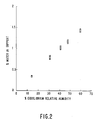
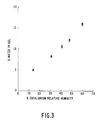
- Figures 2 and 3 show the water content of support and gel as a function of relative humidity determined for equilibrated samples of film product taken from different coating events.
- the step of determining the coefficients includes the steps of first equilibrating, at various relative humidities, a series of photographic film specimens as well as the supports that these film specimens are coated on, and free standing gel films, each being of known support thickness, support type, and coated gel coverage. Secondly, infrared absorbance spectra in the region 2000 to 6000 wavenumbers were obtained of these films and supports at the various relative humidities. These spectra were then baseline corrected as described above in the third step of the method of the invention and plotted as a function of humidity to show the wavenumbers at which moisture is observed in the support, moisture is observed in the gel, and bands are observed for support and gel.
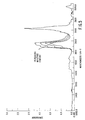
- Figures 4, 5, and 6 show, respectively, the absorbance spectra of a photographic film, an acetate support, and a free standing gelatin film. It is clear from these figures that the spectral features of absorbance versus wavenumber are different for support and for gel and that moisture in support has absorbance between 3200 and 3700 wavenumbers, with a very large absorbance between 3500 and 3700 wavenumbers, while moisture in gel has absorbance between 3000 and 3600 wavenumbers, with a very large absorbance between 3050 wavenumbers and 3300 wavenumbers.
- gel itself has a large absorbance spectrum in the region 3000 to 3600 wavenumbers, but different from that of water bound to gel, and that cellulose acetate support has a large absorbance between 2800 and 3100 wavenumbers, although absorbance bands from each of the components are very strongly overlapping so that no component can be said to absorb exclusively at any given wavelength.
- step six of the method of the invention for an individual absorbance spectrum one has a set of four or more integrated absorbance values and the attendant absorbance coefficients (four for each absorbance range) that can be combined using Beer's Law to determine the four coverage or thickness values of the sample measured.
- Statistical methods to accomplish these transformations are abundant in the art and can be either sequential or parallel in time, as for example the partial least squares method.
- the first example illustrates a typical apparatus used with the invention and a typical calibration step of the method.
- an example of an apparatus used to measure compositional information in multilayer films is an Analect Model PCM 4000 process FTIR spectrometer 9 modified at the output with electrically actuated mirrors 15, 17 and beam transport systems as shown in Figure 7.
- the source 13 for the Analect Model FX-30 interferometer 11 is a tungsten lamp.
- an electrically actuated mirror 15 which, when moved into the path of the collimated output beam 19 reflects the infrared rays through potassium bromide windows and an open path of 7.62 cm (3 inches) to its mirror image 17 and to a deuterated triglycine sulfate detector 21 to provide the off-web reference path.
- the collimated infrared rays 19 from the interferometer 11 are projected through a 38.1 cm (15 inch) segment of closed 5.08 cm (2 inch) diameter tubing 23 to a fixed mirror 25, potassium bromide windows, and an open path of 7.62 cm (3 inches) containing the multilayer web 27 to be measured, and then returned to the same detector 21 with an identical mirror 29 and tubing 31.
- Interferograms of all infrared rays between 800 wavenumbers and 6000 wavenumbers (the range is limited by the detector) in either the background or web path are averaged for 30 seconds to two minutes, depending on the application, in the Analect DCM control computer 33 and then sent to the data analysis computer 35, an Analect 16 MHz 80386SX AT compatible, for analysis according to the method outlined in this application.
- the background and sample interferograms were transformed by Fourier methods to single beam spectra; these were divided to obtain the sample transmission spectra; and finally these were converted to sample absorbance spectra between 2000 wavenumbers and 6000 wavenumbers.
- Baseline spectra were obtained by drawing straight lines between the absorbances at 2540, 2676, 4536, and 4767 wavenumbers and these baseline spectra were subtracted from the sample absorbance spectra to compensate for light scattering by the samples. Examples of such baseline corrected spectra for film A are shown in Figure 4.
- Integrated absorbance areas were calculated from these corrected spectra between 4068-4120 wavenumbers, 3940-4110 wavenumbers, 3642-3672 wavenumbers, 3140-3200 wavenumbers, 3090-3108 wavenumbers, and 3012-3020 wavenumbers.
- these areas along with known measurements of support thickness, gel coverage, gel moisture from measured isotherms, and support moisture from measured isotherms, were analyzed with the multiple linear regression statistics module of Systat, a PC-based statistics program, to obtain average coefficients relating the measured absorbances to the measured quantities. These coefficients are then used to predict the measured quantities of each sample from the integrated areas.
- This example illustrates a comparison with commercial near-infrared moisture measurements.
- Four film samples were selected as examples of multilayer photographic film on cellulose acetate support having different amounts of silver halide particles.
- the apparatus outlined in Example #1 was used along with the method outlined therein to obtain the sample absorbance spectra of these stationary films at six different relative humidities at 21.1°C (70 F), corrected for scattering.
- the ratios of the integrated intensity at 3642-3672 wavenumbers to that at 3012-3020 wavenumbers was fit to a linear model versus the relative humidity of the measurement to obtain an average calibration coefficient of ratio versus relative humidity. That average coefficient was multiplied by the individual ratios to obtain a plot of predicted versus actual relative humidity shown as the squares in Figure 8.
- a commercial filter near-infrared moisture sensor the Micro-Quad 8000 from Moisture Systems Corp. was used to measure the same samples using a previously determined calibration method provided by the manufacturer. The results of that measurement are also shown in Figure 8 by the diamond shaped points. It is clear that the mid- infrared FTIR method is far more precise than this commercially available method. For a given actual relative humidity, represented by points on the x-axis, the relative humidities predicted by the FTIR method are consistently closer to the actual relative humidities than are those predicted by the Micro-Quad method.
- This example illustrates an on-line measurement of a moving web.
- the apparatus outlined in Example #1 was installed at a point approximately 6 feet from the point at which film is wound into rolls at the end of a coating machine used to manufacture experimental photographic films.
- the reference background is a 1 minute average obtained every 30 minutes.
- Sample measurements on the moving web are sequential 30 second averages. These are processed in the data analysis computer using the method outlined in Example 1 and the coefficients determined in the calibration step outlined there, to obtain measurements of support thickness, gel coverage, moisture in support and moisture in gel. In Figure 9, those outputs are plotted versus time for a typical experimental coating event.
- the experiment consisted of four gel coatings on cellulose acetate support (portions of the figure where gel coverage is not zero), each with different drying conditions that produce different final moisture contents.
- the first coating was dried less harshly and the last more harshly than the middle two coatings which have identical drying conditions.
- the apparatus measured compositional information on uncoated polyethylene terephthalate leader. This example shows the excellence of the measurements of compositional information as well as the excellent lack of noise in sequential 30 second measurements where each mark on the time axis represents 5 minutes.
Landscapes
- Physics & Mathematics (AREA)
- Spectroscopy & Molecular Physics (AREA)
- Health & Medical Sciences (AREA)
- Life Sciences & Earth Sciences (AREA)
- Chemical & Material Sciences (AREA)
- Analytical Chemistry (AREA)
- Biochemistry (AREA)
- General Health & Medical Sciences (AREA)
- General Physics & Mathematics (AREA)
- Immunology (AREA)
- Pathology (AREA)
- Investigating Or Analysing Materials By Optical Means (AREA)
Claims (10)
- Procédé de détermination d'informations relatives à la composition d'une bande multicouches, comprenant les étapes suivantes :a) la détermination d'au moins un ensemble de coefficients à partir de spécimens de bandes multicouches ayant des informations connues de composition, chaque ensemble de coefficients comprenant un coefficient pour chaque article d'informations de composition à déterminer, chaque ensemble de coefficients étant calculé pour une plage choisie de nombres d'onde, le nombre de plages choisies de nombres d'onde étant au moins égal au nombre d'articles d'informations de composition à déterminer,b) la projection d'un spectre large de rayons infrarouges à l'air libre près de la bande échantillon pour l'obtention d'un spectre de fond continu à un seul faisceau,c) la projection d'un spectre large de rayons infrarouges sur une bande échantillon pour l'obtention d'un spectre à un seul faisceau de l'échantillon,d) le calcul d'un spectre échantillon à partir du spectre de fond à un seul faisceau et du spectre à un seul faisceau de l'échantillon,e) l'obtention d'un spectre corrigé d'échantillon par soustraction d'un spectre de référence du spectre d'échantillon,f) l'intégration du spectre corrigé d'échantillon, l'intégration étant réalisée pour chaque plage choisie de nombres d'onde utilisée pour le calcul des coefficients dans l'étape a), si bien que des valeurs intégrées d'échantillon sont déterminées pour chaque plage choisie de nombres d'onde,g) la comparaison des valeurs intégrées d'échantillon aux valeurs normalisées du type de support pour la détermination d'un type de support dans la bande multicouches et ainsi d'un ensemble correspondant de coefficients d'après ceux qui sont déterminés dans l'étape a) afin qu'ils soient utilisés dans l'étape h), eth) la combinaison des valeurs intégrées d'échantillon et de l'ensemble des coefficients pour la résolution d'au moins une équation relative aux valeurs des articles d'informations de composition à déterminer.
- Procédé selon la revendication 1, dans lequel les spectres sont des spectres d'absorption et une équation au moins est une équation suivant la Loi de Beer.
- Procédé selon la revendication 1, dans lequel l'étape de détermination comprend la détermination de coefficients à partir de spécimens de bandes multicouches qui diffusent la lumière.
- Procédé selon la revendication 1, dans lequel l'étape de projection d'un spectre large de rayons infrarouges à l'air libre près de la bande pour l'obtention d'un spectre de fond continu à un seul faisceau est réalisée lorsque la bande multicouches se déplace à la vitesse de traitement, le spectre large de rayons infrarouges étant projeté dans une région immédiatement adjacente à la bande mobile, si bien que la composition de l'air libre dans laquelle est obtenu le spectre large par projection des rayons infrarouges est pratiquement égale à la composition de l'air au-dessus de la bande mobile.
- Procédé selon la revendication 1, dans lequel l'étape d'obtention d'un spectre corrigé d'échantillon comprend l'étape suivante :
la construction d'un spectre de référence par construction de droites ayant des nombres d'onde auxquels les composantes à mesurer n'absorbent pas le rayonnement audelà de celui qui est perdu par diffusion infrarouge. - Procédé selon la revendication 5, dans lequel les droites sont construites entre les nombres d'onde d'environ 2 540, 2 676, 3 787, 4 536 et 4 767 cm⁻¹.
- Procédé selon la revendication 1, dans lequel l'étape de détermination d'au moins un ensemble de coefficients comprend les étapes suivantes :
la mise en équilibre, à plusieurs humidités relatives, d'une série de bandes spécimens, de supports de chacune des bandes spécimens et de films libres de gélatine pour chacune des bandes spécimens, chacun des bandes spécimens, supports et films de gélatine ayant une épaisseur, un type et une couverture de gel qui sont connus,
la projection d'un spectre large de rayons infrarouges sur chacun des bandes spécimens, supports et films de gélatine à chacune des humidités relatives pour l'obtention des spectres à un seul faisceau des spécimens,
la projection d'un spectre large de rayons infrarouges à l'air libre adjacent aux bandes spécimens, aux supports et aux films de gélatine pour chacune des humidités relatives pour l'obtention des spectres de fond continu à un seul faisceau,
le calcul des spectres des spécimens à partir des spectres à un seul faisceau des spécimens et des spectres du fond continu à un seul faisceau,
l'obtention des spectres corrigés de chacun des bandes spécimens, supports et films de gélatine par soustraction des spectres de référence des spectres des spécimens,
le tracé des spectres corrigés pour chacune des diverses humidités relatives,
la sélection des plages de nombres d'onde des spectres corrigés ainsi tracés qui sont sensibles aux articles des informations de composition à déterminer,
l'intégration des spectres corrigés sur les plages choisies de nombres d'onde avec délimitation des valeurs intégrées de spécimens pour chaque plage choisie de nombres d'onde, et
la combinaison des valeurs intégrées de spécimens ayant les épaisseurs types et couvertures de gel connus pour la solution d'un ensemble d'équations pour un ensemble de coefficients pour chaque plage choisie de nombres d'onde. - Procédé selon la revendication 7, dans lequel l'étape de sélection des plages de nombres d'onde comprend la sélection de plages de nombres d'onde dans des parties des spectres dans lesquelles les valeurs corrigées ne dépassent pas la référence de plus de 3,5 unités.
- Procédé selon la revendication 8, dans lequel l'étape de sélection des plages de nombres d'onde comprend la sélection d'au moins l'une des plages de nombres d'onde comprises entre environ 3 642 et 3 672, 3 140 et 3 200, 3 090 et 3 108, 3 012 et 3 020, 3 940 et 4 110, 4 068 et 4 120, 2 850 et 2 858, et 3 060 et 3 080 cm⁻¹.
- Procédé selon la revendication 4, dans lequel les articles d'informations de la composition à déterminer par solution d'au moins une équation comprennent l'épaisseur du support, le dépôt de gel, la quantité d'eau dans le support, et la quantité d'eau dans le gel.
Applications Claiming Priority (2)
| Application Number | Priority Date | Filing Date | Title |
|---|---|---|---|
| US07/812,247 US5250811A (en) | 1991-12-20 | 1991-12-20 | Method for determining compositional information of a multilayer web |
| US812247 | 1991-12-20 |
Publications (2)
| Publication Number | Publication Date |
|---|---|
| EP0548582A1 EP0548582A1 (fr) | 1993-06-30 |
| EP0548582B1 true EP0548582B1 (fr) | 1995-09-20 |
Family
ID=25208991
Family Applications (1)
| Application Number | Title | Priority Date | Filing Date |
|---|---|---|---|
| EP92120253A Expired - Lifetime EP0548582B1 (fr) | 1991-12-20 | 1992-11-27 | Procédé permettant d'obtenir des informations sur la composition de feuilles multicouches |
Country Status (5)
| Country | Link |
|---|---|
| US (1) | US5250811A (fr) |
| EP (1) | EP0548582B1 (fr) |
| JP (1) | JP2598594B2 (fr) |
| CA (1) | CA2084802A1 (fr) |
| DE (1) | DE69204975T2 (fr) |
Families Citing this family (19)
| Publication number | Priority date | Publication date | Assignee | Title |
|---|---|---|---|---|
| SE9401718L (sv) * | 1994-05-18 | 1995-11-19 | Eka Nobel Ab | Sätt att bestämma parametrarna i papper |
| US5679954A (en) * | 1994-11-14 | 1997-10-21 | Soloman; Sabrie | Non-destructive identification of tablet and tablet dissolution by means of infared spectroscopy |
| DE69525226T2 (de) * | 1994-11-25 | 2002-06-27 | Kyoto Daiichi Kagaku Co. Ltd., Kyoto | Vorrichtung und Verfahren zur Bestimmung von Wasserstoffperoxid |
| GB9624035D0 (en) * | 1996-11-19 | 1997-01-08 | Infrared Eng | Infrared measuring gauge |
| FI970612A7 (fi) * | 1997-02-13 | 1998-08-14 | Metso Paper Automation Oy | Menetelmä paperin päällysteen komponenttien mittaamiseksi |
| FI112975B (fi) * | 1997-09-15 | 2004-02-13 | Metso Automation Oy | Menetelmä ja laitteisto paperin laatuominaisuuksien mittaamiseksi liikkuvasta paperiradasta paperikoneella |
| DE19855957B4 (de) * | 1998-12-04 | 2008-10-30 | Henkel Ag & Co. Kgaa | Automatische Kontrolle der Hydrophilie einer festen Oberfläche mit Infrarotspektroskopie |
| FI115856B (fi) * | 2000-02-10 | 2005-07-29 | Metso Automation Oy | Menetelmä ja laite päällysteen mittaamiseksi |
| US6573999B1 (en) | 2000-07-14 | 2003-06-03 | Nanometrics Incorporated | Film thickness measurements using light absorption |
| US6805899B2 (en) | 2002-01-30 | 2004-10-19 | Honeywell International Inc. | Multi-measurement/sensor coating consolidation detection method and system |
| US7009750B1 (en) | 2002-10-25 | 2006-03-07 | Eclipse Energy Systems, Inc. | Apparatus and methods for modulating refractive index |
| US20080009748A1 (en) * | 2006-05-16 | 2008-01-10 | The Regents Of The University Of California | method and apparatus for the determination of intrinsic spectroscopic tumor markers by broadband-frequency domain technology |
| JP5262612B2 (ja) * | 2008-11-18 | 2013-08-14 | 住友金属鉱山株式会社 | 水分量測定方法及び水分量測定装置 |
| FI125721B (en) | 2012-05-25 | 2016-01-29 | Valmet Automation Oy | Apparatus and method for measuring an object comprising a cellulosic material and at least one dye containing printing ink |
| US9739661B2 (en) * | 2015-06-30 | 2017-08-22 | Agilent Technologies, Inc. | Infrared imaging system with automatic referencing |
| DE102018103171A1 (de) * | 2017-11-23 | 2019-05-23 | Tdk Electronics Ag | Verfahren zum Bestimmen von Eigenschaften einer Beschichtung auf einer transparenten Folie, Verfahren zur Herstellung einer Kondensatorfolie und Einrichtung zum Bestimmen von Eigenschaften einer Beschichtung auf einer transparenten Folie |
| US11726034B2 (en) * | 2019-03-07 | 2023-08-15 | Missouri State University | IR spectra matching methods |
| JP2023004226A (ja) * | 2021-06-25 | 2023-01-17 | 株式会社日立ハイテクサイエンス | 分光光度計、分光測定方法、およびプログラム |
| CN115586159B (zh) * | 2022-11-04 | 2025-04-11 | 四川轻化工大学 | 基于中红外光谱检测技术的白酒陈化缔合程度评定方法 |
Family Cites Families (28)
| Publication number | Priority date | Publication date | Assignee | Title |
|---|---|---|---|---|
| US3008369A (en) * | 1956-08-22 | 1961-11-14 | Bell Telephone Labor Inc | Optical thickness gauge |
| US3405268A (en) * | 1965-03-12 | 1968-10-08 | Brun Sensor Systems Inc | Radiant energy absorption gage for measuring the weight of a base material and the content of a material sorbed by the base material |
| US3551678A (en) * | 1967-02-13 | 1970-12-29 | Sybron Corp | Paper parameter measurement using infrared radiation |
| GB1302196A (fr) * | 1969-04-23 | 1973-01-04 | ||
| US3641349A (en) * | 1969-09-29 | 1972-02-08 | Measurex Corp | Method for measuring the amount of substance associated with a base material |
| US3675019A (en) * | 1971-03-19 | 1972-07-04 | Measurex Corp | Apparatus for measuring the amount of a substance that is associated with a base material |
| US3793524A (en) * | 1972-09-05 | 1974-02-19 | Measurex Corp | Apparatus for measuring a characteristic of sheet materials |
| US4006358A (en) * | 1975-06-12 | 1977-02-01 | Measurex Corporation | Method and apparatus for measuring the amount of moisture that is associated with a web of moving material |
| US4097743A (en) * | 1977-04-19 | 1978-06-27 | Moisture Systems Corp. | Moisture analyzing method and apparatus |
| JPS589362B2 (ja) * | 1978-03-10 | 1983-02-21 | 旭化成株式会社 | 赤外線多層フイルム膜厚測定方法及びその測定装置 |
| JPS60620B2 (ja) * | 1979-05-21 | 1985-01-09 | 横河電機株式会社 | 紙の水分量を測定する方法および装置 |
| US4289964A (en) * | 1980-01-24 | 1981-09-15 | Intec Corporation | Radiation inspection system for a material making apparatus and method using a beta ray gauge |
| GB2077426B (en) * | 1980-05-30 | 1983-12-14 | Fuji Electric Co Ltd | Apparatus for measuring film thickness |
| JPS5857911U (ja) * | 1981-10-17 | 1983-04-19 | 富士電機株式会社 | 赤外線膜厚計 |
| GB2127541B (en) * | 1982-09-27 | 1986-08-20 | Imp Group Plc | Monitoring sheet material |
| GB8325691D0 (en) * | 1983-09-26 | 1983-10-26 | Wiggins Teape Group Ltd | Measuring water content |
| US4602160A (en) * | 1983-09-28 | 1986-07-22 | Sentrol Systems Ltd. | Infrared constituent analyzer and control system |
| US4574194A (en) * | 1983-11-01 | 1986-03-04 | Fife Corporation | Method and apparatus for monitoring the manufacture of a two-component web |
| US4577104A (en) * | 1984-01-20 | 1986-03-18 | Accuray Corporation | Measuring the percentage or fractional moisture content of paper having a variable infrared radiation scattering characteristic and containing a variable amount of a broadband infrared radiation absorber |
| GB8601176D0 (en) * | 1986-01-17 | 1986-02-19 | Infrared Eng Ltd | Sensing |
| SU1326904A1 (ru) * | 1986-03-28 | 1987-07-30 | Специализированная Проектно-Конструкторская Технологическая Организация Росавтоматстром | Влагомер |
| US4786817A (en) * | 1986-08-29 | 1988-11-22 | Measurex Corporation | System and method for measurement of traveling webs |
| US4879471A (en) * | 1987-03-25 | 1989-11-07 | Measurex Corporation | Rapid-scanning infrared sensor |
| US4957770A (en) * | 1989-01-27 | 1990-09-18 | Measurex Corporation | Coating weight measuring and control apparatus and method |
| US5019710A (en) * | 1989-03-30 | 1991-05-28 | Measurex Corporation | Optical system for detecting properties of traveling sheet materials |
| US4943721A (en) * | 1989-06-22 | 1990-07-24 | Measurex Corporation | Method of obtaining accurate compositional information of multi-layer compositions |
| US5166748A (en) * | 1989-10-06 | 1992-11-24 | Measurex Corporation | Scanning interferometer sensor system |
| US5073712A (en) * | 1991-04-11 | 1991-12-17 | Abb Process Automation, Inc. | Light scanner web profile measurement apparatus and method |
-
1991
- 1991-12-20 US US07/812,247 patent/US5250811A/en not_active Expired - Fee Related
-
1992
- 1992-11-27 EP EP92120253A patent/EP0548582B1/fr not_active Expired - Lifetime
- 1992-11-27 DE DE69204975T patent/DE69204975T2/de not_active Expired - Fee Related
- 1992-12-08 CA CA002084802A patent/CA2084802A1/fr not_active Abandoned
- 1992-12-18 JP JP4339011A patent/JP2598594B2/ja not_active Expired - Lifetime
Also Published As
| Publication number | Publication date |
|---|---|
| EP0548582A1 (fr) | 1993-06-30 |
| JPH05249034A (ja) | 1993-09-28 |
| DE69204975D1 (de) | 1995-10-26 |
| CA2084802A1 (fr) | 1993-06-21 |
| JP2598594B2 (ja) | 1997-04-09 |
| US5250811A (en) | 1993-10-05 |
| DE69204975T2 (de) | 1996-05-23 |
Similar Documents
| Publication | Publication Date | Title |
|---|---|---|
| EP0548582B1 (fr) | Procédé permettant d'obtenir des informations sur la composition de feuilles multicouches | |
| JP7305727B2 (ja) | 多孔質フィルムの測定 | |
| CA1252645A (fr) | Methode et instrument d'hygrometrie | |
| US6573999B1 (en) | Film thickness measurements using light absorption | |
| US4302108A (en) | Detection of subsurface defects by reflection interference | |
| US4748329A (en) | Method for on-line thickness monitoring of a transparent film | |
| CA1038193A (fr) | Methode et appareil pour mesurer la quantite de matiere propre a une feuille en defilement | |
| JP2517858B2 (ja) | 近赤外透過スペクトルによる果実糖度の非破壊測定法 | |
| US4885709A (en) | Method and apparatus for sensing or determining one or more properties or the identity of a sample | |
| US9927366B2 (en) | Spectroscopic sensor for thickness or weight measurement of thin plastic films | |
| US20020191192A1 (en) | Method and arrangement for contactless determination of product characteristics | |
| US5420041A (en) | Method of acid value determination by infrared absorption | |
| CA2563777C (fr) | Mesure de l'epaisseur d'une couche mince au moyen d'un capteur infrarouge multicanaux | |
| JPH0348443B2 (fr) | ||
| JPH11237377A (ja) | 紙やシートの品質測定装置 | |
| Mutschler et al. | Characterization of thin polymer and biopolymer layers by ellipsometry and evanescent field technology | |
| CA2279904C (fr) | Procede de determination des composants d'une couche sur un materiau de base mobile | |
| US11946862B2 (en) | Method for in-line analysis of a composite product in a machine for the production of absorbent sanitary articles | |
| CN112185470A (zh) | 数据处理方法 | |
| EP3502637A1 (fr) | Procédé et système de surveillance de fabrication de bandes en temps réel | |
| RU2805385C2 (ru) | Способ коррекции изменения амплитуды в спектрометре | |
| Ghosh | On-line measurement of polyvinyl alcohol size on warp yarns using a near-IR diffuse reflectance spectroscopy method | |
| US7482590B2 (en) | Method for determining the coating quantity on a material web | |
| US20030132387A1 (en) | Method and device for measuring the amount of coating on a moving substrate | |
| EP4657011A1 (fr) | Procédé et système de détermination d'une épaisseur de couche ou d'une densité d'occupation de surface d'un revêtement d'un objet à contrôler |
Legal Events
| Date | Code | Title | Description |
|---|---|---|---|
| PUAI | Public reference made under article 153(3) epc to a published international application that has entered the european phase |
Free format text: ORIGINAL CODE: 0009012 |
|
| AK | Designated contracting states |
Kind code of ref document: A1 Designated state(s): AT BE CH DE DK ES FR GB GR IE IT LI LU MC NL PT SE |
|
| 17P | Request for examination filed |
Effective date: 19931203 |
|
| 17Q | First examination report despatched |
Effective date: 19950102 |
|
| RBV | Designated contracting states (corrected) |
Designated state(s): DE GB NL |
|
| GRAA | (expected) grant |
Free format text: ORIGINAL CODE: 0009210 |
|
| AK | Designated contracting states |
Kind code of ref document: B1 Designated state(s): DE GB NL |
|
| REF | Corresponds to: |
Ref document number: 69204975 Country of ref document: DE Date of ref document: 19951026 |
|
| PLBE | No opposition filed within time limit |
Free format text: ORIGINAL CODE: 0009261 |
|
| 26N | No opposition filed | ||
| PGFP | Annual fee paid to national office [announced via postgrant information from national office to epo] |
Ref country code: NL Payment date: 19980914 Year of fee payment: 7 |
|
| PGFP | Annual fee paid to national office [announced via postgrant information from national office to epo] |
Ref country code: GB Payment date: 19981008 Year of fee payment: 7 |
|
| PGFP | Annual fee paid to national office [announced via postgrant information from national office to epo] |
Ref country code: DE Payment date: 19981125 Year of fee payment: 7 |
|
| PG25 | Lapsed in a contracting state [announced via postgrant information from national office to epo] |
Ref country code: GB Free format text: LAPSE BECAUSE OF NON-PAYMENT OF DUE FEES Effective date: 19991127 |
|
| PG25 | Lapsed in a contracting state [announced via postgrant information from national office to epo] |
Ref country code: NL Free format text: LAPSE BECAUSE OF NON-PAYMENT OF DUE FEES Effective date: 20000601 |
|
| GBPC | Gb: european patent ceased through non-payment of renewal fee |
Effective date: 19991127 |
|
| NLV4 | Nl: lapsed or anulled due to non-payment of the annual fee |
Effective date: 20000601 |
|
| PG25 | Lapsed in a contracting state [announced via postgrant information from national office to epo] |
Ref country code: DE Free format text: LAPSE BECAUSE OF NON-PAYMENT OF DUE FEES Effective date: 20000901 |