EP0548679A1 - Procédé pour la préparation de gaz de synthèse - Google Patents
Procédé pour la préparation de gaz de synthèse Download PDFInfo
- Publication number
- EP0548679A1 EP0548679A1 EP92121013A EP92121013A EP0548679A1 EP 0548679 A1 EP0548679 A1 EP 0548679A1 EP 92121013 A EP92121013 A EP 92121013A EP 92121013 A EP92121013 A EP 92121013A EP 0548679 A1 EP0548679 A1 EP 0548679A1
- Authority
- EP
- European Patent Office
- Prior art keywords
- preparation
- catalyst
- synthetic gases
- gases
- carrier
- Prior art date
- Legal status (The legal status is an assumption and is not a legal conclusion. Google has not performed a legal analysis and makes no representation as to the accuracy of the status listed.)
- Withdrawn
Links
Images

Classifications
-
- C—CHEMISTRY; METALLURGY
- C01—INORGANIC CHEMISTRY
- C01B—NON-METALLIC ELEMENTS; COMPOUNDS THEREOF; METALLOIDS OR COMPOUNDS THEREOF NOT COVERED BY SUBCLASS C01C
- C01B3/00—Hydrogen; Gaseous mixtures containing hydrogen; Separation of hydrogen from mixtures containing it; Purification of hydrogen; Reversible storage of hydrogen
- C01B3/02—Production of hydrogen; Production of gaseous mixtures containing hydrogen
- C01B3/32—Production of hydrogen; Production of gaseous mixtures containing hydrogen by reaction of gaseous or liquid organic compounds with gasifying agents, e.g. water, carbon dioxide or air
- C01B3/34—Production of hydrogen; Production of gaseous mixtures containing hydrogen by reaction of gaseous or liquid organic compounds with gasifying agents, e.g. water, carbon dioxide or air by reaction of hydrocarbons with gasifying agents
- C01B3/38—Production of hydrogen; Production of gaseous mixtures containing hydrogen by reaction of gaseous or liquid organic compounds with gasifying agents, e.g. water, carbon dioxide or air by reaction of hydrocarbons with gasifying agents using catalysts
- C01B3/40—Production of hydrogen; Production of gaseous mixtures containing hydrogen by reaction of gaseous or liquid organic compounds with gasifying agents, e.g. water, carbon dioxide or air by reaction of hydrocarbons with gasifying agents using catalysts characterised by the catalyst
-
- C—CHEMISTRY; METALLURGY
- C01—INORGANIC CHEMISTRY
- C01B—NON-METALLIC ELEMENTS; COMPOUNDS THEREOF; METALLOIDS OR COMPOUNDS THEREOF NOT COVERED BY SUBCLASS C01C
- C01B3/00—Hydrogen; Gaseous mixtures containing hydrogen; Separation of hydrogen from mixtures containing it; Purification of hydrogen; Reversible storage of hydrogen
- C01B3/02—Production of hydrogen; Production of gaseous mixtures containing hydrogen
- C01B3/32—Production of hydrogen; Production of gaseous mixtures containing hydrogen by reaction of gaseous or liquid organic compounds with gasifying agents, e.g. water, carbon dioxide or air
- C01B3/34—Production of hydrogen; Production of gaseous mixtures containing hydrogen by reaction of gaseous or liquid organic compounds with gasifying agents, e.g. water, carbon dioxide or air by reaction of hydrocarbons with gasifying agents
- C01B3/38—Production of hydrogen; Production of gaseous mixtures containing hydrogen by reaction of gaseous or liquid organic compounds with gasifying agents, e.g. water, carbon dioxide or air by reaction of hydrocarbons with gasifying agents using catalysts
- C01B3/386—Catalytic partial combustion
-
- C—CHEMISTRY; METALLURGY
- C01—INORGANIC CHEMISTRY
- C01B—NON-METALLIC ELEMENTS; COMPOUNDS THEREOF; METALLOIDS OR COMPOUNDS THEREOF NOT COVERED BY SUBCLASS C01C
- C01B2203/00—Integrated processes for the production of hydrogen or synthesis gas
- C01B2203/02—Processes for making hydrogen or synthesis gas
- C01B2203/025—Processes for making hydrogen or synthesis gas containing a partial oxidation step
- C01B2203/0261—Processes for making hydrogen or synthesis gas containing a partial oxidation step containing a catalytic partial oxidation step [CPO]
-
- C—CHEMISTRY; METALLURGY
- C01—INORGANIC CHEMISTRY
- C01B—NON-METALLIC ELEMENTS; COMPOUNDS THEREOF; METALLOIDS OR COMPOUNDS THEREOF NOT COVERED BY SUBCLASS C01C
- C01B2203/00—Integrated processes for the production of hydrogen or synthesis gas
- C01B2203/10—Catalysts for performing the hydrogen forming reactions
- C01B2203/1041—Composition of the catalyst
- C01B2203/1047—Group VIII metal catalysts
- C01B2203/1064—Platinum group metal catalysts
-
- C—CHEMISTRY; METALLURGY
- C01—INORGANIC CHEMISTRY
- C01B—NON-METALLIC ELEMENTS; COMPOUNDS THEREOF; METALLOIDS OR COMPOUNDS THEREOF NOT COVERED BY SUBCLASS C01C
- C01B2203/00—Integrated processes for the production of hydrogen or synthesis gas
- C01B2203/10—Catalysts for performing the hydrogen forming reactions
- C01B2203/1041—Composition of the catalyst
- C01B2203/1082—Composition of support materials
-
- C—CHEMISTRY; METALLURGY
- C01—INORGANIC CHEMISTRY
- C01B—NON-METALLIC ELEMENTS; COMPOUNDS THEREOF; METALLOIDS OR COMPOUNDS THEREOF NOT COVERED BY SUBCLASS C01C
- C01B2203/00—Integrated processes for the production of hydrogen or synthesis gas
- C01B2203/10—Catalysts for performing the hydrogen forming reactions
- C01B2203/1041—Composition of the catalyst
- C01B2203/1094—Promotors or activators
-
- C—CHEMISTRY; METALLURGY
- C01—INORGANIC CHEMISTRY
- C01B—NON-METALLIC ELEMENTS; COMPOUNDS THEREOF; METALLOIDS OR COMPOUNDS THEREOF NOT COVERED BY SUBCLASS C01C
- C01B2203/00—Integrated processes for the production of hydrogen or synthesis gas
- C01B2203/12—Feeding the process for making hydrogen or synthesis gas
- C01B2203/1205—Composition of the feed
- C01B2203/1211—Organic compounds or organic mixtures used in the process for making hydrogen or synthesis gas
- C01B2203/1235—Hydrocarbons
- C01B2203/1241—Natural gas or methane
-
- Y—GENERAL TAGGING OF NEW TECHNOLOGICAL DEVELOPMENTS; GENERAL TAGGING OF CROSS-SECTIONAL TECHNOLOGIES SPANNING OVER SEVERAL SECTIONS OF THE IPC; TECHNICAL SUBJECTS COVERED BY FORMER USPC CROSS-REFERENCE ART COLLECTIONS [XRACs] AND DIGESTS
- Y02—TECHNOLOGIES OR APPLICATIONS FOR MITIGATION OR ADAPTATION AGAINST CLIMATE CHANGE
- Y02P—CLIMATE CHANGE MITIGATION TECHNOLOGIES IN THE PRODUCTION OR PROCESSING OF GOODS
- Y02P20/00—Technologies relating to chemical industry
- Y02P20/50—Improvements relating to the production of bulk chemicals
- Y02P20/52—Improvements relating to the production of bulk chemicals using catalysts, e.g. selective catalysts
Definitions
- the present invention relates to a process for the preparation of synthetic gases and, more particulaly cularly, to a process for the preparation of synthetic gases suitable as a raw material for the synthesis of methanol and the like.
- synthetic gases containing hydrogen and carbon monoxide can suitably be employed as a raw gas for use in the synthesis reaction, such as methanol synthesis, oxo synthesis, Fischer-Tropsch synthesis, and the like.
- U.S. DOE REPORT No. DOE-MC-6024, 1985, page 3408 discloses a process for selectively forming carbon monoxide by carrying out the aforesaid reaction on a fluidized bed.
- This process is carried out at temperatures as high as 900°C or higher, so that it suffers from the disadvantages that the catalyst is likely to sinter and the life of the catalyst becomes short.
- this process raises costs of equipment because a material that can withstand high temperatures should be employed for a reactor and it is less economical because an oven should be heated at high temperatures.
- this process restricts the type of reaction to be applied because the use of the fluidised bed is essential.
- Ashcroft et al. at Oxford University disclose catalysts suitable for the preparation of the synthetic gases, which are prepared by depositing nickel, platinum, ruthenium, rhodium or the like on a carrier such as an alumina (Nature; vol. 344, 22 March, 1990).
- a carrier such as an alumina
- this process can be said to raise a rate of selectivity into carbon monoxide at high temperatures yet it is still insufficient in terms of a rate of selectivity into carbon monoxide at temperatures of 650 °C or lower, and it suffers from the disadvantage that a rate of conversion from methane is still low.
- the present invention has been achieved in order to solve the problems which are presented by the conventional processes and by the catalysts as have been proposed as the catalysts to be employed for the process for the preparation of the synthetic gases.
- the object of the present invention is to provide a process for the preparation of synthetic gases which can achieve a high rate of selectivity into carbon monoxide and hydrogen and produce the synthetic gases containing a less rate of by-products at cheap costs and with high efficiency and which forms carbon dioxide at a considerably low rate so that it is extremely low in causing pollution.
- an aspect of the present invention consists of a process for the preparation of synthetic gases, which is characterized in that the synthetic gases are prepared by reacting methane with oxygen in the presence of a catalyst prepared by depositing at least an active ingredient selected from the group consisting of ruthenium and rhodium on at least a carrier selected from the group consisting of zirconia and stabilized zirconia.
- Another aspect of the present invention consists of a process for the preparation of synthetic gases, which is characterized in that the synthetic gases are prepared by reacting methane with oxygen in the presence of a catalyst prepared by depositing at least an active ingredient selected from the group consisting of ruthenium and rhodium and at least a member selected from the group consisting of cobalt and manganese on at least a carrier selected from the group consisting of zirconia and stabilized zirconia.
- Fig. 1 is a graph showing a rate of conversion from methane in examples of the process according to the present invention, as compared with a comparative example.
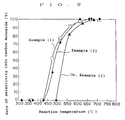
- Fig. 2 is a graph showing a rate of selectivity into carbon monoxide in the examples of the process according to the present invention, as compared with a comparative example.
- An aspect of the catalyst to be employed in the process according to the present invention contains at least one active ingredient selected from the group consisting of ruthenium and rhodium deposited on at least one carrier selected from the group consisting of zirconia and stabilized zirconia.
- Another aspect of the catalyst to be employed in the process according to the present invention contains at least one active ingredient selected from the group consisting of ruthenium and rhodium and at least one promoter selected from the group consisting of cobalt and manganese deposited on at least one carrier selected from the group consisting of zirconia and stabilized zirconia.
- the carrier to be employed for the process according to the present invention may include, for example, zirconia and stabilized zirconia.
- the carrier may be employed singly or in combination of two.
- the stabilized zirconia may be prepared by modifying and stabilizing a portion or a whole portion of zirconia with a stabilizing agent.
- the excellent characteristics inherent in the zirconia itself can be demonstrated in such a manner that reactivity with water is particularly so high that the reaction for the preparation of the synthetic gases can be facilitated, thereby suppressing carbon resulting during the reaction from depositing on the catalyst.
- the stabilized zirconia when employed as the carrier, resistance to heat, stability and mechanical strength can be further improved due to the employment of the stabilizing agent, in addition to the excellent characteristics inherent in the zirconia itself, which can be demonstrated in such a manner that reactivity with water is particularly so high that the reaction for the preparation of the synthetic gases can be facilitated and that carbon resulting during the reaction is suppressed from depositing on the catalyst.
- the stabilized zirconia even if the stabilized zirconia is employed at temperatures of higher than 500°C, it can function as a catalyst in a stable manner because the stabilized zirconia causes a small degree of a decrease in a surface area.
- the carrier may contain a metal oxide as a carrier ingredient, in addition to the zirconia and/or the stabilized zirconia, as long as such a carrier ingredient does not cause any adverse influence upon the objects of the present invention.
- the carrier may be in any form, such as in a form of finely pulverized powder, bead, pellet, plate, membrane, monolith or so on.
- the active ingredient there may be employed rhodium and ruthenium, and they are employed singly or in combination of two.
- the rate of the active ingredient to be deposited on the carrier may range usually from 0.05% to 3.0% by weight, preferably from 0.1% to 2.0% by weight.
- the catalyst to be employed for the process according to the present invention may additionally contain cobalt or manganese as a promoter, and the promoter may be employed singly or in combination of two.
- the rate of the promoter to be deposited on the carrier may range usually from 0.1% to 10.0% by weight, preferably from 0.5% to 5.0% by weight.
- the catalyst can maintain its highly catalytic activity and prolong its catalytic life.
- the rate of the promoter is outside the range as defined hereinabove, on the other hand, there is the risk that the catalyst may not act effectively because the active ingredient such as ruthenium and/or rhodium may be covered with the promoter.
- the shape of the catalyst to be employed for the process according to the present invention is not restricted to a particular one.
- the catalyst may be prepared from the carrier or a raw material for the carrier and the active ingredient or a raw material for the active ingredient or from the carrier or the raw material for the carrier, the catalyst or the raw material for the catalyst, and the promoter or a raw material for the promoter by using a conventional procedure for the preparation of catalysts, such as impregnation, immersion, wet adsorption, dry absorption, CVD method, solvent evaporation, dry mixing method, wet mixing method, spray wetting method, or the like, or a combination of these procedures, or by a conventional procedure for the deposition of active ingredients on carriers, such as standing method, stirring method, solution flowing method, solvent refluxing method, or the like.
- a conventional procedure for the preparation of catalysts such as impregnation, immersion, wet adsorption, dry absorption, CVD method, solvent evaporation, dry mixing method, wet mixing method, spray wetting method, or the like, or a combination of these procedures, or by a conventional procedure for the deposition of active ingredients on
- the raw material for the carrier there may be employed, for example, zirconium oxide, a zirconium compound capable of being converted into zirconium oxide at the time of the preparation of the catalyst or at the time of the preparation of the synthetic gases, stabilized zirconium oxide, or a mixture of zirconium oxide with a stabilizer capable of converting the zirconium oxide into the stabilized zirconia at the time of the preparation of the catalyst or at the time of the preparation of the synthetic gases.
- zirconium oxide a zirconium compound capable of being converted into zirconium oxide at the time of the preparation of the catalyst or at the time of the preparation of the synthetic gases
- stabilized zirconium oxide or a mixture of zirconium oxide with a stabilizer capable of converting the zirconium oxide into the stabilized zirconia at the time of the preparation of the catalyst or at the time of the preparation of the synthetic gases.
- zirconium compound capable of being converted into the zirconium oxide there may be employed, for example, zirconium hydroxide, a zirconium halide, zirconium nitrate, zirconyl nitrate, zirconium acetate, zirconium oxalate, a zirconium alkoxide, zirconium oxychloride, an organic zirconium compound, or the like.
- a salt among these compounds would be sparingly soluble, an acid or other compounds may be added as needed in order to solubilize it.
- the stabilizer capable of converting the zirconium oxide into the stabilized zirconia there may be employed, for example, yttrium oxide, lanthanum oxide, magnesium oxide, cerium oxide, or any other oxide that is conventionally employed for stabilizing zirconia in a variety of fields of materials.
- yttrium oxide, lanthanum oxide, magnesium oxide, cerium oxide or any other oxide that is conventionally employed for stabilizing zirconia in a variety of fields of materials.
- these stabilizers particularly yttrium oxide, magnesium oxide and cerium oxide are preferably employed.
- yttrium oxide in place of the yttrium oxide, there may be employed a substance capable of being converted into yttrium oxide at the time of the preparation of the catalyst or at the time of the preparation of the synthetic gases.
- yttrium hydroxide an yttrium halide, an yttrium oxyhalide, yttrium nitrate, yttrium carbonate, yttrium acetate, yttrium oxalate, or an yttrium alkoxide, such as yttrium trimethoxide, yttrium triethoxide, yttrium tripropoxide, yttrium triisopropoxide, yttrium tributoxide, or the like.
- the yttrium alkoxide can preferably be employed.
- magnesium oxide can be replaced with a substance capable of being converted into magnesium oxide at the time of the preparation of the catalyst or at the time of the preparation of the synthetic gases.
- magnesium hydroxide a magnesium halide, a magnesium oxyhalide, magnesium nitrate, magnesium carbonate, magnesium acetate, magnesium oxalate, a magnesium alkoxide such as magnesium methoxide, magnesium ethoxide, magnesium propoxide, magnesium isopropoxide or magnesium butoxide, or the like.
- magnesium alkoxide can be preferably employed.
- cerium oxide there may be employed a substance capable of being converted into cerium oxide at the time of the preparation of the catalyst or at the time of the preparation of the synthetic gases.
- cerium hydroxide a cerium halide, a cerium oxyhalide, cerium nitrate, cerium carbonate, cerium acetate, cerium oxalate, a cerium alkoxide such as cerium methoxide, cerium ethoxide, cerium propoxide, cerium isopropoxide or cerium butoxide, or the like.
- cerium alkoxide may be preferably employed.
- an alcohol or an acid may be employed as needed to solubilize them.
- the compounds as illustrated hereinabove may be employed singly or in combination of two or more.
- the active ingredient includes rhodium and ruthenium.
- a rhodium halide such as rhodium chloride or the like
- a halogenated rhodinate such as sodium chlororhodinate, ammoniumchlororhodinate or the like
- a halogenated rhodinic acid such as chlororhodinic acid or the like
- a rhodiumhydroxide such as rhodium (III) hydroxide, rhodium (IV) hydroxide or the like
- rhodium nitrate such as rhodium oxide
- an organic rhodium compound such as rhodium carbonyl or the like.
- ruthenium halide such as ruthenium iodide, ruthenium chloride or the like; a halogenated ruthenate such as ammonium chlororuthenate or the like; a halogenated ruthenic acid such as chloro- ruthenic acid or the like; ruthenium hydroxide; aruthenium oxide such as ruthenium dioxide, ruthenium tetroxide or the like; a ruthenate such as potassium ruthenate or the like; or an organic ruthenium compound such as ruthenium carbonyl or the like.
- ruthenium trichloride is preferably employed.
- these raw materials for the active ingredients of the catalysts may be employed singly or in combination of two or more.
- the promoter for the catalysts includes cobalt and manganese.
- the raw materials for the promoters there may be employed, for example, sulfates, nitrates, carbonates, acetates, hydroxides, oxides, basic salts, alkoxides and organic compounds of the metals.
- the raw materials for cobalt may include, for example, cobalt chloride, cobalt nitrate, cobalt sulfate, cobalt acetate, cobalt formate, cobalt oxalate, cobalt hydroxide, cobalt oxide, cobalt carbonate (basic cobalt carbonate), cobalt (II) acetylacetonate, cobalt (III) acetylacetonate and the like.
- cobalt chloride cobalt nitrate
- cobalt sulfate cobalt acetate
- cobalt formate cobalt oxalate
- cobalt hydroxide cobalt oxide
- cobalt carbonate basic cobalt carbonate
- cobalt (II) acetylacetonate cobalt (III) acetylacetonate
- cobalt nitrate is particularly preferred.
- the raw materials for magnesium may include, for example, magnesium chloride, magnesium nitrate, magnesium sulfate, magnesium acetate, magnesium formate, magnesium oxalate, magnesium hydroxide, magnesium oxide, magnesium carbonate (basic magnesium carbonate), magnesium (II) acetylacetonate, magnesium (III) acetylacetonate and the like.
- anhydrides or hydrates of these compounds may be employed.
- magnesium nitrate is particularly preferred.
- the promoters for the catalysts may be employed singly or in combination of two or more.
- the process according to the present invention involves reacting gases of raw materials in the presence of a particular catalyst.
- gases to be employed as the raw materials in the process for the preparation of the synthetic gases comprise methane gas and oxygen gas. It should be noted herein, however, that the gases are not restricted to a mixture of the gases comprising of methane gas and oxygen gas and that they may contain a mixture of methane-containing gases with oxygen-containing gases. Further, gases containing vapor or carbon dioxide may be employed for adjusting the composition of the resulting synthetic gases consisting of hydrogen and carbon monoxide.
- the methane gas may include, for example, highly purified methane and the like.
- the methane-containing gases are not restricted to particular ones and they may include, for example, city gases, natural gases and the like.
- oxygen gas there may be employed, for example, oxygen gas obtainable by the separation from nitrogen by means of PSA (Pressure Swing Absorbent) method or the like.
- the oxygen-containing gases are not restricted to particular ones and they may include, for example, air, dried air and the like.
- a molal ratio of methane to oxygen within the gases to be employed as the raw materials may range usually from 1.3 to 2.2, preferably from 1.5 to 2.0.
- the molal ratio of methane to oxygen would exceed the 2.2-to-1 ratio, the amount of the methane becomes so large that carbon becomes likely to settle.
- the molal ratio of methane to oxygen would become smaller than the 1.3-to-1 ratio, the amount of the oxygen is rendered so excessive that carbon monoxide is oxidized rather than carbon dioxide, thereby resulting in a decrease in a rate of selectivity into carbon monoxide in the synthetic gases produced.
- the reaction pressure may usually be approximately 300 kg/cm2G or lower, preferably approximately 50 kg/cm2G or smaller. If the reaction pressure would become larger than 300 kg/cm2G, high temperatures are required for carrying out the reaction.
- the reaction temperature may range usually from approximately 350 °C to 1,200 °C, preferably from approximately 450 °C to 900 °C. If the reaction temperature would become lower than 350 °C, on the one hand, the catalytic activity of the catalyst is reduced to a great extent. If the reaction temperature would become higher than 1,200°C, on the other hand, the reactor should be made of a material that can withstand such high temperatures, so that it is not practical.
- the type of reaction may be a continuous type or a batch type, although the reaction of the continuous type is preferred.
- methane and oxygen to be employed as the gases of the raw materials may be fed at a GHSV in the range of usually from 1,000 to 40,000 h ⁇ 1, preferably from 2,000 to 20,000 h ⁇ 1.
- reaction system is not restricted to a particular one as long as it does not impair the objects of the present invention, and the reaction may be carried out on a fixed bed or a fluidized bed.
- the process according to the present invention can produce the synthetic gases consisting of carbon monoxide and hydrogen at higher rates of selectivity and containing a lesser amount of by-products. Further, in this process, the catalytic activity of the catalyst can be maintained at a high level and the life of the catalyst can be kept for a longer period of time so that the reaction can be carried out without exchanging reaction systems for a long period of time. Hence, the process according to the present invention can produce the synthetic gases at cheaper costs and with higher efficiency, without causing little pollution.
- the resulting catalyst was found to contain ruthenium in the concentration of 0.5% by weight with respect to the weight of zirconium oxide.
- the resulting catalyst (1.3 grams) was granulated through #16 to #32 mesh and filled in a quartz reactor, followed by reducing the catalyst with hydrogen at 500°C over the period of 1 hour.
- the catalyst was employed for the preparation of synthetic gases at the temperatures as shown in Figs. 1 and 2 under reaction conditions, as will be described hereinafter.
- the catalyst has maintained its catalytic activity when it has been employed at 730 °C for 50 hours and that no precipitation of carbon was recognized on the catalyst when observed upon removal from the reaction system after the completion of the reaction.
- a catalyst was prepared in substantially the same manner as in Example 1(A), with the exception that 100 grams of the carrier was mixed with 300 ml of a solution of 1.1 grams of ruthenium chloride and 4.7 grams of cobalt nitrate (hexahydrate) in water. It was found that the catalyst contained ruthenium in the concentration of 0.5% by weight and cobalt in the concentration of 1.0% by weight, with respect to the weight of zirconium oxide.
- the synthetic gases were prepared by reacting the raw materials with the aid of the catalyst in substantially the same manner as in Example 1 at the temperatures as shown in Figs. 1 and 2.
- the resulting synthetic gases were evaluated in the same manner as in Example 1. The results are shown in Figs. 1 and 2.
- Example 2(A) The synthetic gases were prepared under the same reaction conditions as in Example 1(B) in substantially the same manner as in Example 2(A). The resulting synthetic gases were evaluated in the same manner as in Example 1. The results are shown in Table below.
- a catalyst was prepared in substantially the same manner as in Example 1, with the exception that ⁇ -alumina was employed as a carrier in place of the zirconium carrier and 100 grams of the alumina was mixed with 30 ml of a solution of 1.1 grams of ruthenium chloride in ethanol. It was found that the resulting catalyst contained ruthenium in the concentration of 0.5% by weight with respect to the weight of ⁇ -alumina.
- the synthetic gases were prepared using the resulting catalyst in substantially the same manner as in Example 1 at the temperatures as shown in Figs. 1 and 2.
- the resulting synthetic gases were evaluated in the same manner as in Example 1. The results are shown in Figs. 1 and 2.
- Fig. 1 shows that the catalyst used in Example 2 demonstrates its catalytic activity at the temperatures lower by 100°C or more than that used in Comparative Example 1. Likewise, it is shown that the catalyst used in Example 1 demonstrates its catalytic activity at the temperatures lower by approximately 70°C than that used in Comparative Example 1.
- Fig. 2 shows that the catalysts used in Examples 1 and 2 exhibit the rate of selectivity into carbon monoxide equal to each other and higher than that used in Comparative Example 1. Further, it is found that the temperatures at which the rate of selectivity into carbon monoxide reaches 100% in Examples 1 and 2 as well as in Comparative Example 1 are 680 °C, 630 °C and 700°C , respectively, so that the catalysts used in Examples 1 and 2 can exhibit the higher rate of selectivity into carbon monoxide at lower temperatures than that used in Comparative Example 1.
- a catalyst was prepared in substantially the same manner as in Example 2 from 5.2 grams of magnesium nitrate (hexahydrate), which in turn was employed in place of 4.7 grams of cobalt nitrate (hexahydrate). It was found that the resulting catalyst contained ruthenium in the concentration of 0.5% by weight and magnesium in the concentration of 1.0% by weight with respect to the weight of zirconium oxide.
- the resulting catalyst was granulated through #16 to #32 mesh and 1.0 gram of the catalyst having equal particle sizes was filled in a quartz reactor, followed by reducing the catalyst with hydrogen at 500 °C over the period of 1 hour.
- the catalyst was employed for the preparation of synthetic gases under reaction conditions, as will be described hereinafter.
- a catalyst was prepared in substantially the same manner as in Example 1 with the exception that 1.3 grams of rhodium chloride was employed in place of 1.1 grams of ruthenium chloride (hexahydrate). It was found that the resulting catalyst contained rhodium in the concentration of 0.5% by weight with respect to the weight of zirconium oxide.
- the synthetic gases were prepared using the resulting catalyst in substantially the same manner as in Example 3, and they were evaluated in the same manner as in Example 3. The evaluation results are shown in Table below.
- a catalyst was prepared in substantially the same manner in Example 4 with the exception that 100 grams of the carrier was mixed with 30 ml of a mixture of a solution of 1.3 grams of rhodium chloride in water with a solution of 4.7 grams of cobalt nitrate (hexahydrate) in water. It was found that the resulting catalyst contained rhodium in the concentration of 0.5% by weight and cobalt in the concentration of 1.0% by weight, with respect to the weight of zirconium oxide.
- the synthetic gases were prepared using the resulting catalyst in substantially the same manner as in Example 3, and they were evaluated in the same manner as in Example 3. The evaluation results are shown in Table below.
- a catalyst was prepared in substantially the same manner as in Example 5, with the exception that 5.2 grams of magnesium nitrate (hexahydrate) was employed in place of 4.7 grams of cobalt nitrate (hexahydrate). It was found that the resulting catalyst contained rhodium in the concentration of 0.5% by weight and magnesium in the concentration of 1.0% by weight, with respect to the weight of zirconium oxide.
- the synthetic gases were prepared using the resulting catalyst in substantially the same manner as in Example 3, and they were evaluated in the same manner as in Example 3. The evaluation results are shown in Table below.
- a catalyst was prepared in substantially the same manner as in Comparative Example 1, with the exception that 1.3 grams of rhodium chloride was employed in place of ruthenium chloride.
- the synthetic gases were prepared, using the resulting catalyst in substantially the same manner as in Example 3, and they were evaluated in the same manner as in Example 3. The evaluation results are shown in Table below.
- a catalyst was prepared by mixing 100 grams of stabilized zirconia powder of a cubic crystal system, containing 8 moles of yttrium oxide (Y2O3), with 300 ml of a solution of 1.1 grams of ruthenium chloride in water, followed by subjecting the mixture to wet kneading at 80 °C until the water contained in the mixture was allowed to evaporate to a full extent. Thereafter, the resulting kneaded product was dried at 120°C over the period of 6 hours and then calcined at 500°C over the period of 1 hour.
- Y2O3 yttrium oxide
- the synthetic gases were prepared using the resulting catalyst in substantially the same manner as in Example 3, and they were evaluated in the same manner as in Example 3. The evaluation results are shown in Table below.
Landscapes
- Chemical & Material Sciences (AREA)
- Chemical Kinetics & Catalysis (AREA)
- Organic Chemistry (AREA)
- Engineering & Computer Science (AREA)
- Combustion & Propulsion (AREA)
- Health & Medical Sciences (AREA)
- General Health & Medical Sciences (AREA)
- Inorganic Chemistry (AREA)
- Organic Low-Molecular-Weight Compounds And Preparation Thereof (AREA)
- Catalysts (AREA)
- Hydrogen, Water And Hydrids (AREA)
Applications Claiming Priority (2)
| Application Number | Priority Date | Filing Date | Title |
|---|---|---|---|
| JP33902791 | 1991-12-20 | ||
| JP339027/91 | 1991-12-20 |
Publications (1)
| Publication Number | Publication Date |
|---|---|
| EP0548679A1 true EP0548679A1 (fr) | 1993-06-30 |
Family
ID=18323581
Family Applications (1)
| Application Number | Title | Priority Date | Filing Date |
|---|---|---|---|
| EP92121013A Withdrawn EP0548679A1 (fr) | 1991-12-20 | 1992-12-09 | Procédé pour la préparation de gaz de synthèse |
Country Status (5)
| Country | Link |
|---|---|
| EP (1) | EP0548679A1 (fr) |
| AU (1) | AU661742B2 (fr) |
| CA (1) | CA2085315A1 (fr) |
| NO (1) | NO924885L (fr) |
| NZ (1) | NZ245394A (fr) |
Cited By (17)
| Publication number | Priority date | Publication date | Assignee | Title |
|---|---|---|---|---|
| GB2274284A (en) * | 1992-12-23 | 1994-07-20 | Snam Progetti | Catalytic process for producing synthesis gas |
| WO1996004200A1 (fr) * | 1994-08-02 | 1996-02-15 | Shell Internationale Research Maatschappij B.V. | Procede pour l'oxydation partielle catalytique d'hydrocarbures |
| GR1002933B (el) * | 1995-05-03 | 1998-07-07 | ����������� & ������� (���������� ���������� ������� ...) | Καταλυτης ρουθυνιου για τη μερικη οξειδωση ελαφρων υδρογονανθρακων προς αεριο συνθεσης |
| WO1998035908A1 (fr) * | 1997-02-14 | 1998-08-20 | Shell Internationale Research Maatschappij B.V. | Oxydation catalytique partielle d'hydrocarbures |
| WO1999037580A1 (fr) * | 1998-01-20 | 1999-07-29 | Shell Internationale Research Maatschappij B.V. | Catalyseur approprie a la preparation d'hydrogene et de monoxyde de carbone, a partir d'une charge hydrocarbonee |
| WO1999048805A1 (fr) * | 1998-03-24 | 1999-09-30 | Johnson Matthey Public Limited Company | Production catalytique d'hydrogene |
| EP0939672A4 (fr) * | 1997-06-02 | 2000-02-23 | Univ Chicago | Catalyseur d'oxydation partielle |
| WO2001032556A1 (fr) * | 1999-10-29 | 2001-05-10 | Exxon Research And Engineering Company | Procede d'oxydation catalytique partielle utilisant des catalyseurs sous forme de particules |
| WO2001046069A1 (fr) * | 1999-12-21 | 2001-06-28 | Shell Internationale Research Maatschappij B.V. | Procede d'oxydation catalytique partielle d'une charge d'hydrocarbure |
| EP1093852A4 (fr) * | 1998-06-09 | 2002-09-04 | Idemitsu Kosan Co | Catalyseur et procede de reformage d'hydrocarbures |
| US6458334B1 (en) | 2000-03-02 | 2002-10-01 | The Boc Group, Inc. | Catalytic partial oxidation of hydrocarbons |
| EP1134188A3 (fr) * | 2000-03-02 | 2004-06-09 | The Boc Group, Inc. | Oxydation partielle catalytique d'hydrocarbures |
| EP1591156A1 (fr) * | 2004-04-30 | 2005-11-02 | Henkel KGaA | Catalyseur et procédé pour élimination des aldehydes |
| US7066984B2 (en) | 2003-09-25 | 2006-06-27 | The Boc Group, Inc. | High recovery carbon monoxide production process |
| US7090826B2 (en) | 2002-12-23 | 2006-08-15 | The Boc Group, Inc. | Monolith based catalytic partial oxidation process for syngas production |
| US7214331B2 (en) | 2004-02-26 | 2007-05-08 | The Boc Group, Inc. | Catalyst configuration and methods for syngas production |
| US7351275B2 (en) | 2004-12-21 | 2008-04-01 | The Boc Group, Inc. | Carbon monoxide production process |
Citations (3)
| Publication number | Priority date | Publication date | Assignee | Title |
|---|---|---|---|---|
| EP0333037A2 (fr) * | 1988-03-12 | 1989-09-20 | Igarashi, Akira c/o Kohgakuin University | Procédé pour le réformage à la vapeur d'hydrocarbures |
| EP0406896A1 (fr) * | 1989-07-07 | 1991-01-09 | Idemitsu Kosan Company Limited | Catalyseur de reformage à la vapeur d'hydrocarbure |
| GB2239406A (en) * | 1989-08-25 | 1991-07-03 | Gas Res Inst | Catalytic gas conversion method |
-
1992
- 1992-12-07 NZ NZ245394A patent/NZ245394A/en unknown
- 1992-12-09 AU AU30020/92A patent/AU661742B2/en not_active Expired - Fee Related
- 1992-12-09 EP EP92121013A patent/EP0548679A1/fr not_active Withdrawn
- 1992-12-14 CA CA002085315A patent/CA2085315A1/fr not_active Abandoned
- 1992-12-17 NO NO92924885A patent/NO924885L/no unknown
Patent Citations (3)
| Publication number | Priority date | Publication date | Assignee | Title |
|---|---|---|---|---|
| EP0333037A2 (fr) * | 1988-03-12 | 1989-09-20 | Igarashi, Akira c/o Kohgakuin University | Procédé pour le réformage à la vapeur d'hydrocarbures |
| EP0406896A1 (fr) * | 1989-07-07 | 1991-01-09 | Idemitsu Kosan Company Limited | Catalyseur de reformage à la vapeur d'hydrocarbure |
| GB2239406A (en) * | 1989-08-25 | 1991-07-03 | Gas Res Inst | Catalytic gas conversion method |
Non-Patent Citations (1)
| Title |
|---|
| NATURE, vol. 344, March 22, 1990 A.T. ASHCROFT et al. "Selec- tive oxidation of methane to synthesis gas using transi- tion metal catalysts" pages 319-321 * |
Cited By (29)
| Publication number | Priority date | Publication date | Assignee | Title |
|---|---|---|---|---|
| GB2274284B (en) * | 1992-12-23 | 1996-08-07 | Snam Progetti | Catalytic process for producing synthesis gas |
| GB2274284A (en) * | 1992-12-23 | 1994-07-20 | Snam Progetti | Catalytic process for producing synthesis gas |
| CN1056585C (zh) * | 1994-08-02 | 2000-09-20 | 国际壳牌研究有限公司 | 烃类催化部分氧化方法 |
| WO1996004200A1 (fr) * | 1994-08-02 | 1996-02-15 | Shell Internationale Research Maatschappij B.V. | Procede pour l'oxydation partielle catalytique d'hydrocarbures |
| US5639401A (en) * | 1994-08-02 | 1997-06-17 | Shell Oil Company | Process for the catalytic partial oxidation of hydrocarbons |
| AU693245B2 (en) * | 1994-08-02 | 1998-06-25 | Shell Internationale Research Maatschappij B.V. | Process for the catalytic partial oxidation of hydrocarbons |
| RU2154015C2 (ru) * | 1994-08-02 | 2000-08-10 | Шелл Интернэшнл Рисерч Маатсхаппий Б.В. | Способ неполного каталитического окисления углеводородов |
| GR1002933B (el) * | 1995-05-03 | 1998-07-07 | ����������� & ������� (���������� ���������� ������� ...) | Καταλυτης ρουθυνιου για τη μερικη οξειδωση ελαφρων υδρογονανθρακων προς αεριο συνθεσης |
| WO1998035908A1 (fr) * | 1997-02-14 | 1998-08-20 | Shell Internationale Research Maatschappij B.V. | Oxydation catalytique partielle d'hydrocarbures |
| EP0939672A4 (fr) * | 1997-06-02 | 2000-02-23 | Univ Chicago | Catalyseur d'oxydation partielle |
| US6110861A (en) * | 1997-06-02 | 2000-08-29 | The University Of Chicago | Partial oxidation catalyst |
| WO1999037580A1 (fr) * | 1998-01-20 | 1999-07-29 | Shell Internationale Research Maatschappij B.V. | Catalyseur approprie a la preparation d'hydrogene et de monoxyde de carbone, a partir d'une charge hydrocarbonee |
| US6887455B2 (en) | 1998-03-24 | 2005-05-03 | Johnson Matthey Public Limited Company | Catalytic generation of hydrogen |
| WO1999048805A1 (fr) * | 1998-03-24 | 1999-09-30 | Johnson Matthey Public Limited Company | Production catalytique d'hydrogene |
| KR100600218B1 (ko) * | 1998-06-09 | 2006-07-13 | 이데미쓰 고산 가부시키가이샤 | 탄화수소 개질용 촉매 및 탄화수소의 개질방법 |
| EP1093852A4 (fr) * | 1998-06-09 | 2002-09-04 | Idemitsu Kosan Co | Catalyseur et procede de reformage d'hydrocarbures |
| EP1481729A1 (fr) * | 1998-06-09 | 2004-12-01 | Idemitsu Kosan Company Limited | Procédé autothermique de réformage à la vapeur d'une charge d'hydrocabures |
| US6749828B1 (en) | 1998-06-09 | 2004-06-15 | Idemitsu Kosan Corp Ltd. | Process for reforming hydrocarbon |
| WO2001032556A1 (fr) * | 1999-10-29 | 2001-05-10 | Exxon Research And Engineering Company | Procede d'oxydation catalytique partielle utilisant des catalyseurs sous forme de particules |
| WO2001046069A1 (fr) * | 1999-12-21 | 2001-06-28 | Shell Internationale Research Maatschappij B.V. | Procede d'oxydation catalytique partielle d'une charge d'hydrocarbure |
| EP1134188A3 (fr) * | 2000-03-02 | 2004-06-09 | The Boc Group, Inc. | Oxydation partielle catalytique d'hydrocarbures |
| US6551959B2 (en) | 2000-03-02 | 2003-04-22 | The Boc Group, Inc. | Catalytic monolith substrate made of ceria and titania |
| US6458334B1 (en) | 2000-03-02 | 2002-10-01 | The Boc Group, Inc. | Catalytic partial oxidation of hydrocarbons |
| US7090826B2 (en) | 2002-12-23 | 2006-08-15 | The Boc Group, Inc. | Monolith based catalytic partial oxidation process for syngas production |
| US7066984B2 (en) | 2003-09-25 | 2006-06-27 | The Boc Group, Inc. | High recovery carbon monoxide production process |
| US7214331B2 (en) | 2004-02-26 | 2007-05-08 | The Boc Group, Inc. | Catalyst configuration and methods for syngas production |
| EP1591156A1 (fr) * | 2004-04-30 | 2005-11-02 | Henkel KGaA | Catalyseur et procédé pour élimination des aldehydes |
| WO2005105270A1 (fr) * | 2004-04-30 | 2005-11-10 | Henkel Kommanditgesellschaft Auf Aktien | Catalyseurs et procede d'elimination d'aldehydes |
| US7351275B2 (en) | 2004-12-21 | 2008-04-01 | The Boc Group, Inc. | Carbon monoxide production process |
Also Published As
| Publication number | Publication date |
|---|---|
| NZ245394A (en) | 1995-03-28 |
| AU661742B2 (en) | 1995-08-03 |
| NO924885D0 (no) | 1992-12-17 |
| CA2085315A1 (fr) | 1993-06-21 |
| NO924885L (no) | 1993-06-21 |
| AU3002092A (en) | 1993-07-01 |
Similar Documents
| Publication | Publication Date | Title |
|---|---|---|
| EP0406896B1 (fr) | Catalyseur de reformage à la vapeur d'hydrocarbure | |
| EP0548679A1 (fr) | Procédé pour la préparation de gaz de synthèse | |
| CA1333278C (fr) | Catalyseur pour le reformage a la vapeur d'hydrocarbures | |
| US5254520A (en) | Catalyst for the synthesis of methanol | |
| US4565803A (en) | Methanol synthesis catalyst | |
| EP0938446B1 (fr) | Procede de reformage d'hydrocarbures et catalyseur et precurseur de catalyseur associes | |
| US4778827A (en) | Catalytic system and process for producing a mixture of methanol and higher alcohols | |
| US5703133A (en) | Isoalcohol synthesis | |
| US5118715A (en) | Selective fixed-bed fischer-tropsch synthesis with high surface area Cu and K promoted, iron/manganese spinels | |
| CA1321604C (fr) | Procede catalytique pour la production d'alcools a partir du monoxyde de carbone, de l'hydrogene et d'olefines | |
| US5387570A (en) | Catalysts for iso-alcohol synthesis from CO + H2 | |
| SE427269B (sv) | Forfarande for framstellning av dimetyleter genom omsettning av co och h?712 i nervaro av en katalysator, som stabiliserats med kiselforeningar | |
| EP0216472A1 (fr) | Procédé de conversion de gaz de synthèse en présence de sulfures résistant à l'attrition | |
| US3404100A (en) | Methane production using a promoted catalyst | |
| US4863971A (en) | Synthesis gas conversion with perovskite catalysts | |
| US4624942A (en) | Iron on mixed zirconia-titania substrate Fischer-Tropsch catalyst and method of making same | |
| US4605639A (en) | Methods for making a supported iron-copper catalyst | |
| AU595853B2 (en) | Improved syngas conversion catalyst, production and use thereof | |
| US4168276A (en) | Methanation | |
| KR101783647B1 (ko) | 메탄의 복합 개질반응용 니켈계 촉매 | |
| US5082977A (en) | Aldehydes by olefin hydroformylation | |
| US4238371A (en) | Methanation catalyst | |
| US5767166A (en) | Process for producing mixtures of methanol and higher alcohols | |
| US5118891A (en) | Syngas conversion catalyst, production and use thereof | |
| JPH03109942A (ja) | 炭化水素の水蒸気改質用触媒 |
Legal Events
| Date | Code | Title | Description |
|---|---|---|---|
| PUAI | Public reference made under article 153(3) epc to a published international application that has entered the european phase |
Free format text: ORIGINAL CODE: 0009012 |
|
| 17P | Request for examination filed |
Effective date: 19921209 |
|
| AK | Designated contracting states |
Kind code of ref document: A1 Designated state(s): DE DK FR GB IT NL |
|
| 17Q | First examination report despatched |
Effective date: 19950505 |
|
| STAA | Information on the status of an ep patent application or granted ep patent |
Free format text: STATUS: THE APPLICATION IS DEEMED TO BE WITHDRAWN |
|
| 18D | Application deemed to be withdrawn |
Effective date: 19950918 |